EP0724154A1 - Electrophorèse avec des tampons de faible conductivité - Google Patents
Electrophorèse avec des tampons de faible conductivité Download PDFInfo
- Publication number
- EP0724154A1 EP0724154A1 EP95306280A EP95306280A EP0724154A1 EP 0724154 A1 EP0724154 A1 EP 0724154A1 EP 95306280 A EP95306280 A EP 95306280A EP 95306280 A EP95306280 A EP 95306280A EP 0724154 A1 EP0724154 A1 EP 0724154A1
- Authority
- EP
- European Patent Office
- Prior art keywords
- buffering
- molecular weight
- ampholyte
- buffer solution
- accordance
- Prior art date
- Legal status (The legal status is an assumption and is not a legal conclusion. Google has not performed a legal analysis and makes no representation as to the accuracy of the status listed.)
- Withdrawn
Links
- 239000000872 buffer Substances 0.000 title claims abstract description 94
- 238000001962 electrophoresis Methods 0.000 title abstract description 43
- 238000000926 separation method Methods 0.000 claims abstract description 24
- 230000003139 buffering effect Effects 0.000 claims abstract description 18
- 239000006172 buffering agent Substances 0.000 claims abstract description 12
- 230000002378 acidificating effect Effects 0.000 claims abstract description 7
- -1 polyoxyethylene Polymers 0.000 claims description 36
- 239000000203 mixture Substances 0.000 claims description 30
- 229920003171 Poly (ethylene oxide) Polymers 0.000 claims description 18
- 239000007853 buffer solution Substances 0.000 claims description 17
- 238000000034 method Methods 0.000 claims description 14
- 239000000243 solution Substances 0.000 claims description 11
- 238000001155 isoelectric focusing Methods 0.000 claims description 7
- KDXKERNSBIXSRK-UHFFFAOYSA-N Lysine Natural products NCCCCC(N)C(O)=O KDXKERNSBIXSRK-UHFFFAOYSA-N 0.000 claims description 6
- 239000004472 Lysine Substances 0.000 claims description 6
- 150000001412 amines Chemical group 0.000 claims description 3
- PNCLCMCDRWQJSM-UHFFFAOYSA-N 2-[carboxymethyl(cyclohexyl)amino]acetic acid Chemical compound OC(=O)CN(CC(O)=O)C1CCCCC1 PNCLCMCDRWQJSM-UHFFFAOYSA-N 0.000 claims description 2
- FRYULLIZUDQONW-UHFFFAOYSA-N Aspartyl-Aspartate Chemical compound OC(=O)CC(N)C(=O)NC(CC(O)=O)C(O)=O FRYULLIZUDQONW-UHFFFAOYSA-N 0.000 claims description 2
- SCCPDJAQCXWPTF-VKHMYHEASA-N Gly-Asp Chemical compound NCC(=O)N[C@H](C(O)=O)CC(O)=O SCCPDJAQCXWPTF-VKHMYHEASA-N 0.000 claims description 2
- YIWFXZNIBQBFHR-LURJTMIESA-N Gly-His Chemical compound [NH3+]CC(=O)N[C@H](C([O-])=O)CC1=CN=CN1 YIWFXZNIBQBFHR-LURJTMIESA-N 0.000 claims description 2
- LCWXJXMHJVIJFK-UHFFFAOYSA-N Hydroxylysine Natural products NCC(O)CC(N)CC(O)=O LCWXJXMHJVIJFK-UHFFFAOYSA-N 0.000 claims description 2
- KDXKERNSBIXSRK-YFKPBYRVSA-N L-lysine Chemical compound NCCCC[C@H](N)C(O)=O KDXKERNSBIXSRK-YFKPBYRVSA-N 0.000 claims description 2
- 108010040443 aspartyl-aspartic acid Proteins 0.000 claims description 2
- 125000005619 boric acid group Chemical group 0.000 claims description 2
- YSMODUONRAFBET-UHFFFAOYSA-N delta-DL-hydroxylysine Natural products NCC(O)CCC(N)C(O)=O YSMODUONRAFBET-UHFFFAOYSA-N 0.000 claims description 2
- 108010009297 diglycyl-histidine Proteins 0.000 claims description 2
- YSMODUONRAFBET-UHNVWZDZSA-N erythro-5-hydroxy-L-lysine Chemical compound NC[C@H](O)CC[C@H](N)C(O)=O YSMODUONRAFBET-UHNVWZDZSA-N 0.000 claims description 2
- 108010039216 glycylaspartic acid Proteins 0.000 claims description 2
- 108010020688 glycylhistidine Proteins 0.000 claims description 2
- QJHBJHUKURJDLG-UHFFFAOYSA-N hydroxy-L-lysine Natural products NCCCCC(NO)C(O)=O QJHBJHUKURJDLG-UHFFFAOYSA-N 0.000 claims description 2
- 229920006395 saturated elastomer Polymers 0.000 claims description 2
- LYCAIKOWRPUZTN-UHFFFAOYSA-N Ethylene glycol Chemical compound OCCO LYCAIKOWRPUZTN-UHFFFAOYSA-N 0.000 claims 2
- PDAWDNVHMUKWJR-ZETCQYMHSA-N Gly-Gly-His Chemical compound NCC(=O)NCC(=O)N[C@H](C(O)=O)CC1=CNC=N1 PDAWDNVHMUKWJR-ZETCQYMHSA-N 0.000 claims 1
- WGCNASOHLSPBMP-UHFFFAOYSA-N hydroxyacetaldehyde Natural products OCC=O WGCNASOHLSPBMP-UHFFFAOYSA-N 0.000 claims 1
- 239000000959 ampholyte mixture Substances 0.000 abstract description 8
- 238000005251 capillar electrophoresis Methods 0.000 abstract description 7
- 238000004458 analytical method Methods 0.000 description 12
- 102000004169 proteins and genes Human genes 0.000 description 10
- 108090000623 proteins and genes Proteins 0.000 description 10
- 230000005012 migration Effects 0.000 description 9
- 238000013508 migration Methods 0.000 description 9
- UXFQFBNBSPQBJW-UHFFFAOYSA-N 2-amino-2-methylpropane-1,3-diol Chemical compound OCC(N)(C)CO UXFQFBNBSPQBJW-UHFFFAOYSA-N 0.000 description 7
- QTBSBXVTEAMEQO-UHFFFAOYSA-N Acetic acid Chemical compound CC(O)=O QTBSBXVTEAMEQO-UHFFFAOYSA-N 0.000 description 7
- 239000000126 substance Substances 0.000 description 7
- GMKMEZVLHJARHF-UHFFFAOYSA-N (2R,6R)-form-2.6-Diaminoheptanedioic acid Natural products OC(=O)C(N)CCCC(N)C(O)=O GMKMEZVLHJARHF-UHFFFAOYSA-N 0.000 description 6
- FJKROLUGYXJWQN-UHFFFAOYSA-N 4-hydroxybenzoic acid Chemical compound OC(=O)C1=CC=C(O)C=C1 FJKROLUGYXJWQN-UHFFFAOYSA-N 0.000 description 6
- GMKMEZVLHJARHF-SYDPRGILSA-N meso-2,6-diaminopimelic acid Chemical compound [O-]C(=O)[C@@H]([NH3+])CCC[C@@H]([NH3+])C([O-])=O GMKMEZVLHJARHF-SYDPRGILSA-N 0.000 description 6
- 230000037230 mobility Effects 0.000 description 6
- XNSAINXGIQZQOO-SRVKXCTJSA-N protirelin Chemical compound NC(=O)[C@@H]1CCCN1C(=O)[C@@H](NC(=O)[C@H]1NC(=O)CC1)CC1=CN=CN1 XNSAINXGIQZQOO-SRVKXCTJSA-N 0.000 description 6
- 101000766306 Homo sapiens Serotransferrin Proteins 0.000 description 5
- 230000007423 decrease Effects 0.000 description 5
- 238000002474 experimental method Methods 0.000 description 5
- 241000283073 Equus caballus Species 0.000 description 4
- 102000008100 Human Serum Albumin Human genes 0.000 description 4
- 108091006905 Human Serum Albumin Proteins 0.000 description 4
- 102000036675 Myoglobin Human genes 0.000 description 4
- 108010062374 Myoglobin Proteins 0.000 description 4
- 230000008901 benefit Effects 0.000 description 4
- 150000001875 compounds Chemical class 0.000 description 4
- 238000001514 detection method Methods 0.000 description 4
- 239000000499 gel Substances 0.000 description 4
- 229920002521 macromolecule Polymers 0.000 description 4
- NBIIXXVUZAFLBC-UHFFFAOYSA-K phosphate Chemical compound [O-]P([O-])([O-])=O NBIIXXVUZAFLBC-UHFFFAOYSA-K 0.000 description 4
- 229920000642 polymer Polymers 0.000 description 4
- 238000001228 spectrum Methods 0.000 description 4
- 229940090248 4-hydroxybenzoic acid Drugs 0.000 description 3
- 102000003846 Carbonic anhydrases Human genes 0.000 description 3
- 108090000209 Carbonic anhydrases Proteins 0.000 description 3
- 230000009102 absorption Effects 0.000 description 3
- 238000010521 absorption reaction Methods 0.000 description 3
- WPYMKLBDIGXBTP-UHFFFAOYSA-N benzoic acid Chemical compound OC(=O)C1=CC=CC=C1 WPYMKLBDIGXBTP-UHFFFAOYSA-N 0.000 description 3
- KGBXLFKZBHKPEV-UHFFFAOYSA-N boric acid Chemical compound OB(O)O KGBXLFKZBHKPEV-UHFFFAOYSA-N 0.000 description 3
- 238000005194 fractionation Methods 0.000 description 3
- 239000000463 material Substances 0.000 description 3
- 241000894007 species Species 0.000 description 3
- WKOLLVMJNQIZCI-UHFFFAOYSA-N vanillic acid Chemical compound COC1=CC(C(O)=O)=CC=C1O WKOLLVMJNQIZCI-UHFFFAOYSA-N 0.000 description 3
- TUUBOHWZSQXCSW-UHFFFAOYSA-N vanillic acid Natural products COC1=CC(O)=CC(C(O)=O)=C1 TUUBOHWZSQXCSW-UHFFFAOYSA-N 0.000 description 3
- XLYOFNOQVPJJNP-UHFFFAOYSA-N water Chemical compound O XLYOFNOQVPJJNP-UHFFFAOYSA-N 0.000 description 3
- BTBUEUYNUDRHOZ-UHFFFAOYSA-N Borate Chemical compound [O-]B([O-])[O-] BTBUEUYNUDRHOZ-UHFFFAOYSA-N 0.000 description 2
- 241000283690 Bos taurus Species 0.000 description 2
- 108010026206 Conalbumin Proteins 0.000 description 2
- 101000609762 Gallus gallus Ovalbumin Proteins 0.000 description 2
- 235000010469 Glycine max Nutrition 0.000 description 2
- 244000068988 Glycine max Species 0.000 description 2
- 102000008192 Lactoglobulins Human genes 0.000 description 2
- 108010060630 Lactoglobulins Proteins 0.000 description 2
- 229920002873 Polyethylenimine Polymers 0.000 description 2
- VYPSYNLAJGMNEJ-UHFFFAOYSA-N Silicium dioxide Chemical compound O=[Si]=O VYPSYNLAJGMNEJ-UHFFFAOYSA-N 0.000 description 2
- 239000007983 Tris buffer Substances 0.000 description 2
- 101710162629 Trypsin inhibitor Proteins 0.000 description 2
- 229940122618 Trypsin inhibitor Drugs 0.000 description 2
- 238000000862 absorption spectrum Methods 0.000 description 2
- 239000002253 acid Substances 0.000 description 2
- 125000003277 amino group Chemical group 0.000 description 2
- ROOXNKNUYICQNP-UHFFFAOYSA-N ammonium persulfate Chemical compound [NH4+].[NH4+].[O-]S(=O)(=O)OOS([O-])(=O)=O ROOXNKNUYICQNP-UHFFFAOYSA-N 0.000 description 2
- 238000006243 chemical reaction Methods 0.000 description 2
- 238000001212 derivatisation Methods 0.000 description 2
- 239000005350 fused silica glass Substances 0.000 description 2
- 230000035945 sensitivity Effects 0.000 description 2
- 150000003384 small molecules Chemical class 0.000 description 2
- 238000001179 sorption measurement Methods 0.000 description 2
- LENZDBCJOHFCAS-UHFFFAOYSA-N tris Chemical compound OCC(N)(CO)CO LENZDBCJOHFCAS-UHFFFAOYSA-N 0.000 description 2
- 239000002753 trypsin inhibitor Substances 0.000 description 2
- 238000002211 ultraviolet spectrum Methods 0.000 description 2
- FOLCGNMPUKNAMA-UHFFFAOYSA-N 1-[bis(carboxymethyl)amino]cyclohexane-1-carboxylic acid Chemical compound OC(=O)CN(CC(O)=O)C1(C(O)=O)CCCCC1 FOLCGNMPUKNAMA-UHFFFAOYSA-N 0.000 description 1
- SMZOUWXMTYCWNB-UHFFFAOYSA-N 2-(2-methoxy-5-methylphenyl)ethanamine Chemical compound COC1=CC=C(C)C=C1CCN SMZOUWXMTYCWNB-UHFFFAOYSA-N 0.000 description 1
- NIXOWILDQLNWCW-UHFFFAOYSA-N 2-Propenoic acid Natural products OC(=O)C=C NIXOWILDQLNWCW-UHFFFAOYSA-N 0.000 description 1
- PDAWDNVHMUKWJR-UHFFFAOYSA-N 2-[[2-[(2-azaniumylacetyl)amino]acetyl]amino]-3-(1h-imidazol-5-yl)propanoate Chemical compound NCC(=O)NCC(=O)NC(C(O)=O)CC1=CN=CN1 PDAWDNVHMUKWJR-UHFFFAOYSA-N 0.000 description 1
- QKNYBSVHEMOAJP-UHFFFAOYSA-N 2-amino-2-(hydroxymethyl)propane-1,3-diol;hydron;chloride Chemical compound Cl.OCC(N)(CO)CO QKNYBSVHEMOAJP-UHFFFAOYSA-N 0.000 description 1
- 229940058020 2-amino-2-methyl-1-propanol Drugs 0.000 description 1
- VIBOGIYPPWLDTI-UHFFFAOYSA-N 2-naphthylacetic acid Chemical compound C1=CC=CC2=CC(CC(=O)O)=CC=C21 VIBOGIYPPWLDTI-UHFFFAOYSA-N 0.000 description 1
- YFICSDVNKFLZRQ-UHFFFAOYSA-N 3-trimethylsilylpropyl 2-methylprop-2-enoate Chemical compound CC(=C)C(=O)OCCC[Si](C)(C)C YFICSDVNKFLZRQ-UHFFFAOYSA-N 0.000 description 1
- HRPVXLWXLXDGHG-UHFFFAOYSA-N Acrylamide Chemical compound NC(=O)C=C HRPVXLWXLXDGHG-UHFFFAOYSA-N 0.000 description 1
- 229920000936 Agarose Polymers 0.000 description 1
- 239000005711 Benzoic acid Substances 0.000 description 1
- FBPFZTCFMRRESA-FSIIMWSLSA-N D-Glucitol Natural products OC[C@H](O)[C@H](O)[C@@H](O)[C@H](O)CO FBPFZTCFMRRESA-FSIIMWSLSA-N 0.000 description 1
- 102000004190 Enzymes Human genes 0.000 description 1
- 108090000790 Enzymes Proteins 0.000 description 1
- KWYHDKDOAIKMQN-UHFFFAOYSA-N N,N,N',N'-tetramethylethylenediamine Chemical compound CN(C)CCN(C)C KWYHDKDOAIKMQN-UHFFFAOYSA-N 0.000 description 1
- QNJHYRQIDFSQDO-UHFFFAOYSA-N NC(C(=O)O)CCCC(C(=O)O)N.NC(CO)(CO)C Chemical compound NC(C(=O)O)CCCC(C(=O)O)N.NC(CO)(CO)C QNJHYRQIDFSQDO-UHFFFAOYSA-N 0.000 description 1
- 229910019142 PO4 Inorganic materials 0.000 description 1
- 102000004338 Transferrin Human genes 0.000 description 1
- 238000002835 absorbance Methods 0.000 description 1
- CBTVGIZVANVGBH-UHFFFAOYSA-N aminomethyl propanol Chemical compound CC(C)(N)CO CBTVGIZVANVGBH-UHFFFAOYSA-N 0.000 description 1
- 229910001870 ammonium persulfate Inorganic materials 0.000 description 1
- 238000005349 anion exchange Methods 0.000 description 1
- 235000010233 benzoic acid Nutrition 0.000 description 1
- 229960000182 blood factors Drugs 0.000 description 1
- 229910021538 borax Inorganic materials 0.000 description 1
- 239000004327 boric acid Substances 0.000 description 1
- ZADPBFCGQRWHPN-UHFFFAOYSA-N boronic acid Chemical compound OBO ZADPBFCGQRWHPN-UHFFFAOYSA-N 0.000 description 1
- 239000008231 carbon dioxide-free water Substances 0.000 description 1
- 230000008859 change Effects 0.000 description 1
- 239000003795 chemical substances by application Substances 0.000 description 1
- 230000001268 conjugating effect Effects 0.000 description 1
- 238000005859 coupling reaction Methods 0.000 description 1
- 230000003247 decreasing effect Effects 0.000 description 1
- 230000001419 dependent effect Effects 0.000 description 1
- 238000011161 development Methods 0.000 description 1
- 230000005684 electric field Effects 0.000 description 1
- 238000005370 electroosmosis Methods 0.000 description 1
- 150000002334 glycols Chemical class 0.000 description 1
- 238000010438 heat treatment Methods 0.000 description 1
- 230000006872 improvement Effects 0.000 description 1
- 230000003993 interaction Effects 0.000 description 1
- 230000031700 light absorption Effects 0.000 description 1
- 238000005259 measurement Methods 0.000 description 1
- 150000007523 nucleic acids Chemical class 0.000 description 1
- 102000039446 nucleic acids Human genes 0.000 description 1
- 108020004707 nucleic acids Proteins 0.000 description 1
- 239000010452 phosphate Substances 0.000 description 1
- 229920002401 polyacrylamide Polymers 0.000 description 1
- 229920001184 polypeptide Polymers 0.000 description 1
- 108090000765 processed proteins & peptides Proteins 0.000 description 1
- 102000004196 processed proteins & peptides Human genes 0.000 description 1
- 238000011084 recovery Methods 0.000 description 1
- 239000012146 running buffer Substances 0.000 description 1
- 150000003839 salts Chemical group 0.000 description 1
- 239000001488 sodium phosphate Substances 0.000 description 1
- 229910000162 sodium phosphate Inorganic materials 0.000 description 1
- 235000010339 sodium tetraborate Nutrition 0.000 description 1
- 239000000600 sorbitol Substances 0.000 description 1
- 230000002194 synthesizing effect Effects 0.000 description 1
- 238000012360 testing method Methods 0.000 description 1
- 239000012581 transferrin Substances 0.000 description 1
- BSVBQGMMJUBVOD-UHFFFAOYSA-N trisodium borate Chemical compound [Na+].[Na+].[Na+].[O-]B([O-])[O-] BSVBQGMMJUBVOD-UHFFFAOYSA-N 0.000 description 1
- RYFMWSXOAZQYPI-UHFFFAOYSA-K trisodium phosphate Chemical compound [Na+].[Na+].[Na+].[O-]P([O-])([O-])=O RYFMWSXOAZQYPI-UHFFFAOYSA-K 0.000 description 1
Images



Classifications
-
- G—PHYSICS
- G01—MEASURING; TESTING
- G01N—INVESTIGATING OR ANALYSING MATERIALS BY DETERMINING THEIR CHEMICAL OR PHYSICAL PROPERTIES
- G01N27/00—Investigating or analysing materials by the use of electric, electrochemical, or magnetic means
- G01N27/26—Investigating or analysing materials by the use of electric, electrochemical, or magnetic means by investigating electrochemical variables; by using electrolysis or electrophoresis
- G01N27/416—Systems
- G01N27/447—Systems using electrophoresis
- G01N27/44704—Details; Accessories
- G01N27/44747—Composition of gel or of carrier mixture
Definitions
- This invention lies in the field of capillary electrophoresis.
- electrophoresis One of the most widely used analytical techniques is electrophoresis, owing to its versatility and its ability to separate and identify the components of complex chemical and biochemical mixtures.
- the variety of different forms of electrophoresis which are now in use has extended the applicability of the method to analyses of many different types of molecules, ranging from simple organic molecules to macromolecules such as polypeptides, enzymes, blood factors and other biological compounds, and nucleic acids.
- capillary electrophoresis has further extended the usefulness of the method by permitting analyses to be performed on extremely small samples, and by permitting the electrophoretic media to tolerate high voltages and thereby achieve even shorter separation times and more complex separations.
- Electrophoresis is commonly performed in capillaries at voltages of 100-300 V/cm without thermally induced zone deformation which can cause a significant loss of resolution. In electrophoresis cells other than capillaries, typical voltages are 10-100 V/cm.
- electrophoresis can be performed in buffers of low electrical conductivity and yet achieve high resolution.
- electrophoresis can be performed at high field strengths while experiencing less of the difficulties encountered with conventional buffers, and one of the discoveries giving rise to this invention is that low conductivity buffers permit one to increase the field strength well beyond levels typically used for capillary electrophoresis without a loss in resolution.
- This invention is applicable to electrophoresis in general, but is of particular interest in capillary electrophoresis, where the highest field strengths are typically used.
- the invention further resides in the use of various classes of buffering agents which offer low conductivity while maintaining their effectiveness as buffers. These classes are as follows:
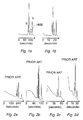
- FIGS. 1a and 1b are detector traces of electrophoretic separations of a mixture of low molecular weight compounds performed at two different voltages. Both separations were performed in a capillary filled with a mixture of polyoxyethylene bis(3-amino-2-hydroxypropyl) and polyoxyethylene bis(acetic acid) as the buffer.
- FIGS. 2a , 2b , 2c and 2d are detector traces of electrophoretic separations performed with buffers of the prior art, at varying voltages.
- the sample and capillary were the same as those used in the traces of FIGS. 1a and 1b .
- FIGS. 3a and 3b are detector traces of electrophoretic separations of a mixture of macromolecules at two different voltages, using the same buffer as FIGS. 1a and 1b .
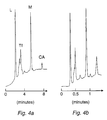
- FIGS. 4a and 4b are detector traces of electrophoretic separations of a further mixture of macromolecules at two different voltages, using the same buffer as FIGS. 1a and 1b .
- FIGS. 5a and 5b are detector traces of electrophoretic separations of the sample mixture used in FIGS. 1a and 1b at two different voltages, using a mixture of diaminopimelic acid and 2-amino-2-methyl-1,3-propanediol as the buffer.
- FIGS. 6a , 6b , 6c and 6d are detector traces of electrophoretic separations of a mixture of proteins at four different voltages, using a fraction of an isoelectrically focused carrier ampholyte as the buffer.
- FIGS. 7a , 7b , 7c and 7d are detector traces of electrophoretic separations of a mixture of proteins at four different voltages, using lysine as the buffer.
- FIG. 8 is a plot of migration velocities of various solutes in the buffer consisting of a mixture of polyoxyethylene bis(3-amino-2-hydroxypropyl) and polyoxyethylene bis(acetic acid), as a function of field strength.
- FIG. 9 are ultraviolet absorption spectra of the buffers used in the preceding figures and the prior art buffers.
- This invention has applicability to all types of electrophoresis, in cells of all forms and shapes, notably capillaries, slabs, and tubes.
- capillaries the separation medium is most often the buffer solution itself, whereas in slab cells, tube cells and gel-filled capillaries, the separation medium is a gel equilibrated and saturated with the buffer solution.
- Buffer solutions for use in accordance with this invention are characterized at least in part by a conductivity low enough to permit the use of voltages well in excess of the typical voltages used for capillary electrophoresis, without substantial loss in peak resolution. While the conductivity can vary depending on how fast a separation is desired and therefore how high a voltage is needed, best results in most cases will be obtained with conductivities in the range of 25 ⁇ 10 -5 ohm -1 cm -1 or less.
- the conductivities are within the range of about 1 ⁇ 10 -5 ohm -1 cm -1 to about 20 ⁇ 10 -5 ohm -1 cm -1 , and in particularly preferred embodiments, the conductivities are within the range of about 2 ⁇ 10 -5 ohm -1 cm -1 to about 10 ⁇ 10 -5 ohm -1 cm -1 . All such conductivities are as determined by Equation (2) above.
- the benefits of this invention are achieved at voltages above the normal range for the particular type of electrophoretic cell.
- the invention offers benefits at voltages of about 300 volts per cm (along the distance of the direction of the voltage).
- preferred voltages for the practice of this invention are in the range of about 600 volts per cm of capillary length or greater. More preferred are voltages of at least about 750 volts per cm of column length, and the most preferred are those of at least about 2,000 volts per cm of column length.
- Equation (2) indicates that the conductivity of the buffer solution for a separation performed in a capillary is readily determined by measuring the current across the capillary. The current in turn is controlled by selection of the buffering agent.
- buffering agents which meet the characteristics of the invention are listed above. Each will now be discussed in detail.
- These buffers achieve a low conductivity by virtue of their small number of charged groups per molecule.
- the number is preferably in the range of one to four (all ranges in this specification are inclusive of their upper and lower limits), more preferably one to three, and most preferably two.
- the molecular weights of these agents are preferably about 100 or higher, more preferably about 2,000 or higher, and most preferably about 2,500 to about 5,000. For polymers, these molecular weight ranges refer to weight-averaged molecular weights.
- the buffering agents may consist of a single species or a combination of two or more species, to provide both acidic and basic buffering groups.
- the molecular weight ranges cited above refer to the molecular weights which are weight-averaged between the species, as well as within any single species which has an inherent molecular weight range.
- An example of a buffering agent with a molecular weight below 2,000 is a mixture of diaminopimelic acid with pK 3 of 8.8 and 2-amino-2-methyl-1,3-propanediol with pK of 8.4.
- buffering agents with molecular weights of about 2,000 and above are derivatized polyoxyethylenes with one to three, and preferably two, charged buffering groups per molecule.
- the derivatized polyoxyethylenes may be used in combinations, such as for example one containing two basic buffering groups per molecule and a second containing two acidic buffering groups per molecule.
- One example of such a combination is a mixture of polyoxyethylene bis(3-amino-2-hydroxypropyl) and polyoxyethylene bis(acetic acid) with pK values of approximately 9 and 5, respectively.
- Carrier ampholytes are well known among biochemists who use electrophoresis, and are widely used for isoelectric focusing.
- the term "carrier ampholyte” refers to a complex mixture of molecules which vary in their isoelectric points. The isoelectric points span a range of values, with a sufficient number of different isoelectric points among the molecules in the mixture to produce essentially a continuum of values of the isoelectric points.
- Carrier ampholytes can be formed from synthetic substances or from naturally occurring materials.
- a variety of synthetic carrier ampholytes are available for purchase to laboratories. Examples are the “PHARMALYTES®” of Pharmacia LKB, Uppsala, Sweden, and the “BIO-LYTES®” of Bio-Rad Laboratories, Inc., Hercules, California, USA.
- Examples of carrier ampholytes derived from naturally occurring substances are hydrolyzed proteins of various kinds.
- BIO-LYTES are polyethyleneimines derivatized with acrylic acid, with molecular weights of about 1,000 or greater.
- the variation in isoelectric point results from the large number of isomeric forms of the starting polyethyleneimine, and the range is achieved in a single derivatization reaction.
- the carrier ampholyte is isoelectrically focused and a fraction at a selected pH is isolated and recovered.
- the fractionation and recovery are readily performed by preparative isoelectric focusing techniques using laboratory equipment designed for this purpose.
- An example of a preparative isoelectric focusing cell is the ROTOFOR Cell manufactured by Bio-Rad Laboratories.
- the fractionation is preferably performed in such a manner as to achieve as narrow a pH range as conveniently possible.
- the pH range of the fraction is at most about 0.2 pH units in width, and in the most preferred embodiments, about 0.1 pH units in width.
- the midpoint of the pH range in these preferred embodiments is from about pH 3 to about pH 10, and most preferably from about pH 5 to about pH 9.
- ampholytes referred to in this section are relatively low molecular weight compounds, preferably with molecular weights of about 1,000 or less, with buffering groups in free form rather than neutralized to salt form.
- An ampholyte in accordance with this section is dissolved in deionized, carbon-dioxide-free water, and the pH of the resulting solution is very close to the isoelectric point of the ampholyte. The conductivity of the solution is therefore very low.
- Ampholytes meeting this description which also have a pK value that is approximately equal to the isoelectric point have a substantial buffering capacity sufficient for use as a running buffer for electrophoresis.
- Ampholytes of this group preferably have three or more pK values, at least one of which is within about 1.0 of the isoelectric point of the ampholyte. These values can be spaced apart by up to 7 or 8 pK units, or two or more of them can be very close in value.
- ampholytes meeting these descriptions are lysine, aspartyl-aspartic acid, glycyl- -histidine, glycyl-aspartic acid, hydroxylysine, glycyl-glycyl- -histidine, N-cyclohexyl-iminodiacetic acid, N-(1-carboxycyclohexyl)-iminodiacetic acid, and cyclobutane-1,2-bis(N-iminodiacetic acid).
- Preferred ampholytes of this type are derivatized polymers having molecular weights of about 2,500 or greater.
- Polyoxyethylene glycols are examples of polymers which can be used effectively for this purpose.
- Derivatization can be achieved for example by conjugating the polymer to boric acid or a boric acid derivative at one end and an amino derivative at the other.
- An example of a boric acid derivative is 3-(aminophenyl) boronic acid; examples of amino derivatives are 2-amino-2-methyl-1,3-propanediol and 2-amino-2-methyl-1-propanol.
- Substantially equal pK values for the acid and basic groups can be achieved by synthesizing the compound in a manner which will provide the boric acid residue with a pK value which is somewhat higher than that of the amino group residue, then adjusting the pH to the pK value of the amino group by the addition of sorbitol.
- Detection was performed by absorption of light at 210 nm and at a sensitivity of 0.0005 AUFS (absorbance units full scale), except where noted, on a detector with a short rise time of 0.1 sec.
- the chart speed was adjusted in proportion to the voltage change to achieve electropherograms of the same width and thereby facilitate comparison among the electropherograms within the series.
- the time scales in the horizontal axes are modified accordingly, however, so that actual detection times are shown in each electropherogram.
- FIGS. 1a-4b Polyoxyethylene Bis(3-amino-2-hydroxypropyl) and Polyoxyethylene Bis(acetic acid) -- FIGS. 1a-4b
- a series of electrophoretic separations were performed on a mixture of compounds of low molecular weight in a buffer consisting of a mixture of polyoxyethylene bis(3-amino-2-hydroxypropyl) at 0.3% (weight/volume) and polyoxyethylene bis(acetic acid) at 0.025% (weight/volume) at pH 8.6.
- the sample mixture consisted of the following aromatic carboxylic acids: benzoic acid (B) 4-hydroxybenzoic acid (HB) 4-hydroxy-3-methoxybenzoic acid (HMB) ⁇ -naphthylacetic acid (N) each dissolved in the buffer to a final concentration of about 0.01 mg/mL.
- the conductivity of this buffer according to Equation (2) above is 6 ⁇ 10 -5 ohm -1 cm -1 .
- FIG. 1a One run was performed at a voltage of 5,000 V (330 V/cm, 0.4 ⁇ A). The resulting electropherogram is shown in FIG. 1a , where the peaks are identified by the letter symbols indicated above. A second run was performed at a voltage of 30,000 V (2,000 V/cm, 2.5 ⁇ A), and the resulting electropherogram is shown in FIG. 1b .
- the polyoxyethylene bis(3-amino-2-hydroxypropyl)/polyoxyethylene bis(acetic acid) buffer was then used for separations of proteins to show the efficacy of the buffer on macromolecules.
- One sample mixture consisted of human serum albumin (Alb) and human transferrin (Tf), each protein dissolved in the buffer to a final concentration of 1.5 and 3.0 mg/mL, respectively.
- One run, whose electropherogram is shown in FIG. 3a was performed at 5,000 V (330 V/cm, 0.48 ⁇ A), and a second run, whose electropherogram is shown in FIG. 3b , was performed at 30,000 V (2,000 V/cm, 3.5 ⁇ A).
- a second sample mixture of proteins separated in the same buffer solution was one consisting of ⁇ -lactoglobulin (L), human transferrin (Tf), equine myoglobin (M) and bovine carbonic anhydrase (CA), with 2 mg of each protein dissolved in 1 mL of the buffer.
- L ⁇ -lactoglobulin
- Tf human transferrin
- M equine myoglobin
- CA bovine carbonic anhydrase
- FIG. 5a is the electropherogram of a run performed at 5,000 V (330 V/cm, 1.2 ⁇ A), and FIG. 5b is the electropherogram of a run performed at 30,000 V (2,000 V/cm, 7.5 ⁇ A).
- the peaks are symmetrical, there is no loss of resolution as the voltage is increased, and the higher field strength is preferable since it shortens the analysis time.
- a buffer was prepared by isoelectrically focusing 40 mL of a 10% (volume/volume) solution of BIO/LYTE 7-9 in the ROTOFOR apparatus, for 12 hours.
- the resulting pH gradient was divided into twenty fractions with median pH values of 6.72, 6.94, 7.67, 8.03, 8.32, 8.51, 8.69, 8.81, 8.90, 8.98, 9.05, 9.11, 9.16, 9.20, 9.27, 9.34, 9.50, 9.62, 9.77 and 10.10.
- the pH 8.69 fraction was isolated and diluted 1 part with 39 parts of water.
- the conductivity of the resulting buffer according to Equation (2) above was 5 ⁇ 10 -5 ohm -1 cm -1 .
- the sample mixture of human serum albumin (Alb) and human transferrin (Tf) used in the run represented by FIGS. 3a and 3b was used.
- the buffers used in the preceding sections of these Examples were tested in additional separations of the same solute mixtures, varying the concentrations, and hence the conductivities (as determined by Equation (2) above), of the buffers.
- the conditions are listed in the following table, which includes the separations reported in the preceding sections of these Examples plus the additional separations.
- the resolution of the solutes was observed as a function of the buffer concentrations and conductivities.
- the underlined entries in the table indicate the concentrations and conductivities below which resolution decreased, i.e. , these are the lowest concentrations and conductivities where resolution was not dependent on buffer concentration.
- the improvement of the buffers of the invention over the prior art Tris/HCl buffer is clearly evident, since at a ⁇ value of 120 the lower limit for Tris/HCl is at least 6.7 times higher than the lower limit for the other buffers.
- the solutes used in the experiments reported in the preceding sections of these Examples were run in the polyoxyethylene bis(3-amino-2-hydroxypropyl)/polyoxyethylene bis(acetic acid) buffer of Section IA at a series of different field strengths.
- the mobilities for the four aromatic carboxylic acids (B, HB, HMB and N), human serum albumin (Alb) and human transferrin (Tf) are plotted against the field strength in FIG. 8 , which shows that for each solute the mobility is constant and independent of the field strength. This confirms that the Joule heat is negligible and that the conformation of the proteins is not affected by the high field strengths.
- UV spectra of the buffers were taken together with spectra of prior art buffers.
- the blank cuvette contained water in each case.
- FIG. 9 shows these spectra, where:
Landscapes
- Chemical & Material Sciences (AREA)
- Health & Medical Sciences (AREA)
- Life Sciences & Earth Sciences (AREA)
- Molecular Biology (AREA)
- Analytical Chemistry (AREA)
- Chemical Kinetics & Catalysis (AREA)
- Electrochemistry (AREA)
- Physics & Mathematics (AREA)
- Dispersion Chemistry (AREA)
- Biochemistry (AREA)
- General Health & Medical Sciences (AREA)
- General Physics & Mathematics (AREA)
- Immunology (AREA)
- Pathology (AREA)
- Investigating Or Analysing Biological Materials (AREA)
- Electrostatic Separation (AREA)
Applications Claiming Priority (2)
| Application Number | Priority Date | Filing Date | Title |
|---|---|---|---|
| US08/380,425 US5464517A (en) | 1995-01-30 | 1995-01-30 | Electrophoresis in low conductivity buffers |
| US380425 | 1995-01-30 |
Publications (1)
| Publication Number | Publication Date |
|---|---|
| EP0724154A1 true EP0724154A1 (fr) | 1996-07-31 |
Family
ID=23501118
Family Applications (1)
| Application Number | Title | Priority Date | Filing Date |
|---|---|---|---|
| EP95306280A Withdrawn EP0724154A1 (fr) | 1995-01-30 | 1995-09-07 | Electrophorèse avec des tampons de faible conductivité |
Country Status (4)
| Country | Link |
|---|---|
| US (1) | US5464517A (fr) |
| EP (1) | EP0724154A1 (fr) |
| JP (1) | JP2883565B2 (fr) |
| CA (1) | CA2162336C (fr) |
Families Citing this family (34)
| Publication number | Priority date | Publication date | Assignee | Title |
|---|---|---|---|---|
| US5605662A (en) | 1993-11-01 | 1997-02-25 | Nanogen, Inc. | Active programmable electronic devices for molecular biological analysis and diagnostics |
| US6051380A (en) * | 1993-11-01 | 2000-04-18 | Nanogen, Inc. | Methods and procedures for molecular biological analysis and diagnostics |
| US5849486A (en) | 1993-11-01 | 1998-12-15 | Nanogen, Inc. | Methods for hybridization analysis utilizing electrically controlled hybridization |
| US6017696A (en) | 1993-11-01 | 2000-01-25 | Nanogen, Inc. | Methods for electronic stringency control for molecular biological analysis and diagnostics |
| US6331274B1 (en) | 1993-11-01 | 2001-12-18 | Nanogen, Inc. | Advanced active circuits and devices for molecular biological analysis and diagnostics |
| US7582421B2 (en) * | 1993-11-01 | 2009-09-01 | Nanogen, Inc. | Methods for determination of single nucleic acid polymorphisms using a bioelectronic microchip |
| US7101661B1 (en) | 1993-11-01 | 2006-09-05 | Nanogen, Inc. | Apparatus for active programmable matrix devices |
| US7314708B1 (en) | 1998-08-04 | 2008-01-01 | Nanogen, Inc. | Method and apparatus for electronic synthesis of molecular structures |
| US6225059B1 (en) | 1993-11-01 | 2001-05-01 | Nanogen, Inc. | Advanced active electronic devices including collection electrodes for molecular biological analysis and diagnostics |
| US6309602B1 (en) | 1993-11-01 | 2001-10-30 | Nanogen, Inc. | Stacked, reconfigurable system for electrophoretic transport of charged materials |
| US7172864B1 (en) | 1993-11-01 | 2007-02-06 | Nanogen | Methods for electronically-controlled enzymatic reactions |
| US6783651B1 (en) * | 1994-03-31 | 2004-08-31 | Invitrogen Corporation | System for pH-neutral stable electrophoresis gel |
| US6379897B1 (en) * | 2000-11-09 | 2002-04-30 | Nanogen, Inc. | Methods for gene expression monitoring on electronic microarrays |
| US7857957B2 (en) | 1994-07-07 | 2010-12-28 | Gamida For Life B.V. | Integrated portable biological detection system |
| US6403367B1 (en) | 1994-07-07 | 2002-06-11 | Nanogen, Inc. | Integrated portable biological detection system |
| US7824532B2 (en) * | 1995-04-26 | 2010-11-02 | Life Technologies Corporation | Apparatus and method for electrophoresis |
| AU6519496A (en) * | 1995-07-18 | 1997-02-18 | Waters Investments Limited | Buffer/additives electrolyte combinations for electrokinetic chromatography |
| US20040086917A1 (en) * | 1995-09-27 | 2004-05-06 | Nanogen, Inc. | Methods for electronic fluorescent perturbation for analysis and electronic perturbation catalysis for synthesis |
| DE19741715A1 (de) * | 1997-09-22 | 1999-03-25 | Hoechst Ag | Pentopyranosyl-Nucleosid, seine Herstellung und Verwendung |
| US6706161B1 (en) | 1998-06-10 | 2004-03-16 | Agilent Technologies, Inc. | Methods and compositions for modifying the surface of a polymeric substrate |
| US6562213B1 (en) * | 2000-08-30 | 2003-05-13 | Ethrog Biotechnology Ltd. | Electrophoresis apparatus for simultaneous loading of multiple samples |
| JP2004527739A (ja) * | 2001-03-08 | 2004-09-09 | エスログ・バイオテクノロジー・リミテッド | 電気泳動のための装置及び方法 |
| US7601493B2 (en) * | 2002-07-26 | 2009-10-13 | Nanogen, Inc. | Methods and apparatus for screening and detecting multiple genetic mutations |
| AU2004269196B2 (en) * | 2003-09-03 | 2010-03-04 | Shmuel Bukshpan | Methods and apparatus for rapid crystallization of biomolecules |
| US20050161332A1 (en) * | 2004-01-23 | 2005-07-28 | Gyula Vigh | Method and apparatus to improve the concentration detection sensitivity in isoelectric focusing systems |
| US20060049052A1 (en) * | 2004-09-02 | 2006-03-09 | The Texas A&M University System | Ampholytic buffer having high buffering capacity and high conductivity in isoelectric form |
| US7314542B2 (en) * | 2004-09-23 | 2008-01-01 | Nanogen, Inc. | Methods and materials for optimization of electronic transportation and hybridization reactions |
| US20080272002A1 (en) * | 2007-05-03 | 2008-11-06 | Protein Forest, Inc. | System and Method for Proteomics |
| US20100032296A1 (en) * | 2008-08-07 | 2010-02-11 | Protein Forest, Inc. | Systems and methods for quantitative analyte transfer |
| EP2470892B1 (fr) | 2009-08-24 | 2017-09-27 | Life Technologies Corporation | Système permettant une électrophorèse en gel haute résolution rapide |
| AU2011245047B2 (en) | 2010-04-27 | 2016-01-28 | Dgel Electrosystem Inc. | Electrophoresis buffer for faster migration, improved resolution and extended shelf-life |
| CA2876933A1 (fr) | 2011-07-14 | 2013-01-17 | Dgel Electrosystem Inc. | Tampon d'electrophorese permettant d'allonger la duree de vie d'electrophorese utile d'un gel d'electrophorese |
| JP6232591B2 (ja) * | 2016-04-27 | 2017-11-22 | パナソニックIpマネジメント株式会社 | 電気泳動媒体によって満たされたキャピラリーが電気泳動のために適切に用いられるかどうかを判定する方法 |
| JP6895678B2 (ja) * | 2017-02-09 | 2021-06-30 | 学校法人上智学院 | 超分子複合体の製造方法、超分子複合体及び電解質 |
Citations (3)
| Publication number | Priority date | Publication date | Assignee | Title |
|---|---|---|---|---|
| EP0292837A1 (fr) * | 1987-05-27 | 1988-11-30 | Abbott Laboratories | Solutions de tampons polycationiques et méthode pour l'électrophorèse sur gel d'acies nucléiques |
| US4904366A (en) * | 1986-12-12 | 1990-02-27 | Hitachi, Ltd. | Instrument for determination of the base sequence of nucleic acid |
| EP0494686A1 (fr) * | 1991-01-11 | 1992-07-15 | Millipore Corporation | Procédé pour l'exécution de séparations de haute efficacité par électrophorèse capillaire |
Family Cites Families (1)
| Publication number | Priority date | Publication date | Assignee | Title |
|---|---|---|---|---|
| US4936963A (en) * | 1987-05-27 | 1990-06-26 | Abbott Laboratories | Polycationic buffers and method for gel electrophoresis of nucleic acids |
-
1995
- 1995-01-30 US US08/380,425 patent/US5464517A/en not_active Expired - Fee Related
- 1995-09-07 EP EP95306280A patent/EP0724154A1/fr not_active Withdrawn
- 1995-11-07 CA CA002162336A patent/CA2162336C/fr not_active Expired - Fee Related
- 1995-11-30 JP JP7313268A patent/JP2883565B2/ja not_active Expired - Lifetime
Patent Citations (3)
| Publication number | Priority date | Publication date | Assignee | Title |
|---|---|---|---|---|
| US4904366A (en) * | 1986-12-12 | 1990-02-27 | Hitachi, Ltd. | Instrument for determination of the base sequence of nucleic acid |
| EP0292837A1 (fr) * | 1987-05-27 | 1988-11-30 | Abbott Laboratories | Solutions de tampons polycationiques et méthode pour l'électrophorèse sur gel d'acies nucléiques |
| EP0494686A1 (fr) * | 1991-01-11 | 1992-07-15 | Millipore Corporation | Procédé pour l'exécution de séparations de haute efficacité par électrophorèse capillaire |
Non-Patent Citations (3)
| Title |
|---|
| HJERTEN, S.: "Zone broadening in electrophoresis with special reference to high-performance electrophoresis in capillaries : An interplay between theory and practice", ELECTROPHORESIS, vol. 11, 1990, pages 665 - 690, XP000570176, DOI: doi:10.1002/elps.1150110904 |
| J. R. FULLARTON: "A RAPID SYSTEM FOR PREPARATIVE ELECTROPHORESIS DEPENDING ON ISOELECTRIC BUFFERS OF LOW CONDUCTIVITY", THE BIOCHEMICAL JOURNAL, vol. 116, 1970, GB, pages 147 - 149, XP000570093 * |
| R. S. SAHOTA: "NONAQUEOUS CAPILLARY ELECTROPHORESIS", ANALYTICAL CHEMISTRY, vol. 66, no. 7, 1 April 1994 (1994-04-01), WASHINGTON, DC , US, pages 1141 - 1146, XP000442481 * |
Also Published As
| Publication number | Publication date |
|---|---|
| US5464517A (en) | 1995-11-07 |
| JPH08220069A (ja) | 1996-08-30 |
| CA2162336A1 (fr) | 1996-07-31 |
| CA2162336C (fr) | 1999-03-30 |
| JP2883565B2 (ja) | 1999-04-19 |
Similar Documents
| Publication | Publication Date | Title |
|---|---|---|
| US5464517A (en) | Electrophoresis in low conductivity buffers | |
| Vesterberg | History of electrophoretic methods | |
| Westermeier | Electrophoresis in practice: a guide to methods and applications of DNA and protein separations | |
| Gordon et al. | Capillary electrophoresis | |
| Shintani | Handbook of capillary electrophoresis applications | |
| Schwer et al. | Analytical and micropreparative separation of peptides by capillary zone electrophoresis using discontinuous buffer systems | |
| Camilleri | Capillary electrophoresis: theory and practice | |
| Ewing et al. | Capillary electrophoresis | |
| Ueda et al. | Separation of naphthalene-2, 3-dicarboxaldehyde-labeled amino acids by high-performance capillary electrophoresis with laser-induced fluorescence detection | |
| Goldenberg et al. | Gel electrophoresis in studies of protein conformation and folding | |
| Altria | Overview of capillary electrophoresis and capillary electrochromatography | |
| Paulus et al. | Analysis of oligonucleotides by capillary gel electrophoresis | |
| Oguri | Electromigration methods for amino acids, biogenic amines and aromatic amines | |
| Jorgenson | Zone electrophoresis in open-tubular capillaries | |
| Vesterberg | A short history of electrophoretic methods | |
| Klepárník et al. | Electrophoresis today and tomorrow: Helping biologists' dreams come true | |
| Rana et al. | Electrophoresis: Basic principle, types, and applications | |
| Righetti | Recent developments in electrophoretic methods | |
| EP0607833A1 (fr) | Procédé d'analyse utilisant l'électrophorèse capillaire | |
| Engelhardt et al. | Capillary electrophoresis: methods and scope | |
| Bergmann et al. | Potential of on-line isotachophoresis-capillary zone electrophoresis with hydrodynamic counterflow in the analysis of various basic proteins and recombinant human interleukin-3 | |
| Righetti et al. | Recent advances in electrophoretic techniques for the characterization of protein biomolecules: A poker of aces | |
| Schwer et al. | Capillary electrophoresis | |
| Kašička et al. | Capillary zone electrophoresis and isotachophoresis of biologically active peptides | |
| Wenisch et al. | Capillary zone electrophoresis for monitoring r-DNA protein purification in multi-compartment electrolysers with immobiline membranes |
Legal Events
| Date | Code | Title | Description |
|---|---|---|---|
| PUAI | Public reference made under article 153(3) epc to a published international application that has entered the european phase |
Free format text: ORIGINAL CODE: 0009012 |
|
| AK | Designated contracting states |
Kind code of ref document: A1 Designated state(s): DE FR GB IT |
|
| 17P | Request for examination filed |
Effective date: 19960822 |
|
| STAA | Information on the status of an ep patent application or granted ep patent |
Free format text: STATUS: THE APPLICATION HAS BEEN WITHDRAWN |
|
| 18W | Application withdrawn |
Withdrawal date: 20000403 |