EP0724191A1 - Mikroausgefällte Farbdispersionen enthaltende photographische Materialien geeignet für Anwendungen mit schneller Verarbeitung - Google Patents
Mikroausgefällte Farbdispersionen enthaltende photographische Materialien geeignet für Anwendungen mit schneller Verarbeitung Download PDFInfo
- Publication number
- EP0724191A1 EP0724191A1 EP95203367A EP95203367A EP0724191A1 EP 0724191 A1 EP0724191 A1 EP 0724191A1 EP 95203367 A EP95203367 A EP 95203367A EP 95203367 A EP95203367 A EP 95203367A EP 0724191 A1 EP0724191 A1 EP 0724191A1
- Authority
- EP
- European Patent Office
- Prior art keywords
- dye
- substituted
- photographic material
- dyes
- merostyryl
- Prior art date
- Legal status (The legal status is an assumption and is not a legal conclusion. Google has not performed a legal analysis and makes no representation as to the accuracy of the status listed.)
- Granted
Links
- 239000006185 dispersion Substances 0.000 title claims abstract description 72
- 239000000463 material Substances 0.000 title claims abstract description 71
- 238000012545 processing Methods 0.000 title claims abstract description 24
- 239000000975 dye Substances 0.000 claims abstract description 207
- 238000000034 method Methods 0.000 claims abstract description 31
- -1 silver halide Chemical class 0.000 claims abstract description 31
- 229910052709 silver Inorganic materials 0.000 claims abstract description 29
- 239000004332 silver Substances 0.000 claims abstract description 29
- 239000000839 emulsion Substances 0.000 claims abstract description 26
- 239000000084 colloidal system Substances 0.000 claims abstract description 23
- 238000001035 drying Methods 0.000 claims abstract description 4
- 238000000576 coating method Methods 0.000 claims description 68
- 239000011248 coating agent Substances 0.000 claims description 67
- 239000000243 solution Substances 0.000 claims description 67
- 108010010803 Gelatin Proteins 0.000 claims description 21
- 239000008273 gelatin Substances 0.000 claims description 21
- 229920000159 gelatin Polymers 0.000 claims description 21
- 235000019322 gelatine Nutrition 0.000 claims description 21
- 235000011852 gelatine desserts Nutrition 0.000 claims description 21
- 239000012670 alkaline solution Substances 0.000 claims description 19
- KRKNYBCHXYNGOX-UHFFFAOYSA-N citric acid Chemical compound OC(=O)CC(O)(C(O)=O)CC(O)=O KRKNYBCHXYNGOX-UHFFFAOYSA-N 0.000 claims description 18
- 230000002378 acidificating effect Effects 0.000 claims description 14
- 125000000217 alkyl group Chemical group 0.000 claims description 12
- 125000004429 atom Chemical group 0.000 claims description 11
- 125000003118 aryl group Chemical group 0.000 claims description 10
- 229910052739 hydrogen Inorganic materials 0.000 claims description 8
- 239000001257 hydrogen Substances 0.000 claims description 8
- 125000004435 hydrogen atom Chemical class [H]* 0.000 claims description 6
- 125000004433 nitrogen atom Chemical group N* 0.000 claims description 6
- 238000000862 absorption spectrum Methods 0.000 claims description 4
- 125000001434 methanylylidene group Chemical group [H]C#[*] 0.000 claims description 4
- RMAQACBXLXPBSY-UHFFFAOYSA-N silicic acid Chemical compound O[Si](O)(O)O RMAQACBXLXPBSY-UHFFFAOYSA-N 0.000 claims description 3
- JGRCHNVLXORPNM-UHFFFAOYSA-N 1,2-oxazol-4-one Chemical compound O=C1CON=C1 JGRCHNVLXORPNM-UHFFFAOYSA-N 0.000 claims description 2
- RVBUGGBMJDPOST-UHFFFAOYSA-N 2-thiobarbituric acid Chemical compound O=C1CC(=O)NC(=S)N1 RVBUGGBMJDPOST-UHFFFAOYSA-N 0.000 claims description 2
- UFHFLCQGNIYNRP-UHFFFAOYSA-N Hydrogen Chemical compound [H][H] UFHFLCQGNIYNRP-UHFFFAOYSA-N 0.000 claims description 2
- 239000007864 aqueous solution Substances 0.000 claims description 2
- HNYOPLTXPVRDBG-UHFFFAOYSA-N barbituric acid Chemical compound O=C1CC(=O)NC(=O)N1 HNYOPLTXPVRDBG-UHFFFAOYSA-N 0.000 claims description 2
- 125000004432 carbon atom Chemical group C* 0.000 claims description 2
- WJRBRSLFGCUECM-UHFFFAOYSA-N hydantoin Chemical compound O=C1CNC(=O)N1 WJRBRSLFGCUECM-UHFFFAOYSA-N 0.000 claims description 2
- COWNFYYYZFRNOY-UHFFFAOYSA-N oxazolidinedione Chemical compound O=C1COC(=O)N1 COWNFYYYZFRNOY-UHFFFAOYSA-N 0.000 claims description 2
- 125000000843 phenylene group Chemical group C1(=C(C=CC=C1)*)* 0.000 claims description 2
- KIWUVOGUEXMXSV-UHFFFAOYSA-N rhodanine Chemical compound O=C1CSC(=S)N1 KIWUVOGUEXMXSV-UHFFFAOYSA-N 0.000 claims description 2
- 238000002360 preparation method Methods 0.000 abstract description 8
- 239000010410 layer Substances 0.000 description 69
- 239000000203 mixture Substances 0.000 description 18
- 239000002245 particle Substances 0.000 description 15
- 238000010521 absorption reaction Methods 0.000 description 14
- HEMHJVSKTPXQMS-UHFFFAOYSA-M Sodium hydroxide Chemical compound [OH-].[Na+] HEMHJVSKTPXQMS-UHFFFAOYSA-M 0.000 description 9
- 238000011065 in-situ storage Methods 0.000 description 9
- 238000003801 milling Methods 0.000 description 8
- 238000001228 spectrum Methods 0.000 description 7
- 238000003860 storage Methods 0.000 description 6
- 239000003929 acidic solution Substances 0.000 description 5
- XLYOFNOQVPJJNP-UHFFFAOYSA-N water Substances O XLYOFNOQVPJJNP-UHFFFAOYSA-N 0.000 description 5
- 239000011229 interlayer Substances 0.000 description 4
- 238000004519 manufacturing process Methods 0.000 description 4
- 230000005855 radiation Effects 0.000 description 4
- WSFSSNUMVMOOMR-UHFFFAOYSA-N Formaldehyde Chemical compound O=C WSFSSNUMVMOOMR-UHFFFAOYSA-N 0.000 description 3
- VYPSYNLAJGMNEJ-UHFFFAOYSA-N Silicium dioxide Chemical compound O=[Si]=O VYPSYNLAJGMNEJ-UHFFFAOYSA-N 0.000 description 3
- 239000002253 acid Substances 0.000 description 3
- 239000007788 liquid Substances 0.000 description 3
- 230000001617 migratory effect Effects 0.000 description 3
- 238000006386 neutralization reaction Methods 0.000 description 3
- 230000001681 protective effect Effects 0.000 description 3
- 230000035945 sensitivity Effects 0.000 description 3
- 239000006096 absorbing agent Substances 0.000 description 2
- 239000003513 alkali Substances 0.000 description 2
- 230000002238 attenuated effect Effects 0.000 description 2
- 238000000498 ball milling Methods 0.000 description 2
- 238000006243 chemical reaction Methods 0.000 description 2
- 239000003795 chemical substances by application Substances 0.000 description 2
- 238000010348 incorporation Methods 0.000 description 2
- 239000004615 ingredient Substances 0.000 description 2
- 239000011049 pearl Substances 0.000 description 2
- 238000001556 precipitation Methods 0.000 description 2
- 239000011241 protective layer Substances 0.000 description 2
- 239000007787 solid Substances 0.000 description 2
- 230000003595 spectral effect Effects 0.000 description 2
- ZRHUHDUEXWHZMA-UHFFFAOYSA-N 1,4-dihydropyrazol-5-one Chemical group O=C1CC=NN1 ZRHUHDUEXWHZMA-UHFFFAOYSA-N 0.000 description 1
- ISWSIDIOOBJBQZ-UHFFFAOYSA-N Phenol Chemical compound OC1=CC=CC=C1 ISWSIDIOOBJBQZ-UHFFFAOYSA-N 0.000 description 1
- OAICVXFJPJFONN-UHFFFAOYSA-N Phosphorus Chemical compound [P] OAICVXFJPJFONN-UHFFFAOYSA-N 0.000 description 1
- LSNNMFCWUKXFEE-UHFFFAOYSA-N Sulfurous acid Chemical compound OS(O)=O LSNNMFCWUKXFEE-UHFFFAOYSA-N 0.000 description 1
- 150000007513 acids Chemical class 0.000 description 1
- 230000009471 action Effects 0.000 description 1
- 238000005054 agglomeration Methods 0.000 description 1
- 230000002776 aggregation Effects 0.000 description 1
- 125000000129 anionic group Chemical group 0.000 description 1
- 230000002180 anti-stress Effects 0.000 description 1
- IISBACLAFKSPIT-UHFFFAOYSA-N bisphenol A Chemical group C=1C=C(O)C=CC=1C(C)(C)C1=CC=C(O)C=C1 IISBACLAFKSPIT-UHFFFAOYSA-N 0.000 description 1
- 230000000903 blocking effect Effects 0.000 description 1
- 125000003178 carboxy group Chemical group [H]OC(*)=O 0.000 description 1
- 230000000052 comparative effect Effects 0.000 description 1
- 150000001875 compounds Chemical class 0.000 description 1
- 239000013078 crystal Substances 0.000 description 1
- 230000006378 damage Effects 0.000 description 1
- 238000004042 decolorization Methods 0.000 description 1
- 125000004663 dialkyl amino group Chemical group 0.000 description 1
- 238000002845 discoloration Methods 0.000 description 1
- 238000004090 dissolution Methods 0.000 description 1
- 230000000694 effects Effects 0.000 description 1
- 238000002474 experimental method Methods 0.000 description 1
- 239000000499 gel Substances 0.000 description 1
- 238000003384 imaging method Methods 0.000 description 1
- 238000000338 in vitro Methods 0.000 description 1
- 239000004816 latex Substances 0.000 description 1
- 229920000126 latex Polymers 0.000 description 1
- 238000009607 mammography Methods 0.000 description 1
- 238000005259 measurement Methods 0.000 description 1
- 238000010297 mechanical methods and process Methods 0.000 description 1
- 230000005226 mechanical processes and functions Effects 0.000 description 1
- RVTZCBVAJQQJTK-UHFFFAOYSA-N oxygen(2-);zirconium(4+) Chemical compound [O-2].[O-2].[Zr+4] RVTZCBVAJQQJTK-UHFFFAOYSA-N 0.000 description 1
- 230000000149 penetrating effect Effects 0.000 description 1
- 125000001997 phenyl group Chemical group [H]C1=C([H])C([H])=C(*)C([H])=C1[H] 0.000 description 1
- 229920000139 polyethylene terephthalate Polymers 0.000 description 1
- JEXVQSWXXUJEMA-UHFFFAOYSA-N pyrazol-3-one Chemical compound O=C1C=CN=N1 JEXVQSWXXUJEMA-UHFFFAOYSA-N 0.000 description 1
- 150000003219 pyrazolines Chemical class 0.000 description 1
- 230000009467 reduction Effects 0.000 description 1
- 238000011160 research Methods 0.000 description 1
- 150000003839 salts Chemical group 0.000 description 1
- 239000004576 sand Substances 0.000 description 1
- 238000012216 screening Methods 0.000 description 1
- 230000001235 sensitizing effect Effects 0.000 description 1
- 239000000377 silicon dioxide Substances 0.000 description 1
- 238000004513 sizing Methods 0.000 description 1
- 239000000126 substance Substances 0.000 description 1
- 239000004094 surface-active agent Substances 0.000 description 1
- 238000001429 visible spectrum Methods 0.000 description 1
- 229910001928 zirconium oxide Inorganic materials 0.000 description 1
Images

Classifications
-
- G—PHYSICS
- G03—PHOTOGRAPHY; CINEMATOGRAPHY; ANALOGOUS TECHNIQUES USING WAVES OTHER THAN OPTICAL WAVES; ELECTROGRAPHY; HOLOGRAPHY
- G03C—PHOTOSENSITIVE MATERIALS FOR PHOTOGRAPHIC PURPOSES; PHOTOGRAPHIC PROCESSES, e.g. CINE, X-RAY, COLOUR, STEREO-PHOTOGRAPHIC PROCESSES; AUXILIARY PROCESSES IN PHOTOGRAPHY
- G03C1/00—Photosensitive materials
- G03C1/76—Photosensitive materials characterised by the base or auxiliary layers
- G03C1/825—Photosensitive materials characterised by the base or auxiliary layers characterised by antireflection means or visible-light filtering means, e.g. antihalation
- G03C1/83—Organic dyestuffs therefor
- G03C1/832—Methine or polymethine dyes
-
- G—PHYSICS
- G03—PHOTOGRAPHY; CINEMATOGRAPHY; ANALOGOUS TECHNIQUES USING WAVES OTHER THAN OPTICAL WAVES; ELECTROGRAPHY; HOLOGRAPHY
- G03C—PHOTOSENSITIVE MATERIALS FOR PHOTOGRAPHIC PURPOSES; PHOTOGRAPHIC PROCESSES, e.g. CINE, X-RAY, COLOUR, STEREO-PHOTOGRAPHIC PROCESSES; AUXILIARY PROCESSES IN PHOTOGRAPHY
- G03C1/00—Photosensitive materials
- G03C1/005—Silver halide emulsions; Preparation thereof; Physical treatment thereof; Incorporation of additives therein
Definitions
- the present invention relates to dispersions of filter dyes and their use as antihalation and anti-cross-over dyes in photographic elements.
- Dispersions of non-spectrally sensitizing dyes are widely used in photographic elements, particularly in photographic elements of the silver halide type. They may be used in a photosensitive silver halide emulsion layer as screening dye dispersions, in an undercoat layer adjacent to the photosensitive layer and/or in a backing layer on the side of the support opposite to the photosensitive layer(s) in order to absorb reflected and scattered light thereby serving as antihalation dye dispersions. In an overcoat or interlayer the said dispersions may be used to shield a particular photosensitive layer against undesired exposure being therefore referred to as filter or absorber dye, thereby adjusting the sensitivity of a photographic element as required in the production specifications.
- an absorber dye dispersion can be present in one or more filter layers between silver halide emulsion layers that are coated at opposite sides of a transparent film support of an X-ray recording material.
- the imagewise exposure of said recording material proceeds in a cassette between a pair of X-ray intensifying screens that each are held in contact with an adjacent silver halide emulsion layer.
- the absorption spectrum of the dye dispersion should approximately be equal to the sensitivity spectrum of the corresponding silver halide emulsion in the layer of which a sharp image has to be reproduced.
- filter dyes present in dispersed form remain, i.e., that they are non-migratory, in the layer wherein they have been incorporated especially when this layer is in direct contact with the silver halide emulsion layer in order to prevent a desensitizing action on the silver halide.
- the filter dyes present in dispersed form may not stain the photographic material after image processing. Therefore preference is given to filter dyes that decolorize or can be removed from the photographic element in the processing stage. This requirement is nowadays becoming more and more stringent as rapid processing times are of increasing interest.
- filter dyes characterized by the presence of a 2-pyrazoline-5-one nucleus substituted with a carboxyphenyl group and including a methine group or chain linked to a dialkylamino group are described in US-P 4,857,446.
- the decolorization of said filter dyes proceeds very rapidly in alkaline aqueous processing baths.
- the monomethine dyes have an absorption spectrum of which the maximum is in the shorter wavelength range of the visible spectrum so that normally a second filter dye is needed to block or absorb green light and even a third one to absorb radiations of longer wavelengths, e.g., radiations in the red or even in the infrared region.
- the problem is how to get the filter dye in a coated layer so that all the requirements mentioned previously are met.
- Normally storage dispersions of said solid particle dispersions are formed in aqueous gelatinous medium by means of ball milling, sand milling, roller milling and other techniques. Said techniques are not very economically interesting as milling times from 6 to 24 hours are not exceptionnal.
- the mechanical load therein is very hard as temperature increases may lead to a partial destruction of the dyes.
- milling techniques are leading to the blocking of the mechanical process as the viscosity is increasing dramatically.
- the long preparation time makes a preparation " directly ready-for-incorporation in coating solutions" impossible.
- the dispersions have to be stored and desintegration of the dispersing colloid and/or agglomeration of the dye particles may occur.
- Microprecipitation techniques have, e.g., been described in DE-PS 932 343 wherein the statement is made that "alkaline soluble dyes can be precipitated in acid medium, e.g., in the presence of gelatin” and in EP-Specification 15 601, wherein it has been disclosed that "it is possible to use the dyes in their salt form and to convert them in situ into their acid form”.
- JP-A 61185568 in EP-S 19 299, EP-A's 323 729; 549 486 and 549 489; in GB 1,210,253 and 1,305,441 and in US-P's 4,970,139; 5,075,205; 5,077,184; 5,089,380; 5,104,776; 5,155,015 and in 5,182,189.
- Precipitation of mixtures of dyes in an alkaline gelatinous solution of alkaline soluble dyes by acidifying said solution, in order to get them in dispersed form, covering an extended wavelength region, can however lead to an increase of the viscosity of the solution. This depends not only on the degree of viscosity of the gelatin used, but also on the choice of the dye mixture (amount of dyes and ratio by weight of the dyes), the particle size (further determining the dissolution rate) and of the chemical composition of the dyes.
- a still further object of this invention is to eliminate the need to provide storage dispersions and to prepare these dispersions "in situ" at the time the coating solution is prepared.
- a photographic material comprising a support and on at least side thereof at least one light-sensitive silver halide emulsion layer characterised in that said material comprises at least one hydrophilic colloid layer, comprising a dispersion of at least two dyes: at least one dye being a merostyryl dye and the at least one other dye being an oxonol dye, wherein both dyes are soluble at a pH value above 8.0 and insoluble at a pH value below 6.0, and wherein at least said oxonol dye is in the form of a microprecipitated dispersion.
- a method of preparing the dispersion of at least two dyes according to this invention is also disclosed, wherein at least said at least one oxonol dye is microprecipitated by acidifying an aqueous alkaline solution.
- a method of processing the photographic material comprising the steps of developing, fixing, rinsing and drying, within a total processing cycle of less than 60 seconds.
- dispersions of at least two dyes has to be interpreted as being different from a mixture of two classical dispersions obtained by mechanical techniques such as, e.g., ball milling said dyes apart or together in the presence of gelatin.
- the dispersion of at least two dyes present in a silver halide material according to this invention that at least one oxonol dye is present in the form of a microprecipitated dispersion.
- Said microprecipitated dispersion is obtained by the method of acidifying an aqueous alkaline solution.
- the presence of the at least one merostyryl dye in microprecipitated form may occur in the said dispersion mixture.
- Dye dispersions of at least two dyes to be incorporated in the silver halide photographic material according to this invention are those wherein at least one merostyryl dye corresponding to the formula (I), and at least one microprecipitated oxonol dye corresponding to the formula (II), are present.
- Preferred merostyryl dyes present in at least one hydrophilic layer of a photographic material according to this invention are represented by the general formula (I) wherein n represents 0 or 1; each of p and q independently represents 0, 1 or 2; Q represents the atoms necessary to form an acidic nucleus; each of R 1 and R 2 independently represents hydrogen, substituted or unsubstituted alkyl, substituted or unsubstituted aryl, COOR 3 , NHCOR 4 or NHSO 2 R 5 with R 3 representing hydrogen or substituted or unsubstituted alkyl, each of R 4 and R 5 independently representing substituted or unsubstituted alkyl, or substituted or unsubstituted aryl, X represents OR 6 , SR 6 or NR 7 R 8 , wherein R 6 represents H, substituted or unsubstituted alkyl, substituted or unsubstituted aryl and each of R 7 and R 8 which may be the same or different represents hydrogen, substituted or
- said ionizable group is situated at R 2 .
- the acidic nucleus is preferably a pyrazolone, barbituric acid, thiobarbituric acid, rhodanine, hydantoine, oxazolidindione, thio-oxazolidindione or an isoxazolinone.
- the necessary atoms represented by L 1 -L 3 are mono- or trimethine.
- Said oxonol dye(s) has (have) been described, e.g., in US-P's 4,092,168 and 4,288,534.
- the dispersion of at least two dyes is incorporated in at least one hydrophilic colloid layer of a silver halide photographic material wherein the absorption spectrum is in the region from 370 to 700 nm and wherein the amount per sq.m. of the merostyryl dye(s) corresponding to the formula (I) is from 0.1 to 0.3 g, whereas the amount per sq.m. of the oxonol dye(s) is about 0.1 g, i.a. from 0.09 to 0.11 g.
- the ratio by weight, of the said at least one merostyryl dye corresponding to the formula (I) and the said at least one oxonol dye corresponding to the formula (II) is from 3:1 to 1:1 in the said at least one hydrophilic colloid layer of the silver halide photographic material according to this invention.
- Preparation methods of the dye dispersion of the said at least two dyes are leading to particle sizes of the dispersion which are smaller than 500 nm.
- Particle sizes smaller than 500 nm require an acidifying step of alkaline solutions (coating solutions or separate solutions containing at least one dye) in well-defined pH-conditions.
- a pH-stat apparatus can be used to controll these conditions, but the rate at which the acidic solutions are added is important too. Both conditions are not only determining the ultimate particle size of the dispersed dye particles, but are also determining the absorption densities over the whole wavelenght region from 370 to 700 nm that can be obtained.
- Preferred absorption densities in said wavelength region are at least 0.3, and, more preferably, at least 0.6. It is evident that more finely dispersed dye particles require a lower coating amount of the said dyes in order to reach the preferred absorption densities. Moreover in the alkaline developer it is evident that finer alkali soluble dye particles are decolourised more quickly and can be more easily removed from the silver halide photographic material in the further processing steps. It is clear that this is in favour of rapid processing applications of the photographic material according to this invention.
- a preferred acidic solution to acidify alkaline dye solutions and/or coating solutions is citric acid, although other acids can also be used.
- microprecipition of an alkaline dye solution proceeds in the presence of a protective colloid.
- Preferred protective colloids are gelatin and/or silica sol. Further specific embodiments if silica sol is used as a protective colloid have been described in EP-A 569 074, which is incorporated herein by reference. In the thus obtained dye dispersions the ratio by weight of gelatin or silica to the dyes is preferably from 1:5 to 5:1.
- One method of incorporating dyes in at least one hydrophilic colloid layer of a photographic material according to this invention consists in that at least one oxonol dye according to the general formula (II) is microprecipitated by the step of acidifying an alkaline solution in which said at least one dye is soluble.
- Said alkaline solution can be a separately prepared solution that is added to the coating solution afterwards.
- After addition of (a) merostyryl dye(s) according to the general formula (I) to the said coating solution coating is performed on at least one side of a support to form at least one hydrophilic colloid layer of said photographic material.
- At least one oxonol dye according to the general formula (II) is microprecipitated by acidifying the coating solution which already contains a merostyryl dye according to the general formula (I) in dispersed form.
- Said coating solution can be acidic or alkaline beforehand.
- the at least one merostyryl dye according to the general formula (I) can be present as a microprecipitated dispersion (when the coating solution is acidic) or as a solubilized dye (when said coating solution is alkaline).
- Another method of incorporating dyes in at least one hydrophilic colloid layer of a photographic material according to this invention consists in that said at least one oxonol dye according to the general formula (II) is microprecipitated before addition to the acidic coating solution which contains the merostyryl dye according to the general formula (I) in dispersed form and wherein said microprecipitated oxonol dye is added thereto.
- the coating solution is already acidic. Further coating of the said coating solution follows on at least one side of a support to form at least one hydrophilic colloid layer.
- an alkaline solution of the at least one oxonol dye according to the general formula (II) is added to the acidic coating solution, which contains the merostyryl dye according to the general formula (I) in dispersed form.
- said merostyryl dye(s) according to the formula (I), present in dispersed form has (have) been prepared by the step of microprecipitation, characterised in that an aqueous alkaline solution of the said dye(s) is (are) acidified
- This preparation step can occur in the coating solution before addition of the oxonol dye(s) or in a separate precipation vessel.
- incorporating dyes in at least one hydrophilic colloid layer of a photographic material according to this invention is performed in such a way that at least one merostyryl dye according to the general formula (I) and at least one oxonol dye according to the general formula (II) are microprecipitated apart or together before or after addition to the coating solution by acidifying the said at least one aqueous alkaline dye or alkaline coating solution.
- This addition to the coating solution may proceed consecutively or simultaneously.
- Said coating solution may still be alkaline, whereafter an acidifying step can be applied afterwards.
- the coating solution can be acidified just before coating on a support.
- an acidic solution can be added to the coating solution or an acidic coating solution can be coated simultaneously together with the said coating solution.
- Said coating solution can be alkaline or slightly acidic before coating.
- dispersions of dyes according to this invention in the light-sensitive silver halide layer(s) is not excluded, it is preferred to incorporate them into hydrophilic non light-sensitive layers as there are one or more backing layers in the case of single side coated materials, antihalation undercoat layers, interlayers, protective layers and/or outermost layers.
- an X-ray photographic material or a material for micrography contains one or more layers wherein dye dispersions as described hereinbefore are incorporated, although other materials are not excluded either.
- multilayer materials such as, e.g., colour materials, may contain at least one filter layer, interlayer and/or antihalation layer wherein dye dispersions prepared according to the method of this invention are present.
- Interlayers in the layer arrangement of such multilayer materials may contain very fine light-insensitive silver halide particles with a diameter of 10 to 100 nm known as Lippmann emulsions, incorporated into said layers, e.g., to serve as scavangers to prevent oxidized developer products to migrate into adjacent layers.
- the dye dispersions prepared by the method according to this invention may be used to adjust the sensitivity of the photographic material as required by the production specifications. So it is possible to apply a dosing feeder just before coating the hydrophilic layer concerned and to control the production of the photographic material in this way.
- the dye dispersions according to this invention absorbing in the blue, green and red spectral range can be used advantageously between silver halide emulsion layers of double-sided emulsion coated (duplitized) photographic film material as applied in X-ray recording for use with visible light emitting X-ray conversion phosphor screens.
- the light that would cross the support and to some extent become scattered thereby, is considerably attenuated and cannot give rise to an unsharp image into an opposite silver halide emulsion layer.
- the dye dispersions are incorporated into non-light sensitive hydrophilic colloid layers a radiographic material that is provided at both sides of the support with a silver halide emulsion layer and an antistress layer as a protective layer coated thereover.
- the radiographic material preferably has on both sides of the film support silver halide emulsion coatings that are split into two distinctive emulsion layers having silver halide crystals of different average grain size one of which is a high speed emulsion layer and the other is a low speed emulsion layer; the high speed emulsion layer being situated at a larger distance from the support than the low speed emulsion layer.
- the layer arrangement may also be opposite to the previously cited sequence in order to get a higher contrast. Moreover even without using a separate anticrossover layer this layer arrangement reduces crossover, especially in the critical low density area.
- the crossover reduction is improved without leaving a colour stain upon processing, especially upon rapid processing in less than 60 seconds, preferably in 45, 38 or 30 seconds as reference processing times of materials with high-throughput.
- said dispersions absorbing blue, green and red light can be used in an antihalation layer of a photographic silver halide photographic material according to this invention in order to improve image sharpness by absorbing exposure light penetrating the emulsion layer(s) into the direction of the support.
- the use of said light absorbing dye dispersions in an antihalation layer is particularly advantageous in silver halide photographic emulsion materials that are made spectrally sensitive to blue, green or red light and of which the exposure proceeds with a suitable light source.
- a method of processing is disclosed of a photographic material according to this invention built up with hydrophilic layers containing dye dispersions according to this invention, said method comprising the steps of developing, fixing, rinsing and drying, within a total processing cycle of less than 60 seconds.
- a processing time of less than 45 seconds and even less than 30 seconds can be obtained.
- the dyes dispersed as disclosed herein are easily solubilized and are indeed removed almost completely from a hydrophilic waterpermeable colloid layer of a photographic silver halide emulsion material by its common alkaline aqueous liquid processing without leaving any residual stain.
- the presence of sulfite in the processing solution contributes to a more rapid discoloration of the filter dyes.
- a more convenient method of dispersion is followed by preparing the dispersion "in situ" in a coating solution.
- the dyes were dissolved in water and alkali as described hereinafter and were added to a gelatin solution at 40°C.
- the pH value was adjusted with an aqueous acidic solution to a value of about 5.0 in order to obtain a particle size of less than 500 nm.
- a dispersion was obtained by dissolving dye-(IIIa) and dye-(IVb) in an aqueous alkaline solution.
- the solutions were added to an aqueous solution of 20 % of gelatin and dispersed by neutralisation with an aqueous acidic solution to a solution pH of about 5.0.
- a 2 %, respectively 1 % dispersion of the respective dye-(IIIa) and dye-(IVb) in 3.3 % of gelatin was obtained, the particle size of which was less than 500 nm.
- Dye dispersions prepared by acidifying the alkaline solutions of said dyes are called “in situ dispersions” (further indicated by ISD), opposite to the classic “gelatinous milling dispersions” (further indicated as GMD).
- Coating solutions were made for antihalation layers. Besides the dyes or dye dispersions added thereto, a latex compound, surfactants, a biocid (phenol) and a hardening agent (formaldehyde) were present in the aqueous gelatinous solution.
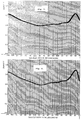
- the viscosity of the coating solution of Example 1, as in Fig. 2, was measured at a coating pH of 5.3 and at a coating temperature of 36°C by means of a viscosimeter and expressed in mPas for each measurement.
- in situ prepared dispersions of merostyryl dyes and oxonol dyes are offering the possibility to make “in situ” prepared dispersions, opposite to the little handsome "storage dispersions”. Moreover the viscosity of the coating solution is not increased, even not if higher amounts of dyes are precipitated and/or if said coating solution is stored for several hours before coating.
- a weight ratio between dye IIIa and dye IVb of about 2 or more offers the lowest increase of the viscosity at a coating pH value of 4.5. It is clear that lower amounts of gelatin are leading to a lower increase in viscosity if the coating pH is lowered.
Landscapes
- Chemical & Material Sciences (AREA)
- Engineering & Computer Science (AREA)
- Materials Engineering (AREA)
- Physics & Mathematics (AREA)
- General Physics & Mathematics (AREA)
- Chemical Kinetics & Catalysis (AREA)
- Silver Salt Photography Or Processing Solution Therefor (AREA)
Priority Applications (1)
| Application Number | Priority Date | Filing Date | Title |
|---|---|---|---|
| EP19950203367 EP0724191B1 (de) | 1994-12-27 | 1995-12-06 | Mikroausgefällte Farbdispersionen enthaltende photographische Materialien geeignet für Anwendungen mit schneller Verarbeitung |
Applications Claiming Priority (3)
| Application Number | Priority Date | Filing Date | Title |
|---|---|---|---|
| EP94203766 | 1994-12-27 | ||
| EP94203766 | 1994-12-27 | ||
| EP19950203367 EP0724191B1 (de) | 1994-12-27 | 1995-12-06 | Mikroausgefällte Farbdispersionen enthaltende photographische Materialien geeignet für Anwendungen mit schneller Verarbeitung |
Publications (2)
| Publication Number | Publication Date |
|---|---|
| EP0724191A1 true EP0724191A1 (de) | 1996-07-31 |
| EP0724191B1 EP0724191B1 (de) | 2003-08-27 |
Family
ID=26136861
Family Applications (1)
| Application Number | Title | Priority Date | Filing Date |
|---|---|---|---|
| EP19950203367 Expired - Lifetime EP0724191B1 (de) | 1994-12-27 | 1995-12-06 | Mikroausgefällte Farbdispersionen enthaltende photographische Materialien geeignet für Anwendungen mit schneller Verarbeitung |
Country Status (1)
| Country | Link |
|---|---|
| EP (1) | EP0724191B1 (de) |
Cited By (4)
| Publication number | Priority date | Publication date | Assignee | Title |
|---|---|---|---|---|
| US6045986A (en) * | 1997-05-20 | 2000-04-04 | Tulalip Consultoria Commerial Sociedade Unipessoal S.A. | Formation and photographic use of solid particle dye dispersions |
| EP1246003A1 (de) * | 2001-03-29 | 2002-10-02 | Agfa-Gevaert | Verfahren zur Herstellung von zusammen ausgefällten mikrokristallinen Farbstoffdispersionen und Materialien, die Schichten mit diesen Dispersionen aufweisen |
| US6641621B2 (en) | 2001-03-29 | 2003-11-04 | Agfa-Gevaert | Method of preparing co-precipitated microcrystalline dye dispersions and layers coated therewith in materials |
| EP1246004A3 (de) * | 2001-03-29 | 2006-07-26 | Agfa-Gevaert | Verfahren zur Herstellung von zusammen ausgefällten mikrokristallinen Farbstoffdispersionen und Materialien, die Schichten mit diesen Dispersionen aufweisen |
Citations (3)
| Publication number | Priority date | Publication date | Assignee | Title |
|---|---|---|---|---|
| EP0549489A1 (de) * | 1991-12-20 | 1993-06-30 | Eastman Kodak Company | Mikrofällungsverfahren zur Dispergierung photographischer Filterfarbstoffe |
| EP0554834A2 (de) * | 1992-02-03 | 1993-08-11 | Fuji Photo Film Co., Ltd. | Verfahren zur Dispergierung eines Farbstoffs und ein Farbstoff enthaltendes photographisches Silberhalogenidmaterial |
| EP0587229A2 (de) * | 1992-09-11 | 1994-03-16 | Agfa-Gevaert N.V. | Filterfarbstoffe für Schnellverarbeitungs-Verwendungen |
-
1995
- 1995-12-06 EP EP19950203367 patent/EP0724191B1/de not_active Expired - Lifetime
Patent Citations (3)
| Publication number | Priority date | Publication date | Assignee | Title |
|---|---|---|---|---|
| EP0549489A1 (de) * | 1991-12-20 | 1993-06-30 | Eastman Kodak Company | Mikrofällungsverfahren zur Dispergierung photographischer Filterfarbstoffe |
| EP0554834A2 (de) * | 1992-02-03 | 1993-08-11 | Fuji Photo Film Co., Ltd. | Verfahren zur Dispergierung eines Farbstoffs und ein Farbstoff enthaltendes photographisches Silberhalogenidmaterial |
| EP0587229A2 (de) * | 1992-09-11 | 1994-03-16 | Agfa-Gevaert N.V. | Filterfarbstoffe für Schnellverarbeitungs-Verwendungen |
Cited By (5)
| Publication number | Priority date | Publication date | Assignee | Title |
|---|---|---|---|---|
| US6045986A (en) * | 1997-05-20 | 2000-04-04 | Tulalip Consultoria Commerial Sociedade Unipessoal S.A. | Formation and photographic use of solid particle dye dispersions |
| EP1246003A1 (de) * | 2001-03-29 | 2002-10-02 | Agfa-Gevaert | Verfahren zur Herstellung von zusammen ausgefällten mikrokristallinen Farbstoffdispersionen und Materialien, die Schichten mit diesen Dispersionen aufweisen |
| US6641621B2 (en) | 2001-03-29 | 2003-11-04 | Agfa-Gevaert | Method of preparing co-precipitated microcrystalline dye dispersions and layers coated therewith in materials |
| US7026108B2 (en) | 2001-03-29 | 2006-04-11 | Agfa-Gevaert | Method of preparing co-precipitated microcrystalline dye dispersions and layers coated therewith in materials |
| EP1246004A3 (de) * | 2001-03-29 | 2006-07-26 | Agfa-Gevaert | Verfahren zur Herstellung von zusammen ausgefällten mikrokristallinen Farbstoffdispersionen und Materialien, die Schichten mit diesen Dispersionen aufweisen |
Also Published As
| Publication number | Publication date |
|---|---|
| EP0724191B1 (de) | 2003-08-27 |
Similar Documents
| Publication | Publication Date | Title |
|---|---|---|
| JP2714007B2 (ja) | 写真フィルター組成物 | |
| EP0549486B1 (de) | Dispersionen von mikroausgefällten Methinoxonolfilterfarbstoffen | |
| JPS5950973B2 (ja) | 光吸収性染料を含有する感光性写真材料 | |
| DE3313394A1 (de) | Verfahren zur behandlung eines photographischen materials und photographisches material | |
| US5344749A (en) | Filter dyes for rapid processing applications | |
| US5380634A (en) | Filter dyes for rapid processing applications | |
| EP0289820B1 (de) | Lichtempfindliche photographische Silberhalogenidmaterialien und Prozess für die Einführung hydrophober photographischer Additive in hydrophile Kolloidzusammensetzungen | |
| EP0724191B1 (de) | Mikroausgefällte Farbdispersionen enthaltende photographische Materialien geeignet für Anwendungen mit schneller Verarbeitung | |
| DE69318863T2 (de) | Verfahren zur Dispergierung eines Farbstoffs und ein Farbstoff enthaltendes photographisches Silberhalogenidmaterial | |
| DE2404591A1 (de) | Waermeentwicklungsfaehiges photographisches material | |
| DE1547793A1 (de) | Direkt-positive photographische Silberhalogenidemulsion | |
| DE2428125A1 (de) | Thermisch entwicklungsfaehiges lichtempfindliches material | |
| EP0587229B1 (de) | Photographisches Element,das einen Filterfarbstoff enthält, für Schnellverarbeitungs-Verwendungen | |
| EP0587230B1 (de) | Photographisches Element,das einen Filterfarbstoff enthält, für Schnellverarbeitungs-Verwendungen | |
| EP0656401B1 (de) | Neue Farbstoffe brauchbar für verschiedene Anwendungen | |
| DE69328225T2 (de) | Photographisches Silberhalogenidmaterial | |
| US5478708A (en) | New dyes for use in diverse applications | |
| JPH08278598A (ja) | 迅速処理用途に好適な微細沈澱染料分散体を含有する写真材料 | |
| EP0786497B1 (de) | Farbstoffe, brauchbar für verschiedene Anwendungen | |
| JPH01253734A (ja) | ハロゲン化銀写真感光材料 | |
| JPH0555057B2 (de) | ||
| EP0781816B1 (de) | Farbstoffe brauchbar für verschiedene Anwendungen | |
| DE68916325T2 (de) | Lichtempfindliches photographisches Element ohne Silber und Verfahren, um hydrophobe Zusammensetzungen in hydrophile kolloidale Zusammensetzungen einzusetzen. | |
| DE60218599T2 (de) | Photographisches Silberhalogenidmaterial mit verbesserter Stabilität des Latentbildes | |
| US5919609A (en) | Dyes for use in diverse applications |
Legal Events
| Date | Code | Title | Description |
|---|---|---|---|
| PUAI | Public reference made under article 153(3) epc to a published international application that has entered the european phase |
Free format text: ORIGINAL CODE: 0009012 |
|
| AK | Designated contracting states |
Kind code of ref document: A1 Designated state(s): BE DE FR GB NL |
|
| 17P | Request for examination filed |
Effective date: 19970131 |
|
| RAP1 | Party data changed (applicant data changed or rights of an application transferred) |
Owner name: AGFA-GEVAERT |
|
| 17Q | First examination report despatched |
Effective date: 20020731 |
|
| GRAH | Despatch of communication of intention to grant a patent |
Free format text: ORIGINAL CODE: EPIDOS IGRA |
|
| GRAS | Grant fee paid |
Free format text: ORIGINAL CODE: EPIDOSNIGR3 |
|
| GRAA | (expected) grant |
Free format text: ORIGINAL CODE: 0009210 |
|
| AK | Designated contracting states |
Designated state(s): BE DE FR GB NL |
|
| PG25 | Lapsed in a contracting state [announced via postgrant information from national office to epo] |
Ref country code: NL Free format text: LAPSE BECAUSE OF FAILURE TO SUBMIT A TRANSLATION OF THE DESCRIPTION OR TO PAY THE FEE WITHIN THE PRESCRIBED TIME-LIMIT Effective date: 20030827 Ref country code: FR Free format text: LAPSE BECAUSE OF FAILURE TO SUBMIT A TRANSLATION OF THE DESCRIPTION OR TO PAY THE FEE WITHIN THE PRESCRIBED TIME-LIMIT Effective date: 20030827 Ref country code: BE Free format text: LAPSE BECAUSE OF FAILURE TO SUBMIT A TRANSLATION OF THE DESCRIPTION OR TO PAY THE FEE WITHIN THE PRESCRIBED TIME-LIMIT Effective date: 20030827 |
|
| REG | Reference to a national code |
Ref country code: GB Ref legal event code: FG4D |
|
| REF | Corresponds to: |
Ref document number: 69531600 Country of ref document: DE Date of ref document: 20031002 Kind code of ref document: P |
|
| PGFP | Annual fee paid to national office [announced via postgrant information from national office to epo] |
Ref country code: GB Payment date: 20031027 Year of fee payment: 9 |
|
| PG25 | Lapsed in a contracting state [announced via postgrant information from national office to epo] |
Ref country code: DE Free format text: LAPSE BECAUSE OF FAILURE TO SUBMIT A TRANSLATION OF THE DESCRIPTION OR TO PAY THE FEE WITHIN THE PRESCRIBED TIME-LIMIT Effective date: 20031128 |
|
| NLV1 | Nl: lapsed or annulled due to failure to fulfill the requirements of art. 29p and 29m of the patents act | ||
| PLBE | No opposition filed within time limit |
Free format text: ORIGINAL CODE: 0009261 |
|
| STAA | Information on the status of an ep patent application or granted ep patent |
Free format text: STATUS: NO OPPOSITION FILED WITHIN TIME LIMIT |
|
| 26N | No opposition filed |
Effective date: 20040528 |
|
| EN | Fr: translation not filed | ||
| PG25 | Lapsed in a contracting state [announced via postgrant information from national office to epo] |
Ref country code: GB Free format text: LAPSE BECAUSE OF NON-PAYMENT OF DUE FEES Effective date: 20041206 |
|
| GBPC | Gb: european patent ceased through non-payment of renewal fee |
Effective date: 20041206 |