EP0724585B1 - Hydantoinderivate und deren verwendung als bleichaktivator - Google Patents
Hydantoinderivate und deren verwendung als bleichaktivator Download PDFInfo
- Publication number
- EP0724585B1 EP0724585B1 EP94924837A EP94924837A EP0724585B1 EP 0724585 B1 EP0724585 B1 EP 0724585B1 EP 94924837 A EP94924837 A EP 94924837A EP 94924837 A EP94924837 A EP 94924837A EP 0724585 B1 EP0724585 B1 EP 0724585B1
- Authority
- EP
- European Patent Office
- Prior art keywords
- activator
- activators
- hydantoin derivatives
- phenyl
- hydantoin
- Prior art date
- Legal status (The legal status is an assumption and is not a legal conclusion. Google has not performed a legal analysis and makes no representation as to the accuracy of the status listed.)
- Expired - Lifetime
Links
- 239000012190 activator Substances 0.000 title claims abstract description 56
- 150000001469 hydantoins Chemical class 0.000 title claims abstract description 20
- 229940053195 antiepileptics hydantoin derivative Drugs 0.000 title claims abstract description 16
- 239000007844 bleaching agent Substances 0.000 title claims description 5
- 125000001997 phenyl group Chemical group [H]C1=C([H])C([H])=C(*)C([H])=C1[H] 0.000 claims abstract description 14
- 125000002252 acyl group Chemical group 0.000 claims abstract description 8
- 239000012459 cleaning agent Substances 0.000 claims abstract description 7
- 239000000645 desinfectant Substances 0.000 claims abstract description 7
- 125000004453 alkoxycarbonyl group Chemical group 0.000 claims abstract description 6
- 125000000864 peroxy group Chemical group O(O*)* 0.000 claims abstract 2
- -1 sulpho groups Chemical group 0.000 claims description 26
- MHAJPDPJQMAIIY-UHFFFAOYSA-N Hydrogen peroxide Chemical compound OO MHAJPDPJQMAIIY-UHFFFAOYSA-N 0.000 claims description 14
- 239000003599 detergent Substances 0.000 claims description 12
- 125000003178 carboxy group Chemical group [H]OC(*)=O 0.000 claims description 9
- 239000003795 chemical substances by application Substances 0.000 claims description 7
- 125000001424 substituent group Chemical group 0.000 claims description 6
- 125000006273 (C1-C3) alkyl group Chemical group 0.000 claims description 3
- UFHFLCQGNIYNRP-UHFFFAOYSA-N Hydrogen Chemical compound [H][H] UFHFLCQGNIYNRP-UHFFFAOYSA-N 0.000 claims description 3
- 125000002777 acetyl group Chemical group [H]C([H])([H])C(*)=O 0.000 claims description 3
- 125000004432 carbon atom Chemical group C* 0.000 claims description 3
- 125000001183 hydrocarbyl group Chemical group 0.000 claims description 3
- 229910006069 SO3H Inorganic materials 0.000 claims description 2
- QVGXLLKOCUKJST-UHFFFAOYSA-N atomic oxygen Chemical compound [O] QVGXLLKOCUKJST-UHFFFAOYSA-N 0.000 claims description 2
- 125000003236 benzoyl group Chemical group [H]C1=C([H])C([H])=C(C([H])=C1[H])C(*)=O 0.000 claims description 2
- 125000004063 butyryl group Chemical group O=C([*])C([H])([H])C([H])([H])C([H])([H])[H] 0.000 claims description 2
- RTZKZFJDLAIYFH-UHFFFAOYSA-N ether Substances CCOCC RTZKZFJDLAIYFH-UHFFFAOYSA-N 0.000 claims description 2
- 239000001257 hydrogen Substances 0.000 claims description 2
- 229910052739 hydrogen Inorganic materials 0.000 claims description 2
- 239000001301 oxygen Substances 0.000 claims description 2
- 229910052760 oxygen Inorganic materials 0.000 claims description 2
- 125000001501 propionyl group Chemical group O=C([*])C([H])([H])C([H])([H])[H] 0.000 claims description 2
- 229920006395 saturated elastomer Polymers 0.000 claims description 2
- 229930195734 saturated hydrocarbon Natural products 0.000 claims description 2
- 229930195735 unsaturated hydrocarbon Natural products 0.000 claims description 2
- MWNQXXOSWHCCOZ-UHFFFAOYSA-L sodium;oxido carbonate Chemical compound [Na+].[O-]OC([O-])=O MWNQXXOSWHCCOZ-UHFFFAOYSA-L 0.000 claims 2
- IDNDJMUXSLVWLH-UHFFFAOYSA-N 4-(1,3,5-trioxo-7,7a-dihydro-6h-pyrrolo[1,2-c]imidazole-2-carbonyl)benzoic acid Chemical compound C1=CC(C(=O)O)=CC=C1C(=O)N1C(=O)N2C(=O)CCC2C1=O IDNDJMUXSLVWLH-UHFFFAOYSA-N 0.000 claims 1
- 238000004061 bleaching Methods 0.000 abstract description 15
- 238000005406 washing Methods 0.000 abstract description 11
- 238000004140 cleaning Methods 0.000 abstract description 6
- FRPJTGXMTIIFIT-UHFFFAOYSA-N tetraacetylethylenediamine Chemical compound CC(=O)C(N)(C(C)=O)C(N)(C(C)=O)C(C)=O FRPJTGXMTIIFIT-UHFFFAOYSA-N 0.000 abstract 2
- 150000001875 compounds Chemical class 0.000 description 30
- 229910052757 nitrogen Inorganic materials 0.000 description 19
- 150000004965 peroxy acids Chemical class 0.000 description 16
- WFDIJRYMOXRFFG-UHFFFAOYSA-N Acetic anhydride Chemical compound CC(=O)OC(C)=O WFDIJRYMOXRFFG-UHFFFAOYSA-N 0.000 description 12
- BGRWYDHXPHLNKA-UHFFFAOYSA-N Tetraacetylethylenediamine Chemical compound CC(=O)N(C(C)=O)CCN(C(C)=O)C(C)=O BGRWYDHXPHLNKA-UHFFFAOYSA-N 0.000 description 12
- 239000002253 acid Substances 0.000 description 11
- XLYOFNOQVPJJNP-UHFFFAOYSA-N water Substances O XLYOFNOQVPJJNP-UHFFFAOYSA-N 0.000 description 11
- 239000000126 substance Substances 0.000 description 9
- ZMXDDKWLCZADIW-UHFFFAOYSA-N N,N-Dimethylformamide Chemical compound CN(C)C=O ZMXDDKWLCZADIW-UHFFFAOYSA-N 0.000 description 8
- 150000007513 acids Chemical class 0.000 description 7
- MSIVQMPZGFPHLC-UHFFFAOYSA-N 1,3-diacetylimidazolidine-2,4-dione Chemical compound CC(=O)N1CC(=O)N(C(C)=O)C1=O MSIVQMPZGFPHLC-UHFFFAOYSA-N 0.000 description 6
- QTBSBXVTEAMEQO-UHFFFAOYSA-N Acetic acid Chemical compound CC(O)=O QTBSBXVTEAMEQO-UHFFFAOYSA-N 0.000 description 6
- WHUUTDBJXJRKMK-VKHMYHEASA-N L-glutamic acid Chemical compound OC(=O)[C@@H](N)CCC(O)=O WHUUTDBJXJRKMK-VKHMYHEASA-N 0.000 description 6
- KFSLWBXXFJQRDL-UHFFFAOYSA-N Peracetic acid Chemical compound CC(=O)OO KFSLWBXXFJQRDL-UHFFFAOYSA-N 0.000 description 6
- HEMHJVSKTPXQMS-UHFFFAOYSA-M Sodium hydroxide Chemical compound [OH-].[Na+] HEMHJVSKTPXQMS-UHFFFAOYSA-M 0.000 description 6
- VWFWNXQAMGDPGG-UHFFFAOYSA-N hydantoin-5-propionic acid Chemical compound OC(=O)CCC1NC(=O)NC1=O VWFWNXQAMGDPGG-UHFFFAOYSA-N 0.000 description 6
- 239000000203 mixture Substances 0.000 description 6
- MAFYTGCINHDXFY-UHFFFAOYSA-N 2-acetyl-7,7a-dihydro-6h-pyrrolo[1,2-c]imidazole-1,3,5-trione Chemical compound C1CC(=O)N2C(=O)N(C(=O)C)C(=O)C21 MAFYTGCINHDXFY-UHFFFAOYSA-N 0.000 description 5
- 239000008346 aqueous phase Substances 0.000 description 5
- 230000000694 effects Effects 0.000 description 5
- 239000011734 sodium Substances 0.000 description 5
- 239000007787 solid Substances 0.000 description 5
- OYIFNHCXNCRBQI-UHFFFAOYSA-N 2-aminoadipic acid Chemical compound OC(=O)C(N)CCCC(O)=O OYIFNHCXNCRBQI-UHFFFAOYSA-N 0.000 description 4
- XSVSPKKXQGNHMD-UHFFFAOYSA-N 5-bromo-3-methyl-1,2-thiazole Chemical compound CC=1C=C(Br)SN=1 XSVSPKKXQGNHMD-UHFFFAOYSA-N 0.000 description 4
- IJGRMHOSHXDMSA-UHFFFAOYSA-N Atomic nitrogen Chemical compound N#N IJGRMHOSHXDMSA-UHFFFAOYSA-N 0.000 description 4
- 230000004913 activation Effects 0.000 description 4
- 230000015572 biosynthetic process Effects 0.000 description 4
- 229910000104 sodium hydride Inorganic materials 0.000 description 4
- 239000000243 solution Substances 0.000 description 4
- 239000002904 solvent Substances 0.000 description 4
- 239000003381 stabilizer Substances 0.000 description 4
- 239000004094 surface-active agent Substances 0.000 description 4
- 238000005160 1H NMR spectroscopy Methods 0.000 description 3
- QQDAQYPICPWNKI-UHFFFAOYSA-N 6,7,8,8a-tetrahydroimidazo[1,5-a]pyridine-1,3,5-trione Chemical compound C1(C2N(C(N1)=O)C(CCC2)=O)=O QQDAQYPICPWNKI-UHFFFAOYSA-N 0.000 description 3
- YMWUJEATGCHHMB-UHFFFAOYSA-N Dichloromethane Chemical compound ClCCl YMWUJEATGCHHMB-UHFFFAOYSA-N 0.000 description 3
- WHUUTDBJXJRKMK-UHFFFAOYSA-N Glutamic acid Natural products OC(=O)C(N)CCC(O)=O WHUUTDBJXJRKMK-UHFFFAOYSA-N 0.000 description 3
- OKKJLVBELUTLKV-UHFFFAOYSA-N Methanol Chemical compound OC OKKJLVBELUTLKV-UHFFFAOYSA-N 0.000 description 3
- 229910019142 PO4 Inorganic materials 0.000 description 3
- 229960000583 acetic acid Drugs 0.000 description 3
- 239000003513 alkali Substances 0.000 description 3
- VTIIJXUACCWYHX-UHFFFAOYSA-L disodium;carboxylatooxy carbonate Chemical compound [Na+].[Na+].[O-]C(=O)OOC([O-])=O VTIIJXUACCWYHX-UHFFFAOYSA-L 0.000 description 3
- 150000002191 fatty alcohols Chemical class 0.000 description 3
- 239000012362 glacial acetic acid Substances 0.000 description 3
- 229960002989 glutamic acid Drugs 0.000 description 3
- 238000011065 in-situ storage Methods 0.000 description 3
- 230000003647 oxidation Effects 0.000 description 3
- 238000007254 oxidation reaction Methods 0.000 description 3
- 235000021317 phosphate Nutrition 0.000 description 3
- NLKNQRATVPKPDG-UHFFFAOYSA-M potassium iodide Chemical compound [K+].[I-] NLKNQRATVPKPDG-UHFFFAOYSA-M 0.000 description 3
- 239000011541 reaction mixture Substances 0.000 description 3
- 238000010992 reflux Methods 0.000 description 3
- 150000003839 salts Chemical class 0.000 description 3
- 229940045872 sodium percarbonate Drugs 0.000 description 3
- 238000004611 spectroscopical analysis Methods 0.000 description 3
- 239000010457 zeolite Substances 0.000 description 3
- KXDHJXZQYSOELW-UHFFFAOYSA-N Carbamic acid Chemical class NC(O)=O KXDHJXZQYSOELW-UHFFFAOYSA-N 0.000 description 2
- LFQSCWFLJHTTHZ-UHFFFAOYSA-N Ethanol Chemical compound CCO LFQSCWFLJHTTHZ-UHFFFAOYSA-N 0.000 description 2
- SCKXCAADGDQQCS-UHFFFAOYSA-N Performic acid Chemical compound OOC=O SCKXCAADGDQQCS-UHFFFAOYSA-N 0.000 description 2
- 239000002202 Polyethylene glycol Substances 0.000 description 2
- 229910021536 Zeolite Inorganic materials 0.000 description 2
- WNLRTRBMVRJNCN-UHFFFAOYSA-N adipic acid Chemical compound OC(=O)CCCCC(O)=O WNLRTRBMVRJNCN-UHFFFAOYSA-N 0.000 description 2
- 229910052783 alkali metal Inorganic materials 0.000 description 2
- 229910052910 alkali metal silicate Inorganic materials 0.000 description 2
- 239000003945 anionic surfactant Substances 0.000 description 2
- 150000004649 carbonic acid derivatives Chemical class 0.000 description 2
- 238000006243 chemical reaction Methods 0.000 description 2
- 230000000536 complexating effect Effects 0.000 description 2
- 239000000470 constituent Substances 0.000 description 2
- HNPSIPDUKPIQMN-UHFFFAOYSA-N dioxosilane;oxo(oxoalumanyloxy)alumane Chemical compound O=[Si]=O.O=[Al]O[Al]=O HNPSIPDUKPIQMN-UHFFFAOYSA-N 0.000 description 2
- 238000000855 fermentation Methods 0.000 description 2
- 230000004151 fermentation Effects 0.000 description 2
- 150000004820 halides Chemical class 0.000 description 2
- 125000002883 imidazolyl group Chemical group 0.000 description 2
- 150000003949 imides Chemical class 0.000 description 2
- 150000004682 monohydrates Chemical class 0.000 description 2
- 239000002736 nonionic surfactant Substances 0.000 description 2
- 239000012074 organic phase Substances 0.000 description 2
- 150000003013 phosphoric acid derivatives Chemical class 0.000 description 2
- 229920001223 polyethylene glycol Polymers 0.000 description 2
- 239000000843 powder Substances 0.000 description 2
- 239000002244 precipitate Substances 0.000 description 2
- 239000000047 product Substances 0.000 description 2
- 238000000425 proton nuclear magnetic resonance spectrum Methods 0.000 description 2
- 239000002994 raw material Substances 0.000 description 2
- 229910052708 sodium Inorganic materials 0.000 description 2
- 229960001922 sodium perborate Drugs 0.000 description 2
- IBDSNZLUHYKHQP-UHFFFAOYSA-N sodium;3-oxidodioxaborirane;tetrahydrate Chemical compound O.O.O.O.[Na+].[O-]B1OO1 IBDSNZLUHYKHQP-UHFFFAOYSA-N 0.000 description 2
- YKLJGMBLPUQQOI-UHFFFAOYSA-M sodium;oxidooxy(oxo)borane Chemical compound [Na+].[O-]OB=O YKLJGMBLPUQQOI-UHFFFAOYSA-M 0.000 description 2
- 239000002689 soil Substances 0.000 description 2
- 125000000020 sulfo group Chemical group O=S(=O)([*])O[H] 0.000 description 2
- ODIGIKRIUKFKHP-UHFFFAOYSA-N (n-propan-2-yloxycarbonylanilino) acetate Chemical compound CC(C)OC(=O)N(OC(C)=O)C1=CC=CC=C1 ODIGIKRIUKFKHP-UHFFFAOYSA-N 0.000 description 1
- RTBFRGCFXZNCOE-UHFFFAOYSA-N 1-methylsulfonylpiperidin-4-one Chemical compound CS(=O)(=O)N1CCC(=O)CC1 RTBFRGCFXZNCOE-UHFFFAOYSA-N 0.000 description 1
- QFGCFKJIPBRJGM-UHFFFAOYSA-N 12-[(2-methylpropan-2-yl)oxy]-12-oxododecanoic acid Chemical compound CC(C)(C)OC(=O)CCCCCCCCCCC(O)=O QFGCFKJIPBRJGM-UHFFFAOYSA-N 0.000 description 1
- HCBICWDWWMXQIH-UHFFFAOYSA-N 2-(2,5-dioxoimidazolidin-4-yl)propanoic acid Chemical compound OC(=O)C(C)C1NC(=O)NC1=O HCBICWDWWMXQIH-UHFFFAOYSA-N 0.000 description 1
- BXQLHKVBFNOVAS-UHFFFAOYSA-N 2-nonanoyl-7,7a-dihydro-6h-pyrrolo[1,2-c]imidazole-1,3,5-trione Chemical compound C1CC(=O)N2C(=O)N(C(=O)CCCCCCCC)C(=O)C21 BXQLHKVBFNOVAS-UHFFFAOYSA-N 0.000 description 1
- 125000003903 2-propenyl group Chemical group [H]C([*])([H])C([H])=C([H])[H] 0.000 description 1
- YSTMGAOLTYEFPR-UHFFFAOYSA-N 4-(2,5-dioxoimidazolidin-4-yl)butanoic acid Chemical compound C(=O)(O)CCCC1C(NC(N1)=O)=O YSTMGAOLTYEFPR-UHFFFAOYSA-N 0.000 description 1
- 229920000742 Cotton Polymers 0.000 description 1
- 102000004190 Enzymes Human genes 0.000 description 1
- 108090000790 Enzymes Proteins 0.000 description 1
- 235000007688 Lycopersicon esculentum Nutrition 0.000 description 1
- 230000006181 N-acylation Effects 0.000 description 1
- KEAYESYHFKHZAL-UHFFFAOYSA-N Sodium Chemical compound [Na] KEAYESYHFKHZAL-UHFFFAOYSA-N 0.000 description 1
- CDBYLPFSWZWCQE-UHFFFAOYSA-L Sodium Carbonate Chemical compound [Na+].[Na+].[O-]C([O-])=O CDBYLPFSWZWCQE-UHFFFAOYSA-L 0.000 description 1
- 240000003768 Solanum lycopersicum Species 0.000 description 1
- 229920002472 Starch Polymers 0.000 description 1
- KDYFGRWQOYBRFD-UHFFFAOYSA-N Succinic acid Natural products OC(=O)CCC(O)=O KDYFGRWQOYBRFD-UHFFFAOYSA-N 0.000 description 1
- 244000269722 Thea sinensis Species 0.000 description 1
- 239000003082 abrasive agent Substances 0.000 description 1
- 239000000654 additive Substances 0.000 description 1
- 239000001361 adipic acid Substances 0.000 description 1
- 235000011037 adipic acid Nutrition 0.000 description 1
- 125000001931 aliphatic group Chemical group 0.000 description 1
- 150000004996 alkyl benzenes Chemical class 0.000 description 1
- 125000000217 alkyl group Chemical group 0.000 description 1
- NGXUUAFYUCOICP-UHFFFAOYSA-N aminometradine Chemical group CCN1C(=O)C=C(N)N(CC=C)C1=O NGXUUAFYUCOICP-UHFFFAOYSA-N 0.000 description 1
- 150000008064 anhydrides Chemical class 0.000 description 1
- JFCQEDHGNNZCLN-UHFFFAOYSA-N anhydrous glutaric acid Natural products OC(=O)CCCC(O)=O JFCQEDHGNNZCLN-UHFFFAOYSA-N 0.000 description 1
- 125000000129 anionic group Chemical group 0.000 description 1
- 239000007864 aqueous solution Substances 0.000 description 1
- PASDCCFISLVPSO-UHFFFAOYSA-N benzoyl chloride Chemical compound ClC(=O)C1=CC=CC=C1 PASDCCFISLVPSO-UHFFFAOYSA-N 0.000 description 1
- 230000000903 blocking effect Effects 0.000 description 1
- KDYFGRWQOYBRFD-NUQCWPJISA-N butanedioic acid Chemical compound O[14C](=O)CC[14C](O)=O KDYFGRWQOYBRFD-NUQCWPJISA-N 0.000 description 1
- 125000000484 butyl group Chemical group [H]C([*])([H])C([H])([H])C([H])([H])C([H])([H])[H] 0.000 description 1
- BVKZGUZCCUSVTD-UHFFFAOYSA-N carbonic acid Chemical class OC(O)=O BVKZGUZCCUSVTD-UHFFFAOYSA-N 0.000 description 1
- 125000002915 carbonyl group Chemical group [*:2]C([*:1])=O 0.000 description 1
- FZFAMSAMCHXGEF-UHFFFAOYSA-N chloro formate Chemical compound ClOC=O FZFAMSAMCHXGEF-UHFFFAOYSA-N 0.000 description 1
- 239000004927 clay Substances 0.000 description 1
- 239000007931 coated granule Substances 0.000 description 1
- 235000016213 coffee Nutrition 0.000 description 1
- 235000013353 coffee beverage Nutrition 0.000 description 1
- 230000000052 comparative effect Effects 0.000 description 1
- 239000008139 complexing agent Substances 0.000 description 1
- 238000001816 cooling Methods 0.000 description 1
- 235000021438 curry Nutrition 0.000 description 1
- 125000004122 cyclic group Chemical group 0.000 description 1
- 125000002704 decyl group Chemical group [H]C([H])([H])C([H])([H])C([H])([H])C([H])([H])C([H])([H])C([H])([H])C([H])([H])C([H])([H])C([H])([H])C([H])([H])* 0.000 description 1
- 230000000249 desinfective effect Effects 0.000 description 1
- 150000001991 dicarboxylic acids Chemical class 0.000 description 1
- PXEDJBXQKAGXNJ-QTNFYWBSSA-L disodium L-glutamate Chemical compound [Na+].[Na+].[O-]C(=O)[C@@H](N)CCC([O-])=O PXEDJBXQKAGXNJ-QTNFYWBSSA-L 0.000 description 1
- 238000004821 distillation Methods 0.000 description 1
- JHUXOSATQXGREM-UHFFFAOYSA-N dodecanediperoxoic acid Chemical compound OOC(=O)CCCCCCCCCCC(=O)OO JHUXOSATQXGREM-UHFFFAOYSA-N 0.000 description 1
- 239000003792 electrolyte Substances 0.000 description 1
- 150000002170 ethers Chemical class 0.000 description 1
- 125000001495 ethyl group Chemical group [H]C([H])([H])C([H])([H])* 0.000 description 1
- 239000004744 fabric Substances 0.000 description 1
- 239000006260 foam Substances 0.000 description 1
- 229940049906 glutamate Drugs 0.000 description 1
- 235000013922 glutamic acid Nutrition 0.000 description 1
- 239000004220 glutamic acid Substances 0.000 description 1
- 229930182470 glycoside Natural products 0.000 description 1
- 239000008187 granular material Substances 0.000 description 1
- 230000003179 granulation Effects 0.000 description 1
- 238000005469 granulation Methods 0.000 description 1
- 125000003187 heptyl group Chemical group [H]C([*])([H])C([H])([H])C([H])([H])C([H])([H])C([H])([H])C([H])([H])C([H])([H])[H] 0.000 description 1
- 125000004051 hexyl group Chemical group [H]C([H])([H])C([H])([H])C([H])([H])C([H])([H])C([H])([H])C([H])([H])* 0.000 description 1
- WJRBRSLFGCUECM-UHFFFAOYSA-N hydantoin Chemical compound O=C1CNC(=O)N1 WJRBRSLFGCUECM-UHFFFAOYSA-N 0.000 description 1
- 229940091173 hydantoin Drugs 0.000 description 1
- 150000004678 hydrides Chemical class 0.000 description 1
- 238000010952 in-situ formation Methods 0.000 description 1
- 239000004615 ingredient Substances 0.000 description 1
- 239000003112 inhibitor Substances 0.000 description 1
- 235000008960 ketchup Nutrition 0.000 description 1
- 229910052744 lithium Inorganic materials 0.000 description 1
- 238000000691 measurement method Methods 0.000 description 1
- 238000000034 method Methods 0.000 description 1
- JYQQWQJCEUMXQZ-UHFFFAOYSA-N methyl cyanate Chemical compound COC#N JYQQWQJCEUMXQZ-UHFFFAOYSA-N 0.000 description 1
- 125000002496 methyl group Chemical group [H]C([H])([H])* 0.000 description 1
- 230000003641 microbiacidal effect Effects 0.000 description 1
- LPUQAYUQRXPFSQ-DFWYDOINSA-M monosodium L-glutamate Chemical compound [Na+].[O-]C(=O)[C@@H](N)CCC(O)=O LPUQAYUQRXPFSQ-DFWYDOINSA-M 0.000 description 1
- NTQYXUJLILNTFH-UHFFFAOYSA-N nonanoyl chloride Chemical compound CCCCCCCCC(Cl)=O NTQYXUJLILNTFH-UHFFFAOYSA-N 0.000 description 1
- 125000001402 nonanoyl group Chemical group O=C([*])C([H])([H])C([H])([H])C([H])([H])C([H])([H])C([H])([H])C([H])([H])C([H])([H])C([H])([H])[H] 0.000 description 1
- 125000002347 octyl group Chemical group [H]C([*])([H])C([H])([H])C([H])([H])C([H])([H])C([H])([H])C([H])([H])C([H])([H])C([H])([H])[H] 0.000 description 1
- 230000003287 optical effect Effects 0.000 description 1
- 150000004967 organic peroxy acids Chemical class 0.000 description 1
- 239000003960 organic solvent Substances 0.000 description 1
- 239000007800 oxidant agent Substances 0.000 description 1
- 239000006072 paste Substances 0.000 description 1
- 125000001147 pentyl group Chemical group C(CCCC)* 0.000 description 1
- 150000002978 peroxides Chemical class 0.000 description 1
- 125000005342 perphosphate group Chemical group 0.000 description 1
- JRKICGRDRMAZLK-UHFFFAOYSA-L persulfate group Chemical group S(=O)(=O)([O-])OOS(=O)(=O)[O-] JRKICGRDRMAZLK-UHFFFAOYSA-L 0.000 description 1
- 239000000546 pharmaceutical excipient Substances 0.000 description 1
- NBIIXXVUZAFLBC-UHFFFAOYSA-K phosphate Chemical compound [O-]P([O-])([O-])=O NBIIXXVUZAFLBC-UHFFFAOYSA-K 0.000 description 1
- 239000010452 phosphate Substances 0.000 description 1
- 229920005646 polycarboxylate Polymers 0.000 description 1
- 229910052700 potassium Inorganic materials 0.000 description 1
- 235000019353 potassium silicate Nutrition 0.000 description 1
- CZPZWMPYEINMCF-UHFFFAOYSA-N propaneperoxoic acid Chemical compound CCC(=O)OO CZPZWMPYEINMCF-UHFFFAOYSA-N 0.000 description 1
- RZWZRACFZGVKFM-UHFFFAOYSA-N propanoyl chloride Chemical compound CCC(Cl)=O RZWZRACFZGVKFM-UHFFFAOYSA-N 0.000 description 1
- 125000001436 propyl group Chemical group [H]C([*])([H])C([H])([H])C([H])([H])[H] 0.000 description 1
- 239000012429 reaction media Substances 0.000 description 1
- 235000020095 red wine Nutrition 0.000 description 1
- 238000007363 ring formation reaction Methods 0.000 description 1
- 238000007142 ring opening reaction Methods 0.000 description 1
- 150000004760 silicates Chemical class 0.000 description 1
- 239000000344 soap Substances 0.000 description 1
- ZVCDLGYNFYZZOK-UHFFFAOYSA-M sodium cyanate Chemical compound [Na]OC#N ZVCDLGYNFYZZOK-UHFFFAOYSA-M 0.000 description 1
- 239000012312 sodium hydride Substances 0.000 description 1
- 239000012418 sodium perborate tetrahydrate Substances 0.000 description 1
- NTHWMYGWWRZVTN-UHFFFAOYSA-N sodium silicate Chemical compound [Na+].[Na+].[O-][Si]([O-])=O NTHWMYGWWRZVTN-UHFFFAOYSA-N 0.000 description 1
- AKHNMLFCWUSKQB-UHFFFAOYSA-L sodium thiosulfate Chemical compound [Na+].[Na+].[O-]S([O-])(=O)=S AKHNMLFCWUSKQB-UHFFFAOYSA-L 0.000 description 1
- 235000019345 sodium thiosulphate Nutrition 0.000 description 1
- RPACBEVZENYWOL-XFULWGLBSA-M sodium;(2r)-2-[6-(4-chlorophenoxy)hexyl]oxirane-2-carboxylate Chemical compound [Na+].C=1C=C(Cl)C=CC=1OCCCCCC[C@]1(C(=O)[O-])CO1 RPACBEVZENYWOL-XFULWGLBSA-M 0.000 description 1
- 239000008107 starch Substances 0.000 description 1
- 235000019698 starch Nutrition 0.000 description 1
- 238000004659 sterilization and disinfection Methods 0.000 description 1
- 150000003467 sulfuric acid derivatives Chemical class 0.000 description 1
- 239000000725 suspension Substances 0.000 description 1
- 230000002195 synergetic effect Effects 0.000 description 1
- 238000003786 synthesis reaction Methods 0.000 description 1
- 239000003826 tablet Substances 0.000 description 1
- 239000008399 tap water Substances 0.000 description 1
- 235000020679 tap water Nutrition 0.000 description 1
- 235000013616 tea Nutrition 0.000 description 1
- 125000004853 tetrahydropyridinyl group Chemical group N1(CCCC=C1)* 0.000 description 1
- 239000004753 textile Substances 0.000 description 1
- 125000002948 undecyl group Chemical group [H]C([*])([H])C([H])([H])C([H])([H])C([H])([H])C([H])([H])C([H])([H])C([H])([H])C([H])([H])C([H])([H])C([H])([H])C([H])([H])[H] 0.000 description 1
- 125000000391 vinyl group Chemical group [H]C([*])=C([H])[H] 0.000 description 1
- 229920002554 vinyl polymer Polymers 0.000 description 1
- 229910052724 xenon Inorganic materials 0.000 description 1
- FHNFHKCVQCLJFQ-UHFFFAOYSA-N xenon atom Chemical compound [Xe] FHNFHKCVQCLJFQ-UHFFFAOYSA-N 0.000 description 1
Classifications
-
- C—CHEMISTRY; METALLURGY
- C07—ORGANIC CHEMISTRY
- C07D—HETEROCYCLIC COMPOUNDS
- C07D471/00—Heterocyclic compounds containing nitrogen atoms as the only ring hetero atoms in the condensed system, at least one ring being a six-membered ring with one nitrogen atom, not provided for by groups C07D451/00 - C07D463/00
- C07D471/02—Heterocyclic compounds containing nitrogen atoms as the only ring hetero atoms in the condensed system, at least one ring being a six-membered ring with one nitrogen atom, not provided for by groups C07D451/00 - C07D463/00 in which the condensed system contains two hetero rings
- C07D471/04—Ortho-condensed systems
-
- C—CHEMISTRY; METALLURGY
- C07—ORGANIC CHEMISTRY
- C07D—HETEROCYCLIC COMPOUNDS
- C07D487/00—Heterocyclic compounds containing nitrogen atoms as the only ring hetero atoms in the condensed system, not provided for by groups C07D451/00 - C07D477/00
- C07D487/02—Heterocyclic compounds containing nitrogen atoms as the only ring hetero atoms in the condensed system, not provided for by groups C07D451/00 - C07D477/00 in which the condensed system contains two hetero rings
- C07D487/04—Ortho-condensed systems
-
- C—CHEMISTRY; METALLURGY
- C11—ANIMAL OR VEGETABLE OILS, FATS, FATTY SUBSTANCES OR WAXES; FATTY ACIDS THEREFROM; DETERGENTS; CANDLES
- C11D—DETERGENT COMPOSITIONS; USE OF SINGLE SUBSTANCES AS DETERGENTS; SOAP OR SOAP-MAKING; RESIN SOAPS; RECOVERY OF GLYCEROL
- C11D3/00—Other compounding ingredients of detergent compositions covered in group C11D1/00
- C11D3/39—Organic or inorganic per-compounds
- C11D3/3902—Organic or inorganic per-compounds combined with specific additives
- C11D3/3905—Bleach activators or bleach catalysts
- C11D3/3907—Organic compounds
- C11D3/3917—Nitrogen-containing compounds
- C11D3/392—Heterocyclic compounds, e.g. cyclic imides or lactames
Definitions
- the invention is directed to new hydantoin derivatives based on N-acylated hydantoins, which can be used as activators for inorganic peroxygen compounds, such as, in particular, hydrogen peroxide and compounds releasing hydrogen peroxide.
- the invention is further directed to bleaching, washing, cleaning and disinfecting agents containing these activators.
- Inorganic peroxygen compounds are used as oxidizing agents in bleaching, washing, cleaning and disinfecting agents in order to improve the action of such agents.
- hydrogen peroxide and those substances which release hydrogen peroxide in aqueous solution, such as perborates and percarbonates are used as peroxygen compounds.
- the effect of the inorganic peroxygen compounds depends not only on the pH value, but also on the temperature. While a good effect is achieved at temperatures above approximately 80 ° C., the use of so-called activators is required when using the inorganic peroxygen compound mentioned at lower temperatures, in particular at 60 ° C. or 40 ° C. or below.
- the activators are predominantly N-acyl or O-acyl compounds.
- the inorganic peroxygen compounds and the activators form percarboxylic acids, which have a higher oxidation potential than H 2 O 2 and these releasing compounds and therefore also have a good washing, cleaning, bleaching and disinfecting action in the low temperature range.
- N-acyl compounds numerous classes of substances have been proposed as activators, including: N, N, N ', N'-tetraacetylethylenediamine (TAED), N, N, N', N'-tetraacetylglycoluril (TAGU), N, N '-Di (alkoxycarbonyl) -hydantoins (US 3,928,223), N-mono- and N, N'-di (C 1 - to C 4 ) alkanoylhydantoins (DE-A 14 67 582 and DE-C 19 49 561), N - (C 1 - to C 4 -) alkyloxycarbonylsuccinimides (US 3,928,223) and N, N'-diacyl-2,5-diketopiperazines (DE-A 20 38 106).
- TAED N, N, N', N'-tetraacetylethylenediamine
- TAGU N, N ', N
- activators based on N-acyl compounds which essentially match the properties of the TAED and / or this in one or surpass another point. Since it is known that the structure of the peracid has a certain influence on the oxidation and bleaching capacity compared to, for example, different soiling, there is an additional interest in such activators which, in the presence of inorganic peroxygen compounds, are able to release two or more different peracids in situ, in order to achieve a synergistic effect compared to conventional activators which only release one type of peracid, without having to use two different activators.
- the activators to be provided should, if possible be accessible from readily available and biodegradable raw materials.
- the hydantoin derivatives according to the invention were not previously known. Surprisingly, they are distinguished by a significantly higher activator performance than previously known N, N'-dialkanoyl-hydantoins, such as N, N'-diacetyl-hydantoin, which are known as activators.
- Activators according to the invention based on the N-acylated bicyclic hydantoin derivatives form more than one equivalent of peracid under test conditions at 30 ° C. in the presence of sodium perborate monohydrate (Pbmh).
- peracid For example, about 1.8 equivalents of peracid are released from 2-acetyl-dihydropyrrolo [1,2-c] imidazole-1,3,5-trione, some being peracetic acid and some being 3- (5-hydantoinyl) perpropionic acid . Knowing the unsatisfactory formation of peracid from previously known N, N'-dialkanoyl hydantoins, this peracid release rate was not to be expected.
- N-acylated bicyclic hydantoin derivatives according to the invention was also confirmed in the wash test of fabrics with test soiling which is important in practice.
- some of the activators according to the invention in particular those of the formula (I) with n equal to 1 and R equal to acetyl, propionyl, butyryl, phenyl, o- or p-carboxyphenyl, not only achieve the performance level of the standard TAED , but in some cases significantly exceeded.
- hydantoin derivatives according to the invention are based on dihydro-pyrrolo [1,2-c] imidazole-1,3,5-trione (1) or its 2-N-acylated derivatives if n in the general formula (I) is 1 or to tetrahydro-pyridino [1,2-c] imidazole-1,3,5-trione (8) when n is 2.
- Preferred compounds are those with n equal to 1 because they are obtainable from easily accessible raw materials, namely glutamic acid or Na-glutamate (which can be prepared by fermentation), whereas compounds with n equal to 2 are derived from 2-aminoadipic acid, which are synthetic in a manner known per se can be produced, let win.
- Hydantoin derivatives according to the invention with n equal to 1, which can be in the form of the possible stereoisomers or mixtures thereof, can be prepared from fermentatively produced L-glutamic acid or Na-L-glutamate or from synthetically produced D, L-glutamic acid or its salt.
- a conventional hydantoin synthesis follows, preferably using an alkali metal cyanate:
- HPS aforementioned product
- HPS is reacted in glacial acetic acid with acetic anhydride.
- R acyl or alkoxycarbonyl
- (1) is expediently first deprotonated on the imide nitrogen - for example by means of a Alkali hydride and then reacted in a dipolar solvent with the acid halide.
- Hydantoin derivatives of the formula (I) according to the invention with n equal to 2 can be prepared in a manner analogous to that described above.
- 2-aminoadipic acid is converted into 4- (hydantoin-5-yl) butyric acid by means of an alkali metal cyanate; the cyclization to the tetrahydropyridine ring is again carried out by means of water-releasing agents such as acetic anhydride.
- the N-acylation of the imide nitrogen is carried out in a known manner.
- the 2-N-acylated compounds of (1) and (8) are preferred with regard to their activation.
- the meaning of the radical R 'in the acyl group R'-CO- can be very versatile and include an aliphatic, olefinic, cycloaliphatic or aromatic radical, the radicals mentioned themselves being able to have one or two substituents from the series already mentioned.
- R ' is particularly advantageously a linear alkyl group having 1 to 11 carbon atoms, such as methyl, ethyl, propyl, butyl, pentyl, hexyl, heptyl, octyl, decyl, undecyl.
- Olefinic hydrocarbon residues such as vinyl, allyl, propen-2-yl are possible, but are less preferred.
- the number and size of the substituents on the hydrocarbon residue is generally kept low to limit the molecular weight of the resulting percarboxylic acid.
- aromatic radical R ' phenyl-substituted phenyl with preferably one or two carboxy or sulfo groups is preferred.
- Particularly preferred compounds are the N-acylhydantoins derived from (1) with a C 2 -C 9 -n-alkanoyl or a benzoyl or o- or p-carboxybenzoyl group; this group includes the activators (2) to (5) according to Examples 2 to 5.
- Diperoxydodecanedioic acid is formed in situ, from 3- (hydantoin-5-yl) propionic acid and the ⁇ , ⁇ -dodecanedicarboxylic acid dichloride.
- the use according to the invention relates to the activation of inorganic peroxygen compounds, in particular H 2 O 2 and those compounds which release hydrogen peroxide in the aqueous phase.
- inorganic peroxygen compounds in particular H 2 O 2 and those compounds which release hydrogen peroxide in the aqueous phase.
- perborates especially sodium perborate monohydrate, sodium perborate tetrahydrate, superoxidized sodium perborate, and sodium percarbonate (2 Na 2 CO 3 .3H 2 O 2 ).
- Perphosphates, persilicates and persulfates can also be used.
- Several inorganic per-compounds can also be present during activation.
- inorganic peroxygen compounds and activators are used in a ratio of 1 mol of active oxygen to 0.05 to 1 mol, preferably 1 to 0.1 to 0.5 mol, of activator.
- the activators to be used according to the invention can be used for activation in pure form or with auxiliaries, such as granulation aids, stabilizers, pH-regulating substances; Suitable forms of addition are powders, pastes, tablets, granules or coated granules.
- the activators and inorganic peroxygen compounds can be used not only in the purely aqueous phase but also in the aqueous-organic phase.
- the usual washing, bleaching and cleaning liquors have a purely aqueous environment.
- An aqueous organic environment can be useful in disinfection applications and in technical oxidation processes.
- the pH of the reaction medium can be between about 4 and 13, but is preferably carried out in the alkaline range, usually at pH 8 to 11, since in this range both the in situ formation of the organic peracid proceeds well and the stability of the Perconnections is satisfactory.
- the invention further relates to bleaching, washing, cleaning and disinfecting agents which contain an inorganic peroxygen compound and an activator from the series of the hydantoin derivatives of the formula (I) or (II) according to the invention.
- the agent can contain one or more inorganic peroxygen compounds and one or more activators, including at least one activator according to the invention and, if required, commercially available or other previously known activators.
- Activators and inorganic peroxygen compounds according to the invention can be combined with all the usual constituents of detergents and bleaches in order to obtain detergents and bleaches which are suitable for textile treatment in the low and medium temperature range, but also for hot laundry.
- the main constituents of such detergents and bleaches are, in addition to the per-compounds and activators mentioned, builders and surfactants.
- builders Sodium aluminum silicates (zeolites), condensed phosphates, alkali silicates, alkali carbonates, complexing aminocarboxylic acids, polyphosphonic acids, polyvalent hydroxycarboxylic acids as well as polycarboxylic acids and salts of the acids mentioned may be mentioned in particular.
- non-ionic surfactants such as fatty alcohol and alkylphenol polyethylene glycol ethers and long-chain alkyl glycosides
- anionic surfactants such as alkyl benzene sulfonates and sulfates of fatty alcohols and polyethylene glycol monoethers
- Other substances in the detergents and bleaches are electrolytes, pH regulators, stabilizers, foam regulators, graying inhibitors, optical brighteners, enzymes, softeners.
- the substances and amounts to be used in such agents are known to the person skilled in the art - HG Hauthal provides an overview in addition to literature in "Chemistry in our time" 26 (1992) No. 6, 293-303).
- Cleaning agents according to the invention generally contain surfactants, builders, peroxygen compounds and activators according to the invention; Abrasives also contain abrasive components.
- Disinfectants according to the invention are generally based on a combination of inorganic Per compounds and activators according to the invention and auxiliaries from the series of stabilizers, surfactants, pH regulators and, if desired, organic solvents and other microbiocidal substances than the peracids formed from the activators and per compounds.
- Example 3 Analogously to Example 3, (1) (from Example 1) was first deprotonated in 2 hours in DMF at 20 ° C. with NaH and then reacted at 20 ° C. with propionyl chloride; Post-reaction 2 h at 80 ° C; Working up as in Example 3. This gives (4) (according to the 1 H-NMR spectrum) as a crystalline solid.
- L-glutamic acid (Glu) obtained by fermentation, was converted into sodium L-glutamate in water using sodium hydroxide solution. It was then treated in water with sodium cyanate (20 mol% excess) at 80 to 85 ° C. for 2 h. The reaction mixture was concentrated with. HCl adjusted to pH 0 and boiled under reflux for 2 h. After cooling, crystalline (7) is isolated in the usual way.
- Table 1 Peracid formation and stability at 30 ° C Activator according to the example (1) (2) (3) (4) (5) (6) (VB) Time (min) Peracid Equivalents (Measured) 2nd 0.50 1.45 0.22 1.31 0.58 0.12 0.78 10th 0.90 1.85 0.54 1.70 1.21 0.41 0.91 20th 0.92 1.82 0.81 1.72 1.45 0.72 0.90 30th 0.89 1.75 0.90 1.63 1.54 0.94 0.88 40 0.86 1.65 1.00 1.59 1.54 1.05 50 1.05 1.52 1.10
- the bleaching effect (arithmetic mean) determined from the test soiling, stated as% increase in reflectance (determination at 460 nm; Datacolor Elrepho 2000; xenon lamp, UV blocking filter 420 nm; BaSO 4 as standard (100%)) follows from the table: Activator% Increase in remission (1) 12.9 (2) 14.1 (VB) 13.7 (TAED) 14.4
- the activator (2) according to the invention achieves on average approximately the bleaching performance of the TAED.
- the activator (1) according to the invention shows a superior bleaching performance compared to the comparison products.
Landscapes
- Chemical & Material Sciences (AREA)
- Organic Chemistry (AREA)
- Inorganic Chemistry (AREA)
- Life Sciences & Earth Sciences (AREA)
- Engineering & Computer Science (AREA)
- Chemical Kinetics & Catalysis (AREA)
- Oil, Petroleum & Natural Gas (AREA)
- Wood Science & Technology (AREA)
- Detergent Compositions (AREA)
Abstract
Description
- Die Erfindung richtet sich auf neue Hydantoinderivate auf der Basis N-acylierter Hydantoine, welche als Aktivatoren für anorganische Persauerstoffverbindungen, wie insbesondere Wasserstoffperoxid und Wasserstoffperoxid freisetzende Verbindungen, verwendet werden können. Die Erfindung richtet sich ferner auf diese Aktivatoren enthaltende Bleich-, Wasch-, Reinigungs- und Desinfektionsmittel.
- Anorganische Persauerstoffverbindungen werden als Oxidationsmittel in Bleich-, Wasch-, Reinigungs- und Desinfektionsmitteln eingesetzt, um die Wirkung derartiger Mittel zu verbessern. Als Persauerstoffverbindungen kommen insbesondere Wasserstoffperoxid und solche Stoffe zum Einsatz, welche in wäßriger Lösung Wasserstoffperoxid freisetzen, wie Perborate und Percarbonate. Die Wirkung der anorganischen Persauerstoffverbindungen hängt außer vom pH-Wert maßgeblich von der Temperatur ab. Während bei Temperaturen oberhalb etwa 80 °C eine gute Wirkung erzielt wird, ist bei der Verwendung der genannten anorganischen Persauerstoffverbindung bei niedrigeren Temperaturen, insbesondere bei 60 °C oder 40 °C oder darunter, die Mitverwendung sogenannter Aktivatoren erforderlich. Bei den Aktivatoren handelt es sich überwiedend um N-Acyl- oder O-Acylverbindungen. In wäßriger Phase bilden sich aus den anorganischen Persauerstoffverbindungen und den Aktivatoren Percarbonsäuren, welche ein höheres Oxidationspotential als H2O2 und dieses freisetzende Verbindungen aufweisen und daher auch im Niedertemperaturbereich eine gute Wasch-, Reinigungs-, Bleich- und Desinfektionswirkung entfalten.
- Unter den N-Acylverbindungen sind zahlreiche Stoffklassen als Aktivatoren vorgeschlagen worden, darunter: N,N,N',N'-Tetraacetyl-ethylendiamin (TAED), N,N,N',N'-Tetraacetylglykoluril (TAGU), N,N'-Di(alkoxycarbonyl)-hydantoine (US 3,928,223), N-Mono- und N,N'-Di(C1- bis C4)alkanoylhydantoine (DE-A 14 67 582 und DE-C 19 49 561), N-(C1- bis C4-)Alkyloxycarbonylsuccinimide (US 3,928,223) und N,N'-Diacyl-2,5-diketopiperazine (DE-A 20 38 106). Trotz dieser Vielfalt konnte sich im Markt von den N-Acylverbindungen im wesentlichen nur TAED durchsetzen.
- Sowohl beim TAED als auch bei etlichen anderen N-Acylverbindungen werden nicht alle Acylgruppen in die entsprechenden Percarbonsäuren überführt - aus TAED entstehen maximal 2 Mol Peressigsäure. Bei den vorbekannten Diacyl-hydantoinen, wie dem N,N'-Diacetyl-hydantoin, wurde festgestellt, daß diese im Aktivatortest bei 30 °C weniger als 1 Mol Percarbonsäure freizusetzen vermögen - etwa 0,9 Mol Peressigsäure im Fall des N,N'-Diacetyl-hydantoins.
- In Anbetracht des wachsenden Bedarfs an Wasch-, Bleich-, Reinigungs- und Desinfektionsmitteln für den Niedrigtemperaturbereich besteht auch ein Interesse an weiteren Aktivatoren auf der Basis von N-Acylverbindungen, welche im wesentlichen an das Eigenschaftbild des TAED heranreichen und/oder dieses in dem einen oder anderen Punkt übertreffen. Da bekannt ist, daß die Struktur der Persäure einen gewissen Einfluß auf das Oxidations- und Bleichvermögen gegenüber beispielsweise unterschiedlichen Anschmutzungen hat, besteht zusätzlich ein Interesse an solchen Aktivatoren, welche in Gegenwart anorganischer Persauerstoffverbindungen zwei oder mehr unterschiedliche Persäuren in situ freizusetzen in der Lage sind, um im Vergleich zu üblichen, nur eine Art Persäure freisetzenden Aktivatoren zu einer synergistischen Wirkung zu gelangen, ohne zwei unterschiedliche Aktivatoren einsetzen zu müssen. Die bereitzustellenden Aktivatoren sollen nach Möglichkeit aus leicht verfügbaren und biologisch abbaubaren Rohstoffen zugänglich sein.
- Gefunden wurden Hydantoinderivate der allgemeinen Formel (I)
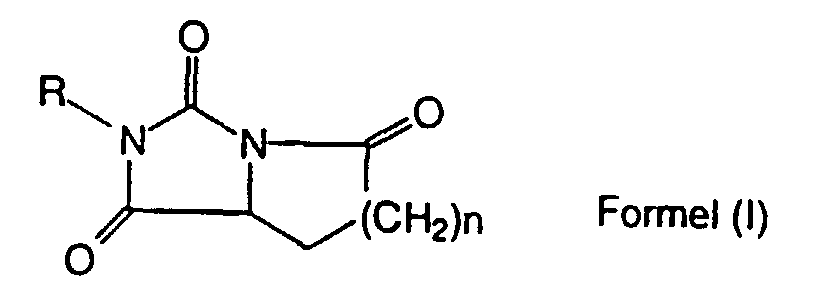
- n
- die Zahl 1 oder 2 und
- R
- Wasserstoff, (C1- bis C4)Alkyloxycarbonyl oder eine Acylgruppe der allgemeinen Formel R'-CO-, wobei
- R'
- für einen linearen oder verzweigten gesättigten oder ungesättigten Kohlenwasserstoffrest mit 1 bis 11 C-Atomen, dessen längste Kette durch eine oder mehrere Etherbrücken unterbrochen sein kann und der zusätzlich ein oder zwei Substituenten aus der Reihe Carboxy, C1- bis C3-Alkoxy, -N((C1-C3)alkyl)3 +Cl-, Phenyl oder mit ein oder zwei Carboxy- oder Sulfogruppen subtituiertes Phenyl aufweisen kann,
oder
für Phenyl oder ein- oder zweifach substituiertes Phenyl, wobei die Substituenten C1- bis C4-Alkyl, Carboxy, -SO3H, -NO2, -N((C1-C3)alkyl)3 +Cl- oder -CN sein können,
oder
für einen Rest der Formel (II)
- Die erfindungsgemäßen Hydantoinderivate waren bisher nicht bekannt. Überraschenderweise zeichnen sie sich durch eine wesentlich höhere Aktivatorleistung aus als vorbekannte und als Aktivatoren bekannte N,N'-Dialkanoyl-hydantoine, wie N,N'-Diacetyl-hydantoin. Erfindungsgemäße Aktivatoren auf der Basis der N-acylierten bicyclischen Hydantoinderivate bilden unter Testbedingungen bei 30 °C in Gegenwart von Natriumperborat-monohydrat (Pbmh) mehr als ein Äquivalent Persäure. Beispielsweise werden aus 2-Acetyl-dihydropyrrolo[1,2-c]imidazol-1,3,5-trion etwa 1,8 Äquivalente Persäure freigesetzt, wobei ein Teil auf Peressigsäure entfällt und ein Teil auf 3-(5-Hydantoinyl)perpropionsäure. Diese Persäurefreisetzungsrate war in Kenntnis der unbefriedigenden Persäurebildung aus vorbekannten N,N'-Dialkanoyl-hydantoinen nicht zu erwarten.
- Auch im für die Praxis bedeutsamen Waschtest von Geweben mit Testanschmutzungen wurde die überlegene Wirkung erfindungsgemäßer N-acylierter bicyclischer Hydantoinderivate bestätigt. Im Mittel von sechs unterschiedlichen Testanschmutzungen wird von einigen erfindungsgemäßen Aktivatoren, insbesondere jenen der Formel (I) mit n gleich 1 und R gleich Acetyl, Propionyl, Butyryl, Phenyl, o- oder p-Carboxyphenyl das Leistungsniveau des als Standart dienenden TAED nicht nur erreicht, sondern zum Teil deutlich überschritten.
- Einige Verbindungen auf der Basis des Dihydropyrrolo[1,2-c]imidazol-Ringsystems sind bekannt - gemäß US 5,110,823 Dihydropyrrolo[1,2-c]imidazol-3,5(1H,6H)-dion und dessen 1-Alkoxycarbonylderivate - jedoch ist das erfindungsgemäße Ringsystem durch eine weitere Carbonylgruppe im Imidazolring gekennzeichnet, welche für die Aktivatorwirkung der N-acylierten Verbindungen wichtig ist. Hinweise auf eine durch Perhydrolyse mögliche Ringöffnung und die Verwendbarkeit solcher Stoffe als Aktivatoren lassen sich diesem Dokument nicht entnehmen.
- Die erfindungsgemäßen Hydantoinderivate basieren auf Dihydro-pyrrolo[1,2-c]imidazol-1,3,5-trion (1) bzw. dessen 2-N-acylierten Derivaten, wenn n in der allgemeinen Formel (I) gleich 1 ist oder auf Tetrahydro-pyridino [1,2-c]imidazol-1,3,5-trion (8), wenn n gleich 2 ist.
- Bevorzugte Verbindungen sind solche mit n gleich 1, weil diese aus leicht zugänglichen Rohstoffen, nämlich Glutaminsäure oder Na-glutamat (fermentativ herstellbar), erhältlich sind, wohingegen sich Verbindungen mit n gleich 2 aus der 2-Aminoadipinsäure, die in an sich bekannter Weise synthetisch hergestellt werden kann, gewinnen lassen.
- Erfindungsgemäße Hydantoinderivate mit n gleich 1, welche in Form der möglichen Stereoisomeren oder Gemischen derselben vorliegen können, lassen sich aus fermentativ hergestellter L-Glutaminsäure oder Na-L-Glutamat oder aus synthetisch hergestellter D,L-Glutaminsäure oder dessen Salz herstellen. Nach Überführung der Säure in das Na-Salz, etwa durch Zugabe von Natronlauge in wäßriger Phase, schließt sich eine konventionelle Hydantoinsynthese an, vorzugsweise unter Verwendung eines Alkalicyanats: In wäßriger Phase wird Na-Glu mit MeOCN (Me = Li, Na, K) bei erhöhter Temperatur umgesetzt, anschließend das Reaktionsgemisch mit HCl behandelt, wobei die 3(Hydantoin-5-yl)-propionsäure (HPS) auskristallisiert. Zur Herstellung von (1) wird das vorgenannte Produkt (HPS) in Eisessig mit Essigsäureanhydrid umgesetzt. Die acylierten Verbindungen von (1), also Stoffe mit R = Acyl oder Alkoxycarbonyl, sind in für den Fachmann bekannter Weise durch Umsetzung von (1) mit einem Säurehalogenid oder -anhydrid zu gewinnen. Zur Acylierung von (1) wird (1) zweckmäßigerweise zunächst am Imidstickstoff deprotoniert - etwa mittels eines Alkalihydrids und dann in einem dipolaren Lösungsmittel mit dem Säurehalogenid umgesetzt.
- Erfindungsgemäße Hydantoinderivate der Formel (I) mit n gleich 2 lassen sich in prinzipiell analoger Weise, wie oben beschrieben, herstellen. 2-Aminoadipinsäure wird mittels eines Alkalicyanats in 4-(Hydantoin-5-yl)-buttersäure überführt; die Cyclisierung zum Tetrahydropyridinoring erfolgt wieder mittels wasserabspaltender Mittel, wie Essigsäureanhydrid. Die N-Acylierung des Imidstickstoffs erfolgt in bekannter Weise.
- Bezüglich ihrer Aktivierung werden die 2-N-acylierten Verbindungen von (1) beziehungsweise (8) bevorzugt. Die Bedeutung des Rests R' in der Acylgruppe R'-CO- kann sehr vielseitig sein und einen aliphatischen, olefinischen, cycloaliphatischen oder aromatischen Rest umfassen, wobei die genannten Reste selbst ein oder zwei Substituenten aus der bereits genannten Reihe aufweisen können. Besonders zweckmäßig steht R' für eine lineare Alkylgruppe mit 1 bis 11 C-Atomen, wie Methyl, Ethyl, Propyl, Butyl, Pentyl, Hexyl, Heptyl, Octyl, Decyl, Undecyl. Olefinische Kohlenwasserstoffreste, wie Vinyl, Allyl, Propen-2-yl, sind möglich, werden aber weniger bevorzugt. Die Zahl und Größe der Substituenten am Kohlenwasserstoffrest wird im allgemeinen niedrig gehalten, um das Molekulargewicht der resultierenden Percarbonsäure zu begrenzen. Als aromatischer Rest R' wird außer Phenyl substituiertes Phenyl mit vorzugsweise einer oder zwei Carboxy- oder Sulfogruppen bevorzugt.
- Besonders bevorzugte Verbindungen sind die von (1) abgeleiteten N-Acylhydantoine mit einer C2- bis C9-n-Alkanoyl- oder einer Benzoyl- oder o- oder p-Carboxybenzoylgruppe; unter diese Gruppe fallen die Aktivatoren (2) bis (5) gemäß den Beispielen 2 bis 5.
- Verbindungen vom Formeltyp (II) sind besonders zweckmäßig, wenn n für 2, 3, 4 und 10 steht. Die zur Herstellung dieser Verbindungen erforderlichen Dicarbonsäuren, nämlich Bernsteinsäure, Glutarsäure, Adipinsäure und Dodecandisäure, deren Dichloride mit 2 Mol Dihydropyrrolo[1,2-c]imidazol-1,3,5-trion unter Bildung von (II) umgesetzt werden, sind leicht verfügbar. Beispielsweise läßt sich N,N'-Dodecan-1,12-dioyl-di-2-(dihydropyrrolo[1,2-c]imidazol-1,3,5-trion, aus welchem in Gegenwart von Wasserstoffperoxid die als besonders bleichwirksam bekannte Diperoxydodecandisäure in situ gebildet wird, aus 3-(Hydantoin-5-yl)-propionsäure und dem α,ω-Dodecandicarbonsäuredichlorid herstellen.
- Die erfindungsgemäße Verwendung betrifft die Aktivierung anorganischer Persauerstoffverbindungen, insbesondere H2O2 und solche Verbindungen, welche in wäßriger Phase Wasserstoffperoxid freisetzen. Hervorzuheben sind Perborate, insbesondere Natriumperborat-monohydrat, Natriumperborat-tetrahydrat, superoxidiertes Natriumperborat, und Natriumpercarbonat (2 Na2CO3·3 H2O2). Einsetzbar sind auch Perphosphate, Persilikate und Persulfate. Bei der Aktivierung können auch mehrere anorganische Perverbindungen zugegen sein.
- Bei der Verwendung werden anorganische Persauerstoffverbindungen und Aktivatoren in einem Verhältnis von 1 Mol Aktivsauerstoff zu 0,05 bis 1 Mol, vorzugsweise 1 zu 0,1 bis 0,5 Mol Aktivator eingesetzt.
- Die erfindungsgemäß zu verwendenden Aktivatoren können zur Aktivierung in reiner Form oder mit Hilfsstoffen, wie Granulierhilfsmitteln, Stabilisatoren, pH-regulierenden Stoffen, eingesetzt werden; geeignete Zugabeformen sind Pulver, Pasten, Tabletten, Granulate oder umhüllte Granulate.
- Je nach Verwendungszweck können die Aktivatoren und anorganischen Persauerstoffverbindungen außer in rein wäßriger Phase auch in wäßrig-organischer Phase zum Einsatz kommen. Ein rein wäßriges Milieu liegt bei den üblichen Wasch-, Bleich- und Reinigungsflotten vor. Ein wäßrigorganisches Milieu kann bei Anwendungen zur Desinfektion sowie bei technischen Oxidationsprozessen zweckmäßig sein.
- Der pH-Wert des Reaktionsmediums kann zwischen etwa 4 und 13 liegen, vorzugsweise wird aber im alkalischen Bereich, meist bei pH 8 bis 11, gearbeitet, da in diesem Bereich sowohl die in situ-Bildung der organischen Persäure gut abläuft als auch die Stabilität der Perverbindungen befriedigend ist.
- Ein weiterer Gegenstand der Erfindung richtet sich auf Bleich-, Wasch-, Reinigungs- und Desinfektionsmittel, welche eine anorganische Persauerstoffverbindung und einen Aktivator aus der Reihe der erfindungsgemäßen Hydantoinderivate der Formel (I) oder (II) enthalten.
- In den Mitteln können ein oder mehrere anorganische Persauerstoffverbindungen sowie ein oder mehrere Aktivatoren, darunter mindestens ein erfindungsgemäßer und bei Bedarf auch handelsübliche oder andere vorbekannte Aktivatoren enthalten sein.
- Erfindungsgemäße Aktivatoren und anorganische Persauerstoffverbindungen können mit allen üblichen Bestandteilen von Wasch- und Bleichmitteln kombiniert werden, um zu Wasch- und Bleichmitteln zu gelangen, welche zur Textilbehandlung im Nieder- und Mitteltemperaturbereich, aber auch zur Kochwäsche geeignet sind.
- Hauptbestandteile solcher Wasch- und Bleichmittel sind, neben den erwähnten Perverbindungen und Aktivatoren, Gerüststubstanzen (Builder) und Tenside. Unter den Buildern sind insbesondere Natriumaluminiumsilikate (Zeolithe), kondensierte Phosphate, Alkalisilikate, Alkalicarbonate, komplexierende Aminocarbonsäuren, Polyphosphonsäuren, mehrwertige Hydroxycarbonsäuren sowie Polycarbonsäuren und Salze der genannten Säuren zu nennen. Unter den Tensiden sind insbesondere nichtionische Tenside, wie Fettalkohol- und Alkylphenol-polyethylenglykolether sowie langkettige Alkylglykoside, und anionische Tenside, wie Alkylbenzolsulfonate und Sulfate von Fettalkoholen und Polyethylenglykolmonoethern, hervorzuheben. Weitere Stoffe der Wasch- und Bleichmittel sind Elektrolyte, pH-regulierende Stoffe, Stabilisatoren, Schaumregulatoren, Vergrauungsinhibitoren, optische Aufheller, Enzyme, Avivagemittel. Die in derartigen Mitteln zu verwendenden Stoffe und Einsatzmengen sind dem Fachmann bekannt - eine Übersicht nebst Literatur vermittelt H.G. Hauthal in "Chemie in unserer Zeit" 26 (1992) Nr.6, 293-303).
- Üblicherweise setzen sich erfindungsgemäße Wasch- und Bleichmittel etwa wie folgt zusammen:
- 5 bis 30 Gew.-%,
- vorzugsweise 10 bis 25 Gew.-% anionische und/oder nichtionische Tenside,
- 5 bis 60 Gew.-%,
- vorzugsweise 20 bis 40 Gew.-% Gerüstsubstanzen aus der Gruppe Natriumaluminiumsilikate, kondensierte Phosphate, Alkalisilikate, Alkalicarbonate, und deren Mischungen,
- 0 bis 20 Gew.-%,
- vorzugsweise 1 bis 8 Gew.-% Gerüstsubstanzen aus der Gruppe komplexierender Aminocarbonsäuren, Polyphosphonsäuren, Polycarbonsäuren oder deren Salze sowie deren Mischungen,
- 2 bis 35 Gew.-%,
- vorzugsweise 10 bis 25 Gew.-% anorganische Persauerstoffverbindungen aus der Gruppe Natriumperborate und Natriumpercarbonat,
- 0,3 bis 20 Gew.-%,
- vorzugsweise 1 bis 10 Gew.-% erfindungsgemäße Hydantoinderivate, vorzugsweise N-acylierte Hydantoinderivate der Formel (I) mit n gleich 1 als Aktivatoren
- ad 100 %
- übliche Hilfsstoffe und Wasser
- Reine Bleichmittel, wie sie als Zusatzmittel für bleichmittelfreie Waschmittel zur Anwendung gelangen können, setzen sich im allgemeinen wie folgt zusammen:
- 5 bis 50 Gew.-%,
- insbesondere 15 bis 35 Gew.-%, anorganische Persauerstoffverbindungen, insbesondere Na-perborat-monohydrat oder - tetrahydrat oder/und Natriumpercarbonat,
- 2 bis 50 Gew.-%,
- insbesondere 5 bis 25 Gew.-% erfindungsgemäße Hydantoinderivate, vorzugsweise N-acylierte Hydantoinderivate der Formel (I) mit n gleich 1 als Aktivatoren,
- 0 bis 5 Gew.-%
- Peroxidstabilisatoren, wie Wasserglas und Komplexbildner,
- 0 bis 40 Gew.-%
- pH-regulierende Mittel
- ad 100 Gew.-%
- andere übliche Hilfsstoffe.
- Erfindungsgemäße Reinigungsmittel enthalten im allgemeinen Tenside, Builder, Persauerstoffverbindungen und erfindungsgemäße Aktivatoren; Scheuermittel enthalten zusätzlich abrasiv wirkende Bestandteile.
- Erfindungsgemäße Desinfektionsmittel basieren im allgemeinen auf einer Kombination aus anorganischen Perverbindungen und erfindungsgemäße Aktivatoren sowie Hilfsstoffen aus der Reihe der Stabilisatoren, Tenside, pH-regulierenden Stoffe und, sofern erwünscht, organischen Lösungsmitteln und anderen mikrobioziden Stoffen als die aus den Aktivatoren und Perverbindungen entstehenden Persäuren.
- Ein Gemisch aus 130 g (0,76 Mol) 3-(Hydantoin-5-yl)propionsäure, 79 g (0,74 Mol) Essigsäureanhydrid und 250 g Eisessig wurden 24 h unter Rückfluß erhitzt und anschließend die Reaktionsmischung auf Raumtemperatur abgekühlt. Der ausgefallene Niederschlag wurde abfiltriert und getrocknet. Man erhielt 76 g (66 % d. Th.) als farblosen Feststoff.
Die 1H-NMR-spektroskopischen Daten stehen mit der Struktur im Einklang. - 17 g (0,1 Mol) 3-(Hydantoin-5-yl)propionsäure und 60 g (0,6 Mol) Essigsäureanhydrid wurden 3 h unter Rückfluß erhitzt. Durch Destillation unter Normalbedingungen entfernte man 40 ml des Lösungsmittels und ließ die Reaktionslösung bei Raumtemperatur stehen. Der ausgefallene Niederschlag wurde abgesaugt, mit Methanol gewaschen und getrocknet. Man erhielt 13,8 g (71 % d. Th.) als farblos kristallinen Feststoff.
Die 1H-NMR-spektroskopischen Daten stehen mit der Struktur im Einklang. - 4 g (26 mMol) Dihydro-pyrrolo[1,2-c]imidazol-1,3,5-trion (1) wurden in 30 ml Dimethylformamid gelöst, bei Eisbadtemperatur portionsweise mit 0,69 g (29 mMol) Natriumhydrid versetzt und 1 h bei Raumtemperatur gerührt. Anschließend tropfte man 4,8 g (27 mMol) Nonanoylchlorid in 10 ml Dimethylformamid zu und ließ 2 h bei Raumtemperatur und 1 h bei 80 °C rühren. Danach entfernte man weitgehend das Lösungsmittel im Rotationsverdampfer (70 °C, 10 mbar) und nahm den Rückstand in Methylenchlorid auf. Die Suspension wurde mit Wasser gewaschen, die organische Phase getrocknet (MgSO4) und nach Entfernen des Lösungsmittels im Rotationsverdampfer der Rückstand aus Ethanol umkristallisiert. Man erhielt 3 g als Feststoff.
Die 1H-NMR-spektroskopischen Daten stehen mit der Struktur im Einklang. - Analog Beispiel 3 wurde (1) (aus Beispiel 1) zunächst innerhalb 2 h in DMF bei 20 °C mit NaH deprotoniert und anschließend bei 20 °C mit Propionylchlorid umgesetzt; Nachreaktion 2 h bei 80 °C; Aufarbeitung wie Beispiel 3. Man erhält (4) (gemäß 1H-NMR-Spektrum) als kristallinen Feststoff.
- Analog Beispiel 4 wurde (1) mit NaH und Benzoylchlorid umgesetzt, woraus der feste Stoff (5) resultierte.
- Analog Beispiel 4 wurde (1) mit NaH und Chlorameisensäureethylester umgesetzt, woraus gemäß 1H-NMR-Spektrum (6) in Form eines viskosen Öls erhalten wurde.
- L-Glutaminsäure (Glu), gewonnen durch Fermentation, wurde mittels Natronlauge in Wasser in Natrium-L-glutamat überführt. Anschließend wurde in Wasser mit Natriumcyanat (20 Mol-% Überschuß) 2 h bei 80 bis 85 °C behandelt. Das Reaktionsgemisch wurde mit konz. HCl auf pH 0 gestellt und 2 h unter Rückfluß gekocht. Nach dem Abkühlen wird kristallines (7) in üblicher Weise isoliert.
- Zu jeweils 1 Liter Wasser, auf 30 °C temperiert, wurden 8 g bleichmittelfreies zeolithhaltiges Waschmittel-Turmpulver, 1,5 g Natriumperborat-monohydrat (Pbmh) und 0,5 g Aktivator zugegeben. In bestimmten Zeitabständen wurden 100 ml-Proben entnommen, diese sofort auf ein Gemisch aus 250 g Eis und 15 ml Eisessig gegeben und anschließend nach Zugabe von Kaliumjodid mit 0,1 n Natriumthiosulfatlösung und Stärke als Indikator titriert. Unter den angegebenen Bedingungen wurden nur die in situ gebildeten Persäuren erfaßt. Die Ergebnisse - Gehalt Äquivalente Persäure in Zeitabhängigkeit - folgen aus Tabelle 1.
Tabelle 1: Persäurebildung und -stabilität bei 30 °C Aktivator gemäß Beispiel (1) (2) (3) (4) (5) (6) (VB) Zeit (Min) Persäure - Äquivalente (gemessen) 2 0,50 1,45 0,22 1,31 0,58 0,12 0,78 10 0,90 1,85 0,54 1,70 1,21 0,41 0,91 20 0,92 1,82 0,81 1,72 1,45 0,72 0,90 30 0,89 1,75 0,90 1,63 1,54 0,94 0,88 40 0,86 1,65 1,00 1,59 1,54 1,05 50 1,05 1,52 1,10 - Aus dem Gehalt an Persäure in Zeitabhängigkeit folgt, daß der vorbekannte Aktivator Diacetylhydantoin (VB) anstelle der theoretisch möglichen 2 Äquivalente nur etwa 0,9 Äquivalente Persäure bildet, wogegen bevorzugte erfindungsgemäße Aktivatoren mit R = Acyl bis zu 1,85 Äquivalente Persäure gebildet werden.
- Bleichleistung der Aktivatoren
Dihydropyrrolo[1,2-c]imidazol-1,3,5-trion (1) 2-Acetyldihydro-pyrrolo[1,2-c]imidazol-1,3,5-trion (2) und zum Vergleich Diacetylhydantoin (VB) sowie TAED bei 40 °C. - Untersucht wurde die Bleichwirkung an sechs
Testanschmutzungen auf Baumwolle (Bandy-black-Lehm; WFK-BW: Tee, Curry, Rotwein, Kaffee, Tomatenketchup) im Launderometer (Atlas).
Temperatur: 40 °C
Zugabemengen: Waschmittelbestandteile in g/l FlotteAlkylbenzolsulfonate 0,52 Fettalkoholethoxylate 0,35 Seife 0,10 Zeolith A 1,52 Polycarboxylate 0,18 Soda 0,76 Na- und Mg-silikate 0,24 CMC 0,06 Hilfsstoffe (insgesamt) 0,07 Na-perborat-monohydrat 0,71 g/l Aktivator 0,24 g/l
Flottenverhältnis: 1 : 20
Waschflotte: 200 ml
Waschzeit: 15 Min. (Laborwaschgerät)
Wasserhärte: 14 °d
Spülen: 3 x 30 s - Die aus den Testanschmutzungen ermittelte Bleichwirkung (arithmetisches Mittel), angegeben als % Remissionszunahme (Bestimmung bei 460 nm; Datacolor Elrepho 2000; Xenonlampe, UV-Sperrfilter 420 nm; BaSO4 als Standard (100 %)), folgt aus der Tabelle:
Aktivator % Remissionszunahme (1) 12,9 (2) 14,1 (VB) 13,7 (TAED) 14,4 - Der erfindungsgemäße Aktivator (2) erreicht im Mittel etwa die Bleichleistung des TAED.
- Gewebe mit Testanschmutzungen sowie Meßmethode der Remissionszunahme wie Beispiel 9.
- Die Prüfung erfolgt im Launderometer (Typ Atlas) unter Verwendung eines bleichmittel- und aktivatorfreien handelsüblichen Waschmittels aus dem US-Markt (TIDE-Ultra®).
- Waschflotte:
- 200 ml
- Wasserhärte:
- 5 °d
- Temperatur:
- 30 °C
- Spülen:
- Leitungswasser 3*30 s
- Flottenverhältnis:
- 1 : 20 Ca:Mg = 2,7 : 1
- Waschzeit:
- 15 Min.
- Einsatzmengen (g) pro Waschflotte:
Waschmittel 0,27 Na-perborat-monohydrat 0,015 Aktivator 0,015 - Die Remissionszunahme in % (arithemetisches Mittel aus den sechs Testanschmutzungen) folgen aus der Tabelle:
Aktivator % Remissionszunahme (2) 9,2 (VB) 8,8 (TAED) 8,7 - Der erfindungsgemäße Aktivator (1) zeigt unter diesen Waschbedingungen gegenüber den Vergleichsprodukten eine überlegene Bleichleistung.
Claims (8)
- Hydantoinderivate der allgemeinen Formel (I)
 n die Zahl 1 oder 2 undR Wasserstoff, (C1- bis C4)Alkyloxycarbonyl oder eine Acylgruppe der allgemeinen Formel R'-CO-, wobeiR' für einen linearen oder verzweigten gesättigten oder ungesättigten Kohlenwasserstoffrest mit 1 bis 11 C-Atomen, dessen längste Kette durch eine oder mehrere Etherbrücken unterbrochen sein kann und der zusätzlich ein oder zwei Substituenten aus der Reihe Carboxy, C1- bis C3-Alkoxy, -N((C1-C3)alkyl)3 +Cl-, Phenyl oder mit ein oder zwei Carboxy- oder
Sulfogruppen subtituiertes Phenyl aufweisen kann,
oder
für Phenyl oder ein- oder zweifach substituiertes Phenyl, wobei die Substituenten C1- bis C4-Alkyl, Carboxy, -SO3H, -NO2, -N((C1-C3)alkyl)3 +Cl- oder -CN sein können,
oder
für einen Rest der Formel (II)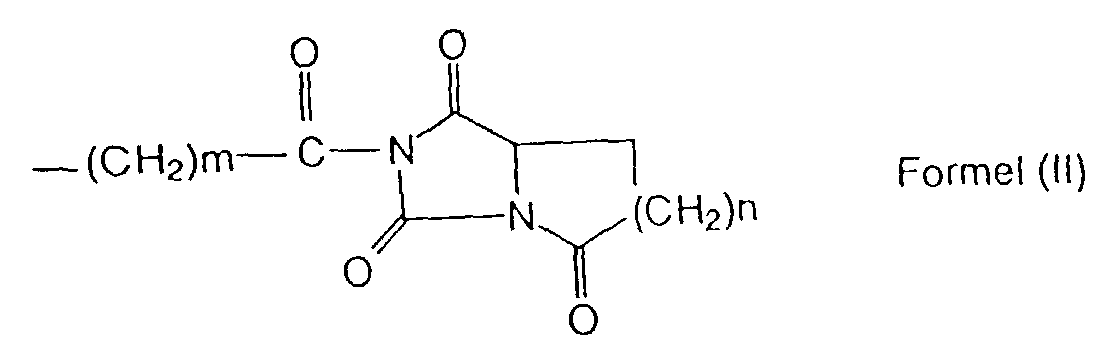
- Hydantoinderivate nach Anspruch 1,
dadurch gekennzeichnet,
daß der Rest R Acetyl, Propionyl, Butyryl, Benzoyl oder o- oder p-Carboxybenzoyl ist. - Verwendung der Hydantoinderivate gemäß Anspruch 1 oder 2 als Aktivator für anorganische Persauerstoffverbindungen.
- Verwendung nach Anspruch 3,
dadurch gekennzeichnet,
daß als Aktivator ein solcher gemäß Anspruch 2 und als anorganische Persauerstoffverbindung Wasserstoffperoxid, ein Perborat oder Percarbonat eingesetzt wird. - Bleich-, Wasch-, Reinigungs- oder Desinfektionsmittel, enthaltend eine anorganische Persauerstoffverbindung und einen Aktivator,
dadurch gekennzeichnet,
daß es als Aktivator ein Hydandoinderivat gemäß Anspruch 1 enthält. - Mittel nach Anspruch 5,
dadurch gekennzeichnet,
daß es pro Mol Aktivsauerstoff 0,05 bis 1 Mol Aktivator enthält. - Mittel nach Anspruch 5 oder 6,
dadurch gekennzeichnet,
daß es als anorganische Persauerstoffverbindung ein Perborat oder Percarbonat enthält. - Mittel nach einem der Ansprüche 5 bis 7,
dadurch gekennzeichnet,
daß es als Aktivator 2-Acetyl-, 2-Propionyl-, 2-Butytyl-, 2-Benzoyl-, 2-o- oder p-Carboxybenzoyldihydro-pyrrolo[1,2-c]imidazol-1,3,5-trion enthält.
Applications Claiming Priority (3)
| Application Number | Priority Date | Filing Date | Title |
|---|---|---|---|
| DE4338920 | 1993-11-15 | ||
| DE4338920A DE4338920A1 (de) | 1993-11-15 | 1993-11-15 | Hydantoinderivate und deren Verwendung als Bleichaktivator |
| PCT/EP1994/002568 WO1995014021A1 (de) | 1993-11-15 | 1994-08-03 | Hydantoinderivate und deren verwendung als bleichaktivator |
Publications (2)
| Publication Number | Publication Date |
|---|---|
| EP0724585A1 EP0724585A1 (de) | 1996-08-07 |
| EP0724585B1 true EP0724585B1 (de) | 1997-05-21 |
Family
ID=6502599
Family Applications (1)
| Application Number | Title | Priority Date | Filing Date |
|---|---|---|---|
| EP94924837A Expired - Lifetime EP0724585B1 (de) | 1993-11-15 | 1994-08-03 | Hydantoinderivate und deren verwendung als bleichaktivator |
Country Status (3)
| Country | Link |
|---|---|
| EP (1) | EP0724585B1 (de) |
| DE (2) | DE4338920A1 (de) |
| WO (1) | WO1995014021A1 (de) |
Families Citing this family (1)
| Publication number | Priority date | Publication date | Assignee | Title |
|---|---|---|---|---|
| US5814233A (en) * | 1997-11-10 | 1998-09-29 | Great Lakes Chemical Corporation | Compositions and methods for treating water |
Family Cites Families (1)
| Publication number | Priority date | Publication date | Assignee | Title |
|---|---|---|---|---|
| DE1802576A1 (de) * | 1967-11-01 | 1969-08-07 | Colgate Palmolive Co | Bleich- und Waschmittel |
-
1993
- 1993-11-15 DE DE4338920A patent/DE4338920A1/de not_active Withdrawn
-
1994
- 1994-08-03 WO PCT/EP1994/002568 patent/WO1995014021A1/de not_active Ceased
- 1994-08-03 EP EP94924837A patent/EP0724585B1/de not_active Expired - Lifetime
- 1994-08-03 DE DE59402849T patent/DE59402849D1/de not_active Expired - Fee Related
Also Published As
| Publication number | Publication date |
|---|---|
| DE4338920A1 (de) | 1995-05-18 |
| WO1995014021A1 (de) | 1995-05-26 |
| DE59402849D1 (de) | 1997-06-26 |
| EP0724585A1 (de) | 1996-08-07 |
Similar Documents
| Publication | Publication Date | Title |
|---|---|---|
| EP0729503A1 (de) | Aktivatoren für anorganische persauerstoffverbindungen | |
| DE3886969T2 (de) | Quartäre Ammonium- oder Phosphonium-Peroxycarbonsäure-Prekursoren und ihre Verwendung in Detergensbleichmittelzusammensetzungen. | |
| DE69419432T2 (de) | Bleichmittelzusammensetzungen | |
| DE69115959T2 (de) | Bleichende Verbindungen und Zusammensetzungen | |
| DE3823172A1 (de) | Imidoperoxycarbonsaeuren, verfahren zu deren herstellung und deren verwendung | |
| DE19620411A1 (de) | Übergangsmetallamminkomplexe als Aktivatoren für Persauerstoffverbindungen | |
| DE19616693A1 (de) | Enolester als Bleichaktivatoren für Wasch- und Reinigungsmittel | |
| WO1996017920A1 (de) | Aktivatormischungen für anorganische perverbindungen | |
| DE19529905A1 (de) | Aktivatorkomplexe für Persauerstoffverbindungen | |
| DE602004005839T2 (de) | Waschmittelzusammensetzungen | |
| DE69019221T2 (de) | Polyglykolat-Persäurevorläufer und diese enthaltende Waschmittelzusammensetzungen. | |
| DE19518039A1 (de) | Verwendung von heterocyclischen Verbindungen als Aktivatoren für anorganische Perverbindungen | |
| EP0825251A2 (de) | Sulphonylimin-Derivate als Bleichkatalysatoren | |
| EP0373546B1 (de) | Verwendung von triacylierten Ethanolaminen als flüssige, wassermischbare Peroxidaktivatoren | |
| DE3906768A1 (de) | Peroxycarbonsaeuren und deren verwendung | |
| EP0512432B1 (de) | Imidocarbonsäureaktivatoren und Sulfimidocarbonsäureaktivatoren, Verfahren zu deren Herstellung und deren Verwendung | |
| EP0075751A2 (de) | Triazolidin-3,5-dione als Aktivatoren für Perverbindungen | |
| EP0528900B1 (de) | Aktivatoren für anorganische perverbindungen | |
| EP0698661A2 (de) | Aktivatoren für anorganische Peroxoverbindungen und sie enthaltende Mittel | |
| WO1995014021A1 (de) | Hydantoinderivate und deren verwendung als bleichaktivator | |
| EP0332050A1 (de) | Aktivatoren für anorganische Perverbindungen | |
| EP0485927A1 (de) | Sulfimidoperoxicarbonsäuren | |
| DE3304848A1 (de) | Organische cyanamidverbindungen als aktivatoren fuer anorganische perverbindungen | |
| DE69114616T2 (de) | Bleich- und Waschmittel. | |
| EP0733701A1 (de) | Aktivatoren für Peroxoverbindungen und sie enthaltende Mittel |
Legal Events
| Date | Code | Title | Description |
|---|---|---|---|
| PUAI | Public reference made under article 153(3) epc to a published international application that has entered the european phase |
Free format text: ORIGINAL CODE: 0009012 |
|
| 17P | Request for examination filed |
Effective date: 19960327 |
|
| AK | Designated contracting states |
Kind code of ref document: A1 Designated state(s): DE FR GB IT |
|
| GRAG | Despatch of communication of intention to grant |
Free format text: ORIGINAL CODE: EPIDOS AGRA |
|
| 17Q | First examination report despatched |
Effective date: 19960819 |
|
| GRAH | Despatch of communication of intention to grant a patent |
Free format text: ORIGINAL CODE: EPIDOS IGRA |
|
| GRAH | Despatch of communication of intention to grant a patent |
Free format text: ORIGINAL CODE: EPIDOS IGRA |
|
| GRAA | (expected) grant |
Free format text: ORIGINAL CODE: 0009210 |
|
| AK | Designated contracting states |
Kind code of ref document: B1 Designated state(s): DE FR GB IT |
|
| PG25 | Lapsed in a contracting state [announced via postgrant information from national office to epo] |
Ref country code: GB Effective date: 19970521 |
|
| REF | Corresponds to: |
Ref document number: 59402849 Country of ref document: DE Date of ref document: 19970626 |
|
| ET | Fr: translation filed | ||
| GBV | Gb: ep patent (uk) treated as always having been void in accordance with gb section 77(7)/1977 [no translation filed] |
Effective date: 19970521 |
|
| PLBE | No opposition filed within time limit |
Free format text: ORIGINAL CODE: 0009261 |
|
| STAA | Information on the status of an ep patent application or granted ep patent |
Free format text: STATUS: NO OPPOSITION FILED WITHIN TIME LIMIT |
|
| PG25 | Lapsed in a contracting state [announced via postgrant information from national office to epo] |
Ref country code: FR Free format text: LAPSE BECAUSE OF NON-PAYMENT OF DUE FEES Effective date: 19980430 |
|
| PG25 | Lapsed in a contracting state [announced via postgrant information from national office to epo] |
Ref country code: DE Free format text: LAPSE BECAUSE OF NON-PAYMENT OF DUE FEES Effective date: 19980501 |
|
| 26N | No opposition filed | ||
| REG | Reference to a national code |
Ref country code: FR Ref legal event code: ST |
|
| PG25 | Lapsed in a contracting state [announced via postgrant information from national office to epo] |
Ref country code: IT Free format text: LAPSE BECAUSE OF NON-PAYMENT OF DUE FEES;WARNING: LAPSES OF ITALIAN PATENTS WITH EFFECTIVE DATE BEFORE 2007 MAY HAVE OCCURRED AT ANY TIME BEFORE 2007. THE CORRECT EFFECTIVE DATE MAY BE DIFFERENT FROM THE ONE RECORDED. Effective date: 20050803 |