EP0725246B1 - Eversiondüse und Verfahren zur Reparatur von einem unterirdischen Rohr - Google Patents
Eversiondüse und Verfahren zur Reparatur von einem unterirdischen Rohr Download PDFInfo
- Publication number
- EP0725246B1 EP0725246B1 EP95300628A EP95300628A EP0725246B1 EP 0725246 B1 EP0725246 B1 EP 0725246B1 EP 95300628 A EP95300628 A EP 95300628A EP 95300628 A EP95300628 A EP 95300628A EP 0725246 B1 EP0725246 B1 EP 0725246B1
- Authority
- EP
- European Patent Office
- Prior art keywords
- nozzle
- eversion
- eversion nozzle
- liner bag
- tubular
- Prior art date
- Legal status (The legal status is an assumption and is not a legal conclusion. Google has not performed a legal analysis and makes no representation as to the accuracy of the status listed.)
- Expired - Lifetime
Links
- 238000000034 method Methods 0.000 title claims description 25
- XLYOFNOQVPJJNP-UHFFFAOYSA-N water Substances O XLYOFNOQVPJJNP-UHFFFAOYSA-N 0.000 claims description 33
- 239000011347 resin Substances 0.000 claims description 15
- 229920005989 resin Polymers 0.000 claims description 15
- 239000012530 fluid Substances 0.000 claims description 14
- 239000007788 liquid Substances 0.000 claims description 14
- 229920001187 thermosetting polymer Polymers 0.000 claims description 7
- 238000005192 partition Methods 0.000 claims description 5
- 230000002950 deficient Effects 0.000 description 3
- 238000007796 conventional method Methods 0.000 description 2
- 238000010438 heat treatment Methods 0.000 description 2
- 239000000463 material Substances 0.000 description 2
- 239000004698 Polyethylene Substances 0.000 description 1
- 239000002250 absorbent Substances 0.000 description 1
- 230000015572 biosynthetic process Effects 0.000 description 1
- 230000000694 effects Effects 0.000 description 1
- 239000004744 fabric Substances 0.000 description 1
- 230000005484 gravity Effects 0.000 description 1
- 230000003116 impacting effect Effects 0.000 description 1
- 238000003780 insertion Methods 0.000 description 1
- 230000037431 insertion Effects 0.000 description 1
- 239000004033 plastic Substances 0.000 description 1
- 229920003023 plastic Polymers 0.000 description 1
- 239000002985 plastic film Substances 0.000 description 1
- 229920006255 plastic film Polymers 0.000 description 1
- 229920000728 polyester Polymers 0.000 description 1
- -1 polyethylene Polymers 0.000 description 1
- 229920000573 polyethylene Polymers 0.000 description 1
- 229920002635 polyurethane Polymers 0.000 description 1
- 239000004814 polyurethane Substances 0.000 description 1
Images




Classifications
-
- F—MECHANICAL ENGINEERING; LIGHTING; HEATING; WEAPONS; BLASTING
- F16—ENGINEERING ELEMENTS AND UNITS; GENERAL MEASURES FOR PRODUCING AND MAINTAINING EFFECTIVE FUNCTIONING OF MACHINES OR INSTALLATIONS; THERMAL INSULATION IN GENERAL
- F16L—PIPES; JOINTS OR FITTINGS FOR PIPES; SUPPORTS FOR PIPES, CABLES OR PROTECTIVE TUBING; MEANS FOR THERMAL INSULATION IN GENERAL
- F16L55/00—Devices or appurtenances for use in, or in connection with, pipes or pipe systems
- F16L55/18—Appliances for use in repairing pipes
-
- F—MECHANICAL ENGINEERING; LIGHTING; HEATING; WEAPONS; BLASTING
- F16—ENGINEERING ELEMENTS AND UNITS; GENERAL MEASURES FOR PRODUCING AND MAINTAINING EFFECTIVE FUNCTIONING OF MACHINES OR INSTALLATIONS; THERMAL INSULATION IN GENERAL
- F16L—PIPES; JOINTS OR FITTINGS FOR PIPES; SUPPORTS FOR PIPES, CABLES OR PROTECTIVE TUBING; MEANS FOR THERMAL INSULATION IN GENERAL
- F16L55/00—Devices or appurtenances for use in, or in connection with, pipes or pipe systems
- F16L55/16—Devices for covering leaks in pipes or hoses, e.g. hose-menders
- F16L55/162—Devices for covering leaks in pipes or hoses, e.g. hose-menders from inside the pipe
- F16L55/165—Devices for covering leaks in pipes or hoses, e.g. hose-menders from inside the pipe a pipe or flexible liner being inserted in the damaged section
- F16L55/1651—Devices for covering leaks in pipes or hoses, e.g. hose-menders from inside the pipe a pipe or flexible liner being inserted in the damaged section the flexible liner being everted
Definitions
- the present invention relates to an eversion nozzle, a method for everting a tubular liner bag by means of the nozzle, and a method for repairing an underground tubular conduit by lining the inner wall of the tubular conduit with the tubular liner bag.
- this method of conduit repair comprises inserting a sufficiently long tubular flexible liner bag into the tubular conduit to be repaired by means of a pressurized fluid, such as air or water.
- the tubular liner bag is made of a flexible resin-absorbent material impregnated with a thermosetting liquid resin, and has the outer surface covered with an impermeable plastic film.
- the tubular flexible liner bag is closed at one end and open at the other; the tubular flexible liner bag is first flattened, then the closed end of the tubular liner bag is tied to a control rope; the open end of the tubular liner bag is made to gape wide and hooked (anchored) at the end of the defective or old tubular conduit in a manner such that the wide-opened end of the liner completely and fixedly covers and closes the conduit end; a portion of the liner is pushed into the conduit; then, pressurized fluid is applied to the said portion of the tubular liner such that the fluid urges the tubular liner to enter the conduit.
- the everted tubular liner is pressed against the inner wall of the conduit by the said pressurized fluid, and the tubular flexible liner is hardened as the thermosetting liquid resin impregnated in the liner is heated, which is effected by heating the fluid filling the tubular liner bag by means of a hot steam, etc. It is thus possible to line the inside wall of the defective or old conduit with a rigid liner without digging the ground and disassembling the conduit sections.
- an eversion nozzle such as the nozzle 101 shown in Fig. 14 of the accompanying drawings has been employed for the purpose of causing the tubular liner bag to evert more effectively.
- the eversion nozzle 101 which is an elbow pipe having a right-angled bend, is installed in the bottom of a manhole 108, and the open end of the liner bag 106 is passed through the nozzle 101 from the inlet port and turned inside out at the outlet port thereof to wrap over the brim of the outlet port and fixed thereat.
- the inlet port of the eversion nozzle 101 is fixed the lower end of a guide tube 107.
- That portion of the tubular liner bag 106 yet to be turned inside out (everted) is suspended inside the eversion nozzle 101 and the guide tube 107 and its closed end portion is coiled on the ground ready to reel off.
- the upper end of the guide tube 107 is fixed at a support frame 111 installed on the ground.
- one end of a draining hose 110 is connected to the eversion nozzle 101, and the other end of the draining hose 110 is held over a water tank 137 to pour water therein.
- the tubular liner bag 106 is caused by the water head to evert into the tubular conduit 113, as indicated by the arrows in the conduit 113.
- a manhole to a sewer pipe is designed to have a smaller diameter at the entrance than inside.
- the interior diameter d 1 is 900 mm and the entrance diameter d 2 is only 600 mm.
- the length L of the nozzle ought to be substantially smaller than the entrance diameter d 2 of the manhole 108.
- the length L of a nozzle is designed to be at least twice as great as the inner diameter D thereof, so that when the entrance diameter of the manhole is 600 mm, the length L must be less than 600 mm and hence the inner diameter D of the nozzle must be substantially smaller than 300 mm. Consequently, the tubular liner bag that can pass the nozzle must have an outer diameter less than 30 mm. For this reason, the conventional eversion nozzle 101 could not be used in the cases where the inner diameter of the tubular conduit to be repaired is 300 mm or greater.
- the present invention aims to overcome the above problems, and it is, therefore, an object of the invention to provide a new eversion nozzle and a new method for everting a tubular liner bag with which it becomes possible to line a tubular conduit having a relatively large diameter without wasting much of the length of the tubular liner bag.
- a new method of repairing a tubular liner conduit is also proposed in this invention.
- EP-A-650006 discloses an eversion nozzle (7) to be used in the operation of repairing an underground tubular conduit (1) by lining the inner wall of the tubular conduit with an everted tubular liner bag (4) impregnated with a hardenable liquid resin, wherein the relation of the inner diameter and the length of the nozzle is around 1.
- EP-A-650006 discloses a method for repairing a tubular conduit (1) by lining the inner wall of the tubular conduit with an everted tubular liner bag (4) impregnated with thermosetting liquid resin, comprising the steps of: preparing a hollow eversion nozzle (7); passing the open end of the tubular liner bag (4) through the eversion nozzle (7) from the inlet side of the eversion nozzle and turning the open end of the tubular liner bag inside out to wrap round the outlet side of the eversion nozzle and to be fixed thereat; fixing one end of a guide tube (16) around the inlet side of the eversion nozzle (7); supplying a pressurized fluid into said eversion nozzle (7) to thereby evert said tubular liner bag (4) from the eversion nozzle into said tubular conduit (1); and curing the hardenable liquid resin in said everted tubular liner bag (4) to thereby harden the bag.
- the present invention in one aspect provide an eversion nozzle to be used in the operation of repairing an underground tubular conduit by lining the inner wall of the tubular conduit with an everted tubular liner bag impregnated with a hardenable liquid resin, wherein said nozzle is a hollow straight cylinder and wherein its length L and its inner diameter D have the following relation: D/5 ⁇ L ⁇ 2D
- the invention in another aspect provides a method for repairing a tubular conduit by lining the inner wall of the tubular conduit with an everted tubular liner bag impregnated with thermosetting liquid resin, comprising the steps of: (a) preparing a hollow cylindrical eversion nozzle the length L and inner diameter D of which have the relation that D/ 5 ⁇ L ⁇ 2D; (b) passing the open end of the tubular liner bag through the eversion nozzle from the inlet side of the eversion nozzle and turning the open end of the tubular liner bag inside out to wrap round the outlet side of the eversion nozzle and to be fixed thereat; (c) fixing one end of a guide tube around the inlet side of the eversion nozzle; (d) lowering said eversion nozzle to the bottom of a hole while holding the eversion nozzle vertically with its outlet port facing downward; (e) turning the eversion nozzle to lie horizontally such that its outlet port looks toward the tubular conduit; (f) supplying a pressurized fluid
- the guide tube be resilient at its end portion such that said end portion can be straightened but when left alone it curls into a 90-degree bend. This prevents formation of a pleat at the bend of the guide tube.
- the eversion nozzle has an introduction port by which air is received into said nozzle, and at step (f) above said fluid is water, and a closed space (S) is defined by the everted tubular liner bag, the eversion nozzle and the pleat formed at the bend of the guide tube, and then pressurized air is supplied to said eversion nozzle via the introduction port.
- an eversion nozzle whose inner space is divided into a first room and a second room by means of a perforated partition, said first room having an introduction port by which air is received and said second room having a drain port by which fluid is let out at a location slightly higher than the central axis of the eversion nozzle. Then, the upper end of the guide tube is sealed, and after the eversion is completed, hot water is sprinkled on the inner wall of the everted liner bag, and during the sprinkling, pressurized air is supplied into the everted liner bag to thereby cause the sprinkled water to be discharged from said drain port of the eversion nozzle.
- the eversion nozzle is a hollow cylinder in shape and when it is introduced into a manhole together with the tubular liner bag and the guide tube, it is held vertically with its outlet port facing downward, so that it can enter the manhole only if its diameter D is substantially smaller than the entrance diameter of the manhole. Therefore, in designing the eversion nozzle the diameter D can be increased as much as possible without approaching too closely to the entrance diameter of the manhole.
- the eversion nozzle when the eversion nozzle is designed such that its length L is greater than one fifth of its inner diameter D but smaller than twice of D, i.e., D/5 ⁇ L ⁇ 2D, it turns easily in the narrow bottoms of manholes.
- the inner diameter D of the eversion nozzle can be increased quite close to the entrance diameter of the manhole, so that even when the underground tubular conduit has a diameter as large as the entrance diameter of the manhole, it is possible to evert the tubular liner bag of a correspondingly large diameter into the tubular conduit by means of the eversion nozzle which is installed inside the manhole. Therefore, it is not necessary to install the eversion nozzle on the ground and thus sacrifice a considerable length of the tubular liner bag, which length extends from the eversion nozzle on the ground to the end of the underground tubular conduit and is not used to line the conduit, unlike the conventional method. As a result, a substantial cost reduction is brought about.
- the drain port by which fluid is let out is located slightly higher than the central axis of the eversion nozzle, even when a lower part of the eversion nozzle is in a ditch formed in the bottom of a manhole, it is possible to let the hot water stream out from the eversion nozzle.
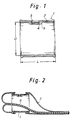
- Fig. 1 is a sectional view of an eversion nozzle according to a first embodiment of the invention
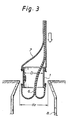
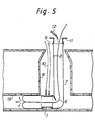
- Figs. 2 to 6 are sectional views to show in sequence the procedure of everting a tubular liner bag, utilizing the eversion nozzle according to the invention
- Fig. 7 is a sectional view of another type of guide tube
- Fig. 8 is a sectional view showing to another manner of everting the tubular liner bag
- Fig. 9 is a vertical sectional view of an eversion nozzle of a second embodiment according to the invention.
- Fig. 10 is a cross section taken along the line A - A of Fig. 9;
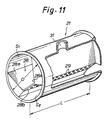
- Fig. 11 is a perspective view of the same eversion nozzle of Fig. 9 after a part is removed therefrom;
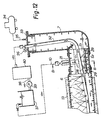
- Fig. 12 is a sectional view of the main elements involved in an eversion operation
- Fig. 13 is a sectional view taken along the line B - B of Fig. 12;
- Fig. 14 is a sectional view showing a method for everting a tubular liner bag wherein a conventional eversion nozzle is used.
- Fig. 1 is a vertical sectional view of an eversion nozzle 1 according to the invention.
- the eversion nozzle 1 is formed as a hollow cylinder having a screw hole 2 and a circular bore 3 at its top portion, and a cylindrical ring joint 4 having the same inner diameter as the diameter of the bore 3 is attached to the inner wall of the eversion nozzle 1 at a location such that the circular bore 3 coincides with the hole of the ring joint 4, as shown in Fig. 1.
- the inner wall of the joint ring 4 is cut with a screw thread.
- Resin 5 is applied to the outer wall of the joint ring 4 so as to prevent the joint ring 4 from damaging a tubular liner bag 6, described later.
- the eversion nozzle 1 of the present embodiment is designed such that its length L is greater than one fifth of its inner diameter D but smaller than twice of D, i.e., D/5 ⁇ L ⁇ 2D.
- Figs. 2 through 6 are sectional views to show in sequence the procedure of everting the tubular liner bag, and Fig. 6 provides an enlarged view of a more functional portion of Fig. 5.
- the eversion nozzle 1 is held over the ground such that it lies generally horizontally.
- the open end of the tubular liner bag 6 is passed through the eversion nozzle 1 from the inlet side of the eversion nozzle 1 and turned inside out to wrap round the brim of the outlet side of the eversion nozzle 1, and anchored thereat.
- One end of a guide tube 7 is similarly fixed around the brim of the inlet side of the eversion nozzle 1.
- a length of the uneverted portion of the tubular liner bag 6 is contained in the eversion nozzle 1 and the guide tube 7.
- the tubular liner bag 6 is prepared in the following manner.
- a rectangular nonwoven resin-absorbable fabric of polyester felt is sewed into a tubular shape.
- This tubular pipe liner is then impregnated with a hardenable liquid resin (thermosetting or photosetting) and is coated with an air-and water-tight film which hermetically covers at least the outer surface of the tubular pipe liner.
- This hermetic film may be made of polyurethane, polyethylene or any other plastic material that forms an air- and water-tight film.
- the eversion nozzle 1 is held vertically with its outlet port, to which is attached the tubular liner bag 6, facing downward, and lowered into a manhole 8.
- the eversion nozzle 1 can pass through the entrance of the manhole 8, so long as the inner diameter D of the eversion nozzle 1 is substantially smaller than the entrance diameter (smallest diameter) d 2 of the manhole 8. Therefore, in designing the eversion nozzle 1 the diameter D can be increased as much as possible without approaching too closely to d 2 , which is generally 600 mm. In this embodiment the diameter D is 524 mm. L is 500 mm.
- the eversion nozzle 1 When the vertically supported eversion nozzle 1 has been introduced into the manhole 8 together with the tubular liner bag 6 and the guide tube 7 and lands on the bottom of the manhole 8, then the eversion nozzle 1 is turned to lie horizontally such that its outlet port looks toward the tubular conduit 13 to be repaired, as shown in Fig. 4. On this occasion, since the eversion nozzle 1 has a length L such that D/5 ⁇ L ⁇ 2D, the turning of the eversion nozzle 1 in the bottom of the manhole 8 is conducted with ease.
- the guide tube 7 is bent by 90 degrees at the portion where it is connected to the eversion nozzle 1, as shown in Figs. 5 and 6, and the uneverted portion of the tubular liner bag 6 extends backward through the eversion nozzle 1 and the guide tube 7 and then the remainder is placed on the ground.
- an air hose 9 with a screwed metallic end piece 9a is screwed into the screw hole 2 made in the eversion nozzle 1 so that the air hose 9 communicates with the interior of the eversion nozzle 1.
- a valve 14 is provided across the air hose 9.
- a draining hose 10 with a screwed metallic end piece 10a is screwed into the joint ring 4 to thereby connect the draining hose 10 to the eversion nozzle 1.
- the other end of the air hose 9 is connected to an air compressor, not shown, and the other end of the draining hose 10 is connected to heating equipment such as a boiler or to a draining pump.
- a valve 15 is provided across the draining hose 10.
- tubular liner bag 6 When the tubular liner bag 6 has been everted until it occupies the entire length of the tubular conduit 13, the tubular liner bag 6 is pneumatically pressed against the inner wall of the tubular conduit 13, and at the same time treated with heat or light so that the hardenable liquid resin impregnated through the thickness of the tubular liner bag 6 is hardened and, as a result, the tubular conduit 13 is lined with the hardened tubular liner bag 6 and thus repaired.
- the inner diameter D of the eversion nozzle 1 can be approximated as close as possible to the entrance diameter d 2 (600 mm) of the manhole 8, provided that it is not too large to prevent a smooth entrance of the vertically held nozzle 1 into the manhole 8, so that in this embodiment the inner diameter D of the eversion nozzle 1 is as large as 524 mm.
- the tubular conduit 13 has a diameter as large as the entrance diameter d 2 of the manhole 8
- a straight flexible guide tube 7 is attached to the eversion nozzle 1, so that when the eversion nozzle 1 is turned to assume a generally horizontal posture in the bottom of the manhole 8, the guide tube 7 is bent by approximately a right angle, as shown in Fig. 6, and as result, a deep pleat 7a is formed at the bend.
- a guide tube 17 which is resilient such that it can be straightened but when left alone it is curled into a 90-degree bend at its end portion 17a, then, when the eversion nozzle 1 is turned to assume a generally horizontal posture in the bottom of the manhole 8, no deep pleat can be formed in the guide tube 17.
- Fig. 8 is a sectional view of the main elements involved in this eversion operation
- water is charged into the guide tube 7 from the upper open end; then, a compressor 16 is driven to supply compressed air to the eversion nozzle 1 by way of an air hose 9.
- a closed space S is formed inside the eversion nozzle 1 and the tubular liner bag 6, which space S is also defined by the water and the pleat 7a of the guide tube 7, the latter functioning as a barrage.
- Fig. 9 is a vertical sectional view of an eversion nozzle
- Fig. 10 is a cross section taken along the line A - A of Fig. 9
- Fig. 11 is a perspective view of the same eversion nozzle after a part is removed therefrom.
- the eversion nozzle 21 of this embodiment is formed as a hollow cylinder like the eversion nozzle 1 of the first embodiment, and its length L is designed in relation to the inner diameter D such that D/5 ⁇ L ⁇ 2D.
- the interior of the eversion nozzle 21 is divided into two rooms S 1 and S 2 by means of a partition 28, which is shaped like a trough.
- This partition 28 comprises a pair of sloped side plates 28a which converge downwards and a narrow horizontal bottom plate 28b providing a floor to the two plates 28a.
- a plurality of drain holes 29 are made in the bottom plate 28b.
- an air introduction port 30 which opens into the room S 1
- a drain port 31 at a location slightly higher than the central axis of the nozzle 21, each port 31 opening into the room S 2 .
- Fig. 12 is a sectional view of the main elements involved in this eversion operation
- Fig. 13 is a sectional view taken along the line B - B of Fig. 12.
- the tubular liner bag 6 is everted from the eversion nozzle 21 into the tubular conduit 13 in a similar manner as in the foregoing embodiment (the procedure as illustrated in Figs. 2 through 6).
- a sprinkler hose 32 with the front end closed is drawn into the everted tubular liner bag 6 past the guide tube 7 and the eversion nozzle 21, as shown in Fig. 12.
- the sprinkler hose 32 is passed airtight through a hole made in the cap 33, which is also equipped with a pressure gauge 36 and provides an opening for an air hose 35 from a compressor 34 to open into the guide tube 7.
- the air hose 9 is connected to the air introduction port 30 of the eversion nozzle 21 to communicate with the room S 1 of the eversion nozzle 21, and draining hoses 10 are connected to the respective drain ports 31 to communicate with the room S 2 .
- the other ends of the draining hoses 10 are held to open over a water tank 37 installed on the ground.
- This water tank 37 communicates with a boiler 40 by way of a pipe 38 and a pump 39, and to this boiler 40 is connected the other end of the sprinkler hose 32.
- the tubular liner bag 6 When the compressor 34 is driven to supply compressed air to the guide tube 7 via the air hose 35, the tubular liner bag 6 is inflated with the air pressure, and is pressed tightly against the inner wall of the tubular conduit 13, as shown in Fig. 12.
- the hot water heated in the boiler 40 is passed into the sprinkler hose 32, and sprinkled from numerous punctures made along that portion of the sprinkler hose 32 which is drawn inside the everted liner bag 6, with equal strength, as shown in Fig. 12, in observance of Pascal's law. As a result, the tubular liner bag 6 is heated with the hot water.
- the hot water After impacting upon the inner wall of the tubular liner bag 6, the hot water falls and gathers in the bottoms of the tubular liner bag 6, the eversion nozzle 21 and the guide tube 7. Pressed by the air pressure, however, the hot water in the room S 1 of the eversion nozzle 21 passes into the room S 2 through the drain holes 29 made in the bottom plate 28b, and then it is pushed up and discharged from the eversion nozzle 21 via the drain ports 31.
- the lukewarm water discharged from the eversion nozzle 21 is then returned to the water tank 37 by way of the draining hoses 10, and the pump 39 continuously transfer the water in the water tank 37 to the boiler 40 by way of the pipe 38.
- the water is then heated again by the boiler 40, and passed again into the sprinkler hose 32 to be used to heat the tubular liner bag 6.
- the tubular liner bag 6 By continuously sprinkling the circulated hot water on the inner wall of the tubular liner bag 6, the latter is kept heated and, as a result, the thermosetting resin impregnated through the thickness of the tubular liner bag 6 is cured and thus the tubular conduit 13 is lined with the hardened tubular liner bag 6.
- the hot water that collects in the room S 2 of the eversion nozzle 21 is pushed up and discharged by means of the propelling power of air pressure, so that it is now possible to provide the drain ports 31 at a location higher than the central axis of the nozzle 21.
Landscapes
- Engineering & Computer Science (AREA)
- General Engineering & Computer Science (AREA)
- Mechanical Engineering (AREA)
- Lining Or Joining Of Plastics Or The Like (AREA)
- Pipe Accessories (AREA)
Claims (7)
- Umstülpdüse (1; 21), die beim Reparaturvorgang einer erdverlegten Rohrleitung (13) durch Auskleiden der Innenwand der Rohrleitung mit einem umgestülpten Rohrauskleidungsschlauch (6), der mit einem härtbaren flüssigen Harz imprägniert ist, eingesetzt wird, wobei die Düse ein hohler geradliniger Zylinder ist, und wobei ihre Länge L und ihr Innendurchmesser D die folgende Beziehung aufweisen:
- Umstülpdüse (21) nach Anspruch 1, dadurch gekennzeichnet, daß der Innenraum der Düse in einen ersten Raum (S1) und einen zweiten Raum (S2) mittels einer perforierten Trennwand (28) unterteilt ist, wobei der erste Raum (S1) eine Einführungsöffnung (30) aufweist, durch die Luft aufgenommen wird, und wobei der zweite Raum (S2) eine Ablaßöffnung (31) aufweist, durch die das fließende Medium an einer Stelle herausgelassen wird, die etwas höher ist als die Mittelachse der Umstülpdüse.
- Verfahren zur Reparatur einer Rohrleitung (13) durch Auskleiden der Innenwand der Rohrleitung mit einem umgestülpten Rohrauskleidungsschlauch (6), der mit duroplastischem flüssigem Harz imprägniert ist, das die folgenden Schritte aufweist: (a) Herstellen einer hohlen zylindrischen Umstülpdüse (1; 21), deren Länge L und Innendurchmesser D die Beziehung aufweisen, daß D/5 < L < 2D; (b) Hindurchgehen des offenen Endes des Rohrauskleidungsschlauches (6) durch die Umstülpdüse von der Eintrittsseite der Umstülpdüse aus und Wenden des offenen Endes des Rohrauskleidungsschlauches mit der Innenseite nach außen, um sich um die Austrittsseite der Umstülpdüse herumzuwickeln und dort befestigt zu werden; (c) Befestigen eines Endes eines Führungsschlauches (7; 17) um die Eintrittsseite der Umstülpdüse herum; (d) Absenken der Umstülpdüse auf den Boden eines Loches (8), während die Umstülpdüse vertikal gehalten wird, wobei ihre Austrittsöffnung nach unten hin liegt; (e) Drehen der Umstülpdüse, damit sie horizontal so liegt, daß ihre Austrittsöffnung zur Rohrleitung (13) hin liegt; (f) Zuführen eines unter Druck stehenden fließenden Mediums in die Umstülpdüse, um dadurch den Rohrauskleidungsschlauch (6) von der Umstülpdüse aus in die Rohrleitung (13) hinein umzustülpen; und (g) Aushärten des härtbaren flüssigen Harzes im umgestülpten Rohrauskleidungsschlauch, um dadurch den Schlauch auszuhärten.
- Verfahren nach Anspruch 3, dadurch gekennzeichnet, daß das Führungsrohr (17) an seinem Endabschnitt (17a) elastisch ist, so daß der Endabschnitt begradigt werden kann, sich aber, wenn er allein gelassen wird, in eine Biegung von 90 Grad verdreht.
- Verfahren nach Anspruch 3, dadurch gekennzeichnet, daß die Umstülpdüse (1) eine Einführungsöffnung aufweist, durch die Luft in der Düse erhalten wird; daß beim Schritt (f) das fließende Medium Wasser ist; ein geschlossener Raum (S) durch den umgestülpten Rohrauskleidungsschlauch (6), die Umstülpdüse (1) und eine Falte (7a) definiert wird, die in der Biegung des Führungsschlauches (7) gebildet wird; und daß Druckluft der Umstülpdüse über die Einführungsöffnung zugeführt wird.
- Verfahren nach Anspruch 3, dadurch gekennzeichnet, daß der Innenraum der Umstülpdüse (21) in einen ersten Raum (S1) und in einen zweiten Raum (S2) mittels einer perforierten Trennwand (28) unterteilt ist, wobei der erste Raum (S1) eine Einführungsöffnung (30) aufweist, durch die Luft aufgenommen wird, und wobei der zweite Raum (S2) eine Ablaßöffnung (31) aufweist, durch die das fließende Medium an einer Stelle herausgelassen wird, die etwas höher ist als die Mittelachse der Umstülpdüse; daß das andere Ende des Führungsschlauches (7) abgedichtet ist; und daß beim Schritt (g) heißes Wasser auf die Innenwand des umgestülpten Auskleidungsschlauches (6) gesprüht wird, und daß während des Sprühens Druckluft in den umgestülpten Auskleidungsschlauch geführt wird, um dadurch zu bewirken, daß das gesprühte Wasser aus der Ablaßöffnung (31) der Umstülpdüse abgelassen wird.
- Verfahren nach Anspruch 6, dadurch gekennzeichnet, daß beim Schritt (g) die Druckluft über die Einführungsöffnung (30) der Umstülpdüse (21) zugeführt wird.
Priority Applications (3)
| Application Number | Priority Date | Filing Date | Title |
|---|---|---|---|
| DE1995622922 DE69522922T2 (de) | 1995-02-01 | 1995-02-01 | Eversiondüse und Verfahren zur Reparatur von einem unterirdischen Rohr |
| EP95300628A EP0725246B1 (de) | 1995-02-01 | 1995-02-01 | Eversiondüse und Verfahren zur Reparatur von einem unterirdischen Rohr |
| DK95300628T DK0725246T3 (da) | 1995-02-01 | 1995-02-01 | Udkrængningsdyse og fremgangsmåde til reparation af en underjordisk rørformet ledning |
Applications Claiming Priority (1)
| Application Number | Priority Date | Filing Date | Title |
|---|---|---|---|
| EP95300628A EP0725246B1 (de) | 1995-02-01 | 1995-02-01 | Eversiondüse und Verfahren zur Reparatur von einem unterirdischen Rohr |
Publications (2)
| Publication Number | Publication Date |
|---|---|
| EP0725246A1 EP0725246A1 (de) | 1996-08-07 |
| EP0725246B1 true EP0725246B1 (de) | 2001-09-26 |
Family
ID=8221072
Family Applications (1)
| Application Number | Title | Priority Date | Filing Date |
|---|---|---|---|
| EP95300628A Expired - Lifetime EP0725246B1 (de) | 1995-02-01 | 1995-02-01 | Eversiondüse und Verfahren zur Reparatur von einem unterirdischen Rohr |
Country Status (3)
| Country | Link |
|---|---|
| EP (1) | EP0725246B1 (de) |
| DE (1) | DE69522922T2 (de) |
| DK (1) | DK0725246T3 (de) |
Citations (1)
| Publication number | Priority date | Publication date | Assignee | Title |
|---|---|---|---|---|
| EP0650006A1 (de) * | 1993-09-28 | 1995-04-26 | Shonan Gosei - Jushi Seisakusho K.K. | Verfahren zur Beschichtung einer Abzweigeleitung |
Family Cites Families (3)
| Publication number | Priority date | Publication date | Assignee | Title |
|---|---|---|---|---|
| GB1002131A (en) * | 1963-05-22 | 1965-08-25 | Wolff & Company Kommanditgesel | Improvements in or relating to apparatus for and method of turning inside out a flexible tube |
| GB8400233D0 (en) | 1984-01-05 | 1984-02-08 | Edgealpha Ltd | Lining pipelines and passageways |
| DK87584A (da) * | 1984-02-22 | 1985-08-23 | Bent Joergen Rump | Fremgangsmaade og apparat til udfyldning eller lukning hhv. afpropning af sideaabninger i kloakledninger, f.eks. side- eller grenroer til hovedkloakledninger |
-
1995
- 1995-02-01 EP EP95300628A patent/EP0725246B1/de not_active Expired - Lifetime
- 1995-02-01 DK DK95300628T patent/DK0725246T3/da active
- 1995-02-01 DE DE1995622922 patent/DE69522922T2/de not_active Expired - Fee Related
Patent Citations (1)
| Publication number | Priority date | Publication date | Assignee | Title |
|---|---|---|---|---|
| EP0650006A1 (de) * | 1993-09-28 | 1995-04-26 | Shonan Gosei - Jushi Seisakusho K.K. | Verfahren zur Beschichtung einer Abzweigeleitung |
Also Published As
| Publication number | Publication date |
|---|---|
| EP0725246A1 (de) | 1996-08-07 |
| DE69522922D1 (de) | 2001-10-31 |
| DK0725246T3 (da) | 2001-11-26 |
| DE69522922T2 (de) | 2002-04-11 |
Similar Documents
| Publication | Publication Date | Title |
|---|---|---|
| US5520484A (en) | Eversion nozzle, and a method for repairing an underground tubular conduit | |
| EP0620103B1 (de) | Reparaturverfahren für eine Rohrleitung | |
| EP0620102B1 (de) | Auskleidungsverfahren und Auskleidung eines Abzweigrohres | |
| EP0752305B1 (de) | Verfahren zum Innenbeschichten eines gebogenen Rohres | |
| US6024910A (en) | Method for lining a tubular conduit | |
| EP0640787B1 (de) | Verfahren zur Beschichtung einer Abzweigeleitung | |
| USRE35944E (en) | Method of everting a tube | |
| US5374174A (en) | Apparatus for/installing a liner within a service pipe or the like | |
| US4434115A (en) | Method for remote lining of side connections | |
| EP0938964B1 (de) | Auskleidung eines Abzweigrohres und Auskleidungsverfahren | |
| US6093363A (en) | Method of lining pipelines with flow-through apparatus and liner | |
| JP2010149285A (ja) | 管ライニング材及び管ライニング工法 | |
| US5167901A (en) | Method of everting a tube | |
| EP0704294A2 (de) | Verfahren zum Auskleiden eines Mannloches | |
| US5503190A (en) | Method for repairing a tubular conduit | |
| EP0620100B1 (de) | Umstülpverfahren für einen Auskleidungsschlauch | |
| EP0620101B1 (de) | Verfahren und Vorrichtung zur Auskleidung eines Abzweigrohres | |
| EP0797042B1 (de) | Vorrichtung und Verfahren zum Auskleiden eines im Erdreich verlegten Leitungsrohres | |
| CN101529147A (zh) | 用于翻转现场固化内衬的可重复使用的翻转套筒组件 | |
| EP0725246A1 (de) | Eversiondüse und Verfahren zur Reparatur von einem unterirdischen Rohr | |
| JP3667190B2 (ja) | 管ライニング工法 | |
| KR100204605B1 (ko) | 반전노즐, 관라이닝재의 반전방법 및 관로보수공법 | |
| JP2509101B2 (ja) | 取付管用内張り材の施工方法 | |
| JP2635515B2 (ja) | 管ライニング工法 | |
| JPH0957852A (ja) | 枝管用鍔付スタートライナー及び管ライニング工法 |
Legal Events
| Date | Code | Title | Description |
|---|---|---|---|
| PUAI | Public reference made under article 153(3) epc to a published international application that has entered the european phase |
Free format text: ORIGINAL CODE: 0009012 |
|
| AK | Designated contracting states |
Kind code of ref document: A1 Designated state(s): DE DK FR GB |
|
| 17P | Request for examination filed |
Effective date: 19970131 |
|
| 17Q | First examination report despatched |
Effective date: 19991026 |
|
| GRAG | Despatch of communication of intention to grant |
Free format text: ORIGINAL CODE: EPIDOS AGRA |
|
| GRAG | Despatch of communication of intention to grant |
Free format text: ORIGINAL CODE: EPIDOS AGRA |
|
| GRAH | Despatch of communication of intention to grant a patent |
Free format text: ORIGINAL CODE: EPIDOS IGRA |
|
| GRAH | Despatch of communication of intention to grant a patent |
Free format text: ORIGINAL CODE: EPIDOS IGRA |
|
| GRAA | (expected) grant |
Free format text: ORIGINAL CODE: 0009210 |
|
| AK | Designated contracting states |
Kind code of ref document: B1 Designated state(s): DE DK FR GB |
|
| REF | Corresponds to: |
Ref document number: 69522922 Country of ref document: DE Date of ref document: 20011031 |
|
| REG | Reference to a national code |
Ref country code: DK Ref legal event code: T3 |
|
| ET | Fr: translation filed | ||
| REG | Reference to a national code |
Ref country code: GB Ref legal event code: IF02 |
|
| PLBE | No opposition filed within time limit |
Free format text: ORIGINAL CODE: 0009261 |
|
| STAA | Information on the status of an ep patent application or granted ep patent |
Free format text: STATUS: NO OPPOSITION FILED WITHIN TIME LIMIT |
|
| 26N | No opposition filed | ||
| PGFP | Annual fee paid to national office [announced via postgrant information from national office to epo] |
Ref country code: DK Payment date: 20040123 Year of fee payment: 10 |
|
| PGFP | Annual fee paid to national office [announced via postgrant information from national office to epo] |
Ref country code: GB Payment date: 20040128 Year of fee payment: 10 |
|
| PGFP | Annual fee paid to national office [announced via postgrant information from national office to epo] |
Ref country code: FR Payment date: 20040210 Year of fee payment: 10 |
|
| PGFP | Annual fee paid to national office [announced via postgrant information from national office to epo] |
Ref country code: DE Payment date: 20040212 Year of fee payment: 10 |
|
| PG25 | Lapsed in a contracting state [announced via postgrant information from national office to epo] |
Ref country code: GB Free format text: LAPSE BECAUSE OF NON-PAYMENT OF DUE FEES Effective date: 20050201 |
|
| PG25 | Lapsed in a contracting state [announced via postgrant information from national office to epo] |
Ref country code: DK Free format text: LAPSE BECAUSE OF NON-PAYMENT OF DUE FEES Effective date: 20050228 |
|
| PG25 | Lapsed in a contracting state [announced via postgrant information from national office to epo] |
Ref country code: DE Free format text: LAPSE BECAUSE OF NON-PAYMENT OF DUE FEES Effective date: 20050901 |
|
| GBPC | Gb: european patent ceased through non-payment of renewal fee |
Effective date: 20050201 |
|
| REG | Reference to a national code |
Ref country code: DK Ref legal event code: EBP |
|
| PG25 | Lapsed in a contracting state [announced via postgrant information from national office to epo] |
Ref country code: FR Free format text: LAPSE BECAUSE OF NON-PAYMENT OF DUE FEES Effective date: 20051031 |
|
| REG | Reference to a national code |
Ref country code: FR Ref legal event code: ST Effective date: 20051031 |