EP0725419A1 - Herstellungsverfahren einer Feldemissionsvorrichtung mit wellenförmigen Stützsäulen für hohe Durchschlagsfestigkeit - Google Patents
Herstellungsverfahren einer Feldemissionsvorrichtung mit wellenförmigen Stützsäulen für hohe Durchschlagsfestigkeit Download PDFInfo
- Publication number
- EP0725419A1 EP0725419A1 EP96300483A EP96300483A EP0725419A1 EP 0725419 A1 EP0725419 A1 EP 0725419A1 EP 96300483 A EP96300483 A EP 96300483A EP 96300483 A EP96300483 A EP 96300483A EP 0725419 A1 EP0725419 A1 EP 0725419A1
- Authority
- EP
- European Patent Office
- Prior art keywords
- rods
- corrugated
- dielectric
- pillar
- anode
- Prior art date
- Legal status (The legal status is an assumption and is not a legal conclusion. Google has not performed a legal analysis and makes no representation as to the accuracy of the status listed.)
- Granted
Links
- 238000000034 method Methods 0.000 title claims abstract description 33
- 230000015556 catabolic process Effects 0.000 title abstract description 15
- 238000005520 cutting process Methods 0.000 claims abstract description 5
- 239000003989 dielectric material Substances 0.000 claims description 16
- 238000005530 etching Methods 0.000 claims description 2
- 238000010008 shearing Methods 0.000 claims description 2
- 230000000873 masking effect Effects 0.000 claims 2
- 239000003365 glass fiber Substances 0.000 claims 1
- 238000004519 manufacturing process Methods 0.000 abstract description 7
- 239000011521 glass Substances 0.000 description 11
- 239000000463 material Substances 0.000 description 11
- OAICVXFJPJFONN-UHFFFAOYSA-N Phosphorus Chemical compound [P] OAICVXFJPJFONN-UHFFFAOYSA-N 0.000 description 7
- 239000011248 coating agent Substances 0.000 description 6
- 238000000576 coating method Methods 0.000 description 6
- VYPSYNLAJGMNEJ-UHFFFAOYSA-N Silicium dioxide Chemical compound O=[Si]=O VYPSYNLAJGMNEJ-UHFFFAOYSA-N 0.000 description 5
- 238000010586 diagram Methods 0.000 description 5
- 239000012212 insulator Substances 0.000 description 5
- 229920000642 polymer Polymers 0.000 description 5
- 239000000758 substrate Substances 0.000 description 5
- 239000000919 ceramic Substances 0.000 description 4
- 239000002002 slurry Substances 0.000 description 4
- HEMHJVSKTPXQMS-UHFFFAOYSA-M Sodium hydroxide Chemical compound [OH-].[Na+] HEMHJVSKTPXQMS-UHFFFAOYSA-M 0.000 description 3
- 239000000853 adhesive Substances 0.000 description 3
- 230000001070 adhesive effect Effects 0.000 description 3
- 238000013461 design Methods 0.000 description 3
- 239000010432 diamond Substances 0.000 description 3
- 229910003460 diamond Inorganic materials 0.000 description 3
- 238000003618 dip coating Methods 0.000 description 3
- 229910052751 metal Inorganic materials 0.000 description 3
- 239000002184 metal Substances 0.000 description 3
- 229920002120 photoresistant polymer Polymers 0.000 description 3
- 239000000843 powder Substances 0.000 description 3
- 238000012545 processing Methods 0.000 description 3
- NTHWMYGWWRZVTN-UHFFFAOYSA-N sodium silicate Chemical compound [Na+].[Na+].[O-][Si]([O-])=O NTHWMYGWWRZVTN-UHFFFAOYSA-N 0.000 description 3
- 238000005507 spraying Methods 0.000 description 3
- RZVAJINKPMORJF-UHFFFAOYSA-N Acetaminophen Chemical compound CC(=O)NC1=CC=C(O)C=C1 RZVAJINKPMORJF-UHFFFAOYSA-N 0.000 description 2
- 235000008733 Citrus aurantifolia Nutrition 0.000 description 2
- KRHYYFGTRYWZRS-UHFFFAOYSA-N Fluorane Chemical compound F KRHYYFGTRYWZRS-UHFFFAOYSA-N 0.000 description 2
- 235000011941 Tilia x europaea Nutrition 0.000 description 2
- GWEVSGVZZGPLCZ-UHFFFAOYSA-N Titan oxide Chemical compound O=[Ti]=O GWEVSGVZZGPLCZ-UHFFFAOYSA-N 0.000 description 2
- MCMNRKCIXSYSNV-UHFFFAOYSA-N Zirconium dioxide Chemical compound O=[Zr]=O MCMNRKCIXSYSNV-UHFFFAOYSA-N 0.000 description 2
- 239000007864 aqueous solution Substances 0.000 description 2
- 239000011230 binding agent Substances 0.000 description 2
- 239000004020 conductor Substances 0.000 description 2
- 238000000151 deposition Methods 0.000 description 2
- 230000008021 deposition Effects 0.000 description 2
- 230000005684 electric field Effects 0.000 description 2
- 238000004070 electrodeposition Methods 0.000 description 2
- 238000001652 electrophoretic deposition Methods 0.000 description 2
- 238000004924 electrostatic deposition Methods 0.000 description 2
- 239000004571 lime Substances 0.000 description 2
- 239000007788 liquid Substances 0.000 description 2
- 239000013307 optical fiber Substances 0.000 description 2
- 238000000059 patterning Methods 0.000 description 2
- 235000019353 potassium silicate Nutrition 0.000 description 2
- 239000002243 precursor Substances 0.000 description 2
- 239000005297 pyrex Substances 0.000 description 2
- 239000010453 quartz Substances 0.000 description 2
- 238000007493 shaping process Methods 0.000 description 2
- 239000012703 sol-gel precursor Substances 0.000 description 2
- 239000002904 solvent Substances 0.000 description 2
- 239000007858 starting material Substances 0.000 description 2
- 239000000126 substance Substances 0.000 description 2
- 229920001169 thermoplastic Polymers 0.000 description 2
- 229910017083 AlN Inorganic materials 0.000 description 1
- PIGFYZPCRLYGLF-UHFFFAOYSA-N Aluminum nitride Chemical compound [Al]#N PIGFYZPCRLYGLF-UHFFFAOYSA-N 0.000 description 1
- 239000004593 Epoxy Substances 0.000 description 1
- 239000004115 Sodium Silicate Substances 0.000 description 1
- 239000004809 Teflon Substances 0.000 description 1
- 229920006362 Teflon® Polymers 0.000 description 1
- 239000002253 acid Substances 0.000 description 1
- 239000000654 additive Substances 0.000 description 1
- 230000000996 additive effect Effects 0.000 description 1
- 229910052782 aluminium Inorganic materials 0.000 description 1
- PNEYBMLMFCGWSK-UHFFFAOYSA-N aluminium oxide Inorganic materials [O-2].[O-2].[O-2].[Al+3].[Al+3] PNEYBMLMFCGWSK-UHFFFAOYSA-N 0.000 description 1
- 238000013459 approach Methods 0.000 description 1
- 239000003054 catalyst Substances 0.000 description 1
- 229910010293 ceramic material Inorganic materials 0.000 description 1
- 238000005234 chemical deposition Methods 0.000 description 1
- 238000003486 chemical etching Methods 0.000 description 1
- 238000005229 chemical vapour deposition Methods 0.000 description 1
- 239000002131 composite material Substances 0.000 description 1
- 230000006835 compression Effects 0.000 description 1
- 238000007906 compression Methods 0.000 description 1
- 229910052802 copper Inorganic materials 0.000 description 1
- 229910052593 corundum Inorganic materials 0.000 description 1
- 238000000280 densification Methods 0.000 description 1
- 230000001419 dependent effect Effects 0.000 description 1
- 238000004090 dissolution Methods 0.000 description 1
- 238000007772 electroless plating Methods 0.000 description 1
- 238000005421 electrostatic potential Methods 0.000 description 1
- 230000008020 evaporation Effects 0.000 description 1
- 238000001704 evaporation Methods 0.000 description 1
- 238000010304 firing Methods 0.000 description 1
- 239000005350 fused silica glass Substances 0.000 description 1
- 229910052737 gold Inorganic materials 0.000 description 1
- 238000010438 heat treatment Methods 0.000 description 1
- AMGQUBHHOARCQH-UHFFFAOYSA-N indium;oxotin Chemical compound [In].[Sn]=O AMGQUBHHOARCQH-UHFFFAOYSA-N 0.000 description 1
- 238000003780 insertion Methods 0.000 description 1
- 230000037431 insertion Effects 0.000 description 1
- 238000001459 lithography Methods 0.000 description 1
- 230000013011 mating Effects 0.000 description 1
- 239000011159 matrix material Substances 0.000 description 1
- -1 melt Substances 0.000 description 1
- 230000008018 melting Effects 0.000 description 1
- 238000002844 melting Methods 0.000 description 1
- 150000002739 metals Chemical class 0.000 description 1
- 150000004767 nitrides Chemical class 0.000 description 1
- 239000000615 nonconductor Substances 0.000 description 1
- 238000010943 off-gassing Methods 0.000 description 1
- TWNQGVIAIRXVLR-UHFFFAOYSA-N oxo(oxoalumanyloxy)alumane Chemical compound O=[Al]O[Al]=O TWNQGVIAIRXVLR-UHFFFAOYSA-N 0.000 description 1
- 239000002245 particle Substances 0.000 description 1
- 238000000206 photolithography Methods 0.000 description 1
- 238000005289 physical deposition Methods 0.000 description 1
- 239000004033 plastic Substances 0.000 description 1
- 229910052697 platinum Inorganic materials 0.000 description 1
- 229920001721 polyimide Polymers 0.000 description 1
- 239000009719 polyimide resin Substances 0.000 description 1
- 239000002861 polymer material Substances 0.000 description 1
- 238000006116 polymerization reaction Methods 0.000 description 1
- 238000000197 pyrolysis Methods 0.000 description 1
- 239000000377 silicon dioxide Substances 0.000 description 1
- 238000005245 sintering Methods 0.000 description 1
- 229910052911 sodium silicate Inorganic materials 0.000 description 1
- 229910000679 solder Inorganic materials 0.000 description 1
- 239000000243 solution Substances 0.000 description 1
- 239000007921 spray Substances 0.000 description 1
- 238000004544 sputter deposition Methods 0.000 description 1
- 239000004416 thermosoftening plastic Substances 0.000 description 1
- 239000001993 wax Substances 0.000 description 1
- 229910001845 yogo sapphire Inorganic materials 0.000 description 1
Images

Classifications
-
- H—ELECTRICITY
- H01—ELECTRIC ELEMENTS
- H01J—ELECTRIC DISCHARGE TUBES OR DISCHARGE LAMPS
- H01J9/00—Apparatus or processes specially adapted for the manufacture, installation, removal, maintenance of electric discharge tubes, discharge lamps, or parts thereof; Recovery of material from discharge tubes or lamps
- H01J9/24—Manufacture or joining of vessels, leading-in conductors or bases
- H01J9/241—Manufacture or joining of vessels, leading-in conductors or bases the vessel being for a flat panel display
- H01J9/242—Spacers between faceplate and backplate
-
- H—ELECTRICITY
- H01—ELECTRIC ELEMENTS
- H01J—ELECTRIC DISCHARGE TUBES OR DISCHARGE LAMPS
- H01J29/00—Details of cathode-ray tubes or of electron-beam tubes of the types covered by group H01J31/00
- H01J29/86—Vessels; Containers; Vacuum locks
- H01J29/864—Spacers between faceplate and backplate of flat panel cathode ray tubes
-
- H—ELECTRICITY
- H01—ELECTRIC ELEMENTS
- H01J—ELECTRIC DISCHARGE TUBES OR DISCHARGE LAMPS
- H01J31/00—Cathode ray tubes; Electron beam tubes
- H01J31/08—Cathode ray tubes; Electron beam tubes having a screen on or from which an image or pattern is formed, picked up, converted, or stored
- H01J31/10—Image or pattern display tubes, i.e. having electrical input and optical output; Flying-spot tubes for scanning purposes
- H01J31/12—Image or pattern display tubes, i.e. having electrical input and optical output; Flying-spot tubes for scanning purposes with luminescent screen
- H01J31/123—Flat display tubes
-
- H—ELECTRICITY
- H01—ELECTRIC ELEMENTS
- H01J—ELECTRIC DISCHARGE TUBES OR DISCHARGE LAMPS
- H01J2329/00—Electron emission display panels, e.g. field emission display panels
- H01J2329/86—Vessels
- H01J2329/8625—Spacing members
- H01J2329/863—Spacing members characterised by the form or structure
-
- H—ELECTRICITY
- H01—ELECTRIC ELEMENTS
- H01J—ELECTRIC DISCHARGE TUBES OR DISCHARGE LAMPS
- H01J2329/00—Electron emission display panels, e.g. field emission display panels
- H01J2329/86—Vessels
- H01J2329/8625—Spacing members
- H01J2329/863—Spacing members characterised by the form or structure
- H01J2329/8635—Spacing members characterised by the form or structure having a corrugated lateral surface
Definitions
- This invention relates to methods for making field emission devices and, in particular, to methods for making field emission devices, such as flat panel displays, having corrugated support pillars for breakdown resistance.
- Support pillars are important components of electron field emission devices (FEDs) such as flat panel displays.
- a typical field emission device comprises a cathode including a plurality of field emitter tips and an anode spaced from the cathode.
- a voltage applied between the anode and cathode induces emission of electrons towards the anode.
- an additional electrode called a gate is typically disposed between the anode and cathode to selectively activate desired pixels.
- the space between the cathode and anode is evacuated, and integrated cylindrical support pillars keep the cathode and anode separated. Without support pillars, the atmospheric pressure outside would force the anode and cathode surfaces together. Pillars are typically 100-1000 ⁇ m high and each provides pillar support for an area of 1-10,000 pixels.
- cylindrical pillars may provide adequate mechanical support, they are not well suited for new field emission devices employing higher voltages.
- Applicants have determined that increasing the operating voltage between the emitting cathode and the anode can substantially increase the efficiency and operating life of a field emission device. For example, in a flat panel display, changing the operating voltage from 500 V to 5000 V could increase the operating life of a typical phosphor by a factor of 100.
- changing the operating voltage from 500 V to 5000 V could increase the operating life of a typical phosphor by a factor of 100.
- insulator breakdown and arcing along the surface of cylindrical pillars precludes the use of such high voltages.
- a cylindrical insulator is disposed between two electrodes and subjected to a continuous voltage gradient, then emitted electrons colliding with the dielectric can stimulate the emission of secondary electrons. These secondary electrons in turn accelerate toward the positive electrode. This secondary emission can lead to a runaway process where the insulator becomes positively charged and an arc forms along the surface. Accordingly, there is a need for a new pillar design that will permit the use of higher voltages without breakdown and arcing.
- a field emission device is made by providing the device electrodes, forming a plurality of corrugated insulating rods, adhering the rods to an electrode, cutting away the tops of the rods to define corrugated pillars, and finishing the device.
- the corrugated rods can be formed in one of three different methods. The result is low cost production of a field emission device having superior resistance to breakdown in high voltage operation.
- Part I describes fabrication of a FED device having corrugated support pillars and part II describes preferred ways of making the corrugated pillars.
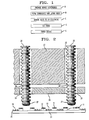
- FIG. 1 is a block diagram of the steps in making a field emission device.
- a preliminary step shown in Block A is to provide the device electrodes: an emitter cathode and an anode which may include a phosphor layer.
- the emitter cathode uses diamond field emitters because of their low voltage emission and their robust mechanical and chemical properties.
- Field emitting cathodes employing diamond field emitters are described, for example, in Okano et al., Appl. Phys. Lett ., Vol. 64, p. 2742 (1994) and in United States Patents Nos. 5,129,850 and 5,138,237, all of which are incorporated by reference.
- Preferred electrodes for flat panel displays are disclosed in co-pending United States Patent application Serial No. 08/220,077 filed by Eom et al. on March 30, 1994; and the following applications filed by Jin et al: Serial No. 08/299674 (August 31, 1994); Serial No. 08/299470 (August 31, 1994); Serial No. 08/331458 (October 31, 1994); Serial No. 08/332179 (October 31, 1994); and Serial No. 08/361616 (December 22, 1994).
- the next step (FIG. 1, Block B) is to form a plurality of corrugated insulating rods to be used as support pillars separating the emitter cathode from an anode.
- the optimal pillar design is one where the height of the pillar is short in order to minimize the divergence of emitted electrons, while the length of surface paths from negative to positive electrodes are as long as possible in order to reduce the likelihood of insulator breakdown.
- “close” is defined as a point where the electrostatic potential is less than 500V more positive than the point at which the electron is generated, and preferably less than 200V more positive.
- the pillar must not be so much wider at the anode end so that it substantially reduces the area that can be allocated to the phosphor screen.
- the pillar material should not only be mechanically strong but also should be an electrical insulator with a high breakdown voltage in order to withstand the high electrical field applied to operate the phosphor of the display.
- the breakdown voltage should be greater than about 2000 V and preferably greater than 4000 V.
- a suitable pillar material may be chosen from glasses such as lime glass, pyrex, fused quartz, ceramic materials such as oxide, nitride, oxynitride, carbide (e.g., Al 2 O 3 , TiO 2 , ZrO 2 , AlN), polymers (e.g., polyimide resins) or composites of ceramics, polymers, or metals.
- glasses such as lime glass, pyrex, fused quartz
- ceramic materials such as oxide, nitride, oxynitride, carbide (e.g., Al 2 O 3 , TiO 2 , ZrO 2 , AlN)
- polymers e.g., polyimide resins
- a typical geometry of the pillar is advantageously a modified form of either round or rectangular rod.
- the diameter or thickness of the pillar is typically 50-1000 ⁇ m, and preferably 100-300 ⁇ m.
- the height-to-diameter or height-to-thickness aspect ratio of the pillar is typically in the range of 1-10, preferably in the range of 3-6.
- the desired number or density of the pillars is dependent on various factors to be considered. For sufficient mechanical support of the anode plate, a larger number of pillars is desirable, however, in order to minimize expense, electrical leakage, and the possibility of breakdown, some compromise is necessary.
- a typical density of the pillar is about 0.01-2% of the total display surface area, and preferably 0.05-0.5%.
- a FED display of about 25x25 cm 2 area with approximately 500-100,000 pillars, each with a cross-sectional area of 100x100 ⁇ m 2 is a good example.
- corrugations are advantageously formed in one of three ways described hereinafter in Part II.
- the next step shown in FIG. 1, block C is to adhere the ends of a plurality of rods to an electrode (either cathode or anode) of the field emitting device, preferably the emitting cathode.
- an electrode either cathode or anode
- the placement of pillars on the electrode can be conveniently accomplished by using the apparatus illustrated in FIG. 2.
- a plurality of corrugated rods 20 are applied to an electrode 21 through apertures in a two part template comprising an upper portion 23 and a lower portion 24.
- the apertures 25 and 26 of the upper and lower templates are aligned with each other and with positions on the electrode where pillars are to be adhered.
- Adhesive spots 27 on the projecting ends of the rods can be provided to unite the rods with electrode 21. Notches 28 are advantageously provided in the rods at desired cutting points.
- the electrode is the device cathode emitter including emitter regions 10 on conductive substrate 21. Conductive gates 11 are separated from the substrate by an insulating layer 12.
- display--sized templates e.g., metal sheets with drilled holes at the desired pillar locations
- the template holes are simultaneously and continuously supplied with long rods (wires) of corrugated dielectric material.
- the protruding bottoms of the wires are coated with a material to facilitate bonding, such as adhesive material (e.g. uncured or semicured epoxy), low melting point glass or solder that is molten or in the paste form. Adhesion can be facilitated, if necessary, by locally heating the pillar-to-electrode junction by a laser beam.
- the next step shown in Block D of FIG. 1 is to cut the corrugated rods into support pillars. This can be advantageously done by shearing with the apparatus of FIG. 2.
- the upper template 23 is moved sideways while the lower template 24 is fixed with the adhesive in contact with display cathode surface, so that the bottom pillar is broken away at the pre-designed V-notch location 28. This process is repeated for the next display substrate. As many of the pillars are placed simultaneously, the assembly can be fast and of low cost.
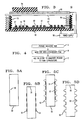
- FIG. 3 is a schematic cross section of an exemplary flat panel display 90 using the high breakdown voltage pillars according to the present invention.
- the display comprises a cathode 91 including a plurality of emitters 92 and an anode 93 disposed in spaced relation from the emitters within a vacuum seal.
- the anode conductor 93 formed on a transparent insulating substrate 94 is provided with a phosphor layer 95 and mounted on support pillars 96.
- a perforated conductive gate layer 97 Between the cathode and the anode and closely spaced from the emitters.
- the space between the anode and the emitter is sealed and evacuated, and voltage is applied by power supply 98.
- the field-emitted electrons from electron emitters 92 are accelerated by the gate electrode 97 from multiple emitters 92 on each pixel and move toward the anode conductive layer 93 (typically transparent conductor such as indium-tin-oxide) coated on the anode substrate 94.
- Phosphor layer 95 is disposed between the electron emitters and the anode. As the accelerated electrons hit the phosphor, a display image is generated.
- FIG. 4 is a flow diagram illustrating the steps involved in a preferred method for creating a corrugated or grooved pillar rod structure.
- corrugated encompasses a grooved structure.
- the FIG. 4 method is based on additive processing.
- the corrugated structure is created by adding extra dielectric material, in a pre-designed fashion, on the surface of the rod, wire or plate-shaped base dielectric material.
- the term "rod” as used herein encompasses a cylinder, a vertically-oriented plate or any other aperiodic shape used as the base form for a pillar.
- the first step, block A in FIG. 4 is to provide a rod-shaped dielectric starting material.
- a long wire in the form of wound spool is a convenient configuration for handling.
- Optical fiber glass which is widely used for telecommunications, is easily available, relatively low-cost material with roughly right size and shape, and hence can conveniently be utilized.
- Other dielectric materials such as polymer wires or, ceramic wires can also be
- the next step in FIG. 4 is to apply a patterned, anti-adhesion film (or mask) on the surface of the base wire material, either circumferentially or helically.
- the anti-adhesion film is exemplarily made of a thin coating of wax, teflon or diamond, applied by any physical, chemical or electro-chemical deposition technique such as spray-coating or dip-coating. Rotation can advantageously be used to assist annular or helical deposition.
- the desired pitch of the circumferential or helix pattern is typically 10-100 ⁇ m for a pillar height of about 300-1000 ⁇ m.
- the patterning can be optionally aided by the use of known mask or photolithography procedures (e.g., exposing rotating wire to a beam of UV light).
- the next step is to add extra dielectric material to form annular or helical corrugations.
- This is accomplished, for example, by dip-coating, spray-coating, electrostatic, electrophoretic, or electrochemical deposition on the wire with a slurry, sol-gel precursor, melt, aqueous solution, or dry powder that contains either the dielectric material itself (e.g., powder) or a precursor of the dielectric (the same as the base wire or a different material).
- Continuously pulling wires through a liquid bath is an advantageous method.
- the patterned anti-adhesion film ensures the addition of material selectively where the film is not present.
- a slurry consisting of silica or glass particles with suitable binder and solvent may be coated on the base wire.
- a water glass (sodium silicate) solution or well-known sol-gel precursor for optical fiber glass may also be used.
- This process of adding the patterned dielectric material can be repeated if desired to increase the depth of the groove, with optional intermediate or final baking or firing to burn off binder and solvent, and cause strong bonding and densification.
- Glasses are typically fired at 500-1000°C for 0.1-100 hrs.
- Ceramics and quartz can be sintered or fused typically at 800-1200°C for 0.1-100 hrs.
- Water glass can be dried or baked at lower temperature of below ⁇ 500°C.
- the added patterned dielectric material is made of polymer-based liquid or slurry, polymerization or curing either by heat (typically below ⁇ 300°C or catalyst, or fusing (in the case of thermoplastic polymer) can be used to density the material. A careful selection of polymer is needed for the field emission device applications because of the possibility of outgassing in vacuum environment.
- the anti-adhesion film may be optionally dissolved off or burned off, leaving a corrugated pillar structure with increased surface length.
- FIGs. 5A, 5B, 5C and 5D illustrate the rod at various stages of fabrication.
- FIG. 5A shows the cylindrical rod or wire 50 at the outset.
- FIG. 5B illustrates the rod 50 with the anti-adhesion coating 51 in place.
- FIG. 5C shows the addition of dielectric corrugations 52 on the portions of rod 50 not covered with coating 51, and
- FIG. 5D shows the rod with corrugations 52 after the anti-adhesion coating is burned away.
- a thicker patterned photoresist mask can be employed in lieu of anti-adhesion coating 51.
- Photoresist patterning of deep grooved mask with an aspect ratio in excess of 1 is an established technique.
- the additional dielectric material is added into these deep grooves.
- Spray-coating, dip-coating, electrostatic or electrophoretic deposition of powders, slurry, sol-gel, melt or aqueous solution containing the desired dielectric material or its precursor can be used, followed by baking or sintering and optional dissolution or pyrolysis of the mask material.
- the deep-grooved dielectric pillar structure is particularly desirable because not only is the breakdown voltage raised, but the secondary emission electrons can be trapped in the deep groove for improved reliability of the pillar.
- the desired depth of the groove expressed in terms of the ratio of the groove depth d to the maximum width of the groove opening w, is at least d/w >0.3, and preferably d/w >1.0.
- FIG. 6 is a flow diagram for a second method of creating a corrugated (grooved) pillar structure, this method based on subtractive processing.
- the grooved structure in this case is produced by removing (e.g., by etching away) part of the dielectric material in a pre-designed fashion from the surface of the wire-shaped base dielectric material.
- the first step, block A in FIG. 6, is to provide a dielectric rod of starting material.
- the next step (block B) is to apply a peripherally patterned (e.g. annular or helical), etch-resistant film on the rod surface.
- a peripherally patterned (e.g. annular or helical), etch-resistant film on the rod surface.
- Photoresist polymer materials can be spray-coated or dip-coated and UV patterned.
- etch-resistant metal Au or Pt films on glass are relatively resistant to chemical etching by hydrofluoric acid
- ceramic films may be used. These films are physically (as by evaporation or sputtering) or chemically (as by electroless plating or chemical vapor deposition) deposited. They can be patterned either by deposition through a patterned template or by mechanical removal of local regions as by scribing with a sharp-tipped comb.
- FIG. 7A The rod at various stages of the FIG. 6 method is schematically illustrated in FIGs. 7A, 7B and 7C.
- the etch-resistant film 71 is applied with a desired helical or annular pattern on the surface of the dielectric rod 50, which is then etched (e.g., in HF acid in the case of glass wire, in NaOH in the case of aluminum oxide wire for a suitable time period to obtain etched regions 72 as shown in FIG. 7B.
- the remnant etch-resistant film 71 is then optionally dissolved, etched or burned off to leave a corrugated, grooved dielectric pillar structure of FIG. 7C.
- the desired depth of the groove is typically d/w >0.3 and preferably d/w >1.0.
- the shallower grooves have a generally lenticular shape.
- the deeper grooves have additional benefit of trapping secondary emission electrons for enhanced reliability of the pillar.
- FIG. 8 is a flow diagram for processing steps using plastic deformation for shaping the pillar.
- the first step in FIG. 8 (block A) is to provide a rod-shaped dielectric material.
- the second step (block B) is to soften the rod, as by applying heat.
- Lime glass and pyrex glass are softened at temperatures below ⁇ 900°C. Quartz is softened at > 1100°C.
- Thermoplastic wires are softened at a relatively low temperature of typically below ⁇ 500°C.
- the next step in FIG. 8 is to plastically deform the softened rod by mechanical compression with a corrugated die, usually consisting of mating pair, and preferably cooled so that undesirable adhesion between the die and wire is minimized.
- a corrugated die usually consisting of mating pair, and preferably cooled so that undesirable adhesion between the die and wire is minimized.
- One exemplary forming die comprising two halves 90A and 90B is schematically illustrated in FIG. 9. A portion of the rod 50 is deformed and moved lengthwise so that the next portion can be deformed.
- the above-described embodiments are illustrative of only a few of the many possible specific embodiments which can represent applications of the principles of the invention.
- the high breakdown voltage pillars of this invention can be used not only for flat-panel display apparatus but for other applications, such as a x-y matrix addressable electron sources for electron lithography or for microwave power amplifier tubes.
Landscapes
- Engineering & Computer Science (AREA)
- Manufacturing & Machinery (AREA)
- Cathode-Ray Tubes And Fluorescent Screens For Display (AREA)
- Manufacture Of Electron Tubes, Discharge Lamp Vessels, Lead-In Wires, And The Like (AREA)
- Vessels, Lead-In Wires, Accessory Apparatuses For Cathode-Ray Tubes (AREA)
- Cold Cathode And The Manufacture (AREA)
Applications Claiming Priority (2)
| Application Number | Priority Date | Filing Date | Title |
|---|---|---|---|
| US08/381,262 US5561340A (en) | 1995-01-31 | 1995-01-31 | Field emission display having corrugated support pillars and method for manufacturing |
| US381262 | 1995-01-31 |
Publications (2)
| Publication Number | Publication Date |
|---|---|
| EP0725419A1 true EP0725419A1 (de) | 1996-08-07 |
| EP0725419B1 EP0725419B1 (de) | 2000-06-07 |
Family
ID=23504338
Family Applications (1)
| Application Number | Title | Priority Date | Filing Date |
|---|---|---|---|
| EP96300483A Revoked EP0725419B1 (de) | 1995-01-31 | 1996-01-24 | Herstellungsverfahren einer Feldemissionsvorrichtung mit wellenförmigen Stützsäulen für hohe Durchschlagsfestigkeit |
Country Status (5)
| Country | Link |
|---|---|
| US (1) | US5561340A (de) |
| EP (1) | EP0725419B1 (de) |
| JP (1) | JP2968201B2 (de) |
| CA (1) | CA2166505C (de) |
| DE (1) | DE69608713T2 (de) |
Cited By (4)
| Publication number | Priority date | Publication date | Assignee | Title |
|---|---|---|---|---|
| EP1032014A2 (de) | 1999-02-25 | 2000-08-30 | Canon Kabushiki Kaisha | Herstellungsverfahren eines Abstandshalters für ein Elektronenstrahlgerät und Verfahren zur Herstellung eines Elektronenstrahlgerätes |
| US6517399B1 (en) | 1998-09-21 | 2003-02-11 | Canon Kabushiki Kaisha | Method of manufacturing spacer, method of manufacturing image forming apparatus using spacer, and apparatus for manufacturing spacer |
| US6761606B2 (en) | 2000-09-08 | 2004-07-13 | Canon Kabushiki Kaisha | Method of producing spacer and method of manufacturing image forming apparatus |
| EP1517359A3 (de) * | 2003-09-17 | 2006-06-14 | Patent-Treuhand-Gesellschaft für elektrische Glühlampen mbH | Verfahren zur Herstellung einer flachen Entladungslampe mit Abstandselementen |
Families Citing this family (22)
| Publication number | Priority date | Publication date | Assignee | Title |
|---|---|---|---|---|
| GB2280924B (en) * | 1993-08-10 | 1997-02-26 | Brian See | Structural members |
| CA2166506C (en) * | 1995-01-31 | 2000-11-28 | Sungho Jin | Improved field emission devices having corrugated support pillars with discontinuous conductive coating |
| US5704820A (en) * | 1995-01-31 | 1998-01-06 | Lucent Technologies Inc. | Method for making improved pillar structure for field emission devices |
| JP2809129B2 (ja) * | 1995-04-20 | 1998-10-08 | 日本電気株式会社 | 電界放射冷陰極とこれを用いた表示装置 |
| JP2907080B2 (ja) * | 1995-09-26 | 1999-06-21 | 双葉電子工業株式会社 | 電界放出型表示装置 |
| JP3765901B2 (ja) * | 1996-02-26 | 2006-04-12 | 株式会社東芝 | プラズマディスプレイ及びプラズマ液晶ディスプレイ |
| US6153973A (en) * | 1996-12-26 | 2000-11-28 | Canon Kabushiki Kaisha | Spacer and an image-forming apparatus, and a manufacturing method thereof |
| US6554671B1 (en) * | 1997-05-14 | 2003-04-29 | Micron Technology, Inc. | Method of anodically bonding elements for flat panel displays |
| US5980349A (en) | 1997-05-14 | 1999-11-09 | Micron Technology, Inc. | Anodically-bonded elements for flat panel displays |
| US6072274A (en) * | 1997-10-22 | 2000-06-06 | Hewlett-Packard Company | Molded plastic panel for flat panel displays |
| US6506087B1 (en) | 1998-05-01 | 2003-01-14 | Canon Kabushiki Kaisha | Method and manufacturing an image forming apparatus having improved spacers |
| JP3639785B2 (ja) * | 1998-09-08 | 2005-04-20 | キヤノン株式会社 | 電子線装置及び画像形成装置 |
| JP4115051B2 (ja) * | 1998-10-07 | 2008-07-09 | キヤノン株式会社 | 電子線装置 |
| US6507146B2 (en) * | 2000-03-01 | 2003-01-14 | Chad Byron Moore | Fiber-based field emission display |
| GB0015928D0 (en) * | 2000-06-30 | 2000-08-23 | Printable Field Emitters Limit | Field emitters |
| US6670629B1 (en) * | 2002-09-06 | 2003-12-30 | Ge Medical Systems Global Technology Company, Llc | Insulated gate field emitter array |
| US7187114B2 (en) * | 2002-11-29 | 2007-03-06 | Ngk Insulators, Ltd. | Electron emitter comprising emitter section made of dielectric material |
| JP3867065B2 (ja) * | 2002-11-29 | 2007-01-10 | 日本碍子株式会社 | 電子放出素子及び発光素子 |
| US7129642B2 (en) * | 2002-11-29 | 2006-10-31 | Ngk Insulators, Ltd. | Electron emitting method of electron emitter |
| US6750470B1 (en) | 2002-12-12 | 2004-06-15 | General Electric Company | Robust field emitter array design |
| US20040113178A1 (en) * | 2002-12-12 | 2004-06-17 | Colin Wilson | Fused gate field emitter |
| RU2693560C2 (ru) * | 2013-06-21 | 2019-07-03 | Смитс Детекшен Монреаль Инк. | Способ и устройство для покрытого оболочкой источника ионизации коронного разряда |
Citations (3)
| Publication number | Priority date | Publication date | Assignee | Title |
|---|---|---|---|---|
| JPH02299136A (ja) * | 1989-05-15 | 1990-12-11 | Canon Inc | 画像形成装置 |
| EP0404022A2 (de) * | 1989-06-19 | 1990-12-27 | Matsushita Electric Industrial Co., Ltd. | Flache Bildwiedergabevorrichtung und Verfahren zur Herstellung derselben |
| EP0616354A2 (de) * | 1993-03-18 | 1994-09-21 | International Business Machines Corporation | Abstandhalter für flaches Anzeigepaneel |
Family Cites Families (7)
| Publication number | Priority date | Publication date | Assignee | Title |
|---|---|---|---|---|
| US3665241A (en) * | 1970-07-13 | 1972-05-23 | Stanford Research Inst | Field ionizer and field emission cathode structures and methods of production |
| FR2623013A1 (fr) * | 1987-11-06 | 1989-05-12 | Commissariat Energie Atomique | Source d'electrons a cathodes emissives a micropointes et dispositif de visualisation par cathodoluminescence excitee par emission de champ,utilisant cette source |
| US5063327A (en) * | 1988-07-06 | 1991-11-05 | Coloray Display Corporation | Field emission cathode based flat panel display having polyimide spacers |
| US5129850A (en) * | 1991-08-20 | 1992-07-14 | Motorola, Inc. | Method of making a molded field emission electron emitter employing a diamond coating |
| US5138237A (en) * | 1991-08-20 | 1992-08-11 | Motorola, Inc. | Field emission electron device employing a modulatable diamond semiconductor emitter |
| US5283500A (en) * | 1992-05-28 | 1994-02-01 | At&T Bell Laboratories | Flat panel field emission display apparatus |
| FR2705830B1 (fr) | 1993-05-27 | 1995-06-30 | Commissariat Energie Atomique | Procédé de fabrication de dispositifs d'affichage à micropointes, utilisant la lithographie par ions lourds. |
-
1995
- 1995-01-31 US US08/381,262 patent/US5561340A/en not_active Expired - Lifetime
-
1996
- 1996-01-03 CA CA002166505A patent/CA2166505C/en not_active Expired - Fee Related
- 1996-01-24 EP EP96300483A patent/EP0725419B1/de not_active Revoked
- 1996-01-24 DE DE69608713T patent/DE69608713T2/de not_active Expired - Fee Related
- 1996-01-29 JP JP8012720A patent/JP2968201B2/ja not_active Expired - Lifetime
Patent Citations (3)
| Publication number | Priority date | Publication date | Assignee | Title |
|---|---|---|---|---|
| JPH02299136A (ja) * | 1989-05-15 | 1990-12-11 | Canon Inc | 画像形成装置 |
| EP0404022A2 (de) * | 1989-06-19 | 1990-12-27 | Matsushita Electric Industrial Co., Ltd. | Flache Bildwiedergabevorrichtung und Verfahren zur Herstellung derselben |
| EP0616354A2 (de) * | 1993-03-18 | 1994-09-21 | International Business Machines Corporation | Abstandhalter für flaches Anzeigepaneel |
Non-Patent Citations (1)
| Title |
|---|
| PATENT ABSTRACTS OF JAPAN vol. 015, no. 082 (E - 1038) 26 February 1991 (1991-02-26) * |
Cited By (6)
| Publication number | Priority date | Publication date | Assignee | Title |
|---|---|---|---|---|
| US6517399B1 (en) | 1998-09-21 | 2003-02-11 | Canon Kabushiki Kaisha | Method of manufacturing spacer, method of manufacturing image forming apparatus using spacer, and apparatus for manufacturing spacer |
| US6926571B2 (en) | 1998-09-21 | 2005-08-09 | Canon Kabushiki Kaisha | Method of manufacturing spacer, method of manufacturing image forming apparatus using spacer, and apparatus for manufacturing spacer |
| EP1032014A2 (de) | 1999-02-25 | 2000-08-30 | Canon Kabushiki Kaisha | Herstellungsverfahren eines Abstandshalters für ein Elektronenstrahlgerät und Verfahren zur Herstellung eines Elektronenstrahlgerätes |
| EP1032014A3 (de) * | 1999-02-25 | 2007-06-20 | Canon Kabushiki Kaisha | Herstellungsverfahren eines Abstandshalters für ein Elektronenstrahlgerät und Verfahren zur Herstellung eines Elektronenstrahlgerätes |
| US6761606B2 (en) | 2000-09-08 | 2004-07-13 | Canon Kabushiki Kaisha | Method of producing spacer and method of manufacturing image forming apparatus |
| EP1517359A3 (de) * | 2003-09-17 | 2006-06-14 | Patent-Treuhand-Gesellschaft für elektrische Glühlampen mbH | Verfahren zur Herstellung einer flachen Entladungslampe mit Abstandselementen |
Also Published As
| Publication number | Publication date |
|---|---|
| DE69608713D1 (de) | 2000-07-13 |
| DE69608713T2 (de) | 2000-11-09 |
| EP0725419B1 (de) | 2000-06-07 |
| CA2166505C (en) | 2001-03-20 |
| JP2968201B2 (ja) | 1999-10-25 |
| JPH08241670A (ja) | 1996-09-17 |
| US5561340A (en) | 1996-10-01 |
| CA2166505A1 (en) | 1996-08-01 |
Similar Documents
| Publication | Publication Date | Title |
|---|---|---|
| EP0725419B1 (de) | Herstellungsverfahren einer Feldemissionsvorrichtung mit wellenförmigen Stützsäulen für hohe Durchschlagsfestigkeit | |
| CA2166504C (en) | Multilayer pillar structure for improved field emission devices | |
| EP1553613B1 (de) | Verfahren zur Herstellung eines Emitters aus Kohlenstoffnanoröhre | |
| US7105200B2 (en) | Method of producing thick-film sheet member | |
| US7365482B2 (en) | Field emission display including electron emission source formed in multi-layer structure | |
| KR100602071B1 (ko) | 전계 방출 디바이스 | |
| CA2168377C (en) | Method for making improved pillar structure for field emission devices | |
| EP0725418B1 (de) | Wellenförmige Stützsäulen einer Feldemissionsvorrichtung mit einer diskontinuierlichen leitfähigen Schicht | |
| JP3836539B2 (ja) | 電界放出素子およびその製造方法 | |
| CN1288693C (zh) | 利用波形模具生产微通道面板的方法及装置 | |
| CN1784763A (zh) | 图象显示设备和用于图象显示设备中的间隔组件的制造方法 | |
| KR100326532B1 (ko) | 표시소자용 스페이서 부재의 제조방법 | |
| KR100303546B1 (ko) | 전계 방출 표시소자 및 그의 제조 방법 | |
| JP2003059391A (ja) | 電子放出源及びその製造方法並びに蛍光表示装置 | |
| EP0470631A2 (de) | Drahtförmige Elektronenquelle | |
| KR100266224B1 (ko) | 전계방출 소자 및 그 제조방법과 그를 이용한전계방출 디스플레이 장치 | |
| KR100351149B1 (ko) | 표시소자 제조방법 | |
| KR100261542B1 (ko) | 전계효과 전자방출 표시소자의 스페이서 제조방법 |
Legal Events
| Date | Code | Title | Description |
|---|---|---|---|
| PUAI | Public reference made under article 153(3) epc to a published international application that has entered the european phase |
Free format text: ORIGINAL CODE: 0009012 |
|
| AK | Designated contracting states |
Kind code of ref document: A1 Designated state(s): DE FR GB |
|
| 17P | Request for examination filed |
Effective date: 19970122 |
|
| 17Q | First examination report despatched |
Effective date: 19970228 |
|
| GRAG | Despatch of communication of intention to grant |
Free format text: ORIGINAL CODE: EPIDOS AGRA |
|
| GRAG | Despatch of communication of intention to grant |
Free format text: ORIGINAL CODE: EPIDOS AGRA |
|
| GRAH | Despatch of communication of intention to grant a patent |
Free format text: ORIGINAL CODE: EPIDOS IGRA |
|
| GRAH | Despatch of communication of intention to grant a patent |
Free format text: ORIGINAL CODE: EPIDOS IGRA |
|
| GRAA | (expected) grant |
Free format text: ORIGINAL CODE: 0009210 |
|
| AK | Designated contracting states |
Kind code of ref document: B1 Designated state(s): DE FR GB |
|
| REF | Corresponds to: |
Ref document number: 69608713 Country of ref document: DE Date of ref document: 20000713 |
|
| ET | Fr: translation filed | ||
| PG25 | Lapsed in a contracting state [announced via postgrant information from national office to epo] |
Ref country code: GB Free format text: LAPSE BECAUSE OF NON-PAYMENT OF DUE FEES Effective date: 20010124 |
|
| PLBQ | Unpublished change to opponent data |
Free format text: ORIGINAL CODE: EPIDOS OPPO |
|
| PLBI | Opposition filed |
Free format text: ORIGINAL CODE: 0009260 |
|
| 26 | Opposition filed |
Opponent name: CANON KABUSHIKI KAISHA Effective date: 20010308 |
|
| GBPC | Gb: european patent ceased through non-payment of renewal fee |
Effective date: 20010124 |
|
| PG25 | Lapsed in a contracting state [announced via postgrant information from national office to epo] |
Ref country code: FR Free format text: LAPSE BECAUSE OF NON-PAYMENT OF DUE FEES Effective date: 20010928 |
|
| PG25 | Lapsed in a contracting state [announced via postgrant information from national office to epo] |
Ref country code: DE Free format text: LAPSE BECAUSE OF NON-PAYMENT OF DUE FEES Effective date: 20011101 |
|
| REG | Reference to a national code |
Ref country code: FR Ref legal event code: ST |
|
| RDAH | Patent revoked |
Free format text: ORIGINAL CODE: EPIDOS REVO |
|
| RDAG | Patent revoked |
Free format text: ORIGINAL CODE: 0009271 |
|
| STAA | Information on the status of an ep patent application or granted ep patent |
Free format text: STATUS: PATENT REVOKED |
|
| 27W | Patent revoked |
Effective date: 20020523 |