EP0725439A2 - Elektronisches Bauteil mit metallischen Leiterbahnen und Verfahren zu seiner Herstellung - Google Patents
Elektronisches Bauteil mit metallischen Leiterbahnen und Verfahren zu seiner Herstellung Download PDFInfo
- Publication number
- EP0725439A2 EP0725439A2 EP96105263A EP96105263A EP0725439A2 EP 0725439 A2 EP0725439 A2 EP 0725439A2 EP 96105263 A EP96105263 A EP 96105263A EP 96105263 A EP96105263 A EP 96105263A EP 0725439 A2 EP0725439 A2 EP 0725439A2
- Authority
- EP
- European Patent Office
- Prior art keywords
- film
- metal wiring
- thin film
- substrate
- amorphous
- Prior art date
- Legal status (The legal status is an assumption and is not a legal conclusion. Google has not performed a legal analysis and makes no representation as to the accuracy of the status listed.)
- Granted
Links
Images






Classifications
-
- H—ELECTRICITY
- H10—SEMICONDUCTOR DEVICES; ELECTRIC SOLID-STATE DEVICES NOT OTHERWISE PROVIDED FOR
- H10W—GENERIC PACKAGES, INTERCONNECTIONS, CONNECTORS OR OTHER CONSTRUCTIONAL DETAILS OF DEVICES COVERED BY CLASS H10
- H10W20/00—Interconnections in chips, wafers or substrates
- H10W20/40—Interconnections external to wafers or substrates, e.g. back-end-of-line [BEOL] metallisations or vias connecting to gate electrodes
- H10W20/41—Interconnections external to wafers or substrates, e.g. back-end-of-line [BEOL] metallisations or vias connecting to gate electrodes characterised by their conductive parts
- H10W20/44—Conductive materials thereof
- H10W20/4403—Conductive materials thereof based on metals, e.g. alloys, metal silicides
-
- H—ELECTRICITY
- H10—SEMICONDUCTOR DEVICES; ELECTRIC SOLID-STATE DEVICES NOT OTHERWISE PROVIDED FOR
- H10W—GENERIC PACKAGES, INTERCONNECTIONS, CONNECTORS OR OTHER CONSTRUCTIONAL DETAILS OF DEVICES COVERED BY CLASS H10
- H10W20/00—Interconnections in chips, wafers or substrates
- H10W20/40—Interconnections external to wafers or substrates, e.g. back-end-of-line [BEOL] metallisations or vias connecting to gate electrodes
- H10W20/41—Interconnections external to wafers or substrates, e.g. back-end-of-line [BEOL] metallisations or vias connecting to gate electrodes characterised by their conductive parts
- H10W20/435—Cross-sectional shapes or dispositions of interconnections
-
- H—ELECTRICITY
- H10—SEMICONDUCTOR DEVICES; ELECTRIC SOLID-STATE DEVICES NOT OTHERWISE PROVIDED FOR
- H10P—GENERIC PROCESSES OR APPARATUS FOR THE MANUFACTURE OR TREATMENT OF DEVICES COVERED BY CLASS H10
- H10P14/00—Formation of materials, e.g. in the shape of layers or pillars
- H10P14/40—Formation of materials, e.g. in the shape of layers or pillars of conductive or resistive materials
- H10P14/412—Deposition of metallic or metal-silicide materials
-
- H—ELECTRICITY
- H10—SEMICONDUCTOR DEVICES; ELECTRIC SOLID-STATE DEVICES NOT OTHERWISE PROVIDED FOR
- H10W—GENERIC PACKAGES, INTERCONNECTIONS, CONNECTORS OR OTHER CONSTRUCTIONAL DETAILS OF DEVICES COVERED BY CLASS H10
- H10W20/00—Interconnections in chips, wafers or substrates
- H10W20/40—Interconnections external to wafers or substrates, e.g. back-end-of-line [BEOL] metallisations or vias connecting to gate electrodes
- H10W20/45—Interconnections external to wafers or substrates, e.g. back-end-of-line [BEOL] metallisations or vias connecting to gate electrodes characterised by their insulating parts
- H10W20/48—Insulating materials thereof
Definitions
- the present invention relates to electronic parts such as integrated circuit (IC) devices, and particularly to electronic parts with metal wiring having higher reliability e.g., the improved electromigration endurance, and manufacturing method thereof.
- IC integrated circuit
- metal wiring is formed on the surface of an amorphous thin film generally represented by a SiO 2 interlayer insulative film with or without a barrier layer.
- a metal thin film with the high crystalline properties cannot be formed by a so-called epitaxial crystal growth method where a single-crystal thin film can be grown by continuing the crystalline arrangement of an underlayer.
- metal wiring with the excellent electromigration endurance and high reliability is hardly obtained.
- An object of the invention is to provide electronic parts allowing finer elements, higher integration, higher current density, and higher temperature of operation conditions.
- Another object of the invention is to provide electronic parts with highly reliable metal wiring obtained by the formation of a metal thin film with the high crystalline properties.
- a further object of the invention is to provide electronic parts with highly reliable metal wiring obtained by an underlying layer of which electrical resistance in a contact part is satisfactorily low and which can he easily processed, and a metal thin film with the high crystalline properties formed on the underlying layer.
- a still further object of the invention is to provide electronic parts with highly reliable metal wiring simultaneously preventing wiring failures and shortcircuit.
- a still further object of the invention is to provide electronic parts with metal wiring with the improved electromigration and stress-migration endurance.
- a big problem for obtaining a metal thin film with the high crystalline properties is that many crystal nucleuses, from which growth of thin films will start, are simultaneously formed on an underlying layer to be deposited thereon at an initial stage of the deposition. At a film-growing stage, crystal growth of these crystal nucleuses is advanced by absorbing deposited particles or uniting with other nucleuses. However, the size of the crystal nucleuses growing by this mechanism is limited.
- a finally obtained thin film is of polycrystalline where individual crystal grains have different orientation arrangements. Accordingly, in order to form a thin film with the high crystalline properties in a large region, it is important to suppress occurrence of nucleuses as low as possible.
- the interfacial energy ⁇ i depends on 1) lattice matching of a deposited material and underlying material, and 2) interatomic bonding energy between a deposited material and underlying material, in crystal-crystal interface.
- an amorphous material is used as an underlying material like at the time of forming metal wiring in semiconductor devices, it has not been found on what the surface energy of underlying material and interfacial energy depends.
- the inventors have eagerly investigated and examined relationships of atomic arrangement at an interface in detail. As a result, it was found that atomic or molecular arrangement at an interface significantly effected crystal arrangement of a deposited material in the case where an amorphous material is used as an underlying layer as well. Namely, diffraction by X-ray, electron beam and the like revealed that even in an amorphous material, the structure thereof is not completely disordered and there exists regular structure in a small range. As described above, the magnitude of interfaceial energy, which determines atomic arrangement at an interface, is determined by the degree of lattice matching of 2 to 3 periods.
- This small lattice size is substantially the same as an interatomic distance corresponding to a peak of halo pattern which appears in diffraction measurement of an amorphous material.
- this interatomic distance was matched with the spacing of atoms or molecules of a deposited material so that interface energy could be reduced, resulting in the formation of a thin film with the very high crystalline properties.
- the present invention provides an electronic part comprising an amorphous thin film formed on a substrate and metal wiring with the high orientation formed on the surface thereof, the electronic part characterized in that an atomic distance, ds, corresponding to a peak of halo pattern appearing in diffraction measurement of the amorphous thin film approximately matches with the spacing of a particular crystal planes, df, defined with the first-nearest interatomic distance of the metal wiring.
- the interatomic distance ds of the amorphous thin film matches with the spacing df of the metal wiring.
- the above particular crystal plane defined with the first-nearest interatomic distance of the metal wiring is, for example, (111), (200) or (220) in fcc structure; (200) or (110) in bcc structure; or (002) or (110) in hexagonal system.
- the particular crystal plane is not limited to an orientated plane. Composition of the amorphous thin film varies the degree of match. If the amorphous thin film contains an element mainly constituting the metal wiring, a better matching can be obtained.
- the amorphous thin film preferably contains an element M of which the metal wiring is mainly made. Otherwise, the amorphous thin film preferably contains an element A forming an intermetallic compound with the element M, or an element B capable of continuous series of solid solution with the element M or having the range allowing a complete solid solution.
- Al, Cu, Au, Ag, or W can be generally used as an element M.
- the surface energy of a material in a crystal state constituting the amorphous thin film is preferably larger than the surface energy of a material constituting metal wiring (deposited material).
- the melting point, roughly proportional to the surface energy, of a material in a crystal state constituting the amorphous thin film is desirably high.
- the surface energy of an amorphous material formed of a plurality of elements is defiened as the sum of the fractional surface energies of individual elements.
- Substrates of the invention are not particularly limited.
- Conventional semiconductor substrates such as a Si substrate and GaAs substrate, and glass substrates with and without ITO may be used.
- the shape thereof may be flat or have grooves.
- simple metals, alloys or conductive compounds capable of being amorphous are used for an amorphous thin film formed on a substrate. Further, they preferably have composition containing at least one of the above-mentioned elements M, A, and B. Considering the ability of forming amorphous, transition metals, metalloids, semiconductor alloys, and semiconductor compounds are preferable.
- a metal element M III B group elements (Sc, Y, Lanthanide), IV B group elements (Ti, Zr, Hf), V B group elements (V, Nb, Ta), VI B group elements (Cr, Mo, W), VIII group elements (Fe, Ru, Os, Co, Rh, Ir, Ni, Pd, Pt), B, C, N, O, P, Si, and Ge.
- Compounds with perovskite type oxide compositions can be used as an amorphous thin film.
- Amorphous thin films used in this invention are an amorphous thin film where a broad diffraction intensity, namely halo peak, can be measured in diffraction measurements represented by electron diffraction such as RHEED and X-ray diffraction. Diffraction lines from fine crystals such as intermetallic compounds due to incomplete amorphousstate are allowed for amorphous thin films used in this invention. Further amorphous thin films used in this invention are not required to be entirely amorphous. Crystalline thin films of which only the surface is amorphous may be used.
- the thickness thereof is preferably thin, more preferably 10 to 1000 ⁇ where the substrate does not expose. However, even if thickness of 1000 ⁇ or more, the crystalline properties of metal thin film formed thereon can be improved.
- this amorphous thin film 3 can be used not only as an underlying layer for a single-layer wiring but also as an underlying layer for each metal wiring 2 constituting multi-layer wirings.
- the film 3 can be used as an under-layer for a conductive connecting part in the longitudinal direction such as a via 4 or through hole.
- the film 3 may be formed directly on the substrate 1; or on an interposed layer, for example, an insulative layer 5 such as a SiO 2 thermal oxide film, a barrier layer 6 of Ti, TiN or the like, a contact layer or another wiring above the substrate 1.
- the interposed layer may be flat or have grooves.
- reference numeral 5 indicates an insulative film such as SiO 2 destined for an element isolation area
- reference numeral 7 indicates a doped layer.
- the formation of an amorphous thin film as an underlying layer for metal wiring can considerably reduce the number of hillocks caused by thermal treatment or electromigration.
- hillocks normally take place due to compressive stress introduced in a thin film or metal wiring. Excess volume generating compressive stress is released as hillocks. A point where a hillock takes place is a point where stress is concentrated. Endurance against deformation of a thin film at this stress-concentrated point determines whether a hillock takes place or not. Since the conventional W or TiN thin film is of a polycrystal, crystal grain boundaries act as stress concentration parts, and cause cracks, and at these parts hillocks take place.
- amorphous state could overcome the above inherent drawback of polycrystal.
- the use of amorphous thin film can increase deformation endurance in a stress concentrated part where a hillock may take place, thereby remarkably suppressing of hillocks can be attained.
- an amorphous thin film contains the previously mentioned element M, A or B, this effect is particularly remarkable.
- the reasons therefor are thought that since the bonding power between a main element forming metal wiring and element in an amorphous thin film increases, concentrated compressive stress generated in the metal wiring can be uniformly distributed in the amorphous thin film, resulting in considerable decrease in frequency of hillock occurrence.
- an amorphous thin film is not required to be formed as an underlying layer for metal wiring, but may coat a part of metal wiring.
- an amorphous thin film 101 may be formed in the upper part or periphery of metal wiring 100.
- an amorphous thin film is formed in the upper part of a metal film, since the effect of preventing hillocks depends on an interatomic bonding power between the amorphous thin film and metal wiring, this effect necessarily depends on the surface state of the metal wiring prior to the formation of the amorphous thin film.
- the surface is generally coated with an Al oxide.
- RHEED reflection high-energy electron diffraction
- an amorphous thin film between a substrate and metal wiring can suppress reactions caused by grain boundary diffusion in conventional technique.
- an Al amorphous alloy as an amorphous thin film does not form a high resistance reactive layer with metal wiring mainly formed of Al, resulting in a high reliable contact part.
- an alloy containing one of Ta, Nb, V, Mo and W is used as an Al amorphous alloy, a simultaneous fine wiring process for metal mainly formed of Al is possible, thereby reducing the number of processes as compared with the other amorphous alloys.
- the content of Al is preferably 15 at% or more for stabilizing amorphous state.
- the content is more preferably 15 to 80 at% to maintain the surface energy of the amorphous thin film to be high.
- Al amorphous alloys are Ta x Al 1-x (0.20 ⁇ x ⁇ 0.85), Nb x Al 1-x (0.20 ⁇ x ⁇ 0.85), V x Al 1-x (0.20 ⁇ x ⁇ 0.60), W x Al 1-x (0.15 ⁇ x ⁇ 0.50) and Mo x Al 1-x (0.25 ⁇ x ⁇ 0.80).
- Cu amorphous alloys have excellent contact properties with metal wiring mainly made of Cu, a contact part with the high reliability can be provided.
- Cu amorphous alloys examples include Ti x Cu 1-x (0.18 ⁇ x ⁇ 0.70), Zr x Cu 1-x (0.18 ⁇ x ⁇ 0.70), Hf x Cu 1-x (0.20 ⁇ x ⁇ 0.70), Y x Cu 1-x (0.10 ⁇ x ⁇ 0.53) and Ta x Cu 1-x (0.20 ⁇ x ⁇ 0.80).
- amorphous alloys such as V x Co 1-x (0.15 ⁇ x ⁇ 0.80), Nb x Cr 1-x (0.25 ⁇ x ⁇ 0.45), Nb x Co 1-x (0.22 ⁇ x ⁇ 0.55), Ta x Cr 1-x (0.25 ⁇ x ⁇ 0.40), Ta x Co 1-x (0.25 ⁇ x ⁇ 0.45), Cr x Co 1-x (0.50 ⁇ x ⁇ 0.70), Mo x Co 1-x (0.20 ⁇ x ⁇ 0.60), and W x Co 100-x (0.20 ⁇ x ⁇ 0.60) are also preferably used since they do not form solid solution, and can avoid the inherent electrical resistance increase by interfacial reaction at elevated temperature for sintering.
- an amorphous thin film may be of multi-layer structure where different amorphous materials are laminated.
- the upper most surface is preferably formed of the above-mentioned amorphous alloys with the high surface energy; and SiO 2 , polyimide, TEOS, SiN and the like containing B or P may be used as the underlying layer of the above multi-layer structure.
- the above-mentioned metal wiring which is formed on an amorphous thin film, is formed of crystal with the high orientation and crystalline properties which is oriented in a given plane direction.
- the angle formed between the normal line direction of the close-packed plane of each crystal grain and the normal line direction of the bottom surface of metal wiring is preferably 80° or less.
- the angle between the close-packed plane and the wiring longitudinal direction is preferably 20° or less.
- metal wiring is formed such that a (111) plane of the close-packed plane in the case where metal wiring crystal structure is fcc structure; a (110) plane in the case of bcc structure; or a (0001) plane in the case of hexagonal structure is approximately parallel to the wiring longitudinal direction.
- the close-packed plane is preferably an upper plane, that is, metal wiring oriented in the close-packed plane is preferably formed.
- metal wiring is preferably of highly oriented crystal where small angle boundary energies are distributed, which small angle boundary energies are 88% or less of general random grain boundary energies in polycrystal where general random grain boundary energy is defined by one third of the surface energy of a solid.
- small angle boundaries with low grain boundary energy are small angle boundaries with a relative misorientation of 10° or less in tilt, rotation and combination thereof around orientation axes of neighboring crystal grains, coincidence boundaries where the ⁇ value of grain boundaries is 10 or less, and grain boundaries with a relative misorientation of 3° or less from a coincidence boundary.
- the number of such small angle boundaries are preferably half or more of entire grain boundaries, more preferably 90% or more.
- This metal wiring can be used not only in a single-layer wiring but also in multi-layer wirings and a conductive connecting part in the longitudinal direction thereof, namely, a via or through hole. Even if a material of the conductive connecting part in the longitudinal direction is different from that of a wiring layer above or under the part, continuity of the crystalline orientation of the metal wiring can be maintained, thus allowing the improved reliability. Further, this metal wiring may be of multi-layer structure where different kinds of metals or metals with different crystal states are laminated.
- Illustrative materials for such metal wirings have the low electric resistance, and are fcc structured pure Al, pure Cu, pure Au, pure Ag, Al-Cu, Al-Ti, Al-Cr, Al-Ta, Al-Mg, Al-In, Al-Li, Cu-Be, Cu-Ag, Au-Pt, Au-Ag, Au-Pd, Au-Cu, bcc structured pure W.
- the amount of addition of a solute is desirably in the range allowing a complete solid solution.
- Si may be contained in 1wt% or less. Making an alloy can reduce the surface energy of metal wiring (surface energy of a deposited material ⁇ f).
- Such metal wiring may contain an element in the grain boundaries, or an upper or lower layer thereof, which element has a melting point lower than that of a wiring material, which does not form an intermetallic compound with an element forming the metal wiring, and whose affinity with a substrate or interposed layer is smaller than that of an element forming the metal wiring.
- an element in the grain boundaries or an upper or lower layer thereof, which element has a melting point lower than that of a wiring material, which does not form an intermetallic compound with an element forming the metal wiring, and whose affinity with a substrate or interposed layer is smaller than that of an element forming the metal wiring.
- Al or an Al alloy for metal wiring at least one element of Ga, In, Cd, Bi, Pb, Sn and Tl is exemplified.
- Cu or a Cu alloy for metal wiring at least one element of Pb and Tl is exemplified.
- Metals with a high melting point or silicides, nitrides, oxides or carbides of metals with a high melting point may coat on the metal wiring.
- an insulative layer, a barrier layer, a contact layer and the like are formed on a substrate.
- an amorphous thin film is formed by conventional deposition methods such as a sputter method so as to match with a spacing of a particular crystalline plane of metal wiring to be formed thereon.
- the metal wiring is formed. If the amorphous thin film is exposed to the air, the surface is cleaned by Ar bias sputtering and the like, and then the metal wiring is formed.
- metal wiring may be formed without surface cleaning.
- desirable methods for forming a metal thin film by physical vapor deposition include a sputter method, bias sputter method and ion beam method.
- Desirable methods for forming a metal thin film by chemical vapor deposition include, for example in the case of an Al-CVD method, a thermal chemical vapor deposition (CVD) method with the use of alkylaluminum such as TIBA or alkylaluminum hydride such as DMAH as a source gas.
- CVD thermal chemical vapor deposition
- Si or Cu may be contained in the source gas during film deposition.
- An alloy may be made by lamination by ion implantation or sputtering, and subsequent heat treatment after film deposition.
- an amorphous thin film and metal wiring may be formed thereon via an insulative layer and the like to construct multi-layer wirings.
- heat treatment may be conducted so that crystal can grow from seeds.
- seeds are Si
- the following two pretreatment are preferable.
- One pretreatment contains a diluted-HF treatment step and thereafter, without a water rinse, a drying step in N 2 with a dew point of -90°C or less.
- Another pretreatment contains a diluted-HF treatment step, a washing step with ultra pure water where dissolved oxygen concentration is 10ppb or less, and thereafter a drying step in N 2 with a dew point of -90°C or less.
- a graphoepitaxy method may be used with processing the surface of the substrate. It is previously described that crystal of a metal thin film formed on an amorphous thin film of an underlying layer with the high surface energy has the extremely high orientation, and is oriented in a given plane direction. It appears that if the surface energy of the under layer is high, a wetting angle of nucleuses vapor-deposited is small and thereby, for example in the case of Al, a (111) plane with low surface energy can stably grow. However, at this time, directions in a plane of the growing nucleuses are at random. Thus, control of directions in a plane is required for the higher wiring reliability.
- an amorphous thin film with grooves formed thereon is used as an underlying layer, and thereby not only the crystalline properties of a metal thin film to be formed but also control of directions in a plane are sufficiently enhanced.
- the bottom part of the grooves may be made of a material different from or identical to that of which the side wall part is made.
- the bottom part and side wall part of the grooves are made of different materials and difference therebetween in the surface energy is utilized at the time of forming a metal thin film.
- the reasons therefor are as follows; A material to be deposited orientates and grows in a part with higher surface energy than the bottom or side wall part with lower surface energy.
- direction of the other axis of deposited film can be controlled at an interface with the other low-surface-energy part.
- a metal thin film similar to single crystal can be formed.
- a metal thin film with the high crystalline properties can be obtained.
- Desirable grooves are as follows:
- the shape of the grooves is a stripe, rectangle, square, regular triangle or combination thereof. Many of such grooves are arranged such that one side of the groove is parallel to one of the other groove with accuracy of ⁇ 5°.
- the width of each groove is the average grain size of metal wiring or less and the space of each groove is also the average grain size of metal wiring or less. In the case of stripe-like grooves, the groove width and space are preferably the average grain size of metal wiring or less.
- a preferable method for removing a surface oxide of the amorphous thin film is plasma etching immediately before the deposition of a metal thin film. After etching, it is important to maintain the vacuum to be 1 x 10 -6 Torr or less.
- a CVD method or PVD method may be applied as a method for forming a metal thin film.
- a substrate temperature is preferably raised to promote migration of deposited particles by means such as resistance heating, electron beam irradiation and laser beam irradiation. Further, an oblique vapor deposition method, where a vapor deposited particle flux is oblique against a substrate, is preferable.
- the above metal wiring of highly oriented crystal can be obtained by supplying an element with the low surface energy before or during the deposition of the conductor layer.
- a metal wiring consisted of Al or Al alloy one or two elements selected from the group of Ga, In, Cd, Bi, Pb, Sn and Tl are supplied.
- a metal wiring consisted of Cu or Cu alloy one or two elements selected from the group of Pb and Tl are supplied.
- reference number 1 is a substrate, 5 an insulative layer formed of a thermal oxide film, 50 a control layer, 2 metal wiring.
- the surface energy of an element forming the control layer is low, the sum of ⁇ f and ⁇ i in the (b) state is smaller than that in the (a) state.
- the elements diffuse towards the surface of the conductor layer to minimize the free energy.
- the surface energy of the deposited substrate seemingly decreases and its crystal growth becomes similar to layer growth. Accordingly even if an underlying material is one of an insulative layer, barrier layer, contact layer and amorphous thin film layer, a metal thin film with the high crystalline properties can be formed. This effect is remarkable when the above elements are supplied during the deposition of the conductor layer.
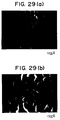
- Fig. 29 (a) is a surface SEM photograph when Al was vapor deposited in a thickness of 500 ⁇ on a SiO 2 insulative layer.
- Fig. 29 (b) is a surface SEM photograph when Bi of 1 atomic layer was supplied at the time of Al vapor deposition.
- a substrate is subjected to thermal treatment at 400°C for 3 hours under vacuum, thereby obtaining film aggregation.
- film aggregation can be obtained without heating a substrate immediately after the deposition.
- a barrier layer, contact layer or the like which is made of a compound or an alloy, is formed as an underlying layer on a substrate, subjected to thermal treatment, and a conductor layer is then deposited; the underlying layer is etched by plasma containing at least one element constituting the compound or alloy as a pretreatment for the deposition of the conductor layer, thereby allowing the formation of a metal thin film with the high crystalline properties and orientation. This is because the etching prevents oxidation of the surface of the underlying layer made of the compound and alloy, and active seeds on the surface so that a stable interface can be formed.
- the surface is etched by plasma of a mixture of an inert gas and nitrogen and a conductor layer is then deposited thereon.
- the conductor film is deposited continuously after etching under vacuum.
- exposure to the air for a short period of time is allowable.
- the etching after etching with the use of a mixture gas, this may be exposed to plasma containing only elements constituting the compound and alloy. These etching are preferably performed while supplying a bias voltage to a substrate.
- the desirable voltage is - 100V or less.
- illustrative methods for depositing a conductor layer are various CVD methods as well as physical vapor deposition methods such as a sputtering method and resistance heating vapor deposition method.
- Illustrative materials of which the conductor layer is formed are Si, WSi, MoSi, pure Al, an Al alloy, pure Cu, a Cu alloy, W, Au, and Ag.
- Desirable Al alloys are an Al-Cu alloy, Al-Cr alloy and Al-Mg alloy. Alternatively, these materials may be layer-like laminated.
- film-deposition is preferably performed by a thermal CVD method with the use of alkylaluminum such as TIBA or alkylaluminum hydride such as DMAH as a source gas.
- alkylaluminum such as TIBA
- alkylaluminum hydride such as DMAH
- Si or Cu may be contained in the source gas during film deposition.
- An alloy may be made by lamination by ion implantation or sputtering, and subsequent thermal treatment after film deposition.
- the improvement in the crystalline properties of a metal thin film thus obtained allows electronic parts with metal wiring having the excellent reliability such as the high stress-migration and electromigration endurance.
- an electrical current is loaded in metal wiring via an insulative layer and the like on a substrate after the formation of metal wiring.
- This current loading allows similar effects in the case where an amorphous thin film is not formed or the other film is interposed.
- grain boundaries in the metal wiring consists of small angle boundaries and twin boundaries with low grain boundary energy
- the more remarkable effect derived from such current loading is obtained.
- a current density ranged from 5 x 10 6 A/cm 2 to 2 x 10 7 A/cm 2 is preferable.
- a reason for limiting a current density is as follows. If a current density is 5 x 10 6 A/cm 2 or less, the above-described effect by current loading cannot be obtained. If a current density is 2 x 10 7 A/cm 2 or more, an electromigration-induced void is formed due to an increased atomic flux divergence from temperature inhamogeneity by enhanced Joule-heating, resulting in a worse wiring shape and poor reliability. A proper loading period depends on the length and shape of metal wiring. However, in view of the stability of Joule-heating and dislocation emission speed, 1 minute or longer is preferable.
- a substrate temperature may be room temperatures or raised temperatures, preferably 300°C or lower. If a substrate is heated to 300°C or higher, thermal etch pits may take place.
- current-loading is preferably conducted at every time of forming metal wiring.
- current loading may be conducted simultaneously in two or more metal wirings.
- materials similar to metal wiring are preferably used for filling a via part (conductive connecting part).
- difference in the amount of additives is allowed as far as the difference is 10% or less per total amount of additives.
- a given thermal treatment may be conducted for the purpose of further crystal grain growth in metal wiring of highly orientated crystal.
- the amorphous thin film is allowed to be crystallized or disappear by the thermal treatment. Since its crystalline property is improved by the crystal grain growth of the highly orientated crystal, the reliability of the metal wiring can be further improved.
- the present invention relates to the improvement in the reliability of metal wiring as mentioned above, the technique of the invention can be similarly applied to an electrode part of a capacitor or resistance heater in an electronic part.
- an under electrode of a capacitor if an interatomic distance corresponding to a peak of halo pattern appearing in diffraction measurement of an amorphous thin film of an underlying layer approximately matches with a spacing of a particular crystal plane defined with the first adjacent interatomic distance of the under electrode, the interface energy between the amorphous thin film and under electrode is reduced so that the under electrode with the very excellent crystalline properties can be formed. Accordingly, the crystalline properties of a dielectric thin film formed thereon is enhanced.
- an amorphous thin film is used as a resistance heater uniform and stable electrical resistance can be attained. Further if an electrode is deposited on this amorphous thin film such that the interatomic distance of the amorphous thin film approximately matches with the spacing of the electrode, the crystalline properties of the electrode are improved and electromigration induced degradation is suppressed at the time of a large current application.
- a pad part connecting with metal wiring is formed of single crystal or highly orientated crystal with the previously mentioned small angle boundaries having the low grain boundary energy, like the metal wiring.
- the shape of the pad part is an aggregation of fine lines successively branched from the metal wiring.
- "successive branch” means, as shown in Fig. 4, that fine line increases in a branch-shape in the upper and lower directions of metal wiring assumed as a central axis.
- the number of upper branches may not be the same as that of lower branches.
- the branch may not be perpendicular to the metal wiring.
- the preferable angle ⁇ is 90° or less.
- voids at the upper side of the wiring, which form and move in the wiring successively move to fine lines above the pad part
- voids at the lower side of the wiring which form and move in the wiring, successively move to fine lines under the pad part.
- the voids cannot grow in the wiring width or more, and remain in fine lines around the outer periphery of the pad. If an element constituting fine lines run out by voids in the fine line of the mostly outer periphery, the voids remain in the next fine line.
- a central part of the pad part bonded with wire connected to an external power source does not allow the defect to be accumulated, thereby extremely enlarge the lifetime of the pad part.
- branch successively advances prevents rapid change of a current density in a connecting part with metal wiring, allowing attemperment of flux divergence due to change in a current density.
- voids in a (-) pad but also hillocks in a (+) pad are advantageously dispersed. Spacing between branches is not required to be equal.
- the branched fine lines are preferably connected with a fine line running in the perpendicular direction. Further, the width of these fine lines is preferably more than that of metal wiring.
- a pad part that a region where a current density is one tenth or more of metal wiring is made of an aggregation of fine lines. In a region where a current density is one tenth or less, a continuous (not-brancehd) pad is allowable.
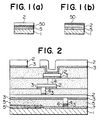
- Figs. 1 (a) and (b) are sectional views for explaining functions of the invention.
- Fig. 2 is a sectional view showing a layer-structure of the invention.
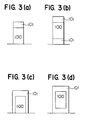
- Figs. 3 (a) to (d) are sectional views showing metal wiring structure of the invention.
- Fig. 4 is an enlarged view showing pads of the invention.
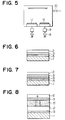
- Fig. 5 is a view showing a multi-target sputter apparatus for use in the invention.
- Fig. 6 is a sectional view according to Example 1.
- Fig. 7 is a sectional view according to Example 3.
- Fig. 8 is a sectional view according to Example 5.
- Fig. 9 is a sectional view according to Example 6.
- Fig. 10 is a sectional view according to Example 7.
- Fig. 11 is a sectional view according to Example 8.
- Figs. 12 (a) to (f) are sectional view showing a method for forming a wiring according to Example 9.
- Fig. 13 is a view showing results of an accelerated test according to Example 9.
- Fig. 14 is a sectional view according to Example 10.
- Fig. 15 is a plan view showing a test substrate with a wiring part according to Example 11.
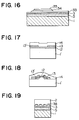
- Fig. 16 is a sectional view according to Example 14.
- Fig. 17 is a sectional view according to Example 16.
- Fig. 18 is a sectional view according to Example 17.
- Fig. 19 is a sectional view according to Example 18.
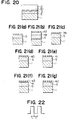
- Fig. 20 is a sectional view according to Example 19.
- Figs. 21 (a) to (g) are sectional views according to Example 21.
- Fig. 22 is a sectional view according to Example 21.
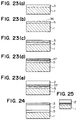
- Figs. 23 (a) to (e) are sectional views showing a flow of steps according to Example 23.
- Fig. 24 is a sectional view according to Example 25.
- Fig. 25 is a sectional view according to Example 27.
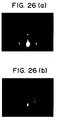
- Figs. 26 (a) and (b) are RHEED photographs according to Example 30.
- Fig. 27 is a sectional view according to Example 38.
- Fig. 28 is a sectional view according to Example 43 and Example 44.
- Figs. 29 (a) and (b) are SEM photographs according to Example 46.
- Figs. 30 (a) to (d) are views according to Example 48.
- Fig. 31 is a view showing a four-terminal pattern according to Example 54.
- an amorphous thin film 3 and metal wiring 2 were successively formed by sputtering.
- an AlTa film was formed as an amorphous thin film 3 by means of a multi-target sputter apparatus as shown in Fig. 5. The sputtering conditions are shown below.
- reference numeral 8 indicates a high frequency power source, 9 a matching circuit, 10 a mass flow controller, 11 a target.
- Sputter system RF magnetron system Target: 100 mm ⁇ AlTa mosaic target (concentric circle like form)
- Composition analysis revealed that the formed film was Al 40 Ta 60 (hereinafter, numeral value shows ratio of an atomic composition).
- X-ray diffraction revealed that the film was amorphous and that an interatomic distance ds corresponding to peak of halo pattern was 2.34 ⁇ . The following fact was found. Namely, since a spacing df of Al (111) was 2.34 ⁇ , the relation,
- /ds 0 was satisfied.
- the spacing ds can match with the spacing of a particular crystal plane of the metal wiring.
- a mosaic target was used.
- other methods such as simultaneous sputtering with the use of a binary target and lamination of each element could produce a similar amorphous thin film.
- the film thus formed with a layer-structure shown in Fig. 6 was processed into a four-terminal pattern 0.5 ⁇ m in width and 1mm in length, and subjected to an electromigration (EM) test.
- the test conditions were that a wiring temperature was 200°C and a current density was 2x10 6 A/cm 2 .
- EM electromigration
- an amorphous thin film and metal wiring (an amorphous thin film/metal wiring); that is, (Pt 21 Zr 79 /Pt), (Cu 50 Ti 50 /Cu), (Ag 55 Cu 45 /Ag), and (Fe 80 B 20 /Fe); were formed. Similar evaluation of the orientation FWHM revealed that Pt, Cu and Ag were (111) orientation and the FWHMs thereof were 1.4°, 1.8° and 1.6° respectively; and Fe was (110) orientation and the orientation FWHM of (110) reflection thereof was 1.7°.
- Example 1 an amorphous thin film made of Ni 30 Ta 70 (melting point of intermetallic compound of Ni 30 Ta 70 : 1500°C) was formed and a metal wiring made of Al (melting point: 660°C) was formed thereon.
- the amorphous thin film contained an element which has a melting point higher than that of a metal wiring and which could constitute an intermetallic compound with a main element forming the metal wiring.
- an interatomic distance ds of Ni 30 Ta 70 corresponding to a peak of halo pattern was 2.33 ⁇ . This approximately matches with a spacing df 2.34 ⁇ of Al (111).
- (111) orientation FWHM of 0.9° and excellent crystalline properties were observed. Further, in the EM test, it was confirmed that even after an elapsed time of 1000 hours there was no failure and excellent reliability was also obtained.
- an amorphous thin film and metal wiring that is, (Pd 80 Si 20 /Al), (Ag 55 Cu 45 /Al), and (W 70 Zr 30 /Al); were formed. Similar evaluation revealed that the (111) orientation FWHMs thereof were 1.9°, 1.8° and 1.2 respectively.
- Example 1 an amorphous thin film made of a Co-based alloy, Co 80 Zr 9 Nb 11 was formed and a metal wiring made of Al was formed thereon.
- an interatomic distance ds of Co 80 Zr 9 Nb 11 corresponding to a peak of halo pattern was 2.04 ⁇ . This approximately matches with a spacing df 2.02 ⁇ of Al (200).
- (111) orientation and excellent crystalline properties were observed. Further, in the EM test, it was confirmed that even after an elapsed time of 1000 hours there was no failure and excellent reliability was obtained.
- an amorphous thin film and metal wiring (an amorphous thin film/metal wiring); that is, (Co 80 Zr 8 Nb 12 /Al), (Co 85 Zr 6 Nb 9 /Al), (Co 88 Zr 8 Ta 9 /Al), and (Co 90 Hf 6 Pd 4 /Al); were formed. Similar evaluation revealed that the (111) orientation FWHMs thereof were 1.2° and satisfactory crystalline properties was obtained.
- Al metal wirings 2 were formed after various combinations of the following steps; these steps were that a polycrystalline TiN/Ti layer was formed on the insulative layer 5 as a barrier layer 6, that an amorphous thin film 3 (Co 80 Zr 9 Nb 11 ) was formed thereon, that thereafter it was exposed to the air as shown in Table 1, and that it was then subjected to Ar bias sputtering.
- the crystalline orientation of these Al metal wirings were evaluated with the FWHM of an Al(111) rocking curve by X-ray diffraction using a CuK ⁇ line. As shown in Table 1, in the cases of no amorphous thin film and no Ar bias sputtering after exposure to the air, the crystalline orientation was remarkably degraded.
- Example 2 amorphous thin films and metal wirings shown in Table 2 were formed. As also shown in Table 2, in this embodiment, amorphous thin films with larger surface energy than that of metal wiring in the crystalline state were used.
- borides, carbides and nitrides of TiB 2 and the like were preferably used as an amorphous thin film, since their surface energy was large.
- a metal wiring was directly formed on SiO 2 in a similar way to Example 1.
- An interatomic distance ds of SiO 2 corresponding to a peak of halo pattern does not approximately match even for the nearest spacing df of (111) Al. Further, the surface energy of SiO 2 is smaller than that of Al.
- the (111) orientation FWHM was as large as 8.2° and in the EM test a wiring failure was observed within 10 hours.
- a conductive connecting part 4 namely a via, was formed in the longitudinal direction.
- a SiO 2 thermal oxide film was formed as an insulative layer 5 on a Si substrate 1 and thereafter a 4000 ⁇ thick thin film, which was made of Al, Cu, W or MoSi 2 , was deposited as a under-layer metal wiring 2'.
- a 3000 ⁇ thick SiO 2 interlayer insulative film 5' was deposited by means of a thermal CVD method.
- a via (or through hole) 4 with a diameter of 50 ⁇ m was formed by means of conventional PEP, reactive ion etching (RIE) steps.
- RIE reactive ion etching
- the via 4 was filled with W by a selective CVD method.
- a 200 ⁇ thick Co 80 Zr 9 Nb 11 thin film was formed as an amorphous thin film 3 of the present invention.
- the surface of Co 80 Zr 9 Nb 11 was exposed to the air one time, it was subjected to Ar RF plasma cleaning.
- pure Al thin film was deposited as a metal wiring 2 in a thickness of 4000 ⁇ by sputtering.
- the crystalline orientation of the Al thin film was evaluated with the FWHM of an Al (111) rocking curve by X-ray diffraction using a CuK ⁇ line.
- Example 5 Like Example 5, a via 4 was formed and then, as shown in Fig. 9, Ni 62 Nb 38 was formed in a thickness of 300 ⁇ as an amorphous thin film 3 by sputtering. As a result, as shown in Fig. 9, although a side wall of the via become slightly thin, a Ni-Nb layer was conformably formed. Under vacuum of 1 x 10 -7 Torr, a 4000 ⁇ thick pure Al thin film was continuously formed as a metal wiring 2 thereon by sputtering. As a result of evaluation similar to Example 5, FWHM was uniformly 1.35°.
- Example 5 a via 4 was formed and then, as shown in Fig. 10, Al 40 Ta 60 was formed as an amorphous thin film 3 by sputtering.
- provision of a collimator between a substrate with the via and target improved the direct-advance property of particles to be deposited. Accordingly, an amorphous layer was hardly formed on a side wall of the via 4 and a 100 ⁇ Al-Ta amorphous thin film 3 could be formed on the bottom surface of the via 4 and interlayer insulative film 5'.
- Ar RF bias sputter cleaning After exposure to the air one time, it was subjected to Ar RF bias sputter cleaning. Then pure Al thin film was deposited in a thickness of 4000 ⁇ as a metal wiring 2 by sputtering.
- FWHM was uniformly 1.1°.
- an Al 40 Nb 60 film was formed as an amorphous thin film 3' on an insulative layer 5 formed of a SiO 2 thermal oxide film, and thereafter under vacuum of 1 x 10 -7 Torr or less pure Al was continuously deposited to form an under-layer metal wiring 2' with a thickness of 4000 ⁇ .
- the FWHM of a rocking curve of the under-layer metal wiring 2' was 1.2°.
- a SiO 2 interlayer insulative film 5' and via 4 were formed on the Al under-layer metal wiring 2'.
- the via 4 was selectively filled with Al by means of a thermal CVD method using TIBA (triisobuthyl aluminum, i-(C 4 H 9 ) 3 Al) as a source gas.
- TIBA triisobuthyl aluminum, i-(C 4 H 9 ) 3 Al
- This Al with which the via 4 was filled had the continuous crystalline orientation of the lower Al and had the same FWHM of a rocking curve as that of the under-layer metal wiring 2'.
- Al-Nb was continuously deposited in a thickness of 250 ⁇ as an amorphous thin film 3 by sputtering.
- an Al film was deposited in a thickness of 250 ⁇ as a metal wiring 2 by means of a sputter or thermal CVD method using TIBA.
- the distribution of the crystalline orientation of this Al film was uniform and the rocking FWHM was 1.2 °.
- Al may be deposited after removing an amorphous thin film 3 corresponding to the via 4 by a conventional PEP step and ion-milling step. Even the Al film thus obtained had the uniform orientation including the via part, and the FWHM was similarly 1.2 °.
- an insulative layer formed of amorphous SiO 2 was formed on the surface of a Si substrate 1.
- a 1000 ⁇ thick amorphous thin film 3 was deposited on the amorphous SiO 2 by a sputter method (Fig. 12 (b)) and then the amorphous thin film 3 on parts other than parts on which wiring would be formed were removed by etching (Fig. 12 (c)).
- a 5000 ⁇ thick insulative layer 5 formed of amorphous SiO 2 was uniformly deposited thereon (Fig. 12 (d)).
- only SiO 2 on the amorphous thin film 3 was removed by etching to form a groove in which wiring would be arranged (Fig. 12 (e)).
- the bottom surfaces of the grooves were made of the amorphous thin film 3.
- the width of the grooves, the width of the metal wiring was 0.8 ⁇ m and the depth of the grooves was 4000 ⁇ .
- An ion beam with low energy was irradiated on the above substrate 1 with the grooves to remove an oxide film on the surface of the amorphous thin film 3.
- Al was deposited by means of a thermal CVD method using TIBA to obtain a metal wiring 4 (Fig. 12 (f)). Selective growth that Al was deposited only in the grooves could be performed at a substrate temperature of 300°C or lower.
- Table 3 shows the Al deposition speed in the grooves against substrate temperatures in the case where an Al amorphous alloy, as the amorphous thin film 3, was formed on the groove bottom surface.
- the Al amorphous alloys include Al 30 Ta 70 , Al 40 Nb 60 , and Al 50 V 50 . Further, in order to confirm the selective growth, Table 3 also shows if selective growth for SiO 2 was performed in parts other than the grooves. As comparative examples, a film of amorphous SiO 2 , polycrystalline silicon or polycrystalline silver was formed on the groove bottom surface. The Al deposition speeds and selective growth of the comparative examples are shown in Table 3.
- Al filled in the grooves whose bottom was formed of the Al amorphous alloy was examined by a transmission electron microscope.
- the examination revealed that a diameter of Al crystal grains was about 1 ⁇ m to be substantially the same as the wiring width and that these (111) crystal grains were connected with small angle grain boundaries in the line direction of the wiring. Further, there existed a region which consisted of one crystal grain with length of 10 ⁇ m or more in the wiring line direction. This exhibits that a single-crystal Al wiring was partially obtained which had more excellent stress-migration and electromigration endurance than those of (111) high orientation.
- Table 3 Constituent material of groove bottom surface Al deposition speed (A/min) Selectivity for SiO2 Continuity of surface form 320 (°C) 300 (°C) 280 (°C) 260 (°C)
- Example 9-1 Al30Ta70 1400 430 170 60 o o
- Example 9-2 Al40Nb60 1400 430 170 60 o o
- Example 9-3 Al50V50 1400 430 170 60 o o Comparative Example 9-1
- Amorphous SiO2 110 30 10 0 x x Comparative Example 9-2 Polycrystalline Si 150 50 20 0 ⁇ x Comparative Example 9-3 Polycrystalline Ag 430 150 60 20 o ⁇
- Table 4 Constituent material of groove bottom surface Al(111) FWHM (°)
- Example 9-4 Al30Ta70 1.0
- Example 9-5 A140Nb60 1.1
- Example 9-6 A150V50 1.0
- a SiO 2 insulative layer 5 was formed on a semiconductor substrate 1 with a functional element 31 by means of a CVD method.
- a region destined for a contact part was removed by etching to from a contacting hole 32.
- a natural oxide film which was formed on the semiconductor substrate 1 of the contacting hole bottom surface was removed by hydrofluoric acid cleaning.
- it was rinsed with pure water with a low oxygen concentration and then dried by highly pure nitrogen gas purge.
- An Al-Ta amorphous thin film 3 was formed on the substrate by a multi-sputter apparatus. The sputtering conditions are shown below.
- Sputter system RF magnetron system Target: 100 mm ⁇ Al-Ta mosaic target
- Substrate temperature Room temperature (25°C)
- Sputter gas Ar Gas pressure: 0.20Pa
- Applied power 10W/cm 2
- Film thickness 400 ⁇
- Composition analysis revealed that the formed film was Al 55 Ta 45 .
- X-ray diffraction revealed that the film was amorphous.
- the Al amorphous thin film 3 was formed by a sputter method in this embodiment, a similar amorphous film can be formed by a CVD method or vapor deposition method.
- a similar amorphous thin film can be obtained by the other methods such as simultaneous sputtering with an Al/Ta binary target or alternate laminating Al and Ta in thin thicknesses.
- an Al film was formed thereon by a sputter method.
- the sputtering conditions are shown below.
- Sputter system RF magnetron system Target: 100 mm ⁇ Al target
- Sputter gas Ar Gas pressure: 1Pa
- Applied power 5W/cm 2
- Film thickness 4000 ⁇
- the Al film thus formed was evaluated for the orientation and crystalline properties by X-ray diffraction.
- the FWHM of a (111) rocking curve was 1.0° and excellent orientation was observed. Namely satisfactory orientation was obtained.
- the Al film was formed by a sputter method in this embodiment, similarly satisfactory layers can be obtained by means of a CVD method and vapor deposition method.
- an Al-Ta amorphous thin film and Al film were formed on a silicon substrate with a thermal oxide film under condition similar to Example 10.
- a test substrate 24 was made which had an anode 21, a cathode 22 and a 0.8 ⁇ m wide wiring part 23 connecting these electrodes.
- the orientation and crystalline properties of an Al film of this test substrate was evaluated by X-ray diffraction.
- the FWHM of a (111) rocking curve was 1.0°.
- a current at a current density of 2 x 10 6 A/cm 2 was flown in the test substrate 24 at a test temperature of 200°C to measure its average failure time. The value was 1000 hours or more, thereby exhibiting that the test substrate had the high electromigration endurance.
- Al-Mo amorphous thin film was formed on a substrate with functional elements thereon.
- the formed film was Al 60 Mo 40 .
- X-ray diffraction revealed that the film was amorphous.
- An Al film formed thereon was evaluated for the orientation and crystalline properties by X-ray diffraction. As a result, the FWHM of a (111) rocking curve was 1.1°. Satisfactory orientation was observed.
- Example 10 Al-Nb-Si amorphous thin film was formed on a substrate with functional elements thereon. As a result of composition analysis, it was found the formed film was Al 40 Nb 55 Si 5 . X-ray diffraction revealed that the film was amorphous. An Al film formed thereon was evaluated for the orientation and crystalline properties by X-ray diffraction. As a result, the FWHM of a (111) rocking curve was 1.3°. Excellent orientation was observed.
- a six-inch silicon wafer with a 4000 ⁇ insulative film 5 formed of a thermal oxide film was used as a substrate 1.
- a PtZr amorphous thin film 3 was formed by means of a multi-target sputter apparatus as shown in Fig. 5. The sputtering conditions are shown below.
- Sputter system RF magnetron system
- Target 100 mm ⁇ PtZr mosaic target
- Substrate temperature Room temperature (25°C)
- Sputter gas Ar Gas pressure: 0.20Pa
- Applied power 10W/cm 2
- Film thickness 500 ⁇ Composition analysis revealed that the formed film was Pt 21 Zr 79 .
- X-ray diffraction revealed that the film was amorphous.
- a strontium titanate film 34 was formed as a dielectric thin film by means of a RF magnetron sputter method.
- a sintered body of strontium titanate was used as a target.
- the sputter conditions are shown below.
- Sputter system RF magnetron system Target: 100 mm ⁇ SrTiO 3 target
- Substrate temperature 500°C
- Sputter gas Ar/O 2 Gas pressure: 1Pa
- Applied power 5W/cm 2
- Film thickness 5000 ⁇
- the orientation and crystalline properties of the dielectric thin film were evaluated by X-ray diffraction.
- the (111) orientation of Pt film 33 was continued and the (111) orientation FWHM was 1.5°.
- Example 14 using a six-inch silicon wafer substrate with a 4000 ⁇ thermal oxide film, a Pt 21 Zr 79 film was formed as an amorphous thin film by means of a multi-target sputter apparatus.
- a PtTi film was formed by sputtering as an under electrode on the amorphous Pt 21 Zr 79 film.
- the sputter conditions are shown below.
- Sputter system RF magnetron system Target: 100 mm ⁇ Pt/Ti binary alloy target
- Substrate temperature Room temperature (25°C)
- Sputter gas Ar Gas pressure: 1Pa
- Applied power 5W/cm 2
- Film thickness 1000 ⁇
- the PtTi film thus formed was subjected to composition analysis. The analysis revealed that the composition thereof was Pt 88 Ti 12 .
- the orientation and crystalline properties thereof were evaluated by X-ray diffraction.
- the (111) orientation FWHM was 1.4° and satisfactory crystalline properties were observed.
- a ferrodielectric thin film of lead titanate zirconate was grown by means of a RF magnetron sputter method.
- a used target was a sintered body where powder of lead titanate zirconate added with lead oxide 10 mol% rich was sintered at 1200°C. The sputtering conditions are shown below.
- Sputter system RF magnetron system Target: 100 mm ⁇ Pb(ZrTi)O 3 target (PbO 10 mol% RICH) Substrate temperature: 600°C Sputter gas: Ar/O 2 Gas pressure: 1Pa Applied power: 5W/cm 2 Film thickness: 5000 ⁇
- the orientation and crystalline properties of the obtained strong dielectric thin film were evaluated by X-ray diffraction.
- the (111) orientation of the PtTi film was continued and the (111) orientation FWHM was 1.9°.
- the orientation FWHM of a Pt film directly formed on the thermal oxide film was 9.2°.
- the orientation FWHM was 9.8°.
- an AlTa amorphous thin film was formed as a resistance heater film 12 by means of a multi-target sputter apparatus as shown in Fig. 5.
- the sputter conditions are shown below.
- Sputter system RF magnetron system Target: 100 mm ⁇ Al/Ta binary target
- Substrate temperature Room temperature (25°C)
- Sputter gas Ar Gas pressure: 0.20Pa
- Applied power 10W/cm 2
- the formed film was Al 25 Ta 75 .
- X-ray diffraction revealed that this film was amorphous.
- an Al thin film was sputtered thereon.
- the sputter conditions are shown below.
- Sputter system RF magnetron system Target: 100 mm ⁇ Al target Substrate temperature: room temperature (25°C)
- Sputter gas Ar Gas pressure: 1Pa
- Applied power 5W/cm 2
- This film was an oriented film with the FWHM 1.0° of a (111) rocking curve.
- an AlNa thin film was formed as a resistance exothermic body film 12 by means of a multi-target sputter apparatus as shown in Fig. 5.
- the sputter conditions are shown below.
- Sputter system RF magnetron system Target: 100 mm ⁇ Al/Nb binary target
- Substrate temperature Room temperature (25°C)
- Sputter gas Ar Gas pressure: 0.20Pa
- Applied power 10W/cm 2
- the formed film was Al 40 Nb 60 .
- This Al-Nb film was processed by lithography and etching steps to remain only on the height and vicinity thereof. Next this was placed in a chamber again and subjected to Ar bias cleaning. Then an Al film was sputtered.
- the sputter conditions are shown below.
- Sputter system RF magnetron system Target: 100 mm ⁇ Al target
- Sputter gas Ar Gas pressure: 1Pa
- Applied power 5W/cm 2
- the crystalline properties of the Al film formed on the flat part were evaluated by X-ray diffraction. This film was an oriented film with the FWHM of 1.2° of a (111) rocking curve.
- an AlTa amorphous film 3 was formed by means of a multi-target sputter apparatus as shown in Fig. 5.
- the sputter conditions are shown below.
- Sputter system RF magnetron system Target: 100 mm ⁇ Al/Ta binary target
- Substrate temperature Room temperature (25°C)
- Sputter gas Ar Gas pressure: 0.20Pa
- Applied power 10W/cm 2
- Film thickness 1000 ⁇ Composition analysis revealed that the formed film was Al 45 Ta 55 .
- X-ray diffraction revealed that the film was amorphous.
- grooves 38 were formed by standard lithography and RIE steps.
- the depth of the grooves 38 was 100 ⁇ and the width thereof was 1000 ⁇ .
- a test substrate 24 had an anode 21, a cathode 22 and a 0.8 ⁇ m wide wiring part 23 connecting these electrode.
- the test substrate 24 was made by standard lithography and RIE steps. A current at a current density of 2 x 10 6 A/cm 2 was flown to the wiring part 23 of the test substrate 24 at a test temperature of 200°C. It was confirmed that even after the elapsed time of 1000 hours there was no failure. This exhibits that since Al film was highly oriented and the Al film was a film formed only of small angle grain boundaries, the electromigration endurance was dramatically enhanced.
- grooves were formed by means of standard lithography and RIE steps.
- a NiTa amorphous film 3 with grooves 30 was formed on the substrate 1 by means of a multi-target sputter apparatus as shown in Fig. 5.
- the sputter conditions are shown below.
- Sputter system RF magnetron system Target: 100 mm ⁇ Ni/Ta binary target
- Substrate temperature Room temperature (25°C)
- Sputter gas Ar Gas pressure: 0.20Pa
- Applied power 10W/cm 2
- Film thickness 100 ⁇
- Composition analysis revealed that the formed film was Ni 50 Ta 50 .
- X-ray diffraction revealed that the film was amorphous.
- a sectional surface was examined by a SEM. The examination revealed that the grooves 30 were uniformly formed in the surface of NiTa amorphous film 3, the depth of the grooves 30 being 1000 ⁇ , the width thereof being 1000 ⁇ .
- Example 18 After the NiTa amorphous thin film 3 was subjected to Ar bias cleaning, Al was sputtered in a manner similar to Example 18. The formed Al film was evaluated for the orientation and crystalline properties by X-ray diffraction. The (111) orientation FWHM was 0.9° and satisfactory crystalline properties were observed.
- an AlNb amorphous thin film was formed by means of a multi-target sputter apparatus as shown in Fig. 5.
- the sputter conditions are shown below.
- Sputter system RF magnetron system Target: 100 mm ⁇ Al/Nb binary target
- Substrate temperature Room temperature (25°C)
- Sputter gas Ar Gas pressure: 0.20Pa
- Applied power 10W/cm 2
- Film thickness 1000 ⁇
- X-ray diffraction revealed that the film was amorphous.
- grooves were formed by standard lithography and RIE steps.
- the depth of the grooves was 100 ⁇ and the width thereof was 1000 ⁇ .
- a 1000 ⁇ thick thermal oxide film was formed on a Si (100) six-inch substrate 1 as an insulating layer 5. Thereafter, the following seven samples were prepared.
- L/S is shown in Fig. 22.
- polycrystalline Ta surface energy: 2150erg/cm 2
- polycrystalline Ta was sputtered on the thermal oxide film to form a 200 ⁇ thick Ta film 39.
- a 1000 ⁇ thick thermal oxide film was formed on Si(100) six-inch substrates and then a 200 ⁇ thick Ta-40at%Al film was deposited by sputtering. These samples were processed to form grooves of L/S as shown in Table 6 by RIE. The resultant samples were subjected to Ar plasma etching in a high vacuum sputter whose the degree of vacuum was on the order of 10 -10 Torr so that a surface oxide film of the Al-Ta film surface was removed by Ar plasma etching. Subsequently, a pure Al film was formed in a thickness of 4000 ⁇ . The EM test was conducted in a manner similar to Example 21. The results are shown in Table 6.
- grooves 36 were formed by standard lithography and RIE steps (Fig. 23 (b)). The depth of the grooves 36 was 100 ⁇ and the width thereof was 1500 ⁇ .
- a AlTa amorphous film 3 was formed on this substrate 1 by means of a multi-target sputter apparatus as shown in Fig. 5 (Fig. 23 (c)).
- the sputter conditions are shown below.
- Sputter system RF magnetron system Target: 100 mm ⁇ Al/Ta binary target
- Substrate temperature Room temperature (25°C)
- Sputter gas Ar Gas pressure: 0.20Pa
- Applied power 10W/cm 2
- Film thickness 1000 ⁇
- Composition analysis revealed that the formed film was Al 75 Ta 25 .
- X-ray diffraction revealed that the film was amorphous.
- this substrate 1 was subjected to thermal treatment at 450°C for 30 minutes so that the AlTa amorphous thin film 3 was crystallized to form an intermetallic compound of Al 3 Ta or a polycrystalline film 37 with small angle grain boundaries in a grain diameter of 1 to 2 ⁇ m (Fig. 23 (d)).
- an Al film was sputtered thereon (Fig. 23 (e)). The sputter conditions are shown below.
- Sputter system RF magnetron system Target: 100 mm ⁇ Al target Substrate temperature: Room temperature (25°C) Sputter gas: Ar Gas pressure: 1Pa Applied power: 5W/cm 2 Film thickness: 4000 ⁇
- the Al film thus formed was evaluated for the orientation and crystalline properties by X-ray diffraction.
- the (111) orientation FWHM was improved to be 0.3° and almost grain boundaries remaining in the Al film were small angle boundaries.
- a test substrate 24 had an anode 21, a cathode 22 and a 0.8 ⁇ m wide wiring part 23 connecting these electrode.
- the test substrate 24 was made by standard lithography and RIE steps. A current at a current density of 2 x 10 6 A/cm 2 was loaded to the wiring part 23 of the test substrate 24 at a test temperature of 200°C. Even after the elapsed time of 1000 hours there was no failure. This exhibits that since the Al film was similar to single-crystal, the electromigration endurance was dramatically enhanced.
- grooves were formed by standard lithography and RIE steps.
- the depth of the grooves was 500 ⁇ and the width thereof was 5000 ⁇ .
- the space between the grooves was 3000 ⁇ .
- a AlNb amorphous film was formed on this substrate by means of a multi-target sputter apparatus as shown in Fig. 5.
- the sputter conditions are shown below.
- Sputter system RF magnetron system
- Target 100 mm ⁇ Al/Nb binary target
- Substrate temperature Room temperature (25°C)
- Sputter gas Ar Gas pressure: 0.20Pa
- Applied power 10W/cm 2
- Film thickness 400 ⁇
- X-ray diffraction revealed that the film was amorphous.
- this substrate was heated at 450°C for 30 minutes so that the AlNb amorphous film was crystallized to form an intermetallic compound of Al 3 Nb.
- the intermetallic compound was filled in the grooves to be of single-crystal.
- the surface of the resultant substrate was flatted by polishing and then was placed into a chamber again.
- Ar bias cleaning an Al-0.1at%Cu alloy was sputtered as a metal thin film.
- the sputter conditions are shown below.
- Sputter system RF magnetron system Target: 100 mm ⁇ AlCu alloy target
- Substrate temperature Room temperature (25°C)
- Sputter gas Ar Gas pressure: 1Pa Applied power: 5W/cm 2 Film thickness: 4000 ⁇
- the AlCu film thus formed was processed into a metal wiring by a RIE step.
- RIE reactive ion plasma
- a 4000 ⁇ thick pure Al thin film destined for a metal wiring 2 was formed by sputtering.
- an Al-Ta amorphous thin film 3 was formed by sputtering using an Al/Ta mosaic target. The thickness of the layer 3 varied 100, 300, and 500 ⁇ .
- some samples were exposed to the air. The exposed samples were then placed into a sputter apparatus again so that the Al-Ta amorphous thin film 3 was formed on the pure Al thin film.
- a surface oxide of the exposed samples was removed by RF-Ar plasma where the substrate 1 side was an electrode.
- plasma etching was conducted until a clear diffraction pattern of an Al thin film was observed by RHEED for the surface of the Al thin film.
- the composition of the amorphous thin film 3 was Al 20 Ta 80 .
- the laminated structure of the metal film 2 of a pure Al and Al-Ta amorphous thin film 3 was thus prepared.
- these thin samples were thermal treated in a forming gas (N 2 -H 2 ) at 450°C for 30 minutes.
- Hillock density measured by an optical microscope and tracer type device for measuring a film thickness ( ⁇ -STEP) are shown in Table 7. As shown in table 7, it was found that the existence of the amorphous thin film 3 considerably reduced the number of hillocks and that even when the thickness of the amorphous thin film 3 was 100 ⁇ , this effect could be obtained.
- a 4000 ⁇ thick pure Cu thin film destined for a metal wiring was formed by sputtering.
- a Cu-Zr amorphous thin film or a Ni-Nb amorphous thin film was formed by binary target sputtering.
- the thickness of the amorphous Cu-Zr alloy layer or the amorphous Ni-Nb alloy layer varied 100, 300, and 500 ⁇ . At this time, after the formation of this Cu thin film, some samples were exposed to the air.
- the exposed samples were then placed into a sputter apparatus again so that the Cu-Zr amorphous thin film or the Ni-Nb amorphous thin film was formed on the pure Cu thin film.
- a surface oxide of the exposed samples was removed by RF-Ar plasma where the substrate side was an electrode.
- plasma etching was conducted until a clear diffraction pattern of a Cu thin film was observed by RHEED for the surface of the Cu thin film.
- the composition of the amorphous thin film was Cu 50 Zr 50 or Ni 65 Nb 35 .
- Sn was vapor deposited on the substrate to form a Sn film 51 in 1 mono layer (ML) (Fig. 25).
- a K-cell (Knudsen-Cell) temperature was 1100°C and a substrate temperature was 450°C.
- Al was vapor deposited on the substrate 1 with the Sn film 51 to form a 1000 ⁇ thick Al film for a metal wiring 2.
- a K-cell temperature was 1050°C and a substrate temperature was room temperature.
- the Al film thus formed was evaluated for the orientation by X-ray diffraction.
- the (111) orientation FWHM was 2.0° and satisfactory crystalline properties were observed.
- a K-cell temperature was 600°C and a substrate temperature was room temperature. Keeping vacuum, a 1000 ⁇ thick Cu film was vapor deposited on the substrate with the Pb film. A K-cell temperature was 1200°C and a substrate temperature was room temperature.
- the Cu film thus formed was evaluated for the orientation by X-ray diffraction.
- the (111) orientation FWHM was 4.0° and satisfactory crystalline properties were observed.
- an Al-Ta amorphous thin film was formed by a multi-sputter apparatus.
- the sputter conditions are shown below.
- Sputter system RF magnetron system Target: 100 mm ⁇ AlTa alloy target
- Substrate temperature Room temperature (25°C)
- Sputter gas Ar Gas pressure: 0.20Pa
- Film thickness 400 ⁇ Composition analysis revealed that the formed film was Al 55 Ta 45 .
- X-ray diffraction revealed that the film was amorphous.
- Sn was vapor deposited in one mono layer thereon.
- the vapor deposition conditions were similar to Example 27. Further keeping vacuum, a 1000 ⁇ thick Al film was vapor deposited on the substrate with the Sn film.
- a K-cell temperature was 1050°C and a substrate temperature was room temperature.
- the Al film thus formed was evaluated for the orientation by X-ray diffraction.
- the (111) orientation FWHM was 1.6° and satisfactory crystalline properties were observed.
- Bi vapor deposited in 0.5 and 1 mono layers (ML).
- a K-cell temperature was 600°C and a substrate temperature was room temperature. Keeping vacuum, an Al film was vapor deposited on the substrates with the Bi films in a thickness of 100 ⁇ .
- a K-cell temperature was 1050°C and a substrate temperature was room temperature. For comparison, a sample where an Al film was vapor deposited directly on the substrate was prepared.
- the Al films thus formed were evaluated for the orientation and crystalline properties by RHEED and X-ray diffraction. The results are shown in Fig. 26.
- Fig. 26 In the sample without Bi deposition, as shown in Fig. 26 (a), a RHEED pattern where (111) and (100) orientations were mixed was observed.
- Fig. 26 (b) In the sample with Bi deposition in one atom layer, as shown in Fig. 26 (b), (100) orientation was not observed and satisfactory crystal with the (111) orientation FWHM of 0.3° was obtained.
- the sample with Bi deposition in 0.5 atom layer although the (111) orientation FWHM was 0.5°, (100) orientation was not observed.
- the surface morphology of the Al films were examined by a SEM. In the samples with Bi deposition, the high surface smoothness property was confirmed.
- compositions of the Al films were analyzed by an AES. It was found that Bi existed in the Al film surface, the Al film grain boundaries, and the interface between the Al film and thermal oxide film.
- Bi was vapor deposited in one mono layer.
- a K-cell temperature was 600°C and a substrate temperature was room temperature.
- an Al film was vapor deposited on the substrates with the Bi films in a thickness of 500 ⁇ .
- a K cell temperature was 1050°C and a substrate temperature was room temperature.
- a sample where an Al film was vapor deposited directly on the substrate was prepared.
- the surface forms of the Al films were examined by a SEM.
- crystal grain grew and the grain size become 1890 ⁇ 20 ⁇ .
- the grain diameter of crystal grain was 980 ⁇ 20 ⁇ .
- compositions of the Al films were analyzed by an AES. It was found that Bi existed in the Al film surface, the Al film grain boundary, and the interface between the Al film and thermal oxide film.
- a six-inch silicon wafer with a 4000 ⁇ insulative layer of a thermal oxide film was used as a substrate.
- Bi was vapor deposited in one mono layer on the substrate.
- the vapor deposition conditions were similar to Example 31. Keeping vacuum, a 500 ⁇ thick Al film was vapor deposited on the substrates with the Bi film.
- a K-cell temperature was 1050°C and a substrate temperature was 400°C.
- a sample where an Al film was vapor deposited directly on the substrate was prepared.
- the surface form of the Al film was examined by a SEM.
- crystal grain grew and the average grain size become 3130 ⁇ 20 ⁇ .
- the grain diameter of crystal grain was 1230 ⁇ 15 ⁇ .
- a six-inch silicon wafer with a 4000 ⁇ insulative layer of a thermal oxide film was used as a substrate.
- An Al-Ta amorphous thin film was formed by means of a multi-target sputter apparatus. The sputter conditions are shown below.
- Sputter system RF magnetron system
- Target 100 mm ⁇ Al-Ta alloy target
- Substrate temperature Room temperature (25°C)
- Sputter gas Ar Gas pressure: 0.20Pa
- Film thickness 400 ⁇ Composition analysis revealed that the formed film was Al 55 Ta 45 .
- X-ray diffraction revealed that the film was amorphous.
- Bi was vapor deposited in one mono layer thereon.
- the vapor deposition conditions were similar to Example 31.
- Al was deposited on the substrate with the Bi film to form a 500 ⁇ thick Al film.
- a K cell temperature was 1050°C and a substrate temperature was room temperature.
- a sample where an Al film was vapor deposited directly on the substrate was prepared.
- the Al film thus formed was examined by a SEM.
- the sample with Bi deposition crystal grain grew and the grain diameter become 2970 ⁇ 20 ⁇ .
- the grain diameter of crystal grain was 960 ⁇ 10 ⁇ .
- a high resistance Si (100) and Si (111) substrate were treated with 1%HF and then washed with pure water in which the concentration of solved oxygen was 10ppb. Subsequently, a Cu or Al film was deposited on the Si (100) substrate or Si (111) substrate respectively by a sputter apparatus in which the degree of vacuum was 1 x 10 -8 Torr or less. Ar pressure during deposition was 1 x 10 -3 Torr. Thereafter, the resultant substrates were thermal treated under vacuum at 450°C for 1 hour to process into a four-terminal wiring 1 ⁇ m in width and 100 ⁇ m in length. The kinds of grain boundaries were identified by channelling pattern analysis of a SEM.
- a (111) orientated Al film was formed in a thickness of 4000 ⁇ by high vacuum sputtering. Before Al film deposition as shown in Table 10, the following six kinds of pretreatment silicon wafer were conducted;
- Al film orientation was identified by a X-ray diffraction method, and the sample was processed such that the wiring line direction was in parallel with a ⁇ 111 ⁇ plane.
- the sample subjected to the above SM test was observed by a SEM. It was found that voids formed in a trapezoidal shape substantially in parallel with a wiring line direction. No failure was observed.
- Table 10 Kind of water rinse % of relative misorientation 10° or less Process-ability EM failure time SM defective (%) Contact defective (%) O2 5ppb, air closed 100% ooo 1000hrs. or more 0% 0% open to air 80% oo 200hrs. 1% 0.1% O2 50ppb, air closed 97% ooo 1000hrs. or more 0% 0% open to air 72% oo 160hrs. 2% 0.6% O2 1ppm, air closed 90% ooo 1000hrs. or more 0.1% 0% open to air 10% o 10hrs. 5% 3%
- a Cu film was deposited on a MgO (100) substrate in a thickness of 4000 ⁇ by super high vacuum sputtering to form a Cu film.
- An electron microscope observation revealed that this Cu film was a ⁇ 100 ⁇ epitaxial film containing twin boundaries.
- This Cu film was processed into a four-terminal pattern 0.5 ⁇ m in width and 1mm in length to form a metal wiring.
- the EM test was conducted. The test conditions were a wiring temperature of 300°C and a current density of 2 x 10 6 A/cm 2 . Although twin was observed in a wiring, there was no failure after a welding test of 1000 hours.
- a (111) oriented Al film was formed in a thickness of 4000 ⁇ on a high resistance (111) silicon wafer substrate by high vacuum sputtering.
- the substrate was treated with 1% HF, and washed with ultra pure water in which the dissolved oxygen concentration was 5 ppb under air-closed condition. Thereafter a 0.5 ⁇ m wide four-terminal pattern, where the length of a measurement part was 1000 ⁇ m, was prepared to form a metal wiring.
- electrical current loading at 150°C of five current densities shown in Table 11
- a 1000 ⁇ SiO 2 thick thermal oxide film was formed on a Si (100) substrate 1 as an insulative layer 5 and thereafter a 300 ⁇ thick amorphous Al 30 Ta 70 film 52 was formed by dual simultaneous sputtering. After forming the films, grooves 54 with L/S of 1500 ⁇ /1500 ⁇ and depth of 300 ⁇ were formed by lithography. Moreover, after evacuating upto 1 x 10 -8 Torr or less the resultant substrate was exposed to plasma by bias cleaning where a bias voltage of -50V was applied to the substrate for 5 minutes, thereby removing an oxide film on the Ta-Al film 52. Subsequently, an Al film was formed in a thickness of 4000 ⁇ .
- a sample was prepared by that a 4000 ⁇ thick Al film was formed directly on SiO 2 .
- the Al films of these samples were processed into a 0.5 ⁇ m wide four-terminal metal wiring pattern where the length of a measurement part was 1000 ⁇ m.
- An 4000 ⁇ thick Al film was formed on a high resistance (111) silicon wafer substrate by high vacuum sputtering and thermal CVD methods.
- the substrate was treated with 1% HF, rinsed with ultra pure water where the dissolved oxygen concentration was 5 ppb under air-closed condition, and then dried at N 2 atmosphere where the vapor concentration was 10 ppb or less.
- the vacuum degree was 1 x 10 -9 Torr
- a dew point of Ar was -90° or less
- an Ar pressure was 1 x 10 -3 Torr at the time of forming.
- TIBA was used as a gas source. The formed Al film was observed by a TEM.
- the sputtered Al film contained small angle grain boundaries formed in dislocation arrays.
- X-ray diffraction revealed that the sputtered Al film was of single-crystal with the (111) orientation FWHM of 0.3°.
- the CVD film was of single-crystal containing no small angle grain boundaries, and had the (111) orientation FWHM of 0.17° by X-ray diffraction.
- the above film was processed into a four-terminal pattern where the width of wiring part was 0.5 ⁇ m and the length thereof was 100 ⁇ m, thereby forming a metal wiring and pad part.
- the pad consisted of aggregation of fine lines in a shape of Fig. 4.
- the width of the fine line was 0.5 ⁇ m
- the spacing between the fine lines was 0.5 ⁇ m
- the spacing between branch points was 0.5 ⁇ m.
- the electronmigration endurance was examined by a in situ SEM observation at a current density of 2 x 10 7 A/cm 2 at 200°C.
- a 4000 ⁇ thick SiO 2 film was formed on the wiring by a thermal CVD method and a 7500 ⁇ thick SiN film was formed by a plasma CVD method. This was subjected to an identical electromigration test. Stress-migration (SM) induced voids were similarly accumulated in a fine line in the mostly outer periphery of the pad part. Neither of increase in electric resistance nor failure was observed in the centor of the pad part.
- SM Stress-migration
- a Cu film was deposited in a thickness of 4000 ⁇ on a MgO (100) substrate by super high vacuum sputtering. An electron microscope observation revealed, that this film was a ⁇ 100 ⁇ epitaxial film containing twin boundaries.
- the above film was processed into a four-terminal pattern where the width of a wiring part was 1.0 ⁇ m and the length thereof was 100 ⁇ m, thereby forming a metal wiring and pad part.
- the pad part consisted of aggregation of fine lines in a shape of Fig. 4.
- the width of the fine line was 1.0 ⁇ m
- the spacing between the fine lines was 1.0 ⁇ m
- the spacing between branch points was 1.0 ⁇ m.
- the electronmigration endurance was examined by a in situ SEM observation at a current density of 2 x 10 7 A/cm 2 at 250°C.
- a 1000 ⁇ thick thermal oxide film was formed on a (100) Si substrate as an insulative layer, and a TiN film was then formed to be subjected to 600°C thermal treatment in a N 2 atmosphere.
- the TiN film was subjected to sputter-etching. Thereafter a 4000 ⁇ thick Al film was deposited by sputtering.
- the Al film was processed into a four-terminal pattern 0.5 ⁇ m in width and 1mm in length, thereby forming a metal wiring.
- the EM test was conducted.
- the test conditions were a wiring temperature of 200°C and a current density of 2 x 10 6 A/cm 2 .
- the results are shown in Table 13.
- Table 13 Etching bias voltage EM endurance Plasma etching -50V o -100V o -120V x plasma etching + N2 plasma processing -50V o Without etching - x o: no failure up to 500 hours o: failed between 300 and 500 hours x: faulure after 300 hours or less
- amorphous thin films of compositions as shown in Table 14 were formed by sputtering with the use of a mosaic target or by simultaneous sputtering with the use of a multi target. Subsequently, a 4000 ⁇ thick Cu film was formed. Since the various amorphous thin films destined for an underlying layer were exposed to the air, the surface of the amorphous thin films was cleaned by sputter-etching prior to forming the Cu film for the purpose of removing an oxide film on the surface. The conditions of this surface cleaning were an Ar gas pressure of 1.0 x 10 3 Torr, a 100MHz RF power output of 100W, a substrate bias voltage of -50V and cleaning time of 4 minutes.
- the crystalline properties of the underlying layer was confirmed by RHEED. It was confirmed that the underlying layer was an amorphous thin film.
- the Cu film was formed under the following conditions: degree of vacuum: less than 1 x 10 -8 Torr Ar gas pressure: 1.0 x 10 -3 Torr 100MHZ RF power output: 400W cathode bias voltage: -300V film forming speed: 40 ⁇ /second.
- the crystalline properties of the formed Cu film were evaluated by X-ray. For evaluation of the EM endurance, this was processed into a four-terminal pattern with a wiring width of 1 ⁇ m and wiring length of 300 ⁇ m, thereby forming a metal wiring. The electromigration test was then conducted at a current density of 2 x 10 6 A/cm 2 at a wiring temperature of 300°C. These results are also shown in Table 14.
- an underlying layer may have composition slightly different from those of Table 14 as far as the underlying material was amorphous, similar results can be obtained. Further, a little amount of an additive may be added to improve the corrosion resistance, processability and barrier property.
- 100 ⁇ thick alloy thin films 56 of TiNb, TiTa, ZrNb, ZrTa, TiW, ZrMo, TiY and ZrY were formed on Si substrates 1 with a 1000 ⁇ thick insulative layer 5 of a thermal oxide film by multi-target sputtering system using an Ar gas.
- An electric power applied to each target was adjusted such that the compositions of the alloy thin films 56 were Ti 50 Nb 50 , Ti 50 Ta 50 , Zr 50 Nb 50 , Zr 50 Ta 50 , Ti 50 W 50 , Zr 50 Mo 50 , Ti 50 Y 50 , and Zr 50 Y 50 .
- the gas was replaced with a N 2 gas and the surface of the alloy thin film 56 was exposed to N 2 plasma by RF discharge where a substrate 1 was an electrode. Then the crystalline properties of the metal thin film 56 was evaluated by RHEED. It was found that an amorphous layer was formed at least on the surface. Auger electron spectroscopy (AES) analysis revealed that the amorphous layer contained the nitrogen. Thus it was supposed that the amorphous layer consisted of amorphous nitride. For comparison, a sample which was not N 2 plasma processed was prepared. These alloy thin films thus formed were exposed to the air, and thereafter a 4000 ⁇ thick metal film 2 of a pure Al or pure Cu thin films was deposited on the alloy thin films 56.
- AES Auger electron spectroscopy
- a six-inch silicon wafer with a 1000 ⁇ thermal oxide film was used as a substrate and Bi was vapor deposited on the substrate.
- the vapor deposition conditions were similar to those of Example 31. Keeping vacuum, Al was vapor deposited in a thickness of 200 ⁇ to 1000 ⁇ on the substrate deposited with Bi.
- a K-cell temperature was 1200°C and a substrate temperature was room temperature. After the film formation, the substrate temperature was raised to 400°C and subjected to thermal treatment for 3 hours.
- the surface morphology and grain size of the Al film was examined by a SEM and TEM. As a result, a grain size of an Al film with Bi was 7810 ⁇ 30 ⁇ , while a grain size of an Al film without Bi was 1680 ⁇ 20 ⁇ . Namely, it was confirmed that a grain size of an Al film with Bi was larger than that of an Al film without Bi.
- a six-inch silicon wafer with a 1000 ⁇ thermal oxide film was used as a substrate.
- Al was deposited on the substrate in thicknesses of 200 ⁇ to 1000 ⁇ , and 1ML of Bi was deposited simultaneously at beginning of the Al deposition while rotating the substrate.
- the Bi deposition conditions were similar to those of Example 31.
- the Al deposition conditions were that a K-cell temperature was 1200°C and a substrate temperature was room temperature.
- Figs. 29 (a) and (b) show a SEM photograph of the surface of the sample where a 500 ⁇ Al film was formed on SiO 2 .
- Fig. 29 (b) shows a SEM photograph of the surface of the sample where a 500 ⁇ Al film with 1 ML Bi formed on SiO 2 .
- a six-inch silicon wafer with a 1000 ⁇ thermal oxide film was used as a substrate.
- a film of Al crystal grains with (111) orientation against the substrate was formed on the substrate by a thermal CVD apparatus.
- the film forming conditions are shown below.
- Source gas Triisobuthyl aluminum Method for supplying the source gas: Bubbling system by Ar
- the density of Al crystal grains forming the film under these conditions was 5 x 10 7 to 1 x 10 8 /cm 2 .
- Bi was vapor deposited on the substrate under conditions similar to those of Example 31. Keeping vacuum, Al was vapor deposited in a thickness of 200 ⁇ to 1000 ⁇ on the substrate deposited with Bi. A K-cell temperature was 1200°C and a substrate temperature was room temperature.
- the surface morphology of the Al film was observed by a SEM and TEM. As a result, a grain size of an Al film with Bi was 3610 ⁇ 15 ⁇ , while a grain size of an Al film without Bi was 1140 ⁇ 20 ⁇ . Namely, it was confirmed that a grain size of an Al film with Bi was larger than that of an Al film without Bi.
- the Al film thus formed was evaluated for the orientation by X-ray diffraction.
- the (111) orientation FWHM was 1.0°.
- the (111) FWHM of the Al film without pre-deposition of the Al small crystal grains by CVD method was 2.0°. Therefore, the existence of (111) oriented Al small grains improves the final continuous Al film (111) orientation.
- Grooves as shown in Fig. 30 (a) were formed on a six-inch silicon wafer with a 4000 ⁇ thermal oxide film. Al was vapor deposited on the substrate in a thickness of 200 ⁇ . For Al deposition, a K-cell temperature was 1200°C and a substrate temperature was room temperature. The Al morphology was observed by a SEM. As shown in Fig. 30 (b), it was found that Al 20 was uniformly deposited on both the grooves and SiO 2 surface other than the grooves.
- Al was vapor deposited to form a 200 ⁇ thick Al film on a similar substrate with grooves under the above conditions.
- a substrate temperature was room temperature. Subsequently, keeping vacuum, thermal treatment at 400°C for 3 hours was conducted. As shown in Fig. (c), it was found that the grooves of the substrate were substantially completely filled with a metal wiring 2 made of Al, and Al 20 hardly remained on the SiO 2 surface other than the grooves.
- Al was deposited on a similar substrate with grooves in thicknesses of 200 ⁇ and 1ML of Bi was simultaneously deposited at beginning of the Al deposition.
- the Bi vapor deposition conditions were similar to those of Example 31.
- the Al deposition conditions were the same as those mentioned above.
- a substrate temperature was room temperature.
- Fig. 30 (d) it was found that the grooves of the substrate were substantially completely filled with a metal wiring 2 made of Al, and Al 20 hardly remained on the SiO 2 surface other than the grooves. Namely, although the observation was conducted immediately after the film formation at room temperature, the existence of Bi permitted to obtain similar effects of the thermal treatment.
- a six-inch silicon wafer with a 4000 ⁇ thermal oxide film was used as a substrate.
- An AlTa film was formed by means of a multi-target sputter apparatus as shown in Fig. 5.
- the sputter conditions are shown below.
- Sputter system RF magnetron system Target: 100 mm ⁇ Al/Ta binary target
- Substrate temperature Room temperature (25°C)
- Sputter gas Ar Gas pressure: 0.20Pa
- Applied power 10W/cm 2
- Film thickness 50 ⁇
- Composition analysis revealed that the formed film was Al 25 Ta 75 .
- X-ray diffraction revealed that the film was amorphous.
- this conductive thin film was processed into a wiring for the EM test.
- Steps for preparing a test sample were as follows: As shown in Fig. 15, a test substrate 24 had an anode 21, a cathode 22 and a 0.8 ⁇ m wide wiring part 23 connecting these electrode.
- the test substrate 24 was made by standard lithography and RIE steps. An electrical current of 2 x 10 6 A/cm 2 was loaded to the wiring part 23 of the test substrate 24 at a test temperature of 200°C. It was confirmed that even after the elapsed time of 1000 hours there was no failure. This exhibits that since (111) orientation of the Al thin film which was the conductive thin film was improved, the electromigration endurance was dramatically enhanced.
- a six-inch silicon wafer with a 4000 ⁇ thermal oxide film was used as a substrate.
- An AlNb film was formed by means of a multi-target sputter apparatus similar to Example 48.
- the sputter conditions are shown below.
- Sputter system RF magnetron system Target: 100 mm ⁇ Al/Nb binary target
- Substrate temperature Room temperature (25°C)
- Sputter gas Ar Gas pressure: 0.20Pa
- Applied power 10W/cm 2
- Film thickness 500 ⁇
- Composition analysis revealed that the formed film was Al 75 Nb 25 .
- X-ray diffraction revealed that the film was amorphous.
- Al was sputtered on the amorphous Al 75 Nb 25 thin film as a conductive thin film in similar manner to Example 49.
- the Al film thus formed was evaluated for the orientation by X-ray diffraction. It was found that the Al film was a (111) orientated film where the FWHM of a rocking curve was 1.5°. Further, this thin film was subjected to thermal treatment at 400°C for 15 minutes. As a result, the amorphous thin film layer was crystallized and the amorphous thin film layer disappeared. At the same time the FWHM was improved to be 0.9°. The EM test was conducted under the same conditions as those of Example 49. Even after the elapsed time of 1000 hours there was no failure.
- a six-inch silicon wafer with a 4000 ⁇ thermal oxide film was used as a substrate.
- a CuTi film was formed by means of a multi-target sputter apparatus similar to Example 49. The sputter conditions are shown below.
- Sputter system RF magnetron system Target: 100 mm ⁇ Cu/Ti binary target
- Substrate temperature Room temperature (25°C)
- Sputter gas Ar Gas pressure: 0.20Pa
- Applied power 10W/cm 2
- Film thickness 500 ⁇
- Composition analysis revealed that the formed film was Cu 50 Ti 50 .
- X-ray diffraction revealed that the film was amorphous. This amorphous CuTi thin film was exposed to the air and thereafter cleaned by Ar plasma.
- An Al-0.1at%Cu alloy was sputtered as a conductive thin film.
- the sputter conditions are shown below.
- Sputter system RF magnetron system Target: 100 mm ⁇ AlCu alloy target (Cu 0.1atm%)
- Sputter gas Ar Gas pressure: 1Pa
- Applied power 5W/cm 2
- Film thickness 4000 ⁇
- the AlCu film thus formed was evaluated for the orientation by X-ray diffraction. It was found that the AlCu film was a (111) orientated film where the FWHM of a rocking curve was 0.9°. Further, this thin film was subjected to thermal treatment at 400°C for 15 minutes. As a result, the amorphous thin film layer was crystallized and the amorphous thin film layer disappeared. At the same time, the (111) orientation of the AlCu film was further improved and the FWHM become 0.6°.
- a TiN/Ti layer was formed on a six-inch silicon wafer as a diffusion prevention layer.
- An AlTa film was formed thereon by sputtering.
- the sputter conditions are shown below.
- Sputter system RF magnetron system Target: 100 mm ⁇ Al/Ta binary target
- Substrate temperature Room temperature (25°C)
- Sputter gas Ar Gas pressure: 0.20Pa
- Applied power 10W/cm 2
- Film thickness 100 ⁇
- Composition analysis revealed that the formed film was Al 40 Ta 60 .
- X-ray diffraction revealed that the film was amorphous.
- Al was sputtered on the amorphous AlTa film as a conductive thin film under the same conditions as those of Example 49.
- the Al film thus formed was evaluated for the orientation by X-ray diffraction. It was found that the Al film was a (111) orientated film where the FWHM of a rocking curve was 1.3°. Further, this thin film was subjected to thermal treatment at 500°C for 15 minutes. As a result, the amorphous thin film layer reacted with the conductive thin film to form Al 3 Ta phase and the amorphous thin film layer disappeared. However, the specific resistance was not increased and orientation of the conductive thin film were improved and the FWHM become 0.8°. This exhibited that the TiN/Ti layer suppressed reaction with silicon. The EM test was conducted under the same conditions as those of Example 49. Even after the elapsed time of 1000 hours there was no failure.
- a six-inch silicon wafer with a 4000 ⁇ thermal oxide film was used as a substrate.
- a 100 ⁇ thick amorphous V x Al 100-x , Nb x Al 100-x , Ta x Al 100-x , Mo x Al 100-x , or W x Al 100-x layer was formed on the substrate by means of a multi-sputter apparatus of Example 49 while controlling electric power to be applied to a target of Al, and V, Nb, Ta, Mo or W. Compositions of these amorphous layers are shown in Table 17. It was confirmed by X-ray diffraction that each layer was amorphous.
- a 1000 ⁇ thick thermal oxide film was formed on a Si (100) six-inch substrate.
- Films of various alloy compositions as shown in Table 18 (a) to (n) were formed in a thickness of 1000 ⁇ by using a mosaic target or multi-simultaneous sputtering. Keeping vacuum, a Cu film was continuously formed in a thickness of 4000 ⁇ and then subjected to thermal treatment at 450°C for 30 minutes.
- a rocking curve of Cu (111) Cu was measured by X-ray diffraction to examine the crystal orientation of the Cu film thus formed.
- the FWHMs were shown in Table 18 (a) to (n).
- a 3 ⁇ m thick SiO 2 film was formed on the Si substrate, and then the groove of a four-terminal electric resistance measurement pattern was provided on the SiO 2 film as shown in Fig. 31 by PEP and RIE steps.
- a resistance measurement part had groove 1.0 ⁇ m wide, 4500 ⁇ deep and 1mm long.
- the various under films were formed in a thickness of 500 ⁇ by collimated sputtering. Subsequently a Cu film was formed in a thickness of 6000 ⁇ and subjected to thermal treatment at 450°C for 30 minutes. Excess Cu was removed by chemical-mechanical polishing (CMP) to obtain a sample for a reliability test.
- CMP chemical-mechanical polishing
- the reliability test was conducted at a test temperature of 300°C at a current density of 2 x 10 6 A/cm 2 under vacuum. The results were also shown in Table 18. If the electrical resistance of the wiring after the thermal treatment was converted to specific resistance value, the value was about 1.7 ⁇ cm. This value was substantially the same as a bulk value of Cu. Accordingly this indicated that the thermal treatment did not cause reaction between the underlying film and Cu. Further, although the thermal treatment of this example was conducted under vacuum, the thermal treatment may be conducted at a hydrogen atmosphere or, a mixture of hydrogen and nitrogen gas (forming gas). Moreover, although in this example a Cu film was formed continuously after the formation of an under film, the Cu film does not need to be formed just after the formation of the under film. That is, after the formation of the under film, the sample may be exposed to the air and subjected to plasma cleaning of the under film surface in vacuum for removing a natural oxide film, followed the formation of the Cu film.
- One of Ti, Zr, Hf, V, Nb, Ta or Cr elements was added to the underlying film in the amount of 1 to 10 at% keeping the amorphous formability.
- the sample was heated to 600 to 750°C at a NH 3 or N 2 atmosphere to form a nitride film on the Cu wiring surface and in the interface between the underlying film and Cu film.
- the electrical resistance did not increase and the oxidation of Cu wiring was remarkably reduced.
- FWHM Full Width at Half Maximum EM endurance : (Test temperature, 300°C; Current density, 2 x 10 6 A/cm 2 ) Endurance of 1000 hours or more ; o Endurance of 500 hours or more, but not more than 1000 hours ; ⁇ Endurance of 500 or less ; x Composition in at% unit.
- Grooves with a depth of 2000 ⁇ and width of 1 ⁇ m in a shape similar to that as shown in Fig. 30 (a) were formed on a six-inch silicon wafer with a 4000 ⁇ thermal oxide film. Al was vapor deposited in a thickness of 2000 ⁇ on this substrate. In the Al vapor deposition, a K-cell temperature was 1200°C and a substrate temperature was room temperature. The Al film morphology was observed by a SEM. It was found that Al was uniformly deposited on the grooves and SiO 2 surface other than the grooves like the Al film as shown in Fig. 30 (b).
- Al was vapor deposited in a thickness of 2000 ⁇ on a similar substrate with grooves under the above conditions.
- a substrate temperature was room temperature.
- thermal treatment at 400°C for 3 hours was conducted. It was found that the grooves of the substrate were substantially completely filled with Al, while Al hardly remained on SiO 2 surface other than the grooves like the Al film as shown in Fig. 30 (c).
- Al deposited on a similar substrate with grooves in thicknesses of 2000 ⁇ and 1ML of Bi was simultaneously deposited at the beginning of the Al deposition.
- the Bi vapor deposition conditions were similar to those of Example 31.
- the Al vapor deposition conditions are shown above.
- a substrate temperature was room temperature.
- Subsequently, keeping vacuum, thermal treatment at 200°C for 3 hours was conducted. It was found that the grooves of the substrate were substantially completely filled with Al, while Al hardly remained on the SiO 2 surface other than the grooves as shown in Fig. 30 (d).
Landscapes
- Internal Circuitry In Semiconductor Integrated Circuit Devices (AREA)
- Parts Printed On Printed Circuit Boards (AREA)
Applications Claiming Priority (5)
| Application Number | Priority Date | Filing Date | Title |
|---|---|---|---|
| JP228264/92 | 1992-08-27 | ||
| JP22826492 | 1992-08-27 | ||
| JP8010893 | 1993-03-15 | ||
| JP80108/93 | 1993-03-15 | ||
| EP93306663A EP0594286B1 (de) | 1992-08-27 | 1993-08-23 | Elektronisches Teil mit metallischen Leiterbahnen und Verfahren zu seiner Herstellung |
Related Parent Applications (2)
| Application Number | Title | Priority Date | Filing Date |
|---|---|---|---|
| EP93306663A Division EP0594286B1 (de) | 1992-08-27 | 1993-08-23 | Elektronisches Teil mit metallischen Leiterbahnen und Verfahren zu seiner Herstellung |
| EP93306663.1 Division | 1993-08-23 |
Publications (3)
| Publication Number | Publication Date |
|---|---|
| EP0725439A2 true EP0725439A2 (de) | 1996-08-07 |
| EP0725439A3 EP0725439A3 (de) | 1996-10-30 |
| EP0725439B1 EP0725439B1 (de) | 2006-01-18 |
Family
ID=26421158
Family Applications (2)
| Application Number | Title | Priority Date | Filing Date |
|---|---|---|---|
| EP93306663A Expired - Lifetime EP0594286B1 (de) | 1992-08-27 | 1993-08-23 | Elektronisches Teil mit metallischen Leiterbahnen und Verfahren zu seiner Herstellung |
| EP96105263A Expired - Lifetime EP0725439B1 (de) | 1992-08-27 | 1993-08-23 | Elektronisches Bauteil mit metallischen Leiterbahnen und Verfahren zu seiner Herstellung |
Family Applications Before (1)
| Application Number | Title | Priority Date | Filing Date |
|---|---|---|---|
| EP93306663A Expired - Lifetime EP0594286B1 (de) | 1992-08-27 | 1993-08-23 | Elektronisches Teil mit metallischen Leiterbahnen und Verfahren zu seiner Herstellung |
Country Status (3)
| Country | Link |
|---|---|
| EP (2) | EP0594286B1 (de) |
| KR (1) | KR0132402B1 (de) |
| DE (2) | DE69322233T2 (de) |
Cited By (15)
| Publication number | Priority date | Publication date | Assignee | Title |
|---|---|---|---|---|
| EP0877421A3 (de) * | 1997-05-08 | 1998-12-30 | Applied Materials, Inc. | Zerstaubungsabscheidung und Temperen von Metallisierung aus Kupferlegierung |
| EP0954027A1 (de) * | 1998-04-27 | 1999-11-03 | International Business Machines Corporation | Struktur für Kupferleitungsverbindungsleitung, die eine metallische Keimschicht umfasst |
| WO2000004573A1 (en) * | 1998-07-16 | 2000-01-27 | National University Of Singapore | Highly selective and complete interconnect metal line and via/contact hole filling by electroless plating |
| US6037257A (en) * | 1997-05-08 | 2000-03-14 | Applied Materials, Inc. | Sputter deposition and annealing of copper alloy metallization |
| WO2000021129A1 (en) * | 1998-10-07 | 2000-04-13 | Tokyo Electron Arizona, Inc. | In situ titanium aluminide deposit in high aspect ratio features |
| WO2000003420A3 (en) * | 1998-07-10 | 2000-06-29 | Cvc Inc | Method for forming a copper film on a substrate |
| US6245655B1 (en) | 1999-04-01 | 2001-06-12 | Cvc Products, Inc. | Method for planarized deposition of a material |
| US6274495B1 (en) | 1998-09-03 | 2001-08-14 | Cvc Products, Inc. | Method for fabricating a device on a substrate |
| US6294836B1 (en) | 1998-12-22 | 2001-09-25 | Cvc Products Inc. | Semiconductor chip interconnect barrier material and fabrication method |
| EP1094515A3 (de) * | 1999-10-18 | 2002-01-02 | Lucent Technologies Inc. | Mikrostrukturregelung von Kupfer-Verbindungstrukturen |
| US6444263B1 (en) | 2000-09-15 | 2002-09-03 | Cvc Products, Inc. | Method of chemical-vapor deposition of a material |
| US6516030B1 (en) | 1998-05-14 | 2003-02-04 | Interval Research Corporation | Compression of combined black/white and color video signal |
| US6627995B2 (en) | 2000-03-03 | 2003-09-30 | Cvc Products, Inc. | Microelectronic interconnect material with adhesion promotion layer and fabrication method |
| US7749361B2 (en) | 2006-06-02 | 2010-07-06 | Applied Materials, Inc. | Multi-component doping of copper seed layer |
| US8116377B2 (en) | 1998-11-20 | 2012-02-14 | Interval Licensing Llc | Low cost video compression using fast, modified Z-coding of wavelet pyramids |
Families Citing this family (3)
| Publication number | Priority date | Publication date | Assignee | Title |
|---|---|---|---|---|
| JP2004179327A (ja) * | 2002-11-26 | 2004-06-24 | Sharp Corp | 半導体用合金材料、該合金材料を用いた半導体チップ及びその製造方法 |
| CN110364538B (zh) * | 2018-04-11 | 2024-10-29 | Agc株式会社 | 布线膜和布线膜的形成方法 |
| KR102590568B1 (ko) * | 2021-07-06 | 2023-10-18 | 한국과학기술연구원 | 이종 접합 반도체 기판, 그의 제조방법 및 그를 이용한 전자소자 |
Family Cites Families (9)
| Publication number | Priority date | Publication date | Assignee | Title |
|---|---|---|---|---|
| WO1981001629A1 (en) * | 1979-11-30 | 1981-06-11 | Western Electric Co | Fine-line solid state device |
| US4352239A (en) * | 1980-04-17 | 1982-10-05 | Fairchild Camera And Instrument | Process for suppressing electromigration in conducting lines formed on integrated circuits by control of crystalline boundary orientation |
| US4742014A (en) * | 1985-05-10 | 1988-05-03 | Texas Instruments Incorporated | Method of making metal contacts and interconnections for VLSI devices with copper as a primary conductor |
| US5019891A (en) * | 1988-01-20 | 1991-05-28 | Hitachi, Ltd. | Semiconductor device and method of fabricating the same |
| JPH01302842A (ja) * | 1988-05-31 | 1989-12-06 | Nec Corp | 多層配線構造の半導体装置 |
| JP2680468B2 (ja) * | 1989-07-01 | 1997-11-19 | 株式会社東芝 | 半導体装置および半導体装置の製造方法 |
| ATE174450T1 (de) * | 1990-07-06 | 1998-12-15 | Tsubochi Kazuo | Verfahren zur herstellung einer metallschicht |
| JP3131239B2 (ja) * | 1991-04-25 | 2001-01-31 | キヤノン株式会社 | 半導体回路装置用配線および半導体回路装置 |
| JP2937613B2 (ja) * | 1991-07-16 | 1999-08-23 | 日本電気株式会社 | 薄膜配線およびその製造方法 |
-
1993
- 1993-08-23 EP EP93306663A patent/EP0594286B1/de not_active Expired - Lifetime
- 1993-08-23 DE DE69322233T patent/DE69322233T2/de not_active Expired - Lifetime
- 1993-08-23 DE DE69333966T patent/DE69333966T2/de not_active Expired - Lifetime
- 1993-08-23 EP EP96105263A patent/EP0725439B1/de not_active Expired - Lifetime
- 1993-08-26 KR KR1019930016657A patent/KR0132402B1/ko not_active Expired - Fee Related
Cited By (30)
| Publication number | Priority date | Publication date | Assignee | Title |
|---|---|---|---|---|
| US6066892A (en) * | 1997-05-08 | 2000-05-23 | Applied Materials, Inc. | Copper alloy seed layer for copper metallization in an integrated circuit |
| US6387805B2 (en) | 1997-05-08 | 2002-05-14 | Applied Materials, Inc. | Copper alloy seed layer for copper metallization |
| EP0877421A3 (de) * | 1997-05-08 | 1998-12-30 | Applied Materials, Inc. | Zerstaubungsabscheidung und Temperen von Metallisierung aus Kupferlegierung |
| US6037257A (en) * | 1997-05-08 | 2000-03-14 | Applied Materials, Inc. | Sputter deposition and annealing of copper alloy metallization |
| US6181012B1 (en) | 1998-04-27 | 2001-01-30 | International Business Machines Corporation | Copper interconnection structure incorporating a metal seed layer |
| EP0954027A1 (de) * | 1998-04-27 | 1999-11-03 | International Business Machines Corporation | Struktur für Kupferleitungsverbindungsleitung, die eine metallische Keimschicht umfasst |
| US6399496B1 (en) | 1998-04-27 | 2002-06-04 | International Business Machines Corporation | Copper interconnection structure incorporating a metal seed layer |
| KR100339179B1 (ko) * | 1998-04-27 | 2002-05-31 | 포만 제프리 엘 | 상호 접속 구조 및 그 형성 방법 |
| US6516030B1 (en) | 1998-05-14 | 2003-02-04 | Interval Research Corporation | Compression of combined black/white and color video signal |
| WO2000003420A3 (en) * | 1998-07-10 | 2000-06-29 | Cvc Inc | Method for forming a copper film on a substrate |
| US6461675B2 (en) | 1998-07-10 | 2002-10-08 | Cvc Products, Inc. | Method for forming a copper film on a substrate |
| WO2000004573A1 (en) * | 1998-07-16 | 2000-01-27 | National University Of Singapore | Highly selective and complete interconnect metal line and via/contact hole filling by electroless plating |
| US6660636B1 (en) | 1998-07-16 | 2003-12-09 | The National University Of Singapore | Highly selective and complete interconnect metal line and via/contact hole filling by electroless plating |
| US6274495B1 (en) | 1998-09-03 | 2001-08-14 | Cvc Products, Inc. | Method for fabricating a device on a substrate |
| US6508197B1 (en) | 1998-09-03 | 2003-01-21 | Cvc Products, Inc. | Apparatus for dispensing gas for fabricating substrates |
| US6544341B1 (en) | 1998-09-03 | 2003-04-08 | Cvc Products, Inc. | System for fabricating a device on a substrate with a process gas |
| US6692575B1 (en) | 1998-09-03 | 2004-02-17 | Cvc Products Inc. | Apparatus for supporting a substrate in a reaction chamber |
| WO2000021129A1 (en) * | 1998-10-07 | 2000-04-13 | Tokyo Electron Arizona, Inc. | In situ titanium aluminide deposit in high aspect ratio features |
| US6268284B1 (en) | 1998-10-07 | 2001-07-31 | Tokyo Electron Limited | In situ titanium aluminide deposit in high aspect ratio features |
| US8116377B2 (en) | 1998-11-20 | 2012-02-14 | Interval Licensing Llc | Low cost video compression using fast, modified Z-coding of wavelet pyramids |
| US6365502B1 (en) | 1998-12-22 | 2002-04-02 | Cvc Products, Inc. | Microelectronic interconnect material with adhesion promotion layer and fabrication method |
| US6294836B1 (en) | 1998-12-22 | 2001-09-25 | Cvc Products Inc. | Semiconductor chip interconnect barrier material and fabrication method |
| US6812126B1 (en) | 1998-12-22 | 2004-11-02 | Cvc Products, Inc. | Method for fabricating a semiconductor chip interconnect |
| US6645847B2 (en) | 1998-12-22 | 2003-11-11 | Cvc Products, Inc. | Microelectronic interconnect material with adhesion promotion layer and fabrication method |
| US6245655B1 (en) | 1999-04-01 | 2001-06-12 | Cvc Products, Inc. | Method for planarized deposition of a material |
| US6440849B1 (en) | 1999-10-18 | 2002-08-27 | Agere Systems Guardian Corp. | Microstructure control of copper interconnects |
| EP1094515A3 (de) * | 1999-10-18 | 2002-01-02 | Lucent Technologies Inc. | Mikrostrukturregelung von Kupfer-Verbindungstrukturen |
| US6627995B2 (en) | 2000-03-03 | 2003-09-30 | Cvc Products, Inc. | Microelectronic interconnect material with adhesion promotion layer and fabrication method |
| US6444263B1 (en) | 2000-09-15 | 2002-09-03 | Cvc Products, Inc. | Method of chemical-vapor deposition of a material |
| US7749361B2 (en) | 2006-06-02 | 2010-07-06 | Applied Materials, Inc. | Multi-component doping of copper seed layer |
Also Published As
| Publication number | Publication date |
|---|---|
| EP0594286A3 (en) | 1994-07-13 |
| EP0594286B1 (de) | 1998-11-25 |
| DE69322233D1 (de) | 1999-01-07 |
| DE69333966T2 (de) | 2006-09-14 |
| EP0725439B1 (de) | 2006-01-18 |
| KR940004755A (ko) | 1994-03-15 |
| DE69333966D1 (de) | 2006-04-06 |
| KR0132402B1 (ko) | 1998-04-15 |
| DE69322233T2 (de) | 1999-07-08 |
| EP0725439A3 (de) | 1996-10-30 |
| EP0594286A2 (de) | 1994-04-27 |
Similar Documents
| Publication | Publication Date | Title |
|---|---|---|
| US5709958A (en) | Electronic parts | |
| US6001461A (en) | Electronic parts and manufacturing method thereof | |
| EP0725439B1 (de) | Elektronisches Bauteil mit metallischen Leiterbahnen und Verfahren zu seiner Herstellung | |
| JP3936458B2 (ja) | 高誘電キャパシタ及びその製造方法 | |
| KR950004589B1 (ko) | 반도체장치 및 반도체장치의 제조방법 | |
| JP3353874B2 (ja) | 半導体装置及びその製造方法 | |
| US5401675A (en) | Method of depositing conductors in high aspect ratio apertures using a collimator | |
| US6339020B1 (en) | Method for forming a barrier layer | |
| KR100187601B1 (ko) | 반도체장치 및 그 제조방법 | |
| US5869901A (en) | Semiconductor device having aluminum interconnection and method of manufacturing the same | |
| US7157738B2 (en) | Capacitor element and its manufacturing method | |
| HK167395A (en) | Integrated semiconductor circuit with at least two planes made of aluminium or aluminium compound and method of manufacturing the same | |
| JPH1041247A (ja) | 自己調心超薄膜を用いたcvdアルミニウムのブランケット選択的堆積及び反射率の改善 | |
| Lanford et al. | Alloying of copper for use in microelectronic metallization | |
| US5278448A (en) | Semiconductor device and method of fabricating the same | |
| US5008217A (en) | Process for fabricating integrated circuits having shallow junctions | |
| JP3315211B2 (ja) | 電子部品 | |
| JP3491237B2 (ja) | 半導体装置の積層導電膜構造 | |
| US6552431B2 (en) | Semiconductor structure with a titanium aluminum nitride layer and method for fabricating same | |
| EP0370387A2 (de) | Supraleitendes Material | |
| JP4230713B2 (ja) | 電子部品及びその製造方法 | |
| JPH0193149A (ja) | 半導体装置 | |
| US5976946A (en) | Thin film formation method for ferroelectric materials | |
| US4295147A (en) | Josephson devices of improved thermal cyclability and method | |
| KR100200696B1 (ko) | 티에이와 금속 또는 금속산화물로 이루어지는 확산방지막 조성물 및 상기 확산방지막을 포함하는 디-램소자 |
Legal Events
| Date | Code | Title | Description |
|---|---|---|---|
| PUAI | Public reference made under article 153(3) epc to a published international application that has entered the european phase |
Free format text: ORIGINAL CODE: 0009012 |
|
| 17P | Request for examination filed |
Effective date: 19960429 |
|
| AC | Divisional application: reference to earlier application |
Ref document number: 594286 Country of ref document: EP |
|
| AK | Designated contracting states |
Kind code of ref document: A2 Designated state(s): DE FR GB |
|
| PUAL | Search report despatched |
Free format text: ORIGINAL CODE: 0009013 |
|
| AK | Designated contracting states |
Kind code of ref document: A3 Designated state(s): DE FR GB |
|
| 17Q | First examination report despatched |
Effective date: 19990707 |
|
| GRAP | Despatch of communication of intention to grant a patent |
Free format text: ORIGINAL CODE: EPIDOSNIGR1 |
|
| GRAS | Grant fee paid |
Free format text: ORIGINAL CODE: EPIDOSNIGR3 |
|
| GRAA | (expected) grant |
Free format text: ORIGINAL CODE: 0009210 |
|
| AC | Divisional application: reference to earlier application |
Ref document number: 0594286 Country of ref document: EP Kind code of ref document: P |
|
| AK | Designated contracting states |
Kind code of ref document: B1 Designated state(s): DE FR GB |
|
| REG | Reference to a national code |
Ref country code: GB Ref legal event code: FG4D |
|
| REF | Corresponds to: |
Ref document number: 69333966 Country of ref document: DE Date of ref document: 20060406 Kind code of ref document: P |
|
| ET | Fr: translation filed | ||
| PLBE | No opposition filed within time limit |
Free format text: ORIGINAL CODE: 0009261 |
|
| STAA | Information on the status of an ep patent application or granted ep patent |
Free format text: STATUS: NO OPPOSITION FILED WITHIN TIME LIMIT |
|
| 26N | No opposition filed |
Effective date: 20061019 |
|
| PGFP | Annual fee paid to national office [announced via postgrant information from national office to epo] |
Ref country code: GB Payment date: 20120822 Year of fee payment: 20 |
|
| PGFP | Annual fee paid to national office [announced via postgrant information from national office to epo] |
Ref country code: FR Payment date: 20120823 Year of fee payment: 20 Ref country code: DE Payment date: 20120816 Year of fee payment: 20 |
|
| REG | Reference to a national code |
Ref country code: DE Ref legal event code: R071 Ref document number: 69333966 Country of ref document: DE |
|
| REG | Reference to a national code |
Ref country code: GB Ref legal event code: PE20 Expiry date: 20130822 |
|
| PG25 | Lapsed in a contracting state [announced via postgrant information from national office to epo] |
Ref country code: DE Free format text: LAPSE BECAUSE OF EXPIRATION OF PROTECTION Effective date: 20130824 |
|
| PG25 | Lapsed in a contracting state [announced via postgrant information from national office to epo] |
Ref country code: GB Free format text: LAPSE BECAUSE OF EXPIRATION OF PROTECTION Effective date: 20130822 |