EP0725486B1 - Transmission de code à parité locale - Google Patents
Transmission de code à parité locale Download PDFInfo
- Publication number
- EP0725486B1 EP0725486B1 EP96100861A EP96100861A EP0725486B1 EP 0725486 B1 EP0725486 B1 EP 0725486B1 EP 96100861 A EP96100861 A EP 96100861A EP 96100861 A EP96100861 A EP 96100861A EP 0725486 B1 EP0725486 B1 EP 0725486B1
- Authority
- EP
- European Patent Office
- Prior art keywords
- disparity
- bit
- code
- frame
- bit bytes
- Prior art date
- Legal status (The legal status is an assumption and is not a legal conclusion. Google has not performed a legal analysis and makes no representation as to the accuracy of the status listed.)
- Expired - Lifetime
Links
Images


Classifications
-
- H—ELECTRICITY
- H03—ELECTRONIC CIRCUITRY
- H03M—CODING; DECODING; CODE CONVERSION IN GENERAL
- H03M13/00—Coding, decoding or code conversion, for error detection or error correction; Coding theory basic assumptions; Coding bounds; Error probability evaluation methods; Channel models; Simulation or testing of codes
- H03M13/03—Error detection or forward error correction by redundancy in data representation, i.e. code words containing more digits than the source words
- H03M13/05—Error detection or forward error correction by redundancy in data representation, i.e. code words containing more digits than the source words using block codes, i.e. a predetermined number of check bits joined to a predetermined number of information bits
- H03M13/09—Error detection only, e.g. using cyclic redundancy check [CRC] codes or single parity bit
- H03M13/095—Error detection codes other than CRC and single parity bit codes
-
- H—ELECTRICITY
- H03—ELECTRONIC CIRCUITRY
- H03M—CODING; DECODING; CODE CONVERSION IN GENERAL
- H03M5/00—Conversion of the form of the representation of individual digits
- H03M5/02—Conversion to or from representation by pulses
- H03M5/04—Conversion to or from representation by pulses the pulses having two levels
- H03M5/14—Code representation, e.g. transition, for a given bit cell depending on the information in one or more adjacent bit cells, e.g. delay modulation code, double density code
- H03M5/145—Conversion to or from block codes or representations thereof
Definitions
- the present invention is directed to an apparatus and method for generating coded data from uncoded data using a code having local parity and a unique and singular comma.
- transmission codes The primary purpose of transmission codes is to transform the frequency spectrum of a serial data stream so that clocking can be recovered readily and AC coupling is possible.
- the code must also provide special characters outside the data alphabet for functions such as character synchronization, frame delimiters and perhaps for abort, reset, idle, diagnostics, etc. Codes are also used, often in combination with signal waveform shaping, to adapt the signal spectrum more closely to specific channel requirements. In most cases, a reduction in bandwidth by constraints on both the high and the low frequency components is desirable to reduce distortion in the transmission media, especially electromagnetic cables, or in the band limited receiver, and to reduce the effects of extrinsic and intrinsic noise.
- Such codes generally exhibit the undesirable feature of enlarging error bursts in the decoded data, making detection by a cyclic redundancy check more difficult.
- a good transmission code should minimize these effects.
- the task force considered the outlines of a specific FEC proposal. A more detailed description is now available in the literature [Benz et al., 1991; McMahon et al, 1992; Springer, 1992].
- the proposal included a table lookup 8B/10B code and an 8 bit shortened Hamming code applied to the coded bits for every 8 information bytes.
- the FEC bits are Manchester coded. One pair of such coded bits is inserted between the 8B/10B coded bytes.
- the data transfer rate is reduced from 0.8 to 0.667. A single error in 8 data bytes can always be corrected.
- GB-A-2 232 858 discloses a method and data coding apparatus for encoding data in which 8-bit data bytes are encoded as 10-bit code blocks, whereby the code blocks satisfy the following rules:
- Each code block contains either 5 bits of a first predetermined binary value and 5 bits of a second predetermined binary value, or 4 bits of the first binary value and 6 bits o the second binary value.
- No code block has more than 4 contiguous bits of the first binary value or more than 4 contiguous bits of the second binary value.
- Each code block has at least one transition in its first three bits and at least one transition in its last three bits.
- Each code block contains at least four transitions, and each code block contains at least two transitions in its first six bits and at least two transitions in its last six bits.
- Alternate disparate code blocks i.e., code blocks containing 4 bits of the first binary value and 6 bits of the second binary value, are inverted to maintain an overall balance between ones and zeros in the encoded data.
- the 10-bit blocks 1000011110 and 0111100001 are
- EP-A-0 097 763 discloses a method and a data encoding apparatus for producing a DC balanced run length limited rate 8B/10B code from an unconstrained input data stream comprising a multiplicity of 8 bit data blocks.
- the 8-bit block is partitioned into two sub-blocks consisting of 5 and 3 contiguous bits, whereby each sub-block is examined in order to determine if any of the individual bits require alteration. If yes, the predetermined bits are altered based on said determination in order to produce an alternate code pattern.
- the disparity of the current output sub-block being coded is determined and the disparity of the last non-zero sub-block code is ascertained.
- a first code pattern is selected as the current output sub-block for certain of the output sub-blocks if the last non-zero disparity in the output code pattern was of a first polarity and the complements of said first code pattern is assigned if the last non-zero disparity was of the opposite polarity.
- All 6B and 4B sub-blocks individually and the complete 10-baud characters have a disparity of either 0, or +/-2, i.e. each valid character in the 10B alphabet has either 5 ones and 5 zeros, or 6 ones and 4 zeros, or 4 ones and 6 zeros.
- Ferreira h.c. et al. Hamming Distance Preserving Mapping and Trellis Codes with Constrained Binary Symbols', IEEE Transactions on Information Theory, September 1989, vol. 35, no. 5, pages 1009, 1100 to 1103 discloses a transformation of a linear convolutional code into a runlength constrained or balanced trellis code with the same or larger free distance, whereby the transformation involves a Hamming distance preserving mapping of the set of unconstrained binary symbols of the convolutional code onto a set of suitable constrained symbols.
- a classical error correction technique uses a horizontal parity (HP) and a vertical parity (VP).
- Each "X" in Figure 1 represents one bit of data.
- the numbers 0-7 in the raw data bits represent the eight locations of an eight bit byte.
- B0 to B(N-1) represent the N bytes of a frame 50.
- Eight vertical parity bits form vertical parity byte 52.
- each byte and its associated horizontal parity are transmitted and the byte 52 corresponding to the vertical parities for each of the bit locations is transmitted with the frame.
- the receiving machine recomputes a horizontal parity for each transmitted byte and recomputes a vertical parity for the transmitted frame.
- the recomputed horizontal parity is compared to the transmitted horizontal parity, and the recomputed vertical parity is compared to the transmitted vertical parity.
- bit 58 which is bit location 5 of byte B1 is in error and the value is changed to the other binary state; that is, if it is a 1, it is changed to a 0 or vice versa.
- the raw binary data is generally not transmitted but is first converted into coded data having bytes with a larger number of bits than contained in the raw data bytes. Coding is used for a number of reasons as outlined above.
- a delimiter is needed to define word boundaries and frame boundaries.
- a delimiter is needed so that when data is transmitted, the receiver can determine where the frame of data which is being sent begins.
- a comma is a singular bit sequence which identifies the character or byte boundaries in a serial bit stream. It is desirable to have a code with a comma which is confined to a single character.
- a comma character is usually used to serve both as a delimiter and byte synchronizer.
- coded data is used to limit the run length to less than some predetermined value so the relative timing of data and receiver clock transitions can be compared at frequent intervals. Also, it is desirable to have coded data which is DC balanced. The digital sum variation must be finite and a low value. If there are a large number of ones or zeros consecutively, the charge levels on circuitry containing reactive components will increase, adversely affecting AC coupling because of DC and low frequency wander.
- coded bytes have more bits than contained in the byte of raw data, it is undesirable to use classical horizontal and vertical parity with coded data since the horizontal parity for the coded data is likely to need more than one bit location in the coded byte. For a frame containing a large number of bytes, the horizontal parity would add a substantially large amount of additional bits, thereby resulting in a significant impact on the number of bit locations which are carrying useful information.
- Broad aspects of the invention are a method and apparatus for coding a frame of N-bit bytes into a frame of coded M-bit bytes wherein M > N > 0 and wherein said frame includes a comma for byte and frame demarcation, providing a code consisting of a set of M-bit bytes which is a subset of all possible M-bit bytes; for each of the 2 N possible N-bit bytes there is a corresponding member in said set; each of said member of said code is a sequence of bits such that if one of the bits is changed, a resulting M-bit byte is not one of said members of said code; one of the members of the code is a comma used to identify the byte and frame boundaries, the comma has a sequence of bits having a binary state selected from a first and second value such that the bit sequence of the comma is confined to one of said members of the code and the bit sequence of the comma does not occur across a boundary between any combination of any other
- a more specific aspect of the present invention is a method and apparatus for converting all 256 8-bit bytes to a set of coded 10-bit bytes wherein if an error accrues in a bit location of a particular coded byte, it generates an invalid coded byte, and wherein the set of coded bytes includes a comma which is confined to a single byte, and wherein the bit sequence of the comma is singular, that is the sequence of bits corresponding to the comma cannot be found in any byte sequence with another alignment relative to the byte boundaries, neither inside the bytes nor across the byte boundaries.
- vertical parity is used to identify the bit location of the error within a byte known to be erroneous.
- the code is limited to a run length less than 5 or equal to 5.
- a bit pattern '11011111' and its complement '00100000' are a synchronizing sequence or comma embedded in a 10-bit comma character '0110111110' and its complement '1001000001', respectively.
- the comma contains 4 transitions within the comma and a sequence of comma characters generates 5 transitions per comma character.
- the code contains 256 data characters, corresponding to the number of 8-bit data bytes, and 4 non-data characters.
- the comma bit sequence and the complementary comma bit sequence do not accrue in any other coded byte or in spanning a boundary between adjacent valid coded bytes.
- An invention described herein is directed to a method to correct a single erroneous byte in a frame.
- the fundamental principle is using a rectangular arrangement of horizontal and vertical parity bits, where the horizontal parity locates the erroneous byte and the vertical parity is used to correct it.
- the distinctive feature is that the functional equivalent of the horizontal parity is provided by a special 8B/10B transmission code with local parity.
- each 8-bit byte has a unique coded 10-bit byte which corresponds thereto.
- the coded bytes are designed such that if there is an error in any one of the bit locations, the valid coded byte would be converted into an invalid coded byte. Described herein below is a code having local parity.
- a set VPAR of 8 vertical parity bits is derived from the uncoded data, coded and packed into the first Idle word following the End of Frame. After identification of a faulty byte at the receiver, the VPAR bits are used to correct it.
- the basic correction scheme proposed according to the present invention is based on ordering of data and parity bits, as shown in Figure 1, in a rectangular or matrix arrangement.
- a frame is partitioned into small segments, preferably bytes or words.
- a parity or other means of error detection is attached to each of the segments, and together they form a matrix line. Successive segments are placed on the following lines.
- This first set of parity bits is called the horizontal parity.
- Several of these segments are followed by a vertical parity set as indicated in the matrix in Figure 1.
- the vertical parity consists of a parity bit for each data bit column. It is used to identify and correct the erroneous bit or bits in the segment which was tagged as erroneous by the horizontal parity.
- the vertical parity is computed on the uncoded bits, since error spread from decoding contained to a segment or byte does not interfere with correction.
- the vertical parity has enough bits to cover at least one segment.
- two or more vertical parity lines may be appended; by way of example, a first parity can be calculated from all the even numbered lines, and a second one from all the odd numbered lines. It is then possible to correct error bursts extending over a pair of adjacent lines, or two isolated shorter bursts, if one of them occurs in an even and the other in an odd numbered line.
- the vertical parity bits are coded like data. If an error occurs in a vertical parity byte, it is ignored and not used for correction of possible other errors.
- a necessary assumption is that, apart from short error bursts, the link error events occur randomly at a low enough rate so most of the time there is just a single error event within a frame. If this assumption does not hold, the frame length must be reduced, or a vertical parity must be inserted into the frame at fixed intervals. Another assumption is that most errors are confined to a single matrix line. The systems and methods shown described herein can be adapted to handle errors crossing line boundaries at the cost of increased complexity. It is a further requirement to have correct recognition of the start and the end of the frame in the presence of errors. A cyclic redundancy check computed over the frame ultimately determines the validity of the corrected or uncorrected frame.
- Retransmission facilities are preferably still available for the case where error correction fails: failure of the horizontal parity to detect certain multiple errors, an error burst longer than the vertical parity, lost byte synchronization, multiple error bursts, false start and end of frame detection, truncated or missing frames, etc.
- the horizontal parity is an explicit bit for each matrix line.
- the horizontal parity is instead supplied by the transmission code all by itself.
- Transmission codes are subject to several constraints to enhance reliable low cost transmission. Additional constraints can be built into a code, so any odd number of errors in a byte or word generates an invalid word. Such a property of the code is referred to as 'local parity' [Martin, 1985]. For general applications, such codes are less desirable, because the added constraint makes it necessary to degrade some transmission parameters, and to accept a more complex and higher cost implementation.
- Other 8B/10B codes including the Fibre Channel Standard (FCS) code, most times also indicate immediately an invalid byte when an error has occurred.
- FCS Fibre Channel Standard
- the code below translates 8 source bits to 10 coded bits in an arrangement better suitable for serial transmission. It uses vectors from the set of 252 balanced (zero disparity) 10-bit vectors and from the 120 complementary vector pairs with a disparity of +/-4, which are inserted with alternating polarity. Thus, a single error in a character will generate a disparity of 2 or 6, which both are illegal combinations.
- the bit pattern '11011111' and its complement are a synchronizing sequence or comma. It is embedded in a comma character '0110111110' or its complement '1001000001'. Serial transmission starts from the left.
- the comma character contains 4 inside transitions, and a sequence of comma characters generates 5 transitions per character. Beside the comma character, there are 4 other special, non-data characters.
- bit sequence '11111011' and its complement can be chosen as a comma with compatible code vectors.
- the trellis diagrams below are then read from right to left rather than from left to right.
- the first bit of a transmitted code byte is then on the right hand side.
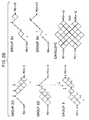
- the numbers to the right of each node of Figure 2 stand for the number of different valid paths to that node from the input node. Each possible path through the trellis diagramm corresponds to one legitimate bit pattern.
- the disparity of a block of bits (such as a byte or character) is the algebraic difference between the number of ones minus the number of zeros.
- the running disparity RD at a particular point in the serial bit stream is the sum of the disparity of the preceding blocks.
- the disparity of a block of bits is equal to the difference between the RD at the end of the block and the RD at the beginning of the block.
- the digital sum variation is the algebraic difference between the maximum and minimum values of the RD over a block.
- the running disparity RD for the present code is always +/-2.
- the RD at byte boundaries is usually +/-1.
- the RL across character boundaries is thus limited to 5.
- the neighborhood of every possible RL of 5 is pruned so no misaligned comma sequences can arise. In Fig. 2, vectors passing through the isolated points marked x could all generate a false comma or a RL violation, including contiguous runs of 5.
- the code comprises in the coded domain three major groups of vectors:
- the Envelope contains all the vectors needed for the coding of 260 characters for a starting disparity of either +2 or -2. Not all the vectors of the envelope are actually permitted, but only those listed in the separate groupings listed above, which define all the constraints.
- DSV Digital Sum Variation
- the upper and lower contours of the envelope do not represent valid characters.
- the only vectors through the highest and lowest point of the envelope are those of Group A/B.
- the outermost contours of the envelope are given by the outermost upper and lower contour of Group 1 or Group 1A/B.
- the complements of these same vectors starting with negative disparity follow the lower contour.
- the low frequency cut-off can be moved up to 0.063% of the bit rate for an equal eye closure penalty. From Fig. 2, we can also easily see that the minimum transition density is 3 per character.
- An odd parity bit is derived for each column of the coded or uncoded matrix, and transmitted in coded form after the end of the frame. For easy implementation, it is preferred to derive the parity from the uncoded data, because of better compatibility with common data formats, buffer width, and the processing stream. Typically, one byte of vertical parity bits will be generated, but a larger or smaller segmentation is possible.
- the decoder may enlarge a single bit error to a burst of 8 in the decoded domain. The matrix correction scheme is not adversely affected by this error spread.
- a code with local parity can locate an erroneous byte in a frame without extra parity bits, but such a code is more complex to implement and generates larger low frequency spectral components.
- This error locating techniques make error correction by simple vertical parity possible and is well suited for link architectures with short frames. It can be made transparent to transmission protocols above the link level.
- FC-PH Fibre Channel, Physical and Signaling Interface
- FC-P/92-001R3.0 American National Standards Institute, 1430 Broadway, New York, NY 10018, 1992. Available from: Global Engineering, 2805 McGaw St., Irvine, CA 92714
Landscapes
- Engineering & Computer Science (AREA)
- Theoretical Computer Science (AREA)
- Physics & Mathematics (AREA)
- Probability & Statistics with Applications (AREA)
- Error Detection And Correction (AREA)
- Detection And Prevention Of Errors In Transmission (AREA)
- Dc Digital Transmission (AREA)
Claims (31)
- Un dispositif pour coder une trame, formée de multiplets à Nbit, en une trame de multiplets à Mbit, dans lequel M > N > 0 et dans lequel ladite trame présente une frontière et dans lequel il existe une frontière de multiplets entre lesdits multiplets, comprenant :caractérisé pardes moyens pour fournir un code, contenant des éléments de multiplets à Mbit, qui est un sousjeu de la totalité des multiplets à Mbit possibles pour chacun des 2N multiplets à Nbit possibles il y a un nombre correspondant dans ledit sousjeu,l'un desdits éléments dudit code est une virgule, utilisée pour identifier ladite frontière de trame et ladite frontière de multiplet, ladite virgule ayant une séquence de multiplets, ayant un état binaire, sélectionné depuis une première et une deuxième valeur, de manière que ladite séquence de bits de ladite virgule soit confinée à l'un desdits éléments dudit code et que ladite séquence de bit de ladite virgule ne se produise pas sur une frontière entre une combinaison éventuelle d'un quelconque d'autres éléments dudit code;des moyens, pour affecter à chacun desdits multiplets à Nbit, dans ladite trame, ledit élément correspondant venant dudit code, afin de former une trame codée, correspondant à ladite trame;
des moyens pour stocker ladite trame de multiplets à Nbit, et
des moyens pour stocker ladite trame codée;
de manière que chacun desdits éléments dudit code est une séquence de bit, tel que, si un état d'un desdits bits est modifié, un multiplet à Nbit résultant ne soit pas l'un desdits éléments dudit code,
de manière que N=8 et M=10, ledit code permettant uniquement des longueurs d'exécution d'un état binaire inférieur ou égal à 5, et lesdits éléments dudit code ont un début et une fin, avec une longueur d'exécution de un ou de deux; une valeur de trois audit départ d'un élément étant autorisée uniquement si la disparité d'exécution se déplace vers un équilibre pour les 2 premiers bits de la passe; une valeur de trois à ladite fin d'un élément étant autorisée uniquement si la disparité d'exécution s'écarte de l'équilibre pour les 2 derniers bits de l'exécution. - Un dispositif selon la revendication 1, comprenant en outre un moyen pour transmettre ladite trame codée à un dispositif récepteur, tel qu'une trame codée transmise.
- Un dispositif selon la revendication 2, dans lequel ledit dispositif récepteur comprend des moyens pour déterminer si ladite trame codée transmise présente une erreur.
- Un dispositif selon la revendication 3, comprenant en outre des moyens pour corriger ladite erreur.
- Un dispositif selon la revendication 1, dans lequel ledit code est un code à 10bit et dans lequel ledit code comprend des multiplets à 10bit, dont la totalité ont une variation de somme numérique de zéro, +quatre ou -quatre.
- Un dispositif selon la revendication 1, dans lequel ladite virgule contient un motif de bits sélectionné à partir du groupe formé de '11011111' et son complément '00100000'.
- Un dispositif selon la revendication 1, dans lequel ladite virgule est incorporée dans '0110111110' et son complément '1001000001'.
- Un dispositif selon la revendication 1, dans lequel ladite longueur d'exécution à ladite frontière de départ de certains desdits éléments est de 3 "1" si la disparité d'exécution audit départ est de -2 et de 3 "0" si la disparité d'exécution est de +2 audit départ.
- Un dispositif selon la revendication 1, dans lequel ladite longueur d'exécution à ladite extrémité de certains desdits éléments est de 3 zéros si la disparité d'exécution à ladite fin est de -2 et de trois uns si la disparité d'exécution est de +2 à ladite fin.
- Un dispositif selon la revendication 1, dans lequel ledit code comprend 174 multiplets à 10bit, équilibrés et indépendants de toute disparité, 27 paires de multiplets à 10bit équilibrés et dépendants d'une disparité et 59 paires de multiplets à 10bit ayant une disparité de ± 4 et dépendants d'une disparité.
- Un dispositif selon la revendication 1, dans lequel lesdits moyens de stocker ladite trame de multiplets à Nbit sont constitués d'une mémoire et dans lequel lesdits moyens de stockage de ladite trame codée sont constitués d'une mémoire.
- Un dispositif selon la revendication 3, comprenant en outre des moyens pour déterminer un emplacement de bit de ladite erreur.
- Un dispositif selon la revendication 1, pour produire un code 8B/10B, à longueur d'exécution limitée, pour un flux de données d'entrée sans contrainte, comprenant :des moyens pour stocker une trame d'une pluralité de multiplets à 8bit;des moyens pour allouer à chacun desdits multiplets à 8bit un multiplet à 10bit codé, afin de former une trame codée;des moyens pour stocker ladite trame codée;ledit jeu de multiplets à 10bit codés, comprend :1 multiplet à 10bit, dépendant d'une disparité, non équilibré, avec une disparité de +4, utilisé pour une disparité d'exécution de départ de 2, et pour lequel le complément est utilisé pour une disparité d'exécution de départ de +2, de la forme suivante :un jeu de 162 multiplets codés, indépendants de toute disparité, équilibrés, ayant des variations de somme numérique de 4 ou moins, de la forme suivante :
11001 10100, 11001 10100, 10110 10100, 10101 10100, 10011 10100, 01110, 10100, 11001 01100, 11001 01100, 10110 01100, 10101 01100, 10011 01100, 01110 01100, 11001 10010, 11001 10010, 10110 10010, 10101 10010, 10011 10010, 01110 10010, 11001 01010, 11001 01010, 10110 01010, 10101 01010, 10011 01010, 01110 01010, 11001 00110, 11001 00110, 10110 00110, 10101 00110, 10011 00110, 01110 00110, 11001 10001, 11001 10001, 10110 10001, 10101 10001, 10011 10001, 01110 10001, 11001 01001, 11001 01001, 10110 01001, 10101 01001, 10011 01001, 01110 01001, 11001 00101, 11001 00101, 10110 00101, 10101 00101, 10011 00101, 01110 00101, 11001 00011, 11001 00011, 10110 00011, 10101 00011, 10011 00011, 01110 00011, 01101 10100, 01011 10100, 00111 10100, 00101 01011, 00110 01011, 01001 01011, 01101 01100, 01011 01100, 00111 01100, 00101 10011, 00110 10011, 01001 10011, 01101 10010, 01011 10010, 00111 10010, 00101 01101, 00110 01101, 01001 01101, 01101 01010, 01011 01010, 00111 01010, 00101 10101, 00110 10101, 01001 10101, 01101 00110, 01011 00110, 00111 00110, 00101 11001, 00110 11001, 01001 11001, 01101 10001, 01011 10001, 00111 10001, 00101 01110, 00110 01110, 01001 01110, 01101 01001, 01011 01001, 00111 01001, 00101 10110, 00110 10110, 01001 10110, 01101 00101, 01011 00101, 00111 00101, 00101 11010, 00110 11010, 01001 11010, 01101 00011, 01011 00011, 00111 00011, 00101 11100, 00110 11100, 01001 11100, 01010 01011, 01100 01011, 10001 01011, 10010 01011, 10100 01011, 11000 01011, 01010 10011, 01100 10011, 10001 10011, 10010 10011, 10100 10011, 11000 10011, 01010 01101, 01100 01101, 10001 01101, 10010 01101, 10100 01101, 11000 01101, 01010 10101, 01100 10101, 10001 10101, 10010 10101, 10100 10101, 11000 10101, 01010 11001, 01100 11001, 10001, 11001, 10010 11001, 10100 11001, 11000 11001, 01010 01110, 01100 01110, 10001 01110, 10010 01110, 10100 01110, 11000 01110, 01010 10110, 01100 10110, 10001 10110, 10010 10110, 10100 10110, 11000 10110, 01010 11010, 01100 11010, 10001 11010, 10010 11010, 10100 11010, 11000 11010, 01010 11100, 01100 11100, 10001 11100, 10010 11100, 10100 11100, 11000 11100, un jeu de 12 multiplets codés, indépendants de toute disparité, équilibrés, ayant une variation de somme numérique de 6 pour le jeu de la forme suivante :11011 00010, 11011 00001 00100 11101, 00100 11110, 10111 000110, 10111 00001 01000 11101, 01000 11110, 01111 00010, 01111 00001 10000 11101, 10000 11110, un jeu de 3 multiplets à 10bit, dépendants d'une disparité, équilibrés, utilisés pour une disparité d'exécution de départ de 2 et pour lequel le complément est utilisé pour une disparité d'exécution de départ de +2 : de la forme suivante :11011 00100, 10111 00100, 01111 00100, un jeu de 11 multiplets à 10bit, indépendants de toute disparité, équilibrés, utilisés pour une disparité d'exécution de départ de 2 et pour lequel le complément est utilisé pour une disparité d'exécution de départ de +2, de la forme suivante :11101 00100, 11100 10100, 11100 01100, 11100 00110, 11101 00010, 11100 10010, 11100 01010, 11100 00101, 11101 00001, 11100 10001, 11100 01001, un jeu de 13 multiplets à 10bit, dépendants d'une disparité, équilibrés, utilisés pour une disparité d'exécution de départ de -2, et pour lequel le complément est utilisé pour une disparité d'exécution de départ de +2, de la forme suivante :11101 01000, 11100 11000, 11001 11000, 11011 01000, 11010 11000, 10101 11000, 10111 01000, 10110 11000, 10011 11000, 01111 01000, 01110 11000, 01101 11000, 01011 11000, un jeu de 32 multiplets à 10bit, dépendants d'une disparité, non équilibrés, avec une disparité de +4, utilisé pour une disparité d'exécution de départ de -2, et pour lequel le complément est utilisé pour une disparité d'exécution de départ de +2, de la forme suivante :11101 01110, 10111 01110, 11100 11110, 10110 11110, 11101 01101, 10111 01101, 11100 11101, 10110 11101, 11101 01011, 10111 01011, 11100 11011, 10110 11011, 11101 00111, 10111 00111, 11100 10111, 10110 10111, 11011 01110, 01111 01110, 11010 11110, 01110 11110, 11011 01101, 01111 01101, 11010 11101, 01110 11101, 11011 01011, 01111 01011, 11010 11011, 01110 11011, 11011 00111, 01111 00111, 11010 10111, 01110 10111, un jeu de 9 multiplets à 10bit, dépendants d'une disparité, non équilibrés, avec une disparité de +4, utilisé pour une disparité d'exécution de départ de 2, et pour lequel le complément est utilisé pour une disparité d'exécution de départ de +2, ayant une forme dans laquelle le multiplet codé 01101 11110 représente la virgule11001 11110, 10101 11110, 01101 11110, 11001 11101, 10101 11101, 01101 11101, 11001 11011, 10101 11011, 01101 11011, un jeu de 4 multiplets à 10bit, dépendants d'une disparité, non équilibrés, avec une disparité de +4, utilisé pour une disparité d'exécution de départ de 2, et pour lequel le complément est utilisé pour une disparité d'exécution de départ de +2, de la forme suivante :10011 11101, 01011 11101, 10011 11011, 01011 11011, un jeu de 9 multiplets à 10bit, dépendants d'une disparité, non équilibrés, avec une disparité de +4, utilisé pour une disparité d'exécution de départ de 2, et pour lequel le complément est utilisé pour une disparité d'exécution de départ de +2, de la forme suivante :11101 10110, 11011 10110, 10111 10110, 11101 10101, 11011 10101, 10111 10101, 11101 10011, 11011 10011, 10111 10011 un jeu de 5 multiplets à 10bit, dépendants d'une disparité, non équilibrés, avec une disparité de +4, utilisé pour une disparité d'exécution de départ de 2, et pour lequel le complément est utilisé pour une disparité d'exécution de départ de +2, de la forme suivante :11101 11010, 11011 11010, 11101 11001, 11011 11001, 11101 11100 - Un dispositif selon la revendication 12, dans lequel lesdits moyens pour stocker ladite trame sont une mémoire et lesdits moyens pour stocker ladite trame codée sont une mémoire.
- Un procédé de codage d'une trame de multiplets à Nbit en une trame de multiplets à Mbit codés, dans lequel M > N > 0, et dans lequel ladite trame a une frontière de trame et dans lequel il y a une frontière de multiplet entre lesdits multiplets, comprenant les étapes consistant à :caractérisé parfournir des éléments contenant un code formé de multiplets à Mbit, qui est un sousjeu de tous les multiplets à Mbit possibles; pour chacun des 2N multiplets à Nbit possibles, existe un élément correspondant dans ledit sousjeu, de manière qu'un desdits éléments dudit code soit une virgule utilisée pour identifier ladite frontière de trame et ladite frontière de multiplets, ladite virgule ayant une séquence de bits ayant un état binaire sélectionné à partir d'une première et d'une deuxième valeur, de façon que ladite séquence de bit de ladite virgule soit confinée audit un desdits éléments dudit code, et de ladite séquence de bit de ladite virgule ne se produit pas sur une frontière entre une combinaison éventuelle quelconque d'autres éléments quelconques dudit code,affecter à chacun desdits multiplets à Nbit dans ladite trame, ledit élément correspondant depuis ledit code, afin de former une trame codée, correspondant à ladite trame, et
le stockage de ladite trame formée de multiplets à Nbit,
et
le stockage de ladite trame codée,
de manière que chacun desdits éléments dudit code ait une séquence de bit telle que, si un état d'un desdits bit est modifié, un multiplet à Nbit résultant n'est pas l'un desdits éléments dudit code,
de manière que N=8 et M=10, ledit code permet uniquement des longueurs d'exécution d'un état binaire, inférieur ou égal à 5, et lesdits éléments dudit code ont un début et une fin, avec une longueur d'exécution de un ou de deux; une exécution de trois audit départ d'un élément étant autorisée uniquement si la disparité d'exécution se déplace vers l'équilibre pour les 2 premiers bits de l'exécution; une exécution de trois à ladite fin d'un élément est autorisée uniquement si la disparité d'exécution s'écarte de l'équilibre pour les 2 derniers bits de l'exécution. - Un dispositif selon la revendication 15, comprenant en outre les étapes de transmission de ladite trame codée à un dispositif récepteur, en tant que trame codée transmise.
- Un procédé selon la revendication 16, dans lequel ledit dispositif de réception détermine si ladite trame codée transmise comporte une erreur.
- Un procédé selon la revendication 17, comprenant en outre la correction de ladite erreur.
- Un procédé selon la revendication 15, dans lequel ledit code est un code à 10bit et dans lequel ledit code comprend la totalité des multiplets à 10bitn ayant une variation de somme numérique de 4 ou moins et une limite de longueur d'exécution de 2 à chaque extrémité.
- Un procédé selon la revendication 15, dans lequel ladite virgule contient un motif de bits sélectionné dans le groupe formé de '11011111' et son complément '00100000'.
- Un procédé selon la revendication 15, dans lequel ladite virgule est sélectionnée dans le groupe formé de '0110111110' et son complément '1001000001'.
- Un procédé selon la revendication 15, dans lequel ladite longueur d'exécution à ladite frontière de départ de certains desdits éléments est de 3 "1" si la disparité d'exécution audit départ est de -2 et de 3 "0" si la disparité d'exécution est de +2 audit départ.
- Un dispositif selon la revendication 1, dans lequel ladite longueur d'exécution à ladite fin de certains desdits éléments est de 3 zéros si la disparité d'exécution à ladite fin est de -2 et de trois uns si la disparité d'exécution est de +2 à ladite fin.
- Un procédé selon la revendication 15, dans lequel ledit code comprend 174 multiplets à 10bit équilibrés et indépendants de toute disparité, 27 paires de multiplets à 10bit équilibrés et dépendants d'une disparité, et 59 paires complémentaires de multiplets à 10bit ayant une disparité de ± 4 et dépendants d'une disparité.
- Un dispositif selon la revendication 1, dans lequel ladite étape de stockage de ladite trame de multiplets à Nbit est le stockage dans une mémoire et dans lequel ladite étape de stockage de ladite trame codée est le stockage dans une mémoire.
- Un procédé selon la revendication 17, comprenant en outre l'étape de détermination d'un emplacement de bit pour ladite erreur.
- Un procédé selon la revendication 15, pour produire un code 8B/10B à longueur d'exécution limitée, pour une séquence de données d'entrée sans contrainte, comprenant :la fourniture, en un premier emplacement de mémoire, d'une trame d'une pluralité de multiplets à 8bit;l'allocation à chacun desdits multiplets à 8bit d'un multiplet à 10bit correspondant;le stockage, en un deuxième emplacement de mémoire, desdits multiplets à 10bit codés, correspondants, sous forme de trame codée;ladite trame de multiplets à 10bit codée comprenant :1 multiplet à 10bit, dépendant d'une disparité, non équilibré, avec une disparité de +4, utilisé pour une disparité d'exécution de départ de 2, et pour lequel le complément est utilisé pour une disparité d'exécution de départ de +2, ayant la forme suivante :un jeu de 162 multiplets codés, indépendants de toute disparité, équilibrés, ayant une variation de somme numérique de 4 ou moins, présentant la forme suivante :
11010 10100, 11001 10100, 10110 10100, 10101 10100, 10011 10100, 01110, 10100, 11010 01100, 11001 01100, 10110 01100, 10101 01100, 10011 01100, 01110 01100, 11010 10010, 11001 10010, 10110 10010, 10101 10010, 10011 10010, 01110 10010, 11010 01010, 11001 01010, 10110 01010, 10101 01010, 10011 01010, 01110 01010, 11010 00110, 11001 00110, 10110 00110, 10101 00110, 10011 00110, 01110 00110, 11010 10001, 11001 10001, 10110 10001, 10101 10001, 10011 10001, 01110 10001, 11010 01001, 11001 01001, 10110 01001, 10101 01001, 10011 01001, 01110 01001, 11010 00101, 11001 00101, 10110 00101, 10101 00101, 10011 00101, 01110 00101, 11010 00011, 11001 00011, 10110 00011, 10101 00011, 10011 00011, 01110 00011, 01101 10100, 01011 10100, 00111 10100, 00101 01011, 00110 01011, 01001 01011, 01101 01100, 01011 01100, 00111 01100, 00101 10011, 00110 10011, 01001 10011, 01101 10010, 01011 10010, 00111 10010, 00101 01101, 00110 01101, 01001 01101, 01101 01010, 01011 01010, 00111 01010, 00101 10101, 00110 10101, 01001 10101, 01101 00110, 01011 00110, 00111 00110, 00101 11001, 00110 11001, 01001 11001, 01101 10001, 01011 10001, 00111 10001, 00101 01110, 00110 01110, 01001 01110, 01101 01001, 01011 01001, 00111 01001, 00101 10110, 00110 10110, 01001 10110, 01101 00101, 01011 00101, 00111 00101, 00101 11010, 00110 11010, 01001 11010, 01101 00011, 01011 00011, 00111 00011, 00101 11100, 00110 11100, 01001 11100, 01010 01011, 01100 01011, 10001 01011, 10010 01011, 10100 01011, 11000 01011, 01010 10011, 01100 10011, 10001 10011, 10010 10011, 10100 10011, 11000 10011, 01010 01101, 01100 01101, 10001 01101, 10010 01101, 10100 01101, 11000 01101, 01010 10101, 01100 10101, 10001 10101, 10010 10101, 10100 10101, 11000 10101, 01010 11001, 01100 11001, 10001, 11001, 10010 11001, 10100 11001, 11000 11001, 01010 01110, 01100 01110, 10001 01110, 10010 01110, 10100 01110, 11000 01110, 01010 10110, 01100 10110, 10001 10110, 10010 10110, 10100 10110, 11000 10110, 01010 11010, 01100 11010, 10001 11010, 10010 11010, 10100 11010, 11000 11010, 01010 11100, 01100 11100, 10001 11100, 10010 11100, 10100 11100, 11000 11100, un jeu de 12 multiplets codés, indépendants de toute disparité, équilibrés, ayant une variation de somme numérique de 6 pour le jeu ayant la forme suivante :11011 00010, 11011 00001, 00100 11101, 00100 11110, 10111 00110, 10111 00001 01000 11101, 01000 11110, 01111 00010, 01111 00001 10000 11101, 10000 11110, un jeu de 3 multiplets à 10bit, dépendants d'une disparité, équilibrés, utilisés pour une disparité d'exécution de départ de 2 et pour lequel le complément est utilisé pour une disparité d'exécution départ de +2, ayant la forme suivante :11011 00100, 10111 00100, 01111 00100, un jeu de 11 multiplets à 10bit, dépendants d'une disparité, équilibrés, utilisés pour une disparité d'exécution de départ de 2 et pour lequel le complément est utilisé pour une disparité d'exécution de départ de +2, ayant la forme suivante :11101 00100, 11100 10100, 11100 01100, 11100 00110, 11101 00010, 11100 10010, 11100 01010, 11100 00101, 11101 00001, 11100 10001, 11100 01001, un jeu de 13 multiplets à 10bit, dépendants d'une disparité, équilibrés, utilisés pour une disparité d'exécution de départ de -2, et pour lequel le complément est utilisé pour une disparité d'exécution de départ de +2, ayant forme suivante :11101 01000, 11100 11000, 11001 11000, 11011 01000, 11010 11000, 10101 11000, 10111 01000, 10110 11000, 10011 11000, 01111 01000, 01110 11000, 01101 11000, 01011 11000, un jeu de 32 multiplets à 10bit, dépendants d'une disparité, non équilibrés, avec une disparité de +4, utilisé pour une disparité d'exécution de départ de -2, et pour lequel le complément est utilisé pour une disparité d'exécution de départ de +2, ayant la forme suivante :11101 01110, 10111 01110, 11100 11110, 10110 11110, 11101 01101, 10111 01101, 11100 11101, 10110 11101, 11101 01011, 10111 01011, 11100 11011, 10110 11011, 11101 00111, 10111 00111, 11100 10111, 10110 10111, 11011 01110, 01111 01110, 11010 11110, 01110 11110, 11011 01101, 01111 01101, 11010 11101, 01110 11101, 11011 01011, 01111 01011, 11010 11011, 01110 11011, 11011 00111, 01111 00111, 11010 10111, 01110 10111, un jeu de 9 multiplets à 10bit, dépendants d'une disparité, non équilibrés, avec une disparité de +4, utilisé pour une disparité d'exécution de départ de 2, et pour lequel le complément est utilisé pour une disparité d'exécution de départ de +2, ayant une forme dans laquelle la virgule est le multiplet 01101 11110 :11001 11110, 10101 11110, 01101 11110, 11001 11101, 10101 11101, 01101 11101, 11001 11011, 10101 11011, 01101 11011, un jeu de 5 multiplets à 10bit, dépendants d'une disparité, non équilibrés, avec une disparité de +4, utilisé pour une disparité d'exécution de départ de 2, et pour lequel le complément est utilisé pour une disparité d'exécution de départ de +2, ayant la forme:10011 11101, 01011 11101, 10011 11011, 01011 11011, un jeu de 9 multiplets à 10bit, dépendants d'une disparité, non équilibrés, avec une disparité de +4, utilisé pour une disparité d'exécution de départ de 2, et pour lequel le complément est utilisé pour une disparité d'exécution de départ de +2, ayant la forme suivante :11101 10110, 11011 10110, 10111 10110, 11101 10101, 11011 10101, 10111 10101, 11101 10011, 11011 10011, 10111 10011 un jeu de 4 multiplets à 10bit, dépendants d'une disparité, non équilibrés, avec une disparité de +4, utilisé pour une disparité d'exécution de départ de 2, et pour lequel le complément est utilisé pour une disparité d'exécution de départ de +2, ayant la forme suivante :11101 11010, 11011 11010, 11101 11001, 11011 11001, 11101 11100. - Un procédé selon la revendication 26, dans lequel ladite étape de stockage de ladite trame stocke ladite trame dans une mémoire et ladite étape de stockage de ladite trame codée stocke ladite trame codée dans une mémoire.
- Un dispositif selon la revendication 13, dans lequel ladite virgule contient un motif de bits sélectionné dans le groupe formé de '11111011' et son complément '00000100'.
- Un dispositif selon la revendication 13, dans lequel ladite virgule est incorporée dans '0111110110' et son complément '1000001001'.
- Un dispositif selon la revendication 16, faisant utilisation de jeux de mots codés, qui sont les images symétriques, à gauche/droite, des tables de code représentées.
Applications Claiming Priority (2)
| Application Number | Priority Date | Filing Date | Title |
|---|---|---|---|
| US532152 | 1995-02-01 | ||
| US08/532,152 US5699062A (en) | 1995-02-01 | 1995-02-01 | Transmission code having local parity |
Publications (3)
| Publication Number | Publication Date |
|---|---|
| EP0725486A2 EP0725486A2 (fr) | 1996-08-07 |
| EP0725486A3 EP0725486A3 (fr) | 1998-05-20 |
| EP0725486B1 true EP0725486B1 (fr) | 2004-07-14 |
Family
ID=24120571
Family Applications (1)
| Application Number | Title | Priority Date | Filing Date |
|---|---|---|---|
| EP96100861A Expired - Lifetime EP0725486B1 (fr) | 1995-02-01 | 1996-01-23 | Transmission de code à parité locale |
Country Status (3)
| Country | Link |
|---|---|
| US (1) | US5699062A (fr) |
| EP (1) | EP0725486B1 (fr) |
| DE (1) | DE69632879T2 (fr) |
Families Citing this family (25)
| Publication number | Priority date | Publication date | Assignee | Title |
|---|---|---|---|---|
| TW362305B (en) * | 1996-10-18 | 1999-06-21 | Koninkl Philips Electronics Nv | Apparatus and method for converting a sequence of m-bit information words into a modulated signal |
| WO1998023060A1 (fr) * | 1996-11-22 | 1998-05-28 | Sony Corporation | Procede et dispositif de transmission des donnees |
| US5881074A (en) * | 1997-03-25 | 1999-03-09 | Level One Communications, Inc. | 1000base-t packetized trellis coder |
| US5835036A (en) * | 1997-05-12 | 1998-11-10 | Cisco Systems Co. | Method of encoding data for transmission |
| US6088827A (en) * | 1997-08-28 | 2000-07-11 | Level One Communications, Inc. | 1000BASE-T packetized trellis coder |
| US6226269B1 (en) * | 1998-05-01 | 2001-05-01 | Emulex Corporation | Elimination of invalid data in loop network |
| US6438728B1 (en) * | 1999-12-15 | 2002-08-20 | Intel Corporation | Error character generation |
| KR100384886B1 (ko) * | 2000-10-10 | 2003-05-22 | 주식회사 케이티 | 니블 반전 부호 활용 방법 및 그 장치 |
| FR2817683B1 (fr) * | 2000-12-05 | 2003-01-31 | Bull Sa | Procede de codage/decodage de donnees numeriques transmises sur une liaison serie, notamment du type dit "8b/10b", et dispositif de mise en oeuvre |
| EP1391040A2 (fr) * | 2001-05-08 | 2004-02-25 | International Business Machines Corporation | Codage et decodage 8b/10b pour applications haute vitesse |
| US7389463B2 (en) * | 2001-05-29 | 2008-06-17 | Thomson Licensing | Hierarchical block coding for a packet-based communications system |
| US6920604B2 (en) * | 2002-04-08 | 2005-07-19 | Galazar Networks, Inc. | Systems and methods for high speed serial encoding and decoding for data and control interfaces |
| US7243296B2 (en) * | 2002-06-21 | 2007-07-10 | Thomson Licensing | Method of forward error correction |
| FR2861517B1 (fr) * | 2003-10-23 | 2006-01-27 | Thomson Licensing Sa | Methode de reconstruction de paquets perdus et appareils implementant la methode |
| US6876315B1 (en) | 2004-03-12 | 2005-04-05 | International Business Machines Corporation | DC-balanced 6B/8B transmission code with local parity |
| US6914545B1 (en) * | 2004-10-13 | 2005-07-05 | Seiko Epson Corporation | Circuitry and methods for reducing run-length of encoded data |
| US7292161B2 (en) * | 2005-05-31 | 2007-11-06 | International Business Machines Corporation | NB/MB coding apparatus and method using both disparity independent and disparity dependent encoded vectors |
| US7158057B1 (en) | 2005-09-07 | 2007-01-02 | Seiko Epson Corporation | Circuitry and methods for high speed data encoding |
| US7405679B1 (en) | 2007-01-30 | 2008-07-29 | International Business Machines Corporation | Techniques for 9B10B and 7B8B coding and decoding |
| US9407394B2 (en) * | 2014-02-03 | 2016-08-02 | Valens Semiconductor Ltd. | Frequent flow control by replacing certain idle words with bitwise complement words |
| US9887707B2 (en) * | 2016-06-30 | 2018-02-06 | Mapper Lithography Ip B.V. | Method and device for generating a decoded and synchronized output |
| CN106776394B (zh) * | 2017-01-11 | 2019-05-14 | 深圳大普微电子科技有限公司 | 一种数据转换的硬件系统和存储器 |
| US11996937B2 (en) | 2019-08-30 | 2024-05-28 | Sony Semiconductor Solutions Corporation | Encoding device, encoding method, decoding device, decoding method, and program |
| US11962329B2 (en) | 2019-08-30 | 2024-04-16 | Sony Semiconductor Solutions Corporation | Encoding device, encoding method, decoding device, decoding method, and program |
| US20260019314A1 (en) * | 2024-07-11 | 2026-01-15 | Analog Devices International Unlimited Company | Coding scheme for inserting information bit into 8b/10b coded data stream |
Family Cites Families (10)
| Publication number | Priority date | Publication date | Assignee | Title |
|---|---|---|---|---|
| US4365332A (en) * | 1980-11-03 | 1982-12-21 | Fairchild Camera And Instrument Corp. | Method and circuitry for correcting errors in recirculating memories |
| US4464747A (en) * | 1982-02-18 | 1984-08-07 | The Singer Company | High reliability memory |
| US4486739A (en) * | 1982-06-30 | 1984-12-04 | International Business Machines Corporation | Byte oriented DC balanced (0,4) 8B/10B partitioned block transmission code |
| NL8402445A (nl) * | 1984-01-20 | 1985-08-16 | Philips Nv | Werkwijze voor het coderen van n-bits informatiewoorden naar m-bits codewoorden, inrichting voor het uitvoeren van die werkwijze, werkwijze voor het decoderen van m-bits codewoorden naar n-bits informatiewoorden en inrichting voor het uitvoeren van die werkwijze. |
| DE3587535T2 (de) * | 1984-10-01 | 1994-01-20 | Matsushita Electric Ind Co Ltd | Verfahren und Vorrichtung zur numerischen Datenkodierung. |
| JPS63257836A (ja) * | 1987-04-16 | 1988-10-25 | Man Design Kk | デ−タ伝送方式 |
| GB8912471D0 (en) * | 1989-05-31 | 1989-07-19 | Int Computers Ltd | Data transmission code |
| US5144304A (en) * | 1989-07-17 | 1992-09-01 | Digital Equipment Corporation | Data and forward error control coding techniques for digital signals |
| EP0511373B1 (fr) * | 1990-11-13 | 1998-01-07 | Hewlett-Packard Company | Code de ligne sans composante dc et synchronisation de bits et de blocs pour transmission de donnees quelconques |
| JP3083011B2 (ja) * | 1992-12-28 | 2000-09-04 | キヤノン株式会社 | データ記録方法及び装置 |
-
1995
- 1995-02-01 US US08/532,152 patent/US5699062A/en not_active Expired - Fee Related
-
1996
- 1996-01-23 DE DE69632879T patent/DE69632879T2/de not_active Expired - Lifetime
- 1996-01-23 EP EP96100861A patent/EP0725486B1/fr not_active Expired - Lifetime
Non-Patent Citations (2)
| Title |
|---|
| FERREIRA H.C. ET AL: "Hamming Distance Preserving Mappings and Trellis Codes with Constrained Binary Symbols", IEEE TRANSACTIONS ON INFORMATION THEORY, vol. 35, no. 5, September 1989 (1989-09-01), pages 1009 - 1103, XP000100947, DOI: doi:10.1109/18.42229 * |
| SCHOUHAMMER; IMMINK; BEENKER: "Binary Transmission Codes with Higher Order Spectral Zeroes at Zero Frequency", IEEE TRANSACTIONS ON INFORMATION THEORY, vol. IT-33, no. 3, May 1987 (1987-05-01), pages 452 - 454, XP002218921 * |
Also Published As
| Publication number | Publication date |
|---|---|
| DE69632879D1 (de) | 2004-08-19 |
| EP0725486A2 (fr) | 1996-08-07 |
| EP0725486A3 (fr) | 1998-05-20 |
| US5699062A (en) | 1997-12-16 |
| DE69632879T2 (de) | 2005-08-25 |
Similar Documents
| Publication | Publication Date | Title |
|---|---|---|
| EP0725486B1 (fr) | Transmission de code à parité locale | |
| US6198413B1 (en) | Partitioned DC balanced (0,6) 16B/18B transmission code with error correction | |
| JP3254357B2 (ja) | 伝送されるビットのエラーを訂正する方法 | |
| EP0097763B1 (fr) | Procédé et dispositif pour produire un code à courant continu équilibré et à longueur de course limitée (0,4) de rapport 8B/10B à partir d'un flux de données d'entrée | |
| US6425107B1 (en) | Data encoder/decoder for a high speed serial link | |
| Widmer et al. | A DC-balanced, partitioned-block, 8B/10B transmission code | |
| US3810111A (en) | Data coding with stable base line for recording and transmitting binary data | |
| EP0352970B1 (fr) | Système et méthode pour détecter les limites des caractères dans un flux de données codées en série | |
| US5396239A (en) | Data and forward error control coding techniques for digital signals | |
| US5663724A (en) | 16B/20B encoder | |
| EP0471130B1 (fr) | Méthode de codage et dispositif de traitement en parallèle et en pipeline | |
| US6504493B1 (en) | Method and apparatus for encoding/decoding data | |
| US6333704B1 (en) | Coding/decoding system of bit insertion/manipulation line code for high-speed optical transmission system | |
| EP0344903A2 (fr) | Convertisseur de violation de la règle du code pour un code (d,k) | |
| JPH06119197A (ja) | エラー検出および同時スイッチングノイズ減少装置および方法 | |
| MXPA96006099A (en) | Method of digital data transmission | |
| US7205911B2 (en) | Apparatus and method for 8B/10B code-group validity check | |
| US5878061A (en) | Providing serial data clock signal transitions with parity bits | |
| US4476458A (en) | Dual threshold decoder for convolutional self-orthogonal codes | |
| US6617985B1 (en) | Method and/or apparatus for implementing constraint codes with low error propagation | |
| JP3014309B2 (ja) | コード化装置および方法 | |
| US5938773A (en) | Sideband signaling with parity bit schemes | |
| US8281207B2 (en) | Data transmission equipment and generating method for transmission code | |
| JPS59183559A (ja) | デイジタル伝送装置 | |
| JP3497435B2 (ja) | データ伝送誤り監視システム、データ送信装置、データ受信装置およびデータ伝送誤り監視方法 |
Legal Events
| Date | Code | Title | Description |
|---|---|---|---|
| PUAI | Public reference made under article 153(3) epc to a published international application that has entered the european phase |
Free format text: ORIGINAL CODE: 0009012 |
|
| AK | Designated contracting states |
Kind code of ref document: A2 Designated state(s): DE FR GB |
|
| 17P | Request for examination filed |
Effective date: 19970120 |
|
| PUAL | Search report despatched |
Free format text: ORIGINAL CODE: 0009013 |
|
| AK | Designated contracting states |
Kind code of ref document: A3 Designated state(s): DE FR GB |
|
| 17Q | First examination report despatched |
Effective date: 20020402 |
|
| GRAP | Despatch of communication of intention to grant a patent |
Free format text: ORIGINAL CODE: EPIDOSNIGR1 |
|
| GRAS | Grant fee paid |
Free format text: ORIGINAL CODE: EPIDOSNIGR3 |
|
| GRAA | (expected) grant |
Free format text: ORIGINAL CODE: 0009210 |
|
| AK | Designated contracting states |
Kind code of ref document: B1 Designated state(s): DE FR GB |
|
| REG | Reference to a national code |
Ref country code: GB Ref legal event code: FG4D |
|
| REF | Corresponds to: |
Ref document number: 69632879 Country of ref document: DE Date of ref document: 20040819 Kind code of ref document: P |
|
| ET | Fr: translation filed | ||
| PLBE | No opposition filed within time limit |
Free format text: ORIGINAL CODE: 0009261 |
|
| STAA | Information on the status of an ep patent application or granted ep patent |
Free format text: STATUS: NO OPPOSITION FILED WITHIN TIME LIMIT |
|
| 26N | No opposition filed |
Effective date: 20050415 |
|
| REG | Reference to a national code |
Ref country code: GB Ref legal event code: 746 Effective date: 20071206 |
|
| PGFP | Annual fee paid to national office [announced via postgrant information from national office to epo] |
Ref country code: FR Payment date: 20110120 Year of fee payment: 16 |
|
| REG | Reference to a national code |
Ref country code: FR Ref legal event code: ST Effective date: 20120928 |
|
| PG25 | Lapsed in a contracting state [announced via postgrant information from national office to epo] |
Ref country code: FR Free format text: LAPSE BECAUSE OF NON-PAYMENT OF DUE FEES Effective date: 20120131 |
|
| PGFP | Annual fee paid to national office [announced via postgrant information from national office to epo] |
Ref country code: DE Payment date: 20150129 Year of fee payment: 20 |
|
| PGFP | Annual fee paid to national office [announced via postgrant information from national office to epo] |
Ref country code: GB Payment date: 20150127 Year of fee payment: 20 |
|
| REG | Reference to a national code |
Ref country code: DE Ref legal event code: R071 Ref document number: 69632879 Country of ref document: DE |
|
| REG | Reference to a national code |
Ref country code: GB Ref legal event code: PE20 Expiry date: 20160122 |
|
| PG25 | Lapsed in a contracting state [announced via postgrant information from national office to epo] |
Ref country code: GB Free format text: LAPSE BECAUSE OF EXPIRATION OF PROTECTION Effective date: 20160122 |