EP0726661A2 - Allocation d'intervalle temporells dans un système de communication TDMA - Google Patents
Allocation d'intervalle temporells dans un système de communication TDMA Download PDFInfo
- Publication number
- EP0726661A2 EP0726661A2 EP96300687A EP96300687A EP0726661A2 EP 0726661 A2 EP0726661 A2 EP 0726661A2 EP 96300687 A EP96300687 A EP 96300687A EP 96300687 A EP96300687 A EP 96300687A EP 0726661 A2 EP0726661 A2 EP 0726661A2
- Authority
- EP
- European Patent Office
- Prior art keywords
- time
- slots
- transmission speed
- communication
- slot
- Prior art date
- Legal status (The legal status is an assumption and is not a legal conclusion. Google has not performed a legal analysis and makes no representation as to the accuracy of the status listed.)
- Granted
Links
Images





Classifications
-
- H—ELECTRICITY
- H04—ELECTRIC COMMUNICATION TECHNIQUE
- H04J—MULTIPLEX COMMUNICATION
- H04J3/00—Time-division multiplex systems
- H04J3/16—Time-division multiplex systems in which the time allocation to individual channels within a transmission cycle is variable, e.g. to accommodate varying complexity of signals, to vary number of channels transmitted
- H04J3/1694—Allocation of channels in TDM/TDMA networks, e.g. distributed multiplexers
Definitions
- the present invention relates to a method of time-slot allocation in a time division multiple access (TDMA) communication system which allocates one or more time-slots in a TDMA frame for a communication signal to perform the communication, and, more particularly, to a method of efficient time-slot allocation for high transmission speed data communication.
- TDMA time division multiple access
- Figures 1(A) and 1(B) show a system construction and a TDMA frame respectively for explaining this conventional technique.
- This system is constituted by a public telephone network 10, a gateway exchange 20 for switching and connecting the public telephone network 10 and a mobile radio communication system which is adopting a TDMA communication system.
- the mobile radio communication system is constituted by a radio channel control station 35 connected to the gateway exchange 20, a base station 40 connected to the radio channel control station 35 and a plurality of mobile terminals 60 which can communicate, within a cell 50 where the base station 40 covers, with the base station 40 by radio signals.
- the radio channel control station 35 has a function of allocating a plurality of fixed number of time-slots to a communication signal having a higher transmission speed than the transmission speed provided for one time-slot in a TDMA frame.
- Figure 1(B) is a diagram showing an example of the TDMA frame construction of the carrier when a plurality of time-slots are allocated to a communication signal having a higher. transmission speed than the transmission speed provided for one time-slot in the TDMA frame.
- one time-slot is capable of transferring one channel of low transmission speed communication signal indicated by T1 or T2.
- 4 time-slots are allocated to high transmission speed communication signal indicated by D1.
- communication signal of 64 kbps is allocated to two time-slots, and communication signal of 128 kbps is allocated to four time-slots.
- the TDMA frame is constructed such that one time-slot corresponds to the lowest transmission speed signal, and with respect to a higher transmission speed signal, various kinds of transmission speed signals are dealt with by allocating a plurality of fixed number of time-slots enough for transferring the data. Therefore, if the proportion of higher transmission speed communications is high the probability of requiring a plurality of idle time-slots to be allocated at the same time to a new communication request will be increased. As the result, there is the drawback that the probability of call loss is increased because the call request which needs a plurality of time-slots for transferring the data is rejected if sufficient idle time-slots are not available at the time of time-slots allocation.
- the objective of the present invention is to provide an efficient TDMA time-slot allocating method which is capable of flexible time-slots allocation for a high transmission speed communication for reducing the call loss of a newly requested call when the proportion of high transmission speed communications is relatively large in the communication system.
- a method of time-slot allocation for a communication in a time division multiple access (TMDA) communication system which allocates one or more time-slots in a TDMA frame, comprises the following steps:
- time-slots for high transmission speed communications Although all time-slots required for transmitting the data in the normal speed is preferable, it can be reduced depending on the availability of idle time-slots for newly requested call. If there is not enough idle time-slot for new call, one or more of the time-slots currently being used for the high transmission speed communication is released and used for the new call to avoid rejection of call request due to non availability of an appropriate time-slot.
- the method of time-slot allocation as set forth above may further comprise the following steps in releasing at least one time-slot from a plurality of time-slots being used for one of the high transmission speed communications existing:
- the high transmission speed communication whose time-slot is partially released is selected from those which is using a maximum number of time-slots, and transmission speed adjustment should be performed because it is not sufficient number of time-slots is used.
- a method of time-slot allocation for a communication in a TDMA communication system comprises the following steps:
- time-slot reallocation when idle time-slot becomes available. Those time-slots are to be reallocated to high transmission speed communication having insufficient number of time-slots.
- time-slot reallocation further comprises the step of:
- Figure 1(A) is a schematic block diagram of a mobile communication system using a conventional TDMA communication system
- figure 1(B) is a diagram showing an example of the conventional TDMA frame construction of a carrier to which a plurality of time-slots are allocated for a high transmission speed communication data and one time-slot is allocated to low transmission speed communication data.
- Figure 2(A) is a schematic block diagram of a mobile communication system using an embodiment of the present invention
- figure 2(B) is a diagram showing an example of a TDMA frame construction of a carrier according to the present invention to which a plurality of time-slots are allocated for a high transmission speed communication data depending on the traffic condition.
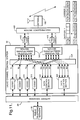
- Figure 3 is a schematic block diagram of the radio channel control station 30 in figure 2.
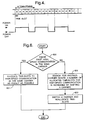
- Figure 4 is a diagram showing an example of the operation of the mobile terminal 60 in figure 2 in the case where a plurality of time-slots are allocated to its communication.
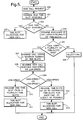
- Figure 5 is a flowchart of the time-slot allocation according to the present invention when a call request is received.
- Figure 6 is a flowchart of the reallocation of idle time-slot according to the present invention.
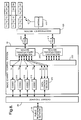
- Figure 7 is a schematic connection diagram in the radio channel control station 30 and the corresponding TDMA frame construction according to the present invention when there are idle time-slots available for allocating to new call request.
- Figure 8 is a schematic connection diagram in the radio channel control station 30 and the corresponding TDMA frame construction according to the present invention when there is no time-slot available for allocation, and a time-slot being used is allocated to new call request of low transmission speed communication.
- Figure 9 is a schematic connection diagram in the radio channel control station 30 and the corresponding TDMA frame construction according to the present invention when there is no time-slot available for allocation, and a time-slot being used is allocated to new call request of high transmission speed communication.
- Figure 10 is a schematic connection diagram in the radio channel control station 30 and the corresponding TDMA frame construction according to the present invention when idle time-slots have become available and signals of high transmission speed communication existing in the same carrier are reallocated to those idle time-slots.
- Figure 11 is a schematic connection diagram in the radio channel control station 30 and the corresponding TDMA frame construction according to the present invention when idle time-slots have become available and signals of high transmission speed communication existing in the different carrier are reallocated to those idle time-slots.
- Figure 2(A) is a schematic block diagram of a TDMA communication system of an embodiment of the present invention.
- the network construction of the communication system of the embodiment is basically the same as the conventional construction shown in figure 1(A).
- Calls from/to a public telephone network 10 are switched and connected to/from a mobile radio communication system by a gateway exchange 20.
- the gateway exchange 20 is connected to a radio channel control station 30.
- the base station 40 covers a cell 50 which is a radio communication area.
- Within the cell 50 there exist a plurality of mobile terminals 60, each of which accommodates a telephone set or terminal equipment each subscriber has.
- the mobile terminals 60 are communicatable with the base station 40 by radio signals. In this drawing, only one base station 40 is shown, however, it may exist a plurality of base stations to be connected to the radio channel control station 30.
- the radio channel control station 30 controls time-slots allocation of the TDMA frame according to the present invention for calls from/to gateway exchange 20 to/from the base station 40.
- the specific feature of the present invention is to allow flexible time-slot allocation requiring a plurality of time-slots.
- the time-slots of the TDMA frame shown in figure 2(B) are allocated for one high transmission speed communication data D1 and two low transmission speed communication data T1 and T2, and four time-slots are allocated for data D1.
- number of time-slots allocated for the high transmission speed communication is varied.
- time-slots of the TDMA frame shown in figure 2(B), (b) are allocated for one high transmission speed communication data D1 and three low transmission speed communication data T1, T2 and T3 and three time-slots are allocated for data D1 instead of four time-slots.
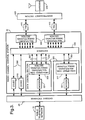
- FIG. 3 is a schematic block diagram of the radio channel control station 30 in the figure 2.
- the radio channel control station 30 is constituted by codecs 310, data control sections 320, an exchange (or a switching section) 330, and multiplexing-demultiplexing sections 340.
- the data control section 320 consists of a modem 321 and a high-speed communication multiplexing-demultiplexing section 322.
- the multiplexing-demultiplexing sections 340 are connected to TRXs (Transmitters/Receivers) 410, and the TRXs 410 are connected through a high frequency section 420 to an antenna 430 for radio signal transmission and reception.
- TRXs Transmitters/Receivers
- a call path for the low transmission speed communication is established between the CODEC 310 and the public telephone network 10 throhgh the gateway exchange 20, and a call path for the high transmission speed communication is established between the data control section 320 and the public telephone network 10 through the gateway exchange 20.
- a voice call be an example of low transmission speed communication.
- a call from the public telephone network 10 is switched and connected to the codec 310 by the gateway exchange 20.
- the signal of the call processed by the codec 310 is switched and provided to the multiplexing-demultiplexing section 340 by the exchange 330 in the radio channel control station 30.
- the signal and other signals of other calls are multiplexed and provided to the TRX 410.
- the multiplexed signals are transmitted through the high-frequency section 420 and from the antenna 430 to the mobile terminal 60.
- the signal of the call received at the antenna 430 is provided through the high-frequency section 420 and the TRX 410 to the multiplexing-demultiplexing section 340.
- the signals, demultiplexted at the multiplexing-demultiplexing section 340, are switched and provided to the codecs 310 by the exchange 330 in the radio channel control station 30.
- the signals processed by the codecs 310 are switched and transferred to the public telephone network 10 by the gateway exchange 20.
- a call from the public telephone network 10 is switched and connected to the modem 321 of the data control section 320 by the gateway exchange 20.
- the signal modulated by the modem 321 is provided to the high-speed communication multiplexing-demultiplexing section 322 and is separated to a plurality of lines 350 that can be allocated depending on the transmission speed of data of the communication.
- the transmission speed of the lines 350, connected to the exchange 330 in the radio channel control station 30, are equal to one another, and it is equal to the data speed of the low transmission speed communication.
- the separated signals are switched and provided to the multiplexing-demultiplexing sections 340 by the exchange 330 in the radio channel control station 30.
- the separated signals and other signals are multiplexed and provided to the TRXs 410.
- the multiplexed signals are transmitted through the high-frequency section 420 and from the antenna 430 to the mobile terminal 60.
- the signal received at the antenna 430 is provided through the high-frequency section 420 and the TRX 410 to the multiplexing-demultiplexing section 340.
- the signals, demultiplexted at the multiplexing-demultiplexing section 340, are switched and provided through the lines 350 to the high-speed communication multiplexing-demultiplexing sections 322 in the data control section 320 by the exchange 330 in the radio channel control station 30.
- the signals are demultiplexed and restored to a single signal and provided to the modem 321.
- the signal modulated by the modem 321 is switched and transferred to the public telephone network 10 by the gateway exchange 20.
- each multiplexing-demultiplexing section 340 in the mobile channel control station 30 corresponds to the TDMA frame for each carrier, and allocation of time-slot for the TDMA frame is performed by connection switching between each line 350 corresponding to the CODEC 310 or the data control section 320 and each input of the multiplexing-demultiplexing section 340 controlled by the exchange 330.
- the high transmission speed communication data provided in the data control section 320 is distributed to required number of low transmission speed data which corresponds to the line 350 and also corresponding to the time-slot of the TDMA frame.
- a carrier frequency and the time-slot number to be used for the communication are specified prior to the commencement of the communication or during the communication by the radio channel control station 30.
- the mobile terminal 60 which performs high-speed communication using a plurality of time slots, transmits and receives a signal when the transmitter-receiver of the mobile terminal is powered on whose operation has been instructed by the radio channel control station 30 depending on the allocation of time-slots of the TDMA frame to be used for the communication.
- the radio channel control station 30 monitors the status of use of the time-slots, and performs the appropriate time-slot allocation at the time when a new call is requested or any of idle time-slot has become available due to completion of other calls.
- the TDMA frame construction of the upward direction and the TDMA frame construction of the downward direction are assumed to be the same.
- the radio channel control station 30 When the radio channel control station 30 has received a request for a high transmission speed communication from the mobile terminal 60, the radio channel control station 30 will search for a carrier capable of allocating the maximum number of idle time-slots for the communication to one TDMA frame and notify the mobile terminal 60 of a usable carrier and a usable time-slot number. The mobile terminal 60 sends the confirmation of the notification to the radio channel control station 30, and commencing the communication by using the notified carrier and time-slots.
- a message which instructs temporarily to interrupt the communication is sent from the radio channel control station 30 to the mobile terminal 60 for notifying the necessity of changing the carrier and the time-slot to be used for the communication.
- the mobile terminal 60 upon reception of this message, will temporarily stop the transmission of data for the communication and send back the confirmation message to the radio channel control station 30.
- the radio channel control station 30, upon reception of this confirmation, will notify the mobile terminal 60 of a new carrier and a new time-slot number to be used.
- the mobile terminal 60 sends back the confirmation of the notification and changes the carrier to new frequency and the synchronized operation with new time-slots, and continues the communication.
- Figure 5 is a flowchart of the time-slot allocation in the radio channel control station 30 at the time when new call request is arised.
- Figures 7 to 9 are diagrams showing examples of a TDMA frame construction and related connection in the radio channel control station 30.
- step 500 When new call is requested, the acquisition of a communication channel will be started (step 500). Initially, it is examined whether the number of idle time-slots requiered for the communication is available within the cell (step 501). If time-slots are available for the communication, the time-slot allocation is performed (steps 502 and 503).
- the TDMA frame construction in this case is shown in Figure 7.
- the data D1 for the communication is allocated to three time-slots in the TDMA frame which has only used by three low transmission speed communication T1, T2 and T3, and other time-slots are being idle.
- step 504 When number of idle time-slots required for the communication is not available, it will be examined whether high transmission speed communication using a plurality of time slots exists or not (step 504). If there is no such a communication using a plurality of time slots, the new call request is rejected and the call becomes a call loss (steps 505 and 506).
- step 505 and 507 When there are a plurality of high transmission speed communications each using a plurality of time slots, high transmission speed communication using a maximum number of time slots is examined among those plurality of high transmission speed communications (steps 505 and 507). Then, whether the new call request is the low transmission speed communication or high transmission speed communication (step 508) is examined.
- one time slot is released from the high transmission speed communication using a maximum number of time slots (steps 509 and 510), and this one time slot is allocated to the new call request (step 511).
- the TDMA frame construction and related connection in the radio channel control station 30 in this case is shown in figure 8.
- the low transmission speed communications T1, T2 and T3 and the high transmission speed communication D1 are allocated to time-slots of the TDMA frame. Now, one time slot is released from the high transmission speed communication D1 using three time-slots, and this time slot is allocated to new low transmission speed communication T4.
- the high transmission speed communication D1 normally requires three time-slots for data transmission, but now, the time-slots available for this communication decreased to two. Therefore, buffering means or other countermeasures are provided in the data control section 320 for adjusting transmission data speed in this condition.
- a plurality of time-slots are released so that, between the new high transmission speed communication and the high transmission speed communication whose time-slots are to be shared, the time-slots are distributed as evenly as possible (steps 509 and 512).
- the released time-slots are allocated to the new call request (step 513).
- the TDMA frame construction and related connection in the radio channel control station 30 in this case is shown in figure 9.
- the low transmission speed communications T1 and T2 and the high transmission speed communication D1 are allocated to time-slots of the TDMA frame.
- two time-slots are released from the high transmission speed communication D1 using four time-slots, and these two time-slots are allocated to new high transmission speed communication D2.
- both of high transmission speed communications D1 and D2 should perform transmission speed adjustment in the radio channel control station 30.
- Figure 6 is a flowchart of the time-slot reallocation when any of idle time-slot becomes available due to completion of other calls.
- Figures 10 and 11 are diagrams showing examples of the time-slot reallocation.
- step 600 When communication is completed and the time-slot having been used for the communication become idle, initially it is examined whether high transmission speed communication using not sufficient number of time-slots exists within the same carrier (step 600). If there is such a high transmission speed communication, the time-slots having become idle are reallocated to the communication. If there are more than two such communications, the time-slots having become idle are reallocated to those communications as evenly as possible (step 601).
- the TDMA frame construction and related connection in the radio channel control station 30 in this case is shown in figure 10.
- the low transmission speed communications T1 and T2 and the high transmission speed communications D1 and D2 are allocated to time-slots of the TDMA frame.
- the low transmission speed communications T1 and T2 have been completed and two time-slots become idle. These two time-slots are reallocated to the high transmission speed communication D1 which nornally requires four time-slots.
- the high transmission speed communication D1 has become normal state, therefore the transmission speed adjustment having been performed in the radio channel control station 30 is stopped.
- the high transmission speed communication in other carrier is also examined, and the high transmission speed communication in which the number of time slots to be allocated is increased is searched for (step 602). If there is such a high transmission speed communication in other carrier, the high transmission speed communication is switched to the carrier where the idle time-slots become avilable, and the time-slots are reallocated to the high transmission speed communication(step 603).
- the TDMA frame construction and related connection in the radio channel control station 30 in this case is shown in figure 11. Four time slots have become idle in a carrier 1, however, there is no high transmission speed communication in the carrier 1.
- the number of time-slots is not sufficient for both of high transmission speed communications D2 and D3 and they are sharing time-slots each other. Therefore, four time-slots being available now in the carrier 1 are reallocated to the high transmission speed communication D3, and as the result of switching the high transmission speed communication D3 to the carrier 1, two time-slots in the carrier 2 have also become availabe now for the high transmission speed communication D2 to which the number of time-slots were insufficient.
- the high transmission speed communication D2 and D3 have become normal state, therefore the transmission speed adjustment having been performed for those communications in the radio channel control station 30 is stopped.
- the present invention searches for communication using a plurality of time slots, and when there is no idle time-slot available for allocating to newly requested call, a time-slot is allocated from such a plurality of time slots. Accordingly, there is the advantage that the probability of call loss in this system is reduced.
Landscapes
- Engineering & Computer Science (AREA)
- Computer Networks & Wireless Communication (AREA)
- Signal Processing (AREA)
- Mobile Radio Communication Systems (AREA)
- Time-Division Multiplex Systems (AREA)
Priority Applications (1)
| Application Number | Priority Date | Filing Date | Title |
|---|---|---|---|
| EP06015638A EP1720272A1 (fr) | 1995-01-31 | 1996-01-31 | Allocation d'intervalle temporels dans un système de communication TDMA |
Applications Claiming Priority (2)
| Application Number | Priority Date | Filing Date | Title |
|---|---|---|---|
| JP13592/95 | 1995-01-31 | ||
| JP7013592A JP3014023B2 (ja) | 1995-01-31 | 1995-01-31 | Tdma通信システムにおけるタイムスロット割り当て方法 |
Related Child Applications (1)
| Application Number | Title | Priority Date | Filing Date |
|---|---|---|---|
| EP06015638A Division EP1720272A1 (fr) | 1995-01-31 | 1996-01-31 | Allocation d'intervalle temporels dans un système de communication TDMA |
Publications (3)
| Publication Number | Publication Date |
|---|---|
| EP0726661A2 true EP0726661A2 (fr) | 1996-08-14 |
| EP0726661A3 EP0726661A3 (fr) | 1996-11-27 |
| EP0726661B1 EP0726661B1 (fr) | 2007-04-04 |
Family
ID=11837477
Family Applications (2)
| Application Number | Title | Priority Date | Filing Date |
|---|---|---|---|
| EP06015638A Withdrawn EP1720272A1 (fr) | 1995-01-31 | 1996-01-31 | Allocation d'intervalle temporels dans un système de communication TDMA |
| EP96300687A Expired - Lifetime EP0726661B1 (fr) | 1995-01-31 | 1996-01-31 | Allocation d'intervalle temporells dans un système de communication TDMA |
Family Applications Before (1)
| Application Number | Title | Priority Date | Filing Date |
|---|---|---|---|
| EP06015638A Withdrawn EP1720272A1 (fr) | 1995-01-31 | 1996-01-31 | Allocation d'intervalle temporels dans un système de communication TDMA |
Country Status (4)
| Country | Link |
|---|---|
| US (1) | US5748624A (fr) |
| EP (2) | EP1720272A1 (fr) |
| JP (1) | JP3014023B2 (fr) |
| DE (1) | DE69637003T2 (fr) |
Cited By (9)
| Publication number | Priority date | Publication date | Assignee | Title |
|---|---|---|---|---|
| WO1997036402A1 (fr) * | 1996-03-25 | 1997-10-02 | Net Insight Ab | Procedure de reaffectation |
| WO1998010540A3 (fr) * | 1996-09-06 | 1998-05-14 | Nokia Telecommunications Oy | Procede de transmission de donnees et systeme radio |
| WO2000062488A1 (fr) * | 1999-04-08 | 2000-10-19 | Net Insight Ab | Procede et systeme concernant le controle de ressources dans un reseau de communication |
| DE10063679A1 (de) * | 2000-12-20 | 2002-07-11 | Siemens Ag | Verfahren zur Datenübertragung in einem verschiedene Einheiten umfassenden Funkkommunikationssystem und dafür eingerichtetes Basisstationssystem und Funkkommunikationssystem |
| US6587472B1 (en) | 1998-03-20 | 2003-07-01 | Telefonaktiebolaget Lm Ericsson (Publ) | Fair channel allocation protocol for DTM networks |
| US6694348B1 (en) | 1999-05-12 | 2004-02-17 | Nec Corporation | Data communication system and time slot allocating method |
| DE10353337A1 (de) * | 2003-11-14 | 2005-06-23 | Abb Research Ltd. | Verfahren zum Betrieb eines System mit mehreren Knoten und einer Basisstation gemäß TDMA |
| WO2007073245A1 (fr) * | 2005-12-19 | 2007-06-28 | Infineon Technologies Ag | Procédé et agencement destinés à l' attribution d'intervalles dans un système dect |
| CN110089090A (zh) * | 2016-12-19 | 2019-08-02 | 日立江森自控空调有限公司 | 通信控制装置以及设备通信系统 |
Families Citing this family (51)
| Publication number | Priority date | Publication date | Assignee | Title |
|---|---|---|---|---|
| GB2362298B (en) * | 1996-12-06 | 2002-01-02 | Immarsat Ltd | Communication method and apparatus |
| US6542481B2 (en) * | 1998-06-01 | 2003-04-01 | Tantivy Communications, Inc. | Dynamic bandwidth allocation for multiple access communication using session queues |
| US6151332A (en) * | 1997-06-20 | 2000-11-21 | Tantivy Communications, Inc. | Protocol conversion and bandwidth reduction technique providing multiple nB+D ISDN basic rate interface links over a wireless code division multiple access communication system |
| US6081536A (en) | 1997-06-20 | 2000-06-27 | Tantivy Communications, Inc. | Dynamic bandwidth allocation to transmit a wireless protocol across a code division multiple access (CDMA) radio link |
| FI104135B1 (fi) * | 1997-06-24 | 1999-11-15 | Nokia Mobile Phones Ltd | Aikajakoiset monikäyttöradiojärjestelmät |
| JP2974297B2 (ja) * | 1997-07-09 | 1999-11-10 | 埼玉日本電気株式会社 | セルラシステム |
| US6466557B1 (en) | 1997-07-14 | 2002-10-15 | Sanyo Electric Co., Ltd. | Transmission channel allocation method and allocation apparatus |
| EP0939566B1 (fr) * | 1997-08-19 | 2008-05-28 | NTT DoCoMo, Inc. | Procede de transmission de signaux et station de base pour telecommunications mobiles |
| DE69839874D1 (de) | 1997-09-16 | 2008-09-25 | Nippon Telegraph & Telephone | Verfahren und vorrichtung zur datenübertragung, rähmenübertragungsverfahren, mobiles kommunikationsverfahren, system und vermittlung |
| FI974034A7 (fi) * | 1997-10-23 | 1999-04-24 | Nokia Corp | Menetelmä tukiasemaverkon siirtojärjestelmän kapasiteetin jakamiseksi |
| DE69739331D1 (de) * | 1997-12-10 | 2009-05-07 | Mitsubishi Electric Corp | Übertragungsleistung und Datenraten basierte Kommunikations-Kontrollmethode in einem Mobilfunksystem |
| US9525923B2 (en) | 1997-12-17 | 2016-12-20 | Intel Corporation | Multi-detection of heartbeat to reduce error probability |
| US7394791B2 (en) | 1997-12-17 | 2008-07-01 | Interdigital Technology Corporation | Multi-detection of heartbeat to reduce error probability |
| US6222832B1 (en) | 1998-06-01 | 2001-04-24 | Tantivy Communications, Inc. | Fast Acquisition of traffic channels for a highly variable data rate reverse link of a CDMA wireless communication system |
| DE19811825B4 (de) * | 1998-03-18 | 2004-09-16 | Telefonaktiebolaget Lm Ericsson (Publ) | Kommunikationssystem mit einer begrenzten Anzahl von Kommunikationskanälen |
| CN1196366C (zh) * | 1998-03-26 | 2005-04-06 | 皇家菲利浦电子有限公司 | 具有改进的接入协议的通信网 |
| FI106836B (fi) * | 1998-05-25 | 2001-04-12 | Nokia Networks Oy | Menetelmä kanavien käyttämiseksi aikajakomonikäyttöradiojärjestelmässä ja aikajakomonikäyttöradiojärjestelmä |
| US6724772B1 (en) * | 1998-09-04 | 2004-04-20 | Advanced Micro Devices, Inc. | System-on-a-chip with variable bandwidth |
| JP2002525913A (ja) * | 1998-09-11 | 2002-08-13 | シェアウェーブ・インコーポレーテッド | コンピュータ・ネットワーク内の通信を制御するための方法および装置 |
| US6327276B1 (en) * | 1998-12-22 | 2001-12-04 | Nortel Networks Limited | Conferencing over LAN/WAN using a hybrid client/server configuration |
| JP3075278B1 (ja) * | 1999-02-19 | 2000-08-14 | ソニー株式会社 | 無線通信方法および無線通信装置 |
| US6625128B1 (en) * | 1999-06-28 | 2003-09-23 | Legerity, Inc. | Method and apparatus for prioritizing packet data transmission and reception |
| EP1087630B1 (fr) * | 1999-09-24 | 2009-07-15 | Alcatel Lucent | Procéde d'allocation de canal dynamique avec réarrangement dans un réseau radio TDD/AMRC et système correspondant |
| JP4260394B2 (ja) * | 1999-10-14 | 2009-04-30 | 富士通株式会社 | 回線終端方法及び回線終端装置 |
| US7006477B1 (en) * | 1999-12-10 | 2006-02-28 | Lucent Technologies Inc. | Method for interleaving of half rate channels suitable for half duplex operation and statistical multiplexing |
| EP1133109A1 (fr) * | 2000-03-07 | 2001-09-12 | Lucent Technologies Inc. | Système de radio-télécommunication utilisant des intervalles temporels |
| US6463074B1 (en) * | 2000-06-14 | 2002-10-08 | Tantivy Communications, Inc. | Receiver for time division multiplex system without explicit time slot assignment |
| US6845104B2 (en) * | 2000-06-14 | 2005-01-18 | Ipr Licensing, Inc. | Receiver for time division multiplex system without explicit time slot assignment |
| US6807165B2 (en) | 2000-11-08 | 2004-10-19 | Meshnetworks, Inc. | Time division protocol for an ad-hoc, peer-to-peer radio network having coordinating channel access to shared parallel data channels with separate reservation channel |
| US7072650B2 (en) * | 2000-11-13 | 2006-07-04 | Meshnetworks, Inc. | Ad hoc peer-to-peer mobile radio access system interfaced to the PSTN and cellular networks |
| US6873839B2 (en) | 2000-11-13 | 2005-03-29 | Meshnetworks, Inc. | Prioritized-routing for an ad-hoc, peer-to-peer, mobile radio access system |
| US6920119B2 (en) * | 2001-01-09 | 2005-07-19 | Motorola, Inc. | Method for scheduling and allocating data transmissions in a broad-band communications system |
| US7151769B2 (en) * | 2001-03-22 | 2006-12-19 | Meshnetworks, Inc. | Prioritized-routing for an ad-hoc, peer-to-peer, mobile radio access system based on battery-power levels and type of service |
| US20030081569A1 (en) * | 2001-10-25 | 2003-05-01 | Nokia Corporation | Method and apparatus providing call admission that favors mullti-slot mobile stations at cell edges |
| JP3967115B2 (ja) * | 2001-11-22 | 2007-08-29 | 株式会社エヌ・ティ・ティ・ドコモ | 基地局、無線リソース制御装置、端末装置、通信システム及び通信方法 |
| US7301959B1 (en) * | 2003-02-24 | 2007-11-27 | United States Of America As Represented By The Secretary Of The Navy | System and method for multiplying communications capacity on a time domain multiple access network using slave channeling |
| US8687607B2 (en) * | 2003-10-08 | 2014-04-01 | Qualcomm Incorporated | Method and apparatus for feedback reporting in a wireless communications system |
| US20050175027A1 (en) * | 2004-02-09 | 2005-08-11 | Phonex Broadband Corporation | System and method for requesting and granting access to a network channel |
| JP4599097B2 (ja) * | 2004-05-31 | 2010-12-15 | 京セラ株式会社 | 通信装置及び呼割当方法 |
| US7881339B2 (en) * | 2004-10-06 | 2011-02-01 | Qualcomm, Incorporated | Method and apparatus for assigning users to use interlaces in a wireless cellular communication system |
| JP4463237B2 (ja) * | 2006-04-28 | 2010-05-19 | 株式会社ソニー・コンピュータエンタテインメント | 通信装置、ゲーム装置、無線ゲームコントローラおよびゲームシステム |
| US9113325B2 (en) * | 2007-04-25 | 2015-08-18 | Texas Instruments Incorporated | Signaling of random access preamble time-frequency location in wireless networks |
| JP5041922B2 (ja) * | 2007-08-29 | 2012-10-03 | 京セラ株式会社 | 通信端末、通信端末における再接続制御方法および再接続制御装置 |
| JP5174520B2 (ja) * | 2008-04-18 | 2013-04-03 | 京セラ株式会社 | 移動通信システム、およびチャネル割り当て方法 |
| JP5173786B2 (ja) | 2008-12-22 | 2013-04-03 | 株式会社日立製作所 | 無線基地局装置および無線通信システム |
| EP2397004B1 (fr) * | 2009-02-11 | 2018-12-05 | Nokia Technologies Oy | Procédé et dispositif pour réduire la consommation d'énergie pendant le transfert de données |
| JP2011082908A (ja) * | 2009-10-09 | 2011-04-21 | Nec Corp | 局内装置、光通信システム、帯域割当方法、および装置のプログラム |
| EP2871895B1 (fr) * | 2013-11-11 | 2016-09-14 | ND SatCom Products GmbH | Virtualisation de canal de liaison par satellite |
| US9621292B2 (en) | 2014-05-07 | 2017-04-11 | Simmonds Precision Products, Inc. | Deterministic scheduling algorithm for wireless communication |
| US20160127061A1 (en) * | 2014-11-05 | 2016-05-05 | Qualcomm Incorporated | Broadcast interface |
| US11229012B2 (en) * | 2019-11-18 | 2022-01-18 | Verzon Patent and Licensing Inc. | Dynamic modification of device band and radio access technology information |
Family Cites Families (13)
| Publication number | Priority date | Publication date | Assignee | Title |
|---|---|---|---|---|
| CH577253A5 (fr) * | 1974-05-17 | 1976-06-30 | Ibm | |
| US4630261A (en) * | 1984-07-30 | 1986-12-16 | International Business Machines Corp. | Integrated buffer management and signaling technique |
| DE3580481D1 (de) * | 1985-08-13 | 1990-12-13 | Ibm | Mechanismus zur dynamischen zuordnung von bandbreite zwischen durchschaltkanaelen und paketbitstrom in einem nachrichtennetz. |
| US4727536A (en) * | 1986-06-19 | 1988-02-23 | General Datacomm, Inc. | Variable control and data rates in highly efficient multiplexer |
| US4980886A (en) * | 1988-11-03 | 1990-12-25 | Sprint International Communications Corporation | Communication system utilizing dynamically slotted information |
| JPH02203632A (ja) * | 1989-02-02 | 1990-08-13 | Fujitsu Ltd | 時分割多重通信方式 |
| US4949395A (en) * | 1989-07-07 | 1990-08-14 | Telefonaktiebolaget L M Ericsson | Method and arrangement for dynamically allocating time slots to connections in a digital mobile radio system |
| AU627953B2 (en) * | 1989-11-15 | 1992-09-03 | Digital Equipment Corporation | Integrated communications link having dynamically allocatable bandwidth and a protocol for transmission or allocation information over the link |
| US5134615A (en) * | 1990-10-05 | 1992-07-28 | Motorola, Inc. | Frequency agile tdma communications system |
| JPH04339432A (ja) * | 1991-01-25 | 1992-11-26 | Oki Electric Ind Co Ltd | 低速多重通信方式 |
| US5355374A (en) * | 1992-05-08 | 1994-10-11 | Scientific-Atlanta, Inc. | Communication network with divisible auxilliary channel allocation |
| US5521925A (en) * | 1993-09-09 | 1996-05-28 | Hughes Aircraft Company | Method and apparatus for providing mixed voice and data communication in a time division multiple access radio communication system |
| US5515379A (en) * | 1993-10-18 | 1996-05-07 | Motorola, Inc. | Time slot allocation method |
-
1995
- 1995-01-31 JP JP7013592A patent/JP3014023B2/ja not_active Expired - Fee Related
-
1996
- 1996-01-31 US US08/594,913 patent/US5748624A/en not_active Expired - Lifetime
- 1996-01-31 EP EP06015638A patent/EP1720272A1/fr not_active Withdrawn
- 1996-01-31 DE DE69637003T patent/DE69637003T2/de not_active Expired - Lifetime
- 1996-01-31 EP EP96300687A patent/EP0726661B1/fr not_active Expired - Lifetime
Cited By (11)
| Publication number | Priority date | Publication date | Assignee | Title |
|---|---|---|---|---|
| WO1997036402A1 (fr) * | 1996-03-25 | 1997-10-02 | Net Insight Ab | Procedure de reaffectation |
| US6504853B1 (en) | 1996-03-25 | 2003-01-07 | Net Insight Ab | Reallocation procedure |
| WO1998010540A3 (fr) * | 1996-09-06 | 1998-05-14 | Nokia Telecommunications Oy | Procede de transmission de donnees et systeme radio |
| US6587472B1 (en) | 1998-03-20 | 2003-07-01 | Telefonaktiebolaget Lm Ericsson (Publ) | Fair channel allocation protocol for DTM networks |
| WO2000062488A1 (fr) * | 1999-04-08 | 2000-10-19 | Net Insight Ab | Procede et systeme concernant le controle de ressources dans un reseau de communication |
| US6694348B1 (en) | 1999-05-12 | 2004-02-17 | Nec Corporation | Data communication system and time slot allocating method |
| DE10063679A1 (de) * | 2000-12-20 | 2002-07-11 | Siemens Ag | Verfahren zur Datenübertragung in einem verschiedene Einheiten umfassenden Funkkommunikationssystem und dafür eingerichtetes Basisstationssystem und Funkkommunikationssystem |
| DE10063679B4 (de) * | 2000-12-20 | 2006-07-06 | Siemens Ag | Verfahren zur Datenübertragung in einem verschiedene Einheiten umfassenden Funkkommunikationssystem und dafür eingerichtetes Basisstationssystem und Funkkommunikationssystem |
| DE10353337A1 (de) * | 2003-11-14 | 2005-06-23 | Abb Research Ltd. | Verfahren zum Betrieb eines System mit mehreren Knoten und einer Basisstation gemäß TDMA |
| WO2007073245A1 (fr) * | 2005-12-19 | 2007-06-28 | Infineon Technologies Ag | Procédé et agencement destinés à l' attribution d'intervalles dans un système dect |
| CN110089090A (zh) * | 2016-12-19 | 2019-08-02 | 日立江森自控空调有限公司 | 通信控制装置以及设备通信系统 |
Also Published As
| Publication number | Publication date |
|---|---|
| EP0726661B1 (fr) | 2007-04-04 |
| JP3014023B2 (ja) | 2000-02-28 |
| EP0726661A3 (fr) | 1996-11-27 |
| DE69637003D1 (de) | 2007-05-16 |
| DE69637003T2 (de) | 2007-12-13 |
| US5748624A (en) | 1998-05-05 |
| EP1720272A1 (fr) | 2006-11-08 |
| JPH08204673A (ja) | 1996-08-09 |
Similar Documents
| Publication | Publication Date | Title |
|---|---|---|
| EP0726661B1 (fr) | Allocation d'intervalle temporells dans un système de communication TDMA | |
| US5719859A (en) | Time division multiple access radio communication system | |
| EP0700603B1 (fr) | Station de base dans un systeme radio cellulaire | |
| FI96565B (fi) | Piensoluradioverkko | |
| US6031845A (en) | Allocation of bandwidth to calls in a wireless telecommunications system | |
| EP0454776B1 (fr) | Systeme de communication a multiplexage en frequence/multiplexage temporel a multiples tranches de gestion | |
| US5920547A (en) | TDD method between a base station and at least one mobile station | |
| NO325895B1 (no) | Fremgangsmate og anordning for allokering av radioressurser | |
| JPH11285059A (ja) | 移動通信システムにおける基地局と移動端末機との間のデ―タ通信方法 | |
| CA2232006C (fr) | Systeme de radiocommunication mobile | |
| JPH09233051A (ja) | Cdma移動通信システムにおけるマルチアクセス方法および移動局ならびに基地局 | |
| GB2138652A (en) | Distributed PABX | |
| GB2287381A (en) | Radio channel selection method | |
| US20080318589A1 (en) | Transmission Optimization in a Wireless Base Station System Based on Load-Sharing | |
| GB2281177A (en) | Seamless handoff method | |
| GB2301749A (en) | Allocation of signalling and traffic slots in TDM communication system | |
| AU646318B2 (en) | A radio system | |
| EP0932318A2 (fr) | Procédé de change de canal dans un système de radiocommunication numérique | |
| JPH029294A (ja) | Isdn加入者無線通信方式 | |
| FI98033C (fi) | Menetelmä ja matkaviestinjärjestelmä etuoikeutetun tietoliikenneyhteyden muodostamiseksi | |
| JP4020827B2 (ja) | 基地局装置、基地局装置の制御方法および基地局装置の制御プログラム | |
| FI88990B (fi) | Foerfarande foer behandling av samtal vaentande pao radiokanaler i ett radiosystem | |
| JP2907161B2 (ja) | 送信電力制御装置 | |
| EP1326461B1 (fr) | Système cellulaire AMRC à attribution de canaux différents | |
| JPH0879818A (ja) | 移動通信のチャネル切替え方法 |
Legal Events
| Date | Code | Title | Description |
|---|---|---|---|
| PUAI | Public reference made under article 153(3) epc to a published international application that has entered the european phase |
Free format text: ORIGINAL CODE: 0009012 |
|
| AK | Designated contracting states |
Kind code of ref document: A2 Designated state(s): DE FR GB |
|
| 17P | Request for examination filed |
Effective date: 19960708 |
|
| PUAL | Search report despatched |
Free format text: ORIGINAL CODE: 0009013 |
|
| AK | Designated contracting states |
Kind code of ref document: A3 Designated state(s): DE FR GB |
|
| 17Q | First examination report despatched |
Effective date: 20040120 |
|
| GRAP | Despatch of communication of intention to grant a patent |
Free format text: ORIGINAL CODE: EPIDOSNIGR1 |
|
| GRAS | Grant fee paid |
Free format text: ORIGINAL CODE: EPIDOSNIGR3 |
|
| GRAA | (expected) grant |
Free format text: ORIGINAL CODE: 0009210 |
|
| AK | Designated contracting states |
Kind code of ref document: B1 Designated state(s): DE FR GB |
|
| REG | Reference to a national code |
Ref country code: GB Ref legal event code: FG4D |
|
| REF | Corresponds to: |
Ref document number: 69637003 Country of ref document: DE Date of ref document: 20070516 Kind code of ref document: P |
|
| ET | Fr: translation filed | ||
| PLBE | No opposition filed within time limit |
Free format text: ORIGINAL CODE: 0009261 |
|
| STAA | Information on the status of an ep patent application or granted ep patent |
Free format text: STATUS: NO OPPOSITION FILED WITHIN TIME LIMIT |
|
| 26N | No opposition filed |
Effective date: 20080107 |
|
| PGFP | Annual fee paid to national office [announced via postgrant information from national office to epo] |
Ref country code: DE Payment date: 20140129 Year of fee payment: 19 |
|
| PGFP | Annual fee paid to national office [announced via postgrant information from national office to epo] |
Ref country code: FR Payment date: 20140108 Year of fee payment: 19 |
|
| PGFP | Annual fee paid to national office [announced via postgrant information from national office to epo] |
Ref country code: GB Payment date: 20140129 Year of fee payment: 19 |
|
| REG | Reference to a national code |
Ref country code: DE Ref legal event code: R119 Ref document number: 69637003 Country of ref document: DE |
|
| GBPC | Gb: european patent ceased through non-payment of renewal fee |
Effective date: 20150131 |
|
| PG25 | Lapsed in a contracting state [announced via postgrant information from national office to epo] |
Ref country code: GB Free format text: LAPSE BECAUSE OF NON-PAYMENT OF DUE FEES Effective date: 20150131 Ref country code: DE Free format text: LAPSE BECAUSE OF NON-PAYMENT OF DUE FEES Effective date: 20150801 |
|
| REG | Reference to a national code |
Ref country code: FR Ref legal event code: ST Effective date: 20150930 |
|
| PG25 | Lapsed in a contracting state [announced via postgrant information from national office to epo] |
Ref country code: FR Free format text: LAPSE BECAUSE OF NON-PAYMENT OF DUE FEES Effective date: 20150202 |