EP0727578A2 - Système d'allumage inductif pour moteurs à combustion interne avec contrÔle électronique de l'avance à l'allumage - Google Patents
Système d'allumage inductif pour moteurs à combustion interne avec contrÔle électronique de l'avance à l'allumage Download PDFInfo
- Publication number
- EP0727578A2 EP0727578A2 EP96101816A EP96101816A EP0727578A2 EP 0727578 A2 EP0727578 A2 EP 0727578A2 EP 96101816 A EP96101816 A EP 96101816A EP 96101816 A EP96101816 A EP 96101816A EP 0727578 A2 EP0727578 A2 EP 0727578A2
- Authority
- EP
- European Patent Office
- Prior art keywords
- mos2
- mos1
- voltage
- pick
- circuit
- Prior art date
- Legal status (The legal status is an assumption and is not a legal conclusion. Google has not performed a legal analysis and makes no representation as to the accuracy of the status listed.)
- Granted
Links
Images


Classifications
-
- F—MECHANICAL ENGINEERING; LIGHTING; HEATING; WEAPONS; BLASTING
- F02—COMBUSTION ENGINES; HOT-GAS OR COMBUSTION-PRODUCT ENGINE PLANTS
- F02P—IGNITION, OTHER THAN COMPRESSION IGNITION, FOR INTERNAL-COMBUSTION ENGINES; TESTING OF IGNITION TIMING IN COMPRESSION-IGNITION ENGINES
- F02P3/00—Other installations
- F02P3/02—Other installations having inductive energy storage, e.g. arrangements of induction coils
- F02P3/04—Layout of circuits
- F02P3/055—Layout of circuits with protective means to prevent damage to the circuit, e.g. semiconductor devices or the ignition coil
- F02P3/0552—Opening or closing the primary coil circuit with semiconductor devices
-
- F—MECHANICAL ENGINEERING; LIGHTING; HEATING; WEAPONS; BLASTING
- F02—COMBUSTION ENGINES; HOT-GAS OR COMBUSTION-PRODUCT ENGINE PLANTS
- F02P—IGNITION, OTHER THAN COMPRESSION IGNITION, FOR INTERNAL-COMBUSTION ENGINES; TESTING OF IGNITION TIMING IN COMPRESSION-IGNITION ENGINES
- F02P1/00—Installations having electric ignition energy generated by magneto- or dynamo- electric generators without subsequent storage
- F02P1/08—Layout of circuits
- F02P1/083—Layout of circuits for generating sparks by opening or closing a coil circuit
-
- F—MECHANICAL ENGINEERING; LIGHTING; HEATING; WEAPONS; BLASTING
- F02—COMBUSTION ENGINES; HOT-GAS OR COMBUSTION-PRODUCT ENGINE PLANTS
- F02P—IGNITION, OTHER THAN COMPRESSION IGNITION, FOR INTERNAL-COMBUSTION ENGINES; TESTING OF IGNITION TIMING IN COMPRESSION-IGNITION ENGINES
- F02P5/00—Advancing or retarding ignition; Control therefor
- F02P5/04—Advancing or retarding ignition; Control therefor automatically, as a function of the working conditions of the engine or vehicle or of the atmospheric conditions
- F02P5/145—Advancing or retarding ignition; Control therefor automatically, as a function of the working conditions of the engine or vehicle or of the atmospheric conditions using electrical means
- F02P5/155—Analogue data processing
- F02P5/1553—Analogue data processing by determination of elapsed angle with reference to a particular point on the motor axle, dependent on specific conditions
- F02P5/1556—Analogue data processing by determination of elapsed angle with reference to a particular point on the motor axle, dependent on specific conditions using a stepped control, dependent on speed
-
- F—MECHANICAL ENGINEERING; LIGHTING; HEATING; WEAPONS; BLASTING
- F02—COMBUSTION ENGINES; HOT-GAS OR COMBUSTION-PRODUCT ENGINE PLANTS
- F02P—IGNITION, OTHER THAN COMPRESSION IGNITION, FOR INTERNAL-COMBUSTION ENGINES; TESTING OF IGNITION TIMING IN COMPRESSION-IGNITION ENGINES
- F02P9/00—Electric spark ignition control, not otherwise provided for
- F02P9/002—Control of spark intensity, intensifying, lengthening, suppression
- F02P9/005—Control of spark intensity, intensifying, lengthening, suppression by weakening or suppression of sparks to limit the engine speed
-
- Y—GENERAL TAGGING OF NEW TECHNOLOGICAL DEVELOPMENTS; GENERAL TAGGING OF CROSS-SECTIONAL TECHNOLOGIES SPANNING OVER SEVERAL SECTIONS OF THE IPC; TECHNICAL SUBJECTS COVERED BY FORMER USPC CROSS-REFERENCE ART COLLECTIONS [XRACs] AND DIGESTS
- Y02—TECHNOLOGIES OR APPLICATIONS FOR MITIGATION OR ADAPTATION AGAINST CLIMATE CHANGE
- Y02T—CLIMATE CHANGE MITIGATION TECHNOLOGIES RELATED TO TRANSPORTATION
- Y02T10/00—Road transport of goods or passengers
- Y02T10/10—Internal combustion engine [ICE] based vehicles
- Y02T10/40—Engine management systems
Definitions
- the present invention relates to an inductive-ignition system for internal-combustion engines, provided with an electronically controlled spark advance, particularly suitable for low-powered one-cylinder engines, such as for example those used in lawn-mowers, chain saws and similar devices.
- an ignition system for internal-combustion engines substantially comprises a voltage generator including a magnetic rotor and a stator defining a flow path for the magnetic flux linked to an ignition coil, the primary winding of which is inductively coupled to a secondary winding connected to a spark plug.
- An electronic current control switch is normally arranged in the circuit of the primary winding to suddenly break the flow of the current at the time when ignition occurs, causing a high inductive voltage generation in the secondary winding of the ignition coil suitable for generating an ignition spark for the fuel mixture inside the engine; a suitable control circuit for the main electronic switch allows the current to be suddenly interrupted at the time when ignition occurs.
- the spark in the engine can occur only at the time when the current flowing in the primary winding of the ignition coil is close to its maximum value.
- Inductive ignitions of the kind referred to above have the drawback, however, that it is not possible to change the spark advance time, except by a few degrees, for example about 6 to 8 degrees, without adversely affecting the performance, since excessively advancing the time when ignition occurs would result in a breakage at lower values of the primary current and, consequently, the generation of voltages on the secondary winding, having a value less than that required for generating the spark in the spark plug. Furthermore, it is desirable that the time length of the spark should be particularly long, to improve the combustion in the engine.
- the generation of the spark at low running of the engine can again occur at a point close to the maximum value of the negative half-wave of the current rectified by the diode bridge, which usually has values higher than those of the initial and final half-waves of the generator. Since, when the speed of the engine increases, the voltage in the primary circuit also increases, the threshold value of the primary discharge current will be reached in advance, in correspondence with the first positive half-wave generated by the circuit. In this way, the timing of the ignition advance depends on the rotational speed or running of the engine.
- this solution enables shifting of the spark advance to be obtained at a predetermined speed, it nevertheless has problems mainly due to the fact that the shifting time for the spark advance is still depending on the current flowing in the primary winding of the ignition coil and consequently to the performance of the entire system. Since this current does not increase in a linear manner with the speed and beyond a certain value does not increase practically at all, it is clearly difficult to establish, as required, the speed at which the shifting of the spark advance occurs; furthermore, voltage drops caused by the diodes of the rectifier bridge and by the main current control switch as well as by the resistor generating the trigger signal have a negative effect on the high-voltage performance of the circuit, in particular at low running of the engine.
- the object of the present invention is to provide an inductive-ignition system for small combustion engines provided with electronically controlled spark advance means, in which the shifting of the spark advance timing, hereinafter referred to as "spark advance" is no longer dependent upon the current circulating in the primary winding of the ignition coil, eliminating at the same time certain negative influences of the voltage generator and the temperatures on the voltage triggering the spark advance.
- a further object of the present invention is to provide an inductive-ignition system for low-powered internal combustion engines, as defined above, by means of which it is possible to increase considerably the time length of the spark, thus improving the ignition conditions.
- Yet another object of the present invention is to provide an inductive-ignition system by means of which it is possible to obtain a limitation in the maximum number of revolutions of the engine by means of the same ignition system.
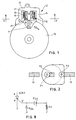
- the voltage magneto generator is designed to generate, at each revolution of the rotor, a first negative half-wave, followed by a second positive half-wave of greater amplitude, which is followed by a third negative half-wave substantially similar to the first negative half-wave to cause a current to flow in the primary winding of an ignition coil, as shown in Figure 4. Therefore, the generator comprises a magnetic rotor 10 provided with a radially extending permanent magnet 11 polarized in the cross direction, having the opposite poles arranged between two pole shoes N and S facing the periphery of the same rotor 10.
- the magneto generator moreover, comprises, a stator 12 consisting of a pack 13 of magnetic laminations defining a circuit for the magnetic flux, comprising a central leg 14 and two lateral legs 15, 16 which are angularly spaced and arranged in the rotational direction of the rotor 10.
- the central leg 14 has arranged around it an ignition coil comprising a primary winding 17 linked to the flux flowing in the magnetic system; the primary winding 17 is in turn inductively coupled to a secondary winding 18 or high-voltage winding which supplies power to a spark plug CD (Fig. 3).
- the primary winding 17, as shown in Figure 3, is connected to an inductive ignition circuit comprising electronically controlled spark advance means according to the present invention.
- This circuit comprises a first magnetic pick-up P1 designed to emit a first control signal for triggering the ignition at a minimum revolution number of the engine, for example at start-up, which is shifted to provide a spark with a certain delay with respect to a second magnetic pick-up P2 designed to generate, with a certain advance compared to the former, a second control signal which reaches the ignition trigger threshold at a predetermined number of revolutions higher than the former one, during normal working of the engine; the difference between the two instants, equivalent to the angle ⁇ of rotation of the rotor 10, represents the shifting in the spark advance.
- the two magnetic pick-ups P1 and P2 must therefore have a phase displacement angle equal to the required ignition advance ⁇ ; furthermore, their position must be chosen to be as close as possible to the maximum tearing point for the magnetic flux, as for example shown in Figure 1, where the magnetic pick-up P1 is positioned in the vicinity of the central leg 14 of the stator, while the magnetic pick-up P2 is positioned in the vicinity of the lateral leg 15 which precedes the central leg 14 in the rotational direction of the rotor 10.
- L1 denotes inductance of the primary winding 17 of the ignition coil of the generator shown in Figure 1
- L2 denotes the inductance of the secondary winding 18 connected to the spark plug CD.
- the system comprises two main electronic control switches for controlling the primary current in the winding 17 which, in the specific case, consists of two MOS-FETs indicated by MOS1 and MOS2 in Figure 3; it is obvious, however, that any other electronic control switch or circuit arrangement equivalent to a MOS circuit of figure 3 is suitable for the purposes of the present invention.
- the gate G of both MOS switches is connected, via a resistor R3, to a feed circuit 20 designed to generate a supply voltage having a value predetermined by the Zener diode DZ2, for polarization of the control electrodes G of both the switches MOS1 and MOS2.
- the two MOS have at their input a high-value impedance and, in order to start conducting, i.e.
- the feed circuit 20 which polarizes the gates G of the two main switches must provide a voltage with a value greater than the threshold voltage mentioned above (for example 12 volts).
- the feed circuit 20 comprises a capacitor C1, the voltage of which is limited by the Zener diode DZ2; the capacitor C1 is connected to the gates G of the two main switches MOS1 and MOS2, via the resistor R3, while it is supplied with current by the primary winding L1 via the resistor R4 and the diode D3 during the positive half-wave.
- the ignition system shown in Figure 3 comprises moreover a first circuit 21 for inhibiting MOS1 as well as a second circuit 22 for inhibiting MOS2, by which the circulation of the primary current is suddenly caused to stop at the times when the spark must be generated in the spark plug.
- each inhibiting circuit 21, 22 comprises an electronic switch SCR1 and SCR2 designed to connect to earth the gate G of the MOS in order to inhibit the respective main switch MOS1 and MOS2; the control electrode G' of SCR1 and SCR2 is directly connected to the magnetic pick-up P1 and P2, respectively.
- the system shown in Figure 3 comprises finally an holding circuit 23 for maintaining the inhibited state of the two main switches MOS1 and MOS2, which keeps the gates G connected to earth for the whole of the time during which voltage is generated in the primary winding L1 following the instant at which ignition sparks.
- This circuit 23 is necessary since the current which flows in R3 is unable to keep SCR1 and SCR2 in a conductive state.
- the holding circuit 23 comprises moreover a transistor J4 having the collector-emitter circuit CE designed to connect to earth the power supply of the control electrodes G of the two main switches MOS1 and MOS2; the base B of the transistor J4 is polarized with a voltage signal supplied by the voltage divider R1, R2 connected to both sides of L1 via the Zener diode DZ1 and the two diodes D1 and D2 having a common cathode connection.
- Figure 4 shows the graph of the primary current I L1 and Figure 5 which shows the graph of the voltages supplied by the two magnetic pick-ups P1 and P2 at low running speeds of the combustion engine, while the broken line indicates a threshold voltage value V S corresponding to the value V G'K at which SCR1 and SCR2 start to conduct, typically at 0.65 volts.
- ⁇ denotes the shifting angle for the advance of the ignition, corresponding to the angular difference between the two magnetic pick-ups P1 and P2 in the magnetic circuit of the stator 12; it is pointed out moreover that the pick-up P1 which is activated at a low number of revolutions has a large number of turns, while the pick-up P2 which is activated at a higher number of revolutions has a proportionally much smaller number of turns.
- the pick-up P1 has 600 turns and must be activated for example at 500 revolutions of the engine and the pick-up P2 must be activated for example at 4000 revolutions; the pick-up P2 must therefore have a number of turns which is proportionally reduced by the same ratio, i.e. 75 turns.
- the primary voltage peak in addition to causing the spark on the spark plug CD, via the diode D3 and the resistor R4 keeps the capacitor C1 charged at the voltage value determined by the Zener diode DZ2; furthermore, via D1, DZ1, R1 and R2, it causes conduction of the transistor J4 of the holding circuit 23 which will keep MOS1 and MOS2 inhibited until the primary winding generates a voltage.
- MOS1 and MOS2 are polarized again beyond the threshold voltage by a current supplied by the capacitor C1 which causes the two switches to assume the conductive state again. Since MOS1 and MOS2 have an inlet capacity for example of the order of 1000 PF, a few hundreds of microseconds will be needed in order to reach the desired threshold voltage.
- the pulse generated by the pick-up P2 which is positioned in the region of the lateral leg 15 of the stator first occurring for the magnet 11, in the rotational direction of the rotor 10, namely at the highest point of the first negative peak of the current I L1 , will reach the value for triggering SCR2 at the instant ⁇ 2, causing again a cut-off of the current in the primary winding L1; this causes the generation of a spark which is phase-shifted by an angle ⁇ with respect to the advance angle of the pick-up P1, having a value equivalent to about 30 ⁇ 35°.
- the variation in flow caused by rotation of the rotor 10 therefore produces on the secondary winding L2 of the ignition coil a voltage able to generate and maintain the spark for the entire angle comprised between the instant in which the pick-up generates its trigger signal for the spark and the instant in which said rotor will stop to induce voltage in the windings of the ignition coil.
- the rotational speed at which shifting of the ignition advance occurs depends on the number of turns of the pick-up P2; similarly the number of turns of the pick-up P1 determines the speed at which the high voltage starts to appear on the secondary winding L2, i.e. the "spark minimum".
- spark minimum speed is not very critical in terms of tolerance, provided that it is of a sufficiently low value, while in some applications a low tolerance is required for the speed value at which shifting of the spark advance occurs.
- the tolerance at which shifting of the spark advance occurs depends in turn on the tolerances of the voltage V G'K of the controlled switch SCR2, typically 0.65 to 0.15 volts and the variation of said voltage V G'K according to the temperature, typically 2.5 m volt/°C, in addition to the mechanical and magnetic tolerances of the generator which may be kept to within acceptable values.
- FIG. 6 A way of ensuring acceptable the variations in the voltage V G'K between the control electrode G' and the cathode K of SCR2 is shown in Figure 6 of the accompanying drawings.
- a Zener diode DZ3 typically of 6,2 volts, upstream of which a polarization resistor R G'K has been branched off, said resistor enabling the variations in the voltage V G'K of SCR2 to be limited to negligible values, the voltage of the Zener diode DZ3 being very precise, of the order of 1%, with a thermal derivative of opposite sign to that of the voltage V G'K of SCR2.
- the turns of the pick-up P2 must be suitably increased.
- the invention therefore proposes a very simple and low-cost system for obtaining an inductive ignition with variation in the spark advance controlled electronically.
- the system according to Figure 7 still comprises a first main electronic switch MOS1 and a second main switch MOS2 connected to the primary winding L1 of the ignition coil, the control electrodes G of which are connected to the feed circuit 20 which provides a constant polarization voltage supplying also two timers T1 and T2 with the voltage V DD .
- the holding circuit for maintaining the inhibited state of the two main switches MOS1 and MOS2.
- the system according to Figure 7 differs from that shown in Figure 3 in that a timing circuit T1, T2 is provided between each magnetic pick-up P1, P2 and the control electrode G' of the SCR inhibiting the flow of the primary current, said timing circuit consisting of a re-triggerable, resettable, monostable precision multivibrator which allows a pulse of a predetermined length to be emitted so as to interrupt the spark or the current flowing in the windings L1 and L2 of the ignition coil, when a predetermined number of revolutions of the engine is reached.
- a timing circuit T1, T2 is provided between each magnetic pick-up P1, P2 and the control electrode G' of the SCR inhibiting the flow of the primary current
- said timing circuit consisting of a re-triggerable, resettable, monostable precision multivibrator which allows a pulse of a predetermined length to be emitted so as to interrupt the spark or the current flowing in the windings L1 and L2 of the ignition coil, when a predetermined number
- T1 and T2 denote respectively the two re-triggerable monostable timers, for example consisting of a dual precision timer Motorola MC14538B, which act on the trailing edge of the signals at their inputs B1 and B2, respectively ( Figures 10 and 11); in other words the non-inverted output Q1 and Q2 ( Figures 12 and 13) will receive a pulse T A1 and T A2 of a predetermined length from the last trailing edge of the signal on the respective input B1 and B2. Therefore, if:
- the signal of the pick-up P2 similarly is in turn squared by the transistor J2 and, via the resistor R8 still supplied with the voltage V DD output from the capacitor C1, is sent to the input B2 of the transistor J2.
- the non-inverted output Q2 of P2 is sent, via the capacitor C2, to the control electrode G' of SCR2; the diodes D4 and D5 have the function of discharging the capacitors C2 and C3 when Q1 and Q2 are low.
- the output Q1 switches high for a time period T A1 predetermined by T1 and thus SCR1 is activated via C3, preventing MOS1 from generating the spark on the spark plug CD with an advance controlled by the first pick-up P1.
- Q1 ⁇ switches low so that J3 is inhibited for the whole of the time period T A1 . If, during this time period T A1 , Q2 switches high, then SCR2 may be activated, inhibiting MOS2 and causing the spark to be generated in synchronism with the pick-up P2.
- the time T A2 of T 2 determines the speed at which the spark is suppressed, thus forming a speed limiter for the engine. Normally shifting of the spark advance is performed at low speeds for example 3000 rpm, while speed limitation is performed for example at 12,000 rpm. During the limiting phase, the power supply is maintained by the capacitor C 1 since this situation is transient and of short duration.
Landscapes
- Engineering & Computer Science (AREA)
- Chemical & Material Sciences (AREA)
- Combustion & Propulsion (AREA)
- Mechanical Engineering (AREA)
- General Engineering & Computer Science (AREA)
- Signal Processing (AREA)
- Ignition Installations For Internal Combustion Engines (AREA)
- Electrical Control Of Ignition Timing (AREA)
Applications Claiming Priority (2)
| Application Number | Priority Date | Filing Date | Title |
|---|---|---|---|
| ITMI950278 | 1995-02-15 | ||
| ITMI950278A IT1275159B (it) | 1995-02-15 | 1995-02-15 | Sistema di accensione induttiva per motori a combustione interna con anticipo controllato elettronicamente |
Publications (3)
| Publication Number | Publication Date |
|---|---|
| EP0727578A2 true EP0727578A2 (fr) | 1996-08-21 |
| EP0727578A3 EP0727578A3 (fr) | 1998-01-07 |
| EP0727578B1 EP0727578B1 (fr) | 2001-12-19 |
Family
ID=11370558
Family Applications (1)
| Application Number | Title | Priority Date | Filing Date |
|---|---|---|---|
| EP96101816A Expired - Lifetime EP0727578B1 (fr) | 1995-02-15 | 1996-02-08 | Système d'allumage inductif pour moteurs à combustion interne avec contrôle électronique de l'avance à l'allumage |
Country Status (5)
| Country | Link |
|---|---|
| EP (1) | EP0727578B1 (fr) |
| AT (1) | ATE211218T1 (fr) |
| DE (1) | DE69618041T2 (fr) |
| ES (1) | ES2164791T3 (fr) |
| IT (1) | IT1275159B (fr) |
Cited By (5)
| Publication number | Priority date | Publication date | Assignee | Title |
|---|---|---|---|---|
| EP1387084A2 (fr) | 2002-08-02 | 2004-02-04 | DUCATI ENERGIA S.p.A. | Système d'allumage par induction avec contrôle numérique |
| EP0850358B1 (fr) * | 1995-09-12 | 2004-10-13 | Robert Bosch Gmbh | Etage de sortie d'allumage |
| WO2009099388A1 (fr) * | 2008-02-07 | 2009-08-13 | Sem Aktiebolag | Système pour un support d'énergie dans un système cdi |
| EP1598552A3 (fr) * | 2004-05-21 | 2010-06-02 | DUCATI ENERGIA S.p.A. | Système d'allumage inductif pour moteurs à combustion interne |
| CN103174576A (zh) * | 2011-12-07 | 2013-06-26 | 安德烈亚斯.斯蒂尔两合公司 | 点火线路 |
Family Cites Families (4)
| Publication number | Priority date | Publication date | Assignee | Title |
|---|---|---|---|---|
| DE3137550A1 (de) * | 1981-09-22 | 1983-03-31 | Robert Bosch Gmbh, 7000 Stuttgart | Zuendanlage fuer brennkraftmaschinen |
| DE3325275A1 (de) * | 1983-07-13 | 1985-01-24 | Robert Bosch Gmbh, 7000 Stuttgart | Schaltungsanordnung zur zuendung von brennkraftmaschinen |
| SE450029B (sv) * | 1985-02-27 | 1987-06-01 | Electrolux Ab | Momentbegrensande anordning i forbrenningsmotor med magnettendsystem |
| JPS61226568A (ja) * | 1985-03-29 | 1986-10-08 | Mitsubishi Electric Corp | 内燃機関点火装置 |
-
1995
- 1995-02-15 IT ITMI950278A patent/IT1275159B/it active IP Right Grant
-
1996
- 1996-02-08 ES ES96101816T patent/ES2164791T3/es not_active Expired - Lifetime
- 1996-02-08 EP EP96101816A patent/EP0727578B1/fr not_active Expired - Lifetime
- 1996-02-08 DE DE69618041T patent/DE69618041T2/de not_active Expired - Fee Related
- 1996-02-08 AT AT96101816T patent/ATE211218T1/de not_active IP Right Cessation
Cited By (13)
| Publication number | Priority date | Publication date | Assignee | Title |
|---|---|---|---|---|
| EP0850358B1 (fr) * | 1995-09-12 | 2004-10-13 | Robert Bosch Gmbh | Etage de sortie d'allumage |
| EP1387084A3 (fr) * | 2002-08-02 | 2006-09-13 | DUCATI ENERGIA S.p.A. | Système d'allumage par induction avec contrôle numérique |
| EP1387084A2 (fr) | 2002-08-02 | 2004-02-04 | DUCATI ENERGIA S.p.A. | Système d'allumage par induction avec contrôle numérique |
| EP1598552A3 (fr) * | 2004-05-21 | 2010-06-02 | DUCATI ENERGIA S.p.A. | Système d'allumage inductif pour moteurs à combustion interne |
| CN101939534B (zh) * | 2008-02-07 | 2013-03-13 | Sem股份公司 | 用于电容性放电点火系统中的能量支持的系统 |
| JP2011511211A (ja) * | 2008-02-07 | 2011-04-07 | セム アクティエボラグ | Cdiシステムにおけるエネルギ支援のためのシステム |
| WO2009099388A1 (fr) * | 2008-02-07 | 2009-08-13 | Sem Aktiebolag | Système pour un support d'énergie dans un système cdi |
| RU2480618C2 (ru) * | 2008-02-07 | 2013-04-27 | СЕМ Актиеболаг | Система генерации энергии в системе зажигания емкостным разрядом |
| US8490609B2 (en) | 2008-02-07 | 2013-07-23 | Sem Aktiebolag | System for energy support in a CDI system |
| CN103174576A (zh) * | 2011-12-07 | 2013-06-26 | 安德烈亚斯.斯蒂尔两合公司 | 点火线路 |
| EP2602477A3 (fr) * | 2011-12-07 | 2014-08-27 | Andreas Stihl AG & Co. KG | Circuit d'allumage |
| US9518552B2 (en) | 2011-12-07 | 2016-12-13 | Andreas Stihl Ag & Co. Kg | Ignition circuit |
| CN103174576B (zh) * | 2011-12-07 | 2016-12-21 | 安德烈亚斯.斯蒂尔两合公司 | 点火线路 |
Also Published As
| Publication number | Publication date |
|---|---|
| ITMI950278A0 (it) | 1995-02-15 |
| ITMI950278A1 (it) | 1996-08-15 |
| IT1275159B (it) | 1997-07-30 |
| DE69618041D1 (de) | 2002-01-31 |
| ATE211218T1 (de) | 2002-01-15 |
| DE69618041T2 (de) | 2002-06-13 |
| EP0727578A3 (fr) | 1998-01-07 |
| EP0727578B1 (fr) | 2001-12-19 |
| ES2164791T3 (es) | 2002-03-01 |
Similar Documents
| Publication | Publication Date | Title |
|---|---|---|
| KR930007999B1 (ko) | 내연기관용 점화장치 | |
| US4924831A (en) | Capacitor discharge ignition system with microprocessor timing control | |
| US4566425A (en) | Ignition system of the condensor-discharge type for internal combustion engine | |
| US3963015A (en) | Simplified automatic advance ignition system for an internal combustion engine | |
| US3941111A (en) | Ignition system | |
| KR890001736B1 (ko) | 내연기관용 전자 점화장치 | |
| EP0727578B1 (fr) | Système d'allumage inductif pour moteurs à combustion interne avec contrôle électronique de l'avance à l'allumage | |
| US3280810A (en) | Semiconductor ignition system | |
| US5513619A (en) | Discharge ignition apparatus for internal combustion engine | |
| JPH0745865B2 (ja) | 内燃機関用点火装置 | |
| US3768455A (en) | Ignition arrangement for internal combustion engine | |
| US6799557B2 (en) | Processor controlled discharge ignition with fixed firing angle at startup | |
| JPH0851731A (ja) | 内燃機関用電源装置 | |
| US5806503A (en) | Discharge ignition apparatus for internal combustion engine having stepped spark advance | |
| JPS5836187B2 (ja) | ナイネンキカンヨウテンカソウチ | |
| US7028676B2 (en) | Inductive ignition system for internal combustion engines | |
| US3439663A (en) | Transistor ignition system for gas engines | |
| US4463743A (en) | Capacitor discharge ignition system for internal combustion engines | |
| US4565180A (en) | Contactless ignition device for internal combustion engines | |
| JPS6253714B2 (fr) | ||
| JP2927128B2 (ja) | コンデンサ放電式多気筒内燃機関用点火装置 | |
| JPH0247264Y2 (fr) | ||
| US5048502A (en) | Capacitive-discharge ignition system with step timing advance | |
| JPH0355817Y2 (fr) | ||
| JPH0343422Y2 (fr) |
Legal Events
| Date | Code | Title | Description |
|---|---|---|---|
| PUAI | Public reference made under article 153(3) epc to a published international application that has entered the european phase |
Free format text: ORIGINAL CODE: 0009012 |
|
| AK | Designated contracting states |
Kind code of ref document: A2 Designated state(s): AT DE ES FR IT SE |
|
| PUAL | Search report despatched |
Free format text: ORIGINAL CODE: 0009013 |
|
| AK | Designated contracting states |
Kind code of ref document: A3 Designated state(s): AT DE ES FR IT SE |
|
| 17P | Request for examination filed |
Effective date: 19980520 |
|
| 17Q | First examination report despatched |
Effective date: 19990507 |
|
| GRAG | Despatch of communication of intention to grant |
Free format text: ORIGINAL CODE: EPIDOS AGRA |
|
| GRAG | Despatch of communication of intention to grant |
Free format text: ORIGINAL CODE: EPIDOS AGRA |
|
| GRAH | Despatch of communication of intention to grant a patent |
Free format text: ORIGINAL CODE: EPIDOS IGRA |
|
| GRAH | Despatch of communication of intention to grant a patent |
Free format text: ORIGINAL CODE: EPIDOS IGRA |
|
| GRAA | (expected) grant |
Free format text: ORIGINAL CODE: 0009210 |
|
| AK | Designated contracting states |
Kind code of ref document: B1 Designated state(s): AT DE ES FR IT SE |
|
| REF | Corresponds to: |
Ref document number: 211218 Country of ref document: AT Date of ref document: 20020115 Kind code of ref document: T |
|
| REF | Corresponds to: |
Ref document number: 69618041 Country of ref document: DE Date of ref document: 20020131 |
|
| REG | Reference to a national code |
Ref country code: ES Ref legal event code: FG2A Ref document number: 2164791 Country of ref document: ES Kind code of ref document: T3 |
|
| PLBE | No opposition filed within time limit |
Free format text: ORIGINAL CODE: 0009261 |
|
| 26N | No opposition filed | ||
| PGFP | Annual fee paid to national office [announced via postgrant information from national office to epo] |
Ref country code: FR Payment date: 20050128 Year of fee payment: 10 |
|
| PGFP | Annual fee paid to national office [announced via postgrant information from national office to epo] |
Ref country code: ES Payment date: 20050203 Year of fee payment: 10 |
|
| PGFP | Annual fee paid to national office [announced via postgrant information from national office to epo] |
Ref country code: SE Payment date: 20050215 Year of fee payment: 10 |
|
| PGFP | Annual fee paid to national office [announced via postgrant information from national office to epo] |
Ref country code: AT Payment date: 20050228 Year of fee payment: 10 |
|
| PGFP | Annual fee paid to national office [announced via postgrant information from national office to epo] |
Ref country code: DE Payment date: 20050331 Year of fee payment: 10 |
|
| PG25 | Lapsed in a contracting state [announced via postgrant information from national office to epo] |
Ref country code: AT Free format text: LAPSE BECAUSE OF NON-PAYMENT OF DUE FEES Effective date: 20060208 |
|
| PG25 | Lapsed in a contracting state [announced via postgrant information from national office to epo] |
Ref country code: SE Free format text: LAPSE BECAUSE OF NON-PAYMENT OF DUE FEES Effective date: 20060209 Ref country code: ES Free format text: LAPSE BECAUSE OF NON-PAYMENT OF DUE FEES Effective date: 20060209 |
|
| PG25 | Lapsed in a contracting state [announced via postgrant information from national office to epo] |
Ref country code: DE Free format text: LAPSE BECAUSE OF NON-PAYMENT OF DUE FEES Effective date: 20060901 |
|
| EUG | Se: european patent has lapsed | ||
| REG | Reference to a national code |
Ref country code: FR Ref legal event code: ST Effective date: 20061031 |
|
| REG | Reference to a national code |
Ref country code: ES Ref legal event code: FD2A Effective date: 20060209 |
|
| PG25 | Lapsed in a contracting state [announced via postgrant information from national office to epo] |
Ref country code: FR Free format text: LAPSE BECAUSE OF NON-PAYMENT OF DUE FEES Effective date: 20060228 |
|
| PGFP | Annual fee paid to national office [announced via postgrant information from national office to epo] |
Ref country code: IT Payment date: 20120229 Year of fee payment: 17 |
|
| PG25 | Lapsed in a contracting state [announced via postgrant information from national office to epo] |
Ref country code: IT Free format text: LAPSE BECAUSE OF NON-PAYMENT OF DUE FEES Effective date: 20130208 |