EP0728520A1 - Bedrucken von Bibliotheken von Molekularketten - Google Patents
Bedrucken von Bibliotheken von Molekularketten Download PDFInfo
- Publication number
- EP0728520A1 EP0728520A1 EP96300860A EP96300860A EP0728520A1 EP 0728520 A1 EP0728520 A1 EP 0728520A1 EP 96300860 A EP96300860 A EP 96300860A EP 96300860 A EP96300860 A EP 96300860A EP 0728520 A1 EP0728520 A1 EP 0728520A1
- Authority
- EP
- European Patent Office
- Prior art keywords
- substrate
- deprotection
- group
- deprotection agent
- printing
- Prior art date
- Legal status (The legal status is an assumption and is not a legal conclusion. Google has not performed a legal analysis and makes no representation as to the accuracy of the status listed.)
- Granted
Links
- 238000007639 printing Methods 0.000 title claims description 50
- 238000003491 array Methods 0.000 title description 7
- 238000000034 method Methods 0.000 claims abstract description 106
- 239000000758 substrate Substances 0.000 claims abstract description 105
- 238000010511 deprotection reaction Methods 0.000 claims abstract description 104
- 230000004888 barrier function Effects 0.000 claims abstract description 98
- 239000000463 material Substances 0.000 claims abstract description 88
- 239000000178 monomer Substances 0.000 claims abstract description 63
- 239000003795 chemical substances by application Substances 0.000 claims abstract description 56
- 108091034117 Oligonucleotide Proteins 0.000 claims abstract description 34
- 239000012808 vapor phase Substances 0.000 claims abstract description 26
- JLCPHMBAVCMARE-UHFFFAOYSA-N [3-[[3-[[3-[[3-[[3-[[3-[[3-[[3-[[3-[[3-[[3-[[5-(2-amino-6-oxo-1H-purin-9-yl)-3-[[3-[[3-[[3-[[3-[[3-[[5-(2-amino-6-oxo-1H-purin-9-yl)-3-[[5-(2-amino-6-oxo-1H-purin-9-yl)-3-hydroxyoxolan-2-yl]methoxy-hydroxyphosphoryl]oxyoxolan-2-yl]methoxy-hydroxyphosphoryl]oxy-5-(5-methyl-2,4-dioxopyrimidin-1-yl)oxolan-2-yl]methoxy-hydroxyphosphoryl]oxy-5-(6-aminopurin-9-yl)oxolan-2-yl]methoxy-hydroxyphosphoryl]oxy-5-(6-aminopurin-9-yl)oxolan-2-yl]methoxy-hydroxyphosphoryl]oxy-5-(6-aminopurin-9-yl)oxolan-2-yl]methoxy-hydroxyphosphoryl]oxy-5-(6-aminopurin-9-yl)oxolan-2-yl]methoxy-hydroxyphosphoryl]oxyoxolan-2-yl]methoxy-hydroxyphosphoryl]oxy-5-(5-methyl-2,4-dioxopyrimidin-1-yl)oxolan-2-yl]methoxy-hydroxyphosphoryl]oxy-5-(4-amino-2-oxopyrimidin-1-yl)oxolan-2-yl]methoxy-hydroxyphosphoryl]oxy-5-(5-methyl-2,4-dioxopyrimidin-1-yl)oxolan-2-yl]methoxy-hydroxyphosphoryl]oxy-5-(5-methyl-2,4-dioxopyrimidin-1-yl)oxolan-2-yl]methoxy-hydroxyphosphoryl]oxy-5-(6-aminopurin-9-yl)oxolan-2-yl]methoxy-hydroxyphosphoryl]oxy-5-(6-aminopurin-9-yl)oxolan-2-yl]methoxy-hydroxyphosphoryl]oxy-5-(4-amino-2-oxopyrimidin-1-yl)oxolan-2-yl]methoxy-hydroxyphosphoryl]oxy-5-(4-amino-2-oxopyrimidin-1-yl)oxolan-2-yl]methoxy-hydroxyphosphoryl]oxy-5-(4-amino-2-oxopyrimidin-1-yl)oxolan-2-yl]methoxy-hydroxyphosphoryl]oxy-5-(6-aminopurin-9-yl)oxolan-2-yl]methoxy-hydroxyphosphoryl]oxy-5-(4-amino-2-oxopyrimidin-1-yl)oxolan-2-yl]methyl [5-(6-aminopurin-9-yl)-2-(hydroxymethyl)oxolan-3-yl] hydrogen phosphate Polymers Cc1cn(C2CC(OP(O)(=O)OCC3OC(CC3OP(O)(=O)OCC3OC(CC3O)n3cnc4c3nc(N)[nH]c4=O)n3cnc4c3nc(N)[nH]c4=O)C(COP(O)(=O)OC3CC(OC3COP(O)(=O)OC3CC(OC3COP(O)(=O)OC3CC(OC3COP(O)(=O)OC3CC(OC3COP(O)(=O)OC3CC(OC3COP(O)(=O)OC3CC(OC3COP(O)(=O)OC3CC(OC3COP(O)(=O)OC3CC(OC3COP(O)(=O)OC3CC(OC3COP(O)(=O)OC3CC(OC3COP(O)(=O)OC3CC(OC3COP(O)(=O)OC3CC(OC3COP(O)(=O)OC3CC(OC3COP(O)(=O)OC3CC(OC3COP(O)(=O)OC3CC(OC3COP(O)(=O)OC3CC(OC3COP(O)(=O)OC3CC(OC3CO)n3cnc4c(N)ncnc34)n3ccc(N)nc3=O)n3cnc4c(N)ncnc34)n3ccc(N)nc3=O)n3ccc(N)nc3=O)n3ccc(N)nc3=O)n3cnc4c(N)ncnc34)n3cnc4c(N)ncnc34)n3cc(C)c(=O)[nH]c3=O)n3cc(C)c(=O)[nH]c3=O)n3ccc(N)nc3=O)n3cc(C)c(=O)[nH]c3=O)n3cnc4c3nc(N)[nH]c4=O)n3cnc4c(N)ncnc34)n3cnc4c(N)ncnc34)n3cnc4c(N)ncnc34)n3cnc4c(N)ncnc34)O2)c(=O)[nH]c1=O JLCPHMBAVCMARE-UHFFFAOYSA-N 0.000 claims abstract description 23
- 239000012876 carrier material Substances 0.000 claims abstract description 6
- 229920000642 polymer Polymers 0.000 claims description 56
- 239000004593 Epoxy Substances 0.000 claims description 52
- 239000007788 liquid Substances 0.000 claims description 25
- 239000004922 lacquer Substances 0.000 claims description 24
- 125000006239 protecting group Chemical group 0.000 claims description 23
- 239000003921 oil Substances 0.000 claims description 12
- 229920000728 polyester Polymers 0.000 claims description 9
- 239000012351 deprotecting agent Substances 0.000 claims description 7
- XLYOFNOQVPJJNP-UHFFFAOYSA-N water Chemical compound O XLYOFNOQVPJJNP-UHFFFAOYSA-N 0.000 claims description 7
- 238000001459 lithography Methods 0.000 claims description 6
- 229920002545 silicone oil Polymers 0.000 claims description 5
- 239000012159 carrier gas Substances 0.000 claims description 4
- 238000010168 coupling process Methods 0.000 claims description 4
- 125000000524 functional group Chemical group 0.000 claims description 3
- 238000007646 gravure printing Methods 0.000 claims description 3
- 230000002194 synthesizing effect Effects 0.000 claims description 3
- 239000012190 activator Substances 0.000 claims description 2
- 230000008878 coupling Effects 0.000 claims description 2
- 238000005859 coupling reaction Methods 0.000 claims description 2
- 229910052751 metal Inorganic materials 0.000 claims description 2
- 239000002184 metal Substances 0.000 claims description 2
- 229920002635 polyurethane Polymers 0.000 claims description 2
- 239000004814 polyurethane Substances 0.000 claims description 2
- 239000002210 silicon-based material Substances 0.000 claims description 2
- 230000002378 acidificating effect Effects 0.000 claims 2
- 238000007644 letterpress printing Methods 0.000 claims 2
- 230000015572 biosynthetic process Effects 0.000 abstract description 34
- 238000003786 synthesis reaction Methods 0.000 abstract description 31
- 239000007787 solid Substances 0.000 abstract description 16
- 239000002777 nucleoside Substances 0.000 abstract description 14
- 150000003833 nucleoside derivatives Chemical class 0.000 abstract description 9
- 125000005647 linker group Chemical group 0.000 description 55
- 108090000765 processed proteins & peptides Proteins 0.000 description 36
- 238000002474 experimental method Methods 0.000 description 34
- 108091033319 polynucleotide Proteins 0.000 description 32
- 102000040430 polynucleotide Human genes 0.000 description 32
- 239000002157 polynucleotide Substances 0.000 description 32
- 238000007792 addition Methods 0.000 description 28
- 239000002609 medium Substances 0.000 description 23
- 102000004196 processed proteins & peptides Human genes 0.000 description 23
- 239000011521 glass Substances 0.000 description 22
- 238000006243 chemical reaction Methods 0.000 description 20
- 239000003153 chemical reaction reagent Substances 0.000 description 19
- -1 dimethoxytrityl Chemical group 0.000 description 19
- 108020003175 receptors Proteins 0.000 description 19
- 102000005962 receptors Human genes 0.000 description 19
- 239000000523 sample Substances 0.000 description 19
- CSCPPACGZOOCGX-UHFFFAOYSA-N Acetone Chemical compound CC(C)=O CSCPPACGZOOCGX-UHFFFAOYSA-N 0.000 description 18
- 239000003973 paint Substances 0.000 description 15
- PXHVJJICTQNCMI-UHFFFAOYSA-N Nickel Chemical compound [Ni] PXHVJJICTQNCMI-UHFFFAOYSA-N 0.000 description 14
- 239000003446 ligand Substances 0.000 description 14
- 239000000243 solution Substances 0.000 description 14
- XUIMIQQOPSSXEZ-UHFFFAOYSA-N Silicon Chemical compound [Si] XUIMIQQOPSSXEZ-UHFFFAOYSA-N 0.000 description 13
- 235000001014 amino acid Nutrition 0.000 description 13
- 150000001413 amino acids Chemical class 0.000 description 12
- 229920001184 polypeptide Polymers 0.000 description 12
- 229910052710 silicon Inorganic materials 0.000 description 12
- 239000010703 silicon Substances 0.000 description 11
- 230000000873 masking effect Effects 0.000 description 10
- 125000003729 nucleotide group Chemical group 0.000 description 10
- VYPSYNLAJGMNEJ-UHFFFAOYSA-N Silicium dioxide Chemical compound O=[Si]=O VYPSYNLAJGMNEJ-UHFFFAOYSA-N 0.000 description 9
- 229940079593 drug Drugs 0.000 description 9
- 239000003814 drug Substances 0.000 description 9
- 239000012528 membrane Substances 0.000 description 9
- 239000002773 nucleotide Substances 0.000 description 9
- 230000027455 binding Effects 0.000 description 8
- 230000008569 process Effects 0.000 description 8
- 108090000790 Enzymes Proteins 0.000 description 7
- 102000004190 Enzymes Human genes 0.000 description 7
- 210000004027 cell Anatomy 0.000 description 7
- 238000011161 development Methods 0.000 description 7
- 229910052759 nickel Inorganic materials 0.000 description 7
- 150000008300 phosphoramidites Chemical class 0.000 description 7
- WFDIJRYMOXRFFG-UHFFFAOYSA-N Acetic anhydride Chemical compound CC(=O)OC(C)=O WFDIJRYMOXRFFG-UHFFFAOYSA-N 0.000 description 6
- JUJWROOIHBZHMG-UHFFFAOYSA-N Pyridine Chemical compound C1=CC=NC=C1 JUJWROOIHBZHMG-UHFFFAOYSA-N 0.000 description 6
- WYURNTSHIVDZCO-UHFFFAOYSA-N Tetrahydrofuran Chemical compound C1CCOC1 WYURNTSHIVDZCO-UHFFFAOYSA-N 0.000 description 6
- 230000008901 benefit Effects 0.000 description 6
- 239000010408 film Substances 0.000 description 6
- 238000009396 hybridization Methods 0.000 description 6
- 150000007523 nucleic acids Chemical class 0.000 description 6
- 238000007645 offset printing Methods 0.000 description 6
- 238000012545 processing Methods 0.000 description 6
- 239000000126 substance Substances 0.000 description 6
- ZCYVEMRRCGMTRW-UHFFFAOYSA-N 7553-56-2 Chemical compound [I] ZCYVEMRRCGMTRW-UHFFFAOYSA-N 0.000 description 5
- 108020004414 DNA Proteins 0.000 description 5
- 229910052740 iodine Inorganic materials 0.000 description 5
- 239000011630 iodine Substances 0.000 description 5
- 102000039446 nucleic acids Human genes 0.000 description 5
- 108020004707 nucleic acids Proteins 0.000 description 5
- 108090000623 proteins and genes Proteins 0.000 description 5
- 238000012546 transfer Methods 0.000 description 5
- 241000870659 Crassula perfoliata var. minor Species 0.000 description 4
- JXTHNDFMNIQAHM-UHFFFAOYSA-N dichloroacetic acid Chemical compound OC(=O)C(Cl)Cl JXTHNDFMNIQAHM-UHFFFAOYSA-N 0.000 description 4
- 208000037265 diseases, disorders, signs and symptoms Diseases 0.000 description 4
- 238000010884 ion-beam technique Methods 0.000 description 4
- 230000036961 partial effect Effects 0.000 description 4
- 238000002360 preparation method Methods 0.000 description 4
- 238000012552 review Methods 0.000 description 4
- 239000000377 silicon dioxide Substances 0.000 description 4
- MCTWTZJPVLRJOU-UHFFFAOYSA-N 1-methyl-1H-imidazole Chemical compound CN1C=CN=C1 MCTWTZJPVLRJOU-UHFFFAOYSA-N 0.000 description 3
- WEVYAHXRMPXWCK-UHFFFAOYSA-N Acetonitrile Chemical compound CC#N WEVYAHXRMPXWCK-UHFFFAOYSA-N 0.000 description 3
- 108091035707 Consensus sequence Proteins 0.000 description 3
- LYCAIKOWRPUZTN-UHFFFAOYSA-N Ethylene glycol Chemical compound OCCO LYCAIKOWRPUZTN-UHFFFAOYSA-N 0.000 description 3
- 230000009471 action Effects 0.000 description 3
- 239000003242 anti bacterial agent Substances 0.000 description 3
- 229940088710 antibiotic agent Drugs 0.000 description 3
- 238000005284 basis set Methods 0.000 description 3
- 230000004071 biological effect Effects 0.000 description 3
- 230000000295 complement effect Effects 0.000 description 3
- 150000001875 compounds Chemical class 0.000 description 3
- 238000012217 deletion Methods 0.000 description 3
- 230000037430 deletion Effects 0.000 description 3
- YFCVAZGXPLMNDG-UHFFFAOYSA-N dimethyl-bis[[methyl(diphenyl)silyl]oxy]silane Chemical compound C=1C=CC=CC=1[Si](C)(C=1C=CC=CC=1)O[Si](C)(C)O[Si](C)(C=1C=CC=CC=1)C1=CC=CC=C1 YFCVAZGXPLMNDG-UHFFFAOYSA-N 0.000 description 3
- 201000010099 disease Diseases 0.000 description 3
- 239000003822 epoxy resin Substances 0.000 description 3
- 239000012530 fluid Substances 0.000 description 3
- 150000004676 glycans Chemical class 0.000 description 3
- 108020004999 messenger RNA Proteins 0.000 description 3
- 125000003835 nucleoside group Chemical group 0.000 description 3
- 238000002515 oligonucleotide synthesis Methods 0.000 description 3
- 229920001542 oligosaccharide Polymers 0.000 description 3
- 150000002482 oligosaccharides Chemical class 0.000 description 3
- 229920000647 polyepoxide Polymers 0.000 description 3
- 229920001282 polysaccharide Polymers 0.000 description 3
- 239000005017 polysaccharide Substances 0.000 description 3
- 235000018102 proteins Nutrition 0.000 description 3
- 102000004169 proteins and genes Human genes 0.000 description 3
- UMJSCPRVCHMLSP-UHFFFAOYSA-N pyridine Natural products COC1=CC=CN=C1 UMJSCPRVCHMLSP-UHFFFAOYSA-N 0.000 description 3
- 239000000376 reactant Substances 0.000 description 3
- 150000003384 small molecules Chemical class 0.000 description 3
- 125000006850 spacer group Chemical group 0.000 description 3
- 239000007921 spray Substances 0.000 description 3
- 238000006467 substitution reaction Methods 0.000 description 3
- 238000012360 testing method Methods 0.000 description 3
- YNJBWRMUSHSURL-UHFFFAOYSA-N trichloroacetic acid Chemical compound OC(=O)C(Cl)(Cl)Cl YNJBWRMUSHSURL-UHFFFAOYSA-N 0.000 description 3
- QGZKDVFQNNGYKY-UHFFFAOYSA-N Ammonia Chemical compound N QGZKDVFQNNGYKY-UHFFFAOYSA-N 0.000 description 2
- 150000008574 D-amino acids Chemical class 0.000 description 2
- VEXZGXHMUGYJMC-UHFFFAOYSA-N Hydrochloric acid Chemical compound Cl VEXZGXHMUGYJMC-UHFFFAOYSA-N 0.000 description 2
- 150000008575 L-amino acids Chemical class 0.000 description 2
- KDXKERNSBIXSRK-YFKPBYRVSA-N L-lysine Chemical compound NCCCC[C@H](N)C(O)=O KDXKERNSBIXSRK-YFKPBYRVSA-N 0.000 description 2
- 108090001090 Lectins Proteins 0.000 description 2
- 102000004856 Lectins Human genes 0.000 description 2
- 239000000020 Nitrocellulose Substances 0.000 description 2
- 229920002302 Nylon 6,6 Polymers 0.000 description 2
- 102000003840 Opioid Receptors Human genes 0.000 description 2
- 108090000137 Opioid Receptors Proteins 0.000 description 2
- 108091093037 Peptide nucleic acid Proteins 0.000 description 2
- 239000004743 Polypropylene Substances 0.000 description 2
- DRTQHJPVMGBUCF-XVFCMESISA-N Uridine Chemical compound O[C@@H]1[C@H](O)[C@@H](CO)O[C@H]1N1C(=O)NC(=O)C=C1 DRTQHJPVMGBUCF-XVFCMESISA-N 0.000 description 2
- 230000000890 antigenic effect Effects 0.000 description 2
- 230000003197 catalytic effect Effects 0.000 description 2
- 210000000170 cell membrane Anatomy 0.000 description 2
- 238000011109 contamination Methods 0.000 description 2
- OPTASPLRGRRNAP-UHFFFAOYSA-N cytosine Chemical compound NC=1C=CNC(=O)N=1 OPTASPLRGRRNAP-UHFFFAOYSA-N 0.000 description 2
- 229960005215 dichloroacetic acid Drugs 0.000 description 2
- 238000009826 distribution Methods 0.000 description 2
- 229920001971 elastomer Polymers 0.000 description 2
- 238000005516 engineering process Methods 0.000 description 2
- 239000000499 gel Substances 0.000 description 2
- UYTPUPDQBNUYGX-UHFFFAOYSA-N guanine Chemical compound O=C1NC(N)=NC2=C1N=CN2 UYTPUPDQBNUYGX-UHFFFAOYSA-N 0.000 description 2
- 108091008039 hormone receptors Proteins 0.000 description 2
- 238000007641 inkjet printing Methods 0.000 description 2
- NOESYZHRGYRDHS-UHFFFAOYSA-N insulin Chemical compound N1C(=O)C(NC(=O)C(CCC(N)=O)NC(=O)C(CCC(O)=O)NC(=O)C(C(C)C)NC(=O)C(NC(=O)CN)C(C)CC)CSSCC(C(NC(CO)C(=O)NC(CC(C)C)C(=O)NC(CC=2C=CC(O)=CC=2)C(=O)NC(CCC(N)=O)C(=O)NC(CC(C)C)C(=O)NC(CCC(O)=O)C(=O)NC(CC(N)=O)C(=O)NC(CC=2C=CC(O)=CC=2)C(=O)NC(CSSCC(NC(=O)C(C(C)C)NC(=O)C(CC(C)C)NC(=O)C(CC=2C=CC(O)=CC=2)NC(=O)C(CC(C)C)NC(=O)C(C)NC(=O)C(CCC(O)=O)NC(=O)C(C(C)C)NC(=O)C(CC(C)C)NC(=O)C(CC=2NC=NC=2)NC(=O)C(CO)NC(=O)CNC2=O)C(=O)NCC(=O)NC(CCC(O)=O)C(=O)NC(CCCNC(N)=N)C(=O)NCC(=O)NC(CC=3C=CC=CC=3)C(=O)NC(CC=3C=CC=CC=3)C(=O)NC(CC=3C=CC(O)=CC=3)C(=O)NC(C(C)O)C(=O)N3C(CCC3)C(=O)NC(CCCCN)C(=O)NC(C)C(O)=O)C(=O)NC(CC(N)=O)C(O)=O)=O)NC(=O)C(C(C)CC)NC(=O)C(CO)NC(=O)C(C(C)O)NC(=O)C1CSSCC2NC(=O)C(CC(C)C)NC(=O)C(NC(=O)C(CCC(N)=O)NC(=O)C(CC(N)=O)NC(=O)C(NC(=O)C(N)CC=1C=CC=CC=1)C(C)C)CC1=CN=CN1 NOESYZHRGYRDHS-UHFFFAOYSA-N 0.000 description 2
- 239000002523 lectin Substances 0.000 description 2
- 238000004519 manufacturing process Methods 0.000 description 2
- 102000006240 membrane receptors Human genes 0.000 description 2
- 108020004084 membrane receptors Proteins 0.000 description 2
- 244000005700 microbiome Species 0.000 description 2
- 239000000203 mixture Substances 0.000 description 2
- 238000012986 modification Methods 0.000 description 2
- 230000004048 modification Effects 0.000 description 2
- BQJCRHHNABKAKU-KBQPJGBKSA-N morphine Chemical compound O([C@H]1[C@H](C=C[C@H]23)O)C4=C5[C@@]12CCN(C)[C@@H]3CC5=CC=C4O BQJCRHHNABKAKU-KBQPJGBKSA-N 0.000 description 2
- 239000002086 nanomaterial Substances 0.000 description 2
- 239000002858 neurotransmitter agent Substances 0.000 description 2
- 229920001220 nitrocellulos Polymers 0.000 description 2
- 230000003647 oxidation Effects 0.000 description 2
- 238000007254 oxidation reaction Methods 0.000 description 2
- 239000000816 peptidomimetic Substances 0.000 description 2
- 150000003904 phospholipids Chemical class 0.000 description 2
- 239000004033 plastic Substances 0.000 description 2
- 229920003023 plastic Polymers 0.000 description 2
- 239000004417 polycarbonate Substances 0.000 description 2
- 229920000515 polycarbonate Polymers 0.000 description 2
- 229920001155 polypropylene Polymers 0.000 description 2
- 229920001296 polysiloxane Polymers 0.000 description 2
- 239000000047 product Substances 0.000 description 2
- 230000002441 reversible effect Effects 0.000 description 2
- 238000012216 screening Methods 0.000 description 2
- 241000894007 species Species 0.000 description 2
- 235000000346 sugar Nutrition 0.000 description 2
- 150000008163 sugars Chemical class 0.000 description 2
- YLQBMQCUIZJEEH-UHFFFAOYSA-N tetrahydrofuran Natural products C=1C=COC=1 YLQBMQCUIZJEEH-UHFFFAOYSA-N 0.000 description 2
- 230000001225 therapeutic effect Effects 0.000 description 2
- 239000010409 thin film Substances 0.000 description 2
- RWQNBRDOKXIBIV-UHFFFAOYSA-N thymine Chemical compound CC1=CNC(=O)NC1=O RWQNBRDOKXIBIV-UHFFFAOYSA-N 0.000 description 2
- 210000001519 tissue Anatomy 0.000 description 2
- 238000011282 treatment Methods 0.000 description 2
- HIGSZOUZFKGHLA-XNIJJKJLSA-N (2r,3r,4r,5r)-5-(6-amino-2-methylpurin-9-yl)-2-(hydroxymethyl)-5-(3-methylbut-3-enyl)-4-sulfanyloxolan-3-ol Chemical compound C1=NC2=C(N)N=C(C)N=C2N1[C@]1(CCC(=C)C)O[C@H](CO)[C@@H](O)[C@H]1S HIGSZOUZFKGHLA-XNIJJKJLSA-N 0.000 description 1
- BQCIDUSAKPWEOX-UHFFFAOYSA-N 1,1-Difluoroethene Chemical compound FC(F)=C BQCIDUSAKPWEOX-UHFFFAOYSA-N 0.000 description 1
- ZLOIGESWDJYCTF-UHFFFAOYSA-N 4-Thiouridine Natural products OC1C(O)C(CO)OC1N1C(=O)NC(=S)C=C1 ZLOIGESWDJYCTF-UHFFFAOYSA-N 0.000 description 1
- ZLOIGESWDJYCTF-XVFCMESISA-N 4-thiouridine Chemical compound O[C@@H]1[C@H](O)[C@@H](CO)O[C@H]1N1C(=O)NC(=S)C=C1 ZLOIGESWDJYCTF-XVFCMESISA-N 0.000 description 1
- OGHAROSJZRTIOK-KQYNXXCUSA-O 7-methylguanosine Chemical compound C1=2N=C(N)NC(=O)C=2[N+](C)=CN1[C@@H]1O[C@H](CO)[C@@H](O)[C@H]1O OGHAROSJZRTIOK-KQYNXXCUSA-O 0.000 description 1
- 229930024421 Adenine Natural products 0.000 description 1
- GFFGJBXGBJISGV-UHFFFAOYSA-N Adenine Chemical compound NC1=NC=NC2=C1N=CN2 GFFGJBXGBJISGV-UHFFFAOYSA-N 0.000 description 1
- 108700028369 Alleles Proteins 0.000 description 1
- VHUUQVKOLVNVRT-UHFFFAOYSA-N Ammonium hydroxide Chemical compound [NH4+].[OH-] VHUUQVKOLVNVRT-UHFFFAOYSA-N 0.000 description 1
- 208000023275 Autoimmune disease Diseases 0.000 description 1
- OKTJSMMVPCPJKN-UHFFFAOYSA-N Carbon Chemical compound [C] OKTJSMMVPCPJKN-UHFFFAOYSA-N 0.000 description 1
- 108010078791 Carrier Proteins Proteins 0.000 description 1
- 102000014914 Carrier Proteins Human genes 0.000 description 1
- KDXKERNSBIXSRK-RXMQYKEDSA-N D-lysine Chemical compound NCCCC[C@@H](N)C(O)=O KDXKERNSBIXSRK-RXMQYKEDSA-N 0.000 description 1
- 230000004568 DNA-binding Effects 0.000 description 1
- PIICEJLVQHRZGT-UHFFFAOYSA-N Ethylenediamine Chemical compound NCCN PIICEJLVQHRZGT-UHFFFAOYSA-N 0.000 description 1
- 241000233866 Fungi Species 0.000 description 1
- 229910005540 GaP Inorganic materials 0.000 description 1
- 229910001218 Gallium arsenide Inorganic materials 0.000 description 1
- 102000018997 Growth Hormone Human genes 0.000 description 1
- 108010051696 Growth Hormone Proteins 0.000 description 1
- 102000002265 Human Growth Hormone Human genes 0.000 description 1
- 108010000521 Human Growth Hormone Proteins 0.000 description 1
- 239000000854 Human Growth Hormone Substances 0.000 description 1
- 229930010555 Inosine Natural products 0.000 description 1
- UGQMRVRMYYASKQ-KQYNXXCUSA-N Inosine Chemical compound O[C@@H]1[C@H](O)[C@@H](CO)O[C@H]1N1C2=NC=NC(O)=C2N=C1 UGQMRVRMYYASKQ-KQYNXXCUSA-N 0.000 description 1
- 102000004877 Insulin Human genes 0.000 description 1
- 108090001061 Insulin Proteins 0.000 description 1
- 235000019766 L-Lysine Nutrition 0.000 description 1
- 239000004472 Lysine Substances 0.000 description 1
- RSPURTUNRHNVGF-IOSLPCCCSA-N N(2),N(2)-dimethylguanosine Chemical compound C1=NC=2C(=O)NC(N(C)C)=NC=2N1[C@@H]1O[C@H](CO)[C@@H](O)[C@H]1O RSPURTUNRHNVGF-IOSLPCCCSA-N 0.000 description 1
- 108010038807 Oligopeptides Proteins 0.000 description 1
- 102000015636 Oligopeptides Human genes 0.000 description 1
- 239000004952 Polyamide Substances 0.000 description 1
- 239000004698 Polyethylene Substances 0.000 description 1
- 229920002873 Polyethylenimine Polymers 0.000 description 1
- 239000004642 Polyimide Substances 0.000 description 1
- 239000004793 Polystyrene Substances 0.000 description 1
- 229920002396 Polyurea Polymers 0.000 description 1
- ONIBWKKTOPOVIA-UHFFFAOYSA-N Proline Natural products OC(=O)C1CCCN1 ONIBWKKTOPOVIA-UHFFFAOYSA-N 0.000 description 1
- 229930185560 Pseudouridine Natural products 0.000 description 1
- PTJWIQPHWPFNBW-UHFFFAOYSA-N Pseudouridine C Natural products OC1C(O)C(CO)OC1C1=CNC(=O)NC1=O PTJWIQPHWPFNBW-UHFFFAOYSA-N 0.000 description 1
- 230000004570 RNA-binding Effects 0.000 description 1
- 108020004511 Recombinant DNA Proteins 0.000 description 1
- 229910008051 Si-OH Inorganic materials 0.000 description 1
- 229910006358 Si—OH Inorganic materials 0.000 description 1
- 241000519995 Stachys sylvatica Species 0.000 description 1
- 239000004809 Teflon Substances 0.000 description 1
- 229920006362 Teflon® Polymers 0.000 description 1
- 241000700605 Viruses Species 0.000 description 1
- XXFXTBNFFMQVKJ-UHFFFAOYSA-N [diphenyl(trityloxy)methyl]benzene Chemical compound C=1C=CC=CC=1C(C=1C=CC=CC=1)(C=1C=CC=CC=1)OC(C=1C=CC=CC=1)(C=1C=CC=CC=1)C1=CC=CC=C1 XXFXTBNFFMQVKJ-UHFFFAOYSA-N 0.000 description 1
- 238000010521 absorption reaction Methods 0.000 description 1
- 239000002253 acid Substances 0.000 description 1
- 238000005903 acid hydrolysis reaction Methods 0.000 description 1
- 229960000643 adenine Drugs 0.000 description 1
- 239000000556 agonist Substances 0.000 description 1
- 238000007605 air drying Methods 0.000 description 1
- HSFWRNGVRCDJHI-UHFFFAOYSA-N alpha-acetylene Natural products C#C HSFWRNGVRCDJHI-UHFFFAOYSA-N 0.000 description 1
- 150000001371 alpha-amino acids Chemical class 0.000 description 1
- 235000008206 alpha-amino acids Nutrition 0.000 description 1
- 229910052782 aluminium Inorganic materials 0.000 description 1
- XAGFODPZIPBFFR-UHFFFAOYSA-N aluminium Chemical compound [Al] XAGFODPZIPBFFR-UHFFFAOYSA-N 0.000 description 1
- 125000003277 amino group Chemical group 0.000 description 1
- 229910021529 ammonia Inorganic materials 0.000 description 1
- 239000000908 ammonium hydroxide Substances 0.000 description 1
- 230000003321 amplification Effects 0.000 description 1
- 239000012491 analyte Substances 0.000 description 1
- 238000004458 analytical method Methods 0.000 description 1
- 239000005557 antagonist Substances 0.000 description 1
- 239000000427 antigen Substances 0.000 description 1
- 108091007433 antigens Proteins 0.000 description 1
- 102000036639 antigens Human genes 0.000 description 1
- 230000001580 bacterial effect Effects 0.000 description 1
- 239000011324 bead Substances 0.000 description 1
- 229940049706 benzodiazepine Drugs 0.000 description 1
- 150000001557 benzodiazepines Chemical class 0.000 description 1
- DRTQHJPVMGBUCF-PSQAKQOGSA-N beta-L-uridine Natural products O[C@H]1[C@@H](O)[C@H](CO)O[C@@H]1N1C(=O)NC(=O)C=C1 DRTQHJPVMGBUCF-PSQAKQOGSA-N 0.000 description 1
- WGDUUQDYDIIBKT-UHFFFAOYSA-N beta-Pseudouridine Natural products OC1OC(CN2C=CC(=O)NC2=O)C(O)C1O WGDUUQDYDIIBKT-UHFFFAOYSA-N 0.000 description 1
- 230000008827 biological function Effects 0.000 description 1
- 230000000903 blocking effect Effects 0.000 description 1
- 230000036772 blood pressure Effects 0.000 description 1
- 210000004556 brain Anatomy 0.000 description 1
- 229910052799 carbon Inorganic materials 0.000 description 1
- 239000011203 carbon fibre reinforced carbon Substances 0.000 description 1
- 125000003178 carboxy group Chemical group [H]OC(*)=O 0.000 description 1
- 230000001413 cellular effect Effects 0.000 description 1
- 239000007806 chemical reaction intermediate Substances 0.000 description 1
- UUAGAQFQZIEFAH-UHFFFAOYSA-N chlorotrifluoroethylene Chemical group FC(F)=C(F)Cl UUAGAQFQZIEFAH-UHFFFAOYSA-N 0.000 description 1
- 238000004140 cleaning Methods 0.000 description 1
- 239000011248 coating agent Substances 0.000 description 1
- 238000000576 coating method Methods 0.000 description 1
- 229910052681 coesite Inorganic materials 0.000 description 1
- 239000004020 conductor Substances 0.000 description 1
- 239000000039 congener Substances 0.000 description 1
- 238000010276 construction Methods 0.000 description 1
- 239000007822 coupling agent Substances 0.000 description 1
- 229910052906 cristobalite Inorganic materials 0.000 description 1
- 229920005565 cyclic polymer Polymers 0.000 description 1
- 125000000151 cysteine group Chemical group N[C@@H](CS)C(=O)* 0.000 description 1
- 229940104302 cytosine Drugs 0.000 description 1
- 230000003247 decreasing effect Effects 0.000 description 1
- 230000000994 depressogenic effect Effects 0.000 description 1
- 206010012601 diabetes mellitus Diseases 0.000 description 1
- 238000003745 diagnosis Methods 0.000 description 1
- 239000000032 diagnostic agent Substances 0.000 description 1
- 229940039227 diagnostic agent Drugs 0.000 description 1
- 238000010586 diagram Methods 0.000 description 1
- 150000004985 diamines Chemical class 0.000 description 1
- ZPTBLXKRQACLCR-XVFCMESISA-N dihydrouridine Chemical compound O[C@@H]1[C@H](O)[C@@H](CO)O[C@H]1N1C(=O)NC(=O)CC1 ZPTBLXKRQACLCR-XVFCMESISA-N 0.000 description 1
- 239000000539 dimer Substances 0.000 description 1
- 208000035475 disorder Diseases 0.000 description 1
- 230000000694 effects Effects 0.000 description 1
- 230000009881 electrostatic interaction Effects 0.000 description 1
- 125000001033 ether group Chemical group 0.000 description 1
- 239000005357 flat glass Substances 0.000 description 1
- 239000012634 fragment Substances 0.000 description 1
- 239000000446 fuel Substances 0.000 description 1
- 229910052732 germanium Inorganic materials 0.000 description 1
- 239000000122 growth hormone Substances 0.000 description 1
- 238000010438 heat treatment Methods 0.000 description 1
- 229920000140 heteropolymer Polymers 0.000 description 1
- 150000002402 hexoses Chemical class 0.000 description 1
- 239000005556 hormone Substances 0.000 description 1
- 229940088597 hormone Drugs 0.000 description 1
- 125000002887 hydroxy group Chemical group [H]O* 0.000 description 1
- 125000001841 imino group Chemical group [H]N=* 0.000 description 1
- 238000007654 immersion Methods 0.000 description 1
- 230000002163 immunogen Effects 0.000 description 1
- 230000000977 initiatory effect Effects 0.000 description 1
- 239000007924 injection Substances 0.000 description 1
- 238000002347 injection Methods 0.000 description 1
- 229960003786 inosine Drugs 0.000 description 1
- 238000007689 inspection Methods 0.000 description 1
- 229940125396 insulin Drugs 0.000 description 1
- 238000007648 laser printing Methods 0.000 description 1
- 230000000670 limiting effect Effects 0.000 description 1
- 229920002521 macromolecule Polymers 0.000 description 1
- 230000005499 meniscus Effects 0.000 description 1
- 150000002739 metals Chemical class 0.000 description 1
- YACKEPLHDIMKIO-UHFFFAOYSA-N methylphosphonic acid Chemical group CP(O)(O)=O YACKEPLHDIMKIO-UHFFFAOYSA-N 0.000 description 1
- 238000000302 molecular modelling Methods 0.000 description 1
- 229910021421 monocrystalline silicon Inorganic materials 0.000 description 1
- 229960005181 morphine Drugs 0.000 description 1
- 238000003199 nucleic acid amplification method Methods 0.000 description 1
- 238000002966 oligonucleotide array Methods 0.000 description 1
- 229940127240 opiate Drugs 0.000 description 1
- 210000003463 organelle Anatomy 0.000 description 1
- 239000007800 oxidant agent Substances 0.000 description 1
- 238000010422 painting Methods 0.000 description 1
- 239000002245 particle Substances 0.000 description 1
- 238000002161 passivation Methods 0.000 description 1
- 150000002972 pentoses Chemical class 0.000 description 1
- 108010011903 peptide receptors Proteins 0.000 description 1
- 102000014187 peptide receptors Human genes 0.000 description 1
- 230000000144 pharmacologic effect Effects 0.000 description 1
- 239000012071 phase Substances 0.000 description 1
- 150000004713 phosphodiesters Chemical class 0.000 description 1
- 229920003229 poly(methyl methacrylate) Polymers 0.000 description 1
- 229920002647 polyamide Polymers 0.000 description 1
- 229920000412 polyarylene Polymers 0.000 description 1
- 239000004645 polyester resin Substances 0.000 description 1
- 229920001225 polyester resin Polymers 0.000 description 1
- 229920000573 polyethylene Polymers 0.000 description 1
- 229920001721 polyimide Polymers 0.000 description 1
- 229920001195 polyisoprene Polymers 0.000 description 1
- 239000004926 polymethyl methacrylate Substances 0.000 description 1
- 239000002244 precipitate Substances 0.000 description 1
- 238000004886 process control Methods 0.000 description 1
- 230000001737 promoting effect Effects 0.000 description 1
- 230000000069 prophylactic effect Effects 0.000 description 1
- PTJWIQPHWPFNBW-GBNDHIKLSA-N pseudouridine Chemical compound O[C@@H]1[C@H](O)[C@@H](CO)O[C@H]1C1=CNC(=O)NC1=O PTJWIQPHWPFNBW-GBNDHIKLSA-N 0.000 description 1
- 230000007420 reactivation Effects 0.000 description 1
- 230000008707 rearrangement Effects 0.000 description 1
- 230000009467 reduction Effects 0.000 description 1
- 230000002829 reductive effect Effects 0.000 description 1
- 230000003252 repetitive effect Effects 0.000 description 1
- 229920005989 resin Polymers 0.000 description 1
- 239000011347 resin Substances 0.000 description 1
- 238000007894 restriction fragment length polymorphism technique Methods 0.000 description 1
- 238000007363 ring formation reaction Methods 0.000 description 1
- 238000007650 screen-printing Methods 0.000 description 1
- 238000000926 separation method Methods 0.000 description 1
- 230000035939 shock Effects 0.000 description 1
- 150000003376 silicon Chemical class 0.000 description 1
- 229910052814 silicon oxide Inorganic materials 0.000 description 1
- 239000002904 solvent Substances 0.000 description 1
- 230000009870 specific binding Effects 0.000 description 1
- 238000007592 spray painting technique Methods 0.000 description 1
- 150000003431 steroids Chemical class 0.000 description 1
- 229910052682 stishovite Inorganic materials 0.000 description 1
- 230000004083 survival effect Effects 0.000 description 1
- 208000024891 symptom Diseases 0.000 description 1
- 230000005062 synaptic transmission Effects 0.000 description 1
- 238000001308 synthesis method Methods 0.000 description 1
- 230000009897 systematic effect Effects 0.000 description 1
- BFKJFAAPBSQJPD-UHFFFAOYSA-N tetrafluoroethene Chemical group FC(F)=C(F)F BFKJFAAPBSQJPD-UHFFFAOYSA-N 0.000 description 1
- 150000003536 tetrazoles Chemical class 0.000 description 1
- 150000003568 thioethers Chemical class 0.000 description 1
- 229940113082 thymine Drugs 0.000 description 1
- 239000003053 toxin Substances 0.000 description 1
- 231100000765 toxin Toxicity 0.000 description 1
- 108700012359 toxins Proteins 0.000 description 1
- 238000010023 transfer printing Methods 0.000 description 1
- 229910052905 tridymite Inorganic materials 0.000 description 1
- 238000009827 uniform distribution Methods 0.000 description 1
- DRTQHJPVMGBUCF-UHFFFAOYSA-N uracil arabinoside Natural products OC1C(O)C(CO)OC1N1C(=O)NC(=O)C=C1 DRTQHJPVMGBUCF-UHFFFAOYSA-N 0.000 description 1
- 229940045145 uridine Drugs 0.000 description 1
- 229960005486 vaccine Drugs 0.000 description 1
- 230000003639 vasoconstrictive effect Effects 0.000 description 1
- 231100000611 venom Toxicity 0.000 description 1
- 239000002435 venom Substances 0.000 description 1
- 210000001048 venom Anatomy 0.000 description 1
- 230000003612 virological effect Effects 0.000 description 1
- 238000005406 washing Methods 0.000 description 1
Images







Classifications
-
- C—CHEMISTRY; METALLURGY
- C07—ORGANIC CHEMISTRY
- C07H—SUGARS; DERIVATIVES THEREOF; NUCLEOSIDES; NUCLEOTIDES; NUCLEIC ACIDS
- C07H21/00—Compounds containing two or more mononucleotide units having separate phosphate or polyphosphate groups linked by saccharide radicals of nucleoside groups, e.g. nucleic acids
-
- B—PERFORMING OPERATIONS; TRANSPORTING
- B01—PHYSICAL OR CHEMICAL PROCESSES OR APPARATUS IN GENERAL
- B01J—CHEMICAL OR PHYSICAL PROCESSES, e.g. CATALYSIS OR COLLOID CHEMISTRY; THEIR RELEVANT APPARATUS
- B01J19/00—Chemical, physical or physico-chemical processes in general; Their relevant apparatus
- B01J19/0046—Sequential or parallel reactions, e.g. for the synthesis of polypeptides or polynucleotides; Apparatus and devices for combinatorial chemistry or for making molecular arrays
-
- G—PHYSICS
- G03—PHOTOGRAPHY; CINEMATOGRAPHY; ANALOGOUS TECHNIQUES USING WAVES OTHER THAN OPTICAL WAVES; ELECTROGRAPHY; HOLOGRAPHY
- G03F—PHOTOMECHANICAL PRODUCTION OF TEXTURED OR PATTERNED SURFACES, e.g. FOR PRINTING, FOR PROCESSING OF SEMICONDUCTOR DEVICES; MATERIALS THEREFOR; ORIGINALS THEREFOR; APPARATUS SPECIALLY ADAPTED THEREFOR
- G03F7/00—Photomechanical, e.g. photolithographic, production of textured or patterned surfaces, e.g. printing surfaces; Materials therefor, e.g. comprising photoresists; Apparatus specially adapted therefor
-
- B—PERFORMING OPERATIONS; TRANSPORTING
- B01—PHYSICAL OR CHEMICAL PROCESSES OR APPARATUS IN GENERAL
- B01J—CHEMICAL OR PHYSICAL PROCESSES, e.g. CATALYSIS OR COLLOID CHEMISTRY; THEIR RELEVANT APPARATUS
- B01J2219/00—Chemical, physical or physico-chemical processes in general; Their relevant apparatus
- B01J2219/00274—Sequential or parallel reactions; Apparatus and devices for combinatorial chemistry or for making arrays; Chemical library technology
- B01J2219/00277—Apparatus
- B01J2219/00351—Means for dispensing and evacuation of reagents
- B01J2219/00378—Piezoelectric or ink jet dispensers
-
- B—PERFORMING OPERATIONS; TRANSPORTING
- B01—PHYSICAL OR CHEMICAL PROCESSES OR APPARATUS IN GENERAL
- B01J—CHEMICAL OR PHYSICAL PROCESSES, e.g. CATALYSIS OR COLLOID CHEMISTRY; THEIR RELEVANT APPARATUS
- B01J2219/00—Chemical, physical or physico-chemical processes in general; Their relevant apparatus
- B01J2219/00274—Sequential or parallel reactions; Apparatus and devices for combinatorial chemistry or for making arrays; Chemical library technology
- B01J2219/00277—Apparatus
- B01J2219/00351—Means for dispensing and evacuation of reagents
- B01J2219/00382—Stamping
-
- B—PERFORMING OPERATIONS; TRANSPORTING
- B01—PHYSICAL OR CHEMICAL PROCESSES OR APPARATUS IN GENERAL
- B01J—CHEMICAL OR PHYSICAL PROCESSES, e.g. CATALYSIS OR COLLOID CHEMISTRY; THEIR RELEVANT APPARATUS
- B01J2219/00—Chemical, physical or physico-chemical processes in general; Their relevant apparatus
- B01J2219/00274—Sequential or parallel reactions; Apparatus and devices for combinatorial chemistry or for making arrays; Chemical library technology
- B01J2219/00277—Apparatus
- B01J2219/00351—Means for dispensing and evacuation of reagents
- B01J2219/00385—Printing
-
- B—PERFORMING OPERATIONS; TRANSPORTING
- B01—PHYSICAL OR CHEMICAL PROCESSES OR APPARATUS IN GENERAL
- B01J—CHEMICAL OR PHYSICAL PROCESSES, e.g. CATALYSIS OR COLLOID CHEMISTRY; THEIR RELEVANT APPARATUS
- B01J2219/00—Chemical, physical or physico-chemical processes in general; Their relevant apparatus
- B01J2219/00274—Sequential or parallel reactions; Apparatus and devices for combinatorial chemistry or for making arrays; Chemical library technology
- B01J2219/00277—Apparatus
- B01J2219/00351—Means for dispensing and evacuation of reagents
- B01J2219/00427—Means for dispensing and evacuation of reagents using masks
-
- B—PERFORMING OPERATIONS; TRANSPORTING
- B01—PHYSICAL OR CHEMICAL PROCESSES OR APPARATUS IN GENERAL
- B01J—CHEMICAL OR PHYSICAL PROCESSES, e.g. CATALYSIS OR COLLOID CHEMISTRY; THEIR RELEVANT APPARATUS
- B01J2219/00—Chemical, physical or physico-chemical processes in general; Their relevant apparatus
- B01J2219/00274—Sequential or parallel reactions; Apparatus and devices for combinatorial chemistry or for making arrays; Chemical library technology
- B01J2219/00277—Apparatus
- B01J2219/00452—Means for the recovery of reactants or products
- B01J2219/00454—Means for the recovery of reactants or products by chemical cleavage from the solid support
-
- B—PERFORMING OPERATIONS; TRANSPORTING
- B01—PHYSICAL OR CHEMICAL PROCESSES OR APPARATUS IN GENERAL
- B01J—CHEMICAL OR PHYSICAL PROCESSES, e.g. CATALYSIS OR COLLOID CHEMISTRY; THEIR RELEVANT APPARATUS
- B01J2219/00—Chemical, physical or physico-chemical processes in general; Their relevant apparatus
- B01J2219/00274—Sequential or parallel reactions; Apparatus and devices for combinatorial chemistry or for making arrays; Chemical library technology
- B01J2219/00277—Apparatus
- B01J2219/00497—Features relating to the solid phase supports
- B01J2219/00527—Sheets
-
- B—PERFORMING OPERATIONS; TRANSPORTING
- B01—PHYSICAL OR CHEMICAL PROCESSES OR APPARATUS IN GENERAL
- B01J—CHEMICAL OR PHYSICAL PROCESSES, e.g. CATALYSIS OR COLLOID CHEMISTRY; THEIR RELEVANT APPARATUS
- B01J2219/00—Chemical, physical or physico-chemical processes in general; Their relevant apparatus
- B01J2219/00274—Sequential or parallel reactions; Apparatus and devices for combinatorial chemistry or for making arrays; Chemical library technology
- B01J2219/00277—Apparatus
- B01J2219/00497—Features relating to the solid phase supports
- B01J2219/00527—Sheets
- B01J2219/00529—DNA chips
-
- B—PERFORMING OPERATIONS; TRANSPORTING
- B01—PHYSICAL OR CHEMICAL PROCESSES OR APPARATUS IN GENERAL
- B01J—CHEMICAL OR PHYSICAL PROCESSES, e.g. CATALYSIS OR COLLOID CHEMISTRY; THEIR RELEVANT APPARATUS
- B01J2219/00—Chemical, physical or physico-chemical processes in general; Their relevant apparatus
- B01J2219/00274—Sequential or parallel reactions; Apparatus and devices for combinatorial chemistry or for making arrays; Chemical library technology
- B01J2219/00583—Features relative to the processes being carried out
- B01J2219/00585—Parallel processes
-
- B—PERFORMING OPERATIONS; TRANSPORTING
- B01—PHYSICAL OR CHEMICAL PROCESSES OR APPARATUS IN GENERAL
- B01J—CHEMICAL OR PHYSICAL PROCESSES, e.g. CATALYSIS OR COLLOID CHEMISTRY; THEIR RELEVANT APPARATUS
- B01J2219/00—Chemical, physical or physico-chemical processes in general; Their relevant apparatus
- B01J2219/00274—Sequential or parallel reactions; Apparatus and devices for combinatorial chemistry or for making arrays; Chemical library technology
- B01J2219/00583—Features relative to the processes being carried out
- B01J2219/0059—Sequential processes
-
- B—PERFORMING OPERATIONS; TRANSPORTING
- B01—PHYSICAL OR CHEMICAL PROCESSES OR APPARATUS IN GENERAL
- B01J—CHEMICAL OR PHYSICAL PROCESSES, e.g. CATALYSIS OR COLLOID CHEMISTRY; THEIR RELEVANT APPARATUS
- B01J2219/00—Chemical, physical or physico-chemical processes in general; Their relevant apparatus
- B01J2219/00274—Sequential or parallel reactions; Apparatus and devices for combinatorial chemistry or for making arrays; Chemical library technology
- B01J2219/00583—Features relative to the processes being carried out
- B01J2219/00596—Solid-phase processes
-
- B—PERFORMING OPERATIONS; TRANSPORTING
- B01—PHYSICAL OR CHEMICAL PROCESSES OR APPARATUS IN GENERAL
- B01J—CHEMICAL OR PHYSICAL PROCESSES, e.g. CATALYSIS OR COLLOID CHEMISTRY; THEIR RELEVANT APPARATUS
- B01J2219/00—Chemical, physical or physico-chemical processes in general; Their relevant apparatus
- B01J2219/00274—Sequential or parallel reactions; Apparatus and devices for combinatorial chemistry or for making arrays; Chemical library technology
- B01J2219/00583—Features relative to the processes being carried out
- B01J2219/00603—Making arrays on substantially continuous surfaces
- B01J2219/00605—Making arrays on substantially continuous surfaces the compounds being directly bound or immobilised to solid supports
-
- B—PERFORMING OPERATIONS; TRANSPORTING
- B01—PHYSICAL OR CHEMICAL PROCESSES OR APPARATUS IN GENERAL
- B01J—CHEMICAL OR PHYSICAL PROCESSES, e.g. CATALYSIS OR COLLOID CHEMISTRY; THEIR RELEVANT APPARATUS
- B01J2219/00—Chemical, physical or physico-chemical processes in general; Their relevant apparatus
- B01J2219/00274—Sequential or parallel reactions; Apparatus and devices for combinatorial chemistry or for making arrays; Chemical library technology
- B01J2219/00583—Features relative to the processes being carried out
- B01J2219/00603—Making arrays on substantially continuous surfaces
- B01J2219/00605—Making arrays on substantially continuous surfaces the compounds being directly bound or immobilised to solid supports
- B01J2219/00608—DNA chips
-
- B—PERFORMING OPERATIONS; TRANSPORTING
- B01—PHYSICAL OR CHEMICAL PROCESSES OR APPARATUS IN GENERAL
- B01J—CHEMICAL OR PHYSICAL PROCESSES, e.g. CATALYSIS OR COLLOID CHEMISTRY; THEIR RELEVANT APPARATUS
- B01J2219/00—Chemical, physical or physico-chemical processes in general; Their relevant apparatus
- B01J2219/00274—Sequential or parallel reactions; Apparatus and devices for combinatorial chemistry or for making arrays; Chemical library technology
- B01J2219/00583—Features relative to the processes being carried out
- B01J2219/00603—Making arrays on substantially continuous surfaces
- B01J2219/00605—Making arrays on substantially continuous surfaces the compounds being directly bound or immobilised to solid supports
- B01J2219/0061—The surface being organic
-
- B—PERFORMING OPERATIONS; TRANSPORTING
- B01—PHYSICAL OR CHEMICAL PROCESSES OR APPARATUS IN GENERAL
- B01J—CHEMICAL OR PHYSICAL PROCESSES, e.g. CATALYSIS OR COLLOID CHEMISTRY; THEIR RELEVANT APPARATUS
- B01J2219/00—Chemical, physical or physico-chemical processes in general; Their relevant apparatus
- B01J2219/00274—Sequential or parallel reactions; Apparatus and devices for combinatorial chemistry or for making arrays; Chemical library technology
- B01J2219/00583—Features relative to the processes being carried out
- B01J2219/00603—Making arrays on substantially continuous surfaces
- B01J2219/00605—Making arrays on substantially continuous surfaces the compounds being directly bound or immobilised to solid supports
- B01J2219/00612—Making arrays on substantially continuous surfaces the compounds being directly bound or immobilised to solid supports the surface being inorganic
-
- B—PERFORMING OPERATIONS; TRANSPORTING
- B01—PHYSICAL OR CHEMICAL PROCESSES OR APPARATUS IN GENERAL
- B01J—CHEMICAL OR PHYSICAL PROCESSES, e.g. CATALYSIS OR COLLOID CHEMISTRY; THEIR RELEVANT APPARATUS
- B01J2219/00—Chemical, physical or physico-chemical processes in general; Their relevant apparatus
- B01J2219/00274—Sequential or parallel reactions; Apparatus and devices for combinatorial chemistry or for making arrays; Chemical library technology
- B01J2219/00583—Features relative to the processes being carried out
- B01J2219/00603—Making arrays on substantially continuous surfaces
- B01J2219/00605—Making arrays on substantially continuous surfaces the compounds being directly bound or immobilised to solid supports
- B01J2219/00614—Delimitation of the attachment areas
- B01J2219/00621—Delimitation of the attachment areas by physical means, e.g. trenches, raised areas
-
- B—PERFORMING OPERATIONS; TRANSPORTING
- B01—PHYSICAL OR CHEMICAL PROCESSES OR APPARATUS IN GENERAL
- B01J—CHEMICAL OR PHYSICAL PROCESSES, e.g. CATALYSIS OR COLLOID CHEMISTRY; THEIR RELEVANT APPARATUS
- B01J2219/00—Chemical, physical or physico-chemical processes in general; Their relevant apparatus
- B01J2219/00274—Sequential or parallel reactions; Apparatus and devices for combinatorial chemistry or for making arrays; Chemical library technology
- B01J2219/00583—Features relative to the processes being carried out
- B01J2219/00603—Making arrays on substantially continuous surfaces
- B01J2219/00605—Making arrays on substantially continuous surfaces the compounds being directly bound or immobilised to solid supports
- B01J2219/00623—Immobilisation or binding
- B01J2219/00626—Covalent
-
- B—PERFORMING OPERATIONS; TRANSPORTING
- B01—PHYSICAL OR CHEMICAL PROCESSES OR APPARATUS IN GENERAL
- B01J—CHEMICAL OR PHYSICAL PROCESSES, e.g. CATALYSIS OR COLLOID CHEMISTRY; THEIR RELEVANT APPARATUS
- B01J2219/00—Chemical, physical or physico-chemical processes in general; Their relevant apparatus
- B01J2219/00274—Sequential or parallel reactions; Apparatus and devices for combinatorial chemistry or for making arrays; Chemical library technology
- B01J2219/00583—Features relative to the processes being carried out
- B01J2219/00603—Making arrays on substantially continuous surfaces
- B01J2219/00605—Making arrays on substantially continuous surfaces the compounds being directly bound or immobilised to solid supports
- B01J2219/00632—Introduction of reactive groups to the surface
- B01J2219/00637—Introduction of reactive groups to the surface by coating it with another layer
-
- B—PERFORMING OPERATIONS; TRANSPORTING
- B01—PHYSICAL OR CHEMICAL PROCESSES OR APPARATUS IN GENERAL
- B01J—CHEMICAL OR PHYSICAL PROCESSES, e.g. CATALYSIS OR COLLOID CHEMISTRY; THEIR RELEVANT APPARATUS
- B01J2219/00—Chemical, physical or physico-chemical processes in general; Their relevant apparatus
- B01J2219/00274—Sequential or parallel reactions; Apparatus and devices for combinatorial chemistry or for making arrays; Chemical library technology
- B01J2219/00583—Features relative to the processes being carried out
- B01J2219/00603—Making arrays on substantially continuous surfaces
- B01J2219/00639—Making arrays on substantially continuous surfaces the compounds being trapped in or bound to a porous medium
-
- B—PERFORMING OPERATIONS; TRANSPORTING
- B01—PHYSICAL OR CHEMICAL PROCESSES OR APPARATUS IN GENERAL
- B01J—CHEMICAL OR PHYSICAL PROCESSES, e.g. CATALYSIS OR COLLOID CHEMISTRY; THEIR RELEVANT APPARATUS
- B01J2219/00—Chemical, physical or physico-chemical processes in general; Their relevant apparatus
- B01J2219/00274—Sequential or parallel reactions; Apparatus and devices for combinatorial chemistry or for making arrays; Chemical library technology
- B01J2219/00583—Features relative to the processes being carried out
- B01J2219/00603—Making arrays on substantially continuous surfaces
- B01J2219/00659—Two-dimensional arrays
-
- B—PERFORMING OPERATIONS; TRANSPORTING
- B01—PHYSICAL OR CHEMICAL PROCESSES OR APPARATUS IN GENERAL
- B01J—CHEMICAL OR PHYSICAL PROCESSES, e.g. CATALYSIS OR COLLOID CHEMISTRY; THEIR RELEVANT APPARATUS
- B01J2219/00—Chemical, physical or physico-chemical processes in general; Their relevant apparatus
- B01J2219/00274—Sequential or parallel reactions; Apparatus and devices for combinatorial chemistry or for making arrays; Chemical library technology
- B01J2219/00718—Type of compounds synthesised
- B01J2219/0072—Organic compounds
- B01J2219/00722—Nucleotides
-
- B—PERFORMING OPERATIONS; TRANSPORTING
- B41—PRINTING; LINING MACHINES; TYPEWRITERS; STAMPS
- B41M—PRINTING, DUPLICATING, MARKING, OR COPYING PROCESSES; COLOUR PRINTING
- B41M3/00—Printing processes to produce particular kinds of printed work, e.g. patterns
-
- C—CHEMISTRY; METALLURGY
- C40—COMBINATORIAL TECHNOLOGY
- C40B—COMBINATORIAL CHEMISTRY; LIBRARIES, e.g. CHEMICAL LIBRARIES
- C40B40/00—Libraries per se, e.g. arrays, mixtures
- C40B40/04—Libraries containing only organic compounds
- C40B40/06—Libraries containing nucleotides or polynucleotides, or derivatives thereof
-
- C—CHEMISTRY; METALLURGY
- C40—COMBINATORIAL TECHNOLOGY
- C40B—COMBINATORIAL CHEMISTRY; LIBRARIES, e.g. CHEMICAL LIBRARIES
- C40B50/00—Methods of creating libraries, e.g. combinatorial synthesis
- C40B50/14—Solid phase synthesis, i.e. wherein one or more library building blocks are bound to a solid support during library creation; Particular methods of cleavage from the solid support
-
- C—CHEMISTRY; METALLURGY
- C40—COMBINATORIAL TECHNOLOGY
- C40B—COMBINATORIAL CHEMISTRY; LIBRARIES, e.g. CHEMICAL LIBRARIES
- C40B60/00—Apparatus specially adapted for use in combinatorial chemistry or with libraries
- C40B60/14—Apparatus specially adapted for use in combinatorial chemistry or with libraries for creating libraries
Definitions
- the present invention relates to the synthesis and placement of materials at known locations.
- one embodiment of the invention provides a method and associated apparatus for the selective application of an array of oligonucleotides on a substrate by way of standard dimethoxytrityl (DMT) based chemistry.
- DMT dimethoxytrityl
- the invention may be applied in the field of preparation of an oligomer, a peptide, a nucleic acid, an oligosaccharide, a phospholipid, a polymer, or a drug congener preparation, especially to create sources of chemical diversity for use in screening for biological activity.
- oligonucleotides using DMT-based chemistry and other suitable oligonucleotide synthesis chemistries, as is a method and apparatus for conventional phosphoramidite-based synthesis of a spatially defined array of oligomers (e.g., polynucleotides, polypeptides, oligosaccharides, and the like) each having a substantially predetermined sequence of residues (i.e., polymerized monomer units).
- oligomers e.g., polynucleotides, polypeptides, oligosaccharides, and the like
- residues i.e., polymerized monomer units
- a method and apparatus to form an array of polymers such as oligonucleotides and related polymers (e.g., peptide nucleic acids) at selected regions of a substrate using conventional linkage chemistries (e.g., standard DMT-based oligonucleotide synthesis chemistry)
- the method and apparatus includes use of selected printing techniques in distributing materials such as barrier materials, deprotection agents, base groups, nucleosides, nucleotides, nucleotide analogs, amino acids, imino acids, carrier materials, and the like to selected regions of a substrate.
- Each of the printing techniques may be used in some embodiments with, for example, standard DMT-based chemistry for synthesis of oligonucleotides, and in particular selected deprotecting agents in vapor form.
- the present invention provides a method of forming polymers having diverse monomer sequences on a substrate.
- the method is used to synthesize oligonucleotides having predetermined polynucleotide sequence(s) on a solid substrate, typically in the form of a spatially defined array, wherein the sequence(s) of an oligonucleotide is positionally determined.
- the present method includes steps of providing a substrate with a linker molecule layer thereon.
- the linker molecule layer has a linker molecule and a protective group.
- the present method also includes a step of applying a barrier layer overlying at least a portion of the linker molecule layer.
- the barrier layer shields the underlying portion from contact with a reagent capable of otherwise reacting with the underlying portion and applied subsequent to application of the barrier layer, thereby substantially precluding a predetermined chemical reaction from occurring on areas of the substrate overlaid with the barrier material.
- the applying step forms selected exposed regions of the linker molecule layer.
- a step of exposing the selected exposed regions of the linker molecule layer (e.g., regions not overlaid with the barrier material) to a reagent, typically in vapor phase, and often comprising a deprotecting agent is also included.
- the present method includes a method of applying a medium in selected regions of a substrate.
- the present method includes steps of providing a substrate with a top surface, and selectively applying a medium having an element selected from a group consisting of a barrier material, a receptor, a deprotection agent, a monomer group, a carrier material, and an activator to selected regions of the substrate top surface.
- the invention provides a method for synthesizing a spatial array of polymers of diverse monomeric sequence (e.g., such as a collection of oligonucleotides having unique sequences), wherein the composition (e.g., nucleotide sequence) of each polymer is positionally defined by its location in the spatial array.
- the method employs a masking step whereby a spatially distributed barrier material is applied to a substrate to block at least one step of a monomer addition cycle from occurring on a portion of the substrate overlaid by the barrier material.
- the method comprises applying a barrier material to a first spatially defined portion of a substrate, said substrate optionally also comprising a layer of linker molecules and/or nascent polymers (e.g., nascent oligonucleotides), whereby the barrier material overlaying said first spatially defined portion of said substrate shields the underlying portion from contact with a subsequently applied reagent capable of otherwise reacting with the underlying portion and necessary for a complete monomer addition cycle whereby a monomer unit is covalently linked to a nascent polymer or linker, thereby substantially precluding a chemical reaction from occurring on said first spatially defined portion which is overlaid with the barrier material and providing a remaining unshielded portion of said substrate (i.e., portion(s) not overlaid with the barrier material) available for contacting said subsequently applied reagent and undergoing said chemical reaction necessary for a complete monomer addition cycle (i.e., polymer elongation).
- nascent polymers
- the subsequently applied reagent is typically a monomer (e.g., nucleotide, nucleoside, nucleoside derivative, amino acid, and the like), a deprotecting agent for removing protecting group(s) which block polymer elongation (e.g., removal of DMT groups by acid hydrolysis), a coupling agent (e.g., phosphoramidites, such as cyanoethyl phosphoramidite nucleosides), a capping agent (e.g., acetic anhydride and 1-methylimidazole), and/or an oxidation agent (e.g., iodine; such as in iodine:water:pyridine:tetrahydrofuran mixture).
- a monomer e.g., nucleotide, nucleoside, nucleoside derivative, amino acid, and the like
- a deprotecting agent for removing protecting group(s) which block polymer elongation e.g., removal of
- the method further provides that, subsequent to the application of the barrier material, the reagent(s) is/are applied and permitted to chemically react with the unshielded portion of the substrate for a suitable time period and under suitable reaction conditions. Following reaction of the unshielded portion with the reagent(s), monomer addition is completed and the barrier material is removed (not necessarily in that order), resulting in a monomer addition to polymer(s) in the unshielded portion of the substrate and substantial lack of monomer addition to polymer(s) in the shielded portion of the substrate, during said monomer addition cycle.
- the masking step wherein a barrier material is applied to a spatially defined portion of the substrate and used to shield said spatially defined portion to block a monomer addition cycle on said spatially defined portion, is employed repetitively.
- a first barrier mask is applied to overlay a first spatially defined portion of a substrate creating: (1) a first shielded portion overlain by said barrier mask, and (2) a first unshielded portion comprising the portion of the substrate not overlain by said barrier mask.
- the application of the first barrier mask is followed by completion of a first monomer addition cycle, whereby a monomer unit is covalently added to the first unshielded portion to extend or initiate a nascent polymer bound to said substrate, typically covalently, and whereby said first monomer addition cycle substantially fails to result in addition of a monomer unit to nascent polymers in the first shielded portion.
- the first barrier mask is removed, concomitant with, prior to, or subsequent to the completion of said first monomer addition cycle, and one or more subsequent cycles of applying a subsequent barrier mask, which may overlay subsequent shielded portions which is/are spatially distinct from said first shielded portion, and performing at least one subsequent monomer addition cycle(s) followed after each cycle by barrier removal, and optionally, reapplication of a barrier mask and initiation of a further monomer addition cycle until polymers of a predetermined length (number of incorporated monomer units) are produced.
- a repetitive masking/synthesis process can be comprised of the following steps:
- a substrate having a spatial array of polymers of predetermined length produced by the method described supra.
- a method for applying a barrier material or reagent necessary for a monomer addition cycle to a substrate comprising transferring the barrier material or reagent as a charged droplet by electrostatic interaction, such as, for example, in an inkjet or bubble jet print head or similar device.
- the barrier material or reagent is suitable for use in polynucleotide (oligonucleotide) synthesis.
- the substrate is a silicon or glass substrate or a charged membrane (e.g., nylon 66 or nitrocellulose).
- An aspect of the invention provides a method for synthesizing polynucleotides on a substrate, said method comprising application of at least one reagent necessary for addition of a nucleotide to a nascent polynucleotide or linker molecule bound to a substrate, wherein said application is performed with the reagent present substantially in vapor phase.
- a ligand is a molecule that is recognized by a particular receptor.
- ligand that can be investigated by this invention include, but are not restricted to, agonists and antagonists for cell membrane receptors, toxins and venoms, viral epitopes, hormones (e.g., opiates, steroids, etc.), hormone receptors, peptides, enzymes, enzyme substrates, cofactors, drugs, lectins, sugars, oligonucleotides, nucleic acids, oligosaccharides, proteins, and monoclonal antibodies.
- Monomer A member of the set of small molecules which are or can be joined together to form a polymer.
- the set of monomers includes but is not restricted to, for example, the set of common L-amino acids, the set of D-amino acids, the set of synthetic and/or natural amino acids, the set of nucleotides and the set of pentoses and hexoses.
- the particular ordering of monomers within a polymer is referred to herein as the "sequence" of the polymer.
- monomers refers to any member of a basis set for synthesis of a polymer, which include for example and not limitation, polynucleotides, polypeptides, and small molecules such as benzodiazepines, ⁇ -turn mimetics, and protoprostaglandins, among others.
- dimers of the 20 naturally occurring L-amino acids form a basis set of 400 monomers for synthesis of polypeptides.
- Different basis sets of monomers may be used at successive steps in the synthesis of a polymer.
- each of the sets may include protected members which are modified after synthesis.
- the invention is described herein primarily with regard to the preparation of molecules containing sequences of monomers such as amino acids, but could readily be applied in the preparation of other polymers.
- Such polymers include, for example, both linear and cyclic polymers of nucleic acids, polysaccharides, phospholipids, and peptides having either ⁇ -, ⁇ -, OR ⁇ - amino acids, heteropolymers in which a known drug is covalently bound to any of the above, polynucleotides, polyurethanes, polyesters, polycarbonates, polyureas, polyamides, polyethyleneimines, polyarylene sulfides, polysiloxanes, polyimides, polyacetates, or other polymers which will be apparent upon review of this disclosure.
- Such polymers are "diverse" when polymers having different monomer sequences are formed at different predefined regions of a substrate.
- Peptide A polymer in which the monomers are alpha amino acids and which are joined together through amide bonds, alternatively referred to as a polypeptide.
- the amino acids may be the L-optical isomer or the D-optical isomer.
- Peptides are often two or more amino acid monomers long, and often more than 20 amino acid monomers long. Standard abbreviations for amino acids are used (e.g., P for proline). These abbreviations are included in Stryer, Biochemistry , Third Ed., 1988, which is incorporated herein by reference for all purposes.
- Peptide analogs are commonly used in the pharmaceutical industry as non-peptide drugs with properties analogous to those of the template peptide.
- a particularly preferred non-peptide linkage is -CH 2 NH-.
- Such peptide mimetics may have significant advantages over polypeptide embodiments, including, for example: more economical production, greater chemical stability, enhanced pharmacological properties (half-life, absorption, potency, efficacy, etc.), altered specificity (e.g., a broad-spectrum of biological activities), reduced antigenicity, and others.
- Systematic substitution of one or more amino acids of a consensus sequence with a D-amino acid of the same type e.g., D-lysine in place of L-lysine
- D-lysine in place of L-lysine
- constrained peptides comprising a consensus sequence or a substantially identical consensus sequence variation
- constrained peptides comprising a consensus sequence or a substantially identical consensus sequence variation
- Receptor A molecule that has an affinity for a given ligand. Receptors may be naturally-occurring or manmade molecules. Also, they can be employed in their unaltered state or as aggregates with other species. Receptors may be attached, covalently or noncovalently, to a binding member, either directly or via a specific binding substance.
- receptors which can be employed by this invention include, but are not restricted to, antibodies, cell membrane receptors, monoclonal antibodies and antisera reactive with specific antigenic determinants (such as on viruses, cells or other materials), drugs, polynucleotides, nucleic acids, peptides, cofactors, lectins, sugars, polysaccharides, cells, cellular membranes, and organelles.
- Receptors are sometimes referred to in the art as anti-ligands. As the term receptors is used herein, no difference in meaning is intended.
- a "Ligand Receptor Pair" is formed when two macromolecules have combined through molecular recognition to form a complex.
- receptors which can be investigated by this invention include but are not restricted to:
- Substrate A material having a rigid or semi-rigid surface.
- at least one surface of the substrate will be substantially flat, although in some embodiments it may be desirable to physically separate synthesis regions for different polymers with, for example, wells, raised regions, etched trenches, or the like. According to other embodiments, small beads may be provided on the surface which may be released upon completion of the synthesis.
- the substrate is a silicon or glass surface, or a charged membrane, such as nylon 66 or nitrocellulose.
- Protective Group A material which is bound to a monomer unit and which may be selectively removed therefrom to expose an active site such as, in the specific example of an amino acid, an amine group.
- a protecting group can be a trityl ether (DMT ether) group linked to a nucleotide via a 5'-hydroxyl position.
- a predefined region is a localized area on a substrate which is, was, or is intended to be used for formation of a selected polymer and is otherwise referred to herein in the alternative as a "selected" region or simply a "region.”
- the predefined region may have any convenient shape, e.g., circular, rectangular, elliptical, wedge-shaped, etc.
- a predefined region and, therefore, the area upon which each distinct polymer sequence is synthesized is smaller than about 1 cm 2 , more preferably less than 1 mm 2 , still more preferably less than 0.5 mm 2 , and in some embodiments about 0.125 to 0.5 mm 2 .
- the regions have an area less than about 10,000 ⁇ m 2 or, more preferably, less than 100 ⁇ m 2 .
- the polymer synthesized therein is preferably synthesized in a substantially pure form.
- a shielded portion or unshielded portion can be a predefined region.
- a polymer is considered to be "substantially pure" within a predefined region of a substrate when it exhibits characteristics that distinguish it from other predefined regions. Typically, purity will be measured in terms of biological activity or function as a result of uniform sequence. such characteristics will typically be measured by way of binding with a selected ligand or receptor. Preferably the region is sufficiently pure such that the predominant species in the predefined region is the desired sequence.
- the polymer is 5% pure, more preferably more than 10% pure, preferably more than 20% pure, and more preferably more than 80% pure, more preferably more than 90% pure, more preferably more than 95% pure, where purity for this purpose refers to the ratio of the number of ligand molecules formed in a predefined region having a desired sequence to the total number of molecules formed in the predefined region.
- a monomer addition cycle is a cycle comprising the chemical reactions necessary to produce covalent attachment of a monomer to a nascent polymer or linker, such as to elongate the polymer with the desired chemical bond (e.g., 5'-3' phosphodiester bond, peptide bond, etc.).
- the following steps typically comprise a monomer additon cycle in phosphoramidite-based oligonucleotide synthesis: (1) deprotection , comprising removal of the DMT group from a 5'-protected nucleoside (which may be part of a nascent polynucleotide) wherein the 5'-hydroxyl is blocked by covalent attachment of DMT, such deprotection is usually done with a suitable deprotection agent (e.g., a protic acid: trichloroacetic acid or dichloroacetic acid), and may include physical removal (e.g., washing, such as with acetonitrile) of the removed protecting group (e.g., the cleaved dimethyltrityl group), (2) coupling , comprising reacting a phosphoramidite nucleoside(s), often activated with tetrazole, with the deprotected nucleoside, (3) optionally including capping , to
- trichloroacetic acid or dichloroacetic acid a phosphoramidite nucleoside
- an oxidizing agent such as iodine (e.g., iodine/water/THF/pyridine), and optionally N-methylimidazole for capping.
- Specific hybridization is defined herein as the formation of hybrids between a probe polynucleotide (e.g., a polynucleotide of the invention which may include substitutions, deletion, and/or additions) and a specific target polynucleotide (e.g., an analyte polynucleotide) wherein the probe preferentially hybridizes to the specific target polynucleotide and substantially does not hybridize to polynucleotides consisting of sequences which are not substantially identical to the target polynucleotide.
- a probe polynucleotide e.g., a polynucleotide of the invention which may include substitutions, deletion, and/or additions
- a specific target polynucleotide e.g., an analyte polynucleotide
- the minimum length of a polynucleotide required for specific hybridization to a target polynucleotide will depend on several factors: G/C content, positioning of mismatched bases (if any), degree of uniqueness of the sequence as compared to the population of target polynucleotides, and chemical nature of the polynucleotide (e.g., methylphosphonate backbone, phosphorothiolate, etc.), among others.
- the present invention provides for the use of a substrate with a surface.
- linker molecules are provided on a surface of the substrate.
- the purpose of the linker molecules is to facilitate receptor recognition of the synthesized polymers.
- the linker molecules each include a protection group.
- a layer of barrier material may be applied to the surface of the substrate, and in particular the linker molecule layer.
- the barrier material is selectively applied by way of a variety of printing techniques to form exposed regions.
- a step of deprotection by way of deprotection agents may then be applied to the exposed regions.
- the deprotection step occurs with use of deprotection agents in the vapor phase. This sequence of steps may be used for the selected synthesis of an array of oligonucleotides.
- the present invention also provides for use of selected printing techniques to apply deprotection agents, barrier materials, nucleosides, and the like for the synthesis of an array of oligonucleotides.
- the type of printing technique should be able to transfer a sufficient volume of print material to selected regions of the substrate in an easy, accurate, and cost effective manner. Examples of various printing techniques for the synthesis of for example an array of oligonucleotides are described herein. Further examples of these embodiments of the present invention may be applied to the synthesis of arrays of DNA as explained by Application Serial No. 07/796,243 in the name of Winkler et al. , and U.S. Patent No. 5,143,854 in the name of Pirrung et al. , which are both hereby incorporated by reference for all purposes.
- polynucleotide arrays of the invention have many art-recognized uses.
- the synthesized sequences may be used as hybridization probes or PCR amplimers to detect the presence of a specific DNA or mRNA, for example to diagnose a disease characterized by the presence of an elevated mRNA level in cells, to identify a disease allele, or to perform tissue typing (i.e., identify tissues characterized by the expression of a particular mRNA), and the like.
- sequences may also be used for detecting genomic gene sequences in a DNA sample, such as for forensic DNA analysis (e.g., by RFLP analysis, PCR product length(s) distribution, etc.) or for diagnosis of diseases characterized by amplification and/or rearrangements of a characteristic gene.
- forensic DNA analysis e.g., by RFLP analysis, PCR product length(s) distribution, etc.
- diagnosis of diseases characterized by amplification and/or rearrangements of a characteristic gene e.g., amplification and/or rearrangements of a characteristic gene.
- An embodiment of the present invention may be briefly outlined by way of the following method.
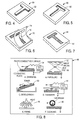
- Fig. 1 illustrates one embodiment according to the present method.
- a substrate 12 is shown in cross-section.
- the substrate may be biological, nonbiological, organic, inorganic, or a combination of any of these, existing as particles, strands, precipitates, gels, sheets, tubing, spheres, containers, capillaries, pads, slices, films, plates, slides, and the like.
- the substrate may have any convenient shape, such as a disc, square, sphere, circle, etc.
- the substrate is preferably flat but may take on a variety of alternative surface configurations.
- the substrate may contain raised or depressed regions on which the synthesis takes place.
- the substrate and its surface preferably form a rigid support on which to carry out the reactions described herein.
- the substrate may be a functionalized glass, Si, Ge, GaAs, GaP, SiO 2 , SiN 4 , modified silicon, or any one of a wide variety of gels or polymers such as (poly)tetrafluoroethylene, polypropylene, polyethylene, (poly)vinylidenedifluoride, poly-styrene, polycarbonate, or combinations thereof.
- gels or polymers such as (poly)tetrafluoroethylene, polypropylene, polyethylene, (poly)vinylidenedifluoride, poly-styrene, polycarbonate, or combinations thereof.
- Other substrate materials will be readily apparent to those of skill in the art upon review of this disclosure.
- the substrate is flat glass or single-crystal silicon with surface relief features of less than 10 microns.
- the substrate is a polypropylene material.
- the surface may be composed of any of a wide variety of materials, for example, polymers, plastics, resins, polysaccharides, silica or silica-based materials, carbon, metals, inorganic glasses, membranes, or any of the above-listed substrate materials.
- the surface may provide for the use of caged binding members which are attached firmly to the surface of the substrate.
- the surface will contain reactive groups, which could be carboxyl, amino, hydroxyl, or the like.
- the surface will have surface Si-OH functionalities, such as are found on silica surfaces.
- a linker consisting of (-COCH2CH2CONHCH2CH2CH2-siloxane bond-glass substrate) may be used to attach to a DMT-protected nucleoside via formation of a carboxyl bond to the 3' hydroxyl of the nucleoside.
- the substrate 12 includes a surface 14 with a layer of linker (or spacer) molecules 16 thereon.
- the linker molecules are preferably of sufficient length to permit polymers in a completed substrate to interact freely with molecules exposed to the substrate.
- the linker molecules should be about 4 to about 40 atoms long to provide sufficient exposure.
- the linker molecules may be, for example, aryl acetylene, ethylene glycol oligomers containing 2-10 monomer units, diamines, diacids, amino acids, among others, and combinations thereof.
- the linkers may be the same molecule type as that being synthesized (i.e., nascent polymers), such as oligonucleotides or oligopeptides.
- the linker molecules are PEG linker.
- the type of linker molecules used depends upon the particular application.
- the linker molecules can be attached to the substrate via carbon-carbon bonds using, for example, (poly)trifluorochloroethylene surfaces, or preferably, by siloxane bonds (using, for example, glass or silicon oxide surfaces).
- Siloxane bonds with the surface of the substrate may be formed in one embodiment via reactions of linker molecules bearing trichlorosilyl groups.
- the linker molecules may optionally be attached in an ordered array, i.e., as parts of the head groups. In alternative embodiments, the linker molecules are absorbed to the surface of the substrate.
- the linker molecules or substrate itself and monomers used herein are provided with a functional group to which is bound a protective group.
- the protective group is on the distal or terminal end of the linker molecule opposite the substrate.
- the protective group may be either a negative protective group (i.e., the protective group renders the linker molecules less reactive with a monomer upon exposure) or a positive protective group (i.e., the protective group renders the linker molecules more reactive with a monomer upon exposure).
- negative protective groups an additional step of reactivation will be required. In some embodiments, this will be done by heating.
- the substrate 12 includes a barrier pattern 18 with selected exposed regions 20 formed thereon.
- Each of the exposed regions corresponds to an "opening" in the barrier material where it is desirable to remove protecting groups from the linker molecules.
- the protecting groups may be removed from the linker molecules by immersion in the deprotecting solution. Examples of the deprotecting solution include trichloroacetic acid, hydrochloric acid, among others.
- the barrier pattern can be made of any suitable material capable of masking certain regions of the linker molecule layer to protect such regions from subsequent processing.
- the barrier pattern may include, for example, materials such as a lacquer, an oil, a mask stencil, a silicone mask, an epoxy, a silicone oil, a polyester, a silicon membrane mask, a liquid capable of providing a barrier to protecting groups, a solid capable of providing a barrier to protecting groups, among others, and combinations thereof.
- the lacquer may include a lacquer such as Pactra 63-1 and others, often having characteristics formulated to withstand hot fuel.
- An epoxy may include any suitable epoxy type material such as West 105 and others.
- Selected oils are a rotary pump oil such as Mowioc MC110, a silicone oil such as Dow Corning 704, and others.
- Polyester type materials may include TAP SB and the like, and combinations thereof.
- the barrier pattern is applied as a liquid or a vapor by a variety of techniques. Examples of selected ways to apply the barrier material include brush, spray techniques, selected printing techniques, and others.
- Selected printing techniques may be used for the application of liquid barrier materials.
- the selected techniques of printing include a relief or letter press (the oldest form), gravure or intaglio, stencil printing, lithography, among others.
- Figs. 4-17 which will be described in more detail below, illustrate a variety of printing techniques used in applying the barrier material.
- Fig. 3 illustrates a simplified cross-sectional diagram of the substrate 12, linker molecule layer 16, and monomer layer "A.” The sequence of steps illustrated by Figs. 1-3 may be repeated to achieve the desired sequence of monomers at selected regions to form an array of oligonucleotides, peptides, other polymers, and the like.
- Figs. 4-7 illustrate techniques of printing as relief or letter press 50, gravure or intaglio 60, stencil printing 70, and lithography 80, respectively.
- Relief printing 50 relies upon the use of raised features 52 to transfer printing medium to a substrate.
- Gravure or intaglio printing 60 it uses sunken features 62 to apply the desired shape to a substrate.
- Stencil printing 70 which includes screen printing, shadow masking, spray painting, and others, occurs through mechanical openings 72 of a stencil 74.
- Lithography is a form of printing regions 82 of a surface that are chemically treated to selectively retain print medium.
- Each of these techniques may be used for the application of a barrier material, a carrier material, a deprotecting agent, or a polymer unit pattern onto a substrate.
- xerography which includes laser printing
- ink jet printing or print medium jet printing
- Figs. 8-13 illustrate the more recent forms of printing.
- Fig. 8 illustrates a form of xerography printing 90.
- Xerography printing is directed to printing by way of an electrical charge pattern.
- Steps of xerography printing often include steps of charging 91, exposure 92, development 93, transfer 94, fixing 95, and cleaning 96.
- Fig. 9-10 illustrates two forms of printing known as ink jet printing or in this case print medium jet printing.
- print medium is forced through an array of orifices that is scanned across a workpiece, and is therefore really a form or derivative of stencil printing.
- Fig. 9 illustrates a continuous ink jet process 110.
- the continuous print medium jet process includes a substrate 111, a catcher assembly 112, a recycle 113, a deflector ribbon 114, a charge plate 115, an orifice plate 116, among other elements.
- the print medium jet type printer may deliver a pattern of selected print medium in a single pass.
- a resolution of such printing technique can be as low as about 200 microns and less.
- the printhead includes a substrate 121, a heater assembly 122, a barrier 123, print medium 124, a nozzle plate 125, and the print medium jet 126.
- the heater assembly 122 may be formed from a underlayer 127 overlying the substrate, a resistive heater element 128 overlying the underlayer, a conductor 129, and a overlying layer of passivation 130.
- the drop-on-demand printhead has the capability of delivering controlled amounts of fluids such as barrier medium, carrier material, monomer units, and the like onto the surface of a workpiece.
- FIG. 11 A simplified cross-sectional view of an offset rotary press 140 is illustrated by Fig. 11.
- the offset rotary press includes a impression cylinder 141, a blanket cylinder 142, a plate cylinder 143, print medium rollers 144, a solvent roller 145, and a substrate 146.
- the image is transferred (or offset) from the plate cylinder to the blanket cylinder, which reverses the image.
- the image is then passed to the press substrate (or sheet) as it moves between the blanket cylinder and the impression cylinder.
- Gravure offset printing includes steps of print medium transfer 151, transfer 152, and printing 153.
- a doctor blade 154 may be used to force medium 155 into grooves 158 during the print medium transfer step.
- the print medium is then transferred onto a blanket cylinder 156, often covered with a rubber blanket 157.
- the blanket cylinder then prints the print medium onto a substrate.
- An example of gravure offset printing is illustrated in Mikami et al., IEEE Transactions on Electron Devices 41, 306, (March 1994), which is hereby incorporated by reference for all purposes. Mikami et al. applies offset printing for the manufacture of arrays of thin film transistors for flat panel displays. By way of gravure offset printing, features sizes down to about 30 micrometers have been made.
- the printing technique includes use of a plate cylinder 162, a plurality of distribution rollers 164, a plurality of form rollers 166, a print medium fountain roller 168, a ductor roller 169, and other elements.
- This type of technique provides for a more uniform distribution of barrier medium, carrier medium, deprotecting agents or polymer units (or conventional ink) in selected applications.
- spatial selectivity and in particular local selectivity is achieved by way of trapping liquid under an in-contact stencil mask.
- local selectivity refers to the process of forming the liquid barrier at a selected or predefined region.
- R A suitable value for R often requires that the volume of liquid just fills the gap between the solid surfaces of the barrier and substrate. Too little liquid and the gap empties to drain certain regions, thereby creating no deprotection at such regions. Too much liquid corresponds to a larger R, and the reduction of the attractive force P. Of course, the selected amount of liquid depends upon the particular application.
- Fig. 14 illustrates a simplified cross-sectional view of an apparatus 170 used to achieve local selectivity.
- the apparatus includes a glass workpiece 172, a stencil 174, an upper electrode 176, a mask mount (or lower electrode) 178, and other features.
- the glass workpiece is positioned between the upper electrode and the mask mount.
- a voltage such as one of about 20,000 volts is applied to the upper electrode, while the mask mount (or lower electrode includes a potential at about 0 volt. The difference in voltages provides an electrostatic force for the attachment of the workpiece to the stencil.
- An attractive pressure between the stencil and the workpiece ranges from about 0.5 gm-force/cm 2 to about 50 gm-force/cm 2 and is preferably about 5 gm-force/cm 2 .
- the attachment between the stencil and the workpiece allows for deprotection agents to be introduced onto exposed regions 179 of the workpiece.
- a deprotection agent 177 such as vapor phase TCA passes over exposed regions of the workpiece, thereby causing selective deprotection of such regions.
- the apparatus includes a jig 180 for aligning a stencil 181 coated with a liquid barrier material onto the workpiece 183, as illustrated by Fig. 15.
- the jig substantially prevents the liquid barrier material from smearing onto unselected regions of cells on the workpiece.
- the jig includes a workpiece holder 184, a stencil mount 185, sliding surfaces 186, among other features.
- the stencil mount includes a gasket 187, a stencil holder 188, the stencil mask 181, a spacer 189, sliding surfaces 186, and other features.
- the coated stencil is firmly placed onto the stencil holder of the stencil mount.
- the stencil mount then inserts into a cavity 191 of the workpiece holder.
- the coated stencil firmly abuts the surface of the workpiece.
- the tolerance between the sliding surfaces is about 1.0 micron to about 10.0 microns, and is preferably at about 2.5 microns.
- An attractive pressure between the stencil and the workpiece ranges from about 0.8 gm-force/cm 2 to about 50 gm-force/cm 2 and is preferably about 5 gm-force/cm 2 .
- a gasket made of a material such as teflon, polyisoprene, polymethyl methacrylate, and others is located between the spacer and the stencil mask mount. This gasket absorbs shock between the stencil and workpiece to seal them together upon an applied pressure.
- a further alternative embodiment provides a high resolution stencil mask for ion beam proximity printing, ion beam projection lithography, and the like.
- the high resolution stencil mask includes, for example, a silicon membrane mask, an epoxy barrier mask, and others. Another example of a high resolution stencil mask may include electroformed nickel, among others.
- a high resolution stencil mask includes feature sizes of about 0.5 micron to about 50 microns, but less than about 100 microns.
- a high resolution stencil mask also includes a thickness of about 2 to about 20 microns, and is preferably about 5 microns and less. An example of such mask is made by Nanostructures, Inc.
- the high resolution stencil mask attaches to the workpiece by the aforementioned techniques.
- the stencil mask directly attaches to the surface of the workpiece by placement.
- the stencil mask may be attached to the workpiece with an interfacial fluid.
- the stencil mask attaches to the workpiece with use of an electrostatic force, among other forces.
- the apparatus of Figs. 14 and 15 may also be used to attach the high resolution stencil onto the workpiece.
- the type of high resolution stencil mask depends upon the particular application.
- the present invention provides for the use of vapor phase deprotection agents.
- the vapor phase deprotection agents may be introduced at low pressure, atmospheric pressure, among others.
- the use of such vapor phase deprotection agents allows for ease in processing the work piece with linker molecules and barrier material.
- Deprotection may be carried out in a directional stream of deprotection agent at low pressure.
- Low pressure deprotection occurs by first removing the work piece with linker molecules and barrier material from the synthesizer. The work piece is then transferred into a vacuum chamber, preferably an extremely low pressure vacuum chamber. The deprotection agent is then bled into the vacuum chamber at a selected rate to promote directionality of the deprotection agent stream.
- the vacuum chamber includes pressures ranging from about 10 -5 torr to about 1 torr to promote the directionality of the stream.
- the deprotection agents may include either a 2% solution of TCA in DCP, solid TCA, among others, and combinations thereof. By use of the TCA/DCP solution or solid TCA, the vapor pressure ranges from about 0.1 millitorr to about 1 torr to promote a directional stream of deprotection agents.
- the deprotecting steps occur at atmospheric pressure.
- the work piece is held over a solution of deprotection agents at atmospheric pressure, and preferably at room temperature.
- a deprotection agent includes TCA, DCP, and the like, and combinations thereof.
- the TCA may be mixed with DCP to form a 2% solution.
- the TCA may be used in pure form at room temperature, or at a temperature ranging from about 10°C to about 50°C, and preferably at about 20°C.
- the work piece is held over the TCA type deprotection agents for about 1 minute or less.
- the TCA can also be blown against the workpiece by way of forced convection and the like, and even mixed with a water vapor, a carrier gas, or the like.
- An advantage of the vapor phase deprotection agent, even at atmospheric pressure, is the lack of mechanical action to disturb any physical barrier pattern material.
- a further advantage with the vapor phase deprotection agent is the ease in use with selected work pieces.
- barrier material patterns of candidate materials were applied with a fine paint brush to the linker layer.
- the fine paint brush produced features made of the barrier material down to about 100 microns.
- the barrier material was allowed to dry in air, typically at room temperature.
- the barrier material is intended to provide an enclosure over selected regions of the linker layer. The regions outside the selected regions were exposed for further processing such as a step of deprotection and further synthesis.
- a lacquer known as Pactra 63-1 was found to be an effective barrier material.
- a fine brush applied the lacquer as dots from about 0.1 mm to about 1 mm in dimension to the linker layer.
- the lacquer was dried for several hours at room temperature, before subsequent processing.
- a step of deprotection followed the application of the barrier material.
- the workpiece was immersed into a deprotecting solution to remove the protecting group from the linker layer.
- the workpiece was reinserted back into the reaction chamber of the synthesizer.
- the workpiece was fluoreprime coupled.
- a solution of ethylene diamine/ammonia was used to immerse the workpiece for about 5 to 10 minutes.
- the workpiece was then placed into a confocal scanning fluorescence microscope for inspection.
- the deprotected regions fluoresced strongly, and the successfully shielded regions (or selected regions) by the barrier material did not fluoresce. This experiment shows the effectiveness of the lacquer barrier material.
- Table 1 Sample and Control Groups for Barrier Material Formation Experiment. # TYPE PROCESS RESULT 1 Contro 1 Apply barrier pattern, strip, and scan. No fluorescence. 2 Contro 1 Apply barrier pattern, strip, fluoreprime, and scan. Complete fluorescence. 3 Sample Apply barrier pattern, strip, deprotect, fluoreprime, and scan. Selective fluorescence.
- Fig. 16 is a photograph of fluorescent image of the fluoreprimed workpiece that was selectively shielded from liquid deprotection by lacquer.
- the photograph 200 shows a workpiece 202 with exposed regions 204, and protected regions 205.
- the layer of barrier material which includes the lacquer effectively shielded the protecting groups, from deprotection.
- the contrast ratio between the exposed regions and the protected regions 205 is about 20:1.
- At least one type of material such as the lacquer can serve as an effective barrier material for complete deprotection and complete protection.
- the lacquer barrier material is easily applied and dries at room temperature.
- at least one type of material such as acetone effectively strips the lacquer from the linker layer but does not affect the coupling process.
- Vapor phase deprotection was carried out on a standard workpiece.
- the workpiece was a standard 2 inch by 3 inch derivatized glass slide.
- An ABI Model 392 synthesizer was used to apply PEG linker-CC-DMT (linker layer-2 polymer units-protecting group) on one side of the glass slide.
- the glass slide also known as the work piece was fluoreprimed, as before. Experiments were performed at a variety of selected barrier materials and deprotection agent pressures as follows.
- Atmospheric deprotection was also carried out using a variety of different barrier materials.
- barrier materials include an epoxy such as West 105 (an uncured epoxy resin), a rotary pump oil such as Mowioc MC 110, a silicone oil such as Dow Corning 704, and a polyester such as TAP SB.
- the workpieces were made as before and the experiments were carried out with the solid TCA deprotection agent at room temperature. Samples were held over the solid TCA for a period of about 20 to about 60 seconds. All of the liquids appeared to act as effective barriers, that is, protection occurred underlying the liquid regions.
- the West 105 epoxy appeared to give the best results by having the crispest edges, and was therefore chosen for later experiments as described herein.
- Fig. 17 is a photograph of dots of uncured epoxy and pump oil overlying a workpiece.
- the photograph 300 shows a workpiece 302 with exposed regions 304, and protected regions 306, 308.
- the protected regions include painted-on patches of uncured epoxy 306 (the patches on the left-side of the dotted line), and patches of vacuum pump oil 308 (the patches on the right-side of the dotted line). From the photograph, the patches of uncured epoxy appeared to have crisper edges than the patches of vacuum pump oil.
- the contrast ratio for the uncured epoxy was about 20:1.
- An electrode at about 22 kV on a back surface of the glass slide applies electrostatic force onto the workpiece, typically at about an attractive pressure of about 200 Pa (or about 2 x 10 -3 atmospheres or 2 grams-force/cm 2 ).
- the glass slide is then removed from the mask which retains a coating of barrier material.
- Alignment of the coated stencil mask with workpiece occurred with use of the jig apparatus of Fig. 15.
- the jig apparatus brought the stencil mask in contact with the workpiece without smearing more than a small fraction of a cell size, typically about 2.5 microns in this experiment.
- a mask using a 1,000 mesh/inch (25 micron pitch) grid was used as a stencil mask.
- Fig. 18 illustrates a SEM photograph 400 at 1300 times magnification of a liquid uncured epoxy pattern on a glass workpiece (following removal from stencil mask). As shown, the photograph includes a glass workpiece 402, a grid pattern of uncured epoxy 403, and exposed regions 404. The grid pattern bars are about 7 microns across. This photograph demonstrates the accuracy of the aforementioned apparatus for the placement of an epoxy barrier material onto a workpiece surface without smearing.
- Fig. 19 illustrates a photograph 500 of a 100 micron resolution sample.
- the photograph 500 shows a workpiece 502 with exposed regions 504, and protected regions 506.
- the workpiece was prepared as before.
- a stencil mask made of nickel was coated with West 105 epoxy (an uncured epoxy resin) and electrostatically held against the workpiece.
- West 105 epoxy an uncured epoxy resin
- Each of the spaces between the protected regions was about 100 microns in length from inner edge to inner edge.
- the contrast ratio between the exposed and protected regions was about 200:1.
- This photograph clearly shows the effectiveness of present apparatus and West 105 epoxy. It should be noted that the arc shaped region 508 was caused by West 105 epoxy applied with a fine paint brush.
- Fig. 20 illustrates a photograph of a 75 micron resolution sample.
- the workpiece was prepared as before.
- the photograph 600 shows a workpiece 602 with exposed regions 604, and protected regions 606.
- the workpiece was prepared as before.
- a stencil mask made of nickel was coated with West 105 epoxy (an uncured epoxy resin) and electrostatically held against the workpiece.
- West 105 epoxy an uncured epoxy resin
- Each of the spaces between the protected regions is about 75 microns in length from inner edge to inner edge.
- the width of each of the bars is about 25 microns.
- the contrast ratio between the exposed and protected regions was less than that of Fig. 19. As even narrower width bars were attached to the workpiece, the contrast ratio between the exposed and protected regions decreased.
- the photograph 600 shows a contrast ratio of about 4:1 to about 2:1.
- Fig. 21 is the photograph of fluorescent pattern from the vapor deprotection through the uncoated silicon stencil mask.
- the photograph 700 includes a workpiece 702 with exposed regions 706 and protected regions 704. As noted, the protected regions were protected by way of the silicon mask.
- the fluorescent contrast ratios exceeded 10:1 for features of about 50 microns, which are clearly desirable results. No substantial "undercutting" (reaction under the stencil) occurred, presumably due to partial separation caused by particulate contamination.
- Table 4 Fluorescent Count Rate for 105 Epoxy Samples # REGION FLUORESCENT COUNT RATE 1 Region of exposed 105 epoxy on the workpiece. about 390 to about 490 2 Region of silicon fragments covering the 105 epoxy. about 330 to about 390 3 Region of scored 105 epoxy to form unprotected area. about 1530 to about 1630
- Table 4 illustrates that thin film epoxy blocks at least about 75% of the deprotecting action, for example. Further tests may need to be performed to achieve higher contrasts, between protected and unprotected regions.
- Another experiment was performed using a fine grid pattern of 105 epoxy applied to a workpiece.
- the workpiece was made similar to the technique as described above up to the deprotecting step.
- a fine, clear, epoxy grid pattern of 25 microns half-pitch was applied to a center region of the workpiece. No epoxy was placed around such center region. Additional widths (down to about 25 microns) of epoxy were applied with an ultra-fine paint brush.
- Fig. 23 is a photograph 800 of the paint pattern transferred from the nickel grid.
- the photograph 800 includes a workpiece 802 with an epoxy paint pattern 804 and exposed regions 806. The distance in each of the exposed regions is about 25 microns, and the pattern includes bars, each having a width of about 20 microns.
- This type of printing is an example of high resolution gravure printing, as described above.
- the transferred paint pattern acted as the barrier material during subsequent deprotecting steps. As shown, the paint patterns were crisp (and fine lined) to create an effective mask for printing a barrier pattern to obtain a diverse array of oligonucleotides.
- Figs. 24 and 25 are photographs of fluorescent images resulting from vapor phase deprotection through an epoxy pattern, similar to the one shown by the photograph of Fig. 23. Both of the photograph show good contrast ratios between the exposed and protected regions. The photographs do not show any visible proximity effect and the contrast ratio exceeds 10:1, clearly desirable results.
- Fig. 26 illustrates a 2 X 2 array 1000 of oligonucleotides formed by masking out the deprotect agents after A (vertical mask 1009) and the first T in the synthesis of 3'-CGCATTCCG 1004.
- a 10nM target 5'-GCGTAGGC-fluorescein at 15 C was exposed in the flow cell to the array, which was then scanned with a scanner.
- the four probes were 3'-CGCATCCG (match) 1005, 3'-CGCTCCG (deletion) 1006, 3'-CGCTTCCG (substitution) 1007 , and 3'-CGCATTCCG (addition) 1004.
- Fig. 27 is a photograph of a representative scanned fluorescent output, which shows the counts obtained in the four areas.
- the matched area is the most strongly fluorescing, indicating the strongest hybridization to the match and the weakest to the deletion.
- the white spots appear most frequently in the matching region and was a characteristic of all experiments using this particular target.
- Another sample was hybridized with a more freshly prepared target oligo and obtained better results (as in Fig. 28) that were further enhanced by hybridizing at 10°C for 15 minutes and then scanning at 15°C.
- the counts in the matching region 1005 were more than doubled with only a modest increase in the unmatched regions as shown in Fig. 29.
Landscapes
- Chemical & Material Sciences (AREA)
- Organic Chemistry (AREA)
- Molecular Biology (AREA)
- Health & Medical Sciences (AREA)
- Life Sciences & Earth Sciences (AREA)
- Biochemistry (AREA)
- Biotechnology (AREA)
- Engineering & Computer Science (AREA)
- Chemical Kinetics & Catalysis (AREA)
- General Health & Medical Sciences (AREA)
- Genetics & Genomics (AREA)
- Physics & Mathematics (AREA)
- General Physics & Mathematics (AREA)
- Measuring Or Testing Involving Enzymes Or Micro-Organisms (AREA)
- Apparatus Associated With Microorganisms And Enzymes (AREA)
- Saccharide Compounds (AREA)
Applications Claiming Priority (2)
| Application Number | Priority Date | Filing Date | Title |
|---|---|---|---|
| US08/395,604 US5599695A (en) | 1995-02-27 | 1995-02-27 | Printing molecular library arrays using deprotection agents solely in the vapor phase |
| US395604 | 1995-02-27 |
Publications (3)
| Publication Number | Publication Date |
|---|---|
| EP0728520A1 true EP0728520A1 (de) | 1996-08-28 |
| EP0728520B1 EP0728520B1 (de) | 2001-05-16 |
| EP0728520B2 EP0728520B2 (de) | 2008-11-19 |
Family
ID=23563722
Family Applications (1)
| Application Number | Title | Priority Date | Filing Date |
|---|---|---|---|
| EP96300860A Expired - Lifetime EP0728520B2 (de) | 1995-02-27 | 1996-02-08 | Bedrucken von Bibliotheken von Molekularketten |
Country Status (3)
| Country | Link |
|---|---|
| US (3) | US5599695A (de) |
| EP (1) | EP0728520B2 (de) |
| DE (1) | DE69612772T3 (de) |
Cited By (72)
| Publication number | Priority date | Publication date | Assignee | Title |
|---|---|---|---|---|
| DE19625397A1 (de) * | 1996-06-25 | 1998-01-08 | Deutsches Krebsforsch | Verfahren zur Kombination von paralleler Oligonukleotidsynthese und Darstellung von Oligomer-Chips |
| DE19819735A1 (de) * | 1998-05-02 | 1999-11-04 | Novartis Ag | Vorrichtung und Verfahren zur Herstellung einer Anordnung von Kettenmolekülen auf einem Trägermaterial |
| WO2000027521A1 (en) * | 1998-11-06 | 2000-05-18 | Solexa Ltd. | A method for reproducing molecular arrays |
| WO2000001859A3 (en) * | 1998-07-02 | 2000-06-15 | Orchid Biocomputer Inc | Gene pen devices for array printing |
| WO2000053310A1 (fr) * | 1999-03-08 | 2000-09-14 | Commissariat A L'energie Atomique | Procede de realisation d'une matrice de sequences de molecules chimiques ou biologiques pour dispositif d'analyse chimique ou biologique |
| US6653151B2 (en) | 1999-07-30 | 2003-11-25 | Large Scale Proteomics Corporation | Dry deposition of materials for microarrays using matrix displacement |
| US6713309B1 (en) | 1999-07-30 | 2004-03-30 | Large Scale Proteomics Corporation | Microarrays and their manufacture |
| US6800439B1 (en) | 2000-01-06 | 2004-10-05 | Affymetrix, Inc. | Methods for improved array preparation |
| US6806361B1 (en) | 2000-03-17 | 2004-10-19 | Affymetrix, Inc. | Methods of enhancing functional performance of nucleic acid arrays |
| US6833450B1 (en) | 2000-03-17 | 2004-12-21 | Affymetrix, Inc. | Phosphite ester oxidation in nucleic acid array preparation |
| US7005259B1 (en) | 2000-06-01 | 2006-02-28 | Affymetrix, Inc. | Methods for array preparation using substrate rotation |
| WO2007016367A2 (en) | 2005-07-29 | 2007-02-08 | Bayer Healthcare Llc | Neoplastic disease-related methods, kits, systems and databases |
| WO2008008284A2 (en) | 2006-07-14 | 2008-01-17 | The Regents Of The University Of California | Cancer biomarkers and methods of use threof |
| EP1892306A2 (de) | 2003-10-06 | 2008-02-27 | Bayer HealthCare AG | Verfahren und Kit zur Untersuchung von Krebs |
| EP1900827A2 (de) | 2002-05-21 | 2008-03-19 | Bayer HealthCare AG | Verfahren und Zusammensetzungen zur Vorhersage, Diagnose, Prognose, Verhinderung und Behandlung maligner Neoplasien |
| EP1953243A2 (de) | 2000-06-15 | 2008-08-06 | Novartis Vaccines and Diagnostics, Inc. | Polynukleotide im Zusammenhang mit Darmkrebs |
| US7498407B2 (en) | 2001-11-09 | 2009-03-03 | Georgetown University | Vascular endothelial cell growth inhibitor, VEGI-192a |
| EP2075346A2 (de) | 2002-01-08 | 2009-07-01 | Novartis Vaccines and Diagnostics, Inc. | Genprodukte, die in Brustkrebszellen differentiell exprimiert werden, sowie Verfahren zu deren Verwendung |
| WO2009146204A1 (en) | 2008-04-18 | 2009-12-03 | Tufts Medical Center | Polymorphisms associated with age-related macular degeneration and methods for evaluating patient risk |
| EP2145895A1 (de) | 2008-07-08 | 2010-01-20 | Commissariat à l'Energie Atomique | Verfahren zur Herstellung von Glycochips |
| US7700359B2 (en) | 2000-06-02 | 2010-04-20 | Novartis Vaccines And Diagnostics, Inc. | Gene products differentially expressed in cancerous cells |
| EP2211234A1 (de) * | 2009-01-27 | 2010-07-28 | Xerox Corporation | Abbildungssystem und Verfahren mit monoklonalen Antikörpern |
| WO2010111595A2 (en) | 2009-03-27 | 2010-09-30 | Tufts - New England Medical Center | Markers related to age-related macular degeneration and uses therefor |
| US7901881B2 (en) | 2004-04-09 | 2011-03-08 | The United States Of America As Represented By The Department Of Health And Human Services | Diagnostic tool for diagnosing benign versus malignant thyroid lesions |
| EP2311530A2 (de) | 2004-10-27 | 2011-04-20 | Vanderbilt University | An infektionen beteiligte Säugergene |
| EP2319939A2 (de) | 1999-10-21 | 2011-05-11 | Case Western Reserve University | Genexpressionsprofil für entzündliche Darmerkrankung |
| EP2336368A1 (de) | 2000-12-07 | 2011-06-22 | Novartis Vaccines and Diagnostics, Inc. | Positive eingestellte endogene Retroviren in Prostatakrebs |
| WO2011139721A1 (en) | 2010-04-27 | 2011-11-10 | The Regents Of The University Of California | Cancer biomarkers and methods of use thereof |
| EP2386653A2 (de) | 2004-09-16 | 2011-11-16 | Turun Yliopisto | Verfahren zur Verwendung neuer Target-Gene, die im Zusammenhang mit immunvermittelten Krankheiten stehen |
| WO2011146725A1 (en) | 2010-05-19 | 2011-11-24 | Bayer Healthcare Llc | Biomarkers for a multikinase inhibitor |
| WO2012090073A2 (en) | 2010-12-30 | 2012-07-05 | The Netherlands Cancer Institute | Methods and compositions for predicting chemotherapy sensitivity |
| WO2012138789A2 (en) | 2011-04-04 | 2012-10-11 | Netherlands Cancer Institute | Methods and compositions for predicting resistance to anticancer treatment |
| WO2012138783A2 (en) | 2011-04-04 | 2012-10-11 | Netherlands Cancer Institute | Methods and compositions for predicting resistance to anticancer treatment |
| US8642295B2 (en) | 2007-01-11 | 2014-02-04 | Erasmus University Medical Center | Circular chromosome conformation capture (4C) |
| WO2014172661A1 (en) | 2013-04-19 | 2014-10-23 | The Regent Of The University Of California | Lone star virus |
| US8969255B2 (en) | 2009-06-19 | 2015-03-03 | The Arizona Board Of Regents | Compound arrays for sample profiling |
| US9234244B2 (en) | 2007-08-27 | 2016-01-12 | The United States Of America, As Represented By The Secretary, Department Of Health And Human Services | Diagnostic tool for diagnosing benign versus malignant thyroid lesions |
| US9267112B2 (en) | 2011-05-10 | 2016-02-23 | The Regents Of The University Of California | Adenovirus isolated from Titi Monkeys |
| US9273949B2 (en) | 2012-05-11 | 2016-03-01 | Vanderbilt University | Backscattering interferometric methods |
| US9382590B2 (en) | 2011-03-25 | 2016-07-05 | Florida Agricultural and Mechanical University (FAMU) | Methods and compositions for prostate cancer metastasis |
| US9411930B2 (en) | 2013-02-01 | 2016-08-09 | The Regents Of The University Of California | Methods for genome assembly and haplotype phasing |
| US9562853B2 (en) | 2011-02-22 | 2017-02-07 | Vanderbilt University | Nonaqueous backscattering interferometric methods |
| US9638632B2 (en) | 2010-06-11 | 2017-05-02 | Vanderbilt University | Multiplexed interferometric detection system and method |
| US9715573B2 (en) | 2015-02-17 | 2017-07-25 | Dovetail Genomics, Llc | Nucleic acid sequence assembly |
| US9808472B2 (en) | 2013-08-12 | 2017-11-07 | Tokai Pharmaceuticals, Inc. | Biomarkers for treatment of neoplastic disorders using androgen-targeted therapies |
| US9884067B2 (en) | 2013-03-14 | 2018-02-06 | University Of Maryland, Baltimore | Androgen receptor down-regulating agents and uses thereof |
| US9970932B2 (en) | 2013-03-15 | 2018-05-15 | Arizona Board Of Regents On Behalf Of Arizona State University | Non-covalent patterned chemical features and use thereof in MALDI-based quality control |
| US10006919B2 (en) | 2013-03-15 | 2018-06-26 | Arizona Board Of Regents On Behalf Of Arizona State University | Peptide array quality control |
| US10089437B2 (en) | 2013-02-01 | 2018-10-02 | The Regents Of The University Of California | Methods for genome assembly and haplotype phasing |
| US10202615B2 (en) | 2010-12-10 | 2019-02-12 | Vanderbilt University | Mammalian genes involved in toxicity and infection |
| US10221218B2 (en) | 2011-05-10 | 2019-03-05 | The Regents Of The University Of California | Adenovirus isolated from titi monkeys |
| US10261013B2 (en) | 2015-01-23 | 2019-04-16 | Vanderbilt University | Robust interferometer and methods of using same |
| US10393751B2 (en) | 2015-04-20 | 2019-08-27 | Roche Sequencing Solutions, Inc. | Specific peptide binders to proteins identified via systematic discovery, maturation and extension process |
| US10457934B2 (en) | 2015-10-19 | 2019-10-29 | Dovetail Genomics, Llc | Methods for genome assembly, haplotype phasing, and target independent nucleic acid detection |
| US10526641B2 (en) | 2014-08-01 | 2020-01-07 | Dovetail Genomics, Llc | Tagging nucleic acids for sequence assembly |
| US10627396B2 (en) | 2016-01-29 | 2020-04-21 | Vanderbilt University | Free-solution response function interferometry |
| US10758886B2 (en) | 2015-09-14 | 2020-09-01 | Arizona Board Of Regents On Behalf Of Arizona State University | Conditioned surfaces for in situ molecular array synthesis |
| US10774387B2 (en) | 2014-05-19 | 2020-09-15 | The Johns Hopkins University | Methods for identifying androgen receptor splice variants in subjects having castration resistant prostate cancer |
| WO2020264185A1 (en) | 2019-06-27 | 2020-12-30 | Dovetail Genomics, Llc | Methods and compositions for proximity ligation |
| US10894986B2 (en) | 2008-04-16 | 2021-01-19 | The Johns Hopkins University | Compositions and methods for treating or preventing prostate cancer and for detecting androgen receptor variants |
| US10900961B2 (en) | 2007-09-20 | 2021-01-26 | Vanderbilt University | Free solution measurement of molecular interactions by backscattering interferometry |
| US10947579B2 (en) | 2016-05-13 | 2021-03-16 | Dovetail Genomics, Llc | Recovering long-range linkage information from preserved samples |
| US10975417B2 (en) | 2016-02-23 | 2021-04-13 | Dovetail Genomics, Llc | Generation of phased read-sets for genome assembly and haplotype phasing |
| US11345956B2 (en) | 2014-08-25 | 2022-05-31 | The Johns Hopkins University | Methods and compositions related to prostate cancer therapeutics |
| US11371990B2 (en) | 2016-11-11 | 2022-06-28 | Cowper Sciences Inc. | Methods for identifying candidate biomarkers |
| EP4019643A1 (de) | 2015-09-23 | 2022-06-29 | Oklahoma Medical Research Foundation | Biomarker zur beurteilung von subjekten mit multipler sklerose |
| US11543411B2 (en) | 2014-12-05 | 2023-01-03 | Prelude Corporation | DCIS recurrence and invasive breast cancer |
| US11747334B2 (en) | 2016-06-20 | 2023-09-05 | Cowper Sciences Inc. | Methods for differential diagnosis of autoimmune diseases |
| US11774446B2 (en) | 2016-06-20 | 2023-10-03 | Cowper Sciences Inc. | Methods for diagnosis and treatment of autoimmune diseases |
| US11807896B2 (en) | 2015-03-26 | 2023-11-07 | Dovetail Genomics, Llc | Physical linkage preservation in DNA storage |
| US11821900B2 (en) | 2018-09-14 | 2023-11-21 | Prelude Corporation | Method of selection for treatment of subjects at risk of invasive breast cancer |
| US12378592B2 (en) | 2018-01-31 | 2025-08-05 | Dovetail Genomics, Llc. | Sample prep for DNA linkage recovery |
Families Citing this family (452)
| Publication number | Priority date | Publication date | Assignee | Title |
|---|---|---|---|---|
| WO1992010588A1 (en) * | 1990-12-06 | 1992-06-25 | Affymax Technologies N.V. | Sequencing by hybridization of a target nucleic acid to a matrix of defined oligonucleotides |
| US20030232361A1 (en) * | 1993-10-26 | 2003-12-18 | Affymetrix, Inc. | Nucleic acid array preparation using purified phosphoramidites |
| US6239273B1 (en) | 1995-02-27 | 2001-05-29 | Affymetrix, Inc. | Printing molecular library arrays |
| US5599695A (en) * | 1995-02-27 | 1997-02-04 | Affymetrix, Inc. | Printing molecular library arrays using deprotection agents solely in the vapor phase |
| US5959098A (en) | 1996-04-17 | 1999-09-28 | Affymetrix, Inc. | Substrate preparation process |
| US6953663B1 (en) * | 1995-11-29 | 2005-10-11 | Affymetrix, Inc. | Polymorphism detection |
| US6300063B1 (en) | 1995-11-29 | 2001-10-09 | Affymetrix, Inc. | Polymorphism detection |
| US5840256A (en) * | 1996-04-09 | 1998-11-24 | David Sarnoff Research Center Inc. | Plate for reaction system |
| US6048691A (en) * | 1996-05-13 | 2000-04-11 | Motorola, Inc. | Method and system for performing a binding assay |
| US5731152A (en) * | 1996-05-13 | 1998-03-24 | Motorola, Inc. | Methods and systems for biological reagent placement |
| AU4428497A (en) | 1996-09-20 | 1998-04-14 | James P. Demers | Spatially addressable combinatorial chemical arrays in cd-rom format |
| JP3866809B2 (ja) * | 1996-12-19 | 2007-01-10 | 松下電器産業株式会社 | 有機膜及びその製造方法 |
| JP4663824B2 (ja) * | 1996-12-31 | 2011-04-06 | ハイ スループット ジェノミクス インコーポレイテッド | 多重化分子分析装置および方法 |
| EP1009802B1 (de) * | 1997-02-12 | 2004-08-11 | Eugene Y. Chan | Verfahren zur analyse von polymeren |
| DE19706570C1 (de) * | 1997-02-19 | 1998-02-26 | Inst Physikalische Hochtech Ev | Verfahren zur Herstellung von strukturierten, selbstorganisierten molekularen Monolagen einzelner molekularer Spezies, insbesondere von Substanzbibliotheken |
| EP0983292A4 (de) | 1997-05-05 | 2005-05-18 | Third Wave Tech Inc | Zielabhängige reaktionen mittels strukturüberbrückender oligonukleotide |
| US7101672B2 (en) | 1998-05-05 | 2006-09-05 | Third Wave Technologies, Inc. | Target-dependent reactions using structure-bridging oligonucleotides |
| US6194149B1 (en) | 1998-03-03 | 2001-02-27 | Third Wave Technologies, Inc. | Target-dependent reactions using structure-bridging oligonucleotides |
| US6210880B1 (en) | 1997-09-19 | 2001-04-03 | Third Wave Technologies, Inc. | Polymorphism analysis by nucleic acid structure probing with structure-bridging oligonucleotides |
| US6214545B1 (en) | 1997-05-05 | 2001-04-10 | Third Wave Technologies, Inc | Polymorphism analysis by nucleic acid structure probing |
| DE69824586T2 (de) * | 1997-06-26 | 2005-06-23 | PerSeptive Biosystems, Inc., Framingham | Probenträger hoher dichte für die analyse biologischer proben |
| US6326489B1 (en) | 1997-08-05 | 2001-12-04 | Howard Hughes Medical Institute | Surface-bound, bimolecular, double-stranded DNA arrays |
| JP2001517789A (ja) * | 1997-09-19 | 2001-10-09 | アクレイラ バイオサイエンシズ,インコーポレイティド | 液体移送装置および液体移送方法 |
| US6511803B1 (en) | 1997-10-10 | 2003-01-28 | President And Fellows Of Harvard College | Replica amplification of nucleic acid arrays |
| US6485944B1 (en) | 1997-10-10 | 2002-11-26 | President And Fellows Of Harvard College | Replica amplification of nucleic acid arrays |
| CA2305449A1 (en) | 1997-10-10 | 1999-04-22 | President & Fellows Of Harvard College | Replica amplification of nucleic acid arrays |
| US6548021B1 (en) | 1997-10-10 | 2003-04-15 | President And Fellows Of Harvard College | Surface-bound, double-stranded DNA protein arrays |
| AU1517999A (en) | 1997-10-15 | 1999-05-03 | Aclara Biosciences, Inc. | Laminate microstructure device and method for making same |
| US5945286A (en) * | 1997-10-23 | 1999-08-31 | Motorola, Inc. | Electrochemical-based molecular detection apparatus and method |
| JP4303418B2 (ja) * | 1997-10-24 | 2009-07-29 | ライフ テクノロジーズ コーポレーション | 組換え部位を有する核酸を使用する組換えクローニング |
| US6322968B1 (en) | 1997-11-21 | 2001-11-27 | Orchid Biosciences, Inc. | De novo or “universal” sequencing array |
| US20030096232A1 (en) * | 1997-12-19 | 2003-05-22 | Kris Richard M. | High throughput assay system |
| US20030039967A1 (en) * | 1997-12-19 | 2003-02-27 | Kris Richard M. | High throughput assay system using mass spectrometry |
| US20100105572A1 (en) * | 1997-12-19 | 2010-04-29 | Kris Richard M | High throughput assay system |
| US6289229B1 (en) | 1998-01-20 | 2001-09-11 | Scimed Life Systems, Inc. | Readable probe array for in vivo use |
| US20040035690A1 (en) * | 1998-02-11 | 2004-02-26 | The Regents Of The University Of Michigan | Method and apparatus for chemical and biochemical reactions using photo-generated reagents |
| JP4503828B2 (ja) * | 1998-02-11 | 2010-07-14 | ユニバーシティー オブ ヒューストン | 光生成試薬を用いる化学反応および生化学反応のための方法および装置 |
| US6375903B1 (en) | 1998-02-23 | 2002-04-23 | Wisconsin Alumni Research Foundation | Method and apparatus for synthesis of arrays of DNA probes |
| US6780591B2 (en) * | 1998-05-01 | 2004-08-24 | Arizona Board Of Regents | Method of determining the nucleotide sequence of oligonucleotides and DNA molecules |
| US7875440B2 (en) * | 1998-05-01 | 2011-01-25 | Arizona Board Of Regents | Method of determining the nucleotide sequence of oligonucleotides and DNA molecules |
| US6271957B1 (en) * | 1998-05-29 | 2001-08-07 | Affymetrix, Inc. | Methods involving direct write optical lithography |
| US6872521B1 (en) | 1998-06-16 | 2005-03-29 | Beckman Coulter, Inc. | Polymerase signaling assay |
| US6551557B1 (en) * | 1998-07-07 | 2003-04-22 | Cartesian Technologies, Inc. | Tip design and random access array for microfluidic transfer |
| US6288221B1 (en) | 1998-08-20 | 2001-09-11 | Duke University | Methods of synthesis of halogen base-modified oligonucleotides and subsequent labeling with a metal-catalyzed reaction |
| US6461812B2 (en) | 1998-09-09 | 2002-10-08 | Agilent Technologies, Inc. | Method and multiple reservoir apparatus for fabrication of biomolecular arrays |
| US6458583B1 (en) * | 1998-09-09 | 2002-10-01 | Agilent Technologies, Inc. | Method and apparatus for making nucleic acid arrays |
| US6103199A (en) * | 1998-09-15 | 2000-08-15 | Aclara Biosciences, Inc. | Capillary electroflow apparatus and method |
| US6203989B1 (en) | 1998-09-30 | 2001-03-20 | Affymetrix, Inc. | Methods and compositions for amplifying detectable signals in specific binding assays |
| US6262216B1 (en) | 1998-10-13 | 2001-07-17 | Affymetrix, Inc. | Functionalized silicon compounds and methods for their synthesis and use |
| US7034143B1 (en) | 1998-10-13 | 2006-04-25 | Brown University Research Foundation | Systems and methods for sequencing by hybridization |
| AU1724000A (en) | 1998-11-12 | 2000-05-29 | Nyxis, Inc. | Diagnostic assay for cancer |
| US6087112A (en) | 1998-12-30 | 2000-07-11 | Oligos Etc. Inc. | Arrays with modified oligonucleotide and polynucleotide compositions |
| US7595189B2 (en) * | 1999-01-08 | 2009-09-29 | Applied Biosystems, Llc | Integrated optics fiber array |
| EP1148947B1 (de) | 1999-01-08 | 2006-10-25 | Applera Corporation | Fasermatrix zum zusammenbringen von chemischen stoffen, sowie verfahren zur herstellung und anwendung davon |
| US20050026209A1 (en) * | 1999-01-08 | 2005-02-03 | Vann Charles S. | Optical fiber bundle for detecting binding of chemical species |
| US6261782B1 (en) | 1999-04-06 | 2001-07-17 | Yale University | Fixed address analysis of sequence tags |
| US6824866B1 (en) * | 1999-04-08 | 2004-11-30 | Affymetrix, Inc. | Porous silica substrates for polymer synthesis and assays |
| US20020177135A1 (en) * | 1999-07-27 | 2002-11-28 | Doung Hau H. | Devices and methods for biochip multiplexing |
| US7932213B2 (en) * | 1999-05-11 | 2011-04-26 | President And Fellows Of Harvard College | Small molecule printing |
| US6824987B1 (en) * | 1999-05-11 | 2004-11-30 | President And Fellows Of Harvard College | Small molecule printing |
| JP2003510017A (ja) | 1999-06-22 | 2003-03-18 | インビトロジェン コーポレイション | 核酸の検出および識別のために改良されたプライマーおよび方法 |
| US7501245B2 (en) * | 1999-06-28 | 2009-03-10 | Helicos Biosciences Corp. | Methods and apparatuses for analyzing polynucleotide sequences |
| US6818395B1 (en) * | 1999-06-28 | 2004-11-16 | California Institute Of Technology | Methods and apparatus for analyzing polynucleotide sequences |
| US6830902B1 (en) | 1999-07-02 | 2004-12-14 | Invitrogen Corporation | Compositions and methods for enhanced sensitivity and specificity of nucleic acid synthesis |
| US6346423B1 (en) | 1999-07-16 | 2002-02-12 | Agilent Technologies, Inc. | Methods and compositions for producing biopolymeric arrays |
| US7144700B1 (en) | 1999-07-23 | 2006-12-05 | Affymetrix, Inc. | Photolithographic solid-phase polymer synthesis |
| US7179638B2 (en) | 1999-07-30 | 2007-02-20 | Large Scale Biology Corporation | Microarrays and their manufacture by slicing |
| JP2003527087A (ja) | 1999-08-13 | 2003-09-16 | イェール・ユニバーシティ | バイナリーコード化配列タグ |
| WO2001016372A1 (en) | 1999-08-27 | 2001-03-08 | Matrix Technologies Corporation | Methods of immobilizing ligands on solid supports and apparatus and methods of use therefor |
| US20050118618A1 (en) * | 1999-08-30 | 2005-06-02 | Dale Roderic M. | Method for detecting nucleic acid sequences |
| US6545291B1 (en) * | 1999-08-31 | 2003-04-08 | E Ink Corporation | Transistor design for use in the construction of an electronically driven display |
| CA2317179A1 (en) | 1999-09-01 | 2001-03-01 | Affymetrix, Inc. | Macromolecular arrays on polymeric brushes and methods for preparing the same |
| US6844151B1 (en) | 1999-09-29 | 2005-01-18 | Oligos Etc. Inc. | Methods for production of arrays with modified oligonucleotide and polynucleotide compositions |
| US6171797B1 (en) | 1999-10-20 | 2001-01-09 | Agilent Technologies Inc. | Methods of making polymeric arrays |
| US6387636B1 (en) * | 1999-10-22 | 2002-05-14 | Agilent Technologies, Inc. | Method of shielding biosynthesis reactions from the ambient environment on an array |
| US6958225B2 (en) | 1999-10-27 | 2005-10-25 | Affymetrix, Inc. | Complexity management of genomic DNA |
| US6867851B2 (en) * | 1999-11-04 | 2005-03-15 | Regents Of The University Of Minnesota | Scanning of biological samples |
| US6784982B1 (en) | 1999-11-04 | 2004-08-31 | Regents Of The University Of Minnesota | Direct mapping of DNA chips to detector arrays |
| US7167615B1 (en) | 1999-11-05 | 2007-01-23 | Board Of Regents, The University Of Texas System | Resonant waveguide-grating filters and sensors and methods for making and using same |
| US6440669B1 (en) | 1999-11-10 | 2002-08-27 | Agilent Technologies, Inc. | Methods for applying small volumes of reagents |
| US6642046B1 (en) * | 1999-12-09 | 2003-11-04 | Motorola, Inc. | Method and apparatus for performing biological reactions on a substrate surface |
| US6589778B1 (en) | 1999-12-15 | 2003-07-08 | Amersham Biosciences Ab | Method and apparatus for performing biological reactions on a substrate surface |
| US6569674B1 (en) | 1999-12-15 | 2003-05-27 | Amersham Biosciences Ab | Method and apparatus for performing biological reactions on a substrate surface |
| CN1757724B (zh) | 1999-12-10 | 2014-06-11 | 茵维特罗根公司 | 具有独特特异性的多个重组位点在重组克隆中的用途 |
| US6399295B1 (en) | 1999-12-17 | 2002-06-04 | Kimberly-Clark Worldwide, Inc. | Use of wicking agent to eliminate wash steps for optical diffraction-based biosensors |
| US6500620B2 (en) | 1999-12-29 | 2002-12-31 | Mergen Ltd. | Methods for amplifying and detecting multiple polynucleotides on a solid phase support |
| US6929907B2 (en) | 1999-12-31 | 2005-08-16 | North Carolina State University | Methods and compositions for determining the purity of chemically synthesized nucleic acids |
| US20040014102A1 (en) * | 2000-02-22 | 2004-01-22 | Shiping Chen | High density parallel printing of microarrays |
| US6953551B2 (en) | 2000-02-22 | 2005-10-11 | Genospectra, Inc. | Microarray fabrication techniques and apparatus |
| KR20020097181A (ko) | 2000-02-22 | 2002-12-31 | 제노스펙트라 인코포레이티드 | 마이크로어레이 제작 기술 및 장치 |
| US20050119473A1 (en) * | 2000-03-17 | 2005-06-02 | Affymetrix, Inc. | Phosphite ester oxidation in nucleic acid array preparation |
| US6376191B1 (en) | 2000-03-22 | 2002-04-23 | Mergen, Ltd. | Microarray-based analysis of polynucleotide sequence variations |
| US7244572B1 (en) | 2000-03-24 | 2007-07-17 | Wisys Technology Foundation, Inc. | One-dimensional arrays on optical fibers |
| WO2001072412A1 (de) * | 2000-03-28 | 2001-10-04 | Laser- Und Medizin-Technologie Gmbh Berlin | Verfahren und vorrichtung zum aufbau und untersuchung von substanzbibliotheken |
| US7157564B1 (en) | 2000-04-06 | 2007-01-02 | Affymetrix, Inc. | Tag nucleic acids and probe arrays |
| US6368801B1 (en) | 2000-04-12 | 2002-04-09 | Molecular Staging, Inc. | Detection and amplification of RNA using target-mediated ligation of DNA by RNA ligase |
| WO2005000087A2 (en) * | 2003-06-03 | 2005-01-06 | Chiron Corporation | Gene products differentially expressed in cancerous colon cells and their methods of use ii |
| US7148058B2 (en) * | 2000-06-05 | 2006-12-12 | Chiron Corporation | Protein microarrays on mirrored surfaces for performing proteomic analyses |
| US7153682B2 (en) * | 2000-06-05 | 2006-12-26 | Chiron Corporation | Microarrays on mirrored substrates for performing proteomic analyses |
| JP2003536073A (ja) * | 2000-06-05 | 2003-12-02 | カイロン コーポレイション | プロテオミクス分析を実施するためのマイクロアレイ |
| US20090075256A1 (en) * | 2000-06-17 | 2009-03-19 | Third Wave Technologies, Inc. | Nucleic Acid Accessible Hybridization Site Identification Using Mass Spectrometry |
| WO2001098537A2 (en) | 2000-06-17 | 2001-12-27 | Third Wave Technologies, Inc. | Nucleic acid accessible hybridization sites |
| US6686157B2 (en) | 2000-06-30 | 2004-02-03 | Molecular Staging Inc. | Signal amplification with lollipop probes |
| FR2811588B1 (fr) * | 2000-07-13 | 2002-10-11 | Centre Nat Rech Scient | Tete d'injection et de dosage thermique, son procede de fabrication et systeme de fonctionnalisation ou d'adressage la comprenant |
| US7091033B2 (en) * | 2000-07-21 | 2006-08-15 | Phase-1 Molecular Toxicology, Inc. | Array of toxicologically relevant canine genes and uses thereof |
| US6984522B2 (en) | 2000-08-03 | 2006-01-10 | Regents Of The University Of Michigan | Isolation and use of solid tumor stem cells |
| WO2002014867A2 (en) * | 2000-08-11 | 2002-02-21 | Agilix Corporation | Ultra-sensitive detection systems |
| US7198924B2 (en) | 2000-12-11 | 2007-04-03 | Invitrogen Corporation | Methods and compositions for synthesis of nucleic acid molecules using multiple recognition sites |
| US6900013B1 (en) | 2000-08-25 | 2005-05-31 | Aviva Biosciences Corporation | Methods and compositions for identifying nucleic acid molecules using nucleolytic activities and hybridization |
| WO2002016647A1 (en) * | 2000-08-24 | 2002-02-28 | Aviva Biosciences Corporation | Methods and compositions for identifying nucleic acid molecules using nucleolytic activities and hybridization |
| US20020055112A1 (en) * | 2000-08-26 | 2002-05-09 | Nila Patil | Methods for reducing complexity of nucleic acid samples |
| US20020164634A1 (en) * | 2000-08-26 | 2002-11-07 | Perlegen Sciences, Inc. | Methods for reducing complexity of nucleic acid samples |
| US20040185464A1 (en) * | 2000-09-15 | 2004-09-23 | Kris Richard M. | High throughput assay system |
| EP2333543B1 (de) | 2000-09-26 | 2018-01-10 | Health Research, Incorporated | Analyse der hiv-1 co-rezeptorsverwendung zur klinischen auswertung von hiv-infizierten patienten |
| US6770721B1 (en) | 2000-11-02 | 2004-08-03 | Surface Logix, Inc. | Polymer gel contact masks and methods and molds for making same |
| US6893851B2 (en) | 2000-11-08 | 2005-05-17 | Surface Logix, Inc. | Method for arraying biomolecules and for monitoring cell motility in real-time |
| US7033821B2 (en) * | 2000-11-08 | 2006-04-25 | Surface Logix, Inc. | Device for monitoring cell motility in real-time |
| US6803205B2 (en) * | 2000-11-08 | 2004-10-12 | Surface Logix, Inc. | Methods of measuring enzyme activity using peelable and resealable devices |
| US7374906B2 (en) | 2000-11-08 | 2008-05-20 | Surface Logix, Inc. | Biological assays using gradients formed in microfluidic systems |
| US7439056B2 (en) | 2000-11-08 | 2008-10-21 | Surface Logix Inc. | Peelable and resealable devices for arraying materials |
| US6864065B2 (en) * | 2000-11-08 | 2005-03-08 | Surface Logix, Inc. | Assays for monitoring cell motility in real-time |
| US6844184B2 (en) * | 2000-11-08 | 2005-01-18 | Surface Logix, Inc. | Device for arraying biomolecules and for monitoring cell motility in real-time |
| US7326563B2 (en) | 2000-11-08 | 2008-02-05 | Surface Logix, Inc. | Device and method for monitoring leukocyte migration |
| US7371563B2 (en) * | 2000-11-08 | 2008-05-13 | Surface Logix, Inc. | Peelable and resealable devices for biochemical assays |
| US6699665B1 (en) | 2000-11-08 | 2004-03-02 | Surface Logix, Inc. | Multiple array system for integrating bioarrays |
| US7351575B2 (en) * | 2000-11-08 | 2008-04-01 | Surface Logix, Inc. | Methods for processing biological materials using peelable and resealable devices |
| US6967074B2 (en) * | 2000-11-08 | 2005-11-22 | Surface Logix, Inc. | Methods of detecting immobilized biomolecules |
| US7033819B2 (en) | 2000-11-08 | 2006-04-25 | Surface Logix, Inc. | System for monitoring cell motility in real-time |
| US7001740B2 (en) * | 2000-11-08 | 2006-02-21 | Surface Logix, Inc. | Methods of arraying biological materials using peelable and resealable devices |
| US6861222B2 (en) * | 2000-11-09 | 2005-03-01 | Yale University | Nucleic acid detection using structured probes |
| US7211414B2 (en) * | 2000-12-01 | 2007-05-01 | Visigen Biotechnologies, Inc. | Enzymatic nucleic acid synthesis: compositions and methods for altering monomer incorporation fidelity |
| US7776571B2 (en) * | 2000-12-12 | 2010-08-17 | Autogenomics, Inc. | Multi-substrate biochip unit |
| AU2002245182A1 (en) * | 2000-12-22 | 2002-07-08 | Mergen Ltd. | Methods for identifying g-protein coupled receptors associated with diseases |
| US20020169562A1 (en) * | 2001-01-29 | 2002-11-14 | Gregory Stephanopoulos | Defining biological states and related genes, proteins and patterns |
| US7112305B2 (en) | 2001-01-31 | 2006-09-26 | Agilent Technologies, Inc. | Automation-optimized microarray package |
| US7166258B2 (en) * | 2001-01-31 | 2007-01-23 | Agilent Technologies, Inc. | Automation-optimized microarray package |
| US20030170148A1 (en) * | 2001-01-31 | 2003-09-11 | Mcentee John F. | Reaction chamber roll pump |
| EP1363935B1 (de) * | 2001-02-07 | 2012-11-14 | Life Technologies Corporation | Ter-stellen und ter-bindende proteine |
| WO2002072892A1 (en) * | 2001-03-12 | 2002-09-19 | California Institute Of Technology | Methods and apparatus for analyzing polynucleotide sequences by asynchronous base extension |
| AU785425B2 (en) * | 2001-03-30 | 2007-05-17 | Genetic Technologies Limited | Methods of genomic analysis |
| US20050009101A1 (en) * | 2001-05-17 | 2005-01-13 | Motorola, Inc. | Microfluidic devices comprising biochannels |
| TW490783B (en) * | 2001-05-22 | 2002-06-11 | Hi Max Optoelectronics Corp | Testing device and method built in the wafer scribe line |
| WO2002097109A2 (en) * | 2001-05-25 | 2002-12-05 | Invitrogen Corporation | Compositions and methods for extension of nucleic acids |
| JP4500540B2 (ja) * | 2001-06-29 | 2010-07-14 | ヴェリ‐キュー,インコーポレイテッド | 化学的に合成された核酸の純度を決定し、かつ化学的に合成された核酸を精製するための方法および組成物 |
| US7668697B2 (en) * | 2006-02-06 | 2010-02-23 | Andrei Volkov | Method for analyzing dynamic detectable events at the single molecule level |
| US7297553B2 (en) * | 2002-05-28 | 2007-11-20 | Nanosphere, Inc. | Method for attachment of silylated molecules to glass surfaces |
| WO2003006676A2 (en) * | 2001-07-13 | 2003-01-23 | Nanosphere, Inc. | Method for immobilizing molecules onto surfaces |
| US20080026367A9 (en) * | 2001-08-17 | 2008-01-31 | Perlegen Sciences, Inc. | Methods for genomic analysis |
| US20030087309A1 (en) * | 2001-08-27 | 2003-05-08 | Shiping Chen | Desktop drug screening system |
| US20030044798A1 (en) * | 2001-08-31 | 2003-03-06 | Lefkowitz Steven M. | Methods for generating ligand arrays via deposition of ligands onto olefin displaying substrates, and arrays produced thereby |
| US6974671B1 (en) | 2001-09-12 | 2005-12-13 | Salk Institute For Biological Studies | Methods for indentifying compounds that modulate gluconeogenesis through the binding of CREB to the PGC-1 promoter |
| US20030068621A1 (en) * | 2001-10-04 | 2003-04-10 | Jonathan Briggs | Method and device for producing oligonucleotide arrays |
| US6435666B1 (en) | 2001-10-12 | 2002-08-20 | Eastman Kodak Company | Thermal actuator drop-on-demand apparatus and method with reduced energy |
| US20030165859A1 (en) | 2001-10-23 | 2003-09-04 | Invitrogen Corporation | Primers and methods for the detection and discrimination of nucleic acids |
| MXPA04003382A (es) * | 2001-10-31 | 2004-11-22 | Pfizer Prod Inc | Agentes terapeuticos y diagnostico para transtornos de la eritropoyesis. |
| US20030175947A1 (en) * | 2001-11-05 | 2003-09-18 | Liu Robin Hui | Enhanced mixing in microfluidic devices |
| US6460972B1 (en) | 2001-11-06 | 2002-10-08 | Eastman Kodak Company | Thermal actuator drop-on-demand apparatus and method for high frequency |
| AU2002365271B2 (en) * | 2001-11-06 | 2008-12-11 | Agilix Corporation | Sensitive coded detection systems |
| US20030124599A1 (en) * | 2001-11-14 | 2003-07-03 | Shiping Chen | Biochemical analysis system with combinatorial chemistry applications |
| US20040023237A1 (en) * | 2001-11-26 | 2004-02-05 | Perelegen Sciences Inc. | Methods for genomic analysis |
| EP1521594B1 (de) * | 2001-12-07 | 2013-10-02 | Novartis Vaccines and Diagnostics, Inc. | Mit onkogener transformation in verbindung gebrachte endogene retroviruspolypeptide |
| WO2003053586A1 (en) * | 2001-12-19 | 2003-07-03 | Affymetrix, Inc. | Array plates and method for constructing array plates |
| US6631979B2 (en) | 2002-01-17 | 2003-10-14 | Eastman Kodak Company | Thermal actuator with optimized heater length |
| US6588884B1 (en) | 2002-02-08 | 2003-07-08 | Eastman Kodak Company | Tri-layer thermal actuator and method of operating |
| US6464341B1 (en) | 2002-02-08 | 2002-10-15 | Eastman Kodak Company | Dual action thermal actuator and method of operating thereof |
| US20030156136A1 (en) * | 2002-02-15 | 2003-08-21 | Cattell Herbert F. | Method and system for visualization of results of feature extraction from molecular array data |
| US6770892B2 (en) | 2002-02-28 | 2004-08-03 | Agilent Technologies, Inc. | Method and system for automated focus-distance determination for molecular array scanners |
| US6929951B2 (en) * | 2002-02-28 | 2005-08-16 | Agilent Technologies, Inc. | Method and system for molecular array scanner calibration |
| US6914229B2 (en) | 2002-02-28 | 2005-07-05 | Agilent Technologies, Inc. | Signal offset for prevention of data clipping in a molecular array scanner |
| US20030186302A1 (en) * | 2002-03-29 | 2003-10-02 | Yixin Wang | Colorectal cancer diagnostics |
| US6773888B2 (en) * | 2002-04-08 | 2004-08-10 | Affymetrix, Inc. | Photoactivatable silane compounds and methods for their synthesis and use |
| FR2838752B1 (fr) * | 2002-04-22 | 2005-02-25 | Snecma Moteurs | Procede de formation d'un revetement ceramique sur un substrat par depot physique en phase vapeur sous faisceau d'electrons |
| US20030216870A1 (en) * | 2002-05-07 | 2003-11-20 | Wolber Paul K. | Method and system for normalization of micro array data based on local normalization of rank-ordered, globally normalized data |
| NZ536339A (en) | 2002-05-08 | 2006-04-28 | Northwest Biotherapeutics Inc | Quality assays for antigen presenting cells |
| US6869169B2 (en) * | 2002-05-15 | 2005-03-22 | Eastman Kodak Company | Snap-through thermal actuator |
| US7221785B2 (en) * | 2002-05-21 | 2007-05-22 | Agilent Technologies, Inc. | Method and system for measuring a molecular array background signal from a continuous background region of specified size |
| US20030220746A1 (en) * | 2002-05-21 | 2003-11-27 | Srinka Ghosh | Method and system for computing and applying a global, multi-channel background correction to a feature-based data set obtained from scanning a molecular array |
| US20050033525A1 (en) * | 2002-05-21 | 2005-02-10 | Corson John F. | Method and system for computing and applying a user-defined, global, multi-channel background correction to a feature-based data set obtained from reading a microarray |
| US6598960B1 (en) | 2002-05-23 | 2003-07-29 | Eastman Kodak Company | Multi-layer thermal actuator with optimized heater length and method of operating same |
| WO2003102216A2 (en) * | 2002-05-31 | 2003-12-11 | Diversa Corporation | Multiplexed systems for nucleic acid sequencing |
| US6806460B2 (en) * | 2002-05-31 | 2004-10-19 | Agilent Technologies, Inc. | Fluorescence detection with increased dynamic range |
| CA2489292A1 (en) * | 2002-06-13 | 2003-12-24 | Chiron Corporation | Vectors for expression of hml-2 polypeptides |
| US7332273B2 (en) | 2002-06-20 | 2008-02-19 | Affymetrix, Inc. | Antireflective coatings for high-resolution photolithographic synthesis of DNA arrays |
| US6644786B1 (en) | 2002-07-08 | 2003-11-11 | Eastman Kodak Company | Method of manufacturing a thermally actuated liquid control device |
| US20050009055A1 (en) * | 2002-07-12 | 2005-01-13 | Affymetrix, Inc. | System and method for examination of microarrays using scanning electron microscope |
| US7504215B2 (en) | 2002-07-12 | 2009-03-17 | Affymetrix, Inc. | Nucleic acid labeling methods |
| US20040018497A1 (en) * | 2002-07-26 | 2004-01-29 | Warden Craig H | Human obesity LIPIN3 polynucleotide and polypeptide sequences and methods of use thereof |
| AU2003257109A1 (en) * | 2002-08-05 | 2004-02-23 | Invitrogen Corporation | Compositions and methods for molecular biology |
| US6685303B1 (en) * | 2002-08-14 | 2004-02-03 | Eastman Kodak Company | Thermal actuator with reduced temperature extreme and method of operating same |
| US20050233473A1 (en) * | 2002-08-16 | 2005-10-20 | Zyomyx, Inc. | Methods and reagents for surface functionalization |
| US20040038214A1 (en) * | 2002-08-23 | 2004-02-26 | Corson John F. | Method and system for reading a molecular array |
| US6824249B2 (en) | 2002-08-23 | 2004-11-30 | Eastman Kodak Company | Tapered thermal actuator |
| US20040067492A1 (en) * | 2002-10-04 | 2004-04-08 | Allan Peng | Reverse transcription on microarrays |
| AU2003301825A1 (en) * | 2002-10-31 | 2004-06-07 | Pfizer Products, Inc. | Panels of molecular targets differentially expressed during cd8+ t-cell priming |
| US6721020B1 (en) | 2002-11-13 | 2004-04-13 | Eastman Kodak Company | Thermal actuator with spatial thermal pattern |
| US6817702B2 (en) * | 2002-11-13 | 2004-11-16 | Eastman Kodak Company | Tapered multi-layer thermal actuator and method of operating same |
| US6726310B1 (en) | 2002-11-14 | 2004-04-27 | Eastman Kodak Company | Printing liquid droplet ejector apparatus and method |
| AU2002952696A0 (en) | 2002-11-14 | 2002-11-28 | Genomics Research Partners Pty Ltd | Status determination |
| NZ540288A (en) * | 2002-11-22 | 2009-06-26 | Univ Johns Hopkins | Target for therapy of cognitive impairment |
| US9487823B2 (en) * | 2002-12-20 | 2016-11-08 | Qiagen Gmbh | Nucleic acid amplification |
| US6896346B2 (en) * | 2002-12-26 | 2005-05-24 | Eastman Kodak Company | Thermo-mechanical actuator drop-on-demand apparatus and method with multiple drop volumes |
| US7354317B2 (en) * | 2003-01-15 | 2008-04-08 | Ultraviolet Devices, Inc. | Lamp keying system and method |
| US20060160087A1 (en) * | 2003-01-31 | 2006-07-20 | Mcgrath Michael | Monitoring and treatment of amyotrophic lateral sclerosis |
| US20090124514A1 (en) * | 2003-02-26 | 2009-05-14 | Perlegen Sciences, Inc. | Selection probe amplification |
| US20060183132A1 (en) * | 2005-02-14 | 2006-08-17 | Perlegen Sciences, Inc. | Selection probe amplification |
| US20040235019A1 (en) * | 2003-03-06 | 2004-11-25 | Agouron Pharmaceuticals, Inc. | Diagnostics and therapeutics for the gene expression signature of PPAR-gamma receptor ligand |
| WO2004087323A1 (en) * | 2003-03-28 | 2004-10-14 | Mergen Ltd. | Multi-array systems and methods of use thereof |
| US8043834B2 (en) * | 2003-03-31 | 2011-10-25 | Qiagen Gmbh | Universal reagents for rolling circle amplification and methods of use |
| EP1623010A4 (de) * | 2003-04-25 | 2007-12-26 | Janssen Pharmaceutica Nv | Konservierung von rna in einer biologischen probe |
| US7051654B2 (en) * | 2003-05-30 | 2006-05-30 | Clemson University | Ink-jet printing of viable cells |
| US20050170367A1 (en) * | 2003-06-10 | 2005-08-04 | Quake Stephen R. | Fluorescently labeled nucleoside triphosphates and analogs thereof for sequencing nucleic acids |
| EP1633892A4 (de) | 2003-06-10 | 2007-10-24 | Univ Boston | Nachweismethoden für lungenerkrankungen |
| US20040259100A1 (en) | 2003-06-20 | 2004-12-23 | Illumina, Inc. | Methods and compositions for whole genome amplification and genotyping |
| US7642064B2 (en) | 2003-06-24 | 2010-01-05 | Ventana Medical Systems, Inc. | Enzyme-catalyzed metal deposition for the enhanced detection of analytes of interest |
| CA2773566C (en) * | 2003-06-24 | 2015-09-15 | Ventana Medical Systems, Inc. | Enzyme-catalyzed metal deposition for the enhanced in situ detection of immunohistochemical epitopes and nucleic acid sequences |
| US7025443B2 (en) * | 2003-06-27 | 2006-04-11 | Eastman Kodak Company | Liquid drop emitter with split thermo-mechanical actuator |
| US6848771B2 (en) | 2003-06-30 | 2005-02-01 | Eastman Kodak Company | Method of operating a thermal actuator and liquid drop emitter with multiple pulses |
| US20050100911A1 (en) * | 2003-08-06 | 2005-05-12 | Perlegen Sciences, Inc. | Methods for enriching populations of nucleic acid samples |
| US7073890B2 (en) * | 2003-08-28 | 2006-07-11 | Eastman Kodak Company | Thermally conductive thermal actuator and liquid drop emitter using same |
| US7011394B2 (en) | 2003-08-28 | 2006-03-14 | Eastman Kodak Company | Liquid drop emitter with reduced surface temperature actuator |
| US8131475B2 (en) | 2003-09-03 | 2012-03-06 | The United States Of America As Represented By The Secretary, Department Of Health And Human Services | Methods for identifying, diagnosing, and predicting survival of lymphomas |
| EP1664762A4 (de) | 2003-09-03 | 2008-08-13 | Us Gov Health & Human Serv | Verfahren zur identifizierung und diagnose von sowie vohersage des überlebens bei lymphomen |
| US20050227251A1 (en) | 2003-10-23 | 2005-10-13 | Robert Darnell | Method of purifying RNA binding protein-RNA complexes |
| US7169560B2 (en) * | 2003-11-12 | 2007-01-30 | Helicos Biosciences Corporation | Short cycle methods for sequencing polynucleotides |
| EP1709198B1 (de) | 2003-11-26 | 2013-08-14 | AdvanDx, Inc. | Peptid-nukleinsäure-sonden zur analyse bestimmter staphylococcus spezies |
| WO2005054441A2 (en) * | 2003-12-01 | 2005-06-16 | California Institute Of Technology | Device for immobilizing chemical and biomedical species and methods of using same |
| US8304189B2 (en) * | 2003-12-01 | 2012-11-06 | Life Technologies Corporation | Nucleic acid molecules containing recombination sites and methods of using the same |
| TWI275333B (en) * | 2003-12-05 | 2007-03-01 | Ind Tech Res Inst | Method for forming metal wire by microdispensing |
| JP2005173484A (ja) * | 2003-12-15 | 2005-06-30 | Canon Inc | 画像形成装置及びプロセスカートリッジ |
| CA2497324A1 (en) | 2004-02-17 | 2005-08-17 | Affymetrix, Inc. | Methods for fragmenting and labelling dna |
| EP2248911A1 (de) | 2004-02-19 | 2010-11-10 | Helicos Biosciences Corporation | Verfahren und Zusammensetzungen zur Analyse von Polynukleotidsequenzen |
| US20050186577A1 (en) | 2004-02-20 | 2005-08-25 | Yixin Wang | Breast cancer prognostics |
| US20050266432A1 (en) * | 2004-02-26 | 2005-12-01 | Illumina, Inc. | Haplotype markers for diagnosing susceptibility to immunological conditions |
| US20060046258A1 (en) * | 2004-02-27 | 2006-03-02 | Lapidus Stanley N | Applications of single molecule sequencing |
| EP3611273A1 (de) | 2004-03-31 | 2020-02-19 | The General Hospital Corporation | Verfahren zur bestimmung des ansprechens von krebs auf den epidermalen wachstumsfaktorrezeptor gerichtete behandlungen |
| US20050239085A1 (en) * | 2004-04-23 | 2005-10-27 | Buzby Philip R | Methods for nucleic acid sequence determination |
| US20050244984A1 (en) * | 2004-04-28 | 2005-11-03 | Parker Russell A | Methods and compositions for calibrating chemical array readers |
| US20050260609A1 (en) * | 2004-05-24 | 2005-11-24 | Lapidus Stanley N | Methods and devices for sequencing nucleic acids |
| US20070117103A1 (en) * | 2005-11-22 | 2007-05-24 | Buzby Philip R | Nucleotide analogs |
| US7476734B2 (en) * | 2005-12-06 | 2009-01-13 | Helicos Biosciences Corporation | Nucleotide analogs |
| US20070117104A1 (en) * | 2005-11-22 | 2007-05-24 | Buzby Philip R | Nucleotide analogs |
| CA2566806A1 (en) * | 2004-05-25 | 2006-01-19 | Helicos Biosciences Corporation | Methods and devices for nucleic acid sequence determination |
| EP2290073A3 (de) | 2004-05-28 | 2011-08-31 | Asuragen, Inc. | Verfahren und Zusammensetzungen mit MicroRNA |
| US7302348B2 (en) | 2004-06-02 | 2007-11-27 | Agilent Technologies, Inc. | Method and system for quantifying and removing spatial-intensity trends in microarray data |
| US20060040287A1 (en) * | 2004-06-02 | 2006-02-23 | Corson John F | Method and system for quantifying random errors and any spatial-intensity trends present in microarray data sets |
| US20060004527A1 (en) * | 2004-07-01 | 2006-01-05 | Sampas Nicholas M | Methods, systems and computer readable media for identifying dye-normalization probes |
| JP4654627B2 (ja) * | 2004-07-26 | 2011-03-23 | セイコーエプソン株式会社 | 化学吸着膜の形成方法、及び化学吸着膜 |
| US20060024678A1 (en) * | 2004-07-28 | 2006-02-02 | Helicos Biosciences Corporation | Use of single-stranded nucleic acid binding proteins in sequencing |
| US20060046252A1 (en) * | 2004-08-30 | 2006-03-02 | Srinka Ghosh | Method and system for developing probes for dye normalization of microarray signal-intensity data |
| US20060073506A1 (en) | 2004-09-17 | 2006-04-06 | Affymetrix, Inc. | Methods for identifying biological samples |
| EP1645640B1 (de) | 2004-10-05 | 2013-08-21 | Affymetrix, Inc. | Verfahren zur Detektion von chromosomalen Translokationen |
| CA2524964A1 (en) | 2004-10-29 | 2006-04-29 | Affymetrix, Inc. | Automated method of manufacturing polymer arrays |
| US7682782B2 (en) | 2004-10-29 | 2010-03-23 | Affymetrix, Inc. | System, method, and product for multiple wavelength detection using single source excitation |
| CA2857878A1 (en) | 2004-11-12 | 2006-12-28 | Asuragen, Inc. | Methods and compositions involving mirna and mirna inhibitor molecules |
| US20060105348A1 (en) * | 2004-11-15 | 2006-05-18 | Lee Jun E | Compositions and methods for the detection and discrimination of nucleic acids |
| US20060275792A1 (en) * | 2004-11-15 | 2006-12-07 | Lee Jun E | Enhancement of nucleic acid amplification using double-stranded DNA binding proteins |
| US7283030B2 (en) * | 2004-11-22 | 2007-10-16 | Eastman Kodak Company | Doubly-anchored thermal actuator having varying flexural rigidity |
| US7188931B2 (en) * | 2004-11-22 | 2007-03-13 | Eastman Kodak Company | Doubly-anchored thermal actuator having varying flexural rigidity |
| US7175258B2 (en) * | 2004-11-22 | 2007-02-13 | Eastman Kodak Company | Doubly-anchored thermal actuator having varying flexural rigidity |
| DE102004056980A1 (de) * | 2004-11-25 | 2006-06-01 | Clondiag Chip Technologies Gmbh | Verfahren zur ortsspezifischen Synthese von Biopolymeren auf festen Trägern |
| WO2006060653A2 (en) * | 2004-11-30 | 2006-06-08 | Veridex Llc | Lung cancer prognostics |
| US7647186B2 (en) * | 2004-12-07 | 2010-01-12 | Illumina, Inc. | Oligonucleotide ordering system |
| US20060118754A1 (en) * | 2004-12-08 | 2006-06-08 | Lapen Daniel C | Stabilizing a polyelectrolyte multilayer |
| US7220549B2 (en) | 2004-12-30 | 2007-05-22 | Helicos Biosciences Corporation | Stabilizing a nucleic acid for nucleic acid sequencing |
| US20060172328A1 (en) * | 2005-01-05 | 2006-08-03 | Buzby Philip R | Methods and compositions for correcting misincorporation in a nucleic acid synthesis reaction |
| US7482120B2 (en) * | 2005-01-28 | 2009-01-27 | Helicos Biosciences Corporation | Methods and compositions for improving fidelity in a nucleic acid synthesis reaction |
| EP1851551A2 (de) * | 2005-02-03 | 2007-11-07 | Perkinelmer Las, Inc. | Ultrasensitive detektionssysteme mit mehrdimensionalen signalen |
| US20090042734A1 (en) * | 2005-03-25 | 2009-02-12 | Ngk Insulators, Ltd. | Probe Array and Method for Producing Probe Array |
| US8309303B2 (en) * | 2005-04-01 | 2012-11-13 | Qiagen Gmbh | Reverse transcription and amplification of RNA with simultaneous degradation of DNA |
| CA2603898A1 (en) * | 2005-04-04 | 2006-10-12 | Veridex, Llc | Laser microdissection and microarray analysis of breast tumors reveal estrogen receptor related genes and pathways |
| EP2360278A1 (de) | 2005-04-14 | 2011-08-24 | Trustees Of Boston University | Diagnose für Lungenerkrankungen mittels Klassenvorhersage |
| US20060263790A1 (en) * | 2005-05-20 | 2006-11-23 | Timothy Harris | Methods for improving fidelity in a nucleic acid synthesis reaction |
| AU2006259565B2 (en) | 2005-06-15 | 2011-01-06 | Complete Genomics, Inc. | Single molecule arrays for genetic and chemical analysis |
| US7666593B2 (en) | 2005-08-26 | 2010-02-23 | Helicos Biosciences Corporation | Single molecule sequencing of captured nucleic acids |
| EP1762627A1 (de) | 2005-09-09 | 2007-03-14 | Qiagen GmbH | Verfahren zur Aktivierung einer Nukleinsäure für eine Polymerase-Reaktion |
| US20070059742A1 (en) * | 2005-09-09 | 2007-03-15 | Stover Axel G | Process of stripping a microarray for reuse |
| ES2494843T3 (es) * | 2005-09-19 | 2014-09-16 | Janssen Diagnostics, Llc | Métodos y materiales para identificar el origen de un carcinoma de origen primario desconocido |
| US20070117102A1 (en) * | 2005-11-22 | 2007-05-24 | Buzby Philip R | Nucleotide analogs |
| US7329860B2 (en) | 2005-11-23 | 2008-02-12 | Illumina, Inc. | Confocal imaging methods and apparatus |
| US20070128610A1 (en) * | 2005-12-02 | 2007-06-07 | Buzby Philip R | Sample preparation method and apparatus for nucleic acid sequencing |
| US7634363B2 (en) * | 2005-12-07 | 2009-12-15 | Affymetrix, Inc. | Methods for high throughput genotyping |
| US20090305248A1 (en) * | 2005-12-15 | 2009-12-10 | Lander Eric G | Methods for increasing accuracy of nucleic acid sequencing |
| US20070161031A1 (en) * | 2005-12-16 | 2007-07-12 | The Board Of Trustees Of The Leland Stanford Junior University | Functional arrays for high throughput characterization of gene expression regulatory elements |
| US20070154923A1 (en) * | 2005-12-29 | 2007-07-05 | Affymetrix, Inc. | Method for Gridding and Quality Control of Polymer Arrays |
| US20070255054A1 (en) * | 2005-12-30 | 2007-11-01 | Affymetrix, Inc. | Oligonucleotide synthesis with intermittent and post synthetic oxidation |
| WO2008013569A2 (en) * | 2006-01-03 | 2008-01-31 | The President And Fellows Of Harvard College | Small molecule printing |
| EP2025762A3 (de) | 2006-01-17 | 2009-09-30 | Health Research Inc. | Heteroduplex-Trackingassay |
| US7397546B2 (en) * | 2006-03-08 | 2008-07-08 | Helicos Biosciences Corporation | Systems and methods for reducing detected intensity non-uniformity in a laser beam |
| US20080309926A1 (en) * | 2006-03-08 | 2008-12-18 | Aaron Weber | Systems and methods for reducing detected intensity non uniformity in a laser beam |
| EP1999472A2 (de) | 2006-03-09 | 2008-12-10 | The Trustees Of Boston University | Diagnose- und prognoseverfahren für lungenerkrankungen mittels genexpressionsprofilen aus nasenepithelzellen |
| JP2009529880A (ja) * | 2006-03-13 | 2009-08-27 | ベリデックス・エルエルシー | 原発細胞の増殖 |
| US20070224616A1 (en) * | 2006-03-24 | 2007-09-27 | Erdogan Gulari | Method for forming molecular sequences on surfaces |
| US7914988B1 (en) | 2006-03-31 | 2011-03-29 | Illumina, Inc. | Gene expression profiles to predict relapse of prostate cancer |
| DE102006020885A1 (de) * | 2006-05-05 | 2007-11-08 | Qiagen Gmbh | Einführung von Sequenzelementen in Nukleinsäuren |
| JP5244103B2 (ja) | 2006-08-09 | 2013-07-24 | ホームステッド クリニカル コーポレイション | 器官特異的蛋白質およびその使用方法 |
| US20090002703A1 (en) * | 2006-08-16 | 2009-01-01 | Craig Edward Parman | Methods and systems for quantifying isobaric labels and peptides |
| JP2010510964A (ja) | 2006-09-19 | 2010-04-08 | アシュラジェン インコーポレイテッド | 治療的介入の標的としての、miR−15、miR−26、miR−31、miR−145、miR−147、miR−188、miR−215、miR−216、miR−331、mmu−miR−292−3pによって調節される遺伝子および経路 |
| WO2008036765A2 (en) | 2006-09-19 | 2008-03-27 | Asuragen, Inc. | Micrornas differentially expressed in pancreatic diseases and uses thereof |
| US20080090236A1 (en) * | 2006-10-13 | 2008-04-17 | Yakhini Zohar H | Methods and systems for identifying tumor progression in comparative genomic hybridization data |
| US9845494B2 (en) | 2006-10-18 | 2017-12-19 | Affymetrix, Inc. | Enzymatic methods for genotyping on arrays |
| DE102006035388A1 (de) * | 2006-11-02 | 2008-05-15 | Signature Diagnostics Ag | Prognostische Marker für die Klassifizierung von Kolonkarzinomen basierend auf Expressionsprofilen von biologischen Proben |
| DE102006035392A1 (de) | 2006-11-02 | 2008-10-16 | Signature Diagnostics Ag | Prognostische Marker für die Vorhersage des fünfjährigen progressionsfreien Überlebens von Patienten mit Kolonkarzinomen basierend auf Expressionsprofilen von biologischen Proben |
| DE102006035393A1 (de) | 2006-11-02 | 2008-05-15 | Signature Diagnostics Ag | Prognostische Marker für die Klassifizierung des dreijährigen progessionsfreien Überlebens von Patienten mit Kolonkarzinomen basierend auf Expressionsprofilen von biologischen Proben |
| US20080242560A1 (en) * | 2006-11-21 | 2008-10-02 | Gunderson Kevin L | Methods for generating amplified nucleic acid arrays |
| US8293684B2 (en) * | 2006-11-29 | 2012-10-23 | Exiqon | Locked nucleic acid reagents for labelling nucleic acids |
| US20100248975A1 (en) * | 2006-12-29 | 2010-09-30 | Gunjan Tiwari | Fluorogenic peptide substrate arrays for highly multiplexed, real-time monitoring of kinase activities |
| US20080220983A1 (en) * | 2007-03-08 | 2008-09-11 | Switchgear Genomics A California Corporation | Functional arrays for high throughput characterization of regulatory elements in untranslated regions of genes |
| US20080241831A1 (en) * | 2007-03-28 | 2008-10-02 | Jian-Bing Fan | Methods for detecting small RNA species |
| ES2529790T3 (es) | 2007-04-13 | 2015-02-25 | Dana-Farber Cancer Institute, Inc. | Métodos de tratamiento de cáncer resistente a agentes terapéuticos de ERBB |
| WO2008140793A2 (en) * | 2007-05-11 | 2008-11-20 | Tufts Medical Center | Polynucleotides associated with age-related macular degeneration and methods for evaluating patient risk |
| US8200440B2 (en) | 2007-05-18 | 2012-06-12 | Affymetrix, Inc. | System, method, and computer software product for genotype determination using probe array data |
| US7778512B2 (en) * | 2007-08-28 | 2010-08-17 | Scenterra, Inc. | Light-pipe array system |
| EP2195451A4 (de) * | 2007-08-28 | 2011-01-19 | Merck Sharp & Dohme | Expressionsprofile von biomarkergenen bei notch-vermittelten krebserkrankungen |
| US20090192045A1 (en) * | 2008-01-22 | 2009-07-30 | Yuqiu Jiang | Molecular staging of stage ii and iii colon cancer and prognosis |
| US20090233809A1 (en) * | 2008-03-04 | 2009-09-17 | Affymetrix, Inc. | Resequencing methods for identification of sequence variants |
| CN101918597B (zh) | 2008-03-11 | 2013-09-18 | 国立癌中心 | 应用snp阵列测量染色体、基因或特定核苷酸序列拷贝数的方法 |
| US7932036B1 (en) | 2008-03-12 | 2011-04-26 | Veridex, Llc | Methods of determining acute myeloid leukemia response to treatment with farnesyltransferase |
| US8039817B2 (en) | 2008-05-05 | 2011-10-18 | Illumina, Inc. | Compensator for multiple surface imaging |
| EP2294214A2 (de) * | 2008-05-07 | 2011-03-16 | Illumina, Inc. | Zusammensetzungen und verfahren zur bereitstellung von substanzen an und aus einem array |
| US8258111B2 (en) | 2008-05-08 | 2012-09-04 | The Johns Hopkins University | Compositions and methods related to miRNA modulation of neovascularization or angiogenesis |
| CA2726811C (en) | 2008-06-06 | 2019-11-26 | The United States Of America, As Represented By The Secretary, Dept. Of Health And Human Services | Survival predictor for diffuse large b cell lymphoma |
| US20100087325A1 (en) * | 2008-10-07 | 2010-04-08 | Illumina, Inc. | Biological sample temperature control system and method |
| US8541207B2 (en) | 2008-10-22 | 2013-09-24 | Illumina, Inc. | Preservation of information related to genomic DNA methylation |
| CN102308004A (zh) | 2008-10-30 | 2012-01-04 | 卡里斯生命科学卢森堡控股有限责任公司 | 评价rna图案的方法 |
| CA2743211A1 (en) | 2008-11-12 | 2010-05-20 | Caris Life Sciences Luxembourg Holdings, S.A.R.L. | Methods and systems of using exosomes for determining phenotypes |
| WO2010068702A2 (en) * | 2008-12-10 | 2010-06-17 | Illumina, Inc. | Methods and compositions for hybridizing nucleic acids |
| CA2751888C (en) | 2009-02-11 | 2022-06-14 | Caris Mpi, Inc. | Molecular profiling of tumors |
| WO2010111691A2 (en) | 2009-03-27 | 2010-09-30 | Life Technologies Corp | Conjugates of biomolecules to nanoparticles |
| US8741581B2 (en) | 2009-04-27 | 2014-06-03 | Technion Research And Development Foundation Ltd. | Markers for cancer detection |
| US20100298171A1 (en) * | 2009-05-22 | 2010-11-25 | Affymetrix, Inc. | Apparatus for polymer synthesis |
| US9771618B2 (en) * | 2009-08-19 | 2017-09-26 | Bioarray Genetics, Inc. | Methods for treating breast cancer |
| US8815779B2 (en) | 2009-09-16 | 2014-08-26 | SwitchGear Genomics, Inc. | Transcription biomarkers of biological responses and methods |
| CA2779223A1 (en) | 2009-10-27 | 2011-05-12 | Caris Mpi, Inc. | Molecular profiling for personalized medicine |
| EP2510110A1 (de) | 2009-11-13 | 2012-10-17 | Pangaea Biotech S.L. | Molekulare biomarker zur vorhersage der reaktion auf tyrosinkinaseinhibitoren bei lungenkrebs |
| US20130203061A1 (en) | 2009-11-30 | 2013-08-08 | Michael KLASS | Methods and systems for isolating, storing, and analyzing vesicles |
| US8501122B2 (en) | 2009-12-08 | 2013-08-06 | Affymetrix, Inc. | Manufacturing and processing polymer arrays |
| US20110143966A1 (en) * | 2009-12-15 | 2011-06-16 | Affymetrix, Inc. | Surface Modifications and Methods for their Synthesis and Use |
| US8835358B2 (en) | 2009-12-15 | 2014-09-16 | Cellular Research, Inc. | Digital counting of individual molecules by stochastic attachment of diverse labels |
| AU2011205230A1 (en) | 2010-01-13 | 2012-08-02 | Caris Life Sciences Switzerland Holdings Gmbh | Detection of gastrointestinal disorders |
| WO2011093939A1 (en) | 2010-02-01 | 2011-08-04 | Illumina, Inc. | Focusing methods and optical systems and assemblies using the same |
| US9128101B2 (en) | 2010-03-01 | 2015-09-08 | Caris Life Sciences Switzerland Holdings Gmbh | Biomarkers for theranostics |
| EP3214174B1 (de) | 2010-03-04 | 2019-10-16 | InteRNA Technologies B.V. | Mirna-molekül, das über seine quelle definiert ist, und seine diagnostischen und therapeutischen verwendungen bei mit emt assoziierten krankheiten |
| DE202011003570U1 (de) | 2010-03-06 | 2012-01-30 | Illumina, Inc. | Systeme und Vorrichtungen zum Detektieren optischer Signale aus einer Probe |
| WO2011127219A1 (en) | 2010-04-06 | 2011-10-13 | Caris Life Sciences Luxembourg Holdings | Circulating biomarkers for disease |
| EP2388336A1 (de) | 2010-05-19 | 2011-11-23 | Signature Diagnostics AG | Verfahren und Kits zur Diagnostizierung eines kolorektalen Karzinoms |
| US9353412B2 (en) | 2010-06-18 | 2016-05-31 | Illumina, Inc. | Conformational probes and methods for sequencing nucleic acids |
| NZ605420A (en) | 2010-07-06 | 2015-02-27 | Interna Technologies Bv | Mirna and its diagnostic and therapeutic uses in diseases or conditions associated with melanoma, or in diseases or conditions associated with activated braf pathway |
| US8759038B2 (en) | 2010-09-29 | 2014-06-24 | Illumina Cambridge Limited | Compositions and methods for sequencing nucleic acids |
| WO2012055929A1 (en) | 2010-10-26 | 2012-05-03 | Illumina, Inc. | Sequencing methods |
| CA2817882C (en) | 2010-11-17 | 2022-08-23 | Asuragen, Inc. | Mirnas as biomarkers for distinguishing benign from malignant thyroid neoplasms |
| US8951781B2 (en) | 2011-01-10 | 2015-02-10 | Illumina, Inc. | Systems, methods, and apparatuses to image a sample for biological or chemical analysis |
| EP2474617A1 (de) | 2011-01-11 | 2012-07-11 | InteRNA Technologies BV | MIR zur Behandlung von Neoangiogenese |
| EP2492688A1 (de) | 2011-02-23 | 2012-08-29 | Pangaea Biotech, S.A. | Molekulare Biomarker zur Vorhersage der Reaktion auf die Antitumorbehandlung bei Lungenkrebs |
| MX2013009863A (es) | 2011-02-28 | 2013-12-06 | Univ Iowa Res Found | Cambios de la hormona anti-mulleriana en el embarazo y prediccion de sexo y de resultados adversos en el embarazo. |
| EP2520661A1 (de) | 2011-05-02 | 2012-11-07 | Rheinische Friedrich-Wilhelms-Universität Bonn | Blutbasierte Genexpressionssignaturen bei Lungenkrebs |
| EP2527459A1 (de) | 2011-05-02 | 2012-11-28 | Rheinische Friedrich-Wilhelms-Universität Bonn | Blutbasierte Gendetektion von nichtkleinzelligem Lungenkrebs |
| WO2012156515A1 (en) | 2011-05-18 | 2012-11-22 | Rheinische Friedrich-Wilhelms-Universität Bonn | Molecular analysis of acute myeloid leukemia |
| EP2524967A1 (de) | 2011-05-19 | 2012-11-21 | Signature Diagnostics AG | Verfahren und Kits zur Diagnostizierung eines kolorektalen Karzinoms |
| EP2524968A1 (de) | 2011-05-19 | 2012-11-21 | Signature Diagnostics AG | Verfahren und Kits zur Diagnostizierung eines kolorektalen Karzinoms |
| US8778848B2 (en) | 2011-06-09 | 2014-07-15 | Illumina, Inc. | Patterned flow-cells useful for nucleic acid analysis |
| JP6523683B2 (ja) | 2011-07-26 | 2019-06-05 | ザ キュレイターズ オブ ザ ユニバーシティ オブ ミズーリ | 加工食用肉 |
| WO2013040251A2 (en) | 2011-09-13 | 2013-03-21 | Asurgen, Inc. | Methods and compositions involving mir-135b for distinguishing pancreatic cancer from benign pancreatic disease |
| KR20130029680A (ko) * | 2011-09-15 | 2013-03-25 | 엘지디스플레이 주식회사 | 액정표시장치 및 그 제조방법 |
| US20130157884A1 (en) | 2011-10-26 | 2013-06-20 | Asuragen, Inc. | Methods and compositions involving mirna expression levels for distinguishing pancreatic cysts |
| EP2771487A1 (de) | 2011-10-27 | 2014-09-03 | Asuragen, INC. | Mirnas als diagnostische biomarker zur unterscheidung gutartiger von bösartigen tumoren in der schilddrüse |
| CA3003082C (en) | 2011-10-28 | 2020-12-15 | Illumina, Inc. | Microarray fabrication system and method |
| AU2012340192B2 (en) | 2011-11-18 | 2016-04-07 | Memorial Sloan-Kettering Cancer Center | 2-hydroxyglutarate as a biomarker for chronic hypoxia |
| US8748097B1 (en) | 2011-12-02 | 2014-06-10 | President And Fellows Of Harvard College | Identification of agents for treating calcium disorders and uses thereof |
| EP2798085B1 (de) | 2011-12-30 | 2018-01-24 | Quest Diagnostics Investments Incorporated | Aptamere und diagnostische verfahren zum nachweis des egf-rezeptors |
| US10202628B2 (en) | 2012-02-17 | 2019-02-12 | President And Fellows Of Harvard College | Assembly of nucleic acid sequences in emulsions |
| CA2865170C (en) | 2012-02-21 | 2020-12-22 | Cytonics Corporation | Systems, compositions, and methods for transplantation |
| US11177020B2 (en) | 2012-02-27 | 2021-11-16 | The University Of North Carolina At Chapel Hill | Methods and uses for molecular tags |
| CA2865575C (en) | 2012-02-27 | 2024-01-16 | Cellular Research, Inc. | Compositions and kits for molecular counting |
| US20150152499A1 (en) | 2012-07-03 | 2015-06-04 | Interna Technologies B.V. | Diagnostic portfolio and its uses |
| CA3040684C (en) | 2012-08-20 | 2023-02-07 | Hod Finkelstein | Method and system for fluorescence lifetime based sequencing |
| US20140100124A1 (en) | 2012-10-04 | 2014-04-10 | Asuragen, Inc. | Diagnostic mirnas for differential diagnosis of incidental pancreatic cystic lesions |
| US10597710B2 (en) | 2012-12-21 | 2020-03-24 | New England Biolabs, Inc. | Ligase activity |
| US10597650B2 (en) | 2012-12-21 | 2020-03-24 | New England Biolabs, Inc. | Ligase activity |
| US9944992B2 (en) | 2013-03-15 | 2018-04-17 | The University Of Chicago | Methods and compositions related to T-cell activity |
| WO2014144495A1 (en) | 2013-03-15 | 2014-09-18 | Abvitro, Inc. | Single cell bar-coding for antibody discovery |
| US9868992B2 (en) | 2013-03-15 | 2018-01-16 | Baylor Research Institute | Tissue and blood-based miRNA biomarkers for the diagnosis, prognosis and metastasis-predictive potential in colorectal cancer |
| US9758835B2 (en) | 2013-03-15 | 2017-09-12 | Baylor Research Institute | Ulcerative colitis (UC)-associated colorectal neoplasia markers |
| KR101520615B1 (ko) | 2013-03-20 | 2015-05-18 | 서울대학교산학협력단 | 간암 진단용 바이오 마커 |
| EP3633048B1 (de) | 2013-03-27 | 2022-10-12 | Alan Handyside | Beurteilung des risikos auf aneuploidie |
| WO2014165814A1 (en) | 2013-04-04 | 2014-10-09 | Georgia State University Research Foundation, Inc. | Rna microchip detection using nanoparticle-assisted signal amplification |
| KR101527283B1 (ko) | 2013-08-13 | 2015-06-10 | 서울대학교산학협력단 | 당단백질의 탈당화 검출을 통한 암 마커 스크리닝 방법 및 간세포암 마커 |
| US9567645B2 (en) | 2013-08-28 | 2017-02-14 | Cellular Research, Inc. | Massively parallel single cell analysis |
| WO2015031654A2 (en) | 2013-08-28 | 2015-03-05 | Cytonics Corporation | Systems, compositions, and methods for transplantation and treating conditions |
| WO2015038988A1 (en) | 2013-09-13 | 2015-03-19 | Modern Meadow, Inc. | Edible and animal-product-free microcarriers for engineered meat |
| US9352315B2 (en) | 2013-09-27 | 2016-05-31 | Taiwan Semiconductor Manufacturing Company, Ltd. | Method to produce chemical pattern in micro-fluidic structure |
| AU2014329535B2 (en) | 2013-10-03 | 2017-09-07 | Oklahoma Medical Research Foundation | Biomarkers for systemic lupus erythematosus disease activity, and intensity and flare |
| EP3066215B1 (de) | 2013-11-06 | 2019-04-24 | The United States of America, represented by the Secretary, Department of Health and Human Services | Methode zur lymphoma typisierung mit hilfe von expressionsmarker bestimmung |
| JP6666852B2 (ja) | 2014-01-16 | 2020-03-18 | イルミナ インコーポレイテッド | 前立腺がん再発の予後に関する遺伝子発現パネル |
| EP3102043A4 (de) | 2014-02-05 | 2017-08-09 | Modern Meadow, Inc. | Getrocknete lebensmittelprodukte aus kultivierten muskelzellen |
| KR102541849B1 (ko) | 2014-09-15 | 2023-06-09 | 에이비비트로, 엘엘씨 | 고-처리량 뉴클레오티드 라이브러리 서열결정 |
| EP3230314B1 (de) | 2014-12-08 | 2023-05-03 | Berg LLC | Verwendung von markern einschliesslich filamin a bei der diagnose und behandlung von prostatakrebs |
| WO2016130572A2 (en) | 2015-02-10 | 2016-08-18 | Dana-Farber Cancer Institute, Inc. | Methods of determining levels of exposure to radiation and uses thereof |
| EP3256566A4 (de) | 2015-02-10 | 2018-10-17 | Multerra Bio, Inc. | Vorrichtungen und verfahren zur detektion von molekülen und bindungsenergie |
| US9976174B2 (en) | 2015-03-24 | 2018-05-22 | Illumina Cambridge Limited | Methods, carrier assemblies, and systems for imaging samples for biological or chemical analysis |
| KR102134953B1 (ko) | 2015-05-29 | 2020-07-16 | 일루미나, 인코포레이티드 | 지정된 반응을 수행하기 위한 샘플 캐리어 및 검정 시스템 |
| CN108474805A (zh) | 2015-08-24 | 2018-08-31 | 亿明达股份有限公司 | 用于生物和化学测定的线路内蓄压器和流量控制系统 |
| ES2842501T5 (es) | 2015-09-21 | 2023-04-13 | Modern Meadow Inc | Materiales compuestos de tejido reforzados con fibras |
| CN108291257B (zh) | 2015-09-24 | 2023-12-29 | 阿布维特罗有限责任公司 | 亲和-寡核苷酸缀合物及其用途 |
| US10928392B2 (en) | 2015-09-25 | 2021-02-23 | Abvitro Llc | High throughput process for T cell receptor target identification of natively-paired T cell receptor sequences |
| RU2706203C1 (ru) | 2015-10-18 | 2019-11-14 | Эффиметрикс, Инк. | Мультиаллельное генотипирование однонуклеотидных полиморфизмов и индел-мутаций |
| US11525042B2 (en) | 2016-02-15 | 2022-12-13 | Modern Meadow, Inc. | Composite biofabricated material |
| CA3021569A1 (en) | 2016-04-20 | 2017-10-26 | The United States Of America, As Represented By The Secretary, Department Of Health And Human Services | Evaluation of mantle cell lymphoma and methods related thereto |
| JP7042755B2 (ja) | 2016-06-05 | 2022-03-28 | バーグ エルエルシー | 患者層別化及び潜在的バイオマーカー同定のためのシステム及び方法 |
| US9816988B1 (en) | 2016-08-10 | 2017-11-14 | Multerra Bio, Inc. | Apparatuses and methods for detecting molecules and binding energy |
| US10444179B2 (en) | 2016-08-10 | 2019-10-15 | Multerra Bio, Inc. | Apparatuses and methods for detecting molecules and binding energy |
| BR112019005748A2 (pt) | 2016-09-24 | 2019-06-18 | Abvitro Llc | afinidade-conjugados de oligonucleotídeo e usos destes |
| WO2018064116A1 (en) | 2016-09-28 | 2018-04-05 | Illumina, Inc. | Methods and systems for data compression |
| WO2018140606A1 (en) | 2017-01-26 | 2018-08-02 | Oklahoma Medical Research Foundation | Biomarkers for systemic lupus erythematosus disease activity, and intensity and flare |
| KR101966515B1 (ko) | 2017-04-12 | 2019-04-05 | 서울대학교산학협력단 | 아쿠아포린 5에 대한 자가항체를 특이적으로 인식하는 에피토프 펩타이드 및 그 용도 |
| KR102116178B1 (ko) | 2017-05-10 | 2020-05-27 | 서울대학교산학협력단 | 간암 고위험군의 간암 발병 모니터링 또는 진단용 바이오마커 및 그 용도 |
| WO2018213803A1 (en) | 2017-05-19 | 2018-11-22 | Neon Therapeutics, Inc. | Immunogenic neoantigen identification |
| WO2018231589A1 (en) | 2017-06-14 | 2018-12-20 | The United States Of America, As Represented By The Secretary, Department Of Health And Human Services | Method for determining lymphoma type |
| US12140592B2 (en) | 2017-06-16 | 2024-11-12 | Oklahoma Medical Research Foundation | Biomarkers for assessing risk of transitioning to systemic lupus erythematosus classification and disease pathogenesis |
| US12025615B2 (en) | 2017-09-15 | 2024-07-02 | Arizona Board Of Regents On Behalf Of Arizona State University | Methods of classifying response to immunotherapy for cancer |
| EP3704250A1 (de) | 2017-11-03 | 2020-09-09 | InteRNA Technologies B.V. | Mirna-molekül, äquivalent, antagomir oder quelle davon zur behandlung und/oder diagnose eines zustands und/oder einer erkrankung im zusammenhang mit neuronaler defizienz oder neuronaler (re)generation |
| AU2018253595A1 (en) | 2017-11-13 | 2019-05-30 | Modern Meadow, Inc. | Biofabricated leather articles having zonal properties |
| EP3714053B1 (de) | 2017-11-22 | 2025-12-31 | The University of Chicago | Von chemischer sonde abhängige bewertung der proteinaktivität und verwendung davon |
| US20190366292A1 (en) | 2018-05-29 | 2019-12-05 | Centrillion Technologies, Inc. | Increasing Efficiency Of Photochemical Reactions On Substrates |
| NL2021377B1 (en) | 2018-07-03 | 2020-01-08 | Illumina Inc | Interposer with first and second adhesive layers |
| US12510539B2 (en) | 2018-10-18 | 2025-12-30 | Progentec Diagnostics, Inc. | Biomarkers for a systemic lupus erythematosus (SLE) disease activity immune index that characterizes disease activity |
| US20210349088A1 (en) | 2018-10-18 | 2021-11-11 | Oklahoma Medical Research Foundation | Biomarkers For A Systemic Lupus Erythematosus (SLE) Disease Activity Immune Index That Characterizes Disease Activity |
| WO2020113237A1 (en) | 2018-11-30 | 2020-06-04 | Caris Mpi, Inc. | Next-generation molecular profiling |
| EP3704202A4 (de) | 2019-01-17 | 2020-12-16 | Modern Meadow, Inc. | Geschichtete kollagenmaterialien und verfahren zu ihrer herstellung |
| US20220205035A1 (en) | 2019-04-05 | 2022-06-30 | Board Of Regents, The University Of Texas System | Methods and applications for cell barcoding |
| WO2020210521A2 (en) | 2019-04-12 | 2020-10-15 | The Regents Of The University Of California | Compositions and methods for increasing muscle mass and oxidative metabolism |
| EP3956476A1 (de) | 2019-04-17 | 2022-02-23 | Igenomix S.L. | Verbesserte verfahren zur frühdiagnose von uterinen leiomyomen und leiomyosarkomen |
| SG11202111824UA (en) | 2019-04-30 | 2021-11-29 | Larimar Therapeutics Inc | Frataxin-sensitive markers for determining effectiveness of frataxin replacement therapy |
| KR102289278B1 (ko) | 2019-07-09 | 2021-08-13 | 주식회사 베르티스 | 췌장암 진단용 바이오마커 패널 및 그 용도 |
| EP4038222A4 (de) | 2019-10-02 | 2023-10-18 | Arizona Board of Regents on behalf of Arizona State University | Verfahren und zusammensetzungen zur identifizierung von neoantigenen zur verwendung bei der behandlung und vorbeugung von krebs |
| KR20260043144A (ko) | 2019-12-02 | 2026-03-31 | 캐리스 엠피아이, 아이엔씨. | 범-암 백금 반응 예측기 |
| EP4143258A4 (de) | 2020-05-01 | 2024-05-22 | Modern Meadow, Inc. | Proteinpolyurethanlegierungen und schichtmaterialien damit |
| WO2022026909A1 (en) | 2020-07-31 | 2022-02-03 | Becton, Dickinson And Company | Single cell assay for transposase-accessible chromatin |
| WO2022047359A1 (en) | 2020-08-31 | 2022-03-03 | Berg Llc | Protein biomarkers for pancreatic cancer |
| CA3214833A1 (en) | 2021-04-06 | 2022-10-13 | Bpgbio, Inc. | Protein markers for the prognosis of breast cancer progression |
| CA3214819A1 (en) | 2021-04-06 | 2022-10-13 | Guisong WANG | Protein markers for estrogen receptor (er)-positive luminal a(la)-like and luminal b1 (lb1)-like breast cancer |
| EP4320441A1 (de) | 2021-04-06 | 2024-02-14 | BPGbio, Inc. | Proteinmarker für östrogenrezeptor (er)-positiv- und östrogenrezeptor (er)-negativ-ähnlichen brustkrebs |
| KR102783485B1 (ko) | 2021-10-15 | 2025-03-20 | 아주대학교산학협력단 | miR-625-3p의 건선 중증도 진단용 바이오마커로서의 용도 |
| US20230215515A1 (en) | 2021-12-23 | 2023-07-06 | Illumina Software, Inc. | Facilitating secure execution of external workflows for genomic sequencing diagnostics |
| WO2023122363A1 (en) | 2021-12-23 | 2023-06-29 | Illumina Software, Inc. | Dynamic graphical status summaries for nucelotide sequencing |
| EP4457814A1 (de) | 2021-12-29 | 2024-11-06 | Illumina, Inc. | Automatische umschaltung von variantenanalysemodellversionen für genomanalyseanwendungen |
| CN119365780A (zh) | 2022-04-06 | 2025-01-24 | 拉利玛生物医药公司 | 用于监测共济蛋白替代疗法的共济蛋白敏感性标志物 |
| WO2023240201A1 (en) | 2022-06-08 | 2023-12-14 | Larimar Therapeutics, Inc. | Frataxin-sensitive markers for monitoring progression and treatment of leigh syndrome |
| WO2024028794A1 (en) | 2022-08-02 | 2024-02-08 | Temple Therapeutics BV | Methods for treating endometrial and ovarian hyperproliferative disorders |
| KR20240177780A (ko) | 2023-06-19 | 2024-12-30 | 재단법인 아산사회복지재단 | 맥락막 비후 질환의 진단 또는 예후 예측용 조성물, 키트 및 진단 또는 예후 예측을 위한 정보를 제공하는 방법 |
| WO2025155991A2 (en) | 2024-01-19 | 2025-07-24 | Bpgbio, Inc. | Predictive biomarkers for response to coenzyme q10 treatment in pancreatic cancer |
| WO2025248505A1 (en) | 2024-05-31 | 2025-12-04 | Wayne State University | Methods for treating endometrial and ovarian hyperproliferative disorders |
| WO2026044153A1 (en) | 2024-08-21 | 2026-02-26 | Bpgbio, Inc. | Use of biomarkers in the diagnosis of pancreatic cancer |
Citations (5)
| Publication number | Priority date | Publication date | Assignee | Title |
|---|---|---|---|---|
| WO1993009668A1 (en) * | 1991-11-22 | 1993-05-27 | Affymax Technology N.V. | Combinatorial strategies for polymer synthesis |
| US5318679A (en) * | 1991-08-07 | 1994-06-07 | H & N Instruments, Inc. | Synthesis of chain chemical compounds |
| EP0619321A1 (de) * | 1989-06-07 | 1994-10-12 | Affymax Technologies N.V. | Synthese von immobilisierten Peptiden in grossem Masstab |
| US5449754A (en) * | 1991-08-07 | 1995-09-12 | H & N Instruments, Inc. | Generation of combinatorial libraries |
| WO1995025116A1 (en) * | 1994-03-16 | 1995-09-21 | California Institute Of Technology | Method and apparatus for performing multiple sequential reactions on a matrix |
Family Cites Families (22)
| Publication number | Priority date | Publication date | Assignee | Title |
|---|---|---|---|---|
| JPS6112373B2 (de) * | 1974-09-04 | 1986-04-08 | Hitachi Ltd | |
| US4500707A (en) * | 1980-02-29 | 1985-02-19 | University Patents, Inc. | Nucleosides useful in the preparation of polynucleotides |
| US4458066A (en) * | 1980-02-29 | 1984-07-03 | University Patents, Inc. | Process for preparing polynucleotides |
| US4401796A (en) * | 1981-04-30 | 1983-08-30 | City Of Hope Research Institute | Solid-phase synthesis of polynucleotides |
| US4507433A (en) * | 1983-10-07 | 1985-03-26 | The Johns Hopkins University | Preparation of oligodeoxyribonucleoside alkyl or arylphosphonates |
| GB8810400D0 (en) * | 1988-05-03 | 1988-06-08 | Southern E | Analysing polynucleotide sequences |
| US5700637A (en) * | 1988-05-03 | 1997-12-23 | Isis Innovation Limited | Apparatus and method for analyzing polynucleotide sequences and method of generating oligonucleotide arrays |
| US5200051A (en) * | 1988-11-14 | 1993-04-06 | I-Stat Corporation | Wholly microfabricated biosensors and process for the manufacture and use thereof |
| US5242974A (en) * | 1991-11-22 | 1993-09-07 | Affymax Technologies N.V. | Polymer reversal on solid surfaces |
| US5744101A (en) * | 1989-06-07 | 1998-04-28 | Affymax Technologies N.V. | Photolabile nucleoside protecting groups |
| US5424186A (en) * | 1989-06-07 | 1995-06-13 | Affymax Technologies N.V. | Very large scale immobilized polymer synthesis |
| US5527681A (en) * | 1989-06-07 | 1996-06-18 | Affymax Technologies N.V. | Immobilized molecular synthesis of systematically substituted compounds |
| US5094594A (en) * | 1990-04-23 | 1992-03-10 | Genomyx, Incorporated | Piezoelectric pumping device |
| ES2155822T3 (es) * | 1990-12-06 | 2001-06-01 | Affymetrix Inc | Compuestos y su utilizacion en una estrategia de sintesis binaria. |
| US5474796A (en) * | 1991-09-04 | 1995-12-12 | Protogene Laboratories, Inc. | Method and apparatus for conducting an array of chemical reactions on a support surface |
| US5384261A (en) * | 1991-11-22 | 1995-01-24 | Affymax Technologies N.V. | Very large scale immobilized polymer synthesis using mechanically directed flow paths |
| US5472672A (en) * | 1993-10-22 | 1995-12-05 | The Board Of Trustees Of The Leland Stanford Junior University | Apparatus and method for polymer synthesis using arrays |
| US5514789A (en) * | 1994-04-21 | 1996-05-07 | Barrskogen, Inc. | Recovery of oligonucleotides by gas phase cleavage |
| US5556752A (en) * | 1994-10-24 | 1996-09-17 | Affymetrix, Inc. | Surface-bound, unimolecular, double-stranded DNA |
| US5599695A (en) * | 1995-02-27 | 1997-02-04 | Affymetrix, Inc. | Printing molecular library arrays using deprotection agents solely in the vapor phase |
| US6239273B1 (en) * | 1995-02-27 | 2001-05-29 | Affymetrix, Inc. | Printing molecular library arrays |
| US5545531A (en) * | 1995-06-07 | 1996-08-13 | Affymax Technologies N.V. | Methods for making a device for concurrently processing multiple biological chip assays |
-
1995
- 1995-02-27 US US08/395,604 patent/US5599695A/en not_active Expired - Lifetime
-
1996
- 1996-02-08 DE DE69612772T patent/DE69612772T3/de not_active Expired - Lifetime
- 1996-02-08 EP EP96300860A patent/EP0728520B2/de not_active Expired - Lifetime
- 1996-04-19 US US08/635,272 patent/US5831070A/en not_active Expired - Lifetime
-
2003
- 2003-03-13 US US10/387,969 patent/US20030175409A1/en not_active Abandoned
Patent Citations (5)
| Publication number | Priority date | Publication date | Assignee | Title |
|---|---|---|---|---|
| EP0619321A1 (de) * | 1989-06-07 | 1994-10-12 | Affymax Technologies N.V. | Synthese von immobilisierten Peptiden in grossem Masstab |
| US5318679A (en) * | 1991-08-07 | 1994-06-07 | H & N Instruments, Inc. | Synthesis of chain chemical compounds |
| US5449754A (en) * | 1991-08-07 | 1995-09-12 | H & N Instruments, Inc. | Generation of combinatorial libraries |
| WO1993009668A1 (en) * | 1991-11-22 | 1993-05-27 | Affymax Technology N.V. | Combinatorial strategies for polymer synthesis |
| WO1995025116A1 (en) * | 1994-03-16 | 1995-09-21 | California Institute Of Technology | Method and apparatus for performing multiple sequential reactions on a matrix |
Non-Patent Citations (1)
| Title |
|---|
| H.D.GOLDBERG ET AL.: "Screen printing: a technology for the batch fabrication of integrated chemical-sensor arrays", SENSORS AND ACTUATORS B, vol. 21, no. 3, September 1994 (1994-09-01), LAUSANNE CH, pages 171 - 183, XP002004775 * |
Cited By (109)
| Publication number | Priority date | Publication date | Assignee | Title |
|---|---|---|---|---|
| DE19625397A1 (de) * | 1996-06-25 | 1998-01-08 | Deutsches Krebsforsch | Verfahren zur Kombination von paralleler Oligonukleotidsynthese und Darstellung von Oligomer-Chips |
| DE19819735A1 (de) * | 1998-05-02 | 1999-11-04 | Novartis Ag | Vorrichtung und Verfahren zur Herstellung einer Anordnung von Kettenmolekülen auf einem Trägermaterial |
| US6235473B1 (en) | 1998-07-02 | 2001-05-22 | Orchid Biosciences, Inc. | Gene pen devices for array printing |
| WO2000001859A3 (en) * | 1998-07-02 | 2000-06-15 | Orchid Biocomputer Inc | Gene pen devices for array printing |
| WO2000027521A1 (en) * | 1998-11-06 | 2000-05-18 | Solexa Ltd. | A method for reproducing molecular arrays |
| WO2000053310A1 (fr) * | 1999-03-08 | 2000-09-14 | Commissariat A L'energie Atomique | Procede de realisation d'une matrice de sequences de molecules chimiques ou biologiques pour dispositif d'analyse chimique ou biologique |
| FR2790766A1 (fr) * | 1999-03-08 | 2000-09-15 | Commissariat Energie Atomique | Procede de realisation d'une matrice de sequences de molecules chimiques ou biologiques pour dispositif d'analyse chimique ou biologique |
| US6653151B2 (en) | 1999-07-30 | 2003-11-25 | Large Scale Proteomics Corporation | Dry deposition of materials for microarrays using matrix displacement |
| US6713309B1 (en) | 1999-07-30 | 2004-03-30 | Large Scale Proteomics Corporation | Microarrays and their manufacture |
| US6846635B1 (en) | 1999-07-30 | 2005-01-25 | Large Scale Proteomics Corp. | Microarrays and their manufacture |
| US6887701B2 (en) | 1999-07-30 | 2005-05-03 | Large Scale Proteomics Corporation | Microarrays and their manufacture |
| EP2319939A2 (de) | 1999-10-21 | 2011-05-11 | Case Western Reserve University | Genexpressionsprofil für entzündliche Darmerkrankung |
| US6800439B1 (en) | 2000-01-06 | 2004-10-05 | Affymetrix, Inc. | Methods for improved array preparation |
| US6806361B1 (en) | 2000-03-17 | 2004-10-19 | Affymetrix, Inc. | Methods of enhancing functional performance of nucleic acid arrays |
| US6833450B1 (en) | 2000-03-17 | 2004-12-21 | Affymetrix, Inc. | Phosphite ester oxidation in nucleic acid array preparation |
| US7005259B1 (en) | 2000-06-01 | 2006-02-28 | Affymetrix, Inc. | Methods for array preparation using substrate rotation |
| US7700359B2 (en) | 2000-06-02 | 2010-04-20 | Novartis Vaccines And Diagnostics, Inc. | Gene products differentially expressed in cancerous cells |
| EP1953243A2 (de) | 2000-06-15 | 2008-08-06 | Novartis Vaccines and Diagnostics, Inc. | Polynukleotide im Zusammenhang mit Darmkrebs |
| EP2339035A1 (de) | 2000-12-07 | 2011-06-29 | Novartis Vaccines and Diagnostics, Inc. | Endogene Retroviren, die in Prostatkrebs hochreguliert sind |
| EP2336368A1 (de) | 2000-12-07 | 2011-06-22 | Novartis Vaccines and Diagnostics, Inc. | Positive eingestellte endogene Retroviren in Prostatakrebs |
| US7750133B2 (en) | 2001-11-09 | 2010-07-06 | Georgetown University | Vascular endothelial cell growth inhibitor, VEGI-192a |
| US7498407B2 (en) | 2001-11-09 | 2009-03-03 | Georgetown University | Vascular endothelial cell growth inhibitor, VEGI-192a |
| EP2075346A2 (de) | 2002-01-08 | 2009-07-01 | Novartis Vaccines and Diagnostics, Inc. | Genprodukte, die in Brustkrebszellen differentiell exprimiert werden, sowie Verfahren zu deren Verwendung |
| EP1900827A2 (de) | 2002-05-21 | 2008-03-19 | Bayer HealthCare AG | Verfahren und Zusammensetzungen zur Vorhersage, Diagnose, Prognose, Verhinderung und Behandlung maligner Neoplasien |
| EP1892306A2 (de) | 2003-10-06 | 2008-02-27 | Bayer HealthCare AG | Verfahren und Kit zur Untersuchung von Krebs |
| US7901881B2 (en) | 2004-04-09 | 2011-03-08 | The United States Of America As Represented By The Department Of Health And Human Services | Diagnostic tool for diagnosing benign versus malignant thyroid lesions |
| EP2386653A2 (de) | 2004-09-16 | 2011-11-16 | Turun Yliopisto | Verfahren zur Verwendung neuer Target-Gene, die im Zusammenhang mit immunvermittelten Krankheiten stehen |
| EP2311530A2 (de) | 2004-10-27 | 2011-04-20 | Vanderbilt University | An infektionen beteiligte Säugergene |
| WO2007016367A2 (en) | 2005-07-29 | 2007-02-08 | Bayer Healthcare Llc | Neoplastic disease-related methods, kits, systems and databases |
| EP2442109A1 (de) | 2006-07-14 | 2012-04-18 | The Regents of the University of California | Krebsbiomarker und Anwendungsverfahren dafür |
| EP2442108A1 (de) | 2006-07-14 | 2012-04-18 | The Regents of the University of California | Krebsbiomarker und Anwendungsverfahren dafür |
| WO2008008284A2 (en) | 2006-07-14 | 2008-01-17 | The Regents Of The University Of California | Cancer biomarkers and methods of use threof |
| EP3796002A1 (de) | 2006-07-14 | 2021-03-24 | The Regents of The University of California | Krebsbiomarker und verfahren zur verwendung davon |
| US12332245B2 (en) | 2006-07-14 | 2025-06-17 | The Regents Of The University Of California | Cancer biomarkers and methods of use thereof |
| EP2450710A2 (de) | 2006-07-14 | 2012-05-09 | The Regents of the University of California | Krebsbiomarker und Anwendungsverfahren dafür |
| US8642295B2 (en) | 2007-01-11 | 2014-02-04 | Erasmus University Medical Center | Circular chromosome conformation capture (4C) |
| US9234244B2 (en) | 2007-08-27 | 2016-01-12 | The United States Of America, As Represented By The Secretary, Department Of Health And Human Services | Diagnostic tool for diagnosing benign versus malignant thyroid lesions |
| US10900961B2 (en) | 2007-09-20 | 2021-01-26 | Vanderbilt University | Free solution measurement of molecular interactions by backscattering interferometry |
| US12084723B2 (en) | 2008-04-16 | 2024-09-10 | The Johns Hopkins University | Compositions and methods for treating or preventing prostate cancer and for detecting androgen receptor variants |
| US10894986B2 (en) | 2008-04-16 | 2021-01-19 | The Johns Hopkins University | Compositions and methods for treating or preventing prostate cancer and for detecting androgen receptor variants |
| WO2009146204A1 (en) | 2008-04-18 | 2009-12-03 | Tufts Medical Center | Polymorphisms associated with age-related macular degeneration and methods for evaluating patient risk |
| EP2145895A1 (de) | 2008-07-08 | 2010-01-20 | Commissariat à l'Energie Atomique | Verfahren zur Herstellung von Glycochips |
| EP2211234A1 (de) * | 2009-01-27 | 2010-07-28 | Xerox Corporation | Abbildungssystem und Verfahren mit monoklonalen Antikörpern |
| WO2010111595A2 (en) | 2009-03-27 | 2010-09-30 | Tufts - New England Medical Center | Markers related to age-related macular degeneration and uses therefor |
| EP2894229A1 (de) | 2009-03-27 | 2015-07-15 | Tufts Medical Center, Inc. | Marker im Zusammenhang mit altersbedingter Makuladegeneration und Verwendungen davon |
| US10422793B2 (en) | 2009-06-19 | 2019-09-24 | Arizona Board Of Regents On Behalf Of Arizona State University | Compound arrays for sample profiling |
| US8969255B2 (en) | 2009-06-19 | 2015-03-03 | The Arizona Board Of Regents | Compound arrays for sample profiling |
| US9709558B2 (en) | 2009-06-19 | 2017-07-18 | Arizona Board Of Regents On Behalf Of Arizona State University | Compound arrays for sample profiling |
| WO2011139721A1 (en) | 2010-04-27 | 2011-11-10 | The Regents Of The University Of California | Cancer biomarkers and methods of use thereof |
| US12571798B2 (en) | 2010-04-27 | 2026-03-10 | The Regents Of The University Of California | Cancer biomarkers and methods of use thereof |
| EP3508854A1 (de) | 2010-04-27 | 2019-07-10 | The Regents of The University of California | Krebsbiomarker und verfahren zur verwendung davon |
| WO2011146725A1 (en) | 2010-05-19 | 2011-11-24 | Bayer Healthcare Llc | Biomarkers for a multikinase inhibitor |
| US9638632B2 (en) | 2010-06-11 | 2017-05-02 | Vanderbilt University | Multiplexed interferometric detection system and method |
| US10202615B2 (en) | 2010-12-10 | 2019-02-12 | Vanderbilt University | Mammalian genes involved in toxicity and infection |
| WO2012090073A2 (en) | 2010-12-30 | 2012-07-05 | The Netherlands Cancer Institute | Methods and compositions for predicting chemotherapy sensitivity |
| US9562853B2 (en) | 2011-02-22 | 2017-02-07 | Vanderbilt University | Nonaqueous backscattering interferometric methods |
| US9382590B2 (en) | 2011-03-25 | 2016-07-05 | Florida Agricultural and Mechanical University (FAMU) | Methods and compositions for prostate cancer metastasis |
| US9914976B2 (en) | 2011-03-25 | 2018-03-13 | Florida Agricultural And Mechanical University (Fa | Methods and compositions for prostate cancer metastasis |
| WO2012138783A2 (en) | 2011-04-04 | 2012-10-11 | Netherlands Cancer Institute | Methods and compositions for predicting resistance to anticancer treatment |
| WO2012138789A2 (en) | 2011-04-04 | 2012-10-11 | Netherlands Cancer Institute | Methods and compositions for predicting resistance to anticancer treatment |
| US9267112B2 (en) | 2011-05-10 | 2016-02-23 | The Regents Of The University Of California | Adenovirus isolated from Titi Monkeys |
| US10221218B2 (en) | 2011-05-10 | 2019-03-05 | The Regents Of The University Of California | Adenovirus isolated from titi monkeys |
| US9273949B2 (en) | 2012-05-11 | 2016-03-01 | Vanderbilt University | Backscattering interferometric methods |
| US9411930B2 (en) | 2013-02-01 | 2016-08-09 | The Regents Of The University Of California | Methods for genome assembly and haplotype phasing |
| EP3885446A1 (de) | 2013-02-01 | 2021-09-29 | The Regents of The University of California | Verfahren zur genomanordnung und haplotypen-phasierung |
| US11081209B2 (en) | 2013-02-01 | 2021-08-03 | The Regents Of The University Of California | Methods for genome assembly and haplotype phasing |
| US10089437B2 (en) | 2013-02-01 | 2018-10-02 | The Regents Of The University Of California | Methods for genome assembly and haplotype phasing |
| US11935626B2 (en) | 2013-02-01 | 2024-03-19 | The Regents Of The University Of California | Methods for genome assembly and haplotype phasing |
| US9910955B2 (en) | 2013-02-01 | 2018-03-06 | The Regents Of The University Of California | Methods for genome assembly and haplotype phasing |
| US10529443B2 (en) | 2013-02-01 | 2020-01-07 | The Regents Of The University Of California | Methods for genome assembly and haplotype phasing |
| US12444480B2 (en) | 2013-02-01 | 2025-10-14 | The Regents Of The University Of California | Methods for genome assembly and haplotype phasing |
| US9884067B2 (en) | 2013-03-14 | 2018-02-06 | University Of Maryland, Baltimore | Androgen receptor down-regulating agents and uses thereof |
| US11067582B2 (en) | 2013-03-15 | 2021-07-20 | Arizona Board Of Regents On Behalf Of Arizona State University | Peptide array quality control |
| US10578623B2 (en) | 2013-03-15 | 2020-03-03 | Arizona Board of Regents of behalf of Arizona State University | Peptide array quality control |
| US10006919B2 (en) | 2013-03-15 | 2018-06-26 | Arizona Board Of Regents On Behalf Of Arizona State University | Peptide array quality control |
| US9970932B2 (en) | 2013-03-15 | 2018-05-15 | Arizona Board Of Regents On Behalf Of Arizona State University | Non-covalent patterned chemical features and use thereof in MALDI-based quality control |
| WO2014172661A1 (en) | 2013-04-19 | 2014-10-23 | The Regent Of The University Of California | Lone star virus |
| US9808472B2 (en) | 2013-08-12 | 2017-11-07 | Tokai Pharmaceuticals, Inc. | Biomarkers for treatment of neoplastic disorders using androgen-targeted therapies |
| US10774387B2 (en) | 2014-05-19 | 2020-09-15 | The Johns Hopkins University | Methods for identifying androgen receptor splice variants in subjects having castration resistant prostate cancer |
| US11866787B2 (en) | 2014-05-19 | 2024-01-09 | The Johns Hopkins University | Methods for identifying androgen receptor splice variants in subjects having castration resistant prostate cancer |
| US10526641B2 (en) | 2014-08-01 | 2020-01-07 | Dovetail Genomics, Llc | Tagging nucleic acids for sequence assembly |
| US12180535B2 (en) | 2014-08-01 | 2024-12-31 | Dovetail Genomics, Llc | Tagging nucleic acids for sequence assembly |
| EP4219710A2 (de) | 2014-08-01 | 2023-08-02 | Dovetail Genomics, LLC | Markierung von nukleinsäuren für sequenzassemblierung |
| US11345956B2 (en) | 2014-08-25 | 2022-05-31 | The Johns Hopkins University | Methods and compositions related to prostate cancer therapeutics |
| US11543411B2 (en) | 2014-12-05 | 2023-01-03 | Prelude Corporation | DCIS recurrence and invasive breast cancer |
| US12487242B2 (en) | 2014-12-05 | 2025-12-02 | Prelude Corporation | DCIS recurrence and invasive breast cancer |
| US10261013B2 (en) | 2015-01-23 | 2019-04-16 | Vanderbilt University | Robust interferometer and methods of using same |
| US11293863B2 (en) | 2015-01-23 | 2022-04-05 | Vanderbilt University | Robust interferometer and methods of using same |
| US11600361B2 (en) | 2015-02-17 | 2023-03-07 | Dovetail Genomics, Llc | Nucleic acid sequence assembly |
| US9715573B2 (en) | 2015-02-17 | 2017-07-25 | Dovetail Genomics, Llc | Nucleic acid sequence assembly |
| US10318706B2 (en) | 2015-02-17 | 2019-06-11 | Dovetail Genomics, Llc | Nucleic acid sequence assembly |
| US11807896B2 (en) | 2015-03-26 | 2023-11-07 | Dovetail Genomics, Llc | Physical linkage preservation in DNA storage |
| US10393751B2 (en) | 2015-04-20 | 2019-08-27 | Roche Sequencing Solutions, Inc. | Specific peptide binders to proteins identified via systematic discovery, maturation and extension process |
| US10758886B2 (en) | 2015-09-14 | 2020-09-01 | Arizona Board Of Regents On Behalf Of Arizona State University | Conditioned surfaces for in situ molecular array synthesis |
| EP4019643A1 (de) | 2015-09-23 | 2022-06-29 | Oklahoma Medical Research Foundation | Biomarker zur beurteilung von subjekten mit multipler sklerose |
| US10457934B2 (en) | 2015-10-19 | 2019-10-29 | Dovetail Genomics, Llc | Methods for genome assembly, haplotype phasing, and target independent nucleic acid detection |
| US11143649B2 (en) | 2016-01-29 | 2021-10-12 | Vanderbilt University | Free-solution response function interferometry |
| US10627396B2 (en) | 2016-01-29 | 2020-04-21 | Vanderbilt University | Free-solution response function interferometry |
| US12404537B2 (en) | 2016-02-23 | 2025-09-02 | Dovetail Genomics, Llc | Generation of phased read-sets for genome assembly and haplotype phasing |
| US10975417B2 (en) | 2016-02-23 | 2021-04-13 | Dovetail Genomics, Llc | Generation of phased read-sets for genome assembly and haplotype phasing |
| US10947579B2 (en) | 2016-05-13 | 2021-03-16 | Dovetail Genomics, Llc | Recovering long-range linkage information from preserved samples |
| US12065691B2 (en) | 2016-05-13 | 2024-08-20 | Dovetail Genomics, Llc | Recovering long-range linkage information from preserved samples |
| US11774446B2 (en) | 2016-06-20 | 2023-10-03 | Cowper Sciences Inc. | Methods for diagnosis and treatment of autoimmune diseases |
| US11747334B2 (en) | 2016-06-20 | 2023-09-05 | Cowper Sciences Inc. | Methods for differential diagnosis of autoimmune diseases |
| US11371990B2 (en) | 2016-11-11 | 2022-06-28 | Cowper Sciences Inc. | Methods for identifying candidate biomarkers |
| US12378592B2 (en) | 2018-01-31 | 2025-08-05 | Dovetail Genomics, Llc. | Sample prep for DNA linkage recovery |
| US11821900B2 (en) | 2018-09-14 | 2023-11-21 | Prelude Corporation | Method of selection for treatment of subjects at risk of invasive breast cancer |
| EP4545965A2 (de) | 2019-06-27 | 2025-04-30 | Dovetail Genomics, LLC | Verfahren und zusammensetzungen für näherungsligation |
| WO2020264185A1 (en) | 2019-06-27 | 2020-12-30 | Dovetail Genomics, Llc | Methods and compositions for proximity ligation |
Also Published As
| Publication number | Publication date |
|---|---|
| EP0728520B1 (de) | 2001-05-16 |
| US5599695A (en) | 1997-02-04 |
| DE69612772T2 (de) | 2001-08-30 |
| US20030175409A1 (en) | 2003-09-18 |
| DE69612772D1 (de) | 2001-06-21 |
| EP0728520B2 (de) | 2008-11-19 |
| DE69612772T3 (de) | 2009-07-09 |
| US5831070A (en) | 1998-11-03 |
Similar Documents
| Publication | Publication Date | Title |
|---|---|---|
| EP0728520B2 (de) | Bedrucken von Bibliotheken von Molekularketten | |
| US6239273B1 (en) | Printing molecular library arrays | |
| AU701032B2 (en) | Method and apparatus for performing multiple sequential reactions on a matrix | |
| US6589726B1 (en) | Method and apparatus for in situ synthesis on a solid support | |
| EP1086742B2 (de) | Kombinatorische Strategien für Polymersynthese | |
| EP0703825B1 (de) | Verfahren und vorrichtung zur durchfürung einer vielzahl von chemischen reaktionen auf einer traegerflaeche | |
| US6943034B1 (en) | Combinatorial strategies for polymer synthesis | |
| US6419883B1 (en) | Chemical synthesis using solvent microdroplets | |
| US6849462B1 (en) | Combinatorial strategies for polymer synthesis | |
| AU6572598A (en) | Solvent for biopolymer synthesis, solvent microdroplets and methods of use | |
| WO1998001221A1 (en) | Electrochemical solid phase synthesis of polymers | |
| JP2006227017A (ja) | 核酸プローブアレイに対する非特異的な結合を減少させるための方法 | |
| JP3808313B2 (ja) | 化学又は生体分子配列の鋳型の製造方法 | |
| HK1025278B (en) | Method of forming arrays of polymers | |
| JP2004532382A (ja) | 複数の異なるポリヌクレオチドおよび/またはペプチド配列を保有する支持体を製造するための方法および装置 | |
| HK1020540B (en) | Electrochemical solid phase synthesis of polymers |
Legal Events
| Date | Code | Title | Description |
|---|---|---|---|
| PUAI | Public reference made under article 153(3) epc to a published international application that has entered the european phase |
Free format text: ORIGINAL CODE: 0009012 |
|
| AK | Designated contracting states |
Kind code of ref document: A1 Designated state(s): DE FR GB IT NL |
|
| 17P | Request for examination filed |
Effective date: 19960923 |
|
| 17Q | First examination report despatched |
Effective date: 19981012 |
|
| RAP1 | Party data changed (applicant data changed or rights of an application transferred) |
Owner name: AFFYMETRIX, INC. |
|
| RAP1 | Party data changed (applicant data changed or rights of an application transferred) |
Owner name: AFFYMETRIX, INC. (A DELAWARE CORPORATION) |
|
| GRAG | Despatch of communication of intention to grant |
Free format text: ORIGINAL CODE: EPIDOS AGRA |
|
| GRAG | Despatch of communication of intention to grant |
Free format text: ORIGINAL CODE: EPIDOS AGRA |
|
| GRAH | Despatch of communication of intention to grant a patent |
Free format text: ORIGINAL CODE: EPIDOS IGRA |
|
| GRAH | Despatch of communication of intention to grant a patent |
Free format text: ORIGINAL CODE: EPIDOS IGRA |
|
| GRAA | (expected) grant |
Free format text: ORIGINAL CODE: 0009210 |
|
| AK | Designated contracting states |
Kind code of ref document: B1 Designated state(s): DE FR GB IT NL |
|
| ITF | It: translation for a ep patent filed | ||
| REF | Corresponds to: |
Ref document number: 69612772 Country of ref document: DE Date of ref document: 20010621 |
|
| ET | Fr: translation filed | ||
| REG | Reference to a national code |
Ref country code: GB Ref legal event code: IF02 |
|
| PLBQ | Unpublished change to opponent data |
Free format text: ORIGINAL CODE: EPIDOS OPPO |
|
| PLBI | Opposition filed |
Free format text: ORIGINAL CODE: 0009260 |
|
| PLBF | Reply of patent proprietor to notice(s) of opposition |
Free format text: ORIGINAL CODE: EPIDOS OBSO |
|
| 26 | Opposition filed |
Opponent name: PAMGENE B.V. Effective date: 20020218 |
|
| NLR1 | Nl: opposition has been filed with the epo |
Opponent name: PAMGENE B.V. |
|
| PLBF | Reply of patent proprietor to notice(s) of opposition |
Free format text: ORIGINAL CODE: EPIDOS OBSO |
|
| PLBF | Reply of patent proprietor to notice(s) of opposition |
Free format text: ORIGINAL CODE: EPIDOS OBSO |
|
| NLR1 | Nl: opposition has been filed with the epo |
Opponent name: PAMGENE B.V. |
|
| RDAF | Communication despatched that patent is revoked |
Free format text: ORIGINAL CODE: EPIDOSNREV1 |
|
| APBP | Date of receipt of notice of appeal recorded |
Free format text: ORIGINAL CODE: EPIDOSNNOA2O |
|
| APBQ | Date of receipt of statement of grounds of appeal recorded |
Free format text: ORIGINAL CODE: EPIDOSNNOA3O |
|
| APAA | Appeal reference recorded |
Free format text: ORIGINAL CODE: EPIDOS REFN |
|
| APAH | Appeal reference modified |
Free format text: ORIGINAL CODE: EPIDOSCREFNO |
|
| APAH | Appeal reference modified |
Free format text: ORIGINAL CODE: EPIDOSCREFNO |
|
| APBU | Appeal procedure closed |
Free format text: ORIGINAL CODE: EPIDOSNNOA9O |
|
| PLAY | Examination report in opposition despatched + time limit |
Free format text: ORIGINAL CODE: EPIDOSNORE2 |
|
| PLBC | Reply to examination report in opposition received |
Free format text: ORIGINAL CODE: EPIDOSNORE3 |
|
| PLAP | Information related to despatch of examination report in opposition + time limit deleted |
Free format text: ORIGINAL CODE: EPIDOSDORE2 |
|
| PLAT | Information related to reply to examination report in opposition deleted |
Free format text: ORIGINAL CODE: EPIDOSDORE3 |
|
| PLAY | Examination report in opposition despatched + time limit |
Free format text: ORIGINAL CODE: EPIDOSNORE2 |
|
| PUAH | Patent maintained in amended form |
Free format text: ORIGINAL CODE: 0009272 |
|
| STAA | Information on the status of an ep patent application or granted ep patent |
Free format text: STATUS: PATENT MAINTAINED AS AMENDED |
|
| 27A | Patent maintained in amended form |
Effective date: 20081119 |
|
| AK | Designated contracting states |
Kind code of ref document: B2 Designated state(s): DE FR GB IT NL |
|
| NLR2 | Nl: decision of opposition |
Effective date: 20081119 |
|
| NLR3 | Nl: receipt of modified translations in the netherlands language after an opposition procedure | ||
| PGFP | Annual fee paid to national office [announced via postgrant information from national office to epo] |
Ref country code: FR Payment date: 20120306 Year of fee payment: 17 |
|
| PGFP | Annual fee paid to national office [announced via postgrant information from national office to epo] |
Ref country code: DE Payment date: 20120228 Year of fee payment: 17 |
|
| PGFP | Annual fee paid to national office [announced via postgrant information from national office to epo] |
Ref country code: GB Payment date: 20120224 Year of fee payment: 17 Ref country code: IT Payment date: 20120224 Year of fee payment: 17 |
|
| PGFP | Annual fee paid to national office [announced via postgrant information from national office to epo] |
Ref country code: NL Payment date: 20120228 Year of fee payment: 17 |
|
| REG | Reference to a national code |
Ref country code: NL Ref legal event code: V1 Effective date: 20130901 |
|
| GBPC | Gb: european patent ceased through non-payment of renewal fee |
Effective date: 20130208 |
|
| PG25 | Lapsed in a contracting state [announced via postgrant information from national office to epo] |
Ref country code: NL Free format text: LAPSE BECAUSE OF NON-PAYMENT OF DUE FEES Effective date: 20130901 |
|
| REG | Reference to a national code |
Ref country code: FR Ref legal event code: ST Effective date: 20131031 |
|
| REG | Reference to a national code |
Ref country code: DE Ref legal event code: R119 Ref document number: 69612772 Country of ref document: DE Effective date: 20130903 |
|
| PG25 | Lapsed in a contracting state [announced via postgrant information from national office to epo] |
Ref country code: IT Free format text: LAPSE BECAUSE OF NON-PAYMENT OF DUE FEES Effective date: 20130208 |
|
| PG25 | Lapsed in a contracting state [announced via postgrant information from national office to epo] |
Ref country code: FR Free format text: LAPSE BECAUSE OF NON-PAYMENT OF DUE FEES Effective date: 20130228 Ref country code: DE Free format text: LAPSE BECAUSE OF NON-PAYMENT OF DUE FEES Effective date: 20130903 Ref country code: GB Free format text: LAPSE BECAUSE OF NON-PAYMENT OF DUE FEES Effective date: 20130208 |