EP0729075A2 - Bildherstellungsverfahren, Bildherstellungsgerät und Tonerelemente - Google Patents
Bildherstellungsverfahren, Bildherstellungsgerät und Tonerelemente Download PDFInfo
- Publication number
- EP0729075A2 EP0729075A2 EP96300910A EP96300910A EP0729075A2 EP 0729075 A2 EP0729075 A2 EP 0729075A2 EP 96300910 A EP96300910 A EP 96300910A EP 96300910 A EP96300910 A EP 96300910A EP 0729075 A2 EP0729075 A2 EP 0729075A2
- Authority
- EP
- European Patent Office
- Prior art keywords
- toner
- image forming
- particles
- black
- image
- Prior art date
- Legal status (The legal status is an assumption and is not a legal conclusion. Google has not performed a legal analysis and makes no representation as to the accuracy of the status listed.)
- Granted
Links
- 238000000034 method Methods 0.000 title claims abstract description 126
- 238000012546 transfer Methods 0.000 claims abstract description 453
- 239000002245 particle Substances 0.000 claims abstract description 391
- 239000000843 powder Substances 0.000 claims abstract description 156
- 229920005989 resin Polymers 0.000 claims abstract description 140
- 239000011347 resin Substances 0.000 claims abstract description 140
- 239000003086 colorant Substances 0.000 claims abstract description 79
- 239000011230 binding agent Substances 0.000 claims abstract description 54
- 239000010410 layer Substances 0.000 claims description 101
- 239000010687 lubricating oil Substances 0.000 claims description 81
- VYPSYNLAJGMNEJ-UHFFFAOYSA-N Silicium dioxide Chemical compound O=[Si]=O VYPSYNLAJGMNEJ-UHFFFAOYSA-N 0.000 claims description 80
- 239000000178 monomer Substances 0.000 claims description 67
- 239000002609 medium Substances 0.000 claims description 65
- 239000000203 mixture Substances 0.000 claims description 61
- 239000000463 material Substances 0.000 claims description 54
- 239000010419 fine particle Substances 0.000 claims description 44
- 239000000696 magnetic material Substances 0.000 claims description 43
- 229920002545 silicone oil Polymers 0.000 claims description 43
- 230000002209 hydrophobic effect Effects 0.000 claims description 41
- 238000006116 polymerization reaction Methods 0.000 claims description 40
- 239000011164 primary particle Substances 0.000 claims description 38
- 239000000377 silicon dioxide Substances 0.000 claims description 38
- GWEVSGVZZGPLCZ-UHFFFAOYSA-N Titan oxide Chemical compound O=[Ti]=O GWEVSGVZZGPLCZ-UHFFFAOYSA-N 0.000 claims description 32
- 238000009826 distribution Methods 0.000 claims description 24
- XLYOFNOQVPJJNP-UHFFFAOYSA-N water Substances O XLYOFNOQVPJJNP-UHFFFAOYSA-N 0.000 claims description 24
- 239000006229 carbon black Substances 0.000 claims description 21
- 239000011148 porous material Substances 0.000 claims description 21
- 238000004438 BET method Methods 0.000 claims description 15
- 150000001875 compounds Chemical class 0.000 claims description 14
- 238000010298 pulverizing process Methods 0.000 claims description 14
- 239000012736 aqueous medium Substances 0.000 claims description 13
- 239000002344 surface layer Substances 0.000 claims description 11
- 238000005227 gel permeation chromatography Methods 0.000 claims description 10
- PNEYBMLMFCGWSK-UHFFFAOYSA-N aluminium oxide Inorganic materials [O-2].[O-2].[O-2].[Al+3].[Al+3] PNEYBMLMFCGWSK-UHFFFAOYSA-N 0.000 claims description 8
- 238000004898 kneading Methods 0.000 claims description 8
- 239000001060 yellow colorant Substances 0.000 claims description 8
- 125000001153 fluoro group Chemical group F* 0.000 claims description 7
- 238000001816 cooling Methods 0.000 claims description 5
- 239000012798 spherical particle Substances 0.000 claims 3
- 238000004519 manufacturing process Methods 0.000 description 139
- 239000003795 chemical substances by application Substances 0.000 description 49
- 230000000704 physical effect Effects 0.000 description 44
- 238000011161 development Methods 0.000 description 43
- 230000000052 comparative effect Effects 0.000 description 37
- PPBRXRYQALVLMV-UHFFFAOYSA-N Styrene Natural products C=CC1=CC=CC=C1 PPBRXRYQALVLMV-UHFFFAOYSA-N 0.000 description 36
- 239000000047 product Substances 0.000 description 35
- -1 alkylbenzene sulfonate Chemical class 0.000 description 33
- 229920001577 copolymer Polymers 0.000 description 26
- 238000001035 drying Methods 0.000 description 24
- FFUAGWLWBBFQJT-UHFFFAOYSA-N hexamethyldisilazane Chemical compound C[Si](C)(C)N[Si](C)(C)C FFUAGWLWBBFQJT-UHFFFAOYSA-N 0.000 description 24
- 239000000049 pigment Substances 0.000 description 23
- 239000000123 paper Substances 0.000 description 22
- OGIDPMRJRNCKJF-UHFFFAOYSA-N titanium oxide Inorganic materials [Ti]=O OGIDPMRJRNCKJF-UHFFFAOYSA-N 0.000 description 22
- 238000003756 stirring Methods 0.000 description 21
- 230000009477 glass transition Effects 0.000 description 18
- 229920001225 polyester resin Polymers 0.000 description 17
- 239000004645 polyester resin Substances 0.000 description 17
- 239000000243 solution Substances 0.000 description 17
- 230000000930 thermomechanical effect Effects 0.000 description 17
- 230000001050 lubricating effect Effects 0.000 description 16
- 229910052751 metal Inorganic materials 0.000 description 16
- 239000002184 metal Substances 0.000 description 16
- 230000002093 peripheral effect Effects 0.000 description 16
- XLOMVQKBTHCTTD-UHFFFAOYSA-N Zinc monoxide Chemical compound [Zn]=O XLOMVQKBTHCTTD-UHFFFAOYSA-N 0.000 description 15
- 239000002253 acid Substances 0.000 description 15
- 238000004140 cleaning Methods 0.000 description 15
- 239000003921 oil Substances 0.000 description 15
- 235000019198 oils Nutrition 0.000 description 15
- 239000004925 Acrylic resin Substances 0.000 description 14
- 229920000178 Acrylic resin Polymers 0.000 description 14
- UQSXHKLRYXJYBZ-UHFFFAOYSA-N Iron oxide Chemical compound [Fe]=O UQSXHKLRYXJYBZ-UHFFFAOYSA-N 0.000 description 13
- 239000000654 additive Substances 0.000 description 13
- 239000006185 dispersion Substances 0.000 description 13
- 238000002156 mixing Methods 0.000 description 13
- 239000001993 wax Substances 0.000 description 13
- 239000000975 dye Substances 0.000 description 12
- 230000008569 process Effects 0.000 description 12
- 239000000126 substance Substances 0.000 description 12
- 229910000859 α-Fe Inorganic materials 0.000 description 12
- OKTJSMMVPCPJKN-UHFFFAOYSA-N Carbon Chemical compound [C] OKTJSMMVPCPJKN-UHFFFAOYSA-N 0.000 description 11
- CERQOIWHTDAKMF-UHFFFAOYSA-M Methacrylate Chemical compound CC(=C)C([O-])=O CERQOIWHTDAKMF-UHFFFAOYSA-M 0.000 description 11
- CQEYYJKEWSMYFG-UHFFFAOYSA-N butyl acrylate Chemical compound CCCCOC(=O)C=C CQEYYJKEWSMYFG-UHFFFAOYSA-N 0.000 description 11
- 239000011248 coating agent Substances 0.000 description 11
- 238000000576 coating method Methods 0.000 description 11
- 239000002612 dispersion medium Substances 0.000 description 11
- 230000000694 effects Effects 0.000 description 11
- 239000005011 phenolic resin Substances 0.000 description 11
- XYJRNCYWTVGEEG-UHFFFAOYSA-N trimethoxy(2-methylpropyl)silane Chemical compound CO[Si](OC)(OC)CC(C)C XYJRNCYWTVGEEG-UHFFFAOYSA-N 0.000 description 11
- 238000000429 assembly Methods 0.000 description 10
- 230000000712 assembly Effects 0.000 description 10
- 239000007822 coupling agent Substances 0.000 description 10
- 239000006249 magnetic particle Substances 0.000 description 10
- 229920000098 polyolefin Polymers 0.000 description 10
- 239000011241 protective layer Substances 0.000 description 10
- 239000000758 substrate Substances 0.000 description 10
- 238000004381 surface treatment Methods 0.000 description 10
- XOLBLPGZBRYERU-UHFFFAOYSA-N tin dioxide Chemical compound O=[Sn]=O XOLBLPGZBRYERU-UHFFFAOYSA-N 0.000 description 10
- VEXZGXHMUGYJMC-UHFFFAOYSA-N Hydrochloric acid Chemical compound Cl VEXZGXHMUGYJMC-UHFFFAOYSA-N 0.000 description 9
- 230000005684 electric field Effects 0.000 description 9
- 150000002148 esters Chemical class 0.000 description 9
- 230000003179 granulation Effects 0.000 description 9
- 238000005469 granulation Methods 0.000 description 9
- 239000003505 polymerization initiator Substances 0.000 description 9
- 229920002050 silicone resin Polymers 0.000 description 9
- 239000007787 solid Substances 0.000 description 9
- QORWJWZARLRLPR-UHFFFAOYSA-H tricalcium bis(phosphate) Chemical compound [Ca+2].[Ca+2].[Ca+2].[O-]P([O-])([O-])=O.[O-]P([O-])([O-])=O QORWJWZARLRLPR-UHFFFAOYSA-H 0.000 description 9
- 239000004677 Nylon Substances 0.000 description 8
- WYURNTSHIVDZCO-UHFFFAOYSA-N Tetrahydrofuran Chemical compound C1CCOC1 WYURNTSHIVDZCO-UHFFFAOYSA-N 0.000 description 8
- 230000000996 additive effect Effects 0.000 description 8
- NYGZLYXAPMMJTE-UHFFFAOYSA-M metanil yellow Chemical group [Na+].[O-]S(=O)(=O)C1=CC=CC(N=NC=2C=CC(NC=3C=CC=CC=3)=CC=2)=C1 NYGZLYXAPMMJTE-UHFFFAOYSA-M 0.000 description 8
- 229920001778 nylon Polymers 0.000 description 8
- 229920001343 polytetrafluoroethylene Polymers 0.000 description 8
- 239000004810 polytetrafluoroethylene Substances 0.000 description 8
- 229910001887 tin oxide Inorganic materials 0.000 description 8
- 229920006311 Urethane elastomer Polymers 0.000 description 7
- 230000009471 action Effects 0.000 description 7
- 229910052799 carbon Inorganic materials 0.000 description 7
- 239000003822 epoxy resin Substances 0.000 description 7
- 238000010438 heat treatment Methods 0.000 description 7
- 230000006872 improvement Effects 0.000 description 7
- 150000002736 metal compounds Chemical class 0.000 description 7
- 229910044991 metal oxide Inorganic materials 0.000 description 7
- 150000004706 metal oxides Chemical class 0.000 description 7
- 229920000647 polyepoxide Polymers 0.000 description 7
- 229910001220 stainless steel Inorganic materials 0.000 description 7
- 239000010935 stainless steel Substances 0.000 description 7
- 229910052720 vanadium Inorganic materials 0.000 description 7
- 239000011787 zinc oxide Substances 0.000 description 7
- IJGRMHOSHXDMSA-UHFFFAOYSA-N Atomic nitrogen Chemical compound N#N IJGRMHOSHXDMSA-UHFFFAOYSA-N 0.000 description 6
- 238000005054 agglomeration Methods 0.000 description 6
- 230000002776 aggregation Effects 0.000 description 6
- 229910052782 aluminium Inorganic materials 0.000 description 6
- XAGFODPZIPBFFR-UHFFFAOYSA-N aluminium Chemical compound [Al] XAGFODPZIPBFFR-UHFFFAOYSA-N 0.000 description 6
- 125000000751 azo group Chemical group [*]N=N[*] 0.000 description 6
- 238000006243 chemical reaction Methods 0.000 description 6
- 229910010272 inorganic material Inorganic materials 0.000 description 6
- 150000004698 iron complex Chemical class 0.000 description 6
- 229920005668 polycarbonate resin Polymers 0.000 description 6
- 239000004431 polycarbonate resin Substances 0.000 description 6
- 230000002829 reductive effect Effects 0.000 description 6
- 150000003839 salts Chemical class 0.000 description 6
- 229920006395 saturated elastomer Polymers 0.000 description 6
- 239000002904 solvent Substances 0.000 description 6
- WYGWHHGCAGTUCH-UHFFFAOYSA-N 2-[(2-cyano-4-methylpentan-2-yl)diazenyl]-2,4-dimethylpentanenitrile Chemical compound CC(C)CC(C)(C#N)N=NC(C)(C#N)CC(C)C WYGWHHGCAGTUCH-UHFFFAOYSA-N 0.000 description 5
- UXVMQQNJUSDDNG-UHFFFAOYSA-L Calcium chloride Chemical compound [Cl-].[Cl-].[Ca+2] UXVMQQNJUSDDNG-UHFFFAOYSA-L 0.000 description 5
- YCKRFDGAMUMZLT-UHFFFAOYSA-N Fluorine atom Chemical compound [F] YCKRFDGAMUMZLT-UHFFFAOYSA-N 0.000 description 5
- 239000002033 PVDF binder Substances 0.000 description 5
- 238000010521 absorption reaction Methods 0.000 description 5
- 239000001110 calcium chloride Substances 0.000 description 5
- 229910001628 calcium chloride Inorganic materials 0.000 description 5
- 239000007795 chemical reaction product Substances 0.000 description 5
- XCJYREBRNVKWGJ-UHFFFAOYSA-N copper(II) phthalocyanine Chemical compound [Cu+2].C12=CC=CC=C2C(N=C2[N-]C(C3=CC=CC=C32)=N2)=NC1=NC([C]1C=CC=CC1=1)=NC=1N=C1[C]3C=CC=CC3=C2[N-]1 XCJYREBRNVKWGJ-UHFFFAOYSA-N 0.000 description 5
- VPWFPZBFBFHIIL-UHFFFAOYSA-L disodium 4-[(4-methyl-2-sulfophenyl)diazenyl]-3-oxidonaphthalene-2-carboxylate Chemical compound [Na+].[Na+].[O-]S(=O)(=O)C1=CC(C)=CC=C1N=NC1=C(O)C(C([O-])=O)=CC2=CC=CC=C12 VPWFPZBFBFHIIL-UHFFFAOYSA-L 0.000 description 5
- 229920001971 elastomer Polymers 0.000 description 5
- 238000011156 evaluation Methods 0.000 description 5
- 239000011737 fluorine Substances 0.000 description 5
- 229910052731 fluorine Inorganic materials 0.000 description 5
- 239000010439 graphite Substances 0.000 description 5
- 229910002804 graphite Inorganic materials 0.000 description 5
- 150000002484 inorganic compounds Chemical class 0.000 description 5
- 239000011572 manganese Substances 0.000 description 5
- 238000005259 measurement Methods 0.000 description 5
- 229920002981 polyvinylidene fluoride Polymers 0.000 description 5
- 239000005060 rubber Substances 0.000 description 5
- HBMJWWWQQXIZIP-UHFFFAOYSA-N silicon carbide Chemical compound [Si+]#[C-] HBMJWWWQQXIZIP-UHFFFAOYSA-N 0.000 description 5
- 229910000391 tricalcium phosphate Inorganic materials 0.000 description 5
- RYFMWSXOAZQYPI-UHFFFAOYSA-K trisodium phosphate Chemical compound [Na+].[Na+].[Na+].[O-]P([O-])([O-])=O RYFMWSXOAZQYPI-UHFFFAOYSA-K 0.000 description 5
- 229910000406 trisodium phosphate Inorganic materials 0.000 description 5
- 125000000391 vinyl group Chemical group [H]C([*])=C([H])[H] 0.000 description 5
- 238000005406 washing Methods 0.000 description 5
- MYRTYDVEIRVNKP-UHFFFAOYSA-N 1,2-Divinylbenzene Chemical compound C=CC1=CC=CC=C1C=C MYRTYDVEIRVNKP-UHFFFAOYSA-N 0.000 description 4
- BTBUEUYNUDRHOZ-UHFFFAOYSA-N Borate Chemical compound [O-]B([O-])[O-] BTBUEUYNUDRHOZ-UHFFFAOYSA-N 0.000 description 4
- 229920002943 EPDM rubber Polymers 0.000 description 4
- BAPJBEWLBFYGME-UHFFFAOYSA-N Methyl acrylate Chemical compound COC(=O)C=C BAPJBEWLBFYGME-UHFFFAOYSA-N 0.000 description 4
- CBENFWSGALASAD-UHFFFAOYSA-N Ozone Chemical compound [O-][O+]=O CBENFWSGALASAD-UHFFFAOYSA-N 0.000 description 4
- BUGBHKTXTAQXES-UHFFFAOYSA-N Selenium Chemical compound [Se] BUGBHKTXTAQXES-UHFFFAOYSA-N 0.000 description 4
- 239000006087 Silane Coupling Agent Substances 0.000 description 4
- FAPWRFPIFSIZLT-UHFFFAOYSA-M Sodium chloride Chemical compound [Na+].[Cl-] FAPWRFPIFSIZLT-UHFFFAOYSA-M 0.000 description 4
- YXFVVABEGXRONW-UHFFFAOYSA-N Toluene Chemical compound CC1=CC=CC=C1 YXFVVABEGXRONW-UHFFFAOYSA-N 0.000 description 4
- 229910021417 amorphous silicon Inorganic materials 0.000 description 4
- MWPLVEDNUUSJAV-UHFFFAOYSA-N anthracene Chemical compound C1=CC=CC2=CC3=CC=CC=C3C=C21 MWPLVEDNUUSJAV-UHFFFAOYSA-N 0.000 description 4
- 230000015572 biosynthetic process Effects 0.000 description 4
- 239000001506 calcium phosphate Substances 0.000 description 4
- 229910000389 calcium phosphate Inorganic materials 0.000 description 4
- 235000011010 calcium phosphates Nutrition 0.000 description 4
- 239000003431 cross linking reagent Substances 0.000 description 4
- 235000014113 dietary fatty acids Nutrition 0.000 description 4
- 229910001873 dinitrogen Inorganic materials 0.000 description 4
- 239000000194 fatty acid Substances 0.000 description 4
- 229930195729 fatty acid Natural products 0.000 description 4
- 150000004665 fatty acids Chemical class 0.000 description 4
- 238000001914 filtration Methods 0.000 description 4
- 239000008187 granular material Substances 0.000 description 4
- LNEPOXFFQSENCJ-UHFFFAOYSA-N haloperidol Chemical compound C1CC(O)(C=2C=CC(Cl)=CC=2)CCN1CCCC(=O)C1=CC=C(F)C=C1 LNEPOXFFQSENCJ-UHFFFAOYSA-N 0.000 description 4
- 150000002430 hydrocarbons Chemical group 0.000 description 4
- 230000003301 hydrolyzing effect Effects 0.000 description 4
- 238000002844 melting Methods 0.000 description 4
- 230000008018 melting Effects 0.000 description 4
- VLKZOEOYAKHREP-UHFFFAOYSA-N n-Hexane Chemical compound CCCCCC VLKZOEOYAKHREP-UHFFFAOYSA-N 0.000 description 4
- TWNQGVIAIRXVLR-UHFFFAOYSA-N oxo(oxoalumanyloxy)alumane Chemical compound O=[Al]O[Al]=O TWNQGVIAIRXVLR-UHFFFAOYSA-N 0.000 description 4
- 229920003023 plastic Polymers 0.000 description 4
- 239000004033 plastic Substances 0.000 description 4
- 229920002037 poly(vinyl butyral) polymer Polymers 0.000 description 4
- 229920006122 polyamide resin Polymers 0.000 description 4
- 229920001296 polysiloxane Polymers 0.000 description 4
- 229920005990 polystyrene resin Polymers 0.000 description 4
- 230000002265 prevention Effects 0.000 description 4
- 229910052711 selenium Inorganic materials 0.000 description 4
- 239000011669 selenium Substances 0.000 description 4
- 229910052710 silicon Inorganic materials 0.000 description 4
- 239000010703 silicon Substances 0.000 description 4
- 229910010271 silicon carbide Inorganic materials 0.000 description 4
- 238000001179 sorption measurement Methods 0.000 description 4
- 239000003381 stabilizer Substances 0.000 description 4
- 238000003860 storage Methods 0.000 description 4
- 238000010557 suspension polymerization reaction Methods 0.000 description 4
- YLQBMQCUIZJEEH-UHFFFAOYSA-N tetrahydrofuran Natural products C=1C=COC=1 YLQBMQCUIZJEEH-UHFFFAOYSA-N 0.000 description 4
- KAKZBPTYRLMSJV-UHFFFAOYSA-N Butadiene Chemical group C=CC=C KAKZBPTYRLMSJV-UHFFFAOYSA-N 0.000 description 3
- XEEYBQQBJWHFJM-UHFFFAOYSA-N Iron Chemical compound [Fe] XEEYBQQBJWHFJM-UHFFFAOYSA-N 0.000 description 3
- OFOBLEOULBTSOW-UHFFFAOYSA-N Propanedioic acid Natural products OC(=O)CC(O)=O OFOBLEOULBTSOW-UHFFFAOYSA-N 0.000 description 3
- PYKYMHQGRFAEBM-UHFFFAOYSA-N anthraquinone Natural products CCC(=O)c1c(O)c2C(=O)C3C(C=CC=C3O)C(=O)c2cc1CC(=O)OC PYKYMHQGRFAEBM-UHFFFAOYSA-N 0.000 description 3
- 125000003118 aryl group Chemical group 0.000 description 3
- 230000003247 decreasing effect Effects 0.000 description 3
- 239000008151 electrolyte solution Substances 0.000 description 3
- 235000019271 petrolatum Nutrition 0.000 description 3
- 229920000642 polymer Polymers 0.000 description 3
- 238000003825 pressing Methods 0.000 description 3
- 230000002441 reversible effect Effects 0.000 description 3
- 239000010689 synthetic lubricating oil Substances 0.000 description 3
- 229920002554 vinyl polymer Polymers 0.000 description 3
- NJVOHKFLBKQLIZ-UHFFFAOYSA-N (2-ethenylphenyl) prop-2-enoate Chemical compound C=CC(=O)OC1=CC=CC=C1C=C NJVOHKFLBKQLIZ-UHFFFAOYSA-N 0.000 description 2
- AZQWKYJCGOJGHM-UHFFFAOYSA-N 1,4-benzoquinone Chemical compound O=C1C=CC(=O)C=C1 AZQWKYJCGOJGHM-UHFFFAOYSA-N 0.000 description 2
- YBYIRNPNPLQARY-UHFFFAOYSA-N 1H-indene Chemical compound C1=CC=C2CC=CC2=C1 YBYIRNPNPLQARY-UHFFFAOYSA-N 0.000 description 2
- SMZOUWXMTYCWNB-UHFFFAOYSA-N 2-(2-methoxy-5-methylphenyl)ethanamine Chemical compound COC1=CC=C(C)C=C1CCN SMZOUWXMTYCWNB-UHFFFAOYSA-N 0.000 description 2
- GOXQRTZXKQZDDN-UHFFFAOYSA-N 2-Ethylhexyl acrylate Chemical compound CCCCC(CC)COC(=O)C=C GOXQRTZXKQZDDN-UHFFFAOYSA-N 0.000 description 2
- NIXOWILDQLNWCW-UHFFFAOYSA-N 2-Propenoic acid Natural products OC(=O)C=C NIXOWILDQLNWCW-UHFFFAOYSA-N 0.000 description 2
- KUDUQBURMYMBIJ-UHFFFAOYSA-N 2-prop-2-enoyloxyethyl prop-2-enoate Chemical compound C=CC(=O)OCCOC(=O)C=C KUDUQBURMYMBIJ-UHFFFAOYSA-N 0.000 description 2
- WUPHOULIZUERAE-UHFFFAOYSA-N 3-(oxolan-2-yl)propanoic acid Chemical compound OC(=O)CCC1CCCO1 WUPHOULIZUERAE-UHFFFAOYSA-N 0.000 description 2
- UJOBWOGCFQCDNV-UHFFFAOYSA-N 9H-carbazole Chemical compound C1=CC=C2C3=CC=CC=C3NC2=C1 UJOBWOGCFQCDNV-UHFFFAOYSA-N 0.000 description 2
- HRPVXLWXLXDGHG-UHFFFAOYSA-N Acrylamide Chemical compound NC(=O)C=C HRPVXLWXLXDGHG-UHFFFAOYSA-N 0.000 description 2
- NLHHRLWOUZZQLW-UHFFFAOYSA-N Acrylonitrile Chemical compound C=CC#N NLHHRLWOUZZQLW-UHFFFAOYSA-N 0.000 description 2
- SOGAXMICEFXMKE-UHFFFAOYSA-N Butylmethacrylate Chemical compound CCCCOC(=O)C(C)=C SOGAXMICEFXMKE-UHFFFAOYSA-N 0.000 description 2
- VTYYLEPIZMXCLO-UHFFFAOYSA-L Calcium carbonate Chemical compound [Ca+2].[O-]C([O-])=O VTYYLEPIZMXCLO-UHFFFAOYSA-L 0.000 description 2
- HEDRZPFGACZZDS-UHFFFAOYSA-N Chloroform Chemical compound ClC(Cl)Cl HEDRZPFGACZZDS-UHFFFAOYSA-N 0.000 description 2
- JIGUQPWFLRLWPJ-UHFFFAOYSA-N Ethyl acrylate Chemical compound CCOC(=O)C=C JIGUQPWFLRLWPJ-UHFFFAOYSA-N 0.000 description 2
- SIKJAQJRHWYJAI-UHFFFAOYSA-N Indole Chemical compound C1=CC=C2NC=CC2=C1 SIKJAQJRHWYJAI-UHFFFAOYSA-N 0.000 description 2
- RRHGJUQNOFWUDK-UHFFFAOYSA-N Isoprene Chemical compound CC(=C)C=C RRHGJUQNOFWUDK-UHFFFAOYSA-N 0.000 description 2
- CERQOIWHTDAKMF-UHFFFAOYSA-N Methacrylic acid Chemical compound CC(=C)C(O)=O CERQOIWHTDAKMF-UHFFFAOYSA-N 0.000 description 2
- GYCMBHHDWRMZGG-UHFFFAOYSA-N Methylacrylonitrile Chemical compound CC(=C)C#N GYCMBHHDWRMZGG-UHFFFAOYSA-N 0.000 description 2
- PXHVJJICTQNCMI-UHFFFAOYSA-N Nickel Chemical compound [Ni] PXHVJJICTQNCMI-UHFFFAOYSA-N 0.000 description 2
- 229920000459 Nitrile rubber Polymers 0.000 description 2
- 239000004698 Polyethylene Substances 0.000 description 2
- 229910052581 Si3N4 Inorganic materials 0.000 description 2
- XUIMIQQOPSSXEZ-UHFFFAOYSA-N Silicon Chemical compound [Si] XUIMIQQOPSSXEZ-UHFFFAOYSA-N 0.000 description 2
- 239000004809 Teflon Substances 0.000 description 2
- 229920006362 Teflon® Polymers 0.000 description 2
- KKEYFWRCBNTPAC-UHFFFAOYSA-N Terephthalic acid Chemical compound OC(=O)C1=CC=C(C(O)=O)C=C1 KKEYFWRCBNTPAC-UHFFFAOYSA-N 0.000 description 2
- XTXRWKRVRITETP-UHFFFAOYSA-N Vinyl acetate Chemical compound CC(=O)OC=C XTXRWKRVRITETP-UHFFFAOYSA-N 0.000 description 2
- QYKIQEUNHZKYBP-UHFFFAOYSA-N Vinyl ether Chemical class C=COC=C QYKIQEUNHZKYBP-UHFFFAOYSA-N 0.000 description 2
- YRKCREAYFQTBPV-UHFFFAOYSA-N acetylacetone Chemical compound CC(=O)CC(C)=O YRKCREAYFQTBPV-UHFFFAOYSA-N 0.000 description 2
- 150000001336 alkenes Chemical class 0.000 description 2
- 150000004703 alkoxides Chemical class 0.000 description 2
- 125000000217 alkyl group Chemical group 0.000 description 2
- 229910045601 alloy Inorganic materials 0.000 description 2
- 239000000956 alloy Substances 0.000 description 2
- VSCWAEJMTAWNJL-UHFFFAOYSA-K aluminium trichloride Chemical compound Cl[Al](Cl)Cl VSCWAEJMTAWNJL-UHFFFAOYSA-K 0.000 description 2
- 150000001408 amides Chemical class 0.000 description 2
- 238000004458 analytical method Methods 0.000 description 2
- TZCXTZWJZNENPQ-UHFFFAOYSA-L barium sulfate Chemical compound [Ba+2].[O-]S([O-])(=O)=O TZCXTZWJZNENPQ-UHFFFAOYSA-L 0.000 description 2
- 239000000981 basic dye Substances 0.000 description 2
- 230000000903 blocking effect Effects 0.000 description 2
- FUSUHKVFWTUUBE-UHFFFAOYSA-N buten-2-one Chemical compound CC(=O)C=C FUSUHKVFWTUUBE-UHFFFAOYSA-N 0.000 description 2
- 229910052980 cadmium sulfide Inorganic materials 0.000 description 2
- OSGAYBCDTDRGGQ-UHFFFAOYSA-L calcium sulfate Chemical compound [Ca+2].[O-]S([O-])(=O)=O OSGAYBCDTDRGGQ-UHFFFAOYSA-L 0.000 description 2
- 238000011088 calibration curve Methods 0.000 description 2
- 229910000420 cerium oxide Inorganic materials 0.000 description 2
- 239000002131 composite material Substances 0.000 description 2
- 238000009833 condensation Methods 0.000 description 2
- 230000005494 condensation Effects 0.000 description 2
- HGCIXCUEYOPUTN-UHFFFAOYSA-N cyclohexene Chemical compound C1CCC=CC1 HGCIXCUEYOPUTN-UHFFFAOYSA-N 0.000 description 2
- 230000006866 deterioration Effects 0.000 description 2
- HNPSIPDUKPIQMN-UHFFFAOYSA-N dioxosilane;oxo(oxoalumanyloxy)alumane Chemical compound O=[Si]=O.O=[Al]O[Al]=O HNPSIPDUKPIQMN-UHFFFAOYSA-N 0.000 description 2
- 238000003618 dip coating Methods 0.000 description 2
- 239000002270 dispersing agent Substances 0.000 description 2
- POULHZVOKOAJMA-UHFFFAOYSA-N dodecanoic acid Chemical compound CCCCCCCCCCCC(O)=O POULHZVOKOAJMA-UHFFFAOYSA-N 0.000 description 2
- 239000013013 elastic material Substances 0.000 description 2
- 238000007720 emulsion polymerization reaction Methods 0.000 description 2
- 230000007613 environmental effect Effects 0.000 description 2
- FJKIXWOMBXYWOQ-UHFFFAOYSA-N ethenoxyethane Chemical compound CCOC=C FJKIXWOMBXYWOQ-UHFFFAOYSA-N 0.000 description 2
- 238000000445 field-emission scanning electron microscopy Methods 0.000 description 2
- LNTHITQWFMADLM-UHFFFAOYSA-N gallic acid Chemical compound OC(=O)C1=CC(O)=C(O)C(O)=C1 LNTHITQWFMADLM-UHFFFAOYSA-N 0.000 description 2
- 239000000499 gel Substances 0.000 description 2
- YBMRDBCBODYGJE-UHFFFAOYSA-N germanium dioxide Chemical compound O=[Ge]=O YBMRDBCBODYGJE-UHFFFAOYSA-N 0.000 description 2
- 229930195733 hydrocarbon Natural products 0.000 description 2
- 229910052738 indium Inorganic materials 0.000 description 2
- APFVFJFRJDLVQX-UHFFFAOYSA-N indium atom Chemical compound [In] APFVFJFRJDLVQX-UHFFFAOYSA-N 0.000 description 2
- 229910003437 indium oxide Inorganic materials 0.000 description 2
- PJXISJQVUVHSOJ-UHFFFAOYSA-N indium(iii) oxide Chemical compound [O-2].[O-2].[O-2].[In+3].[In+3] PJXISJQVUVHSOJ-UHFFFAOYSA-N 0.000 description 2
- 239000011810 insulating material Substances 0.000 description 2
- 230000001788 irregular Effects 0.000 description 2
- 230000009191 jumping Effects 0.000 description 2
- PBOSTUDLECTMNL-UHFFFAOYSA-N lauryl acrylate Chemical compound CCCCCCCCCCCCOC(=O)C=C PBOSTUDLECTMNL-UHFFFAOYSA-N 0.000 description 2
- 239000000314 lubricant Substances 0.000 description 2
- 239000011976 maleic acid Substances 0.000 description 2
- 230000007246 mechanism Effects 0.000 description 2
- 125000005395 methacrylic acid group Chemical group 0.000 description 2
- 239000000025 natural resin Substances 0.000 description 2
- 229940065472 octyl acrylate Drugs 0.000 description 2
- ANISOHQJBAQUQP-UHFFFAOYSA-N octyl prop-2-enoate Chemical compound CCCCCCCCOC(=O)C=C ANISOHQJBAQUQP-UHFFFAOYSA-N 0.000 description 2
- 150000002894 organic compounds Chemical class 0.000 description 2
- 239000003960 organic solvent Substances 0.000 description 2
- 230000003647 oxidation Effects 0.000 description 2
- 238000007254 oxidation reaction Methods 0.000 description 2
- BMMGVYCKOGBVEV-UHFFFAOYSA-N oxo(oxoceriooxy)cerium Chemical compound [Ce]=O.O=[Ce]=O BMMGVYCKOGBVEV-UHFFFAOYSA-N 0.000 description 2
- 229910052760 oxygen Inorganic materials 0.000 description 2
- 239000012188 paraffin wax Substances 0.000 description 2
- 235000019809 paraffin wax Nutrition 0.000 description 2
- PNJWIWWMYCMZRO-UHFFFAOYSA-N pent‐4‐en‐2‐one Natural products CC(=O)CC=C PNJWIWWMYCMZRO-UHFFFAOYSA-N 0.000 description 2
- 125000002080 perylenyl group Chemical group C1(=CC=C2C=CC=C3C4=CC=CC5=CC=CC(C1=C23)=C45)* 0.000 description 2
- 239000003208 petroleum Substances 0.000 description 2
- YNPNZTXNASCQKK-UHFFFAOYSA-N phenanthrene Chemical compound C1=CC=C2C3=CC=CC=C3C=CC2=C1 YNPNZTXNASCQKK-UHFFFAOYSA-N 0.000 description 2
- 150000002989 phenols Chemical class 0.000 description 2
- 229920003216 poly(methylphenylsiloxane) Polymers 0.000 description 2
- 229920003217 poly(methylsilsesquioxane) Polymers 0.000 description 2
- 229920000573 polyethylene Polymers 0.000 description 2
- 229920003225 polyurethane elastomer Polymers 0.000 description 2
- 230000001681 protective effect Effects 0.000 description 2
- BBEAQIROQSPTKN-UHFFFAOYSA-N pyrene Chemical compound C1=CC=C2C=CC3=CC=CC4=CC=C1C2=C43 BBEAQIROQSPTKN-UHFFFAOYSA-N 0.000 description 2
- 238000005070 sampling Methods 0.000 description 2
- HQVNEWCFYHHQES-UHFFFAOYSA-N silicon nitride Chemical compound N12[Si]34N5[Si]62N3[Si]51N64 HQVNEWCFYHHQES-UHFFFAOYSA-N 0.000 description 2
- 229920002379 silicone rubber Polymers 0.000 description 2
- 239000004945 silicone rubber Substances 0.000 description 2
- 239000002002 slurry Substances 0.000 description 2
- 239000011780 sodium chloride Substances 0.000 description 2
- VEALVRVVWBQVSL-UHFFFAOYSA-N strontium titanate Chemical compound [Sr+2].[O-][Ti]([O-])=O VEALVRVVWBQVSL-UHFFFAOYSA-N 0.000 description 2
- 229920003048 styrene butadiene rubber Polymers 0.000 description 2
- 239000004094 surface-active agent Substances 0.000 description 2
- DLYUQMMRRRQYAE-UHFFFAOYSA-N tetraphosphorus decaoxide Chemical class O1P(O2)(=O)OP3(=O)OP1(=O)OP2(=O)O3 DLYUQMMRRRQYAE-UHFFFAOYSA-N 0.000 description 2
- 239000010936 titanium Substances 0.000 description 2
- 229910052719 titanium Inorganic materials 0.000 description 2
- VZCYOOQTPOCHFL-UHFFFAOYSA-N trans-butenedioic acid Natural products OC(=O)C=CC(O)=O VZCYOOQTPOCHFL-UHFFFAOYSA-N 0.000 description 2
- 238000002834 transmittance Methods 0.000 description 2
- AAAQKTZKLRYKHR-UHFFFAOYSA-N triphenylmethane Chemical compound C1=CC=CC=C1C(C=1C=CC=CC=1)C1=CC=CC=C1 AAAQKTZKLRYKHR-UHFFFAOYSA-N 0.000 description 2
- 238000001132 ultrasonic dispersion Methods 0.000 description 2
- 239000002966 varnish Substances 0.000 description 2
- UIYCHXAGWOYNNA-UHFFFAOYSA-N vinyl sulfide Chemical compound C=CSC=C UIYCHXAGWOYNNA-UHFFFAOYSA-N 0.000 description 2
- 238000004804 winding Methods 0.000 description 2
- NPKXGASKBARKGM-UHFFFAOYSA-N (2-propylphenyl) dihydrogen phosphate Chemical compound CCCC1=CC=CC=C1OP(O)(O)=O NPKXGASKBARKGM-UHFFFAOYSA-N 0.000 description 1
- QLLUAUADIMPKIH-UHFFFAOYSA-N 1,2-bis(ethenyl)naphthalene Chemical compound C1=CC=CC2=C(C=C)C(C=C)=CC=C21 QLLUAUADIMPKIH-UHFFFAOYSA-N 0.000 description 1
- VDYWHVQKENANGY-UHFFFAOYSA-N 1,3-Butyleneglycol dimethacrylate Chemical compound CC(=C)C(=O)OC(C)CCOC(=O)C(C)=C VDYWHVQKENANGY-UHFFFAOYSA-N 0.000 description 1
- TUSDEZXZIZRFGC-UHFFFAOYSA-N 1-O-galloyl-3,6-(R)-HHDP-beta-D-glucose Natural products OC1C(O2)COC(=O)C3=CC(O)=C(O)C(O)=C3C3=C(O)C(O)=C(O)C=C3C(=O)OC1C(O)C2OC(=O)C1=CC(O)=C(O)C(O)=C1 TUSDEZXZIZRFGC-UHFFFAOYSA-N 0.000 description 1
- IANQTJSKSUMEQM-UHFFFAOYSA-N 1-benzofuran Chemical compound C1=CC=C2OC=CC2=C1 IANQTJSKSUMEQM-UHFFFAOYSA-N 0.000 description 1
- KTZVZZJJVJQZHV-UHFFFAOYSA-N 1-chloro-4-ethenylbenzene Chemical compound ClC1=CC=C(C=C)C=C1 KTZVZZJJVJQZHV-UHFFFAOYSA-N 0.000 description 1
- OZCMOJQQLBXBKI-UHFFFAOYSA-N 1-ethenoxy-2-methylpropane Chemical compound CC(C)COC=C OZCMOJQQLBXBKI-UHFFFAOYSA-N 0.000 description 1
- NVZWEEGUWXZOKI-UHFFFAOYSA-N 1-ethenyl-2-methylbenzene Chemical compound CC1=CC=CC=C1C=C NVZWEEGUWXZOKI-UHFFFAOYSA-N 0.000 description 1
- XHUZSRRCICJJCN-UHFFFAOYSA-N 1-ethenyl-3-ethylbenzene Chemical compound CCC1=CC=CC(C=C)=C1 XHUZSRRCICJJCN-UHFFFAOYSA-N 0.000 description 1
- JZHGRUMIRATHIU-UHFFFAOYSA-N 1-ethenyl-3-methylbenzene Chemical compound CC1=CC=CC(C=C)=C1 JZHGRUMIRATHIU-UHFFFAOYSA-N 0.000 description 1
- WHFHDVDXYKOSKI-UHFFFAOYSA-N 1-ethenyl-4-ethylbenzene Chemical compound CCC1=CC=C(C=C)C=C1 WHFHDVDXYKOSKI-UHFFFAOYSA-N 0.000 description 1
- OSSNTDFYBPYIEC-UHFFFAOYSA-N 1-ethenylimidazole Chemical compound C=CN1C=CN=C1 OSSNTDFYBPYIEC-UHFFFAOYSA-N 0.000 description 1
- RNAMYOYQYRYFQY-UHFFFAOYSA-N 2-(4,4-difluoropiperidin-1-yl)-6-methoxy-n-(1-propan-2-ylpiperidin-4-yl)-7-(3-pyrrolidin-1-ylpropoxy)quinazolin-4-amine Chemical compound N1=C(N2CCC(F)(F)CC2)N=C2C=C(OCCCN3CCCC3)C(OC)=CC2=C1NC1CCN(C(C)C)CC1 RNAMYOYQYRYFQY-UHFFFAOYSA-N 0.000 description 1
- QHVBLSNVXDSMEB-UHFFFAOYSA-N 2-(diethylamino)ethyl prop-2-enoate Chemical compound CCN(CC)CCOC(=O)C=C QHVBLSNVXDSMEB-UHFFFAOYSA-N 0.000 description 1
- DPBJAVGHACCNRL-UHFFFAOYSA-N 2-(dimethylamino)ethyl prop-2-enoate Chemical compound CN(C)CCOC(=O)C=C DPBJAVGHACCNRL-UHFFFAOYSA-N 0.000 description 1
- YATIYDNBFHEOFA-UHFFFAOYSA-N 3-trimethoxysilylpropan-1-ol Chemical compound CO[Si](OC)(OC)CCCO YATIYDNBFHEOFA-UHFFFAOYSA-N 0.000 description 1
- XDLMVUHYZWKMMD-UHFFFAOYSA-N 3-trimethoxysilylpropyl 2-methylprop-2-enoate Chemical compound CO[Si](OC)(OC)CCCOC(=O)C(C)=C XDLMVUHYZWKMMD-UHFFFAOYSA-N 0.000 description 1
- JLBJTVDPSNHSKJ-UHFFFAOYSA-N 4-Methylstyrene Chemical compound CC1=CC=C(C=C)C=C1 JLBJTVDPSNHSKJ-UHFFFAOYSA-N 0.000 description 1
- DBCAQXHNJOFNGC-UHFFFAOYSA-N 4-bromo-1,1,1-trifluorobutane Chemical compound FC(F)(F)CCCBr DBCAQXHNJOFNGC-UHFFFAOYSA-N 0.000 description 1
- JTHZUSWLNCPZLX-UHFFFAOYSA-N 6-fluoro-3-methyl-2h-indazole Chemical compound FC1=CC=C2C(C)=NNC2=C1 JTHZUSWLNCPZLX-UHFFFAOYSA-N 0.000 description 1
- 229910000838 Al alloy Inorganic materials 0.000 description 1
- 229910011255 B2O3 Inorganic materials 0.000 description 1
- 229930185605 Bisphenol Natural products 0.000 description 1
- 229920002799 BoPET Polymers 0.000 description 1
- 239000005046 Chlorosilane Substances 0.000 description 1
- VYZAMTAEIAYCRO-UHFFFAOYSA-N Chromium Chemical compound [Cr] VYZAMTAEIAYCRO-UHFFFAOYSA-N 0.000 description 1
- RYGMFSIKBFXOCR-UHFFFAOYSA-N Copper Chemical compound [Cu] RYGMFSIKBFXOCR-UHFFFAOYSA-N 0.000 description 1
- 239000001692 EU approved anti-caking agent Substances 0.000 description 1
- 239000001856 Ethyl cellulose Substances 0.000 description 1
- ZZSNKZQZMQGXPY-UHFFFAOYSA-N Ethyl cellulose Chemical compound CCOCC1OC(OC)C(OCC)C(OCC)C1OC1C(O)C(O)C(OC)C(CO)O1 ZZSNKZQZMQGXPY-UHFFFAOYSA-N 0.000 description 1
- 239000001263 FEMA 3042 Substances 0.000 description 1
- 108010010803 Gelatin Proteins 0.000 description 1
- 235000000177 Indigofera tinctoria Nutrition 0.000 description 1
- 239000005639 Lauric acid Substances 0.000 description 1
- FYYHWMGAXLPEAU-UHFFFAOYSA-N Magnesium Chemical compound [Mg] FYYHWMGAXLPEAU-UHFFFAOYSA-N 0.000 description 1
- VVQNEPGJFQJSBK-UHFFFAOYSA-N Methyl methacrylate Chemical compound COC(=O)C(C)=C VVQNEPGJFQJSBK-UHFFFAOYSA-N 0.000 description 1
- KKCBUQHMOMHUOY-UHFFFAOYSA-N Na2O Inorganic materials [O-2].[Na+].[Na+] KKCBUQHMOMHUOY-UHFFFAOYSA-N 0.000 description 1
- 239000000020 Nitrocellulose Substances 0.000 description 1
- CTQNGGLPUBDAKN-UHFFFAOYSA-N O-Xylene Chemical compound CC1=CC=CC=C1C CTQNGGLPUBDAKN-UHFFFAOYSA-N 0.000 description 1
- 229910019142 PO4 Inorganic materials 0.000 description 1
- LRBQNJMCXXYXIU-PPKXGCFTSA-N Penta-digallate-beta-D-glucose Natural products OC1=C(O)C(O)=CC(C(=O)OC=2C(=C(O)C=C(C=2)C(=O)OC[C@@H]2[C@H]([C@H](OC(=O)C=3C=C(OC(=O)C=4C=C(O)C(O)=C(O)C=4)C(O)=C(O)C=3)[C@@H](OC(=O)C=3C=C(OC(=O)C=4C=C(O)C(O)=C(O)C=4)C(O)=C(O)C=3)[C@H](OC(=O)C=3C=C(OC(=O)C=4C=C(O)C(O)=C(O)C=4)C(O)=C(O)C=3)O2)OC(=O)C=2C=C(OC(=O)C=3C=C(O)C(O)=C(O)C=3)C(O)=C(O)C=2)O)=C1 LRBQNJMCXXYXIU-PPKXGCFTSA-N 0.000 description 1
- 239000004264 Petrolatum Substances 0.000 description 1
- 229920003171 Poly (ethylene oxide) Polymers 0.000 description 1
- 239000004952 Polyamide Substances 0.000 description 1
- 239000002202 Polyethylene glycol Substances 0.000 description 1
- 239000004743 Polypropylene Substances 0.000 description 1
- 239000004793 Polystyrene Substances 0.000 description 1
- 239000004372 Polyvinyl alcohol Substances 0.000 description 1
- NRCMAYZCPIVABH-UHFFFAOYSA-N Quinacridone Chemical class N1C2=CC=CC=C2C(=O)C2=C1C=C1C(=O)C3=CC=CC=C3NC1=C2 NRCMAYZCPIVABH-UHFFFAOYSA-N 0.000 description 1
- YSMRWXYRXBRSND-UHFFFAOYSA-N TOTP Chemical compound CC1=CC=CC=C1OP(=O)(OC=1C(=CC=CC=1)C)OC1=CC=CC=C1C YSMRWXYRXBRSND-UHFFFAOYSA-N 0.000 description 1
- ATJFFYVFTNAWJD-UHFFFAOYSA-N Tin Chemical compound [Sn] ATJFFYVFTNAWJD-UHFFFAOYSA-N 0.000 description 1
- RTAQQCXQSZGOHL-UHFFFAOYSA-N Titanium Chemical compound [Ti] RTAQQCXQSZGOHL-UHFFFAOYSA-N 0.000 description 1
- WGLPBDUCMAPZCE-UHFFFAOYSA-N Trioxochromium Chemical compound O=[Cr](=O)=O WGLPBDUCMAPZCE-UHFFFAOYSA-N 0.000 description 1
- BZHJMEDXRYGGRV-UHFFFAOYSA-N Vinyl chloride Chemical compound ClC=C BZHJMEDXRYGGRV-UHFFFAOYSA-N 0.000 description 1
- 229910021536 Zeolite Inorganic materials 0.000 description 1
- HCHKCACWOHOZIP-UHFFFAOYSA-N Zinc Chemical compound [Zn] HCHKCACWOHOZIP-UHFFFAOYSA-N 0.000 description 1
- AZWHFTKIBIQKCA-UHFFFAOYSA-N [Sn+2]=O.[O-2].[In+3] Chemical compound [Sn+2]=O.[O-2].[In+3] AZWHFTKIBIQKCA-UHFFFAOYSA-N 0.000 description 1
- NOZAQBYNLKNDRT-UHFFFAOYSA-N [diacetyloxy(ethenyl)silyl] acetate Chemical compound CC(=O)O[Si](OC(C)=O)(OC(C)=O)C=C NOZAQBYNLKNDRT-UHFFFAOYSA-N 0.000 description 1
- 239000003082 abrasive agent Substances 0.000 description 1
- 150000007513 acids Chemical class 0.000 description 1
- 239000008186 active pharmaceutical agent Substances 0.000 description 1
- 238000012644 addition polymerization Methods 0.000 description 1
- 230000002411 adverse Effects 0.000 description 1
- 238000013019 agitation Methods 0.000 description 1
- 150000001298 alcohols Chemical class 0.000 description 1
- 125000003545 alkoxy group Chemical group 0.000 description 1
- 230000004075 alteration Effects 0.000 description 1
- 229910000323 aluminium silicate Inorganic materials 0.000 description 1
- 229910003481 amorphous carbon Inorganic materials 0.000 description 1
- 150000008064 anhydrides Chemical class 0.000 description 1
- 239000010775 animal oil Substances 0.000 description 1
- 239000012164 animal wax Substances 0.000 description 1
- 229910052787 antimony Inorganic materials 0.000 description 1
- WATWJIUSRGPENY-UHFFFAOYSA-N antimony atom Chemical compound [Sb] WATWJIUSRGPENY-UHFFFAOYSA-N 0.000 description 1
- 229910000410 antimony oxide Inorganic materials 0.000 description 1
- 239000008346 aqueous phase Substances 0.000 description 1
- 230000008901 benefit Effects 0.000 description 1
- 239000000440 bentonite Substances 0.000 description 1
- 229910000278 bentonite Inorganic materials 0.000 description 1
- SVPXDRXYRYOSEX-UHFFFAOYSA-N bentoquatam Chemical compound O.O=[Si]=O.O=[Al]O[Al]=O SVPXDRXYRYOSEX-UHFFFAOYSA-N 0.000 description 1
- 150000008641 benzimidazolones Chemical class 0.000 description 1
- QSRFYFHZPSGRQX-UHFFFAOYSA-N benzyl(tributyl)azanium Chemical compound CCCC[N+](CCCC)(CCCC)CC1=CC=CC=C1 QSRFYFHZPSGRQX-UHFFFAOYSA-N 0.000 description 1
- 230000005540 biological transmission Effects 0.000 description 1
- 125000002529 biphenylenyl group Chemical group C1(=CC=CC=2C3=CC=CC=C3C12)* 0.000 description 1
- SAOKZLXYCUGLFA-UHFFFAOYSA-N bis(2-ethylhexyl) adipate Chemical compound CCCCC(CC)COC(=O)CCCCC(=O)OCC(CC)CCCC SAOKZLXYCUGLFA-UHFFFAOYSA-N 0.000 description 1
- 229910000416 bismuth oxide Inorganic materials 0.000 description 1
- IISBACLAFKSPIT-UHFFFAOYSA-N bisphenol A Chemical compound C=1C=C(O)C=CC=1C(C)(C)C1=CC=C(O)C=C1 IISBACLAFKSPIT-UHFFFAOYSA-N 0.000 description 1
- 229920001400 block copolymer Polymers 0.000 description 1
- 150000001642 boronic acid derivatives Chemical class 0.000 description 1
- ABBZJHFBQXYTLU-UHFFFAOYSA-N but-3-enamide Chemical class NC(=O)CC=C ABBZJHFBQXYTLU-UHFFFAOYSA-N 0.000 description 1
- UTOVMEACOLCUCK-PLNGDYQASA-N butyl maleate Chemical compound CCCCOC(=O)\C=C/C(O)=O UTOVMEACOLCUCK-PLNGDYQASA-N 0.000 description 1
- QHIWVLPBUQWDMQ-UHFFFAOYSA-N butyl prop-2-enoate;methyl 2-methylprop-2-enoate;prop-2-enoic acid Chemical compound OC(=O)C=C.COC(=O)C(C)=C.CCCCOC(=O)C=C QHIWVLPBUQWDMQ-UHFFFAOYSA-N 0.000 description 1
- 229910000019 calcium carbonate Inorganic materials 0.000 description 1
- CJZGTCYPCWQAJB-UHFFFAOYSA-L calcium stearate Chemical compound [Ca+2].CCCCCCCCCCCCCCCCCC([O-])=O.CCCCCCCCCCCCCCCCCC([O-])=O CJZGTCYPCWQAJB-UHFFFAOYSA-L 0.000 description 1
- 235000013539 calcium stearate Nutrition 0.000 description 1
- 239000008116 calcium stearate Substances 0.000 description 1
- 239000003990 capacitor Substances 0.000 description 1
- 239000002775 capsule Substances 0.000 description 1
- BVKZGUZCCUSVTD-UHFFFAOYSA-N carbonic acid Chemical compound OC(O)=O BVKZGUZCCUSVTD-UHFFFAOYSA-N 0.000 description 1
- 150000001733 carboxylic acid esters Chemical class 0.000 description 1
- 239000004203 carnauba wax Substances 0.000 description 1
- 235000013869 carnauba wax Nutrition 0.000 description 1
- 239000005018 casein Substances 0.000 description 1
- BECPQYXYKAMYBN-UHFFFAOYSA-N casein, tech. Chemical compound NCCCCC(C(O)=O)N=C(O)C(CC(O)=O)N=C(O)C(CCC(O)=N)N=C(O)C(CC(C)C)N=C(O)C(CCC(O)=O)N=C(O)C(CC(O)=O)N=C(O)C(CCC(O)=O)N=C(O)C(C(C)O)N=C(O)C(CCC(O)=N)N=C(O)C(CCC(O)=N)N=C(O)C(CCC(O)=N)N=C(O)C(CCC(O)=O)N=C(O)C(CCC(O)=O)N=C(O)C(COP(O)(O)=O)N=C(O)C(CCC(O)=N)N=C(O)C(N)CC1=CC=CC=C1 BECPQYXYKAMYBN-UHFFFAOYSA-N 0.000 description 1
- 235000021240 caseins Nutrition 0.000 description 1
- 230000015556 catabolic process Effects 0.000 description 1
- 239000002800 charge carrier Substances 0.000 description 1
- 239000013522 chelant Substances 0.000 description 1
- KOPOQZFJUQMUML-UHFFFAOYSA-N chlorosilane Chemical class Cl[SiH3] KOPOQZFJUQMUML-UHFFFAOYSA-N 0.000 description 1
- 229910052804 chromium Inorganic materials 0.000 description 1
- 239000011651 chromium Substances 0.000 description 1
- 229910000423 chromium oxide Inorganic materials 0.000 description 1
- HNEGQIOMVPPMNR-IHWYPQMZSA-N citraconic acid Chemical compound OC(=O)C(/C)=C\C(O)=O HNEGQIOMVPPMNR-IHWYPQMZSA-N 0.000 description 1
- 239000002734 clay mineral Substances 0.000 description 1
- 229910017052 cobalt Inorganic materials 0.000 description 1
- 239000010941 cobalt Substances 0.000 description 1
- GUTLYIVDDKVIGB-UHFFFAOYSA-N cobalt atom Chemical compound [Co] GUTLYIVDDKVIGB-UHFFFAOYSA-N 0.000 description 1
- 229910052681 coesite Inorganic materials 0.000 description 1
- 239000000084 colloidal system Substances 0.000 description 1
- 238000013329 compounding Methods 0.000 description 1
- 238000007906 compression Methods 0.000 description 1
- 230000006835 compression Effects 0.000 description 1
- 229920001940 conductive polymer Polymers 0.000 description 1
- 239000000356 contaminant Substances 0.000 description 1
- 238000011109 contamination Methods 0.000 description 1
- 229910052802 copper Inorganic materials 0.000 description 1
- 239000010949 copper Substances 0.000 description 1
- IDLFZVILOHSSID-OVLDLUHVSA-N corticotropin Chemical compound C([C@@H](C(=O)N[C@@H](CO)C(=O)N[C@@H](CCSC)C(=O)N[C@@H](CCC(O)=O)C(=O)N[C@@H](CC=1NC=NC=1)C(=O)N[C@@H](CC=1C=CC=CC=1)C(=O)N[C@@H](CCCNC(N)=N)C(=O)N[C@@H](CC=1C2=CC=CC=C2NC=1)C(=O)NCC(=O)N[C@@H](CCCCN)C(=O)N1[C@@H](CCC1)C(=O)N[C@@H](C(C)C)C(=O)NCC(=O)N[C@@H](CCCCN)C(=O)N[C@@H](CCCCN)C(=O)N[C@@H](CCCNC(N)=N)C(=O)N[C@@H](CCCNC(N)=N)C(=O)N1[C@@H](CCC1)C(=O)N[C@@H](C(C)C)C(=O)N[C@@H](CCCCN)C(=O)N[C@@H](C(C)C)C(=O)N[C@@H](CC=1C=CC(O)=CC=1)C(=O)N1[C@@H](CCC1)C(=O)N[C@@H](CC(N)=O)C(=O)NCC(=O)N[C@@H](C)C(=O)N[C@@H](CCC(O)=O)C(=O)N[C@@H](CC(O)=O)C(=O)N[C@@H](CCC(O)=O)C(=O)N[C@@H](CO)C(=O)N[C@@H](C)C(=O)N[C@@H](CCC(O)=O)C(=O)N[C@@H](C)C(=O)N[C@@H](CC=1C=CC=CC=1)C(=O)N1[C@@H](CCC1)C(=O)N[C@@H](CC(C)C)C(=O)N[C@@H](CCC(O)=O)C(=O)N[C@@H](CC=1C=CC=CC=1)C(O)=O)NC(=O)[C@@H](N)CO)C1=CC=C(O)C=C1 IDLFZVILOHSSID-OVLDLUHVSA-N 0.000 description 1
- 229910052593 corundum Inorganic materials 0.000 description 1
- 229910052906 cristobalite Inorganic materials 0.000 description 1
- 238000004132 cross linking Methods 0.000 description 1
- 230000007547 defect Effects 0.000 description 1
- 238000003795 desorption Methods 0.000 description 1
- 229910003460 diamond Inorganic materials 0.000 description 1
- 239000010432 diamond Substances 0.000 description 1
- TYIXMATWDRGMPF-UHFFFAOYSA-N dibismuth;oxygen(2-) Chemical compound [O-2].[O-2].[O-2].[Bi+3].[Bi+3] TYIXMATWDRGMPF-UHFFFAOYSA-N 0.000 description 1
- JGFBRKRYDCGYKD-UHFFFAOYSA-N dibutyl(oxo)tin Chemical compound CCCC[Sn](=O)CCCC JGFBRKRYDCGYKD-UHFFFAOYSA-N 0.000 description 1
- WCRDXYSYPCEIAK-UHFFFAOYSA-N dibutylstannane Chemical compound CCCC[SnH2]CCCC WCRDXYSYPCEIAK-UHFFFAOYSA-N 0.000 description 1
- 150000001991 dicarboxylic acids Chemical class 0.000 description 1
- QULMZVWEGVTWJY-UHFFFAOYSA-N dicyclohexyl(oxo)tin Chemical compound C1CCCCC1[Sn](=O)C1CCCCC1 QULMZVWEGVTWJY-UHFFFAOYSA-N 0.000 description 1
- BRCGUTSVMPKEKH-UHFFFAOYSA-N dicyclohexyltin Chemical compound C1CCCCC1[Sn]C1CCCCC1 BRCGUTSVMPKEKH-UHFFFAOYSA-N 0.000 description 1
- 239000003989 dielectric material Substances 0.000 description 1
- 150000005690 diesters Chemical class 0.000 description 1
- 238000001938 differential scanning calorimetry curve Methods 0.000 description 1
- IJKVHSBPTUYDLN-UHFFFAOYSA-N dihydroxy(oxo)silane Chemical compound O[Si](O)=O IJKVHSBPTUYDLN-UHFFFAOYSA-N 0.000 description 1
- 238000007865 diluting Methods 0.000 description 1
- JJQZDUKDJDQPMQ-UHFFFAOYSA-N dimethoxy(dimethyl)silane Chemical compound CO[Si](C)(C)OC JJQZDUKDJDQPMQ-UHFFFAOYSA-N 0.000 description 1
- LDCRTTXIJACKKU-ARJAWSKDSA-N dimethyl maleate Chemical compound COC(=O)\C=C/C(=O)OC LDCRTTXIJACKKU-ARJAWSKDSA-N 0.000 description 1
- YYLGKUPAFFKGRQ-UHFFFAOYSA-N dimethyldiethoxysilane Chemical compound CCO[Si](C)(C)OCC YYLGKUPAFFKGRQ-UHFFFAOYSA-N 0.000 description 1
- VJHINFRRDQUWOJ-UHFFFAOYSA-N dioctyl sebacate Chemical compound CCCCC(CC)COC(=O)CCCCCCCCC(=O)OCC(CC)CCCC VJHINFRRDQUWOJ-UHFFFAOYSA-N 0.000 description 1
- LQRUPWUPINJLMU-UHFFFAOYSA-N dioctyl(oxo)tin Chemical compound CCCCCCCC[Sn](=O)CCCCCCCC LQRUPWUPINJLMU-UHFFFAOYSA-N 0.000 description 1
- HGQSXVKHVMGQRG-UHFFFAOYSA-N dioctyltin Chemical compound CCCCCCCC[Sn]CCCCCCCC HGQSXVKHVMGQRG-UHFFFAOYSA-N 0.000 description 1
- 238000012674 dispersion polymerization Methods 0.000 description 1
- 238000006073 displacement reaction Methods 0.000 description 1
- AFOSIXZFDONLBT-UHFFFAOYSA-N divinyl sulfone Chemical compound C=CS(=O)(=O)C=C AFOSIXZFDONLBT-UHFFFAOYSA-N 0.000 description 1
- KHAYCTOSKLIHEP-UHFFFAOYSA-N docosyl prop-2-enoate Chemical compound CCCCCCCCCCCCCCCCCCCCCCOC(=O)C=C KHAYCTOSKLIHEP-UHFFFAOYSA-N 0.000 description 1
- GVGUFUZHNYFZLC-UHFFFAOYSA-N dodecyl benzenesulfonate;sodium Chemical compound [Na].CCCCCCCCCCCCOS(=O)(=O)C1=CC=CC=C1 GVGUFUZHNYFZLC-UHFFFAOYSA-N 0.000 description 1
- 238000004043 dyeing Methods 0.000 description 1
- 238000010556 emulsion polymerization method Methods 0.000 description 1
- 238000005538 encapsulation Methods 0.000 description 1
- FWDBOZPQNFPOLF-UHFFFAOYSA-N ethenyl(triethoxy)silane Chemical compound CCO[Si](OCC)(OCC)C=C FWDBOZPQNFPOLF-UHFFFAOYSA-N 0.000 description 1
- NKSJNEHGWDZZQF-UHFFFAOYSA-N ethenyl(trimethoxy)silane Chemical compound CO[Si](OC)(OC)C=C NKSJNEHGWDZZQF-UHFFFAOYSA-N 0.000 description 1
- SUPCQIBBMFXVTL-UHFFFAOYSA-N ethyl 2-methylprop-2-enoate Chemical compound CCOC(=O)C(C)=C SUPCQIBBMFXVTL-UHFFFAOYSA-N 0.000 description 1
- 229920001249 ethyl cellulose Polymers 0.000 description 1
- 235000019325 ethyl cellulose Nutrition 0.000 description 1
- 229920006242 ethylene acrylic acid copolymer Polymers 0.000 description 1
- STVZJERGLQHEKB-UHFFFAOYSA-N ethylene glycol dimethacrylate Substances CC(=C)C(=O)OCCOC(=O)C(C)=C STVZJERGLQHEKB-UHFFFAOYSA-N 0.000 description 1
- 238000002474 experimental method Methods 0.000 description 1
- 239000012530 fluid Substances 0.000 description 1
- GVEPBJHOBDJJJI-UHFFFAOYSA-N fluoranthrene Natural products C1=CC(C2=CC=CC=C22)=C3C2=CC=CC3=C1 GVEPBJHOBDJJJI-UHFFFAOYSA-N 0.000 description 1
- HDNHWROHHSBKJG-UHFFFAOYSA-N formaldehyde;furan-2-ylmethanol Chemical compound O=C.OCC1=CC=CO1 HDNHWROHHSBKJG-UHFFFAOYSA-N 0.000 description 1
- 125000000524 functional group Chemical group 0.000 description 1
- 239000007849 furan resin Substances 0.000 description 1
- 230000004927 fusion Effects 0.000 description 1
- 229940074391 gallic acid Drugs 0.000 description 1
- 235000004515 gallic acid Nutrition 0.000 description 1
- LRBQNJMCXXYXIU-QWKBTXIPSA-N gallotannic acid Chemical compound OC1=C(O)C(O)=CC(C(=O)OC=2C(=C(O)C=C(C=2)C(=O)OC[C@H]2[C@@H]([C@@H](OC(=O)C=3C=C(OC(=O)C=4C=C(O)C(O)=C(O)C=4)C(O)=C(O)C=3)[C@H](OC(=O)C=3C=C(OC(=O)C=4C=C(O)C(O)=C(O)C=4)C(O)=C(O)C=3)[C@@H](OC(=O)C=3C=C(OC(=O)C=4C=C(O)C(O)=C(O)C=4)C(O)=C(O)C=3)O2)OC(=O)C=2C=C(OC(=O)C=3C=C(O)C(O)=C(O)C=3)C(O)=C(O)C=2)O)=C1 LRBQNJMCXXYXIU-QWKBTXIPSA-N 0.000 description 1
- 239000007789 gas Substances 0.000 description 1
- 239000008273 gelatin Substances 0.000 description 1
- 229920000159 gelatin Polymers 0.000 description 1
- 235000019322 gelatine Nutrition 0.000 description 1
- 235000011852 gelatine desserts Nutrition 0.000 description 1
- 239000003292 glue Substances 0.000 description 1
- 229910052736 halogen Inorganic materials 0.000 description 1
- 150000002367 halogens Chemical class 0.000 description 1
- RBTKNAXYKSUFRK-UHFFFAOYSA-N heliogen blue Chemical class [Cu].[N-]1C2=C(C=CC=C3)C3=C1N=C([N-]1)C3=CC=CC=C3C1=NC([N-]1)=C(C=CC=C3)C3=C1N=C([N-]1)C3=CC=CC=C3C1=N2 RBTKNAXYKSUFRK-UHFFFAOYSA-N 0.000 description 1
- RSKGMYDENCAJEN-UHFFFAOYSA-N hexadecyl(trimethoxy)silane Chemical compound CCCCCCCCCCCCCCCC[Si](OC)(OC)OC RSKGMYDENCAJEN-UHFFFAOYSA-N 0.000 description 1
- 238000005470 impregnation Methods 0.000 description 1
- 229940097275 indigo Drugs 0.000 description 1
- COHYTHOBJLSHDF-UHFFFAOYSA-N indigo powder Natural products N1C2=CC=CC=C2C(=O)C1=C1C(=O)C2=CC=CC=C2N1 COHYTHOBJLSHDF-UHFFFAOYSA-N 0.000 description 1
- PZOUSPYUWWUPPK-UHFFFAOYSA-N indole Natural products CC1=CC=CC2=C1C=CN2 PZOUSPYUWWUPPK-UHFFFAOYSA-N 0.000 description 1
- RKJUIXBNRJVNHR-UHFFFAOYSA-N indolenine Natural products C1=CC=C2CC=NC2=C1 RKJUIXBNRJVNHR-UHFFFAOYSA-N 0.000 description 1
- 230000002401 inhibitory effect Effects 0.000 description 1
- 238000002347 injection Methods 0.000 description 1
- 239000007924 injection Substances 0.000 description 1
- 239000011147 inorganic material Substances 0.000 description 1
- 229910017053 inorganic salt Inorganic materials 0.000 description 1
- 229910052742 iron Inorganic materials 0.000 description 1
- PXZQEOJJUGGUIB-UHFFFAOYSA-N isoindolin-1-one Chemical class C1=CC=C2C(=O)NCC2=C1 PXZQEOJJUGGUIB-UHFFFAOYSA-N 0.000 description 1
- 150000002576 ketones Chemical class 0.000 description 1
- 229940033355 lauric acid Drugs 0.000 description 1
- 239000007788 liquid Substances 0.000 description 1
- 150000004668 long chain fatty acids Chemical class 0.000 description 1
- 230000007774 longterm Effects 0.000 description 1
- 229910052749 magnesium Inorganic materials 0.000 description 1
- 239000011777 magnesium Substances 0.000 description 1
- 239000000395 magnesium oxide Substances 0.000 description 1
- CPLXHLVBOLITMK-UHFFFAOYSA-N magnesium oxide Inorganic materials [Mg]=O CPLXHLVBOLITMK-UHFFFAOYSA-N 0.000 description 1
- AXZKOIWUVFPNLO-UHFFFAOYSA-N magnesium;oxygen(2-) Chemical compound [O-2].[Mg+2] AXZKOIWUVFPNLO-UHFFFAOYSA-N 0.000 description 1
- VZCYOOQTPOCHFL-UPHRSURJSA-N maleic acid Chemical compound OC(=O)\C=C/C(O)=O VZCYOOQTPOCHFL-UPHRSURJSA-N 0.000 description 1
- 150000002688 maleic acid derivatives Chemical class 0.000 description 1
- WPBNNNQJVZRUHP-UHFFFAOYSA-L manganese(2+);methyl n-[[2-(methoxycarbonylcarbamothioylamino)phenyl]carbamothioyl]carbamate;n-[2-(sulfidocarbothioylamino)ethyl]carbamodithioate Chemical compound [Mn+2].[S-]C(=S)NCCNC([S-])=S.COC(=O)NC(=S)NC1=CC=CC=C1NC(=S)NC(=O)OC WPBNNNQJVZRUHP-UHFFFAOYSA-L 0.000 description 1
- 239000012528 membrane Substances 0.000 description 1
- 150000001247 metal acetylides Chemical class 0.000 description 1
- 229910001507 metal halide Inorganic materials 0.000 description 1
- 150000005309 metal halides Chemical class 0.000 description 1
- 150000002739 metals Chemical class 0.000 description 1
- 125000005397 methacrylic acid ester group Chemical group 0.000 description 1
- 239000000113 methacrylic resin Substances 0.000 description 1
- 125000001434 methanylylidene group Chemical group [H]C#[*] 0.000 description 1
- POPACFLNWGUDSR-UHFFFAOYSA-N methoxy(trimethyl)silane Chemical compound CO[Si](C)(C)C POPACFLNWGUDSR-UHFFFAOYSA-N 0.000 description 1
- 229920000609 methyl cellulose Polymers 0.000 description 1
- XJRBAMWJDBPFIM-UHFFFAOYSA-N methyl vinyl ether Chemical compound COC=C XJRBAMWJDBPFIM-UHFFFAOYSA-N 0.000 description 1
- 239000001923 methylcellulose Substances 0.000 description 1
- 235000010981 methylcellulose Nutrition 0.000 description 1
- BFXIKLCIZHOAAZ-UHFFFAOYSA-N methyltrimethoxysilane Chemical compound CO[Si](C)(OC)OC BFXIKLCIZHOAAZ-UHFFFAOYSA-N 0.000 description 1
- 239000004200 microcrystalline wax Substances 0.000 description 1
- 235000019808 microcrystalline wax Nutrition 0.000 description 1
- 239000012184 mineral wax Substances 0.000 description 1
- 239000002808 molecular sieve Substances 0.000 description 1
- MEFBJEMVZONFCJ-UHFFFAOYSA-N molybdate Chemical class [O-][Mo]([O-])(=O)=O MEFBJEMVZONFCJ-UHFFFAOYSA-N 0.000 description 1
- 150000002763 monocarboxylic acids Chemical class 0.000 description 1
- ZARXZEARBRXKMO-UHFFFAOYSA-N n,n-bis(ethenyl)aniline Chemical compound C=CN(C=C)C1=CC=CC=C1 ZARXZEARBRXKMO-UHFFFAOYSA-N 0.000 description 1
- 150000004780 naphthols Chemical class 0.000 description 1
- 229910052759 nickel Inorganic materials 0.000 description 1
- 150000004767 nitrides Chemical class 0.000 description 1
- 229920001220 nitrocellulos Polymers 0.000 description 1
- 229910052757 nitrogen Inorganic materials 0.000 description 1
- HILCQVNWWOARMT-UHFFFAOYSA-N non-1-en-3-one Chemical compound CCCCCCC(=O)C=C HILCQVNWWOARMT-UHFFFAOYSA-N 0.000 description 1
- XIVNZHXRIPJOIZ-UHFFFAOYSA-N octadecanoic acid;zinc Chemical compound [Zn].CCCCCCCCCCCCCCCCCC(O)=O XIVNZHXRIPJOIZ-UHFFFAOYSA-N 0.000 description 1
- SLYCYWCVSGPDFR-UHFFFAOYSA-N octadecyltrimethoxysilane Chemical compound CCCCCCCCCCCCCCCCCC[Si](OC)(OC)OC SLYCYWCVSGPDFR-UHFFFAOYSA-N 0.000 description 1
- NZIDBRBFGPQCRY-UHFFFAOYSA-N octyl 2-methylprop-2-enoate Chemical compound CCCCCCCCOC(=O)C(C)=C NZIDBRBFGPQCRY-UHFFFAOYSA-N 0.000 description 1
- JRZJOMJEPLMPRA-UHFFFAOYSA-N olefin Natural products CCCCCCCC=C JRZJOMJEPLMPRA-UHFFFAOYSA-N 0.000 description 1
- 239000011368 organic material Substances 0.000 description 1
- WCPAKWJPBJAGKN-UHFFFAOYSA-N oxadiazole Chemical compound C1=CON=N1 WCPAKWJPBJAGKN-UHFFFAOYSA-N 0.000 description 1
- VTRUBDSFZJNXHI-UHFFFAOYSA-N oxoantimony Chemical compound [Sb]=O VTRUBDSFZJNXHI-UHFFFAOYSA-N 0.000 description 1
- RVTZCBVAJQQJTK-UHFFFAOYSA-N oxygen(2-);zirconium(4+) Chemical compound [O-2].[O-2].[Zr+4] RVTZCBVAJQQJTK-UHFFFAOYSA-N 0.000 description 1
- UCUUFSAXZMGPGH-UHFFFAOYSA-N penta-1,4-dien-3-one Chemical class C=CC(=O)C=C UCUUFSAXZMGPGH-UHFFFAOYSA-N 0.000 description 1
- 239000012466 permeate Substances 0.000 description 1
- CSHWQDPOILHKBI-UHFFFAOYSA-N peryrene Natural products C1=CC(C2=CC=CC=3C2=C2C=CC=3)=C3C2=CC=CC3=C1 CSHWQDPOILHKBI-UHFFFAOYSA-N 0.000 description 1
- 229940066842 petrolatum Drugs 0.000 description 1
- WRAQQYDMVSCOTE-UHFFFAOYSA-N phenyl prop-2-enoate Chemical compound C=CC(=O)OC1=CC=CC=C1 WRAQQYDMVSCOTE-UHFFFAOYSA-N 0.000 description 1
- NBIIXXVUZAFLBC-UHFFFAOYSA-K phosphate Chemical compound [O-]P([O-])([O-])=O NBIIXXVUZAFLBC-UHFFFAOYSA-K 0.000 description 1
- 239000010452 phosphate Substances 0.000 description 1
- 150000004714 phosphonium salts Chemical class 0.000 description 1
- AVFBYUADVDVJQL-UHFFFAOYSA-N phosphoric acid;trioxotungsten;hydrate Chemical compound O.O=[W](=O)=O.O=[W](=O)=O.O=[W](=O)=O.O=[W](=O)=O.O=[W](=O)=O.O=[W](=O)=O.O=[W](=O)=O.O=[W](=O)=O.O=[W](=O)=O.O=[W](=O)=O.O=[W](=O)=O.O=[W](=O)=O.OP(O)(O)=O AVFBYUADVDVJQL-UHFFFAOYSA-N 0.000 description 1
- 229920002382 photo conductive polymer Polymers 0.000 description 1
- IEQIEDJGQAUEQZ-UHFFFAOYSA-N phthalocyanine Chemical compound N1C(N=C2C3=CC=CC=C3C(N=C3C4=CC=CC=C4C(=N4)N3)=N2)=C(C=CC=C2)C2=C1N=C1C2=CC=CC=C2C4=N1 IEQIEDJGQAUEQZ-UHFFFAOYSA-N 0.000 description 1
- 229940110337 pigment blue 1 Drugs 0.000 description 1
- 229920003227 poly(N-vinyl carbazole) Polymers 0.000 description 1
- 229920001084 poly(chloroprene) Polymers 0.000 description 1
- 229920002493 poly(chlorotrifluoroethylene) Polymers 0.000 description 1
- 229920002285 poly(styrene-co-acrylonitrile) Polymers 0.000 description 1
- 229920013639 polyalphaolefin Polymers 0.000 description 1
- 229920002647 polyamide Polymers 0.000 description 1
- 229920001083 polybutene Polymers 0.000 description 1
- 239000004417 polycarbonate Substances 0.000 description 1
- 229920000515 polycarbonate Polymers 0.000 description 1
- 239000005023 polychlorotrifluoroethylene (PCTFE) polymer Substances 0.000 description 1
- 125000003367 polycyclic group Chemical group 0.000 description 1
- 229920000728 polyester Polymers 0.000 description 1
- 229920001223 polyethylene glycol Polymers 0.000 description 1
- 229920013716 polyethylene resin Polymers 0.000 description 1
- 239000010695 polyglycol Substances 0.000 description 1
- 229920000151 polyglycol Polymers 0.000 description 1
- 229920000193 polymethacrylate Polymers 0.000 description 1
- 229920005862 polyol Polymers 0.000 description 1
- 229920005672 polyolefin resin Polymers 0.000 description 1
- 229920013636 polyphenyl ether polymer Polymers 0.000 description 1
- 229920001155 polypropylene Polymers 0.000 description 1
- 229920001451 polypropylene glycol Polymers 0.000 description 1
- 229920002223 polystyrene Polymers 0.000 description 1
- 229920002635 polyurethane Polymers 0.000 description 1
- 239000004814 polyurethane Substances 0.000 description 1
- 229920005749 polyurethane resin Polymers 0.000 description 1
- 239000011118 polyvinyl acetate Substances 0.000 description 1
- 229920002689 polyvinyl acetate Polymers 0.000 description 1
- 229920002451 polyvinyl alcohol Polymers 0.000 description 1
- 229920000915 polyvinyl chloride Polymers 0.000 description 1
- 239000004800 polyvinyl chloride Substances 0.000 description 1
- 229920002102 polyvinyl toluene Polymers 0.000 description 1
- 239000005033 polyvinylidene chloride Substances 0.000 description 1
- 235000019353 potassium silicate Nutrition 0.000 description 1
- PNXMTCDJUBJHQJ-UHFFFAOYSA-N propyl prop-2-enoate Chemical compound CCCOC(=O)C=C PNXMTCDJUBJHQJ-UHFFFAOYSA-N 0.000 description 1
- DNXIASIHZYFFRO-UHFFFAOYSA-N pyrazoline Chemical compound C1CN=NC1 DNXIASIHZYFFRO-UHFFFAOYSA-N 0.000 description 1
- FYNROBRQIVCIQF-UHFFFAOYSA-N pyrrolo[3,2-b]pyrrole-5,6-dione Chemical class C1=CN=C2C(=O)C(=O)N=C21 FYNROBRQIVCIQF-UHFFFAOYSA-N 0.000 description 1
- WVIICGIFSIBFOG-UHFFFAOYSA-N pyrylium Chemical class C1=CC=[O+]C=C1 WVIICGIFSIBFOG-UHFFFAOYSA-N 0.000 description 1
- 150000003242 quaternary ammonium salts Chemical class 0.000 description 1
- 230000009257 reactivity Effects 0.000 description 1
- WPPDXAHGCGPUPK-UHFFFAOYSA-N red 2 Chemical compound C1=CC=CC=C1C(C1=CC=CC=C11)=C(C=2C=3C4=CC=C5C6=CC=C7C8=C(C=9C=CC=CC=9)C9=CC=CC=C9C(C=9C=CC=CC=9)=C8C8=CC=C(C6=C87)C(C=35)=CC=2)C4=C1C1=CC=CC=C1 WPPDXAHGCGPUPK-UHFFFAOYSA-N 0.000 description 1
- 239000004065 semiconductor Substances 0.000 description 1
- 125000005372 silanol group Chemical group 0.000 description 1
- 150000003377 silicon compounds Chemical class 0.000 description 1
- 229910052814 silicon oxide Inorganic materials 0.000 description 1
- 239000002356 single layer Substances 0.000 description 1
- URGAHOPLAPQHLN-UHFFFAOYSA-N sodium aluminosilicate Chemical compound [Na+].[Al+3].[O-][Si]([O-])=O.[O-][Si]([O-])=O URGAHOPLAPQHLN-UHFFFAOYSA-N 0.000 description 1
- 229940080264 sodium dodecylbenzenesulfonate Drugs 0.000 description 1
- NTHWMYGWWRZVTN-UHFFFAOYSA-N sodium silicate Chemical compound [Na+].[Na+].[O-][Si]([O-])=O NTHWMYGWWRZVTN-UHFFFAOYSA-N 0.000 description 1
- 239000006104 solid solution Substances 0.000 description 1
- 238000007711 solidification Methods 0.000 description 1
- 230000008023 solidification Effects 0.000 description 1
- 125000006850 spacer group Chemical group 0.000 description 1
- 239000007921 spray Substances 0.000 description 1
- 238000005507 spraying Methods 0.000 description 1
- 238000003892 spreading Methods 0.000 description 1
- 230000007480 spreading Effects 0.000 description 1
- 230000006641 stabilisation Effects 0.000 description 1
- 238000011105 stabilization Methods 0.000 description 1
- 229910052682 stishovite Inorganic materials 0.000 description 1
- 150000003440 styrenes Chemical class 0.000 description 1
- 125000005504 styryl group Chemical group 0.000 description 1
- 235000015523 tannic acid Nutrition 0.000 description 1
- 229940033123 tannic acid Drugs 0.000 description 1
- 229920002258 tannic acid Polymers 0.000 description 1
- XHGGEBRKUWZHEK-UHFFFAOYSA-L tellurate Chemical class [O-][Te]([O-])(=O)=O XHGGEBRKUWZHEK-UHFFFAOYSA-L 0.000 description 1
- 229910052714 tellurium Inorganic materials 0.000 description 1
- 150000003505 terpenes Chemical class 0.000 description 1
- 235000007586 terpenes Nutrition 0.000 description 1
- DZLFLBLQUQXARW-UHFFFAOYSA-N tetrabutylammonium Chemical compound CCCC[N+](CCCC)(CCCC)CCCC DZLFLBLQUQXARW-UHFFFAOYSA-N 0.000 description 1
- TXEYQDLBPFQVAA-UHFFFAOYSA-N tetrafluoromethane Chemical compound FC(F)(F)F TXEYQDLBPFQVAA-UHFFFAOYSA-N 0.000 description 1
- 125000000383 tetramethylene group Chemical group [H]C([H])([*:1])C([H])([H])C([H])([H])C([H])([H])[*:2] 0.000 description 1
- OZLXDDRBXFHZNO-UHFFFAOYSA-N tetraoctyl silicate Chemical compound CCCCCCCCO[Si](OCCCCCCCC)(OCCCCCCCC)OCCCCCCCC OZLXDDRBXFHZNO-UHFFFAOYSA-N 0.000 description 1
- 229920002803 thermoplastic polyurethane Polymers 0.000 description 1
- 229920001187 thermosetting polymer Polymers 0.000 description 1
- JOUDBUYBGJYFFP-FOCLMDBBSA-N thioindigo Chemical class S\1C2=CC=CC=C2C(=O)C/1=C1/C(=O)C2=CC=CC=C2S1 JOUDBUYBGJYFFP-FOCLMDBBSA-N 0.000 description 1
- OKYDCMQQLGECPI-UHFFFAOYSA-N thiopyrylium Chemical class C1=CC=[S+]C=C1 OKYDCMQQLGECPI-UHFFFAOYSA-N 0.000 description 1
- 150000003609 titanium compounds Chemical class 0.000 description 1
- XJDNKRIXUMDJCW-UHFFFAOYSA-J titanium tetrachloride Chemical compound Cl[Ti](Cl)(Cl)Cl XJDNKRIXUMDJCW-UHFFFAOYSA-J 0.000 description 1
- 229910052905 tridymite Inorganic materials 0.000 description 1
- CPUDPFPXCZDNGI-UHFFFAOYSA-N triethoxy(methyl)silane Chemical compound CCO[Si](C)(OCC)OCC CPUDPFPXCZDNGI-UHFFFAOYSA-N 0.000 description 1
- 125000000725 trifluoropropyl group Chemical group [H]C([H])(*)C([H])([H])C(F)(F)F 0.000 description 1
- ZNOCGWVLWPVKAO-UHFFFAOYSA-N trimethoxy(phenyl)silane Chemical compound CO[Si](OC)(OC)C1=CC=CC=C1 ZNOCGWVLWPVKAO-UHFFFAOYSA-N 0.000 description 1
- PBYZMCDFOULPGH-UHFFFAOYSA-N tungstate Chemical class [O-][W]([O-])(=O)=O PBYZMCDFOULPGH-UHFFFAOYSA-N 0.000 description 1
- 238000001771 vacuum deposition Methods 0.000 description 1
- 239000012808 vapor phase Substances 0.000 description 1
- 235000015112 vegetable and seed oil Nutrition 0.000 description 1
- 239000008158 vegetable oil Substances 0.000 description 1
- 239000012178 vegetable wax Substances 0.000 description 1
- KOZCZZVUFDCZGG-UHFFFAOYSA-N vinyl benzoate Chemical compound C=COC(=O)C1=CC=CC=C1 KOZCZZVUFDCZGG-UHFFFAOYSA-N 0.000 description 1
- 229920001567 vinyl ester resin Polymers 0.000 description 1
- 229960000834 vinyl ether Drugs 0.000 description 1
- 238000000196 viscometry Methods 0.000 description 1
- 239000008096 xylene Substances 0.000 description 1
- 229910001845 yogo sapphire Inorganic materials 0.000 description 1
- 239000010457 zeolite Substances 0.000 description 1
- 229910052725 zinc Inorganic materials 0.000 description 1
- 239000011701 zinc Substances 0.000 description 1
- XOOUIPVCVHRTMJ-UHFFFAOYSA-L zinc stearate Chemical compound [Zn+2].CCCCCCCCCCCCCCCCCC([O-])=O.CCCCCCCCCCCCCCCCCC([O-])=O XOOUIPVCVHRTMJ-UHFFFAOYSA-L 0.000 description 1
- 229910001928 zirconium oxide Inorganic materials 0.000 description 1
Images

Classifications
-
- G—PHYSICS
- G03—PHOTOGRAPHY; CINEMATOGRAPHY; ANALOGOUS TECHNIQUES USING WAVES OTHER THAN OPTICAL WAVES; ELECTROGRAPHY; HOLOGRAPHY
- G03G—ELECTROGRAPHY; ELECTROPHOTOGRAPHY; MAGNETOGRAPHY
- G03G9/00—Developers
- G03G9/08—Developers with toner particles
- G03G9/0827—Developers with toner particles characterised by their shape, e.g. degree of sphericity
-
- G—PHYSICS
- G03—PHOTOGRAPHY; CINEMATOGRAPHY; ANALOGOUS TECHNIQUES USING WAVES OTHER THAN OPTICAL WAVES; ELECTROGRAPHY; HOLOGRAPHY
- G03G—ELECTROGRAPHY; ELECTROPHOTOGRAPHY; MAGNETOGRAPHY
- G03G9/00—Developers
- G03G9/08—Developers with toner particles
-
- G—PHYSICS
- G03—PHOTOGRAPHY; CINEMATOGRAPHY; ANALOGOUS TECHNIQUES USING WAVES OTHER THAN OPTICAL WAVES; ELECTROGRAPHY; HOLOGRAPHY
- G03G—ELECTROGRAPHY; ELECTROPHOTOGRAPHY; MAGNETOGRAPHY
- G03G9/00—Developers
- G03G9/08—Developers with toner particles
- G03G9/0819—Developers with toner particles characterised by the dimensions of the particles
-
- G—PHYSICS
- G03—PHOTOGRAPHY; CINEMATOGRAPHY; ANALOGOUS TECHNIQUES USING WAVES OTHER THAN OPTICAL WAVES; ELECTROGRAPHY; HOLOGRAPHY
- G03G—ELECTROGRAPHY; ELECTROPHOTOGRAPHY; MAGNETOGRAPHY
- G03G9/00—Developers
- G03G9/08—Developers with toner particles
- G03G9/0821—Developers with toner particles characterised by physical parameters
-
- G—PHYSICS
- G03—PHOTOGRAPHY; CINEMATOGRAPHY; ANALOGOUS TECHNIQUES USING WAVES OTHER THAN OPTICAL WAVES; ELECTROGRAPHY; HOLOGRAPHY
- G03G—ELECTROGRAPHY; ELECTROPHOTOGRAPHY; MAGNETOGRAPHY
- G03G9/00—Developers
- G03G9/08—Developers with toner particles
- G03G9/0825—Developers with toner particles characterised by their structure; characterised by non-homogenuous distribution of components
-
- G—PHYSICS
- G03—PHOTOGRAPHY; CINEMATOGRAPHY; ANALOGOUS TECHNIQUES USING WAVES OTHER THAN OPTICAL WAVES; ELECTROGRAPHY; HOLOGRAPHY
- G03G—ELECTROGRAPHY; ELECTROPHOTOGRAPHY; MAGNETOGRAPHY
- G03G9/00—Developers
- G03G9/08—Developers with toner particles
- G03G9/09—Colouring agents for toner particles
-
- G—PHYSICS
- G03—PHOTOGRAPHY; CINEMATOGRAPHY; ANALOGOUS TECHNIQUES USING WAVES OTHER THAN OPTICAL WAVES; ELECTROGRAPHY; HOLOGRAPHY
- G03G—ELECTROGRAPHY; ELECTROPHOTOGRAPHY; MAGNETOGRAPHY
- G03G9/00—Developers
- G03G9/08—Developers with toner particles
- G03G9/097—Plasticisers; Charge controlling agents
- G03G9/09708—Inorganic compounds
- G03G9/09716—Inorganic compounds treated with organic compounds
Definitions
- This invention relates to an image forming method employing an intermediate transfer member in electrophotography or electrostatic recording, an image forming apparatus making use of such an image forming method, and a toner kit used in such method and appratus. More particularly, the present invention relates to an image forming method applied in copying machines, printers, facsimile machines and so forth in which a toner image is formed on an electrostatic latent image bearing member, the toner image is thereafter transferred from the electrostatic latent image bearing member to an intermediate transfer member, and the toner image is further transferred from the intermediate transfer member to a transfer medium, and also relates to an image forming apparatus making use of such an image forming method, and a toner kit used in such method and apparatus.
- a number of methods are conventionally known for electrophotography. Copies or prints are commonly obtained by forming an electrostatic latent image on a photosensitive member by utilizing a photoconductive material and by various means, subsequently developing the electrostatic latent image by the use of a toner to form a toner image, transferring the toner image to a transfer medium such as paper if necessary, and thereafter fixing the toner image to the transfer medium by heat, pressure or heat-and-pressure.
- the transfer medium may cause a faulty close contact at its rear end because of a high stiffness of the transfer medium, consequently tending to cause faulty images due to faulty transfer. Similar faulty images tend to occur also in small-sized sheets of paper.
- U.S. Patent No. 5,187,526 a full-color image forming apparatus making use of a drum type intermediate transfer member is proposed in U.S. Patent No. 5,187,526.
- U.S. Patent No. 5,187,526 has no specific disclosure as to the shape and constitution of toner particles.
- Japanese Patent Application Laid-open No. 59-15739 discloses a recording method in which a toner image formed of a toner having an average particle diameter of 10 ⁇ m or smaller is transferred to an intermediate transfer member, and the toner image on the intermediate transfer member is further transferred to a transfer medium. To produce the toner, it further discloses a method in which toner particles are directly produced by suspension polymerization.
- the transfer is carried out by pressure transfer or adhesion transfer, where the surface of the intermediate transfer member tends to be contaminated during running on a large number of sheets, and the transfer step is quite different from the step of transferring the toner image by chiefly utilizing an electrical attraction force in an electric field.
- Japanese Patent Application Laid-open No. 59-50473 also discloses an electrostatic recording process or electrophotographic copying process in which a toner image on an image bearing member is transferred to an intermediate transfer member comprising a support, which is heated to a given temperature, and provided thereon a heat-resistant elastic layer and a surface layer formed of an addition polymerization type silicone rubber, and the toner image on the intermediate transfer member is further transferred to a transfer medium.
- the image forming method disclosed in Japanese Patent Application Laid-open No. 59-50473 tends to cause a deterioration of the image bearing member coming into contact with the intermediate transfer member heated. Also, it has no disclosure relating to the step of transfer by using an intermediate transfer member to which a voltage is applied. In the system making use of an intermediate transfer member, it is necessary to once transfer the toner image from the electrostatic latent image bearing member such as a photosensitive member to the intermediate transfer member and further again transfer the toner image from the intermediate transfer member to a transfer medium, and hence the transfer efficiency of toner must be more improved than ever.
- the intermediate transfer member On account of a poor transfer efficiency of the toner image transferred from the intermediate transfer member to the transfer medium, it has been essential for the intermediate transfer member to have a cleaning member, which, however, is not preferable in view of the lifetime of the intermediate transfer member. Thus, it has been sought to improve the transfer efficiency.
- Japanese Patent Application Laid-open No. 61-279864 still also discloses a toner whose shape factors SF-1 and SF-2 are defined.
- the toner has been found to have a poor transfer efficiency and an insufficient transfer efficiency especially when used in an image forming apparatus employing an intermediate transfer member, and has been sought to be further improved.
- Japanese Patent Application Laid-open No. 63-235953 discloses a magnetic toner whose particles have been made more spherical by a mechanical impact force. However, its transfer efficiency is still insufficient when used in the image forming apparatus employing an intermediate transfer member, and the toner must be further improved.
- a roller comprising a mandrel covered with a dielectric material made of nylon or polyurethane rubber is used. This makes it possible to apply a low voltage when the photosensitive member is charged.
- Japanese Patent Application Laid-open No. 63-149669 and No. 2-123385 a contact charging method and a contact transfer method are proposed.
- a conductive elastic roller is brought into contact with an electrostatic latent image bearing member, and the electrostatic latent image bearing member is uniformly electrostatically charged while applying a voltage to the conductive roller, followed by exposure to form an electrostatic latent image, and then development to obtain a toner image. Thereafter, while another conductive roller (a transfer member) to which a voltage is applied is pressed against the electrostatic latent image bearing member, a transfer medium is passed between them to transfer to the transfer medium the toner image held on the electrostatic latent image bearing member, following by the step of fixing to obtain a copied image.
- a transfer member to which a voltage is applied
- the quantity of toners on the intermediate transfer member is larger than the case of black and white copying machines making use of monochromatic black toners, and it is difficult to improve transfer efficiency when conventional amorphous toners having large SF-1 and SF-2 values.
- the melt-adhesion of toner or filming tends to occur on the surface of the photosensitive member or the surface of the intermediate transfer member because of a shear force or frictional force acting between the photosensitive member and the cleaning member, between the intermediate transfer member and the cleaning member and/or between the photosensitive member and the intermediate transfer member.
- the transfer efficiency tends to become poor, so that in the formation of a full-color image the toner images corresponding to the four colors can be uniformly transferred with difficulty.
- problems tend to occur in respect of uneven colors and color balance, and it is not easy to stably output full-color images with a high-quality.
- An object of the present invention is to provide an image forming method employing an intermediate transfer member, having solved the problems involved in the prior art.
- Another object of the present invention is to provide an image forming method that can achieve a superior transfer efficiency of toner images, and an image forming apparatus making use of such a method.
- Still another object of the present invention is to provide an image forming apparatus that can also transfer toner images to sheets of cardboard or small-sized sheets of paper such as cards and post cards, and an image forming apparatus making use of such a method.
- a further object of the present invention is to provide an image forming apparatus that can prevent toner melt-adhesion and filming from occurring on the surface of the electrostatic latent image bearing member and the surface of the intermediate transfer member, and an image forming apparatus making use of such a method.
- a still further object of the present invention is to provide an image forming apparatus that can achieve superior formation of multi-color images or full-color images, and an image forming apparatus making use of such a method.
- a still further object of the present invention is to provide a toner kit preferably applicable to the above full-color image forming apparatus.
- a still further object of the present invention is to provide a toner kit that can achieve a high image density and superior fine-line reproduction and highlight gradation.
- a still further object of the present invention is to provide a toner kit that may cause no toner scatters and can promise a superior transfer performance.
- a still further object of the present invention is to provide a toner kit that may cause no changes in performance when used for a long time.
- the present invention provides an image forming method comprising;
- the present invention also provides an image forming apparatus comprising;
- the present invention also provides a toner kit comprising a yellow toner comprising i) yellow toner particles containing a yellow colorant and a binder resin and ii) an inorganic fine powder, a magenta toner comprising i) magenta toner particles containing a magenta colorant and a binder resin and ii) an inorganic fine powder, a cyan toner comprising i) cyan toner particles containing a cyan colorant and a binder resin and ii) an inorganic fine powder, and a black toner comprising i) black toner particles containing at least one of carbon black and a magnetic material and a binder resin and ii) an inorganic fine powder, wherein; the black toner has the value of shape factor SF-2 of 140 or less, and greater than the values of shape factor SF-2 of said yellow toner, magenta toner and cyan toner.
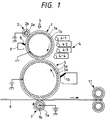
- Fig. 1 is a schematic illustration of an example of a full-color image forming electrophotographic apparatus preferably used in the present invention.
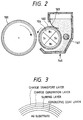
- Fig. 2 is a schematic illustration of an example of a black-color developing assembly used for one-component magnetic development.
- Fig. 3 is a schematic illustration of an example of the constitution of a photosensitive member preferably used in the present invention.
- Fig. 4 is a schematic illustration of a charge quantity measuring device for measuring the quantity of triboelectricity of toners.
- Fig. 5A illustrates a good image free of "blank areas caused by poor transfer"
- Fig. 5B a poor image having caused "blank areas caused by poor transfer”.
- Fig. 6 shows the scope of the present invention in relation to the shape factors SF-1 and SF-2.
- Fig. 7 is a schematic illustration of an example of a full-color image forming electrophotographic apparatus preferably used in the present invention, having a transfer belt as the transfer means of the secondary transfer step.
- Fig. 8 is a schematic illustration of an example of a full-color image forming electrophotographic apparatus preferably used in the present invention, having an endless belt as the intermediate transfer member.
- a black toner having at least i) black toner particles formed of a binder resin with a colorant dispersed therein and ii) an inorganic fine powder is used.
- the black toner has the value of shape factor SF-1 of 110 ⁇ SF-1 ⁇ 180, the value of shape factor SF-2 of 110 ⁇ SF-2 ⁇ 140, and the value of ratio B/A of 1.0 or less which is the ratio of a value B obtained by subtracting 100 from the value of SF-2 to a value A obtained by subtracting 100 from the value of SF-1.
- the shape factor SF-1 and shape factor SF-2 are the values obtained by sampling at random 100 particle images of a toner with particle diameters of 2 ⁇ m or larger by the use of, e.g., FE-SEM (S-800; a scanning electron microscope manufactured by Hitachi Ltd.), introducing their image information in an image analyzer (LUZEX-III; manufactured by Nikore Co.) through an interface to make analysis, and calculating the data according to the following expression.
- the values obtained are defined as shape factor SF-1 and shape factor SF-2.
- SF-1 (MXLNG) 2 /AREA ⁇ ⁇ /4 ⁇ 100
- SF-2 (PERIME) 2 /AREA ⁇ 1/4 ⁇ ⁇ 100 wherein MXLNG represents an absolute maximum length of a toner particle, PERIME represents a peripheral length of a toner particle, and AREA represents a projected area of a toner particle.
- the shape factor SF-1 indicates the degree of sphericity of toner particles.
- SF-2 indicates the degree of surface irregularity of toner particles.
- shape factor SF-1 of the black toner is more than 180 or SF-2 is more than 140, toner particles become less spherical and become more closely amorphous (shapeless), and the toner particles tend to be crushed in the developing assembly, so that the particle size distribution may vary or the charge quantity distribution tends to become broad to tend to cause ground fog and reversal fog.
- the transfer efficiency of toner images may also lower when the toner images are transferred from the electrostatic latent image bearing member to the intermediate transfer member, the transfer efficiency of toner images may also lower when the toner images are transferred from the intermediate transfer member to the transfer member, and the blank areas caused by poor transfer may occur on line images. Thus, such values are not preferable.
- the shape factor SF-1 of the black toner is 110 or less or the shape factor SF-2 is 110 or less, and the value of ratio B/A is more than 1.0, faulty cleaning usually tends to occur.
- the present invention has solved these problems by making the shape of black toner particles satisfy the conditions as defined in the present invention.
- the value of SF-1 may be 120 ⁇ SF-1 ⁇ 160, and the value of SF-2 may be 115 ⁇ SF-2 ⁇ 140. It is preferable to use toner particles produced by pulverization and having been treated to become spherical.
- a full-color toner kit having a cyan toner, a yellow toner, a magenta toner and a black toner, it is preferable to make the SF-2 of the black toner largest.
- the shape of particles of black toner may be made less spherical than that of particles of other color toners to become irregular, whereby the development or transfer electric field effectively acts on convexes of such irregular particle surfaces, and also, because of an appropriate surface resistance of such particles, the electric field uniformly acts on the toner particles to make it possible to achieve a higher image quality.
- the convexes appropriately present over the toner particle surfaces effectively function to produce an electrode effect, so that a transfer performance free of black spots around images can be obtained.
- the shape factor SF-2 of the black toner may preferably be larger by at least 5 than the shape factor SF-2 of the cyan toner, SF-2 of the yellow toner and SF-2 of the magenta toner.
- the shape factor SF-1 may preferably be from 100 to 170, more preferably from 100 to 160, and still more preferably from 100 to 150
- the SF-2 may preferably be from 100 to 139, more preferably from 100 to 130, and still more preferably from 100 to 125.
- the value of ratio B/A which is the ratio of a value B obtained by subtracting 100 from SF-2 to a value A obtained by subtracting 100 from SF-1 indicates the slope of a straight line that passes an origin in Fig. 6.
- the ratio B/A may preferably be from 0.20 to 0.95, and more preferably from 0.35 to 0.85.
- the toner used in the present invention also has an inorganic fine powder on its toner particle surfaces. This contributes to the improvement in transfer efficiency and the better prevention of blank areas caused by poor transfer in characters or line images.
- the transfer efficiency may lower, and if it is more than 7.0, the image density may lower. This is presumably because the particles of the inorganic fine powder added to the toner particles effectively behave as spacers between the toner particles and the toner carrying member.
- the specific surface area of the toner in the above range can be achieved by controlling the specific surface area of the toner particles, the specific surface area and amount of the inorganic fine powder added to the toner particles, and the strength when it is added and mixed. If it is added and mixed at a too great strength, the inorganic fine powder particles may be buried in the toner particles, resulting in a less improvement in transfer efficiency.
- the toner particles may have a specific surface area Sr per unit volume which ranges from 1.2 to 2.5 m 2 /cm 3 ; and preferably from 1.4 to 2.1 m 2 /cm 3 , and is from 1.5 to 2.5 times the theoretical specific surface area per unit volume as calculated from weight average particle diameter on the assumption that the toner particles are truly spherical.
- the specific surface area of the toner particles may preferably increase by at least 1.5 m 2 /cm 3 .
- the toner particles Before the addition of the inorganic fine powder, it is preferable for the toner particles to have a 60% pore radius of 3.5 nm or smaller in the integrating pore area percentage curve of pores of 1 nm to 100 nm in size.
- the ratio of the BET specific surface area Sb of the toner to the BET specific surface area Sr of the toner particles, Sb/Sr may preferably be in the range of from 2 to 5.
- the pores in the toner particles having a size larger than the primary particle diameter of the inorganic fine powder added to the toner particles, are decreased, so that the inorganic fine powder is presumed to more effectively behave to improve the transfer efficiency.
- the BET specific surface area is determined by the BET method, where nitrogen is adsorbed on sample surfaces using a specific surface area measuring device AUTOSOBE 1 (manufactured by Yuasa Ionics Co.), and the specific surface area is calculated by the BET multiple point method.
- the 60% pore radius is determined from the integrating pore area percentage curve with respect to the pore radius on the side of desorption.
- AUTOSOBE 1 the pore distribution is calculated by the B.J.H. method proposed by Barrett, Joyner and Harenda (B.J.H.).
- any lowering of transfer efficiency causes a lowering of utilization efficiency of the toner, and may come into question.
- a color image original In digital full-color copying machines or printers, a color image original must be previously color separated using a B (blue) filter, a G (green) filter and a R (red) filter and thereafter a 20 to 70 ⁇ m dot latent image must be formed on the photosensitive member so that a multi-color image faithful to the original can be reproduced by utilizing the action of subtractive mixture using a Y (yellow) toner, a M (magenta) toner, a C (cyan) toner and a B (black) toner.
- the Y toner, M toner, C toner and B toner are laid superimposingly on the photosensitive member or intermediate transfer member in accordance with the color information of the original or of a CRT, and hence the toner used in the present invention is required to have a very high transfer performance.
- the black toner may preferably be a magnetic toner.
- Other color toners may preferably be non-magnetic toner so that vivid colors can be reproduced.
- the toner particles may preferably have a weight average particle diameter of from 4 ⁇ m to 9 ⁇ m.
- the toner may less cause a lowering of transfer efficiency, may less remain on the photosensitive member or intermediate transfer member after transfer, and may hardly cause non-uniform or uneven images ascribable to fog and faulty transfer.
- the toner particles having a weight average particle diameter of from 4 ⁇ m to 9 ⁇ m the toner may hardly cause black spots around characters or line images.
- the average particle diameter and particle size distribution of the toner can be measured using a measuring device such as a Coulter Counter Model TA-II or Coulter Multisizer (manufactured by Coulter Electronics, Inc.).
- An interface manufactured by Nikkaki k.k.
- Nikkaki k.k. that outputs number distribution and volume distribution
- a personal computer PC9801 manufactured by NEC.
- an electrolytic solution an aqueous 1% NaCl solution is prepared using first-grade sodium chloride. For example, ISOTON R-II (Coulter Scientific Japan Co.) may be used.
- Measurement is carried out by adding as a dispersant from 0.1 to 5 ml of a surface active agent, preferably an alkylbenzene sulfonate, to from 100 to 150 ml of the above aqueous electrolytic solution, and further adding from 2 to 20 mg of a sample to be measured.
- the electrolytic solution in which the sample has been suspended is subjected to dispersion for about 1 minute to about 3 minutes in an ultrasonic dispersion machine.
- the volume distribution and number distribution are calculated by measuring the volume and number of toner particles with diameters of not smaller than 2 ⁇ m by means of, e.g., the above Coulter Counter Model TA-II, using an aperture of 100 ⁇ m as its aperture. Then, the volume-based weight average particle diameter (D 4 ) according to the present invention, determined from volume distribution, and the number-based length average particle diameter (D 1 ) determined from number distribution are determined.
- a surface active agent preferably an alkylbenzene sulfonate
- the toner according to the present invention may preferably have a charge quantity (quantity of triboelectricity) per unit volume, of from 30 to 80 C/m 3 , and more preferably from 40 to 70 C/m 3 (as measured by the two-component method).
- a mixture prepared by adding 0.5 g of the toner to 9.5 g of the carrier is put in a bottle with a volume of 50 to 100 ml, made of polyethylene, and manually shaked 50 times.
- 1.0 g to 1.2 g of the resulting mixture is put in a measuring container 22 made of a metal at the bottom of which a conductive screen 23 of 500 meshes is provided, and the container is covered with a plate 24 made of a metal.
- the total weight of the measuring container 22 at this time is weighed and is expressed as W 1 (g).
- a suction device 21 made of an insulating material at least at the apart coming into contact with the measuring container 22
- air is sucked from a suction opening 27 and an air-flow control valve 26 is operated to control the pressure indicated by a vacuum indicator 25 to be 2,450 hPa (250 mm Ag).
- suction is carried out for 1 minute to remove the toner by suction.
- the potential indicated by a potentiometer 29 at this time is expressed as V (volt).
- Reference numeral 28 denotes a capacitor, whose capacitance is expressed as C ( ⁇ F).
- the total weight of the measuring container after completion of the suction is also weighed and is expressed as W 2 (g).
- the true density of the toner is measured using a gas displacement type densitometer ACCUPYC 1330 (manufactured by Micromeritics Co.).
- a peak of low-molecular weight in its molecular weight distribution as measured by gel permeation chromatography may be in the range of from 3,000 to 15,000. This is preferable when the shape of toner particles produced by pulverization is controlled by thermomechanical impact force. If the peak of low-molecular weight is higher than 15,000, it is difficult to control the shape factors SF-1 and SF-2 within the range of the present invention, and the transfer efficiency can not be well improved. If the peak is lower than 3,000, the toner particles tend to melt-adhere at the time of surface treatment. The molecular weight is measured by GPC.
- the toner is beforehand extracted with tetrahydrofuran (THF) for 20 hours by means of a Soxhlet extractor.
- THF tetrahydrofuran
- the molecular weight distribution can be measured using a calibration curve of a standard polystyrene resin.
- a resin having a ratio of weight average molecular weight (Mw) to number average molecular weight (Mn), Mw/Mn, of 2 to 100 is preferred in the present invention.
- the toner may preferably have a glass transition point (Tg) of from 50°C to 75°C, and more preferably from 52°C to 70°C, in view of fixing performance and storage stability.
- Tg glass transition point
- the glass transition point is measured using, for example, a differential scanning calorimeter of a high-precision inner heat input compensation type, such as DSC-7, manufactured by Parkin Elmer Co. Measured according to ASTM D3418-82.
- a DSC curve is used which is measured when the temperature of a sample is once raised to previously take a history, followed by rapid cooling, and the temperature is again raised at a rate of temperature rise of 10°C/min within the range of temperatures of from 0 to 200°C.
- binder resin used in the present invention it is possible to use polystyrene; styrene derivatives such as poly-p-chlorostyrene and polyvinyl toluene; styrene copolymers such as a styrene-p-chlorostyrene copolymer, a styrene-vinyltoluene copolymer, a styrene-vinylnaphthalene copolymer, a styrene-acrylate copolymer, a styrene-methacrylate copolymer, a styrene-methyl ⁇ -chloromethacrylate copolymer, a styrene-acrylonitrile copolymer, a styrene-methyl vinyl ether copolymer, a styrene-ethyl vinyl ether copolymer, a styrene-e
- Comonomers copolymerizable with styrene monomers in the styrene copolymers may include vinyl monomers such as monocarboxylic acids having a double bond and derivatives thereof such as acrylic acid, methyl acrylate, ethyl acrylate, butyl acrylate, dodecyl acrylate, octyl acrylate, 2-ethylhexyl acrylate, phenyl acrylate, methacrylic acid, methyl methacrylate, ethyl methacrylate, butyl methacrylate, octyl methacrylate, acrylonitrile, methacrylonitrile and acrylamide; dicarboxylic acids having a double bond and derivatives thereof such as maleic acid, butyl maleate, methyl maleate and dimethyl maleate; vinyl esters such as vinyl chloride, vinyl acetate and vinyl benzoate; olefins such as ethylene, propylene and butylene;
- compounds having at least two polymerizable double bonds may be used.
- it may include aromatic divinyl compounds such as divinyl benzene and divinyl naphthalene; carboxylic acid esters having two double bonds such as ethylene glycol diacrylate, ethylene glycol dimethacrylate and 1,3-butanediol dimethacrylate; divinyl compounds such as divinyl aniline, divinyl ether, divinyl sulfide and divinyl sulfone; and compounds having at least three vinyl groups. Any of these may be used alone or in the form of a mixture.
- waxes may include paraffin wax and derivatives thereof, microcrystalline wax and derivatives thereof, Fischer-Tropsch wax and derivatives thereof, polyolefin wax and derivatives thereof, and carnauba wax and derivatives thereof.
- the derivatives may include oxides, block copolymers with vinyl monomers, and graft modified products.
- long-chain alcohols long-chain fatty acids, acid amides, ester waxes, ketones, hardened caster oil and derivatives thereof, vegetable waxes, animal waxes, mineral waxes and petrolatum may be used as occasion calls.
- the binder resin, a wax, a pigment or dye as a colorant, a magnetic material, and optionally additives such as a charge control agent are thoroughly mixed using a mixing machine such as a Henschel mixer or a ball mill, and then the mixture is melt-kneaded using a heat kneading machine such as a heating roll, a kneader or an extruder to make the resin melt one another, in which the pigment, the dye or the magnetic material is dispersed or dissolved, followed by cooling for solidification and thereafter pulverization and classification.
- a multi-division classifier may preferably be used in view of production effeciency.
- the mechanical impact method in particular, a thermomechanical impact method in which the toner particles are treated at a temperature around the glass transition point Tg (Tg ⁇ 10°C) of the toner particles is preferred in view of the prevention of agglomeration and the productivity. More preferably, the treatment may be made at a temperature within a glass transition point Tg ⁇ 5°C of the black toner particles. This is especially effective for decreasing pores having a radius of 10 nm or larger, present in the surfaces of toner particles, and for effectively working the inorganic fine powder present on the toner particles.
- the toner may also be produced by the method disclosed in Japanese Patent Publication No. 56-13945, in which a molten mixture is atomized or sprayed in the air by means of a disk or multiple fluid nozzles to obtain a spherical toner; the method disclosed in Japanese Patent Publication No. 36-10231 and Japanese Patent Applications Laid-open No. 59-53856 and No.
- toners are directly produced by suspension polymerization; a dispersion polymerization method in which toners are directly produced using an aqueous organic solvent in which monomers are soluble and polymers obtained are insoluble; or an emulsion polymerization method as typified by soap-free polymerization in which toners are produced by direct polymerization in the presence of a water-soluble polar polymerization initiator.
- the toner particles may particularly preferably be produced by the suspension polymerization.
- Toner particles produced by seed polymerization, in which monomers are further adsorbed on polymer particles once obtained and thereafter a polymerization initiator is added to carry out polymerization, may also be preferably employed in the present invention.
- a polar resin such as a styrene- acrylate or methacrylate copolymer, a styrene-maleic acid copolymer and a saturated polyester resin.
- toner particles having a charge control agent are produced by the direct polymerization in the present invention, it is preferable to use charge control agents having neither polymerization inhibitory action nor solubilizates in an aqueous medium.
- the toner particles can be produced by a process as described below.
- a monomer composition comprising polymerizable monomers and added therein a release agent comprised of a low-softening substance, a colorant, a charge control agent, a polymerization initiator and other additives, which are uniformly dissolved or dispersed by means of a homogenizer, an ultrasonic dispersion machine or the like, is dispersed in an aqueous phase containing a dispersion stabilizer, by means of a conventional stirrer, or a homomixer or a homogenizer.
- Granulation is carried out preferably while controlling the stirring speed and time so that droplets of the polymerizable monomer composition can have the desired toner particle size.
- stirring may be carried out to such an extent that the state of particles is maintained and the particles can be prevented from settling by the acton of the dispersion stabilizer.
- the polymerization may be carried out at a polymerization temperature set at 40°C or above, usually from 50 to 90°C.
- the present invention can be more effective when toners whose particles have been partly or entirely formed by polymerization are used,
- toner particles whose surface portions have been formed by polymerization toner particles are brought into presence in a dispersion medium as pre-toner (monomer composition) particles and their necessary portions are formed by the polymerization reaction.
- pre-toner monomer composition
- reasonably smoothed toner particles can be obtained.
- Toner particles preferably used in the image forming method can be produced also when toner particles made to have a core/shell structure and whose shells are formed by polymerization are used.
- the core/shell structure contributes to an improvement in blocking resistance without damaging a good fixing performance of the toner.
- residual monomers can be more readily removed in a post-treatment step after the step of polymerization when only shells are polymerized.
- a low-softening substance As a main component of the core, it is preferable to use a low-softening substance, and it is preferable to use a compound having a main maximum peak value of endothermic peaks within a temperature range of from 40 to 90°C as measured according to ASTM D3418-8. If the maximum peak value is lower than 40°C, the low-softening substance may have a weak self-cohesive force, undesirably resulting in a lowering of high-temperature anti-offset properties. If on the other hand the maximum peak value is higher than 90°C, fixing temperature may become higher.
- the temperature of the maximum peak value of the low-softening substance is measured using, for example, DSC-7, manufactured by Perkin Elmer Co.
- the temperature at the detecting portion of the device is corrected on the basis of melting points of indium and zinc, and the calorie is corrected on the basis of heat of fusion of indium.
- the sample is put in a pan made of aluminum and an empty pan is set as a control, to make measurement at a rate of temperature rise of 10°C/min.
- the low-softening substance may include paraffin waxes, polyolefin waxes, Fischer-Tropsch waxes, amide waxes, higher fatty acids, ester waxes, and derivatives of these or grafted or blocked compounds of these.
- the low-softening substance may preferably be added in the toner in an amount of from 5 to 30 parts by weight based on 100 parts by weight of the binder resin. Its addition in an amount less than 5 parts by weight may impose a load on the removal of the residual monomers previously mentioned. On the other hand, its addition in an amount more than 30 parts by weight tends to cause toner particles to coalesce one another during granulation even when produced by polymerization, tending to produce toner particles having a broad particle size distribution.
- the surfaces of the toner particles may preferably be coated with an external additive such as the inorganic fine powder so that the external additive on the toner particle surfaces may be in a coverage of from 5 to 99%, and more preferably from 10 to 99%.
- the coverage with the external additive on the toner particle surfaces is the value obtained by sampling at random 100 toner particle images (e.g., magnified 20,000 times) by the use of FE-SEM (S-800; a scanning electron microscope manufactured by Hitachi Ltd.), introducing their image information in an image analyzer (LUZEX-III; manufactured by Nikore Co.) through an interface to make analysis, and calculating the data obtained.
- the external additive may preferably have a particle diameter not larger than 1/10 of a weight average particle diameter of the toner particles, in view of its durability when mixed with the toner particles.
- the particle diameter of this external additive refers to an average particle diameter obtained by observing the toner particles (e.g., magnified 20,000 times) on the electron microscope.
- the external additive may include fine powders of metal oxides such as aluminum oxide, titanium oxide, strontium titanate, cerium oxide, magnesium oxide, chromium oxide, tin oxide and zinc oxide; fine powders of nitrides such as silicon nitride; fine powders of carbides such as silicon carbide; fine powders of metal salts such as calcium sulfate, barium sulfate and calcium carbonate; fine powders of fatty acid metal salts such as zinc stearate and calcium stearate; carbon black; and fine silica powder.
- metal oxides such as aluminum oxide, titanium oxide, strontium titanate, cerium oxide, magnesium oxide, chromium oxide, tin oxide and zinc oxide
- fine powders of nitrides such as silicon nitride
- fine powders of carbides such as silicon carbide
- fine powders of metal salts such as calcium sulfate, barium sulfate and calcium carbonate
- fine powders of fatty acid metal salts such as zinc
- any of these external additives may be used in an amount of from 0.01 to 10 parts by weight, and preferably from 0.05 to 5 parts by weight, based on 100 parts by weight of the toner particles. These external additives may be used alone or may be used in combination of plural ones. Those having been subjected to hydrophobic treatment are more preferred.
- the toner particles may particularly preferably be produced by the suspension polymerization under normal pressure or under application of a pressure, which can obtain relatively with ease a fine-particle toner having a sharp particle size distribution and a particle diameter of from 4 to 8 ⁇ m.
- the polarities of materials in an aqueous medium are set smaller on the low-softening substance than on the main polymerizable monomers and also a small amount of resin or polymerizable monomer with a great polarity may be added.
- toner particles having the core/shell structure wherein the low-softening substance is covered with the shell resin can be obtained.
- the particle size distribution and particle diameter of the toner particles may be controlled by a method in which the types and amounts of a sparingly water-insoluble inorganic salt and a dispersant having the action of protective colloids are changed, or by controlling mechanical device conditions (e.g., conditions for agitation, such as the peripheral speed of a rotor, pass times, the shape of agitating blades, the shape of a container), or the concentration of solid matter in the aqueous medium, whereby the desired toner particles can be obtained.
- mechanical device conditions e.g., conditions for agitation, such as the peripheral speed of a rotor, pass times, the shape of agitating blades, the shape of a container
- concentration of solid matter in the aqueous medium whereby the desired toner particles can be obtained.
- Cross sections of the toner particles can be observed by, for example, a method in which toner particles are well dispersed in a room temperature curing epoxy resin, followed by curing in an environment of temperature 40°C for 2 days, and the cured product obtained is dyed with triruthenium tetraoxide (optionally in combination with triosmium tetraoxide), thereafter samples are cut out in slices by means of a microtome having a diamond cutter, to observe the cross sections of toner particles using a transmission electron microscope (TEM). It is preferable to use the triruthenium tetraoxide dyeing method in order to form a contrast between the materials by utilizing some difference in crystallinity between the low-softening substance and the resin constituting the shell.
- TEM transmission electron microscope
- the resin used to form the shell may include a styrene-acrylate or methacrylate copolymer, polyester resins, epoxy resins and a styrene-butadiene copolymer.
- styrene styrene
- styrene type monomers such as o-, m- or p-methylstyrene, and m- or p-ethylstyrene
- acrylic or methacrylic acid ester monomers such as methyl acrylate or methacrylate, ethyl acrylate or methacrylate, propyl acrylate or methacrylate, butyl acrylate or methacrylate, octyl acrylate or methacrylate, dodecyl acrylate or methacrylate, stearyl acrylate or methacrylate, behenyl acrylate or methacrylate, 2-ethyl
- any of these may be used in the polymerization, alone or in the form of an appropriate mixture of monomers so mixed that the theoretical glass transition temperature (Tg) as described in a publication POLYMER HANDBOOK, 2nd Edition III, pp.139-192 (John Wiley & Sons, Inc.) ranges from 40 to 75°C. If the theoretical glass transition temperature is lower than 40°C, problems may arise in respect of storage stability or running stability of the toner. If on the other hand it is higher than 75°C, the fixing point of the toner may become higher. Especially in the case of color toners used to form full-color images, the color mixing performance of the respective color toners at the time of fixing may lower, resulting in a poor color reproducibility. Also, the transparency of OHP images may lower.
- Tg theoretical glass transition temperature
- Molecular weight of the shell resin is measured by gel permeation chromatography (GPC).
- GPC gel permeation chromatography
- the toner is beforehand extracted with a toluene solvent for 20 hours by means of a Soxhlet extractor, and thereafter the toluene is evaporated by means of a rotary evaporator, followed by addition of an organic solvent capable of dissolving the low-softening substance but dissolving no shell resin (e.g., chloroform), to thoroughly carry out washing. Thereafter, the solution is dissolved in tetrahydrofuran (THF), and then filtered with a solvent-resistant membrane filter of 0.3 ⁇ m in pore diameter to obtain a sample.
- THF tetrahydrofuran
- Molecular weight of the sample is measured using a detector 150C, manufactured by Waters Co. As column constitution, A-801, A-802, A-803, A-804, A-805, A-806 and A-807, available from Showa Denko K.K., are connected, and molecular weight distribution can be measured using a calibration curve of a standard polystyrene resin.
- the resin component obtained may preferably have a number average molecular weight (Mn) of from 5,000 to 1,000,000, and a shell resin standing 2 to 100 as the ratio of weight average molecular weight (Mw) to number average molecular weight (Mn), Mw/Mn, is preferred.
- the toner particles having such core/shell structure are produced, in order to encapsulate the low-softening substance with the shell resin, it is particularly preferable to further add a polar resin as an additional shell resin.
- a polar resin used in the present invention, copolymers of styrene with acrylic or methacrylic acid, maleic acid copolymers, saturated polyester resins and epoxy resins are preferably used.
- the polar resin may particularly preferably be those not containing in the molecule any unsaturated groups that may react with the shell resin or polymerizable monomers.
- a polar resin having such unsaturated groups is contained, cross-linking reaction with the polymerizable monomers that form the shell resin takes place, so that the shell resin comes to have a too high molecular weight especially for the toners for forming full-color images and is disadvantageous for color mixture of four color toners. Thus, such a resin is not preferable.
- the surfaces of the toner particles may be further provided with an outermost shell resin layer.
- Such an outermost shell resin layer may preferably have a glass transition temperature so designed as to be higher than the glass transition temperature of the shell resin in order to more improve blocking resistance.
- the outermost shell resin layer may also preferably be cross-linked to such an extent that the fixing performance is not damaged.
- the outermost shell resin layer may preferably be incorporated with a polar resin or a charge control agent in order to improve charging performance.
- the outermost shell resin layer there are no particular limitations on how to provide the outermost shell resin layer. For example, it may be provided by a method including the following.
- a charge control agent may preferably be used by compounding it into toner particles (internal addition) or blending it with toner particles (external addition).
- the charge control agent enables control of optimum charge quantity in conformity with developing systems. Particularly in the present invention, it can make more stable the balance between particle size distribution and charge quantity.
- Those capable of controlling the toner to be negatively chargeable may include the following materials.
- organic metal complexes or chelate compounds are effective. They include monoazo metal complexes, acetylacetone metal complexes, and metal complexes of an aromatic hydroxycarboxylic acid type or aromatic dicarboxylic acid type. Besides, they include aromatic mono- or polycarboxylic acids and metal salts, anhydrides or esters thereof, and phenol derivatives such as bisphenol.
- Those capable of controlling the toner to be positively chargeable may include the following materials.
- Nigrosine and products modified with a fatty acid metal salt quaternary ammonium salts such as tributylbenzylammonium l-hydroxy-4-naphthosulfonate and tetrabutylammonium teterafluoroborate, and analogues of these, including onium salts such as phosphonium salts and lake pigments of these; triphenylmethane dyes and lake pigments of these (lake-forming agents may include tungstophosphoric acid, molybdophosphoric acid, tungstomolybdophosphoric acid, tannic acid, lauric acid, gallic acid, ferricyanides and ferrocyanides); metal salts of higher fatty acids; diorganotin oxides such as dibutyltin oxide, dioctyltin oxide and dicyclohexyltin oxide; and diorganotin borates such as dibutyltin borate, dioctyltin borate
- the charge control agents described above may preferably be used in the form of fine particles. These charge control agents may preferably have a number average particle diameter of 4 ⁇ m or smaller, and particularly preferably 3 ⁇ m or smaller. In the case when the charge control agent is internally added to the toner particles, it may preferably be used in an amount of from 0.1 to 20 parts by weight, and particularly from 0.2 to 10 parts by weight, based on 100 parts by weight of the binder resin.
- Black colorants may include carbon black, magnetic materials, and colorants toned in black by the use of yellow, magenta and cyan colorants shown below.
- the yellow colorants include compounds as typified by condensation azo compounds, isoindolinone compounds, anthraquinone compounds, azo metal complexes, methine compounds and allylamide compounds. Stated specifically, C.I. Pigment Yellow 12, 13, 14, 15, 17, 62, 74, 83, 93, 94, 95, 97, 109, 110, 111, 120, 127, 128, 129, 147, 168, 174, 176, 180, 181 and 191 are preferably used.
- the magenta colorants include condensation azo compounds, diketopyrrolopyrrole compounds, anthraquinone compounds, quinacridone compounds, basic dye lake compounds, naphthol compounds, benzimidazolone compounds, thioindigo compounds and perylene compounds. Stated specifically, C.I. Pigment Red 2, 3, 5, 6, 7, 23, 48:2, 48:3, 48:4, 57:1, 81:1, 144, 146, 166, 169, 177, 184, 185, 202, 206, 220, 221 and 254 are particularly preferable.
- the cyan colorants include copper phthalocyanine compounds and derivatives thereof, anthraquinone compounds and basic dye lake compounds. Stated specifically, C.I. Pigment Blue 1, 7, 15, 15:1, 15:2, 15:3, 15:4, 60, 62 and 66 may be particularly preferably used.
- colorants may be used alone, in the form of a mixture, or in the state of a solid solution.
- the colorants are selected taking account of hue angle, chroma, brightness, weatherability, transparency on OHP films and dispersibility in toner particles.
- the non-magnetic colorant may preferably be used in an amount of from 1 to 20 parts by weight based on 100 parts by weight of the binder resin.
- the magnetic material includes metal oxides containing an element such as iron, cobalt, nickel, copper, magnesium, manganese, aluminum or silicon. In particular, those mainly composed of an iron oxide such as triiron tetraoxide or ⁇ -iron oxide are preferred.
- the magnetic material may contain metal element such as silicon element or aluminum element. These magnetic materials may have a BET specific surface area, as measured by nitrogen gas absorption, of from 2 to 30 m 2 /g, and particularly from 3 to 28 m 2 /g, and may preferably magnetic materials having a Mohs hardness of from 5 to 7.
- the shape of the magnetic material it may be octahedral, hexahedral, spherical, acicular or flaky. Those having less anisotropy such as octahedral, hexahedral or spherical ones are preferred in view of an improvement in image density.
- the magnetic material may preferably have an average particle diameter of from 0.05 to 1.0 ⁇ m, more preferably from 0.1 to 0.6 ⁇ m, and still more preferably from 0.1 to 0.4 ⁇ m.
- the magnetic material may be in a content of from 30 to 200 parts by weight, preferably from 40 to 200 parts by weight, and more preferably from 50 to 150 parts by weight, based on 100 parts by weight of the binder resin. If it is in a content less than 30 parts by weight, the transport performance of the magnetic toner may lower to tend to make the toner layer on the toner carrying member uneven and cause uneven images in the case of developing assemblies where a magnetic force is utilized to transport the toner. Also, the quantity of triboelectricity of the magnetic toner may increase to tend to cause a decrease in image density. On the other hand, if it is in a content more than 200 parts by weight, the fixing performance tends to come into question.
- the inorganic fine powder mixed with the toner particles known materials may be used. In order to improve charge stability, developing performance, fluidity and storage stability, it may preferably be selected from fine silica powder, fine alumina powder, fine titania powder, and fine powders of double oxides thereof. Fine silica powder is particularly preferred.
- Silica includes dry-process silica produced by vapor phase oxidation of silicon halides or alkoxides and wet-process silica produced from alkoxides or water glass, either of which can be used. The dry-process silica is preferred, as having less silanol groups on the surface and the inside of fine silica powder and leaving no production residue such as Na 2 O and SO 3 2- .
- a metal halide such as aluminum chloride or titanium chloride together with the silicon halide to give a composite fine powder of silica with other metal oxide.
- Such powders may also be used.
- the inorganic fine powder used in the present invention may have a specific surface area, as measured by the BET method using nitrogen gas absorption, of 30 m 2 /g or above, and particularly ranging from 50 to 400 m 2 /g, where good results can be obtained.
- the fine silica powder may be used in an amount of from 0.1 to 8 parts by weight, preferably from 0.5 to 5 parts by weight, and more preferably from 1.0 to 3.0 parts by weight, based on 100 parts by weight of the toner particles.
- the inorganic fine powder used in the present invention may preferably have a primary particle diameter of 30 nm or smaller.
- the inorganic fine powder used in the present invention may preferably be treated, if necessary, with a treating agent such as silicone varnish, modified silicone varnish of various types, silicone oil, modified silicone oil of various types, a silane coupling agent, a silane coupling agent having a functional group, other organic silicon compound or an organic titanium compound.
- a treating agent such as silicone varnish, modified silicone varnish of various types, silicone oil, modified silicone oil of various types, a silane coupling agent, a silane coupling agent having a functional group, other organic silicon compound or an organic titanium compound.
- the treating agent may be used in combination of two or more kinds.
- the inorganic fine powder may more preferably be treated with silicone oil.
- inorganic or organic in order to improve transfer performance and/or cleaning performance, closely spherical fine particles having a primary particle diameter larger than 30 nm (preferably having a specific surface area smaller than 50 m 2 ), and more preferably 50 nm or larger (preferably having a specific surface area smaller than 50 m 2 ) may be further added in addition to the inorganic fine powder described above.
- spherical silica particles, spherical polymethylsilsesquioxane particles and spherical resin particles are preferably used.
- additives may also be used so long as they substantially do not adversely affect the toner. They may include, for example, lubricant powders such as Teflon powder, stearic acid zinc powder and polyvinylidene fluoride powder; abrasives such as cerium oxide powder, silicon carbide powder and strontium titanate powder; fluidity-providing agents such as titanium oxide powder and aluminum oxide powder; anti-caking agents; conductivity-providing agents such as carbon black powder, zinc oxide powder and tin oxide powder; and reverse-polarity organic fine particles and inorganic fine particles.
- lubricant powders such as Teflon powder, stearic acid zinc powder and polyvinylidene fluoride powder
- abrasives such as cerium oxide powder, silicon carbide powder and strontium titanate powder
- fluidity-providing agents such as titanium oxide powder and aluminum oxide powder
- anti-caking agents such as anti-caking agents
- conductivity-providing agents such as carbon black powder, zinc oxide powder
- magenta toner and cyan toner titanium oxide or alumina
- titanium oxide or alumina is preferred which has been treated while hydrolyzing a specific coupling agent in the presence of water, and has an average particle diameter of from 0.01 to 0.2 ⁇ m, a hydrophobicity of from 20 to 98% and a light transmittance at 400 nm, of 40% or more.
- homogeneous hydrophobic treatment can be carried out, and also no particles may coalesce one another.
- such powder is very effective in view of charge stabilization of the toner and providing fluidity to the toner.
- the coupling agent may include silane coupling agents or titanium coupling agents.
- silane coupling agents including the compounds represented by the following formula.
- R m SiY n wherein R is an alkoxyl group; m is an integer of 1 to 3; Y is a hydrocarbon group such as an alkyl group, a vinyl group, a glycidoxyl group or a methacrylic group; and n is an integer of 1 to 3.
- the compounds may include vinyltrimethoxysilane, vinyltriethoxysilane, ⁇ -methacryloxypropyltrimethoxysilane, vinyltriacetoxysilane, methyltrimethoxysilane, methyltriethoxysilane, isobutyltrimethoxysilane, dimethyldimethoxysilane, dimethyldiethoxysilane, trimethylmethoxysilane, hydroxypropyltrimethoxysilane, phenyltrimethoxysilane, n-hexadecyltrimethoxysilane and n-octadecyltrimethoxysilane.
- Trialkoxyalkylsilane coupling agents represented by the following formula are more preferred.
- a is smaller than 4, the treatment becomes easier but the hydrophobicity may lower. If a is greater than 12, a satisfactory hydrophobicity can be achieved but the particles tend to coalesce one another.
- a should be 4 to 12, and preferably 4 to 8, and b should be 1 to 3, and preferably 1 or 2.
- the treatment may be made in a quantity of from 1 to 50 parts by weight, and preferably from 3 to 40 parts by weight, based on 100 parts by weight of the inorganic fine powder.
- the inorganic fine powder may be treated to have a hydrophobicity of from 20 to 98%, preferably from 30 to 90%, and more preferably from 40 to 80%.
- hydrophobicity is smaller than 20%, the charge quantity tends to lower when the toner is left for a long term in an environment of high humidity. If its hydrophobicity is higher than 98%, the toner tends to cause charge-up in an environment of low humidity.
- the inorganic fine powder made hydrophobic may preferably have an average particle diameter of from 0.01 to 0.2 ⁇ m. If its average particle diameter is larger than 0.2 ⁇ m, the uniformity in the charging of toner may lower, consequently tending to cause toner scatter and fog. If its average particle diameter is smaller than 0.01 ⁇ m, the treated fine powder tends to be buried in the toner particle surfaces to cause a deterioration of the toner, tending to result in a lowering of durability or running performance.
- the powder is treated by hydrolyzing the coupling agent while dispersing the particles in an aqueous medium so as to mechanically turn into primary particles.
- the inorganic fine powder made hydrophobic in the manner as described above may also preferably have a light transmittance at 400 nm, of 40% or more.
- inorganic or organic closely spherical fine particles having a primary particle diameter larger than 50 nm (preferably having a specific surface area smaller than 30 m 2 ) may be further added.
- spherical silica particles, spherical polymethylsilsesquioxane particles and spherical resin particles are preferably used.
- the black toner used in the present invention may preferably hold a liquid lubricant.
- a small amount of the liquid lubricant coats the surface of the electrostatic latent image bearing member and intermediate transfer member and imparts a good releasability to the toner particles, so that the toner on the surface of the electrostatic latent image bearing member can be uniformly and effectively transferred to the intermediate transfer member.
- the liquid lubricant may preferably be supported on supporting particles such as magnetic material particles by adsorption, granulation, agglomeration, impregnation or encapsulation so as to be incorporated into the toner particles. This enables the liquid lubricant to be present on the toner particle surfaces uniformly and in a proper quantity, so that the releasability and lubricity of the toner particles can be made stable.
- the liquid lubricant for imparting the releasability and lubricity to the toner animal oil, vegetable oil, petroleum oil or synthetic lubricating oil may be used.
- Synthetic lubricating oil is preferably used in view of its stability.
- the synthetic lubricating oil may include silicone oils such as dimethylsilicone oil, methylphenylsilicone oil, modified silicone oil of various types; polyol esters such as pentaerythritol ester and trimethylolpropane ester; polyolefins such as polyethylene, polypropylene, polybutene and poly( ⁇ -olefin); polyglycols such as polyethylene glycol and polypropylene glycol; silicic esters such as tetradecyl silicate and tetraoctyl silicate; diesters such as di-2-ethylhexyl sebacate and di-2-ethylhexyl adipate; phosphoric esters such as tric
- silicone oils or fluorinated hydrocarbons are preferred.
- the silicone oils may include reactive silicone oils such as amino-modified silicone oil, epoxy-modified silicone oil, carboxyl-modified silicone oil, carbinol-modified silicone oil, methacryl-modified silicone oil, mercapto-modified silicone oil, phenol-modified silicone oil and heterofunctional group-modified silicone oil; non-reactive silicone oils such as polyether-modified silicone oil, methylstyryl-modified silicone oil, alkyl-modified silicone oil, fatty acid-modified silicone oil, alkoxy-modified silicone oil and fluorine-modified silicone oil; and straight silicone oils such as dimethylsilicone oil, methylphenylsilicone oil and methylhydrogensilicone oil.
- curable silicone oils are less effective on account of their nature.
- Reactive silicone oils or silicone oils having polar groups may be strongly adsorbed on the supporting medium of the liquid lubricant or may become compatible with the binder resin. They may be liberated in a small quantity depending on the degree of adsorption or compatibility, and can not be so effective in some cases.
- Non-reactive silicone oils may also become compatible with the binder resin, depending on the structure of the side chain, and can be less effective in some cases.
- dimethylsilicone oil, fluorine-modified silicone oils or fluorinated hydrocarbons are preferably used because of less polarity, no strong adsorption and no compatibility with binder resins.
- the liquid lubricant may preferably have a viscosity at 25°C of from 10 to 200,000 cSt, more preferably from 20 to 100,000 cSt, and still more preferably from 50 to 70,000 cSt. If it has a viscosity lower than 10 cSt, low-molecular weight components increase to tend to cause problems in developing performance and storage stability.
- viscosity of the liquid lubricant is measured using, for example, Viscotester VT500 (manufactured by Haake Co.).
- Viscosities (pas) indicated on the device are calculated into cSt.
- the liquid lubricant is used in such a way that it is supported on the magnetic material or supporting particles, and hence can achieve better dispersibility than the case when the liquid lubricant such as silicone oil is merely added as it is. It is not intended to merely improve dispersibility.
- the liquid lubricant must be liberated from the supporting particles so that the releasability and lubricity attributable thereto can be exhibited, and at the same time the liquid lubricant must be made to have an appropriate adsorption strength so that it can be prevented from being liberated in excess.
- the liquid lubricant is held on the surfaces of supporting particles so as to be made present on the surfaces of the toner particles or in the vicinity thereof, whereby the quantity of the liquid lubricant on the surfaces of the toner particles can be appropriately controlled.
- a wheel type kneading machine or the like may be used as a specific method for making the liquid lubricant of the present invention supported on the particle surfaces of the magnetic material.
- the liquid lubricant present between magnetic particles is, by virtue of compression action, pressed against magnetic particle surfaces and at the same time passed through gaps between the magnetic particles to widen the gaps by force to increase its adhesion to the magnetic particle surfaces. While the liquid lubricant is extended by virtue of shear action, the shear force acts on the magnetic particles at different positions to loosen their agglomeration.
- the liquid lubricant present on the magnetic particle surfaces is uniformly spread.
- These actions are repeated to completely loosen the agglomeration between magnetic particles, so that the liquid lubricant is uniformly supported on the surfaces of individual magnetic particles in such a state that the individual magnetic particles are kept apart one by one.
- this is a particularly preferred means.
- a Simpson mix muller it is preferable to use a Simpson mix muller, a multi-muller, a Stotz mill, an Eirich mill or a reverse-flow kneader.
- liquid lubricant is, as it is or after diluted with a solvent, directly mixed with magnetic particles so as to be supported thereon, by means of a mixing machine such as a Henschel mixer or a ball mill, or a method in which the liquid lubricant is directly sprayed on magnetic material particles so as to be supported thereon.
- a mixing machine such as a Henschel mixer or a ball mill
- the liquid lubricant is directly sprayed on magnetic material particles so as to be supported thereon.
- silicone oils the liquid lubricant may seize (or burn to stick) on the supporting particles and hence can not be effectively liberated therefrom in some cases.
- the relative amount of the liquid lubricant with respect to the binder resin is important from the viewpoint of its efficacy.
- the liquid lubricant may preferably be added and made supported on the magnetic material so as to be in an amount of from 0.1 to 7 parts by weight, more preferably from 0.2 to 5 parts by weight, and particularly from 0.3 to 2 parts by weight, based on 100 parts by weight of the binder resin.
- lubricant-supported particles other than the lubricant-supported magnetic material described above, containing the liquid lubricant, fine particles of an organic compound or inorganic compound which are prepared by granulation or agglomeration using the liquid lubricant may be used as the lubricant-supported particles.
- the organic compound that constitutes organic fine particles may include resins such as styrene resin, acrylic resin, silicone resin, polyester resin, urethane resin, polyamide resin, polyethylene resin and fluorine resin.
- the inorganic compound that constitutes inorganic fine particles may include oxides such as SiO 2 , GeO 2 , TiO 2 , SnO 2 , Al 2 O 3 , B 2 O 3 and P 2 O 5 ; metal oxide salts such as silicate, borate, phosphate, borosilicate, aluminosilicate, aluminoborate, aluminoborosilicate, tungstate, molybdate and tellurate; composite compounds of any of these; silicon carbide, silicon nitride, and amorphous carbon. These may be used alone or in the form of a mixture.
- inorganic compounds in particular, metal oxides are preferable in view of their appropriate electrical resistance.
- oxides or double oxides of Si, Al or Ti are preferred.
- substantially white inorganic compounds are preferably used.
- Fine particles whose surfaces have been made hydrophobic by a coupling agent may also be used.
- some liquid lubricants tend to cause excessive charging when the surfaces of the toner particles are coated.
- Use of those having not been made hydrophobic enables the charges to be appropriately leaked to make it possible to maintain good developing performance.
- the supporting fine particles may preferably have a particle diameter of from 0.001 to 20 ⁇ m, and particularly from 0.005 to 10 ⁇ m.
- the supporting particles may preferably have a BET specific surface area, as measured by the BET method using nitrogen gas absorption, of from 5 to 500 m 2 /g, more preferably from 10 to 400 m 2 /g, and still more preferably from 20 to 350 m 2 /g. If the particles have a BET specific surface area smaller than 5 m 2 /g, it is difficult for the liquid lubricant of the present invention to be held to form lubricant-supported particles having preferable particle diameters.
- the liquid lubricant in the lubricant-supported particles may be in an amount of from 20 to 90% by weight, preferably from 27 to 87% by weight, and particularly preferably from 40 to 80% by weight. If the liquid lubricant is in an amount less than 20% by weight, good releasability and lubricity can be less effectively imparted to the toner particles. If it is in an amount more than 90% by weight, it is difficult to obtain lubricant-supported particles uniformly containing the liquid lubricant.
- the lubricant-supported particles may preferably have a particle diameter of 0.5 ⁇ m or larger, and more preferably 1 ⁇ m or larger.
- the main component thereof according to volume-based distribution may preferably have a larger particle diameter than the toner particles.
- the liquid lubricant is by no means moved in excess to the surfaces of the toner particles and also the toner can be prevented from causing a lowering of fluidity and developing performance. Meanwhile, even if the liquid lubricant has gone away in part from the surfaces of the toner particles, it can be supplemented from the lubricant-supported particles, and hence it is possible to maintain the releasability and lubricity of the toner particles for a long period of time.
- These lubricant-supported particles can be produced by granulation according to a method in which liquid droplets of the liquid lubricant or of a solution prepared by diluting it in a desired solvent are adsorbed on the supporting fine particles.
- the solvent is evaporated after the granulation, and the product may further be pulverized if necessary.
- a method may also be used in which the liquid lubricant or a dilute solution thereof is added to the supporting particles and the mixture obtained is kneaded, optionally followed by pulverization to carry out granulation, and thereafter the solvent is evaporated.
- the lubricant-supported particles may preferably be contained in an amount of from 0.01 to 50 parts by weight, more preferably from 0.05 to 50 parts by weight, and particularly preferably from 0.1 to 20 parts by weight, based on 100 parts by weight of the binder resin. If it is in an amount less than 0.01 part by weight, its addition can be less effective. If it is in an amount more than 50 parts by weight, charging stability may come into question.
- lubricant-supported particles those comprising a porous powder impregnated with or internally holding the liquid lubricant may also be used.
- the porous powder includes clay minerals such as zeolite, molecular sieves and bentonite, as well as aluminum oxide, titanium oxide, zinc oxide and resin gels.
- clay minerals such as zeolite, molecular sieves and bentonite
- aluminum oxide titanium oxide, zinc oxide and resin gels.
- powders such as resin gels whose particles collapse with ease in the step of kneading when the toner is produced may have any particle diameters without a limitation.
- Porous powders collapsible with difficulty may preferably have a primary particle diameter of 15 ⁇ m or smaller. Those having a primary particle diameter larger than 15 ⁇ m tend to be non-uniformly dispersed in the toner particles.
- the porous powder before it is impregnated with the liquid lubricant, may preferably have a specific surface area, as measured by the BET method using nitrogen gas absorption, of from 10 to 50 m 2 /g. If its specific surface area is smaller than 10 m 2 /g, it is difficult to hold the liquid lubricant in a large quantity. If larger than 50 m 2 /g, the porous powder has so small a pore size that the liquid lubricant can permeate through the pores with difficulty. As a method of impregnating the porous powder with the liquid lubricant, the porous powder may be treated under reduced pressure and the powder thus treated may be immersed in the liquid lubricant to produced the impregnated powder.
- a specific surface area as measured by the BET method using nitrogen gas absorption
- the porous powder impregnated with the liquid lubricant may preferably be mixed in an amount ranging from 0.1 to 20 parts by weight based on 100 parts by weight of the binder resin. If it is in an amount less than 0.1 part by weight, its addition can be less effective. If it is in an amount more than 20 parts by weight, the charging performance of the toner may come into question. Besides these, it is also possible to use capsule type lubricant-supported particles internally holding the liquid lubricant, or resin particles with the liquid lubricant internally dispersed or held therein or those swelled or impregnated with the liquid lubricant.
- the surface of the electrostatic latent image bearing member may have a contact angle to water, not smaller than 85 degrees, preferably not smaller than 90 degrees.
- a contact angle to water not smaller than 85 degrees, the transfer efficiency of toner images is improved and also the toner may hardly cause filming.
- the image forming method of the present invention is effective especially when the surface of the electrostatic latent image bearing member is mainly formed of a polymeric binder; for example, when a protective film mainly formed of a resin is provided on an inorganic photosensitive layer comprised of a material such as selenium or amorphous silicon; when a function-separated photosensitive layer has as a charge transport layer a surface layer formed of a charge-transporting material and a resin; and when the protective layer as described above is further provided thereon.
- the object is achieved by introducing into the resin structure a fluorine-containing group or a silicone-containing group.
- a surface active agent or the like may be used as the additive.
- the material may include powders of compounds containing fluorine atoms, such as polytetrafluoroethylene, polyvinylidene fluoride and carbon fluoride. Of these, polytetrafluoroethylene is particularly preferred.
- the means (3) is particularly preferred, i.e., to disperse the powder with releasability, such as fluorine-containing resin, in the outermost surface layer.
- a layer comprising a binder resin with the powder dispersed therein may be provided on the outermost surface of the electrostatic latent image bearing member.
- the powder may be merely dispersed in the outermost layer without anew providing the surface layer.
- the powder may preferably be added to the surface layer in an amount of from 1 to 60% by weight, and more preferably from 2 to 50% by weight, based on the total weight of the surface layer. Its addition in an amount less than 1% by weight can be less effective for intended improvement. Its addition in an amount more than 60% by weight is not preferable since the film strength may lower or the amount of light incident on the electrostatic latent image bearing member may decrease.
- the present invention is effective especially in the case of a direct charging method where charging means is a charging member brought into contact with the electrostatic latent image bearing member. Since the load on the surface of the electrostatic latent image bearing member is great in such direct charging, compared with the corona charging where charging means is not in contact with the electrostatic latent image bearing member, such an electrostatic latent image bearing member can be remarkably effective for improving its lifetime.
- It basically comprises a conductive substrate, and a photosensitive layer functionally separated into a charge generation layer and a charge transport layer.
- Materials used to form the conductive substrate may include metals such as aluminum and stainless steel; plastics having a coat layer of an alloy such as an aluminum alloy or an indium oxide-tin oxide alloy; papers or plastics impregnated with conductive particles; and plastics having a conductive polymer.
- a cylindrical member or a film is used as the substrate.
- a subbing layer may be provided for the purposes of improving adhesion of the photosensitive layer, improving coating properties, protecting the substrate, covering defects on the substrate, improving the performance of charge injection from the substrate and protecting the photosensitive layer from electrical breakdown.
- the subbing layer may be formed of a material such as polyvinyl alcohol, poly-N-vinyl imidazole, polyethylene oxide, ethyl cellulose, methyl cellulose, nitrocellulose, an ethylene-acrylic acid copolymer, polyvinyl butyral, phenol resin, casein, polyamide, copolymer nylon, glue, gelatin, polyurethane or aluminum oxide.
- the subbing layer may usually be in a thickness of from 0.1 to 10 ⁇ m, and preferably from 0.1 to 3 ⁇ m.
- the charge generation layer is formed by coating a solution prepared by dispersing a charge-generating material in a suitable binder, or by vacuum deposition of the charge-generating material.
- the charge-generating material may include organic materials such as azo pigments, phthalocyanine pigments, indigo pigments, perylene pigments, polycyclic quinone pigments, squarilium dyes, pyrylium salts, thiopyrylium salts, triphenylmethane dyes, and inorganic materials such as selenium and amorphous silicon.
- the binder can be selected from a vast range of binder resins, including, for example, resins such as polycarbonate resin, polyester resin, polyvinyl butyral resin, polystyrene resin, acrylic resin, methacrylic resin, phenol resin, silicone resin, epoxy resin and vinyl acetate resin.
- the binder contained in the charge generation layer may be in an amount not more than 80% by weight, and preferably from 0 to 40% by weight.
- the charge generation layer may preferably have a thickness of 5 ⁇ m or smaller, and particularly from 0.05 to 2 ⁇ m.
- the charge transport layer has the function to receive charge carriers from the charge generation layer in an electric field and transport them.
- the charge transport layer is formed by coating a solution prepared by dispersing a charge-transporting material in a solvent optionally together with a binder resin.
- the charge transport layer may preferably have a layer thickness of from 5 to 40 ⁇ m.
- the charge-transporting material may include polycyclic aromatic compounds having in the main chain or side chain a structure such as biphenylene, anthracene, pyrene and phenanthrene; nitrogen-containing cyclic compounds such as indole, carbazole, oxadiazole and pyrazoline; hydrazone compounds; styryl compounds; and inorganic compounds such as selenium, selenium-tellurium, amorphous silicone and cadmium sulfide.
- the binder resin in which the charge-transporting material is dispersed may include resins such as polycarbonate resin, polyester resin, polymethacrylate, polystyrene resin, acrylic resin and polyamide resin; and organic photoconductive polymers such as poly-N-vinyl carbazole and polyvinyl anthracene.
- a protective layer may be provided as the surface layer.
- resins for the protective layer resins such as polyester, polycarbonate, acrylic resin, epoxy resin and phenol resin, or a product obtained by curing any of these resins with a curing agent, may be used. These resins may be used alone or may be used in combination of two or more kinds.
- conductive fine particles may be dispersed.
- the conductive fine particles may include fine particles of a metal or metal oxide.
- they are fine particles of a material such as zinc oxide, titanium oxide, tin oxide, antimony oxide, indium oxide, bismuth oxide, tin oxide-coated titanium oxide, tin-coated indium oxide, antimony-coated tin oxide or zirconium oxide. These may be used alone or may be used in the form of a mixture of two or more kinds.
- the conductive fine particles when the conductive fine particles are dispersed in the protective layer, the conductive fine particles may preferably have a particle diameter smaller than the wavelength of incident light in order to prevent the conductive fine particles from causing scattering of incident light.
- the conductive fine particles dispersed in the protective layer may preferably have particle diameters of 0.5 ⁇ m or smaller. Such particles in the protective layer may preferably be in a content of from 2 to 90% by weight, and more preferably from 5 to 80% by weight, based on the total weight of the protective layer.
- the protective layer may preferably have a layer thickness of from 0.1 to 10 ⁇ m, and more preferably from 1 to 7 ⁇ m.
- the surface layer can be formed by coating a resin dispersion by spray coating, beam coating or dip coating.
- a magnetic toner on the toner carrying member in a layer thickness which is smaller than the closest distance between the toner carrying member and the electrostatic latent image bearing member (S-D gap) and to develop a latent image through the step of development carried out under application of an alternating electric field.
- the toner carrying member used in the present invention may preferably be in the range of from 0.2 to 3.5 ⁇ m as JIS center-line average roughness (Ra). If Ra is smaller than 0.2 ⁇ m, the charge quantity on the toner carrying member tends to increase to tend to cause a lowering of developing performance. If Ra exceeds 3.5 ⁇ m, the toner coat layer on the toner carrying member tends to become uneven.
- the Ra may more preferably be in the range of from 0.5 to 3.0 ⁇ m.
- the total charge quantity of the toner may preferably be controlled at the time of development.
- the surface of the toner carrying member may preferably be covered with a resin layer with conductive fine particles and/or lubricant dispersed therein.
- the conductive fine particles contained in the resin layer that covers the surface of the toner carrying member may include fine particles of conductive metal oxides such as carbon black, graphite, conductive zinc oxide, and fine particles of metal double oxides. These may be used alone or in combination of two or more.
- resins such as phenol resins, epoxy resins, polyamide resins, polyester resins, polycarbonate resins, polyolefin resins, silicone resins, fluorine resins, styrene resins and acrylic resins may be used. In particular, thermosetting or photocurable resins are preferred.
- the toner may be thickness-controlled by means of an elastic member which is a member that controls the layer thickness of toner on the toner carrying member and is brought into touch with the toner carrying member via the toner. This is especially preferable in view of uniform charging of the magnetic toner.
- a charging member and a transfer member are brought into contact with the electrostatic latent image bearing member so that no ozone may be generated.
- a developer having a cyan toner, a developer having a magenta toner, a developer having a yellow toner and a developer having a black toner are put into developing assemblies 4-1, 4-2, 4-3 ad 4-4, respectively.
- An electrostatic latent image formed on a photosensitive member 1 serving as the electrostatic latent image bearing member is developed by magnetic brush development, non-magnetic one-component development or magnetic jumping development to successively form toner images of respective colors on the photosensitive member 1.
- the photosensitive member 1 may be a photosensitive drum or photosensitive belt having a photoconductive insulating material layer formed of amorphous selenium, cadmium sulfide, zinc oxide, an organic photoconductor, or amorphous silicon.
- the photosensitive member 1 is rotated in the direction of an arrow by means of a drive mechanism (not shown).
- a photosensitive member having an amorphous silicon photosensitive layer or organic photosensitive layer is preferably used as the photosensitive member 1.
- the organic photosensitive layer may be of either a single-layer type in which the charge-generating material and the charge-transporting material are contained in the same layer, or a function-separated photosensitive layer formed of the charge transport layer and the charge generation layer.
- a multi-layer type photosensitive layer comprising the conductive support and superposingly formed thereon the charge generation layer and the charge transport layer in this order is one of preferred examples.
- binder resins for the organic photosensitive layer polycarbonate resins, polyester resins or acrylic resins have a very good cleaning performance, and may hardly cause faulty cleaning and melt-adhesion of toner or filming to the photosensitive member.
- the step of charging has a system making use of a corona charging assembly and being in non-contact with the photosensitive member 1 or a contact type system making use of a charging roller, a charging brush or a charging belt, and either system may be used.
- the contact charging system as shown in Fig. 1 is preferably used so as to enable efficient and uniform charging, simplify the system and make ozone less occur.
- a charging roller 2 is basically comprised of a mandrel 2b at the center and a conductive elastic layer 2a that forms the periphery.
- the charging roller 2 is brought into contact with the surface of the photosensitive member 1 under a pressure, and is rotated in connection with the rotation of the photosensitive member 1.
- preferable process conditions are as follows: Contact pressure of the charging roller 2 is 5 to 500 g/cm; and when an AC voltage is superimposed on a DC voltage, AC voltage is 0.5 to 5 kVpp, AC frequency is 50 to 5 kHz, and DC voltage is ⁇ 0.2 to ⁇ 5 kV.
- the charging roller or the charging blade, serving as the contact charging means may preferably be made of conductive rubber, and a release coating may be provided on its surface.
- a release coating may be provided on its surface.
- nylon resins polyvinylidene fluoride (PVDF), polyvinylidene chloride (PVDC), fluorine acrylic resins or the like.
- the toner image formed on the photosensitive member 1 is transferred to an intermediate transfer member 5 to which a voltage (e.g., ⁇ 0.1 to ⁇ 5 kV) is applied.
- the intermediate transfer member may also be, as shown in Fig. 8, a belt-like intermediate transfer member having a transfer belt 13 and a bias applying means 13a.
- the intermediate transfer member 5 is comprised of a pipe-like conductive mandrel 5b and a medium-resistance elastic layer 5a that forms the periphery.
- the mandrel 5b may have a plastic surface provided thereon with a conductive layer (e.g., a conductive coating).
- the medium-resistance elastic layer 5a is a solid or foamed-material layer made of an elastic material such as silicone rubber, Teflon rubber, chloroprene rubber, urethane rubber or an ethylene-propylene-diene terpolymer (EPDM) in which a conductivity-providing agent such as carbon black, zinc oxide, tin oxide or silicon carbide has been mixed and dispersed to adjust electrical resistance (volume resistivity) to a medium resistance of from 10 5 to 10 11 ⁇ cm.
- an elastic material such as silicone rubber, Teflon rubber, chloroprene rubber, urethane rubber or an ethylene-propylene-diene terpolymer (EPDM) in which a conductivity-providing agent such as carbon black, zinc oxide, tin oxide or silicon carbide has been mixed and dispersed to adjust electrical resistance (volume resistivity) to a medium resistance of from 10 5 to 10 11 ⁇ cm.
- the intermediate transfer member 5 is axially supported in parallel to the photosensitive member 1 so as to be provided in contact with the underside of the photosensitive member 1, and is counterclockwise rotated in the direction of an arrow at the same peripheral speed as that of the photosensitive member 1.
- the toner image is transferred onto the intermediate transfer member 5 by the aid of an electric field formed at the transfer nip by a transfer bias applied to the intermediate transfer member 5.
- a transfer means is axially supported in parallel to the intermediate transfer member 5 so as to be provided in contact with the underside of the intermediate transfer member 5.
- the transfer means is, for example, a transfer roller 7, which is clockwise rotated in the direction of an arrow at the same peripheral speed as that of the intermediate transfer member 5.
- the transfer roller 7 may be provided in the manner that it comes in direct contact with the intermediate transfer member 5, or as shown in Fig. 7 in the manner that it comes in indirect contact with it via a transfer belt 12 provided between the intermediate transfer member 5 and the transfer roller 7.
- the transfer roller 7 is basically comprised of a mandrel 7b at the center and a conductive elastic layer 7a that forms the periphery.
- the volume resistivity of the transfer means may be set smaller than the volume resistivity of the intermediate transfer member, whereby the voltage applied to the transfer means can be decreased.
- the elastic layer of the intermediate transfer member has a volume resistivity at least 10 times higher than the elastic layer of the transfer means.
- the intermediate transfer member used in the present invention may preferably be formed of an elastic layer having a hardness in the range of from 10 to 40 degrees.
- the elastic layer of the transfer means it may preferably have a hardness greater than the hardness of the electric layer of the intermediate transfer member and has the value of from 41 to 80 degrees so that the transfer means can be pressed against the intermediate transfer member so as to form a concave nip on the side of the intermediate transfer member. This is preferable in order to prevent the transfer medium from winding around the intermediate transfer member. If inversely the hardness is greater in the intermediate transfer member than in the transfer means, a concave is formed on the side of the transfer means, so that the transfer medium tends to wind around the intermediate transfer member.
- the transfer roller 7 is rotated at a peripheral speed equal to, or different from, the peripheral speed of the intermediate transfer member 5.
- the transfer medium 6 is transported to the part between the intermediate transfer member 5 and the transfer roller 7, and at the same time a bias with a polarity reverse to that of triboelectric charges possessed by the toner is applied to the transfer roller 7 from a transfer bias applying means, so that the toner images on the intermediate transfer member 5 is transferred to the surface of the transfer medium 6.
- the transfer roller 7 may also be made of the same material as the charging roller. Preferable process conditions are as follows: Contact pressure of the transfer roller 7 is 2.94 to 490 N/m (3 to 500 g/cm), and more preferably 19.6 N/m to 294 N/m, and DC voltage is ⁇ 0.2 to ⁇ 10 kV.
- the conductive elastic layer 7a of the transfer roller 7 is a solid or foamed-material layer made of an elastic material such as polyurethane rubber or EPDM in which a conductivity-providing agent such as carbon black, zinc oxide, tin oxide or silicon carbide has been mixed and dispersed to adjust electrical resistance (volume resistivity) to a medium resistance of from 10 6 to 10 10 ⁇ cm.
- a conductivity-providing agent such as carbon black, zinc oxide, tin oxide or silicon carbide has been mixed and dispersed to adjust electrical resistance (volume resistivity) to a medium resistance of from 10 6 to 10 10 ⁇ cm.
- the transfer medium 6 is transported to a fixing assembly 11 basically comprised of a heating roller internally provided with a heating element such as a halogen heater and an elastic body pressure roller brought into contact with the heating roller under a pressure, and is passed between the heating roller and the pressure roller, where the toner images are fixed by heat-and-pressure.
- a heating element such as a halogen heater and an elastic body pressure roller brought into contact with the heating roller under a pressure
- Another method may also be used in which the toner images are fixed by a heater through a film.
- Fig. 1 cross-sectionally illustrates an electrophotographic apparatus used in Example 1.
- the photosensitive member 1 comprises a substrate 1a and provided thereon a photosensitive layer 1b having an organic photo-semiconductor, and is rotated in the direction of an arrow.
- the charging roller 2 the conductive elastic layer 2a and the mandrel 2b
- the surface of the photosensitive member 1 is electrostatically charged to have a surface potential of about -600 V is formed.
- Exposure is carried out using a polygon mirror by on-off control on the photosensitive member 1 in accordance with digital image information, whereby an electrostatic latent image with an exposed-area potential of -100 V and a dark-area potential of -600 V.
- the magenta toner, cyan toner, yellow toner or black toner are respectively imparted to the surface of the photosensitive member 1 to form toner images by reverse development.
- the toner images are transferred to the intermediate transfer member 5 (the elastic layer 5a, the mandrel 5b as a support) for each color to form four color, color-superimposed developed images on the intermediate transfer member 5.
- the toner remaining on the photosensitive member 1 after transfer is collected in a residual toner container 9 by means of a cleaning member 8.
- toners having a high transfer efficiency When toners having a high transfer efficiency are used, a system having a simple bias roller or having no cleaning member may be used.
- the intermediate transfer member 5 is comprised of the pipe-like mandrel 5b and the elastic layer 5a provided thereon by coating, formed of nitrile-butadiene rubber (NBR) in which carbon black conductivity-providing agent has been well dispersed.
- NBR nitrile-butadiene rubber
- the coat layer thus formed has a hardness according to JIS K-6301, of 30 degrees and a volume resistivity 10 9 ⁇ cm.
- Transfer electric current necessary for the transfer from the photosensitive member 1 to the intermediate transfer member 5 is about 5 ⁇ A, which can be obtained by applying a voltage of +2,000 V to the mandrel 5b from a power source.
- the surface of the intermediate transfer member may be cleaned by means of a cleaning member 10.
- the transfer roller 7 is formed by coating on a mandrel 7b of 20 mm diameter, a foamable material of EPDM in which carbon black conductivity-providing agent has been well dispersed.
- a transfer roller whose elastic layer 7a shows a volume resistivity of 10 6 ⁇ cm and a hardness according to JIS K-6301, of 35 degrees is used.
- a voltage is applied to the transfer roller to flow a transfer current of 15 ⁇ A.
- the toner has the shape factors of 110 ⁇ SF-1 ⁇ 180 (preferably 120 ⁇ SF-1 ⁇ 160) and 110 ⁇ SF-2 ⁇ 140, (preferably 115 ⁇ SF-2 ⁇ 140) to ensure a high transfer efficiency, the cleanerless system can be employed.
- the developing assemblies 4-1, 4-2, 4-3 and 4-4 may be developing assemblies for two-component magnetic brush development or developing assemblies for non-magnetic one-component development.
- the black developing assembly 4-4 constituted as shown in Fig. 2 may be used as the developing assembly for black color.
- the electrostatic latent image formed on a photosensitive member 100 is developed by a one-component magnetic toner, using a developing assembly 140 having an agitator 141.
- the developing assembly 140 is provided, in proximity to the photosensitive drum 100, with a cylindrical toner carrying member 102 (hereinafter "developing sleeve") made of a non-magnetic material such as aluminum or stainless steel.
- developer sleeve a cylindrical toner carrying member 102
- the gap between the photosensitive drum 100 and the developing sleeve 102 is set at about 300 ⁇ m by the aid of a sleeve-to-drum gap holding member or the like (not shown).
- the developing sleeve 102 is internally provided with a magnet roller 104, which is secured concentrically with the developing sleeve 102.
- the developing sleeve 102 is set rotatable.
- the magnet roller 104 has a plurality of magnetic poles as shown in the drawing. Magnetic pole S1 participates in development; N1, control of magnetic toner coating (layer thickness); S2, intake and transport of the magnetic toner; and N2, prevention of the magnetic toner from spouting.
- a resilient blade 103 is provided so that the coat quantity of the magnetic toner transported to the development zone is controlled to provide a layer thickness smaller than the gap between the developing sleeve and the photosensitive drum (S-D gap), according to the pressure under which the resilient blade 103 is brought in touch with the developing sleeve 102.
- S-D gap the gap between the developing sleeve and the photosensitive drum
- DC and AC development biases are applied to the developing sleeve 102, and the magnetic toner on the developing sleeve 102 is caused to fly onto the photosensitive drum 100 in conformity with the electrostatic latent image to form the toner image.
- Magnetic material (magnetic iron oxide powder; average particle diameter: 0.22 ⁇ m) 100 parts Binder resin (styrene/butyl acrylate/butylmaleic acid half ester copolymer; low-molecular weight side peak: about 5,000; glass transition point Tg: 58°C) 100 parts Negative charge control agent (iron complex of monoazo dye) 2 parts Release agent (low-molecular weight polyolefin) 2 parts (all by weight)
- the above materials were mixed using a blender, and then melt-kneaded using a twin-screw extruder heated to 130°C.
- the kneaded product obtained was cooled, and then crushed with a hammer mill.
- the crushed product was finely pulverized by means of a jet mill, and the finely pulverized product obtained was strictly classified using a multi-division classifier utilizing the Coanda effect, to obtain magnetic toner particles.
- the magnetic toner particles obtained were surface-treated by thermomechanical impact force (treatment temperature: 60°C).
- the magnetic toner A obtained had a weight average particle diameter of 6.5 ⁇ m, a number average particle diameter of 5.3 ⁇ m, SF-1 of 141, SF-2 of 125, and a BET specific surface area of 5.3 m 2 /cm 3 .
- the BET specific surface area of the magnetic toner particles was 1.7 m 2 /cm 3 .
- the average particle diameter of the magnetic toner was measured using Coulter Counter Multisizer (manufactured by Coulter Electronics, Inc.).
- Magnetic material magnetagnetic iron oxide powder; average particle diameter: 0.22 ⁇ m
- Binder resin styrene/butyl acrylate/butylmaleic acid half ester copolymer; low-molecular weight side peak: about 10,000; glass transition point Tg: 62°C
- Negative charge control agent iron complex of monoazo dye
- Release agent low-molecular weight polyolefin 2 parts (all by weight)
- a magnetic toner C with a weight average particle diameter of 7.0 ⁇ m was obtained in the same manner as in Toner Production Example 1 except that the above materials were used, the surface treatment of the magnetic toner particles by thermomechanical impact force was made at a temperature of 64°C, and the dry-process silica with a primary particle diameter of 20 nm made hydrophobic with silicone oil was used as the inorganic fine powder in an amount of 1.8 parts by weight.
- a magnetic toner D was obtained in the same manner as in Toner Production Example 1 except that 1.8 parts by weight of dry-process silica with a primary particle diameter of 12 nm made hydrophobic by treatment with silicone oil and hexamethyldisilazane (BET specific surface area: 120 m 2 /g) and 0.5 part by weight of spherical silica (BET specific surface area: 5 m 2 /g; primary particle diameter: 1 ⁇ m) were used as the inorganic fine powder.
- Magnetic toners E and F were obtained in the same manner as in Toner Production Example 1 except that fine titanium oxide particles with a primary particle diameter of 20 nm made hydrophobic with silicone oil (BET specific surface area: 100 m 2 /g) and fine alumina particles with a primary particle diameter of 20 nm (BET specific surface area: 90 m 2 /g) were Each used in an amount of 1.5 parts by weight as the inorganic fine powder.
- a magnetic toner G was obtained in the same manner as in Toner Production Example 1 except that the surface treatment by thermomechanical impact force was not made.
- a magnetic toner H with a weight average particle diameter of 6.7 ⁇ m was obtained in the same manner as in Toner Production Example 1 except that the above materials were used and the surface treatment of the magnetic toner particles by thermomechanical impact force was made at a temperature of 64°C.
- Magnetic material magnetagnetic iron oxide powder; average particle diameter: 0.22 ⁇ m
- Binder resin styrene/butyl acrylate copolymer; low-molecular weight side peak: about 18,000; glass transition point Tg: 71°C
- Negative charge control agent iron complex of monoazo dye
- Release agent low-molecular weight polyolefin 2 parts (all by weight)
- the above materials were mixed using a blender, and then melt-kneaded using a twin-screw extruder heated to 130°C.
- the kneaded product obtained was cooled, and then crushed with a hammer mill.
- the crushed product was finely pulverized by means of a jet mill, and the finely pulverized product obtained was strictly classified using a multi-division classifier utilizing the Coanda effect, to obtain magnetic toner particles.
- the magnetic toner I obtained had a weight average particle diameter of 12 ⁇ m.
- a magnetic toner J was obtained in the same manner as in Toner Production Example 1 except that the inorganic fine powder was not externally added to the magnetic toner particles.
- Styrene monomers 165 parts n-Butyl acrylate monomers 35 parts Divinylbenzene monomers 0.5 part Cyan colorant (C.I. Pigment Blue 15:3) 14 parts Saturated polyester resin (terephthalic acid/propylene oxide modified bisphenol A; acid value: 15 mg KOH/g) 10 parts Negative charge control agent (dialkylsalicylic acid metal compound) 2 parts Release agent (ester wax) 40 parts (all by weight)
- the above materials were dispersed for 3 hours by means of an attritor, and thereafter 10 parts by weight of a polymerization initiator 2,2'-azobis(2,4-dimethylvaleronitrile) was added to obtain a polymerizable monomer composition.
- the monomer composition obtained was introduced into the aqueous dispersion medium to carry out granulation for 15 minutes while maintaining the number of revolution at 12,000 rpm. Thereafter, the high-speed stirrer was changed for a stirrer having propeller stirring blades, the internal temperature was raised to 80°C, and the polymerization was continued for 10 hours at 50 rpm. After the polymerization was completed, the slurry was cooled, and diluted hydrochloric acid was added to remove the dispersion stabilizer.
- the slurry thus treated was further washed and then dried to obtain a non-magnetic negatively chargeable cyan toner particles having a weight average particle diameter of 6.2 ⁇ m, SF-1 of 107 and SF-2 of 115.
- a weight average particle diameter of 6.2 ⁇ m, SF-1 of 107 and SF-2 of 115 To 100 parts by weight of the cyan toner particles thus obtained, 2.0 parts by weight of fine titanium oxide particles with a primary particle diameter of 20 nm made hydrophobic with silicone oil (BET specific surface area: 100 m 2 /g) was externally added to obtain a cyan toner K, having a good fluidity.
- magenta toner and black toner With regard to other yellow toner, magenta toner and black toner, the above procedure was repeated except for replacing the colorant with C.I. Pigment Yellow 17, C.I. Pigment Red 202 and graft carbon black, respectively.
- the respective color toners (yellow toner L, magenta toner M and black toner N) were obtained.
- These toners of four colors were each blended with a silicone resin-coated magnetic ferrite carrier having an average particle diameter of about 50 ⁇ m, in a weight ratio of 6:94, to produce two-component developers of the respective colors, used for magnetic brush development.
- Binder resin polymer resin; low-molecular weight side peak: about 6,000; glass transition point Tg: 55°C
- Colorant C.I. Pigment Blue 15:3
- Negative charge control agent dialkylsalicylic acid metal compound 2 parts (all by weight)
- the above materials were thoroughly melt-kneaded using an extruder.
- the kneaded product obtained was cooled, and then crushed by a mechanical means.
- the crushed product was finely pulverized by causing it to collide against an impact plate by the use of jet streams, and the finely pulverized product was classified using an air classifier utilizing the Coanda effect, to obtain a non-magnetic negatively chargeable cyan toner particles by pulverization, having a weight average particle diameter of 7.9 ⁇ m, SF-1 of 170 and SF-2 of 157.
- magenta toner and black toner the above procedure was repeated except for replacing the colorant with C.I. Pigment Yellow 17, C.I. Pigment Red 202 and graft carbon black, respectively.
- a yellow toner P, a magenta toner Q and a black toner R, produced by pulverization were obtained.
- These toners of four colors were each blended with a silicone resin-coated magnetic ferrite carrier having an average particle diameter of about 50 ⁇ m, in a weight ratio of 5:95 to produce two-component developers of the respective colors, used for magnetic brush development.
- the toner particles of the respective colors as obtained in Toner Production Examples 15 to 18 were surface-treated by thermomechanical impact force (treatment temperature: 60°C). Thereafter, to 100 parts by weight of the toner particles thus treated, 2 parts by weight of fine titanium oxide particles with a primary particle diameter of 20 nm made hydrophobic with isobutyltrimethoxysilane and silicone oil (BET specific surface area: 100 m 2 /g) was externally added to obtain a cyan toner S, a yellow toner T, a magenta toner U and a black toner V.
- These toners of four colors were each blended with a silicone resin-coated magnetic ferrite carrier having an average particle diameter of about 50 ⁇ m, in a weight ratio of 5:95 to produce two-component developers of the respective colors, used for magnetic brush development.
- a magnetic toner W was obtained in the same manner as in Toner Production Example 1 except that 1.8 parts by weight of dry-process silica with a primary particle diameter of 12 nm made hydrophobic by treatment with silicone oil and hexamethyldisilazane (BET specific surface area after treatment: 120 m 2 /g) and 0.5 part by weight of dry-process silica with a primary particle diameter of 40 nm treated with hexamethyldisilazane (BET specific surface area after treatment: 40 m 2 /g) were used as the inorganic fine powder.
- Table 1(A) Physical properties of the magnetic toner W thus obtained are shown in Table 1 [Table 1(A)-1(B)].
- Table 1(A) Shape factors SF-1 SF-2 B/A ratio Toner A (magnetic) 141 125 0.61 Toner B (magnetic) 141 125 0.61 Toner C (magnetic) 140 130 0.75 Toner D (magnetic) 141 125 0.61 Toner E (magnetic) 141 125 0.61 Toner F (magnetic) 141 125 0.61 Toner G (magnetic, comparative) 156 151 0.91 Toner H (magnetic) 145 135 0.78 Toner I (magnetic, comparative) 154 150 0.93 Toner J (magnetic, comparative) 141 125 0.61 Toner K (non-magnetic cyan) 107 115 2.14 Toner L (non-magnetic yellow) 109 113 1.44 Toner M (non-magnetic magenta) 107 115 2.14 To
- an aluminum cylinder of 62 mm diameter was used as the substrate.
- the layers with the configuration as shown in Fig. 3 and the following were successively superposingly formed by dip coating to produce the photosensitive member.
- the contact angle was measured using pure water, and using as a measuring device a contact angle meter Model CA-DS, manufactured by Kyowa Kaimen Kagaku K.K.
- the charge transport layer was formed using a solution prepared by dissolving the hole-transporting triphenylamine compound in the polycarbonate resin in a weight ratio of 10:10, and in a layer thickness of 20 ⁇ m.
- a composition prepared by dissolving the like materials in a weight ratio of 5:10, followed by addition of polytetrafluoroethylene powder (average particle diameter: 0.2 ⁇ m) in an amount of 30% by weight based on the total weight of solid contents and then uniform dispersion was spray coated on the charge transport layer.
- the layer was in a thickness of 5 ⁇ m, and had a contact angle to water, of 102 degrees.
- the primary charging roller a rubber roller (diameter: 12 mm; contact pressure: 50 g/cm) with conductive carbon dispersed therein, its carbon particles having been coated with nylon resin, and also using as the electrostatic latent image bearing member the OPC (organic photoconductor) photosensitive drum as produced in Photosensitive Member Production Example 3, digital latent images were formed by laser exposure (600 dpi) to provide a dark portion potential V D of -600 V and a light portion potential V L of -100 V.
- the developing assembly for black color the developing assembly made up as shown in Fig. 2 was used at the position of the developing assembly 4-4 shown in Fig. 1.
- a developing sleeve comprising a stainless steel cylinder of 16 mm diameter with a blast-finished surface and formed thereon a resin layer having the following composition and having a layer thickness of about 7 ⁇ m and a JIS center-line average roughness (Ra) of 2.2 ⁇ m was used as the black-toner carrying member.
- Resin layer composition :
- the gap between the OPC photosensitive drum and the developing sleeve of the developing assembly 4-4 was set to be 300 ⁇ m, and development magnetic pole, 80 mT (800 gausses).
- As the toner coat control member a urethane rubber blade of 1.0 mm thick and 10 mm in free length was brought into touch with the surface of the developing sleeve at a linear pressure of 14.7 N/m (15 g/cm).
- a urethane rubber blade of 2.0 mm thick and 8 mm in free length was brought into touch with the surface of the photosensitive drum at a linear pressure of 24.5 N/m (25 g/cm).
- the process speed was set at 94 mm/sec.
- the developing sleeve was rotated in the regular direction, setting the ratio of its peripheral speed Vt to the peripheral speed V of the photosensitive drum, Vt/V, to 1.5.
- the black toner the magnetic toner A of Toner Production Example 1 was used.
- magenta toner cyan toner and yellow toner the toners S, T and U of Toner Production Examples 19 to 21, respectively.
- two-component developers were prepared. These developers were respectively put into the developing assemblies 4-1, 4-2 and 4-3 shown in Fig. 1. Toner images of the respective colors were formed in an environment of 23°C/65%RH by magnetic brush development carried out by reverse development under the image forming conditions as described above. The toner images of the respective colors were successively transferred from the OPC photosensitive drum 1 to the intermediate transfer member 5 coming into pressure contact with the OPC photosensitive drum.
- the four-color toner images on the intermediate transfer member 5 were transferred to a transfer medium (plain paper) of 75 g/m 2 basis weight while pressing the transfer roller 7 to the intermediate transfer member 5, under application of a voltage to the transfer roller 7 so as to cause a transfer current of +6 ⁇ A to flow to the drum. Subsequently, the four-color toner images on the transfer medium were thermally fixed by the heat-and-pressure fixing means 11 to form a full-color image.
- a transfer medium plain paper
- the transfer efficiency of the toners of the respective colors transferred from the OPC photosensitive drum 1 to the intermediate transfer member 5 was 95 to 98%, and the transfer efficiency of the toners transferred from the intermediate transfer member 5 to the transfer medium 6 was 95 to 98%.
- transfer efficiency on the whole it was as high as 90.3 to 96.0%.
- the toner images showed a good color mixing performance, and good full-color images were obtained, causing neither blank areas caused by poor transfer nor black spots around images.
- the evaluation on the black spots around images are made on minute fine lines concerned with the image quality of graphical images, and are evaluated on 100 ⁇ m line images, around which the black spots more tend to occur.
- the transfer efficiency of the toners of the respective colors transferred from the OPC photosensitive drum 1 to the intermediate transfer member 5 was 94 to 97%, and the transfer efficiency of the toners transferred from the intermediate transfer member 5 to the transfer medium 6 was 93 to 97%.
- transfer efficiency on the whole it was as high as 87.4 to 94.1%, and good full-color images were obtained, causing neither blank areas caused by poor transfer on characters or lines nor black spots around images.
- Example 1 Images were reproduced in the same manner as in Example 1 except that as the black toner the magnetic toner A was replaced with the magnetic toner J (the inorganic fine powder is not externally added). As a result, each transfer efficiency was as low as less than 70%. As transfer efficiency on the whole, it was as poor as less than 50% compared with Example 1. Also, poor images were formed, having slim lines, many blank areas caused by poor transfer on characters or lines and black spots around images.
- a developing sleeve comprising a stainless steel cylinder of 16 mm diameter with a blast-finished surface and formed thereon a resin layer having the following composition and having a layer thickness of about 7 ⁇ m and a JIS center-line average roughness (Ra) of 1.5 ⁇ m was used as the black-toner carrying member.
- Resin layer composition Phenol resin 100 parts Graphite (particle diameter: about 3 ⁇ m) 45 parts Carbon black 5 parts (by weight)
- Example 2 Images were reproduced using the same apparatus and conditions as in Example 2 except that two-component magnetic brush development was carried out using as the black magnetic toner the non-magnetic black toner V of Toner Production Example 22. As a result, like Example 2, good images were obtained in a good transfer efficiency, causing neither blank areas caused by poor transfer on characters or lines nor black spots around images.
- Example 1 Images were reproduced using the same apparatus and conditions as in Example 1 except that as the color toners the toners K, L and M of Toner Production Examples 11 to 14 were used. As a result, like Example 1, good images were obtained in a good transfer efficiency, causing neither blank areas caused by poor transfer on characters or lines nor black spots around images.
- the above materials were mixed using a blender, and then melt-kneaded using a twin-screw extruder heated to 130°C.
- the kneaded product obtained was cooled, and then crushed with a hammer mill.
- the crushed product was finely pulverized by means of a jet mill, and the finely pulverized product obtained was strictly classified using a multi-division classifier utilizing the Coanda effect, to obtain magnetic toner particles.
- the magnetic toner particles obtained were surface-treated by thermomechanical impact force (treatment temperature: 60°C).
- the magnetic toner 1 obtained had a weight average particle diameter of 6.5 ⁇ m, a number average particle diameter of 5.3 ⁇ m, SF-1 of 142, SF-2 of 126, and a BET specific surface area of 5.3 m 2 /cm 3 .
- the BET specific surface area of the magnetic toner particles was 1.7 m 2 /cm 3 .
- a magnetic toner 2 was obtained in the same manner as in Toner Production Example 24 except that the magnetic material (a) used therein was replaced with magnetic material (b) and 1.3 parts by weight of dry-process silica with a primary particle diameter of 12 nm made hydrophobic by treatment with hexamethyldisilazane (BET specific surface area: 160 m 2 /g) was used as the inorganic fine powder.
- Binder resin styrene/butyl acrylate/butylmaleic acid half ester copolymer; low-molecular weight side peak: about 10,000; glass transition point Tg: 62°C
- Negative charge control agent iron complex of monoazo dye
- Release agent low-molecular weight polyolefin 2 parts (all by weight)
- a magnetic toner 3 was obtained in the same manner as in Toner Production Example 24 except that the above materials were used, the surface treatment of the magnetic toner particles by thermomechanical impact force was made at a temperature of 64°C, and the dry-process silica made hydrophobic with hexamethyldisilazane (BET specific surface area after treatment: 160 m 2 /g) was used in an amount of 1.8 parts by weight as the inorganic fine powder.
- a magnetic toner 4 was obtained in the same manner as in Toner Production Example 24 except that the magnetic material (a) used therein was replaced with magnetic material (d).
- Binder resin polyyester resin; low-molecular weight side peak: about 7,000; glass transition point Tg: 62°C
- Negative charge control agent chromium complex of monoazo dye
- Release agent low-molecular weight polyolefin 2 parts (all by weight)
- a magnetic toner 5 was obtained in the same manner as in Toner Production Example 24 except that the above materials were used and the surface treatment of the magnetic toner particles by thermomechanical impact force was made at a temperature of 64°C.
- Binder resin polyester resin; low-molecular weight side peak: about 6,000; glass transition point Tg: 55°C
- Colorant Carbon black
- Lubricating particles (a) 4 parts Negative charge control agent (dialkylsalicylic acid metal compound) 2 parts (all by weight)
- the above materials were thoroughly melt-kneaded using an extruder.
- the kneaded product obtained was cooled, and then crushed by a mechanical means.
- the crushed product was finely pulverized by causing it to collide against an impact plate by the use of jet streams, and the finely pulverized product was classified using an air classifier utilizing the Coanda effect, to obtain black toner particles.
- the toner particles obtained were surface-treated by thermomechanical impact force (treatment temperature: 60°C).
- Toners 7, 8 and 9 were obtained in the same manner as in Toner Production Example 29 except that the lubricating particles (a) used therein was replaced with lubricating particles (b), (c) or (d) and the conditions for the surface treatment by thermomechanical impact force were changed.
- the above materials were thoroughly melt-kneaded using an extruder.
- the kneaded product obtained was cooled, and then crushed by a mechanical means.
- the crushed product was finely pulverized by causing it to collide against an impact plate by the use of jet streams, and the finely pulverized product was classified using an air classifier utilizing the Coanda effect, to obtain cyan toner particles.
- the cyan toner particles obtained were surface-treated by thermomechanical impact force (treatment temperature: 60°C).
- a yellow color toner 11 was obtained in the same manner as in Toner Production Example 33 except that as the colorant used therein the C.I. Pigment Blue 15:3 was replaced with a yellow colorant C.I. Pigment Yellow 17, and the lubricating particles (a) was replaced with the lubricating particles (b).
- a magenta color toner 12 was obtained in the same manner as in Toner Production Example 33 except that the colorant and lubricating particles used therein were replaced with a magenta colorant C.I. Pigment Red 202 and the lubricating particles (c), respectively, and also a black toner 13 was obtained in the same manner as in Toner Production Example 33 except that the colorant and lubricating particles used therein were replaced with graft carbon black and the lubricating particles (d), respectively.
- a magnetic toner 14 with SF-2 of 152 was obtained in the same manner as in Toner Production Example 24 except that the surface treatment of the magnetic toner particles by thermomechanical impact force was not made.
- a magnetic toner 15 was obtained in the same manner as in Toner Production Example 24 except that the inorganic fine powder was not added to the toner particles.
- a toner 16 with SF-2 of 158 was obtained in the same manner as in Toner Production Example 29 except that the lubricating particles (a) was replaced with 4 parts by weight of the lubricating particles (e) and the surface treatment of the magnetic toner particles by thermomechanical impact force was not made. Then, the above toner was blended with a resin-coated ferrite carrier having an average particle diameter of about 50 ⁇ m, in a weight ratio of 5:95 to produce a two-componet developer.
- the above materials were thoroughly melt-kneaded using an extruder.
- the kneaded product obtained was cooled, and then crushed by a mechanical means.
- the crushed product was finely pulverized by causing it to collide against an impact plate by the use of jet streams, and the finely pulverized product was classified using an air classifier utilizing the Coanda effect, to obtain a non-magnetic negatively chargeable cyan toner particles by pulverization, having a weight average particle diameter of 7.9 ⁇ m, SF-1 of 170 and SF-2 of 157.
- magenta toner and black toner With regard to yellow toner, magenta toner and black toner, the above procedure was repeated except for replacing the colorant with C.I. Pigment Yellow 17, C.I. Pigment Red 202 and graft carbon black, respectively. Thus, a yellow toner 18, a magenta toner 19 and a black toner 20, produced by pulverization, were obtained. These toners of four colors were each blended with a silicone resin-coated magnetic ferrite carrier having an average particle diameter of about 50 ⁇ m, in a weight ratio of 5:95 to produce two-component developers of the respective colors.
- a magnetic toner 21 was obtained in the same manner as in Toner Production Example 24 except that 1.8 parts by weight of dry-process silica with a primary particle diameter of 12 nm made hydrophobic by treatment with hexamethyldisilazane (BET specific surface area after treatment: 160 m 2 /g) and 0.5 part by weight of dry-process silica with a primary particle diameter of 40 nm treated with hexamethyldisilazane (BET specific surface area after treatment: 40 m 2 /g) were used as the inorganic fine powder.
- the primary charging roller a rubber roller (diameter: 12 mm; contact pressure: 50 g/cm) with conductive carbon dispersed therein, its carbon particles having been coated with nylon resin, and also using as the electrostatic latent image bearing member the OPC (organic photoconductor) photosensitive drum as produced in Photosensitive Member Production Example 3, digital latent images were formed by laser exposure (600 dpi) to provide a dark portion potential V D of -600 V and a light portion potential V L of -100 V.
- the developing assembly for black color the developing assembly made up as shown in Fig. 2 was used at the position of the developing assembly 4-4 shown in Fig. 1.
- a developing sleeve comprising a stainless steel cylinder of 16 mm diameter with a blast-finished surface and formed thereon a resin layer having the following composition and having a layer thickness of about 7 ⁇ m and a JIS center-line average roughness (Ra) of 2.2 ⁇ m was used as the black-toner carrying member.
- Resin layer composition :
- the gap (S-D gap) between the OPC photosensitive drum and the developing sleeve of the developing assembly 4-4 was set to be 300 ⁇ m, and development magnetic pole, 80 mT (800 gausses).
- As the toner coat control member a urethane rubber blade of 1.0 mm thick and 10 mm in free length was brought into touch with the surface of the developing sleeve at a linear pressure of 14.7 N/m (15 g/cm).
- a urethane rubber blade of 2.0 mm thick and 8 mm in free length was brought into touch with the surface of the photosensitive drum at a linear pressure of 24.5 N/m (25 g/cm).
- the process speed was set at 94 mm/sec.
- the developing sleeve was rotated in the regular direction, setting the ratio of its peripheral speed Vt to the peripheral speed V of the photosensitive drum, Vt/V, to 1.5.
- the black toner the magnetic toner 1 of Toner Production Example 24 was used.
- magenta toner cyan toner and yellow toner
- the toners 10, 11 and 12 of Toner Production Examples 33 to 35 respectively, two-component developers were prepared. These developers were respectively put into the developing assemblies 4-1, 4-2 and 4-3 shown in Fig. 1. Toner images of the respective colors were formed in an environment of 23°C/65%RH by magnetic brush development under the image forming conditions as described above. The toner images of the respective colors were successively transferred from the OPC photosensitive drum 1 to the intermediate transfer member 5 coming into pressure contact with the OPC photosensitive drum.
- the four-color toner images on the intermediate transfer member 5 were transferred to a transfer medium (plain paper) of 75 g/m 2 basis weight while pressing the transfer roller 7 to the intermediate transfer member 5, under application of a voltage to the transfer roller 7 so as to cause a transfer current of +6 ⁇ A to flow to the drum. Subsequently, the four-color toner images on the transfer medium were thermally fixed by the heat-and-pressure fixing means 11 to form a full-color image.
- a transfer medium plain paper
- the transfer efficiency of the toners of the respective colors transferred from the OPC photosensitive drum 1 to the intermediate transfer member 5 was 95 to 98%, and the transfer efficiency of the toners transferred from the intermediate transfer member 5 to the transfer medium 6 was 95 to 98%.
- transfer efficiency on the whole it was as high as 90 to 96.0%.
- the toner images showed a good color mixing performance, and good full-color images were obtained, causing neither blank areas caused by poor transfer nor black spots around images.
- the transfer efficiency of the toners of the respective colors transferred from the OPC photosensitive drum 1 to the intermediate transfer member 5 was 95 to 98%
- the transfer efficiency of the toners transferred from the intermediate transfer member 5 to the transfer medium 6 was 95 to 98%.
- transfer efficiency on the whole it was as high as 90 to 96%, and good full-color images were obtained, causing neither blank areas caused by poor transfer on characters or lines nor black spots around images.
- a developing sleeve comprising a stainless steel cylinder of 16 mm diameter with a blast-finished surface and formed thereon a resin layer having the following composition and having a layer thickness of about 7 ⁇ m and a JIS center-line average roughness (Ra) of 1.5 ⁇ m was used as the black-toner carrying member.
- Example 12 Images were reproduced using the same apparatus and conditions as in Example 12 except that two-component magnetic brush development was carried out using as the black toner the black toner 13 of Toner Production Example 36. As a result, like Example 12, good images were obtained in a good transfer efficiency, causing neither blank areas caused by poor transfer on characters or lines nor black spots around images.
- Example 18 Images were reproduced using the same manner as in Example 18 except that as the black toners the toners 6, 7, 8 and 9 of Toner Production Examples 29 to 32 were used. As a result, like Example 18, good images were obtained in a good transfer efficiency, causing neither blank areas caused by poor transfer on characters or lines nor black spots around images. In the case of the toner 9, its transfer efficiency was a little poor, but images substantially as good as those in the case of the toners 6, 7 and 8 were obtained without any problem in practical use.
- aqueous 0.1M Na 3 PO 4 solution Into 710 parts by weight of ion-exchanged water, 450 parts by weight of an aqueous 0.1M Na 3 PO 4 solution were introduced, and the mixture was heated to 60°C, followed by stirring by means of a TK-type homomixer (manufactured by Tokushukika Kogyo K.K.) at 12,000 rpm. Then, 68 parts by weight of an aqueous 1.0M CaCl 2 solution was added thereto little by little to prepare an aqueous dispersion medium containing fine particles of Ca 3 (PO 4 ) 2 .
- Styrene monomers 165 parts n-Butyl acrylate monomers 35 parts Magenta colorant (C.I. Pigment Red 202) 15 parts Negative charge control agent (dialkylsalicylic acid metal compound) 3 parts Polar resin (saturated polyester resin) 10 parts Release agent (ester wax; melting point: 70°C) 50 parts (all by weight)
- the above materials were heated to 60°C and then uniformly dissolved and dispersed by means of a TK-type homomixer (manufactured by Tokushukika Kogyo K.K.) at 12,000 rpm.
- a TK-type homomixer manufactured by Tokushukika Kogyo K.K.
- 10 parts by weight of a polymerization initiator 2,2'-azobis(2,4-dimethylvaleronitrile) was dissolved to obtain a polymerizable monomer composition.
- the polymerizable monomer composition obtained was introduced into the above aqueous dispersion medium, followed by stirring for 10 minutes by means of the TK-type homomixer at 10,000 rpm at 60°C in an environment of N 2 to granulate the polymerizable monomer composition. Thereafter, while stirring with a paddle stirring blade, the temperature was raised to 80°C, and the reaction was carried out for 10 hours. After the polymerization was completed, the residual monomers were removed under reduced pressure. After the reaction product was cooled, hydrochloric acid was added to dissolve the calcium phosphate, followed by filtration, washing with water, and drying to obtain a non-magnetic negatively chargeable magenta toner particles having a weight average particle diameter of 5.8 ⁇ m in a sharp particle size distribution.
- magenta color toner 22 To 100 parts by weight of the magenta toner particles thus obtained, 2.0 parts by weight of hydrophobic fine titanium oxide particles made hydrophobic by treatment with isobutyltrimethoxysilane to have a specific surface area of 100 m 2 /g as measured by the BET method was externally added to obtain a magenta color toner 22.
- aqueous 0.1M Na 3 PO 4 solution Into 710 parts by weight of ion-exchanged water, 450 parts by weight of an aqueous 0.1M Na 3 PO 4 solution were introduced, and the mixture was heated to 60°C, followed by stirring by means of a TK-type homomixer (manufactured by Tokushukika Kogyo K.K.) at 12,000 rpm. Then, 68 parts by weight of an aqueous 1.0M CaCl 2 solution was added thereto little by little to prepare an aqueous dispersion medium containing fine particles of Ca 3 (PO 4 ) 2 .
- Styrene monomers 165 parts n-Butyl acrylate monomers 35 parts Cyan colorant (C.I. Pigment Blue 15:3) 15 parts Negative charge control agent (dialkylsalicylic acid metal compound) 3 parts Polar resin (saturated polyester resin) 10 parts Release agent (ester wax; melting point: 70°C) 50 parts (all by weight)
- the above materials were heated to 60°C and then uniformly dissolved and dispersed by means of a TK-type homomixer (manufactured by Tokushukika Kogyo K.K.) at 12,000 rpm.
- a TK-type homomixer manufactured by Tokushukika Kogyo K.K.
- 10 parts by weight of a polymerization initiator 2,2'-azobis(2,4-dimethylvaleronitrile) was dissolved to obtain a polymerizable monomer composition.
- the polymerizable monomer composition obtained was introduced into the above aqueous dispersion medium, followed by stirring for 10 minutes by means of the TK-type homomixer at 10,000 rpm at 60°C in an environment of N 2 to granulate the polymerizable monomer composition. Thereafter, while stirring with a paddle stirring blade, the temperature was raised to 80°C, and the reaction was carried out for 10 hours. After the polymerization was completed, the residual monomers were removed under reduced pressure. After the reaction product was cooled, hydrochloric acid was added to dissolve the calcium phosphate, followed by filtration, washing with water, and drying to obtain a non-magnetic negatively chargeable cyan toner particles having a weight average particle diameter of 5.5 ⁇ m in a sharp particle size distribution.
- aqueous 0.1M Na 3 PO 4 solution Into 710 parts by weight of ion-exchanged water, 450 parts by weight of an aqueous 0.1M Na 3 PO 4 solution were introduced, and the mixture was heated to 60°C, followed by stirring by means of a TK-type homomixer (manufactured by Tokushukika Kogyo K.K.) at 12,000 rpm. Then, 68 parts by weight of an aqueous 1.0M CaCl 2 solution was added thereto little by little to prepare an aqueous dispersion medium containing fine particles of Ca 3 (PO 4 ) 2 .
- Styrene monomers 165 parts n-Butyl acrylate monomers 35 parts Yellow colorant (C.I. Pigment Yellow 17) 15 parts Negative charge control agent (dialkylsalicylic acid metal compound) 3 parts Polar resin (saturated polyester resin) 10 parts Release agent (ester wax; melting point: 70°C) 50 parts (all by weight)
- the above materials were heated to 60°C and then uniformly dissolved and dispersed by means of a TK-type homomixer (manufactured by Tokushukika Kogyo K.K.) at 12,000 rpm.
- a TK-type homomixer manufactured by Tokushukika Kogyo K.K.
- 10 parts by weight of a polymerization initiator 2,2'-azobis(2,4-dimethylvaleronitrile) was dissolved to obtain a polymerizable monomer composition.
- the polymerizable monomer composition obtained was introduced into the above aqueous dispersion medium, followed by stirring for 10 minutes by means of the TK-type homomixer at 10,000 rpm at 60°C in an environment of N 2 to granulate the polymerizable monomer composition. Thereafter, while stirring with a paddle stirring blade, the temperature was raised to 80°C, and the reaction was carried out for 10 hours. After the polymerization was completed, the residual monomers were removed under reduced pressure. After the reaction product was cooled, hydrochloric acid was added to dissolve the calcium phosphate, followed by filtration, washing with water, and drying to obtain a non-magnetic negatively chargeable yellow toner particles having a weight average particle diameter of 5.9 ⁇ m in a sharp particle size distribution.
- Magnetic material (magnetic iron oxide powder; average particle diameter: 0.22 ⁇ m) 100 parts Binder resin (styrene/butyl acrylate/butylmaleic acid half ester copolymer; low-molecular weight side peak: about 5,000; glass transition point Tg: 58°C) 100 parts Negative charge control agent (iron complex of monoazo dye) 2 parts Release agent (low-molecular weight polyolefin) 2 parts (all by weight)
- the above materials were mixed using a blender, and then melt-kneaded using a twin-screw extruder heated to 130°C.
- the kneaded product obtained was cooled, and then crushed with a hammer mill.
- the crushed product was finely pulverized by means of a jet mill, and the finely pulverized product obtained was strictly classified using a multi-division classifier utilizing the Coanda effect, to obtain magnetic black toner particles.
- the magnetic toner particles obtained were surface-treated by thermomechanical impact force (treatment temperature: 60°C).
- the black toner 25 obtained had a weight average particle diameter of 6.5 ⁇ m, a number average particle diameter of 5.3 ⁇ m, SF-1 of 141, SF-2 of 125, and a BET specific surface area of 5.3 m 2 /cm 3 .
- the BET specific surface area of the magnetic toner particles was 1.0 m 2 /cm 3 .
- a black toner 26 was obtained in the same manner as in Toner Production Example 48 except that neither dry-process silica nor spherical silica were externally added.
- Binder resin polymer resin; low-molecular weight side peak: about 6,000; glass transition point Tg: 55°C
- Colorant C.I. Pigment Blue 15:3
- Negative charge control agent dialkylsalicylic acid metal compound 2 parts (parts: by weight)
- the above materials were thoroughly melt-kneaded using an extruder.
- the kneaded product obtained was cooled, and then crushed by a mechanical means.
- the crushed product was finely pulverized by causing it to collide against an impact plate by the use of jet streams, and the finely pulverized product was classified using an air classifier utilizing the Coanda effect, to obtain a cyan toner particles by pulverization, having a weight average particle diameter of 5.8 ⁇ m, SF-1 of 165 and SF-2 of 155.
- the above toner was blended with an acrylic resin-coated magnetic ferrite carrier having an average particle diameter of about 35 ⁇ m, in a weight ratio of 7:93 to produce two-component developer (E).
- Binder resin styrene/butyl acrylate/butylmaleic acid half ester copolymer; low-molecular weight side peak: molecular weight of about 5,000; glass transition point Tg: 58°C
- Negative charge control agent iron complex of monoazo dye
- Release agent low-molecular weight polyolefin
- the above materials were mixed using a blender, and then melt-kneaded using a twin-screw extruder heated to 130°C.
- the kneaded product obtained was cooled, and then crushed with a hammer mill.
- the crushed product was finely pulverized by means of a jet mill, and the finely pulverized product obtained was strictly classified using a multi-division classifier utilizing the Coanda effect, to obtain black toner particles.
- the toner particles obtained were surface-treated by thermomechanical impact force (treatment temperature: 60°C).
- treatment temperature 60°C
- To 100 parts by weight of the toner particles thus obtained 1.8 parts by weight of the fine titanium oxide particles as used in Example 50 was added as the inorganic fine powder, which were then mixed by means of a mixing machine to obtain black toner 28.
- the black toner obtained had a weight average particle diameter of 5.8 ⁇ m, SF-1 of 140 and SF-2 of 130.
- aqueous 0.1M Na 3 PO 4 solution Into 710 parts by weight of ion-exchanged water, 450 parts by weight of an aqueous 0.1M Na 3 PO 4 solution were introduced, and the mixture was heated to 60°C, followed by stirring by means of a TK-type homomixer (manufactured by Tokushukika Kogyo K.K.) at 12,000 rpm. Then, 68 parts by weight of an aqueous 1.0M CaCl 2 solution was added thereto little by little to prepare an aqueous dispersion medium containing fine particles of Ca 3 (PO 4 ) 2 . To this medium, 0.1 part by weight of sodium dodecylbenzenesulfonate was added, and mixed together.
- TK-type homomixer manufactured by Tokushukika Kogyo K.K.
- the polymerizable monomer composition obtained was introduced into the above aqueous dispersion medium, followed by stirring for 10 minutes by means of the TK-type homomixer at 10,000 rpm at 60°C in an environment of N 2 to granulate the polymerizable monomer composition. Thereafter, while stirring with a paddle stirring blade, the temperature was raised to 80°C, and the reaction was carried out for 10 hours. After the polymerization was completed, the residual monomers were removed under reduced pressure. After the reaction product was cooled, hydrochloric acid was added to dissolve the calcium phosphate to thereafter obtain colored suspended particles.
- the suspended particles were heated to 60°C, which were then adjusted to pH 7, further heated to 90°C, and maintained at this temperature for 2 hours, followed by filtration, washing with water, and drying to obtain a non-magnetic negatively chargeable black toner particles formed of agglomerate particles having a weight average particle diameter of 6.3 ⁇ m.
- a black toner 30 was obtained in the same manner as in Toner Production Example 48 except that fine silica particles not made hydrophobic (BET specific surface area: 180 m 2 /g). This is designated as developer (H).
- a cyan toner 31 was obtained in the same manner as in Toner Production Example 46 except that fine alumina particles made hydrophobic by treatment with isobutyltrimethoxysilane (BET specific surface area: 160 m 2 /g) were used. The subsequent procedure was repeated to produce a developer (I).
- a cyan toner 32 was obtained in the same manner as in Toner Production Example 46 except that the fine titanium oxide particles were replaced with the hydrophobic fine silica particles as used in Toner Production Example 48. The subsequent procedure was repeated to produce a developer (J).
- Toners 33, 34 and 35 of the respective colors were produced in the same manner as in Toner Production Examples 45, 46 and 47, respectively, except that after the polymerization reaction at 80°C the reaction product was further reacted at 120°C for 5 hours in an autoclave. The subsequent procedure was repeated to obtain a magenta developer (K), a cyan developer (L) and a yellow developer (M),respectively.
- K magenta developer
- L cyan developer
- M yellow developer
- a black toner 36 was produced in the same manner as in Toner Production Example 45 except that carbon black was used as the colorant. The subsequent procedure was repeated to produce a black developer (N). Physical properties of the toner are shown in Table 5. Table 5 Toner No. Color Developer Weight average particle diameter ( ⁇ m) SF-1 SF-2 B/A ratio 22 Magenta (A) 5.8 107 114 2.0 23 Cyan (B) 5.5 107 115 2.1 24 Yellow (C) 5.9 108 113 1.6 25 Black (D) 6.5 141 125 0.6 26 Black* - 6.5 141 126 0.6 27 Cyan* (E) 5.8 165 155 0.8 28 Black (F) 5.8 140 130 0.8 29 Black (G) 6.3 140 139 1.0 30 Black (H) 6.3 140 126 0.7 31 Cyan (I) 5.5 107 115 2.1 32 Cyan (J) 5.5 107 115 2.1 33 Magenta (K) 5.7 106 107 1.2 34 Cyan (L) 5.4 105 107 1.4
- the primary charging roller a rubber roller (diameter: 12 mm; contact pressure: 50 g/cm) with conductive carbon dispersed therein, its carbon particles having been coated with nylon resin, and also using as the electrostatic latent image bearing member the OPC (organic photoconductor) photosensitive drum 3 as produced in Photosensitive Member Production Example 3, digital latent images were formed by laser exposure (600 dpi) to provide a dark portion potential V D of -600 V and a light portion potential V L of -100 V.
- the developing assembly for black color the developing assembly made up as shown in Fig. 2 was used at the position of the developing assembly 4-4 shown in Fig. 1.
- a developing sleeve comprising a stainless steel cylinder of 16 mm diameter with a blast-finished surface and formed thereon a resin layer having the following composition and having a layer thickness of about 7 ⁇ m and a JIS center-line average roughness (Ra) of 2.2 ⁇ m was used as the black-toner carrying member.
- Resin layer composition Phenol resin 100 parts Graphite (particle diameter: about 7 ⁇ m) 90 parts Carbon black 10 parts (all by weight)
- the gap (S-D gap) between the OPC photosensitive drum and the developing sleeve of the developing assembly 4-4 was set to be 300 ⁇ m, and development magnetic pole, 80 mT (800 gausses).
- As the toner coat control member a urethane rubber blade of 1.0 mm thick and 10 mm in free length was brought into touch with the surface of the developing sleeve at a linear pressure of 14.7 N/m (15 g/cm).
- a urethane rubber blade of 2.0 mm thick and 8 mm in free length was brought into touch with the surface of the photosensitive drum at a linear pressure of 24.5 N/m (25 g/cm).
- the process speed was set at 94 mm/sec.
- the developing sleeve was rotated in the regular direction, setting the ratio of its peripheral speed Vt to the peripheral speed V of the photosensitive drum, Vt/V, to 1.5.
- the developer (D) was used as the magnetic toner.
- the transfer efficiency of the toners of the respective colors transferred from the OPC photosensitive drum to the intermediate transfer member 5 was 95 to 98%, and the transfer efficiency of the toners transferred from the intermediate transfer member 5 to the transfer medium 6 was 95 to 98%.
- transfer efficiency on the whole it was as high as 90.3 to 96.0%.
- the toner images showed a good color mixing performance, and good full-color images were obtained, causing neither blank areas caused by poor transfer nor black spots around images.
- Example 24 Images were reproduced in the same manner as in Example 24 except that the developer (D) was replaced with the toner 26 (the inorganic fine powder is not externally added). As a result, the transfer efficiency extremely lowered in respect of solid images. Blank areas caused by poor transfer seriously occurred, and coarse images were conspicuous at highlight areas.
- Example 24 Images were reproduced in the same manner as in Example 24 except that the developing assemblies for magenta, cyan and yellow colors were modified into non-magnetic one-component development systems, and, as development conditions, keeping the gap between each OPC photosensitive drum and each developing sleeve to 300 ⁇ m, an DC electric field of 300 V and an AC electric field of 2 KDpp at 2 kHz were superimposingly applied as a development electric field (no carrier was used). As a result, the same good results as in Example 24 were obtained.
- Example 24 Images were reproduced in the same manner as in Example 24 except that the black developer was replaced with the black developer (H). As a result, the transfer efficiency at solid images was lower than, and the blank areas caused by poor transfer more occurred than, in Example 24.
Landscapes
- Physics & Mathematics (AREA)
- General Physics & Mathematics (AREA)
- Chemical & Material Sciences (AREA)
- Inorganic Chemistry (AREA)
- Developing Agents For Electrophotography (AREA)
Priority Applications (2)
| Application Number | Priority Date | Filing Date | Title |
|---|---|---|---|
| EP00203055A EP1059567B1 (de) | 1995-02-10 | 1996-02-09 | Apparat für Bildherstellung, der ein Entwicklungselement umfasst worin ein schwarzer Toner mit spezifischer Rundheit eingesetzt wird, die Verwendung eines solchen schwarzen Toners in einem Bildherstellungsverfahren, und Tonerbehälterelement |
| EP02076331A EP1223473B1 (de) | 1995-02-10 | 1996-02-09 | Bildherstellungsverfahren, Bildherstellungsgerät und Tonerbehälter |
Applications Claiming Priority (12)
| Application Number | Priority Date | Filing Date | Title |
|---|---|---|---|
| JP4512095 | 1995-02-10 | ||
| JP4512095 | 1995-02-10 | ||
| JP4505995 | 1995-02-10 | ||
| JP45059/95 | 1995-02-10 | ||
| JP45120/95 | 1995-02-10 | ||
| JP4505995 | 1995-02-10 | ||
| JP9316495 | 1995-03-28 | ||
| JP9316495 | 1995-03-28 | ||
| JP93164/95 | 1995-03-28 | ||
| JP9416095 | 1995-03-29 | ||
| JP9416095 | 1995-03-29 | ||
| JP94160/95 | 1995-03-29 |
Related Child Applications (1)
| Application Number | Title | Priority Date | Filing Date |
|---|---|---|---|
| EP00203055A Division EP1059567B1 (de) | 1995-02-10 | 1996-02-09 | Apparat für Bildherstellung, der ein Entwicklungselement umfasst worin ein schwarzer Toner mit spezifischer Rundheit eingesetzt wird, die Verwendung eines solchen schwarzen Toners in einem Bildherstellungsverfahren, und Tonerbehälterelement |
Publications (3)
| Publication Number | Publication Date |
|---|---|
| EP0729075A2 true EP0729075A2 (de) | 1996-08-28 |
| EP0729075A3 EP0729075A3 (de) | 1997-01-22 |
| EP0729075B1 EP0729075B1 (de) | 2001-05-23 |
Family
ID=27461638
Family Applications (3)
| Application Number | Title | Priority Date | Filing Date |
|---|---|---|---|
| EP96300910A Expired - Lifetime EP0729075B1 (de) | 1995-02-10 | 1996-02-09 | Bildherstellungsverfahren, Bildherstellungsgerät und Tonerelemente |
| EP02076331A Expired - Lifetime EP1223473B1 (de) | 1995-02-10 | 1996-02-09 | Bildherstellungsverfahren, Bildherstellungsgerät und Tonerbehälter |
| EP00203055A Expired - Lifetime EP1059567B1 (de) | 1995-02-10 | 1996-02-09 | Apparat für Bildherstellung, der ein Entwicklungselement umfasst worin ein schwarzer Toner mit spezifischer Rundheit eingesetzt wird, die Verwendung eines solchen schwarzen Toners in einem Bildherstellungsverfahren, und Tonerbehälterelement |
Family Applications After (2)
| Application Number | Title | Priority Date | Filing Date |
|---|---|---|---|
| EP02076331A Expired - Lifetime EP1223473B1 (de) | 1995-02-10 | 1996-02-09 | Bildherstellungsverfahren, Bildherstellungsgerät und Tonerbehälter |
| EP00203055A Expired - Lifetime EP1059567B1 (de) | 1995-02-10 | 1996-02-09 | Apparat für Bildherstellung, der ein Entwicklungselement umfasst worin ein schwarzer Toner mit spezifischer Rundheit eingesetzt wird, die Verwendung eines solchen schwarzen Toners in einem Bildherstellungsverfahren, und Tonerbehälterelement |
Country Status (3)
| Country | Link |
|---|---|
| US (1) | US5774771A (de) |
| EP (3) | EP0729075B1 (de) |
| DE (3) | DE69612892T2 (de) |
Cited By (13)
| Publication number | Priority date | Publication date | Assignee | Title |
|---|---|---|---|---|
| EP0822456A1 (de) * | 1996-07-31 | 1998-02-04 | Canon Kabushiki Kaisha | Toner zur Entwicklung elektrostatischer Bilder und Bilderzeugungsmethode |
| EP0881544A1 (de) * | 1997-05-30 | 1998-12-02 | Canon Kabushiki Kaisha | Magnetischer Toner für die Entwicklung elektrostatischer Bilder, Verfahren zur Herstellung, Bildherstellungsverfahren und Prozesscassette |
| EP0886186A1 (de) * | 1997-06-18 | 1998-12-23 | Canon Kabushiki Kaisha | Bilderzeugungsverfahren und Bilderzeugungsgerät |
| EP0869397A3 (de) * | 1997-04-02 | 1999-01-13 | Canon Kabushiki Kaisha | Toner für die Entwicklung elektrostatischer Bilder, Bildherstellungsverfahren und Geräteeinheit für die Entwicklung |
| EP0896252A1 (de) * | 1997-08-04 | 1999-02-10 | Ricoh Company, Ltd. | Toner zur Entwicklung elektrostatischer Bilder und Bildaufzeichnungsmethode |
| EP0886187A3 (de) * | 1997-06-18 | 1999-02-17 | Canon Kabushiki Kaisha | Toner, Zweikomponenten-Entwickler und Bilderzeugungsverfahren |
| EP0933685A1 (de) * | 1998-01-28 | 1999-08-04 | Canon Kabushiki Kaisha | Toner, Zweikomponenten-Entwickler, Bilderzeugungsverfahren und Geräteeinheit |
| EP1280012A1 (de) * | 1997-01-31 | 2003-01-29 | Seiko Epson Corporation | Entwickler für die effiziente Übertragung eines Tonerbildes mit einer Bandzwischenübertragung |
| EP1319992A1 (de) * | 2001-12-14 | 2003-06-18 | Ricoh Company, Ltd. | Externe Zusatzmittel für elektrophotographische Toner, elektrophotographische Toner, elektrophotographische Entwickler, bildformendes Verfahren und bildformender Apparat |
| US6731899B2 (en) | 1997-01-31 | 2004-05-04 | Seiko Epson Corporation | Intermediate transfer unit |
| EP1473601A1 (de) * | 2003-05-02 | 2004-11-03 | Canon Kabushiki Kaisha | Bildaufzeichnungsapparat und Toner |
| US6856782B2 (en) | 1997-01-31 | 2005-02-15 | Seiko Epson Corporation | Intermediate transfer unit having a primary and a secondary transfer member |
| JP2012237991A (ja) * | 2011-04-26 | 2012-12-06 | Ricoh Co Ltd | トナー及び画像形成装置、プロセスカートリッジ |
Families Citing this family (29)
| Publication number | Priority date | Publication date | Assignee | Title |
|---|---|---|---|---|
| US6075965A (en) * | 1996-07-29 | 2000-06-13 | Eastman Kodak Company | Method and apparatus using an endless web for facilitating transfer of a marking particle image from an intermediate image transfer member to a receiver member |
| US6393250B1 (en) * | 1996-11-29 | 2002-05-21 | Canon Kabushiki Kaisha | Cleaning apparatus and image forming apparatus |
| DE69825213T2 (de) * | 1997-05-20 | 2005-08-11 | Canon K.K. | Bilderzeugungsgerät, Bilderzeugungsverfahren und Zwischenübertragungselement |
| JPH1144981A (ja) * | 1997-07-25 | 1999-02-16 | Toshiba Corp | 画像形成装置及び画像形成方法 |
| US6033820A (en) * | 1998-03-31 | 2000-03-07 | Konica Corporation | Toner for developing an electrostatic image |
| JP2000003068A (ja) | 1998-04-14 | 2000-01-07 | Minolta Co Ltd | 静電潜像現像用トナ― |
| DE69928062T2 (de) | 1998-11-06 | 2006-07-20 | Toda Kogyo Corp. | Elektrophotographischer magnetischer Träger |
| JP4136247B2 (ja) * | 1999-02-17 | 2008-08-20 | キヤノン株式会社 | 画像形成装置 |
| JP4013014B2 (ja) * | 1999-03-05 | 2007-11-28 | 信越化学工業株式会社 | 静電荷像現像剤 |
| KR100359367B1 (ko) * | 1999-05-27 | 2002-10-31 | 가부시키가이샤 리코 | 화상 형성 장치 |
| DE60330448D1 (de) * | 2002-04-10 | 2010-01-21 | Fujifilm Imaging Colorants Ltd | Chemisch hergestellter toner und sein herstellungsverfahren |
| US20040081904A1 (en) * | 2002-09-24 | 2004-04-29 | Brother Kogyo Kabushiki Kaisha | Electrostatic developing toner |
| US7162187B2 (en) * | 2003-06-30 | 2007-01-09 | Ricoh Company, Ltd. | Image forming apparatus and image forming method |
| US7421223B2 (en) * | 2004-04-23 | 2008-09-02 | Hewlett-Packard Development Company, L.P. | Printing system |
| US20060269329A1 (en) * | 2005-05-30 | 2006-11-30 | Kyocera Mita Corporation | Image forming apparatus and image forming method |
| US8206879B2 (en) * | 2007-03-19 | 2012-06-26 | Ricoh Company, Ltd. | Image forming method |
| JP4470974B2 (ja) * | 2007-08-28 | 2010-06-02 | 富士ゼロックス株式会社 | 無端ベルト、その製造方法および画像形成装置 |
| US20090067876A1 (en) * | 2007-09-10 | 2009-03-12 | Takuya Seshita | Image forming method, image forming apparatus and process cartridge |
| JP2009168861A (ja) * | 2008-01-10 | 2009-07-30 | Sharp Corp | トナーおよびそのトナーの製造方法、現像剤、現像装置、ならびに画像形成装置 |
| US8301064B2 (en) * | 2008-02-06 | 2012-10-30 | Ricoh Company, Limited | Image forming apparatus including pressers configured to press a receptor to image bearers downward in the vertical direction |
| US9770738B2 (en) | 2013-07-17 | 2017-09-26 | Hewlett-Packard Indigo B.V. | Method of producing an electrostatic ink composition |
| US9250547B2 (en) * | 2014-02-14 | 2016-02-02 | Xerox Corporation | Intermediate transfer members and processes |
| US9733583B2 (en) | 2015-04-08 | 2017-08-15 | Canon Kabushiki Kaisha | Toner |
| DE102017101171B4 (de) | 2016-01-28 | 2021-07-22 | Canon Kabushiki Kaisha | Toner |
| US10503090B2 (en) | 2017-05-15 | 2019-12-10 | Canon Kabushiki Kaisha | Toner |
| JP7532109B2 (ja) | 2020-06-22 | 2024-08-13 | キヤノン株式会社 | トナー |
| JP7784260B2 (ja) | 2020-10-16 | 2025-12-11 | キヤノン株式会社 | トナー、トナー用外添剤、及び微粒子 |
| JP7604165B2 (ja) | 2020-10-16 | 2024-12-23 | キヤノン株式会社 | トナー |
| JP7608246B2 (ja) | 2021-04-06 | 2025-01-06 | キヤノン株式会社 | 電子写真装置、プロセスカートリッジ |
Family Cites Families (26)
| Publication number | Priority date | Publication date | Assignee | Title |
|---|---|---|---|---|
| JPS5613945A (en) * | 1979-07-12 | 1981-02-10 | Terumo Corp | Agent and device for removing antigennantibody complex to which complement is combined |
| JPS5950473A (ja) * | 1982-09-17 | 1984-03-23 | Konishiroku Photo Ind Co Ltd | 中間転写体 |
| JPS5953856A (ja) * | 1982-09-21 | 1984-03-28 | Canon Inc | トナ−の製造方法 |
| JPS5961842A (ja) * | 1982-09-30 | 1984-04-09 | Canon Inc | 磁性トナ−の製造方法 |
| JPS59125739A (ja) * | 1982-12-31 | 1984-07-20 | Konishiroku Photo Ind Co Ltd | 記録方法 |
| JPH0629979B2 (ja) * | 1985-06-06 | 1994-04-20 | 昭和電工株式会社 | 静電荷像現像用トナ− |
| JPS63149669A (ja) * | 1986-12-15 | 1988-06-22 | Canon Inc | 接触帯電方法 |
| US4851960A (en) * | 1986-12-15 | 1989-07-25 | Canon Kabushiki Kaisha | Charging device |
| US5164275A (en) * | 1987-01-19 | 1992-11-17 | Canon Kabushiki Kaisha | Method of forming a multicolor image with color toner and two-component developer containing same |
| US5256512A (en) * | 1987-01-19 | 1993-10-26 | Canon Kabushiki Kaisha | Color toner and two-component developer containing same |
| EP0275636B1 (de) * | 1987-01-19 | 1993-07-21 | Canon Kabushiki Kaisha | Farbtoner und ihn enthaltende Zweikomponentenentwickler |
| JPS63235953A (ja) * | 1987-03-24 | 1988-09-30 | Konica Corp | 1成分系現像剤 |
| US4904558A (en) * | 1988-03-08 | 1990-02-27 | Canon Kabushiki Kaisha | Magnetic, two-component developer containing fluidity improver and image forming method |
| US5202213A (en) * | 1988-08-31 | 1993-04-13 | Canon Kabushiki Kaisha | Developer with surface treated silicic acid for developing electrostatic image |
| JP2704277B2 (ja) * | 1988-11-02 | 1998-01-26 | キヤノン株式会社 | 画像形成装置 |
| DE68925344T2 (de) * | 1988-11-02 | 1996-06-27 | Canon Kk | Bilderzeugungsgerät |
| JP2810389B2 (ja) * | 1988-11-17 | 1998-10-15 | キヤノン株式会社 | 正帯電性現像剤 |
| EP0395026B1 (de) * | 1989-04-26 | 1995-09-27 | Canon Kabushiki Kaisha | Magnetischer Entwickler, Bildherstellungsverfahren und Bildherstellungsapparat |
| US5270770A (en) * | 1989-04-27 | 1993-12-14 | Canon Kabushiki Kaisha | Image forming method comprising electrostatic transfer of developed image and corresponding image forming apparatus |
| US5139914A (en) * | 1989-07-28 | 1992-08-18 | Canon Kabushiki Kaisha | Developer for developing electrostatic images and image forming apparatus |
| EP0482665B1 (de) * | 1990-10-26 | 1998-03-04 | Canon Kabushiki Kaisha | Entwickler zur Entwicklung elektrostatischer Bilder, Bilderzeugungsverfahren, elektrographischer Apparat, Geräteeinheit und Faksimile-Apparatur |
| JP2812080B2 (ja) * | 1991-07-24 | 1998-10-15 | 日本ゼオン株式会社 | 非磁性一成分現像剤 |
| US5187526A (en) * | 1991-09-23 | 1993-02-16 | Eastman Kodak Company | Method and apparatus of forming a toner image on a receiving sheet using an intermediate image member |
| JP2954786B2 (ja) * | 1992-06-26 | 1999-09-27 | キヤノン株式会社 | フルカラートナーキット |
| JP3066943B2 (ja) * | 1993-11-29 | 2000-07-17 | キヤノン株式会社 | 画像形成方法 |
| SG49550A1 (en) * | 1994-05-31 | 1998-06-15 | Canon Kk | Toner for developing electrostatic images and image forming method |
-
1996
- 1996-02-09 EP EP96300910A patent/EP0729075B1/de not_active Expired - Lifetime
- 1996-02-09 EP EP02076331A patent/EP1223473B1/de not_active Expired - Lifetime
- 1996-02-09 EP EP00203055A patent/EP1059567B1/de not_active Expired - Lifetime
- 1996-02-09 DE DE69612892T patent/DE69612892T2/de not_active Expired - Lifetime
- 1996-02-09 US US08/599,375 patent/US5774771A/en not_active Expired - Lifetime
- 1996-02-09 DE DE69635142T patent/DE69635142T2/de not_active Expired - Lifetime
- 1996-02-09 DE DE69628350T patent/DE69628350T2/de not_active Expired - Lifetime
Cited By (23)
| Publication number | Priority date | Publication date | Assignee | Title |
|---|---|---|---|---|
| EP0822456A1 (de) * | 1996-07-31 | 1998-02-04 | Canon Kabushiki Kaisha | Toner zur Entwicklung elektrostatischer Bilder und Bilderzeugungsmethode |
| US6033817A (en) * | 1996-07-31 | 2000-03-07 | Canon Kabushiki Kaisha | Toner for developing electrostatic image and image forming method |
| US7187893B2 (en) | 1997-01-31 | 2007-03-06 | Seiko Epson Corporation | Image transfer unit having an intermediate transfer belt to which a toner image is applied |
| US6957032B2 (en) | 1997-01-31 | 2005-10-18 | Seiko Epson Corporation | Intermediate transfer unit having a primary transfer member and a secondary transfer roller |
| US6856782B2 (en) | 1997-01-31 | 2005-02-15 | Seiko Epson Corporation | Intermediate transfer unit having a primary and a secondary transfer member |
| US6731899B2 (en) | 1997-01-31 | 2004-05-04 | Seiko Epson Corporation | Intermediate transfer unit |
| EP1280012A1 (de) * | 1997-01-31 | 2003-01-29 | Seiko Epson Corporation | Entwickler für die effiziente Übertragung eines Tonerbildes mit einer Bandzwischenübertragung |
| EP0869397A3 (de) * | 1997-04-02 | 1999-01-13 | Canon Kabushiki Kaisha | Toner für die Entwicklung elektrostatischer Bilder, Bildherstellungsverfahren und Geräteeinheit für die Entwicklung |
| US5948582A (en) * | 1997-04-02 | 1999-09-07 | Canon Kabushiki Kaisha | Toner for developing electrostatic image, image forming method and developing apparatus unit |
| US6238834B1 (en) | 1997-05-30 | 2001-05-29 | Canon Kabushiki Kaisha | Magnetic toner for developing electrostatic images, process for producing it, image forming method and process cartridge |
| EP0881544A1 (de) * | 1997-05-30 | 1998-12-02 | Canon Kabushiki Kaisha | Magnetischer Toner für die Entwicklung elektrostatischer Bilder, Verfahren zur Herstellung, Bildherstellungsverfahren und Prozesscassette |
| CN100357832C (zh) * | 1997-05-30 | 2007-12-26 | 佳能株式会社 | 磁性调色剂、其生产方法、图象形成方法和处理盒 |
| EP0886187A3 (de) * | 1997-06-18 | 1999-02-17 | Canon Kabushiki Kaisha | Toner, Zweikomponenten-Entwickler und Bilderzeugungsverfahren |
| US6077635A (en) * | 1997-06-18 | 2000-06-20 | Canon Kabushiki Kaisha | Toner, two-component developer and image forming method |
| EP0886186A1 (de) * | 1997-06-18 | 1998-12-23 | Canon Kabushiki Kaisha | Bilderzeugungsverfahren und Bilderzeugungsgerät |
| EP0896252A1 (de) * | 1997-08-04 | 1999-02-10 | Ricoh Company, Ltd. | Toner zur Entwicklung elektrostatischer Bilder und Bildaufzeichnungsmethode |
| EP0933685A1 (de) * | 1998-01-28 | 1999-08-04 | Canon Kabushiki Kaisha | Toner, Zweikomponenten-Entwickler, Bilderzeugungsverfahren und Geräteeinheit |
| CN100359409C (zh) * | 1998-01-28 | 2008-01-02 | 佳能株式会社 | 色粉,双组分显影剂,成象方法及成象设备 |
| EP1319992A1 (de) * | 2001-12-14 | 2003-06-18 | Ricoh Company, Ltd. | Externe Zusatzmittel für elektrophotographische Toner, elektrophotographische Toner, elektrophotographische Entwickler, bildformendes Verfahren und bildformender Apparat |
| CN100378582C (zh) * | 2001-12-14 | 2008-04-02 | 株式会社理光 | 电子照相调色剂、其外部添加剂、电子照相显影剂及成像设备 |
| EP1473601A1 (de) * | 2003-05-02 | 2004-11-03 | Canon Kabushiki Kaisha | Bildaufzeichnungsapparat und Toner |
| US7123862B2 (en) | 2003-05-02 | 2006-10-17 | Canon Kabushiki Kaisha | Image forming apparatus |
| JP2012237991A (ja) * | 2011-04-26 | 2012-12-06 | Ricoh Co Ltd | トナー及び画像形成装置、プロセスカートリッジ |
Also Published As
| Publication number | Publication date |
|---|---|
| EP1223473B1 (de) | 2005-08-31 |
| DE69612892T2 (de) | 2001-10-25 |
| EP1059567B1 (de) | 2003-05-21 |
| US5774771A (en) | 1998-06-30 |
| EP1223473A2 (de) | 2002-07-17 |
| DE69628350T2 (de) | 2004-03-25 |
| EP0729075A3 (de) | 1997-01-22 |
| DE69612892D1 (de) | 2001-06-28 |
| EP1059567A1 (de) | 2000-12-13 |
| DE69635142T2 (de) | 2006-06-29 |
| DE69635142D1 (de) | 2005-10-06 |
| EP0729075B1 (de) | 2001-05-23 |
| EP1223473A3 (de) | 2003-05-28 |
| DE69628350D1 (de) | 2003-06-26 |
Similar Documents
| Publication | Publication Date | Title |
|---|---|---|
| EP1223473B1 (de) | Bildherstellungsverfahren, Bildherstellungsgerät und Tonerbehälter | |
| US5618647A (en) | Magnetic toner and image forming method | |
| KR100211268B1 (ko) | 화상 형성 방법 및 화상 형성 장치 | |
| JP4801721B2 (ja) | トナー及び画像形成方法 | |
| EP1406129B1 (de) | Feine Silica-Partikel, Toner, Zweikomponentenentwickler und Bilderzeugungsverfahren | |
| KR100237814B1 (ko) | 정전하상 현상용 토너 및 화상 형성 방법 | |
| EP0726503A2 (de) | Bilderzeugungsverfahren und -gerät | |
| KR20010039631A (ko) | 토너 및 화상 형성 방법 | |
| JP3243597B2 (ja) | 画像形成方法,画像形成装置及びトナーキット | |
| JP3416412B2 (ja) | トナー及び画像形成方法 | |
| JP4422363B2 (ja) | トナー及び画像形成方法 | |
| JP2004145325A (ja) | シリカ微粉体、トナー、二成分系現像剤及び画像形成方法 | |
| JPH08240925A (ja) | 静電荷潜像現像用トナー,画像形成方法及び画像形成装置 | |
| JP4225203B2 (ja) | 静電潜像現像用トナー、静電潜像現像用現像剤、及び、それを用いた画像形成方法 | |
| JP3862412B2 (ja) | トナー | |
| JP2000047475A (ja) | 画像形成方法及び画像形成用トナー | |
| JP3035695B2 (ja) | 磁性トナー及び画像形成方法 | |
| JP3282010B2 (ja) | トナー及び画像形成方法 | |
| JPH08272133A (ja) | トナー及び画像形成方法 | |
| JPH11149177A (ja) | 画像形成方法 | |
| JP3372699B2 (ja) | トナー及び画像形成方法 | |
| JP3074590B2 (ja) | 磁性トナー及び画像形成方法 | |
| JP2003107791A (ja) | トナー、画像形成方法及び画像形成装置 | |
| JP2004126250A (ja) | 画像形成方法及びトナー | |
| JPH07199525A (ja) | 磁性現像剤及び磁性現像剤を用いた画像形成方法 |
Legal Events
| Date | Code | Title | Description |
|---|---|---|---|
| PUAI | Public reference made under article 153(3) epc to a published international application that has entered the european phase |
Free format text: ORIGINAL CODE: 0009012 |
|
| AK | Designated contracting states |
Kind code of ref document: A2 Designated state(s): DE FR GB IT |
|
| PUAL | Search report despatched |
Free format text: ORIGINAL CODE: 0009013 |
|
| AK | Designated contracting states |
Kind code of ref document: A3 Designated state(s): DE FR GB IT |
|
| 17P | Request for examination filed |
Effective date: 19970604 |
|
| 17Q | First examination report despatched |
Effective date: 19990422 |
|
| GRAG | Despatch of communication of intention to grant |
Free format text: ORIGINAL CODE: EPIDOS AGRA |
|
| GRAG | Despatch of communication of intention to grant |
Free format text: ORIGINAL CODE: EPIDOS AGRA |
|
| GRAG | Despatch of communication of intention to grant |
Free format text: ORIGINAL CODE: EPIDOS AGRA |
|
| GRAH | Despatch of communication of intention to grant a patent |
Free format text: ORIGINAL CODE: EPIDOS IGRA |
|
| GRAH | Despatch of communication of intention to grant a patent |
Free format text: ORIGINAL CODE: EPIDOS IGRA |
|
| GRAA | (expected) grant |
Free format text: ORIGINAL CODE: 0009210 |
|
| AK | Designated contracting states |
Kind code of ref document: B1 Designated state(s): DE FR GB IT |
|
| REF | Corresponds to: |
Ref document number: 69612892 Country of ref document: DE Date of ref document: 20010628 |
|
| ITF | It: translation for a ep patent filed | ||
| ET | Fr: translation filed | ||
| REG | Reference to a national code |
Ref country code: GB Ref legal event code: IF02 |
|
| PLBE | No opposition filed within time limit |
Free format text: ORIGINAL CODE: 0009261 |
|
| STAA | Information on the status of an ep patent application or granted ep patent |
Free format text: STATUS: NO OPPOSITION FILED WITHIN TIME LIMIT |
|
| 26N | No opposition filed | ||
| PGFP | Annual fee paid to national office [announced via postgrant information from national office to epo] |
Ref country code: DE Payment date: 20140228 Year of fee payment: 19 |
|
| PGFP | Annual fee paid to national office [announced via postgrant information from national office to epo] |
Ref country code: IT Payment date: 20140204 Year of fee payment: 19 Ref country code: FR Payment date: 20140228 Year of fee payment: 19 |
|
| PGFP | Annual fee paid to national office [announced via postgrant information from national office to epo] |
Ref country code: GB Payment date: 20140220 Year of fee payment: 19 |
|
| REG | Reference to a national code |
Ref country code: DE Ref legal event code: R119 Ref document number: 69612892 Country of ref document: DE |
|
| GBPC | Gb: european patent ceased through non-payment of renewal fee |
Effective date: 20150209 |
|
| REG | Reference to a national code |
Ref country code: FR Ref legal event code: ST Effective date: 20151030 |
|
| PG25 | Lapsed in a contracting state [announced via postgrant information from national office to epo] |
Ref country code: IT Free format text: LAPSE BECAUSE OF NON-PAYMENT OF DUE FEES Effective date: 20150209 |
|
| PG25 | Lapsed in a contracting state [announced via postgrant information from national office to epo] |
Ref country code: DE Free format text: LAPSE BECAUSE OF NON-PAYMENT OF DUE FEES Effective date: 20150901 Ref country code: GB Free format text: LAPSE BECAUSE OF NON-PAYMENT OF DUE FEES Effective date: 20150209 |
|
| PG25 | Lapsed in a contracting state [announced via postgrant information from national office to epo] |
Ref country code: FR Free format text: LAPSE BECAUSE OF NON-PAYMENT OF DUE FEES Effective date: 20150302 |