EP0730882A2 - Système de stimulation cardiaque implantable amélioré - Google Patents
Système de stimulation cardiaque implantable amélioré Download PDFInfo
- Publication number
- EP0730882A2 EP0730882A2 EP96301418A EP96301418A EP0730882A2 EP 0730882 A2 EP0730882 A2 EP 0730882A2 EP 96301418 A EP96301418 A EP 96301418A EP 96301418 A EP96301418 A EP 96301418A EP 0730882 A2 EP0730882 A2 EP 0730882A2
- Authority
- EP
- European Patent Office
- Prior art keywords
- information
- programmer
- program
- memory
- patient
- Prior art date
- Legal status (The legal status is an assumption and is not a legal conclusion. Google has not performed a legal analysis and makes no representation as to the accuracy of the status listed.)
- Withdrawn
Links
Images

Classifications
-
- A—HUMAN NECESSITIES
- A61—MEDICAL OR VETERINARY SCIENCE; HYGIENE
- A61N—ELECTROTHERAPY; MAGNETOTHERAPY; RADIATION THERAPY; ULTRASOUND THERAPY
- A61N1/00—Electrotherapy; Circuits therefor
- A61N1/18—Applying electric currents by contact electrodes
- A61N1/32—Applying electric currents by contact electrodes alternating or intermittent currents
- A61N1/36—Applying electric currents by contact electrodes alternating or intermittent currents for stimulation
- A61N1/372—Arrangements in connection with the implantation of stimulators
- A61N1/37211—Means for communicating with stimulators
- A61N1/37252—Details of algorithms or data aspects of communication system, e.g. handshaking, transmitting specific data or segmenting data
-
- G—PHYSICS
- G06—COMPUTING OR CALCULATING; COUNTING
- G06F—ELECTRIC DIGITAL DATA PROCESSING
- G06F8/00—Arrangements for software engineering
- G06F8/60—Software deployment
-
- A—HUMAN NECESSITIES
- A61—MEDICAL OR VETERINARY SCIENCE; HYGIENE
- A61N—ELECTROTHERAPY; MAGNETOTHERAPY; RADIATION THERAPY; ULTRASOUND THERAPY
- A61N1/00—Electrotherapy; Circuits therefor
- A61N1/18—Applying electric currents by contact electrodes
- A61N1/32—Applying electric currents by contact electrodes alternating or intermittent currents
- A61N1/36—Applying electric currents by contact electrodes alternating or intermittent currents for stimulation
- A61N1/372—Arrangements in connection with the implantation of stimulators
- A61N1/37211—Means for communicating with stimulators
- A61N1/37235—Aspects of the external programmer
Definitions
- This invention pertains to a system for implantable cardiac stimulation, and more particularly to a system including an implantable cardiac stimulation device such as a pacemaker, defibrillator, cardioverter, and so on, which device includes a microprocessor for controlling the same, said system further including a universal, rather than a dedicated programmer, for programming the microprocessor.
- the present invention also pertains to a method of operating the improved system.
- pacemakers such as pacemakers, defibrillators, cardioverters and combinations thereof.
- these devices consist of a housing holding the electronic circuitry and a power supply.
- the electronic circuitry is connected to the heart by one or more leads terminating in electrodes.
- the electronic circuitry consists of an interface to the leads, and a microprocessor for analyzing the signals from the leads and for generating the signals required for stimulating the heart, depending on the function of the device.
- a memory Associated with the microprocessor is a memory used for storing programmable parameters used by the microprocessor for control.
- the system further includes an external device to provide the programming for the microprocessor. Communication between the pacemaker and the programmer takes place over a telemetry link.
- the cardiac stimulation device includes a memory with several addresses, for holding device-specific information, such as identification and the current programming parameters.
- the device specific information uniquely identifies the implant by model and serial number.
- the programmer In order to check and modify the operation of the device, the programmer first accesses and retrieves from the device's memory its identification. The programmer than uses this information to call up from its own memory a complete set of addresses which then enable it to retrieve other specific operational characteristics of the device. This information is then displayed to the physician.
- the physician is then free to review the current parameters of the device on the programmer display, and modify them, if necessary.
- the programmer uses the modifications to generate a new program for the device.
- the new program is then transmitted to the implanted device.
- the term "program” is used generically to describe either the actual sequence of steps required to operate the implanted device, or a set of parameters which are required by the microprocessor within the device for its operation. These parameters may include, for example, a pacing mode, upper and lower pacing limits, a rate response factor, duration of various functions such as A-V delay or PVARP, and so on.
- a dedicated programmer i.e. separate software package
- every time a device is modified no matter how little the corresponding programmer software package has to be provided with a new set of characteristic functions associated with the modified devices.
- a typical cardiac stimulator system is very inflexible in that modifications of the cardiac device must be accompanied by a corresponding modification of the programmer (usually software).
- a further disadvantage of the existing systems is that patient specific data including historical data is stored in the programmer, and therefore this historical data is useful only if the same programmer is used every time the patient visits his doctor for a check up or other procedure.
- a further objective is to provide a system having a universal programmer which can be used to handle any number of different cardiac devices without the need for modifying or updating its programming.
- a further objective is to provide a system wherein historic patient data may be stored on a long term basis in the implantable device.
- a system constructed in accordance with this invention includes an implantable cardiac device and a programmer.
- the cardiac device includes cardiac stimulation means for applying a preselected cardiac therapy.
- the cardiac therapy could include pacing, antiarrhythmic therapy, defibrillation, or a combination thereof.
- the cardiac device also includes a controller, such as a microprocessor, for controlling the cardiac stimulation means and includes memory means for storing substantially all the information required for generating the program for the microprocessor. This information may include data descriptive of the operational characteristics of the device for operating the device in one of several modes, patient specific information and so on.
- the device In order to program the device, either for setting up a new cardiac therapy, or for modifying an existing cardiac therapy, communication is first established between the device and a separate programmer. The information from the memory means is then downloaded into the programmer. The programmer may display various information related to the device and the patient to assist the physician to decide what therapy to apply. The physician then enters instructions to the programmer for defining a new or modified therapy to be used. The programmer using these instructions and the information received from the device generates a new program. This new program is uploaded to the device together with new information for defining the same. At a later time, the device can be reprogrammed using a different general purpose programmer, since all the required information is found in the implanted device.
- FIG. 1 This prior art system 10 consists of a cardiac device 12 which may be, for example, a pacemaker, and a programmer 14.
- the programmer 14 may be used to program various cardiac stimulation devices, as discussed below.
- Device 12 consists of a hermetically sealed implantable housing 16. Attached to the device 12 may be one or two leads 18 and 20 which extend into the chambers of a heart 22.
- the device 12 includes electronic circuitry such as analog/digital interface circuit 24, a microprocessor 26, a telemetry module 28, a memory 30 and a power supply 32, all disposed in housing 16.
- Interface circuit 24 receives signals from leads 18, 20 which after processing go to microprocessor 26 over a bus 34 to the microprocessor 26. Information described below is exchanged between the microprocessor 26 and memory 30 over another bus 36. Power to all the circuits is provided by power supply 32.
- leads 18, 20 sense electrical activity in the chambers of the heart 22. This activity is processed and, if necessary, the microprocessor 26 generates digital pulses which are converted into analog pacing signals by interface circuit 24 and applied to the heart over leads 18, 20.
- a detailed description of this operation can be found in co-pending U.S. application S.N. 226,654 filed April 12, 1994, entitled FORCED ATRIOVENTRICULAR SYNCHRONY DUAL CHAMBER PACEMAKER, by T. A. Nappholz, which is incorporated herein by reference.
- the memory 30 is used to hold current programming parameters, as well as pacemaker specific information.
- the memory 30 may hold the serial number of the pacemaker, such as 0123111.
- the programmer 14 includes a microprocessor 40, an A/D interface 42, and a telemetry module 44.
- microprocessor 40 Associated with microprocessor 40 are a plurality of device memories 46, 48, 50, 52, 54 and a program memory 56.
- Memory 56 holds the program for the microprocessor 40. These memories are shown in separate physical blocks but can be implemented as in a large memory bank or as multiple replacement cartridges.
- the programmer can display instructions and various information on display 58, and commands for the microprocessor 40 can be entered on keyboard 60. Certain common subroutines are shared by the specific programming in memories 48-54 to save on memory space.
- the programmer 14 can be used for any one of a plurality of cardiac devices.
- Each memory 46-54 is dedicated to a particular cardiac device.
- memory bank 46 may be provided for device 12, and, accordingly, may hold the following listing.
- Table I contains information on specific product characteristics. TABLE I DESCRIPTION INFORMATION SERIAL NUMBERS 0001 - 10000; 20001 - 30,000 PACER MODEL META - DDDR 1254, 1256, 2258, 2260D... PACER STATUS IDE, R PHYSICAL INFORMATION SIZE, WEIGHT
- the Allowed Serial Numbers in the first row refers to a list of Serial Numbers that a device is allowed to have by the manufacturer. Each specific range of serial numbers is coupled to a Model Number identified in the second row.
- the third row identifies the status of the device, i.e. whether it is an experimental device (identified by the FDA as an Investigative Device Exemption, IDE) or a device commercially released (R).
- the third row contain physical information about each device, including size, weight, etc.
- memory 46 contains a second listing of other characteristics of the pacemaker 12, such as for example, various options, operational ranges and limits for various operational and programming parameters, and so on, as illustrated in Table II: TABLE II CHARACTERISTIC OPTIONS Modes AOO, VOO, DOO, VVIR, DDDR, DDIR Minimum Rate 50-120 in 5 ppm steps Maximum Rate 80-180 in 5 ppm steps Response Rate Factor 1-45 A-V Delay 0-200 in 20 ms steps Pacing Pulse Amplitude 2.5, 5, 7.5 V Electrodes Unipolar, Bipolar
- the first row of this table relates to the permissible modes of operation of the device 12.
- the second and third rows define the permissible minimum and maximum pacing rates, respectively, and also indicate the sizes of the steps for incrementing or decrementing these rates.
- the fourth, fifth, and sixth rows similarly pertain to permissible values for the response rate factor, A-V delay and pacing pulse amplitude, respectively.
- the seventh or last row indicates that the pacemaker can operate with either unipolar or bipolar leads.
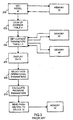
- microprocessor 40 After communication is established between telemetry modules 28 and 44, in step 200 microprocessor 40 obtains the model number of the device 12. By convention, this information is always in a specific address of memory 30, such as 0000. Once the microprocessor 40 obtains this information, it checks to determine which of its memories 46-54 contains the information characteristic of the designated model. In the present case, the information pertaining to the model META DDDR 1254 is stored in memory 46. In step 202, the microprocessor 40 looks up the tables of device characteristics, programming parameters and options for the designated pacemaker. A partial listing of these tables are shown above as TABLE I and TABLE II.
- step 204 the various information designated by TABLE I is displayed.
- step 206 the information retrieved from the memory 30, as well as the information from Table II is shown on display 58.
- step 208 the physician selects the operational parameters he wants to change by entering commands on keyboard 60 for modifying the programming of device 12. As part of this step, the physician also selects different values for the parameters listed in Table I.
- step 210 the microprocessor re-calculates the new programming parameters necessary to conform to the instructions received in step 208.
- step 212 the new programming parameters are transmitted to the device 12 for storing in memory 30. The device 12 then can resume its operation using the new programming parameters.
- modifying the operation of device 12 in existing systems is a time consuming operation.
- the programmer 14 if it is to be used for initialzing or modifying the operation of various types of devices, it must contain in its memories various data specific to that device, such as the data shown in Tables I and II. If the programmer does not contain the necessary information, it must be updated.
- some patient specific historical data for long time periods for diagnostic purposes. For example it may be useful to record the patient's pacing threshold each time the patient visits his physician. At present, this type of data must be stored in the programmer, which means that the same programmer 14 must be used all the time for the same patient or access to previous programmed states in a print out. If the programmer is down during a patient visit, or the patient is at a different location, for example in an emergency, the historical data is unavailable.
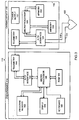
- System 110 constructed in accordance with the present invention is shown in Figure 3.
- System 110 includes a device 112 enclosed in a housing 116 and having a microprocessor 126, A/D interface 124, telemetry module 128, memory 130 and power supply 132 performing the same functions as the respective counterparts of Figure 1 except as noted below. These elements cooperate for sensing and pacing the chambers of heart 122 via leads 118 and 120.
- the system 110 includes a programmer 114 which can be used to program any one of a plurality of heart stimulating devices.
- the programmer 114 includes a microprocessor 140, A/D converter 142, telemetry module 144, program memory 156, display 158 and keyboard 160.
- the device 112 also includes a second memory 162.
- Memory 162 is used to store substantially all the information required to program the device 112, i.e., the information originally contained in memory 46 in the device 12 of Figure 1, and illustrated in Tables II and III. Of course, since Tables I and II are physically in the same location, i.e., within the device 112, they may be combined in a single table. In a preferred implementation memory 162 will be in ROM to ensure safety, minimum space and energy requirements. RAM is used only when absolutely unavoidable.
- the first row may contain the identification 'Model No.' and the actual model number of the device, i.e., 'META DDDR 3000' rather than an address location in memory 130.
- the entry in memory 162 may still be cross-referenced to an address in memory 130.
- Information stored in memory 162 can be optimized by storing it in a pre-arranged framework. This is best shown below: TABLE III LOCATION I.D.
- the 'LOCATION' is the sequential location normally maintained in the ROM. The programmer then vectors to LOCATION 1 in the implant which is always in one place and is given after the opening sequence of the telemetering the subsequent locations are in sequence and correspond to standard parameters. There is normally a correspondence between 'Location" and address. Location 'O' will normally be the identification of product. Preferably all the possible options are listed, as indicated below, for modes of operation with a "1" indicating that an option is available and a "0" indicating that the option is not available, as shown below. This corresponds to the 'MODE' code in Table III. For future options not yet developed, an industry accepted conversion may be used from existing options. TABLE IV AOO 0 AAI 1 VOO 0 VVI 1 VDI 1 DOO 1 DDI 0 DDD 0
- table III also contains at locations 20, 21 a listing of forbidden combinational states or operational parameters.
- a listing may be stored identifying the forbidden ranges for an operational parameter, such as the rate (location 21) for a specific mode of operation, such as AAI.
- This framework or data structure can be created to cover most of the options of implantable devices. Measurements and data logging can also use this approach as most of these items can be standardized. Correction factors and other pacing units can be handled in a similar manner. It is to be understood that a variety of structures are possible and the objective is to have flexibility at minimum cost of memory space.
- Table V below shows a typical memory 162 with the various information required to identify a specific implant. This information is readily changed for each model without any need for changing the programmer. The use of ROM for programmer specific information is not unreasonable imposition. In the case of some data in TABLE V the full ASCII CODE may be used, such as 'MODEL NAME' to give maximum flexibility. For most other information some simple framework will allow considerable saving of space and yet provide sufficient flexibility.
- the contents of the memory 162 may be extended to contain other information, such as a list of functions that can be monitored by the microprocessor 126. These functions then can be logged over time to generate historical data.
- the memory 162 may further include an indication of how much memory is available for storing the historical data.
- programmer 114 does not contain any specific information related to the device 112.
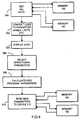
- the microprocessor 140 reads all the information from memory 162 required to program device 112. Patient specific information such as the patient's name, physician and so forth, are entered into the device 112 during an initialization phase.
- the received information is stored by the microprocessor 140 in a RAM (Random Access Memory) 164.
- step 304 information required by the physician for initializing or modifying the device 112 is displayed on display 158.
- the information can be displayed in the same format used by the present system (system 10) so that the physician need not learn any new skills for the operation of system 110.
- the physician selects the parameters that are to be modified in step 306, using the keyboard 160.
- the microprocessor 140 calculates the new programming parameters for the device 112.
- the new parameters are transmitted to the device 112.
- the device 112 receives the new parameters selected in step 306 or calculated in step 308.
- the microprocessor 126 stores the received information in memory 130 as required. The device 112 is now ready for operation.
- the programmer can also obtain from device 112 the information relevant for data logging.
- the physician may select the parameter to be logged as part of programming. These functions may include pulse threshold, ECG's, etc.
- the historical data stored in the memory 130 is retrieved and displayed by the programmer for analysis and diagnosis.
- the programmer 114 can be used with any number of cardiac stimulation devices without the need of a priori programming or updating regarding any particular device.
- the device 112 or any other heart stimulation device can be used with any other programmer without the loss of any information or flexibility of use.
- the cardiac device has been illustrated as having two separate memories, 130, 162.
- the device may be provided with a single memory performing the same function as memories 130, 162. Accordingly, the embodiment described in particular should be considered exemplary, not limiting, with respect to the following claims.
Landscapes
- Engineering & Computer Science (AREA)
- Health & Medical Sciences (AREA)
- Theoretical Computer Science (AREA)
- General Engineering & Computer Science (AREA)
- Software Systems (AREA)
- Public Health (AREA)
- Animal Behavior & Ethology (AREA)
- General Health & Medical Sciences (AREA)
- Life Sciences & Earth Sciences (AREA)
- Veterinary Medicine (AREA)
- Radiology & Medical Imaging (AREA)
- Nuclear Medicine, Radiotherapy & Molecular Imaging (AREA)
- Physics & Mathematics (AREA)
- General Physics & Mathematics (AREA)
- Biomedical Technology (AREA)
- Electrotherapy Devices (AREA)
- Measurement And Recording Of Electrical Phenomena And Electrical Characteristics Of The Living Body (AREA)
Applications Claiming Priority (2)
| Application Number | Priority Date | Filing Date | Title |
|---|---|---|---|
| US40163995A | 1995-03-08 | 1995-03-08 | |
| US401639 | 1995-03-08 |
Publications (2)
| Publication Number | Publication Date |
|---|---|
| EP0730882A2 true EP0730882A2 (fr) | 1996-09-11 |
| EP0730882A3 EP0730882A3 (fr) | 1997-08-06 |
Family
ID=23588600
Family Applications (1)
| Application Number | Title | Priority Date | Filing Date |
|---|---|---|---|
| EP96301418A Withdrawn EP0730882A3 (fr) | 1995-03-08 | 1996-03-01 | Système de stimulation cardiaque implantable amélioré |
Country Status (2)
| Country | Link |
|---|---|
| US (1) | US5690690A (fr) |
| EP (1) | EP0730882A3 (fr) |
Cited By (22)
| Publication number | Priority date | Publication date | Assignee | Title |
|---|---|---|---|---|
| WO1997026043A1 (fr) * | 1996-01-16 | 1997-07-24 | Medtronic, Inc. | Memorisation de donnees redactionnelles compressees relatives a un patient et reconstruction de la totalite du texte a partir de dispositifs medicaux pouvant etre implantes |
| WO1997043004A1 (fr) * | 1996-05-16 | 1997-11-20 | Sulzer Intermedics Inc. | Dispositif medical implantable pouvant etre ameliore par programmation |
| EP0756877A3 (fr) * | 1995-08-02 | 1998-06-03 | Pacesetter, Inc. | Système et procédé d'aide de décision pour un stimulateur cardiaque implantable |
| US5800473A (en) * | 1996-02-08 | 1998-09-01 | Ela Medical S.A. | Systems, methods, and apparatus for automatic updating of a programmer for an active implantable medical device |
| EP0890370A1 (fr) * | 1997-07-09 | 1999-01-13 | Vitatron Medical B.V. | Système pour stimulateur cardiaque à capacité de modification programmable ameliorée |
| WO1999010043A1 (fr) * | 1997-08-29 | 1999-03-04 | Medtronic, Inc. | Systeme de stimulation cardiaque comportant diverses unites therapeutiques de stimulation |
| FR2800489A1 (fr) * | 1999-10-29 | 2001-05-04 | Medtronic Inc | Systemes et procedes pour facturer ou inventorier des systemes de dispositifs medicaux |
| EP0917079A3 (fr) * | 1997-11-07 | 2002-01-23 | Orga Kartensysteme GmbH | Unité et procédé de traitement de données |
| WO2003003956A1 (fr) * | 2001-07-06 | 2003-01-16 | Cochlear Limited | Systeme pour dispositifs implantes |
| WO2004093990A1 (fr) * | 2003-04-02 | 2004-11-04 | Medtronic, Inc. | Gestion de therapies de neurostimulation utilisant differents ensembles de parametres enregistres |
| US7463928B2 (en) | 2003-04-25 | 2008-12-09 | Medtronic, Inc. | Identifying combinations of electrodes for neurostimulation therapy |
| US7505815B2 (en) | 2003-04-02 | 2009-03-17 | Medtronic, Inc. | Neurostimulation therapy usage diagnostics |
| US7548786B2 (en) | 2003-04-02 | 2009-06-16 | Medtronic, Inc. | Library for management of neurostimulation therapy programs |
| US7774067B2 (en) | 2006-04-12 | 2010-08-10 | Medtronic, Inc. | Autogeneration of neurostimulation therapy program groups |
| US7819909B2 (en) | 2004-07-20 | 2010-10-26 | Medtronic, Inc. | Therapy programming guidance based on stored programming history |
| US7894908B2 (en) | 2003-04-02 | 2011-02-22 | Medtronic, Inc. | Neurostimulation therapy optimization based on a rated session log |
| US8630715B2 (en) | 2006-04-12 | 2014-01-14 | Medtronic, Inc. | Rule-based stimulation program search |
| US8694115B2 (en) | 2004-07-20 | 2014-04-08 | Medtronic, Inc. | Therapy programming guidance based on stored programming history |
| US8784312B2 (en) | 2006-02-10 | 2014-07-22 | Cochlear Limited | Recognition of implantable medical device |
| US10105539B2 (en) | 2014-12-17 | 2018-10-23 | Cochlear Limited | Configuring a stimulation unit of a hearing device |
| US10576275B2 (en) | 2001-07-06 | 2020-03-03 | Cochlear Limited | System and method for configuring an external device using operating parameters from an implanted device |
| US10602284B2 (en) | 2016-07-18 | 2020-03-24 | Cochlear Limited | Transducer management |
Families Citing this family (51)
| Publication number | Priority date | Publication date | Assignee | Title |
|---|---|---|---|---|
| US7624028B1 (en) | 1992-11-17 | 2009-11-24 | Health Hero Network, Inc. | Remote health monitoring and maintenance system |
| US9215979B2 (en) * | 1992-11-17 | 2015-12-22 | Robert Bosch Healthcare Systems, Inc. | Multi-user remote health monitoring system |
| US6968375B1 (en) | 1997-03-28 | 2005-11-22 | Health Hero Network, Inc. | Networked system for interactive communication and remote monitoring of individuals |
| US20010011224A1 (en) | 1995-06-07 | 2001-08-02 | Stephen James Brown | Modular microprocessor-based health monitoring system |
| WO2001037174A1 (fr) | 1992-11-17 | 2001-05-25 | Health Hero Network, Inc. | Procede et systeme pour ameliorer l'observance d'un programme dietetique ou de tout autre regime medical |
| US5307263A (en) | 1992-11-17 | 1994-04-26 | Raya Systems, Inc. | Modular microprocessor-based health monitoring system |
| US5873733A (en) * | 1998-01-23 | 1999-02-23 | Sulzer Intermedics Inc. | Training unit for the pacemaker emergency intervention system using magnetic entry code |
| US6243608B1 (en) | 1998-06-12 | 2001-06-05 | Intermedics Inc. | Implantable device with optical telemetry |
| US6088618A (en) * | 1998-07-07 | 2000-07-11 | Vitatron Medical, B.V. | Pacemaker system and method for providing manual display concurrent with pacemaker software modification |
| US6308099B1 (en) | 1998-11-13 | 2001-10-23 | Intermedics Inc. | Implantable device and programmer system which permits multiple programmers |
| US6285909B1 (en) | 1999-05-27 | 2001-09-04 | Cardiac Pacemakers, Inc. | Preserving patient specific data in implantable pulse generator systems |
| US7181505B2 (en) * | 1999-07-07 | 2007-02-20 | Medtronic, Inc. | System and method for remote programming of an implantable medical device |
| US6497655B1 (en) * | 1999-12-17 | 2002-12-24 | Medtronic, Inc. | Virtual remote monitor, alert, diagnostics and programming for implantable medical device systems |
| US6650944B2 (en) * | 2000-02-23 | 2003-11-18 | Medtronic, Inc. | Follow-up monitoring method and system for implantable medical devices |
| US6622040B2 (en) * | 2000-12-15 | 2003-09-16 | Cardiac Pacemakers, Inc. | Automatic selection of stimulation chamber for ventricular resynchronization therapy |
| US7181285B2 (en) * | 2000-12-26 | 2007-02-20 | Cardiac Pacemakers, Inc. | Expert system and method |
| AUPR247601A0 (en) * | 2001-01-10 | 2001-02-01 | Cochlear Limited | Cochlear implant communicator |
| US6622045B2 (en) * | 2001-03-29 | 2003-09-16 | Pacesetter, Inc. | System and method for remote programming of implantable cardiac stimulation devices |
| AUPR551301A0 (en) * | 2001-06-06 | 2001-07-12 | Cochlear Limited | Monitor for auditory prosthesis |
| US6766198B1 (en) * | 2001-08-09 | 2004-07-20 | Pacesetter, Inc. | System and method for providing patient status information during interrogation of an implantable cardiac stimulation device |
| SE0102918D0 (sv) * | 2001-08-30 | 2001-08-30 | St Jude Medical | Method for providing software to an implantable medical device system |
| US7383088B2 (en) | 2001-11-07 | 2008-06-03 | Cardiac Pacemakers, Inc. | Centralized management system for programmable medical devices |
| US20040122294A1 (en) | 2002-12-18 | 2004-06-24 | John Hatlestad | Advanced patient management with environmental data |
| US20040122487A1 (en) | 2002-12-18 | 2004-06-24 | John Hatlestad | Advanced patient management with composite parameter indices |
| US8043213B2 (en) | 2002-12-18 | 2011-10-25 | Cardiac Pacemakers, Inc. | Advanced patient management for triaging health-related data using color codes |
| US7983759B2 (en) | 2002-12-18 | 2011-07-19 | Cardiac Pacemakers, Inc. | Advanced patient management for reporting multiple health-related parameters |
| US8391989B2 (en) | 2002-12-18 | 2013-03-05 | Cardiac Pacemakers, Inc. | Advanced patient management for defining, identifying and using predetermined health-related events |
| US7468032B2 (en) | 2002-12-18 | 2008-12-23 | Cardiac Pacemakers, Inc. | Advanced patient management for identifying, displaying and assisting with correlating health-related data |
| US7043305B2 (en) | 2002-03-06 | 2006-05-09 | Cardiac Pacemakers, Inc. | Method and apparatus for establishing context among events and optimizing implanted medical device performance |
| US7113825B2 (en) | 2002-05-03 | 2006-09-26 | Cardiac Pacemakers, Inc. | Method and apparatus for detecting acoustic oscillations in cardiac rhythm |
| ATE337048T1 (de) * | 2002-10-31 | 2006-09-15 | Medtronic Inc | Fehlersichere programmierung einer implantierbaren medizinischen vorrichtung |
| US7972275B2 (en) | 2002-12-30 | 2011-07-05 | Cardiac Pacemakers, Inc. | Method and apparatus for monitoring of diastolic hemodynamics |
| US7136707B2 (en) * | 2003-01-21 | 2006-11-14 | Cardiac Pacemakers, Inc. | Recordable macros for pacemaker follow-up |
| US7742821B1 (en) | 2003-06-11 | 2010-06-22 | Boston Scientific Neutomodulation Corporation | Remote control for implantable medical device |
| US20040215278A1 (en) * | 2003-04-25 | 2004-10-28 | Wim Stegink | Method and apparatus for locally upgrading implanted reprogrammable medical devices |
| US20040230456A1 (en) * | 2003-05-14 | 2004-11-18 | Lozier Luke R. | System for identifying candidates for ICD implantation |
| US7539803B2 (en) * | 2003-06-13 | 2009-05-26 | Agere Systems Inc. | Bi-directional interface for low data rate application |
| US20050137641A1 (en) * | 2003-12-08 | 2005-06-23 | Alexandra Naughton | User interface for cardiac rhythm management device programmer |
| US8359338B2 (en) * | 2004-07-30 | 2013-01-22 | Carefusion 303, Inc. | System and method for managing medical databases for patient care devices |
| US8285378B1 (en) * | 2004-09-27 | 2012-10-09 | Cardiac Pacemakers, Inc | System and method for determining patient-specific implantable medical device programming parameters |
| US7257447B2 (en) | 2005-04-20 | 2007-08-14 | Cardiac Pacemakers, Inc. | Method and apparatus for indication-based programming of cardiac rhythm management devices |
| US8108034B2 (en) | 2005-11-28 | 2012-01-31 | Cardiac Pacemakers, Inc. | Systems and methods for valvular regurgitation detection |
| US20070185545A1 (en) * | 2006-02-06 | 2007-08-09 | Medtronic Emergency Response Systems, Inc. | Post-download patient data protection in a medical device |
| US8666488B2 (en) | 2006-02-06 | 2014-03-04 | Physio-Control, Inc. | Post-download patient data protection in a medical device |
| WO2008069896A2 (fr) * | 2006-12-06 | 2008-06-12 | Medtronic, Inc. | Dispositif de télémétrie pour programmateur de dispositif médical |
| US9007478B2 (en) * | 2007-01-09 | 2015-04-14 | Capso Vision, Inc. | Methods to compensate manufacturing variations and design imperfections in a capsule camera |
| US20100057167A1 (en) * | 2008-09-02 | 2010-03-04 | Xander Evers | System and Method for the Interrogation of Implantable Medical Devices |
| US8600504B2 (en) | 2010-07-02 | 2013-12-03 | Cardiac Pacemakers, Inc. | Physiologic demand driven pacing |
| US8532775B2 (en) | 2011-02-18 | 2013-09-10 | Medtronic, Inc. | Modular medical device programmer |
| WO2012112179A1 (fr) | 2011-02-18 | 2012-08-23 | Medtronic, Inc. | Programmateur de dispositif médical avec béquille réglable |
| US11134902B2 (en) | 2017-12-26 | 2021-10-05 | Cardiac Pacemakers, Inc. | Identification of implanted electrode location |
Family Cites Families (7)
| Publication number | Priority date | Publication date | Assignee | Title |
|---|---|---|---|---|
| US4958632A (en) * | 1978-07-20 | 1990-09-25 | Medtronic, Inc. | Adaptable, digital computer controlled cardiac pacemaker |
| US4726380A (en) * | 1983-10-17 | 1988-02-23 | Telectronics, N.V. | Implantable cardiac pacer with discontinuous microprocessor, programmable antitachycardia mechanisms and patient data telemetry |
| EP0215730B1 (fr) * | 1985-09-17 | 1993-06-16 | BIOTRONIK Mess- und Therapiegeräte GmbH & Co Ingenieurbüro Berlin | Stimulateur cardiaque |
| US5080096A (en) * | 1990-07-06 | 1992-01-14 | Medtronic, Inc. | Method and apparatus for accessing a nonvolatile memory |
| US5330513A (en) * | 1992-05-01 | 1994-07-19 | Medtronic, Inc. | Diagnostic function data storage and telemetry out for rate responsive cardiac pacemaker |
| US5456692A (en) * | 1993-09-03 | 1995-10-10 | Pacesetter, Inc. | System and method for noninvasively altering the function of an implanted pacemaker |
| US5456691A (en) * | 1993-11-12 | 1995-10-10 | Pacesetter, Inc. | Programming system having multiple program modules |
-
1996
- 1996-03-01 EP EP96301418A patent/EP0730882A3/fr not_active Withdrawn
- 1996-09-12 US US08/712,238 patent/US5690690A/en not_active Expired - Lifetime
Cited By (38)
| Publication number | Priority date | Publication date | Assignee | Title |
|---|---|---|---|---|
| EP0756877A3 (fr) * | 1995-08-02 | 1998-06-03 | Pacesetter, Inc. | Système et procédé d'aide de décision pour un stimulateur cardiaque implantable |
| WO1997026043A1 (fr) * | 1996-01-16 | 1997-07-24 | Medtronic, Inc. | Memorisation de donnees redactionnelles compressees relatives a un patient et reconstruction de la totalite du texte a partir de dispositifs medicaux pouvant etre implantes |
| US5800473A (en) * | 1996-02-08 | 1998-09-01 | Ela Medical S.A. | Systems, methods, and apparatus for automatic updating of a programmer for an active implantable medical device |
| US6073049A (en) * | 1996-05-16 | 2000-06-06 | Sulzer Intermedics, Inc. | Programmably upgradable implantable cardiac pacemaker |
| WO1997043004A1 (fr) * | 1996-05-16 | 1997-11-20 | Sulzer Intermedics Inc. | Dispositif medical implantable pouvant etre ameliore par programmation |
| EP0890370A1 (fr) * | 1997-07-09 | 1999-01-13 | Vitatron Medical B.V. | Système pour stimulateur cardiaque à capacité de modification programmable ameliorée |
| WO1999010043A1 (fr) * | 1997-08-29 | 1999-03-04 | Medtronic, Inc. | Systeme de stimulation cardiaque comportant diverses unites therapeutiques de stimulation |
| EP0917079A3 (fr) * | 1997-11-07 | 2002-01-23 | Orga Kartensysteme GmbH | Unité et procédé de traitement de données |
| FR2800489A1 (fr) * | 1999-10-29 | 2001-05-04 | Medtronic Inc | Systemes et procedes pour facturer ou inventorier des systemes de dispositifs medicaux |
| US7502653B2 (en) | 2001-07-06 | 2009-03-10 | Cochlear Limited | Cochlear implant having patient-specific parameter storage |
| WO2003003956A1 (fr) * | 2001-07-06 | 2003-01-16 | Cochlear Limited | Systeme pour dispositifs implantes |
| EP1411876A4 (fr) * | 2001-07-06 | 2005-06-01 | Cochlear Ltd | Systeme pour dispositifs implantes |
| AU2001272189B2 (en) * | 2001-07-06 | 2008-10-09 | Cochlear Limited | Configuration of implanted devices |
| US10576275B2 (en) | 2001-07-06 | 2020-03-03 | Cochlear Limited | System and method for configuring an external device using operating parameters from an implanted device |
| US10981012B2 (en) | 2001-07-06 | 2021-04-20 | Cochlear Limited | Configuration of implanted devices |
| US7489970B2 (en) | 2003-04-02 | 2009-02-10 | Medtronic, Inc. | Management of neurostimulation therapy using parameter sets |
| US7505815B2 (en) | 2003-04-02 | 2009-03-17 | Medtronic, Inc. | Neurostimulation therapy usage diagnostics |
| US7548786B2 (en) | 2003-04-02 | 2009-06-16 | Medtronic, Inc. | Library for management of neurostimulation therapy programs |
| US8843203B2 (en) | 2003-04-02 | 2014-09-23 | Medtronic, Inc. | Neurostimulation therapy usage diagnostics |
| US7894908B2 (en) | 2003-04-02 | 2011-02-22 | Medtronic, Inc. | Neurostimulation therapy optimization based on a rated session log |
| US8095220B2 (en) | 2003-04-02 | 2012-01-10 | Medtronic, Inc. | Neurostimulation therapy usage diagnostics |
| US8155749B2 (en) | 2003-04-02 | 2012-04-10 | Medtronic, Inc. | Management of neurostimulation therapy using parameter sets |
| WO2004093990A1 (fr) * | 2003-04-02 | 2004-11-04 | Medtronic, Inc. | Gestion de therapies de neurostimulation utilisant differents ensembles de parametres enregistres |
| US7463928B2 (en) | 2003-04-25 | 2008-12-09 | Medtronic, Inc. | Identifying combinations of electrodes for neurostimulation therapy |
| US7826901B2 (en) | 2003-04-25 | 2010-11-02 | Medtronic, Inc. | Generation of therapy programs and program groups |
| US8068915B2 (en) | 2003-04-25 | 2011-11-29 | Medtronic, Inc. | Generation of therapy programs and program groups |
| US9186517B2 (en) | 2003-04-25 | 2015-11-17 | Medtronic, Inc. | Identifying combinations of electrodes for neurostimulation therapy |
| US8649872B2 (en) | 2003-04-25 | 2014-02-11 | Medtronic, Inc. | Identifying combinations of electrodes for neurostimulation therapy |
| US8694115B2 (en) | 2004-07-20 | 2014-04-08 | Medtronic, Inc. | Therapy programming guidance based on stored programming history |
| US7819909B2 (en) | 2004-07-20 | 2010-10-26 | Medtronic, Inc. | Therapy programming guidance based on stored programming history |
| US8784312B2 (en) | 2006-02-10 | 2014-07-22 | Cochlear Limited | Recognition of implantable medical device |
| USRE48038E1 (en) | 2006-02-10 | 2020-06-09 | Cochlear Limited | Recognition of implantable medical device |
| USRE49527E1 (en) | 2006-02-10 | 2023-05-16 | Cochlear Limited | Recognition of implantable medical device |
| US8712539B2 (en) | 2006-04-12 | 2014-04-29 | Medtronic, Inc. | Rule-based stimulation program search |
| US8630715B2 (en) | 2006-04-12 | 2014-01-14 | Medtronic, Inc. | Rule-based stimulation program search |
| US7774067B2 (en) | 2006-04-12 | 2010-08-10 | Medtronic, Inc. | Autogeneration of neurostimulation therapy program groups |
| US10105539B2 (en) | 2014-12-17 | 2018-10-23 | Cochlear Limited | Configuring a stimulation unit of a hearing device |
| US10602284B2 (en) | 2016-07-18 | 2020-03-24 | Cochlear Limited | Transducer management |
Also Published As
| Publication number | Publication date |
|---|---|
| US5690690A (en) | 1997-11-25 |
| EP0730882A3 (fr) | 1997-08-06 |
Similar Documents
| Publication | Publication Date | Title |
|---|---|---|
| US5690690A (en) | Implantable cardiac stimulation system | |
| EP0970722B1 (fr) | Système de programmation pour appareils médicaux implantés | |
| US8321366B2 (en) | Systems and methods for automatically resolving interaction between programmable parameters | |
| EP0890370B1 (fr) | Système pour stimulateur cardiaque à capacité de modification programmable ameliorée | |
| US5456692A (en) | System and method for noninvasively altering the function of an implanted pacemaker | |
| EP1009479B1 (fr) | Systeme de stimulation cardiaque comportant diverses unites therapeutiques de stimulation | |
| US6622045B2 (en) | System and method for remote programming of implantable cardiac stimulation devices | |
| US8352038B2 (en) | Medical device function configuration post-manufacturing | |
| US4867161A (en) | Cardiac pacemaker | |
| US8369945B2 (en) | Implantable cardioverter defibrillator with programmable capacitor charging level | |
| US5456691A (en) | Programming system having multiple program modules | |
| EP1503824B1 (fr) | Capacites d'induction orientees vers les taches, destinees a des defibrillateurs cardiaques implantables et a des programmateurs | |
| US6766198B1 (en) | System and method for providing patient status information during interrogation of an implantable cardiac stimulation device | |
| US6735478B1 (en) | System and method for providing patient status information during interrogation of an implantable cardiac stimulation device | |
| EP1987858B1 (fr) | Système de support de suivi pour dispositifs médicaux implantables | |
| US8812110B2 (en) | Implantable medical device |
Legal Events
| Date | Code | Title | Description |
|---|---|---|---|
| PUAI | Public reference made under article 153(3) epc to a published international application that has entered the european phase |
Free format text: ORIGINAL CODE: 0009012 |
|
| AK | Designated contracting states |
Kind code of ref document: A2 Designated state(s): DE FR GB |
|
| PUAL | Search report despatched |
Free format text: ORIGINAL CODE: 0009013 |
|
| AK | Designated contracting states |
Kind code of ref document: A3 Designated state(s): DE FR GB |
|
| 17P | Request for examination filed |
Effective date: 19970828 |
|
| STAA | Information on the status of an ep patent application or granted ep patent |
Free format text: STATUS: THE APPLICATION HAS BEEN WITHDRAWN |
|
| 18W | Application withdrawn |
Withdrawal date: 19990115 |