EP0890370A1 - Système pour stimulateur cardiaque à capacité de modification programmable ameliorée - Google Patents
Système pour stimulateur cardiaque à capacité de modification programmable ameliorée Download PDFInfo
- Publication number
- EP0890370A1 EP0890370A1 EP98110947A EP98110947A EP0890370A1 EP 0890370 A1 EP0890370 A1 EP 0890370A1 EP 98110947 A EP98110947 A EP 98110947A EP 98110947 A EP98110947 A EP 98110947A EP 0890370 A1 EP0890370 A1 EP 0890370A1
- Authority
- EP
- European Patent Office
- Prior art keywords
- pacemaker
- programmer
- program
- control program
- downloading
- Prior art date
- Legal status (The legal status is an assumption and is not a legal conclusion. Google has not performed a legal analysis and makes no representation as to the accuracy of the status listed.)
- Granted
Links
- 230000004048 modification Effects 0.000 title description 36
- 238000012986 modification Methods 0.000 title description 32
- 230000006870 function Effects 0.000 claims description 9
- 230000008859 change Effects 0.000 claims description 2
- 238000002560 therapeutic procedure Methods 0.000 abstract description 5
- 238000000034 method Methods 0.000 description 17
- 238000010586 diagram Methods 0.000 description 13
- 230000001746 atrial effect Effects 0.000 description 7
- 230000005540 biological transmission Effects 0.000 description 6
- 206010003658 Atrial Fibrillation Diseases 0.000 description 5
- 206010019280 Heart failures Diseases 0.000 description 5
- 230000002861 ventricular Effects 0.000 description 5
- 230000000747 cardiac effect Effects 0.000 description 4
- 102100026827 Protein associated with UVRAG as autophagy enhancer Human genes 0.000 description 2
- 101710102978 Protein associated with UVRAG as autophagy enhancer Proteins 0.000 description 2
- 230000009977 dual effect Effects 0.000 description 2
- 230000000694 effects Effects 0.000 description 2
- 238000004519 manufacturing process Methods 0.000 description 2
- 238000009825 accumulation Methods 0.000 description 1
- 230000002457 bidirectional effect Effects 0.000 description 1
- 238000004891 communication Methods 0.000 description 1
- 230000007812 deficiency Effects 0.000 description 1
- 238000011161 development Methods 0.000 description 1
- 238000005516 engineering process Methods 0.000 description 1
- 230000005055 memory storage Effects 0.000 description 1
- 230000002265 prevention Effects 0.000 description 1
- 230000008569 process Effects 0.000 description 1
- 238000012545 processing Methods 0.000 description 1
- 230000004213 regulation of atrial cardiomyocyte membrane depolarization Effects 0.000 description 1
- 230000034225 regulation of ventricular cardiomyocyte membrane depolarization Effects 0.000 description 1
- 230000000638 stimulation Effects 0.000 description 1
- 230000001360 synchronised effect Effects 0.000 description 1
- 238000012546 transfer Methods 0.000 description 1
- 230000000007 visual effect Effects 0.000 description 1
Images




Classifications
-
- A—HUMAN NECESSITIES
- A61—MEDICAL OR VETERINARY SCIENCE; HYGIENE
- A61N—ELECTROTHERAPY; MAGNETOTHERAPY; RADIATION THERAPY; ULTRASOUND THERAPY
- A61N1/00—Electrotherapy; Circuits therefor
- A61N1/18—Applying electric currents by contact electrodes
- A61N1/32—Applying electric currents by contact electrodes alternating or intermittent currents
- A61N1/36—Applying electric currents by contact electrodes alternating or intermittent currents for stimulation
- A61N1/372—Arrangements in connection with the implantation of stimulators
- A61N1/37211—Means for communicating with stimulators
- A61N1/37252—Details of algorithms or data aspects of communication system, e.g. handshaking, transmitting specific data or segmenting data
- A61N1/37264—Changing the program; Upgrading firmware
-
- A—HUMAN NECESSITIES
- A61—MEDICAL OR VETERINARY SCIENCE; HYGIENE
- A61N—ELECTROTHERAPY; MAGNETOTHERAPY; RADIATION THERAPY; ULTRASOUND THERAPY
- A61N1/00—Electrotherapy; Circuits therefor
- A61N1/18—Applying electric currents by contact electrodes
- A61N1/32—Applying electric currents by contact electrodes alternating or intermittent currents
- A61N1/36—Applying electric currents by contact electrodes alternating or intermittent currents for stimulation
- A61N1/372—Arrangements in connection with the implantation of stimulators
- A61N1/37211—Means for communicating with stimulators
-
- A—HUMAN NECESSITIES
- A61—MEDICAL OR VETERINARY SCIENCE; HYGIENE
- A61N—ELECTROTHERAPY; MAGNETOTHERAPY; RADIATION THERAPY; ULTRASOUND THERAPY
- A61N1/00—Electrotherapy; Circuits therefor
- A61N1/18—Applying electric currents by contact electrodes
- A61N1/32—Applying electric currents by contact electrodes alternating or intermittent currents
- A61N1/36—Applying electric currents by contact electrodes alternating or intermittent currents for stimulation
- A61N1/372—Arrangements in connection with the implantation of stimulators
- A61N1/37211—Means for communicating with stimulators
- A61N1/37252—Details of algorithms or data aspects of communication system, e.g. handshaking, transmitting specific data or segmenting data
- A61N1/37254—Pacemaker or defibrillator security, e.g. to prevent or inhibit programming alterations by hackers or unauthorised individuals
Definitions
- This invention lies in the field of programmable pacemaker systems and, more particularly, to systems for downloading a new program into an implanted pacemaker subject to restrictions which provide security that only a program which is appropriate to the implanted pacemaker is so downloaded.
- Implantable medical devices and in particular stimulus devices such as cardiac pacemakers, have for some time been software programmable.
- software programmable it is meant that the implanted device contains a form of microprocessor or microcomputer, and associated memory, the memory containing a control program for controlling prescribed device operations.
- Such programmable, or software control has become recessary with the advent of more sophisticated and complex pacemaker devices, wherein real time operation can be achieved only with microprocessor-based control. For example, with the increased use of DDD pacing, and rate responsive pacing, as well as ongoing collection of events for diagnostic purposes, exclusive hardware control simply is no longer feasible.
- microprocessor control led to the development of pacemakers with platforms, or main building blocks, wherein the pacemaker could be modified by the software that was downloaded into its memory.
- This technique enables producing different pacemaker types at the factory, or manufacturing site, by the expedient of loading the appropriate control program or programs into the pacemaker.
- microprocessor-based pacemakers also enables a subsequent update of already implanted pacemakers, by downloading new control programs, or software, through the use of commercially available external programmer devices.
- Such capacity for downloading new control program software into an implanted pacemaker enables building a device platform which is flexible enough to be software modified in the future to adapt it for different applications and studies.
- a pacemaker can be upgraded with new diagnostic tools and therapies to study the onset and prevention of atrial tacharthythmias.
- a pacemaker implanted in a patient who was subsequently jeopardized by a different heart failure mode would have the capacity to have his implanted pacemaker modified to enable an appropriate new therapy and to carry out new diagnostic data accumulation.
- downloading of new software into an implanted pacemaker i.e., using an external programmer to transmit a new control program for memory storage in the pacemaker, depends upon access to a programmer; the programmer must be capable of providing the desired software modification, and also be capable of more conventional programming of the pacemaker, e.g., setting stimulus pulse parameters, rate limits, etc.
- a patient having an implanted pacemaker that has been upgraded in order to try a new therapy, or to obtain specific diagnostic data may have need for re-programming of one or more pacing parameters. This could be a problem if a programmer was not available which "knew" the control program in the pacemaker, and consequently could reliably re-program the parameters. Similarly, the same patient may reach the point where it is determined that the program must be changed back to a prior and less complex control program, in which case downgrading of the pacemaker program would be required.
- the pacemaker company may release an upgrade of a program, having determined that all implanted pacemakers of a particular type, i.e., with a particular control program, should be upgraded to the new control program whenever possible.
- an implantable device system preferably a cardiac pacemaker system, having two-way telemetric capability between an implanted pacemaker and external programmer unit.
- the pacemaker suitably has memory for storing a control program, and also stores data representative of a predetermined group of pacemaker types, and data representative of the specific pacemaker type according to the control program stored in the pacemaker memory.
- the different pacemaker types are ranked in a hierarchy, from lowest to highest.
- Each implantable pacemaker stores permissions data representative of the model types within its group to which it can be programmed.
- the external programmer can receive new program releases, i.e., updated control programs, and has memory for storing a plurality of control programs corresponding to pacemaker different types, the different pacemaker types falling in one or more different groups.
- the programmer is software controlled to interrogate the implanted pacemaker, determine its group, type and permissions, and allows modification, i.e., upgrading or downgrading of the control program as a function of the pacemaker data and the program types that it can support.
- the programmer of the system of this invention provides the user with an option, suitably indicated by a visual display, of whether to modify the pacemaker by downloading a different program. More specifically, in a situation where the programmer cannot support the pacemaker, i.e., cannot provide re-programming of pacemaker parameters for that particular type, the user is presented with the option of downgrading the pacemaker to a different type which is supported by the programmer being used.
- the programmer is supplied with a newly released program which constitutes an improved version of a prior release program corresponding to a predetermined pacemaker type. Upon communication with the pacemaker, if the programmer finds that the pacemaker is using the prior release program, an automatic transfer is made whereby the programmer downloads the new program to replace the old program, and adjusts the pacemaker permissions data accordingly.
- a series of devices e.g., pacemakers are provided which are based on a common hardware platform, and are flexibly software modifiable.
- modifiable it is meant that the control program can be changed, either upgrading or downgrading the program to increase or decrease the pacemaker sophistication and capability.
- a common hardware platform including microprocessor and associated memory, and conventional digital controller and timer circuitry, are provided.
- Different groups of pacemakers each group using the same hardware platform, are structured to provide different therapies.
- a first group of pacemakers may be designed specifically for treating atrial fibrillation (AF), a second group for treating heart failure (HF), etc.
- An external programmer utilizes information about the modification group to determine to which products, or pacemaker types, an implanted pacemaker may be modified. In this way, it is possible to control modification of an implanted pacemaker to a specific product and type only if the device is to be included in a certain study, and thus has been placed in a predetermined group.
- the pacemakers of some modification groups will receive permission to be modified to receive the new software, while other pacemakers will not.
- a series of pacemakers within this invention may, at a given time, consist of six products, and four modification groups.
- Group A (comprising AF types) may include types 0, 1, 2 and 3; Group B may include types 0 and 4; Group C, types 0 and 5; and Group D, limited to type 1. Any pacemaker in Group A can be modified to one of the other AF types in the groups, but cannot be modified to type 4 (which may be an HF type) or to type 5. The pacemaker in Group D is to remain programmed as it was programmed at the factory and cannot be modified.
- Each pacemaker has stored in memory the following data, pertinent to the modification procedure of this invention:
- the following represents an implantable device which is programmed to Group A, Type 1, and is permitted to be modified to any one of Types 0, 1, 2 and 3:
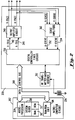
- a pacemaker 6 is illustrated in block diagram form, coupled to a human heart 10. Also shown is an external programmer/display apparatus 4, of a type commercially available for programming multi-programmable implantable pacemakers.
- pacing circuitry 320 which includes circuitry performing all of the basic timing, stimulation and sensing functions of a cardiac pacemaker, and a microprocessor circuit 302, which controls the timing intervals provided by the pacing circuitry 320 and performs other logic functions.
- Pacing circuitry 320 also includes a bidirectional telemetry circuit coupled to an antenna 334, allowing transmission of information from external programmer 4 to pacemaker 6, and allowing transmission of information from the pacemaker 6 to the programmer 4, corresponding to telemetry and programming systems presently available.
- the transmission of data from the programmer to the pacemaker may consist of modifying pacing parameters, or may constitute downloading of a new program to be stored with microprocessor 302, for controlling pacemaker functions.
- Data transmission from pacemaker 6 to programmer 4 may include data representative of the pacemaker, as set forth above, and may also include diagnostic data which has been obtained and stored by the pacemaker.
- Programmer 4 which is used by the physician, includes a corresponding antenna 100 for communicating with the pacemaker, the antenna being coupled to a telemetry/antenna driver circuit 102 which serves to demodulate telemetry signals received from antenna 334 of the pacemaker, and to apply them in parallel or serial digital format to input/output (I/O) unit 108, where they in turn may be applied to a video monitor 112 via graphic interface 110, and/or provided to central processing unit and memory 114, and/or printer 118.
- Unit 114 includes a microprocessor for controlling operation of the programmer/display apparatus, and is responsive to entered commands via keyboard 116, for controlling programming signals sent to the pacemaker, as well as for controlling operation of the video display 112 and printer 118.
- Unit 114 contains suitable memory for storing a plurality of software programs, e.g., control programs corresponding to different pacemaker types as discussed above.
- Fig. 2 is a block functional diagram of the pacemaker 6 illustrated in Fig. 1.
- the pacemaker is divided schematically into a microcomputer circuit 302 and a pacing circuit 320.
- the block diagram of Fig. 2 is representative of a dual chamber pacemaker, and accordingly pulse generator circuit 340 includes a ventricular pulse generator circuit coupled to the heart by a pair of V-pace output lines as well as an atrial pulse generator circuit coupled to the heart by means of atrial lines designated A-pace.
- Also represented at 360 are atrial and ventricular sense amplifiers.
- the output circuit 340 and sense amplifier circuits 360 may contain pulse generators and sense amplifiers corresponding to any of those presently employed in modern pacemakers.
- Digital controller/timer circuit 330 which includes a set of timers and associated logic.
- Digital controller/timer circuit 330 defines the pacing interval of the device, which may take the form of an A-A escape interval initiated on atrial sensing or pacing and triggering atrial pacing at the expiration thereof, or may take the form of a V-V interval initiated on ventricular sensing or pacing and triggering ventricular pulse pacing at the expiration thereof.
- Digital controller/timer circuit 330 similarly defines the A-V escape interval for a dual chamber pacemaker providing synchronous pacing. The specific values of the interval defined are controlled by the microcomputer circuit 302 by means of data and control bus 306.
- Sensed atrial depolarizations are communicated to the digital controller/timer circuit 330 on A-event line 352, ventricular depolarizations are communicated to digital control/timer circuit 330 on V-event line 354.
- digital controller/timer circuit 330 In order to trigger generation of a ventricular pacing pulse, digital controller/timer circuit 330 generates a trigger signal on V trig line 342; similarly, in order to trigger an atrial pacing pulse, digital controller/timer circuit 330 generates a trigger pulse on A-trig line 344.
- Microcomputer circuit 302 controls the operational functions of digital controller/timer 330, specifying which timing intervals are employed, and controlling the -duration of the various timing intervals, via data and control bus 306.
- Microcomputer circuit 302 contains a microprocessor 304 and associated system clock 308, and RAM circuits illustrated at 310 and 312. In addition, circuit 302 may include a separate RAM/ROM chip 314.
- Fig. 3 there is shown a flow diagram which illustrates the principle of the invention.
- the physician starts patient follow-up, using the external programmer, as illustrated at 30.
- the programmer reads the device identification bytes, so as to obtain the pertinent information regarding the implanted pacemaker.
- the device identification data is compared to the programmer software, to determine whether the programmer can support this particular device. If no, as indicated at 35, no further follow-up or modification is possible.
- the device may be directly programmable, without modification, in which case the normal follow-up is undertaken at 36, e.g., the physician may re-program certain basic parameters. If the device is not directly programmable but modifiable, the programmer goes to the modification procedures indicated at 34.
- the physician may, in some circumstances, choose to modify or not modify. If the choice is to modify, the modification procedure is suitably followed by the normal follow-up as indicated at block 36; if the choice is not to modify, no follow-up is possible, as shown at block 38.
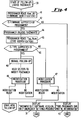
- Fig. 4 there is shown a more detailed flow diagram of the procedure of this invention whereby the programmer determines the circumstances under which an implanted pacemaker can be or must be program modified.
- follow-up is started, with the pacemaker locked, i.e., it is in a fixed mode during programming.
- the programmer interrogates the pacemaker and reads the ROM_Nr, to get an identification of the pacemaker firmware.
- the system proceeds to block 44, and unlocks the pacemaker.
- the programmer reads the Typ_Num, to get an identification of the pacemaker type.
- a modification procedure routine is entered, as indicated at block 47. This procedure may result in no modification allowed, in which case a display is provided to the physician as indicated at 51, to the effect that the pacemaker has an incompatible software version, and only emergency settings are possible.
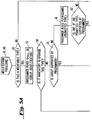
- Fig. 5A and 5B there is shown a more detailed flow diagram representing the modification procedure 47, 49.
- the pacemaker is modifiable type, i.e., is it a type which is part of the overall series of pacemakers adapted for modification? If yes, at 53 the programmer reads the Group_ID. After this, at 54 an initial determination is made as to whether it mandatory to upgrade this type. As discussed further below, the program version which has been stored in an implantable pacemaker type may be found to have a bug, or for any reason it may be deemed required to upgrade the program. If yes, then at block 66 the programmer automatically selects the mandatory upgrade type, and at 68 the pacemaker is modified by downloading the software corresponding to the upgrade type.
- the programmer automatically selects the mandatory upgrade type, and at 68 the pacemaker is modified by downloading the software corresponding to the upgrade type.
- the routine goes to 57 and determines whether the user wants to modify the pacemaker. If yes, at 58 the user selects a type which is group member, and at 59 the pacemaker is modified accordingly. This includes programming the new Typ_Num according to the selected type; re-programming the permissions according to the group members for this programmer; and programming parameters and software according to the new type.
- the programmer reads the permissions data, to determine what types are permitted. Then, at 62, it is determined if any of the permitted types are supported by the programmer in use. If yes, the user is given an option to modify the pacemaker, as indicated at 63. If this option is chosen, then at 64 the user selects a permitted type which is also supported by the programmer. At 65, the pacemaker is modified accordingly, including re-programming the Typ_Num according to the selected type, and programming parameters and software according to the newly selected type.
- a specific application of the system of this invention is where a pacemaker of a relatively new type, i.e., with a late release control program, is interrogated by a programmer which does not have software to support the new type pacemaker.
- the pacemaker is not directly programmable.
- the user is given an option to downgrade the pacemaker to a lower, or earlier type, after which the pacemaker can be programmed.
- the pacemaker is of Group A, Type 2; and Group A contains Types 0, 1 and 2.
- the implanted pacemaker is permitted to be modified to any one of Types 0, 1 and 2.
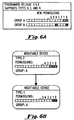
- the programmer While the programmer supports Group A, it only supports Types 0 and 1, and cannot support Type 2. As indicated in Fig. 6A, the programmer has software permitting it to program types 0 and 1 for Group A, and 0 and 4 for Group B (Type 0 is common to both groups). In this situation, and referring first generally to Fig. 3, when a physician attempts to program the implanted device, it is determined that the device is modifiable. Referring to the more detailed flow diagram of Fig. 4, at 42 it is determined that the firmware is supported by the programmer, but at 46 it is determined that the specific type is not. Subsequently, the pacemaker goes to modification procedure block 47. Referring to Fig.
- the detailed flow diagram of the modification block, in 52 it is determined that the implanted pacemaker is a modifiable type. At 54, it is then determined that it is not mandatory to upgrade. At 55 it is determined that the group is supported, and the permissions data loaded into the pacemaker are read at 61. After determining that there are types supported by the programmer (Types 0 and 1), the user is given the option at 63 to modify. Assuming that the user wants to modify, the new type is selected at 64, and the pacemaker is modified at 65. Note that only permissions for Types 0 and 1 are programmed into the pacemaker, i.e., it is then limited to types 0 and 1. Following this, the programmer signals that modification is ready, and the physician can proceed to restart follow-up if desired.
- Figs. 7A and 7B there is shown a second set of circumstances, or scenario, where a mandatory upgrade is performed.
- an upgrade can be made mandatory where it is determined that an existing program either has a deficiency, and thus must be replaced by a corrected program, or a new program has been released which, for one reason or another, is sufficiently more advantageous so as to require upgrading.
- the example of Figs. 7A and 7B illustrates a situation where a problem has been found in the program of Type 1 pacemakers, and it has been determined that all such pacemakers should be modified to Type 3, i.e., the stored program should be replaced with the latest release corresponding to Type 3.
- the pacemaker is in Group A, and the programmer supports Group A, and specifically supports Types 0 and 3.
- the task is to remove the Type 1 program and upgrade the pacemaker with the program for Type 3.
- Figs. 3-5 in the general principle scheme as illustrated in Fig. 3, there is a determination that the device is modifiable.
- the firmware is supported, but the type is not supported, following which the programmer goes to the modification procedure.
- Fig. 5A after it is determined that the pacemaker is a modifiable type, it is determined at 54 that this is a mandatory upgrade, i.e., the Type 1 software must be replaced with Type 3 software.
- the user has no choice; the programmer goes to step 66, selects the mandatory upgrade type, and at 68 proceeds to modify the pacemaker.
- the modification includes disabling Type 1, and enabling Type 3 in the permissions data stored in the pacemaker.
- the user may voluntarily modify the implanted pacemaker. For example, assume that a pacemaker belongs to Group A, and its type is 1; and that the programmer supports Types 0, 1 and 2 of Group A. In this situation, the programmer determines that the firmware is supported and the type is supported, and proceeds to normal follow-up. Referring to Fig. 5, at 52 the pacemaker is found to be modifiable, and at 54 it is found that it is not mandatory to upgrade. At 55, it is found that the group is supported by the programmer, and at 57 the user exercises the option to modify. The user then chooses the desired type, the choice being limited to a group member supported by this programmer.
- a patient with a pacer of a type in a first group appears in a hospital where the programmer supports only groups from a second type.
- the patient may be part of an AF study, for example, Group A, whereas the programmer is designed for pacemakers implanted in patients with heart failure, corresponding to Group B.
- the pacer is in Group A, and assume that its type is Type 2. Its permissions are Types 0, 1 and 2.
- the programmer supports only Group B, but Group B includes Type 0, a basic type to which all pacemakers in this series are modifiable.
- the pacemaker is a modifiable type; it is not mandatory to upgrade; the group is not supported, but there is one permitted type supported, i.e., Type 0.
- the pacemaker can be modified only to Type 0. If this is done, the permissions data would not be changed.
- the firmware is not supported, i.e., the ROM_Nr of the pacemaker is unknown by the programmer, then no follow-up is possible.
- the firmware is supported but the type is not supported, and the type is not a modifiable one, then again no modification or follow-up is possible; only emergency settings can be made.
- the firmware is supported, the type is not supported, the type is a modifiable type, but there is no type in the permissions data which is also supported by the programmer, then no modification or follow-up is possible.
- a system and method for modifying pacemakers that belong to a defined series, whereby controlled conditions are established for downloading a new control program to replace a control program that a pacemaker has been using.
- the system enables upgrading pacemakers to new software versions either when desired, or when mandatory; but, it prevents downloading of new program versions to pacemakers which are not permitted to accept the new software.
- the system permits the flexibility of changing the pacemaker to a different type in order to be able to program it with a programmer that does not support the initial pacemaker type.
Landscapes
- Health & Medical Sciences (AREA)
- Engineering & Computer Science (AREA)
- Biomedical Technology (AREA)
- Nuclear Medicine, Radiotherapy & Molecular Imaging (AREA)
- Radiology & Medical Imaging (AREA)
- Life Sciences & Earth Sciences (AREA)
- Animal Behavior & Ethology (AREA)
- General Health & Medical Sciences (AREA)
- Public Health (AREA)
- Veterinary Medicine (AREA)
- Electrotherapy Devices (AREA)
Applications Claiming Priority (2)
| Application Number | Priority Date | Filing Date | Title |
|---|---|---|---|
| US890435 | 1997-07-09 | ||
| US08/890,435 US5843138A (en) | 1997-07-09 | 1997-07-09 | Pacemaker system with enhanced programmable modification capacity |
Publications (2)
| Publication Number | Publication Date |
|---|---|
| EP0890370A1 true EP0890370A1 (fr) | 1999-01-13 |
| EP0890370B1 EP0890370B1 (fr) | 2006-03-29 |
Family
ID=25396674
Family Applications (1)
| Application Number | Title | Priority Date | Filing Date |
|---|---|---|---|
| EP98110947A Expired - Lifetime EP0890370B1 (fr) | 1997-07-09 | 1998-06-15 | Système pour stimulateur cardiaque à capacité de modification programmable ameliorée |
Country Status (3)
| Country | Link |
|---|---|
| US (1) | US5843138A (fr) |
| EP (1) | EP0890370B1 (fr) |
| DE (1) | DE69833992T2 (fr) |
Families Citing this family (43)
| Publication number | Priority date | Publication date | Assignee | Title |
|---|---|---|---|---|
| US5951594A (en) | 1998-04-28 | 1999-09-14 | Vitatron Medical B.V. | Air core antenna for implantable device and method of production |
| US6088618A (en) | 1998-07-07 | 2000-07-11 | Vitatron Medical, B.V. | Pacemaker system and method for providing manual display concurrent with pacemaker software modification |
| US6308099B1 (en) | 1998-11-13 | 2001-10-23 | Intermedics Inc. | Implantable device and programmer system which permits multiple programmers |
| US6285909B1 (en) | 1999-05-27 | 2001-09-04 | Cardiac Pacemakers, Inc. | Preserving patient specific data in implantable pulse generator systems |
| US7149773B2 (en) * | 1999-07-07 | 2006-12-12 | Medtronic, Inc. | System and method of automated invoicing for communications between an implantable medical device and a remote computer system or health care provider |
| US7181505B2 (en) * | 1999-07-07 | 2007-02-20 | Medtronic, Inc. | System and method for remote programming of an implantable medical device |
| US6493579B1 (en) | 1999-08-20 | 2002-12-10 | Cardiac Pacemakers, Inc. | System and method for detection enhancement programming |
| US6289248B1 (en) | 1999-08-20 | 2001-09-11 | Cardiac Pacemakers, Inc. | System and method for detecting and displaying parameter interactions |
| US6405086B1 (en) * | 1999-08-22 | 2002-06-11 | Cardiac Pacemakers, Inc. | Knowledge sharing in systems including implantable medical devices |
| US6687547B2 (en) | 1999-09-14 | 2004-02-03 | Medtronic, Inc. | Method and apparatus for communicating with an implantable medical device with DTMF tones |
| US6263246B1 (en) | 1999-09-14 | 2001-07-17 | Medtronic, Inc. | Method and apparatus for communications with an implantable device |
| US6907291B1 (en) | 1999-09-30 | 2005-06-14 | Pacesetter, Inc. | Secure telemetry system and method for an implantable cardiac stimulation device |
| US6424867B1 (en) | 1999-09-30 | 2002-07-23 | Pacesetter, Inc. | Secure telemetry system and method for an implantable cardiac stimulation device |
| US6363282B1 (en) * | 1999-10-29 | 2002-03-26 | Medtronic, Inc. | Apparatus and method to automatic remote software updates of medical device systems |
| US6473638B2 (en) * | 1999-12-24 | 2002-10-29 | Medtronic, Inc. | Medical device GUI for cardiac electrophysiology display and data communication |
| US7574368B2 (en) * | 2000-12-15 | 2009-08-11 | Ric Investments, Llc | System and method for upgrading a pressure generating system |
| US6584356B2 (en) * | 2001-01-05 | 2003-06-24 | Medtronic, Inc. | Downloadable software support in a pacemaker |
| SE0102918D0 (sv) * | 2001-08-30 | 2001-08-30 | St Jude Medical | Method for providing software to an implantable medical device system |
| US7082334B2 (en) * | 2001-12-19 | 2006-07-25 | Medtronic, Inc. | System and method for transmission of medical and like data from a patient to a dedicated internet website |
| US6985088B2 (en) * | 2002-03-15 | 2006-01-10 | Medtronic, Inc. | Telemetry module with configurable data layer for use with an implantable medical device |
| US20040064165A1 (en) * | 2002-09-30 | 2004-04-01 | Thompson David L. | Implantable medical device with hardware-based patch |
| US7191006B2 (en) | 2002-12-05 | 2007-03-13 | Cardiac Pacemakers, Inc. | Cardiac rhythm management systems and methods for rule-illustrative parameter entry |
| US7343199B2 (en) * | 2002-12-27 | 2008-03-11 | Cardiac Pacemakers, Inc. | Measurement of respiratory sinus arrhythmia using respiratory and electrogram sensors in an implantable device |
| US20040210273A1 (en) * | 2003-04-18 | 2004-10-21 | Medtronic, Inc. | Presentation of patient image with implantable medical device information |
| US20040249761A1 (en) * | 2003-06-03 | 2004-12-09 | Bea Systems, Inc. | Self-service customer license management application providing transaction history |
| US20040249653A1 (en) * | 2003-06-03 | 2004-12-09 | Bea Systems, Inc. | Self-service customer license management application allowing users to input missing licenses |
| US20040249755A1 (en) * | 2003-06-03 | 2004-12-09 | Bea Systems, Inc. | Self-service customer license management application using a group administration application |
| US20040249762A1 (en) * | 2003-06-03 | 2004-12-09 | Bea Systems, Inc. | Self-service customer license management application using configuration input pages |
| US20040249760A1 (en) * | 2003-06-03 | 2004-12-09 | Bea Systems, Inc. | Self-service customer license management application using encrypted universal resource locators |
| US20040249756A1 (en) * | 2003-06-03 | 2004-12-09 | Bea Systems, Inc. | Self-service customer license management application allowing software version upgrade and downgrade |
| US20050010532A1 (en) * | 2003-07-09 | 2005-01-13 | Bea Systems, Inc. | Self-service customer license management application using software license bank |
| US7684861B2 (en) * | 2003-11-13 | 2010-03-23 | Cardiac Pacemakers, Inc. | Implantable cardiac monitor upgradeable to pacemaker or cardiac resynchronization device |
| US7299086B2 (en) * | 2004-03-05 | 2007-11-20 | Cardiac Pacemakers, Inc. | Wireless ECG in implantable devices |
| US7167755B2 (en) | 2004-10-05 | 2007-01-23 | Cardiac Pacemakers, Inc. | Adaptive software configuration for a medical device |
| US8755885B2 (en) * | 2004-10-13 | 2014-06-17 | Medtronic, Inc. | Software configurable medical device platform and associated methods |
| US7613672B2 (en) * | 2006-04-27 | 2009-11-03 | Cardiac Pacemakers, Inc. | Medical device user interface automatically resolving interaction between programmable parameters |
| US20090048644A1 (en) * | 2007-08-14 | 2009-02-19 | Stahmann Jeffrey E | System and method for providing intrabody data security on an active implantable medical device |
| US8121689B2 (en) | 2007-10-01 | 2012-02-21 | Cardiac Pacemakers, Inc. | Proactive interactive limits override for implantable medical device user interface |
| US20100057167A1 (en) * | 2008-09-02 | 2010-03-04 | Xander Evers | System and Method for the Interrogation of Implantable Medical Devices |
| US8414559B2 (en) | 2009-05-07 | 2013-04-09 | Rainbow Medical Ltd. | Gastroretentive duodenal pill |
| US20130289657A1 (en) * | 2012-04-25 | 2013-10-31 | Cyberonics, Inc. | Programmer upgrading methods, implantable medical device programmers, and articles of manufacture |
| DE102017222387A1 (de) * | 2017-12-11 | 2019-06-13 | Bayerische Motoren Werke Aktiengesellschaft | Verfahren und System zum Autorisieren einer älteren Applikation eines Steuergeräts eines Fahrzeugs |
| DE102018200318A1 (de) * | 2018-01-11 | 2019-07-11 | Bayerische Motoren Werke Aktiengesellschaft | Absicherung eines Softwareupdates eines Steuergerätes eines Fortbewegungsmittels |
Citations (5)
| Publication number | Priority date | Publication date | Assignee | Title |
|---|---|---|---|---|
| US5360437A (en) * | 1991-10-31 | 1994-11-01 | Medtronic, Inc. | Implantable medical device with flexible hardware platform |
| US5456691A (en) | 1993-11-12 | 1995-10-10 | Pacesetter, Inc. | Programming system having multiple program modules |
| US5456692A (en) | 1993-09-03 | 1995-10-10 | Pacesetter, Inc. | System and method for noninvasively altering the function of an implanted pacemaker |
| EP0730882A2 (fr) * | 1995-03-08 | 1996-09-11 | Telectronics N.V. | Système de stimulation cardiaque implantable amélioré |
| WO1997043004A1 (fr) * | 1996-05-16 | 1997-11-20 | Sulzer Intermedics Inc. | Dispositif medical implantable pouvant etre ameliore par programmation |
-
1997
- 1997-07-09 US US08/890,435 patent/US5843138A/en not_active Expired - Lifetime
-
1998
- 1998-06-15 EP EP98110947A patent/EP0890370B1/fr not_active Expired - Lifetime
- 1998-06-15 DE DE69833992T patent/DE69833992T2/de not_active Expired - Lifetime
Patent Citations (5)
| Publication number | Priority date | Publication date | Assignee | Title |
|---|---|---|---|---|
| US5360437A (en) * | 1991-10-31 | 1994-11-01 | Medtronic, Inc. | Implantable medical device with flexible hardware platform |
| US5456692A (en) | 1993-09-03 | 1995-10-10 | Pacesetter, Inc. | System and method for noninvasively altering the function of an implanted pacemaker |
| US5456691A (en) | 1993-11-12 | 1995-10-10 | Pacesetter, Inc. | Programming system having multiple program modules |
| EP0730882A2 (fr) * | 1995-03-08 | 1996-09-11 | Telectronics N.V. | Système de stimulation cardiaque implantable amélioré |
| WO1997043004A1 (fr) * | 1996-05-16 | 1997-11-20 | Sulzer Intermedics Inc. | Dispositif medical implantable pouvant etre ameliore par programmation |
Non-Patent Citations (1)
| Title |
|---|
| WITTKAMPF ET AL., PACE, vol. 7, no. PART 2, November 1994 (1994-11-01) |
Also Published As
| Publication number | Publication date |
|---|---|
| EP0890370B1 (fr) | 2006-03-29 |
| DE69833992T2 (de) | 2007-04-05 |
| US5843138A (en) | 1998-12-01 |
| DE69833992D1 (de) | 2006-05-18 |
Similar Documents
| Publication | Publication Date | Title |
|---|---|---|
| US5843138A (en) | Pacemaker system with enhanced programmable modification capacity | |
| EP0970722B1 (fr) | Système de programmation pour appareils médicaux implantés | |
| US5456692A (en) | System and method for noninvasively altering the function of an implanted pacemaker | |
| EP1009479B1 (fr) | Systeme de stimulation cardiaque comportant diverses unites therapeutiques de stimulation | |
| EP0956093B1 (fr) | Appareil permettant de reguler un dispositif medical implante en fonction du temps | |
| US5690690A (en) | Implantable cardiac stimulation system | |
| US5456691A (en) | Programming system having multiple program modules | |
| US7493165B2 (en) | Implantable device and programmer system which permits multiple programmers | |
| US8352038B2 (en) | Medical device function configuration post-manufacturing | |
| US6073049A (en) | Programmably upgradable implantable cardiac pacemaker | |
| US8255053B2 (en) | Method and apparatus for question-based programming of cardiac rhythm management devices | |
| AU654641B2 (en) | Implantable pacemaker providing hysteresis in dual-chamber modes | |
| EP4299109B1 (fr) | Système de programmation à distance de dispositif médical implantable | |
| US20220387809A1 (en) | Method for programming an implantable medical device | |
| US20040064165A1 (en) | Implantable medical device with hardware-based patch | |
| US7457663B2 (en) | Cardiac rhythm management system providing control of pacing features with a reduced number of variables | |
| US20250262443A1 (en) | Computer implemented method and system for programming leadless cardiac pacemakers | |
| WO2000023145A1 (fr) | Dispositif de stimulation cardiaque implantable |
Legal Events
| Date | Code | Title | Description |
|---|---|---|---|
| PUAI | Public reference made under article 153(3) epc to a published international application that has entered the european phase |
Free format text: ORIGINAL CODE: 0009012 |
|
| AK | Designated contracting states |
Kind code of ref document: A1 Designated state(s): CH DE FR LI NL SE |
|
| AX | Request for extension of the european patent |
Free format text: AL;LT;LV;MK;RO;SI |
|
| 17P | Request for examination filed |
Effective date: 19990217 |
|
| AKX | Designation fees paid |
Free format text: CH DE FR LI NL SE |
|
| 17Q | First examination report despatched |
Effective date: 20050415 |
|
| GRAP | Despatch of communication of intention to grant a patent |
Free format text: ORIGINAL CODE: EPIDOSNIGR1 |
|
| GRAS | Grant fee paid |
Free format text: ORIGINAL CODE: EPIDOSNIGR3 |
|
| GRAA | (expected) grant |
Free format text: ORIGINAL CODE: 0009210 |
|
| AK | Designated contracting states |
Kind code of ref document: B1 Designated state(s): CH DE FR LI NL SE |
|
| REG | Reference to a national code |
Ref country code: CH Ref legal event code: EP |
|
| REF | Corresponds to: |
Ref document number: 69833992 Country of ref document: DE Date of ref document: 20060518 Kind code of ref document: P |
|
| REG | Reference to a national code |
Ref country code: SE Ref legal event code: TRGR |
|
| REG | Reference to a national code |
Ref country code: CH Ref legal event code: PFA Owner name: VITATRON B.V. Free format text: VITATRON MEDICAL B.V.#KANAALWEG 24, P.O. BOX 76#NL-6950 AB DIEREN (NL) -TRANSFER TO- VITATRON B.V.#MEANDER 1051#6825 MJ ARNHEM (NL) Ref country code: CH Ref legal event code: NV Representative=s name: ING. MARCO ZARDI C/O M. ZARDI & CO. S.A. |
|
| ET | Fr: translation filed | ||
| PLBE | No opposition filed within time limit |
Free format text: ORIGINAL CODE: 0009261 |
|
| STAA | Information on the status of an ep patent application or granted ep patent |
Free format text: STATUS: NO OPPOSITION FILED WITHIN TIME LIMIT |
|
| 26N | No opposition filed |
Effective date: 20070102 |
|
| PGFP | Annual fee paid to national office [announced via postgrant information from national office to epo] |
Ref country code: CH Payment date: 20080425 Year of fee payment: 11 |
|
| PGFP | Annual fee paid to national office [announced via postgrant information from national office to epo] |
Ref country code: SE Payment date: 20080609 Year of fee payment: 11 Ref country code: NL Payment date: 20080530 Year of fee payment: 11 |
|
| REG | Reference to a national code |
Ref country code: CH Ref legal event code: PL |
|
| NLV4 | Nl: lapsed or anulled due to non-payment of the annual fee |
Effective date: 20100101 |
|
| PG25 | Lapsed in a contracting state [announced via postgrant information from national office to epo] |
Ref country code: LI Free format text: LAPSE BECAUSE OF NON-PAYMENT OF DUE FEES Effective date: 20090630 Ref country code: CH Free format text: LAPSE BECAUSE OF NON-PAYMENT OF DUE FEES Effective date: 20090630 |
|
| PG25 | Lapsed in a contracting state [announced via postgrant information from national office to epo] |
Ref country code: NL Free format text: LAPSE BECAUSE OF NON-PAYMENT OF DUE FEES Effective date: 20100101 |
|
| PG25 | Lapsed in a contracting state [announced via postgrant information from national office to epo] |
Ref country code: SE Free format text: LAPSE BECAUSE OF NON-PAYMENT OF DUE FEES Effective date: 20090616 |
|
| PGFP | Annual fee paid to national office [announced via postgrant information from national office to epo] |
Ref country code: DE Payment date: 20130627 Year of fee payment: 16 |
|
| PGFP | Annual fee paid to national office [announced via postgrant information from national office to epo] |
Ref country code: FR Payment date: 20130702 Year of fee payment: 16 |
|
| REG | Reference to a national code |
Ref country code: DE Ref legal event code: R119 Ref document number: 69833992 Country of ref document: DE |
|
| REG | Reference to a national code |
Ref country code: FR Ref legal event code: ST Effective date: 20150227 |
|
| REG | Reference to a national code |
Ref country code: DE Ref legal event code: R119 Ref document number: 69833992 Country of ref document: DE Effective date: 20150101 |
|
| PG25 | Lapsed in a contracting state [announced via postgrant information from national office to epo] |
Ref country code: DE Free format text: LAPSE BECAUSE OF NON-PAYMENT OF DUE FEES Effective date: 20150101 |
|
| PG25 | Lapsed in a contracting state [announced via postgrant information from national office to epo] |
Ref country code: FR Free format text: LAPSE BECAUSE OF NON-PAYMENT OF DUE FEES Effective date: 20140630 |