EP0731086B1 - Procédé de préparation de nitriles aromatiques - Google Patents
Procédé de préparation de nitriles aromatiques Download PDFInfo
- Publication number
- EP0731086B1 EP0731086B1 EP96810115A EP96810115A EP0731086B1 EP 0731086 B1 EP0731086 B1 EP 0731086B1 EP 96810115 A EP96810115 A EP 96810115A EP 96810115 A EP96810115 A EP 96810115A EP 0731086 B1 EP0731086 B1 EP 0731086B1
- Authority
- EP
- European Patent Office
- Prior art keywords
- weight
- alkyl
- sulfate
- hydrogen
- process according
- Prior art date
- Legal status (The legal status is an assumption and is not a legal conclusion. Google has not performed a legal analysis and makes no representation as to the accuracy of the status listed.)
- Expired - Lifetime
Links
Classifications
-
- C—CHEMISTRY; METALLURGY
- C07—ORGANIC CHEMISTRY
- C07C—ACYCLIC OR CARBOCYCLIC COMPOUNDS
- C07C253/00—Preparation of carboxylic acid nitriles
-
- Y—GENERAL TAGGING OF NEW TECHNOLOGICAL DEVELOPMENTS; GENERAL TAGGING OF CROSS-SECTIONAL TECHNOLOGIES SPANNING OVER SEVERAL SECTIONS OF THE IPC; TECHNICAL SUBJECTS COVERED BY FORMER USPC CROSS-REFERENCE ART COLLECTIONS [XRACs] AND DIGESTS
- Y02—TECHNOLOGIES OR APPLICATIONS FOR MITIGATION OR ADAPTATION AGAINST CLIMATE CHANGE
- Y02P—CLIMATE CHANGE MITIGATION TECHNOLOGIES IN THE PRODUCTION OR PROCESSING OF GOODS
- Y02P20/00—Technologies relating to chemical industry
- Y02P20/50—Improvements relating to the production of bulk chemicals
- Y02P20/582—Recycling of unreacted starting or intermediate materials
Definitions
- the present application relates to a process for the preparation of aromatic nitriles by solvent-free reaction of corresponding aldehydes with a Hydroxylammonium salt and an inorganic, anhydrous sulfate.
- the decisive factor for the surprisingly good results of the present invention is that The fact that under these conditions precise reaction management as well as shorter Response times are achievable. By choosing cheaper, different high temperatures for the reaction to the oxime, or for the subsequent dehydration to Nitrile, rapid and very selective reactions are encouraged, so that the formation of By-products, especially the formation of the undesirable carbonamide, largely is prevented.
- Anhydrous inorganic sulfates which are stable during acidification are expedient Bisulfate result.
- sodium, potassium, lithium or ammonium sulfate can be used, with sodium sulfate being preferred.
- the hydroxylammonium salt is, for example, hydroxylammonium chloride or sulfate, preferably around hydroxylammonium sulfate.
- Halogen is, for example, chlorine, bromine or fluorine.
- C 1 -C 8 alkyl itself or as a constituent of C 1 -C 18 alkyl, C 1 -C 18 alkoxy, C 1 -C 18 alkylthio, C 1 -C 18 alkylsulfonyl, C 1 -C 18 -Alkylamino or di (C 1 -C 18 alkyl) amino, for example C 1 -C 4 alkyl, such as methyl, ethyl, n-propyl, isopropyl, n-butyl, sec-butyl, tert-butyl or Isobutyl, or n-pentyl, n-hexyl, n-octyl, 2,2-dimethylpropyl or 1,1,3,3-tetramethylbutyl.
- C 1 -C 4 alkyl such as methyl, ethyl, n-propyl, isopropyl, n-butyl, sec-butyl,
- C 6 -C 10 aryl itself or as a component of R 4 -C 6 -C 10 aryl, R 4 -C 6 -C 10 aryloxy, R 4 -C 6 -C 10 arylthio, R 4 -C 6 -C 10 arylsulfonyl or R 4 -C 6 -C 10 arylamino is phenyl or naphthyl.
- inert diluents with the exception of carboxylic acids, heteroaromatic basic nitrogen compounds, sulfur compounds and strong polar compounds to be added in smaller quantities.
- the Viscosity or distribution improves, the melting of the starting aldehyde promoted or the precipitation of the resulting nitrile can be prevented, so that the desired reactions to oxime and / or nitrile are favored.
- the inert diluents may be high-boiling liquids or solids with a melting point ⁇ 70 ° C. of low polarity (dipole moment ⁇ ⁇ 2 ⁇ 10 -18 esu), for example hydrocarbons, ethers, alcohols or mixtures thereof, such as gasoline fractions, petroleum, low-melting point Waxes, Shell-Sol®, Solvesso®, Dowtherm®, trichlorobenzene, diethylene glycol dimethyl ether, n-octanol or ethyl benzoate, which have a boiling point ⁇ 150 ° C / 1 bar, preferably a boiling point ⁇ 150 ° C / 5 mbar.
- low polarity dipole moment ⁇ ⁇ 2 ⁇ 10 -18 esu
- hydrocarbons for example hydrocarbons, ethers, alcohols or mixtures thereof, such as gasoline fractions, petroleum, low-melting point Waxes, Shell-Sol®, Solvess
- Such diluents are considered to be inert if they are completely during the reaction remain unchanged, or their secondary products at most to traces of impurities in the end product (i.e. ⁇ 1% by weight, based on the nitrile).
- Carboxylic acids, heteroaromatic basic nitrogen compounds, sulfur compounds and strongly polar compounds such as propionic acid, acetic acid, formic acid, pyridine, quinoline, carbon disulfide, dimethyl sulfoxide and dimethylformamide, have an undesirable influence on the course of the reaction or interfere during processing and are therefore not suitable as diluents.
- the aldehydes of the formula (II) are known compounds, such as Example benzaldehyde, 2-, 3- or 4-chloro-benzaldehyde, 2- or 3-methoxy-benzaldehyde, Anisaldehyde, 2-, 3- or 4-tolualdehyde, 4-tert-butyl-benzaldehyde, biphenyl-4-carbaldehyde, Mesitylene-2-carbaldehyde, 1- or 2-naphthaldehyde, 3- or 4-phenoxybenzaldehyde or Tetralin-2-carbaldehyde.
- Some aldehydes of formula (II) should be unknown Act connections, so they can be made by known methods.
- the hydroxylammonium salt is preferably used at least in a stoichiometric amount, particularly preferably in a slight excess, ie 0.505 to 0.58 mol (NH 2 OH) 2 .H 2 SO 4 per 1 mol of aldehyde.
- the anhydrous sulfate is advantageously used in an amount of 1 to 20 mol, preferably 2 to 12 moles, based on 1 mole of aldehyde.
- an anhydrous sulfate is used, whose proportions with a grain size ⁇ 50 ⁇ m at least 1 wt .-% of the total represent anhydrous sulfate.
- the anhydrous sulfate particularly preferably contains 2 up to 20% by weight, very particularly preferably from 5 to 15% by weight, in particular approximately 10% by weight, portions with a grain size ⁇ 50 ⁇ m.
- the portion with grain size ⁇ 50 ⁇ m can by sieving the anhydrous sulfate through a 50 ⁇ m sieve.
- Anhydrous sulfate with 10 wt .-% fractions with a grain size ⁇ 50 microns can Example are made such that 90 parts by weight of a relatively coarse anhydrous sulfate (e.g. sieve residue in a 50 ⁇ m sieve), with 10 parts by weight a relatively fine-grained anhydrous sulfate (for example, ground and by a 50 ⁇ m sieve), are mixed together closely.
- a relatively coarse anhydrous sulfate e.g. sieve residue in a 50 ⁇ m sieve
- a relatively fine-grained anhydrous sulfate for example, ground and by a 50 ⁇ m sieve
- Diluents are optionally used in amounts of up to 150% by weight, preferably up to 50% by weight, based on the aldehyde used, was added.
- the optimal temperature control when heating the reaction mixture depends on respective aldehyde. It is expedient to heat in two stages within 1-5 Hours from 25 ° C first to 50-120 ° C, then to 100-200 ° C, being at the first temperature mainly the oxime is formed and the sulfuric acid is bound by the sulfate, and at the second, higher temperature the nitrile is completely formed and formed Water of reaction is distilled off.
- the shortest possible reaction times at the second, higher temperature are preferred. It is therefore expedient to carry out the reaction under reduced pressure, preferably at 2-100 mbar, particularly preferably at 5-50 mbar, where formed Water of reaction can be distilled off particularly quickly.
- the processing can be done conventionally, in that the raw product, optionally separated from the insoluble salt using an organic solvent is, or by dissolving the inorganic constituents in water and the aqueous Phase are separated.
- the pure product can then from the raw product for example by crystallization, distillation or another of the many Methods well known to those skilled in the art can be obtained.
- an inert one is preferably used organic solvent with a low boiling point ( ⁇ 40-120 ° C), such as Acetone, methyl ethyl ketone, methanol, ethyl acetate or toluene. Are preferred Toluene and especially methanol.
- the preferred work-up is the direct distillation of the pure product the reaction mixture immediately after the end of the dehydration Increase in temperature and / or decrease in pressure. This allows nitriles in very high purity can be obtained.
- the distillation conditions can be selected appropriately the degree of purity of the pure product can be increased again by for example a distillation column with several theoretical plates and a high one Reflux ratio can be selected at the head.
- the expert is the setting of desired quality by influencing the distillation parameters.
- nitriles obtainable by the process according to the invention are valuable intermediates i.a. for the production of 1,4-diketo-2,5-dihydro-3,6-diaryl-pyrrolo [4,3-c] pyrrole pigments, for which they are particularly suitable due to their high purity.
- the Production of diketopyrrolopyrrole pigments from nitriles is well known and described for example in US 4,579,949.
- Example 1 A paddlewheel dryer is charged with 1007 parts by weight of anhydrous sodium sulfate, 222 parts by weight of biphenyl-4-carbaldehyde and 105 parts by weight of hydroxylammonium sulfate with stirring (20 rpm) at room temperature. After evacuation to 13 mbar, the mixture is heated to 70 ° C. and stirred at this temperature for 3 hours. The mixture is then heated to 130 ° C., about 43 parts by weight of water being distilled off. After half an hour, the pressure is reduced to 4 mbar and the jacket temperature is gradually increased to 170 ° C. within 60-70 minutes, the product being fractionally distilled. 194 parts by weight of biphenyl-4-carbonitrile with a purity of von98-99% (HPLC) and a melting point of 83-85 ° C. together with 10 parts by weight of a less pure fraction are obtained.
- HPLC von98-99%
- Example 2 A paddlewheel dryer is charged with 1800 parts by weight of anhydrous sodium sulfate, 365 parts by weight of 4-tert-butylbenzaldehyde and 194 parts by weight of hydroxylammonium sulfate with stirring (20 rpm) at room temperature. After evacuation to 25 mbar, the mixture is heated to 100 ° C. and stirred at this temperature for 2 hours. The mixture is then heated to 125 ° C. for 40 minutes, about 82 parts by weight of water being distilled off. The distillation of the nitrile is then initiated and controlled by successively lowering the pressure to 10 mbar and increasing the jacket temperature to 170 ° C. This gives 300 parts by weight of 4-tert-butylbenzonitrile with a purity of -98-99% (HPLC) together with 18 parts by weight of a less pure fraction.
- HPLC 4-tert-butylbenzonitrile with a purity of -98-99%
- Example 3 A paddle wheel dryer is charged with 8000 parts by weight of anhydrous sodium sulfate, 1602 parts by weight of 4-methylbenzaldehyde and 1149 parts by weight of hydroxylammonium sulfate with stirring (20 rpm) at room temperature. After evacuation to 35 mbar, the mixture is heated to 80 ° C. and stirred at this temperature for 21 ⁇ 2 hours. The mixture is then heated to 125 ° C. at a pressure of 80 mbar and held for 10 minutes; then the pressure is reduced to 60 mbar and held for a further 20 min, a total of about 480 parts by weight of water being distilled off.
- Distillation of the nitrile is initiated and controlled by successively lowering the pressure to 10 mbar and subsequently increasing the jacket temperature to 170 ° C. 1265 parts by weight of 4-methylbenzonitrile with a purity of over 98% (HPLC) and 37 parts by weight of a mixed fraction which essentially consists of 4-methylbenzonitrile and 4-methylbenzaldehyde are obtained.
- Example 4 A paddle wheel dryer is charged with 4000 parts by weight of anhydrous sodium sulfate, 951 parts by weight of vanillin and 538.6 parts by weight of hydroxylammonium sulfate with stirring (20 rpm) at room temperature. After evacuation to approx. 10 mbar, the mixture is heated to 85 ° C. and stirred at this temperature for 3 hours. The mixture is then heated to 130 ° C. at the same pressure and held at this temperature for 25 min. A total of about 250 parts by weight of water are distilled off during the entire reaction phase. The distillation of the nitrile is initiated and controlled by lowering the pressure to approx. 5 mbar and then gradually increasing the jacket temperature up to 200 ° C.
- Example 5 A paddle wheel dryer is charged with 4000 parts by weight of anhydrous sodium sulfate, 951 parts by weight of vanillin and 538.6 parts by weight of hydroxylammonium sulfate with stirring (20 rpm) at room temperature. After evacuation to approx. 10 mbar, the mixture is heated to 85 ° C. and stirred at this temperature for 3 hours. The mixture is then heated to 130 ° C. at the same pressure and held at this temperature for 25 min. A total of about 250 parts by weight of water are distilled off during the entire reaction phase. The reaction mass is cooled to 100 ° C. and the negative pressure is released with nitrogen.
- Example 6 A paddle wheel dryer is charged with 4000 parts by weight of anhydrous sodium sulfate, 950 parts by weight of 4- (methylthio) benzaldehyde and 538.4 parts by weight of hydroxylammonium sulfate with stirring (20 rpm) at room temperature. After evacuation to 25 mbar, the mixture is heated to 80 ° C. and kept at this temperature for 3 hours. The mixture is then heated to 130 ° C. at the same pressure and stirred at this temperature for 30 min. A total of approximately 240 parts by weight of water are distilled off during the entire reaction phase. Distillation of the nitrile is initiated and controlled by lowering the pressure to 5 mbar and then gradually increasing the jacket temperature to 150 ° C.
- Example 7 A paddle wheel dryer is stirred (20 rpm) at room temperature with 1280 parts by weight of anhydrous sodium sulfate, 462 parts by weight of 3-bromo-4-hydroxy-5-methoxybenzaldehyde, 172 parts by weight of hydroxylammonium sulfate and 298 Parts by weight of 1-chloronaphthalene charged. After evacuation to about 70 mbar, the mixture is heated to 130 ° C. and kept at this temperature for 31 ⁇ 2 hours. The reaction mass is then cooled to 30 ° C. and the vacuum is released with nitrogen with nitrogen. 2650 parts by weight of methylene chloride are added, the mixture is stirred at room temperature for 20 minutes and the suspension is filtered off.
- the filter cake is extracted three times with 2,000 parts by weight of methylene chloride and evaporated, the mother liquor together with the combined methylene chloride extracts to 1/3 of original volume.
- the crude product dissolved in methylene chloride is column chromatographed over 1400 parts by weight of silica gel 60 [70-230 mesh (Merck)], about 26500 parts by weight of methylene chloride being used for the elution.
- the first approx. 17000 parts by weight of eluate which pass over after discarding the column dead run are combined and evaporated.
- the residue is freed from adhering solvent residues (1-chloromaphthalene) at approx. 80 ° C (in vacuo). This gives 334.5 parts by weight of 3-bromo-4-hydroxy-5-methoxybenzonitrile with a purity of at least 98% (thin layer chromatography) and a melting point of 144-145 ° C.
- Example 8 A paddlewheel dryer is charged with 1280 parts by weight of anhydrous sodium sulfate, 462 parts by weight of 3-bromo-4-hydroxy-5-methoxybenzaldehyde and 172 parts by weight of hydroxylammonium sulfate with stirring (20 rpm) at room temperature. After evacuation to approx. 25 mbar, the mixture is heated to 130 ° C. and kept at this temperature for 31 ⁇ 2 hours. The reaction mass is then cooled to about 30 ° C and the negative pressure is released with nitrogen. 2650 parts by weight of methylene chloride are added, the mixture is stirred at room temperature for 20 minutes and the suspension is filtered off.
- the filter cake is extracted three times with 2,000 parts by weight of methylene chloride and evaporated, the mother liquor together with the combined methylene chloride extracts to 1/3 of original volume.
- the crude product dissolved in methylene chloride is column chromatographed over 1400 parts by weight of silica gel 60 [70-230 mesh (Merck)], about 26500 parts by weight of methylene chloride being used for the elution.
- the first approx. 17000 parts by weight of eluate which pass over after discarding the column dead run are combined and evaporated.
- the residue is dried at 80 ° C.
Landscapes
- Chemical & Material Sciences (AREA)
- Organic Chemistry (AREA)
- Organic Low-Molecular-Weight Compounds And Preparation Thereof (AREA)
- Low-Molecular Organic Synthesis Reactions Using Catalysts (AREA)
- Nitrogen Condensed Heterocyclic Rings (AREA)
- Catalysts (AREA)
Claims (9)
- Procédé pour la préparation d'un nitrile de formule (I)
 par réaction d'un aldéhyde de formule (II)dans lequel R1, R2 et R3 représentent, indépendamment l'un de l'autre, un atome d'hydrogène, un atome d'halogène, des groupes cyano, hydroxy, carboxy, alkyle en C1-C18, alkoxy en C1-C18, alkylthio en C1-C18, alkylsulfonyle en C1-C18, alkylamino en C1-C18, di(alkyl en C1-C18) amino, R4-(aryle en C6-C10), R4-(aryloxy en C6-C10), R4-(aryl en C6-C10)thio, R4-(aryl en C6-C10)-sulfonyle, R4-(aryl en C6-C10)amino,ou, dans le cas où R2 et R3 se trouvent en position ortho l'un par rapport à l'autre, R2 et R3 forment ensemble un pont carboné saturé ou à une ou deux insaturations, substitué en position 4 par un reste R4,et R4 est un atome d'hydrogène, un atome d'halogène, des groupes cyano, carboxy, alkyle en C1-C18, alkoxy en C1-C18, (alkyl en C1-C18)thio, (alkyl en C1-C18)-sulfonyle, (alkyl en C1-C18)amino ou di(alkyle en C1-C18)-amino,dans laquelle R1, R2 et R3 possèdent la signification donnée ci-dessus, avec un sel d'hydroxylammonium, et suivie par une déshydratation en chauffant à une température élevée, caractérisé en ce que la réaction a lieu en présence d'un sulfate anhydre inorganique et en l'absence d'agents de dilution pris dans le groupe comportant des acides carboxyliques, des solvants aprotiques fortement polaires, des composés soufrés et des composés azotés basiques hétéroaromatiques.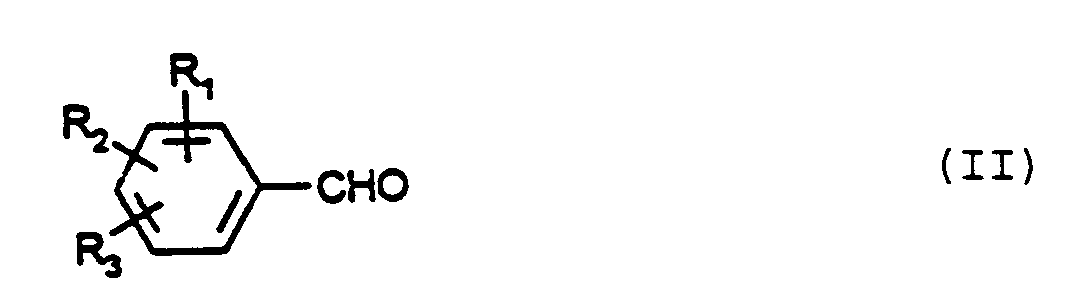
- Procédé selon la revendication 1, dans lequel on utilise du sulfate de sodium, de potassium, de lithium ou d'ammonium anhydre, de préférence du sulfate de sodium anhydre.
- Procédé selon la revendication 1, dans lequel on utilise le sulfate d'hydroxylammonium.
- Procédé selon la revendication 1, dans lequel on utilise un sulfate inorganique anhydre dont les taux d'une taille de grain ≤ 50 µm représentant d'au moins 1 % en poids, de préférence de 2 à 20 % en poids, de manière particulièrement préférée de 5 à 15 % en poids de la quantité totale du sulfate anhydre.
- Procédé selon la revendication 1, dans lequel on ajoute en plus un diluant inerte avec un point de fusion ≤70°C, un point d'ébullition ≥150°C/1 bar et un moment dipolaire µ ≤2x10-18 esu, à l'exception des acides carboxyliques, des composés azotés basiques hétéroaromatiques, des composés soufrés et des composés fortement polaires, éventuellement dans des quantités jusqu'à 150 % en poids, de préférence jusqu'à 50 %, par rapport à l'aldéhyde utilisé.
- Procédé selon la revendication 1, dans lequel R1, R2 et R3 représentent, indépendamment l'un de l'autre, un atome d'hydrogène, un atome d'halogène, des groupes alkyle en C1-C4, alkoxy en C1-C4, di(alkyle en C1-C4)amino, R4-(aryle en C6-C10), R4-(aryloxy en C6-C10) ou R4-di(aryl en C6-C10)amino, et R4 représente un atome d'hydrogène, un atome d'halogène, des groupes alkyle en C1-C2, alkoxy en C1-C2 ou di(alkyl en C1-C2)amino.
- Procédé selon la revendication 1, dans lequel
- R1
- représente un atome d'hydrogène, un atome de chlore, des groupes méthyle, méthoxy, tert-butyle ou phényle, de préférence 4-méthyle, 4-tert-butyle ou 4-phényle, de manière particulièrement préférée, un groupe 4-phényle,
- R2 et R3
- représentent soit un atome d'hydrogène, soit les deux ensemble, le ω-buta-1,3-diénylène, et
- R4
- représente un atome d'hydrogène.
- Procédé selon la revendication 1, dans lequel on utilise le sel d'hydroxylammonium dans des quantités de 0,505 à 0,58 moles, et le sel anhydre dans des quantités de 2 à 12 moles, à chaque fois par rapport à 1 mole d'aldéhyde.
- Procédé selon la revendication 1, dans lequel on isole ensuite le nitrile de formule (I) par distillation directe à partir du mélange réactionnel.
Applications Claiming Priority (3)
| Application Number | Priority Date | Filing Date | Title |
|---|---|---|---|
| CH687/95 | 1995-03-09 | ||
| CH68795 | 1995-03-09 | ||
| US08/610,315 US5618965A (en) | 1995-03-09 | 1996-03-04 | Process for preparing aromatic nitriles |
Publications (2)
| Publication Number | Publication Date |
|---|---|
| EP0731086A1 EP0731086A1 (fr) | 1996-09-11 |
| EP0731086B1 true EP0731086B1 (fr) | 1999-04-28 |
Family
ID=25685369
Family Applications (1)
| Application Number | Title | Priority Date | Filing Date |
|---|---|---|---|
| EP96810115A Expired - Lifetime EP0731086B1 (fr) | 1995-03-09 | 1996-03-01 | Procédé de préparation de nitriles aromatiques |
Country Status (5)
| Country | Link |
|---|---|
| US (1) | US5618965A (fr) |
| EP (1) | EP0731086B1 (fr) |
| JP (1) | JP3816978B2 (fr) |
| CN (1) | CN1060159C (fr) |
| CZ (1) | CZ290917B6 (fr) |
Families Citing this family (15)
| Publication number | Priority date | Publication date | Assignee | Title |
|---|---|---|---|---|
| US5763638A (en) * | 1996-02-15 | 1998-06-09 | Ciba Specialty Chemicals Corporation | Preparation of aromatic nitriles |
| AU3829297A (en) * | 1996-08-08 | 1998-02-25 | Allied-Signal Inc. | Process for the preparation of organic nitriles |
| CN1130338C (zh) * | 1999-05-07 | 2003-12-10 | 湖南南天实业股份有限公司 | 苯腈催化氯化制五氯苯腈的固定床生产工艺 |
| JP3561178B2 (ja) * | 1999-06-02 | 2004-09-02 | 花王株式会社 | ニトリルの製造方法 |
| US7262316B2 (en) * | 2002-10-21 | 2007-08-28 | Ihara Chemical Industry Co., Ltd. | Process for producing aromatic nitrile compound |
| HRP20130356T1 (en) * | 2008-09-10 | 2013-05-31 | Celgene Corporation | Processes for the preparation of aminosulfone compounds |
| CN108546223B (zh) * | 2014-04-16 | 2022-02-11 | 中国石化扬子石油化工有限公司 | 腈及其相应胺的制造方法 |
| CN105016943B (zh) * | 2014-04-16 | 2017-10-10 | 中国石化扬子石油化工有限公司 | 腈及其相应胺的制造方法 |
| CN105001032B (zh) * | 2014-04-16 | 2018-03-16 | 中国石化扬子石油化工有限公司 | 腈及其相应胺的制造方法 |
| CN105085316B (zh) * | 2014-08-29 | 2016-10-12 | 浙江工业大学 | 一种苯腈类化合物的合成方法 |
| CN105384658B (zh) * | 2015-10-16 | 2017-11-17 | 扬州大学 | 一种合成大茴香腈的方法 |
| CN106694023B (zh) * | 2015-11-12 | 2019-03-05 | 中触媒新材料股份有限公司 | 一种用于合成对(邻)羟基苯甲腈的催化剂及其制备方法 |
| US20220002232A1 (en) * | 2018-11-09 | 2022-01-06 | Orion Corporation | Process for the preparation of 4,5-dihydroxy-2-(4-methylbenzyl)isophthalonitrile |
| CN109748818B (zh) * | 2019-01-22 | 2021-12-28 | 河北工业大学 | 一种对苯二甲醛肟化脱水合成对苯二甲腈的方法 |
| CN109748817B (zh) * | 2019-01-22 | 2021-12-28 | 河北工业大学 | 一种由脂肪醛合成脂肪腈的方法 |
Family Cites Families (5)
| Publication number | Priority date | Publication date | Assignee | Title |
|---|---|---|---|---|
| US4456562A (en) * | 1981-12-02 | 1984-06-26 | Sumitomo Chemical Company, Limited | Process for producing nitriles |
| DE3343673A1 (de) * | 1983-12-02 | 1985-09-05 | Basf Ag, 6700 Ludwigshafen | Verfahren zur gleichzeitigen herstellung von nitrilen und acrylamid bzw. methacrylamid |
| EP0550762B1 (fr) * | 1991-07-25 | 1995-11-22 | Kao Corporation | Procede de production de nitrile |
| TW275617B (fr) * | 1993-01-28 | 1996-05-11 | Ciba Geigy Ag | |
| DE4407135A1 (de) * | 1994-03-04 | 1995-09-07 | Thomae Gmbh Dr K | Arylcycloalkylamine, deren Salze, diese Verbindungen enthaltende Arzneimittel und deren Verwendung sowie Verfahren zu ihrer Herstellung |
-
1996
- 1996-03-01 EP EP96810115A patent/EP0731086B1/fr not_active Expired - Lifetime
- 1996-03-04 US US08/610,315 patent/US5618965A/en not_active Expired - Lifetime
- 1996-03-06 CZ CZ1996680A patent/CZ290917B6/cs not_active IP Right Cessation
- 1996-03-08 CN CN96106093A patent/CN1060159C/zh not_active Expired - Lifetime
- 1996-03-08 JP JP05068396A patent/JP3816978B2/ja not_active Expired - Lifetime
Also Published As
| Publication number | Publication date |
|---|---|
| JPH08259511A (ja) | 1996-10-08 |
| CZ290917B6 (cs) | 2002-11-13 |
| CN1060159C (zh) | 2001-01-03 |
| CZ68096A3 (en) | 1996-09-11 |
| EP0731086A1 (fr) | 1996-09-11 |
| CN1139668A (zh) | 1997-01-08 |
| US5618965A (en) | 1997-04-08 |
| JP3816978B2 (ja) | 2006-08-30 |
Similar Documents
| Publication | Publication Date | Title |
|---|---|---|
| EP0731086B1 (fr) | Procédé de préparation de nitriles aromatiques | |
| DE3729530C2 (fr) | ||
| EP0648738B1 (fr) | Procédé pour la préparation d'acéto-acétamides N-aryliques | |
| DE3216262A1 (de) | Verfahren zur abtrennung von feststoffen | |
| EP0504182B1 (fr) | Procede de production de derives de quinophtalone | |
| EP1476436B1 (fr) | Procede de production de 2-anilino-4,6-dimethylpyrimidine | |
| DE69306694T2 (de) | Kristalle von Hydroxyphenylpropionsäure-ester und ihre Herstellung | |
| DE69717156T2 (de) | Verfahren zur kritallisation von (s)-n-n'-bis [2-hydroxy-1-(hydroxymethyl) ethyl]-5-[(2-hydroxy-1-oxopropyl) amino]-2,4,6-triiodo-1,3-benzoldicarboxamid aus linearem oder verzweigtem (c5-c6) alkohol oder gemischen davon | |
| AT398199B (de) | Verfahren zur herstellung von arylhydantoinen | |
| EP0790234B1 (fr) | Procédé de préparation de nitriles aromatiques | |
| EP0634411B1 (fr) | Procédé de préparation de 8- 4'-[4''-(pyrimidin-2'''-yle)-piperazin-1''-yle]-butyle -8-aza-spiro[4,5]decan-7,9-dione et leur hydrochlorides de haute purété | |
| DE2708388A1 (de) | Verfahren zur herstellung von 4,4'- dihydroxydiphenylsulfon | |
| EP0027956A1 (fr) | Procédé de préparation de l'acide (1-(4-chlorobenzoyl)-5-méthoxy-2-méthyl-3-indole) acétoxyacétique | |
| DE69403109T2 (de) | Verfahren zur Wiedergewinnung von L-Phenylalanin | |
| EP0175263B1 (fr) | 2-Amino-3-chlorométhyl-5-(dichlorométhyl)-pyrazines et procédé pour leur préparation | |
| KR100442075B1 (ko) | 방향족니트릴의제조방법 | |
| DE3607993A1 (de) | Verfahren zur herstellung von diaziridinen und produkte daraus | |
| EP0175264B1 (fr) | Procédé de préparation de 2-amino-3-cyano-5-dialkoxyméthyl-pyrazines et intermédiaires pour ce procédé | |
| DE1493965C (de) | Verfahren zum Herstellen von Racema ten optisch aktiver Nitrile | |
| DE69804753T2 (de) | Verfahren zur trennung von isomeren der nitrotoluolsaeure | |
| AT288363B (de) | Verfahren zur Herstellung von neuen β-Aroyl- β-halogenacrylsäuren | |
| DE69904136T2 (de) | Verfahren zur Herstellung von hochreinem N-Formyl-Leucin | |
| EP0341594A2 (fr) | Procédé de préparation d'un adduit de l'acide 2-hydroxy-naphthalène-6-carboxylique et du 1,4-dioxanne; utilisation dudit adduit | |
| DE2315935A1 (de) | Neue imidazolderivate und verfahren zu ihrer herstellung | |
| DD293344A5 (de) | Verfahren zur herstellung von 4-nitrofluorbenzenen |
Legal Events
| Date | Code | Title | Description |
|---|---|---|---|
| PUAI | Public reference made under article 153(3) epc to a published international application that has entered the european phase |
Free format text: ORIGINAL CODE: 0009012 |
|
| AK | Designated contracting states |
Kind code of ref document: A1 Designated state(s): CH DE GB IT LI |
|
| RAP1 | Party data changed (applicant data changed or rights of an application transferred) |
Owner name: CIBA SC HOLDING AG |
|
| RAP3 | Party data changed (applicant data changed or rights of an application transferred) |
Owner name: CIBA SPECIALTY CHEMICALS HOLDING INC. |
|
| 17P | Request for examination filed |
Effective date: 19970120 |
|
| GRAG | Despatch of communication of intention to grant |
Free format text: ORIGINAL CODE: EPIDOS AGRA |
|
| GRAG | Despatch of communication of intention to grant |
Free format text: ORIGINAL CODE: EPIDOS AGRA |
|
| GRAH | Despatch of communication of intention to grant a patent |
Free format text: ORIGINAL CODE: EPIDOS IGRA |
|
| 17Q | First examination report despatched |
Effective date: 19980803 |
|
| GRAH | Despatch of communication of intention to grant a patent |
Free format text: ORIGINAL CODE: EPIDOS IGRA |
|
| GRAA | (expected) grant |
Free format text: ORIGINAL CODE: 0009210 |
|
| AK | Designated contracting states |
Kind code of ref document: B1 Designated state(s): CH DE GB IT LI |
|
| REG | Reference to a national code |
Ref country code: CH Ref legal event code: EP |
|
| REF | Corresponds to: |
Ref document number: 59601747 Country of ref document: DE Date of ref document: 19990602 |
|
| GBT | Gb: translation of ep patent filed (gb section 77(6)(a)/1977) |
Effective date: 19990524 |
|
| ITF | It: translation for a ep patent filed | ||
| PLBE | No opposition filed within time limit |
Free format text: ORIGINAL CODE: 0009261 |
|
| STAA | Information on the status of an ep patent application or granted ep patent |
Free format text: STATUS: NO OPPOSITION FILED WITHIN TIME LIMIT |
|
| 26N | No opposition filed | ||
| REG | Reference to a national code |
Ref country code: GB Ref legal event code: IF02 |
|
| PGFP | Annual fee paid to national office [announced via postgrant information from national office to epo] |
Ref country code: CH Payment date: 20050211 Year of fee payment: 10 |
|
| PGFP | Annual fee paid to national office [announced via postgrant information from national office to epo] |
Ref country code: GB Payment date: 20050217 Year of fee payment: 10 |
|
| PG25 | Lapsed in a contracting state [announced via postgrant information from national office to epo] |
Ref country code: IT Free format text: LAPSE BECAUSE OF NON-PAYMENT OF DUE FEES;WARNING: LAPSES OF ITALIAN PATENTS WITH EFFECTIVE DATE BEFORE 2007 MAY HAVE OCCURRED AT ANY TIME BEFORE 2007. THE CORRECT EFFECTIVE DATE MAY BE DIFFERENT FROM THE ONE RECORDED. Effective date: 20050301 |
|
| PG25 | Lapsed in a contracting state [announced via postgrant information from national office to epo] |
Ref country code: GB Free format text: LAPSE BECAUSE OF NON-PAYMENT OF DUE FEES Effective date: 20060301 |
|
| PG25 | Lapsed in a contracting state [announced via postgrant information from national office to epo] |
Ref country code: LI Free format text: LAPSE BECAUSE OF NON-PAYMENT OF DUE FEES Effective date: 20060331 Ref country code: CH Free format text: LAPSE BECAUSE OF NON-PAYMENT OF DUE FEES Effective date: 20060331 |
|
| REG | Reference to a national code |
Ref country code: CH Ref legal event code: PL |
|
| GBPC | Gb: european patent ceased through non-payment of renewal fee |
Effective date: 20060301 |
|
| PGFP | Annual fee paid to national office [announced via postgrant information from national office to epo] |
Ref country code: DE Payment date: 20110526 Year of fee payment: 16 |
|
| REG | Reference to a national code |
Ref country code: DE Ref legal event code: R119 Ref document number: 59601747 Country of ref document: DE Effective date: 20121002 |
|
| PG25 | Lapsed in a contracting state [announced via postgrant information from national office to epo] |
Ref country code: DE Free format text: LAPSE BECAUSE OF NON-PAYMENT OF DUE FEES Effective date: 20121002 |