EP0731365A2 - Méthode de fabrication d'un dispositif électro-optique - Google Patents
Méthode de fabrication d'un dispositif électro-optique Download PDFInfo
- Publication number
- EP0731365A2 EP0731365A2 EP96102068A EP96102068A EP0731365A2 EP 0731365 A2 EP0731365 A2 EP 0731365A2 EP 96102068 A EP96102068 A EP 96102068A EP 96102068 A EP96102068 A EP 96102068A EP 0731365 A2 EP0731365 A2 EP 0731365A2
- Authority
- EP
- European Patent Office
- Prior art keywords
- carrier plate
- adjustment structure
- molding tool
- electrical structures
- molding
- Prior art date
- Legal status (The legal status is an assumption and is not a legal conclusion. Google has not performed a legal analysis and makes no representation as to the accuracy of the status listed.)
- Granted
Links
Images
Classifications
-
- G—PHYSICS
- G02—OPTICS
- G02B—OPTICAL ELEMENTS, SYSTEMS OR APPARATUS
- G02B6/00—Light guides; Structural details of arrangements comprising light guides and other optical elements, e.g. couplings
- G02B6/24—Coupling light guides
- G02B6/42—Coupling light guides with opto-electronic elements
- G02B6/4201—Packages, e.g. shape, construction, internal or external details
- G02B6/4219—Mechanical fixtures for holding or positioning the elements relative to each other in the couplings; Alignment methods for the elements, e.g. measuring or observing methods especially used therefor
- G02B6/4228—Passive alignment, i.e. without a detection of the degree of coupling or the position of the elements
- G02B6/423—Passive alignment, i.e. without a detection of the degree of coupling or the position of the elements using guiding surfaces for the alignment
-
- G—PHYSICS
- G02—OPTICS
- G02B—OPTICAL ELEMENTS, SYSTEMS OR APPARATUS
- G02B6/00—Light guides; Structural details of arrangements comprising light guides and other optical elements, e.g. couplings
- G02B6/10—Light guides; Structural details of arrangements comprising light guides and other optical elements, e.g. couplings of the optical waveguide type
- G02B6/12—Light guides; Structural details of arrangements comprising light guides and other optical elements, e.g. couplings of the optical waveguide type of the integrated circuit kind
- G02B6/122—Basic optical elements, e.g. light-guiding paths
- G02B6/1221—Basic optical elements, e.g. light-guiding paths made from organic materials
-
- G—PHYSICS
- G02—OPTICS
- G02B—OPTICAL ELEMENTS, SYSTEMS OR APPARATUS
- G02B6/00—Light guides; Structural details of arrangements comprising light guides and other optical elements, e.g. couplings
- G02B6/24—Coupling light guides
- G02B6/36—Mechanical coupling means
- G02B6/3628—Mechanical coupling means for mounting fibres to supporting carriers
- G02B6/3648—Supporting carriers of a microbench type, i.e. with micromachined additional mechanical structures
- G02B6/3652—Supporting carriers of a microbench type, i.e. with micromachined additional mechanical structures the additional structures being prepositioning mounting areas, allowing only movement in one dimension, e.g. grooves, trenches or vias in the microbench surface, i.e. self aligning supporting carriers
-
- G—PHYSICS
- G02—OPTICS
- G02B—OPTICAL ELEMENTS, SYSTEMS OR APPARATUS
- G02B6/00—Light guides; Structural details of arrangements comprising light guides and other optical elements, e.g. couplings
- G02B6/24—Coupling light guides
- G02B6/36—Mechanical coupling means
- G02B6/3628—Mechanical coupling means for mounting fibres to supporting carriers
- G02B6/3684—Mechanical coupling means for mounting fibres to supporting carriers characterised by the manufacturing process of surface profiling of the supporting carrier
- G02B6/3696—Mechanical coupling means for mounting fibres to supporting carriers characterised by the manufacturing process of surface profiling of the supporting carrier by moulding, e.g. injection moulding, casting, embossing, stamping, stenciling, printing, or with metallic mould insert manufacturing using LIGA or MIGA techniques
Definitions
- the invention is based on a method according to the type of the main claim.
- a method of this type is known from the publication "Popcorn: A Novel Technology for Polymer Based Integrated Optics", H. Kragl, 1993 ECIO-93, Neuchatel, conference proceedings.
- an optical waveguide structure is first molded onto a waveguide substrate from a molding tool.
- a semiconductor component here an indium phosphide (InP) detector chip, is also cast with plastic to form a cover plate.
- InP indium phosphide
- the adjustment groove serves to position the cover plate with the semiconductor chip exactly on the previously generated waveguide substrate with the optical waveguide structures.
- Conductor tracks are arranged on its underside for the electrical supply of the semiconductor component.
- the concept of an alignment groove, which is also on the waveguide substrate existing counter-alignment structures cooperates, allows a semiconductor device to be precisely aligned on a waveguide substrate.
- a complex work step is required to form the adjustment groove in the semiconductor component.
- the method according to the invention allows the production of electro-optical components with optical and electrical structures that are precisely assigned to one another in a predetermined manner.
- the alignment to each other is done by a self-adjusting mechanical technique. Active adjustment processes or photolithographic process steps are not necessary.
- the process is based on simple and inexpensive methods of plastic mass production and allows a high degree of automation.
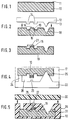
- FIG. 1 shows a metallized carrier plate in section
- FIG. 2 shows a molding tool with a machined carrier plate in section
- FIG. 3 shows a carrier plate with galvanically reinforced conductor tracks in section
- FIG. 4 shows a section through a machined carrier plate with a second molding tool in engagement
- FIG. 5 a component before placing a cover plate.
- the starting point for the proposed method is, as shown in FIG. 1, a carrier plate 10 made of plastic, onto which a thin metal layer 11 has been applied over the entire surface by vapor deposition or sputtering.
- the carrier plate 10 consists of a thermoplastic material. Suitable materials are those which on the one hand withstand the conditions during manufacture, in particular during metallization, and also the operating temperatures of the components to be expected later. Examples of materials of this type are plexiglass (PMMA) or polycarbonate.
- electrical structures 16 and adjustment structures 18 are created on the surface of the metallized carrier plate 10 by stamping with a molding tool.
- the metal layer 11 tears off at locations of vertical edges 19. This makes it possible to produce any structures on the surface of the carrier plate 10 which are electrically insulated from the other parts of the carrier plate 10.
- conductor tracks 16 can be produced by embossing the peripheral edges in the form of trenches 15. In each case between two trenches 15 there remains an insulated electrical surface, the conductor track 16.
- a modified form of this conductor path generation provides that the entire surface surrounding a conductor track 16 is impressed and only the conductor track 16 is left raised.
- lower-level conductor tracks 16 can also be produced by embossing the conductor track structure itself into the carrier plate 10. Because of the high load on the metal layer 11 during embossing, however, there is particularly good adhesion between the metal layer 11 and the latter in the latter method Require thermoplastic material of the support plate 10.
- the adjustment structures 18 preferably have a V-shaped cross section because of their self-adjusting property. However, any other cross sections are of course also possible.
- the molding tool 12 used for the embossing step is expediently produced by micro-galvanic molding of a silicon wafer.
- the electrical structures 16 and the alignment structures 18 are photolithographically defined on the silicon wafer, and are realized by known methods of microstructuring, such as dry or wet chemical etching.
- a metallic replica, the molding tool 12 is then produced from the finished wafer by galvanic molding. Its shape is the inverse image of the structure later embossed into the carrier plate 10. As indicated in FIG. 2, it has, in particular, crenellations 14 for producing the trenches 15, and thus the conductor tracks 16, and an arrow-shaped counter-adjustment structure 13.
- the thermoplastic carrier plate 10 may shrink. It is taken into account by appropriate provision when designing the structures of the molding tool 12.
- a further metal layer 21 with a desired thickness is applied to the existing metal layer 11, preferably by electrodeposition.
- the same metal can be used for the layer 21 as for the metal layer 11.
- the formation of the Metal layer 21 can be produced by selective etching of different metals, using etching solution systems that each etch only a certain metal, or by differential etching, until the thin base metallization is removed and only the galvanically reinforced structures with a correspondingly reduced layer thickness remain , respectively. Subsequently, remaining, non-galvanically reinforced components of the metal layer 11 are completely removed in an etching step.
- the metal used for the layer 21 it can be carried out with selective or non-selective etching solutions.
- the thickness of the metal layer 21 decreases during the etching, the loss of thickness must be taken into account in the previous galvanic reinforcement by designing the metal layer 21 accordingly thicker.
- FIG. 4 illustrates the state of a carrier plate after the non-reinforced metal structures have been removed.
- the unused parts of the metal layer 11 can also remain on the carrier plate 10 after the embossing. If the metal layer 11 has sufficient electrical conductivity, the galvanic can also be used There is no need to reinforce the conductor tracks 16 by applying the metal layer 21.
- a second molding tool 22 is then attached to the carrier plate 10 provided with electrical structures. It is expediently produced in the same way as the first molding tool 12 and in particular also has an arrow-shaped counter-adjustment structure 25, which is an exact inverse image of the V-shaped adjustment structure 18 impressed into the carrier plate 10.
- the molding tool 2 also has a wall structure 23 with a rectangular cross section for producing an optical waveguide channel, and a support beam 24.
- the wall structure 23 is exactly aligned with the conductor track 16, which in turn is arranged in a defined manner relative to the adjustment structure 18.
- the support beam 24 ensures a defined distance between the wall structure 23, that is to say the later optical waveguide and the conductor track 16.
- the carrier plate 10 and the intermediate space 28 formed between the carrier plate 10 and the molding tool 22 are then cast with a substrate material 17, advantageously a plastic.
- a conventional reaction casting process is used for this purpose, which is advantageously carried out under pressure in order to minimize reaction shrinkage.
- the molding tool 22 is then removed from the molded carrier plate.
- an arrangement is formed with an inner carrier plate 10, which is enclosed by a waveguide substrate 26 made of plastic 17.
- the waveguide substrate 26 Towards an upper side, the waveguide substrate 26 has a V-groove extending down into the carrier plate 10 and a channel 29 shaped by the wall structure 23 of the molding tool 22.
- the conductor track 16 is located exactly below the channel 29 on the inside.
- a cover plate 30 is pressed onto the arrangement, as a result of which excess prepolymer is displaced and the optical waveguide 27 formed is covered upwards.
- the method step is illustrated in FIG. 5.
- the component created after the cover plate 30 has been put in place, with the optical waveguides 27 and conductor track structures 16 precisely assigned to one another, is suitable, for example, as a thermally controlled optical switch.
- the fibers must be inserted into the V-grooves 31 before the prepolymer is filled into the channel 29.
- the recess formed by molding the support beam 24 in the waveguide substrate 26 has no significance for the function of the component. It can be left empty, filled with a prepolymer together with the channel 29, or can be separated from the component after the end of production.
Landscapes
- Physics & Mathematics (AREA)
- General Physics & Mathematics (AREA)
- Optics & Photonics (AREA)
- Engineering & Computer Science (AREA)
- Microelectronics & Electronic Packaging (AREA)
- Optical Couplings Of Light Guides (AREA)
- Optical Integrated Circuits (AREA)
Applications Claiming Priority (2)
| Application Number | Priority Date | Filing Date | Title |
|---|---|---|---|
| DE19508025 | 1995-03-07 | ||
| DE19508025A DE19508025A1 (de) | 1995-03-07 | 1995-03-07 | Verfahren zur Herstellung eines elektrooptischen Bauelements |
Publications (3)
| Publication Number | Publication Date |
|---|---|
| EP0731365A2 true EP0731365A2 (fr) | 1996-09-11 |
| EP0731365A3 EP0731365A3 (fr) | 1997-07-30 |
| EP0731365B1 EP0731365B1 (fr) | 1998-12-23 |
Family
ID=7755910
Family Applications (1)
| Application Number | Title | Priority Date | Filing Date |
|---|---|---|---|
| EP96102068A Expired - Lifetime EP0731365B1 (fr) | 1995-03-07 | 1996-02-13 | Méthode de fabrication d'un dispositif électro-optique |
Country Status (2)
| Country | Link |
|---|---|
| EP (1) | EP0731365B1 (fr) |
| DE (2) | DE19508025A1 (fr) |
Cited By (3)
| Publication number | Priority date | Publication date | Assignee | Title |
|---|---|---|---|---|
| WO1998019194A1 (fr) * | 1996-10-29 | 1998-05-07 | Alcatel Sel Aktiengesellschaft | Disposition a centrage automatique de corps microstructures |
| WO1998026885A1 (fr) * | 1996-12-19 | 1998-06-25 | Telefonaktiebolaget Lm Ericsson (Publ) | Micro-replication dans du metal |
| WO2010012540A1 (fr) | 2008-07-31 | 2010-02-04 | Robert Bosch Gmbh | Procédé d'estampage à chaud d'au moins une piste conductrice sur un substrat, substrat pourvu d'au moins une piste conductrice et poinçon d'estampage |
Families Citing this family (3)
| Publication number | Priority date | Publication date | Assignee | Title |
|---|---|---|---|---|
| DE19721721B4 (de) * | 1997-05-23 | 2007-08-30 | Robert Bosch Gmbh | Verfahren zur Herstellung thermooptischer Schaltelemente |
| DE19738589A1 (de) * | 1997-09-03 | 1998-12-03 | Siemens Ag | Leiterplatte mit einem isoleirenden Trägersubstrat und einer Leiterbahnstruktur |
| DE10147876B4 (de) * | 2001-09-28 | 2005-05-25 | Siemens Ag | In Leiterplatten einzubettende optische Leiter |
Family Cites Families (2)
| Publication number | Priority date | Publication date | Assignee | Title |
|---|---|---|---|---|
| US5093883A (en) * | 1991-04-26 | 1992-03-03 | Hoechst Celanese Corp. | Nonlinear optically responsive polymeric waveguides |
| DE4206328A1 (de) * | 1992-02-29 | 1993-09-02 | Sel Alcatel Ag | Verfahren zur herstellung optoelektronischer bauelemente |
-
1995
- 1995-03-07 DE DE19508025A patent/DE19508025A1/de not_active Withdrawn
-
1996
- 1996-02-13 EP EP96102068A patent/EP0731365B1/fr not_active Expired - Lifetime
- 1996-02-13 DE DE59601021T patent/DE59601021D1/de not_active Expired - Fee Related
Cited By (6)
| Publication number | Priority date | Publication date | Assignee | Title |
|---|---|---|---|---|
| WO1998019194A1 (fr) * | 1996-10-29 | 1998-05-07 | Alcatel Sel Aktiengesellschaft | Disposition a centrage automatique de corps microstructures |
| WO1998026885A1 (fr) * | 1996-12-19 | 1998-06-25 | Telefonaktiebolaget Lm Ericsson (Publ) | Micro-replication dans du metal |
| CN1072993C (zh) * | 1996-12-19 | 2001-10-17 | 艾利森电话股份有限公司 | 在金属上进行显微复制的方法和装置 |
| WO2010012540A1 (fr) | 2008-07-31 | 2010-02-04 | Robert Bosch Gmbh | Procédé d'estampage à chaud d'au moins une piste conductrice sur un substrat, substrat pourvu d'au moins une piste conductrice et poinçon d'estampage |
| CN102165853A (zh) * | 2008-07-31 | 2011-08-24 | 罗伯特·博世有限公司 | 用于在衬底上热压印至少一个印制导线的方法、具有至少一个印制导线的衬底以及压印模具 |
| CN102165853B (zh) * | 2008-07-31 | 2017-05-24 | 罗伯特.博世有限公司 | 用于在衬底上热压印至少一个印制导线的方法和衬底 |
Also Published As
| Publication number | Publication date |
|---|---|
| DE59601021D1 (de) | 1999-02-04 |
| DE19508025A1 (de) | 1996-09-12 |
| EP0731365B1 (fr) | 1998-12-23 |
| EP0731365A3 (fr) | 1997-07-30 |
Similar Documents
| Publication | Publication Date | Title |
|---|---|---|
| EP0630486B1 (fr) | Procede de fabrication d'un circuit optique integre de maniere hybride et dispositif permettant d'emettre des ondes lumineuses | |
| EP0614539B1 (fr) | Procede de fabrication d'un couvercle pour un circuit optique integre | |
| DE69624099T2 (de) | Miniatur-haltevorrichtung | |
| DE19909242A1 (de) | Verfahren und Gießform zum Herstellen eines elektrooptischen Moduls und elektrooptisches Modul | |
| WO1998019194A1 (fr) | Disposition a centrage automatique de corps microstructures | |
| DE4220135A1 (de) | Verfahren zum Ankoppeln von Photoelementen an integriert-optische Schaltungen in Polymertechnologie | |
| EP0429877B1 (fr) | Dispositif de positionnement de fibres optiques dans des éléments de connexion | |
| EP0012188A1 (fr) | Procédé pour la fabrication d'un séparateur à fibre-optique | |
| EP0883825B1 (fr) | Procede de production de composants optiques avec guides d'ondes optiques accouples, et composants optiques produits selon ce procede | |
| EP0731365B1 (fr) | Méthode de fabrication d'un dispositif électro-optique | |
| EP0625272B1 (fr) | Procede pour la fabrication d'un couvercle pour un circuit optique integre | |
| DE19501285C1 (de) | Anordnung zur Umsetzung von optischen in elektrische Signale und Verfahren zur Herstellung | |
| DE4200397C1 (fr) | ||
| DE4117449C1 (fr) | ||
| EP1005663B1 (fr) | Procede de production d'un composant optique integre a la puce a guides d'ondes avec connecteur enfichable | |
| DE4200396C1 (fr) | ||
| DE19642088A1 (de) | Verfahren zur Herstellung eines mikrostrukturierten Körpers, eines Gußrahmens und eines integriert-optischen Bauteils | |
| DE19721721B4 (de) | Verfahren zur Herstellung thermooptischer Schaltelemente | |
| DE10200853B4 (de) | Optische Lage mit optischen Leitern, Leiterplatte, Herstellungsverfahren für optische Lage mit optischen Leitern und Herstellungsverfahren für Leiterplatte | |
| DE19716480B4 (de) | Verfahren zum Herstellen einer Vorrichtung mit einem Hohlraum zur Aufnahme eines Lichtwellenleiters | |
| DE19538103A1 (de) | Verfahren zum Herstellen einer Lichtwellenleiter-Glasfaser-Koppelstelle auf einem integriert optischen Bauelement | |
| EP1114345A1 (fr) | Corps microstructure et son procede de production | |
| EP1209494A2 (fr) | Dispositif de guide d'onde en optique intégré et procédé de fabrication associé | |
| EP0692724A1 (fr) | Procédé pour la fabrication et l'alignement d'un dispositif à semi-conducteur | |
| DE19602232A1 (de) | Integriert optische Schaltung und Verfahren zur Herstellung derselben |
Legal Events
| Date | Code | Title | Description |
|---|---|---|---|
| PUAI | Public reference made under article 153(3) epc to a published international application that has entered the european phase |
Free format text: ORIGINAL CODE: 0009012 |
|
| AK | Designated contracting states |
Kind code of ref document: A2 Designated state(s): DE FR GB SE |
|
| PUAL | Search report despatched |
Free format text: ORIGINAL CODE: 0009013 |
|
| AK | Designated contracting states |
Kind code of ref document: A3 Designated state(s): DE FR GB SE |
|
| 17P | Request for examination filed |
Effective date: 19980130 |
|
| GRAG | Despatch of communication of intention to grant |
Free format text: ORIGINAL CODE: EPIDOS AGRA |
|
| 17Q | First examination report despatched |
Effective date: 19980403 |
|
| GRAG | Despatch of communication of intention to grant |
Free format text: ORIGINAL CODE: EPIDOS AGRA |
|
| GRAH | Despatch of communication of intention to grant a patent |
Free format text: ORIGINAL CODE: EPIDOS IGRA |
|
| GRAH | Despatch of communication of intention to grant a patent |
Free format text: ORIGINAL CODE: EPIDOS IGRA |
|
| GRAA | (expected) grant |
Free format text: ORIGINAL CODE: 0009210 |
|
| AK | Designated contracting states |
Kind code of ref document: B1 Designated state(s): DE FR GB SE |
|
| REF | Corresponds to: |
Ref document number: 59601021 Country of ref document: DE Date of ref document: 19990204 |
|
| ET | Fr: translation filed | ||
| GBT | Gb: translation of ep patent filed (gb section 77(6)(a)/1977) |
Effective date: 19990223 |
|
| PLBE | No opposition filed within time limit |
Free format text: ORIGINAL CODE: 0009261 |
|
| STAA | Information on the status of an ep patent application or granted ep patent |
Free format text: STATUS: NO OPPOSITION FILED WITHIN TIME LIMIT |
|
| PG25 | Lapsed in a contracting state [announced via postgrant information from national office to epo] |
Ref country code: DE Free format text: LAPSE BECAUSE OF NON-PAYMENT OF DUE FEES Effective date: 19991201 |
|
| 26N | No opposition filed | ||
| REG | Reference to a national code |
Ref country code: GB Ref legal event code: IF02 |
|
| PGFP | Annual fee paid to national office [announced via postgrant information from national office to epo] |
Ref country code: GB Payment date: 20030127 Year of fee payment: 8 |
|
| PGFP | Annual fee paid to national office [announced via postgrant information from national office to epo] |
Ref country code: FR Payment date: 20030221 Year of fee payment: 8 |
|
| PGFP | Annual fee paid to national office [announced via postgrant information from national office to epo] |
Ref country code: SE Payment date: 20030225 Year of fee payment: 8 |
|
| PG25 | Lapsed in a contracting state [announced via postgrant information from national office to epo] |
Ref country code: GB Free format text: LAPSE BECAUSE OF NON-PAYMENT OF DUE FEES Effective date: 20040213 |
|
| PG25 | Lapsed in a contracting state [announced via postgrant information from national office to epo] |
Ref country code: SE Free format text: LAPSE BECAUSE OF NON-PAYMENT OF DUE FEES Effective date: 20040214 |
|
| EUG | Se: european patent has lapsed | ||
| GBPC | Gb: european patent ceased through non-payment of renewal fee |
Effective date: 20040213 |
|
| PG25 | Lapsed in a contracting state [announced via postgrant information from national office to epo] |
Ref country code: FR Free format text: LAPSE BECAUSE OF NON-PAYMENT OF DUE FEES Effective date: 20041029 |
|
| REG | Reference to a national code |
Ref country code: FR Ref legal event code: ST |