EP0731385B1 - Système libérant un nouveau groupe photographiquement utile - Google Patents
Système libérant un nouveau groupe photographiquement utile Download PDFInfo
- Publication number
- EP0731385B1 EP0731385B1 EP95200573A EP95200573A EP0731385B1 EP 0731385 B1 EP0731385 B1 EP 0731385B1 EP 95200573 A EP95200573 A EP 95200573A EP 95200573 A EP95200573 A EP 95200573A EP 0731385 B1 EP0731385 B1 EP 0731385B1
- Authority
- EP
- European Patent Office
- Prior art keywords
- radical
- pug
- vis
- group
- link
- Prior art date
- Legal status (The legal status is an assumption and is not a legal conclusion. Google has not performed a legal analysis and makes no representation as to the accuracy of the status listed.)
- Expired - Lifetime
Links
- 0 *C(*Nc(cccc1)c1*(NC(CCSc1nnc(*)[s]1)=O)=C)=O Chemical compound *C(*Nc(cccc1)c1*(NC(CCSc1nnc(*)[s]1)=O)=C)=O 0.000 description 12
- CFWGYKRJMYXYND-UHFFFAOYSA-N CSc1nnc(S)[s]1 Chemical compound CSc1nnc(S)[s]1 CFWGYKRJMYXYND-UHFFFAOYSA-N 0.000 description 1
Classifications
-
- C—CHEMISTRY; METALLURGY
- C07—ORGANIC CHEMISTRY
- C07D—HETEROCYCLIC COMPOUNDS
- C07D285/00—Heterocyclic compounds containing rings having nitrogen and sulfur atoms as the only ring hetero atoms, not provided for by groups C07D275/00 - C07D283/00
- C07D285/01—Five-membered rings
- C07D285/02—Thiadiazoles; Hydrogenated thiadiazoles
- C07D285/04—Thiadiazoles; Hydrogenated thiadiazoles not condensed with other rings
- C07D285/12—1,3,4-Thiadiazoles; Hydrogenated 1,3,4-thiadiazoles
- C07D285/125—1,3,4-Thiadiazoles; Hydrogenated 1,3,4-thiadiazoles with oxygen, sulfur or nitrogen atoms, directly attached to ring carbon atoms, the nitrogen atoms not forming part of a nitro radical
-
- C—CHEMISTRY; METALLURGY
- C07—ORGANIC CHEMISTRY
- C07D—HETEROCYCLIC COMPOUNDS
- C07D417/00—Heterocyclic compounds containing two or more hetero rings, at least one ring having nitrogen and sulfur atoms as the only ring hetero atoms, not provided for by group C07D415/00
- C07D417/02—Heterocyclic compounds containing two or more hetero rings, at least one ring having nitrogen and sulfur atoms as the only ring hetero atoms, not provided for by group C07D415/00 containing two hetero rings
- C07D417/12—Heterocyclic compounds containing two or more hetero rings, at least one ring having nitrogen and sulfur atoms as the only ring hetero atoms, not provided for by group C07D415/00 containing two hetero rings linked by a chain containing hetero atoms as chain links
-
- G—PHYSICS
- G03—PHOTOGRAPHY; CINEMATOGRAPHY; ANALOGOUS TECHNIQUES USING WAVES OTHER THAN OPTICAL WAVES; ELECTROGRAPHY; HOLOGRAPHY
- G03C—PHOTOSENSITIVE MATERIALS FOR PHOTOGRAPHIC PURPOSES; PHOTOGRAPHIC PROCESSES, e.g. CINE, X-RAY, COLOUR, STEREO-PHOTOGRAPHIC PROCESSES; AUXILIARY PROCESSES IN PHOTOGRAPHY
- G03C1/00—Photosensitive materials
- G03C1/005—Silver halide emulsions; Preparation thereof; Physical treatment thereof; Incorporation of additives therein
- G03C1/06—Silver halide emulsions; Preparation thereof; Physical treatment thereof; Incorporation of additives therein with non-macromolecular additives
- G03C1/061—Hydrazine compounds
-
- G—PHYSICS
- G03—PHOTOGRAPHY; CINEMATOGRAPHY; ANALOGOUS TECHNIQUES USING WAVES OTHER THAN OPTICAL WAVES; ELECTROGRAPHY; HOLOGRAPHY
- G03C—PHOTOSENSITIVE MATERIALS FOR PHOTOGRAPHIC PURPOSES; PHOTOGRAPHIC PROCESSES, e.g. CINE, X-RAY, COLOUR, STEREO-PHOTOGRAPHIC PROCESSES; AUXILIARY PROCESSES IN PHOTOGRAPHY
- G03C7/00—Multicolour photographic processes or agents therefor; Regeneration of such processing agents; Photosensitive materials for multicolour processes
- G03C7/30—Colour processes using colour-coupling substances; Materials therefor; Preparing or processing such materials
- G03C7/305—Substances liberating photographically active agents, e.g. development-inhibiting releasing couplers
- G03C7/30576—Substances liberating photographically active agents, e.g. development-inhibiting releasing couplers characterised by the linking group between the releasing and the released groups, e.g. time-groups
-
- Y—GENERAL TAGGING OF NEW TECHNOLOGICAL DEVELOPMENTS; GENERAL TAGGING OF CROSS-SECTIONAL TECHNOLOGIES SPANNING OVER SEVERAL SECTIONS OF THE IPC; TECHNICAL SUBJECTS COVERED BY FORMER USPC CROSS-REFERENCE ART COLLECTIONS [XRACs] AND DIGESTS
- Y10—TECHNICAL SUBJECTS COVERED BY FORMER USPC
- Y10S—TECHNICAL SUBJECTS COVERED BY FORMER USPC CROSS-REFERENCE ART COLLECTIONS [XRACs] AND DIGESTS
- Y10S430/00—Radiation imagery chemistry: process, composition, or product thereof
- Y10S430/156—Precursor compound
-
- Y—GENERAL TAGGING OF NEW TECHNOLOGICAL DEVELOPMENTS; GENERAL TAGGING OF CROSS-SECTIONAL TECHNOLOGIES SPANNING OVER SEVERAL SECTIONS OF THE IPC; TECHNICAL SUBJECTS COVERED BY FORMER USPC CROSS-REFERENCE ART COLLECTIONS [XRACs] AND DIGESTS
- Y10—TECHNICAL SUBJECTS COVERED BY FORMER USPC
- Y10S—TECHNICAL SUBJECTS COVERED BY FORMER USPC CROSS-REFERENCE ART COLLECTIONS [XRACs] AND DIGESTS
- Y10S430/00—Radiation imagery chemistry: process, composition, or product thereof
- Y10S430/156—Precursor compound
- Y10S430/158—Development inhibitor releaser, DIR
-
- Y—GENERAL TAGGING OF NEW TECHNOLOGICAL DEVELOPMENTS; GENERAL TAGGING OF CROSS-SECTIONAL TECHNOLOGIES SPANNING OVER SEVERAL SECTIONS OF THE IPC; TECHNICAL SUBJECTS COVERED BY FORMER USPC CROSS-REFERENCE ART COLLECTIONS [XRACs] AND DIGESTS
- Y10—TECHNICAL SUBJECTS COVERED BY FORMER USPC
- Y10S—TECHNICAL SUBJECTS COVERED BY FORMER USPC CROSS-REFERENCE ART COLLECTIONS [XRACs] AND DIGESTS
- Y10S430/00—Radiation imagery chemistry: process, composition, or product thereof
- Y10S430/156—Precursor compound
- Y10S430/16—Blocked developers
Definitions
- the present invention relates to a photographic element comprising a compound capable of releasing a photographically useful group by a mechanism involving radical formation followed by splitting of a homolytically labile bond.
- PUG carrying developing agents such as the inhibitor releasing developers disclosed in e.g. GB 1,058,606 and US 3,841,877. Such compounds are preferably used in combination with free hydroquinone and serve to improve the sharpness characteristics. Hydroquinone and catechol derivatives that release a PUG by means of a conjugated addition-elimniation mechanism due to an intramolecular nucleophilic group attack are disclosed in US 5.202.225.
- the PUG is a dye or a dye precursor, for instance a p.-phenylenediamine moiety
- the compound can be used in special colour forming systems.
- An example of such a PUG releasing system, based on an intramolecular nucleophilic displacement reaction is disclosed in EP 0 295 729.
- PUG releasing systems especially suited for graphic arts materials, are disclosed wherein the PUG is attached to a basic hydrazine or hydrazide structure or where the PUG releasing compound is used in combination with a conventional hydrazine or hydrazide. Examples of disclosures on these latter types can be found in e.g.
- the present invention extends the teachings on PUG releasing compounds in photographic materials.
- the object of the present invention is realized by providing a photographic element comprising a support and at least one silver halide emulsion layer characterized in that said element further contains a compound which comprises in its molecular structure a redox moiety capable of forming a radical under photographic development conditions, said radical being capable of splitting by one or more consecutive reaction(s) a homolytically labile bond present in said same compound, thereby releasing a photographically useful group.
- the redox moiety is a hydrazide or a 3-pyrazolidinone moiety
- the PUG is a development inhibitor
- the present invention relates to a photographic element comprising a compound capable of releasing a photographically useful group by a mechanism involving radical formation followed by splitting a homolytically labile bond.
- the compound capable of releasing a photographically useful group is represented by general formula (I) or general formula (II).
- Redox - Link - X - PUG wherein, PUG together with X, defined hereinafter, represents a photographically useful group, Redox is a moiety capable of forming a radical under photographic development conditions, Link is (a) an optionally substituted methylene group, or (b) a divalent linking group having an endstanding carbon atom at the side bonded to X and containing at least one radical trapping functional group chosen from the following list, and present in the indicated position vis-à-vis the original position of the generated radical :
- position of the different two atom groups defined above is to be understood as the position of that atom closest to the original position of the generated radical.
- a radical is generated in the redoxsystem by oxidation or reduction. This radical is captured by a linking group, having a double aim :
- X and X' are selected as to form a homolytically labile bond with the endstanding atom of LINK (a carbon atom), respectively LINK' (a heteroatom).
- Redox is any redoxsystem capable of being oxidized or reduced during photographic processing. Both oxidation and reduction of photographically active redoxsystems can be considered as consecutive 1-electron transfer processes. In all these redoxsystems intermediate radicals are generated. A detailed overview of radicals generated by oxidation or reduction of a photographically active redoxsystem is given in table 1.
- hydrazides have been claimed for the silver halide triggered radical polymerisation of vinylmonomers and pre-polymers (US 4 772 531), using the radical generated from the hydrazide as initiator.
- Oxidative radical formation from fenidones is the basis for the widespread use of phenidones as electron transfer agent in photography.
- One electron transfer mechanisms in photographic developers are known for a long time, as e.g. the formation of semiquinone as an intermediate in the oxidation of hydroquine.
- Other examples of radical intermediates in different types of developers, as e.g. p.-phenylenediamines and p.-aminophenols, have been reviewed by J.F.
- Hydroxylamines can be oxidized to radical intermediates, as illustrated in the Kodak BEND-system (Ballasted Electron Accepting Nucleophilic Displacement), where radical formation from hydroxylamines prevents the release of the PUG (US 4 199 354; Van de Sande C, Angewandte Chemie, 95 (3), 165-184 (1983)).
- linking group Link and Link'
- the reactivity of the originally generated radical can be controlled and finally leads to the release of X-PUG or X'-PUG.
- the aim of the linking group is to trap the radical formed by the redox system in a very effective matter, suppressing intermolecular trapping by the medium, and finally leading to the homolytical bond cleavage between LINK and X-PUG, respectively LINK' and X'-PUG.
- the linking group has to be very well designed in order to control the radical reactivity. Based on insights in radical reactivity, especially from the last decade, a detailed description of the different linking groups will be given. Mainly two categories of linking groups will be discussed. In the first class of linking groups the bond between X-PUG and LINK (general formula (I)) is a carbon-hetero atom bond. The second class of linking groups deals with a hetero atom - hetero atom bond between X'-PUG and LINK' (general formula II).
- Link (general formula I) : linking groups where the LINK-XPUG bond is a carbon-hetero atom bond
- radical trapping by multiple bonds at a well chosen position in the linking group.
- a well choosen position of the multiple bond is required to avoid a hydrogen shift from the medium, hampering the release of X-PUG.
- the multiple bond should be present in any of the fifth to the nineth position vis-à-vis the original position of the generated radical, and preferably in the fifth or the sixth position.
- the original position of the radical has been defined in table 1.
- Typical multiple bonds capable of fast radical trapping are carbon-carbon double bonds (Beckwith et al, J.Chem.Soc. Perkin II, 1975 , 593-600; Beckwith et al, J.Chem.Soc.Chem.Commun.
- a particularly interesting way to control the reactivity of radicals is making use of the migratory aptitude of different substituents, provided that their position vis-à-vis the originally generated radical is well chosen.
- the selected substituent has to be in any of the fifth to the seventh position vis-à-vis the originally generated radical.
- the migratory aptitude of a substituent is defined as the tendency of this substituent to migrate to a nearby reactive center.
- the migratory aptitude is intensively studied in carbo-cation chemistry, but less systematically documented in radical chemistry.
- easily migrating groups under radical conditions have been reported.
- Halides preferably bromides and iodides, are a typical example easily migrating groups (Danen W.C., Winter R.L., J.Am.Chem.Soc. 93 (3), 716-720 (1971)).
- Fast hydrogen shifts are not limited to 1,5-shifts.
- a fast 1,7-shift, followed by ⁇ -fission of a thioether has been reported by Beckwith and Boate (J.Chem.Soc.Chem.Commun., 1985 , 797-798).
- Typical 1,5-shifts have been described by Curran and co-workers (J. Chem. Soc. Chem. Commun., 1993, 1314-1317; Tetrahedron, 49 (22), 4821-4840 (1993) and by Grimshaw and co-workers (J.Chem.Soc., Perkin I, 19, 2448-2455).
- the efficiency of the intramolecular hydrogen shift can be further optimized by the introduction of specific functional groups in the linking group in ⁇ -position of the shifting hydrogen.
- Typical examples are alkoxy groups (Tsang R., Fraser-Reed B., J.Am.Chem.Soc., 108 , 8102-8104 (1986)), and carboxylic groups (Beckwith A.L.J., Gara W.B., J.Chem.Soc., Perkin II, 1975 , 593-600), capable of stabilizing the formed radical.
- alkoxy groups Tsang R., Fraser-Reed B., J.Am.Chem.Soc., 108 , 8102-8104 (1986)
- carboxylic groups Beckwith A.L.J., Gara W.B., J.Chem.Soc., Perkin II, 1975 , 593-600
- linking groups based on intramolecular hydrogen shift are given in scheme III.
- Free radical ring closures on aromatic systems have been described in the literature (Grimshaw J., Haslett R.J., J.Chem.Soc. Perkin I, 1980 , 657-660), and offer a third possibility for controlling radical reactivity.
- the position of the aromatic system in the linking group has to be carefully chosen, in any of the third to the nineth position vis-à-vis the originally generated radical.
- Five and six-membered ring closures are preferred. Typical examples are given in scheme IV.
- the linking group can be restricted to a methylene or substituted methylene group, when the radical is generated immediately in ⁇ -position vis-à-vis the X-PUG, as illustrated in scheme VI.
- hetero atoms are the endstanding atom from the linking group, forming a hetero - hetero atom, selected from the bonds described above, with the X' from X'PUG.
- Fast intramolecular bond cleavage can be accomplished when the hetero atom - hetero atom bond is positioned in any of the fourth to the nineth positions vis-à-vis the original position of the generated radical.
- a typical example of a homolytical cleavage of a hetero atom - hetero atom bond is given in scheme VII.
- linking groups in general formula (I) the initially formed radical is finally transformed into a radical in (3-position vis-à-vis X PUG.
- X PUG is released from the releasing system by ⁇ -fission, provided that linking group X PUG bond is homolytically labile.
- X has to be a hetero atom, preferably selected from the description given below.
- X-PUG is not limited to thiols. A short overview of possible radical fragmentations is given by P.Curran (Synthesis, 1988 , 489-513).
- X-PUG bonds for a chosen linking group are summarized in scheme VIII. where X is preferably selected from S, Se, Te, Sn, SO 2 , SO.
- X' is a heteroatom capable of forming a homolytically label hetero atom - heteroatom bond with the endstanding hetero atom of link'.
- Typical endstanding atoms of link -X' combinations are given in table 2.
- X-PUG can represent any photographic useful group known in the art but preferably it represents a development inhibitor.
- the compounds used in connection with the present invention are incorporated preferably in the emulsion layer.
- the type and application of the photographic material of the present invention is not specifically limited and can include graphic arts materials such as recording materials for the ouput of scanners, phototypesetters and imagesetters, duplicating materials, radiographic recording and hard-copy materials, diffusion transfer materials, and black-and-white or colour recording or print materials for general photography or cinematography.
- graphic arts materials such as recording materials for the ouput of scanners, phototypesetters and imagesetters, duplicating materials, radiographic recording and hard-copy materials, diffusion transfer materials, and black-and-white or colour recording or print materials for general photography or cinematography.
- the halide composition of the silver halide emulsion(s) incorporated in the photosensitive emulsion layer(s) is not specifically limited and may be any composition selected from silver chloride, silver bromide, silver iodide, silver chlorobromide, silver bromoiodide, and silver chlorobromoiodide.
- the formation of the silver halide grains incorporated into the photosensitive emulsion layer occurs according to well-known conventional techniques. They can be prepared by mixing the halide and silver solutions in partially or fully controlled conditions of temperature, concentrations, sequence of addition, and rates of addition.
- the silver halide can be precipitated according to the single-jet method, the double-jet method, or the conversion method.
- the resulting silver halide particles may have a regular crystalline form such as a cubic or octahedral form or they may have a transition form. They may also have an irregular crystalline form such as a spherical form or a tabular form, or may otherwise have a composite crystal form comprising a mixture of said regular and irregular crystalline forms.
- the silver halide grains may have a multilayered grain structure. According to a simple embodiment the grains may comprise a core and a shell which may have different halide compositions and/or may have undergone different modifications such as the addition of dopes. Besides having a differently composed core and shell the silver halide grains may also comprise different phases in between.
- the average size of the silver halide grains may range from 0.05 to 1.0 ⁇ m, preferably from 0.2 to 0.5 ⁇ m.
- the size distribution of the silver halide particles of the photographic emulsion can be homodisperse or heterodisperse. A homodisperse size distribution is obtained when 95% of the grains have a size that does not deviate more than 30% from the average grain size.
- the silver halide emulsion can be chemically ripened as described i.a. in "Chimie et Physique Photographique” by P. Glafkidès, in “Photographic Emulsion Chemistry” by G.F. Duffin, in “Making and Coating Photographic Emulsion” by V.L. Zelikman et al, and in “Die Grundlagen der Photographischen mit Silberhalogeniden” edited by H. Frieser and published by Akademische Verlagsgesellschaft (1968).
- chemical sensitization can be carried out by effecting the ripening in the presence of small amounts of compounds containing sulphur, e.g., thiosulphate, thiocyanate, thioureas, sulphites, mercapto compounds, and rhodamines.
- sulphur e.g., thiosulphate, thiocyanate, thioureas, sulphites, mercapto compounds, and rhodamines.
- the emulsions can be sensitized also by means of gold-sulphur ripeners or by means of reductors, e.g., tin compounds as described in GB 789,823, amines, hydrazine derivatives, formamidine-sulphinic acids, and silane compounds.
- conventional gold-sulphur ripening agents are used.
- the silver halide emulsion(s) can be appropriately spectrally sensitized with methine dyes such as those described by F.M. Hamer in "The Cyanine Dyes and Related Compounds", 1964, John Wiley & Sons.
- Dyes that can be used for the purpose of spectral sensitization include cyanine dyes, merocyanine dyes, complex cyanine dyes, complex merocyanine dyes, hemicyanine dyes, styryl dyes and hemioxonol dyes.
- Particularly valuable dyes are those belonging to the cyanine dyes, merocyanine dyes and complex merocyanine dyes.
- the silver halide emulsion may comprise compounds preventing the formation of fog or stabilizing the photographic characteristics during the production or storage of photographic elements or during the photographic treatment thereof. Many known compounds can be added as fog-inhibiting agent or stabilizer to the silver halide emulsion.
- the binder is a hydrophilic colloid, preferably gelatin.
- This gelatin can be lime-treated or acid-treated gelatin.
- the preparation of such gelatin types has been described in e.g. "The Science and Technology of Gelatin", edited by A.G. Ward and A. Courts, Academic Press 1977, page 295 and next pages.
- the binders of the photographic element can be hardened with appropriate hardening agents such as those of the epoxide type, those of the ethylenimine type, those of the vinylsulphone type, e.g., 1,3-vinylsulphonyl-2-propanol, chromium salts e.g.
- chromium acetate and chromium alum aldehydes, e.g., formaldehyde, glyoxal, and glutaraldehyde, N-methylol compounds, e.g., dimethylolurea and methyloldimethylhydantoin, dioxan derivatives, e.g., 2,3-dihydroxy-dioxan, active vinyl compounds, e.g., 1,3,5-triacryloyl-hexahydro-s-triazine, active halogen compounds e.g. 2,4-dichloro-6-hydroxy-s-triazine, and mucohalogenic acids e.g.
- aldehydes e.g., formaldehyde, glyoxal, and glutaraldehyde
- N-methylol compounds e.g., dimethylolurea and methyloldimethylhydantoin
- dioxan derivatives e.
- mucochloric acid and mucophenoxychloric acid can be used alone or in combination.
- the binders can also be hardened with fast-reacting hardeners such as carbamoylpyridinium salts as disclosed in US 4,063,952.
- the photographic emulsion can be coated on a support by means of any of the conventional coating techniques, e.g. dip coating, air-knife coating, extrusion coating, slide-hopper coating and curtain coating.
- the photographic material may further comprise various kinds of surface-active agents in the photographic emulsion layer or in at least one other hydrophilic colloid layer.
- the photographic element of the present invention may further comprise various other additives such as, e.g., compounds improving the dimensional stability of the photographic element, UV-absorbers, spacing agents and plasticizers.
- the photographic material can contain several non light sensitive layers, e.g. an anti-stress top layer, one or more backing layers, and one or more intermediate layers eventually containing filter- or antihalation dyes that absorb scattering light and thus promote the image sharpness.
- non light sensitive layers e.g. an anti-stress top layer, one or more backing layers, and one or more intermediate layers eventually containing filter- or antihalation dyes that absorb scattering light and thus promote the image sharpness.
- the support of the photographic material may be opaque or transparent, e.g., a paper support or resin support.
- a paper support preference is given to one coated at one or both sides with an ⁇ -olefin polymer, e.g., a polyethylene layer which optionally contains an anti-halation dye or pigment.
- an organic resin support e.g., cellulose nitrate film, cellulose acetate film, polyvinylacetal film, polystyrene film, polyethylene terephthalate film, polycarbonate film, polyvinyl chloride film or poly- ⁇ -olefin films such as polyethylene or polypropylene film.
- the thickness of such organic resin film is preferably comprised between 0.07 and 0.35 mm.
- These organic resin supports are preferably coated with a subbing layer.
- the photographic material according to the present invention has to be exposed and processed according to its specific design and application.
- Conventional hydroquinone-Phenidone developers can be used but also developers of the so-called "hard dot rapid access” type, and developers having an ascorbic acid as developing agent.
- reaction mixture solidified during the addition. Upon standing the precipitated product dissolved partially, while the yellow coloured reaction mixture decolourized.
- the reaction mixture was poured into 200 ml of ice-water, neutralized with 10 N NaOH, and extracted several times with methylenechoride. The pooled organic fractions were dried over MgSO 4 and evaporated under reduced pressure. The crude product was used without further purification.
- B-1 69 g (0.38 mol) of B-1 was dissolved in 300 ml of dimethyl acetamide and hydrogenated at 30 C over Pd/C at 80 bar hydrogen pressure. The hydrogenation was complete within 20 minutes. After removal of the catalyst, the solvent was removed under reduced pressure at 50°C. The oily residue was treated with 150 ml of t-butyl methylether. B-2 solidified and was isolated by filtration (y : 82 %, m.p. 123°C).
- a silver chlorobromoiodide emulsion composed of 98 % chloride, 1.8 % bromide and 0.2 % iodide was prepared by the double jet precipitation method.
- the average silver halide grain size was 0.3 um (diameter of a sphere with equivalent volume) and contained Rhodium as internal dopant.
- Chemical ripening was carried out by adding 1.456 x 10 -5 mol of HAuCl 4 , 6 x 10 -5 mol of Na 2 S 2 O 3 and 10 -2 of para-toluenesulfinic acid and by stirring for 15 minutes at 60 C.
- the resulting emulsion was precipitated by adding polystyrene sulphonic acid.
- the preciptate was rinsed several times and redispersed by adding 150 g of gelatin as to obtain a final content of 200 g of silver halide, expressed as AgNO 3 , per kg emulsion.
- the resulting emulsion was stabilized by 5-methyl-1,2,4-triazolo[1,5-a]pyrimidine-7-ol.
- the emulsion was coated onto a polyethylene terephtalate support provided with a subbing layer.
- the emulsion was coated at a silver halide coverage of 2g Ag/m 2 , expressed as AgNO 3 ,and the gelatine at a coverage of 3.6g/m 2 .
- the coated layer further contained per m 2 :
- Samples A, E and K were exposed on a sensitometer equipped with a tungsten light source through a step wedge, having a wedge constant of 0.10. The exposed samples were developed in a Agfa G101-developer for 30 seconds at room temperature. The maximum density of each sample is given in Table 2. Sample D max A 1.22 E 0.83 K 1.23
- the kinetics of development of the three samples was measured as follows. A strip of each sample was exposed on a sensitometer, equipped with a tungsten light source for 8 seconds. The strips were developed in an Agfa G101-developer. The absorbance at 800 nm was measured as a function of time during the development, using an UV-VIS-spectrophotometer. The absorbance at 800 nm is considered as a measure for the increase in density. The induction period and the time required to reach maximum density was used as a measure for development inhibition. The results are shown in Table 3. Sample Induction time (s) time to reach D max (s) A 1 3.5 E 7 (1) K 2 5 (1) the expected maximum density was not reached.
- a particularly interesting aspect of this invention is the capability of funtioning at low pH, due to the fact that there is no longer a hydrolytical bond cleavage required for the release of the photographically useful group, as illustrated below.
- Samples A, B, C, D, E, G, J, L and M were exposed on a sensitometer equipped with a tungsten light source through a step wedge having a wedge constant of 0.10 and processed in developer A for 45 seconds at room temperature.
Landscapes
- Chemical & Material Sciences (AREA)
- Organic Chemistry (AREA)
- Physics & Mathematics (AREA)
- General Physics & Mathematics (AREA)
- Spectroscopy & Molecular Physics (AREA)
- Chemical Kinetics & Catalysis (AREA)
- Engineering & Computer Science (AREA)
- Materials Engineering (AREA)
- Plural Heterocyclic Compounds (AREA)
- Silver Salt Photography Or Processing Solution Therefor (AREA)
- Nitrogen Condensed Heterocyclic Rings (AREA)
Claims (9)
- Élément photographique comprenant un support et au moins une couche d'émulsion à l'halogénure d'argent, caractérisé en ce que ledit élément contient en outre un composé qui comprend, dans sa structure moléculaire, une fraction redox capable de former un radical dans des conditions de développement photographique, ledit radical étant capable de rompre, via une ou plusieurs réactions successives, une liaison, manifestant une labilité homolytique, présente dans ledit composé, en libérant ainsi un groupe photographiquement utile.
- Élément photographique selon la revendication 1, dans lequel ledit composé répond à la formule générale (I) ci-après :
PUG, de manière conjointe avec X défini ci-après, représente un groupe photographiquement utile,
Redox représente une fraction capable de former un radical dans des conditions de développement photographique,
Link représente (a) un groupe méthylène le cas échéant substitué ou (b) un groupe de liaison divalent possédant un atome de carbone terminal du côté lié à X et contenant au moins un groupe fonctionnel renfermant un radical, choisi dans la liste de groupes indiqués ci-après et présent dans la position indiquée vis-à-vis de la position initiale du radical généré :avec cette réserve qu'après l'enfermement final du radical, le groupe X-PUG prend la position β vis-à-vis du radical final, et qu'il n'existe aucune contrainte conformationnelle rendant cette réaction intramoléculaire impossible ;(b.1) un groupe Z=Y ou un groupe Z≡Y, positionné dans la chaíne ou en position exo, dans l'une quelconque des positions 5 à 9, dans lequel Z représente un atome de carbone, un atome de soufre ou un atome d'azote et Y représente un atome de carbone, un atome de soufre, un atome d'oxygène ou un atome d'azote ;(b.2) un groupe C-H, un groupe C-Cl, un groupe C-Br, un groupe C-I ou un groupe N-H dans l'une quelconque des positions 5 à 7 ; et(b.3) un groupe aryle ou un groupe hétéroaryle dans l'une quelconque des positions 3 à 9 ;(b.4) un noyau triangulaire carbocyclique ou hétérocyclique dans l'une quelconque des positions 5 à 9 ;
X représente -S-, -Se-, -Sn- ou SO2-, -O- ou -N- lié par un côté au groupe PUG et par l'autre côté un atome de carbone terminal du groupe Link pour ainsi former une liaison manifestant une labilité homolytique. - Élément photographique selon la revendication 1, dans lequel ledit composé répond à la formule générale (II) ci-après :
PUG, de manière conjointe avec X' défini ci-après, représente un groupe photographiquement utile,
Redox représente une fraction capable de former un radical dans des conditions de développement photographique,
Link' représente un groupe de liaison divalent possédant un atome de carbone terminal du côté lié à X' et contenant au moins un groupe fonctionnel renfermant un radical, et
X' représente un atome de liaison divalent, Link' et X' étant choisis de telle sorte que l'atome terminal de Link' forme avec X' une liaison hétéroatome-hétéroatome manifestant une labilité homolytique, choisie parmi le groupe constitué par S-S, N-S, N-Se, N-O, N-N et S-Sn, et positionné dans l'une quelconque des positions 4 à 9 vis-à-vis de la position initiale du radical généré. - Élément photographique selon l'une quelconque des revendications 1 à 3, dans lequel la fraction Redox est une fraction d'hydrazine ou une fraction de 1-aryl-3-pyrazolidinone.
- Élément photographique selon la revendication 2, dans lequel ledit composé, tel que défini par la formule générale I, répond à l'une des formules III ou IV ci-après :dans lesquelles R1 représente un atome d'hydrogène, un groupe alkyle, un groupe aryle, un groupe hétéroaryle;
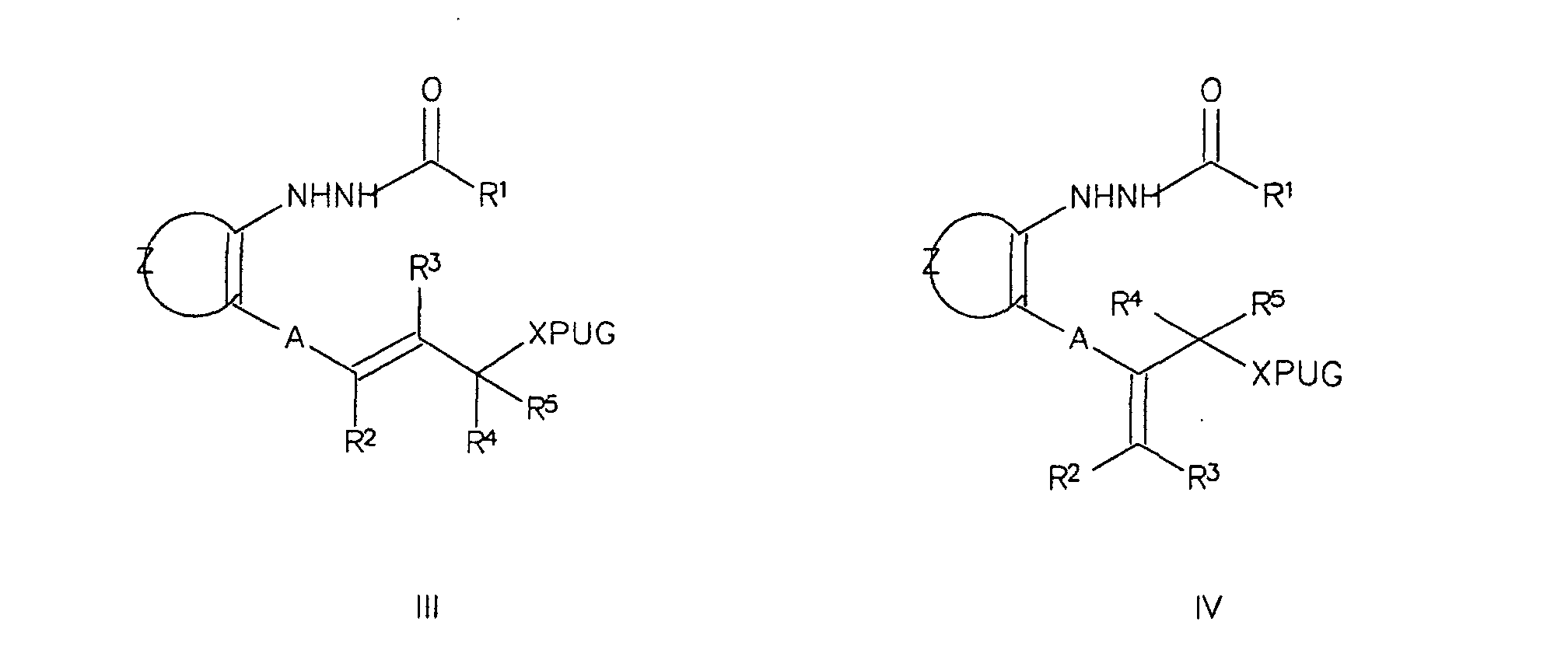
Z représente les atomes nécessaires pour former un noyau aromatique substitué ou non substitué,
A représente un groupe de liaison divalent qui place la double liaison carbone-carbone portant les substituants R2 et R3 dans la position 5 ou 6 vis-à-vis de la position initiale du radical généré, et
chacun des radicaux R2 à R5 représente, de manière indépendante, un atome d'hydrogène, un groupe alkyle ou un groupe aryle, et un ou plusieurs des radicaux R2 à R5 peut former un noyau avec n'importe quel autre membre du groupe R2 à R5. - Élément photographique selon la revendication 2, dans lequel ledit composé tels que défini par la formule générale I répond à une des formules V et VI ci-après :dans lesquelles

Z représente les atomes nécessaires pour former un noyau aromatique substitué ou non substitué,
A' représente un groupe de liaison divalent qui place la double liaison carbone-carbone portant les substituants R10 et R11 dans la position 7 ou 8 vis-à-vis de la position initiale du radical généré, et
chacun des radicaux R6 à R9 représente, de manière indépendante, un atome d'hydrogène, un groupe alkyle ou un groupe aryle, et un ou plusieurs des radicaux R6 à R9 peut former un noyau avec n'importe quel autre membre du groupe R6 à R9,
chacun des radicaux R10 à R13 représente, de manière indépendante, un atome d'hydrogène, un groupe alkyle ou un groupe aryle, et un ou plusieurs des radicaux R10 à R13 peut former un noyau avec n'importe quel autre membre du groupe R10 à R13. - Élément photographique selon la revendication 5, dans lequel ledit composé tel que défini par les formules III ou IV répond à une des formules VII, VIII ou IX ci-après :
 dans lesquelles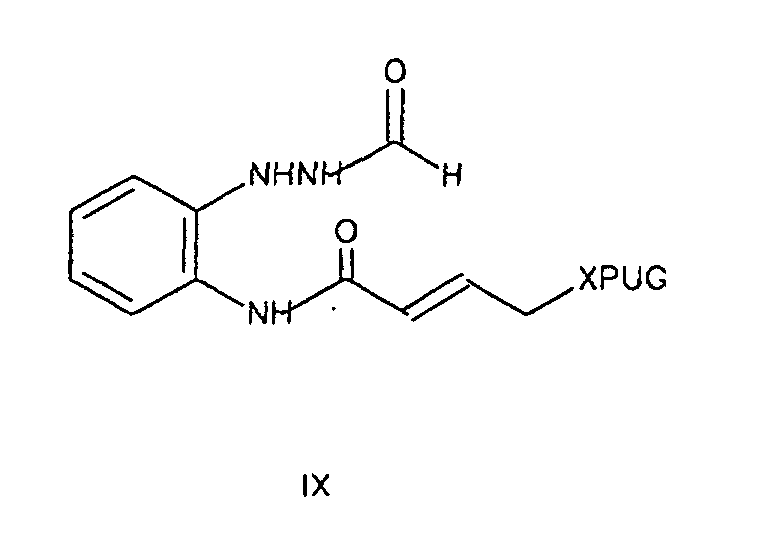
chacun des radicaux R14 et R15 représente, de manière indépendante, un atome d'hydrogène, un groupe alkyle ou un groupe alkyle substitué. - Élément photographique selon la revendication 6, dans lequel ledit composé tel que défini par la formule V ou VI répond à une des formules X ou XI ci-après, dans lesquelles les groupes R possèdent la même signification que celle indiquée à la revendication 6 :

- Élément photographique selon l'une quelconque des revendications 1 à 8, dans lequel X-PUG ou X'-PUG représente un inhibiteur du développement.
Priority Applications (4)
| Application Number | Priority Date | Filing Date | Title |
|---|---|---|---|
| DE69531602T DE69531602T2 (de) | 1995-03-09 | 1995-03-09 | Neue photographische nützliche Gruppe freisetzendes System |
| EP95200573A EP0731385B1 (fr) | 1995-03-09 | 1995-03-09 | Système libérant un nouveau groupe photographiquement utile |
| US08/609,964 US5631125A (en) | 1995-03-09 | 1996-02-29 | Photographic useful group releasing system |
| JP8080926A JPH08262616A (ja) | 1995-03-09 | 1996-03-07 | 新規な写真有用基放出システム |
Applications Claiming Priority (1)
| Application Number | Priority Date | Filing Date | Title |
|---|---|---|---|
| EP95200573A EP0731385B1 (fr) | 1995-03-09 | 1995-03-09 | Système libérant un nouveau groupe photographiquement utile |
Publications (2)
| Publication Number | Publication Date |
|---|---|
| EP0731385A1 EP0731385A1 (fr) | 1996-09-11 |
| EP0731385B1 true EP0731385B1 (fr) | 2003-08-27 |
Family
ID=8220075
Family Applications (1)
| Application Number | Title | Priority Date | Filing Date |
|---|---|---|---|
| EP95200573A Expired - Lifetime EP0731385B1 (fr) | 1995-03-09 | 1995-03-09 | Système libérant un nouveau groupe photographiquement utile |
Country Status (4)
| Country | Link |
|---|---|
| US (1) | US5631125A (fr) |
| EP (1) | EP0731385B1 (fr) |
| JP (1) | JPH08262616A (fr) |
| DE (1) | DE69531602T2 (fr) |
Families Citing this family (2)
| Publication number | Priority date | Publication date | Assignee | Title |
|---|---|---|---|---|
| HN2001000008A (es) | 2000-01-21 | 2003-12-11 | Inc Agouron Pharmaceuticals | Compuesto de amida y composiciones farmaceuticas para inhibir proteinquinasas, y su modo de empleo |
| US6566034B2 (en) * | 2000-09-11 | 2003-05-20 | Agfa-Gevaert | Photographic material containing a novel hydrazine type |
Family Cites Families (6)
| Publication number | Priority date | Publication date | Assignee | Title |
|---|---|---|---|---|
| JPS60249148A (ja) * | 1984-05-25 | 1985-12-09 | Fuji Photo Film Co Ltd | ハロゲン化銀カラ−写真感光材料 |
| JPH0690486B2 (ja) * | 1985-03-19 | 1994-11-14 | 富士写真フイルム株式会社 | ハロゲン化銀写真感光材料 |
| JP2549296B2 (ja) * | 1987-09-29 | 1996-10-30 | 富士写真フイルム株式会社 | ハロゼン化銀写真感光材料 |
| EP0395069B1 (fr) * | 1989-04-27 | 1996-07-10 | Fuji Photo Film Co., Ltd. | Matériaux photographiques à l'halogénure d'argent |
| JPH0497347A (ja) * | 1990-08-15 | 1992-03-30 | Fuji Photo Film Co Ltd | ハロゲン化銀写真感光材料 |
| JP2687189B2 (ja) * | 1991-05-22 | 1997-12-08 | 富士写真フイルム株式会社 | ハロゲン化銀カラー写真感光材料 |
-
1995
- 1995-03-09 DE DE69531602T patent/DE69531602T2/de not_active Expired - Fee Related
- 1995-03-09 EP EP95200573A patent/EP0731385B1/fr not_active Expired - Lifetime
-
1996
- 1996-02-29 US US08/609,964 patent/US5631125A/en not_active Expired - Fee Related
- 1996-03-07 JP JP8080926A patent/JPH08262616A/ja not_active Ceased
Also Published As
| Publication number | Publication date |
|---|---|
| US5631125A (en) | 1997-05-20 |
| JPH08262616A (ja) | 1996-10-11 |
| DE69531602T2 (de) | 2004-06-24 |
| EP0731385A1 (fr) | 1996-09-11 |
| DE69531602D1 (de) | 2003-10-02 |
Similar Documents
| Publication | Publication Date | Title |
|---|---|---|
| CA1090809A (fr) | Materiel photothermographique et procede | |
| US4686167A (en) | Compositions comprising ethane dioic acid hydrazide compounds and derivatives useful as dot-promoting agents | |
| DE3872744T2 (de) | Photographische silberhalogenid-materialien. | |
| JPS60179734A (ja) | ハロゲン化銀写真感光材料 | |
| US4740453A (en) | Silver halide photosensitive material containing a compound capable of releasing a photographically useful group | |
| US4420554A (en) | Silver halide photosensitive materials | |
| JPS58118639A (ja) | 熱現像感光材料 | |
| CA1103082A (fr) | Traduction non-disponible | |
| EP0350903A1 (fr) | Matériaux photographiques à base d'halogénure d'argent | |
| EP0731385B1 (fr) | Système libérant un nouveau groupe photographiquement utile | |
| JP2765227B2 (ja) | ハロゲン化銀用添加剤としてのモノ−およびジフルオロアセチルフェニルヒドラジン化合物 | |
| US5989774A (en) | Photographic material containing a new hydrazide type | |
| US5190854A (en) | Photographic infra-red sensitized material containing a speed enhancing agent | |
| US5558974A (en) | Photographic material containing a new type of hydrazide | |
| JP2995360B2 (ja) | ハロゲン化銀写真感光材料 | |
| US4569899A (en) | Photographic element for silver salt diffusion transfer process | |
| US4702999A (en) | Silver halide photographic light-sensitive materials | |
| US5998087A (en) | Photographic material containing a new hydrazide type | |
| US4174969A (en) | Light sensitive photographic material | |
| JP2663037B2 (ja) | ハロゲン化銀写真感光材料 | |
| EP0609571A1 (fr) | Composés stilbèniques utilisés comme supersensibilisateurs dans des matériaux photographiques sensibles à l'IR | |
| JPH046551A (ja) | ハロゲン化銀写真感光材料 | |
| JPS61190334A (ja) | ハロゲン化銀写真のためのテルル塩系カブリ抑制剤 | |
| JPS6214646A (ja) | ハロゲン化銀乳剤の製造方法 | |
| JPH0528818B2 (fr) |
Legal Events
| Date | Code | Title | Description |
|---|---|---|---|
| PUAI | Public reference made under article 153(3) epc to a published international application that has entered the european phase |
Free format text: ORIGINAL CODE: 0009012 |
|
| AK | Designated contracting states |
Kind code of ref document: A1 Designated state(s): BE DE FR GB NL |
|
| 17P | Request for examination filed |
Effective date: 19970311 |
|
| RAP1 | Party data changed (applicant data changed or rights of an application transferred) |
Owner name: AGFA-GEVAERT |
|
| GRAH | Despatch of communication of intention to grant a patent |
Free format text: ORIGINAL CODE: EPIDOS IGRA |
|
| GRAS | Grant fee paid |
Free format text: ORIGINAL CODE: EPIDOSNIGR3 |
|
| GRAA | (expected) grant |
Free format text: ORIGINAL CODE: 0009210 |
|
| AK | Designated contracting states |
Designated state(s): BE DE FR GB NL |
|
| PG25 | Lapsed in a contracting state [announced via postgrant information from national office to epo] |
Ref country code: NL Free format text: LAPSE BECAUSE OF FAILURE TO SUBMIT A TRANSLATION OF THE DESCRIPTION OR TO PAY THE FEE WITHIN THE PRESCRIBED TIME-LIMIT Effective date: 20030827 Ref country code: BE Free format text: LAPSE BECAUSE OF FAILURE TO SUBMIT A TRANSLATION OF THE DESCRIPTION OR TO PAY THE FEE WITHIN THE PRESCRIBED TIME-LIMIT Effective date: 20030827 |
|
| REG | Reference to a national code |
Ref country code: GB Ref legal event code: FG4D |
|
| REF | Corresponds to: |
Ref document number: 69531602 Country of ref document: DE Date of ref document: 20031002 Kind code of ref document: P |
|
| NLV1 | Nl: lapsed or annulled due to failure to fulfill the requirements of art. 29p and 29m of the patents act | ||
| ET | Fr: translation filed | ||
| PLBE | No opposition filed within time limit |
Free format text: ORIGINAL CODE: 0009261 |
|
| STAA | Information on the status of an ep patent application or granted ep patent |
Free format text: STATUS: NO OPPOSITION FILED WITHIN TIME LIMIT |
|
| 26N | No opposition filed |
Effective date: 20040528 |
|
| PGFP | Annual fee paid to national office [announced via postgrant information from national office to epo] |
Ref country code: DE Payment date: 20070326 Year of fee payment: 13 |
|
| PGFP | Annual fee paid to national office [announced via postgrant information from national office to epo] |
Ref country code: GB Payment date: 20070327 Year of fee payment: 13 |
|
| REG | Reference to a national code |
Ref country code: GB Ref legal event code: 732E |
|
| PGFP | Annual fee paid to national office [announced via postgrant information from national office to epo] |
Ref country code: FR Payment date: 20070323 Year of fee payment: 13 |
|
| GBPC | Gb: european patent ceased through non-payment of renewal fee |
Effective date: 20080309 |
|
| REG | Reference to a national code |
Ref country code: FR Ref legal event code: TP |
|
| REG | Reference to a national code |
Ref country code: FR Ref legal event code: ST Effective date: 20081125 |
|
| PG25 | Lapsed in a contracting state [announced via postgrant information from national office to epo] |
Ref country code: DE Free format text: LAPSE BECAUSE OF NON-PAYMENT OF DUE FEES Effective date: 20081001 |
|
| PG25 | Lapsed in a contracting state [announced via postgrant information from national office to epo] |
Ref country code: FR Free format text: LAPSE BECAUSE OF NON-PAYMENT OF DUE FEES Effective date: 20080331 |
|
| PG25 | Lapsed in a contracting state [announced via postgrant information from national office to epo] |
Ref country code: GB Free format text: LAPSE BECAUSE OF NON-PAYMENT OF DUE FEES Effective date: 20080309 |