EP0731493A2 - Méthode de formation d'un film semi-conducteur polycristallin - Google Patents
Méthode de formation d'un film semi-conducteur polycristallin Download PDFInfo
- Publication number
- EP0731493A2 EP0731493A2 EP96300326A EP96300326A EP0731493A2 EP 0731493 A2 EP0731493 A2 EP 0731493A2 EP 96300326 A EP96300326 A EP 96300326A EP 96300326 A EP96300326 A EP 96300326A EP 0731493 A2 EP0731493 A2 EP 0731493A2
- Authority
- EP
- European Patent Office
- Prior art keywords
- film
- semiconductor film
- substrate
- insulating material
- silicon
- Prior art date
- Legal status (The legal status is an assumption and is not a legal conclusion. Google has not performed a legal analysis and makes no representation as to the accuracy of the status listed.)
- Withdrawn
Links
Images





Classifications
-
- H—ELECTRICITY
- H10—SEMICONDUCTOR DEVICES; ELECTRIC SOLID-STATE DEVICES NOT OTHERWISE PROVIDED FOR
- H10D—INORGANIC ELECTRIC SEMICONDUCTOR DEVICES
- H10D30/00—Field-effect transistors [FET]
- H10D30/01—Manufacture or treatment
- H10D30/021—Manufacture or treatment of FETs having insulated gates [IGFET]
- H10D30/031—Manufacture or treatment of FETs having insulated gates [IGFET] of thin-film transistors [TFT]
- H10D30/0312—Manufacture or treatment of FETs having insulated gates [IGFET] of thin-film transistors [TFT] characterised by the gate electrodes
- H10D30/0314—Manufacture or treatment of FETs having insulated gates [IGFET] of thin-film transistors [TFT] characterised by the gate electrodes of lateral top-gate TFTs comprising only a single gate
-
- C—CHEMISTRY; METALLURGY
- C23—COATING METALLIC MATERIAL; COATING MATERIAL WITH METALLIC MATERIAL; CHEMICAL SURFACE TREATMENT; DIFFUSION TREATMENT OF METALLIC MATERIAL; COATING BY VACUUM EVAPORATION, BY SPUTTERING, BY ION IMPLANTATION OR BY CHEMICAL VAPOUR DEPOSITION, IN GENERAL; INHIBITING CORROSION OF METALLIC MATERIAL OR INCRUSTATION IN GENERAL
- C23C—COATING METALLIC MATERIAL; COATING MATERIAL WITH METALLIC MATERIAL; SURFACE TREATMENT OF METALLIC MATERIAL BY DIFFUSION INTO THE SURFACE, BY CHEMICAL CONVERSION OR SUBSTITUTION; COATING BY VACUUM EVAPORATION, BY SPUTTERING, BY ION IMPLANTATION OR BY CHEMICAL VAPOUR DEPOSITION, IN GENERAL
- C23C16/00—Chemical coating by decomposition of gaseous compounds, without leaving reaction products of surface material in the coating, i.e. chemical vapour deposition [CVD] processes
- C23C16/22—Chemical coating by decomposition of gaseous compounds, without leaving reaction products of surface material in the coating, i.e. chemical vapour deposition [CVD] processes characterised by the deposition of inorganic material, other than metallic material
- C23C16/24—Deposition of silicon only
-
- C—CHEMISTRY; METALLURGY
- C23—COATING METALLIC MATERIAL; COATING MATERIAL WITH METALLIC MATERIAL; CHEMICAL SURFACE TREATMENT; DIFFUSION TREATMENT OF METALLIC MATERIAL; COATING BY VACUUM EVAPORATION, BY SPUTTERING, BY ION IMPLANTATION OR BY CHEMICAL VAPOUR DEPOSITION, IN GENERAL; INHIBITING CORROSION OF METALLIC MATERIAL OR INCRUSTATION IN GENERAL
- C23C—COATING METALLIC MATERIAL; COATING MATERIAL WITH METALLIC MATERIAL; SURFACE TREATMENT OF METALLIC MATERIAL BY DIFFUSION INTO THE SURFACE, BY CHEMICAL CONVERSION OR SUBSTITUTION; COATING BY VACUUM EVAPORATION, BY SPUTTERING, BY ION IMPLANTATION OR BY CHEMICAL VAPOUR DEPOSITION, IN GENERAL
- C23C16/00—Chemical coating by decomposition of gaseous compounds, without leaving reaction products of surface material in the coating, i.e. chemical vapour deposition [CVD] processes
- C23C16/56—After-treatment
-
- H—ELECTRICITY
- H10—SEMICONDUCTOR DEVICES; ELECTRIC SOLID-STATE DEVICES NOT OTHERWISE PROVIDED FOR
- H10D—INORGANIC ELECTRIC SEMICONDUCTOR DEVICES
- H10D30/00—Field-effect transistors [FET]
- H10D30/01—Manufacture or treatment
- H10D30/021—Manufacture or treatment of FETs having insulated gates [IGFET]
- H10D30/031—Manufacture or treatment of FETs having insulated gates [IGFET] of thin-film transistors [TFT]
- H10D30/0321—Manufacture or treatment of FETs having insulated gates [IGFET] of thin-film transistors [TFT] comprising silicon, e.g. amorphous silicon or polysilicon
-
- H—ELECTRICITY
- H10—SEMICONDUCTOR DEVICES; ELECTRIC SOLID-STATE DEVICES NOT OTHERWISE PROVIDED FOR
- H10P—GENERIC PROCESSES OR APPARATUS FOR THE MANUFACTURE OR TREATMENT OF DEVICES COVERED BY CLASS H10
- H10P14/00—Formation of materials, e.g. in the shape of layers or pillars
- H10P14/20—Formation of materials, e.g. in the shape of layers or pillars of semiconductor materials
- H10P14/24—Formation of materials, e.g. in the shape of layers or pillars of semiconductor materials using chemical vapour deposition [CVD]
-
- H—ELECTRICITY
- H10—SEMICONDUCTOR DEVICES; ELECTRIC SOLID-STATE DEVICES NOT OTHERWISE PROVIDED FOR
- H10P—GENERIC PROCESSES OR APPARATUS FOR THE MANUFACTURE OR TREATMENT OF DEVICES COVERED BY CLASS H10
- H10P14/00—Formation of materials, e.g. in the shape of layers or pillars
- H10P14/20—Formation of materials, e.g. in the shape of layers or pillars of semiconductor materials
- H10P14/29—Formation of materials, e.g. in the shape of layers or pillars of semiconductor materials characterised by the substrates
- H10P14/2901—Materials
-
- H—ELECTRICITY
- H10—SEMICONDUCTOR DEVICES; ELECTRIC SOLID-STATE DEVICES NOT OTHERWISE PROVIDED FOR
- H10P—GENERIC PROCESSES OR APPARATUS FOR THE MANUFACTURE OR TREATMENT OF DEVICES COVERED BY CLASS H10
- H10P14/00—Formation of materials, e.g. in the shape of layers or pillars
- H10P14/20—Formation of materials, e.g. in the shape of layers or pillars of semiconductor materials
- H10P14/34—Deposited materials, e.g. layers
- H10P14/3402—Deposited materials, e.g. layers characterised by the chemical composition
- H10P14/3404—Deposited materials, e.g. layers characterised by the chemical composition being Group IVA materials
- H10P14/3408—Silicon carbide
-
- H—ELECTRICITY
- H10—SEMICONDUCTOR DEVICES; ELECTRIC SOLID-STATE DEVICES NOT OTHERWISE PROVIDED FOR
- H10P—GENERIC PROCESSES OR APPARATUS FOR THE MANUFACTURE OR TREATMENT OF DEVICES COVERED BY CLASS H10
- H10P14/00—Formation of materials, e.g. in the shape of layers or pillars
- H10P14/20—Formation of materials, e.g. in the shape of layers or pillars of semiconductor materials
- H10P14/34—Deposited materials, e.g. layers
- H10P14/3402—Deposited materials, e.g. layers characterised by the chemical composition
- H10P14/3404—Deposited materials, e.g. layers characterised by the chemical composition being Group IVA materials
- H10P14/3411—Silicon, silicon germanium or germanium
-
- H—ELECTRICITY
- H10—SEMICONDUCTOR DEVICES; ELECTRIC SOLID-STATE DEVICES NOT OTHERWISE PROVIDED FOR
- H10P—GENERIC PROCESSES OR APPARATUS FOR THE MANUFACTURE OR TREATMENT OF DEVICES COVERED BY CLASS H10
- H10P14/00—Formation of materials, e.g. in the shape of layers or pillars
- H10P14/20—Formation of materials, e.g. in the shape of layers or pillars of semiconductor materials
- H10P14/34—Deposited materials, e.g. layers
- H10P14/3402—Deposited materials, e.g. layers characterised by the chemical composition
- H10P14/3414—Deposited materials, e.g. layers characterised by the chemical composition being group IIIA-VIA materials
- H10P14/3421—Arsenides
-
- H—ELECTRICITY
- H10—SEMICONDUCTOR DEVICES; ELECTRIC SOLID-STATE DEVICES NOT OTHERWISE PROVIDED FOR
- H10P—GENERIC PROCESSES OR APPARATUS FOR THE MANUFACTURE OR TREATMENT OF DEVICES COVERED BY CLASS H10
- H10P14/00—Formation of materials, e.g. in the shape of layers or pillars
- H10P14/20—Formation of materials, e.g. in the shape of layers or pillars of semiconductor materials
- H10P14/34—Deposited materials, e.g. layers
- H10P14/3402—Deposited materials, e.g. layers characterised by the chemical composition
- H10P14/3414—Deposited materials, e.g. layers characterised by the chemical composition being group IIIA-VIA materials
- H10P14/3422—Antimonides
-
- H—ELECTRICITY
- H10—SEMICONDUCTOR DEVICES; ELECTRIC SOLID-STATE DEVICES NOT OTHERWISE PROVIDED FOR
- H10P—GENERIC PROCESSES OR APPARATUS FOR THE MANUFACTURE OR TREATMENT OF DEVICES COVERED BY CLASS H10
- H10P14/00—Formation of materials, e.g. in the shape of layers or pillars
- H10P14/20—Formation of materials, e.g. in the shape of layers or pillars of semiconductor materials
- H10P14/34—Deposited materials, e.g. layers
- H10P14/3438—Doping during depositing
- H10P14/3441—Conductivity type
- H10P14/3442—N-type
-
- H—ELECTRICITY
- H10—SEMICONDUCTOR DEVICES; ELECTRIC SOLID-STATE DEVICES NOT OTHERWISE PROVIDED FOR
- H10P—GENERIC PROCESSES OR APPARATUS FOR THE MANUFACTURE OR TREATMENT OF DEVICES COVERED BY CLASS H10
- H10P14/00—Formation of materials, e.g. in the shape of layers or pillars
- H10P14/20—Formation of materials, e.g. in the shape of layers or pillars of semiconductor materials
- H10P14/34—Deposited materials, e.g. layers
- H10P14/3438—Doping during depositing
- H10P14/3441—Conductivity type
- H10P14/3444—P-type
-
- H—ELECTRICITY
- H10—SEMICONDUCTOR DEVICES; ELECTRIC SOLID-STATE DEVICES NOT OTHERWISE PROVIDED FOR
- H10P—GENERIC PROCESSES OR APPARATUS FOR THE MANUFACTURE OR TREATMENT OF DEVICES COVERED BY CLASS H10
- H10P14/00—Formation of materials, e.g. in the shape of layers or pillars
- H10P14/20—Formation of materials, e.g. in the shape of layers or pillars of semiconductor materials
- H10P14/38—Formation of materials, e.g. in the shape of layers or pillars of semiconductor materials characterised by treatments done after the formation of the materials
- H10P14/3802—Crystallisation or recrystallisation of non-monocrystalline semiconductor materials, e.g. regrowth
- H10P14/3808—Crystallisation or recrystallisation of non-monocrystalline semiconductor materials, e.g. regrowth using laser beams
- H10P14/3816—Pulsed laser beam
Definitions
- the present invention relates to a thin-film semiconductor device applicable to an active matrix type liquid crystal display and others and a crystalline semiconductor film applicable to a solar battery and others.
- the active matrix type can produce a a liquid crystal display having several hundred thousand pixels, where a switching transistor is produced for each pixel.
- a transparent insulating substrate such as a molten quartz or a glass which permits the production of a transparent type display.
- a semiconductor film such as an amorphous silicon (which will hereinafter be referred to as a-Si) film and a polycrystal silicon (which will hereinafter be referred to as poly-Si) film is used as an active layer of a thin-film transistor (TFT), while the polycrystal silicon is advantageous because of its high operating speed in a case where the thin-film transistor is formed to integrally includes an active circuit.
- a molten quartz is used as the substrate, and the TFT is produced in accordance with a so-called high-temperature process being a manufacturing method in which the maximum process temperature commonly exceeds 1000°C.
- the mobility of the polycrystal silicon film assumes approximately 10 cm 2 ⁇ V -1 ⁇ s -1 to 100 cm 2 ⁇ V -1 ⁇ s -1 .
- an ordinary glass substrate is used, because the maximum process temperature is as low as approximately 400°C.
- the mobility of the amorphous silicon film assumes approximately 0.1 cm 2 ⁇ V -1 ⁇ s -1 to 1 cm 2 ⁇ V -1 ⁇ s -1 .
- the maximum process temperature is limited to below approximately 400°C. Accordingly, there have been desired techniques of producing a thin-film transistor which is capable of operating a liquid crystal display under such a condition and further of producing an active layer of the thin-film transistor which is capable of operating a driving circuit at a high speed. These are now referred to as a low-temperature process poly-Si TFT which is under development. In this case, a serious problem is how to form a high-quality crystalline semiconductor film under the condition that the maximum process temperature (low-temperature process) is below approximately 400°C.
- a first prior technique for formation of the poly-Si in the low-temperature process is the SID (Society for Information Display) shown in Digest, P. 389, (1993).
- SID Society for Information Display
- a monosilane (SiH 4 ) is used as the raw material gas and an amorphous silicon (a-Si) film with a thickness of 50 nm is deposited or accumulated at a deposit temperature of 550°C and is exposed to the laser irradiation so as to be changed into a higher-quality poly-Si film.
- the maximum process temperature is 550°C which allows the deposit of the a-Si film (which will hereinafter be referred to as an LPCVD a-Si) by the LPCVD method.
- a second prior technique of forming the poly-Si film in the low-temperature process is typically exemplified by the Japanese Published Unexamined Patent Application No. 6-163401.
- the feature of this prior technique is that, although the aforesaid first prior technique uses the LPCVD a-Si, an a-Si film is deposited in accordance with the plasma CVD method (PECVD method) and then the deposited film is heat-treated at a temperature of approximately 300°C to 450°C (so-called hydrogen-removing annealing) before being subjected to a laser applying process to result in the formation of the poly-Si film.
- PECVD method plasma CVD method
- the statement of the paragraph [0033] of the same Patent Application is as follows.
- a silicon oxide made passivation film 2 with a thickness of 200 nm and an amorphous silicon thin-film 3 with a thickness of 100 nm are formed on a glass substrate (coning 7059) 1 at a substrate temperature of 200°C in accordance with the plasma CVD method.
- the amorphous silicon thin-film 3 is polycrystallized in such a way that light emitted from a 13-W argon laser is condensed to form a light spot with a diameter of approximately 50 ⁇ m and a scanning irradiation is made at a speed of approximately 11 m/second (scanning speed of beam spot diameter x 220000/second).
- the heat treatment is indispensable before the crystalizing process.
- the laser light is applied to the PECVD a-Si film with no heat treatment or in a state with a low temperature, when the irradiated laser energy intensity is weak, the crystallization does not advance at all.
- the irradiated laser energy intensity is strong, the Si film can suffer from a damage, with the result that difficulty is completely encountered in the crystallization of the PECVD a-Si film. A description will be made of this state with reference to an experimental result shown in Fig. 1 and obtained by the Applicant.
- a specimen is an a-Si film deposited on a glass substrate (manufactured by Nippon Denki Garasu Co., Ltd, OA-2) by a parallel flat-plate type PECVD apparatus to have a thickness of 2500 angstroms.
- the film formation condition is that the flow rate of monosilane (SiH 4 ) is 225 SCCM, the flow rate of hydrogen (H 2 ) is 1300 SCCM, the RF output is 150W, the pressure is 1.3 torr, the electrode area is 1656 cm 2 (thus, the applied power density is 0.091 W/cm 2 ), the distance between the electrodes is 24.4 mm, and the substrate temperature is 300°C.
- the formation speed of the PECVD a-Si film is 547 angstrom/min.
- This film is a typical PECVD a-Si film relying on the conventional technique, and contains approximately 10.3 atom% of hydrogen.
- the density of Si atom is 4.38 x 10 22 cm -3 .
- Fig. 1 shows the result for when the laser irradiation is made after the PECVD a-Si film is heat-treated for one hour in a nitrogen (N 2 ) atmosphere with a given temperature.
- N 2 nitrogen
- the horizontal axis represents the temperature for the heat treatment and the vertical axis designates the laser irradiation energy, and A.D.
- character A denotes an amorphous state
- character C represents a crystallized state
- character D depicts a damaged state of the film.
- character A which is present at A.D.
- the crystallization does not advance at all in the as-deposited state when the energy intensity is weak (below approximately 160 mJ ⁇ cm -2 ), whereas, when energy intensity is high (above approximately 160 mJ ⁇ cm -2 ), the film is damaged so as not to function as a semiconductor at all.
- the area crystallized (the region indicated by character C in Fig. 1) expands with the increase in the processing temperature.
- the laser energy intensity for the crystallization is only 180 mJ ⁇ cm -2 , meanwhile, if the processing temperature is raised to 390°C, the crystallization takes place in a wide crystallizing energy intensity range from 190 mJ ⁇ cm -2 to 310 mJ ⁇ cm -2 .
- the area is simply divided into the amorphous area (A), the crystallized area (C) and the damaged area (D), the crystallized area (C) is more finely classified into a well crystallized area, a crystallized area relatively close to the amorphous area, a crystallized area with damage coming on.
- the well crystallized area C is surrounded by a circle.
- the crystallized film in these areas has a crystallization rate above 70% when the measurement is taken by a wavelength distributed type spectral ellipsometry or a Raman spectroscopic method, which crystallization rate is relatively high.
- the formed film is heat-treated at a temperature above approximately 400°C.
- the heat treatment temperature is said to be practically above approximately 450°C.
- the maximum process temperature is approximately 450°C being a temperature for the heat treatment of the PECVD a-Si film before the crystallizing process.
- a third prior technique of forming a poly-Si film in the low-temperature process is typically exemplified by the Japanese Published Unexamined Patent Application No. 5-275336.
- This prior technique involves increasing the laser irradiation energy intensity in succession to allow the crystallization without damage in the laser crystallization of the PECVD a-Si film.
- the claim 1 defines that "In a manufacturing method of polycrystallizing a hydrogenation amorphous semiconductor film by laser irradiation, a producing method characterised in that the irradiation energy of laser light is increased gradually to discharge hydrogen in the hydrogenation amorphous semiconductor film stepwise".
- the statement of the paragraphs [0022] to [0026] is as follows.
- the scanning irradiation is made several times with a constant energy, for example, 160 mJ (in this case, the beam size is 0.9 cm x 0.9 cm, the transmission factor of the whole optical system is 70%, and hence the energy density on the film surface is 138 mJ/cm 2 .), besides the amount of hydrogen is monitored by a mass spectrometer, and when the hydrogen amount is hardly different from the previous amount at the last scanning, the output energy is slightly increased up to, for example, 200 mJ (the energy density is 173 mJ/cm 2 .), and the scanning irradiation is made several times with the increased energy and the hydrogen amount is similarly monitored.
- a constant energy for example, 160 mJ
- the beam size is 0.9 cm x 0.9 cm
- the transmission factor of the whole optical system is 70%
- the energy density on the film surface is 138 mJ/cm 2 .
- the energy is more increased to, for example, 240 mJ (the energy density is 207 mJ/cm 2 .), then followed by the same processes.
- the energy is gradually increased and the same process is effected repeatedly, with the result that the hydrogen in the a-Si : H film is gradually released and, when the laser light is applied to the a-Si : H film with an energy enough to the polycrystallization, the a-Si : H film is changed into a polycrystallized silicon film.
- the laser light irradiation energy energy per unit area of the surface being processed
- the condensation of the laser beam with no laser light output energy being changed.
- FIG. 3 is a diagrammatical illustration of a state of such a laser annealing, where numeral 81 designates a glass substrate (on which a portion of a TFT is placed in the form of a film), numeral 82 denotes an a-Si : H film for producing a TFT at a pixel section, and numeral 83 depicts an a-Si : H film for forming a driver section.
- a small energy due to laser light is first applied to the a-Si : H film so that the hydrogen amount corresponding to that energy is discharged, and if the scanning irradiation is done several times with the laser light with the same energy, the hydrogen is decreased stepwise corresponding to that energy in accordance with the number of times of the scanning and most of the hydrogen finally goes out. Subsequently, the laser light energy is slightly increased as compared with the previous irradiation energy and the same process is carried out, whereby the hydrogen corresponding to the greater energy generates stepwise in accordance with the number of times of the scanning irradiations and its amount decreases accordingly.
- the hydrogen when the laser light irradiation energy increases, the hydrogen successively discharges in correspondence with small energy to large energy. Still further, according to the paragraph [0025], accordingly the hydrogen in the a-Si : H film is discharged stepwise and even the irradiation is transferred to the high energy side in a state with monitoring the amount of the hydrogen, and hence the film is not damaged practically and most of the contained hydrogen is discharged.
- a large energy is applied in order to polycrystallize the a-Si : H film, since the content of the hydrogen in the film is already small, even if the hydrogen is discharged at a stretch, the film does not suffer the damage.
- the laser light irradiation energy is set to be large, in the stage that the hydrogen is generated by only below a predetermined amount, as a process the laser light irradiation is carried out with an energy necessary for the polycrystallization of the a-Si : H film for the first time.
- the size of the current glass substrate for the LCDs is increasing, shifting from 360 mm x 460 mm to 550 mm x 650 mm, nevertheless an LPCVD apparatus suitable for its size increasing is unavailable.
- the heat treatment temperature needs to be raised from approximately 450°C to approximately 500°C, by which temperature raising the the use of a cheap glass becomes impossible, which causes increase in the product prise.
- the distortion of the glass itself due to its dead weight increases in accordance with the increase in its size, whereby the formation of a large-area poly-Si film is difficult.
- the degree of the crystallization due to the laser irradiation varies, i.e., is constant or irregular, at every lot, which brings the production to be unstable, or the degree of the crystallization is low, that is why difficulty is encountered to provide a high-quality crystalline semiconductor film.
- the heat treatment is indispensable irrespective of the degree of the heat treatment temperature. Accordingly, in addition to the PECVD apparatus, a heat treatment furnace becomes necessary. Since in general adding of a vacuum apparatus to the heat treatment furnace provides an LPCVD apparatus, the price of the heat treatment furnace is the same degree as that of the LPCVD apparatus. For these reasons, the second prior technique results in being more expensive than the first prior technique. Moreover, the product yield lowers because of a longer process. Furthermore, as well as the problem 1-2, the heat treatment furnace permitting the size of the glass substrate to increase is unavailable.
- the scanning irradiation is repeated several times at 135 mJ/cm 2 for removal of hydrogen, and then performed several times at 173 mJ/cm 2 , and further carried out at 207 mJ/cm 2 , that is, the same process is repeatedly done in a state that the irradiation energy successively increases.
- the crystallization of the a-Si film takes place after most of the contained hydrogen discharges.
- the number of times of the laser irradiation must reach at least several tens until the PECVD a-Si film comes into a crystallized condition. For this reason, the productivity significantly lowers and the product price rises.
- the careful control of the atmosphere around the substrate is necessary.
- the laser irradiation in the atmosphere causes the oxygen in the air to taken in the semiconductor film at every laser irradiation.
- the oxygen is caught by the dangling bond after the hydrogen disappears, and in the case of the crystallization, the oxygen is introduced into the film while the Si atoms move.
- the third prior technique does not allow the semiconductor film with no introduced oxygen to be obtainable except that the laser irradiation is conducted in a vacuum condition or in non-oxidizing atmosphere. This means that the productivity further lowers and the product price further rises.
- the energy is increased gradually after the laser irradiation is made in a state that the energy intensity is small.
- the crystal particulates are difficult to become large so that the polycrystalline semiconductor film is made up of crystal particulates with relatively small diameters. Accordingly, a high-quality semiconductor film is unobtainable regardless of whether or not the oxygen is introduced thereinto.
- the resultant thin-film semiconductor device has an inferior characteristic.
- the present invention has been developed in order to eliminate the above-mentioned various problems, and it is therefore an object of the present invention to provide a method of stably and simply manufacturing a high-quality crystalline semiconductor film with a manufacturing apparatus accepting a large-sized glass substrate.
- a method of forming a crystalline semiconductor film on an insulating material of a substrate, the substrate at least having the insulating material as a portion of its surface comprising a first step of using a chemical substance containing an element for the semiconductor film as a raw material gas and further using argon (Ar) as an additional gas to deposit the semiconductor film in accordance with a plasma chemical vapor phase deposit (PECVD) method; and a second step of improving a crystallization of the semiconductor film.
- the semiconductor film is a silicon film and a silane (SiH 4 , Si 2 H 6 , Si 3 H 8 ) is used as the raw material gas.
- a method of forming a crystalline semiconductor film on an insulating material of a substrate, the substrate at least having the insulating material as a portion of its surface comprising: a first step of using a chemical substance containing an element for the semiconductor film as a raw material gas and further using an argon (Ar) as an additional gas to deposit the semiconductor film in accordance with a plasma chemical vapor phase deposit (PECVD) method; and a second step of applying one of an optical energy and electromagnetic wave energy to the semiconductor film.
- the semiconductor film is a silicon film and a silane (SiH 4 , Si 2 H 6 , Si 3 H 8 ) is used as the raw material gas.
- a method of forming a silicon film as a crystalline semiconductor film on an insulating material of a substrate, the substrate at least having the insulating material as a portion of its surface comprising: a first step of forming the silicon film in which an absorption peak intensity at the vicinity of 2090 cm -1 is higher than an absorption peak intensity at the vicinity of 2000 cm -1 when measurement of the absorption peak intensity is taken in accordance with an infrared-absorption spectroscopic method; and a second step of improving a crystallization of the silicon film.
- a method of forming a silicon film as a crystalline semiconductor film on an insulating material of a substrate, the substrate at least having the insulating material as a portion of its surface comprising: a first step of depositing, in accordance with a plasma chemical vapor phase deposit (PECVD) method, the silicon film in which an absorption peak intensity at the vicinity of 2090 cm -1 is higher than an absorption peak intensity at the vicinity of 2000 cm -1 when measurement of the absorption peak intensity is taken in accordance with an infrared-absorption spectroscopic method; and a second step of improving a crystallization of the silicon film.
- PECVD plasma chemical vapor phase deposit
- a method of forming a silicon film as a crystalline semiconductor film on an insulating material of a substrate, the substrate at least having the insulating material as a portion of its surface comprising: a first step of forming the silicon film in which an absorption peak intensity at the vicinity of 2090 cm -1 is higher than an absorption peak intensity at the vicinity of 2000 cm -1 when measurement of the absorption peak intensity is taken in accordance with an infrared-absorption spectroscopic method; and a second step of applying one of an optical energy and electromagnetic wave energy to the silicon film.
- a method of forming a silicon film as a crystalline semiconductor film on an insulating material of a substrate, the substrate at least having the insulating material as a portion of its surface comprising: a first step of depositing, in accordance with a plasma chemical vapor phase deposit (PECVD) method, the silicon film in which an absorption peak intensity at the vicinity of 2090 cm -1 is higher than an absorption peak intensity at the vicinity of 2000 cm -1 when measurement of the absorption peak intensity is taken in accordance with an infrared-absorption spectroscopic method; and a second step of applying one of an optical energy and electromagnetic wave energy to the silicon film.
- PECVD plasma chemical vapor phase deposit
- a method of forming a crystalline semiconductor film on an insulating material of a substrate, the substrate at least having the insulating material as a portion of its surface comprising: a first step of depositing the semiconductor film which has a pillar-like configuration; and a second step of improving a crystallization of the pillar-like semiconductor film.
- the semiconductor film is a silicon film.
- a method of forming a crystalline semiconductor film on an insulating material of a substrate, the substrate at least having the insulating material as a portion of its surface comprising: a first step of depositing the semiconductor film which has a pillar-like configuration; and a second step of applying one of an optical energy and electromagnetic wave energy to the pillar-like semiconductor film.
- the semiconductor film is a silicon film.
- a method of forming a crystalline semiconductor film on an insulating material of a substrate, the substrate at least having the insulating material as a portion of its surface comprising: a first step of depositing the semiconductor film, which has a pillar-like configuration, in accordance with a plasma chemical vapor phase deposit (PECVD) method; and a second step of improving a crystallization of the pillar-like semiconductor film.
- the semiconductor film is a silicon film.
- a method of forming a crystalline semiconductor film on an insulating material of a substrate, the substrate at least having the insulating material as a portion of its surface comprising: a first step of depositing the semiconductor film, which has a pillar-like configuration, in accordance with a plasma chemical vapor phase deposit (PECVD) method; and a second step of applying one of an optical energy and electromagnetic wave energy to the pillar-like semiconductor film.
- the semiconductor film is a silicon film.
- substrates to which this invention is applicable are conductive materials such as a metal, ceramic materials such as a silicon carbide (SiC), an alumina (Al 2 O 3 ) and an aluminium nitride (AlN), transparent insulating materials such as a molten quartz and a glass, semiconductor substrates such as a silicon wafer, LSIs obtainable by processing the aforesaid semiconductor substrates, and crystalline insulating materials such as a sapphire (trigonal system Al 2 O 3 crystal).
- conductive materials such as a metal
- ceramic materials such as a silicon carbide (SiC), an alumina (Al 2 O 3 ) and an aluminium nitride (AlN)
- transparent insulating materials such as a molten quartz and a glass
- semiconductor substrates such as a silicon wafer
- LSIs obtainable by processing the aforesaid semiconductor substrates
- crystalline insulating materials such as a sapphire (trigonal system
- the semiconductor film is deposited on an insulating material made as at least a portion of the surface of a substrate.
- this insulating material is referred to as a surface protective film.
- the semiconductor film can directly be deposited on the molten quarts substrate.
- an insulating material such as a silicon oxide film (SiOx : 0 ⁇ x ⁇ 2) and silicon nitride film (Si 3 Nx : 0 ⁇ x ⁇ 4) is formed as a surface protective film on a molten quartz substrate and a semiconductor film is further formed thereon.
- the semiconductor film may directly be deposited on the ordinary glass being an insulating material, whereas in this case it is preferable that a surface protective film is formed on the glass substrate using an insulating material such as a silicon oxide film and a silicon nitride film before the semiconductor film is deposited thereon so that moving ions such as natrium (Na) contained in the glass are not mixed into the semiconductor film.
- a surface protective film is formed on the glass substrate using an insulating material such as a silicon oxide film and a silicon nitride film before the semiconductor film is deposited thereon so that moving ions such as natrium (Na) contained in the glass are not mixed into the semiconductor film.
- the semiconductor film is deposited on the surface protective film.
- the surface protective film plays a role of preventing a sintering assistant raw material added into a ceramic from being dispersed and mixed into the semiconductor section.
- the surface protective film is indispensable because of ensuring its insulation.
- an interlayer insulating film or the like between transistors or between wirings serves as the surface protective film.
- the dimension and configuration of the substrate are freely selectable except that the dimension and configuration do not give rise to deformation such as expansion and contraction and distortion. That is, the selection is possible in a range from a disc with a diameter of approximately 3 inches (76.2 mm) to a rectangular substrate with a dimension of approximately over 560 mm x 720 mm.
- the surface protective film is formed on that substrate with an oxide film such as a silicon oxide film, an aluminium oxide film and a tantalum oxide film or a nitride film such as a silicon nitride film according to such a CVD method as an APCVD method and an LPCVD method or such a PVD method as a sputtering method.
- a silicon oxide film can be deposited at a substrate temperature of approximately 250°C to 450°C if using as the raw materials a monosilane (SiH 4 ) and oxygen.
- the surface protective film is producible at a substrate temperature from the room temperature to 400°C.
- the surface protective film is required to have a thickness sufficient to avoid the dispersion and mixing of impurity ions from the substrate side, and needs to be at least approximately 100 nm. If taking the variation between the lots and between the substrates into consideration, preferably the thickness is above approximately 200 nm. If being 300 nm, the surface protective film can satisfactorily function as a film for protection.
- the film thickness is commonly taken to be approximately 400 nm to 600 nm.
- a semiconductor film is deposited on some substrate. This is taken in all the following embodiments of this invention.
- semiconductor films made of tetragroup element complex materials such as a silicon germanium (Si x Ge 1-x : 0 ⁇ x ⁇ 1), a silicon carbide (Si x C 1-x : 0 ⁇ x ⁇ 1) and a germanium carbide (Ge x C 1-x : 0 ⁇ x ⁇ 1), semiconductor films made of trigroup element and pentagroup element complex compounds such as a gallium arsenic (GaAs) and an indium antimony (InSb), semiconductor films made of digroup element and hexagroup element complex compound materials such as a cadmium selenium (CdSe).
- P-type semiconductor films produced
- a chemical substance containing elements constituting the semiconductor film being deposited acts as a raw material gas to deposit the semiconductor film.
- the semiconductor film is made of silicon (Si)
- a silane such as a monosilane (SiH4), a disilane (Si 2 H 6 ), a trisilane (Si 3 H 6 ), and a dichlorosilane (SiH 2 Cl 2 ).
- the disilane or trisilane is referred to as a high-order silane (Si n H 2n+2 : n is an integer which is 2 or more).
- the semiconductor film being made of germanium (Ge)
- a germane (GeH 4 ) or the like is put in use.
- phosphorus (P) or boron (B) is added into the semiconductor film
- a phosphine (PH 3 ), a diboron (B 2 H 6 ) or the like is used together.
- the raw material gas there is used a chemical substance containing the elements making up aforesaid various semiconductor films, since a portion of the raw material gas always remains in the semiconductor film, the hydride of the constituting element is more preferable.
- chlorine (Cl) always remains irrespective of the degree of the amount in a silicon film made of a dichlorosilane (SiH 2 Cl 2 ), and in the case of applying this silicon film to an active layer of a thin-film semiconductor device, the remaining chlorine can deteriorate the transistor characteristics.
- a monosilane (SiH4) being a hydrogen compound of the constituting element is more preferable than the dichlorosilane. It is more preferable as the purity of the raw material gas and the additional gas added if required is higher, while taking into account the more technical difficulty in attaining the high-purity gas and the raise of the price, the purity is preferable to be above 99.9999%.
- the semiconductor film forming apparatus has a background vacuum degree of approximately 10 -6 torr, and has a film forming pressure of 0.1 torr to several torr.
- the rate of introduction of the impurities from the background vacuum to film forming processes is about 10 -5 to 10 -6 .
- the purity of the raw material gas or the additional gas to be used for the film formation is sufficient if being equal to the ratio of the film forming pressure to the background vacuum degree of the film forming apparatus utilizing that gas.
- the purity of the gas flowing into the film forming apparatus is preferable to be above 99.999% (the rate of the purity is below 1 x 10 -5 ), and if the purity is 99.9999% (the rate of the purity is below 1 x 10 -6 ), this raw material has no problem at all. Further, if the purity is ten times the ratio of the background vacuum degree to the film forming pressure (in this instance, the purity is 99.99999% and the rate of the impurities is below 1 x 10 -7 ), there is no need for the introduction of the impurities to be taken into consideration, and it gets into an ideal condition.
- FIG. 2 a description will be made hereinbelow of the outline of an arrangement of a plasma chemical vapor phase depositing apparatus (PECVD apparatus) employed in this invention.
- the PECVD apparatus is of the capacitive coupling type, and the plasma is designed to take place between parallel flat-plate-like electrodes by means of a high-frequency power source with an industrial frequency (13.56 MHz).
- the upper side view of Fig. 2 schematically shows a reaction chamber and others viewed from the above, where the lower side view of Fig. 2 is a cross section taken along line A-A' in the upper side view of Fig. 3.
- a reaction chamber 201 is isolated from the outside atmosphere by means of a reaction container 202, and comes into a pressure-reduced condition of approximately 0.1 torr to 10 torr during the film formation.
- a reaction container 202 Within the reaction container 202 there are placed a lower flat-plate-like electrode 203 and an upper flat-plate-like electrode 204 disposed in opposed relation to each other. These two electrodes constitute parallel flat plate electrodes.
- the reaction chamber 201 is defined between the parallel flat plate electrodes.
- the parallel flat plate electrodes have a dimension of 470 mm x 560 mm, and the distance therebetween is changeable between 18.0 mm to 37.0 mm and, hence, the volume of the reaction chamber 201 varies from 4738 cm 3 to 9738 cm 3 in accordance with the distance between the electrodes.
- the distance between the parallel flat plate electrodes can freely be set to between 10.0 mm and 40.0 mm in such a way that the position of the lower flat plate electrode 203 is shifted up and down. In a case where the distance therebetween is set to a given value, the deviation of the interelectrode distance within the flat plate electrode surface of 470 mm x 560 mm is only 0.5 mm.
- the deviation of the electric filed strength established between the electrodes becomes below approximately 2% within the flat plate electrode surface, with the result that the plasma with an extremely uniform quality generates within the reaction chamber 201.
- a substrate 205 on which the thin-film is deposited and the circumferential portion of which is pressed by 2 mm through a shadow frame 206.
- the shadow frame 206 is omitted in order to make the outline of the PECVD apparatus clear.
- a heater 207 which allows the temperature of the lower flat plate electrode 203 to be adjustable between 250°C and 400°C.
- the temperature distribution in the lower flat plate electrode 203 other than the circumferential section (2 mm width) is within ⁇ 5°C with respect to the set temperature, and hence, even if the size of the substrate 205 is substantially set to 360 mm x 465 mm, the temperature deviation within the substrate 205 is maintainable within ⁇ 2°C.
- the shadow frame 206 prevents the substrate to be curvedly deformed due to the heat from the heater 207 concurrent with pressing the substrate so that unnecessary thin-film is not formed on the edge portions of the substrate and the rear surface thereof.
- a reaction gas comprising the raw material gas and the additional gas is led through a pipe 208 into the upper flat plate electrode 204, and passes into a gas dispersion plate 209 to flow from the whole upper flat plate electrode surface into the reaction chamber 201 under a substantially even pressure.
- a portion of the reaction gas is electrolytic-dissociated when being out of the upper flat plate electrode so that the plasma occurs between the parallel flat plate electrodes.
- a portion of or all the reaction gas contributes to the film formation, and the remaining reaction gas which does not contribute to the film formation and the gas produced by the chemical reaction for the film formation are discharged as an exhaust gas through an exhaust hole 210 made in a circumferential and upper portion of the reaction container 202.
- the conductance of the exhaust hole 210 is sufficiently greater than the conductance between the parallel flat plate electrodes and is preferable to be more than 100 times the conductance between the parallel flat plate electrodes.
- the conductance between the parallel flat plate electrodes is sufficiently larger than the conductance of the gas dispersion plate 209 and is also preferable to be more than 100 times the conductance of the gas dispersion plate 209.
- the reaction gas is led into the reaction chamber 201 from the whole surface of the large-sized upper flat plate electrode of 470 mm x 560 mm under a substantially uniform pressure, and at the same time the exhaust gas is discharged from the reaction chamber 201 in all the directions with an even flow rate.
- the flow rate of the various reaction gases is adjusted to a given value by a mass flow controller before the gases are led into the pipe 208.
- the pressure within the reaction chamber 201 is adjusted to a desired value by a conductance valve 211 placed at the exit of the exhaust hole 210.
- a vacuum exhaust unit such as a turbo-molecular pump.
- an oil-free dry pump is used as a portion of the vacuum exhaust pump and the background vacuum degree within the reaction container 202 including the reaction chamber 201 is on the order of 10 -5 torr.
- the arrows schematically indicate the flow of the gas.
- the reaction container 202 and the lower flat plate electrode 203 has the grounded potential and are maintained to be electrically insulated from the upper flat plate electrode 204 through an insulating ring 212.
- a high-frequency wave of, for example, 13.56 MHz outputted from a high-frequency wave oscillation source 213 is applied through an impedance matching circuit 214 to the upper flat plate electrode 204.
- the PECVD apparatus used in this invention can realize an extremely precise interelectrode control and uniform gas flow and hence acts as a thin-film forming apparatus which is capable of dealing with a large-sized substrate of 360 mm x 465 mm.
- these basic concepts can also realize an apparatus which can easily deal with a larger-sized substrate having, for example, a dimension of 550 mm x 650 mm.
- a high-frequency wave with a frequency of 13.56 MHz that shows the widest application is used, it is also appropriate to use a high-frequency wave having a frequency integral times that frequency.
- doubled 27.12 MHz, tripled 40.68 MHz, quadrupled 54.24 MHz and others are also effective.
- VHF wave of approximately 100 MHz to 1GHz. If using in the range from an RF wave having a frequency of an approximately 10 MHz to a VHF wave having a frequency of approximately several hundreds MHz, the plasma can take place between the parallel flat plate electrodes.
- the high-frequency wave oscillation source 213 and the impedance matching circuit 214 are replaced with different ones, the generation of the plasma is possible using a high-frequency wave with a desired frequency.
- the electron temperature of the plasma increases with the increase in the frequency so that the radical generation becomes easy.
- the high-frequency plasma is particularly effective to a thin-film forming method according to this invention which will be described later.
- the substrate is placed within the PECVD apparatus where the lower flat plate electrode 203 is kept to have a temperature of 380°C.
- the PECVD apparatus is set to be the same as the film forming process except for the generation of the plasma. For example, 50 SCCM of monosilane and 3000 SCCM of argon are made to flow, and the pressure within the reaction chamber 201 is maintained to be 1.5 torr. The distance between the parallel flat plate electrodes is 24.4 mm. After the substrate installed becomes in equilibrium condition with such a system, the substrate surface temperature is 349°C.
- the equilibrium time in the case of the substrate whose temperature is kept to the room temperature, the equilibrium time assumes at least 5 to 6 minutes. This equilibrium time depends upon the thickness of the substrate, the heat capacity, the thermal conductivity, the substrate temperature before the installation, the kind of the gas introduced into the reaction chamber 201, the flow rate of the introduced gas, the gas pressure and so on. For example, if the thickness of the substrate becomes thinner from 1.1 mm taken in this invention to 0.7 mm, the equilibrium time is also reduced to 3 to 4 minutes in substantial proportion to the thickness of the substrate. If preheating is performed before the substrate is installed within the reaction chamber 201, the equilibrium time is also reducible.
- the preheating is effected at a temperature higher by approximately 10°C than the substrate surface temperature in the equilibrium condition, it is possible that the equilibrium time is reduced to about 1 minute.
- the reduction of the equilibrium time results in the improvement of the throughput and the reduction of the product price.
- a high-frequency wave is given to the upper flat plate electrode 204 to generate the plasma for the formation of the film.
- the high-frequency wave output is 600W. That is, one example of the silicon film deposit condition is as follows.
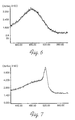
- Fig. 4 shows a spectrum of the silicon film measured by the infrared absorption spectroscopic method.
- Fig. 5 When being compared with a prior a-Si film (Fig. 5), it is found that the absorption peak intensity at the vicinity of 2090 cm -1 is larger than the absorption peak intensity at the vicinity of 2000 cm -1 .
- Fig. 7 shows a measurement result of the silicon film taken by the Raman spectroscopic method.
- the silicon film obtained according to this invention shows a mixed crystal including an amorphous and a crystalline.
- the silane being a chemical substance containing a silicon which is an element for making the semiconductor film is used as the raw material gas, and argon is used as the additional gas.
- the resultant silicon film deposited by the PECVD method is of a mixed crystal having a pillar-like configuration.
- this semiconductor film hydrogen of approximately 1% to 10% is contained in a state with being coupled to the amorphous silicon or crystalline silicon.
- the IR peaks thereof are mainly present in the vicinity of 2090 cm -1 .
- this semiconductor film will hereinafter be referred to as (Ar-based) mixed crystal film.
- the important parameters for depositing such a (Ar-based) mixed crystal semiconductor film by the PECVD method are four: the kind of the additional gas, the pressure, the distance between the electrodes and the substrate surface temperature. Secondly, a detailed description will be made in terms of these things.
- One of the features of this invention is to obtain the as-deposited film as a mixed crystal with a relatively high crystalline according to the PECVD method which is used for general purposes.
- extreme difficulty is encountered to create a mixed crystal with a high crystalline from the as-deposited film according to the PECVD method.
- the reason is that, because the substrate temperature is low as below approximately 400°C, the mobility lowers at the growing film surface of the raw material such as silane and the selectivity to the crystal state of the raw material with respect to the amorphous (noncrystal) state is lost.
- This invention can resolve this disadvantage of the PECVD method by introducing the additional gas such as argon (Ar) and further by diluting the raw material with the additional gas.
- the radical or ion of the raw material is not made but the radical or ion of argon (Ar) is made, and the energy needs to be carried by these to the substrate surface.
- the radical or ion of the raw material causes a gas phase reaction or reacts immediately when the raw material reaches the substrate surface so that the selectivity is lost to hinder the crystal growing in the semiconductor film surface. Accordingly, the formation thereof in the plasma of the radical or ion is necessary to possibly avoid.
- the raw material is carried to the growing film surface in an inert state, and after absorbed thereat, the energy for the reaction is supplied through the dilute gas or the like so that a mixed crystal film with a high crystalline is formed in the as-deposited state.
- the dilution of the raw material gas is necessary, and further it is required that a gas for promoting the reaction of the raw material on the substrate surface is carried as a diluting substance.
- argon consists of elemental atoms, the spectrum of the ionization potential is extremely simple.
- the univalent ionization potential of argon is 15.759 eV
- the bivalent ionization potential is 27.629 eV
- the trivalent ionization potential is 40.74 eV.
- the ionized argon mainly assumes both univalent ions and bivalent ions, and the ionization energy is relatively low so that the radical or ion of the argon is produced effectively.
- the ionization potential of the hydrogen molecular takes ten and several different values between 15 eV and 18 eV.
- the argon creates a plasma state with one or two energies (for example, laser light)
- the molecular gas such as hydrogen produces a plasma state including a number of energies (white light).
- the laser light can more effectively carry the energy as compared with the white light, and if the raw material gas is diluted with the argon with a low ionization energy, the energy can be carried more effectively to the substrate surface.
- the diluting material at deposit of the semiconductor film in addition to the argon there may be used noble gas elements such as helium (He), neon (Ne), krypton (kr) and xenon (Xe).
- the essential condition or requirement on the pressure is to be 1.0 Torr. Even if the other parameter is close to the essential condition value (likely to be out of the essential condition), the (Ar-based) mixed crystal film can surely be formed if the pressure is above approximately 1.6 Torr. If the pressure becomes excessive, the plasma is unstable so that abnormal discharge takes place. In this invention, in order to stably produce uniform plasma, the pressure is preferable to be approximately 2.7 Torr.
- the essential requirement on the distance between the electrodes is that the interelectrode distance is above approximately 17.8 mm. Even if the other parameter is close to the essential condition value (likely to be out of the essential condition), the (Ar-based) mixed crystal film can surely be formed if the interelectrode distance is above approximately 25.4 mm.
- the interelectrode distance is below approximately 45.7 mm.
- the essential requirement on the substrate surface temperature does not exist, while the formation of the mixed crystal film is relatively easy if the temperature is above approximately 200°C. If considering that a low-price large-sized glass substrate is handled with no trouble, it is desired that the temperature is below approximately 400°C.
- the (Ar-based) mixed crystal film prefers a higher pressure and further prefers a larger interelectrode distance. However, bringing these parameters to desired values results in lowering the film formation speed. From a practical point of view in manufacturing, the lower limit of the desired film formation speed is approximately 0.3 nm/s.
- Fig. 8 shows the variation of the crystalline due to the laser irradiation to a (Ar-based) mixed crystal as-deposited film. That is, the (Ar-based) mixed crystal film is formed to have a thickness of 50 nm under the following requirements.
- XeCl excimer laser light having a wavelength of 308 nm was directly applied to this film without any heat treatment (the as-deposited state) and examination was conducted of the variation of the crystalline.
- the half band width of the excimer laser is approximately 45 ns, and the irradiation was made to an about 1 cm x 1 cm rectangular configuration once with each energy.
- the horizontal axis designates the energy density on the substrate surface at each irradiation and the vertical axis denotes the crystallization rate of the semiconductor film after the laser irradiation. The crystallization was measured by a multiwavelength distributed type ellipsometry.
- the black circles indicate that the result of the laser irradiation shows a damaged semiconductor film, corresponding to D in Fig. 1.
- the crystallization rate exceeds approximately 70%, it is taken as a polycrystallization state, and hence a crystallization clearly advances when the laser energy density is between approximately 100 mJ ⁇ cm -2 and approximately 150 mJ ⁇ cm -2 .
- the crystallization rate comes up to the maximum 92% so that a high-quality semiconductor film is obtainable.
- a poly-Si film is produced according to such a manufacturing method, a poly-Si TFT is producible in accordance with a common manufacturing method for the thin-film semiconductor device afterwards. Owing to the high crystalline the melt crystallized film has, it is also possible to produce a high-quality thin-film semiconductor device where the mobility is about 100 cm 2 ⁇ V -1 ⁇ S -1 .
- the amorphous region is more easily molten than the microcrystal region and the microcrystal floating in the molten silicon liquid plays a role of a paste which can suppress the evaporation and fly of the molten silicon solution and further plays a role of a crystal growing core in the cooling cured process.
- the laser energy density for the melt crystallization of the (Ar-based) mixed crystal semiconductor film is lowered by approximately 50 mJ ⁇ cm -2 as compared with the prior art.
- the (Ar-based) mixed crystal film according to this invention has a wider area crystallized due to one laser irradiation, as compared with the prior amorphous film. That is, the (Ar-based) mixed crystal film further reduces the load on the laser irradiation equipment and improves the productivity.
- the general purpose PECVD method can provide a mixed crystal film with a high crystalline even in the as-deposited state. However, that film has no more excellent quality than that of the crystallized film.
- the film attained by the ordinary PECVD method encounters difficulty in the crystallization except for the case of performing the heat treatment for the removal of hydrogen and the fining.
- the crystallization or melt crystallization of the mixed crystal semiconductor film with a high crystalline is easily possible by the RTA method, the VST-SPC method, or the laser irradiation.
- the mixed crystal semiconductor film according to this invention is most suitable as the first semiconductor film in forming a crystalline semiconductor film using the melt crystallization.
- the mixed crystal semiconductor film with a high crystalline is form on an insulating material according to the PECVD method or the like, and then this film is crystallized by the solid phase crystallizing method such as the RTA method and the VST-SPC method or the melt crystallization (SPC) method such as the laser irradiation, with the result that a high-quality crystalline semiconductor film is readily formable.
- the solid phase crystallizing method such as the RTA method and the VST-SPC method or the melt crystallization (SPC) method such as the laser irradiation
- the (Ar-based) mixed crystal semiconductor film according to this invention is obtainable by the PECVD method using a chemical substance containing an element of the inert gas such as argon and an element such as a monosilane for making a semiconductor film.
- the mixed crystal silicon film is also formable if the monosilane is diluted to approximately 3% with hydrogen.
- hydrogen-monosilane-based mixed crystal has an extreme difficulty in the melt crystallization if the heat treatment is not made. The crystallization is Occasionally possible without the heat treatment, whereas the reproductivity is extremely low and the laser energy range where the melt crystallization is successful is limited to at most below approximately 10 mJ/cm 2 .
- the argon-monosilane-based mixed crystal silicon film can be crystallized over a wide energy range from above approximately 50 mJ/cm 2 to approximately 350 mJ/cm 2 if the thickness of the semiconductor film and film formation condition are subjected to adjustments. Accordingly, the hydrogen-based mixed crystal semiconductor film is also suitable as an initial semiconductor film for forming a crystalline semiconductor film, while the (Ar-based) mixed crystal semiconductor film described in detail in the chapter (4) is more suitable.
- the irradiation method will be described in the case of using an example of a xenon chloride (XeCl) excimer laser (wavelength : 308 nm).
- the intensity half band width of the laser pulse is 45 ns. Since the irradiation time is extremely short, in the crystallization of as a semiconductor film of, for example, a mixed crystal, the substrate is not heated, with the result that the deformation of the substrate and others do not occur.
- the laser irradiation brings the substrate to be between the room temperature (25°C) and 400°C, and is performed in the air or in a vacuum atmosphere.
- the area receiving one laser irradiation has a square configuration of 8 mm, and the position to be irradiated is shifted by 4 mm at every irradiation. After the scanning is first made in the horizontal direction (Y direction), the position to be irradiated is also shifted by 4 mm in the vertical direction (X direction) and again shifted by 4 mm in the horizontal direction before the scanning is done. Thereafter, this scanning is repeatedly carried out so that the first laser irradiation is completed over whole substrate surface.
- the first laser irradiation energy density is preferable to be approximately 80 mJ/cm 2 to 250 mJ/cm 2 .
- the energy density is set to be higher than that of the first laser irradiation and the second laser irradiation is conducted over the whole substrate surface.
- the second laser irradiation energy density is preferable to be between 100 mJ/cm 2 to 600 mJ/cm 2 .
- the scanning method is the same as that for the first laser irradiation, and the area to be irradiated has a square configuration of 8 mm and is shifted by 4 mm in the X and Y directions. If using this two-stage laser irradiation method, it is possible to perfectly eliminate the variations of the laser beam at edge portions.
- the irradiation is effected with an energy density which can not damage the semiconductor film. Furthermore, it is also possible to use the one-stage laser irradiation method using a laser beam with a large energy but not damaging the film from the beginning.
- any energy source is usable if the energy irradiation time is within several tens seconds and the irradiation is made to only a portion of the substrate.
- various lasers such as an ArF excimer laser, an XeF excimer laser, a KrF excimer laser, a YAG laser, a carbon dioxide laser, and a dye laser, or to use lamps such as an arc lamp and a tungsten lamp.
- the lamp output is set to be above 0.1 kW/cm 2
- the irradiation time is set to be approximately 0.1 second to approximately one minute, by which conditions the crystallization of the semiconductor film advances.
- the irradiation time is short and a local heat treatment is taken to the whole substrate, and hence the deformation and crack of the substrate do not occur.
- the heat treatment at approximately 450°C is indispensable before the crystallization in order to avoid the rapid discharge of hydrogen.
- the heat treatment before the crystallization is unnecessary in the crystallization according to not only the melt crystallizing method but also the furnace-SPC method, the RTA method or the VST-SPC method.
- the PECVD apparatus is the same as that stated in detail in the chapter (3), and after a surface protective film being an insulating material such as a silicon oxide film is provided at at least a portion of the substrate surface, a semiconductor film is formed on this surface protective film.
- a glass substrate (OA-2) with a dimension of 360 mm x 475 mm x 1.1 mm is placed within the PECVD apparatus where the temperature of the lower flat plate electrode 203 is maintained to be 380°C.
- the recipe after the installation of the substrate within the PECVD apparatus reaction furnace is as follows.
- Fig. 9 shows the spectrum of this silicon film measured by the infrared absorption spectroscopic method. It is found from Fig. 9 that the absorption peak intensity at the vicinity of 2090 cm -1 is higher than that at the vicinity of 2000 cm -1 . Further, Fig. 10 shows a Raman spectroscopic measurement result of this silicon film. It is found that a Raman shift from the crystal component appears at the vicinity of 520 cm -1 , and the silicon film of this example is a mixed crystal.
- the semiconductor film obtained in the first embodiment is exposed to the laser irradiation in the as-deposited state without being heat-treated.
- the result is shown in Fig. 11 which is the same as Fig. 8 in a way of looking.
- the irradiation laser light is obtained from an XeCl excimer laser whose wavelength is 308 nm, and its half band width is approximately 45ns.
- the beam has a rectangular configuration of about 1 cm x 1 cm, and the laser irradiation was made once at each energy. It is found from Fig. 11 that the semiconductor film obtained in the first embodiment can clearly be crystallized if the laser energy density is between approximately 110 mJ ⁇ cm -2 to 160 mJ ⁇ cm -2 .
- the crystallization rate reaches a maximum of 88% when the energy density is 125 mJ ⁇ cm -2 , thus providing a high-quality crystalline semiconductor film.
- the semiconductor film according to this invention it is possible to readily manufacture a high-quality polycrystal semiconductor film with a high crystallization rate with simple laser irradiation and with a relatively low laser energy density, with the heat treatment for the removal of hydrogen which has been carried out being unnecessary.
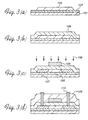
- the semiconductor film obtained in the first embodiment is exposed to the laser irradiation in the as-deposited state without being heat-treated, thus forming a crystalline semiconductor film to produce a thin-film semiconductor device where the crystalline semiconductor film is used as an active layer of a TFT.
- a surface protective film 102 being a silicon oxide film is formed on a large-sized substrate 101 with a dimension of 360 mm x 475 mm according to PECVD method, and an intrinsic silicon film is continuously formed on this surface protective film according to the method of the first embodiment without a vacuum state being broken.
- the thickness of the surface protective film 102 is 300 nm and the thickness of the semiconductor film is 60 nm.
- the semiconductor film thus obtained allows its melt crystallization to advance by the laser irradiation in the as-deposited state without the conduct of the heat treatment.
- the irradiation laser light is emitted from an XeCl excimer laser whose wavelength is 308 nm, and its half band width is approximately 45 ns. Further, the laser light energy density is 140 mJ ⁇ cm -2 .
- the laser irradiation is conducted in the atmosphere.
- the substrate temperature at the laser irradiation is a room temperature of approximately 25°C. In the case of the semiconductor film thus crystallized, the crystallization rate was 93% when being measured by the wavelength distributed type ellipsometry, and the film thickness was 55 nm.
- this semiconductor film is made up of crystal particulates the diameter of which is approximately 180 nm to 400 nm. After the completion of the crystallizing process, this crystalline semiconductor film is patterned, and a semiconductor film 103 is formed which becomes an active layer of a transistor afterwards ((a) of Fig. 3).
- a gate insulating film 104 is formed according to the PECVD method ((b) of Fig. 3).
- the gate insulating film being a silicon oxide film is formed at a substrate surface temperature of 350°C to have a thickness of 120 nm with TEOS (Si-(O-CH 2 -CH 3 ) 4 ) and oxygen (O 2 ) being used as the raw material gas.
- a tantalum (Ta) thin-film serving as a gate electrode 105 is deposited according to the sputtering method.
- the substrate temperature at the sputtering is 150°C and the thickness of the film is 500 nm.
- subsequently impurity ions 106 are injected into the semiconductor film to produce a source-drain area 107 and a channel area 108 ((c) of Fig. 3).
- the gate electrode serves as a mask for the ion injection, the channel has a self-matching structure constructed only under the gate electrode.
- the impurity ion injection is conducted using a mass non-separating type ion injector.
- the phosphorus atom concentration in the source-drain area is approximately 3 x 10 20 cm -3 .
- an interlayer insulating film 109 being a silicon oxide film is formed using TEOS according to the PECVD method.
- the substrate surface temperature is 350°C at the formation of the interlayer insulating film, and the film thickness is 500 nm, Thereafter, the heat treatment is carried out at 350°C for one hour to activate the injected ions.
- a contact hole is made in the source-drain and aluminium (Al) is deposited according to the sputtering method.
- the substrate temperature at the sputtering is 150°C and the film thickness is 500 nm.
- a source-drain leading electrode 110 and an aluminium thin-film being a wiring are patterned, thus completing a thin-film semiconductor device ((d) of Fig. 3).
- a crystalline semiconductor film made of a crystalline silicon film is easily formable at a low temperature of below approximately 400°C, and the quality of the crystalline semiconductor film sharply improves, and the mass production is stably possible. More specifically, the effects are as follows.
- the process temperature is as low as below 400°C, a cheap glass is usable, thereby lowering the product price.
- the distortion due to the dead weight of the glass itself is avoidable, whereby a high-quality crystalline semiconductor film is formable over a wide area.
- a uniform laser irradiation is possible over the whole of the substrate. As a result, the uniformity is improved at every lot and a stable production is possible.
- this invention in a case where this invention is applied to an active matrix liquid crystal display, a cheap glass substrate or the like is usable and a large-sized high-quality LCD is easily and stably producible.
- this invention in a case where this invention is applied to another electric unit, the deterioration of elements and others due to heat is reducible. Accordingly, this invention can show a large effect which easily improves the performance of electronic devices such as an active matrix liquid crystal display, a solar battery and an integrated circuit and further lowers the price thereof.
Landscapes
- Chemical & Material Sciences (AREA)
- General Chemical & Material Sciences (AREA)
- Chemical Kinetics & Catalysis (AREA)
- Engineering & Computer Science (AREA)
- Materials Engineering (AREA)
- Mechanical Engineering (AREA)
- Metallurgy (AREA)
- Organic Chemistry (AREA)
- Inorganic Chemistry (AREA)
- Liquid Crystal (AREA)
- Thin Film Transistor (AREA)
- Crystals, And After-Treatments Of Crystals (AREA)
Applications Claiming Priority (4)
| Application Number | Priority Date | Filing Date | Title |
|---|---|---|---|
| US38603295A | 1995-02-09 | 1995-02-09 | |
| US386032 | 1995-02-09 | ||
| US54880795A | 1995-12-27 | 1995-12-27 | |
| US548807 | 1995-12-27 |
Publications (2)
| Publication Number | Publication Date |
|---|---|
| EP0731493A2 true EP0731493A2 (fr) | 1996-09-11 |
| EP0731493A3 EP0731493A3 (fr) | 1997-01-22 |
Family
ID=27011251
Family Applications (1)
| Application Number | Title | Priority Date | Filing Date |
|---|---|---|---|
| EP96300326A Withdrawn EP0731493A3 (fr) | 1995-02-09 | 1996-01-17 | Méthode de formation d'un film semi-conducteur polycristallin |
Country Status (2)
| Country | Link |
|---|---|
| EP (1) | EP0731493A3 (fr) |
| JP (1) | JP3881715B2 (fr) |
Cited By (2)
| Publication number | Priority date | Publication date | Assignee | Title |
|---|---|---|---|---|
| WO1999045164A1 (fr) * | 1998-03-03 | 1999-09-10 | Applied Komatsu Technology, Inc. | Procede de revetement et de recuisson de substrats de verre de grande superficie |
| US8828859B2 (en) | 2011-02-11 | 2014-09-09 | Semiconductor Energy Laboratory Co., Ltd. | Method for forming semiconductor film and method for manufacturing semiconductor device |
Families Citing this family (2)
| Publication number | Priority date | Publication date | Assignee | Title |
|---|---|---|---|---|
| JP4495851B2 (ja) * | 2000-11-15 | 2010-07-07 | 積水化学工業株式会社 | 半導体素子の製造装置 |
| CN100474084C (zh) * | 2003-07-14 | 2009-04-01 | 株式会社半导体能源研究所 | 液晶显示器件 |
Family Cites Families (2)
| Publication number | Priority date | Publication date | Assignee | Title |
|---|---|---|---|---|
| US4492736A (en) * | 1983-09-29 | 1985-01-08 | Atlantic Richfield Company | Process for forming microcrystalline silicon material and product |
| JPH076960A (ja) * | 1993-06-16 | 1995-01-10 | Fuji Electric Co Ltd | 多結晶半導体薄膜の生成方法 |
-
1996
- 1996-01-17 EP EP96300326A patent/EP0731493A3/fr not_active Withdrawn
- 1996-01-17 JP JP00574196A patent/JP3881715B2/ja not_active Expired - Fee Related
Cited By (3)
| Publication number | Priority date | Publication date | Assignee | Title |
|---|---|---|---|---|
| WO1999045164A1 (fr) * | 1998-03-03 | 1999-09-10 | Applied Komatsu Technology, Inc. | Procede de revetement et de recuisson de substrats de verre de grande superficie |
| US6294219B1 (en) | 1998-03-03 | 2001-09-25 | Applied Komatsu Technology, Inc. | Method of annealing large area glass substrates |
| US8828859B2 (en) | 2011-02-11 | 2014-09-09 | Semiconductor Energy Laboratory Co., Ltd. | Method for forming semiconductor film and method for manufacturing semiconductor device |
Also Published As
| Publication number | Publication date |
|---|---|
| EP0731493A3 (fr) | 1997-01-22 |
| JP3881715B2 (ja) | 2007-02-14 |
| JPH08339965A (ja) | 1996-12-24 |
Similar Documents
| Publication | Publication Date | Title |
|---|---|---|
| JP4466775B2 (ja) | 薄膜半導体装置の製造方法 | |
| US6660572B2 (en) | Thin film semiconductor device and method for producing the same | |
| US6271066B1 (en) | Semiconductor material and method for forming the same and thin film transistor | |
| US5962869A (en) | Semiconductor material and method for forming the same and thin film transistor | |
| US5753542A (en) | Method for crystallizing semiconductor material without exposing it to air | |
| JP4026182B2 (ja) | 半導体装置の製造方法、および電子機器の製造方法 | |
| JP3911971B2 (ja) | シリコン薄膜、薄膜トランジスタおよびシリコン薄膜の製造方法 | |
| EP0997950A2 (fr) | Procédé d amélioration de crystallisation des couches semi-conductrices particulièrement pour transistors à couches minces | |
| JP3999138B2 (ja) | 半導体装置の製造方法、表示装置の製造方法、および電子機器の製造方法 | |
| US6562672B2 (en) | Semiconductor material and method for forming the same and thin film transistor | |
| US5877526A (en) | Semiconductor device having polysilicon thin-film | |
| US5949091A (en) | Semiconductor device having polysilicon thin-film | |
| JP3924828B2 (ja) | 結晶性半導体膜の製造方法、および薄膜トランジスタの製造方法 | |
| US20100062585A1 (en) | Method for forming silicon thin film | |
| JP4258476B2 (ja) | 薄膜半導体装置の製造方法 | |
| JP3881715B2 (ja) | 結晶性半導体膜の形成方法、アクティブマトリクス装置の製造方法、及び電子装置の製造方法 | |
| JP4222232B2 (ja) | 薄膜トランジスタの製造方法 | |
| JP4016525B2 (ja) | 半導体の製造方法 | |
| JPH10120491A (ja) | 結晶膜の形成方法 | |
| JPS59124163A (ja) | 半導体素子 | |
| JP2005167280A (ja) | 半導体装置、アクティブマトリクス基板、及び電子機器 | |
| JPWO1997022141A1 (ja) | 薄膜半導体装置の製造方法及び、薄膜半導体装置 | |
| Jang et al. | We deposited the Ni particles of 1014 cm-2 on a-Si and it was bias |
Legal Events
| Date | Code | Title | Description |
|---|---|---|---|
| PUAI | Public reference made under article 153(3) epc to a published international application that has entered the european phase |
Free format text: ORIGINAL CODE: 0009012 |
|
| AK | Designated contracting states |
Kind code of ref document: A2 Designated state(s): DE GB |
|
| PUAL | Search report despatched |
Free format text: ORIGINAL CODE: 0009013 |
|
| AK | Designated contracting states |
Kind code of ref document: A3 Designated state(s): DE GB |
|
| 17P | Request for examination filed |
Effective date: 19970609 |
|
| 17Q | First examination report despatched |
Effective date: 19981229 |
|
| STAA | Information on the status of an ep patent application or granted ep patent |
Free format text: STATUS: THE APPLICATION IS DEEMED TO BE WITHDRAWN |
|
| 18D | Application deemed to be withdrawn |
Effective date: 19990511 |