EP0732257B1 - Gummi-raupenband mit verbindungsglied - Google Patents
Gummi-raupenband mit verbindungsglied Download PDFInfo
- Publication number
- EP0732257B1 EP0732257B1 EP94903084A EP94903084A EP0732257B1 EP 0732257 B1 EP0732257 B1 EP 0732257B1 EP 94903084 A EP94903084 A EP 94903084A EP 94903084 A EP94903084 A EP 94903084A EP 0732257 B1 EP0732257 B1 EP 0732257B1
- Authority
- EP
- European Patent Office
- Prior art keywords
- rubber crawler
- rubber
- crawler
- track
- core bar
- Prior art date
- Legal status (The legal status is an assumption and is not a legal conclusion. Google has not performed a legal analysis and makes no representation as to the accuracy of the status listed.)
- Expired - Lifetime
Links
- 230000003014 reinforcing effect Effects 0.000 claims description 22
- JOYRKODLDBILNP-UHFFFAOYSA-N Ethyl urethane Chemical compound CCOC(N)=O JOYRKODLDBILNP-UHFFFAOYSA-N 0.000 claims description 10
- 239000000463 material Substances 0.000 claims description 7
- 230000002093 peripheral effect Effects 0.000 claims 2
- 230000000149 penetrating effect Effects 0.000 claims 1
- 229910000831 Steel Inorganic materials 0.000 description 11
- 239000010959 steel Substances 0.000 description 11
- 239000002184 metal Substances 0.000 description 5
- 229910052751 metal Inorganic materials 0.000 description 5
- 230000000694 effects Effects 0.000 description 4
- 238000000034 method Methods 0.000 description 4
- 238000010276 construction Methods 0.000 description 3
- 238000005096 rolling process Methods 0.000 description 3
- XEEYBQQBJWHFJM-UHFFFAOYSA-N Iron Chemical compound [Fe] XEEYBQQBJWHFJM-UHFFFAOYSA-N 0.000 description 2
- 238000006073 displacement reaction Methods 0.000 description 2
- 239000000835 fiber Substances 0.000 description 2
- 239000000853 adhesive Substances 0.000 description 1
- 230000001070 adhesive effect Effects 0.000 description 1
- 230000003247 decreasing effect Effects 0.000 description 1
- 239000004744 fabric Substances 0.000 description 1
- 230000008014 freezing Effects 0.000 description 1
- 238000007710 freezing Methods 0.000 description 1
- 229910052742 iron Inorganic materials 0.000 description 1
- 150000002739 metals Chemical class 0.000 description 1
- 239000004033 plastic Substances 0.000 description 1
- 229920003023 plastic Polymers 0.000 description 1
- 239000000126 substance Substances 0.000 description 1
- 239000012209 synthetic fiber Substances 0.000 description 1
- 229920002994 synthetic fiber Polymers 0.000 description 1
- 238000003466 welding Methods 0.000 description 1
Images






Classifications
-
- B—PERFORMING OPERATIONS; TRANSPORTING
- B62—LAND VEHICLES FOR TRAVELLING OTHERWISE THAN ON RAILS
- B62D—MOTOR VEHICLES; TRAILERS
- B62D55/00—Endless track vehicles
- B62D55/08—Endless track units; Parts thereof
- B62D55/18—Tracks
- B62D55/24—Tracks of continuously flexible type, e.g. rubber belts
- B62D55/244—Moulded in one piece, with either smooth surfaces or surfaces having projections, e.g. incorporating reinforcing elements
Definitions
- the present invention relates to a connecting link type rubber crawler suitably mounted to a traveling unit of a mobile construction machine, etc.
- a steel crawler has been mainly applied to the traveling unit of a mobile construction machine, and a rubber shoe has been partially applied thereto. Recently, however, a rubber crawler is preferably used.
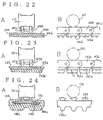
- Fig. 22 is an explanatory view to describe an example of a conventional steel crawler: 101 is an outer flanged rolling wheel, 102 is a crawler shoe, 102a is a shoe plate, 102b is a track link, 102c is a linkage pin, and 102d is a lug (steel made).
- Fig. 23 is an explanatory view to describe an example of a rubber shoe: 103 is a rubber shoe, 103a is a shoe plate, 103b is a track link, 103c is a linkage pin, 103d is a rubber lug.
- Fig. 22 is an explanatory view to describe an example of a conventional steel crawler: 101 is an outer flanged rolling wheel, 102 is a crawler shoe, 102a is a shoe plate, 102b is a track link, 102c is a linkage pin, and 102d is a lug (steel made).
- Fig. 23 is an explanatory view to describe
- 104 is a rubber crawler
- 104c is a lug
- 105 is a core metal
- 106 is a steel cord.
- the same outer flanged rolling wheel can be used.
- a steel crawler wherein the upper surface of track links serves as a continuous track for a rolling wheel, effects small vibrations during traveling. Besides, it scarcely deviates from the wheel because of no elongation nor side displacement of the crawler in a circumferntial or width direction. Moreover, it is excellent in durability because of strong mechanical connection between the links. However, it causes big noise and gives heavy fatigue to a driver because of its poor cushioning ability. In addition, it damages roads.
- a rubber crawler effects small noise and has good cushioning ability without damaging roads. Besides, it is relatively lightweight so as to drive at high speed. However, it causes somewhat strong driving vibrations because an upper face of a projection of each core metal serves as a wheel track. In addition, when it receives big outer pressure in its circumferential or width direction, which causes elongation and side displacement, it deviates from the wheel. Moreover, it is inferior to the steel crawler in mechanical strength and durability.
- a rubber shoe wherein a rubber lug is provided on the ground side of a shoe plate of a steel crawler, has such structural problems that the shoe plat is apt to come off the rubber lug, and that the rubber lug is easily damaged or worn down because it is pressed between the shoe plate and the ground without any space for escape. Besides, a method of vulcanizing and fixing a rubber lug to each shoe plate highers the cost considerably. Accordingly, it can not be superior to a rubber crawler.
- a connecting link type rubber crawler which constituts the basis of the preambles of enclosed independent claims 1 and 2 is known from EP-A 0 525 187.
- the rubber crawler body of this known connecting link type rubber crawler forms an integral body, which is not adaptable in its length to different construction machines and does not allow a partial exchange.
- a first solution of this object is achieved by connecting link type rubber crawlers according to amended claim 1.
- a further solution of the object as mentioned above is achieved by a connecting link type rubber crawler according to claim 2.
- This rubber crawler consists only of rubber crawler shoes which are connected as to form an endless body.
- Subclaims 3 to 8 are directed towards advantageous features and embodiments of rubber crawlers according to independent claims 1 and 2.
- Subclaims 9 to 12 are directed towards further improvement of the inventive rubber crawler, achieved by a central lug pad which is fixed to the center part of the core bar on its ground side.
- Subclaims 13 and 14 are directed towards further advantageous details of connecting an end of the belting rubber crawler body with a rubber crawler shoe by overlapping parts provided on said members.
- Fig. 1 shows an embodiment of a core bar used for a rubber crawler: Fig. 1A is a perspective view, Fig. 1B is a side view, and Fig. 1C is a top view.
- reference number 1 is a core bar
- 1a and 1a are right and left wing portions
- 1b is a concave center part
- m and m are connecting parts on both sides of the center part 1b for fixing later-described trak links
- p and p are bolt holes (through holes) provided on the connecting portions m, m, h shows a difference in height, said center part 1b being lower than the wing portions 1a.
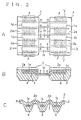
- Fig. 2 shows a rubber crawler body 2 having the above core bars 1 embedded therein at fixed intervals:
- Fig. 2A is a plan view
- Figs. 2B and 2C are sectional views in the lines X-X and Y-Y, respectively, of Fig. 2A.
- the right and left wing portions 1a, 1a are embedded in a rubber material of the rubber crawler body 2, while the bolt holes p, p and their vicinities on the center part 1b are not embedded.
- Reference number 2a is a curvature which is so curved that the crawler body between two wing portions 1a and 1a adjacent in a circumferential direction is raised on the inner circumferential side.
- a reinforcing layer 3 is corrugate, since it is embedded under the wing portions 1a, as shown in Fig. 2C.
- a lug 4 projects on the outer circumferential side, corresponding to each wing portion 1a.
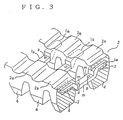
- Fig. 3 is a perspective view of the above rubber crawler body 2.
- Fig. 4 shows a piece of track link 5 used in this embodiment: Fig. 4A is a front view, and Fig. 4B is a bottom view. It is the same track link as has been conventionally used for some steel crawlers.
- reference numbers 6, 6 are right and left pin holes, and an interval l between the pin holes coinsides with an interval between core bars.
- Reference number 7 is a window
- 8 is a lower frame of the window
- m' is a connecting part on the lower face of the track link for being connected to the connecting part m of the core bar 1.
- a bolt hole p' on the connecting part m' goes through the lower frame 8, as shown in FIG. 4A.
- An upper face g of the track link 5 is plane, serving as a track for a wheel.
- the vicinities of the right and left pin holes 6, 6 are made thin (half of thickness t) oppositly on the right and left sides, so that the adjoining track links can be connected with each other in the same thickness.
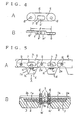
- Fig. 5 is a partial view of the crawler body 2 of this embodiment having the track links fixed thereto:
- Figs. 5A and 5B are sectional views in the circumferential and width drections, respectively.
- the above bolt hole p' and the bolt hole p of the center part 1a of the core bar are united and bolted together, so that a pair of track links 5 are installed on both sides of the center part 1a.
- Each pin hole 6 of the adjacent track links is overlapped with each other, and a link pin is turnably inserted into the overlapped pin hole so as to connect the track links and form a continuos wheel track.
- Reference marks k and k' are a bolt and a nat, respectively, for connecting the track link 5 with the core bar 1, and in Fig. 5, 9 is a link pin.
- FIG. 6 is to explain how the rubber crawler of this embodiment engages with a driving or guiding wheel.
- the rubber crawler outside a line connecting the link pins 9, 9 . . . is elongated.
- An elongating rate increases according to the distance toward the outer side.
- the crawler body where the core bars are embedded is not elongated, while the crawler body between the embedded core bars is elongated. If the elongating rate on this part increases, the crawler body loses its durability because of repeated elongated fatigue.
- the track links are fixed at a relatively lower position, since the center part 1b of the core bar is lowered for a difference h between the wing portion 1a and the center part 1b.
- this part is heightened toward the inner circumferential side to be almost at the same height as the link pin 9. Accordingly, it is hardly elongated even at the engaging part, thereby having no problem for repeated elongated fatigue.
- a reinforcing layer 3 may be embedded.
- the reinforcing layer 3 are used natural or synthetic fiber of high intensity, cloth of metal fiber, and these kinds of fiber cords, as well as a few pieces of steel cords.
- the reinforcing layer 3 is preferably embedded between the core bars in the crawler body at the almost same height as the link pin because of the above reason.
- a plurality of reinforcing layers 3 can be used, or embedded above the core bars 1, if necessary.
- the core bar 1 and the track link 5 can be connected by means other than bolting:
- the connecting parts m and m' of the core bar and the track link, respectively, can be put together by arc welding, or other means.
- the connecting part m of the cor bar 1 on the inner circumferential side of the crawler body is exposed or coverd with a thin rubber layer in relation with the above connecting means to be paired with the track links.
- Besdies, the connecting part m on the outer circumferential side can be exposed or covered with a rubber layer (regardless of thickness of rubber), in relation with the above connecting means.
- the center part 1b except the connecting parts m, m of the core bar 1 can be covered with rubber in any width and any shape.
- the crawler body can be endless or in a belt form.
- the track links fixed to one end of the crawler body are connected with the track links fixed to the other end to form a endless crawler.
- one belting crawler body or a pulrality thereof may be used to make a endless crawler body.
- Figs. 7 ⁇ 9 relates to an embodiment for connecting ends of the belting crawler body.
- Fig. 7 shows an overlapping part n of the crawler body 2:
- Fig. 2A is a plan view (on the inner circumferential side),
- Fig. 2B is a front view, and
- Fig. 7C is a sectional view in the line Y-Y of Fig. 2A.
- the overlapping part n is thinly provided to an end of the crawler body 2, and a reinforcing layer 3 is embedded therein almost to a tip end thereof.
- Reference mark p1 is a bolt hole for connecting a later-described connecting body, being provided at a suitable portion within the width of the reinforcing layer 3.
- Reference number 4' is a lug, u and u' are concaves between the lugs.
- a shallow concave u' is provided under the wing portion 1a of the core bar, and lugs 4', 4' are provided on both sides thereof. Accordingly, collapse of the crawler is small when a wheel rolls between the core bars. Even when the wheel passes above the core bars, suitable cushioning effect enables comforatable driving.
- a curvature 2a is heightened to make a deep concave u thereunder, thereby having no inner distortion of rubber on this part during engaging with a driving or guiding wheel.
- Fig. 8 shows an inventive rubber crawler shoe 21: Fig. 8A is a plan view (on the inner circumferential side), Fig. 8B is a front view, Fig. 8C is a sectional view in the line Y-Y of Fig. 8A, and Fig. 8D is a plan view (on the ground side).
- n' is an overlapping part for being connected with the above overlapping part n of the crawler body 2.
- Reference number 3' is a reinforcing layer, f is a wear plate, and p2 is a bolt hole. As shown in Fig. 8, the reinforcing layer 3' is embedded in almost full length of the rubber crawler shoe 21.
- a bolt hole p2 is provided for connecting the reinforcing layer 3 with the wear plate f embedded thereunder at the overlapping part n'.
- the bolt hole p2 is so arranged that it coninsides with the bolt hole p1 when the overlapping part n' and the above overlapping part n of the crawler body are united.
- the reinforcing layer 3' may be made of the same materials as the above reinforcing layer 3, or a thin metalic plate (suitably bent), or wire netting.
- Reference mark q is a hole for inserting a bolt from the ground side.
- the wear plate f is embedded in the rubber crawler shoe 21 in advance, so that the hole q is provided only at the bolt hole p2.
- a hole q big enough for receiving the wear plate f is provided, and the wear plate f is fixed to the rubber crawler shoe 21 later.
- a bolt k (see Fig. 9) may be embedded in the rubber crawler shoe together with the wear plate f (in this case, a threaded part of the bolt k is exposed on the inner circumferential side of the rubber crawler shoe 21 through the bolt hole of the reinforcing layer 3'), thereby having no hole for inserting the bolt.
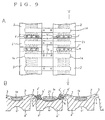
- Fig. 9 shows how the crawler body 2 is connected with the rubber crawler shoe 21:
- Fig. 9A is a plan view (on the inner circumferential side), and
- Fig. 9B is a sectional view in the line Y-Y of Fig. 9A.
- the rubber crawler shoe 21 is provided between the crawler bodies 2.
- the overlapping parts n and n' are united, and the wear plate f' on the inner circumferential side and the wear plate f on the outer circumferential side are firmly bolted at the united part.
- the adjoining track links are fixed to the bolt holes p, p on both sides of the center part 1b of the core bar, and connected with each other.
- the overlapping parts n' may be formed on both ends of the crawler body 2 to be connected with the overlapping parts n formed on both ends of the rubber crawler shoe 21.
- the overlapping part n on one end of the crawler body 2 may be formed the overlapping part n, while on the other end may be formed the overlapping part n', so that both ends are directly united and connected.
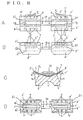
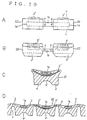
- Fig. 10 relates to other embodiment of the rubber crawler shoe:
- Fig. 10A is a plan view of a connecting body 22 in this embodiment (on the inner circumferential side).
- Fig. 10B is a front view thereof
- Fig. 10C is a sectional view in the line Y-Y of Fig. 10A
- Fig. 10D is a sectional view showing a connecting condition.
- the rubber crawler shoe 22 has no overlapping part in the circumferential direction, the reinforcing layer 3' is embedded therein in almost full length thereof.
- Fig. 10A is a plan view of a connecting body 22 in this embodiment (on the inner circumferential side).
- Fig. 10B is a front view thereof
- Fig. 10C is a sectional view in the line Y-Y of Fig. 10A
- Fig. 10D is a sectional view showing a connecting condition.
- the rubber crawler shoe 22 has no overlapping part in the circumferential direction
- the rubber crawler shoe 22 is arranged between the the crawler bodies 2, 2, and the track links fixed on the inner circumferential side are connected with each end of the rubber crawler shoe 22 and the crawler body 2 in touch.
- the crawler body 2 has no overlapping part on their ends as the rubber crawler shoe 22.
- the rubber crawler shoe 22 has the same function as a conventional rubber shoe.
- the upper surface of the rubber crawler shoe 22 is so curved that both ends thereof can be about at a height of the link pin 9. Accordingly, when the endless body engages with a driving or guiding wheel, an opening between adjoining rubber crawler shoes 22 becomes small enough to prevent extraneous substances from biting into the driving wheel therethrough. Besides, when the rubber crawler shoes 22 roll on the ground, the heightened ends form a high concave u between lugs as if increasing the lug's height. Accordingly, mud comes into the concave u effectively, thereby decreasing slips during driving.
- Fig. 11 relatas to a further different embodiment:
- Fig. 11A is plan view of a rubber crawler shoe 23 of this embodiment (on the inner circumferential side)
- Fig. 11B is a sectional view in the line Y-Y of Fig. 11A
- Fig. 11C is a sectional view showing a connecting condition.
- 1' is a core bar embedded in the rubber crawler shoe 23
- 1'a and 1'b are a wing portion and a center part, respectively.
- a width L2 of the wing portion 1'a is slightly smaller than a circumferential length L1 of the rubber crawler shoe 23.
- the rubber crawler shoe 23 can be disposed between the belting crawler bodies for connection, as in the same manner as the embodiment shown in Fig. 10D.
- the track links can be shifted in the circumferential direction relative to the center part of the core bar for connection.
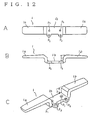
- Fig. 12 shows an example of a core bar in this embodiment: Fig. 12A is a top view, Fig. 12B is a side view, and Fig. 12C is a perspective view.
- 1 is a core bar
- 1a and 1a are right and left wing portions
- 1b is a center part
- h is a height difference.
- the center part 1b is lower than the wing portion 1a.
- Reference marks p1, p1, and p2, p2 are bolt holes (through holes) at both sides of the center part 1b for fixing later-described central lug pads and the track links, respectively.
- Fig. 13 shows a rubber crawler body 2 having the above core bars 1 embedded therein at fixed intervals:
- Fig. 13A is a plan view (on the ground side), and
- Fig. 13B is a sectional view in the line X-X of Fig. 13A.
- the right and left wing portions 1a, 1a are embedded in a rubber material of the rubber crawler body 2, while the center part 1b is not embedded therein.
- Reference number 4 is a lug, 4a1, 4a2 are a top face and a trough, respectively, of the lug 4, and 2b' is a concave formed between the lugs.
- the lug 4 is provided at a position where the wing portion 1a is embedded.
- the shallow trough 4a2 is provided between the top faces of the lug 4, while the deep concave 2b' is formed at a portion where the core bar is not embedded between the lugs 4.
- Fig. 14 shows a piece of a track link used in this embodiment: Fig. 14A is a front view, and Fig. 14B is a bottom view. It is the same track link as has been conventionally used for sortie steel crawlers.
- 5a is a window, 5p1, 5p1' are bolt holes, and 5p2, 5p2 are pin holes for receiving connecting pins.
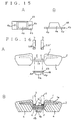
- Fig. 15 shows one embodiment of a center lug pad of this invention: Fig. 15A is a front view, and Fig. 15B is a side view.
- 4A is a central lug pad
- 4a is a lug
- 4b is a core plate (an iron plate)
- 4p is a bolt hole.
- the lug 4a is firmly fixed on the core plate 4b by the following method, etc. Namely, the core plate 4b whose surface is buffed, degreasd, and treated with adhesives in advance, is placed in a metal mold with a suitable amount of unvulcanized rubber, and pressed and vulcanized for a fixed time.
- the interval of the right and left bolt holes 4p, 4p coincides with that of the bolt holes p1, p1 on the center part 1b of the above core bar.
- Fig. 16 is an explanatory view to describe processes for fixing the track links 5 and the central lug pad 4A to the rubber crawler body 2:
- Fig. 16A is a side view showing each arrangement
- Fig. 16B is a sectional view showing a fixing condition.
- the bolt holes 5p1. 5p1 of the right and left track links 5, 5 are united with the bolt holes p2, p2 of the center part 1b of the core bar, and bolted togeth er.
- the bolt holes 4p, 4p of the central lug pad 4A are united with the bolt holes p1, p1, and the bolt holes 5p1', 5p1', and bolted together.
- reference marks k, k' are a bolt and a nut, respectively.
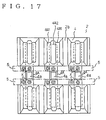
- Fig. 17 is a plan view, showing the rubber crawler body 2 having the central lug pads 4A fixed on the ground side.
- the track link and the central lug pad are fixed on the center part of the core bar through different bolt holes, respectively. Accordingly, the central lug pads can be fixed or removed separately from the track links.
- Fig. 18 shows a different embodiment 10 of the core bar: Fig. 18A is a top view, Fig. 18B is a bottom view. Figs. 18C and 18D are sectional views in the lines X-X and Y-Y, respectively, of Fig. 18A.
- 10a, 10a are right and left sweepback wing portions
- 10b is a center part
- r1, r2 are reinforcing ribs.
- the reinforcing ribs r1, r2 are to reinforce the wing portions 10a and the center part 10b, provided at the positions shown in Fig. 18A.
- This invention is not limited to the above embodiment.
- Only one pair of the bolt holes may be provided on the center part of the core bar, so that the bolt hole of the track link and the bolt hole of the central lug pad should be united with the bolt hole of the center part from the upper side and the lower side, respectively, and bolted and fixed together by means of a common bolt.
- a material of the lug 4a of the above central lug pad 4A is not limited to the same rubber material as the rubber crawler body, but elastic rubber having excellent durability such as urethan rubber, etc. can be also uesd.
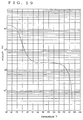
- Fig. 19 is a graph showing a relationship between hardness and temperature of urethan rubber, wherein the vertical axis shows modullus of a logarithm (tensile strength for 85% elongation (unit PSI)) and the horizontal axis shows temperature (°C).
- urethan rubber has excellent elasticity at normal temperature in a workshop, while it turns to a highly rigid body below the freezing point.
- urethan rubber nomally has suitable hardness on the roads, while it turns to a highly rigid body on the snow ground in winter, functioning as spikes. Accordingly, the body can be easily driven and operated, thereby increasing working efficiency and safety.
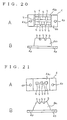
- Figs. 20 and 21 show embodiments of lug patterns for the central lug pad made of urethan rubber: Figs. 20A and 21A are bottom views, and Figs. 20B and 21B are side views.
- 4a1 is a lug made of urethan rubber
- s is a top face of the lug 4a1
- v is a trough.
- the trough v having steep slops is provided on the top face of the lug 4a1, thereby increasing spike effects on the snow ground.
- the lug of the above central lug pad can be made of metals or hard plastics, etc., so as to be used exclusively as spikes on the snow ground.
- the height of the lug of the central lug pad is decided according to its purpose. If the lug is used exclusively as spikes on the snow ground, the middle part of the lug may be heightened than the side parts on the ground side.
- the lug pads are removable, but they can be fixed to the core bars so as not to be removed.
Landscapes
- Engineering & Computer Science (AREA)
- Chemical & Material Sciences (AREA)
- Combustion & Propulsion (AREA)
- Transportation (AREA)
- Mechanical Engineering (AREA)
- Footwear And Its Accessory, Manufacturing Method And Apparatuses (AREA)
Claims (14)
- Gummi-Raupenband mit Verbindungsglied,wobei Kernstäbe (1) in einem Gummi-Raupenbandkörper in geeigneten Abständen mit ihrer Längsrichtung senkrecht zu der Umfangsrichtung des Gummi-Raupenbandkörpers eingebettet sind;wobei der Kernstab einen Zentralteil (1b) und rechte und linke Flügelbereiche (1a) umfaßt, wobei der Zentralteil an seinen beiden Seiten Anschlußteile (m) zum Befestigen von Bahnverbindungsgliedern (5) aufweist;wobei die rechten und linken Flügelteile in einem Gummimaterial des Raupenbandkörpers eingebettet sind;wobei die Anschlußbereiche (m) wenigstens an der inneren Umfangsseite des Raupenbandkörpers freiliegen oder von einer dünnen Gummischicht bedeckt sind;wobei das Bahnverbindungsglied (5) an seinen beiden Seiten mit Stiftlöchern (6) und an seiner Unterseite zwischen den Stiftlöchern mit Anschlußbereichen (m') versehen ist;wobei ein Abstand zwischen den Stiftlöchern mit einem Mitte-zu-Mitte-Abstand zwischen den aneinander anschließenden Kernstäben übereinstimmt;wobei jeder Anschlußbereich (m, m') des Kernstabs und des Bahnverbindungsgliedes so miteinander verbunden sind, daß das Bahnverbindungsglied an dem Kernstab von der inneren Umfangsseite des Raupenbandes aus befestigt ist;wobei der Oberrand des Bahnverbindungsgliedes über den Gummi-Raupenbandkörper um eine vorbestimmte Höhe vorsteht, vorausgesetzt, daß das Bahnverbindungsglied an dem Kernstab befestigt ist;wobei die Stiftlöcher der aneinander anschließenden Bahnverbindungsglieder miteinander verbunden sind und ein Stift (9') in die miteinander verbundenen Stiftlöcher eingesetzt ist, so daß die aneinander anschließenden Bahnverbindungsglieder an der Mitte der aneinander anschließenden Kernstäbe drehbar miteinander verbunden sind; undwobei ein Paar kontinuierlicher Laufbahnen an beiden Seiten des Mittelteils des Raupenbandkörpers gebildet ist,
dadurch gekennzeichnet, daßder Gummi-Raupenbandkörper wenigstens einen Riemengummikörper und wenigstens einen Raupenbandschuh (22, 23) aufweist, wobei die jeweiligen Enden einander zugewandt sind,welcher Gummi-Raupenbandschuh einen in ihn eingebetteten Kernstab (1) aufweist und in seiner Umfangsrichtung eine Länge aufweist, die fast mit einem Abstand zwischen Stiftlöchern (6) an beiden Seiten eines Bahnverbindungsgliedes (5) übereinstimmt,wobei der (die) Riemen-Gummi-Raupenbandkörper und der (die) Gummi-Raupenbandschuh(e) miteinander mittels der Bahnverbindungsglieder (5) verbunden sind, die an ihrer inneren Umfangsseite befestigt sind, um einen endlosen Gummi-Raupenbandkörper zu bilden. - Gummi-Raupenband mit Verbindungsglied,wobei Kernstäbe (1) in einem Gummi-Raupenbandkörper in geeigneten Abständen mit ihrer Längsrichtung senkrecht zu der Umfangsrichtung des Gummi-Raupenbandkörpers eingebettet sind;wobei der Kernstab einen Zentralteil (1b) und rechte und linke Flügelbereiche (1a) umfaßt, wobei der Zentralteil an seinen beiden Seiten Anschlußteile (m) zum Befestigen von Bahnverbindungsgliedern (5) aufweist;wobei die rechten und linken Flügelteile in einem Gummimaterial des Raupenbandkörpers eingebettet sind;wobei die Anschlußbereiche (m) wenigstens an der inneren Umfangsseite des Raupenbandkörpers freiliegen oder von einer dünnen Gummischicht bedeckt sind;wobei das Bahnverbindungsglied (5) an seinen beiden Seiten mit Stiftlöchern (6) und an seiner Unterseite zwischen den Stiftlöchern mit Anschlußbereichen (m') versehen ist;wobei ein Abstand zwischen den Stiftlöchern mit einem Mitte-zu Mitte-Abstand zwischen den aneinander anschließenden Kernstäben übereinstimmt;wobei jeder Anschlußbereich (m, m') des Kernstabs und des Bahnverbindungsgliedes so miteinander verbunden sind, daß das Bahnverbindungsglied an dem Kernstab von der inneren Umfangsseite des Raupenbandes aus befestigt ist;wobei der Oberrand des Bahnverbindungsgliedes über den Gummi-Raupenbandkörper um eine vorbestimmte Höhe vorsteht, vorausgesetzt, daß das Bahnverbindungsglied an dem Kernstab befestigt ist;wobei die Stiftlöcher der aneinander anschließenden Bahnverbindungsglieder miteinander verbunden sind und ein Stift (9) in die miteinander verbundenen Stiftlöcher eingesetzt ist, so daß die aneinander anschließenden Bahnverbindungsglieder an der Mitte der aneinander anschließenden Kernstäbe drehbar miteinander verbunden sind; undwobei ein Paar kontinuierlicher Laufbahnen an beiden Seiten des Mittelteils des Raupenbandkörpers gebildet ist,
dadurch gekennzeichnet, daßein endloser Gummi-Raupenbandkörper gebildet ist, in dem nur Gummi-Raupenbandschuhe (22; 23) miteinander verbunden sind, welche Gummi-Raupenbandschuhe in ihnen eingebettete Kernstäbe (1; 1') aufweisen und in ihrer Umfangsrichtung eine Länge haben, die weitgehend mit einem Abstand zwischen den Stiftlöchern (6) an beiden Seiten des Bahnverbindungsgliedes (5) übereinstimmt. - Gummi-Raupenband nach Anspruch 1 oder 2, dadurch gekennzeichnet, daß in dem Gummi-Raupenbandschuh (21; 22) eine Verstärkungslage (3') eingebettet ist.
- Gummi-Raupenband nach Anspruch 3, dadurch gekennzeichnet, daß über und/oder unter rechten und linken Flügelbereichen (1a) des Kernstabs (1) Verstärkungslagen (3') vorgesehen sind.
- Gummi-Raupenband nach einem der Ansprüche 1 bis 4, dadurch gekennzeichnet, daß die Breite der rechten und linken Flügelbereiche (1a, 1a') des Kernstabs (1, 1') etwas kürzer als die Länge des Gummi-Raupenbandschuhs (21; 22; 23) in dessen Umfangsrichtung ist.
- Gummi-Raupenband nach einem der Ansprüche 1 bis 5, dadurch gekennzeichnet, daß die Oberseite des Gummi-Raupenbandschuhs (21; 22, 23) gekrümmt ist.
- Gummi-Raupenband nach Anspruch 6, dadurch gekennzeichnet, daß die Oberseite des Gummi-Raupenbandschuhs aufwärts gekrümmt ist.
- Gummi-Raupenband nach einem der Ansprüche 1 bis 7, dadurch gekennzeichnet, daß der Mittelteil (1b) des Kernstabs (1) relativ zu seinem rechten und linken Flügelbereich (1a) konkav ist.
- Gummi-Raupenband nach einem der Ansprüche 1 bis 8, dadurch gekennzeichnet, daß an der Unterseite des Zentralteils (1b) des Kernstabs (1) ein zentraler Tragstollen (4A) befestigt ist.
- Gummi-Raupenband nach Anspruch 9, dadurch gekennzeichnet, daß ein zentraler Tragstollen (4A) abnehmbar ist.
- Gummi-Raupenband nach Anspruch 9 oder 10, dadurch gekennzeichnet, daß die Härte des zentralen Tragstollens (4A) 45° bis 95° beträgt, während die eines Stollens (4) an den Flügelbereichen 55° bis 85° beträgt.
- Gummi-Raupenband nach Anspruch 9 oder 10, dadurch gekennzeichnet, daß der zentrale Tragstollen (4A) aus einem hochsteifen und stark elastischen Körner besteht, wie einem Urethan-Gummi.
- Gummi-Raupenband nach einem der Ansprüche 1 bis 3, dadurch gekennzeichnet, daß ein Ende des Riemen-Gummi-Raupenbandkörpers (2) mit einem dünnen überlappenden Teil (n) versehen ist, wobei die Verstärkungslage (3) fast bis zu einem Ende des überlappenden Bereiches eingebettet ist,der Gummi-Raupenbandschuh (22, 23) mit einem überlappenden Bereich (n') für eine Verbindung mit dem überlappenden Bereich des Endes des Riemen-Gummi-Raupenbandkörpers versehen ist und die Verstärkungslage (3') des Gummi-Raupenbandschuhs sich längs des überlappenden Bereiches (n') erstreckt.
- Gummi-Raupenband nach Anspruch 13, dadurch gekennzeichnet, daß der überlappende Bereich (n) des Riemen-Raupenbandkörpers (2) und überlappende Bereich (n') des Raupenbandschuhs (22, 23) miteinander mittels eines Bolzens (k) verbunden sind, der die Verstärkungslagen (3, 3') durchdringt.
Applications Claiming Priority (1)
| Application Number | Priority Date | Filing Date | Title |
|---|---|---|---|
| PCT/JP1993/001910 WO1995018034A1 (en) | 1993-12-27 | 1993-12-27 | Connecting link type rubber crawler |
Publications (3)
| Publication Number | Publication Date |
|---|---|
| EP0732257A1 EP0732257A1 (de) | 1996-09-18 |
| EP0732257A4 EP0732257A4 (de) | 1997-04-02 |
| EP0732257B1 true EP0732257B1 (de) | 2000-11-08 |
Family
ID=14070750
Family Applications (1)
| Application Number | Title | Priority Date | Filing Date |
|---|---|---|---|
| EP94903084A Expired - Lifetime EP0732257B1 (de) | 1993-12-27 | 1993-12-27 | Gummi-raupenband mit verbindungsglied |
Country Status (4)
| Country | Link |
|---|---|
| US (1) | US5984437A (de) |
| EP (1) | EP0732257B1 (de) |
| DE (1) | DE69329659T2 (de) |
| WO (1) | WO1995018034A1 (de) |
Families Citing this family (11)
| Publication number | Priority date | Publication date | Assignee | Title |
|---|---|---|---|---|
| WO1998007613A1 (en) * | 1996-08-20 | 1998-02-26 | Yanmar Diesel Engine Co., Ltd. | Swivel working vehicle |
| EP1008509B1 (de) * | 1997-09-05 | 2005-11-23 | Komatsu Ltd | Flaches elastisches tragsegment |
| US6170925B1 (en) | 1997-10-29 | 2001-01-09 | Bridgestone Corporation | Rubber crawler |
| JP2001180544A (ja) * | 1999-12-24 | 2001-07-03 | Komatsu Ltd | 弾性体履板 |
| US6984006B2 (en) | 2000-03-03 | 2006-01-10 | Komatsu Limited | Elastic flat tread |
| JP2002104258A (ja) * | 2000-10-02 | 2002-04-10 | Komatsu Ltd | 弾性体履板の芯金 |
| JP4392699B2 (ja) * | 2002-05-14 | 2010-01-06 | 株式会社ブリヂストン | ゴムクローラ |
| US20040016578A1 (en) * | 2002-07-25 | 2004-01-29 | Yves St-Pierre | Tire engaging track |
| US8876227B2 (en) * | 2011-06-30 | 2014-11-04 | Caterpillar Inc. | Mobile machine track shoe |
| WO2023164760A1 (en) * | 2022-03-03 | 2023-09-07 | Soucy International Inc. | Reinforcement member for an endless track and endless track including the reinforcement member |
| KR102714611B1 (ko) * | 2023-05-08 | 2024-10-11 | 동일고무벨트주식회사 | 러버트랙 |
Family Cites Families (22)
| Publication number | Priority date | Publication date | Assignee | Title |
|---|---|---|---|---|
| DE469460C (de) * | 1928-12-12 | Esslingen Maschf | Mit Antriebszaehnen und mit einer Verstaerkungseinlage versehener Gleisriemen fuer Kraftfahrzeuge | |
| US1296512A (en) * | 1918-06-13 | 1919-03-04 | H A H Tractors Ltd | Endless track. |
| BE397962A (de) * | 1932-09-06 | |||
| US2230935A (en) * | 1937-04-07 | 1941-02-04 | D Auteuil Soc Ind | Endless chain |
| US2410507A (en) * | 1944-04-14 | 1946-11-05 | Robert M Knight | Track for track laying vehicles |
| US3754798A (en) * | 1971-03-02 | 1973-08-28 | Dayco Corp | Track for snowmobile or the like |
| CA1038916A (en) * | 1975-01-23 | 1978-09-19 | Fiat-Allis Construction Machinery | Master link assembly for crawler tractor track assembly |
| JPS5858268B2 (ja) * | 1979-07-23 | 1983-12-24 | 株式会社ブリヂストン | 防振性弾性無限軌道帯 |
| JPS61113571A (ja) * | 1984-06-01 | 1986-05-31 | Fukuyama Gomme Kogyo Kk | 泥地用弾性無限軌道帯 |
| JPS61212795A (ja) * | 1985-03-18 | 1986-09-20 | 原子燃料工業株式会社 | 原子燃料棒の型式識別検査装置 |
| US4861120A (en) * | 1987-05-14 | 1989-08-29 | Edwards, Harper, Mcnew & Company | Modular endless track drive system and methods of making, installing and repairing same |
| JPH01223086A (ja) * | 1988-03-02 | 1989-09-06 | Ohtsu Tire & Rubber Co Ltd :The | ゴムクローラ |
| JPH0296381A (ja) * | 1988-09-30 | 1990-04-09 | Kanegafuchi Chem Ind Co Ltd | 半導体装置 |
| JP2543574Y2 (ja) * | 1989-01-20 | 1997-08-06 | オカモト株式会社 | クローラシュー |
| JPH078660B2 (ja) * | 1990-04-17 | 1995-02-01 | 福山ゴム工業株式会社 | 連結リンク式ゴムクローラ |
| JPH0471386A (ja) * | 1990-07-09 | 1992-03-05 | Yamamoto Denki Kk | 同期電動機の製御装置 |
| JP3033599B2 (ja) * | 1990-09-21 | 2000-04-17 | 株式会社ブリヂストン | 履帯用ゴムパッド |
| JPH04133879A (ja) * | 1990-09-25 | 1992-05-07 | Komatsu Ltd | 装軌車両のゴム履帯 |
| JPH0717657Y2 (ja) * | 1990-11-03 | 1995-04-26 | 福山ゴム工業株式会社 | 連結リンク式ゴムクローラ |
| JP2591525Y2 (ja) * | 1991-05-29 | 1999-03-03 | 横浜ゴム株式会社 | 履帯用シュー |
| JPH05278646A (ja) * | 1992-03-31 | 1993-10-26 | Hitachi Constr Mach Co Ltd | ゴムパッド付き履帯 |
| JPH0717216B2 (ja) * | 1992-04-10 | 1995-03-01 | オーツタイヤ株式会社 | 走行装置用クローラ部材、その製造方法及び製造装置 |
-
1993
- 1993-12-27 EP EP94903084A patent/EP0732257B1/de not_active Expired - Lifetime
- 1993-12-27 WO PCT/JP1993/001910 patent/WO1995018034A1/ja not_active Ceased
- 1993-12-27 US US08/666,414 patent/US5984437A/en not_active Expired - Lifetime
- 1993-12-27 DE DE69329659T patent/DE69329659T2/de not_active Expired - Lifetime
Also Published As
| Publication number | Publication date |
|---|---|
| DE69329659D1 (de) | 2000-12-14 |
| WO1995018034A1 (en) | 1995-07-06 |
| US5984437A (en) | 1999-11-16 |
| EP0732257A1 (de) | 1996-09-18 |
| EP0732257A4 (de) | 1997-04-02 |
| DE69329659T2 (de) | 2001-06-21 |
Similar Documents
| Publication | Publication Date | Title |
|---|---|---|
| EP0384376B1 (de) | Biegsame Endloslaufkette | |
| EP0654398B1 (de) | Gleiskette | |
| US6474756B2 (en) | Rubber crawler belt | |
| EP3116770B1 (de) | Fahrzeugraupenanordnung mit konischen rädern | |
| EP0497597A1 (de) | Kernstück für Gummiraupenkette und Fahrwerk mit Gummiraupenketten | |
| US5005921A (en) | Endless track drive system | |
| JP4828059B2 (ja) | 弾性クローラ | |
| JP4533569B2 (ja) | ゴムのクローラ | |
| JPS6127227B2 (de) | ||
| JP2003335275A (ja) | ゴムクローラ | |
| EP0732257A1 (de) | Gummi-raupenband mit verbindungsglied | |
| US6471307B2 (en) | Crawler belt type traveling system | |
| WO2003078239A1 (en) | Rubber crawler and crawler traveling equipment | |
| US6474755B1 (en) | Rubber crawler | |
| US5988776A (en) | Soft bottom flexible track belt assembly | |
| US6450593B2 (en) | Elastic crawler shoe for discharging snow | |
| CA1110297A (en) | Track for cross-country vehicles and machines | |
| US5676436A (en) | Positive drive endless rubber belted track | |
| JPH0442230B2 (de) | ||
| US4795222A (en) | Metal faced soft tracks | |
| US1100148A (en) | Traction-engine. | |
| CN115461269A (zh) | 用于履带式车辆的橡胶履带和包括所述橡胶履带的履带式车辆 | |
| JP3368474B2 (ja) | 連結リンク式ゴムクローラ | |
| JPH08301156A (ja) | 連結リンク式ゴムクローラ及び連結リンク式ゴムクロ ーラ用芯金 | |
| JPH07172356A (ja) | ゴムクローラ及びゴムクローラシュー |
Legal Events
| Date | Code | Title | Description |
|---|---|---|---|
| PUAI | Public reference made under article 153(3) epc to a published international application that has entered the european phase |
Free format text: ORIGINAL CODE: 0009012 |
|
| 17P | Request for examination filed |
Effective date: 19960715 |
|
| AK | Designated contracting states |
Kind code of ref document: A1 Designated state(s): DE ES FR GB IT |
|
| A4 | Supplementary search report drawn up and despatched | ||
| AK | Designated contracting states |
Kind code of ref document: A4 Designated state(s): DE ES FR GB IT |
|
| 17Q | First examination report despatched |
Effective date: 19981015 |
|
| GRAG | Despatch of communication of intention to grant |
Free format text: ORIGINAL CODE: EPIDOS AGRA |
|
| GRAG | Despatch of communication of intention to grant |
Free format text: ORIGINAL CODE: EPIDOS AGRA |
|
| GRAH | Despatch of communication of intention to grant a patent |
Free format text: ORIGINAL CODE: EPIDOS IGRA |
|
| 17Q | First examination report despatched |
Effective date: 19981015 |
|
| GRAH | Despatch of communication of intention to grant a patent |
Free format text: ORIGINAL CODE: EPIDOS IGRA |
|
| GRAA | (expected) grant |
Free format text: ORIGINAL CODE: 0009210 |
|
| AK | Designated contracting states |
Kind code of ref document: B1 Designated state(s): DE ES FR GB IT |
|
| PG25 | Lapsed in a contracting state [announced via postgrant information from national office to epo] |
Ref country code: IT Free format text: LAPSE BECAUSE OF FAILURE TO SUBMIT A TRANSLATION OF THE DESCRIPTION OR TO PAY THE FEE WITHIN THE PRE;WARNING: LAPSES OF ITALIAN PATENTS WITH EFFECTIVE DATE BEFORE 2007 MAY HAVE OCCURRED AT ANY TIME BEFORE 2007. THE CORRECT EFFECTIVE DATE MAY BE DIFFERENT FROM THE ONE RECORDED.SCRIBED TIME-LIMIT Effective date: 20001108 Ref country code: FR Free format text: LAPSE BECAUSE OF FAILURE TO SUBMIT A TRANSLATION OF THE DESCRIPTION OR TO PAY THE FEE WITHIN THE PRESCRIBED TIME-LIMIT Effective date: 20001108 Ref country code: ES Free format text: THE PATENT HAS BEEN ANNULLED BY A DECISION OF A NATIONAL AUTHORITY Effective date: 20001108 |
|
| REF | Corresponds to: |
Ref document number: 69329659 Country of ref document: DE Date of ref document: 20001214 |
|
| EN | Fr: translation not filed | ||
| PLBE | No opposition filed within time limit |
Free format text: ORIGINAL CODE: 0009261 |
|
| STAA | Information on the status of an ep patent application or granted ep patent |
Free format text: STATUS: NO OPPOSITION FILED WITHIN TIME LIMIT |
|
| 26N | No opposition filed | ||
| REG | Reference to a national code |
Ref country code: GB Ref legal event code: IF02 |
|
| PGFP | Annual fee paid to national office [announced via postgrant information from national office to epo] |
Ref country code: GB Payment date: 20101222 Year of fee payment: 18 |
|
| PGFP | Annual fee paid to national office [announced via postgrant information from national office to epo] |
Ref country code: DE Payment date: 20101222 Year of fee payment: 18 |
|
| GBPC | Gb: european patent ceased through non-payment of renewal fee |
Effective date: 20111227 |
|
| REG | Reference to a national code |
Ref country code: DE Ref legal event code: R119 Ref document number: 69329659 Country of ref document: DE Effective date: 20120703 |
|
| PG25 | Lapsed in a contracting state [announced via postgrant information from national office to epo] |
Ref country code: DE Free format text: LAPSE BECAUSE OF NON-PAYMENT OF DUE FEES Effective date: 20120703 Ref country code: GB Free format text: LAPSE BECAUSE OF NON-PAYMENT OF DUE FEES Effective date: 20111227 |