EP0733461B1 - Auskleidungsschlauch und Verfahren zum Verbinden der Enden von zwei Auskleidungsschläuchen - Google Patents
Auskleidungsschlauch und Verfahren zum Verbinden der Enden von zwei Auskleidungsschläuchen Download PDFInfo
- Publication number
- EP0733461B1 EP0733461B1 EP96300193A EP96300193A EP0733461B1 EP 0733461 B1 EP0733461 B1 EP 0733461B1 EP 96300193 A EP96300193 A EP 96300193A EP 96300193 A EP96300193 A EP 96300193A EP 0733461 B1 EP0733461 B1 EP 0733461B1
- Authority
- EP
- European Patent Office
- Prior art keywords
- liner
- tubes
- liner tubes
- sheet
- sheets
- Prior art date
- Legal status (The legal status is an assumption and is not a legal conclusion. Google has not performed a legal analysis and makes no representation as to the accuracy of the status listed.)
- Expired - Lifetime
Links
- 238000000034 method Methods 0.000 title claims description 29
- 239000011347 resin Substances 0.000 claims description 28
- 229920005989 resin Polymers 0.000 claims description 28
- 239000002250 absorbent Substances 0.000 claims description 22
- 230000002745 absorbent Effects 0.000 claims description 21
- 239000002985 plastic film Substances 0.000 claims description 9
- 229920006255 plastic film Polymers 0.000 claims description 8
- 238000005520 cutting process Methods 0.000 claims description 6
- 239000002390 adhesive tape Substances 0.000 claims description 4
- 238000005096 rolling process Methods 0.000 claims description 2
- 239000010410 layer Substances 0.000 description 10
- 239000007788 liquid Substances 0.000 description 6
- 239000012530 fluid Substances 0.000 description 5
- 239000000463 material Substances 0.000 description 5
- 238000007796 conventional method Methods 0.000 description 4
- 230000002950 deficient Effects 0.000 description 4
- 239000004677 Nylon Substances 0.000 description 2
- 238000003780 insertion Methods 0.000 description 2
- 230000037431 insertion Effects 0.000 description 2
- 238000005304 joining Methods 0.000 description 2
- 239000004745 nonwoven fabric Substances 0.000 description 2
- 229920001778 nylon Polymers 0.000 description 2
- -1 polypropylene Polymers 0.000 description 2
- 238000009736 wetting Methods 0.000 description 2
- 229920000178 Acrylic resin Polymers 0.000 description 1
- 239000004925 Acrylic resin Substances 0.000 description 1
- OKTJSMMVPCPJKN-UHFFFAOYSA-N Carbon Chemical compound [C] OKTJSMMVPCPJKN-UHFFFAOYSA-N 0.000 description 1
- 239000004698 Polyethylene Substances 0.000 description 1
- 239000004743 Polypropylene Substances 0.000 description 1
- 239000012790 adhesive layer Substances 0.000 description 1
- 229910052799 carbon Inorganic materials 0.000 description 1
- 239000005038 ethylene vinyl acetate Substances 0.000 description 1
- 238000002474 experimental method Methods 0.000 description 1
- 239000000835 fiber Substances 0.000 description 1
- 229920002457 flexible plastic Polymers 0.000 description 1
- 239000011521 glass Substances 0.000 description 1
- 238000010438 heat treatment Methods 0.000 description 1
- 238000003475 lamination Methods 0.000 description 1
- 239000000203 mixture Substances 0.000 description 1
- 238000012986 modification Methods 0.000 description 1
- 230000004048 modification Effects 0.000 description 1
- 229920001200 poly(ethylene-vinyl acetate) Polymers 0.000 description 1
- 229920000728 polyester Polymers 0.000 description 1
- 229920000573 polyethylene Polymers 0.000 description 1
- 229920001155 polypropylene Polymers 0.000 description 1
- 229920002635 polyurethane Polymers 0.000 description 1
- 239000004814 polyurethane Substances 0.000 description 1
- 229920000915 polyvinyl chloride Polymers 0.000 description 1
- 239000004800 polyvinyl chloride Substances 0.000 description 1
- 238000003825 pressing Methods 0.000 description 1
- 229920001187 thermosetting polymer Polymers 0.000 description 1
- XLYOFNOQVPJJNP-UHFFFAOYSA-N water Substances O XLYOFNOQVPJJNP-UHFFFAOYSA-N 0.000 description 1
Images




Classifications
-
- B—PERFORMING OPERATIONS; TRANSPORTING
- B29—WORKING OF PLASTICS; WORKING OF SUBSTANCES IN A PLASTIC STATE IN GENERAL
- B29C—SHAPING OR JOINING OF PLASTICS; SHAPING OF MATERIAL IN A PLASTIC STATE, NOT OTHERWISE PROVIDED FOR; AFTER-TREATMENT OF THE SHAPED PRODUCTS, e.g. REPAIRING
- B29C65/00—Joining or sealing of preformed parts, e.g. welding of plastics materials; Apparatus therefor
- B29C65/56—Joining or sealing of preformed parts, e.g. welding of plastics materials; Apparatus therefor using mechanical means or mechanical connections, e.g. form-fits
- B29C65/62—Stitching
-
- B—PERFORMING OPERATIONS; TRANSPORTING
- B29—WORKING OF PLASTICS; WORKING OF SUBSTANCES IN A PLASTIC STATE IN GENERAL
- B29C—SHAPING OR JOINING OF PLASTICS; SHAPING OF MATERIAL IN A PLASTIC STATE, NOT OTHERWISE PROVIDED FOR; AFTER-TREATMENT OF THE SHAPED PRODUCTS, e.g. REPAIRING
- B29C66/00—General aspects of processes or apparatus for joining preformed parts
- B29C66/01—General aspects dealing with the joint area or with the area to be joined
- B29C66/05—Particular design of joint configurations
- B29C66/10—Particular design of joint configurations particular design of the joint cross-sections
- B29C66/11—Joint cross-sections comprising a single joint-segment, i.e. one of the parts to be joined comprising a single joint-segment in the joint cross-section
- B29C66/114—Single butt joints
- B29C66/1142—Single butt to butt joints
-
- B—PERFORMING OPERATIONS; TRANSPORTING
- B29—WORKING OF PLASTICS; WORKING OF SUBSTANCES IN A PLASTIC STATE IN GENERAL
- B29C—SHAPING OR JOINING OF PLASTICS; SHAPING OF MATERIAL IN A PLASTIC STATE, NOT OTHERWISE PROVIDED FOR; AFTER-TREATMENT OF THE SHAPED PRODUCTS, e.g. REPAIRING
- B29C66/00—General aspects of processes or apparatus for joining preformed parts
- B29C66/50—General aspects of joining tubular articles; General aspects of joining long products, i.e. bars or profiled elements; General aspects of joining single elements to tubular articles, hollow articles or bars; General aspects of joining several hollow-preforms to form hollow or tubular articles
- B29C66/51—Joining tubular articles, profiled elements or bars; Joining single elements to tubular articles, hollow articles or bars; Joining several hollow-preforms to form hollow or tubular articles
- B29C66/52—Joining tubular articles, bars or profiled elements
- B29C66/522—Joining tubular articles
- B29C66/5221—Joining tubular articles for forming coaxial connections, i.e. the tubular articles to be joined forming a zero angle relative to each other
-
- B—PERFORMING OPERATIONS; TRANSPORTING
- B29—WORKING OF PLASTICS; WORKING OF SUBSTANCES IN A PLASTIC STATE IN GENERAL
- B29C—SHAPING OR JOINING OF PLASTICS; SHAPING OF MATERIAL IN A PLASTIC STATE, NOT OTHERWISE PROVIDED FOR; AFTER-TREATMENT OF THE SHAPED PRODUCTS, e.g. REPAIRING
- B29C66/00—General aspects of processes or apparatus for joining preformed parts
- B29C66/70—General aspects of processes or apparatus for joining preformed parts characterised by the composition, physical properties or the structure of the material of the parts to be joined; Joining with non-plastics material
- B29C66/72—General aspects of processes or apparatus for joining preformed parts characterised by the composition, physical properties or the structure of the material of the parts to be joined; Joining with non-plastics material characterised by the structure of the material of the parts to be joined
- B29C66/723—General aspects of processes or apparatus for joining preformed parts characterised by the composition, physical properties or the structure of the material of the parts to be joined; Joining with non-plastics material characterised by the structure of the material of the parts to be joined being multi-layered
- B29C66/7234—General aspects of processes or apparatus for joining preformed parts characterised by the composition, physical properties or the structure of the material of the parts to be joined; Joining with non-plastics material characterised by the structure of the material of the parts to be joined being multi-layered comprising a barrier layer
-
- F—MECHANICAL ENGINEERING; LIGHTING; HEATING; WEAPONS; BLASTING
- F16—ENGINEERING ELEMENTS AND UNITS; GENERAL MEASURES FOR PRODUCING AND MAINTAINING EFFECTIVE FUNCTIONING OF MACHINES OR INSTALLATIONS; THERMAL INSULATION IN GENERAL
- F16L—PIPES; JOINTS OR FITTINGS FOR PIPES; SUPPORTS FOR PIPES, CABLES OR PROTECTIVE TUBING; MEANS FOR THERMAL INSULATION IN GENERAL
- F16L31/00—Arrangements for connecting hoses to one another or to flexible sleeves
-
- F—MECHANICAL ENGINEERING; LIGHTING; HEATING; WEAPONS; BLASTING
- F16—ENGINEERING ELEMENTS AND UNITS; GENERAL MEASURES FOR PRODUCING AND MAINTAINING EFFECTIVE FUNCTIONING OF MACHINES OR INSTALLATIONS; THERMAL INSULATION IN GENERAL
- F16L—PIPES; JOINTS OR FITTINGS FOR PIPES; SUPPORTS FOR PIPES, CABLES OR PROTECTIVE TUBING; MEANS FOR THERMAL INSULATION IN GENERAL
- F16L55/00—Devices or appurtenances for use in, or in connection with, pipes or pipe systems
- F16L55/16—Devices for covering leaks in pipes or hoses, e.g. hose-menders
- F16L55/162—Devices for covering leaks in pipes or hoses, e.g. hose-menders from inside the pipe
- F16L55/165—Devices for covering leaks in pipes or hoses, e.g. hose-menders from inside the pipe a pipe or flexible liner being inserted in the damaged section
-
- B—PERFORMING OPERATIONS; TRANSPORTING
- B29—WORKING OF PLASTICS; WORKING OF SUBSTANCES IN A PLASTIC STATE IN GENERAL
- B29C—SHAPING OR JOINING OF PLASTICS; SHAPING OF MATERIAL IN A PLASTIC STATE, NOT OTHERWISE PROVIDED FOR; AFTER-TREATMENT OF THE SHAPED PRODUCTS, e.g. REPAIRING
- B29C63/00—Lining or sheathing, i.e. applying preformed layers or sheathings of plastics; Apparatus therefor
-
- B—PERFORMING OPERATIONS; TRANSPORTING
- B29—WORKING OF PLASTICS; WORKING OF SUBSTANCES IN A PLASTIC STATE IN GENERAL
- B29C—SHAPING OR JOINING OF PLASTICS; SHAPING OF MATERIAL IN A PLASTIC STATE, NOT OTHERWISE PROVIDED FOR; AFTER-TREATMENT OF THE SHAPED PRODUCTS, e.g. REPAIRING
- B29C65/00—Joining or sealing of preformed parts, e.g. welding of plastics materials; Apparatus therefor
- B29C65/48—Joining or sealing of preformed parts, e.g. welding of plastics materials; Apparatus therefor using adhesives, i.e. using supplementary joining material; solvent bonding
- B29C65/50—Joining or sealing of preformed parts, e.g. welding of plastics materials; Apparatus therefor using adhesives, i.e. using supplementary joining material; solvent bonding using adhesive tape, e.g. thermoplastic tape; using threads or the like
- B29C65/5042—Joining or sealing of preformed parts, e.g. welding of plastics materials; Apparatus therefor using adhesives, i.e. using supplementary joining material; solvent bonding using adhesive tape, e.g. thermoplastic tape; using threads or the like covering both elements to be joined
-
- B—PERFORMING OPERATIONS; TRANSPORTING
- B29—WORKING OF PLASTICS; WORKING OF SUBSTANCES IN A PLASTIC STATE IN GENERAL
- B29C—SHAPING OR JOINING OF PLASTICS; SHAPING OF MATERIAL IN A PLASTIC STATE, NOT OTHERWISE PROVIDED FOR; AFTER-TREATMENT OF THE SHAPED PRODUCTS, e.g. REPAIRING
- B29C66/00—General aspects of processes or apparatus for joining preformed parts
- B29C66/70—General aspects of processes or apparatus for joining preformed parts characterised by the composition, physical properties or the structure of the material of the parts to be joined; Joining with non-plastics material
- B29C66/71—General aspects of processes or apparatus for joining preformed parts characterised by the composition, physical properties or the structure of the material of the parts to be joined; Joining with non-plastics material characterised by the composition of the plastics material of the parts to be joined
-
- B—PERFORMING OPERATIONS; TRANSPORTING
- B29—WORKING OF PLASTICS; WORKING OF SUBSTANCES IN A PLASTIC STATE IN GENERAL
- B29C—SHAPING OR JOINING OF PLASTICS; SHAPING OF MATERIAL IN A PLASTIC STATE, NOT OTHERWISE PROVIDED FOR; AFTER-TREATMENT OF THE SHAPED PRODUCTS, e.g. REPAIRING
- B29C66/00—General aspects of processes or apparatus for joining preformed parts
- B29C66/70—General aspects of processes or apparatus for joining preformed parts characterised by the composition, physical properties or the structure of the material of the parts to be joined; Joining with non-plastics material
- B29C66/72—General aspects of processes or apparatus for joining preformed parts characterised by the composition, physical properties or the structure of the material of the parts to be joined; Joining with non-plastics material characterised by the structure of the material of the parts to be joined
- B29C66/723—General aspects of processes or apparatus for joining preformed parts characterised by the composition, physical properties or the structure of the material of the parts to be joined; Joining with non-plastics material characterised by the structure of the material of the parts to be joined being multi-layered
- B29C66/7234—General aspects of processes or apparatus for joining preformed parts characterised by the composition, physical properties or the structure of the material of the parts to be joined; Joining with non-plastics material characterised by the structure of the material of the parts to be joined being multi-layered comprising a barrier layer
- B29C66/72341—General aspects of processes or apparatus for joining preformed parts characterised by the composition, physical properties or the structure of the material of the parts to be joined; Joining with non-plastics material characterised by the structure of the material of the parts to be joined being multi-layered comprising a barrier layer for gases
-
- B—PERFORMING OPERATIONS; TRANSPORTING
- B29—WORKING OF PLASTICS; WORKING OF SUBSTANCES IN A PLASTIC STATE IN GENERAL
- B29L—INDEXING SCHEME ASSOCIATED WITH SUBCLASS B29C, RELATING TO PARTICULAR ARTICLES
- B29L2023/00—Tubular articles
- B29L2023/005—Hoses, i.e. flexible
- B29L2023/006—Flexible liners
-
- Y—GENERAL TAGGING OF NEW TECHNOLOGICAL DEVELOPMENTS; GENERAL TAGGING OF CROSS-SECTIONAL TECHNOLOGIES SPANNING OVER SEVERAL SECTIONS OF THE IPC; TECHNICAL SUBJECTS COVERED BY FORMER USPC CROSS-REFERENCE ART COLLECTIONS [XRACs] AND DIGESTS
- Y10—TECHNICAL SUBJECTS COVERED BY FORMER USPC
- Y10T—TECHNICAL SUBJECTS COVERED BY FORMER US CLASSIFICATION
- Y10T428/00—Stock material or miscellaneous articles
- Y10T428/13—Hollow or container type article [e.g., tube, vase, etc.]
- Y10T428/1334—Nonself-supporting tubular film or bag [e.g., pouch, envelope, packet, etc.]
-
- Y—GENERAL TAGGING OF NEW TECHNOLOGICAL DEVELOPMENTS; GENERAL TAGGING OF CROSS-SECTIONAL TECHNOLOGIES SPANNING OVER SEVERAL SECTIONS OF THE IPC; TECHNICAL SUBJECTS COVERED BY FORMER USPC CROSS-REFERENCE ART COLLECTIONS [XRACs] AND DIGESTS
- Y10—TECHNICAL SUBJECTS COVERED BY FORMER USPC
- Y10T—TECHNICAL SUBJECTS COVERED BY FORMER US CLASSIFICATION
- Y10T428/00—Stock material or miscellaneous articles
- Y10T428/13—Hollow or container type article [e.g., tube, vase, etc.]
- Y10T428/1352—Polymer or resin containing [i.e., natural or synthetic]
- Y10T428/1362—Textile, fabric, cloth, or pile containing [e.g., web, net, woven, knitted, mesh, nonwoven, matted, etc.]
-
- Y—GENERAL TAGGING OF NEW TECHNOLOGICAL DEVELOPMENTS; GENERAL TAGGING OF CROSS-SECTIONAL TECHNOLOGIES SPANNING OVER SEVERAL SECTIONS OF THE IPC; TECHNICAL SUBJECTS COVERED BY FORMER USPC CROSS-REFERENCE ART COLLECTIONS [XRACs] AND DIGESTS
- Y10—TECHNICAL SUBJECTS COVERED BY FORMER USPC
- Y10T—TECHNICAL SUBJECTS COVERED BY FORMER US CLASSIFICATION
- Y10T428/00—Stock material or miscellaneous articles
- Y10T428/13—Hollow or container type article [e.g., tube, vase, etc.]
- Y10T428/1352—Polymer or resin containing [i.e., natural or synthetic]
- Y10T428/139—Open-ended, self-supporting conduit, cylinder, or tube-type article
- Y10T428/1393—Multilayer [continuous layer]
-
- Y—GENERAL TAGGING OF NEW TECHNOLOGICAL DEVELOPMENTS; GENERAL TAGGING OF CROSS-SECTIONAL TECHNOLOGIES SPANNING OVER SEVERAL SECTIONS OF THE IPC; TECHNICAL SUBJECTS COVERED BY FORMER USPC CROSS-REFERENCE ART COLLECTIONS [XRACs] AND DIGESTS
- Y10—TECHNICAL SUBJECTS COVERED BY FORMER USPC
- Y10T—TECHNICAL SUBJECTS COVERED BY FORMER US CLASSIFICATION
- Y10T428/00—Stock material or miscellaneous articles
- Y10T428/19—Sheets or webs edge spliced or joined
- Y10T428/192—Sheets or webs coplanar
-
- Y—GENERAL TAGGING OF NEW TECHNOLOGICAL DEVELOPMENTS; GENERAL TAGGING OF CROSS-SECTIONAL TECHNOLOGIES SPANNING OVER SEVERAL SECTIONS OF THE IPC; TECHNICAL SUBJECTS COVERED BY FORMER USPC CROSS-REFERENCE ART COLLECTIONS [XRACs] AND DIGESTS
- Y10—TECHNICAL SUBJECTS COVERED BY FORMER USPC
- Y10T—TECHNICAL SUBJECTS COVERED BY FORMER US CLASSIFICATION
- Y10T428/00—Stock material or miscellaneous articles
- Y10T428/19—Sheets or webs edge spliced or joined
- Y10T428/192—Sheets or webs coplanar
- Y10T428/197—Sheets or webs coplanar with noncoplanar reinforcement
-
- Y—GENERAL TAGGING OF NEW TECHNOLOGICAL DEVELOPMENTS; GENERAL TAGGING OF CROSS-SECTIONAL TECHNOLOGIES SPANNING OVER SEVERAL SECTIONS OF THE IPC; TECHNICAL SUBJECTS COVERED BY FORMER USPC CROSS-REFERENCE ART COLLECTIONS [XRACs] AND DIGESTS
- Y10—TECHNICAL SUBJECTS COVERED BY FORMER USPC
- Y10T—TECHNICAL SUBJECTS COVERED BY FORMER US CLASSIFICATION
- Y10T428/00—Stock material or miscellaneous articles
- Y10T428/24—Structurally defined web or sheet [e.g., overall dimension, etc.]
- Y10T428/24033—Structurally defined web or sheet [e.g., overall dimension, etc.] including stitching and discrete fastener[s], coating or bond
Definitions
- the present invention relates to a tubular liner which is used to line the inner wall of defective underground pipes such as pipelines and sewerage pipes,and a method for connecting ends of such liners.
- this method of pipe repair comprises inserting a sufficiently long tubular flexible liner bag into the pipe to be repaired by means of a pressurized fluid, such as air or water.
- the tubular liner bag is made of a flexible resin-absorbent material impregnated with a curable liquid resin, and has the outer surface covered with an impermeable plastic film.
- the tubular flexible liner bag is closed at one end and open at the other; the tubular flexible liner bag is first flattened, then the closed end of the tubular liner bag is tied to a control rope; the open end of the tubular liner bag is made to gape wide and hooked (anchored) at the end of the defective or old pipe in a manner such that the wide-opened end of the liner bag completely and fixedly covers and closes the pipe end; a portion of the liner bag is pushed into the pipe; then, pressurized fluid is applied to the said portion of the tubular liner bag such that the fluid urges the tubular liner bag to enter the pipe.
- the everted tubular liner is pressed against the inner wall of the pipe by the said pressurized fluid or by an inflatable pressure bag, and the tubular flexible liner is hardened as the curable liquid resin impregnated through the thickness of the liner is cured, which is effected, in the case of a thermosetting resin, by heating the fluid filling the tubular liner bag by means of hot steam, etc. It is thus possible to line the inside wall of the defective or old pipe with a rigid liner without digging the ground and disassembling the pipe sections.
- the tubular liner bag used in such non-digging method of repairing an underground pipe is mass-produced and there are several regular-sized liner bags available, in different sizes in terms of length as well as diameter.
- liner bags available, in different sizes in terms of length as well as diameter.
- the cut-off portion of the liner bag is often of a substantial length and considerable wastage occurs.
- the present inventors have considered connecting the cut-off portion to a standard-sized liner bag end-to-end so as to obtain a new liner bag that would suit a NON-standard-sized pipe, either as it is or after slicing off a short portion from it.
- the inventors also considered connecting a number of cut-off portions (also called “liner tubes", throughout this application) together to obtain a longer tubular liner bag and then tailor it to a suitable length for a pipe to be repaired. Therefore, the inventors kept the cut-off liner tubes and conducted diligent experiments with them hoping to arrive at a method for effectively connecting the ends of the otherwise useless cut-off liner tubes of the liner bag.
- One conventional method for connecting ends of two liner tubes is to bring the ends of the liner tubes 101, 111 in contact with each other and then sew them together with even stitches of a thread 104, as shown at (a) of Fig. 12 of the accompanying drawings.
- a problem with this connecting method is that when the curable liquid resin, which is absorbed through the tissue of the liner tubes 101, 111, is cured by heat or some other means,the liner tubes 101, 111 shrink with hardening and the connected ends of the liner tubes 101, 111 are caused to detach from each other and a gap is formed between them, as shown at (b) of Fig. 12.
- Another conventional method for connecting ends of two liner tubes is to bring the ends of the liner tubes 201, 211 in contact with each other and then an adhesive tape 205 made of a material of high strength is pasted over the seam from outside, as shown at (a) of Fig.13 of the accompanying drawings.
- an adhesive tape 205 made of a material of high strength is pasted over the seam from outside, as shown at (a) of Fig.13 of the accompanying drawings.
- a problem with this connecting method is that when a pipe 220 is lined with this integrated tubular liner 201, 211 by eversion thereof, the thick tape 205 forms an inward protrusion to narrow the space in the pipe 220 at the location.
- the present invention was made in view of the above problems and it is an object of the invention to provide a novel structure and method for connecting ends of liner tubes such that when the liner tubes are hardened no gap is formed between the connected ends of the liner tubes and such that the connection is effected without forming a protrusion that narrows the passage space of the pipe to be repaired.
- the present invention in one aspect provides a tubular liner which comprises at least two liner tubes connected in series, wherein any of two neighbouring liner tubes are connected to each other end to end with stitches which bind the abutted ends of the respective liner tubes closely together, characterized in that the thus formed seam generally describes one turn or flight of a spiral.
- each liner tube comprises an inner layer of a resin absorbent sheet and an outer layer of a hermetic plastic film, and the stitches bind abutted ends of respective resin absorbent sheets of any two neighbouring liner tubes together and the thus formed seam generally describes one flight of a spiral.
- the invention in another aspect provides a method for connecting two liner tubes which each have a straight lengthwise seam, and this method comprises steps of: (a) x in both of the liner tubes, cutting open the liner tube along the seam through a predetermined length; (b) x in both of the liner tubes, cutting the opened portion of the liner tube along a straight line which is slanted from the edge line by an angle substantially greater than 0 degrees and substantially smaller than 90 degrees; and (c) abutting and stitching together the thus cut ends of the liner tubes in a manner such that the two liner tubes form a straight integral liner tube.
- the method involves two liner tubes each having an inner layer of a resin absorbent sheet and an outer layer of a hermetic plastic film, the resin absorbent sheet layer being a sheet tube having a straight lengthwise seam along which the long sides of the sheet is stitched; and the method comprises steps of: (a) x in both of the liner tubes, turning over the outer layer film at that end of the liner tube to be connected thereby exposing a predetermined length of the sheet layer; (b) x in both of the liner tubes, unthreading that portion of the thread with which the exposed portion of the sheet layer is stitched lengthwise; (c) x in both of the liner tubes, unrolling and partially flattening that portion of the sheet which is unthreaded; (d) x in both of the liner tubes, cutting the flattened portion of the sheet along a straight line which is slanted from the edge line of the flattened portion of the sheet by an angle substantially greater than 0 degrees and substantially smaller than 90 degrees;
- the two liner tubes are stitched together along a spiral line, the length of the stitching becomes much longer than that in the case of stitching along the cut ends which are cut orthogonally to the lengthwise seams of the liner tubes, so that the joining strength becomes stronger, and consequently even after curable liquid resin wetting the resin absorbent sheets is cured, the jointed ends do not detach from each other and a gap is scarcely formed between the abutted ends.
- adhesive tape pasted on the inner wall and the outer wall of the resin absorbent sheets extends spirally, so that this tape does not constrict the passage in the pipe to be repaired at the joint location.
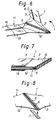
- Figs 1 through 11 are drawings of liner tubes, illustrating steps of the method for connecting ends of them in order of the sequence.
- the reference numerals 1 and 11 designate two liner tubes to be connected end to end.
- These liner tubes can be ones cut from finished tubular liner bags or freshly made liner tubes. In either case they are in principle made in the following manner.
- Rectangular sheets 2, 12 of resin absorbent material are made from a nonwoven fabric obtained by bonding or punch-pressing a mass of fiber such as of polyester, nylon, acrylic resin, polypropylene, carbon, and glass, or a mixture of some of these.
- the resin absorbent sheet is then cut to rectangular shape and rolled up such that the long sides of the rectangular sheet meet each other to form a tube; then, the long sides are sewed together with threads 4, 14.
- the tubular sheets 2, 12 are passed inside flexible plastic film tubes 3, 13, respectively.
- These film tubes 3, 13 are made of a highly airtight material such as polyurethane, polyvinylchloride, polyethylene, EVA, and nylon, and have diameters substantially greater than the outer diameter of the rolled resin absorbent sheet tubes 2, 12; hence it is relatively easy to pass the sheet tubes 2, 12 inside the film tubes 3, 13, and upon the insertion the film tubes 3, 13 envelop the sheet tubes 2, 12 only loosely. It is also practiced that the plastic film tube consists of a lamination of more than one film of different materials selected from those described above.
- the cut ends of the sheets 2, 12 become parallel with each other when the liner tubes 1, 11 are placed in a manner such that their seams are collinear and the cut ends are opposed to each other, as shown in Fig. 4.
- These cut ends are brought together, and a thin tape 5 of a nonwoven fabric with one side coated with an adhesive layer is pasted on the inner side of the sheets 2, 12 along the line at which the cut ends of the sheets 2, 12 meet, as shown in Fig. 5, so as to tentatively connect the resin absorbent sheets 2, 12 together.
- tube 1 in this embodiment is raised at the free end (Fig. 6) and turned over to lie on the other liner tube, tube 11 in this case, so that the tentatively integral tube is folded at the line at which the cut ends of the sheets 2, 12 meet, as shown by cross-section in Fig. 7. Then, this bent edge is stitched with a thread 6, the thread passing through the tape 5 as well as the sheets 2, 12.
- the liner tube 1 is picked and turned back to straighten the tentatively integral tube, and, as shown in Fig. 8, the resin absorbent sheets 2, 12 are now bound together firmly by the thread 6 zigzagging along the oblique meeting line.
- a thin adhesive tape 7 similar to the tape 5 is pasted on the outer side of the sheets 2, 12 in a manner such that the tape 5 covers the stitching 6 entirely.
- the overturned plastic films 3, 13 are unfolded to cover the exposed portions of the resin absorbent sheets 2, 12, and at this time, since the exposed portions of the sheets 2, 12 are now shorter than before, the unfolded films 3, 13 overlap one over the other by some length ⁇ L, as shown in Fig. 10.
- the air in the resin absorbent sheets 2, 12 is drawn by a vacuum pump, not shown, whereupon the loosely enveloping film tubes 3, 13 are tightly pressed against the outer surface of the tubular resin absorbent sheets 2, 12, as shown in Fig. 11. While the operation of the vacuum pump is thus maintained, the plastic film tubes 3, 13 are heated whereupon the film tubes shrink and fuse to adhere to the outer surface of the resin absorbent sheets 2, 12, and thus the outer surface of the tubular sheets 2, 12 is coated with the air-tight layer, and the connection of the two liner tubes 1, 11 is completed.
- the liner tubes 1, 11, which are connected together through the series of operation as described above, are then ready to be used to line and repair a pipe only after the sheets 2, 12 are soaked with a curable liquid resin.
- the two liner tubes 1, 11 are stitched together along the obliquely cut ends of the sheets 2, 12 so that the length of the stitching becomes much longer than that in the case of stitching along cut ends which are cut orthogonally to the seams of the liner tubes, and this will result in a stronger joining strength, and consequently even after the curable liquid resin wetting the tubular sheets 2, 12 is cured, the jointed ends do not detach from each other and a gap is scarcely formed between the ends.
- the thin tape 5 pasted on the inner side of the sheets 2, 12 extends spirally across a region of a length L (Fig. 11), which is a distance between the ends of the tape 5 measured in the direction of the seam 4, 14, so that the tape 5 does not form an inwardly protruding ring that would constrict the passage in the pipe 1, 11 at the joint location.
- L a length between the ends of the tape 5 measured in the direction of the seam 4, 14, so that the tape 5 does not form an inwardly protruding ring that would constrict the passage in the pipe 1, 11 at the joint location.
Landscapes
- Engineering & Computer Science (AREA)
- Mechanical Engineering (AREA)
- General Engineering & Computer Science (AREA)
- Lining Or Joining Of Plastics Or The Like (AREA)
Claims (5)
- Rohrauskleidung, die verwendet wird, um die Innenwand eines Rohres auszukleiden, die mindestens zwei Auskleidungsschläuche (1, 11) aufweist, die in Reihe verbunden sind, worin irgenwelche zwei benachbarte Auskleidungsschläuche miteinander Ende an Ende mit Stichen (6) verbunden werden, die die aneinanderstoßenden Enden der entsprechenden Auskleidungsschläuche (1, 11) eng miteinander verbinden, dadurch gekennzeichnet, daß die auf diese Weise gebildete Naht im allgemeinen eine Windung oder einen Gang einer Spirale beschreibt.
- Rohauskleidung nach Anspruch 1, dadurch gekennzeichnet, daß jeder Auskleidungsschlauch (1, 11) eine Innenschicht einer harzaufnehmenden Schicht (2, 12) und eine Außenschicht eines luftdichten Kunststoffilmes (3, 13) aufweist; und dadurch, daß die Stiche (6) die aneinanderstoßenden Enden der entsprechenden harzaufnehmenden Schichten (2, 12) der benachbarten Auskleidungsschläuche (1, 11) miteinander verbinden.
- Rohrauskleidung nach Anspruch 2, dadurch gekennzeichnet, daß ein Klebeband (5, 7) auf die Innenwand und die Außenwand der harzaufnehmenden Schicht (2, 12) längs der spiralförmigen Naht aufgebracht wird.
- Verfahren zum Verbinden von zwei Auskleidungsschläuchen (1, 11), die jeweils eine geradlinige Längsnaht aufweisen, das aufweist: (a) in beiden Auskleidungsschläuchen das Aufschneiden des Auskleidungsschlauches längs der Naht über eine vorgegebene Länge; dadurch gekennzeichnet, daß (b) in beiden Auskleidungsschläuchen der geöffnete Abschnitt des Auskleidungsschlauches längs einer geraden Linie (c, c') geschnitten wird, die von der Randlinie um einen Winkel geneigt ist, der im wesentlichen größer ist als 0 Grad und im wesentlichen kleiner ist als 90 Grad; und (c) Aneinanderstoßen und Vernähen der auf diese Weise geschnittenen Enden der Auskleidungsschläuche in einer Weise, so daß die zwei Auskleidungsschläuche (1, 11) einen geradlinigen zusammenhängenden Auskleidungsschlauch bilden.
- Verfahren nach Anspruch 4, dadurch gekennzeichnet, daß die zwei Auskleidungsschläuche (1, 11) jeweils eine Innenschicht einer harzaufnehmenden Schicht (2, 12) und eine Außenschicht eines luftdichten Kunststoffilmes (3, 13) aufweisen, wobei die Schicht der harzaufnehmenden Schicht ein Schichtschlauch mit einer geradlinigen Längsnaht ist, längs der die langen Seiten der Schicht genäht werden; und wobei das Verfahren dadurch gekennzeichnet ist, daß es die folgenden Schritte aufweist: (a) bei beiden Auskleidungsschläuchen Umwenden der äußeren Schicht des Filmes (3, 13) an jenem Ende des zu verbindenden Auskleidungsschlauches, wodurch eine vorgegebene Länge der Schicht freigelegt wird; (b) bei beiden Auskleidungsschläuchen Herausziehen jenes Abschnittes des Fadens (4, 14), mit dem der freigelegte Abschnitt der Schicht (2, 12) in der Längsrichtung genäht ist; (c) bei beiden Auskleidungsschläuchen Aufrollen und teilweises Abflachen jenes Abschnittes der Schicht (2, 12), bei dem der Faden herausgezogen ist; (d) bei beiden Auskleidungsschläuchen Schneiden des abgeflachten Abschnittes der Schicht (2, 12) längs einer geraden Linie (c, c'), die von der Randlinie des abgeflachten Abschnittes der Schicht um einen Winkel geneigt ist, der im wesentlichen größer als 0 Grad und im wesentlichen kleiner als 90 Grad ist; (e) Aneinanderstoßen der auf diese Weise geschnittenen Enden der Schichten (2, 12) der zwei Auskleidungsschläuche in einer Weise, so daß die Längsnähte der zwei Auskleidungsschläuche kollinear liegen können; (f) Vernähen der geschnittenen Enden der Schichten (2, 12); (g) Rollen der geöffneten Schichten nach oben, um sie wieder schlauchförmig zu machen; (h) erneutes Nähen der Schichten (2, 12) längs ihr langen Seiten, bis die Längsnaht der verbundenen schlauchförmigen Schichten kontinuierlich wird; und (i) bei beiden Auskleidungsschläuchen Aufrollen der umgewendeten Filmschicht (3, 13), um so die freigelegten Abschnitte der Schicht (2, 12) wieder abzudecken.
Applications Claiming Priority (3)
| Application Number | Priority Date | Filing Date | Title |
|---|---|---|---|
| JP63973/95 | 1995-03-23 | ||
| JP6397395 | 1995-03-23 | ||
| JP7063973A JP2719312B2 (ja) | 1995-03-23 | 1995-03-23 | 管ライニング材の接合方法 |
Publications (3)
| Publication Number | Publication Date |
|---|---|
| EP0733461A2 EP0733461A2 (de) | 1996-09-25 |
| EP0733461A3 EP0733461A3 (de) | 1997-02-26 |
| EP0733461B1 true EP0733461B1 (de) | 2001-10-04 |
Family
ID=13244746
Family Applications (1)
| Application Number | Title | Priority Date | Filing Date |
|---|---|---|---|
| EP96300193A Expired - Lifetime EP0733461B1 (de) | 1995-03-23 | 1996-01-10 | Auskleidungsschlauch und Verfahren zum Verbinden der Enden von zwei Auskleidungsschläuchen |
Country Status (9)
| Country | Link |
|---|---|
| US (1) | US5780123A (de) |
| EP (1) | EP0733461B1 (de) |
| JP (1) | JP2719312B2 (de) |
| KR (1) | KR0178150B1 (de) |
| AU (1) | AU701145B2 (de) |
| CA (1) | CA2172456A1 (de) |
| DE (1) | DE69615593T2 (de) |
| DK (1) | DK0733461T3 (de) |
| TW (1) | TW300945B (de) |
Families Citing this family (25)
| Publication number | Priority date | Publication date | Assignee | Title |
|---|---|---|---|---|
| GB9524998D0 (en) * | 1995-12-07 | 1996-02-07 | British United Shoe Machinery | Manufacture of tubular products |
| JP3790052B2 (ja) * | 1998-09-25 | 2006-06-28 | 株式会社湘南合成樹脂製作所 | 管ライニング材の製造方法 |
| US6540438B2 (en) * | 2000-06-27 | 2003-04-01 | Terre Hill Silo Company | Inflatable underground structure liner |
| US6612340B1 (en) * | 2000-06-30 | 2003-09-02 | Insituform (Netherlands) B.V. | Turnback protection for installation of cured in place liners |
| US6360780B1 (en) * | 2000-08-30 | 2002-03-26 | Owens Corning Fiberglas Technology, Inc. | Liner for reinforcing a pipe and method of making the same |
| GB0909969D0 (en) * | 2009-06-10 | 2009-07-22 | Finecard Internat Ltd | An inflatable structure and a valve assembly for same |
| US9689522B2 (en) * | 2010-02-26 | 2017-06-27 | Trelleborg Pipe Seals Duisburg Gmbh | Lining element, and method of manufacturing a lining element |
| US9568139B2 (en) * | 2010-02-26 | 2017-02-14 | Trelleborg Pipe Seals Duisburg Gmbh | Lining element and method of manufacturing a lining element |
| DE102010018479A1 (de) * | 2010-04-28 | 2011-11-03 | Brandenburger Patentverwertung Gdbr. | Auskleidungsschlauch und Verfahren zur Sanierung einer defekten Rohrleitung sowie Verfahren zur Herstellung eines solchen. |
| FI122524B (fi) * | 2010-05-04 | 2012-03-15 | Picote Oy Ltd | Menetelmä ja järjestely pinnoitesukan käsittelyyn |
| CA2973404C (en) | 2010-07-16 | 2020-05-05 | Ina Acquisition Corp. | Cured in place liner system and installation methods |
| US20130319571A1 (en) * | 2012-06-01 | 2013-12-05 | Todd A. Volker | Composite pipe |
| US10184594B1 (en) * | 2012-06-01 | 2019-01-22 | Todd A. Volker | Composite pipe |
| US10611020B2 (en) | 2013-12-19 | 2020-04-07 | Roam Robotics Inc. | Pneumatic exomuscle system and method |
| US10471662B2 (en) | 2015-05-29 | 2019-11-12 | Ina Acquisition Corp. | Cured in place liner termination |
| US10434956B2 (en) * | 2016-03-24 | 2019-10-08 | Honda Motor Co., Ltd. | Fabric processing method and component |
| ES2969892T3 (es) | 2017-02-03 | 2024-05-23 | Roam Robotics Inc | Sistema y método para reconocimiento de intención de usuario |
| IL272623B2 (en) | 2017-08-29 | 2024-12-01 | Roam Robotics Inc | Semi-supervised intent recognition system and method |
| ES3039928T3 (en) | 2019-12-13 | 2025-10-27 | Roam Robotics Inc | Powered device to benefit a wearer during skiing |
| IL295817A (en) * | 2020-02-25 | 2022-10-01 | Roam Robotics Inc | Fluid Actuator Systems and Methods for Mobile Robots |
| US12514775B2 (en) | 2020-05-27 | 2026-01-06 | Roam Robotics Inc. | Powered medical device and methods for improved user mobility and treatment |
| CN115916472A (zh) | 2020-05-27 | 2023-04-04 | 漫游机械人技术公司 | 用于移动机器人的适配和悬挂系统和方法 |
| US12466060B2 (en) | 2021-08-17 | 2025-11-11 | Roam Robotics Inc. | Mobile power source for a mobile robot |
| WO2023023564A1 (en) | 2021-08-17 | 2023-02-23 | Roam Robotics Inc. | Unified pneumatic and electrical connector system and method |
| JP2024534808A (ja) | 2021-08-17 | 2024-09-26 | ローム ロボティクス インコーポレイテッド | モバイルロボットのための海事アプリケーション |
Family Cites Families (10)
| Publication number | Priority date | Publication date | Assignee | Title |
|---|---|---|---|---|
| US3608603A (en) * | 1967-08-22 | 1971-09-28 | Gen Tire & Rubber Co | Inner tube |
| DE2903117A1 (de) * | 1979-01-27 | 1980-08-14 | Wolff Walsrode Ag | Gekuppelte schlauchhuelle, verfahren zu ihrer herstellung, vorrichtung zur ausuebung des verfahrens und verwendung der schlauchhuelle als verpackungsmittel |
| JPS5856838A (ja) * | 1981-09-30 | 1983-04-04 | Yokohama Rubber Co Ltd:The | タイヤ用チユ−ブ |
| GB8400233D0 (en) * | 1984-01-05 | 1984-02-08 | Edgealpha Ltd | Lining pipelines and passageways |
| CA1279584C (en) * | 1988-04-13 | 1991-01-29 | Oy Wiik & Hoglund Ab | Sewer pipe relining method |
| JP2554411B2 (ja) * | 1991-05-31 | 1996-11-13 | 株式会社ゲット | 枝管ライニング材及びその製造方法 |
| EP0795715B1 (de) * | 1991-12-04 | 2000-05-31 | Ashimori Industry Co., Ltd. | Verfahren und Material zum Auskleiden von Rohren |
| JPH05162260A (ja) * | 1991-12-17 | 1993-06-29 | Nitto Denko Corp | 管路内張り用基材 |
| US5397612A (en) * | 1992-09-14 | 1995-03-14 | Small; James W. | Cotton bale within a circular knit cotton bale cover |
| JPH0775866B2 (ja) * | 1993-02-09 | 1995-08-16 | 株式会社湘南合成樹脂製作所 | 枝管ライニング工法 |
-
1995
- 1995-03-23 JP JP7063973A patent/JP2719312B2/ja not_active Expired - Fee Related
- 1995-12-30 TW TW084114175A patent/TW300945B/zh active
-
1996
- 1996-01-10 DE DE69615593T patent/DE69615593T2/de not_active Expired - Fee Related
- 1996-01-10 DK DK96300193T patent/DK0733461T3/da active
- 1996-01-10 EP EP96300193A patent/EP0733461B1/de not_active Expired - Lifetime
- 1996-01-29 KR KR1019960001972A patent/KR0178150B1/ko not_active Expired - Fee Related
- 1996-02-15 US US08/601,752 patent/US5780123A/en not_active Expired - Fee Related
- 1996-03-19 AU AU48165/96A patent/AU701145B2/en not_active Ceased
- 1996-03-22 CA CA002172456A patent/CA2172456A1/en not_active Abandoned
Also Published As
| Publication number | Publication date |
|---|---|
| DK0733461T3 (da) | 2001-12-10 |
| AU4816596A (en) | 1996-10-03 |
| US5780123A (en) | 1998-07-14 |
| EP0733461A3 (de) | 1997-02-26 |
| KR0178150B1 (ko) | 1999-05-15 |
| TW300945B (de) | 1997-03-21 |
| JPH08258157A (ja) | 1996-10-08 |
| EP0733461A2 (de) | 1996-09-25 |
| CA2172456A1 (en) | 1996-09-24 |
| DE69615593D1 (de) | 2001-11-08 |
| JP2719312B2 (ja) | 1998-02-25 |
| KR960034839A (ko) | 1996-10-24 |
| DE69615593T2 (de) | 2002-06-27 |
| AU701145B2 (en) | 1999-01-21 |
Similar Documents
| Publication | Publication Date | Title |
|---|---|---|
| EP0733461B1 (de) | Auskleidungsschlauch und Verfahren zum Verbinden der Enden von zwei Auskleidungsschläuchen | |
| EP0726136B1 (de) | Verfahren zum Herstellen eines Auskleidungsschlauches | |
| US6117507A (en) | Sealed inversion liner for lining an existing pipeline or conduit | |
| US6042668A (en) | Pipe liner bag and manufacturing methods therefor | |
| US6562426B1 (en) | Pipe liner bag | |
| US6254709B1 (en) | Method of manufacturing a pipe liner bag | |
| EP0548417B1 (de) | Verfahren zur Herstellung einer rohrformigen Auskleidung. | |
| US5242517A (en) | Pipe liner and a method for manufacturing same | |
| CN100520146C (zh) | 具有翻转的外部非渗透层的现场固化内衬及其制造方法 | |
| CN100564983C (zh) | 具有一体内部非渗透层的现场固化内衬及其连续制造方法 | |
| US6006787A (en) | Branch pipe liner bag and branch pipe lining method | |
| CN1886617B (zh) | 具有内部非渗透层的现场固化内衬的安装及设备 | |
| CN1886618B (zh) | 浸渍和制备现场固化内衬的方法、浸渍设备和浸渍塔 | |
| EP0640464B1 (de) | Verfahren zum Herstellen eines Auskleidungsschlauches für eine Abzweigeleitung | |
| AU724669B2 (en) | Method of manufacturing a pipe liner bag | |
| JPH11235758A (ja) | 管ライニング材の製造方法及び管ライニング工法 | |
| CA2024027C (en) | Sealed lining tube for lining of pipelines or passageways | |
| JP2607283B2 (ja) | 管ライニング材の製造方法 | |
| JPH0939095A (ja) | 管ライニング材及びその製造方法 | |
| JP2737104B2 (ja) | 管ライニング材の接合方法 | |
| AU2621397A (en) | Apparatus for repairing a pipeline and method for using same | |
| KR20090085789A (ko) | 관로 보관공사용 튜브제조장치 | |
| JPH1080950A (ja) | 管ライニング材の接合構造 | |
| NZ201351A (en) | Inflatable hose and manufacture thereof | |
| JP2004053001A (ja) | 管路内面補修装置及び補修工法 |
Legal Events
| Date | Code | Title | Description |
|---|---|---|---|
| PUAI | Public reference made under article 153(3) epc to a published international application that has entered the european phase |
Free format text: ORIGINAL CODE: 0009012 |
|
| AK | Designated contracting states |
Kind code of ref document: A2 Designated state(s): DE DK FR GB |
|
| PUAL | Search report despatched |
Free format text: ORIGINAL CODE: 0009013 |
|
| AK | Designated contracting states |
Kind code of ref document: A3 Designated state(s): DE DK FR GB |
|
| 17P | Request for examination filed |
Effective date: 19970731 |
|
| 17Q | First examination report despatched |
Effective date: 19990415 |
|
| GRAG | Despatch of communication of intention to grant |
Free format text: ORIGINAL CODE: EPIDOS AGRA |
|
| RIN1 | Information on inventor provided before grant (corrected) |
Inventor name: YOKOSHIMA, YASUHIRO Inventor name: KAMIYAMA, TAKAO |
|
| GRAG | Despatch of communication of intention to grant |
Free format text: ORIGINAL CODE: EPIDOS AGRA |
|
| GRAH | Despatch of communication of intention to grant a patent |
Free format text: ORIGINAL CODE: EPIDOS IGRA |
|
| GRAH | Despatch of communication of intention to grant a patent |
Free format text: ORIGINAL CODE: EPIDOS IGRA |
|
| GRAA | (expected) grant |
Free format text: ORIGINAL CODE: 0009210 |
|
| AK | Designated contracting states |
Kind code of ref document: B1 Designated state(s): DE DK FR GB |
|
| REF | Corresponds to: |
Ref document number: 69615593 Country of ref document: DE Date of ref document: 20011108 |
|
| REG | Reference to a national code |
Ref country code: DK Ref legal event code: T3 |
|
| ET | Fr: translation filed | ||
| REG | Reference to a national code |
Ref country code: GB Ref legal event code: IF02 |
|
| PLBE | No opposition filed within time limit |
Free format text: ORIGINAL CODE: 0009261 |
|
| STAA | Information on the status of an ep patent application or granted ep patent |
Free format text: STATUS: NO OPPOSITION FILED WITHIN TIME LIMIT |
|
| 26N | No opposition filed | ||
| PGFP | Annual fee paid to national office [announced via postgrant information from national office to epo] |
Ref country code: DK Payment date: 20040123 Year of fee payment: 9 |
|
| PGFP | Annual fee paid to national office [announced via postgrant information from national office to epo] |
Ref country code: GB Payment date: 20040128 Year of fee payment: 9 |
|
| PGFP | Annual fee paid to national office [announced via postgrant information from national office to epo] |
Ref country code: DE Payment date: 20040205 Year of fee payment: 9 |
|
| PGFP | Annual fee paid to national office [announced via postgrant information from national office to epo] |
Ref country code: FR Payment date: 20040210 Year of fee payment: 9 |
|
| PG25 | Lapsed in a contracting state [announced via postgrant information from national office to epo] |
Ref country code: GB Free format text: LAPSE BECAUSE OF NON-PAYMENT OF DUE FEES Effective date: 20050110 |
|
| PG25 | Lapsed in a contracting state [announced via postgrant information from national office to epo] |
Ref country code: DK Free format text: LAPSE BECAUSE OF NON-PAYMENT OF DUE FEES Effective date: 20050131 |
|
| PG25 | Lapsed in a contracting state [announced via postgrant information from national office to epo] |
Ref country code: DE Free format text: LAPSE BECAUSE OF NON-PAYMENT OF DUE FEES Effective date: 20050802 |
|
| GBPC | Gb: european patent ceased through non-payment of renewal fee |
Effective date: 20050110 |
|
| REG | Reference to a national code |
Ref country code: DK Ref legal event code: EBP |
|
| PG25 | Lapsed in a contracting state [announced via postgrant information from national office to epo] |
Ref country code: FR Free format text: LAPSE BECAUSE OF NON-PAYMENT OF DUE FEES Effective date: 20050930 |
|
| REG | Reference to a national code |
Ref country code: FR Ref legal event code: ST |