EP0735175A1 - Procédé de production d'une feuille d'ouate et pièces de coton fabriquées par découpage d'une feuille obtenue à partir de ce procédé - Google Patents
Procédé de production d'une feuille d'ouate et pièces de coton fabriquées par découpage d'une feuille obtenue à partir de ce procédé Download PDFInfo
- Publication number
- EP0735175A1 EP0735175A1 EP95400676A EP95400676A EP0735175A1 EP 0735175 A1 EP0735175 A1 EP 0735175A1 EP 95400676 A EP95400676 A EP 95400676A EP 95400676 A EP95400676 A EP 95400676A EP 0735175 A1 EP0735175 A1 EP 0735175A1
- Authority
- EP
- European Patent Office
- Prior art keywords
- sheet
- cotton
- manner
- autoclave
- supplementary
- Prior art date
- Legal status (The legal status is an assumption and is not a legal conclusion. Google has not performed a legal analysis and makes no representation as to the accuracy of the status listed.)
- Granted
Links
Images
Classifications
-
- D—TEXTILES; PAPER
- D01—NATURAL OR MAN-MADE THREADS OR FIBRES; SPINNING
- D01B—MECHANICAL TREATMENT OF NATURAL FIBROUS OR FILAMENTARY MATERIAL TO OBTAIN FIBRES OF FILAMENTS, e.g. FOR SPINNING
- D01B9/00—Other mechanical treatment of natural fibrous or filamentary material to obtain fibres or filaments
-
- D—TEXTILES; PAPER
- D04—BRAIDING; LACE-MAKING; KNITTING; TRIMMINGS; NON-WOVEN FABRICS
- D04H—MAKING TEXTILE FABRICS, e.g. FROM FIBRES OR FILAMENTARY MATERIAL; FABRICS MADE BY SUCH PROCESSES OR APPARATUS, e.g. FELTS, NON-WOVEN FABRICS; COTTON-WOOL; WADDING ; NON-WOVEN FABRICS FROM STAPLE FIBRES, FILAMENTS OR YARNS, BONDED WITH AT LEAST ONE WEB-LIKE MATERIAL DURING THEIR CONSOLIDATION
- D04H1/00—Non-woven fabrics formed wholly or mainly of staple fibres or like relatively short fibres
- D04H1/02—Cotton wool; Wadding
-
- D—TEXTILES; PAPER
- D04—BRAIDING; LACE-MAKING; KNITTING; TRIMMINGS; NON-WOVEN FABRICS
- D04H—MAKING TEXTILE FABRICS, e.g. FROM FIBRES OR FILAMENTARY MATERIAL; FABRICS MADE BY SUCH PROCESSES OR APPARATUS, e.g. FELTS, NON-WOVEN FABRICS; COTTON-WOOL; WADDING ; NON-WOVEN FABRICS FROM STAPLE FIBRES, FILAMENTS OR YARNS, BONDED WITH AT LEAST ONE WEB-LIKE MATERIAL DURING THEIR CONSOLIDATION
- D04H1/00—Non-woven fabrics formed wholly or mainly of staple fibres or like relatively short fibres
- D04H1/40—Non-woven fabrics formed wholly or mainly of staple fibres or like relatively short fibres from fleeces or layers composed of fibres without existing or potential cohesive properties
- D04H1/44—Non-woven fabrics formed wholly or mainly of staple fibres or like relatively short fibres from fleeces or layers composed of fibres without existing or potential cohesive properties the fleeces or layers being consolidated by mechanical means, e.g. by rolling
- D04H1/46—Non-woven fabrics formed wholly or mainly of staple fibres or like relatively short fibres from fleeces or layers composed of fibres without existing or potential cohesive properties the fleeces or layers being consolidated by mechanical means, e.g. by rolling by needling or like operations to cause entanglement of fibres
- D04H1/492—Non-woven fabrics formed wholly or mainly of staple fibres or like relatively short fibres from fleeces or layers composed of fibres without existing or potential cohesive properties the fleeces or layers being consolidated by mechanical means, e.g. by rolling by needling or like operations to cause entanglement of fibres by fluid jet
-
- D—TEXTILES; PAPER
- D06—TREATMENT OF TEXTILES OR THE LIKE; LAUNDERING; FLEXIBLE MATERIALS NOT OTHERWISE PROVIDED FOR
- D06B—TREATING TEXTILE MATERIALS USING LIQUIDS, GASES OR VAPOURS
- D06B1/00—Applying liquids, gases or vapours onto textile materials to effect treatment, e.g. washing, dyeing, bleaching, sizing or impregnating
- D06B1/02—Applying liquids, gases or vapours onto textile materials to effect treatment, e.g. washing, dyeing, bleaching, sizing or impregnating by spraying or projecting
-
- D—TEXTILES; PAPER
- D06—TREATMENT OF TEXTILES OR THE LIKE; LAUNDERING; FLEXIBLE MATERIALS NOT OTHERWISE PROVIDED FOR
- D06L—DRY-CLEANING, WASHING OR BLEACHING FIBRES, FILAMENTS, THREADS, YARNS, FABRICS, FEATHERS OR MADE-UP FIBROUS GOODS; BLEACHING LEATHER OR FURS
- D06L1/00—Dry-cleaning or washing fibres, filaments, threads, yarns, fabrics, feathers or made-up fibrous goods
- D06L1/12—Dry-cleaning or washing fibres, filaments, threads, yarns, fabrics, feathers or made-up fibrous goods using aqueous solvents
-
- D—TEXTILES; PAPER
- D06—TREATMENT OF TEXTILES OR THE LIKE; LAUNDERING; FLEXIBLE MATERIALS NOT OTHERWISE PROVIDED FOR
- D06L—DRY-CLEANING, WASHING OR BLEACHING FIBRES, FILAMENTS, THREADS, YARNS, FABRICS, FEATHERS OR MADE-UP FIBROUS GOODS; BLEACHING LEATHER OR FURS
- D06L4/00—Bleaching fibres, filaments, threads, yarns, fabrics, feathers or made-up fibrous goods; Bleaching leather or furs
- D06L4/10—Bleaching fibres, filaments, threads, yarns, fabrics, feathers or made-up fibrous goods; Bleaching leather or furs using agents which develop oxygen
Definitions
- the present invention relates to a process of producing a sheet of cotton wool from raw cotton fibres, in particular from combing noil, which is obtained as a by-product in the process of manufacturing cotton fibres with the intention of spinning and weaving the combed products.
- the longest fibres are sorted to be used for spinning and weaving high quality products.
- the wastes from this first sorting or combing operation which are generally known as combing noil, and which are considered, in cotton technology, as high-quality by-products, act as starting material for processes of manufacturing cotton wool, make-up removing products, pharmaceutical or surgical pads, etc.
- These by-products consist of good fibres which are well untangled and very clean, containing only a small amount of vegetable waste or other polluting agents.
- the conventional method of using combing noil of this type consists in subjecting the raw (i.e. crude) cotton fibres to, successively, preliminary beating and opening-up operations in such a manner as to obtain cotton flock which is opened up and physically cleaned and then subjecting this cotton flock to a scalding treatment which consists in removing the greases (pectins, vegetable waxes, etc) which are found around the fibres, and in fluffing out these fibres, while separating out the vegetable wastes, to prepare them for subsequent treatment operations.
- This scalding is most frequently performed in an autoclave using a soda solution.
- a bleaching operation in particular using hydrogen peroxide, likewise performed in an autoclave, and intended to confer on the cotton fibres the whiteness which is necessary for the presentation thereof in the commercial environment.
- the cotton having been subjected to this scalding and bleaching operation, is, subsequently, brought into a card room where it is processed on cards which comb the cotton fibres very finely, align them in a parallel manner, separate them from one another and make them into a nap which is subsequently processed.
- the crude cotton fibres are conducted to perforated cylinders or belts, on which they are deposited in an approximately uniform manner to form a fluffy sheet having almost no cohesion; this sheet is brought to a wetting liquor containing hot water (50 to 70°C) and a wetting agent, in such a manner as to obtain a more compact sheet having a certain strength owing to physical cohesion, and to render this hydrophillic, and then, when this sheet is removed from the wetting liquor, it is dried between calender rollers, and wound on a cylinder which is subsequently introduced into an autoclave, in order to subject it to scalding and bleaching operations in a basic medium and at a temperature of the order of 130°C.
- the sheet when it is ready to be subjected to scalding and bleaching operations in the autoclave, be wound around a hollow cylinder having perforations which are spaced uniformly on the surface thereof, that the spool which has thus been obtained be enclosed in a cylindrical sleeve, comprising, on the periphery thereof, perforations similar to those provided on the cylinder, and that there be associated, with the autoclave, a closed circuit for circulation of treatment fluids, the circuit comprising an inlet duct connected to the end of the perforated cylinder, an outlet duct connected to an aperture provided for this purpose in the autoclave, and a circulation pump.
- a further disadvantage of the above-mentioned method relates to the fact that during the scalding and bleaching operations, it is necessary to control the variations of the pressure differential which are established between the liquid entering the spool and the liquid leaving it, in such a manner as to avoid the coils on a part of the spool being torn.
- the object of the present invention is to overcome these disadvantages by proposing a method of manufacturing a cotton wool sheet of the above-mentioned type, which method is substantially less polluting and in which the treatment time in the autoclave may be substantially reduced whilst avoiding any risk of the coils being torn.
- This method is characterised in that there is performed, in the impregnating bath, a sequestration of the catalytes of the cotton in the acid or neutral phase: agents for hardening the water and the cotton (calcium, magnesium) and metallic ions (iron, copper, manganese) in such a manner as to obtain a preliminary attack of the cotton fibres of such a type as to facilitate the subsequent operations of scalding and bleaching, and in that, before the sheet is wound onto a perforated hollow cylinder, it is subjected to a fluid pretreatment in that the entire width thereof is passed at right angles to banks of spraying devices comprising a series of nozzles which very close to one another and associated with a vacuum source and able to send a series of jets of a rinsing liquid through the sheet in such a manner as to obtain a preliminary connection thereof by the preliminary action of the fluid.
- the preliminary attack of the cotton fibres by acidification to a pH of the order of 3 to 5 may, advantageously, be performed by adding to the impregnating bath, a suitable, weakly acid concentration, together with a sequestering agent; this allows the time necessary for the treatment in the autoclave to be reduced by approximately 45 minutes.
- a suitable, weakly acid concentration together with a sequestering agent
- the rate of removal of the sheet is between 120 and 140%; taking into account the characteristics of this fluid, it is necessary to provide a suitable rinsing with soft water upstream of the scalding operation in order not to disturb the action of the soda which is used; this renewal of the liquid which impregnates the sheet leaving the wetting liquor, permits, at the same time, a demineralisation thereof to be performed by removing the salts which form as a consequence of the action of the acid.
- the fluid pretreatment permits an appreciable increase in the cohesion to be obtained during the scalding and bleaching treatment thereof; this results in a reduction of the risks of tearing following an insufficient control of the pressure differences which may prevail at the interior of the autoclave.
- the rate of removal corresponds to the quantity of water discharged by the sheet; the total weight thereof is thus 275 g + 130 % of 275 g, ie. 632.5 g.
- the scalding and bleaching operations are formed in a single stage by circulating a mixture of soda and hydrogen peroxide in the autoclave.
- This combined pretreatment permits the total time of the treatment in the autoclave to be reduced to a duration of 3 hours in place of 5 hours, whilst a sheet of at least equivalent quality is obtained.
- the hydraulic pretreatment stage according to the invention has the drawback of reducing the softness of the sheet to the touch, and of rendering it too rough to satisfy customers' expectations fully.
- a first phase of this treatment is performed in the autoclave and consists in circulating, when the scalding and bleaching operations have been completed, a rinsing fluid, and then a softening solution which is known per se, and contains, in particular, fatty acid esters, in order to increase the softness and the suppleness of the sheet obtained after unwinding.
- This first phase is broadly comparable to the action of softening agents which housewives have used on their linen for some years.
- a supplementary surface softening treatment phase be associated with the above-mentioned first phase.
- the wrung-out sheet which has previously been treated in the autoclave is, prior to drying, subjected, to this end, to a supplementary treatment consisting of spraying, in fine droplets, a supplementary softening solution onto each of its surfaces.
- the supplementary softening solution consists of an aqueous emulsion of fatty acid amides and cationic fatty acid ester derivatives.
- the sheet is directed substantially vertically by means of the guide rollers and allowed to pass, at right angles, two essentially horizontal banks of spraying devices which are located, respectively, opposite one of its faces and each of which extends over the whole of its width.
- Each of the banks of spraying devices may, according to the invention, advantageously consist of a series of cupels with a substantially vertical axis, mounted side-by-side, turning very rapidly about themselves about this axis and supplied with a supplementary softening solution at their lower end which is opposite the sheet.
- a spraying device of this type has the advantage of not being at risk of blocking.
- the invention likewise relates to pieces of any shape and, in particular, to round pads of cotton produced by cutting a sheet which is obtained using the above-mentioned method.
- Pieces of this type can be distinguished in particular by the softness and velvetiness thereof, and by the strength thereof in both the longitudinal and the transverse directions.
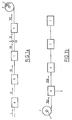
- the raw cotton used in this method is conducted in the direction of the arrow I to a first station A in which it is subjected to conventional preliminary beating and opening-up operations.
- cotton flock which is opened up and physically clean, is obtained, which flock is conducted in the direction of the arrow II to a second station B for forming the sheet, consisting of perforated cylinders at the interior of which a certain sub-pressure prevails.
- These cylinders which are not shown in detail in the Figures, attract the fibres under the effect of their empty interior.
- This sheet which has a thickness of the order of 8 cm, is subsequently brought to a wetting station C consisting of an impregnating and pretreatment bath containing, for example, a solution composed of weak acid and sequestering and wetting agents.
- the sheet III On leaving the impregnating bath, the sheet III is transformed into a sheet IV, the thickness of which is not more than approximately 1.5 mm and which is thus greatly compressed.
- This sheet which has a certain strength as a consequence of the presence of connections between the fibres acquired under the effect of contact with the treatment liquid of the station C, is subsequently dried between the calender rollers D. On leaving these rollers, there is obtained a sheet V which is still very damp in view of the fact that it has a rate of removal of approximately 130%.
- the sheet V is subsequently transferred to a hydraulic pretreatment station E where the entire width thereof is passed at right angles to banks of spraying devices, which are not shown in detail in the Figure, in such a manner as to permit the heavily mineralised treatment liquid from the impregnating bath C which impregnates the sheet, to be replaced by suitable soft water.
- the banks of spraying devices equipping the station E comprise, in series, nozzles which are provided with apertures which are very fine and very close; each bank consequently sending, through the sheet, a series of pressurised jets which permit, in addition to the above-mentioned rinsing, a preadhesion of the sheet to be obtained by the effect of the fluid.
- the sheet VI which has been rinsed and preadhered in this manner leaves the hydraulic pretreatment station E and is subsequently wound in a spool F on a perforated hollow cylinder 1.
- Each spool F which comprises a length of the cotton sheet VI which may be in excess of 1 km, is subsequently transferred into an autoclave associated with a closed circuit for the circulation of processing fluid, as described and shown in the document FR-2 552 120.
- the spool F is subjected, in a first step, to a scalding and bleaching treatment in a single stage by means of a mixture of soda and hydrogen peroxide; it is subsequently rinsed before being treated using a softening solution containing fatty acid esters.
- the acid nature of the treatment bath C and the use of the hydraulic pretreatment phase E permit the total treatment time in the autoclave, which was initially of the order of 5 hours, to be reduced to a duration of from 3 hours to 3 hours 30.
- the sheet VII leaving the autoclave is subsequently unwound and transferred to a station at which it is wrung out by suction.
- the sheet VII which has been wrung out in this manner is subsequently transferred to a supplementary softening treating station H which will be described in more detail hereinbelow, and then to a drying station I and, finally, to a cutting station J where it is cut into round pads with a diameter of the order of 6 cm.
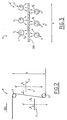
- the supplementary softening treating station is provided with two guide rollers 2, 2' which are capable of deflecting the cotton sheet VIII which is displaced substantially horizontally through this station, in such a manner that it passes over a section K in which it is directed substantially vertically.
- the station H is likewise provided with two substantially vertical banks of spraying devices 3, 3' which are located, respectively, either side of the guide rollers 2 and 2' and which the cotton sheet passes at right angles during the displacement thereof over the vertical section K.
- Each of the vertical banks of spraying devices 3, 3' is intended to treat one of the surfaces of the sheet.
- the vertical banks of spraying devices 3, 3' each extend over the entire width e of the sheet VIII and are each comprised of a series of cupels 4 have an axis X-X' which is substantially vertical and are mounted side-by-side in the immediate vicinity of one another and rotating very rapidly about themselves in the direction of the arrows c about their axis X-X'. It is understood that the number of three cuples which is shown in Figure 3 has only been selected with the object of clarity, and the number of cupels of each bank is, in fact, clearly greater.
- Each of the cupels 4 is supplied in the direction of the arrows b with a softening liquid containing an aqueous emulsion of fatty acid amides and derivatives of cationic fatty acid esters, at the end thereof which is remote from the sheet.
- a softening liquid containing an aqueous emulsion of fatty acid amides and derivatives of cationic fatty acid esters, at the end thereof which is remote from the sheet.
Landscapes
- Engineering & Computer Science (AREA)
- Textile Engineering (AREA)
- Mechanical Engineering (AREA)
- Treatment Of Fiber Materials (AREA)
- Woven Fabrics (AREA)
- Chemical Or Physical Treatment Of Fibers (AREA)
- Yarns And Mechanical Finishing Of Yarns Or Ropes (AREA)
- Treatments For Attaching Organic Compounds To Fibrous Goods (AREA)
- Preliminary Treatment Of Fibers (AREA)
- Absorbent Articles And Supports Therefor (AREA)
Priority Applications (11)
| Application Number | Priority Date | Filing Date | Title |
|---|---|---|---|
| EP95400676A EP0735175B1 (fr) | 1995-03-27 | 1995-03-27 | Procédé de production d'une feuille d'ouate et pièces de coton fabriquées par découpage d'une feuille obtenue à partir de ce procédé |
| DE69508226T DE69508226T2 (de) | 1995-03-27 | 1995-03-27 | Verfahren zur Herstellung einer Baumwoll-Warenbahn und Baumwollstücke, die durch Schneiden dieser Warenbahn hergestellt wurden |
| AT95400676T ATE177484T1 (de) | 1995-03-27 | 1995-03-27 | Verfahren zur herstellung einer baumwoll- warenbahn und baumwollstücke, die durch schneiden dieser warenbahn hergestellt wurden |
| ES95400676T ES2128674T3 (es) | 1995-03-27 | 1995-03-27 | Metodo para producir una lamina de guata, y piezas de algodon producidas al cortar una lamina obtenida al utilizar este metodo. |
| DK95400676T DK0735175T3 (da) | 1995-03-27 | 1995-03-27 | Fremgangsmåde til fremstilling af et vatark og bomuldsstykker fremstillet ved udskæring af et ark frembragt ved anvendelse |
| KR1019970706766A KR100263355B1 (ko) | 1995-03-27 | 1996-03-01 | 면시이트의제조방법 |
| PCT/US1996/002771 WO1996030565A1 (fr) | 1995-03-27 | 1996-03-01 | Procede de production d'une feuille de coton |
| CA002214992A CA2214992A1 (fr) | 1995-03-27 | 1996-03-01 | Procede de production d'une feuille de coton |
| AU53567/96A AU5356796A (en) | 1995-03-27 | 1996-03-01 | Method of producing a sheet of cotton |
| MXPA/A/1997/007323A MXPA97007323A (en) | 1995-03-27 | 1997-09-25 | Method of production of a sheet of something |
| GR990401257T GR3030174T3 (en) | 1995-03-27 | 1999-05-10 | Method of producing a sheet of cotton wool and pieces of cotton produced by cutting a sheet obtained using this method |
Applications Claiming Priority (1)
| Application Number | Priority Date | Filing Date | Title |
|---|---|---|---|
| EP95400676A EP0735175B1 (fr) | 1995-03-27 | 1995-03-27 | Procédé de production d'une feuille d'ouate et pièces de coton fabriquées par découpage d'une feuille obtenue à partir de ce procédé |
Publications (2)
| Publication Number | Publication Date |
|---|---|
| EP0735175A1 true EP0735175A1 (fr) | 1996-10-02 |
| EP0735175B1 EP0735175B1 (fr) | 1999-03-10 |
Family
ID=8221472
Family Applications (1)
| Application Number | Title | Priority Date | Filing Date |
|---|---|---|---|
| EP95400676A Expired - Lifetime EP0735175B1 (fr) | 1995-03-27 | 1995-03-27 | Procédé de production d'une feuille d'ouate et pièces de coton fabriquées par découpage d'une feuille obtenue à partir de ce procédé |
Country Status (10)
| Country | Link |
|---|---|
| EP (1) | EP0735175B1 (fr) |
| KR (1) | KR100263355B1 (fr) |
| AT (1) | ATE177484T1 (fr) |
| AU (1) | AU5356796A (fr) |
| CA (1) | CA2214992A1 (fr) |
| DE (1) | DE69508226T2 (fr) |
| DK (1) | DK0735175T3 (fr) |
| ES (1) | ES2128674T3 (fr) |
| GR (1) | GR3030174T3 (fr) |
| WO (1) | WO1996030565A1 (fr) |
Cited By (2)
| Publication number | Priority date | Publication date | Assignee | Title |
|---|---|---|---|---|
| WO2013014259A1 (fr) * | 2011-07-28 | 2013-01-31 | Georgia Pacific France | Produit fibreux absorbant contenant au moins 50% de fibres cellulosiques hydrophiles et comprenant au moins deux couches dont l'une est hydroliee |
| EP3095422A1 (fr) | 2015-05-22 | 2016-11-23 | SCA Tissue France | Tampon de coton, procédé et dispositif pour sa fabrication |
Families Citing this family (1)
| Publication number | Priority date | Publication date | Assignee | Title |
|---|---|---|---|---|
| KR100804273B1 (ko) | 2007-01-05 | 2008-02-18 | (주)태봉 | 육묘 매트와 이의 제조 방법 및 이 육묘 매트를 이용한육묘장치 |
Citations (1)
| Publication number | Priority date | Publication date | Assignee | Title |
|---|---|---|---|---|
| FR2552120A1 (fr) * | 1983-09-21 | 1985-03-22 | Tempo Sanys | Procede de fabrication d'une nappe de coton hydrophile ainsi que nappe obtenue conformement a la mise en oeuvre de ce procede et pieces de coton de formes quelconques obtenues par decoupage d'une telle nappe |
Family Cites Families (6)
| Publication number | Priority date | Publication date | Assignee | Title |
|---|---|---|---|---|
| BE638882A (fr) * | 1962-10-18 | 1900-01-01 | ||
| FR1478515A (fr) * | 1966-03-10 | 1967-04-28 | Saint Denis Ets | Nouveau feutre de coton |
| FR1533218A (fr) * | 1966-12-15 | 1968-07-19 | Thibeau & Cie A | Procédé de traitement de matières textiles fibreuses dans un fluide et dispositifs pour la mise en oeuvre de ce procédé |
| FR2081133B1 (fr) * | 1970-03-09 | 1974-07-12 | Serviere Hubert De | |
| CH549415A (de) * | 1971-09-07 | 1974-05-31 | Kleinewefers Ind Co Gmbh | Einrichtung zum nassbehandeln von textilen gewebebahnen. |
| FR2265891A1 (en) * | 1974-03-26 | 1975-10-24 | Bertin & Cie | Non-woven fabric prodn. - from fibre lap of which the fibres are entangled by fluid jets directed onto lap |
-
1995
- 1995-03-27 DK DK95400676T patent/DK0735175T3/da active
- 1995-03-27 AT AT95400676T patent/ATE177484T1/de not_active IP Right Cessation
- 1995-03-27 EP EP95400676A patent/EP0735175B1/fr not_active Expired - Lifetime
- 1995-03-27 ES ES95400676T patent/ES2128674T3/es not_active Expired - Lifetime
- 1995-03-27 DE DE69508226T patent/DE69508226T2/de not_active Expired - Lifetime
-
1996
- 1996-03-01 CA CA002214992A patent/CA2214992A1/fr not_active Abandoned
- 1996-03-01 WO PCT/US1996/002771 patent/WO1996030565A1/fr not_active Ceased
- 1996-03-01 KR KR1019970706766A patent/KR100263355B1/ko not_active Expired - Fee Related
- 1996-03-01 AU AU53567/96A patent/AU5356796A/en not_active Abandoned
-
1999
- 1999-05-10 GR GR990401257T patent/GR3030174T3/el unknown
Patent Citations (1)
| Publication number | Priority date | Publication date | Assignee | Title |
|---|---|---|---|---|
| FR2552120A1 (fr) * | 1983-09-21 | 1985-03-22 | Tempo Sanys | Procede de fabrication d'une nappe de coton hydrophile ainsi que nappe obtenue conformement a la mise en oeuvre de ce procede et pieces de coton de formes quelconques obtenues par decoupage d'une telle nappe |
Non-Patent Citations (1)
| Title |
|---|
| H.BEHNKE: "Der Entmineralisierungsprozess", TEXTILVEREDLUNG, vol. 29, no. 5, May 1994 (1994-05-01), WEINFELDEN CH, pages 117 - 127 * |
Cited By (3)
| Publication number | Priority date | Publication date | Assignee | Title |
|---|---|---|---|---|
| WO2013014259A1 (fr) * | 2011-07-28 | 2013-01-31 | Georgia Pacific France | Produit fibreux absorbant contenant au moins 50% de fibres cellulosiques hydrophiles et comprenant au moins deux couches dont l'une est hydroliee |
| FR2978460A1 (fr) * | 2011-07-28 | 2013-02-01 | Georgia Pacific France | Produit fibreux absorbant contenant au moins 50% de fibres cellulosiques hydrophiles et comprenant au moins deux couches dont l'une est hydroliee |
| EP3095422A1 (fr) | 2015-05-22 | 2016-11-23 | SCA Tissue France | Tampon de coton, procédé et dispositif pour sa fabrication |
Also Published As
| Publication number | Publication date |
|---|---|
| WO1996030565A1 (fr) | 1996-10-03 |
| DE69508226T2 (de) | 1999-07-29 |
| MX9707323A (es) | 1997-11-29 |
| KR19980703361A (ko) | 1998-10-15 |
| CA2214992A1 (fr) | 1996-10-03 |
| DK0735175T3 (da) | 1999-09-27 |
| EP0735175B1 (fr) | 1999-03-10 |
| ES2128674T3 (es) | 1999-05-16 |
| AU5356796A (en) | 1996-10-16 |
| ATE177484T1 (de) | 1999-03-15 |
| DE69508226D1 (de) | 1999-04-15 |
| KR100263355B1 (ko) | 2000-12-01 |
| GR3030174T3 (en) | 1999-08-31 |
Similar Documents
| Publication | Publication Date | Title |
|---|---|---|
| CN104313795B (zh) | 一种医疗卫生用天然棉纤维水刺非织造布及其生产方法 | |
| US20200332466A1 (en) | Bleaching and shive reduction process for non-wood fibers | |
| CN102959142A (zh) | 天然竹纤维的生产工艺 | |
| JPH04503231A (ja) | 天然繊維、特に未晒し木綿から成る吸水性不織布の製造方法、得られる不織布 | |
| CN112323485B (zh) | 一种在线水果染水刺无纺布的生产工艺 | |
| CN112267207A (zh) | 一种前脱漂高速高产全棉水刺无纺布的生产方法 | |
| CN112522858A (zh) | 一种前脱漂小微孔全棉水刺无纺布的生产方法 | |
| EP0735175B1 (fr) | Procédé de production d'une feuille d'ouate et pièces de coton fabriquées par découpage d'une feuille obtenue à partir de ce procédé | |
| CN116446104A (zh) | 一种功能性无纺布及其生产工艺 | |
| CN112726015A (zh) | 一种木浆复合材料的成型工艺 | |
| HK1013115A (en) | Method of producing a sheet of cotton wool and pieces of cotton produced by cutting a sheet obtained using this method | |
| CN109023957B (zh) | 一种仿天丝风格面料的制备工艺 | |
| CN111155222A (zh) | 一种纯羊毛面料的生产方法 | |
| DE4303920C2 (de) | Verfahren zum Entschlichten von mit wasserlöslicher Schlichte beladenem Textilgut | |
| MXPA97007323A (en) | Method of production of a sheet of something | |
| KR101775973B1 (ko) | 편백나무섬유와 면섬유 혼방사 및 그 제조방법 | |
| JPH11504683A (ja) | 綿シートの製造方法 | |
| US2972220A (en) | Treatment of fibers | |
| US20200340172A1 (en) | Bleaching and shive reduction process for non-wood fibers | |
| CH554446A (de) | Vorrichtung zur verbesserung der faserstruktur von cellulosefasern enthaltendem textilgut. | |
| GB2026053A (en) | Yarn processing method | |
| JPH064930B2 (ja) | 粗糸のシルケット加工方法 | |
| JPH03174042A (ja) | ファンシーヤーンの製造方法 | |
| CN109605844B (zh) | 一种坦西尔纤维与弹性网布的复合布及其制备工艺 | |
| CN106149064A (zh) | 一种竹原纤维的分类制备方法 |
Legal Events
| Date | Code | Title | Description |
|---|---|---|---|
| PUAI | Public reference made under article 153(3) epc to a published international application that has entered the european phase |
Free format text: ORIGINAL CODE: 0009012 |
|
| AK | Designated contracting states |
Kind code of ref document: A1 Designated state(s): AT BE CH DE DK ES FR GB GR IE IT LI LU NL PT SE |
|
| 17P | Request for examination filed |
Effective date: 19970204 |
|
| GRAG | Despatch of communication of intention to grant |
Free format text: ORIGINAL CODE: EPIDOS AGRA |
|
| GRAG | Despatch of communication of intention to grant |
Free format text: ORIGINAL CODE: EPIDOS AGRA |
|
| GRAH | Despatch of communication of intention to grant a patent |
Free format text: ORIGINAL CODE: EPIDOS IGRA |
|
| 17Q | First examination report despatched |
Effective date: 19980722 |
|
| GRAH | Despatch of communication of intention to grant a patent |
Free format text: ORIGINAL CODE: EPIDOS IGRA |
|
| GRAA | (expected) grant |
Free format text: ORIGINAL CODE: 0009210 |
|
| AK | Designated contracting states |
Kind code of ref document: B1 Designated state(s): AT BE CH DE DK ES FR GB GR IE IT LI LU NL PT SE |
|
| REF | Corresponds to: |
Ref document number: 177484 Country of ref document: AT Date of ref document: 19990315 Kind code of ref document: T |
|
| REG | Reference to a national code |
Ref country code: CH Ref legal event code: EP |
|
| REG | Reference to a national code |
Ref country code: CH Ref legal event code: NV Representative=s name: RITSCHER & SEIFERT |
|
| REF | Corresponds to: |
Ref document number: 69508226 Country of ref document: DE Date of ref document: 19990415 |
|
| REG | Reference to a national code |
Ref country code: IE Ref legal event code: FG4D |
|
| ITF | It: translation for a ep patent filed | ||
| REG | Reference to a national code |
Ref country code: ES Ref legal event code: FG2A Ref document number: 2128674 Country of ref document: ES Kind code of ref document: T3 |
|
| ET | Fr: translation filed | ||
| REG | Reference to a national code |
Ref country code: DK Ref legal event code: T3 |
|
| PGFP | Annual fee paid to national office [announced via postgrant information from national office to epo] |
Ref country code: DK Payment date: 19991203 Year of fee payment: 6 |
|
| PGFP | Annual fee paid to national office [announced via postgrant information from national office to epo] |
Ref country code: PT Payment date: 19991230 Year of fee payment: 6 |
|
| PLBE | No opposition filed within time limit |
Free format text: ORIGINAL CODE: 0009261 |
|
| PGFP | Annual fee paid to national office [announced via postgrant information from national office to epo] |
Ref country code: IE Payment date: 20000126 Year of fee payment: 6 |
|
| PGFP | Annual fee paid to national office [announced via postgrant information from national office to epo] |
Ref country code: GR Payment date: 20000127 Year of fee payment: 6 |
|
| PGFP | Annual fee paid to national office [announced via postgrant information from national office to epo] |
Ref country code: AT Payment date: 20000203 Year of fee payment: 6 |
|
| PLBQ | Unpublished change to opponent data |
Free format text: ORIGINAL CODE: EPIDOS OPPO |
|
| PGFP | Annual fee paid to national office [announced via postgrant information from national office to epo] |
Ref country code: LU Payment date: 20000210 Year of fee payment: 6 |
|
| PLAA | Information modified related to event that no opposition was filed |
Free format text: ORIGINAL CODE: 0009299DELT |
|
| PLBI | Opposition filed |
Free format text: ORIGINAL CODE: 0009260 |
|
| PLBF | Reply of patent proprietor to notice(s) of opposition |
Free format text: ORIGINAL CODE: EPIDOS OBSO |
|
| PGFP | Annual fee paid to national office [announced via postgrant information from national office to epo] |
Ref country code: SE Payment date: 20000302 Year of fee payment: 6 |
|
| 26N | No opposition filed | ||
| 26 | Opposition filed |
Opponent name: PAUL HARTMANN AG Effective date: 19991210 |
|
| D26N | No opposition filed (deleted) | ||
| PGFP | Annual fee paid to national office [announced via postgrant information from national office to epo] |
Ref country code: CH Payment date: 20000407 Year of fee payment: 6 |
|
| PGFP | Annual fee paid to national office [announced via postgrant information from national office to epo] |
Ref country code: BE Payment date: 20000413 Year of fee payment: 6 |
|
| PLBF | Reply of patent proprietor to notice(s) of opposition |
Free format text: ORIGINAL CODE: EPIDOS OBSO |
|
| NLR1 | Nl: opposition has been filed with the epo |
Opponent name: PAUL HARTMANN AG |
|
| PLBF | Reply of patent proprietor to notice(s) of opposition |
Free format text: ORIGINAL CODE: EPIDOS OBSO |
|
| PLBF | Reply of patent proprietor to notice(s) of opposition |
Free format text: ORIGINAL CODE: EPIDOS OBSO |
|
| PG25 | Lapsed in a contracting state [announced via postgrant information from national office to epo] |
Ref country code: LU Free format text: LAPSE BECAUSE OF NON-PAYMENT OF DUE FEES Effective date: 20010327 Ref country code: IE Free format text: LAPSE BECAUSE OF NON-PAYMENT OF DUE FEES Effective date: 20010327 Ref country code: DK Free format text: LAPSE BECAUSE OF NON-PAYMENT OF DUE FEES Effective date: 20010327 Ref country code: AT Free format text: LAPSE BECAUSE OF NON-PAYMENT OF DUE FEES Effective date: 20010327 |
|
| PG25 | Lapsed in a contracting state [announced via postgrant information from national office to epo] |
Ref country code: SE Free format text: LAPSE BECAUSE OF NON-PAYMENT OF DUE FEES Effective date: 20010328 |
|
| PG25 | Lapsed in a contracting state [announced via postgrant information from national office to epo] |
Ref country code: LI Free format text: LAPSE BECAUSE OF NON-PAYMENT OF DUE FEES Effective date: 20010331 Ref country code: GR Free format text: LAPSE BECAUSE OF NON-PAYMENT OF DUE FEES Effective date: 20010331 Ref country code: CH Free format text: LAPSE BECAUSE OF NON-PAYMENT OF DUE FEES Effective date: 20010331 Ref country code: BE Free format text: LAPSE BECAUSE OF NON-PAYMENT OF DUE FEES Effective date: 20010331 |
|
| DX | Miscellaneous (deleted) | ||
| BERE | Be: lapsed |
Owner name: THE PROCTER & GAMBLE CY Effective date: 20010331 |
|
| PG25 | Lapsed in a contracting state [announced via postgrant information from national office to epo] |
Ref country code: PT Free format text: LAPSE BECAUSE OF NON-PAYMENT OF DUE FEES Effective date: 20010930 |
|
| EUG | Se: european patent has lapsed |
Ref document number: 95400676.3 |
|
| REG | Reference to a national code |
Ref country code: CH Ref legal event code: PL |
|
| REG | Reference to a national code |
Ref country code: DK Ref legal event code: EBP |
|
| RDAH | Patent revoked |
Free format text: ORIGINAL CODE: EPIDOS REVO |
|
| REG | Reference to a national code |
Ref country code: GB Ref legal event code: IF02 |
|
| REG | Reference to a national code |
Ref country code: IE Ref legal event code: MM4A |
|
| APAC | Appeal dossier modified |
Free format text: ORIGINAL CODE: EPIDOS NOAPO |
|
| APAE | Appeal reference modified |
Free format text: ORIGINAL CODE: EPIDOS REFNO |
|
| REG | Reference to a national code |
Ref country code: PT Ref legal event code: MM4A Free format text: LAPSE DUE TO NON-PAYMENT OF FEES Effective date: 20010930 |
|
| APAC | Appeal dossier modified |
Free format text: ORIGINAL CODE: EPIDOS NOAPO |
|
| APBU | Appeal procedure closed |
Free format text: ORIGINAL CODE: EPIDOSNNOA9O |
|
| PLBN | Opposition rejected |
Free format text: ORIGINAL CODE: 0009273 |
|
| PLCK | Communication despatched that opposition was rejected |
Free format text: ORIGINAL CODE: EPIDOSNREJ1 |
|
| STAA | Information on the status of an ep patent application or granted ep patent |
Free format text: STATUS: OPPOSITION REJECTED |
|
| 27O | Opposition rejected |
Effective date: 20040707 |
|
| NLR2 | Nl: decision of opposition |
Effective date: 20040707 |
|
| APAH | Appeal reference modified |
Free format text: ORIGINAL CODE: EPIDOSCREFNO |
|
| REG | Reference to a national code |
Ref country code: HK Ref legal event code: WD Ref document number: 1013115 Country of ref document: HK |
|
| PGFP | Annual fee paid to national office [announced via postgrant information from national office to epo] |
Ref country code: DE Payment date: 20140331 Year of fee payment: 20 |
|
| PGFP | Annual fee paid to national office [announced via postgrant information from national office to epo] |
Ref country code: FR Payment date: 20140225 Year of fee payment: 20 Ref country code: IT Payment date: 20140318 Year of fee payment: 20 Ref country code: ES Payment date: 20140319 Year of fee payment: 20 |
|
| PGFP | Annual fee paid to national office [announced via postgrant information from national office to epo] |
Ref country code: GB Payment date: 20140225 Year of fee payment: 20 |
|
| PGFP | Annual fee paid to national office [announced via postgrant information from national office to epo] |
Ref country code: NL Payment date: 20140311 Year of fee payment: 20 |
|
| REG | Reference to a national code |
Ref country code: DE Ref legal event code: R071 Ref document number: 69508226 Country of ref document: DE |
|
| REG | Reference to a national code |
Ref country code: NL Ref legal event code: V4 Effective date: 20150327 |
|
| REG | Reference to a national code |
Ref country code: GB Ref legal event code: PE20 Expiry date: 20150326 |
|
| PG25 | Lapsed in a contracting state [announced via postgrant information from national office to epo] |
Ref country code: GB Free format text: LAPSE BECAUSE OF EXPIRATION OF PROTECTION Effective date: 20150326 |
|
| REG | Reference to a national code |
Ref country code: ES Ref legal event code: FD2A Effective date: 20150603 |
|
| PG25 | Lapsed in a contracting state [announced via postgrant information from national office to epo] |
Ref country code: ES Free format text: LAPSE BECAUSE OF EXPIRATION OF PROTECTION Effective date: 20150328 |