EP0735217A2 - Gâche pour pêne de portes ou fenêtres - Google Patents
Gâche pour pêne de portes ou fenêtres Download PDFInfo
- Publication number
- EP0735217A2 EP0735217A2 EP96104593A EP96104593A EP0735217A2 EP 0735217 A2 EP0735217 A2 EP 0735217A2 EP 96104593 A EP96104593 A EP 96104593A EP 96104593 A EP96104593 A EP 96104593A EP 0735217 A2 EP0735217 A2 EP 0735217A2
- Authority
- EP
- European Patent Office
- Prior art keywords
- bearing part
- carrier
- abutment
- adjusting element
- support
- Prior art date
- Legal status (The legal status is an assumption and is not a legal conclusion. Google has not performed a legal analysis and makes no representation as to the accuracy of the status listed.)
- Ceased
Links
Images



Classifications
-
- E—FIXED CONSTRUCTIONS
- E05—LOCKS; KEYS; WINDOW OR DOOR FITTINGS; SAFES
- E05C—BOLTS OR FASTENING DEVICES FOR WINGS, SPECIALLY FOR DOORS OR WINDOWS
- E05C9/00—Arrangements of simultaneously actuated bolts or other securing devices at well-separated positions on the same wing
- E05C9/18—Details of fastening means or of fixed retaining means for the ends of bars
- E05C9/1808—Keepers
-
- E—FIXED CONSTRUCTIONS
- E05—LOCKS; KEYS; WINDOW OR DOOR FITTINGS; SAFES
- E05B—LOCKS; ACCESSORIES THEREFOR; HANDCUFFS
- E05B15/00—Other details of locks; Parts for engagement by bolts of fastening devices
- E05B15/02—Striking-plates; Keepers; Bolt staples; Escutcheons
- E05B15/0205—Striking-plates, keepers, staples
- E05B15/024—Striking-plates, keepers, staples adjustable
- E05B15/025—Striking-plates, keepers, staples adjustable the striker being movable by a screw/nut
-
- E—FIXED CONSTRUCTIONS
- E05—LOCKS; KEYS; WINDOW OR DOOR FITTINGS; SAFES
- E05B—LOCKS; ACCESSORIES THEREFOR; HANDCUFFS
- E05B17/00—Accessories in connection with locks
- E05B17/0025—Devices for forcing the wing firmly against its seat or to initiate the opening of the wing
Definitions
- the invention relates to an abutment of a locking part on doors or windows, with a support that is stationary in the longitudinal direction on a frame spar, and with an adjustable, fixed in different positions on the support and the locking part supporting bearing part, which is displaceably guided on the carrier, the has an adjusting element driving the bearing part.
- Such an abutment is known from DE 80 34 126 U1. It is fixed to an edge web of a C-shaped groove in the frame spar, for which purpose it has a longitudinal edge strip which engages under the edge web. It is fastened with screw pins. Between these, the bearing part is displaceable transversely, with a threaded piece that can be rotated in a threaded bore of the carrier part and engages with an end plate in a ring segment-shaped groove of the bearing part. The result is a miniaturized abutment of complicated design, which has a comparatively small adjustment range and cannot be used for larger forces exerted by locking parts.
- an abutment is known, on the stationary support of which a bearing part can be fixed in different positions in order to support the locking part.
- the abutment is embedded in the frame so that it is flush with the front edge.
- the fixed support is arranged on the bottom in a recess and on the frame attached, namely by screwing.
- the carrier is designed as a plate on which the likewise plate-like bearing part rests.
- the bearing part is provided with an elongated hole that has a side entry or exit slot for a locking pin of an espagnolette fitting.
- the bearing part has a transverse groove and a longitudinal groove on the carrier side, with which it engages in a transverse groove and in a longitudinal groove of the carrier.
- the bearing part Before the bearing part is firmly connected to the carrier by screwing, it can be gradually adjusted in accordance with the grooving in the directions of its main plane in order to achieve an adjustment of its position relative to the locking bolt, for example in the vertical direction.
- the adjustment options of the bearing part are limited by those recesses which are present in the latter for the passage of fastening elements of the bearing part on the carrier.
- the invention has for its object to improve an abutment with the features mentioned so that the adjustment range of the bearing part in its longitudinal direction is comparatively large, and that the adjustment is easy to handle, even for large support forces.
- bearing part on the carrier is displaceable in its longitudinal direction and has a side wall or edge supporting the locking part, which forms an acute angle with the longitudinal axis of the bearing part.
- the displaceability of the bearing part on the carrier is of importance, because it includes an infinitely variable adjustment option for the bearing part and, on the other hand, ensures by mere displacement movements that the different positions of the bearing part on the carrier can be easily reached. For this purpose, it is not necessary to loosen any fastening screws beforehand with which the bearing part would be fixed on the carrier. Furthermore, with the adjusting element driving the bearing part, a completely unproblematic positioning of the bearing part can be achieved. A corresponding design of the adjusting element at the same time allows the bearing part to be locked on the carrier in the position once it has been reached.
- the abutment is designed such that the bearing part has a side wall or edge supporting the locking part, which forms an acute angle with the longitudinal axis of the bearing part.
- the bearing part is adjusted, not only is it matched, for example, to the height of the attachment of the locking part, but it can also be caused that the locking part is subjected to a predetermined pressure through the side wall. For example, to press a wing, in which the locking part is arranged, close to the abutment surface of the frame and thus to achieve a tight fit of the door or window wing.
- the abutment can be designed so that the bearing part has guide bars on both sides of a locking part engagement, with which it is displaceably guided by L-shaped guide rails of the carrier. With the L-shaped guide rails of the carrier, the bearing part can be easily assembled by inserting the guide rails.
- the cross sections of the guide strips and the guide rails can be designed so that the bearing part and the carrier are practically unaffected in their other shapes, so that a variety of design options of the abutment to adapt to the respective bearing tasks is possible.
- the bearing part is designed as a hollow cuboid open on the locking part side with guide strips pointing away from one another and pointing away from one another.
- the bearing part or the hollow cuboid open on the locking part side forms a pocket for receiving a bolt-shaped or flat cuboid locking or locking part.
- the hollow cuboid presents itself from the visible side as an internally closed element, so that a corresponding covering of the areas surrounding the hollow cuboid is achieved, that is to say in particular a closure of the interior of frame parts, for example the cavities of profile parts.
- the bearing part is provided with shaped elements for the engagement of the adjusting element.
- shaped elements are one-piece cross pins or molded teeth or ribs. They form a structural unit with the bearing part and are easy to manufacture, e.g. by injection molding or by deformation.
- the shaped elements are expediently attached to an outer wall on a guide strip or on a transport projection of the bearing part. This results in a correspondingly diverse range of design options for the bearing part and also for the carrier, in particular with regard to its configuration with respect to the adjusting element.
- the abutment is expediently designed such that the adjusting element is a pinion which can be actuated by a handle and which is rotatably held in a housing formed on the carrier.
- a pinion can, in particular, interact in a simple and proven manner with the shaped elements designed as transverse pins, teeth or ribs.
- the handle can be designed in a simple manner, for example as a screwdriver slot.
- the arrangement of the adjusting element with respect to the carrier can be very different. It is advantageous, for example, to design the abutment in such a way that the adjusting element is arranged with an axis of rotation that is vertical to the visible side of the support. As a result, the adjustment element is more accessible from the visible side of the support and its functionality with regard to the adjustment of the abutment can be easily recognized.
- the abutment can be designed, for example, so that the adjusting element is arranged with its axis of rotation in the longitudinal plane of the carrier next to its through opening for the locking part and with a longitudinally extending one Toothed rack of the bearing part combs. It is then possible to design the visible surface of the carrier without lateral widening because the adjusting element is aligned with the through opening of the carrier for the locking part.
- the abutment so that the adjusting element is arranged with its axis of rotation parallel to the longitudinal plane of the carrier on the longitudinal side of its through opening for the locking part and is in engagement with shaped elements which are arranged on an outer wall of the bearing part.
- the support by the adjustment element or by the support parts required for its storage for receiving the adjustment element but a space-saving design of the adjustment element on the side of the bearing part can be achieved because it is not necessary to have a larger one Bridge the distance between the adjusting element and the bearing part.
- a further embodiment of an advantageous abutment is characterized in that the adjusting element is arranged below a guide bar with an axis of rotation vertical to the longitudinal plane of the support and is in meshing engagement with a corrugation on the underside thereof or with a row of pins on an outer wall of the bearing part.
- the adjusting element for example designed as a pinion, is also flat parallel to a side wall of the bearing part, so that adjusting elements of large diameter can also be used without significantly influencing the extension of the abutment transversely to the carrier.
- the arrangement of the adjusting element is largely free, as can be seen from the fact that it can interact with a corrugation on the underside of the guide strip, or with an arrangement of shaped elements, such as a row of pins, on an outer wall of the bearing part.
- the carrier has a housing open to the outer wall of the bearing part for the installation of the adjusting element with a housing interior adapted to the outer contour of the adjusting element.
- the housing of the carrier supports the adjusting element and requires only a very small amount of material. In particular, this also further minimizes the extent of the carrier transverse to its longitudinal plane.
- the housing needs to be made so stable that it is able to absorb the reaction forces between the adjusting element and the bearing part, which are very low.
- the abutment In order to design the abutment in accordance with conventional designs of fitting technology and at the same time to bring about the greatest possible adjustability of the bearing part, the abutment is designed in such a way that the carrier is a plate provided with a through opening for the locking part, on the underside of which is the length of the Pass-through opening shorter bearing part is slidably guided.
- the abutment can be installed on the sash or frame side. Installation in fittings additionally used in the door or window area is also possible. It is advantageous for the abutment, for example, if it is installed in a recess in a front edge trim strip and is fastened to the latter. It is then possible to achieve a structural design of the abutment with the clothing strip, which is designed to reinforce, for example, less resistant hollow profiles, which are made, for example, of plastic.
- the abutment in such a way that the support is covered on the visible side with a screen, the cover intended for the locking part Aperture is matched to the length of the bearing part.
- the exterior of the abutment can be adapted to its surroundings and areas of the interior of the profile visible between the bearing part and the support are covered by its through openings for the locking part.
- the adjusting element in such a way that it is self-locking, that is to say that movement of the bearing part relative to the carrier is excluded.
- the abutment can also be designed so that the carrier has a locking element acting on the bearing part.
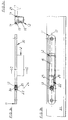
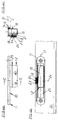
- All abutments 10 shown in the figures essentially consist of a carrier 11 and a bearing part 12.
- the carrier 11 is essentially a striking plate-like plate with fastening bores 33 at its ends for screw fastening to a frame part or according to FIGS. 2b to 5b on one Clothing strip 31, which is adapted to a profile on the back, that is to say in the region of the underside shown in cross section in FIGS. 2c to 5c, to which the clothing strip 31 is to be attached.
- this clothing strip 31 has an unspecified recess into which the carrier or the abutment 10 is installed, so that the surface of the carrier 11 lies flush with the surface of the clothing strip 31, which in turn is assembled with an end edge of a frame.
- All embodiments of abutments 10 also have in common that the bearing part 12 is displaceably guided on the carrier 11, namely longitudinally displaceable in the longitudinal direction of the carrier.
- the carrier 11 has on its underside 30 facing L-shaped guide rails 15. With these guide rails 15 facing one another, the carrier engages under guide rails 14 of the bearing part 12 which point away from one another, so that the latter only has a single degree of freedom for movement, namely in the longitudinal direction.
- the assembly takes place in that the bearing part 12 with its guide strips 14 is inserted from one end face of the carrier 11 into the guide rails 15 which are open there.
- the bearing part 12 is therefore essentially below or behind the carrier 11.
- All of the bearing parts 12 shown have in common that they are essentially designed as hollow cuboids.
- the hollow cuboid is open on the carrier side, so it has no delimiting wall here.
- the guide strips 14 sit on the bearing part 12 on a longitudinal edge of the hollow cuboid and point in opposite directions to one another, the hollow cuboid being dimensioned so wide that it fits fairly precisely between the guide rails 15 of the carrier 11.
- the length of the bearing part 12 or the hollow cuboid is less than the length of the carrier 11.
- the length of the bearing part 12 is essentially matched to the inclusion or insertion geometry of the locking part which is to be pivoted or inserted into the interior of the bearing part 12 .
- the carrier 11 is provided with a through-opening 25 which is so wide that the entire interior of the bearing part 12 remains practically free, and which is as long as the possible displacement of the bearing part 12 in the longitudinal direction of the carrier 11 requires.
- the bearing part 12 is designed in such a way that a side wall 16, namely an inner wall and thus a wall that comes into contact with the locking part, forms an acute angle with the longitudinal axis 17 of the bearing part 12.
- the consequent sloping side wall 16 can be used, e.g.
- All of the exemplary embodiments shown in the drawing also have in common that they have an adjusting element 13 with which the bearing part 12 can be displaced relative to the carrier 11 by actuating the adjusting element 13.
- the design of the adjusting element 13 and its arrangement is, however, quite different and adapted to correspondingly different application tasks.
- FIGS. 1 to 3b are all characterized in that the adjusting element is arranged with an axis of rotation 24 that is vertical to the visible side of the carrier 11, that is to say to the plane of representation of FIGS. 2b, 3b.
- the adjusting element 13 is a pinion which is accommodated in a housing 23 which is located on the longitudinal side 27 of the through opening 25, approximately in the middle between the ends thereof.
- the housing 23 is a vertical cuboid, which extends from the visible side of the carrier 11 over its entire height.
- a toothed strip 26 running in the longitudinal direction thereof, which extends over the entire length of the bearing part 12.
- the rotating element 13 designed as a pinion meshes with the Teeth 19 of this toothed strip 26.
- the pinion 13 is rotated with an axle pin 33 which is flush with the visible side of the carrier 11 and has a screwdriver slot 34 there.
- a locking element 32 Arranged at a short distance below the pin 33 and the rotating element 13 is a locking element 32, namely a clamping screw which presses across the housing 23 onto the outer wall 21 of the bearing part 12 carrying the toothed strip 26. If this locking element 32 is jammed, a relative movement of the carrier 11 and the bearing part 12 with the rotating element 13 is not possible.
- the adjusting element 13 is arranged in the visible surface of the carrier 11 next to the passage opening 25 for the locking part, not shown, on the narrow side of this opening 25 for the locking part, not shown.
- the adjusting element 13 is in turn designed as a pinion and arranged within a housing 23, which consists of the plate-shaped carrier 11 in this area, e.g. is pushed out, so that the adjusting element 13 can be fixed with a stub shaft 35 in a bore of the housing 23.
- a screwdriver slot 34 is used to rotate the adjusting element 13.
- the twisting leads to an adjustment of the bearing part 12, it is provided with a longitudinally extending toothed strip 26 and the rotating element 13 designed as a pinion meshes with the teeth of this toothed strip 26, not shown in detail, which is an integral part of a transport projection 22 of the bearing part 12 and extends in the slot formed between a guide rail 15 and a guide bar 14 and is thus stabilized.
- the adjusting element 13 with its axis of rotation 24 is not arranged in a longitudinal plane or the main longitudinal plane, as in the embodiments of FIGS. 2 a to 3 c, but rather is vertical to a longitudinal plane of the carrier.
- the adjustment elements 13 designed as pinions or pinion-like elements are arranged with this axis of rotation 24 below the plate of the carrier, so that the adjustment elements do not extend over the latter Protruding the surface or visible side.
- the adjustment elements 13 are arranged in particular below a guide bar 14 in order to be brought into adjustment engagement with the bearing part 12 with such a positioning.
- both adjustment elements 13 are housed in housings 23, which are part of the carrier.
- the housings 23 have a housing interior, which is adapted to the outer contour of the adjusting element, in the sense of a space-saving design.
- the interior is open in the area of the adjacent outer wall 21 of the bearing part 12, so that the adjusting element 13 can rest directly on the outer wall 21 of the bearing part 12.
- the adjusting elements 13 are each mounted in a bore of the housing 23 shown in the drawings with an axle stub, each having a screwdriver slot 34 in order to be able to adjust the adjusting element 13.
- the bearing part 12 has a row of pins 29, which is arranged similar to the rack 26 of the abutment of Figure 1 on the outer wall 21, from which the individual transverse pins 18 protrude perpendicularly at a distance from each other.
- the adjusting element 13 is arranged below this row of pins 29 and engages in the spaces between the pins with a toothing.
- the bearing part 12 is displaced via the transverse pins 18, depending on the direction of rotation, in one of the two directions.
- the extent of the housing 23 is comparatively large, namely up to close to the lower edge of the bearing part 12 facing away from the clothing strip 31.
- the adjusting element 13 can be made comparatively large in diameter and generates correspondingly large propulsive forces on the bearing part 12, which is correspondingly smooth is to be adjusted.
- the abutment can also be designed according to FIGS. 5a to 5c.
- a corrugation 28 with transverse ribs 20 on the underside of the guide bar 14.
- Such a corrugation 28 can easily be produced by rolling or rolling.
- a grub screw-like adjusting element 13 with a circumferential toothing which interacts with the corrugation 28 or its ribs 20, in a small housing 23 when the adjusting element 13 is rotated with a screwdriver engaging in the screwdriver slot 34.
- a simplified one can also be used, which consists only of a flat sheet metal, through the through opening of which one can see through. It would also be possible to arrange the adjusting element with a vertical axis and to have it mesh with a side toothing of the bearing part or the sheet.
- the support on the visible side in FIGS. 2b to 4b on the supervisory side, can be clad with a diaphragm which has a diaphragm opening which is smaller in length than the through opening 25 of the carrier 11. This allows the two sides of the Bearing part 12 visible areas of the access opening 25 are covered.
- the panel is fastened, for example, with fastening screws in the fastening bores 33, at the same time with the carrier 11
Landscapes
- Engineering & Computer Science (AREA)
- Mechanical Engineering (AREA)
- Lock And Its Accessories (AREA)
- Bag Frames (AREA)
- Helmets And Other Head Coverings (AREA)
- Hinges (AREA)
Applications Claiming Priority (2)
| Application Number | Priority Date | Filing Date | Title |
|---|---|---|---|
| DE29505071U | 1995-03-25 | ||
| DE29505071U DE29505071U1 (de) | 1995-03-25 | 1995-03-25 | Widerlager eines Sperrteils an Türen oder Fenstern |
Publications (2)
| Publication Number | Publication Date |
|---|---|
| EP0735217A2 true EP0735217A2 (fr) | 1996-10-02 |
| EP0735217A3 EP0735217A3 (fr) | 1996-12-27 |
Family
ID=8005870
Family Applications (1)
| Application Number | Title | Priority Date | Filing Date |
|---|---|---|---|
| EP96104593A Ceased EP0735217A3 (fr) | 1995-03-25 | 1996-03-22 | Gâche pour pêne de portes ou fenêtres |
Country Status (2)
| Country | Link |
|---|---|
| EP (1) | EP0735217A3 (fr) |
| DE (1) | DE29505071U1 (fr) |
Cited By (4)
| Publication number | Priority date | Publication date | Assignee | Title |
|---|---|---|---|---|
| GB2373818A (en) * | 2001-03-30 | 2002-10-02 | Era Products Ltd | Adjustable keeps |
| NL1021723C2 (nl) * | 2002-10-23 | 2004-04-26 | Alprokon Promotie Ontwikk Bv | Slotsamenstel. |
| EP1375787A3 (fr) * | 2002-06-27 | 2004-12-29 | Björkboda Las Oy AB | Gâche de serrure |
| WO2022242801A1 (fr) * | 2021-05-20 | 2022-11-24 | Emka Beschlagteile Gmbh & Co. Kg | Loquet comprenant un coin de verrouillage |
Families Citing this family (1)
| Publication number | Priority date | Publication date | Assignee | Title |
|---|---|---|---|---|
| DE19736934C2 (de) * | 1997-08-25 | 2001-05-10 | Roto Frank Ag | Verriegelungsbeschlag |
Family Cites Families (13)
| Publication number | Priority date | Publication date | Assignee | Title |
|---|---|---|---|---|
| US2161757A (en) * | 1938-09-21 | 1939-06-06 | Keil Francis & Son Inc | Door latch and striker construction |
| DE1185948B (de) * | 1958-09-23 | 1965-01-21 | Curt Weinert | Verriegelungseinrichtung fuer Fenster, Tueren od. dgl. |
| DE7537868U (de) * | 1975-11-28 | 1976-04-01 | Fa. Carl Fuhr, 5628 Heiligenhaus | Verstell-schliessblech, insbesondere fuer treibstangenbeschlaege an fenstern, tueren oder dergleichen |
| DE7619658U1 (de) * | 1976-06-22 | 1976-10-14 | Ferco International Usine De Ferrures De Batiment, Reding-Petit-Eich (Frankreich) | Schliessblech fuer fenster- oder tuerbeschlaege mit verzahnung zur querverstellung |
| DE8034126U1 (de) * | 1980-12-22 | 1981-05-27 | SCHÜCO Heinz Schürmann GmbH & Co, 4800 Bielefeld | Am blendrahmen eines fensters oder einer tuer festlegbares riegelstueck |
| GB2110288B (en) * | 1981-11-21 | 1985-03-20 | Adeptal Systems Ltd | Adjustable striker for locks |
| GB2177153B (en) * | 1985-07-05 | 1988-10-05 | Cego Ltd | Striking plates |
| DE3621811A1 (de) * | 1986-06-28 | 1988-01-07 | Dyna Plastik Gmbh | Schliessstueck fuer fenster und tueren |
| GB2233025A (en) * | 1989-04-26 | 1991-01-02 | Smith Wallis & Company Limited | Adjustable keeper |
| GB2243400A (en) * | 1990-04-26 | 1991-10-30 | Glenn Christopher Harland | Striking plate assembly for a door or window |
| DE4115862C2 (de) * | 1991-05-15 | 1997-10-09 | Aubi Baubeschlaege Gmbh | Verstellbares Schließstück |
| US5118151A (en) * | 1991-07-16 | 1992-06-02 | Nicholas Jr Marvin R | Adjustable door strike and mounting template |
| DE9216213U1 (de) * | 1992-11-28 | 1994-04-07 | Carl Fuhr Gmbh & Co, 42579 Heiligenhaus | Schließplatte |
-
1995
- 1995-03-25 DE DE29505071U patent/DE29505071U1/de not_active Expired - Lifetime
-
1996
- 1996-03-22 EP EP96104593A patent/EP0735217A3/fr not_active Ceased
Cited By (4)
| Publication number | Priority date | Publication date | Assignee | Title |
|---|---|---|---|---|
| GB2373818A (en) * | 2001-03-30 | 2002-10-02 | Era Products Ltd | Adjustable keeps |
| EP1375787A3 (fr) * | 2002-06-27 | 2004-12-29 | Björkboda Las Oy AB | Gâche de serrure |
| NL1021723C2 (nl) * | 2002-10-23 | 2004-04-26 | Alprokon Promotie Ontwikk Bv | Slotsamenstel. |
| WO2022242801A1 (fr) * | 2021-05-20 | 2022-11-24 | Emka Beschlagteile Gmbh & Co. Kg | Loquet comprenant un coin de verrouillage |
Also Published As
| Publication number | Publication date |
|---|---|
| DE29505071U1 (de) | 1996-08-01 |
| EP0735217A3 (fr) | 1996-12-27 |
Similar Documents
| Publication | Publication Date | Title |
|---|---|---|
| DE3738300C2 (de) | Flügelrahmen für ein Fenster oder eine Tür, der aus Metall- oder Kunststoffprofilen zusammengesetzt ist | |
| EP0384224B1 (fr) | Dispositif de guidage | |
| DE3645256C2 (de) | Fenster- und Türbeschlag | |
| EP0440987B2 (fr) | Crémone | |
| EP1331338B1 (fr) | Charnière pour portes, fenêtres et similaires | |
| DE4134705C2 (de) | Treibstangenbeschlag für Fenster, Türen od. dgl. | |
| EP0735217A2 (fr) | Gâche pour pêne de portes ou fenêtres | |
| DE29704610U1 (de) | Antriebsanordnung für verdrehbare Lamellen eines eine Fenster- oder Türöffnung abdeckenden Ladens | |
| DE9114374U1 (de) | Treibstangenbeschlag für Fenster, Türen o.dgl. | |
| EP0128372B1 (fr) | Dispositif de fermeture d'un battant d'une porte, fenêtre ou similaire à deux battants | |
| DE69710027T2 (de) | Monodirektionaler Treibstangenverschluss | |
| DE3800443C2 (de) | Eckverbindung für die Rahmenkonstruktion einer Dusch- oder Badewannenabtrennung u. dgl. | |
| DE1964842A1 (de) | Beschlag fuer Fenster,Tueren u.dgl. | |
| DE19737538A1 (de) | Betätigungsgetriebe für einen Treibstangenbeschlag | |
| EP4146888A1 (fr) | Ensemble charnière à actionnement commun | |
| DE29800735U1 (de) | Betätigungshandhabe | |
| DE19502362C2 (de) | Positionierungseinrichtung für Beschlagteile | |
| DE2431616A1 (de) | Verschlussgetriebe, insbesondere fuer einen fluegel eines fensters, einer tuer o.dgl. | |
| DE29813289U1 (de) | Laderaumtür | |
| EP0158069B1 (fr) | Dispositif de fermeture et de verrouillage pour une porte ou analogue | |
| DE102006016022B4 (de) | Vorrichtung zur drehbaren Halterung von zwei Flächenelementen und deren Verwendung | |
| EP0280950B1 (fr) | Strip de fermeture pour porte, fenêtre ou similaire | |
| DE202005009745U1 (de) | Beschlaganordnung | |
| DE8335786U1 (de) | Vorrichtung zum verriegeln von tueren oder fenstern | |
| AT392817B (de) | Riegelschloss |
Legal Events
| Date | Code | Title | Description |
|---|---|---|---|
| PUAI | Public reference made under article 153(3) epc to a published international application that has entered the european phase |
Free format text: ORIGINAL CODE: 0009012 |
|
| AK | Designated contracting states |
Kind code of ref document: A2 Designated state(s): AT BE CH DE FR GB LI NL |
|
| PUAL | Search report despatched |
Free format text: ORIGINAL CODE: 0009013 |
|
| AK | Designated contracting states |
Kind code of ref document: A3 Designated state(s): AT BE CH DE FR GB LI NL |
|
| 17P | Request for examination filed |
Effective date: 19970429 |
|
| 17Q | First examination report despatched |
Effective date: 19990805 |
|
| STAA | Information on the status of an ep patent application or granted ep patent |
Free format text: STATUS: THE APPLICATION HAS BEEN REFUSED |
|
| 18R | Application refused |
Effective date: 20000610 |