EP0736238B1 - Interface de liaison de donnes pour reseau de commutation par paquets - Google Patents
Interface de liaison de donnes pour reseau de commutation par paquets Download PDFInfo
- Publication number
- EP0736238B1 EP0736238B1 EP95904998A EP95904998A EP0736238B1 EP 0736238 B1 EP0736238 B1 EP 0736238B1 EP 95904998 A EP95904998 A EP 95904998A EP 95904998 A EP95904998 A EP 95904998A EP 0736238 B1 EP0736238 B1 EP 0736238B1
- Authority
- EP
- European Patent Office
- Prior art keywords
- congestion
- network
- conversation
- frame
- data link
- Prior art date
- Legal status (The legal status is an assumption and is not a legal conclusion. Google has not performed a legal analysis and makes no representation as to the accuracy of the status listed.)
- Expired - Lifetime
Links
- 230000005540 biological transmission Effects 0.000 claims abstract description 23
- 238000001514 detection method Methods 0.000 claims description 5
- 238000000034 method Methods 0.000 claims 6
- 238000007456 delayed laparoscopic cholecystectomy Methods 0.000 description 3
- 238000010586 diagram Methods 0.000 description 3
- 239000000872 buffer Substances 0.000 description 2
- 238000012986 modification Methods 0.000 description 2
- 230000004048 modification Effects 0.000 description 2
- 238000013507 mapping Methods 0.000 description 1
- 230000011664 signaling Effects 0.000 description 1
Images

Classifications
-
- H—ELECTRICITY
- H04—ELECTRIC COMMUNICATION TECHNIQUE
- H04L—TRANSMISSION OF DIGITAL INFORMATION, e.g. TELEGRAPHIC COMMUNICATION
- H04L47/00—Traffic control in data switching networks
- H04L47/10—Flow control; Congestion control
- H04L47/26—Flow control; Congestion control using explicit feedback to the source, e.g. choke packets
- H04L47/263—Rate modification at the source after receiving feedback
-
- H—ELECTRICITY
- H04—ELECTRIC COMMUNICATION TECHNIQUE
- H04L—TRANSMISSION OF DIGITAL INFORMATION, e.g. TELEGRAPHIC COMMUNICATION
- H04L12/00—Data switching networks
- H04L12/28—Data switching networks characterised by path configuration, e.g. LAN [Local Area Networks] or WAN [Wide Area Networks]
- H04L12/2854—Wide area networks, e.g. public data networks
-
- H—ELECTRICITY
- H04—ELECTRIC COMMUNICATION TECHNIQUE
- H04L—TRANSMISSION OF DIGITAL INFORMATION, e.g. TELEGRAPHIC COMMUNICATION
- H04L47/00—Traffic control in data switching networks
- H04L47/10—Flow control; Congestion control
-
- H—ELECTRICITY
- H04—ELECTRIC COMMUNICATION TECHNIQUE
- H04L—TRANSMISSION OF DIGITAL INFORMATION, e.g. TELEGRAPHIC COMMUNICATION
- H04L47/00—Traffic control in data switching networks
- H04L47/10—Flow control; Congestion control
- H04L47/12—Avoiding congestion; Recovering from congestion
-
- H—ELECTRICITY
- H04—ELECTRIC COMMUNICATION TECHNIQUE
- H04L—TRANSMISSION OF DIGITAL INFORMATION, e.g. TELEGRAPHIC COMMUNICATION
- H04L47/00—Traffic control in data switching networks
- H04L47/10—Flow control; Congestion control
- H04L47/16—Flow control; Congestion control in connection oriented networks, e.g. frame relay
-
- H—ELECTRICITY
- H04—ELECTRIC COMMUNICATION TECHNIQUE
- H04L—TRANSMISSION OF DIGITAL INFORMATION, e.g. TELEGRAPHIC COMMUNICATION
- H04L47/00—Traffic control in data switching networks
- H04L47/10—Flow control; Congestion control
- H04L47/29—Flow control; Congestion control using a combination of thresholds
-
- Y—GENERAL TAGGING OF NEW TECHNOLOGICAL DEVELOPMENTS; GENERAL TAGGING OF CROSS-SECTIONAL TECHNOLOGIES SPANNING OVER SEVERAL SECTIONS OF THE IPC; TECHNICAL SUBJECTS COVERED BY FORMER USPC CROSS-REFERENCE ART COLLECTIONS [XRACs] AND DIGESTS
- Y02—TECHNOLOGIES OR APPLICATIONS FOR MITIGATION OR ADAPTATION AGAINST CLIMATE CHANGE
- Y02D—CLIMATE CHANGE MITIGATION TECHNOLOGIES IN INFORMATION AND COMMUNICATION TECHNOLOGIES [ICT], I.E. INFORMATION AND COMMUNICATION TECHNOLOGIES AIMING AT THE REDUCTION OF THEIR OWN ENERGY USE
- Y02D30/00—Reducing energy consumption in communication networks
- Y02D30/50—Reducing energy consumption in communication networks in wire-line communication networks, e.g. low power modes or reduced link rate
Definitions
- This invention relates generally to packet-switched networks, and more particularly to a data link interface, such as may be incorporated in a router for connection to a frame relay network.
- Frame relay is a packet switching technology designed to require the minimum processing.
- Frame relay networks provide dynamic bandwidth allocation by switching framed data between connection segments.
- the networks are based on virtual connections, which can either be switched or permanent.
- the present invention is concerned with permanent virtual connections (PVCs).
- Permanent virtual connections are end-to-end logical connections across a frame relay network composed of a sequence of PVC segments between pairs of frame relay DCEs (data connection ends) or frame relay DCE and a frame relay DTE (data terminal end).
- Each end of PVC segment is called a data link connection (DLC) .
- DLC data link connection
- a DLC is identified on a frame relay port with a locally unique number called the data link connection identifier (DLCI).
- DLCI data link connection identifier
- BECN backward explicit congestion notification bit
- N.J.Muller (INTERNATIONAL JOURNAL OF NETWORK MANAGEMENT, vol. 2., No. 2, June 1992, UK pages 87-99) discloses the adjsustment of transmission rate in the presence of network congestion. However, Muller does not disclose any means of making optimum use of the badwidth available in the presence of congestion.
- An object of the invention is to alleviate the aforementioned problems.
- a data link interface for sending and receiving data over a virtual connection in a packet-switched network, comprising means for detecting congestion in the network, and means for adjusting the transmission rate in response to the detection of said congestion so as to reduce congestion in the network, characterized in that it further comprises means for sorting traffic by conversation between two endpoints, and means for re-ordering packets from different conversations on a common link in the presence of congestion while maintaining the order of transmission for each conversation in order to achieve fair allocation of bandwidth among different conversations.
- the network is a frame relay network
- the means for detecting congestion in the network comprises a congestion bit detector, preferably a backward explicit congestion bit (BECN) detector.
- BECN backward explicit congestion bit
- the virtual connection may be a permanent virtual connection.
- the interface which is normally a router drops the transmission rate to a predetermined rate known as the committed information rate (CIR). Traffic is then prioritized according to type, with bandwidth guaranteed to critical applications even during periods of severe congestion.
- CIR committed information rate
- a router operating in accordance with the invention sorts traffic by conversation between user data devices, and then allocates bandwidth fairly between active conversations. Heavy usage applications, such as bulk file transfers, are forced to share link capacity fairly with lighter usage applications.
- the router can therefore offer reliable frame relay data transmission and protection for high priority calls. Network behavior is stabilized during congestion, resulting in increased speed and reduced overheads.
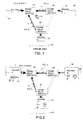
- routers 1A, 1B, and 1C are connected to respective local networks, for example Local Area Networks (LANs) networks, 2A, 2B, and 2C.
- the routers are connected to frame relay switches 3A, 3B, 3C forming part of a frame relay network and providing permanent virtual connections (PVCs a and b) 4 and 5.
- PVCs a and b permanent virtual connections
- the routers include a congestion bit detector 7 and a rate adjuster 8.
- the rate adjuster 8 Upon detection of a backward explicit congestion notification (BECN) by the detector 7 in an incoming packet, the rate adjuster 8 adjusts the outgoing transmission rate downward to a lower rate, known as the committed information rate (CIR), so as to reduce the likelihood of packets being dropped.
- BECN backward explicit congestion notification
- CIR committed information rate
- the routers shown in Figure 2 implement the frame relay data link protocol as described in American National Standards Institute DSS1-Core Aspects of Frame Protocol For Use With Frame Relaying Bearer Service, T1.618 and CCITT, ISDN Data Link Lab Specification For Frame Mode Bearer Services, Volume 6 recommendation Q.922.
- the routers support un-numbered information frames (UI) with 10, 16, or 23 bit DLCIs (data link connection identifiers).
- UI un-numbered information frames
- DLCIs data link connection identifiers
- Frames with a control field set to other than $03 (UI), too short or with a DLCI of a length different from that programmed for the port are silently discarded, counted, and the first 64 bytes of the frame recorded.
- BECN backward explicit congestion notification bit
- FECN forward explicit congestion notification bit
- DE Discard Eligibility
- the routers 1A, 1B, 1C ignore the FECN and C/R bits and act on the BECN bit described below.
- the routers ensure that the frame length is greater than five but less than N201 bytes.
- N201 is not configurable and has a value of 4500.
- DLCIs Data Link Connection Identifiers
- Table 1 The use of DLCIs (Data Link Connection Identifiers) on a frame-rely link is as summarized in Table 1 below. Only the DLCIs marked user-configurable are available to transport traffic on behalf of the clients of the data link.
- DCLI Range Function 10 bit 16bit 23bit 0 0 0 T1.617 Annex D 1-15 1-1023 1-131 071 Reserved (T1.618) 16-1007 1024-63 487 131 072 - 8 126 463
- LMI Local Management Interface
- 001-208966 Digital Equipment Corporation, Northern Telecom Inc. and Stratacom Inc., Cisco Inc., Frame Relay Specification With Extensions, Document Number 001-208966 Revision 1.0, September 1990
- T1.617 Annex D American National Standards Institute, Integrated Services Digital Network (ISDN) - Digital Subscriber Signaling System No. 1 (DSSI) - Signal Specification For Frame Relay Bearer Service, T1.617, March 1991] can be used to provide PVC status and configuration information to the router from the frame-relay network.
- ISDN Integrated Services Digital Network
- DSSI Digital Subscriber Signaling System No. 1
- the routers support T1.617.
- the Annex D protocol runs over DLCI 0 on a link.
- the routers support all mandatory portions of the LMI (local management interface), all extensions specified in Section 6 (common extensions) and implement receive processing of asynchronous updates including the New, Active and Deleted bits (but does not originate asynchronous updates.
- the LMI (local management interface) protocol runs over DLCI 1023 on a link - this is not configurable.
- the LMI can only be used on frame-relay links configured for 10-bit DLCIs.
- each end will receive the management traffic on an unconfigured DLCI and this is reported as part of the per-frame-relay link statistics.
- FIG 3 which shows the BECN monitor 7 and DLC output queue and rate limiter 8
- the BECN monitor is connected to the HDLC receive processing unit 10 and the DLC rate limiter 8 is connected to link output queue unit 9 and HDLC transmit processing unit 11.
- the DLC output queue is a "Fair Queue” (see [Alan Demers, Srinivasan Keshav, Scott Shenker, "Analysis and Simulation of a Fair Queuing Algorithm", SIGCOMM '89, 1989]) with the conversation identifier a function of the upper layer source and destination addresses. This queue is bypassed if the traffic meets the bandwidth admission criteria specified below.
- the link output queue is a "Fair Queue" with the conversation identifier a 1:1 mapping of the DLCI.
- the link output queue is bypassed when the hardware transmit queue is not full.
- the router applies bandwidth admission rules to the encapsulated frame prior to queuing the frame for transmission to enforce a maximum offered load towards the network.
- the load offered by the router to the network is determined by the Committed Information Rate (CIR), Excess Burst (Be) and Committed Burst (Bc) defined by the user on a per-DLC basis - to implement bandwidth usage policies different from those described in T1.617, the user sets the CIR, Be and BC values to reflect those policies.
- CIR Committed Information Rate
- Be Excess Burst
- Bc Committed Burst
- the router delivers a load toward that network that is within ⁇ 500 kbits/s of the target rate.
- the bandwidth admission mechanism will queue frames in a "holding queue” to "smooth" the load offered to the network.
- the holding queue has a maximum length; when the length is exceeded frames are dropped.
- the rate at which the router will transmit frames depends on the congestion status of the attached frame-relay network.
- the congestion status of the connection is approximated by examining the value of a cctCongested (DLCI) state variable.
- the router transmits on the DLCI in question at a rate which approximates the CIR (see Table 3).
- the router internally uses a sliding window with a width of Ti seconds.
- the value of Ti has only internal significance to the router and is chosen to provide the required accuracy in rate enforcement - Ti is currently 100 ms.
- any frame "passed on” is passed to the link output mechanism for further processing. If the size of the output queue for the frame-relay link is less than the mild congestion threshold, the frame will be passed to the hardware for transmission on the link otherwise the frame will be enqueued in the link output queue using the express queuing discipline described below.
- the router ignores both the FECN bit in received frames and CLLM frames in their entirety.
- the router responds to frames received with BECN bits by temporarily reducing the load offered to the network on the indicated DLC.
- the connection is assumed to be congested in the network and the state variable cctCongested [DLCI] is set beginning in interval (n + 1) x Ti.
- the state variable is cleared for the interval after the first one in which the router transmits at the lower rate and remains clear until a frame is received with the BECN bit set.
- Frame-relay links on a router may become congested if the traffic to be transmitted on the link exceeds the access rate of the link. This congestion is likely to occur due to the large (typically an order of magnitude) difference between the data rate on the LAN side of the router and the data rate on the frame relay side.
- Congestion of a frame-relay link is detected by examining the output queues of the frame relay link. There are three thresholds associated with each link:
- a frame-relay link is mildly congested if the size of the output queue for the link exceeds a small limit - the limit is defined by the hardware used to implement the link.
- a frame-relay link is severely congested if the number of bytes queued for transmission on the frame-relay link exceeds the configurable severe congestion threshold.
- a frame-relay link is absolutely congested if the number of bytes queued for transmission on the frame-relay link exceeds the absolute congestion threshold.
- the router When the router drops a frame as part of its link congestion management described below, it also immediately exhausts the DLCs transmit quota for the current interval and sets the cctCongested[DLCI] state variable for the DLC on which the dropped frame was carried for the next interval. This is done in an attempt to alleviate the source of congestion in a reasonably fair manner.
- the router When a frame-relay link is mildly congested, the router imposes an ever-so-slightly modified form of express queuing discipline on the output queue of the frame-relay link to prevent data queued for a DLC in the next interval from preceding any data queued for another DLC in the current interval. This is called "fair queuing".
- time-division means that the express queuing mechanism treats each "conversation” as if it had a separate link for which frames could be queued. From the size of each frame, the router computes "when" a frame would be sent on its virtual link.
- the router chooses the frame with the earliest start of transmission time. This does not cause re-ordering within a conversation, but may cause re-ordering across the whole link in order to attempt to provide a fair allocation of bandwidth to all conversations.
- Figure 4 shows a simple example of how express queuing works.
- the router When a frame-relay link is severely congested, the router continues to impose the express queuing discipline on the link's output queue. In addition, it notifies the outside world and starts to drop frames as described below.
- the router raises an alarm when the number of bytes queued to a frame-relay link exceed the severe congestion threshold and clears the alarm when the number of bytes queued has remained below the severe congestion threshold for 5 second.
- the router attempts to add a frame to the link output queue, and the addition of the frame would cause the link output queue to exceed the severe congestion threshold and the frame would be added at the tail of the queue, the frame is dropped.
- the router When a frame-relay link is absolutely congested, the router continues to impose the express queuing discipline on the link's output queue. In addition. it notifies the outside world and starts to drop frames as described below.
- the router raises an alarm when the number of bytes queued to a frame-relay link exceed the absolute congestion threshold and clears the alarm when the number of bytes queued has remained below the absolute congestion threshold for 10 seconds.
- the router attempts to add a frame to the link output queue, and the addition of the frame would cause the link output queue to exceed the absolute congestion threshold the frame is dropped, regardless of where in the queue it would be added.
- the described data link interface thus alleviates the problem occurring in the prior art where the routers continue to send data out over frame relay links even in the event of severe network congestion. Key applications keep running.
Landscapes
- Engineering & Computer Science (AREA)
- Computer Networks & Wireless Communication (AREA)
- Signal Processing (AREA)
- Data Exchanges In Wide-Area Networks (AREA)
Abstract
Claims (14)
- Une interface pour la transmission et la réception de données au moyen d'une connexion virtuelle (a, b) dans un réseau à commutation par paquets qui comprend des dispositifs (7) pour détecter la congestion dans le réseau, et des dispositifs (8) pour ajuster le taux de transmission en réponse à la détection de ladite congestion, en vue de réduire la congestion de réseau, caractérisée par le fait qu'elle comprend aussi des dispositifs (1A, 1B, 1C) pour trier la conversation entre deux extrémités, et des dispositifs (1A, 1B, 1C) pour rétablir l'ordre des paquets provenant des différentes conversations sur un lien commun en cas de congestion tout en maintenant l'ordre de la transmission pour chaque conversation, et ce, afin de répartir équitablement la largeur de bande parmi les différentes conversations.
- Une interface pour la transmission de données selon la revendication 1, caractérisée en ce que lesdits dispositifs de détection (7) comprennent des dispositifs servant à déceler des bits de notification de congestion dans les paquets de données reçus.
- Une interface pour la transmission de données selon la revendication 1, caractérisée en ce que les dispositifs (8) d'ajustement réduisent le taux de transmission à un taux d'information engagé prédéterminé en cas de congestion du réseau.
- Une interface pour la transmission de données selon la revendication 1, encore caractérisée en ce qu'elle comprend les dispositifs (1A, 1B, 1C) pour allouer équitablement la largeur de bande disponible au taux d'information engagé entre lesdits différents types de trafic.
- Une interface pour la transmission de données selon la revendication 1, caractérisée en ce que ledit réseau est un réseau de relais de trame.
- Une interface pour la transmission de données selon la revendication 5, caractérisée en ce que ladite connexion virtuelle (a, b) est une connexion virtuelle permanente.
- Une interface pour la transmission de données selon la revendication 1, caractérisée en ce qu'elle comprend aussi les dispositifs (1A, 1B, 1C) pour calculer à quel moment un paquet dans chaque conversation serait transmis si la conversation avait son propre lien; lesdits dispositifs de rétablissement de l'ordre (1A, 1B, 1C) établiraient l'ordre de transmission de sorte que les paquets produits en premier soient les premiers à être transmis.
- Un répartiteur comprenant une interface pour la transmission de données de relais de trame, selon n'importe laquelle des revendications 1 à 7.
- Une méthode de réduction de la congestion sur une connexion virtuelle (a, b) dans un réseau de relais de trame, qui comprend les étapes de détection de la congestion dans le réseau, et règle le taux de transmission en réponse à la détection de ladite congestion en vue de réduire la congestion dans le réseau, caractérisée en ce qu'elle comprend encore les étapes de tri du trafic par la conversation entre deux extrémités, et rétablit l'ordre des paquets provenant des différentes conversations sur un lien ordinaire en cas de congestion tout en maintenant l'ordre de la transmission pour chaque conversation dans le but de répartir équitablement la largeur de bande parmi les différentes conversations.
- Une méthode selon la revendication 8, caractérisée en ce que les bits de notification de la congestion sont décelés dans les paquets de données reçus.
- Une méthode selon la revendication 9, caractérisée en ce que le taux de transmission est réduit à un taux d'information engagé prédéterminé en cas de congestion de réseau.
- Une méthode selon la revendication 8, caractérisée en ce qu'elle comprend aussi la détermination du type de trafic transmis, et l'allocation équitable de la largeur de bande disponible au taux d'information engagé parmi les différents types de trafic.
- Une méthode selon n'importe laquelle des revendications 8 à 12, caractérisée en ce que ladite connexion virtuelle (a, b) est une connexion virtuelle permanente.
- Une méthode selon la revendication 8, caractérisée par la possibilité de calculer le moment où un paquet dans chaque conversation serait transmis si la conversation avait son propre lien, l'ordre de transmission est établi de sorte que les paquets produits en premier sont les premiers à être transmis.
Applications Claiming Priority (3)
| Application Number | Priority Date | Filing Date | Title |
|---|---|---|---|
| GB939326276A GB9326276D0 (en) | 1993-12-23 | 1993-12-23 | Frame relay interface |
| GB9326276 | 1993-12-23 | ||
| PCT/CA1994/000724 WO1995017788A1 (fr) | 1993-12-23 | 1994-12-22 | Interface de liaison de donnes pour reseau de commutation par paquets |
Publications (2)
| Publication Number | Publication Date |
|---|---|
| EP0736238A1 EP0736238A1 (fr) | 1996-10-09 |
| EP0736238B1 true EP0736238B1 (fr) | 1999-03-31 |
Family
ID=10747084
Family Applications (1)
| Application Number | Title | Priority Date | Filing Date |
|---|---|---|---|
| EP95904998A Expired - Lifetime EP0736238B1 (fr) | 1993-12-23 | 1994-12-22 | Interface de liaison de donnes pour reseau de commutation par paquets |
Country Status (8)
| Country | Link |
|---|---|
| US (1) | US5781532A (fr) |
| EP (1) | EP0736238B1 (fr) |
| JP (1) | JP3401574B2 (fr) |
| AU (1) | AU703228B2 (fr) |
| CA (1) | CA2179618C (fr) |
| DE (1) | DE69417583T2 (fr) |
| GB (1) | GB9326276D0 (fr) |
| WO (1) | WO1995017788A1 (fr) |
Cited By (1)
| Publication number | Priority date | Publication date | Assignee | Title |
|---|---|---|---|---|
| US7072301B2 (en) | 2000-05-03 | 2006-07-04 | Siemens Aktiengesellschaft | Method for switching connections between at least two subregions of a packet-oriented network |
Families Citing this family (36)
| Publication number | Priority date | Publication date | Assignee | Title |
|---|---|---|---|---|
| US6847611B1 (en) * | 1990-12-10 | 2005-01-25 | At&T Corp. | Traffic management for frame relay switched data service |
| JP3496262B2 (ja) | 1994-02-04 | 2004-02-09 | 富士通株式会社 | Pvc状態確認手順制御方法、pvc状態確認手順制御機能を有するフレームリレー交換機 |
| CA2138061A1 (fr) * | 1994-12-14 | 1996-06-15 | Mark Wolff | Affectation equitable de ressources excedentaires |
| GB9511319D0 (en) * | 1995-06-05 | 1995-08-02 | Gen Datacomm Adv Res | Controlling the flow of ATM cells in an ATM network |
| US6075768A (en) * | 1995-11-09 | 2000-06-13 | At&T Corporation | Fair bandwidth sharing for video traffic sources using distributed feedback control |
| EP0884874A1 (fr) * | 1997-06-13 | 1998-12-16 | International Business Machines Corporation | Méthode pour adapter un débit d'informations garanti dans un réseau commuté à relais de trames |
| US6081524A (en) | 1997-07-03 | 2000-06-27 | At&T Corp. | Frame relay switched data service |
| US6018515A (en) * | 1997-08-19 | 2000-01-25 | Ericsson Messaging Systems Inc. | Message buffering for prioritized message transmission and congestion management |
| JPH1185632A (ja) * | 1997-09-12 | 1999-03-30 | Hitachi Ltd | データ通信方法 |
| US6473425B1 (en) * | 1997-10-02 | 2002-10-29 | Sun Microsystems, Inc. | Mechanism for dispatching packets via a telecommunications network |
| US6240067B1 (en) * | 1997-10-06 | 2001-05-29 | Ericsson Messaging Systems Inc. | Method and apparatus for managing control messages in a communication system |
| US6647424B1 (en) * | 1998-05-20 | 2003-11-11 | Nortel Networks Limited | Method and apparatus for discarding data packets |
| US6621829B1 (en) | 1998-05-20 | 2003-09-16 | Nortel Networks Limited | Method and apparatus for the prioritization of control plane traffic in a router |
| US6490298B1 (en) | 1999-02-26 | 2002-12-03 | Harmonic Inc. | Apparatus and methods of multiplexing data to a communication channel |
| US6687247B1 (en) | 1999-10-27 | 2004-02-03 | Cisco Technology, Inc. | Architecture for high speed class of service enabled linecard |
| EP1240753A1 (fr) * | 1999-12-13 | 2002-09-18 | Nokia Corporation | Procede de regulation de congestion dans un reseau commute par paquets |
| US7260826B2 (en) * | 2000-05-31 | 2007-08-21 | Microsoft Corporation | Resource allocation in multi-stream IP network for optimized quality of service |
| US7263106B2 (en) * | 2000-09-13 | 2007-08-28 | Fortinet, Inc. | System and protocol for frame relay service over the internet |
| WO2002055163A2 (fr) | 2000-11-01 | 2002-07-18 | Station Casinos Inc | Procede et systeme pour jouer a distance |
| US20020151363A1 (en) * | 2001-04-12 | 2002-10-17 | Howard Letovsky | Method and system for broadcast and control of a remotely located wagering device |
| US20020146004A1 (en) * | 2001-04-04 | 2002-10-10 | Adtran, Inc. | Nominal data flow path-based, virtual function configured frame relay state machine |
| US6990079B2 (en) * | 2001-06-08 | 2006-01-24 | International Business Machines Corporation | Optimizing fragment sizes in frame relay networks |
| US7184397B1 (en) * | 2001-11-30 | 2007-02-27 | Cisco Technology, Inc. | Real-time source activated shaping |
| KR100486713B1 (ko) * | 2002-09-17 | 2005-05-03 | 삼성전자주식회사 | 멀티미디어 스트리밍 장치 및 방법 |
| FR2844947B1 (fr) * | 2002-09-23 | 2004-12-31 | France Telecom | Procede de controle de debit dans un reseau de communication en mode paquet |
| KR100460958B1 (ko) * | 2002-12-04 | 2004-12-09 | 삼성전자주식회사 | 비대칭 네트워크 환경에서의 tcp의 데이터 전송효율을향상시킬 수 있는 통신시스템 및 그 방법 |
| US20050052996A1 (en) * | 2003-09-09 | 2005-03-10 | Lucent Technologies Inc. | Method and apparatus for management of voice-over IP communications |
| US7460874B1 (en) * | 2005-08-12 | 2008-12-02 | Sprint Spectrum L.P. | Method for monitoring performance of a message-delivery system |
| US7961605B2 (en) * | 2006-07-31 | 2011-06-14 | International Business Machines Corporation | System and method for enabling management of a plurality of messages in a communication network |
| US8254260B1 (en) * | 2007-06-15 | 2012-08-28 | At&T Intellectual Property Ii, L.P. | Method and apparatus for managing packet congestion |
| US7839777B2 (en) * | 2007-09-27 | 2010-11-23 | International Business Machines Corporation | Method, system, and apparatus for accelerating resolution of network congestion |
| US9215620B2 (en) * | 2008-05-05 | 2015-12-15 | Cisco Technology, Inc. | Distributed bi-directional flow control in wireless mesh networks |
| EP2234346A1 (fr) * | 2009-03-26 | 2010-09-29 | BRITISH TELECOMMUNICATIONS public limited company | Contrôle dans les réseaux de données |
| US8873392B1 (en) * | 2011-06-09 | 2014-10-28 | Marvell International Ltd. | Method and apparatus for controlling the flow of packets in a data network |
| US11100199B2 (en) * | 2018-08-30 | 2021-08-24 | Servicenow, Inc. | Automatically detecting misuse of licensed software |
| KR20220050364A (ko) | 2020-10-16 | 2022-04-25 | 한국전자통신연구원 | 셀-탈피 대규모 mimo 전송 방법 및 이를 위한 장치 |
Family Cites Families (7)
| Publication number | Priority date | Publication date | Assignee | Title |
|---|---|---|---|---|
| EP0438415B1 (fr) * | 1989-08-09 | 1995-01-18 | BELL TELEPHONE MANUFACTURING COMPANY Naamloze Vennootschap | Systeme de remise en sequence pour noeud de commutation |
| US5014265A (en) * | 1989-11-30 | 1991-05-07 | At&T Bell Laboratories | Method and apparatus for congestion control in a data network |
| FR2657482B1 (fr) * | 1990-01-19 | 1993-12-31 | Boyer Pierre | Methode et systeme de lissage et de controle de debits de communications temporelles asynchrones. |
| US5231633A (en) * | 1990-07-11 | 1993-07-27 | Codex Corporation | Method for prioritizing, selectively discarding, and multiplexing differing traffic type fast packets |
| US5335224A (en) * | 1992-06-30 | 1994-08-02 | At&T Bell Laboratories | Service guarantees/congestion control in high speed networks |
| US5600798A (en) * | 1993-10-26 | 1997-02-04 | International Business Machines Corporation | System and method for controlling LAN data flow control through a frame relay network by end point station transmitting notification to LAN stations based on congestion notification from the frame relay network |
| JPH07147592A (ja) * | 1993-11-24 | 1995-06-06 | Fujitsu Ltd | 輻輳制御方法、この方法を用いたターミナルアダプタ及びこのターミナルアダプタを有する通信システム |
-
1993
- 1993-12-23 GB GB939326276A patent/GB9326276D0/en active Pending
-
1994
- 1994-12-22 JP JP51707695A patent/JP3401574B2/ja not_active Expired - Lifetime
- 1994-12-22 AU AU13789/95A patent/AU703228B2/en not_active Expired
- 1994-12-22 EP EP95904998A patent/EP0736238B1/fr not_active Expired - Lifetime
- 1994-12-22 CA CA002179618A patent/CA2179618C/fr not_active Expired - Lifetime
- 1994-12-22 DE DE69417583T patent/DE69417583T2/de not_active Expired - Lifetime
- 1994-12-22 WO PCT/CA1994/000724 patent/WO1995017788A1/fr not_active Ceased
- 1994-12-22 US US08/666,335 patent/US5781532A/en not_active Expired - Lifetime
Cited By (1)
| Publication number | Priority date | Publication date | Assignee | Title |
|---|---|---|---|---|
| US7072301B2 (en) | 2000-05-03 | 2006-07-04 | Siemens Aktiengesellschaft | Method for switching connections between at least two subregions of a packet-oriented network |
Also Published As
| Publication number | Publication date |
|---|---|
| EP0736238A1 (fr) | 1996-10-09 |
| AU703228B2 (en) | 1999-03-18 |
| DE69417583D1 (de) | 1999-05-06 |
| CA2179618C (fr) | 2004-11-23 |
| CA2179618A1 (fr) | 1995-06-29 |
| DE69417583T2 (de) | 1999-09-16 |
| US5781532A (en) | 1998-07-14 |
| JPH09509292A (ja) | 1997-09-16 |
| WO1995017788A1 (fr) | 1995-06-29 |
| AU1378995A (en) | 1995-07-10 |
| JP3401574B2 (ja) | 2003-04-28 |
| GB9326276D0 (en) | 1994-02-23 |
Similar Documents
| Publication | Publication Date | Title |
|---|---|---|
| CA2179618C (fr) | Interface de liaison de donnes pour reseau de commutation par paquets | |
| US6826620B1 (en) | Network congestion control system and method | |
| US7948883B1 (en) | Applying router quality of service on a cable modem interface on a per-service-flow basis | |
| AU689518B2 (en) | Control of overload situations in frame relay network | |
| US5426640A (en) | Rate-based adaptive congestion control system and method for integrated packet networks | |
| JP4080911B2 (ja) | 帯域監視装置 | |
| JP3210344B2 (ja) | フレームリレーネットワークのオーバーロード状態の制御 | |
| US6167027A (en) | Flow control technique for X.25 traffic in a high speed packet switching network | |
| JPS63176045A (ja) | 輻湊制御型パケット交換方法及びその装置 | |
| JP2002527989A (ja) | ハイブリッドip−atmネットワーク内で混雑状態を管理するためのecnベースの方法 | |
| US20050078602A1 (en) | Method and apparatus for allocating bandwidth at a network element | |
| US5956322A (en) | Phantom flow control method and apparatus | |
| US5978357A (en) | Phantom flow control method and apparatus with improved stability | |
| KR100411447B1 (ko) | 티씨피 혼잡 제어 방법 | |
| Doshi et al. | Congestion Control in ISDN Frame‐Relay Networks | |
| JPH08504546A (ja) | フレーム中継ネットワーク内の渋滞管理方法及びフレーム中継ネットワークのノード | |
| JP4917716B2 (ja) | 帯域監視装置 | |
| JP2555653B2 (ja) | 入力トラヒック制御方式 | |
| CA2285086C (fr) | Appareil et procede ameliores d'elimination d'un flux fantome | |
| EP1066703A2 (fr) | Controle de la saturation dans un reseau de telecommunication | |
| WO1998043395A9 (fr) | Appareil et procede ameliores d'elimination d'un flux fantome | |
| Yan et al. | A stateless active queue management scheme for approximating fair bandwidth allocation and stabilized buffer occupation | |
| AU710270B2 (en) | A method for controlling congestion in a telecommunications network | |
| Hunt | Frame relay: protocols, architecture, operation and performance | |
| Roussos et al. | Congestion avoidance in high speed interconnected voice data traffic LANs |
Legal Events
| Date | Code | Title | Description |
|---|---|---|---|
| PUAI | Public reference made under article 153(3) epc to a published international application that has entered the european phase |
Free format text: ORIGINAL CODE: 0009012 |
|
| 17P | Request for examination filed |
Effective date: 19960706 |
|
| AK | Designated contracting states |
Kind code of ref document: A1 Designated state(s): BE DE FR GB IT SE |
|
| 17Q | First examination report despatched |
Effective date: 19961213 |
|
| GRAG | Despatch of communication of intention to grant |
Free format text: ORIGINAL CODE: EPIDOS AGRA |
|
| GRAG | Despatch of communication of intention to grant |
Free format text: ORIGINAL CODE: EPIDOS AGRA |
|
| GRAH | Despatch of communication of intention to grant a patent |
Free format text: ORIGINAL CODE: EPIDOS IGRA |
|
| GRAH | Despatch of communication of intention to grant a patent |
Free format text: ORIGINAL CODE: EPIDOS IGRA |
|
| GRAA | (expected) grant |
Free format text: ORIGINAL CODE: 0009210 |
|
| AK | Designated contracting states |
Kind code of ref document: B1 Designated state(s): BE DE FR GB IT SE |
|
| PG25 | Lapsed in a contracting state [announced via postgrant information from national office to epo] |
Ref country code: SE Free format text: THE PATENT HAS BEEN ANNULLED BY A DECISION OF A NATIONAL AUTHORITY Effective date: 19990331 Ref country code: IT Free format text: LAPSE BECAUSE OF FAILURE TO SUBMIT A TRANSLATION OF THE DESCRIPTION OR TO PAY THE FEE WITHIN THE PRESCRIBED TIME-LIMIT;WARNING: LAPSES OF ITALIAN PATENTS WITH EFFECTIVE DATE BEFORE 2007 MAY HAVE OCCURRED AT ANY TIME BEFORE 2007. THE CORRECT EFFECTIVE DATE MAY BE DIFFERENT FROM THE ONE RECORDED. Effective date: 19990331 Ref country code: BE Free format text: LAPSE BECAUSE OF FAILURE TO SUBMIT A TRANSLATION OF THE DESCRIPTION OR TO PAY THE FEE WITHIN THE PRESCRIBED TIME-LIMIT Effective date: 19990331 |
|
| REF | Corresponds to: |
Ref document number: 69417583 Country of ref document: DE Date of ref document: 19990506 |
|
| ET | Fr: translation filed | ||
| PLBE | No opposition filed within time limit |
Free format text: ORIGINAL CODE: 0009261 |
|
| STAA | Information on the status of an ep patent application or granted ep patent |
Free format text: STATUS: NO OPPOSITION FILED WITHIN TIME LIMIT |
|
| 26N | No opposition filed | ||
| REG | Reference to a national code |
Ref country code: GB Ref legal event code: IF02 |
|
| REG | Reference to a national code |
Ref country code: FR Ref legal event code: TP Owner name: ALCATEL LUCENT CANADA INC., CA Effective date: 20130725 Ref country code: FR Ref legal event code: CD Owner name: ALCATEL LUCENT CANADA INC., CA Effective date: 20130725 |
|
| REG | Reference to a national code |
Ref country code: FR Ref legal event code: GC Effective date: 20130820 |
|
| REG | Reference to a national code |
Ref country code: GB Ref legal event code: 732E Free format text: REGISTERED BETWEEN 20130829 AND 20130904 |
|
| PGFP | Annual fee paid to national office [announced via postgrant information from national office to epo] |
Ref country code: DE Payment date: 20131220 Year of fee payment: 20 Ref country code: GB Payment date: 20131219 Year of fee payment: 20 |
|
| PGFP | Annual fee paid to national office [announced via postgrant information from national office to epo] |
Ref country code: FR Payment date: 20131220 Year of fee payment: 20 |
|
| REG | Reference to a national code |
Ref country code: FR Ref legal event code: RG Effective date: 20141015 |
|
| REG | Reference to a national code |
Ref country code: DE Ref legal event code: R071 Ref document number: 69417583 Country of ref document: DE |
|
| REG | Reference to a national code |
Ref country code: GB Ref legal event code: PE20 Expiry date: 20141221 |
|
| PG25 | Lapsed in a contracting state [announced via postgrant information from national office to epo] |
Ref country code: GB Free format text: LAPSE BECAUSE OF EXPIRATION OF PROTECTION Effective date: 20141221 |