EP0737704B1 - Procédé de décoloration des polymères contenant de l'azote - Google Patents
Procédé de décoloration des polymères contenant de l'azote Download PDFInfo
- Publication number
- EP0737704B1 EP0737704B1 EP96105011A EP96105011A EP0737704B1 EP 0737704 B1 EP0737704 B1 EP 0737704B1 EP 96105011 A EP96105011 A EP 96105011A EP 96105011 A EP96105011 A EP 96105011A EP 0737704 B1 EP0737704 B1 EP 0737704B1
- Authority
- EP
- European Patent Office
- Prior art keywords
- hydrogen
- process according
- containing polymers
- decolorization
- units
- Prior art date
- Legal status (The legal status is an assumption and is not a legal conclusion. Google has not performed a legal analysis and makes no representation as to the accuracy of the status listed.)
- Expired - Lifetime
Links
- 238000000034 method Methods 0.000 title claims description 21
- 229920000642 polymer Polymers 0.000 title claims description 20
- 230000003226 decolorizating effect Effects 0.000 title 1
- QJGQUHMNIGDVPM-UHFFFAOYSA-N nitrogen group Chemical group [N] QJGQUHMNIGDVPM-UHFFFAOYSA-N 0.000 title 1
- 229920000805 Polyaspartic acid Polymers 0.000 claims description 24
- 238000004042 decolorization Methods 0.000 claims description 22
- UFHFLCQGNIYNRP-UHFFFAOYSA-N Hydrogen Chemical compound [H][H] UFHFLCQGNIYNRP-UHFFFAOYSA-N 0.000 claims description 21
- 108010064470 polyaspartate Proteins 0.000 claims description 21
- 229910052739 hydrogen Inorganic materials 0.000 claims description 16
- 239000003054 catalyst Substances 0.000 claims description 15
- 239000001257 hydrogen Substances 0.000 claims description 15
- 239000000243 solution Substances 0.000 claims description 15
- 239000007864 aqueous solution Substances 0.000 claims description 10
- 150000002431 hydrogen Chemical class 0.000 claims description 10
- 238000006243 chemical reaction Methods 0.000 claims description 8
- 238000005984 hydrogenation reaction Methods 0.000 claims description 8
- YZCKVEUIGOORGS-UHFFFAOYSA-N Hydrogen atom Chemical compound [H] YZCKVEUIGOORGS-UHFFFAOYSA-N 0.000 claims description 7
- 150000003839 salts Chemical class 0.000 claims description 7
- 239000010953 base metal Substances 0.000 claims description 6
- 125000002730 succinyl group Chemical group C(CCC(=O)*)(=O)* 0.000 claims description 6
- 238000004090 dissolution Methods 0.000 claims description 5
- 125000004432 carbon atom Chemical group C* 0.000 claims description 4
- 229920001577 copolymer Polymers 0.000 claims description 4
- 229910052987 metal hydride Inorganic materials 0.000 claims description 4
- 150000004681 metal hydrides Chemical class 0.000 claims description 4
- 230000001590 oxidative effect Effects 0.000 claims description 4
- 239000007868 Raney catalyst Substances 0.000 claims description 3
- 125000000217 alkyl group Chemical group 0.000 claims description 3
- 125000002768 hydroxyalkyl group Chemical group 0.000 claims description 3
- 229910052783 alkali metal Inorganic materials 0.000 claims description 2
- PXHVJJICTQNCMI-UHFFFAOYSA-N Nickel Chemical compound [Ni] PXHVJJICTQNCMI-UHFFFAOYSA-N 0.000 claims 1
- 150000001340 alkali metals Chemical class 0.000 claims 1
- 229910000510 noble metal Inorganic materials 0.000 claims 1
- KDLHZDBZIXYQEI-UHFFFAOYSA-N Palladium Chemical compound [Pd] KDLHZDBZIXYQEI-UHFFFAOYSA-N 0.000 description 14
- HEMHJVSKTPXQMS-UHFFFAOYSA-M Sodium hydroxide Chemical compound [OH-].[Na+] HEMHJVSKTPXQMS-UHFFFAOYSA-M 0.000 description 12
- QGZKDVFQNNGYKY-UHFFFAOYSA-N Ammonia Chemical compound N QGZKDVFQNNGYKY-UHFFFAOYSA-N 0.000 description 7
- CKLJMWTZIZZHCS-REOHCLBHSA-N L-aspartic acid Chemical compound OC(=O)[C@@H](N)CC(O)=O CKLJMWTZIZZHCS-REOHCLBHSA-N 0.000 description 7
- 235000003704 aspartic acid Nutrition 0.000 description 7
- OQFSQFPPLPISGP-UHFFFAOYSA-N beta-carboxyaspartic acid Natural products OC(=O)C(N)C(C(O)=O)C(O)=O OQFSQFPPLPISGP-UHFFFAOYSA-N 0.000 description 7
- 238000005282 brightening Methods 0.000 description 7
- 229910052763 palladium Inorganic materials 0.000 description 7
- HCHKCACWOHOZIP-UHFFFAOYSA-N Zinc Chemical compound [Zn] HCHKCACWOHOZIP-UHFFFAOYSA-N 0.000 description 6
- 159000000000 sodium salts Chemical class 0.000 description 6
- 238000006068 polycondensation reaction Methods 0.000 description 5
- MHAJPDPJQMAIIY-UHFFFAOYSA-N Hydrogen peroxide Chemical compound OO MHAJPDPJQMAIIY-UHFFFAOYSA-N 0.000 description 4
- XEEYBQQBJWHFJM-UHFFFAOYSA-N Iron Chemical compound [Fe] XEEYBQQBJWHFJM-UHFFFAOYSA-N 0.000 description 4
- OSVXSBDYLRYLIG-UHFFFAOYSA-N dioxidochlorine(.) Chemical compound O=Cl=O OSVXSBDYLRYLIG-UHFFFAOYSA-N 0.000 description 4
- 230000007062 hydrolysis Effects 0.000 description 4
- 238000006460 hydrolysis reaction Methods 0.000 description 4
- WQYVRQLZKVEZGA-UHFFFAOYSA-N hypochlorite Chemical compound Cl[O-] WQYVRQLZKVEZGA-UHFFFAOYSA-N 0.000 description 4
- 239000012266 salt solution Substances 0.000 description 4
- 239000007787 solid Substances 0.000 description 4
- PQHYOGIRXOKOEJ-UHFFFAOYSA-N 2-(1,2-dicarboxyethylamino)butanedioic acid Chemical group OC(=O)CC(C(O)=O)NC(C(O)=O)CC(O)=O PQHYOGIRXOKOEJ-UHFFFAOYSA-N 0.000 description 3
- OKTJSMMVPCPJKN-UHFFFAOYSA-N Carbon Chemical compound [C] OKTJSMMVPCPJKN-UHFFFAOYSA-N 0.000 description 3
- FYYHWMGAXLPEAU-UHFFFAOYSA-N Magnesium Chemical compound [Mg] FYYHWMGAXLPEAU-UHFFFAOYSA-N 0.000 description 3
- 239000002253 acid Substances 0.000 description 3
- 229910021529 ammonia Inorganic materials 0.000 description 3
- 229910052799 carbon Inorganic materials 0.000 description 3
- FPYJFEHAWHCUMM-UHFFFAOYSA-N maleic anhydride Chemical compound O=C1OC(=O)C=C1 FPYJFEHAWHCUMM-UHFFFAOYSA-N 0.000 description 3
- 238000004519 manufacturing process Methods 0.000 description 3
- 239000007800 oxidant agent Substances 0.000 description 3
- 239000000843 powder Substances 0.000 description 3
- 239000000047 product Substances 0.000 description 3
- 230000035484 reaction time Effects 0.000 description 3
- 239000000126 substance Substances 0.000 description 3
- 238000012719 thermal polymerization Methods 0.000 description 3
- 229910052725 zinc Inorganic materials 0.000 description 3
- 239000011701 zinc Substances 0.000 description 3
- 0 CC(CC(*)=O)(CC(*)=O)N*(CC(*)=O)CC(NC)=O Chemical compound CC(CC(*)=O)(CC(*)=O)N*(CC(*)=O)CC(NC)=O 0.000 description 2
- VTYYLEPIZMXCLO-UHFFFAOYSA-L Calcium carbonate Chemical compound [Ca+2].[O-]C([O-])=O VTYYLEPIZMXCLO-UHFFFAOYSA-L 0.000 description 2
- ZAMOUSCENKQFHK-UHFFFAOYSA-N Chlorine atom Chemical compound [Cl] ZAMOUSCENKQFHK-UHFFFAOYSA-N 0.000 description 2
- 239000004155 Chlorine dioxide Substances 0.000 description 2
- CBENFWSGALASAD-UHFFFAOYSA-N Ozone Chemical compound [O-][O+]=O CBENFWSGALASAD-UHFFFAOYSA-N 0.000 description 2
- NBIIXXVUZAFLBC-UHFFFAOYSA-N Phosphoric acid Chemical compound OP(O)(O)=O NBIIXXVUZAFLBC-UHFFFAOYSA-N 0.000 description 2
- OFOBLEOULBTSOW-UHFFFAOYSA-N Propanedioic acid Natural products OC(=O)CC(O)=O OFOBLEOULBTSOW-UHFFFAOYSA-N 0.000 description 2
- -1 alkali metal salts Chemical class 0.000 description 2
- XAGFODPZIPBFFR-UHFFFAOYSA-N aluminium Chemical compound [Al] XAGFODPZIPBFFR-UHFFFAOYSA-N 0.000 description 2
- 150000001412 amines Chemical class 0.000 description 2
- 239000000460 chlorine Substances 0.000 description 2
- 229910052801 chlorine Inorganic materials 0.000 description 2
- 235000019398 chlorine dioxide Nutrition 0.000 description 2
- 150000001875 compounds Chemical class 0.000 description 2
- VZCYOOQTPOCHFL-UPHRSURJSA-N maleic acid Chemical compound OC(=O)\C=C/C(O)=O VZCYOOQTPOCHFL-UPHRSURJSA-N 0.000 description 2
- 239000011976 maleic acid Substances 0.000 description 2
- BASFCYQUMIYNBI-UHFFFAOYSA-N platinum Chemical compound [Pt] BASFCYQUMIYNBI-UHFFFAOYSA-N 0.000 description 2
- 238000002360 preparation method Methods 0.000 description 2
- 230000002829 reductive effect Effects 0.000 description 2
- 239000002904 solvent Substances 0.000 description 2
- VZCYOOQTPOCHFL-UHFFFAOYSA-N trans-butenedioic acid Natural products OC(=O)C=CC(O)=O VZCYOOQTPOCHFL-UHFFFAOYSA-N 0.000 description 2
- XLYOFNOQVPJJNP-UHFFFAOYSA-N water Substances O XLYOFNOQVPJJNP-UHFFFAOYSA-N 0.000 description 2
- CSDQQAQKBAQLLE-UHFFFAOYSA-N 4-(4-chlorophenyl)-4,5,6,7-tetrahydrothieno[3,2-c]pyridine Chemical compound C1=CC(Cl)=CC=C1C1C(C=CS2)=C2CCN1 CSDQQAQKBAQLLE-UHFFFAOYSA-N 0.000 description 1
- DCXYFEDJOCDNAF-UHFFFAOYSA-N Asparagine Natural products OC(=O)C(N)CC(N)=O DCXYFEDJOCDNAF-UHFFFAOYSA-N 0.000 description 1
- UTFCNULBNYGGHG-UHFFFAOYSA-N CC(CC(NC)=O)(CC(N(C)C)=O)NC(C)(CC(NC)=O)C=[NH+][O-] Chemical compound CC(CC(NC)=O)(CC(N(C)C)=O)NC(C)(CC(NC)=O)C=[NH+][O-] UTFCNULBNYGGHG-UHFFFAOYSA-N 0.000 description 1
- RYGMFSIKBFXOCR-UHFFFAOYSA-N Copper Chemical compound [Cu] RYGMFSIKBFXOCR-UHFFFAOYSA-N 0.000 description 1
- DGAQECJNVWCQMB-PUAWFVPOSA-M Ilexoside XXIX Chemical compound C[C@@H]1CC[C@@]2(CC[C@@]3(C(=CC[C@H]4[C@]3(CC[C@@H]5[C@@]4(CC[C@@H](C5(C)C)OS(=O)(=O)[O-])C)C)[C@@H]2[C@]1(C)O)C)C(=O)O[C@H]6[C@@H]([C@H]([C@@H]([C@H](O6)CO)O)O)O.[Na+] DGAQECJNVWCQMB-PUAWFVPOSA-M 0.000 description 1
- DCXYFEDJOCDNAF-REOHCLBHSA-N L-asparagine Chemical compound OC(=O)[C@@H](N)CC(N)=O DCXYFEDJOCDNAF-REOHCLBHSA-N 0.000 description 1
- REYJJPSVUYRZGE-UHFFFAOYSA-N Octadecylamine Chemical compound CCCCCCCCCCCCCCCCCCN REYJJPSVUYRZGE-UHFFFAOYSA-N 0.000 description 1
- NPXOKRUENSOPAO-UHFFFAOYSA-N Raney nickel Chemical compound [Al].[Ni] NPXOKRUENSOPAO-UHFFFAOYSA-N 0.000 description 1
- 229910000564 Raney nickel Inorganic materials 0.000 description 1
- KJTLSVCANCCWHF-UHFFFAOYSA-N Ruthenium Chemical compound [Ru] KJTLSVCANCCWHF-UHFFFAOYSA-N 0.000 description 1
- 230000003213 activating effect Effects 0.000 description 1
- 230000004913 activation Effects 0.000 description 1
- 230000002411 adverse Effects 0.000 description 1
- 239000003513 alkali Substances 0.000 description 1
- AZDRQVAHHNSJOQ-UHFFFAOYSA-N alumane Chemical compound [AlH3] AZDRQVAHHNSJOQ-UHFFFAOYSA-N 0.000 description 1
- 229910052782 aluminium Inorganic materials 0.000 description 1
- 229910000147 aluminium phosphate Inorganic materials 0.000 description 1
- 150000001408 amides Chemical class 0.000 description 1
- 235000009582 asparagine Nutrition 0.000 description 1
- 229960001230 asparagine Drugs 0.000 description 1
- QVGXLLKOCUKJST-UHFFFAOYSA-N atomic oxygen Chemical compound [O] QVGXLLKOCUKJST-UHFFFAOYSA-N 0.000 description 1
- WPKYZIPODULRBM-UHFFFAOYSA-N azane;prop-2-enoic acid Chemical compound N.OC(=O)C=C WPKYZIPODULRBM-UHFFFAOYSA-N 0.000 description 1
- 238000009835 boiling Methods 0.000 description 1
- 229910000019 calcium carbonate Inorganic materials 0.000 description 1
- 239000007795 chemical reaction product Substances 0.000 description 1
- 239000003245 coal Substances 0.000 description 1
- 229910052802 copper Inorganic materials 0.000 description 1
- 239000010949 copper Substances 0.000 description 1
- 150000001879 copper Chemical class 0.000 description 1
- OMZSGWSJDCOLKM-UHFFFAOYSA-N copper(II) sulfide Chemical compound [S-2].[Cu+2] OMZSGWSJDCOLKM-UHFFFAOYSA-N 0.000 description 1
- 239000002537 cosmetic Substances 0.000 description 1
- 239000003599 detergent Substances 0.000 description 1
- 238000000502 dialysis Methods 0.000 description 1
- CKKXWJDFFQPBQL-UAIGNFCESA-N diazanium;(z)-but-2-enedioate Chemical compound [NH4+].[NH4+].[O-]C(=O)\C=C/C([O-])=O CKKXWJDFFQPBQL-UAIGNFCESA-N 0.000 description 1
- VTIIJXUACCWYHX-UHFFFAOYSA-L disodium;carboxylatooxy carbonate Chemical compound [Na+].[Na+].[O-]C(=O)OOC([O-])=O VTIIJXUACCWYHX-UHFFFAOYSA-L 0.000 description 1
- 239000002270 dispersing agent Substances 0.000 description 1
- 238000009826 distribution Methods 0.000 description 1
- 150000002237 fumaric acid derivatives Chemical class 0.000 description 1
- 238000005227 gel permeation chromatography Methods 0.000 description 1
- 230000000887 hydrating effect Effects 0.000 description 1
- 229910001869 inorganic persulfate Inorganic materials 0.000 description 1
- 150000002500 ions Chemical class 0.000 description 1
- 229910052742 iron Inorganic materials 0.000 description 1
- 239000011777 magnesium Substances 0.000 description 1
- 229910052749 magnesium Inorganic materials 0.000 description 1
- 229910012375 magnesium hydride Inorganic materials 0.000 description 1
- 150000002688 maleic acid derivatives Chemical class 0.000 description 1
- 239000000178 monomer Substances 0.000 description 1
- 230000003647 oxidation Effects 0.000 description 1
- 238000007254 oxidation reaction Methods 0.000 description 1
- 239000001301 oxygen Substances 0.000 description 1
- 229910052760 oxygen Inorganic materials 0.000 description 1
- 150000002978 peroxides Chemical class 0.000 description 1
- 239000000049 pigment Substances 0.000 description 1
- 229910052697 platinum Inorganic materials 0.000 description 1
- 108010052780 polyasparagine Proteins 0.000 description 1
- 230000000379 polymerizing effect Effects 0.000 description 1
- 239000010970 precious metal Substances 0.000 description 1
- 238000001556 precipitation Methods 0.000 description 1
- 238000001953 recrystallisation Methods 0.000 description 1
- 229910052703 rhodium Inorganic materials 0.000 description 1
- 239000010948 rhodium Substances 0.000 description 1
- MHOVAHRLVXNVSD-UHFFFAOYSA-N rhodium atom Chemical compound [Rh] MHOVAHRLVXNVSD-UHFFFAOYSA-N 0.000 description 1
- 229910052707 ruthenium Inorganic materials 0.000 description 1
- 229910052708 sodium Inorganic materials 0.000 description 1
- 239000011734 sodium Substances 0.000 description 1
- 229960001922 sodium perborate Drugs 0.000 description 1
- 229940045872 sodium percarbonate Drugs 0.000 description 1
- YKLJGMBLPUQQOI-UHFFFAOYSA-M sodium;oxidooxy(oxo)borane Chemical compound [Na+].[O-]OB=O YKLJGMBLPUQQOI-UHFFFAOYSA-M 0.000 description 1
- KZNICNPSHKQLFF-UHFFFAOYSA-N succinimide Chemical group O=C1CCC(=O)N1 KZNICNPSHKQLFF-UHFFFAOYSA-N 0.000 description 1
- 239000000725 suspension Substances 0.000 description 1
Classifications
-
- C—CHEMISTRY; METALLURGY
- C08—ORGANIC MACROMOLECULAR COMPOUNDS; THEIR PREPARATION OR CHEMICAL WORKING-UP; COMPOSITIONS BASED THEREON
- C08G—MACROMOLECULAR COMPOUNDS OBTAINED OTHERWISE THAN BY REACTIONS ONLY INVOLVING UNSATURATED CARBON-TO-CARBON BONDS
- C08G73/00—Macromolecular compounds obtained by reactions forming a linkage containing nitrogen with or without oxygen or carbon in the main chain of the macromolecule, not provided for in groups C08G12/00 - C08G71/00
- C08G73/06—Polycondensates having nitrogen-containing heterocyclic rings in the main chain of the macromolecule
- C08G73/10—Polyimides; Polyester-imides; Polyamide-imides; Polyamide acids or similar polyimide precursors
- C08G73/1092—Polysuccinimides
Definitions
- the invention relates to a process for decolorizing N-containing polymers recurring succinyl units with the help of activated hydrogen.
- PAS polyaspartic acid
- polyaspartic acid is prepared and their salts through the thermal polycondensation of aspartic acid via the intermediate stage polysuccinimide (PSI).
- PSI polysuccinimide
- a color brightening of the polymer is here by recrystallization from the Copper salt, subsequent removal of the copper by precipitation as copper sulfide and subsequent dialysis of the free acid against water.
- US-A-4 363 797 discloses the preparation of a weakly colored polyaspartic acid by polycondensation of an aspartic acid suspension in a high-boiling Solvents described in the presence of an ion exchanger.
- US-A-5 292 864 describes a process for lightening the color of polyaspartic acid and their copolymers with amines using oxidizing substances such as Hypochlorite, chlorine, chlorine dioxide, hydrogen peroxide or ozone.
- oxidizing substances such as Hypochlorite, chlorine, chlorine dioxide, hydrogen peroxide or ozone.
- polyaspartic acid sodium salt under to decolorize hydrogenating conditions on a palladium catalyst.
- there was no color brightening presumably as a result lack of activation of hydrogen.
- the invention was based on the object of an improved process for decolorization of N-containing polymers with recurring succinyl units, in particular of To provide polyaspartic acid.
- the decolorization takes place under hydrating conditions.
- the embodiment to be decolorized is a polyaspartic acid or a derivative of it.
- polymers, especially polyaspartic acids also understood the salts of these compounds.
- Particularly preferred derivatives are, in particular, alkali metal salts such as sodium polyaspartic acid, Amine salts and the amides, for example polyasparagine.
- the polymer contains at least 50% by weight of repeating units of the structures in the acid or salt form.
- the iminodisuccinate units can be randomly distributed or preferred in the polymer available as end group. Based on the sum of all recurring units the iminodisuccinate unit is generally at least 0.1 mol%.
- the molar ratio of the iminodisuccinate units built into the polymer to the sum of all monomer units incorporated in the polymer is preferably 0.1 mol% to 99 mol%, preferably 1 mol% to 50 mol%, particularly preferably 2 mol% to 25 Mole%.
- the source of nascent hydrogen a) are all base metals, their redox potential is smaller than that of hydrogen and therefore from aqueous solutions Can release hydrogen, suitable. Iron, magnesium, Aluminum and zinc.
- Particularly preferred metal hydrides b) are magnesium hydride, calcium hydride, Aluminum hydride and borohydride.
- Hydrogenation catalysts preferred for activating c) molecular hydrogen are precious metal catalysts on carbon such as palladium, platinum, Rhodium or ruthenium or Raney catalysts such as e.g. Raney iron, Raney nickel or Raney palladium.
- the reaction is under increased pressure at 10 to 200 bar carried out to saturate the reaction solution with hydrogen.
- the reaction is preferably at 20 to 150 bar and particularly preferably at 20 to 100 bar Hydrogen pressure carried out.
- the reaction times are preferably between 0.5 and 12 h, preferably between 0.5 and 6 h, in particular between 0.5 and 3 h.
- the decolorization can also be carried out discontinuously in this case e.g. in a stirred kettle or be carried out continuously in a residence tube.
- both polyaspartic acids which can be obtained by thermal polycondensation of aspartic acid or asparagine are, as well as those made from maleic acid derivatives such as maleic anhydride or Maleic acid or fumaric acid derivatives and ammonia were used become.
- Another subject of the application is the decolorization of polyaspartic acids, their derivatives and copolymers through a combination of reductive decolorization with activated hydrogen and subsequent further color brightening with Oxidizing agents.
- the raw goods according to one of the above Process partially discolored under hydrogenating conditions.
- Air or oxygen are present as oxidizing agents an oxidation catalyst, hydrogen peroxide, ozone, inorganic peroxides, inorganic percarbonates e.g. Sodium percarbonate, inorganic persulfates, Sodium perborate, chlorine, hypochlorite, chlorine dioxide suitable.
- the oxidizing acting substances are preferably in the aqueous solution to be lightened 0.001 to 10 wt .-%, advantageously in 0.01 to 5 wt .-% based on that in the solution contained solid added.
- the decolorization reaction is at temperatures above 40 ° C, preferably at 40 ° C to 150 ° C, optionally under pressure carried out. The reaction times are preferably between 0.5 and 12 hours, preferably between 0.5 and 6 h.
- the products produced by the processes according to the invention have a clear color brightening compared to the raw products without the application technology Properties are adversely affected.
- the invention Products are therefore particularly suitable for use in areas of application, where the colorlessness of the end product is important, for example as Dispersant for white pigments in cosmetic or detergent applications.
- the activated hydrogen-supplying substances are added decoloring solution in general to 0.01 to 5 wt .-%, preferably 0.1 to 2.5 wt .-% and particularly preferably 0.2 to 1.5 wt .-%, based on the decolorizing solid, added.
- Decolorization is preferably carried out at temperatures from 20 ° C to 150 ° C optionally carried out under pressure.
- the reaction times are preferred between 0.5 and 12, preferably 0.5 and 6 and particularly preferably between 0.5 and 3 hours.
- the reaction can be carried out batchwise in a stirred reactor or continuously e.g. be carried out in a residence tube.
- the color brightening was carried out on 40% aqueous solutions in a cuvette 2 cm diameter visually assessed by comparison.
- Example 4 Decolorization according to Example 4, however, using 0.5 g of aluminum powder instead of zinc. The color brightened from dark brown to light orange on.
- Example 4 Decolorization according to Example 4 using 0.5 g magnesium powder. It kicked a color brightening from dark brown to yellow orange.
- a copolymer was obtained by thermal polymerization of maleic acid ammonium salt and melted acrylic acid ammonium salt at 200 ° C. A reddish brown solid was obtained, which after hydrolysis with Sodium hydroxide solution and dissolving in water a black-brown 45% aqueous solution revealed. 100 g of this solution were 0.5 g of zinc powder at 80 ° C for 1 h warmed up. Here again a lightening of the color after orange occurred.
- a polysuccinimide which was prepared by polymerizing maleic acid at 160 ° C. to 180 ° C. in a screw, was dissolved in DMF and partially opened with 3 mol% stearylamine. After removing the solvent, a reddish solid was obtained. The still unopened succinimide groups of the amine derivative were then opened to the sodium salt with sodium hydroxide solution. 100 g of a 45% aqueous solution of this compound were reacted under 40 bar H 2 pressure with 1 g of a 5% palladium / powder catalyst at 110 ° C. for 2 h. A color brightening from red to yellow-orange occurred.
Landscapes
- Chemical & Material Sciences (AREA)
- Health & Medical Sciences (AREA)
- Chemical Kinetics & Catalysis (AREA)
- Medicinal Chemistry (AREA)
- Polymers & Plastics (AREA)
- Organic Chemistry (AREA)
- Macromolecular Compounds Obtained By Forming Nitrogen-Containing Linkages In General (AREA)
- Polyamides (AREA)
- Addition Polymer Or Copolymer, Post-Treatments, Or Chemical Modifications (AREA)
Claims (10)
- Procédé pour la décoloration de polymères contenant N avec des unités succinyle répétitives, caractérisé en ce que l'on réalise la décoloration à une pression élevée de 10 à 200 bar avec de l'hydrogène activé, dans lequel il s'agit(a) d'hydrogène naissant comme il est produit dans des solutions aqueuses lors de la dissolution de métaux non précieux dont le potentiel Redox est inférieur à celui de l'hydrogène, ou(b) d'hydrogène d'hydrure à partir d'hydrures métalliques, ou(c) d'hydrogène moléculaire en présence de catalyseurs d'hydrogénation.
- Procédé selon la revendication 1, caractérisé en ce que le polymère est un acide polyaspartique ou un dérivé de celui-ci.
- Procédé selon au moins l'une quelconque des revendications précédentes, caractérisé en ce que le polymère présente des unités répétitives d'au moins une des structures suivantes
 dans lesquelles
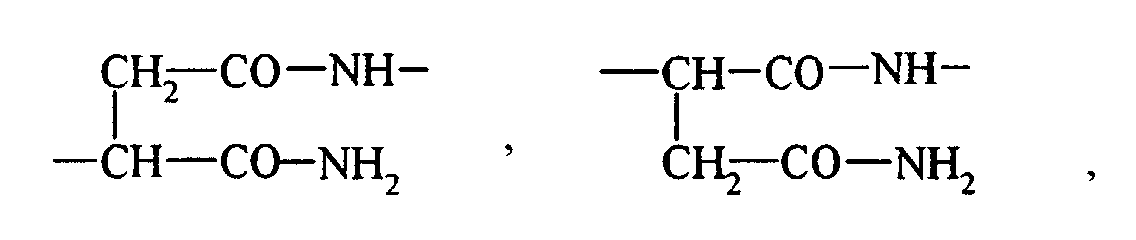 ou un sel de celles-ci.M = H, un alcali, NH4 ou NR4 indépendamment des nombreuses apparitions,R = indépendamment H, un groupe alkyle en particulier avec 1-12 atomes C, un groupe hydroxyalkyle avec de 1 à 8 atomes C
 - Procédé selon au moins l'une quelconque des revendications précédentes, caractérisé en ce que le polymère présente au moins 50% en poids d'unités répétitives de la structureou d'un sel de celle-ci.
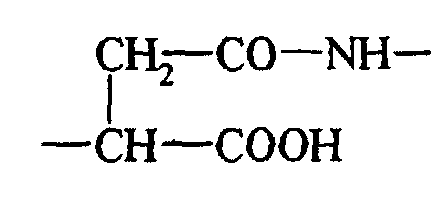
- Procédé selon au moins l'une quelconque des revendications précédentes, caractérisé en ce que le polymère est un copolymère qui présente en plus des unités succinyle répétitives éventuellement des unités répétitives des formules suivantes
 dans lesquelles R1 = OH, O-NH4 + ou NH2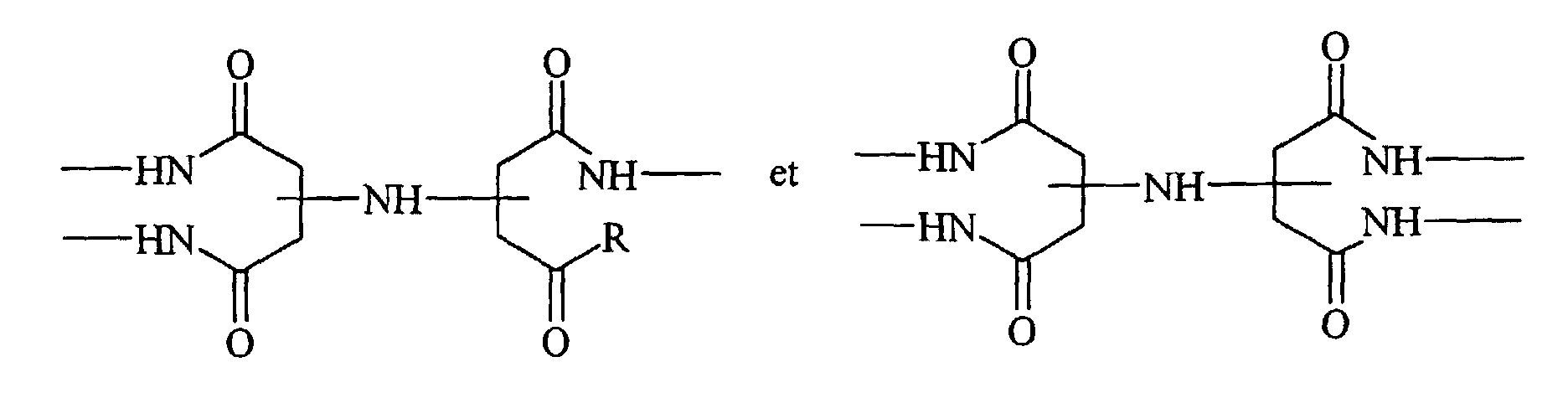
ou un sel de celles-ci. - Procédé selon la revendication 1, caractérisé en ce que le catalyseur d'hydrogénation est un catalyseur de métal précieux ou un catalyseur Raney.
- Procédé selon la revendication 1, caractérisé en ce que l'hydrogène naissant est obtenu par la dissolution de métaux non précieux dans la solution réactionnelle.
- Procédé selon la revendication 1, caractérisé en ce que l'on utilise comme hydrogène activé de l'hydrogène d'hydrure.
- Procédé pour la décoloration de polymères contenant N selon la revendication 1, caractérisé en ce que l'on réalise en outre un traitement oxydant des polymères contenant N.
- Procédé pour la décoloration de polymères contenant N avec des unités succinyle répétitives, caractérisé en ce que l'on réalise la décoloration sans pression avec de l'hydrogène naissant comme il est obtenu dans des solutions aqueuses lors de la dissolution de métaux non précieux dont le potentiel Redox est inférieur à celui de l'hydrogène.
Applications Claiming Priority (4)
| Application Number | Priority Date | Filing Date | Title |
|---|---|---|---|
| DE19513718 | 1995-04-11 | ||
| DE19513718A DE19513718A1 (de) | 1995-04-11 | 1995-04-11 | Verfahren zur Entfärbung von N-haltigen Polymeren |
| DE1995128779 DE19528779A1 (de) | 1995-08-04 | 1995-08-04 | Verfahren zur Entfärbung von N-haltigen Polymeren |
| DE19528779 | 1995-08-04 |
Publications (2)
| Publication Number | Publication Date |
|---|---|
| EP0737704A1 EP0737704A1 (fr) | 1996-10-16 |
| EP0737704B1 true EP0737704B1 (fr) | 1999-08-25 |
Family
ID=26014336
Family Applications (1)
| Application Number | Title | Priority Date | Filing Date |
|---|---|---|---|
| EP96105011A Expired - Lifetime EP0737704B1 (fr) | 1995-04-11 | 1996-03-29 | Procédé de décoloration des polymères contenant de l'azote |
Country Status (4)
| Country | Link |
|---|---|
| EP (1) | EP0737704B1 (fr) |
| JP (1) | JPH08283410A (fr) |
| DE (1) | DE59602841D1 (fr) |
| ES (1) | ES2137582T3 (fr) |
Families Citing this family (1)
| Publication number | Priority date | Publication date | Assignee | Title |
|---|---|---|---|---|
| WO2025223955A1 (fr) | 2024-04-25 | 2025-10-30 | Basf Se | Procédé de production d'acide polyaspartique, acide polyaspartique et son utilisation |
Family Cites Families (5)
| Publication number | Priority date | Publication date | Assignee | Title |
|---|---|---|---|---|
| US5322906A (en) * | 1991-02-27 | 1994-06-21 | Board Of Regents, The University Of Texas System | Synthesis of complex polyamines for ampholyte production |
| JPH05345821A (ja) * | 1991-07-09 | 1993-12-27 | Tosoh Corp | ポリアルキレンポリアミンの脱色方法 |
| JP3281036B2 (ja) * | 1991-07-09 | 2002-05-13 | 東ソー株式会社 | ポリアルキレンポリアミンの脱色方法 |
| US5292864A (en) * | 1992-08-07 | 1994-03-08 | Srchem Incorporated | Decolorizing polyaspartic acid polymers |
| DE59409048D1 (de) * | 1993-11-02 | 2000-02-10 | Bayer Ag | Verfahren zur Herstellung von Asparaginsäure-haltigen Polymeren |
-
1996
- 1996-03-29 DE DE59602841T patent/DE59602841D1/de not_active Expired - Fee Related
- 1996-03-29 EP EP96105011A patent/EP0737704B1/fr not_active Expired - Lifetime
- 1996-03-29 ES ES96105011T patent/ES2137582T3/es not_active Expired - Lifetime
- 1996-04-05 JP JP8108740A patent/JPH08283410A/ja active Pending
Also Published As
| Publication number | Publication date |
|---|---|
| EP0737704A1 (fr) | 1996-10-16 |
| ES2137582T3 (es) | 1999-12-16 |
| JPH08283410A (ja) | 1996-10-29 |
| DE59602841D1 (de) | 1999-09-30 |
Similar Documents
| Publication | Publication Date | Title |
|---|---|---|
| DE69318411T2 (de) | Entfärben von polyaspartinsäure and deren copolymeren | |
| EP0023956B1 (fr) | Procédé pour la préparation de polyéther(ester)amides | |
| DE69309709T2 (de) | Verfahren zur hydrolysebearbeitung von einem polymerisat enthaltendem material | |
| EP1198491B1 (fr) | Procede de production de polyamides a partir de dinitriles et de diamines | |
| DE2642244C2 (de) | Verfahren zur Herstellung von glasklar durchsichtigen Copolyamiden und deren Verwendung zur Herstellung von Formkörpern | |
| DE69107840T2 (de) | Halbkristalline halbaromatische copolyamide. | |
| DE3882644T2 (de) | Durchsichtige Polyamide und Verfahren zu deren Herstellung. | |
| DE69909003T3 (de) | Verfahren zur Herstellung von Polyamiden | |
| EP0199090A2 (fr) | Objets moulés en copolyamide aromatique et leur procédé de fabrication | |
| DE1570890A1 (de) | Polymerisate aus Diaminobenzaniliden | |
| EP0424860B1 (fr) | Polyamides entièrement aromatiques, procédé de préparation et produits formés | |
| EP1056798B1 (fr) | Procede de preparation de polyamides a base de composes d'acide aminocarboxylique | |
| DE2607487A1 (de) | Ungesaettigte polyesteramide, verfahren zu ihrer herstellung und aus diesen polyesteramiden hergestellte haertbare harze | |
| EP0288893B1 (fr) | Polyamides à base de diamines/diacides modifiés par de l'alpha-amino-epsilon-caprolactame | |
| DE4306412A1 (de) | Verfahren zur Herstellung von Polyasparaginsäure | |
| EP0737704A1 (fr) | Procédé de décoloration des polymères contenant de l'azote | |
| EP0522375A1 (fr) | Polymères d'isobutylène saturés, liquides, fonctionalisés en bout de chaîne par des groupes spéciaux, procédé de leur préparation ainsi que leur utilisation pour la préparation de mixtures-caoutchouc ayant une faible viscosité | |
| DE19513718A1 (de) | Verfahren zur Entfärbung von N-haltigen Polymeren | |
| DE19528779A1 (de) | Verfahren zur Entfärbung von N-haltigen Polymeren | |
| EP0567998A1 (fr) | Procédé de préparation de méta-aramides filables | |
| DE19881631B4 (de) | Verfahren zur Reinigung von Tetrahydrofuranen, die als Ausgangsmaterial für Polyetherpolyole verwendet werden | |
| EP0802205A2 (fr) | Polyformamide et polyamine | |
| DE2045770A1 (de) | Neue Polyamide und Verfahren zur Herstellung derselben | |
| WO1998010008A1 (fr) | Procede de preparation de polymeres a motifs succinyle recurrents | |
| DE1909577A1 (de) | Verfahren zum Beschleunigen der anionischen Polymerisation von Lactamen |
Legal Events
| Date | Code | Title | Description |
|---|---|---|---|
| PUAI | Public reference made under article 153(3) epc to a published international application that has entered the european phase |
Free format text: ORIGINAL CODE: 0009012 |
|
| AK | Designated contracting states |
Kind code of ref document: A1 Designated state(s): BE CH DE ES FR GB IT LI NL |
|
| 17P | Request for examination filed |
Effective date: 19970314 |
|
| 17Q | First examination report despatched |
Effective date: 19970606 |
|
| GRAG | Despatch of communication of intention to grant |
Free format text: ORIGINAL CODE: EPIDOS AGRA |
|
| GRAG | Despatch of communication of intention to grant |
Free format text: ORIGINAL CODE: EPIDOS AGRA |
|
| GRAH | Despatch of communication of intention to grant a patent |
Free format text: ORIGINAL CODE: EPIDOS IGRA |
|
| GRAH | Despatch of communication of intention to grant a patent |
Free format text: ORIGINAL CODE: EPIDOS IGRA |
|
| GRAA | (expected) grant |
Free format text: ORIGINAL CODE: 0009210 |
|
| AK | Designated contracting states |
Kind code of ref document: B1 Designated state(s): BE CH DE ES FR GB IT LI NL |
|
| REG | Reference to a national code |
Ref country code: CH Ref legal event code: EP |
|
| REG | Reference to a national code |
Ref country code: CH Ref legal event code: NV Representative=s name: E. BLUM & CO. PATENTANWAELTE |
|
| GBT | Gb: translation of ep patent filed (gb section 77(6)(a)/1977) |
Effective date: 19990827 |
|
| REF | Corresponds to: |
Ref document number: 59602841 Country of ref document: DE Date of ref document: 19990930 |
|
| ITF | It: translation for a ep patent filed | ||
| ET | Fr: translation filed | ||
| REG | Reference to a national code |
Ref country code: ES Ref legal event code: FG2A Ref document number: 2137582 Country of ref document: ES Kind code of ref document: T3 |
|
| PLBE | No opposition filed within time limit |
Free format text: ORIGINAL CODE: 0009261 |
|
| STAA | Information on the status of an ep patent application or granted ep patent |
Free format text: STATUS: NO OPPOSITION FILED WITHIN TIME LIMIT |
|
| 26N | No opposition filed | ||
| REG | Reference to a national code |
Ref country code: GB Ref legal event code: IF02 |
|
| PGFP | Annual fee paid to national office [announced via postgrant information from national office to epo] |
Ref country code: DE Payment date: 20020215 Year of fee payment: 7 |
|
| PGFP | Annual fee paid to national office [announced via postgrant information from national office to epo] |
Ref country code: ES Payment date: 20020311 Year of fee payment: 7 |
|
| PGFP | Annual fee paid to national office [announced via postgrant information from national office to epo] |
Ref country code: FR Payment date: 20020314 Year of fee payment: 7 Ref country code: CH Payment date: 20020314 Year of fee payment: 7 |
|
| PGFP | Annual fee paid to national office [announced via postgrant information from national office to epo] |
Ref country code: GB Payment date: 20020327 Year of fee payment: 7 Ref country code: BE Payment date: 20020327 Year of fee payment: 7 |
|
| PGFP | Annual fee paid to national office [announced via postgrant information from national office to epo] |
Ref country code: NL Payment date: 20020331 Year of fee payment: 7 |
|
| PG25 | Lapsed in a contracting state [announced via postgrant information from national office to epo] |
Ref country code: GB Free format text: LAPSE BECAUSE OF NON-PAYMENT OF DUE FEES Effective date: 20030329 |
|
| PG25 | Lapsed in a contracting state [announced via postgrant information from national office to epo] |
Ref country code: LI Free format text: LAPSE BECAUSE OF NON-PAYMENT OF DUE FEES Effective date: 20030331 Ref country code: ES Free format text: LAPSE BECAUSE OF NON-PAYMENT OF DUE FEES Effective date: 20030331 Ref country code: CH Free format text: LAPSE BECAUSE OF NON-PAYMENT OF DUE FEES Effective date: 20030331 Ref country code: BE Free format text: LAPSE BECAUSE OF NON-PAYMENT OF DUE FEES Effective date: 20030331 |
|
| BERE | Be: lapsed |
Owner name: *BAYER A.G. Effective date: 20030331 |
|
| PG25 | Lapsed in a contracting state [announced via postgrant information from national office to epo] |
Ref country code: NL Free format text: LAPSE BECAUSE OF NON-PAYMENT OF DUE FEES Effective date: 20031001 Ref country code: DE Free format text: LAPSE BECAUSE OF NON-PAYMENT OF DUE FEES Effective date: 20031001 |
|
| REG | Reference to a national code |
Ref country code: CH Ref legal event code: PL |
|
| GBPC | Gb: european patent ceased through non-payment of renewal fee |
Effective date: 20030329 |
|
| PG25 | Lapsed in a contracting state [announced via postgrant information from national office to epo] |
Ref country code: FR Free format text: LAPSE BECAUSE OF NON-PAYMENT OF DUE FEES Effective date: 20031127 |
|
| NLV4 | Nl: lapsed or anulled due to non-payment of the annual fee |
Effective date: 20031001 |
|
| REG | Reference to a national code |
Ref country code: FR Ref legal event code: ST |
|
| REG | Reference to a national code |
Ref country code: ES Ref legal event code: FD2A Effective date: 20030331 |
|
| PG25 | Lapsed in a contracting state [announced via postgrant information from national office to epo] |
Ref country code: IT Free format text: LAPSE BECAUSE OF NON-PAYMENT OF DUE FEES;WARNING: LAPSES OF ITALIAN PATENTS WITH EFFECTIVE DATE BEFORE 2007 MAY HAVE OCCURRED AT ANY TIME BEFORE 2007. THE CORRECT EFFECTIVE DATE MAY BE DIFFERENT FROM THE ONE RECORDED. Effective date: 20050329 |