EP0737731A2 - Abscheider, Verpackungsmaterial oder druckempfindliches Klebebandträgermaterial - Google Patents
Abscheider, Verpackungsmaterial oder druckempfindliches Klebebandträgermaterial Download PDFInfo
- Publication number
- EP0737731A2 EP0737731A2 EP96105802A EP96105802A EP0737731A2 EP 0737731 A2 EP0737731 A2 EP 0737731A2 EP 96105802 A EP96105802 A EP 96105802A EP 96105802 A EP96105802 A EP 96105802A EP 0737731 A2 EP0737731 A2 EP 0737731A2
- Authority
- EP
- European Patent Office
- Prior art keywords
- pressure
- sensitive adhesive
- separator
- releasing agent
- substrate
- Prior art date
- Legal status (The legal status is an assumption and is not a legal conclusion. Google has not performed a legal analysis and makes no representation as to the accuracy of the status listed.)
- Granted
Links
- 239000004820 Pressure-sensitive adhesive Substances 0.000 title claims abstract description 58
- 239000005022 packaging material Substances 0.000 title claims abstract description 36
- 239000000463 material Substances 0.000 title claims abstract description 31
- 230000003578 releasing effect Effects 0.000 claims abstract description 72
- 239000000758 substrate Substances 0.000 claims abstract description 70
- 239000003795 chemical substances by application Substances 0.000 claims abstract description 66
- 239000002985 plastic film Substances 0.000 claims abstract description 32
- 238000003754 machining Methods 0.000 claims abstract description 31
- 229920006255 plastic film Polymers 0.000 claims abstract description 30
- 229920001296 polysiloxane Polymers 0.000 claims abstract description 27
- 239000002216 antistatic agent Substances 0.000 claims abstract description 15
- 239000003963 antioxidant agent Substances 0.000 claims abstract description 13
- 239000000314 lubricant Substances 0.000 claims abstract description 13
- 238000004458 analytical method Methods 0.000 claims abstract description 12
- 230000003078 antioxidant effect Effects 0.000 claims abstract description 11
- 239000006097 ultraviolet radiation absorber Substances 0.000 claims abstract description 11
- 230000000930 thermomechanical effect Effects 0.000 claims abstract description 10
- 229920005989 resin Polymers 0.000 claims description 9
- 239000011347 resin Substances 0.000 claims description 9
- 238000002844 melting Methods 0.000 claims description 8
- 230000008018 melting Effects 0.000 claims description 8
- 229920005992 thermoplastic resin Polymers 0.000 claims description 8
- 229920002397 thermoplastic olefin Polymers 0.000 claims description 4
- 238000004806 packaging method and process Methods 0.000 claims description 2
- 239000010410 layer Substances 0.000 abstract description 97
- 230000037303 wrinkles Effects 0.000 abstract description 5
- 230000001771 impaired effect Effects 0.000 abstract 1
- 239000010408 film Substances 0.000 description 29
- -1 polyethylene Polymers 0.000 description 25
- 229920001684 low density polyethylene Polymers 0.000 description 19
- 238000000034 method Methods 0.000 description 19
- 239000004702 low-density polyethylene Substances 0.000 description 18
- 230000000052 comparative effect Effects 0.000 description 16
- 238000004519 manufacturing process Methods 0.000 description 16
- 229920000642 polymer Polymers 0.000 description 16
- 239000000654 additive Substances 0.000 description 14
- 239000004615 ingredient Substances 0.000 description 13
- 238000001723 curing Methods 0.000 description 12
- 230000000996 additive effect Effects 0.000 description 11
- 239000004743 Polypropylene Substances 0.000 description 9
- 229920001155 polypropylene Polymers 0.000 description 9
- 230000003746 surface roughness Effects 0.000 description 9
- 239000004698 Polyethylene Substances 0.000 description 8
- 229920001971 elastomer Polymers 0.000 description 8
- 229920000573 polyethylene Polymers 0.000 description 8
- 230000000694 effects Effects 0.000 description 7
- 239000000806 elastomer Substances 0.000 description 7
- 239000012943 hotmelt Substances 0.000 description 7
- 238000002156 mixing Methods 0.000 description 7
- 239000000203 mixture Substances 0.000 description 7
- LYRFLYHAGKPMFH-UHFFFAOYSA-N octadecanamide Chemical compound CCCCCCCCCCCCCCCCCC(N)=O LYRFLYHAGKPMFH-UHFFFAOYSA-N 0.000 description 6
- 229920001577 copolymer Polymers 0.000 description 5
- 238000010438 heat treatment Methods 0.000 description 5
- 229920001903 high density polyethylene Polymers 0.000 description 5
- 239000011342 resin composition Substances 0.000 description 5
- 238000007789 sealing Methods 0.000 description 5
- NLZUEZXRPGMBCV-UHFFFAOYSA-N Butylhydroxytoluene Chemical compound CC1=CC(C(C)(C)C)=C(O)C(C(C)(C)C)=C1 NLZUEZXRPGMBCV-UHFFFAOYSA-N 0.000 description 4
- AFCARXCZXQIEQB-UHFFFAOYSA-N N-[3-oxo-3-(2,4,6,7-tetrahydrotriazolo[4,5-c]pyridin-5-yl)propyl]-2-[[3-(trifluoromethoxy)phenyl]methylamino]pyrimidine-5-carboxamide Chemical compound O=C(CCNC(=O)C=1C=NC(=NC=1)NCC1=CC(=CC=C1)OC(F)(F)F)N1CC2=C(CC1)NN=N2 AFCARXCZXQIEQB-UHFFFAOYSA-N 0.000 description 4
- 241000282320 Panthera leo Species 0.000 description 4
- BGYHLZZASRKEJE-UHFFFAOYSA-N [3-[3-(3,5-ditert-butyl-4-hydroxyphenyl)propanoyloxy]-2,2-bis[3-(3,5-ditert-butyl-4-hydroxyphenyl)propanoyloxymethyl]propyl] 3-(3,5-ditert-butyl-4-hydroxyphenyl)propanoate Chemical compound CC(C)(C)C1=C(O)C(C(C)(C)C)=CC(CCC(=O)OCC(COC(=O)CCC=2C=C(C(O)=C(C=2)C(C)(C)C)C(C)(C)C)(COC(=O)CCC=2C=C(C(O)=C(C=2)C(C)(C)C)C(C)(C)C)COC(=O)CCC=2C=C(C(O)=C(C=2)C(C)(C)C)C(C)(C)C)=C1 BGYHLZZASRKEJE-UHFFFAOYSA-N 0.000 description 4
- 125000000217 alkyl group Chemical group 0.000 description 4
- 238000001227 electron beam curing Methods 0.000 description 4
- 239000004700 high-density polyethylene Substances 0.000 description 4
- 238000005259 measurement Methods 0.000 description 4
- 229920006267 polyester film Polymers 0.000 description 4
- 229920000346 polystyrene-polyisoprene block-polystyrene Polymers 0.000 description 4
- 230000001105 regulatory effect Effects 0.000 description 4
- 229920002943 EPDM rubber Polymers 0.000 description 3
- OWYWGLHRNBIFJP-UHFFFAOYSA-N Ipazine Chemical compound CCN(CC)C1=NC(Cl)=NC(NC(C)C)=N1 OWYWGLHRNBIFJP-UHFFFAOYSA-N 0.000 description 3
- GWEVSGVZZGPLCZ-UHFFFAOYSA-N Titan oxide Chemical compound O=[Ti]=O GWEVSGVZZGPLCZ-UHFFFAOYSA-N 0.000 description 3
- 230000008859 change Effects 0.000 description 3
- 239000011248 coating agent Substances 0.000 description 3
- 238000000576 coating method Methods 0.000 description 3
- 230000003292 diminished effect Effects 0.000 description 3
- 238000004049 embossing Methods 0.000 description 3
- 239000005038 ethylene vinyl acetate Substances 0.000 description 3
- QSHDDOUJBYECFT-UHFFFAOYSA-N mercury Chemical compound [Hg] QSHDDOUJBYECFT-UHFFFAOYSA-N 0.000 description 3
- 229910052753 mercury Inorganic materials 0.000 description 3
- 229920006285 olefinic elastomer Polymers 0.000 description 3
- 229920001200 poly(ethylene-vinyl acetate) Polymers 0.000 description 3
- 229920002959 polymer blend Polymers 0.000 description 3
- 229940037312 stearamide Drugs 0.000 description 3
- 238000012360 testing method Methods 0.000 description 3
- 229920002126 Acrylic acid copolymer Polymers 0.000 description 2
- GHKOFFNLGXMVNJ-UHFFFAOYSA-N Didodecyl thiobispropanoate Chemical compound CCCCCCCCCCCCOC(=O)CCSCCC(=O)OCCCCCCCCCCCC GHKOFFNLGXMVNJ-UHFFFAOYSA-N 0.000 description 2
- 206010016322 Feeling abnormal Diseases 0.000 description 2
- PPBRXRYQALVLMV-UHFFFAOYSA-N Styrene Chemical compound C=CC1=CC=CC=C1 PPBRXRYQALVLMV-UHFFFAOYSA-N 0.000 description 2
- 239000006096 absorbing agent Substances 0.000 description 2
- 125000005250 alkyl acrylate group Chemical group 0.000 description 2
- 230000033228 biological regulation Effects 0.000 description 2
- 229920005549 butyl rubber Polymers 0.000 description 2
- 239000000805 composite resin Substances 0.000 description 2
- 238000001816 cooling Methods 0.000 description 2
- 238000011156 evaluation Methods 0.000 description 2
- 238000001125 extrusion Methods 0.000 description 2
- 230000006872 improvement Effects 0.000 description 2
- 238000000691 measurement method Methods 0.000 description 2
- FATBGEAMYMYZAF-KTKRTIGZSA-N oleamide Chemical compound CCCCCCCC\C=C/CCCCCCCC(N)=O FATBGEAMYMYZAF-KTKRTIGZSA-N 0.000 description 2
- 229920001083 polybutene Polymers 0.000 description 2
- 229920000728 polyester Polymers 0.000 description 2
- 229920000098 polyolefin Polymers 0.000 description 2
- 239000000047 product Substances 0.000 description 2
- 229920000468 styrene butadiene styrene block copolymer Polymers 0.000 description 2
- 239000000126 substance Substances 0.000 description 2
- PZRWFKGUFWPFID-UHFFFAOYSA-N 3,9-dioctadecoxy-2,4,8,10-tetraoxa-3,9-diphosphaspiro[5.5]undecane Chemical compound C1OP(OCCCCCCCCCCCCCCCCCC)OCC21COP(OCCCCCCCCCCCCCCCCCC)OC2 PZRWFKGUFWPFID-UHFFFAOYSA-N 0.000 description 1
- 229920000298 Cellophane Polymers 0.000 description 1
- 239000003508 Dilauryl thiodipropionate Substances 0.000 description 1
- UAUDZVJPLUQNMU-UHFFFAOYSA-N Erucasaeureamid Natural products CCCCCCCCC=CCCCCCCCCCCCC(N)=O UAUDZVJPLUQNMU-UHFFFAOYSA-N 0.000 description 1
- 229920000181 Ethylene propylene rubber Polymers 0.000 description 1
- 239000004677 Nylon Substances 0.000 description 1
- 229920003171 Poly (ethylene oxide) Polymers 0.000 description 1
- BEIOEBMXPVYLRY-UHFFFAOYSA-N [4-[4-bis(2,4-ditert-butylphenoxy)phosphanylphenyl]phenyl]-bis(2,4-ditert-butylphenoxy)phosphane Chemical compound CC(C)(C)C1=CC(C(C)(C)C)=CC=C1OP(C=1C=CC(=CC=1)C=1C=CC(=CC=1)P(OC=1C(=CC(=CC=1)C(C)(C)C)C(C)(C)C)OC=1C(=CC(=CC=1)C(C)(C)C)C(C)(C)C)OC1=CC=C(C(C)(C)C)C=C1C(C)(C)C BEIOEBMXPVYLRY-UHFFFAOYSA-N 0.000 description 1
- NIXOWILDQLNWCW-UHFFFAOYSA-N acrylic acid group Chemical group C(C=C)(=O)O NIXOWILDQLNWCW-UHFFFAOYSA-N 0.000 description 1
- 150000008360 acrylonitriles Chemical class 0.000 description 1
- 239000000853 adhesive Substances 0.000 description 1
- 230000001070 adhesive effect Effects 0.000 description 1
- 150000003973 alkyl amines Chemical class 0.000 description 1
- 150000001408 amides Chemical class 0.000 description 1
- 125000000129 anionic group Chemical group 0.000 description 1
- 150000004982 aromatic amines Chemical class 0.000 description 1
- 230000008901 benefit Effects 0.000 description 1
- 150000008366 benzophenones Chemical class 0.000 description 1
- 125000003354 benzotriazolyl group Chemical class N1N=NC2=C1C=CC=C2* 0.000 description 1
- 230000015572 biosynthetic process Effects 0.000 description 1
- WXCZUWHSJWOTRV-UHFFFAOYSA-N but-1-ene;ethene Chemical class C=C.CCC=C WXCZUWHSJWOTRV-UHFFFAOYSA-N 0.000 description 1
- 238000004364 calculation method Methods 0.000 description 1
- 125000004432 carbon atom Chemical group C* 0.000 description 1
- 125000002091 cationic group Chemical group 0.000 description 1
- 239000007795 chemical reaction product Substances 0.000 description 1
- 230000008602 contraction Effects 0.000 description 1
- 230000006866 deterioration Effects 0.000 description 1
- 235000014113 dietary fatty acids Nutrition 0.000 description 1
- 235000019304 dilauryl thiodipropionate Nutrition 0.000 description 1
- 238000010894 electron beam technology Methods 0.000 description 1
- HQQADJVZYDDRJT-UHFFFAOYSA-N ethene;prop-1-ene Chemical group C=C.CC=C HQQADJVZYDDRJT-UHFFFAOYSA-N 0.000 description 1
- 229930195729 fatty acid Natural products 0.000 description 1
- 239000000194 fatty acid Substances 0.000 description 1
- 150000004665 fatty acids Chemical class 0.000 description 1
- 239000000945 filler Substances 0.000 description 1
- 229920002457 flexible plastic Polymers 0.000 description 1
- 238000005243 fluidization Methods 0.000 description 1
- 235000013305 food Nutrition 0.000 description 1
- 238000013007 heat curing Methods 0.000 description 1
- 239000012793 heat-sealing layer Substances 0.000 description 1
- 239000008240 homogeneous mixture Substances 0.000 description 1
- 230000002401 inhibitory effect Effects 0.000 description 1
- 230000005764 inhibitory process Effects 0.000 description 1
- 230000000977 initiatory effect Effects 0.000 description 1
- 239000012948 isocyanate Substances 0.000 description 1
- 238000010030 laminating Methods 0.000 description 1
- 229920000092 linear low density polyethylene Polymers 0.000 description 1
- 239000002075 main ingredient Substances 0.000 description 1
- 230000013011 mating Effects 0.000 description 1
- 229920001179 medium density polyethylene Polymers 0.000 description 1
- 239000000155 melt Substances 0.000 description 1
- 238000012986 modification Methods 0.000 description 1
- 230000004048 modification Effects 0.000 description 1
- 239000000178 monomer Substances 0.000 description 1
- 210000005036 nerve Anatomy 0.000 description 1
- 239000004745 nonwoven fabric Substances 0.000 description 1
- 229920001778 nylon Polymers 0.000 description 1
- FATBGEAMYMYZAF-UHFFFAOYSA-N oleicacidamide-heptaglycolether Natural products CCCCCCCCC=CCCCCCCCC(N)=O FATBGEAMYMYZAF-UHFFFAOYSA-N 0.000 description 1
- 230000003534 oscillatory effect Effects 0.000 description 1
- 230000001590 oxidative effect Effects 0.000 description 1
- 238000012856 packing Methods 0.000 description 1
- NFHFRUOZVGFOOS-UHFFFAOYSA-N palladium;triphenylphosphane Chemical compound [Pd].C1=CC=CC=C1P(C=1C=CC=CC=1)C1=CC=CC=C1.C1=CC=CC=C1P(C=1C=CC=CC=1)C1=CC=CC=C1.C1=CC=CC=C1P(C=1C=CC=CC=1)C1=CC=CC=C1.C1=CC=CC=C1P(C=1C=CC=CC=1)C1=CC=CC=C1 NFHFRUOZVGFOOS-UHFFFAOYSA-N 0.000 description 1
- 150000002989 phenols Chemical class 0.000 description 1
- 239000000049 pigment Substances 0.000 description 1
- 229920003023 plastic Polymers 0.000 description 1
- 239000004033 plastic Substances 0.000 description 1
- 229920005629 polypropylene homopolymer Polymers 0.000 description 1
- 229920002451 polyvinyl alcohol Polymers 0.000 description 1
- 238000003825 pressing Methods 0.000 description 1
- 230000008569 process Effects 0.000 description 1
- 238000005096 rolling process Methods 0.000 description 1
- 239000005060 rubber Substances 0.000 description 1
- 150000003839 salts Chemical class 0.000 description 1
- 230000035939 shock Effects 0.000 description 1
- 239000002356 single layer Substances 0.000 description 1
- 229910001220 stainless steel Inorganic materials 0.000 description 1
- 239000010935 stainless steel Substances 0.000 description 1
- 230000003068 static effect Effects 0.000 description 1
- 238000009864 tensile test Methods 0.000 description 1
- 238000002076 thermal analysis method Methods 0.000 description 1
- 229920001169 thermoplastic Polymers 0.000 description 1
- 239000010409 thin film Substances 0.000 description 1
- 235000010215 titanium dioxide Nutrition 0.000 description 1
- 238000012546 transfer Methods 0.000 description 1
- 229920001862 ultra low molecular weight polyethylene Polymers 0.000 description 1
- 125000000391 vinyl group Chemical group [H]C([*])=C([H])[H] 0.000 description 1
- 229920002554 vinyl polymer Polymers 0.000 description 1
Images

Classifications
-
- A—HUMAN NECESSITIES
- A61—MEDICAL OR VETERINARY SCIENCE; HYGIENE
- A61F—FILTERS IMPLANTABLE INTO BLOOD VESSELS; PROSTHESES; DEVICES PROVIDING PATENCY TO, OR PREVENTING COLLAPSING OF, TUBULAR STRUCTURES OF THE BODY, e.g. STENTS; ORTHOPAEDIC, NURSING OR CONTRACEPTIVE DEVICES; FOMENTATION; TREATMENT OR PROTECTION OF EYES OR EARS; BANDAGES, DRESSINGS OR ABSORBENT PADS; FIRST-AID KITS
- A61F13/00—Bandages or dressings; Absorbent pads
- A61F13/15—Absorbent pads, e.g. sanitary towels, swabs or tampons for external or internal application to the body; Supporting or fastening means therefor; Tampon applicators
- A61F13/551—Packaging before or after use
-
- B—PERFORMING OPERATIONS; TRANSPORTING
- B65—CONVEYING; PACKING; STORING; HANDLING THIN OR FILAMENTARY MATERIAL
- B65D—CONTAINERS FOR STORAGE OR TRANSPORT OF ARTICLES OR MATERIALS, e.g. BAGS, BARRELS, BOTTLES, BOXES, CANS, CARTONS, CRATES, DRUMS, JARS, TANKS, HOPPERS, FORWARDING CONTAINERS; ACCESSORIES, CLOSURES, OR FITTINGS THEREFOR; PACKAGING ELEMENTS; PACKAGES
- B65D57/00—Internal frames or supports for flexible articles, e.g. stiffeners; Separators for articles packaged in stacks or groups, e.g. for preventing adhesion of sticky articles
- B65D57/002—Separators for articles packaged in stacks or groups, e.g. stacked or nested
-
- C—CHEMISTRY; METALLURGY
- C09—DYES; PAINTS; POLISHES; NATURAL RESINS; ADHESIVES; COMPOSITIONS NOT OTHERWISE PROVIDED FOR; APPLICATIONS OF MATERIALS NOT OTHERWISE PROVIDED FOR
- C09J—ADHESIVES; NON-MECHANICAL ASPECTS OF ADHESIVE PROCESSES IN GENERAL; ADHESIVE PROCESSES NOT PROVIDED FOR ELSEWHERE; USE OF MATERIALS AS ADHESIVES
- C09J7/00—Adhesives in the form of films or foils
- C09J7/20—Adhesives in the form of films or foils characterised by their carriers
- C09J7/22—Plastics; Metallised plastics
- C09J7/24—Plastics; Metallised plastics based on macromolecular compounds obtained by reactions involving only carbon-to-carbon unsaturated bonds
- C09J7/241—Polyolefin, e.g.rubber
-
- C—CHEMISTRY; METALLURGY
- C09—DYES; PAINTS; POLISHES; NATURAL RESINS; ADHESIVES; COMPOSITIONS NOT OTHERWISE PROVIDED FOR; APPLICATIONS OF MATERIALS NOT OTHERWISE PROVIDED FOR
- C09J—ADHESIVES; NON-MECHANICAL ASPECTS OF ADHESIVE PROCESSES IN GENERAL; ADHESIVE PROCESSES NOT PROVIDED FOR ELSEWHERE; USE OF MATERIALS AS ADHESIVES
- C09J7/00—Adhesives in the form of films or foils
- C09J7/40—Adhesives in the form of films or foils characterised by release liners
- C09J7/403—Adhesives in the form of films or foils characterised by release liners characterised by the structure of the release feature
-
- C—CHEMISTRY; METALLURGY
- C09—DYES; PAINTS; POLISHES; NATURAL RESINS; ADHESIVES; COMPOSITIONS NOT OTHERWISE PROVIDED FOR; APPLICATIONS OF MATERIALS NOT OTHERWISE PROVIDED FOR
- C09J—ADHESIVES; NON-MECHANICAL ASPECTS OF ADHESIVE PROCESSES IN GENERAL; ADHESIVE PROCESSES NOT PROVIDED FOR ELSEWHERE; USE OF MATERIALS AS ADHESIVES
- C09J2423/00—Presence of polyolefin
- C09J2423/006—Presence of polyolefin in the substrate
-
- C—CHEMISTRY; METALLURGY
- C09—DYES; PAINTS; POLISHES; NATURAL RESINS; ADHESIVES; COMPOSITIONS NOT OTHERWISE PROVIDED FOR; APPLICATIONS OF MATERIALS NOT OTHERWISE PROVIDED FOR
- C09J—ADHESIVES; NON-MECHANICAL ASPECTS OF ADHESIVE PROCESSES IN GENERAL; ADHESIVE PROCESSES NOT PROVIDED FOR ELSEWHERE; USE OF MATERIALS AS ADHESIVES
- C09J2483/00—Presence of polysiloxane
- C09J2483/005—Presence of polysiloxane in the release coating
Definitions
- the present invention relates to a separator for pressure-sensitive adhesive articles such as a pressure-sensitive adhesive sheet, a (double-sided) pressure-sensitive adhesive tape, a tack, etc., and for disposable articles such as a paper diaper, a sanitary napkin. etc., or a packaging material being used for packing foods, pressure-sensitive adhesive articles such as pressure-sensitive adhesive tacks, etc., and sanitary articles such as a sanitary napkin, etc.
- the separator of the present invention is suitably used as a separator for a disposable diaper and a sanitary napkin and also the packaging material of the present invention is suitably used as a package for a sanitary napkin.
- the present invention relates to a base material for a pressure-sensitive adhesive tape useful in medical field or for surface protection.
- a packaging material for a napkin a releasing tape and a packaging material each comprising a substrate composed of a flexible plastic film having thereon a releasing agent layer are proposed as described, e.g., in JP-A-3-24949 and JP-A-3-184543 (the term "JP-A" as used herein means an "unexamined published Japanese patent application").
- the substrates used for the foregoing materials are plastic films composed of a single component such as polyethylene, polypropylene, polyester, nylon, cellophane, etc., and the plastic films usually contain additive ingredients such as an antioxidant, an antistatic agent, a lubricant, and an ultraviolet absorber.
- the substrate is too soft or, to the contrary, too hard. That is, if the substrate is too soft, the substrate is stretched or cut in the conveying step in the production line of napkins, etc., which results in greatly lowering the productivity. Also, if the substrate is too hard, the product such as the releasing tape and the packaging material has a disadvantage that a soft feeling from the point of the practical use is lost and the releasing sound becomes large to lower the commercial value thereof.
- the method generally used especially from the standpoint of production efficiency is to directly apply a heated hot-melt pressure-sensitive adhesive to the separator or the packaging material and transfer the applied pressure-sensitive adhesive to a napkin body. Consequently, if the substrate of the separator or the packaging material is soft and has poor heat resistance, it disadvantageously melts or suffers wrinkling due to heat, making the production difficult.
- the present invention relates to a separator, a packaging material, or a pressure-sensitive adhesive tape base material comprising a substrate and a releasing agent layer formed on part or the whole of at least one side of the substrate, wherein when examined by thermomechanical analysis (thermomechanometry), the substrate has the following values of the average coefficient of linear expansion (1/°Cx10 -3 ) in the machining direction and the traversing direction for each temperature range.
- Temperature Machining direction Traversing direction 70-80°C ⁇ 0.7 ⁇ 1.3 80-90°C ⁇ 0.9 ⁇ 1.3 90-100°C ⁇ 1.4 ⁇ 2.2 100-110°C ⁇ 4.0 ⁇ 5.2
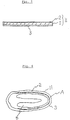
- Fig. 1 is a sectional view showing an embodiment of the separator or packaging material according to the present invention.
- Fig. 2 is a sectional view showing another embodiment of the separator or packaging material according to the present invention.
- Fig. 3 is a sectional view showing still another embodiment of the separator or packaging material according to the present invention.
- Fig. 4 is a sectional view showing a further embodiment of the separator or packaging material according to the present invention.
- Fig. 5 is sectional view showing an embodiment of a pressure-sensitive adhesive tape employing the pressure-sensitive adhesive tape base material according to the present invention.
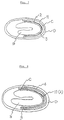
- Fig. 6 is a diagrammatic view of a sanitary napkin package produced using the packaging material of the present invention.
- Fig. 7 is a diagrammatic view of a sanitary napkin package produced using the separator of the present invention.
- Fig. 8 is a diagrammatic view of another sanitary napkin package produced using the separator of the present invention.
- thermomechanical analysis employed in the present invention is a technique for measuring deformations of a sample in which a non-oscillatory load is imposed on the sample while the temperature of the sample is changed according to a program.
- the optimal measurement mode can be selected according to the shape of the sample and the purpose of the measurement.
- the extension mode which will be described later is especially employed.
- This thermomechanical analysis is particularly effective and practically advantageous especially in determining the thermal shock which the substrate of the present invention receives upon contact with a hot-melt pressure-sensitive adhesive, because the analysis reveals the heat distortion temperature (softening temperature) and fluidization initiation temperature of the sample.
- the substrate for use in the present invention is characterized in that the average coefficient of linear expansion thereof (dimensional change per unit length of the material upon a temperature change of 1°C) calculated using the following equation 1 from thermomechanical analysis data is regulated to values in specific ranges.
- ⁇ s (T 1 ⁇ T 2 ) 1 L 0 ⁇ 10 3 ⁇ ⁇ l S (T 2 )- ⁇ l S (T 1 ) T 2 -T 1
- the releasing agent layer which will be described later is formed on part or the whole of one or both sides of a substrate having the above-described property, whereby a separator, a packaging material, a pressure-sensitive adhesive tape base material, or the like which each has improved releasing properties can be obtained.
- This releasing agent layer serves to protect a pressure-sensitive adhesive layer. In the case where the substrate is partly coated with the releasing agent, this treatment also produces the effect of enabling the control of peeling force.
- the sound pressure level measured by the method described in Examples given later is preferably 80 dB or lower, more preferably from 60 to 70 dB.
- the separator or packaging material of the present invention Due to this regulation of sound pressure level, in the case where the separator or packaging material of the present invention is used as a separator or package for a sanitary napkin, they make a diminished noise, for example, when they are peeled from the sanitary napkin, when the separator is folded by hand, or when the packaging bag is torn. Thus, the separator or package can secure female privacy and the article is of extremely high value.
- the thickness of the substrate is not particularly limited. Although the thickness thereof is usually 500 ⁇ m or smaller, it is preferably from 10 to 200 ⁇ m, more preferably from 10 to 50 ⁇ m, from the standpoints of softness and pliability.
- the substrate for use in the present invention has specific values of the average coefficient of linear expansion as described above, the substrate can have sufficient heat resistance and strength in a production line even when it is relatively thin.
- the separator, packaging material, or pressure-sensitive adhesive tape base material of the present invention should have some degree of strength.
- the tensile strength thereof in the machining direction is generally 300 gf/10 mm (2.94 N/10 mm) or higher, preferably from 300 to 1,200 gf/10 mm (2.94 to 11.76 N/10 mm), and most desirably from 300 to 500 gf/10 mm (2.94 to 4.90 N/10 mm), while the tensile strength thereof in the traversing direction is generally 200 gf/10 mm (1.96 N/10 mm) or higher, preferably from 200 to 1,050 gf/10 mm (1.96 to 10.29 N/10 mm), and most preferably from 300 to 500 gf/10 mm (2.94 to 4.90 N/10 mm).
- the material of the substrate of the separator, packaging material, or pressure-sensitive adhesive tape base material of the present invention is not particularly limited as long as the substrate has the specific values of the average coefficient of linear expansion as given hereinabove.
- the substrate in the present invention preferably comprises a plastic film comprising a thermoplastic polyolefin resin as a main component.
- thermoplastic polyolefin resin examples include polyethylene, polybutene, polyhexene, and polyoctene. Such polyolefins can be used alone or as a mixture thereof. Especially preferably used is polyethylene.
- the polyethylene may be any one of ultralow-density, low-density, linear low-density, medium-density, and high-density polyethylenes, or may be a blend of any two or more thereof.
- thermoplastic polyolefin resin have a polyethylene content of 60% by weight or higher. If desired, polypropylene is added preferably in an amount of 40% by weight or smaller to improve heat resistance.
- An elastomer ingredient such as a styrene type, polyolefin type, or polyester type may be added preferably in an amount of 40% by weight or smaller to improve pliability. If desired, a multilayered film substrate composed of two or more layers can be used.
- thermoplastic plastic film examples include polyethylene, polypropylene, an ethylene-vinyl acetate copolymer, an ethylene-(meth)acrylic acid copolymer, an ethylene-methyl (meth)acrylate copolymer, an ethylene-ethyl (meth)acrylate copolymer, a polyethylene-propylene copolymer, an olefinic elastomer, a styrenic elastomer, polyisobutyrene, butyl rubber, and a composite resin composed of two or more selected from these resins.
- the olefinic elastomer there are an ethylene-propylene rubber (EPT), an ethylene-propylene-diene rubber (EPDM), an ethylene-propylene series elastomer, an ethylene-butene series elastomer, etc.
- EPT ethylene-propylene rubber
- EPDM ethylene-propylene-diene rubber
- styrenic elastomer there are a styrene-isoprene-styrene block copolymer (SIS), a styrene-butadiene-styrene block copolymer (SBS), etc., and the hydrogenated products of them.
- the substrate is preferably composed of at least two layers in which one layer is in contact on one or each side with a heat-sealable layer having a melting point lower by at least 5°C, preferably by from 10 to 60°C, than the melting point of that one layer.
- This layer constitution is advantageous in that heat sealing can be easily conducted without fail, and is suitable especially when the material of the present invention is formed into a bag or is fixed to a substance.
- a substrate composed of two or more layers including a layer suitable for heat sealing has the effect of facilitating the selection of heat-sealing conditions.
- the multilayered substrate examples include a two-layer substrate composed of an upper layer made of high-density polyethylene (melting point, 120°C) and a lower layer (heat-sealable layer) made of low-density polyethylene (melting point, 100°C).
- a blend of two or more of the polymers enumerated above can give a substrate having a rough surface such as a matte surface or an embossed surface.
- the effects brought about by this rough surface are that the substrate has a matte appearance to give a feeling of high grade, and that the substrate has a reduced coefficient of dynamic friction and hence improved running properties in a production line. It is thought that in blending polymers having poor compatibility with each other, the polymers which are being melt-mixed constitute separate phases due to a difference in surface tension during melting and hence give a non-homogeneous mixture having not a smooth but a rough surface, i.e., a matte or embossed surface.
- This surface desirably has a roughness of usually from 2 to 30 ⁇ m, preferably from 2 to 5 ⁇ m, in terms of the value of R a determined by the method described later.
- the resulting rough surface preferably has a value of R a within a half of the film thickness.
- Blending a relatively soft polymer or elastomer to produce a substrate also has the effect that the peeling noise made by, e.g., peeling off the substrate can be diminished to such a level that the use thereof is not noticed by other persons.
- another usable method for positively forming a matte or embossed surface is to form the surface roughness by means of the surface of a roll, for example, after T-die extrusion during film production.
- the latter method is preferred in forming an embossed surface.
- the plastic film for use as a substrate in the present invention can have a multilayer structure composed of, e.g., two, three, or four layers, and at least one side of this multilayered plastic film may be constituted of a layer made of the above-described polymer blend and having a matte or embossed surface.
- this multilayer constitution has an advantage that properties of the individual polymer layers can be combined to impart a new function, e.g., a combination of an improvement in the heat sealability as described above or in tear strength and a satisfactory feeling.
- This multilayered plastic film is not particularly limited in any layer other than the polymer blend layer having a matte or embossed surface.
- the layer other than the polymer blend layer is a heat sealing layer, it is preferred that the layer is composed of polyethylene, polypropylene, an ethylene-vinyl acetate copolymer, an ethylene-(meth)acrylic acid copolymer, an ethylene-methyl (meth)acrylate copolymer, an ethylene-ethyl (meth)acrylate copolymer, a polyethylene-propylene copolymer, an olefinic elastomer, a styrenic elastomer, polyisobutyrene, butyl rubber, and a composite resin composed of two or more selected from these resins.
- Another embodiment of the substrate for use in the present invention comprises a film made of a plastic which has a matte or embossed surface having a surface roughness (R a ) of about a half of the film thickness or smaller on at least one side of the film and which has a releasing agent layer on the other side.
- R a surface roughness
- Still another embodiment comprises a plastic film which has a matte or embossed surface having a surface roughness (R a ) of a half of the film thickness or smaller on at least one side of the film and which has a releasing agent layer on the matte or embossed surface.
- R a surface roughness
- the coefficient of static friction of the matte or embossed surface which has been coated with a releasing agent is generally less than 1.5, preferably from 0.4 to 1.0, and the coefficient of dynamic friction thereof is generally less than 1.5, preferably from 0.2 to 1.3.
- This regulation of the coefficients of friction has the effect that the substrate has improved running properties in a production line and is less apt to wrinkle, meandering, or break when in contact with rolls.
- a releasing agent layer on part or the whole of both sides or one side of the substrate gives a separator, a packaging material, a pressure-sensitive adhesive tape base material, or the like.
- a long-chain alkyl releasing agent e.g., a polymer of an alkyl acrylate in which the alkyl is a long-chain alkyl having 12 or more carbon atoms and showing releasing properties; a copolymer of a long-chain alkyl acrylate and another vinyl monomer; or a reaction product obtained by reacting poly(vinyl alcohol) with a long-chain alkyl ingredient such as a long-chain alkyl isocyanate) or a silicone releasing agent.
- a long-chain alkyl releasing agent e.g., a polymer of an alkyl acrylate in which the alkyl is a long-chain alkyl having 12 or more carbon atoms and showing releasing properties
- a copolymer of a long-chain alkyl acrylate and another vinyl monomer or a reaction product obtained by reacting poly(vinyl alcohol) with a long-chain alkyl ingredient such as a long-chain alkyl isocyan
- the silicone releasing agent can be suitably selected from heat-curing, ultraviolet-curing, electron beam-curing, and other silicone releasing agents, but an especially preferred silicone releasing agent is of the ultraviolet-curing or electron beam-curing type.
- This releasing agent layer may be formed either over the whole surface of the film or on part of the surface (e.g., on both dry edges, in a patterned area, or in a central area only).
- an ultraviolet-curing or electron beam-curing silicone releasing agent is used for the releasing agent layer
- the kinds of such a silicone releasing agent are not limited, and known silicone releasing agents can be used.
- ultraviolet ray having a wavelength of 400 nm or less can be generally used, and for instance, a medium or high pressure mercury lamp can be used.
- a low pressure electron beam accelerator and the like can be used for curing the ultraviolet-curing silicone releasing agent.
- the thickness of the releasing agent layer formed on the substrate is preferably from 0.05 to 4.0 ⁇ m, more preferably from 0.3 to 1.5 ⁇ m. If a releasing agent layer having a thickness smaller than 0.05 ⁇ m is to be formed, it is not easy to evenly apply a releasing agent to the substrate surface and unevenness of coating (pinholes) tends to result. Even if the thickness of the coating exceeds 4.0 ⁇ m, further improvement of releasing property is not much exhibited. The provision of such a thick releasing agent layer is economically undesirable.
- the content of an antioxidant, an antistatic agent, a lubricant, and an ultraviolet absorber (these being hereinafter often referred to as "additive ingredients”) in the plastic film substrate comprising a thermoplastic resin as a main component each is preferably 0.4% by weight or lower, more preferably 0% by weight. If the content of any of these additive ingredients exceeds 0.4% by weight, the curing reaction of the silicone releasing agent is apt to be inhibited and this tends to result in a problem that the silicone releasing agent layer reduces the adhesion strength of the pressure-sensitive adhesive layer to be in contact therewith.
- the additive ingredients may be suitably incorporated into the plastic film each in an amount within the range specified above, but the preferred range of the content of each additive ingredient is from 0.01 to 0.3% by weight.
- antioxidants conventionally incorporated for the inhibition of the oxidative deterioration of plastic films can be used, and examples thereof include aromatic amine derivatives and phenol derivatives.
- specific examples of such antioxidants include 2,6-di-t-butyl-p-cresol, tetrakis[3-(4-hydroxy-3,5-di-t-butylphenyl)propionyloxymethyl]methane, dilauryl thiodipropionate, distearylpentaerythritol diphosphite, tetrakis(2,4-di-t-butylphenyl)-4,4'-biphenylene diphosphite, Irganox 1010 (manufactured by Ciba Geigy Ltd.), Sumilizer BHT (manufactured by Sumitomo Chemical Co., Ltd., Japan), Yoshinox DLTP (manufactured by Yoshitomi Pharmaceutical Industries,
- antistatic agents can be used, and examples thereof include nonionic polyoxyethylene alkylamine antistatic agents (Armostat 310, manufactured by Lion Corp., Japan), anionic antistatic agents, and cationic antistatic agents.
- lubricants conventionally incorporated for improving the fluidity of plastic films can be used, and examples thereof include organic fatty acids and salts thereof.
- lubricants include stearamide, oleamide, elucamide, Amide S (manufactured by Nitto Chemical Industry Co., Ltd., Japan), and Armoslip CP and Armoslip E (manufactured by Lion Corp.).
- ultraviolet absorber known ultraviolet absorbers conventionally incorporated for inhibiting plastic films from being deteriorated by light (ultraviolet) can be used, and examples thereof include benzophenone compounds, salicylic ester compounds, benzotriazole compounds, and acrylonitrile compounds. Specific examples of such ultraviolet absorbers include Sumisorb 300, manufactured by Sumitomo Chemical Co., Ltd.
- the above-described plastic film which has been regulated so that the contents of the specific additive ingredients do not exceed the specific amount can be produced by adding an antioxidant, an antistatic agent, a lubricant, and an ultraviolet absorber to a thermoplastic resin as the main ingredient according to need in respective amounts which satisfy the content requirement specified in the present invention, and then forming the mixture into a film by a known film-forming technique.
- additives e.g., fillers and pigments
- additives e.g., fillers and pigments
- Known such additives can be incorporated in ordinary amounts.
- the kind of the pressure-sensitive adhesive is not limited in any way.
- Preferred examples of the method of coating the adhesive on the base material include a method of transferring an ordinary acrylic or rubber type pressure-sensitive adhesive by laminating or a method of directly applying such a pressure-sensitive adhesive to the substrate by the curtain flow or melt flow technique, with which the substrate is less heated.
- Figs. 1 to 4 each is a sectional view showing an embodiment of the separator according to the present invention.
- the embodiment shown in Fig. 1 is composed of a substrate 1 comprising a plastic film mainly composed of a thermoplastic resin and a releasing agent layer 2 formed on one side of the substrate 1.
- the embodiment shown in Fig. 2 is composed of a substrate 1 which comprises a plastic film mainly composed of a thermoplastic resin and has on one side a matte surface (or embossed surface) 11, and a releasing agent layer 2 formed on the matte surface 11.
- the embodiment shown in Fig. 3 is composed of a substrate 1 which comprises a two-layer plastic film mainly composed of thermoplastic resins (first layer 1a and second layer 1b) and in which the first layer 1a has a matte surface (or embossed surface) 11, and a releasing agent layer 2 formed on the matte surface 11.
- the embodiment shown in Fig. 4 is composed of a substrate 1 which comprises a two-layer plastic film mainly composed of thermoplastic resins (first layer 1a and second layer 1b) and in which the second layer 1b has a matte surface (or embossed surface) 11, and a releasing agent layer 2 formed on the surface of the first layer 1a.
- FIG. 5 shows a pressure-sensitive adhesive tape which is composed of a pressure-sensitive adhesive tape base material E according to the present invention composed of a substrate 1 having a releasing agent layer 2 formed on one side thereof, and a pressure-sensitive adhesive layer 3 formed on the other side of the base material E.
- Figs. 6 to 8 each is a diagrammatic view of a sanitary napkin package as an application example of the separator or packaging material of the present invention.
- symbol A denotes the package comprising a packaging material according to the present invention.
- This bag A has a matte surface 11 on the outer side and has a releasing agent layer 2 on the inner side, facing a pressure-sensitive adhesive layer 3.
- a sanitary napkin B which is fixed through the pressure-sensitive adhesive layer 3.
- the packages shown in Figs. 7 and 8 each comprises a sanitary napkin B which has a pressure-sensitive adhesive layer 3 protected with a separator C according to the present invention, and which is contained in a bag D.
- Fig. 6 symbol A denotes the package comprising a packaging material according to the present invention.
- This bag A has a matte surface 11 on the outer side and has a releasing agent layer 2 on the inner side, facing a pressure-sensitive adhesive layer 3.
- a sanitary napkin B which is fixed through the pressure-sensitive adhesive layer
- the separator C has a matte surface 11 on the outer side and has a releasing agent layer 2 on the inner side, i.e., the side facing the pressure-sensitive adhesive layer 3.
- the separator C is fixed to and contained in the bag D through another pressure-sensitive adhesive layer (e.g., a hot-melt pressure-sensitive adhesive layer) 4. Heat sealing may be used for fixing.
- the separator C has a matte surface 11 on the inner side, i.e., the side facing the pressure-sensitive adhesive layer 3, and has a releasing agent layer 2 on this side.
- Films each having the composition and the thickness given in Table 1 were formed by T-die extrusion. On one side of each film, an ultraviolet-curing silicone was coated and irradiated with ultraviolet ray by means of a high pressure mercury lamp to thereby form a releasing agent layer having a thickness of 1 ⁇ m. Thus, the substrate samples according to the present invention were obtained.
- Example Comparative Example 1 2 3 1 2 3 Low-density polyethylene 98 97 50 90 97 10 High-density polyethylene 0.5 - - - - - Polybutene - - - - 0.5 - Polyhexene 1 2 - 3 0.5 - Polyoctene 0.5 1 - 2 0.5 - Polypropylene - - 20 - 1.5 70 Ethylene-vinyl acetate copolymer - - 20 - - - Poly 4-Methylpentene-1 - - - 5 - - EPDM - - 10 - - 20 Thickness ( ⁇ m) 34 25 40 28 12 40
- Table 3 shows the following.
- the samples of the Examples were satisfactory in all the properties.
- the samples of Comparative Examples 1 and 2 had an insufficient strength and hence had the fear of wrinkling or breaking in a production line.
- the sample of Comparative Example 3 had a problem that it was too rigid and made a loud noise.
- Example 1 each had a matte surface as shown in Fig. 2.
- the surface roughness of the samples of Examples 1 and 2 was formed with an embossing roll, while in Example 3 the surface roughness was imparted by means of polymer blending.
- test sample dimensions 50 mm by 50 mm, a sliding piece weight of 500 g, a test speed of 300 mm/min, and a mating material of stainless steel (SUS304A).
- Multilayered film samples according to the present invention were obtained which each had the layer constitution shown in Table 5. These samples were examined by the same thermomechanical analysis as described above, and the results of the determination of the average coefficients of linear expansion are shown in Table 6.
- Table 5 Example 4 Material Melting Point (°C) Thickness ( ⁇ m) Total Thickness ( ⁇ m) 1st layer High-density polyethylene (HDPE) 120 20 30 2nd layer Low-density polyethylene (LDPE) 100 10
- Example 5 1st layer Linear polyethylene (L-LDPE) 120 15 22 2nd layer Low-density polyethylene (LDPE) 100 7
- Example 6 1st layer Polypropylene (random polymer) 130 10 40 2nd layer Polypropylene (homopolymer) 160 20 3rd layer Polypropylene (random polymer) 130 10
- Table 6 Average coefficient of linear expansion Example 4 5 6 70-80°C Machining direction 0.4 0.6 0.1 Traversing direction 0.5 1.2 0.2 80-90°C Machining direction
- a resin composition obtained by incorporating 2 wt% titanium white (TiO 2 ) into a low-density polyethylene resin for improving plastic film whiteness as the only one additive ingredient was subjected to a film-forming operation.
- a low-density polyethylene film (thickness, 30 ⁇ m; tensile strength in the machining direction, 400 gf/10 mm (3.92 N/10mm); tensile strength in the traversing direction, 300 gf/10 mm (2.94 N/10mm)) not containing any of an antioxidant, an antistatic agent, a lubricant, and an ultraviolet absorber was produced.
- an ultraviolet-curing silicone releasing agent was coated and irradiated with ultraviolet ray by means of a high pressure mercury lamp to thereby form a releasing agent layer having a thickness of 1 ⁇ m.
- the substrate sample according to the present invention was obtained.
- a sample according to the present invention was produced in the same manner as in Example 7, except that use was made of a low-density polyethylene film (thickness, 30 ⁇ m; tensile strength in the machining direction, 400 gf/10 mm (3.92 N/10mm); tensile strength in the traversing direction, 300 gf/10 mm (2.94 N/10mm)) obtained from a resin composition produced by incorporating into a low-density polyethylene resin 0.1 wt% antioxidant (2,6-di-t-butyl-p-cresol), 0.03 wt% antistatic agent (trade name, Armostat 310; manufactured by Lion Corp.), 0.1 wt% lubricant (stearamide), and 0.1 wt% ultraviolet absorber (trade name, Irganox 1010; manufactured by Ciba Geigy Ltd.).
- Example 8 The same low-density polyethylene film as in Example 8 was laminated to a polypropylene nonwoven fabric (basis weight, 30 g/m 2 ) to produce a laminated film (tensile strength in the machining direction, 800 gf/10 mm (7.85 N/10mm); tensile strength in the traversing direction, 500 gf/10 mm (4.90 N/10mm)).
- a laminated film tensile strength in the machining direction, 800 gf/10 mm (7.85 N/10mm); tensile strength in the traversing direction, 500 gf/10 mm (4.90 N/10mm)
- an ultraviolet-curing silicone releasing agent layer having a thickness of 1 ⁇ m was provided.
- a sample according to the present invention was obtained.
- a sample according to the present invention was obtained in the same manner as in Example 7, except that use was made of a low-density polyethylene film (thickness, 30 ⁇ m; tensile strength in the machining direction, 400 gf/10 mm (3.92 N/10mm); tensile strength in the traversing direction, 300 gf/10 mm (2.94 N/10mm)) which had been obtained from the same resin composition as in Example 7 and one side of the film was subjected to embossing with an embossing roll during film formation.
- the sample had an ultraviolet-curing silicone releasing agent layer on the non-embossed surface of the substrate.
- a sample was produced in the same manner as in Example 7, except that use was made of a low-density polyethylene film (thickness, 30 ⁇ m; tensile strength in the machining direction, 400 gf/10 mm (3.92 N/10mm); tensile strength in the traversing direction, 300 gf/10 mm (2.94 N/10mm)) obtained from a resin composition produced by incorporating into a low-density polyethylene resin 0.5 wt% antioxidant (2,6-di-t-butyl-p-cresol), 0.5 wt% antistatic agent (trade name, Armostat 310; manufactured by Lion Corp.), 0.5 wt% lubricant (stearamide), and 0.5 wt% ultraviolet absorber (trade name, Irganox 1010; manufactured by Ciba Geigy Ltd.).
- a sample was produced in the same manner as in Example 11, except that use was made of a 20 ⁇ m-thick low-density polyethylene film (tensile strength in the machining direction, 200 gf/10 mm (1.96 N/10mm); tensile strength in the traversing direction 180 gf/10 mm (1.77 N/10mm)) formed from the same resin composition as in Example 11.
- the evaluation samples produced by the above-described method were allowed to stand under the conditions of (1) 23°C x 30 minutes (initial), (2) 120°C x 1 minute (after heating 1), or (3) 150°C x 1 minute (after heating 2). Thereafter, the separator sheet was peeled off, and a 50 ⁇ m-thick polyester film was applied to the pressure-sensitive adhesive layer by pressing the film by rolling a 2-kg roller forward and backward once on the film. The adhesion strength of each of the thus-obtained test pieces was measured through a tensile test in which the 38 ⁇ m-thick polyester film was peeled off with a tensile tester at a pulling rate of 300 mm/min and a peeling angle of 180°.
- the samples of Examples 7 to 10 did not cause a decrease in the adhesion strength of the pressure-sensitive adhesive layer in contact with the silicone releasing agent layer. Furthermore, the samples of Examples 7 to 11 did not develop shrinkage wrinkles even when a heated hot-melt pressure-sensitive adhesive was applied thereto.
- the separator, packaging material, or pressure-sensitive adhesive tape base material of the present invention has high commercial value, namely, it gives an excellent soft feeling and makes a diminished noise, and further has heat resistance and stiffness sufficient for a production line.
- various pressure-sensitive adhesive members members having a pressure-sensitive adhesive layer
- various pressure-sensitive adhesive members in contact with the silicone releasing agent layer are prevented from suffering a decrease in adhesion performance and can retain their intact adhesion performance until use, by regulating the contents of specific additive ingredients in the plastic film substrate to a specific amount or below.
Landscapes
- Health & Medical Sciences (AREA)
- Engineering & Computer Science (AREA)
- Mechanical Engineering (AREA)
- Chemical & Material Sciences (AREA)
- Biomedical Technology (AREA)
- Heart & Thoracic Surgery (AREA)
- Vascular Medicine (AREA)
- Life Sciences & Earth Sciences (AREA)
- Animal Behavior & Ethology (AREA)
- General Health & Medical Sciences (AREA)
- Public Health (AREA)
- Veterinary Medicine (AREA)
- Epidemiology (AREA)
- Organic Chemistry (AREA)
- Chemical Kinetics & Catalysis (AREA)
- Laminated Bodies (AREA)
- Absorbent Articles And Supports Therefor (AREA)
Applications Claiming Priority (6)
| Application Number | Priority Date | Filing Date | Title |
|---|---|---|---|
| JP88259/95 | 1995-04-13 | ||
| JP7088259A JP2952180B2 (ja) | 1995-04-13 | 1995-04-13 | セパレータ、包装用材料もしくは粘着テープ用基材 |
| JP8825995 | 1995-04-13 | ||
| JP8019918A JPH09207285A (ja) | 1996-02-06 | 1996-02-06 | 剥離シート、包装用材料もしくは粘着テープ用基材 |
| JP1991896 | 1996-02-06 | ||
| JP19918/96 | 1996-02-06 |
Publications (3)
| Publication Number | Publication Date |
|---|---|
| EP0737731A2 true EP0737731A2 (de) | 1996-10-16 |
| EP0737731A3 EP0737731A3 (de) | 1997-04-02 |
| EP0737731B1 EP0737731B1 (de) | 2000-11-08 |
Family
ID=26356800
Family Applications (1)
| Application Number | Title | Priority Date | Filing Date |
|---|---|---|---|
| EP96105802A Expired - Lifetime EP0737731B1 (de) | 1995-04-13 | 1996-04-12 | Abscheider, Verpackungsmaterial oder druckempfindliches Klebebandträgermaterial |
Country Status (3)
| Country | Link |
|---|---|
| EP (1) | EP0737731B1 (de) |
| KR (1) | KR100356117B1 (de) |
| DE (1) | DE69610867T2 (de) |
Cited By (8)
| Publication number | Priority date | Publication date | Assignee | Title |
|---|---|---|---|---|
| EP0963838A4 (de) * | 1997-02-24 | 2000-11-22 | Sekisui Chemical Co Ltd | Geformte polyolefynen und verfahren zur herstellung |
| EP1118316A3 (de) * | 2000-01-21 | 2001-09-26 | Uni-Charm Corporation | Wasserdispergierbarer absorbierender Artikel und Verfahren zur Herstellung |
| WO2007042772A3 (en) * | 2005-10-13 | 2007-08-16 | Cpfilms Inc | An electrically conductive release liner |
| WO2008075290A1 (en) * | 2006-12-21 | 2008-06-26 | The Procter & Gamble Company | Individually packaged disposable absorbent article |
| EP1941852A1 (de) * | 2006-12-21 | 2008-07-09 | The Procter and Gamble Company | Einzeln verpackter, absorbierender Wegwerfartikel |
| WO2012130110A1 (zh) * | 2011-03-25 | 2012-10-04 | 叶万东 | 一种用层压包装材料制造包装容器的方法 |
| CN111500201A (zh) * | 2019-01-30 | 2020-08-07 | 南亚塑胶工业股份有限公司 | Oca光学胶及其制造方法 |
| US11259970B2 (en) | 2006-04-24 | 2022-03-01 | The Procter & Gamble Company | Stretch laminate, method of making, and absorbent article |
Families Citing this family (1)
| Publication number | Priority date | Publication date | Assignee | Title |
|---|---|---|---|---|
| BRPI1103142A2 (pt) * | 2011-06-29 | 2013-07-23 | Andrea Villela De Andrade Huss | placa adesiva para prevenÇço de rugas no colo |
Family Cites Families (2)
| Publication number | Priority date | Publication date | Assignee | Title |
|---|---|---|---|---|
| WO1994024977A1 (en) * | 1993-05-03 | 1994-11-10 | Avery Dennison Corporation | Soft diaper tape |
| JPH07132961A (ja) * | 1993-11-04 | 1995-05-23 | Nitto Denko Corp | セパレータもしくは包装用材料 |
-
1996
- 1996-04-12 DE DE69610867T patent/DE69610867T2/de not_active Expired - Fee Related
- 1996-04-12 EP EP96105802A patent/EP0737731B1/de not_active Expired - Lifetime
- 1996-04-13 KR KR1019960011105A patent/KR100356117B1/ko not_active Expired - Fee Related
Cited By (10)
| Publication number | Priority date | Publication date | Assignee | Title |
|---|---|---|---|---|
| EP0963838A4 (de) * | 1997-02-24 | 2000-11-22 | Sekisui Chemical Co Ltd | Geformte polyolefynen und verfahren zur herstellung |
| EP1118316A3 (de) * | 2000-01-21 | 2001-09-26 | Uni-Charm Corporation | Wasserdispergierbarer absorbierender Artikel und Verfahren zur Herstellung |
| US6616787B2 (en) | 2000-01-21 | 2003-09-09 | Uni-Charm Corporation | Water-decomposable absorbent article and method for producing it |
| AU772859B2 (en) * | 2000-01-21 | 2004-05-06 | Uni-Charm Corporation | Water-decomposable absorbent article and method for producing it |
| WO2007042772A3 (en) * | 2005-10-13 | 2007-08-16 | Cpfilms Inc | An electrically conductive release liner |
| US11259970B2 (en) | 2006-04-24 | 2022-03-01 | The Procter & Gamble Company | Stretch laminate, method of making, and absorbent article |
| WO2008075290A1 (en) * | 2006-12-21 | 2008-06-26 | The Procter & Gamble Company | Individually packaged disposable absorbent article |
| EP1941852A1 (de) * | 2006-12-21 | 2008-07-09 | The Procter and Gamble Company | Einzeln verpackter, absorbierender Wegwerfartikel |
| WO2012130110A1 (zh) * | 2011-03-25 | 2012-10-04 | 叶万东 | 一种用层压包装材料制造包装容器的方法 |
| CN111500201A (zh) * | 2019-01-30 | 2020-08-07 | 南亚塑胶工业股份有限公司 | Oca光学胶及其制造方法 |
Also Published As
| Publication number | Publication date |
|---|---|
| DE69610867T2 (de) | 2001-03-01 |
| EP0737731B1 (de) | 2000-11-08 |
| EP0737731A3 (de) | 1997-04-02 |
| KR100356117B1 (ko) | 2005-04-06 |
| KR960037794A (ko) | 1996-11-19 |
| DE69610867D1 (de) | 2000-12-14 |
Similar Documents
| Publication | Publication Date | Title |
|---|---|---|
| US5972473A (en) | Separator or packaging material having a matte or embossed surface | |
| US6299966B1 (en) | Embossed cling wrap | |
| US4339485A (en) | Pressure sensitive adhesive products | |
| EP0237990B1 (de) | Überzug für Monatsbinde aus koextrudierter gelochter Folie | |
| EP1311392B1 (de) | Hülle aus kunststoff mit selbsthaftender schicht | |
| JP5779866B2 (ja) | 多層フィルム及び該フィルムを用いた包装材 | |
| EP0737731B1 (de) | Abscheider, Verpackungsmaterial oder druckempfindliches Klebebandträgermaterial | |
| WO1995020633A1 (en) | Tear-resistant adhesive tape based on monoaxially oriented polyethylene | |
| WO2014207950A1 (ja) | 積層体及びこれを用いた包装材 | |
| WO2015046131A1 (ja) | 防曇性多層フィルム、これを用いる積層体、及び包装材 | |
| JPH09207285A (ja) | 剥離シート、包装用材料もしくは粘着テープ用基材 | |
| EP0862992A1 (de) | Verpackungsmaterial, trägermaterial für klebeband oder trennfilm | |
| US7799436B2 (en) | Biaxially oriented polyolefins with a reduced blocking tendency with respect to cold sealing products | |
| JP3160221B2 (ja) | ポリエチレン系多層フィルム | |
| JP7755756B2 (ja) | ポリプロピレン系無延伸フィルムおよびそれを用いた積層体 | |
| JP2952180B2 (ja) | セパレータ、包装用材料もしくは粘着テープ用基材 | |
| USH1935H1 (en) | Combination pouch and release sheet and method for producing same | |
| EP1010636A1 (de) | Verpackungsmaterial mit formalblösungseigenschaften | |
| EP0700978B1 (de) | Heissschmelzklebstoffzusammensetzungen | |
| CA2167536A1 (en) | Adhesive film | |
| JP7292884B2 (ja) | 表面保護フィルム | |
| JPH07372B2 (ja) | 複合2軸延伸ポリプロピレン系樹脂フィルム | |
| JPH1072057A (ja) | セパレータもしくは包装用材料 | |
| EP0724002A2 (de) | Klebefilm | |
| JP3069020B2 (ja) | ポリエチレン積層フィルム |
Legal Events
| Date | Code | Title | Description |
|---|---|---|---|
| PUAI | Public reference made under article 153(3) epc to a published international application that has entered the european phase |
Free format text: ORIGINAL CODE: 0009012 |
|
| AK | Designated contracting states |
Kind code of ref document: A2 Designated state(s): DE FR GB |
|
| PUAL | Search report despatched |
Free format text: ORIGINAL CODE: 0009013 |
|
| AK | Designated contracting states |
Kind code of ref document: A3 Designated state(s): DE FR GB |
|
| 17P | Request for examination filed |
Effective date: 19970721 |
|
| 17Q | First examination report despatched |
Effective date: 19970919 |
|
| GRAG | Despatch of communication of intention to grant |
Free format text: ORIGINAL CODE: EPIDOS AGRA |
|
| GRAG | Despatch of communication of intention to grant |
Free format text: ORIGINAL CODE: EPIDOS AGRA |
|
| GRAH | Despatch of communication of intention to grant a patent |
Free format text: ORIGINAL CODE: EPIDOS IGRA |
|
| GRAH | Despatch of communication of intention to grant a patent |
Free format text: ORIGINAL CODE: EPIDOS IGRA |
|
| GRAA | (expected) grant |
Free format text: ORIGINAL CODE: 0009210 |
|
| AK | Designated contracting states |
Kind code of ref document: B1 Designated state(s): DE FR GB |
|
| REF | Corresponds to: |
Ref document number: 69610867 Country of ref document: DE Date of ref document: 20001214 |
|
| ET | Fr: translation filed | ||
| PLBE | No opposition filed within time limit |
Free format text: ORIGINAL CODE: 0009261 |
|
| STAA | Information on the status of an ep patent application or granted ep patent |
Free format text: STATUS: NO OPPOSITION FILED WITHIN TIME LIMIT |
|
| 26N | No opposition filed | ||
| REG | Reference to a national code |
Ref country code: GB Ref legal event code: IF02 |
|
| PGFP | Annual fee paid to national office [announced via postgrant information from national office to epo] |
Ref country code: FR Payment date: 20030408 Year of fee payment: 8 |
|
| PGFP | Annual fee paid to national office [announced via postgrant information from national office to epo] |
Ref country code: GB Payment date: 20030409 Year of fee payment: 8 |
|
| PGFP | Annual fee paid to national office [announced via postgrant information from national office to epo] |
Ref country code: DE Payment date: 20030424 Year of fee payment: 8 |
|
| PG25 | Lapsed in a contracting state [announced via postgrant information from national office to epo] |
Ref country code: GB Free format text: LAPSE BECAUSE OF NON-PAYMENT OF DUE FEES Effective date: 20040412 |
|
| PG25 | Lapsed in a contracting state [announced via postgrant information from national office to epo] |
Ref country code: DE Free format text: LAPSE BECAUSE OF NON-PAYMENT OF DUE FEES Effective date: 20041103 |
|
| GBPC | Gb: european patent ceased through non-payment of renewal fee |
Effective date: 20040412 |
|
| PG25 | Lapsed in a contracting state [announced via postgrant information from national office to epo] |
Ref country code: FR Free format text: LAPSE BECAUSE OF NON-PAYMENT OF DUE FEES Effective date: 20041231 |
|
| REG | Reference to a national code |
Ref country code: FR Ref legal event code: ST |