EP0738735A2 - Typ I Prokollagen aminoterminales Propeptid, dessen Antikörper und Testverfahren unter Verwendung davon - Google Patents
Typ I Prokollagen aminoterminales Propeptid, dessen Antikörper und Testverfahren unter Verwendung davon Download PDFInfo
- Publication number
- EP0738735A2 EP0738735A2 EP96302639A EP96302639A EP0738735A2 EP 0738735 A2 EP0738735 A2 EP 0738735A2 EP 96302639 A EP96302639 A EP 96302639A EP 96302639 A EP96302639 A EP 96302639A EP 0738735 A2 EP0738735 A2 EP 0738735A2
- Authority
- EP
- European Patent Office
- Prior art keywords
- propeptide
- antibody
- procollagen
- type
- aminoterminal
- Prior art date
- Legal status (The legal status is an assumption and is not a legal conclusion. Google has not performed a legal analysis and makes no representation as to the accuracy of the status listed.)
- Granted
Links
Images
Classifications
-
- C—CHEMISTRY; METALLURGY
- C07—ORGANIC CHEMISTRY
- C07K—PEPTIDES
- C07K16/00—Immunoglobulins [IG], e.g. monoclonal or polyclonal antibodies
- C07K16/18—Immunoglobulins [IG], e.g. monoclonal or polyclonal antibodies against material from animals or humans
-
- C—CHEMISTRY; METALLURGY
- C07—ORGANIC CHEMISTRY
- C07K—PEPTIDES
- C07K14/00—Peptides having more than 20 amino acids; Gastrins; Somatostatins; Melanotropins; Derivatives thereof
- C07K14/435—Peptides having more than 20 amino acids; Gastrins; Somatostatins; Melanotropins; Derivatives thereof from animals; from humans
- C07K14/78—Connective tissue peptides, e.g. collagen, elastin, laminin, fibronectin, vitronectin or cold insoluble globulin [CIG]
-
- G—PHYSICS
- G01—MEASURING; TESTING
- G01N—INVESTIGATING OR ANALYSING MATERIALS BY DETERMINING THEIR CHEMICAL OR PHYSICAL PROPERTIES
- G01N33/00—Investigating or analysing materials by specific methods not covered by groups G01N1/00 - G01N31/00
- G01N33/48—Biological material, e.g. blood, urine; Haemocytometers
- G01N33/50—Chemical analysis of biological material, e.g. blood, urine; Testing involving biospecific ligand binding methods; Immunological testing
- G01N33/68—Chemical analysis of biological material, e.g. blood, urine; Testing involving biospecific ligand binding methods; Immunological testing involving proteins, peptides or amino acids
- G01N33/6887—Chemical analysis of biological material, e.g. blood, urine; Testing involving biospecific ligand binding methods; Immunological testing involving proteins, peptides or amino acids from muscle, cartilage or connective tissue
-
- A—HUMAN NECESSITIES
- A61—MEDICAL OR VETERINARY SCIENCE; HYGIENE
- A61K—PREPARATIONS FOR MEDICAL, DENTAL OR TOILETRY PURPOSES
- A61K39/00—Medicinal preparations containing antigens or antibodies
-
- G—PHYSICS
- G01—MEASURING; TESTING
- G01N—INVESTIGATING OR ANALYSING MATERIALS BY DETERMINING THEIR CHEMICAL OR PHYSICAL PROPERTIES
- G01N2333/00—Assays involving biological materials from specific organisms or of a specific nature
- G01N2333/435—Assays involving biological materials from specific organisms or of a specific nature from animals; from humans
- G01N2333/78—Connective tissue peptides, e.g. collagen, elastin, laminin, fibronectin, vitronectin, cold insoluble globulin [CIG]
Definitions
- the present invention relates to an improved assay method for the immunological determination of intact, either classical or ⁇ 1-homotrimer, aminoterminal propeptide of type I procollagen in a sample such as serum, and to preparation of an antiserum suitable for use in this method.
- Type I collagen is the most abundant collagen type in the human body. Most of it is found in the bones, although other soft connective tissues also contain considerable amounts of it. In mineralized tissues such as bone, about 90% of the organic matrix is type I collagen, there being no other collagen types in these tissues. Thus analysis of type I collagen is important in diseases affecting bones, such as metabolic bone diseases including primary and secondary osteoporosis, bone metastases in breast or prostatic carcinomas, rheumatoid arthritis and various genetic diseases such as osteogenesis imperfecta. It is also known that the collagen synthesis rate in bone affected by various hormones, e.g. growth hormone, thyroxine, cortisol and estrogens.
- various hormones e.g. growth hormone, thyroxine, cortisol and estrogens.
- Type I collagen is synthesized as a procollagen, containing propeptide extensions at both ends of the molecule.
- the rate of type I collagen synthesis can thus be assessed by determining the amount of propeptide liberated during the conversion of procollagen to collagen. It is known to assay the carboxyterminal propeptide of type I procollagen (abbreviated PICP) in serum (Melkko J, Niemi S, Risteli L, Risteli J: Clin. Chem. 1190; 36 ; 1328-1332).
- PICP carboxyterminal propeptide of type I procollagen
- propeptides isolated from amniotic fluid Teisner B, Boje Rasmussen H, Hoejrup P, Yde-Anderson E, Skjoedt K: APMIS 1992; 100 ; 1106-1114 and Price KM, Silman R, Armstrong P, Grudzinskas JG: Clin. Chim Acta 1994; 224 ; 95-102) or cell culture medium (Jukkola A, Risteli L, Melkko J.Risteli J: J. Bone Miner. Res. 1993; 8 ; 651-657).
- Such assays have been found to detect two antigenic forms in human serum, are of different sizes. One of the forms corresponds to the authentic trimeric propeptide in size and the other is its further degradation product, which resembles the globular, so called Col1 domain of the propeptide.
- kidney disease while decreasing the clearance of the Col1-related peptide, would greatly affect the serum concentration of such peptides and give false results with respect to collagen synthesis.
- the assay of the present invention is applicable to serum and other biological fluids except urine.
- the catabolic status often encountered in seriously ill patients will increase the tissue degradation of pN type I collagen, similarly increasing the serum Col1 concentration and giving false information on the anabolic capacity of the patient.
- the intact propeptide is in the form of a trimer, whereas the degradation product comprises the monomeric globular Col1 domain of the ⁇ 1-chain of type I procollagen.
- the degradation product comprises the monomeric globular Col1 domain of the ⁇ 1-chain of type I procollagen.
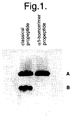
- propeptide The more acidic propeptide lacked the second polypeptide chain that moves faster in electrophoresis and is known to be derived from the pro ⁇ 2-chain of type I procollagen.
- This atypical propeptide was derived from the ⁇ 1-homotrimer type I procollagen containing three identical pro ⁇ 1-chains.
- Such a collagen has been previously described in a fully processed form from the tissues of patients with certain disease states e.g. breast, lung and stomach carcinomas, but the corresponding propeptides have not been identified.
- the ⁇ 1-homotrimer propeptide Since the aminoterminal proportion of the pro ⁇ 2-chain is truncated with respect to the pro ⁇ 1-chain and lacks the whole of the Col1 domain, the ⁇ 1-homotrimer propeptide has three Col1 domains and the classical propeptide only two. Since the Col1 domains are phosphorylated, these two intact propeptides can be separated from each other on the basis of the difference in their charge, e.g. using DEAE-chromatography at pH 5.0. Since the ⁇ 1-homotrimer propeptide has three Col1 domains and the classical propeptide only two, the latter elutes earlier in anion-exchange chromatography. Both these propeptides are susceptible to being denatured at low pH (less than 5.0); something which is not easily detected but can cause problems when producing antibodies if proper precautions are not taken.
- the antisera used previously for assaying the aminoterminal propeptide of type I procollagen has affinity not only for the intact trimeric propeptide, but to a considerable extent also for the monomeric form. This is due to the nature of the antigen used to raise the antisera.
- a linear synthetic peptide, or a propeptide derived from amniotic fluid and isolated in a monomeric form is used for raising the antibodies, these antibodies react preferentially with the monomeric Coll degradation products.
- the propeptide is isolated from cell culture fluid, it is first purified in the form of a procollagen, which is later digested by bacterial collagenase to liberate the propeptide from the collagen proper.
- the authentic propeptide still contains a collagenous domain, part of the bacterial collagenase binds to it, but is not able to digest the propeptide during the short in vitro incubation and isolating procedures. Consequently, when such a propeptide is used as an immunogen, the enzyme is capable of functioning, leading to in vivo degradation of the propeptide and production of antibodies towards its degradation products. In addition, it is also necessary to avoid such conditions and methods (e.g. high performance. liquid chromatography at pH lower than 5.0) which would denature even a small portion of the propeptide during the isolation procedure of the aminoterminal propeptide of type I procollagen..
- starting materials for methods of the invention are preferably free from such contaminating proteolytic enzymes.
- the present invention provides intact, trimeric classical aminoterminal propeptide of type I procollagen and intact trimeric ⁇ 1-homotrimer aminoterminal propeptide of type I procollagen, these propeptides having been isolated without the use of a proteolytic enzyme.
- the isolated propeptides are free from enzymes such as bacterial collagenase, which are capable of degrading the propeptide to its monomeric form.
- the propeptides of the invention may be labelled, using any suitable label. Examples of suitable labels include radiolabels, biotin (which may be detected by avidin or streptavidin conjugated to peroxidase), lanthanides, alkaline phosphatase and fluorescent labels (e.g. fluorescein and rhodamine).
- the present invention also provides a purification procedure for the intact classical and ⁇ 1-homotrimer aminoterminal propeptides of human type I procollagen. It also provides an antibody raised against either of the two forms of the intact propeptide, preferably against the al-homotrimer form, which antibody has little or no affinity, preferably no affinity for the monomeric form of the propeptide. It has been discovered that the ⁇ 1-homotrimer propeptide in particular provides a suitable three dimensional conformation, which is capable of raising antibodies that recognise only the correct spatial configuration found in intact propeptides, and not in the monomeric chains.
- the present invention also provides a purification procedure for the intact classical and ⁇ 1-homotrimer aminoterminal propeptides of human type I procollagen.
- a biological source e.g. human pleural, ascitic or amniotic fluid containing said propeptides in sufficient amounts can be used.
- the ⁇ 1-homotrimer propeptide has been found very often in malignant pleural fluid, seldom in ascitic fluid and so far not in amniotic fluid.
- no active proteolytic enzymes which can partially degrade the propeptides should be present.
- the propeptide-containing material is further purified by a first DEAE chromatographic step, preferably at a neutral pH such as from pH 6.5 to pH 7.5 e.g. pH 7.4; a gel filtration step; a second DEAE chromatographic step, preferably at low pH, such as from pH 4.8 to pH 5.2 e.g. pH 5.0, and reverse phase separation, preferably at a neutral pH such as pH 6.5 to pH 7.5, particularly pH 7.4.
- a first DEAE chromatographic step preferably at a neutral pH such as from pH 6.5 to pH 7.5 e.g. pH 7.4
- a gel filtration step preferably at low pH, such as from pH 4.8 to pH 5.2 e.g. pH 5.0
- reverse phase separation preferably at a neutral pH such as pH 6.5 to pH 7.5, particularly pH 7.4.
- the propeptides are acidic due to phosphorylation of certain serine residues, they will bind tightly to a DEAE column over a wide pH range (from 5.0 to 8.5) and elute in a sharp peak with NaCl.
- a neutral pH is preferable in order to keep the large amounts of other contaminating proteins in solution. This enables effective separation of the propeptides of interest.
- Subsequent gel filtration removes proteins larger and smaller than the propeptides.
- the column can be developed with various buffers, e.g. with 0.2M ammonium bicarbonate, pH 7.9, which has the advantage that it can later be removed by lyophilization.
- the second DEAE chromatography step at low pH e.g.
- Example 1 describes in detail how the propeptides can be isolated from malignant pleural fluid.
- the invention also provides an antibody that is specific for intact, heterotrimeric classical aminoterminal propeptide of type I procollagen, or for intact trimeric ⁇ -1 homotrimer aminoterminal propeptide of type I procollagen; which antibody does not specifically bind to the monomeric form of said propeptide.
- antibodies of the invention have little or no affinity, preferably no affinity, for the monomeric form of the propeptide, but binds to one or both of the homotrimeric forms.
- the antibody has utility in detecting and quantitatively determining human PINP, and hence is useful in diagnosis of diseases and conditions associated with abnormal levels of PINP such as the diseases and conditions listed hereinabove.
- the antibody is preferably monoclonal, but may also be polyclonal.
- the antibody may be labelled.
- suitable antibody labels include radiolabels, biotin (which may be detected by avidin or streptavidin conjugated to peroxidase), lanthanides, alkaline phosphatase and fluorescent labels (e.g. fluorescein and rhodamine).
- the term "antibody” is used herein to include both complete antibody molecules and fragments thereof. Preferred fragments contain at least one antigen binding site, such as Fab and F(ab')2 fragments. Humanised antibodies and fragments thereof are also included within the term "antibody”.
- the antibody is produced by raising antibodies in a host animal against an aminoterminal propeptide according to the invention or against an antigenic epitope thereof (hereinafter "the immunogen").
- the epitope will, of cburse, be representative of the intact trimeric form of the propeptide i.e. an antibody to the epitope will not recognise the monomeric form of the propeptide.
- an epitope comprises two or more short amino acid sequences from different chains which are close to each other because of the configuration of the trimeric propeptide, i.e. a discontinuous rather than a continuous epitope. This configuration will not exist in the monomeric form of the peptide so antibodies to such epitopes will not recognise the monomer.
- antibodies of the invention are directed against the most aminoterminal non-collagenous, globular domain of PINP.
- the classical form of PINP is a heterotrimer containing chains derived from both the pro- ⁇ 1- and the pro- ⁇ -2-chains of type I procollagen.
- the pro ⁇ -2-chain is truncated at the aminoterminus and does not contain the globular antibody formation inducing domain.
- the antibodies must react with the three-diminsional conformation and not with an individual chain.
- the ⁇ -1 homotrimer PINP which contains three similar chains all having this globular domain is particularly suitable for raising antibodies of the invention that recognise a feature of the propeptides' conformation containing three or two different chains in the correct conformation are involved in the antigenic determinant.
- Such antibodies can not be formed when linear synthetic peptides or monomeric chains are used as immunogens.
- a method for producing a polyclonal antibody comprises immunising a suitable host animal, for example an experimental animal, with the immunogen and using properly diluted serum or isolating immunoglobulins from the serum. The animal may therefore be inoculated with the immunogen, with blood subsequently being removed from the animal and the IgG fraction being purified.
- Methods for producing a monoclonal antibody typically comprise immortalising cells which produce the desired antibody.
- Hybridoma cells may be produced by fusing spleen cells from an inoculated experimental animal with tumour cells (Kohler and Milstein, Nature 256 , 495-497, (1975)).
- the antibody may also be produced by recombinant DNA technology, for example as described by Skerra et al (1988) (Science 240 , 1038-1041).
- An immortalised cell producing the desired antibody may be selected by a conventional procedure.
- the hybridomas may be grown in culture or injected intraperitoneally for formation of ascites fluid or into the bloodstream of an allogenic host or immunocompromised host.
- Human antibodies may be prepared by in vitro immunisation of human lymphocytes, followed by transformation of the lymphocytes with Epstein-Barr virus.
- the experimental animal is suitably a goat, rabbit, chicken, sheep, guinea pig, rat or mouse.
- the immunogen may be administered as a conjugate in which the immunogen is coupled, for example via a side chain of one of the amino acid residues, to a suitable carrier.
- the carrier molecule is typically a physiologically acceptable carrier.
- the antibody obtained may be isolated and, if desired, purified, for example to a purity of up to 70%, up to 80%, up to 90% up to 95%, up to 99% or up to 100%.
- the present invention also provides a method of assaying the intact aminoterminal propeptide of type I procollagen, which method comprises contacting a sample to be assayed with an antibody of the invention in the presence of a label, such that the label is bound to the propeptide/antibody complex formed, and assaying the amount of bound and/or unbound label.
- any assay technique that allows detection, and preferably quantification, of either the classical heterotrimeric propeptide or the ⁇ 1 homotrimer, and which relies on specific binding to one of these peptides by an antibody of the invention, may be employed.
- One preferred type of method relies on the use of labelled antibodies, preferably radiolabelled antibodies. In such methods, the amount of (labelled) propeptide (antigen)/antibody complex is assayed, thus giving a measure of the amount of propeptide (antigen) in the sample.
- Another preferred type of method relies on the use of labelled antigen (intact trimeric propeptide in either the classical or ⁇ 1 homotrimeric type) together with an antibody of the invention.
- labelled antigen intact trimeric propeptide in either the classical or ⁇ 1 homotrimeric type
- an antibody of the invention a known amount of labelled, preferably radiolabelled, antigen is added to a sample containing an unkown amount of unlabelled propeptide (antigen). Both the labelled and the unlabelled antigen bind to the antibody, for example in a competitive manner and an assay of the amount of bound labelled propeptide compared to the known amount added can be used to determine how much unlabelled antigen is present in the sampler Methods of these preferred types are descrbed in more detail below.
- the sample must be treated, e.g. by DEAE chromatography, prior to the assay, in order to separate the classical and ⁇ 1-homotrimer propeptides and labelled ⁇ 1-homotrimer propeptide used as tracer, since the assay itself does not distinguish between these two propeptide forms.
- the invention provides a method of detecting and/or quantitatively determining in a sample intact, trimeric human PINP which method comprises:
- the invention provides a method for assaying intact, trimeric, aminoterminal propeptide of human type I procollagen, which method comprises contacting in any order: (i) a sample of a human body fluid, which sample is known or suspected to contain such propeptide; (ii) an antibody which specifically binds to intact, trimeric propeptide of human type I procollagen but not to said propeptide when it is in monomeric form; and (iii) a known amount of labelled trimeric propeptide of the invention, which acts as an antigen, such that the label is bound to the antibody in an amount which depends on the amount of unlabelled propeptide present in the sample; and assaying the amount of the bound and/or unbound label as a measure of unlabelled the level of intact, trimeric aminoterminal propeptide of human type I procollagen in the sample.
- the human body fluid may be, for example, blood, plasma, serum, healing wound fluid, ascitic fluid, cerebral fluid, pleural fluid, synovial fluid, suction blister fluid of skin or amniotic fluid.
- a method for detecting or quantitatively determining intact, trimeric human PINP is Western blotting. Such a method can comprise the steps of:
- Methods of quantitative determination include ELISA (enzyme-linked immunoassay) methods such as ELISA methods or a radioimmunoassay method.
- ELISA enzyme-linked immunoassay
- an ELISA method comprises the steps of:
- a radioimmunoassay method comprises the steps of:
- the present invention also provides a kit suitable for carrying out an assay method of the invention.
- the kit may comprise an antibody, for example a labelled antibody, as described above specific for intact trimeric aminoterminal propeptide of type I procollagen which has little or no affinity, preferably no affinity, for the monomeric form of the propeptide.
- the kit may comprise an antibody of the invention and a labelled, preferably radiolabelled, propeptide of the invention which acts as an antigen and enables the amount of unlabelled antigen in the sample to be determined.
- the sample is then chromatographed on a DEAE-Sephacel column (5 x 50 cm) equilibrated in this buffer. Elution is carried out with a linear gradient of NaCl (0 to 0.5 M NaCl, 4000 + 4000 ml).
- the intact classical and ⁇ 1-homotrimer aminoterminal propeptides of human type I collagen are eluted late in the gradient, after the bulk of other proteins.
- the minor amount of the monomeric Col1-related peptides are eluted first, then the intact classical propeptide, and finally the ⁇ 1-homotrimer aminoterminal propeptide of human type I procollagen.
- the fractions containing the two propeptides are pooled separately and purified independently, applying the procedure described below.
- the pools are dialysed against 0.2M NH 4 HCO 3 , pH 7.9, and lyophilized.
- the samples are dissolved in 0.2M NH 4 HCO 3 , and subjected to chromatography on a Sephacryl S-300 column (1.5 x 110 cm) equilibrated in this solution.
- the fractions containing the propeptide antigenicity are pooled and lyophilized.
- the samples are then dissolved in 50 mM ammonium acetate buffer, pH 5.0, briefly dialzyed against it and subjected to chromatography on an anion-exchange column (Protein-Pak DEAE-5P) using a high performance liquid chromatography (HPLC) instrument.
- the propeptides are eluted using a linear gradient of NaCl (0 to 0.3 M, 0 to 60 min, flow rate 1 ml/min).
- Final purification of the propeptide is performed using HPLC by directly injecting the fractions containing the propeptide into a pH stable reverse phase column (Vydac, Hesperia, CA) in 0.4% ammonium acetate, pH 7.4, and eluting the bound propeptide with increasing concentrations of acetonitrile (0 to 70 %, 0 to 45 min).
- the propeptide is eluted as a sharp peak in the first half of the gradient, located by immunoassay, pooled and lyophilized.
- the isolated classical and ⁇ 1-homotrimer propeptides are trimeric, however, since only one immunoreactive peak corresponding to the size of the authentic propeptide is found in size exclusion chromatography and no reaction is observed at the elution position of the degradation products of the propeptide.
- propeptides after storage in frozen state were repeatedly analysed by gel filtration no degradation to smaller forms was observed.
- Polyclonal antibodies against PINP were raised in New Zealand White rabbits by intradermal injections of 150 ⁇ g/rabbit of highly purified ⁇ 1-homotrimer PINP (free of proteolytic enzymes), dissolved in 1 ml of 0.9% NaCl and mixed with an equal volume of complete Freund's adjuvant.
- Several booster injections 75 ⁇ g/rabbit of ⁇ 1-homotrimer PINP in 1 ml of 0.9% NaCl and mixed with an equal volume of incomplete Freund's adjuvant) were given at three-week-intervals. The antiserum pool was made for each rabbit from several bleedings.
- Ten micrograms of the classical (or ⁇ 1-homotrimer) aminoterminal propeptide of type I procollagen is labelled with 1 millicurie of 125 iodine by Chloramine-T (10 micrograms) and the labelled propeptide is separated from free iodine by gel filtration on a Sephacryl S-300 column (1 x 20 cm) equilibrated in PBS-buffer containing bovine serum albumin (1 gram/liter). The labelled propeptide is eluted from the column as a sharp peak well before the free iodine. Antiserum binding curves are prepared with 50000 counts per minute of the labelled propeptide.
- the propeptide concentration in an unknown sample of serum, or other biological fluid except urine is determined in the following radioimmunoinhibition assay.
- a pretested diluted antiserum 200 ⁇ l is incubated with the unknown sample (50 ⁇ l) and 50000 counts per minute of the tracer (in 200 ⁇ l of PBS-buffer containing 1 gram/liter of bovine serum albumin) for 2 hours at 37°C.
- a solid phase second antibody against rabbit gamma globulin is added and after 20 min incubation at 20°C the antigen bound in the immunocomplex is separated by centrifugation (2000 x g for 20 min) from the solution.
- the inhibition activity of the unknown sample is compared with the activity of standard concentrations of unlabelled aminoterminal propeptide of type I procollagen.
- sample either serum or other biological fluid except urine
- sample contains both the classical and ⁇ 1-homotrimer aminoterminal propeptides of type I procollagen
- these can be separated by chromatography on an anion-exchange column (Protein-Pak DEAE-5P) using a high performance liquid chromatography.
- a one millilitre sample is dialysed against 50 mM ammonium acetate buffer, pH 5.0, injected into the column and eluted using a linear gradient of NaCl (0 to 0.3 M, 0 to 60 min, flow rate 1 ml/min) collecting one millilitre fractions.
- the fractions are then analyzed by radioimmunoassay for the classical aminoterminal propeptide of type I procollagen and the presence and location of the two forms of the aminoterminal propeptides of type I procollagen are detected. If an accurate measurement of the correct amount is needed the fractions containing the said propeptides are pooled, briefly dialysed against distilled water, lyophilized and finally dissolved into PBS-buffer using the original volume of the sample and the concentrations of the propeptides are determined by radioimmunoassay for the classical aminoterminal propeptide of type I procollagen.
Landscapes
- Health & Medical Sciences (AREA)
- Life Sciences & Earth Sciences (AREA)
- Chemical & Material Sciences (AREA)
- Molecular Biology (AREA)
- Engineering & Computer Science (AREA)
- Organic Chemistry (AREA)
- Biomedical Technology (AREA)
- Immunology (AREA)
- Medicinal Chemistry (AREA)
- General Health & Medical Sciences (AREA)
- Proteomics, Peptides & Aminoacids (AREA)
- Biochemistry (AREA)
- Biophysics (AREA)
- Urology & Nephrology (AREA)
- Genetics & Genomics (AREA)
- Hematology (AREA)
- Zoology (AREA)
- Physics & Mathematics (AREA)
- Cell Biology (AREA)
- Gastroenterology & Hepatology (AREA)
- Microbiology (AREA)
- Toxicology (AREA)
- Food Science & Technology (AREA)
- Biotechnology (AREA)
- Analytical Chemistry (AREA)
- General Physics & Mathematics (AREA)
- Pathology (AREA)
- Peptides Or Proteins (AREA)
- Investigating Or Analysing Biological Materials (AREA)
- Measuring Or Testing Involving Enzymes Or Micro-Organisms (AREA)
- Medicines Containing Antibodies Or Antigens For Use As Internal Diagnostic Agents (AREA)
- Investigating Or Analysing Materials By The Use Of Chemical Reactions (AREA)
Applications Claiming Priority (2)
| Application Number | Priority Date | Filing Date | Title |
|---|---|---|---|
| GBGB9507985.1A GB9507985D0 (en) | 1995-04-19 | 1995-04-19 | Antibody to aminoterminal propeptide to type 1 procollagen and assay method using it |
| GB9507985 | 1995-04-19 |
Publications (3)
| Publication Number | Publication Date |
|---|---|
| EP0738735A2 true EP0738735A2 (de) | 1996-10-23 |
| EP0738735A3 EP0738735A3 (de) | 1999-01-20 |
| EP0738735B1 EP0738735B1 (de) | 2003-09-17 |
Family
ID=10773218
Family Applications (1)
| Application Number | Title | Priority Date | Filing Date |
|---|---|---|---|
| EP96302639A Expired - Lifetime EP0738735B1 (de) | 1995-04-19 | 1996-04-16 | Typ I Prokollagen aminoterminales Propeptid, dessen Antikörper und Testverfahren unter Verwendung davon |
Country Status (11)
| Country | Link |
|---|---|
| US (3) | US5895746A (de) |
| EP (1) | EP0738735B1 (de) |
| JP (1) | JP3245052B2 (de) |
| AT (1) | ATE250084T1 (de) |
| AU (1) | AU707232B2 (de) |
| CA (1) | CA2174559C (de) |
| DE (1) | DE69629976T2 (de) |
| DK (1) | DK0738735T3 (de) |
| ES (1) | ES2207665T3 (de) |
| GB (1) | GB9507985D0 (de) |
| NO (1) | NO320120B1 (de) |
Cited By (2)
| Publication number | Priority date | Publication date | Assignee | Title |
|---|---|---|---|---|
| CN113507935A (zh) * | 2018-10-16 | 2021-10-15 | 得克萨斯州大学系统董事会 | 用于诊断和治疗癌症及其他疾病的对致病性胞外基质的鉴定和靶向 |
| US12473598B2 (en) | 2018-03-28 | 2025-11-18 | Board Of Regents, The University Of Texas System | Identification of epigenetic alterations in DNA isolated from exosomes |
Families Citing this family (9)
| Publication number | Priority date | Publication date | Assignee | Title |
|---|---|---|---|---|
| US20030087318A1 (en) * | 1994-04-18 | 2003-05-08 | Lallone Roger L. | Antibodies against an extracellular matrix complex and their use in the detection of cancer |
| US20030082179A1 (en) * | 2001-07-03 | 2003-05-01 | Hutchison James Scott | Parathyroid hormone antibodies and related methods |
| CN102690347B (zh) * | 2012-05-18 | 2014-06-25 | 北京北方生物技术研究所 | 分离i型前胶原氨基末端肽的方法 |
| JP2022505032A (ja) * | 2018-10-16 | 2022-01-14 | ボード オブ リージェンツ,ザ ユニバーシティ オブ テキサス システム | 腫瘍オルガノイドを産生するための組成物および腫瘍オルガノイドを産生する方法 |
| CN111007269A (zh) * | 2019-11-15 | 2020-04-14 | 迪瑞医疗科技股份有限公司 | 总ⅰ型胶原氨基端延长肽化学发光免疫检测试剂盒及其制备方法 |
| CN112326972A (zh) * | 2020-10-30 | 2021-02-05 | 安徽理工大学 | 一种检测血清中完整pinp的化学发光定量检测试剂盒 |
| EP4502601A4 (de) * | 2022-03-25 | 2026-03-25 | Sekisui Medical Co Ltd | Immunologisches nachweisverfahren und immunologisches nachweiskit |
| US20250130242A1 (en) | 2022-03-25 | 2025-04-24 | Sekisui Medical Co., Ltd. | Immunological detection method and immunological detection kit |
| EP4549462A1 (de) * | 2023-04-28 | 2025-05-07 | Shenzhen Mindray Bio-Medical Electronics Co., Ltd. | Prokollagen-i-n-terminaler propeptidspezifischer antikörper, kit und verwendung davon |
Family Cites Families (4)
| Publication number | Priority date | Publication date | Assignee | Title |
|---|---|---|---|---|
| GB2208865B (en) * | 1987-08-19 | 1991-12-11 | Farmos Group Ltd | Purified propeptide of procollagen type iii, antibody to the propeptide and assay method using the antibody. |
| GB9014220D0 (en) * | 1990-06-26 | 1990-08-15 | Farmos Yhtymy Oy | Method for the immunlolgical determinition of the carboxyterminal propeptide of type i procollagen |
| GB9105893D0 (en) * | 1991-03-20 | 1991-05-08 | Orion Yhtymae Oy | Bone resorption assay based on a peptide liberated during collagen degradation |
| CA2128877A1 (en) * | 1992-01-31 | 1993-08-05 | David J. Baylink | Amino procollagen 1(1) peptides |
-
1995
- 1995-04-19 GB GBGB9507985.1A patent/GB9507985D0/en active Pending
- 1995-06-07 US US08/480,822 patent/US5895746A/en not_active Expired - Lifetime
-
1996
- 1996-04-16 AT AT96302639T patent/ATE250084T1/de active
- 1996-04-16 DE DE69629976T patent/DE69629976T2/de not_active Expired - Lifetime
- 1996-04-16 DK DK96302639T patent/DK0738735T3/da active
- 1996-04-16 ES ES96302639T patent/ES2207665T3/es not_active Expired - Lifetime
- 1996-04-16 EP EP96302639A patent/EP0738735B1/de not_active Expired - Lifetime
- 1996-04-17 AU AU50695/96A patent/AU707232B2/en not_active Expired
- 1996-04-18 JP JP12246896A patent/JP3245052B2/ja not_active Expired - Lifetime
- 1996-04-18 NO NO19961543A patent/NO320120B1/no not_active IP Right Cessation
- 1996-04-19 CA CA2174559A patent/CA2174559C/en not_active Expired - Lifetime
-
1998
- 1998-03-02 US US09/033,311 patent/US6090920A/en not_active Expired - Lifetime
- 1998-03-02 US US09/033,310 patent/US6093803A/en not_active Expired - Lifetime
Cited By (3)
| Publication number | Priority date | Publication date | Assignee | Title |
|---|---|---|---|---|
| US12473598B2 (en) | 2018-03-28 | 2025-11-18 | Board Of Regents, The University Of Texas System | Identification of epigenetic alterations in DNA isolated from exosomes |
| CN113507935A (zh) * | 2018-10-16 | 2021-10-15 | 得克萨斯州大学系统董事会 | 用于诊断和治疗癌症及其他疾病的对致病性胞外基质的鉴定和靶向 |
| EP3866831A4 (de) * | 2018-10-16 | 2022-08-24 | Board of Regents, The University of Texas System | Identifizierung und targeting der pathogenen extrazellulären matrix zur diagnose und behandlung von krebs und anderen krankheiten |
Also Published As
| Publication number | Publication date |
|---|---|
| NO961543D0 (no) | 1996-04-18 |
| AU5069596A (en) | 1996-10-31 |
| NO320120B1 (no) | 2005-10-31 |
| ATE250084T1 (de) | 2003-10-15 |
| AU707232B2 (en) | 1999-07-08 |
| US6090920A (en) | 2000-07-18 |
| US6093803A (en) | 2000-07-25 |
| CA2174559C (en) | 2010-10-19 |
| JPH08291197A (ja) | 1996-11-05 |
| ES2207665T3 (es) | 2004-06-01 |
| JP3245052B2 (ja) | 2002-01-07 |
| CA2174559A1 (en) | 1996-10-20 |
| EP0738735B1 (de) | 2003-09-17 |
| DE69629976T2 (de) | 2004-07-22 |
| EP0738735A3 (de) | 1999-01-20 |
| DK0738735T3 (da) | 2003-12-29 |
| NO961543L (no) | 1996-10-21 |
| US5895746A (en) | 1999-04-20 |
| GB9507985D0 (en) | 1995-06-07 |
| DE69629976D1 (de) | 2003-10-23 |
Similar Documents
| Publication | Publication Date | Title |
|---|---|---|
| Ruoslahti et al. | [46] Fibronectin: Purification, immunochemical properties, and biological activities | |
| WO1994018563A1 (en) | Detection of type ii collagen and its peptides | |
| US5296354A (en) | Kit for the specific assay of angiotensin II | |
| US5698407A (en) | Method for the immunological determination of the carboxyterminal propeptide of type I procollagen | |
| EP0738735B1 (de) | Typ I Prokollagen aminoterminales Propeptid, dessen Antikörper und Testverfahren unter Verwendung davon | |
| US6008325A (en) | Antibody to aminoterminal propeptide of type 1 procollagen | |
| EP0304292B1 (de) | Antikörper zum Propeptid des Prokollagen-III und seine Benutzung in einem Analyseverfahren | |
| FI95579B (fi) | Immunologinen menetelmä intaktin prokollageenipeptidin (tyyppi III) ja prokollageenin (tyyppi III) määrittämiseksi selektiivisesti elimistönesteistä ja väline sen toteuttamiseksi | |
| WO1991019001A1 (en) | Immunodiagnostic assay for rheumatoid arthritis | |
| US5679583A (en) | Monoclonal antibodies for the selective immunological determination of intact procollagen peptide (type III) and procollagen (type III) in body fluids | |
| KR960008672B1 (ko) | 심방 나트륨이뇨성 폴리펩티드를 인지하는 단일클론성 항체 | |
| EP0393640B1 (de) | Monoklonale Antikörper gegen den C-Terminus von ANP | |
| EP0401006B1 (de) | Antikörper gegen humanes ANP und Verfahren zur immunologischen Bestimmung von humanem ANP | |
| EP1766411B1 (de) | Verfahren zur bestimmung eines gewebeabbauverfahrens durch nachweis von comp-neoepitopen | |
| IE881290L (en) | Monoclonal antibodies for the selective immunological¹determination of intact procollagen peptide (Type III) and¹procollagen (Type III) in body fluids | |
| US5516643A (en) | Immunochemical assays for cancer-associated SCM-recognition factor | |
| EP0417298A1 (de) | Nachweis von menschlichem gewebefaktoraktivator | |
| Motte et al. | A two-site immunoradiometric assay for serum calcitonin using monoclonal anti-peptide antibodies | |
| WO1994003806A1 (en) | Immunochemical assays for cancer-associated scm recognition factor | |
| JPH08119998A (ja) | ヒトprotein 1特異モノクローナル抗体 | |
| JP2558956C (de) |
Legal Events
| Date | Code | Title | Description |
|---|---|---|---|
| PUAI | Public reference made under article 153(3) epc to a published international application that has entered the european phase |
Free format text: ORIGINAL CODE: 0009012 |
|
| AK | Designated contracting states |
Kind code of ref document: A2 Designated state(s): AT BE CH DE DK ES FI FR GB IT LI LU NL SE |
|
| PUAL | Search report despatched |
Free format text: ORIGINAL CODE: 0009013 |
|
| AK | Designated contracting states |
Kind code of ref document: A3 Designated state(s): AT BE CH DE DK ES FI FR GB IT LI LU NL SE |
|
| 17P | Request for examination filed |
Effective date: 19990326 |
|
| 17Q | First examination report despatched |
Effective date: 20010806 |
|
| GRAH | Despatch of communication of intention to grant a patent |
Free format text: ORIGINAL CODE: EPIDOS IGRA |
|
| GRAH | Despatch of communication of intention to grant a patent |
Free format text: ORIGINAL CODE: EPIDOS IGRA |
|
| RIN1 | Information on inventor provided before grant (corrected) |
Inventor name: KAUPPILA, SAILA Inventor name: MELKKO, JUKKA Inventor name: RISTELI, LEILA Inventor name: RISTELI, JUHA |
|
| RAP1 | Party data changed (applicant data changed or rights of an application transferred) |
Owner name: ORION-YHTYMAE OYJ |
|
| GRAA | (expected) grant |
Free format text: ORIGINAL CODE: 0009210 |
|
| AK | Designated contracting states |
Kind code of ref document: B1 Designated state(s): AT BE CH DE DK ES FI FR GB IT LI LU NL SE |
|
| REG | Reference to a national code |
Ref country code: GB Ref legal event code: FG4D |
|
| REG | Reference to a national code |
Ref country code: CH Ref legal event code: EP |
|
| REF | Corresponds to: |
Ref document number: 69629976 Country of ref document: DE Date of ref document: 20031023 Kind code of ref document: P |
|
| REG | Reference to a national code |
Ref country code: CH Ref legal event code: NV |
|
| REG | Reference to a national code |
Ref country code: DK Ref legal event code: T3 |
|
| REG | Reference to a national code |
Ref country code: SE Ref legal event code: TRGR |
|
| REG | Reference to a national code |
Ref country code: ES Ref legal event code: FG2A Ref document number: 2207665 Country of ref document: ES Kind code of ref document: T3 |
|
| ET | Fr: translation filed | ||
| PLBE | No opposition filed within time limit |
Free format text: ORIGINAL CODE: 0009261 |
|
| STAA | Information on the status of an ep patent application or granted ep patent |
Free format text: STATUS: NO OPPOSITION FILED WITHIN TIME LIMIT |
|
| REG | Reference to a national code |
Ref country code: CH Ref legal event code: PUE Owner name: ORION DIAGNOSTICA OY Free format text: ORION OYJ#ORIONINTIE 1#02100 ESPOO (FI) -TRANSFER TO- ORION DIAGNOSTICA OY#KOIVU-MANKKAAN TIE 6 B#02200 ESPOO (FI) Ref country code: CH Ref legal event code: PFA Owner name: ORION OYJ Free format text: ORION-YHTYMAE OYJ#ORIONINTIE 1#02100 ESPOO (FI) -TRANSFER TO- ORION OYJ#ORIONINTIE 1#02100 ESPOO (FI) |
|
| 26N | No opposition filed |
Effective date: 20040618 |
|
| BECA | Be: change of holder's address |
Owner name: *ORION DIAGNOSTICA OYKOIVU-MANKKAAN TIE 6B, FIN - Effective date: 20040921 |
|
| BECH | Be: change of holder |
Owner name: *ORION DIAGNOSTICA OY Effective date: 20040921 |
|
| REG | Reference to a national code |
Ref country code: GB Ref legal event code: 732E |
|
| NLS | Nl: assignments of ep-patents |
Owner name: ORION DIAGNOSTICA OY |
|
| NLT1 | Nl: modifications of names registered in virtue of documents presented to the patent office pursuant to art. 16 a, paragraph 1 |
Owner name: ORION OYJ |
|
| REG | Reference to a national code |
Ref country code: FR Ref legal event code: TP |
|
| REG | Reference to a national code |
Ref country code: CH Ref legal event code: PFA Owner name: ORION DIAGNOSTICA OY Free format text: ORION DIAGNOSTICA OY#KOIVU-MANKKAAN TIE 6 B#02200 ESPOO (FI) -TRANSFER TO- ORION DIAGNOSTICA OY#KOIVU-MANKKAAN TIE 6 B#02200 ESPOO (FI) |
|
| REG | Reference to a national code |
Ref country code: CH Ref legal event code: PCAR Free format text: NEW ADDRESS: HOLBEINSTRASSE 36-38, 4051 BASEL (CH) |
|
| REG | Reference to a national code |
Ref country code: FR Ref legal event code: PLFP Year of fee payment: 20 |
|
| PGFP | Annual fee paid to national office [announced via postgrant information from national office to epo] |
Ref country code: LU Payment date: 20150422 Year of fee payment: 20 |
|
| PGFP | Annual fee paid to national office [announced via postgrant information from national office to epo] |
Ref country code: NL Payment date: 20150420 Year of fee payment: 20 |
|
| PGFP | Annual fee paid to national office [announced via postgrant information from national office to epo] |
Ref country code: CH Payment date: 20150420 Year of fee payment: 20 Ref country code: DK Payment date: 20150420 Year of fee payment: 20 Ref country code: SE Payment date: 20150420 Year of fee payment: 20 Ref country code: DE Payment date: 20150421 Year of fee payment: 20 Ref country code: GB Payment date: 20150420 Year of fee payment: 20 Ref country code: FI Payment date: 20150413 Year of fee payment: 20 Ref country code: ES Payment date: 20150417 Year of fee payment: 20 |
|
| PGFP | Annual fee paid to national office [announced via postgrant information from national office to epo] |
Ref country code: FR Payment date: 20150421 Year of fee payment: 20 Ref country code: AT Payment date: 20150421 Year of fee payment: 20 Ref country code: IT Payment date: 20150427 Year of fee payment: 20 Ref country code: BE Payment date: 20150420 Year of fee payment: 20 |
|
| REG | Reference to a national code |
Ref country code: DE Ref legal event code: R071 Ref document number: 69629976 Country of ref document: DE |
|
| REG | Reference to a national code |
Ref country code: DK Ref legal event code: EUP Effective date: 20160416 |
|
| REG | Reference to a national code |
Ref country code: NL Ref legal event code: MK Effective date: 20160415 |
|
| REG | Reference to a national code |
Ref country code: CH Ref legal event code: PL |
|
| REG | Reference to a national code |
Ref country code: GB Ref legal event code: PE20 Expiry date: 20160415 |
|
| REG | Reference to a national code |
Ref country code: SE Ref legal event code: EUG |
|
| REG | Reference to a national code |
Ref country code: AT Ref legal event code: MK07 Ref document number: 250084 Country of ref document: AT Kind code of ref document: T Effective date: 20160416 |
|
| REG | Reference to a national code |
Ref country code: ES Ref legal event code: FD2A Effective date: 20160727 |
|
| PG25 | Lapsed in a contracting state [announced via postgrant information from national office to epo] |
Ref country code: GB Free format text: LAPSE BECAUSE OF EXPIRATION OF PROTECTION Effective date: 20160415 |
|
| PG25 | Lapsed in a contracting state [announced via postgrant information from national office to epo] |
Ref country code: ES Free format text: LAPSE BECAUSE OF EXPIRATION OF PROTECTION Effective date: 20160417 |