EP0739104A1 - Autoradio mit Datenspeicher zur Speicherung von bestimmten Sprachelementen - Google Patents
Autoradio mit Datenspeicher zur Speicherung von bestimmten Sprachelementen Download PDFInfo
- Publication number
- EP0739104A1 EP0739104A1 EP96200908A EP96200908A EP0739104A1 EP 0739104 A1 EP0739104 A1 EP 0739104A1 EP 96200908 A EP96200908 A EP 96200908A EP 96200908 A EP96200908 A EP 96200908A EP 0739104 A1 EP0739104 A1 EP 0739104A1
- Authority
- EP
- European Patent Office
- Prior art keywords
- segment
- memory
- vocabulary
- address
- given
- Prior art date
- Legal status (The legal status is an assumption and is not a legal conclusion. Google has not performed a legal analysis and makes no representation as to the accuracy of the status listed.)
- Granted
Links
Images

Classifications
-
- H—ELECTRICITY
- H04—ELECTRIC COMMUNICATION TECHNIQUE
- H04B—TRANSMISSION
- H04B1/00—Details of transmission systems, not covered by a single one of groups H04B3/00 - H04B13/00; Details of transmission systems not characterised by the medium used for transmission
- H04B1/06—Receivers
-
- H—ELECTRICITY
- H04—ELECTRIC COMMUNICATION TECHNIQUE
- H04H—BROADCAST COMMUNICATION
- H04H20/00—Arrangements for broadcast or for distribution combined with broadcast
- H04H20/53—Arrangements specially adapted for specific applications, e.g. for traffic information or for mobile receivers
- H04H20/55—Arrangements specially adapted for specific applications, e.g. for traffic information or for mobile receivers for traffic information
Definitions
- the present invention relates to a radio receiver provided with a vocabulary memory containing descriptions of vocabulary elements, memory in which each of the descriptions of vocabulary elements is addressable from a code consisting of a number designating an element of vocabulary, the set of numbers designating the vocabulary elements useful for a given user constituting a sequence of numbers in which there are solutions of continuity between groups of consecutive numbers, a group of consecutive numbers being called segment.
- Such a car radio receiver is intended in particular to receive and use so-called RDS / TMC signals. It can deliver information messages on traffic or intended for guiding a vehicle by entering the messages on a screen and / or delivering them by text-to-speech.
- the present invention also relates to a module for generating traffic information messages, comprising or being associated with a vocabulary memory which contains descriptions of vocabulary elements, memory in which each of the descriptions of vocabulary elements is addressable from of a code consisting of a number designating a vocabulary element, the set of numbers designating the vocabulary elements useful for a given user constituting a sequence of numbers in which there are solutions of continuity between groups of consecutive numbers, a group of consecutive numbers being called segment.
- the present invention also relates to a portable card, intended for use in a message generation apparatus, comprising a vocabulary memory containing descriptions of vocabulary elements, memory in which each of the descriptions of vocabulary elements is addressable from of a code consisting of a number designating a vocabulary element, the set of numbers designating the vocabulary elements useful for a given user constituting a sequence of numbers in which there are solutions of continuity between groups of consecutive numbers, a group of consecutive numbers being called segment.
- a receiver for radio transmissions in which digital traffic information signals are processed, and which comprises a memory for transforming the digital signals into comprehensible information is known from document EP-A-0 263 332.
- the memory is subdivided into subsets each containing the data of a part of a road, corresponding to a city encountered on this part of the road.
- all the codes and definitions of vocabulary elements today constitute a database which is defined and which groups the vocabulary elements in a way which does not necessarily correspond to the proposal of this document and which can no longer be changed.
- An object of the invention is, from all the codes and vocabulary elements as defined, to reduce the size of the vocabulary memory of the receiver and also to ensure the fastest access possible to an element of vocabulary, from its code.
- the radio receiver according to the invention is remarkable in that the descriptions corresponding to the codes contained in the different segments are placed end to end in the vocabulary memory, and the receiver includes an auxiliary memory which contains digital data allowing to determine, from one of the above codes, the position of the corresponding description in the vocabulary memory.
- the invention is therefore based on the idea of packing the groups as much as possible in the vocabulary memory, despite the complication introduced by the need to use indirect addressing to access a group.
- a first way of managing the vocabulary memory is to use an auxiliary memory which contains, in correspondence with each of the codes of the series of codes useful for a given user, the address of the start of the corresponding description in the vocabulary memory.
- a so-called “tree” memory contains the address in the auxiliary memory of the data relating to a segment and, in correspondence with this address, other addresses which are those, in the auxiliary memory, of data relating to other segments, among those which are below said given segment and those which are above said given segment.
- the tree memory contains, in correspondence with the address relating to a segment, the address in the auxiliary memory of the data relating to another segment of the series of segments, situated practically in the middle of those which are below the said given segment and the address in this same auxiliary memory of the data relating to another segment, situated practically in the middle of those which are above the said given segment.
- the receiver is advantageously provided with a removable card reader, and the vocabulary memory as well as the auxiliary memory are contained in a removable card.
- the device is easily adaptable to regions different, by simply changing the map.
- a module for generating road information messages according to the invention is remarkable in that, the descriptions corresponding to the codes contained in the different segments being placed end to end in the vocabulary memory, the module comprises or is associated with a memory auxiliary which contains numerical data making it possible to determine, from one of the above-mentioned codes, the position of the corresponding description in the vocabulary memory, and it is provided with means for, using said auxiliary memory, determine the position of a description in the vocabulary memory.
- such a module is provided with means for searching, in the auxiliary memory, for the address of the start of a description in the vocabulary memory, in correspondence with each of the codes of the series of codes useful for a given user ,.
- such a module comprises, or is associated with, a so-called “tree” memory and is provided with means for searching there for the address of the data relating to a segment and, in correspondence with this address, other addresses which are those, in this same auxiliary memory, of data concerning other segments, among those which are below said given segment and those which are above said given segment.
- it is provided with means for searching, in the tree memory, in correspondence with the address relating to a segment, the address in the auxiliary memory of the data relating to another segment of the series of segments, located practically at the middle of those below the given given segment and the address in this same auxiliary memory of the data concerning another segment, situated practically in the middle of those which are above the said given segment.
- the descriptions corresponding to the codes contained in the different segments are advantageously placed end to end in the vocabulary memory, and the card comprises an auxiliary memory which contains data. Numeric to determine, from one of the above codes, the position of the corresponding description in the vocabulary memory.
- the auxiliary memory of such a card contains, in correspondence with each of the codes of the series of codes useful for a given user, the address of the start of the corresponding description in the vocabulary memory.
- such a card comprises a so-called "tree" memory which contains the address in the auxiliary memory of the data relating to a segment and, in correspondence with this address, other addresses which are those, in the auxiliary memory, of data concerning other segments, among those which are below said given segment and those which are above said given segment.
- this tree memory contains, in correspondence with the address relating to a segment, the address in the auxiliary memory of the data relating to another segment of the series of segments, situated practically in the middle of those which are below the said given segment and the address in this same auxiliary memory of the data relating to another segment, located practically in the midst of those above the said given segment.
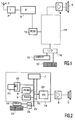
- the receiver of FIG. 1 comprises, from an antenna 1, a device 2 ("tuner") containing a tuning circuit and a frequency change circuit, followed by a device 3 containing an amplifier at intermediate frequency and a receiver.
- a device 2 containing a tuning circuit and a frequency change circuit
- a device 3 containing an amplifier at intermediate frequency and a receiver.
- RDS Radio Data System
- digital data signals useful for the reception of different transmitters of the same chain.
- RDS decoder 13 is present.
- TMC Traffic Message Channel
- traffic information messages are incorporated into certain digital fields of RDS signals, for example:” traffic jam three km before entering Paris ".
- the receiver comprises a module 14, to which the RDS data of the decoder 13 is brought to be analyzed and possibly stored.
- this module 14 is also connected to an amplifier system audio 4 followed by a loudspeaker 5. It is also connected to an input / output interface device 18 connected to a control keyboard 12 and to a display screen 10, for example with liquid crystal.
- the module 14 comprises a microcontroller 7 which generates control signals and processes the signals which come out of the various devices, to which it is connected by an address bus 15 and by a data bus 21. Furthermore, it selects and prepares digital data defining spoken elements for a speech synthesizer module 20 known per se, which provides in known manner the desired analog signals to the audio amplifier 4 followed by the speaker 5.
- the module 14 also includes a memory volatile 8 called "RAM", for the storage of a software layer used at a given time by the microcontroller 7 and also for the temporary storage of the contents of TMC fields to be processed, a permanent memory 9 for the storage of fixed vocabulary descriptions once and for all, and a memory 22, 23 consisting of a memory card reader 22 and of a removable memory card 23, for example of the PCMCIA type, in which e are more specifically stored the descriptions of specific vocabulary elements corresponding to a given user and / or region.
- RAM memory volatile 8
- PROMCIA for the storage of a software layer used at a given time by the microcontroller 7 and also for the temporary storage of the contents of TMC fields to be processed
- a permanent memory 9 for the storage of fixed vocabulary descriptions once and for all
- a memory 22, 23 consisting of a memory card reader 22 and of a removable memory card 23, for example of the PCMCIA type, in which e are more specifically stored the descriptions of specific vocabulary elements corresponding to a given user and / or region.
- a permanent memory in which information in clear form is stored (in the form for example of the ASCII codes of the characters of a message to be displayed), at addresses corresponding to the different possible contents of each field, which makes it possible to retrieve information from the content of a field.
- the 1 st field (describing an event), which has 11 bits, is associated with a memory which can contain in plain text 2048 vocabulary elements (i.e. 2 11 vocabulary elements), each being found at the address defined by the content of the field.
- vocabulary elements say for example "traffic jam", “work”, “accident”, etc. They are placed in memory 9.
- the 2 nd field (describing a place), which comprises 16 bits, is associated with a memory, known as the location point memory, which can contain in plain text up to 65,536 vocabulary elements (i.e. 2 16 vocabulary elements) which include complete data on in particular place names, their type, the region to which they belong, the next and previous points, etc., each vocabulary element being in principle found at an address designated by the content of the field.
- vocabulary elements are for example "Paris”, or "Lille”, or "the exit 21", etc. They are placed in memory 23.
- extension is meant the fact that the event considered extends for example to the following location.
- each location point (each place name) 170 bytes of data.
- the largest number PL is 50004, so with a location point memory in which the address of the data describing a location point would be the code itself, a memory capacity of 50004 times 170 bytes, or 8500680 bytes.
- the only localization points which are useful in a given region and for which the numbers PL are consecutive are considered in the standardized database. They form so-called "segment" groups.
- these segments are concatenated, that is to say placed one after the other without any continuity solution. Thanks to this organization, one can be satisfied with a memory of limited size. With the segments thus concatenated, one could imagine, to find the membership of a code in a given segment, to use an auxiliary memory which contains, for each of the 50004 possible codes (case of the Rhine valley), direct indication of the position of the data describing the location point in the vocabulary memory.
- the belonging of a code to a segment can also be found with an auxiliary memory containing the smallest and the largest number PL of each of the segments, and in which the actual position of the descriptions corresponding to the segment is also indicated by giving the position of one of the limits corresponding to this segment in the vocabulary memory, for example the position of its lower limit, which will be called "offset".
- offset the position of one of the limits corresponding to this segment in the vocabulary memory, for example the position of its lower limit, which will be called "offset”.
- the depth of the tree i.e. the maximum number of search steps to find a segment comprising a given PL number, is at most equal to the base 2 logarithm of the total number of segments contained in the memory of vocabulary.
- the auxiliary memory which contains for each segment the smallest and the largest number PL of each of the segments, and the actual position of the segment, advantageously constitutes the tree memory by adding the addresses of two other nodes each time.
- Figure 3 symbolically represents under the shape of an elongated rectangle 39 a sequence of numbers PL. This is the complete sequence provided by standardization for all of all possible location points: it therefore includes 65,536 positions. However, in a database concerning a country, only certain points of localization are defined. They are grouped into segments 24, 25, 26, 27, 28, 29, 30, 31, represented hatched, which contain codes designating defined localization points, and there are continuity solutions 32, 33, 34, 35 , 36, 37, 38 between the segments.
- the root node (depth 0) of the tree, corresponding to the reference 227, contains among other things the smallest number and the largest number in segment 27.
- this number is in segment 27, and it only remains to calculate the address of the description of the rental point as explained above, or it is on the right in the figure (larger numbers) or on the left ( smaller numbers).
- addresses in the auxiliary memory of the median nodes respectively below 225 and above 230 which makes it possible to follow the tree, by choosing one or the other of these addresses according to the result of the comparison.
- the next node, of depth -1 is that corresponding to the reference 230; it contains the smallest number and the largest number in segment 30. If the number PL is smaller than the smallest number in segment 27, the next node, of depth "-1", is the one corresponding to the reference 225; it contains the smallest number and the largest number of the segment 25. Again the comparison of the number PL given with these two numbers provides three possibilities: either this number is in the segment 25, and it remains only calculate the address of the description of the rental point as explained above, either it is on the right or on the left in the figure.
- the address shown as median node following by node 225 contains the smallest number and the largest number of segment 26, and a code indicating that one arrived at the end of the tree. It is the same for the other segments 24, 28, 31.
- the subdivision of the tree into branches leads to at least one terminal node which does not correspond to a segment: this is the case here for the "pseudo-segment" 250 to the right of node 229; then a code indicates that this segment is empty, either at the level of this segment, or rather at the level of the upstream node (229).
- Figure 4 is intended to illustrate a variant in the manner of organizing the monitoring of a tree. It is based on the solutions of continuity between the segments instead of the segments, but it is more complex to implement than the preferred way.
- the root node (depth 0) of the tree corresponding to the reference 135, contains the smallest number in segment 28 and the largest number in segment 27, on either side of the continuity solution 35.
- the comparison of the given PL number with these two numbers points to the right (larger numbers) of the figure or to the left (smaller numbers).
- the addresses in the auxiliary memory of the median nodes respectively lower 133 and upper 137, which makes it possible to follow the tree.
- the next node, of depth "-1", corresponding to reference 133 contains the smallest number in segment 26 and the largest number in segment 25. If the number PL is greater than the smallest number in segment 28, the next node, of depth "-1", corresponding to reference 137, contains the smallest number in segment 30 and the number the largest in segment 29.
- comparing the number PL given with the smallest number in segment 26 and the largest number in segment 25 points to the right of the figure or to the left, and so on with the nodes of depth -2, corresponding to the references 132, 134, 136, 138, one of which finally leads to the segment sought.
- the characteristics of a segment (the smallest and the largest code contained in the segment, and the offset), and the data making it possible to find in the same memory the following nodes of the tree can be stacked in the same memory which is then both the tree memory and the auxiliary memory. It takes 10 bytes of data to define each segment in the auxiliary memory, namely: 2 bytes to indicate the smallest PL number and 2 bytes to indicate the largest PL number in the segment, 2 bytes for offset, and 2 bytes for each of the two addresses of the following segments of the tree.
Landscapes
- Engineering & Computer Science (AREA)
- Signal Processing (AREA)
- Computer Networks & Wireless Communication (AREA)
- Circuits Of Receivers In General (AREA)
- Mobile Radio Communication Systems (AREA)
- Information Retrieval, Db Structures And Fs Structures Therefor (AREA)
Applications Claiming Priority (2)
| Application Number | Priority Date | Filing Date | Title |
|---|---|---|---|
| FR9504401 | 1995-04-12 | ||
| FR9504401A FR2733103A1 (fr) | 1995-04-12 | 1995-04-12 | Recepteur autoradio muni d'une memoire pour stocker des elements de vocabulaire predetermines |
Publications (2)
| Publication Number | Publication Date |
|---|---|
| EP0739104A1 true EP0739104A1 (de) | 1996-10-23 |
| EP0739104B1 EP0739104B1 (de) | 2005-06-29 |
Family
ID=9478044
Family Applications (1)
| Application Number | Title | Priority Date | Filing Date |
|---|---|---|---|
| EP96200908A Expired - Lifetime EP0739104B1 (de) | 1995-04-12 | 1996-04-03 | Autoradio mit Datenspeicher zur Speicherung von bestimmten Sprachelementen |
Country Status (9)
| Country | Link |
|---|---|
| US (1) | US5950117A (de) |
| EP (1) | EP0739104B1 (de) |
| JP (1) | JP3781475B2 (de) |
| KR (1) | KR960039672A (de) |
| CN (1) | CN1084971C (de) |
| AT (1) | ATE298950T1 (de) |
| DE (1) | DE69634885T2 (de) |
| FR (1) | FR2733103A1 (de) |
| TW (1) | TW302581B (de) |
Families Citing this family (1)
| Publication number | Priority date | Publication date | Assignee | Title |
|---|---|---|---|---|
| US7454273B2 (en) * | 2004-08-20 | 2008-11-18 | Harman International Industries, Incorporated | Informed memory access for vehicle electronic modules |
Citations (7)
| Publication number | Priority date | Publication date | Assignee | Title |
|---|---|---|---|---|
| WO1982000381A1 (en) * | 1980-07-24 | 1982-02-04 | Z Albes | Speech synthesis aid for the vocally handicapped |
| FR2496070A1 (fr) * | 1980-12-12 | 1982-06-18 | Westinghouse Electric Corp | Installation d'ascenseur |
| US4785420A (en) * | 1986-04-09 | 1988-11-15 | Joyce Communications Systems, Inc. | Audio/telephone communication system for verbally handicapped |
| US4857030A (en) * | 1987-02-06 | 1989-08-15 | Coleco Industries, Inc. | Conversing dolls |
| WO1992019093A1 (de) * | 1991-04-19 | 1992-10-29 | Robert Bosch Gmbh | Rundfunkempfänger, insbesondere fahrzeugempfänger |
| US5274560A (en) * | 1990-12-03 | 1993-12-28 | Audio Navigation Systems, Inc. | Sensor free vehicle navigation system utilizing a voice input/output interface for routing a driver from his source point to his destination point |
| WO1994022243A1 (en) * | 1993-03-15 | 1994-09-29 | Macrovision Corporation | Radio receiver for information dissemination using subcarrier |
Family Cites Families (10)
| Publication number | Priority date | Publication date | Assignee | Title |
|---|---|---|---|---|
| FR2591834B1 (fr) * | 1985-12-13 | 1988-02-19 | Radiotechnique | Procede de decodage de donnees radiodiffusees et dispositif de mise en oeuvre |
| DE3633881A1 (de) * | 1986-10-04 | 1988-04-07 | Bosch Gmbh Robert | Empfaenger fuer verkehrsfunksendungen |
| DE3820640C2 (de) * | 1988-06-18 | 1997-04-03 | Bosch Gmbh Robert | Auswerteverfahren digitaler Verkehrsnachrichten |
| DE4039673C1 (de) * | 1990-12-12 | 1992-05-14 | Institut Fuer Rundfunktechnik Gmbh, 8000 Muenchen, De | |
| DE4230912A1 (de) * | 1992-02-21 | 1993-08-26 | Bosch Gmbh Robert | Verfahren zur eingabe von alphanumerischen informationen |
| DE4208277A1 (de) * | 1992-03-13 | 1993-09-16 | Bosch Gmbh Robert | Verkehrsrundfunkempfaenger |
| DE4233210C2 (de) * | 1992-10-02 | 1996-08-14 | Bosch Gmbh Robert | Rundfunkempfänger |
| US5491838A (en) * | 1993-04-08 | 1996-02-13 | Digital D.J. Inc. | Broadcast system with associated data capabilities |
| DE4344173A1 (de) * | 1993-12-23 | 1995-06-29 | Philips Patentverwaltung | Bedienteil für einen RDS-TMC-Rundfunkempfänger |
| US5515372A (en) * | 1994-03-21 | 1996-05-07 | Modulation Sciences, Inc. | Method and apparatus for radio data control |
-
1995
- 1995-04-12 FR FR9504401A patent/FR2733103A1/fr not_active Withdrawn
-
1996
- 1996-04-03 DE DE69634885T patent/DE69634885T2/de not_active Expired - Fee Related
- 1996-04-03 EP EP96200908A patent/EP0739104B1/de not_active Expired - Lifetime
- 1996-04-03 AT AT96200908T patent/ATE298950T1/de not_active IP Right Cessation
- 1996-04-10 KR KR1019960010693A patent/KR960039672A/ko not_active Abandoned
- 1996-04-12 US US08/631,384 patent/US5950117A/en not_active Expired - Lifetime
- 1996-04-12 CN CN96104546A patent/CN1084971C/zh not_active Expired - Fee Related
- 1996-04-12 JP JP09093396A patent/JP3781475B2/ja not_active Expired - Fee Related
- 1996-05-20 TW TW085105929A patent/TW302581B/zh active
Patent Citations (7)
| Publication number | Priority date | Publication date | Assignee | Title |
|---|---|---|---|---|
| WO1982000381A1 (en) * | 1980-07-24 | 1982-02-04 | Z Albes | Speech synthesis aid for the vocally handicapped |
| FR2496070A1 (fr) * | 1980-12-12 | 1982-06-18 | Westinghouse Electric Corp | Installation d'ascenseur |
| US4785420A (en) * | 1986-04-09 | 1988-11-15 | Joyce Communications Systems, Inc. | Audio/telephone communication system for verbally handicapped |
| US4857030A (en) * | 1987-02-06 | 1989-08-15 | Coleco Industries, Inc. | Conversing dolls |
| US5274560A (en) * | 1990-12-03 | 1993-12-28 | Audio Navigation Systems, Inc. | Sensor free vehicle navigation system utilizing a voice input/output interface for routing a driver from his source point to his destination point |
| WO1992019093A1 (de) * | 1991-04-19 | 1992-10-29 | Robert Bosch Gmbh | Rundfunkempfänger, insbesondere fahrzeugempfänger |
| WO1994022243A1 (en) * | 1993-03-15 | 1994-09-29 | Macrovision Corporation | Radio receiver for information dissemination using subcarrier |
Also Published As
| Publication number | Publication date |
|---|---|
| EP0739104B1 (de) | 2005-06-29 |
| DE69634885T2 (de) | 2006-04-27 |
| DE69634885D1 (de) | 2005-08-04 |
| ATE298950T1 (de) | 2005-07-15 |
| TW302581B (de) | 1997-04-11 |
| JPH08293811A (ja) | 1996-11-05 |
| CN1084971C (zh) | 2002-05-15 |
| KR960039672A (ko) | 1996-11-25 |
| CN1140936A (zh) | 1997-01-22 |
| JP3781475B2 (ja) | 2006-05-31 |
| US5950117A (en) | 1999-09-07 |
| FR2733103A1 (fr) | 1996-10-18 |
Similar Documents
| Publication | Publication Date | Title |
|---|---|---|
| EP0290679B2 (de) | Einrichtung für Empfang und Verarbeitung von Strassennachrichtenmeldungen | |
| EP0745964B1 (de) | Verkehrsinformationgerät mit einem mehrsprachigen Meldungsgenerator | |
| EP1261151B1 (de) | Verfahren für Resourcenzuteilung in einem MF-TDMAtelekommunicationseinrichtung | |
| FR2627045A1 (fr) | Systeme de selection pour la reception d'emissions radiodiffusees ou telediffusees | |
| FR2547146A1 (fr) | Procede et dispositif pour l'audition de messages parles synthetises et pour la visualisation de messages graphiques correspondants | |
| FR2831728A1 (fr) | Procede et dispositif de formation d'un signal numerique derive a partir d'un signal numerique compresse | |
| EP0233095B1 (de) | Digitaler Bildumsetzer zur Homogenisierung eines Bildes,erzeugt aus einer Koordinatentransformation. | |
| EP0478438B1 (de) | Bordempfänger für Fahrzeugsnavigationshilfe | |
| CA2092940A1 (fr) | Recepteur de bord d'aide a la navigation d'un vehicule automobile | |
| EP0329533A1 (de) | Kodierungs- und Dekodierungsverfahren variabler Länge, Kodierungs- und Dekodierungsvorrichtung zur Ausführung dieses Verfahrens | |
| FR2851647A1 (fr) | Systeme et procede simples de navigation | |
| EP0738994B1 (de) | Verkehrsinformationsgerät mit einem Nachrichtenspeicher und einem Sprachsynthesegenerator | |
| EP0739104B1 (de) | Autoradio mit Datenspeicher zur Speicherung von bestimmten Sprachelementen | |
| EP0703555B1 (de) | Verfahren zur Durchführung einer virtuellen Interaktivität zwischen einer Person und einem Datenträger | |
| FR2728705A1 (fr) | Procedure de transmission de donnees par bus | |
| EP0743626A1 (de) | Verkehrsinformationsgerät mit verbessertem Sprachsynthesegenerator | |
| WO2006027470A2 (fr) | Edition de graphiques vectoriels , notamment de cartes geographiques | |
| FR2625858A1 (fr) | Procede et dispositif de commutation d'un paquet de donnees | |
| EP1154645B1 (de) | Verfahren und Vorrichtung zum Anzeigen einer Inhaltsübersicht von Teletextseiten | |
| FR2813975A1 (fr) | Procede d'exploitation d'un dispositif d'affichage multifonctionnel | |
| WO2003009614A1 (fr) | Systeme et procede de gestion d'acces d'un terminal mobile a un reseau de communication | |
| CH693786A5 (fr) | Dispositif de commande d'une machine de découpage d'ébauches dans un matériau en feuille. | |
| FR2762113A1 (fr) | Procede de transmission d'informations utlisant un codage matriciel de donnees | |
| FR2668632A1 (fr) | Installation d'aide a la conduite des vehicules automobiles. | |
| FR2716056A1 (fr) | Dispositif de réception et de restitution d'informations et/ou de données transmises par l'intermédiaire d'un signal radiophonique et procédé mettant en Óoeuvre un tel dispositif. |
Legal Events
| Date | Code | Title | Description |
|---|---|---|---|
| PUAI | Public reference made under article 153(3) epc to a published international application that has entered the european phase |
Free format text: ORIGINAL CODE: 0009012 |
|
| AK | Designated contracting states |
Kind code of ref document: A1 Designated state(s): AT BE CH DE ES FR GB GR IE IT LI NL PT SE |
|
| 17P | Request for examination filed |
Effective date: 19970423 |
|
| RAP1 | Party data changed (applicant data changed or rights of an application transferred) |
Owner name: PHILIPS ELECTRONICS N.V. Owner name: PHILIPS ELECTRONIQUE GRAND PUBLIC |
|
| RAP1 | Party data changed (applicant data changed or rights of an application transferred) |
Owner name: MANNESMANN VDO AKTIENGESELLSCHAFT |
|
| RAP1 | Party data changed (applicant data changed or rights of an application transferred) |
Owner name: SIEMENS AKTIENGESELLSCHAFT |
|
| 17Q | First examination report despatched |
Effective date: 20021004 |
|
| GRAP | Despatch of communication of intention to grant a patent |
Free format text: ORIGINAL CODE: EPIDOSNIGR1 |
|
| GRAS | Grant fee paid |
Free format text: ORIGINAL CODE: EPIDOSNIGR3 |
|
| GRAA | (expected) grant |
Free format text: ORIGINAL CODE: 0009210 |
|
| AK | Designated contracting states |
Kind code of ref document: B1 Designated state(s): AT BE CH DE ES FR GB GR IE IT LI NL PT SE |
|
| PG25 | Lapsed in a contracting state [announced via postgrant information from national office to epo] |
Ref country code: IE Free format text: LAPSE BECAUSE OF FAILURE TO SUBMIT A TRANSLATION OF THE DESCRIPTION OR TO PAY THE FEE WITHIN THE PRESCRIBED TIME-LIMIT Effective date: 20050629 Ref country code: AT Free format text: LAPSE BECAUSE OF FAILURE TO SUBMIT A TRANSLATION OF THE DESCRIPTION OR TO PAY THE FEE WITHIN THE PRESCRIBED TIME-LIMIT Effective date: 20050629 |
|
| REG | Reference to a national code |
Ref country code: GB Ref legal event code: FG4D Free format text: NOT ENGLISH |
|
| REG | Reference to a national code |
Ref country code: CH Ref legal event code: EP |
|
| REF | Corresponds to: |
Ref document number: 69634885 Country of ref document: DE Date of ref document: 20050804 Kind code of ref document: P |
|
| REG | Reference to a national code |
Ref country code: IE Ref legal event code: FG4D Free format text: LANGUAGE OF EP DOCUMENT: FRENCH |
|
| PG25 | Lapsed in a contracting state [announced via postgrant information from national office to epo] |
Ref country code: SE Free format text: LAPSE BECAUSE OF FAILURE TO SUBMIT A TRANSLATION OF THE DESCRIPTION OR TO PAY THE FEE WITHIN THE PRESCRIBED TIME-LIMIT Effective date: 20050929 Ref country code: GR Free format text: LAPSE BECAUSE OF FAILURE TO SUBMIT A TRANSLATION OF THE DESCRIPTION OR TO PAY THE FEE WITHIN THE PRESCRIBED TIME-LIMIT Effective date: 20050929 |
|
| GBT | Gb: translation of ep patent filed (gb section 77(6)(a)/1977) |
Effective date: 20050913 |
|
| PG25 | Lapsed in a contracting state [announced via postgrant information from national office to epo] |
Ref country code: ES Free format text: LAPSE BECAUSE OF FAILURE TO SUBMIT A TRANSLATION OF THE DESCRIPTION OR TO PAY THE FEE WITHIN THE PRESCRIBED TIME-LIMIT Effective date: 20051010 |
|
| PG25 | Lapsed in a contracting state [announced via postgrant information from national office to epo] |
Ref country code: PT Free format text: LAPSE BECAUSE OF FAILURE TO SUBMIT A TRANSLATION OF THE DESCRIPTION OR TO PAY THE FEE WITHIN THE PRESCRIBED TIME-LIMIT Effective date: 20051207 |
|
| REG | Reference to a national code |
Ref country code: IE Ref legal event code: FD4D |
|
| PG25 | Lapsed in a contracting state [announced via postgrant information from national office to epo] |
Ref country code: LI Free format text: LAPSE BECAUSE OF NON-PAYMENT OF DUE FEES Effective date: 20060430 Ref country code: CH Free format text: LAPSE BECAUSE OF NON-PAYMENT OF DUE FEES Effective date: 20060430 Ref country code: BE Free format text: LAPSE BECAUSE OF NON-PAYMENT OF DUE FEES Effective date: 20060430 |
|
| PLBE | No opposition filed within time limit |
Free format text: ORIGINAL CODE: 0009261 |
|
| STAA | Information on the status of an ep patent application or granted ep patent |
Free format text: STATUS: NO OPPOSITION FILED WITHIN TIME LIMIT |
|
| 26N | No opposition filed |
Effective date: 20060330 |
|
| REG | Reference to a national code |
Ref country code: CH Ref legal event code: PL |
|
| BERE | Be: lapsed |
Owner name: SIEMENS A.G. Effective date: 20060430 |
|
| PGFP | Annual fee paid to national office [announced via postgrant information from national office to epo] |
Ref country code: IT Payment date: 20080424 Year of fee payment: 13 |
|
| PGFP | Annual fee paid to national office [announced via postgrant information from national office to epo] |
Ref country code: NL Payment date: 20080417 Year of fee payment: 13 |
|
| PGFP | Annual fee paid to national office [announced via postgrant information from national office to epo] |
Ref country code: GB Payment date: 20080417 Year of fee payment: 13 |
|
| PGFP | Annual fee paid to national office [announced via postgrant information from national office to epo] |
Ref country code: DE Payment date: 20090422 Year of fee payment: 14 |
|
| GBPC | Gb: european patent ceased through non-payment of renewal fee |
Effective date: 20090403 |
|
| NLV4 | Nl: lapsed or anulled due to non-payment of the annual fee |
Effective date: 20091101 |
|
| PG25 | Lapsed in a contracting state [announced via postgrant information from national office to epo] |
Ref country code: NL Free format text: LAPSE BECAUSE OF NON-PAYMENT OF DUE FEES Effective date: 20091101 |
|
| PG25 | Lapsed in a contracting state [announced via postgrant information from national office to epo] |
Ref country code: GB Free format text: LAPSE BECAUSE OF NON-PAYMENT OF DUE FEES Effective date: 20090403 |
|
| PG25 | Lapsed in a contracting state [announced via postgrant information from national office to epo] |
Ref country code: DE Free format text: LAPSE BECAUSE OF NON-PAYMENT OF DUE FEES Effective date: 20101103 |
|
| PG25 | Lapsed in a contracting state [announced via postgrant information from national office to epo] |
Ref country code: IT Free format text: LAPSE BECAUSE OF NON-PAYMENT OF DUE FEES Effective date: 20090403 |
|
| REG | Reference to a national code |
Ref country code: FR Ref legal event code: TP |
|
| PGFP | Annual fee paid to national office [announced via postgrant information from national office to epo] |
Ref country code: FR Payment date: 20110510 Year of fee payment: 16 |
|
| REG | Reference to a national code |
Ref country code: FR Ref legal event code: ST Effective date: 20121228 |
|
| PG25 | Lapsed in a contracting state [announced via postgrant information from national office to epo] |
Ref country code: FR Free format text: LAPSE BECAUSE OF NON-PAYMENT OF DUE FEES Effective date: 20120430 |