EP0740043A2 - Anordnung einer Wendetür mit Zargenrahmen und Türblatt - Google Patents
Anordnung einer Wendetür mit Zargenrahmen und Türblatt Download PDFInfo
- Publication number
- EP0740043A2 EP0740043A2 EP96105195A EP96105195A EP0740043A2 EP 0740043 A2 EP0740043 A2 EP 0740043A2 EP 96105195 A EP96105195 A EP 96105195A EP 96105195 A EP96105195 A EP 96105195A EP 0740043 A2 EP0740043 A2 EP 0740043A2
- Authority
- EP
- European Patent Office
- Prior art keywords
- frame
- door leaf
- arrangement according
- door
- transverse
- Prior art date
- Legal status (The legal status is an assumption and is not a legal conclusion. Google has not performed a legal analysis and makes no representation as to the accuracy of the status listed.)
- Granted
Links
- 230000002441 reversible effect Effects 0.000 claims description 17
- 125000006850 spacer group Chemical group 0.000 claims description 14
- 238000005096 rolling process Methods 0.000 claims description 4
- 230000002093 peripheral effect Effects 0.000 abstract description 2
- 238000004049 embossing Methods 0.000 description 4
- 239000003063 flame retardant Substances 0.000 description 2
- 238000009434 installation Methods 0.000 description 2
- 238000004519 manufacturing process Methods 0.000 description 2
- 238000007789 sealing Methods 0.000 description 2
- 238000003860 storage Methods 0.000 description 2
- 206010017577 Gait disturbance Diseases 0.000 description 1
- 206010047571 Visual impairment Diseases 0.000 description 1
- 230000015572 biosynthetic process Effects 0.000 description 1
- 239000002360 explosive Substances 0.000 description 1
- 239000007789 gas Substances 0.000 description 1
- 238000004904 shortening Methods 0.000 description 1
- 208000029257 vision disease Diseases 0.000 description 1
- 230000004393 visual impairment Effects 0.000 description 1
Images

Classifications
-
- E—FIXED CONSTRUCTIONS
- E06—DOORS, WINDOWS, SHUTTERS, OR ROLLER BLINDS IN GENERAL; LADDERS
- E06B—FIXED OR MOVABLE CLOSURES FOR OPENINGS IN BUILDINGS, VEHICLES, FENCES OR LIKE ENCLOSURES IN GENERAL, e.g. DOORS, WINDOWS, BLINDS, GATES
- E06B5/00—Doors, windows, or like closures for special purposes; Border constructions therefor
- E06B5/10—Doors, windows, or like closures for special purposes; Border constructions therefor for protection against air-raid or other war-like action; for other protective purposes
- E06B5/16—Fireproof doors or similar closures; Adaptations of fixed constructions therefor
- E06B5/164—Sealing arrangements between the door or window and its frame, e.g. intumescent seals specially adapted therefor
-
- E—FIXED CONSTRUCTIONS
- E05—LOCKS; KEYS; WINDOW OR DOOR FITTINGS; SAFES
- E05D—HINGES OR SUSPENSION DEVICES FOR DOORS, WINDOWS OR WINGS
- E05D7/00—Hinges or pivots of special construction
- E05D7/02—Hinges or pivots of special construction for use on the right-hand as well as the left-hand side; Convertible right-hand or left-hand hinges
-
- E—FIXED CONSTRUCTIONS
- E06—DOORS, WINDOWS, SHUTTERS, OR ROLLER BLINDS IN GENERAL; LADDERS
- E06B—FIXED OR MOVABLE CLOSURES FOR OPENINGS IN BUILDINGS, VEHICLES, FENCES OR LIKE ENCLOSURES IN GENERAL, e.g. DOORS, WINDOWS, BLINDS, GATES
- E06B1/00—Border constructions of openings in walls, floors, or ceilings; Frames to be rigidly mounted in such openings
- E06B1/04—Frames for doors, windows, or the like to be fixed in openings
- E06B1/52—Frames specially adapted for doors
- E06B1/526—Frames specially adapted for doors for door wings that can be set up to open either left or right, outwards or inwards, e.g. provided with grooves for easily detachable hinges or latch plates
-
- E—FIXED CONSTRUCTIONS
- E05—LOCKS; KEYS; WINDOW OR DOOR FITTINGS; SAFES
- E05Y—INDEXING SCHEME ASSOCIATED WITH SUBCLASSES E05D AND E05F, RELATING TO CONSTRUCTION ELEMENTS, ELECTRIC CONTROL, POWER SUPPLY, POWER SIGNAL OR TRANSMISSION, USER INTERFACES, MOUNTING OR COUPLING, DETAILS, ACCESSORIES, AUXILIARY OPERATIONS NOT OTHERWISE PROVIDED FOR, APPLICATION THEREOF
- E05Y2900/00—Application of doors, windows, wings or fittings thereof
- E05Y2900/10—Application of doors, windows, wings or fittings thereof for buildings or parts thereof
- E05Y2900/13—Type of wing
- E05Y2900/132—Doors
- E05Y2900/134—Fire doors
-
- E—FIXED CONSTRUCTIONS
- E06—DOORS, WINDOWS, SHUTTERS, OR ROLLER BLINDS IN GENERAL; LADDERS
- E06B—FIXED OR MOVABLE CLOSURES FOR OPENINGS IN BUILDINGS, VEHICLES, FENCES OR LIKE ENCLOSURES IN GENERAL, e.g. DOORS, WINDOWS, BLINDS, GATES
- E06B3/00—Window sashes, door leaves, or like elements for closing wall or like openings; Layout of fixed or moving closures, e.g. windows in wall or like openings; Features of rigidly-mounted outer frames relating to the mounting of wing frames
- E06B3/70—Door leaves
- E06B2003/7055—Left-right hinged interchangeable door leaves
Definitions
- the invention relates to an arrangement of a reversible door with frame and door leaf for right or left hinging, wherein the frame is embedded in a masonry opening and the door leaf is pivotally connected to the frame via a hinge.
- the door leaf according to the prior art is pivotally inserted into the frame frame, the door leaf being constructed with two shells and the two shells being folded together at least on both longitudinal sides in such a way that protruding longitudinal folds are concealed in the gap to the frame.
- the frame and the door leaf are connected to each other in such a way that they are arranged symmetrically to each other via the door leaf-side hinge parts.
- Such doors which are constructed with two shells, with longitudinal folds formed on both sides and with a transverse fold in the area of the upper edge, are known; they are preferably used in the area of fire-retardant doors, without being limited to them.
- these doors need to Stop type (right or left stop) are made differently, so that rational production can not be built. Storage is also affected by a double version; Finally, misunderstandings or design errors when installing the frame are to be expected, which gives rise to complaints.
- doors that can be used for both types of stops.
- These doors are strictly symmetrical; their lock pockets and their door hinges are provided accordingly with respect to the horizontal center, the lock pockets being generally arranged on both sides of the center in such a way that the latch set is always slightly below the center.
- the door hinges are designed so that the frame-side hinge part has a double sleeve with a distance between the two, between which the sleeve of the hinge-side hinge part can be inserted and fixed with an insert bolt. This hinge arrangement is also symmetrical to the center of the frame.
- a disadvantage of these doors is that they only have the longitudinal folds formed on both sides, so that an insurmountable gap remains at the bottom and / or at the top, which allows the door opening to be recognized.
- the back of the door leaf rests on the frame frame.
- This gap is not only a visual impairment of the appearance, it also forms an air or sound bridge, since air or sound can pass through it and - in the case of fire-retardant doors - also fire gases, although the door leaf on the back (more or less good) is sealed, can penetrate through the reversible door arrangement.
- the door leaf is folded all round, and means are provided in the frame area with which the door leaf is coordinated with the door frame in the frame for the possibility of turning. Because of this design, it is possible in particular to avoid the annoying air gap or viewing gap. Since, on the one hand, the door leaf is provided with a circumferential fold, the possibility of turning the arrangement, from the right-hand stop, for example, to the left-hand stop, makes it possible, on the other hand, to adapt the frame frame as a result of the means. As a result, the frame frame is designed flexibly, creating a reversible door that can be used for the right or left hinges without any problems. For this purpose, in an advantageous further development, the circumferential fold is shorter in width in the upper and lower transverse region of the door leaf than the longitudinal fold. For this purpose, the width of the transverse fold is approximately one third of the width of the longitudinal fold.
- the means are expediently arranged, in particular in the corner region of the frame.
- the means are formed from angles, the free legs of which each slidably engage in the longitudinal spar or in the transverse spar of the frame frame. Due to this design, the cross bars or the longitudinal bars can be spaced from each other in such a way that in particular the transverse cross bars are adjusted to one another in such a way that a sealing surface is always achieved and the transverse upper or lower air gap is avoided, precisely because, in particular, that Cross bars of the frame frame can be moved or adjusted accordingly.
- clamping means for fixing the cross bar are provided, which are preferably designed as clamping screws.
- a slide ring designed as a spacer is provided on the hinge strap as a means.
- the spacer is a rolling element bearing ring, preferably a ball bearing ring.
- the spacer ring is put on when the door leaf is hooked in, in which state the hinge pin has not yet been inserted, so that the spacer ring can simply be inserted between them.
- This design of the implementable spacer on a reversible door arrangement ensures that the sliding or rolling element ring always carries the door leaf in the corresponding installation situation, and thus an almost frictionless pivoting of the door leaf on the reversible door arrangement is always made possible.
- the transverse stop angle which forms part of the cross member of the frame frame, is particularly removable.
- This design ensures that, in particular, a trip hazard in the foot area of the frame frame can be avoided by the fact that the transverse stop angle can be removed.
- the door leaf has a circumferential embossing in the box area, which is used in particular to insert a receptacle for a fire protection strip or a seal in the embossing, so that there is a hermetic locking of the reversible door in the closed state.
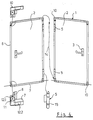
- FIG. 1 shows the arrangement of a reversible door with a frame frame 1 and a door leaf 2.
- the reversible door can be used for the right-hinged or the left-hinged.
- the right-hand stop is shown in the dashed jack set 3, the left-hand stop being shown in a solid line of the jack set 3.
- the frame frame 1 is rotated by 180 degrees in each case in order to achieve the corresponding right-hand or left-hand opening.
- the hinge straps 5 arranged on the longitudinal sides of the frame frame 1 then come to lie on the left or right side accordingly.
- the jack set 3 is then converted accordingly, so that the lock comes to rest below the jack.
- the door leaf 2 is folded all round, the peripheral fold 6 being correspondingly recognizable from the sectional views in FIGS. 2 and 3. It can be seen from FIG. 2 that, in particular, the circumferential fold 6 in its width in the upper and lower transverse region 7 of the door leaf 1 is shorter than the longitudinal fold 8. The width of the circumferential fold 6 in the transverse region 7 is 7 at most one third of the width of the circumferential fold 6 in the longitudinal region 8. Furthermore, it can be seen from the sectioned illustration that the door leaf is of two-shell design and the two shells 9.1 and 9.2 are folded together at least on both longitudinal sides.
- the frame 1, as well as the door leaf 2 and the hinge straps 5 which produce the pivoting connection are arranged on the reversible door in such a way that they are provided correspondingly symmetrically with respect to the center of the door leaf 2 or frame frame 1, so that there is a problem-free turning possibility.
- means 10 and 15 are provided in the frame area of the frame frame 1, by means of which the door leaf (2) is coordinated in the frame frame 1 for the possibility of turning the frame and this can be adapted accordingly in the masonry opening 4 .
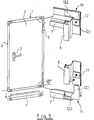
- the means 10 are arranged in the corner region of the frame 1, the means 10 in the detailed representation being emphasized in particular in the case of the door hinged on the right in FIGS. 4 and 5 at the bottom and top of the left region.
- the means 10 consist of angles 11, the free legs 12.1 and 12.2 each slidably engage in the longitudinal spar 8 or in the transverse spar 7 of the frame frame 1 and thus form a right-angled connection of the frame frame 1.
- clamping means 13 are provided in the region of the joint between the end of the cross member 7 and the longitudinal member 8, in particular for fixing the cross member 7. This arrangement ensures that in particular the cross member 7 To avoid an air gap in the upper or lower area of the reversible door can be adjusted so that it can be adjusted either outwards or inwards.
- the clamping means 13 for displacing the cross member 7 are preferably designed as clamping screws. According to the arrow 14 in Figure 4, the change in position is illustrated in the reversible door according to the invention, so that according to the arrow 14, the upper right corner comes to lie in the lower left corner when turning the frame 1 to a door hinged on the right, as shown to get to a door hinged on the left.
- a slide ring designed as a spacer is provided on the hinge strap 5 as the means 15.
- the spacer 15 can also be designed as a rolling element bearing ring, preferably as a ball bearing ring. If the reversible door is turned according to the arrow 14 shown, it is sufficient to implement this spacer 15, which is not a problem, since the frame 1 is first installed, so that the type of storage is predetermined. The spacer 15 is put on when the door leaf 1 is hung in, the hinge pin not being inserted in this state, so that the spacer 15 can simply be inserted and thus serves as a friction-reducing supporting bearing for the door leaf 2.
- the transverse stop bracket 16 which is part of the cross member 7 of the frame frame 1, is designed to be removable.
- This design makes it possible, in particular, to remove the tripping edge on the transverse region 7 of the frame 1, since the stop angle 16 is only required in the upper transverse region 7.
- This design ensures that when the door is turned in the foot area, the stumbling edge, which forms a partial area of the frame frame 1, can be removed.
- the door leaf 1 has a circumferential embossing 17 in the box area, this embossing 17 serving in particular to introduce fire protection strips or sealing strips, which are not shown in detail, so that a hermetic closure of the reversible door is possible in the closed state.
Landscapes
- Engineering & Computer Science (AREA)
- Civil Engineering (AREA)
- Structural Engineering (AREA)
- Mechanical Engineering (AREA)
- Special Wing (AREA)
- Securing Of Glass Panes Or The Like (AREA)
- Specific Sealing Or Ventilating Devices For Doors And Windows (AREA)
- Wing Frames And Configurations (AREA)
- Hinges (AREA)
Abstract
Description
- Die Erfindung betrifft eine Anordnung einer Wendetür mit Zargenrahmen und Türblatt für Rechts- oder Linksanschlag, wobei der Zargenrahmen in eine Mauerwerksöffnung eingelassen ist und das Türblatt mit dem Zargenrahmen über ein Scharnierband schwenkbar verbunden ist.
- Das Türblatt nach dem Stand der Technik ist in den Zargenrahmen schwenkbar eingesetzt, wobei das Türblatt zweischalig ausgebildet ist und die beiden Schalen zumindest an beiden Längsseiten miteinander so verfalzt sind, daß überstehende, in den Spalt zur Zarge verdeckende Längsfalze gebildet werden. Zargenrahmen und Türblatt sind derart miteinander verbunden, daß sie über türblattseitige Bandteile miteinander korrespondierend symmetrisch zur Mitte angeordnet sind. Derartige Türen, die zweischalig aufgebaut sind, mit beidseits ausgeformten Längsfalzen und im Bereich der Oberkante mit einem Querfalz, sind bekannt; sie werden bevorzugt im Bereich feuerhemmender Türen eingesetzt, ohne darauf beschränkt zu sein. Diese Türen müssen jedoch nach Anschlagsart (Rechts- oder Linksanschlag) unterschiedlich gefertigt werden, so daß eine rationelle Fertigung nicht aufgebaut werden kann. Auch ist die Lagerhaltung durch eine Doppel-Ausführung beeinträchtigt; schließlich ist mit Mißverständnissen oder Ausführungsfehlern beim Zargen-Einbau zu rechnen, was zu Reklamationen Anlaß gibt.
- Daher wurde bereits versucht, Rechts-/Links-Türen herzustellen, die für beide Anschlagsarten verwendbar sind. Diese Türen sind streng symmetrisch aufgebaut; ihre Schloßtaschen und ihre Türbänder sind - bezogen auf die horizontale Mitte - dementsprechend vorgesehen, wobei im Regelfall die Schloßtaschen beidseits der Mitte so angeordnet sind, daß die Klinkengarnitur immer geringfügig unterhalb der Mitte liegt. Weiter sind dazu die Türbänder so ausgebildet, daß das zargenseitige Bandteil eine Doppelhülse mit einem Abstand zwischen beiden aufweist, zwischen die die Hülse des türblattseitigen Bandteiles eingeführt und mit einem Einsteckbolzen festgelegt werden kann. Auch diese Bandanordnung liegt wiederum symmetrisch zur Mitte des Zargenrahmens.
- Nachteilig bei diesen Türen ist es, daß sie lediglich die beidseits angeformten Längsfalze aufweisen, so daß unten und/oder oben ein unüberbrückbarer Spalt verbleibt, der die Türöffnung erkennen läßt. Dabei liegt im Regelfall das Türblatt mit seiner Rückseite an dem Zargenrahmen an. Dieser Spalt stellt nicht nur eine optische Beeinträchtigung das Aussehens dar, er bildet auch eine Luft- oder eine Schallbrücke, da durch ihn Luft oder Schall übertreten kann, und - bei feuerhemmenden Türen - auch Brandgase, obwohl das Türblatt rückseitig (mehr oder weniger gut) abgedichtet ist, durch die Wendetüranordnung durchschlagen können.
- Es ist daher die Aufgabe der Erfindung, eine Wendetüranordnung derart weiterzubilden, bei der es das Problem zu lösen gilt, insbesondere den Spalt zu überbrücken, wobei die so weitergebildete Tür mit Zargenrahmen und Rechts-/Links-Türblatt einfach und wirtschaftlich herzustellen ist und der Einbau einfach und wirtschaftlich sein soll.
- Diese Aufgabe wird erfindungsgemäß dadurch gelöst, daß das Türblatt umlaufend gefalzt ist, und wobei im Zargenbereich Mittel vorgesehen sind, mit denen für die Wendemöglichkeit der Zarge eine Abstimmung mit dem Türblatt im Zargenrahmen erfolgt. Aufgrund dieser Ausbildung ist es möglich, insbesondere den störenden Luftspalt bzw. Sichtspalt zu vermeiden. Da einerseits das Türblatt mit einem umlaufenden Falz versehen ist, wobei durch die Wendemöglichkeit der Anordnung, von dem Rechtsanschlag beispielsweise zum Linksanschlag, die Möglichkeit besteht, andererseits in Folge der Mittel zusätzlich den Zargenrahmen entsprechend anzupassen. Hierdurch wird der Zargenrahmen flexibel gestaltet, wobei eine Wendetür geschaffen wird, die problemlos für den Rechts- oder den Linksanschlag eingesetzt werden kann. Hierzu ist in vorteilhafter Weiterbildung der umlaufende Falz von seiner Breite her im oberen und unteren querverlaufenden Bereich des Türblattes kürzer ausgebildet, als der längsverlaufende Falz. Dazu beträgt die Breite des Querfalzes etwa ein Drittel der Breite des Längsfalzes.
- Zur flexiblen Gestaltung des Zargenrahmens sind in zweckmäßiger Weise die Mittel insbesondere im Eckbereich des Zargenrahmens angordnet. Hierzu sind die Mittel aus Winkeln gebildet, deren freie Schenkel jeweils in den Längsholm bzw. in den Querholm des Zargenrahmens verschieblich eingreifen. Aufgrund dieser Ausführung können die Querholme bzw. die Längsholme gegeneinander derart distanziert werden, so daß insbesondere die querverlaufenden Querholme zueinander derart eingestellt werden, daß immer eine dichtende Fläche erreicht wird und der querverlaufende obere bzw. untere Luftspalt vermieden wird, eben dadurch, daß insbesondere die Querholme des Zargenrahmens entsprechend verschoben bzw. verstellt werden können.
- Hierzu sind in zweckmäßiger Weise im Bereich des Stoßes zwischen dem Ende des Querholms und dem Längsholm Klemm-Mittel zum Festlegen des Querholms vorgesehen, die vorzugsweise als Klemmschrauben ausgebildet sind. Diese Möglichkeit bietet insbesondere den Vorteil, daß der Zargenrahmen schnell und einfach auf neue Situationen eingestellt werden kann und somit die Luftspaltbildung eleminiert werden kann.
- Nach einer weiteren vorteilhaften Ausführung der Erfindung ist als Mittel ein als Abstandhalter ausgebildeter Gleitring am Scharnierband vorgesehen. Dabei ist der Abstandhalter ein Wälzkörperlagerring, vorzugsweise ein Kugellagerring. Diese Kürzung des türblattseitigen Bandteils führt zu der Möglichkeit, den Abstandhalter einzufügen, der zum einen unter dem türblattseitigen Hülsenteil (zum Beispiel für Rechtsanschlag), und zum anderen über dem türblattseitigen Hülsenteil (zum Beispiel für Linksanschlag) eingesetzt werden kann. Muß eine Tür gewendet werden, genügt es, diesen Abstandsring umzusetzen, was kein Problem darstellt, da der Zargenrahmen zunächst in die Mauerwerksöffnung eingebaut wird, der die Anschlagsart vorgibt. Das Aufsetzen des Abstandsringes erfolgt beim Einhängen des Türblattes, wobei in diesem Zustand der Bandbolzen noch nicht eingeführt ist, so daß der Abstandsring einfach zwischengefügt werden kann. Diese Ausführung des umsetzbaren Abstandshalters an einer Wendetüranordnung gewährleistet, daß der Gleit- bzw. der Wälzkörperring in der entsprechenden Einbausituation immer das Türblatt trägt, und somit immer ein fast reibungsfreies Verschwenken des Türblattes an der Wendetüranordnung ermöglicht wird.
- Nach einer weiteren vorteilhaften Ausgestaltung der Erfindung ist insbesondere der querverlaufende Anschlagwinkel, der einen Teil des Querholms des Zargenrahmens bildet, abnehmbar. Diese Ausbildung gewährleistet, daß insbesondere eine Stolperschwelle im Fußbereich des Zargenrahmens vermieden werden kann, dadurch, daß der querverlaufende Anschlagwinkel entfernt werden kann. In zweckmäßiger Weiterbildung der Erfindung weist das Türblatt im Kastenbereich eine umlaufende Verprägung auf, die insbesondere dazu dient, in der Verprägung eine Aufnahme für einen Brandschutzstreifen oder eine Dichtung einzubringen, so daß eine hermetische Verriegelung der Wendetür im geschlossenen Zustand gegeben ist.
- Weitere Ausführungsformen der Erfindung werden anhand der nachstehenden Figuren 1 bis 4 näher erläutert, dabei zeigen:
- Fig. 01:
- Eine Frontansicht einer Wendetüranordnung;
- Fig. 02
- : Eine teilweise geschnittene Seitenansicht gemäß der Schnittlinie II - II in der Figur 1;
- Fig. 03:
- Eine teilweise geschnittene Draufsicht gemäß der Schnittlinie III - III in der Figur 1;
- Fig. 04:
- Eine perspektivische Darstellung der Wendetür im Rechts- bzw. im Linksanschlag, mit Detaildarstellungen des Zargenrahmens und des Scharnierbandes; und
- Fig. 05:
- Eine explosionsartige Darstellung der Mittel im Zargenrahmenbereich.
- Die Figur 1 zeigt die Anordnung einer Wendetür mit einem Zargenrahmen 1 und einem Türblatt 2. Wie aus der Frontansicht zu erkennen, kann die Wendetür jeweils für den Rechtsanschlag oder den Linksanschlag verwendet werden. Wie aus der Figur 1 ersichtlich, ist der Rechtsanschlag in der gestrichelten Klinkengarnitur 3 dargestellt, wobei der Linksanschlag in durchgezogener Linie der Klinkengarnitur 3 dargestellt ist. Um eine derartige Wendetür in eine Mauerwerksöffnung 4 einzubringen, so wie es andeutungsweise in den Figuren 2 und 3 in der Schnittdarstellung dargestellt ist, wird der Zargenrahmen 1 jeweils um 180 Grad gedreht, um den entsprechenden Rechts- oder Linksanschlag zu erreichen. Dabei kommen dann die an den Längsseiten des Zargenrahmens 1 angeordneten Scharnierbänder 5 entsprechend auf die linke oder die rechte Seite zu liegen. Entsprechend der Wendung wird dann die Klinkengarnitur 3 entsprechend umgebaut, so daß das Schloß unterhalb der Klinke zu liegen kommt.
- Erfindungsgemäß ist das Türblatt 2 umlaufend gefalzt, wobei der umlaufende Falz 6 entsprechend aus den Schnittdarstellungen der Figuren 2 und 3 zu erkennen ist. Aus der Figur 2 ist zu erkennen, daß insbesondere der umlaufende Falz 6 von seiner Breite her im oberen und unteren querverlaufenden Bereich 7 des Türblattes 1 kürzer ausgebildet ist, als der längsverlaufende Falz 8. Dabei beträgt die Breite des umlaufenden Falzes 6 im querverlaufenden Bereich 7 höchsten ein Drittel der Breite des umlaufenden Falzes 6 im längsverlaufenden Bereich 8. Weiterhin ist aus der geschnittenen Darstellung zu erkennen, daß das Türblatt zweischalig ausgebildet ist und die beiden Schalen 9.1 und 9.2 zumindest an beiden Längsseiten miteinander verfalzt sind.
- Der Zargenrahmen 1, sowie das Türblatt 2 und die zur verschwenkenden Verbindung herstellenden Scharnierbänder 5 sind an der Wendetür derart angeordnet, daß sie miteinander korrespondierend symmetrisch zur Mitte von Türblatt 2 bzw. Zargenrahmen 1 vorgesehen sind, damit eine problemlose Wendemöglichkeit besteht.
- Wie insbesondere aus der Figur 4 zu erkennen, sind im Zargenbereich des Zargenrahmens 1 Mittel 10 und 15 vorgesehen, mit denen für die Wendemöglichkeit der Zarge eine Abstimmung mit dem Türblatt (2) im Zargenrahmen 1 erfolgt und dieser entsprechend in der Mauerwerksöffnung 4 angepaßt werden kann. Dabei sind einerseits die Mittel 10 im Eckbereich des Zargenrahmens 1 angeordnet, wobei die Mittel 10 in der Detaildarstellung insbesondere bei der rechts angeschlagenen Tür der Figur 4 und 5 jeweils unten und oben am linken Bereich herausgestellt werden. Die Mittel 10 bestehen dabei aus Winkeln 11, deren freie Schenkel 12.1 und 12.2 jeweils in den Längsholm 8 bzw. in den Querholm 7 des Zargenrahmens 1 verschieblich eingreifen und somit eine rechtwinklige Verbindung des Zargenrahmens 1 bilden. Zur Stabilisierung des Zargenrahmens 1 sind im Bereich des Stoßes zwischen dem Ende des Querholms 7 und dem Längsholm 8 Klemmmittel 13, insbesondere zum Festlegen des Querholms 7, vorgesehen. Aufgrund dieser Anordnung ist gewährleistet, daß insbesondere der Querholm 7 zur Vermeidung eines Luftspaltes im oberen oder unteren Bereich der Wendetür derart verstellt werden kann, daß er entweder nach außen hin bzw. nach innen hin verstellt werden kann. Die Klemmmittel 13 zur Verlagerung des Querholms 7 sind dabei vorzugsweise als Klemmschrauben ausgebildet. Entsprechend des Pfeiles 14 in der Figur 4 wird die Lageveränderung bei der erfindungsgemäßen Wendetür veranschaulicht, so daß entsprechend des Pfeiles 14 die obere rechte Ecke beim Wenden des Zargenrahmens 1 in die untere linke Ecke zu liegen kommt, um aus einer rechts angeschlagenen Tür, wie dargestellt, zu einer links angeschlagenen Tür zu gelangen.
- Wie aus einer weiteren Detailansicht der Figur 4 zu erkennen ist, ist als Mittel 15 ein als Abstandshalter ausgebildeter Gleitring am Scharnierband 5 vorgesehen. Dabei kann der Abstandshalter 15 auch als Wälzkörperlagerring` vorzugsweise als ein Kugellagerring, ausgebildet sein. Wird die Wendetür gemäß dem dargestellten Pfeil 14 gewendet, genügt es, diesen Abstandshalter 15 umzusetzen, was kein Problem darstellt, da der Zargenrahmen 1 zunächst eingebaut wird, so daß die Lagerungsart vorgegeben ist. Das Aufsetzen des Abstandshalters 15 erfolgt beim Einhängen des Türblattes 1, wobei in diesem Zustand der Bandbolzen noch nicht eingeführt ist, so daß der Abstandshalter 15 einfach zwischengefügt werden kann und somit als reibungsminderndes tragendes Auflager für das Türblatt 2 dient.
- Nach einer vorteilhaften Weiterbildung der Erfindung, wie sie insbesondere in den Figuren 2 und 3 zu erkennen ist, ist der querverlaufende Anschlagwinkel 16, der Teil des Querholmes 7 des Zargenrahmens 1 ist, abnehmbar ausgebildet. Diese Ausbildung, wie sie in der Figur 2 zu erkennen ist, ermöglicht insbesondere an dem querverlaufenden Bereich 7 des Zargenrahmens 1 die Stolperkante zu entfernen, da der Anschlagwinkel 16 nur im oberen querverlaufenden Bereich 7 erforderlich ist. Aufgrund dieser Ausbildung ist gewährleistet, daß beim Wenden der Tür im Fußbereich die Stolperkante, die ein Teilbereich des Zargenrahmens 1 bildet, entfernt werden kann. Weiterhin ist aus den Schnittdarstellungen der Figur 2 und 3 zu erkennen, daß das Türblatt 1 im Kastenbereich eine umlaufende Verprägung 17 aufweist, wobei diese Verprägung 17 insbesondere dazu dient, in ihr nicht näher dargestellte Brandschutzstreifen oder Dichtungsstreifen einzubringen, so daß eine hermetische Verschließung der Wendetür im geschlossenen Zustand möglich ist.
Claims (10)
- Anordnung einer Wendetür mit Zargenrahmen und Türblatt für Rechts- oder Linksanschlag, wobei der Zargenrahmen in eine Mauerwerksöffnung eingelassen ist und das Türblatt mit dem Zargenrahmen über ein Scharnierband schwenkbar verbunden ist, dadurch gekennzeichnet, daß das Türblatt (2) umlaufend gefalzt ist, und wobei im Zargenbereich Mittel (10,15) vorgesehen sind, mit denen für die Wendemöglichkeit der Zarge eine Abstimmung mit dem Türblatt (2) im Zargenrahmen (1) erfolgt.
- Anordnung nach Anspruch 1, dadurch gekennzeichnet, daß der umlaufende Falz (6) von seiner Breite her im oberen und unteren querverlaufenden Bereich (7) des Türblattes (2) kürzer ausgebildet ist als der längsverlaufende Falz (8).
- Anordnung nach Anspruch 2, dadurch gekennzeichnet, daß die Breite der Querfalze (7) etwa ein Drittel der Breite der Längsfalze (8) beträgt.
- Anordnung nach Anspruch 1, dadurch gekennzeichnet, daß die Mittel (10) im Eckbereich des Zargenrahmens (1) angeordnet sind.
- Anordnung nach Anspruch 4, dadurch gekennzeichnet, daß die Mittel (10) aus Winkeln (11) gebildet sind, deren freie Schenkel (12.1) und (12.2) jeweils in den Längsholm (8) bzw. in den Querholm (7) des Zargenrahmens (1) verschieblich eingreifen.
- Anordnung nach Anspruch 5, dadurch gekennzeichnet, daß im Bereich des Stoßes zwischen dem Ende des Querholms (7) und dem Längsholm (8) Klemmittel (13) zum Festlegen des Querholms (7) vorgesehen sind, die vorzugsweise als eine Klemmschraube ausgebildet sind.
- Anordnung nach Anspruch 1, dadurch gekennzeichnet, daß als Mittel (15) ein als Abstandhalter ausgebildeter Gleitring am Scharnierband (5) vorgesehen ist.
- Anordnung nach Anspruch 7, dadurch gekennzeichnet, daß der Abstandshalter (15) ein Wälzkörperlagerring, vorzugsweise ein Kugellagerring ist.
- Anordnung nach Anspruch 1, dadurch gekennzeichnet, daß der querverlaufende Anschlagwinkel (16), der einen Teil des Querholms (7) des Zargenrahmens (1) bildet, abnehmbar ausgebildet ist.
- Anordnung nach einem oder mehreren der vorhergehenden Ansprüche 1 bis 9, dadurch gekennzeichnet, daß das Türblatt (2) im Kastenbereich eine umlaufende Verprägung (17) aufweist, zur Aufnahme eines Brandschutzstreifens oder einer Dichtung.
Applications Claiming Priority (2)
| Application Number | Priority Date | Filing Date | Title |
|---|---|---|---|
| DE29507001U | 1995-04-26 | ||
| DE29507001U DE29507001U1 (de) | 1995-04-26 | 1995-04-26 | Anordnung einer Wendetür mit Zargenrahmen und Türblatt |
Publications (3)
| Publication Number | Publication Date |
|---|---|
| EP0740043A2 true EP0740043A2 (de) | 1996-10-30 |
| EP0740043A3 EP0740043A3 (de) | 1997-05-02 |
| EP0740043B1 EP0740043B1 (de) | 2000-06-14 |
Family
ID=8007304
Family Applications (1)
| Application Number | Title | Priority Date | Filing Date |
|---|---|---|---|
| EP96105195A Expired - Lifetime EP0740043B1 (de) | 1995-04-26 | 1996-04-01 | Anordnung einer Wendetür mit Zargenrahmen und Türblatt |
Country Status (8)
| Country | Link |
|---|---|
| EP (1) | EP0740043B1 (de) |
| CN (1) | CN1139174A (de) |
| AT (1) | ATE193920T1 (de) |
| CZ (1) | CZ120796A3 (de) |
| DE (2) | DE29507001U1 (de) |
| ES (1) | ES2148620T3 (de) |
| HR (1) | HRP960198A2 (de) |
| PL (1) | PL181793B1 (de) |
Cited By (3)
| Publication number | Priority date | Publication date | Assignee | Title |
|---|---|---|---|---|
| EP1550786A3 (de) * | 2003-12-30 | 2006-10-04 | Hörmann KG Brandis | Zarge, insbesondere für eine Wendetür |
| US12018519B2 (en) | 2022-04-26 | 2024-06-25 | Crystal Salcido | Locking device |
| DE102024102537A1 (de) | 2023-01-30 | 2024-08-01 | Huga Kg | Teilesatz einer R/L-verwendbaren Tür auf der Basis von Holzwerkstoffen |
Families Citing this family (8)
| Publication number | Priority date | Publication date | Assignee | Title |
|---|---|---|---|---|
| DE19700973C1 (de) * | 1997-01-14 | 1998-03-12 | Novoferm Gmbh | Feuerschutztür |
| DE19723555C2 (de) * | 1997-06-05 | 2002-03-21 | Rittal Gmbh & Co Kg | Verstellbares Scharnier für einen Schaltschrank |
| DE102006018821B4 (de) * | 2005-07-09 | 2013-02-07 | H & K Teckentrup Kg | Stahltür |
| AT505997B1 (de) * | 2007-10-15 | 2013-02-15 | Josko Fenster Und Tueren Gmbh | Zarge |
| FR2960902B1 (fr) | 2010-06-08 | 2015-04-24 | Baumert Technologies | Bloc-porte coupe feu a un ou deux vantaux pivotant(s) |
| CN104453621B (zh) * | 2014-11-21 | 2016-08-24 | 许健萍 | 一种铝合金门窗窗框的连接勾结构 |
| CN109519067A (zh) * | 2018-10-16 | 2019-03-26 | 潘雲生 | 门组件的铰接机构 |
| CN112593823B (zh) * | 2020-11-27 | 2022-08-23 | 重庆非可智能家居有限公司 | 一种形状可调的门 |
Citations (2)
| Publication number | Priority date | Publication date | Assignee | Title |
|---|---|---|---|---|
| CH447559A (de) | 1967-02-02 | 1967-11-30 | Meyer Ag | Elementtüre |
| DE2947509A1 (de) | 1979-11-24 | 1981-05-27 | Podszuck Gmbh & Co Kg, 2300 Kiel | Tuer mit einem seitlich und oben ueberfaelzten und unten stumpfen tuerblatt |
Family Cites Families (7)
| Publication number | Priority date | Publication date | Assignee | Title |
|---|---|---|---|---|
| US3251156A (en) * | 1963-10-24 | 1966-05-17 | Feather Lite Mfg Co | Door and frame assembly |
| DE1683419C3 (de) * | 1967-02-06 | 1974-09-12 | Fa. Gustav Riexinger, 7100 Heilbronn | Türzarge, die als geschlossener, vorfabrizierter Rechteckrahmen ausgebildet ist |
| FR2056458A5 (de) * | 1970-07-06 | 1971-05-14 | Gregoire Jean Claude | |
| DE8206386U1 (de) * | 1982-03-08 | 1992-08-12 | Held, Richard, 5239 Kirburg | In einer zarge gehaltene thermisch isolierte tuer |
| DE3712584A1 (de) * | 1987-04-14 | 1988-11-03 | Sommer Metallbau Stahlbau Gmbh | Tuer |
| BE1006013A3 (nl) * | 1988-08-03 | 1994-04-19 | Metamar Naamloze Vennootschap | Metalen deur. |
| DE4310284C2 (de) * | 1993-03-30 | 1995-11-09 | Peter Dipl Ing Wagner | Rahmen, insbesondere Tür- oder Fensterzarge |
-
1995
- 1995-04-26 DE DE29507001U patent/DE29507001U1/de not_active Expired - Lifetime
-
1996
- 1996-04-01 EP EP96105195A patent/EP0740043B1/de not_active Expired - Lifetime
- 1996-04-01 DE DE59605428T patent/DE59605428D1/de not_active Expired - Lifetime
- 1996-04-01 ES ES96105195T patent/ES2148620T3/es not_active Expired - Lifetime
- 1996-04-01 AT AT96105195T patent/ATE193920T1/de not_active IP Right Cessation
- 1996-04-19 PL PL96313856A patent/PL181793B1/pl not_active IP Right Cessation
- 1996-04-24 CN CN96105451A patent/CN1139174A/zh active Pending
- 1996-04-24 HR HR29507001.3A patent/HRP960198A2/hr not_active Application Discontinuation
- 1996-04-25 CZ CZ961207A patent/CZ120796A3/cs unknown
Patent Citations (2)
| Publication number | Priority date | Publication date | Assignee | Title |
|---|---|---|---|---|
| CH447559A (de) | 1967-02-02 | 1967-11-30 | Meyer Ag | Elementtüre |
| DE2947509A1 (de) | 1979-11-24 | 1981-05-27 | Podszuck Gmbh & Co Kg, 2300 Kiel | Tuer mit einem seitlich und oben ueberfaelzten und unten stumpfen tuerblatt |
Cited By (3)
| Publication number | Priority date | Publication date | Assignee | Title |
|---|---|---|---|---|
| EP1550786A3 (de) * | 2003-12-30 | 2006-10-04 | Hörmann KG Brandis | Zarge, insbesondere für eine Wendetür |
| US12018519B2 (en) | 2022-04-26 | 2024-06-25 | Crystal Salcido | Locking device |
| DE102024102537A1 (de) | 2023-01-30 | 2024-08-01 | Huga Kg | Teilesatz einer R/L-verwendbaren Tür auf der Basis von Holzwerkstoffen |
Also Published As
| Publication number | Publication date |
|---|---|
| HRP960198A2 (en) | 1997-08-31 |
| EP0740043A3 (de) | 1997-05-02 |
| CN1139174A (zh) | 1997-01-01 |
| PL181793B1 (pl) | 2001-09-28 |
| DE59605428D1 (de) | 2000-07-20 |
| CZ120796A3 (en) | 1996-11-13 |
| ATE193920T1 (de) | 2000-06-15 |
| EP0740043B1 (de) | 2000-06-14 |
| ES2148620T3 (es) | 2000-10-16 |
| DE29507001U1 (de) | 1996-05-30 |
Similar Documents
| Publication | Publication Date | Title |
|---|---|---|
| EP0740043B1 (de) | Anordnung einer Wendetür mit Zargenrahmen und Türblatt | |
| EP4098836B1 (de) | Sektionaltor | |
| EP0947654A1 (de) | Verschwindscharnier | |
| DE2460402B2 (de) | Ausstellvorrichtung für Drehkippflügel von Fenstern, Türen o.dgl. | |
| DE4022827A1 (de) | Einrichtung zum verschluss mit mindestens einem doppelanschlag, insbesondere fuer fenster, fenstertueren und tueren | |
| DE2437296C2 (de) | Hohlprofilleiste | |
| EP3581752B1 (de) | Fenster | |
| DE20321194U1 (de) | Durchgangstür für Lamellentore mit austauschbaren Teilstücken | |
| WO1991008658A1 (de) | Rahmen für einen schaltschrank oder dergleichen | |
| DE1683419A1 (de) | Tuerelement | |
| DE69612538T2 (de) | Flügelrahmen für Doppelflügelfenster | |
| DE69001043T2 (de) | Faltwand. | |
| EP0965719A2 (de) | Falt-Schiebetür | |
| DE10235301B4 (de) | Faltanlage | |
| EP1367209A2 (de) | Faltanlage | |
| DE3050971C3 (de) | Beschlag für den Schiebeflügel von Fenstern, Türen oder dgl. | |
| DE2404267C2 (de) | Ausstellvorrichtung für Drehkippfenster, -türen od. dgl. aus Metall- oder Kunststoffprofilen | |
| DE69913279T2 (de) | Gelenk für eine Gelenkverbindung zwischen Tür-/Tor-Teilen | |
| DE3625105C1 (en) | Door hinge for a sheet-metal or plastic cupboard | |
| CH655762A5 (en) | Folding sliding part for external and internal walls of buildings | |
| DE4308955A1 (de) | Rahmen zur verstellbaren Aufnahme eines Insektengitters | |
| DE20303262U1 (de) | Drehband | |
| EP0715051A1 (de) | Halterung einer eine Gebäudeöffnung abdeckenden Doppel- und Mehrfachscheibe | |
| EP2072744A2 (de) | Zargenprofil für eine Hebe-Schiebetür | |
| DE19541042C2 (de) | Aluminium- oder Kunststoffenster, -tür oder dergleichen mit Gelenkverbindung |
Legal Events
| Date | Code | Title | Description |
|---|---|---|---|
| PUAI | Public reference made under article 153(3) epc to a published international application that has entered the european phase |
Free format text: ORIGINAL CODE: 0009012 |
|
| AK | Designated contracting states |
Kind code of ref document: A2 Designated state(s): AT BE CH DE DK ES FI FR GB GR IE IT LI LU MC NL PT SE |
|
| AX | Request for extension of the european patent |
Free format text: SI PAYMENT 960413 |
|
| RAX | Requested extension states of the european patent have changed |
Free format text: SI PAYMENT 960413 |
|
| PUAL | Search report despatched |
Free format text: ORIGINAL CODE: 0009013 |
|
| RHK1 | Main classification (correction) |
Ipc: E06B 1/52 |
|
| AK | Designated contracting states |
Kind code of ref document: A3 Designated state(s): AT BE CH DE DK ES FI FR GB GR IE IT LI LU MC NL PT SE |
|
| AX | Request for extension of the european patent |
Free format text: SI PAYMENT 960413 |
|
| 17P | Request for examination filed |
Effective date: 19970703 |
|
| 17Q | First examination report despatched |
Effective date: 19981102 |
|
| GRAG | Despatch of communication of intention to grant |
Free format text: ORIGINAL CODE: EPIDOS AGRA |
|
| GRAG | Despatch of communication of intention to grant |
Free format text: ORIGINAL CODE: EPIDOS AGRA |
|
| GRAH | Despatch of communication of intention to grant a patent |
Free format text: ORIGINAL CODE: EPIDOS IGRA |
|
| TPAD | Observations filed by third parties |
Free format text: ORIGINAL CODE: EPIDOS TIPA |
|
| GRAH | Despatch of communication of intention to grant a patent |
Free format text: ORIGINAL CODE: EPIDOS IGRA |
|
| RIN1 | Information on inventor provided before grant (corrected) |
Inventor name: TECKENTRUP, WALTER |
|
| GRAA | (expected) grant |
Free format text: ORIGINAL CODE: 0009210 |
|
| AK | Designated contracting states |
Kind code of ref document: B1 Designated state(s): AT BE CH DE DK ES FI FR GB GR IE IT LI LU MC NL PT SE |
|
| AX | Request for extension of the european patent |
Free format text: SI PAYMENT 19960413 |
|
| PG25 | Lapsed in a contracting state [announced via postgrant information from national office to epo] |
Ref country code: GR Free format text: LAPSE BECAUSE OF NON-PAYMENT OF DUE FEES Effective date: 20000614 Ref country code: FI Free format text: LAPSE BECAUSE OF FAILURE TO SUBMIT A TRANSLATION OF THE DESCRIPTION OR TO PAY THE FEE WITHIN THE PRESCRIBED TIME-LIMIT Effective date: 20000614 |
|
| REF | Corresponds to: |
Ref document number: 193920 Country of ref document: AT Date of ref document: 20000615 Kind code of ref document: T |
|
| REG | Reference to a national code |
Ref country code: CH Ref legal event code: EP |
|
| GBT | Gb: translation of ep patent filed (gb section 77(6)(a)/1977) |
Effective date: 20000615 |
|
| REG | Reference to a national code |
Ref country code: CH Ref legal event code: NV Representative=s name: BOVARD AG PATENTANWAELTE |
|
| REF | Corresponds to: |
Ref document number: 59605428 Country of ref document: DE Date of ref document: 20000720 |
|
| REG | Reference to a national code |
Ref country code: IE Ref legal event code: FG4D Free format text: GERMAN |
|
| ITF | It: translation for a ep patent filed | ||
| PG25 | Lapsed in a contracting state [announced via postgrant information from national office to epo] |
Ref country code: SE Free format text: LAPSE BECAUSE OF FAILURE TO SUBMIT A TRANSLATION OF THE DESCRIPTION OR TO PAY THE FEE WITHIN THE PRESCRIBED TIME-LIMIT Effective date: 20000914 Ref country code: PT Free format text: LAPSE BECAUSE OF FAILURE TO SUBMIT A TRANSLATION OF THE DESCRIPTION OR TO PAY THE FEE WITHIN THE PRESCRIBED TIME-LIMIT Effective date: 20000914 Ref country code: DK Free format text: LAPSE BECAUSE OF FAILURE TO SUBMIT A TRANSLATION OF THE DESCRIPTION OR TO PAY THE FEE WITHIN THE PRESCRIBED TIME-LIMIT Effective date: 20000914 |
|
| ET | Fr: translation filed | ||
| REG | Reference to a national code |
Ref country code: ES Ref legal event code: FG2A Ref document number: 2148620 Country of ref document: ES Kind code of ref document: T3 |
|
| PG25 | Lapsed in a contracting state [announced via postgrant information from national office to epo] |
Ref country code: IE Free format text: LAPSE BECAUSE OF NON-PAYMENT OF DUE FEES Effective date: 20010205 |
|
| REG | Reference to a national code |
Ref country code: IE Ref legal event code: FD4D |
|
| PG25 | Lapsed in a contracting state [announced via postgrant information from national office to epo] |
Ref country code: LU Free format text: LAPSE BECAUSE OF NON-PAYMENT OF DUE FEES Effective date: 20010401 |
|
| PLBE | No opposition filed within time limit |
Free format text: ORIGINAL CODE: 0009261 |
|
| STAA | Information on the status of an ep patent application or granted ep patent |
Free format text: STATUS: NO OPPOSITION FILED WITHIN TIME LIMIT |
|
| PG25 | Lapsed in a contracting state [announced via postgrant information from national office to epo] |
Ref country code: MC Free format text: LAPSE BECAUSE OF NON-PAYMENT OF DUE FEES Effective date: 20010430 Ref country code: BE Free format text: LAPSE BECAUSE OF NON-PAYMENT OF DUE FEES Effective date: 20010430 |
|
| 26N | No opposition filed | ||
| BERE | Be: lapsed |
Owner name: FIRMA WALTER TECKENTRUP Effective date: 20010430 |
|
| REG | Reference to a national code |
Ref country code: GB Ref legal event code: IF02 |
|
| PGFP | Annual fee paid to national office [announced via postgrant information from national office to epo] |
Ref country code: GB Payment date: 20060327 Year of fee payment: 11 |
|
| PGFP | Annual fee paid to national office [announced via postgrant information from national office to epo] |
Ref country code: FR Payment date: 20060329 Year of fee payment: 11 |
|
| PGFP | Annual fee paid to national office [announced via postgrant information from national office to epo] |
Ref country code: NL Payment date: 20060331 Year of fee payment: 11 |
|
| PGFP | Annual fee paid to national office [announced via postgrant information from national office to epo] |
Ref country code: ES Payment date: 20060406 Year of fee payment: 11 |
|
| PGFP | Annual fee paid to national office [announced via postgrant information from national office to epo] |
Ref country code: CH Payment date: 20060408 Year of fee payment: 11 |
|
| PGFP | Annual fee paid to national office [announced via postgrant information from national office to epo] |
Ref country code: AT Payment date: 20060427 Year of fee payment: 11 |
|
| PGFP | Annual fee paid to national office [announced via postgrant information from national office to epo] |
Ref country code: IT Payment date: 20060430 Year of fee payment: 11 |
|
| REG | Reference to a national code |
Ref country code: CH Ref legal event code: PL |
|
| GBPC | Gb: european patent ceased through non-payment of renewal fee |
Effective date: 20070401 |
|
| NLV4 | Nl: lapsed or anulled due to non-payment of the annual fee |
Effective date: 20071101 |
|
| PG25 | Lapsed in a contracting state [announced via postgrant information from national office to epo] |
Ref country code: NL Free format text: LAPSE BECAUSE OF NON-PAYMENT OF DUE FEES Effective date: 20071101 |
|
| PG25 | Lapsed in a contracting state [announced via postgrant information from national office to epo] |
Ref country code: AT Free format text: LAPSE BECAUSE OF NON-PAYMENT OF DUE FEES Effective date: 20070401 Ref country code: CH Free format text: LAPSE BECAUSE OF NON-PAYMENT OF DUE FEES Effective date: 20070430 Ref country code: LI Free format text: LAPSE BECAUSE OF NON-PAYMENT OF DUE FEES Effective date: 20070430 |
|
| PG25 | Lapsed in a contracting state [announced via postgrant information from national office to epo] |
Ref country code: GB Free format text: LAPSE BECAUSE OF NON-PAYMENT OF DUE FEES Effective date: 20070401 |
|
| REG | Reference to a national code |
Ref country code: ES Ref legal event code: FD2A Effective date: 20070402 |
|
| PG25 | Lapsed in a contracting state [announced via postgrant information from national office to epo] |
Ref country code: FR Free format text: LAPSE BECAUSE OF NON-PAYMENT OF DUE FEES Effective date: 20070430 |
|
| PG25 | Lapsed in a contracting state [announced via postgrant information from national office to epo] |
Ref country code: ES Free format text: LAPSE BECAUSE OF NON-PAYMENT OF DUE FEES Effective date: 20070402 |
|
| PG25 | Lapsed in a contracting state [announced via postgrant information from national office to epo] |
Ref country code: IT Free format text: LAPSE BECAUSE OF NON-PAYMENT OF DUE FEES Effective date: 20070401 |
|
| PGFP | Annual fee paid to national office [announced via postgrant information from national office to epo] |
Ref country code: DE Payment date: 20100217 Year of fee payment: 15 |
|
| REG | Reference to a national code |
Ref country code: DE Ref legal event code: R119 Ref document number: 59605428 Country of ref document: DE |
|
| REG | Reference to a national code |
Ref country code: DE Ref legal event code: R119 Ref document number: 59605428 Country of ref document: DE |
|
| PG25 | Lapsed in a contracting state [announced via postgrant information from national office to epo] |
Ref country code: DE Free format text: LAPSE BECAUSE OF NON-PAYMENT OF DUE FEES Effective date: 20111031 |