EP0740318A2 - Hochspannungstransformator für einen Fernsehempfänger - Google Patents
Hochspannungstransformator für einen Fernsehempfänger Download PDFInfo
- Publication number
- EP0740318A2 EP0740318A2 EP96106154A EP96106154A EP0740318A2 EP 0740318 A2 EP0740318 A2 EP 0740318A2 EP 96106154 A EP96106154 A EP 96106154A EP 96106154 A EP96106154 A EP 96106154A EP 0740318 A2 EP0740318 A2 EP 0740318A2
- Authority
- EP
- European Patent Office
- Prior art keywords
- core
- leg
- legs
- core leg
- chamfer
- Prior art date
- Legal status (The legal status is an assumption and is not a legal conclusion. Google has not performed a legal analysis and makes no representation as to the accuracy of the status listed.)
- Granted
Links
Images
Classifications
-
- H—ELECTRICITY
- H01—ELECTRIC ELEMENTS
- H01F—MAGNETS; INDUCTANCES; TRANSFORMERS; SELECTION OF MATERIALS FOR THEIR MAGNETIC PROPERTIES
- H01F3/00—Cores, Yokes, or armatures
- H01F3/10—Composite arrangements of magnetic circuits
- H01F3/14—Constrictions; Gaps, e.g. air-gaps
-
- H—ELECTRICITY
- H01—ELECTRIC ELEMENTS
- H01F—MAGNETS; INDUCTANCES; TRANSFORMERS; SELECTION OF MATERIALS FOR THEIR MAGNETIC PROPERTIES
- H01F38/00—Adaptations of transformers or inductances for specific applications or functions
- H01F38/42—Flyback transformers
-
- H—ELECTRICITY
- H01—ELECTRIC ELEMENTS
- H01F—MAGNETS; INDUCTANCES; TRANSFORMERS; SELECTION OF MATERIALS FOR THEIR MAGNETIC PROPERTIES
- H01F5/00—Coils
- H01F5/02—Coils wound on non-magnetic supports, e.g. formers
- H01F2005/022—Coils wound on non-magnetic supports, e.g. formers wound on formers with several winding chambers separated by flanges, e.g. for high voltage applications
Definitions
- the invention is based on a high-voltage transformer according to the preamble of claim 1.
- a transformer is known from DE-OS 43 02 271.
- a wedge-shaped air gap is created between the ends of the core legs colliding, which advantageously influences the magnetization characteristic of the transformer.
- the two legs meet e.g. together on the outer edge of the core.
- the contact surface is punctiform or linear and therefore very small. This small area results in a high system pressure. Due to tolerance-related deviations in the geometric position of the two core legs relative to one another and in the dimensions of the core legs, it can therefore happen that the outer edges of the two core legs match exactly and then the risk of an edge breaking out on the outside of a core leg is particularly great.
- the invention has for its object to modify the core so that the two core legs are properly supported even with tolerances and the risk of core parts breaking out is reduced.
- the end of a core leg is thus chamfered or rounded on the outside such that the contact area between the core legs is removed from the outer edges of the core legs.
- the contact area in which the two ends of the two legs meet is moved from the outer edge of the core legs towards the center of the core legs. If tolerances now occur in the position of this area, there is no longer any risk that the Contact area with the edges of the core legs.
- the contact area, which is in particular punctiform or line-shaped, is thus with certainty for a core always in an area of the front end of the core leg that is far enough from the edge. The risk of breakage is thus eliminated for this core.
- the edge of one core leg, with which it rests on the front end of the other core leg forms an angle of 90 ° and is therefore relatively sharp.
- the edge at the end of one core leg, which meets the front end of the other core leg forms an increased angle of the order of 130-150 ° and is therefore less sharp, which reduces the risk of damage to this core leg becomes.
- the invention is applicable to core legs with a round and rectangular cross section.
- the end of the core leg is preferably provided with a chamfer. Such a chamfer can be produced when the core is pressed without any significant additional effort.
- the chamfer preferably forms an angle of the order of 130 ° with the front end of the core leg and extends e.g. over about 10% of the width or diameter of the core leg.
- the core leg is preferably symmetrically chamfered or rounded on opposite edges in the same way. This can simplify production and, in particular, avoid stresses during sintering of the core.
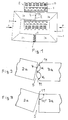
- Fig. 1 shows a ferrite core 1 with two U-shaped core halves 2, 3 whose parallel legs 2a, 2b and 3a, 3b are each composed. This results in a first joint between the core legs 2a and 3a and a second joint between the core legs 2b and 3b.
- the two core halves 2, 3 are tilted against each other. This results in a wedge-shaped air gap 5 at the upper joint, which causes the described improvement in the magnetization characteristic of the transformer and the reduction in the internal resistance of the high-voltage source.
- the core legs 2a and 3a carry the coil former 8, which carries the primary winding 9 and the high-voltage winding 10 designed as a chamber winding.
- the front end of the core leg 3a is now provided with a bevel in the form of a chamfer 11, which forms an angle ⁇ of approximately 130 ° with the remaining surface area of the front end of the core leg 3a.
- a chamfer 11 which forms an angle ⁇ of approximately 130 ° with the remaining surface area of the front end of the core leg 3a.
- the joint 4 which would in itself lie on the upper edge of the core legs 2a and 3a, is displaced in the direction of the center of the core legs 2a, 3a.
- the joint 4 is now so far from the edge of the Core leg 2a and 3a removed that the edge at the end of the core leg 3a rests much more prone to breakage on the end face of the core leg 2a.
- Fig. 2 shows the formation of the core legs 2a and 3a somewhat enlarged. It can be seen that the angle ⁇ between the chamfer 11 and the rest of the front end of the core leg 3a is substantially greater than 90 °, namely approximately 130-150 °. This increased angle reduces the risk of the core being destroyed or individual core parts breaking out. For manufacturing reasons, the chamfer 11 is also provided symmetrically on the other edge of the core leg 3a.
- Fig. 3 shows a known arrangement of the mutually tilted core legs 2a, 3a. This results in the dangerous punctiform or linear support 11 between two sharp edges, in which the risk of breaking out of ferrite parts is very high.
Landscapes
- Engineering & Computer Science (AREA)
- Power Engineering (AREA)
- Chemical & Material Sciences (AREA)
- Composite Materials (AREA)
- Coils Or Transformers For Communication (AREA)
Abstract
Description
- Die Erfindung geht aus von einem Hochspannungstransformator gemäß dem Oberbegriff des Anspruchs 1. Ein derartiger Transformator ist bekannt durch die DE-OS 43 02 271.
- Durch die Kippung der beiden Kernhälften gegeneinander entsteht zwischen den Stirnenden zusammenstoßender Kernschenkel ein keilförmiger Luftspalt, der die Magnetisierungskennlinie des Transformators vorteilhaft beeinflußt. Die beiden Schenkel stoßen dabei z.B. an der Außenkante des Kernes zusammen. Dabei ist die Anlagefläche punktförmig oder linienförmig und daher sehr klein. Durch diese geringe Fläche ergibt sich ein hoher Anlagedruck. Durch toleranzbedingte Abweichungen in der geometrischen Lage der beiden Kernschenkel zueinander und in den Abmessungen der Kernschenkel kann es daher vorkommen, daß die Außenkanten der beiden Kernschenkel genau übereinstimmen und dann die Gefahr des Ausbrechens einer Kante an der Außenseite eines Kernschenkels besonders groß ist.
- Der Erfindung liegt die Aufgabe zugrunde, den Kern so abzuwandeln, daß auch bei Toleranzen eine einwandfreie Auflage der beiden Kernschenkel erfolgt und die Gefahr eines Ausbrechens von Kernteilen verringert wird.
- Diese Aufgabe wird durch die im Anspruch 1 angegebene Erfindung gelöst. Vorteilhafte Weiterbildungen der Erfindung sind in den Unteransprüchen angegeben.
- Gemäß der Erfindung ist somit das Ende eines Kernschenkels an der Außenseite so abgeschrägt oder abgerundet, daß der Anlagebereich zwischen den Kernschenkeln von den Außenkanten der Kernschenkel entfernt ist. Durch diese Ausbildung eines Kernschenkels ergeben sich im wesentlichen zwei Vorteile.
- Durch die Abschrägung oder Abrundung wird der Anlagebereich, in dem die beiden Stirnenden der beiden Schenkel zusammenstoßen, von der Außenkante der Kernschenkel in Richtung zur Mitte der Kernschenkel verlegt. Wenn jetzt Toleranzen in der Lage dieses Bereiches auftreten, so besteht nicht mehr die Gefahr, daß der Anlagebereich mit den Kanten der Kernschenkel übereinstimmt. Der Anlagebereich, der insbesondere punktförmig oder linienförmig ist, liegt somit mit Sicherheit für einen Kern immer in einem Bereich des Stirnendes des Kernschenkels, der von der Kante weit genug entfernt ist. Für diesen Kern ist die Bruchgefahr also beseitigt. Für die andere Kernhälfte gilt folgendes:
- Bei der bekannten Lösung bildet die Kante des eines Kernschenkels, mit der dieser auf dem Stirnende des anderen Kernschenkels aufliegt, ein Winkel von 90° und ist somit relativ scharf. Bei der erfindungsgemäßen Abschrägung oder Abrundnung bildet indessen die Kante am Ende des einen Kernschenkels, die mit dem Stirnende des anderen Kernschenkels zusammenstößt, einen erhöhten Winkel in der Größenordnung von 130 - 150° und ist daher weniger scharf, wodurch die Gefahr einer Beschädigung dieses Kernschenkels verringert wird. Die Erfindung ist bei Kernschenkeln mit rundem und mit rechteckigem Querschnitt anwendbar.
- Vorzugsweise ist das Ende des Kernschenkels mit einer Fase versehen. Eine solche Fase läßt sich beim Pressen des Kernes ohne nennenswerten Mehraufwand herstellen.
- Die Fase bildet vorzugsweise mit dem Stirnende des Kernschenkels einen Winkel in der Größenordnung von 130° und erstreckt sich z.B. über etwa 10 % der Weite oder des Durchmessers des Kernschenkels.
- Vorzugsweise ist der Kernschenkel an gegenüberliegenden Kanten symmetrisch in gleicher Weise abgeschrägt oder abgerundet. Dadurch können die Fertigung vereinfacht und insbesondere Spannungen beim Sintern des Kerns vermieden werden.
- Die Erfindung wird im folgenden anhand der Zeichnung erläutert. Darin zeigen
- Fig. 1
- einen Hochspannungstransformator für einen Fernsehempfänger mit einem erfindungsgemäß ausgebildeten Kern,
- Fig. 2
- die zusammenstoßenden Kernschenkel in vergrößerter Darstellung und
- Fig. 3
- eine bekannte Kernausbildung.
- Fig. 1 zeigt einen Ferritkern 1 mit zwei U-förmigen Kernhälften 2, 3 deren parallele Schenkel 2a, 2b bzw. 3a, 3b jeweils zusammengesetzt sind. Dabei ergibt sich zwischen den Kernschenkeln 2a und 3a eine erste Stoßstelle und zwischen den Kernschenkeln 2b und 3b eine zweite Stoßstelle. Die beiden Kernhälften 2, 3 sind gegeneinander gekippt. Dadurch ergibt sich an der oberen Stoßstelle ein keilförmiger Luftspalt 5, der die beschriebene Verbesserung der Magnetisierungskennlinie des Transformators und die Verringerung des Innenwiderstandes der Hochspannungsquelle bewirkt. Die Kernschenkel 2a und 3a tragen den Spulenkörper 8, der die Primärwicklung 9 und die als Kammerwicklung ausgebildete Hochspannungswicklung 10 trägt.
- An der zweiten Stoßstelle zwischen den Kernschenkeln 2b und 3b ergibt sich ein größerer keilförmiger Luftspalt 6. In diesen Luftspalt ist ein getwisteter, unisolierter Kupferdraht eingelegt. Wie durch die Pfeile P angedeutet, werden die beiden Kernhälften 2, 3 nach Aufbringung des Spulenkörpers 8 zusammengedrückt, wodurch sich der getwistete Kupferdraht 7 verformt. Bei diesem Zusammendrücken wird gleichzeitig die Induktivität der Primärwicklung 9 gemessen, die sich beim Zusammendrücken der Kernhälften 2, 3 durch die Verringerung der Weite des Luftspalts 6 (und damit des magnetischen Widerstandes) erhöht. Wenn die gewünschte Induktivität erreicht ist, wird der Vorgang des Zusammendrücken beendet und der Kern durch Verkleben durch eine umgebende Klammer oder durch den Spulenkörper 8 selbst in dieser Lage arretiert. Wären die Stirnenden der Schenkel 2a und 3a gleich und rund, so ergäbe sich für die Berührungsstelle nur ein Punkt mit dem entsprechenden großen Druck und der Gefahr des Herausbrechens von Ferrit.
- Das Stirnende des Kernschenkels 3a ist nunmehr mit einer Abschrägung in Form einer Fase 11 versehen, die mit dem übrigen Flächenbereich des Stirnendes des Kernschenkels 3a einen Winkel α von etwa 130° bildet. Durch diese Fase 11 verschiebt sich die Stoßstelle 4, die an sich an der oberen Kante der Kernschenkel 2a und 3a liegen würde, in Richtung der Mitte der Kernschenkel 2a, 3a. Die Stoßstelle 4 ist nunmehr so weit von der Kante der Kernschenkel 2a und 3a entfernt, daß die Kante am Stirnende des Kernschenkels 3a sehr viel bruchanfälliger auf der Stirnfläche des Kernschenkels 2a aufliegt.
- Fig. 2 zeigt die Ausbildung der Kernschenkel 2a und 3a etwas vergrößert. Es ist ersichtlich, daß der Winkel α zwischen der Fase 11 und dem übrigen Stirnende des Kernschenkels 3a wesentlich größer ist als 90°, nämlich ungefähr 130 - 150°. Dieser erhöhte Winkel verringert die Gefahr einer Zerstörung des Kernes oder des Herausbrechens einzelner Kernteile. Die Fase 11 ist aus fertigungstechnischen Gründen symmetrisch auch an der anderen Kante des Kernschenkels 3a vorgesehen.
- Fig. 3 zeigt eine bekannte Anordnung der gegeneinander gekippten Kernschenkel 2a, 3a. Dabei ergibt sich die gefährliche punkt- oder linienförmige Auflage 11 zwischen zwei scharfen Kanten, bei der die Gefahr eines Ausbrechens von Ferritteilen sehr groß ist.
Claims (6)
- Hochspannungstransformator für einen Fernsehempfänger mit einem Kern (1) aus zwei derart gegeneinander gekippten Kernhälften (2, 3), daß die Enden von zwei Kernschenkeln (2a, 3a) einen keilförmigen Luftspalt bilden und an der Außenseite in einem Anlagebereich zusammenstoßen, dadurch gekennzeichnet, daß das Ende eines Kernschenkels (3a) an der Außenseite so abgeschrägt oder abgerundet ist, daß der Anlagebereich von der Außenkante des anderen Kernschenkels (2a) entfernt ist.
- Transformator nach Anspruch 1, dadurch gekennzeichnet, daß das Ende des Kernschenkels (3a) mit einer Fase (11) versehen ist.
- Transformator nach Anspruch 2, dadurch gekennzeichnet, daß die Fase (11) mit dem Stirnende des Kernschenkels (3a) einen Winkel in der Größenordnung von 130° bildet.
- Transformator nach Anspruch 2, dadurch gekennzeichnet, daß die Fase (11) sich über etwa 10 % des Durchmessers des Kernschenkels (3a) erstreckt.
- Transformator nach Anspruch 1, dadurch gekennzeichnet, daß der Kernschenkel (3a) an gegenüberliegenden Kanten symmetrisch in gleicher Weise abgeschrägt oder abgerundet ist.
- Transformator nach Anspruch 1, dadurch gekennzeichnet, daß die Abschrägung oder Abrundung beim Herstellen des Kerns (1) angepreßt ist.
Applications Claiming Priority (2)
| Application Number | Priority Date | Filing Date | Title |
|---|---|---|---|
| DE19515226A DE19515226A1 (de) | 1995-04-28 | 1995-04-28 | Hochspannungstransformator für einen Fernsehempfänger |
| DE19515226 | 1995-04-28 |
Publications (3)
| Publication Number | Publication Date |
|---|---|
| EP0740318A2 true EP0740318A2 (de) | 1996-10-30 |
| EP0740318A3 EP0740318A3 (de) | 1997-06-04 |
| EP0740318B1 EP0740318B1 (de) | 1999-05-26 |
Family
ID=7760343
Family Applications (1)
| Application Number | Title | Priority Date | Filing Date |
|---|---|---|---|
| EP96106154A Expired - Lifetime EP0740318B1 (de) | 1995-04-28 | 1996-04-19 | Hochspannungstransformator für einen Fernsehempfänger |
Country Status (4)
| Country | Link |
|---|---|
| US (1) | US5754087A (de) |
| EP (1) | EP0740318B1 (de) |
| JP (1) | JP3545128B2 (de) |
| DE (2) | DE19515226A1 (de) |
Families Citing this family (6)
| Publication number | Priority date | Publication date | Assignee | Title |
|---|---|---|---|---|
| DE19545304A1 (de) * | 1995-12-05 | 1997-06-12 | Bosch Gmbh Robert | Transformator mit aufgeteilter Primärwicklung in einer Sperrwandler-Versorgungsschaltung |
| AU2001260837A1 (en) * | 2000-05-11 | 2001-11-20 | Canterbury TX Limited | Partial core, low frequency transformer |
| JP4775254B2 (ja) * | 2006-12-26 | 2011-09-21 | トヨタ自動車株式会社 | リアクトルコアおよびリアクトル |
| CN106716563A (zh) * | 2014-09-24 | 2017-05-24 | Hiq太阳能股份有限公司 | 双间隙感应器的新颖构造 |
| US9905353B2 (en) * | 2014-09-24 | 2018-02-27 | Hiq Solar, Inc. | Construction of double gap inductor |
| US20170194091A1 (en) * | 2016-01-05 | 2017-07-06 | The Boeing Company | Saturation resistant electromagnetic device |
Family Cites Families (4)
| Publication number | Priority date | Publication date | Assignee | Title |
|---|---|---|---|---|
| DE2753709A1 (de) * | 1977-12-02 | 1979-06-07 | Blum Eisen & Metallind | Aus blechen zu bildendes paket fuer elektrische maschinen, wie transformatoren, drosselspulen, zuendspulen, elektromotore, generatoren o.dgl. |
| DE3017368A1 (de) * | 1980-05-07 | 1981-11-12 | Licentia Patent-Verwaltungs-Gmbh, 6000 Frankfurt | Zeilentransformator fuer einen fernsehempfaenger |
| DE8428108U1 (de) * | 1984-09-24 | 1985-01-03 | Siemens AG, 1000 Berlin und 8000 München | Speicherdrossel |
| DE4302271A1 (de) * | 1993-01-28 | 1994-08-04 | Thomson Brandt Gmbh | Hochspannungstransformator für einen Fernsehempfänger |
-
1995
- 1995-04-28 DE DE19515226A patent/DE19515226A1/de not_active Withdrawn
-
1996
- 1996-03-27 US US08/622,915 patent/US5754087A/en not_active Expired - Lifetime
- 1996-04-19 EP EP96106154A patent/EP0740318B1/de not_active Expired - Lifetime
- 1996-04-19 DE DE59601975T patent/DE59601975D1/de not_active Expired - Fee Related
- 1996-04-25 JP JP10555796A patent/JP3545128B2/ja not_active Expired - Fee Related
Also Published As
| Publication number | Publication date |
|---|---|
| JP3545128B2 (ja) | 2004-07-21 |
| EP0740318B1 (de) | 1999-05-26 |
| DE59601975D1 (de) | 1999-07-01 |
| DE19515226A1 (de) | 1996-11-07 |
| JPH0945565A (ja) | 1997-02-14 |
| EP0740318A3 (de) | 1997-06-04 |
| US5754087A (en) | 1998-05-19 |
Similar Documents
| Publication | Publication Date | Title |
|---|---|---|
| DE69105673T2 (de) | Transformator. | |
| EP0793243B1 (de) | Transformator | |
| EP0740318B1 (de) | Hochspannungstransformator für einen Fernsehempfänger | |
| EP0051103A1 (de) | Vorrichtung zum Anklemmen einer isolierten Kabelader an ein Kontaktelement | |
| EP0024319B1 (de) | Verfahren zum Herstellen E-förmiger Kernbleche und I-förmiger Rückschlussbleche einer Drossel oder eines Transformators, insbesondere für Gasentladungslampen | |
| DE69728709T2 (de) | Vakuum-lastschalter oder-leistungsschalter | |
| EP0811995A1 (de) | Magnetspule sowie Verfahren zu deren Herstellung | |
| DE4219806C2 (de) | Filtersteckverbinder | |
| EP0226907A2 (de) | Relais | |
| EP0176607A1 (de) | Elektrische Verbindungsvorrichtung am Ende einer Wicklung | |
| DE2647203C3 (de) | Elektromagnetisches Miniaturrelais | |
| DE3413740A1 (de) | Schraubklemme | |
| EP0100922A1 (de) | Steckvorrichtungshälfte einer Vielfachsteckvorrichtung | |
| DE1588160C3 (de) | Überspannungsschutzvorrichtung | |
| DE3637626C2 (de) | Verfahren zum Festlegen eines Metallstifts innerhalb eines keramischen Isolierkörpers | |
| EP0069973B1 (de) | Transformatorspule | |
| AT250468B (de) | Federelement für elektrische Steckverbindungen | |
| DE10127556A1 (de) | Metallischer Draht | |
| DE1942643A1 (de) | Klemmelement zum loetfreien Anschluss isolierter elektrischer Leiter | |
| EP0152096B1 (de) | Vorschaltgerät für Gasentladungslampen | |
| DE1234876B (de) | Elektromagnetische Verzoegerungsstrecke in Form einer Kunstleitung | |
| DE4302271A1 (de) | Hochspannungstransformator für einen Fernsehempfänger | |
| EP0776064A2 (de) | Lötstift, insbesondere zur Verwendung in einem Spulenkörper | |
| DE3611069A1 (de) | Vorschaltdrossel, insbesondere fuer gasentladungslampen | |
| DE9213889U1 (de) | Spule für ein elektromagnetisches Relais |
Legal Events
| Date | Code | Title | Description |
|---|---|---|---|
| PUAI | Public reference made under article 153(3) epc to a published international application that has entered the european phase |
Free format text: ORIGINAL CODE: 0009012 |
|
| AK | Designated contracting states |
Kind code of ref document: A2 Designated state(s): DE FR GB IT |
|
| PUAL | Search report despatched |
Free format text: ORIGINAL CODE: 0009013 |
|
| AK | Designated contracting states |
Kind code of ref document: A3 Designated state(s): DE FR GB IT |
|
| 17P | Request for examination filed |
Effective date: 19971031 |
|
| 17Q | First examination report despatched |
Effective date: 19980129 |
|
| GRAG | Despatch of communication of intention to grant |
Free format text: ORIGINAL CODE: EPIDOS AGRA |
|
| GRAG | Despatch of communication of intention to grant |
Free format text: ORIGINAL CODE: EPIDOS AGRA |
|
| GRAH | Despatch of communication of intention to grant a patent |
Free format text: ORIGINAL CODE: EPIDOS IGRA |
|
| GRAH | Despatch of communication of intention to grant a patent |
Free format text: ORIGINAL CODE: EPIDOS IGRA |
|
| GRAA | (expected) grant |
Free format text: ORIGINAL CODE: 0009210 |
|
| ITF | It: translation for a ep patent filed | ||
| AK | Designated contracting states |
Kind code of ref document: B1 Designated state(s): DE FR GB IT |
|
| GBT | Gb: translation of ep patent filed (gb section 77(6)(a)/1977) |
Effective date: 19990526 |
|
| ET | Fr: translation filed | ||
| REF | Corresponds to: |
Ref document number: 59601975 Country of ref document: DE Date of ref document: 19990701 |
|
| PLBE | No opposition filed within time limit |
Free format text: ORIGINAL CODE: 0009261 |
|
| STAA | Information on the status of an ep patent application or granted ep patent |
Free format text: STATUS: NO OPPOSITION FILED WITHIN TIME LIMIT |
|
| 26N | No opposition filed | ||
| REG | Reference to a national code |
Ref country code: GB Ref legal event code: 746 Effective date: 20010808 |
|
| REG | Reference to a national code |
Ref country code: FR Ref legal event code: D6 |
|
| REG | Reference to a national code |
Ref country code: GB Ref legal event code: IF02 |
|
| PGFP | Annual fee paid to national office [announced via postgrant information from national office to epo] |
Ref country code: DE Payment date: 20070424 Year of fee payment: 12 |
|
| PGFP | Annual fee paid to national office [announced via postgrant information from national office to epo] |
Ref country code: FR Payment date: 20070424 Year of fee payment: 12 |
|
| PGFP | Annual fee paid to national office [announced via postgrant information from national office to epo] |
Ref country code: GB Payment date: 20080326 Year of fee payment: 13 |
|
| PGFP | Annual fee paid to national office [announced via postgrant information from national office to epo] |
Ref country code: IT Payment date: 20080424 Year of fee payment: 13 |
|
| PG25 | Lapsed in a contracting state [announced via postgrant information from national office to epo] |
Ref country code: DE Free format text: LAPSE BECAUSE OF NON-PAYMENT OF DUE FEES Effective date: 20081101 |
|
| REG | Reference to a national code |
Ref country code: FR Ref legal event code: ST Effective date: 20081231 |
|
| PG25 | Lapsed in a contracting state [announced via postgrant information from national office to epo] |
Ref country code: FR Free format text: LAPSE BECAUSE OF NON-PAYMENT OF DUE FEES Effective date: 20080430 |
|
| GBPC | Gb: european patent ceased through non-payment of renewal fee |
Effective date: 20090419 |
|
| PG25 | Lapsed in a contracting state [announced via postgrant information from national office to epo] |
Ref country code: GB Free format text: LAPSE BECAUSE OF NON-PAYMENT OF DUE FEES Effective date: 20090419 |
|
| PG25 | Lapsed in a contracting state [announced via postgrant information from national office to epo] |
Ref country code: IT Free format text: LAPSE BECAUSE OF NON-PAYMENT OF DUE FEES Effective date: 20090419 |