EP0740431A1 - Verfahren zur TDMA Verwaltung, Zentralstation, Teilnehmerstation und Netzwerk zur Ausführung des Verfahrens - Google Patents
Verfahren zur TDMA Verwaltung, Zentralstation, Teilnehmerstation und Netzwerk zur Ausführung des Verfahrens Download PDFInfo
- Publication number
- EP0740431A1 EP0740431A1 EP95201108A EP95201108A EP0740431A1 EP 0740431 A1 EP0740431 A1 EP 0740431A1 EP 95201108 A EP95201108 A EP 95201108A EP 95201108 A EP95201108 A EP 95201108A EP 0740431 A1 EP0740431 A1 EP 0740431A1
- Authority
- EP
- European Patent Office
- Prior art keywords
- downstream
- agi
- access
- central station
- counter
- Prior art date
- Legal status (The legal status is an assumption and is not a legal conclusion. Google has not performed a legal analysis and makes no representation as to the accuracy of the status listed.)
- Granted
Links
- 238000000034 method Methods 0.000 title claims description 26
- 238000011144 upstream manufacturing Methods 0.000 claims abstract description 102
- 125000004122 cyclic group Chemical group 0.000 claims abstract description 65
- 230000005540 biological transmission Effects 0.000 claims abstract description 17
- 238000012546 transfer Methods 0.000 claims abstract description 16
- 230000001360 synchronised effect Effects 0.000 claims abstract description 10
- 230000004913 activation Effects 0.000 claims description 4
- 238000004891 communication Methods 0.000 claims description 4
- 230000001413 cellular effect Effects 0.000 claims 1
- 239000000835 fiber Substances 0.000 claims 1
- 239000013307 optical fiber Substances 0.000 claims 1
- 239000003795 chemical substances by application Substances 0.000 description 5
- 230000003247 decreasing effect Effects 0.000 description 5
- 239000008186 active pharmaceutical agent Substances 0.000 description 4
- 238000007726 management method Methods 0.000 description 3
- 230000001960 triggered effect Effects 0.000 description 3
- 238000012937 correction Methods 0.000 description 2
- 230000001934 delay Effects 0.000 description 2
- 230000003287 optical effect Effects 0.000 description 2
- 230000003213 activating effect Effects 0.000 description 1
- 230000006978 adaptation Effects 0.000 description 1
- 230000003111 delayed effect Effects 0.000 description 1
- 230000001419 dependent effect Effects 0.000 description 1
- 238000003780 insertion Methods 0.000 description 1
- 230000037431 insertion Effects 0.000 description 1
- 230000002452 interceptive effect Effects 0.000 description 1
- 238000010295 mobile communication Methods 0.000 description 1
Images

Classifications
-
- H—ELECTRICITY
- H04—ELECTRIC COMMUNICATION TECHNIQUE
- H04J—MULTIPLEX COMMUNICATION
- H04J3/00—Time-division multiplex systems
- H04J3/16—Time-division multiplex systems in which the time allocation to individual channels within a transmission cycle is variable, e.g. to accommodate varying complexity of signals, to vary number of channels transmitted
- H04J3/1694—Allocation of channels in TDM/TDMA networks, e.g. distributed multiplexers
-
- H—ELECTRICITY
- H04—ELECTRIC COMMUNICATION TECHNIQUE
- H04B—TRANSMISSION
- H04B7/00—Radio transmission systems, i.e. using radiation field
- H04B7/24—Radio transmission systems, i.e. using radiation field for communication between two or more posts
- H04B7/26—Radio transmission systems, i.e. using radiation field for communication between two or more posts at least one of which is mobile
- H04B7/2643—Radio transmission systems, i.e. using radiation field for communication between two or more posts at least one of which is mobile using time-division multiple access [TDMA]
Definitions
- the present invention relates to a method, a central station, a terminal station and a network system for time division multiple access (TDMA) management as described in the preambles of claims 1, 11, 12 and 13 respectively.
- TDMA time division multiple access
- a system comprises a central station referenced to as a main station and a plurality of terminal stations named substations.
- time slots are allocated to these substations by means of access grant information, referenced to as transmit enable addresses.
- the access grant information is generated in the central station and transmitted to the terminal stations.
- Similar time division multiple access (TDMA) methods used in the field of satellite communications or mobile communications are described in the European Patent Applications EPA 0371500 and EPA 0511614 respectively.
- the downstream transmitted access grant information is aligned with the downstream frames whereof it forms part and with the upstream bursts since the transmission of the latter bursts from a terminal station to the central station is triggered by the arrival of the access grant information in this terminal station.
- the known solutions lack flexibility with respect to downstream frame length, upstream burst length and downstream to upstream bit rate ratio.
- An object of the present invention is to provide a time division multiple access (TDMA) method of the above known type but wherein downstream frame length and upstream burst length are independent from each other and wherein downstream and upstream bit rate may have a non integer ratio.
- TDMA time division multiple access
- the upstream burst length and bit rate thus becoming independent from the downstream frame length and bit rate respectively.
- transmission of upstream bursts is no longer triggered by the reception of the access grant information but by the zero crossing of the cyclic local grant counter having a predetermined number as count limit, provided access was granted previous to the zero crossing.
- the upstream burst length may thus be increased or decreased independently from the downstream frame length by increasing or decreasing the predetermined number respectively.
- this central station has to be provided with a master grant counter, with which all local grant counters in the terminal stations are synchronized.
- the access grant information might be downstream transmitted at any time but has to be received by the terminal station assigned in this access grant information previous to the zero crossing of the local grant counter which corresponds to the beginning of the time slot allocated to this terminal station.
- the terminal station in the present invention is thus allowed to transfer upstream bursts only at zero crossing of its local grant counter whereby its access grant buffer is not empty.
- TDMA time division multiple access
- a further characteristic feature of the present method is that the local grant counter value can be restored in case synchronization with the master grant counter value is lost.
- time reference information generated by the master grant counter is downstream transmitted and compared in each terminal station with the local grant counter value.
- Comparator means and e.g. a state machine can be included in the terminal stations to detect loss of synchronism and to restore the local grant counter value to obtain synchronization again respectively.
- Still another characteristic feature of the present invention is that a bit of the access grant information (AGI) might be used to inform a terminal station about the fact that the most recently transmitted upstream burst is corrupted by transmission errors.
- AGI access grant information
- the present invention is indeed realized by transmitting the access grant information aligned with the downstream frames but not necessarily aligned with the upstream bursts, or by transmitting the access grant information at equidistant time intervals aligned with the upstream bursts but not necessarily aligned with the downstream frames.
- the access grant information can be made available faster to the terminal stations in those network systems wherein the downstream frames are interleaved in the central station and deinterleaved in the terminal stations.
- This additional feature is described in claim 8.
- To interleave the downstream frames individual bytes of these frames are given different delays according to their positions in these downstream frames. In this way, burst errors on a transmission link are spread out over different downstream frames and can be corrected at the terminal stations with a minimum of error code bytes included in each of the downstream frames.
- the access grant information becomes available fast and is transmitted from central station to terminal station with less delay than the average delay introduced by the interleaving.
- the predetermined time intervals may equal a second fixed time interval instead of a first fixed time interval whenever the access grant information, when inserted after the first fixed time interval, would damage the overhead bytes.
- the first and second fixed time intervals are known in such a way that the access grant information can be found in the downstream frames even if it is not located at the first fixed time interval.
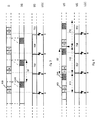
- Fig. 1A and fig 1B show a downstream frame stream DS and upstream burst stream US structure as used in known network systems wherein downstream frames DF are transmitted from a central station to a plurality of terminal stations over the cascade connection of a common transmission path and an individual transmission path, and wherein upstream bursts UB or upstream packets are transferred from the terminal stations to the central station via time division multiple access (TDMA).
- TDMA time division multiple access
- Such a network is used e.g. for interactive services as video on demand.
- the upstream and downstream bit rates are equal to 155 Mb/s.
- the downstream bit rate is equal to 622 Mb/s, whilst the upstream bit rate is a factor 4 lower and equals 155 Mb/s.
- the upstream channel is shared by the plurality of terminal stations and is thereto divided in time slots, TS2, TS8, TS3, TS5, allocated to the terminal stations by means of access grant information AGI included in the downstream frame stream DS.
- the downstream frames DF in the known systems comprise access grant information AGI and data including both payload data and overhead data.
- the contents of the upstream bursts UB in fig. 1A and fig. 1B is not further specified as it is not relevant for the subject invention.
- the access grant information AGI occupies equal positions in each downstream frame DF and is thus aligned with these downstream frames DF.
- the terminal station which is allocated a time slot is triggered to transfer an upstream burst UB by the reception of the access grant information AGI.
- the access grant information AGI is therefore also aligned with the upstream time slots.
- the downstream frame length and the upstream time slots are submitted to specific conditions: in the implementation of fig.
- the upstream time slots necessarily equal the downstream frame length.
- the upstream time slots need to be 4 times as large as the downstream frame length.
- only 1 of each 4 downstream frames DF includes access grant information AGI different from zero and thus really allocates an upstream time slot to a terminal station.
- access grant information AGI is transmitted still aligned with the downstream frames DF but unaligned with the upstream time slots, TS2, TS8, TS3.
- the downstream frames DF include access grant information AGI, time reference information TRI and data comprising overhead data and payload data.
- the time reference information TRI represents a copy of the counter value of a cyclic master grant counter MGC included in the central station CS, at the moment of transmission of this time reference information TRI.
- the value of this master grant counter MGC is increased by 1 each time a byte is downstream transmitted.
- Each terminal station is provided with a cyclic local grant counter which generates a local grant counter value, increased from zero to a predetermined upper limit.
- the local grant counter value therefore is increased by 1 each time a downstream byte is received by the respective terminal station whereof it forms part.
- the time reference information TRI received from the central station is used in the terminal stations to overwrite the local grant counter value in order to obtain synchronization of the cyclic local grant counter with the cyclic master grant counter.
- the time reference information TRI is compared with the local grant counter value (see downward arrows in fig. 2) in a state machine included in the terminal stations. The local grant counter value is then adapted only when synchronism is lost and not permanently.
- a terminal station may transmit data in time slots for upstream bursts UB are bounded by two successive zero crossings of the cyclic local grant counters. This is illustrated by the upward arrows in fig. 2 which indicate that terminal station 2 transmits an upstream burst UB during a time slot TS2, terminal station 8 transmits an upstream burst UB during a time slot TS8, and terminal station T3, transmits an upstream burst UB during a time slot TS3.
- access grant information AGI which is received before the beginning of an upstream time slot that is already allocated to a terminal station by previously transmitted access grant information AGI, is filled with zero. If however, which is not shown in Fig. 2, the downstream frames DF are longer than the upstream time slots, the access grant information AGI in a single downstream frame DF might allocate a plurality of time slots to a plurality of terminal stations.
- an upstream time slot in the time division multiple access (TDMA) method according to the present invention is bounded by a first and second zero crossing of a cyclic local grant counter which are not necessarily successive zero crossings. In this way, longer time slots can be allocated to services or terminal stations which require a large upstream bandwidth.
- TDMA time division multiple access
- each terminal station has to include an access grant buffer to store the received access grant information (AGI) from the reception thereof to the first zero crossing of its cyclic local grant counter.
- AGI access grant information
- the cyclic local grant counter and the cyclic master grant counter may be decreasing counters instead of increasing counters.
- the time reference information TRI in such an embodiment would then represent the delay be taken into account with respect toto the beginning of the next upstream time slot in counter units.
- the access grant information AGI can be made available to the terminal stations with less delay than the average delay introduced by the interleaving.
- a plurality of downstream frames DF are interleaved to spread out burst errors over this plurality of downstream frames DF thereby enabling to correct these burst errors with a minimum of error correction coding added to the downstream frames DF.
- individual bytes are given different delays according to their position in the frames DF.
- upstream burst errors are corrected via retransmission.
- An error detecting code added to the upstream bursts UB allows the central station to detect burst errors.
- the central station sets a retransmission bit which is included thereto in the access grant information AGI.
- the terminal station recognizes that the retransmission bit is set and retransmits the last transmitted upstream burst UB.
- each terminal station is equipped with a buffer, not shown in the figures, to temporarily store its last transmitted upstream burst UB.
- the retransmission bit necessarily has to be received by the terminal station before a new upstream burst UB is transmitted thereby.
- the access grant information AGI is aligned with the upstream bursts UB but not necessarily with the downstream frames DF.
- the structure of downstream frame streams DS and upstream burst streams US according to this second implementation are shown in fig. 3 and fig. 4.
- the central station and terminal stations in the network system corresponding to this second implementation also include a cyclic master grant counter and cyclic local grant counters respectively.
- the access grant information AGI is included in the downstream frames DF at zero crossings of the master grant counter and therefore appear unaligned in the downstream frames DF at equidistant time intervals. Upstream bursts UB are transmitted at the arrival of the access grant information AGI.
- the access grant information AGI is preceded by a sync byte S which is searched for at the terminal stations. Such a sync byte S is necessary to enable the terminal stations to recognize the first access grant information AGI. Otherwise, a terminal station cannot distinguish the access grant information AGI from other data in the downstream frames DF. In other words, the terminal stations become synchronized to the central station via the sync byte S.
- Part of the data transmitted in downstream frames DF is overhead information OHI.
- this overhead information OHI might be damaged if no precautions are taken.
- the sync byte S and access grant information AGI are included in the downstream frames DF at a first fixed time FT1 interval or at a second fixed time interval FT2 if overhead information OHI is deemed to be damaged when the sync byte S and the access grant information AGI are included at the first fixed time interval FT1.
- the terminal stations in this embodiment of the network system are adapted to search for the sync byte S after the first FT1 and second fixed time interval FT2 and are thus always able to find the access grant information AGI.
- this embodiment has the advantage that no phase locked loop has to be provided.
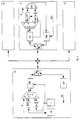
- the network system shown includes a central station CS coupled to a plurality of terminal stations, T1 ... Ti ... Tn, via the cascade connection of a common transmission link and an individual transmission link. Of these terminal stations only Ti is shown in detail, the other stations being identical.
- the central station CS includes a clock unit CK, a processor P, a cyclic master grant counter MGC, an access grant buffer B1, a multiplexer MUX, a downstream modulator DM, an upstream demodulator UD and an upstream/downstream splitter S1.
- the terminal station Ti is equipped with an upstream/downstream splitter S2, an upstream modulator UM, a downstream demodulator DD, a demultiplexer DEMUX, a cyclic local grant counter LGC, an access grant buffer B2 and a logical and gate AND.
- a first input i1 of the multiplexer MUX is a data input D.
- An output of the cyclic master grant counter MGC and an output of the access grant bufferr B1 are coupled to a second i2 and third input i3 of the multiplexer MUX respectively.
- an output of the multiplexer MUX is coupled to the upstream/downstream splitter S1 which is in the upstream direction further coupled to an upstream burst output UB via the upstream demodulator UD.
- An output of the clock unit CK is connected to control inputs of the cyclic master grant counter MGC and of the downstream modulator DM respectively, whilst a processor output of P is coupled to an input of the access grant buffer B1.
- the transmission links are coupled to the demultiplexer DEMUX via the cascade connection of the upstream/downstream splitter S2 and the downstream demodulator DD.
- a first output o1 of the demultiplexer DEMUX is a data output, whilst second o2 and third outputs o3 thereof are coupled to the cyclic local grant counter LGC and access grant buffer B2 respectively.
- An output of the cyclic local grant counter LGC is connected to a zero crossing input ZC of the logical and gate AND, whilst an output of the access grant buffer B2 is connected to an access grant input AG of this logical and gate AND, whose output is coupled to a control input of the upstream modulator UM which couples an upstream burst input UBi to the upstream/downstream splitter S2.
- a clock output of the downstream modulator DD and a control input of the cyclic local grant counter LGC are also interconnected.
- data D, time reference information TRI and access grant information AGI are multiplexed into downstream frames DF and therefore applied to the first i1, second i2 and third input i3 of the multiplexer MUX respectively.
- the downstream modulator modulates these downstream frames DF and applies them to the upstream/downstream splitter S1.
- the cyclic master grant counter MGC increases its grant counter value. In this way, the master grant counter value is increased each time a downstream byte is transmitted by the central station CS.
- the above time reference information TRI is a copy of the master grant counter value generated by the cyclic master grant counter MGC.
- the access grant information AGI is generated by the processor P, temporarily stored in the access grant buffer B1, and supplied to the third output O3 of the multiplexer MUX.
- the in this way generated downstream frames DF are shown in fig. 2 and were described above.
- Upstream bursts UB received by the central station CS are applied to the upstream burst output after being demodulated in the upstream demodulator UD.
- Modulated downstream frames received by terminal station Ti are guided to the downstream demodulator DD by the upstream/downstream splitter S2.
- the modulated downstream frames then become demodulated and are applied to the demultiplexer input.
- Demultiplexer DEMUX demultiplexes the downstream frames DF to thereby generate the data Di, the time reference information TRIi and the access grant information AGIi, applied to the data output, the cyclic local grant counter LGC and the access grant buffer B2 respectively via the outputs o1, o2 and o3.
- this downstream demodulator DD via the clock output thereof, applies a control signal to the cyclic local grant counter LGC to make it increase its local grant counter value.
- This local grant counter value is furthermore overwritten by the time reference information TRIi whenever such information is received.
- cyclic local grant counter LGC and cyclic master grant counter MGC remain synchronized.
- the cyclic local grant counter LGC further generates a zero crossing message at zero crossing moments of its local grant counter value, and supplies this message to the zero crossing input ZC of the logical and gate AND.
- the access grant buffer B2 in terminal Ti generates an access grant message whenever an upstream time slot is allocated to the terminal Ti by the access grant information AGIi.
- This access grant message is applied to the access grant input AG of the logical and gate AND. Only when both messages are present at the logical and gate inputs, ZC and AG.
- the logical and gate AND then generates an upstream allowed message and applies this message to the control input of the upstream modulator UM, thereby activating this upstream modulator UM to transfer an upstream burst UB to the central station CS.
- the local grant counter value can be adapted only when synchronization between cyclic local grant counter LGC and cyclic master grant counter MGC is lost. Means enabled to detect loss of synchronization are therefor shown in fig. 6 and will be described in the following paragraphs.
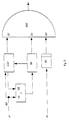
- the cyclic local grant counter LGC of fig. 5 has to be replaced by comparator means C, a cyclic local grant counter LGC' and a state machine SM shown in fig. 6. Furthermore the logical and gate AND has to be replaced by a logical and gate AND' provided with an additional input CV, called a counter valid input.
- the second output o2 and third output o3 of the demultiplexer DEMUX in fig. 5 are represented also by o2 and o3 in fig. 6.
- the second output o2 of demultiplexer DEMUX and an output of the cyclic local grant counter LGC' of fig. 6 are coupled to a first input CI1 and second input CI2 of the comparator means C respectively.
- the second output o2 in addition also is coupled to an input of the cyclic local grant counter LGC'.
- a comparator means output is coupled to an input of the state machine SM, having a first output connected to a control input of the cyclic local grant counter LGC' and a second output connected to the counter valid input CV of the logical and gate AND'. Similar to fig. 5, outputs of the cyclic local grant counter LGC' and of an access grant buffer B2' having the same function as B2 in fig.
- the comparator means compares the time reference information TRI', which is a copy of the master grant counter value, with the local grant counter value and applies a signal to the state machine SM if both differ.
- the state machine SM has to decide whether synchronization between the cyclic local grant counter and cyclic master grant counter still exists or is lost. When synchronism is lost, the state machine SM activates the cyclic local grant counter LGC' to overwrite its local grant counter value with the time reference information TRI' applied thereto via the multiplexer output o2. Otherwise, the state machine SM applies a counter valid message to the counter valid input CV of the logical and gate AND'. The decision with respect to synchronization is taken by the state machine SM in accordance with a predefined algorithm.
- the state machine SM e.g. waits until 5 consecutive local grant counter values differ from the received time reference information TRI' and then applies the activation signal to the cyclic local grant counter LGC'. An occasional difference between local grant counter value and time reference information TRI' is then regarded as a corrupted reception of the time reference information TRI'.
- the logical and gate AND' drawn in fig. 6 thus only activates the upstream modulator at zero crossings of the cyclic local grant counter LGC', whereon an upstream time slot is allocated to the terminal station and whereon synchronization between the cyclic local and master grant counters still exists.
- time division multiple access (TDMA) method can be implemented in radio communication systems and satellite communication systems as well as in electrical or optical cable networks.
- the central station CS in fig. 5 is coupled to the plurality of terminal stations, T1 ... Ti ... Tn, by means of the cascade connection of a common link and an individual link, the present method is not restricted to network systems having such physical links.
- the present method might be combined with frequency division multiplexing (FDM).
- FDM frequency division multiplexing
Landscapes
- Engineering & Computer Science (AREA)
- Computer Networks & Wireless Communication (AREA)
- Signal Processing (AREA)
- Time-Division Multiplex Systems (AREA)
Priority Applications (7)
| Application Number | Priority Date | Filing Date | Title |
|---|---|---|---|
| DE69534445T DE69534445T2 (de) | 1995-04-28 | 1995-04-28 | Verfahren zur TDMA-Verwaltung, Zentralstation, Teilnehmerstation und Netzwerk zur Ausführung des Verfahrens |
| EP95201108A EP0740431B1 (de) | 1995-04-28 | 1995-04-28 | Verfahren zur TDMA Verwaltung, Zentralstation, Teilnehmerstation und Netzwerk zur Ausführung des Verfahrens |
| AU50736/96A AU736295B2 (en) | 1995-04-28 | 1996-04-18 | Method for TDMA management |
| US08/636,236 US5754535A (en) | 1995-04-28 | 1996-04-23 | Method for TDMA management, central station, terminal station and network system to perform this method |
| CN96104480A CN1075913C (zh) | 1995-04-28 | 1996-04-26 | 用于tdma管理的方法,实现这种方法的中心站,终端站及网络系统 |
| CA002175153A CA2175153A1 (en) | 1995-04-28 | 1996-04-26 | Method for tdma management, central station, terminal station and network system to perform this method |
| JP8109956A JPH08331092A (ja) | 1995-04-28 | 1996-04-30 | Tdma管理方法、およびこの方法を実行するための中央ステーション、端末ステーション、およびネットワークシステム |
Applications Claiming Priority (1)
| Application Number | Priority Date | Filing Date | Title |
|---|---|---|---|
| EP95201108A EP0740431B1 (de) | 1995-04-28 | 1995-04-28 | Verfahren zur TDMA Verwaltung, Zentralstation, Teilnehmerstation und Netzwerk zur Ausführung des Verfahrens |
Publications (2)
| Publication Number | Publication Date |
|---|---|
| EP0740431A1 true EP0740431A1 (de) | 1996-10-30 |
| EP0740431B1 EP0740431B1 (de) | 2005-09-14 |
Family
ID=8220236
Family Applications (1)
| Application Number | Title | Priority Date | Filing Date |
|---|---|---|---|
| EP95201108A Expired - Lifetime EP0740431B1 (de) | 1995-04-28 | 1995-04-28 | Verfahren zur TDMA Verwaltung, Zentralstation, Teilnehmerstation und Netzwerk zur Ausführung des Verfahrens |
Country Status (7)
| Country | Link |
|---|---|
| US (1) | US5754535A (de) |
| EP (1) | EP0740431B1 (de) |
| JP (1) | JPH08331092A (de) |
| CN (1) | CN1075913C (de) |
| AU (1) | AU736295B2 (de) |
| CA (1) | CA2175153A1 (de) |
| DE (1) | DE69534445T2 (de) |
Cited By (31)
| Publication number | Priority date | Publication date | Assignee | Title |
|---|---|---|---|---|
| WO1999053640A3 (en) * | 1998-03-27 | 1999-12-09 | Nokia Networks Oy | Method of transmitting synchronized channel in radio transmitter |
| US6230195B1 (en) * | 1998-01-07 | 2001-05-08 | Kabushiki Kaisha Toshiba | Communication system, user apparatus, center apparatus, and terminal interface unit for use in communication system |
| USRE38619E1 (en) | 1995-10-16 | 2004-10-12 | General Instrument Corporation | Method and apparatus for supporting TDMA operating over hybrid fiber coaxial (HFC) or other channels |
| US6967943B1 (en) | 1997-06-24 | 2005-11-22 | Nokia Mobile Phones Ltd. | Time division multiple access radio systems |
| US8787347B2 (en) | 2005-08-24 | 2014-07-22 | Qualcomm Incorporated | Varied transmission time intervals for wireless communication system |
| TWI450624B (zh) * | 2004-07-21 | 2014-08-21 | 高通公司 | 存取頻道上有效率的信號 |
| US8831607B2 (en) | 2006-01-05 | 2014-09-09 | Qualcomm Incorporated | Reverse link other sector communication |
| US8842619B2 (en) | 2005-10-27 | 2014-09-23 | Qualcomm Incorporated | Scalable frequency band operation in wireless communication systems |
| US8885628B2 (en) | 2005-08-08 | 2014-11-11 | Qualcomm Incorporated | Code division multiplexing in a single-carrier frequency division multiple access system |
| US8917654B2 (en) | 2005-04-19 | 2014-12-23 | Qualcomm Incorporated | Frequency hopping design for single carrier FDMA systems |
| US9088384B2 (en) | 2005-10-27 | 2015-07-21 | Qualcomm Incorporated | Pilot symbol transmission in wireless communication systems |
| US9130810B2 (en) | 2000-09-13 | 2015-09-08 | Qualcomm Incorporated | OFDM communications methods and apparatus |
| US9136974B2 (en) | 2005-08-30 | 2015-09-15 | Qualcomm Incorporated | Precoding and SDMA support |
| US9143305B2 (en) | 2005-03-17 | 2015-09-22 | Qualcomm Incorporated | Pilot signal transmission for an orthogonal frequency division wireless communication system |
| US9144060B2 (en) | 2005-10-27 | 2015-09-22 | Qualcomm Incorporated | Resource allocation for shared signaling channels |
| US9148256B2 (en) | 2004-07-21 | 2015-09-29 | Qualcomm Incorporated | Performance based rank prediction for MIMO design |
| US9154211B2 (en) | 2005-03-11 | 2015-10-06 | Qualcomm Incorporated | Systems and methods for beamforming feedback in multi antenna communication systems |
| US9172453B2 (en) | 2005-10-27 | 2015-10-27 | Qualcomm Incorporated | Method and apparatus for pre-coding frequency division duplexing system |
| US9179319B2 (en) | 2005-06-16 | 2015-11-03 | Qualcomm Incorporated | Adaptive sectorization in cellular systems |
| US9184870B2 (en) | 2005-04-01 | 2015-11-10 | Qualcomm Incorporated | Systems and methods for control channel signaling |
| US9209956B2 (en) | 2005-08-22 | 2015-12-08 | Qualcomm Incorporated | Segment sensitive scheduling |
| US9210651B2 (en) | 2005-10-27 | 2015-12-08 | Qualcomm Incorporated | Method and apparatus for bootstraping information in a communication system |
| US9225416B2 (en) | 2005-10-27 | 2015-12-29 | Qualcomm Incorporated | Varied signaling channels for a reverse link in a wireless communication system |
| US9225488B2 (en) | 2005-10-27 | 2015-12-29 | Qualcomm Incorporated | Shared signaling channel |
| US9246560B2 (en) | 2005-03-10 | 2016-01-26 | Qualcomm Incorporated | Systems and methods for beamforming and rate control in a multi-input multi-output communication systems |
| US9307544B2 (en) | 2005-04-19 | 2016-04-05 | Qualcomm Incorporated | Channel quality reporting for adaptive sectorization |
| US9426012B2 (en) | 2000-09-13 | 2016-08-23 | Qualcomm Incorporated | Signaling method in an OFDM multiple access system |
| US9461859B2 (en) | 2005-03-17 | 2016-10-04 | Qualcomm Incorporated | Pilot signal transmission for an orthogonal frequency division wireless communication system |
| US9520972B2 (en) | 2005-03-17 | 2016-12-13 | Qualcomm Incorporated | Pilot signal transmission for an orthogonal frequency division wireless communication system |
| US9660776B2 (en) | 2005-08-22 | 2017-05-23 | Qualcomm Incorporated | Method and apparatus for providing antenna diversity in a wireless communication system |
| US10805038B2 (en) | 2005-10-27 | 2020-10-13 | Qualcomm Incorporated | Puncturing signaling channel for a wireless communication system |
Families Citing this family (23)
| Publication number | Priority date | Publication date | Assignee | Title |
|---|---|---|---|---|
| EP0758822B1 (de) * | 1995-08-11 | 2006-03-01 | Alcatel | Verfahren und Anordnung zur dynamischen Bandbreitenzuordnung in einem TDM/TDMA-Übertragungssystem |
| US5926476A (en) * | 1996-07-09 | 1999-07-20 | Ericsson, Inc. | Network architecture for broadband data communication over a shared medium |
| DE69726845T2 (de) | 1997-07-02 | 2004-07-08 | Alcatel | Zeitmultiplexverfahren und zugehörige Anordnungen zur Verwendung in einer zentralen Station und Netzwerkendstellen eines Nachrichtenübertragungsnetzwerkes |
| US6570857B1 (en) * | 1998-01-13 | 2003-05-27 | Telefonaktiebolaget L M Ericsson | Central multiple access control for frequency hopping radio networks |
| JP4048588B2 (ja) * | 1998-02-27 | 2008-02-20 | ソニー株式会社 | ポーリング制御方法及び伝送制御装置 |
| WO2000003514A1 (en) * | 1998-07-09 | 2000-01-20 | Nec Corporation | Time division multiplex transmission system, and communication system using time division multiplex transmission access method |
| JP2000032013A (ja) * | 1998-07-15 | 2000-01-28 | Oki Electric Ind Co Ltd | データ伝送システム |
| US6138186A (en) * | 1998-07-20 | 2000-10-24 | Hewlett-Packard Company | Burst transfer management system utilizing pointers to ensure that there is enough space in a buffer to receive burst transfers without corrupting data |
| SE516084C2 (sv) * | 1998-12-01 | 2001-11-19 | Ericsson Telefon Ab L M | En teknik för åtkomststyrning i kommunikationsnät med paketförmedling |
| US6628676B1 (en) * | 1999-06-21 | 2003-09-30 | Ericsson Inc. | Systems and methods for communicating messages among cascaded devices by bit shifting |
| US6498667B1 (en) | 1999-09-10 | 2002-12-24 | Quantum Bridge Communications, Inc. | Method and system for packet transmission over passive optical network |
| US6122335A (en) * | 1999-10-01 | 2000-09-19 | Quantum Bridge Communications, Inc. | Method and apparatus for fast burst mode data recovery |
| US6592272B1 (en) | 1999-10-22 | 2003-07-15 | Quantum Bridge Communications, Inc. | Burst mode transmission over multiple optical wavelengths |
| US6990123B1 (en) | 2000-01-24 | 2006-01-24 | Quantum Bridge Communications Inc. | Method and apparatus for redundant transmission over TDMA optical networks |
| EP1179908A1 (de) * | 2000-08-10 | 2002-02-13 | Siemens Aktiengesellschaft | Kommunikationsverfahren |
| US7136432B2 (en) * | 2001-06-08 | 2006-11-14 | Broadcom Corporation | Robust burst detection and acquisition system and method |
| US7613167B2 (en) * | 2001-09-27 | 2009-11-03 | Broadcom Corporation | Method and system for upstream priority lookup at physical interface |
| GB0203539D0 (en) * | 2002-02-14 | 2002-04-03 | Nokia Corp | Broadband digital transmission networks |
| US7184705B2 (en) * | 2002-03-08 | 2007-02-27 | Telefonaktiebolaget Lm Ericsson (Publ) | Distributed MAC in an uncoordinated radio environment |
| KR100477179B1 (ko) * | 2002-09-04 | 2005-03-21 | 네오웨이브주식회사 | 광 중계 전송 장치 |
| KR100677116B1 (ko) * | 2004-04-02 | 2007-02-02 | 삼성전자주식회사 | 사이클릭 레퍼런싱 방법/장치, 파싱 방법/장치 및 그방법을 수행하는 프로그램이 기록된 컴퓨터 판독가능한기록매체 |
| US8428521B2 (en) * | 2009-08-04 | 2013-04-23 | Qualcomm Incorporated | Control for uplink in MIMO communication system |
| US8582606B2 (en) * | 2010-05-24 | 2013-11-12 | Cortina Systems, Inc. | Network system with synchronization and method of operation thereof |
Citations (4)
| Publication number | Priority date | Publication date | Assignee | Title |
|---|---|---|---|---|
| EP0337619A1 (de) * | 1988-03-24 | 1989-10-18 | BRITISH TELECOMMUNICATIONS public limited company | Kommunikationssystem |
| EP0544975A1 (de) * | 1991-12-05 | 1993-06-09 | ALCATEL BELL Naamloze Vennootschap | Verwaltungssystem von Zeitschlitzen |
| WO1993019540A1 (de) * | 1992-03-26 | 1993-09-30 | Siemens Aktiengesellschaft | Verfahren zur zuteilung von übertragungszeiträumen in einem passiven optischen netz |
| EP0593812A1 (de) * | 1992-10-22 | 1994-04-27 | Siemens Aktiengesellschaft | Verfahren zur Ausregelung der Drift zwischen einem erwarteten Auftreten von Nachrichtenzellen und dem tatsächlichen Auftreten von Nachrichtenzellen |
Family Cites Families (6)
| Publication number | Priority date | Publication date | Assignee | Title |
|---|---|---|---|---|
| US4630267A (en) * | 1983-12-23 | 1986-12-16 | International Business Machines Corporation | Programmable timing and synchronization circuit for a TDMA communications controller |
| US4570257A (en) * | 1984-02-14 | 1986-02-11 | Rosemount Inc. | Communication system with slot time error detection |
| IT1202598B (it) * | 1987-02-27 | 1989-02-09 | Etefin Spa | Impianti di controllo e gestione automatizzata di dispositivi,apparecchiature e umita' periferiche per la commutazione ed elaborazione di segnali in genere,in particolare di fonici e/o di dati e/o immagini |
| JPH02256329A (ja) * | 1988-12-01 | 1990-10-17 | Nec Corp | 復調器制御方式 |
| US5172375A (en) * | 1989-06-22 | 1992-12-15 | Nec Corporation | Multiple access satellite communication system for mini-earth station networks |
| GB9114808D0 (en) * | 1991-07-09 | 1991-08-28 | Philips Electronic Associated | Information transmission system |
-
1995
- 1995-04-28 DE DE69534445T patent/DE69534445T2/de not_active Expired - Lifetime
- 1995-04-28 EP EP95201108A patent/EP0740431B1/de not_active Expired - Lifetime
-
1996
- 1996-04-18 AU AU50736/96A patent/AU736295B2/en not_active Ceased
- 1996-04-23 US US08/636,236 patent/US5754535A/en not_active Expired - Lifetime
- 1996-04-26 CN CN96104480A patent/CN1075913C/zh not_active Expired - Fee Related
- 1996-04-26 CA CA002175153A patent/CA2175153A1/en not_active Abandoned
- 1996-04-30 JP JP8109956A patent/JPH08331092A/ja active Pending
Patent Citations (4)
| Publication number | Priority date | Publication date | Assignee | Title |
|---|---|---|---|---|
| EP0337619A1 (de) * | 1988-03-24 | 1989-10-18 | BRITISH TELECOMMUNICATIONS public limited company | Kommunikationssystem |
| EP0544975A1 (de) * | 1991-12-05 | 1993-06-09 | ALCATEL BELL Naamloze Vennootschap | Verwaltungssystem von Zeitschlitzen |
| WO1993019540A1 (de) * | 1992-03-26 | 1993-09-30 | Siemens Aktiengesellschaft | Verfahren zur zuteilung von übertragungszeiträumen in einem passiven optischen netz |
| EP0593812A1 (de) * | 1992-10-22 | 1994-04-27 | Siemens Aktiengesellschaft | Verfahren zur Ausregelung der Drift zwischen einem erwarteten Auftreten von Nachrichtenzellen und dem tatsächlichen Auftreten von Nachrichtenzellen |
Non-Patent Citations (1)
| Title |
|---|
| VAALEN M J M VAN: "ASYNCHRONOUS TRANSFER MODE TRANSMISSION ON A PASSIVE OPTICAL HOME NETWORK", CABLE TV SESSIONS, MONTREUX, JUNE 13 - 18, 1991, no. SYMP. 17, 14 June 1991 (1991-06-14), CCITT, pages 97 - 107, XP000260033 * |
Cited By (46)
| Publication number | Priority date | Publication date | Assignee | Title |
|---|---|---|---|---|
| USRE38619E1 (en) | 1995-10-16 | 2004-10-12 | General Instrument Corporation | Method and apparatus for supporting TDMA operating over hybrid fiber coaxial (HFC) or other channels |
| US6967943B1 (en) | 1997-06-24 | 2005-11-22 | Nokia Mobile Phones Ltd. | Time division multiple access radio systems |
| US6230195B1 (en) * | 1998-01-07 | 2001-05-08 | Kabushiki Kaisha Toshiba | Communication system, user apparatus, center apparatus, and terminal interface unit for use in communication system |
| US6990093B1 (en) | 1998-03-27 | 2006-01-24 | Nokia Networks Oy | Method of transmitting synchronized channel in radio transmitter |
| WO1999053640A3 (en) * | 1998-03-27 | 1999-12-09 | Nokia Networks Oy | Method of transmitting synchronized channel in radio transmitter |
| US10313069B2 (en) | 2000-09-13 | 2019-06-04 | Qualcomm Incorporated | Signaling method in an OFDM multiple access system |
| US9426012B2 (en) | 2000-09-13 | 2016-08-23 | Qualcomm Incorporated | Signaling method in an OFDM multiple access system |
| US11032035B2 (en) | 2000-09-13 | 2021-06-08 | Qualcomm Incorporated | Signaling method in an OFDM multiple access system |
| US9130810B2 (en) | 2000-09-13 | 2015-09-08 | Qualcomm Incorporated | OFDM communications methods and apparatus |
| US11039468B2 (en) | 2004-07-21 | 2021-06-15 | Qualcomm Incorporated | Efficient signaling over access channel |
| US10517114B2 (en) | 2004-07-21 | 2019-12-24 | Qualcomm Incorporated | Efficient signaling over access channel |
| US10237892B2 (en) | 2004-07-21 | 2019-03-19 | Qualcomm Incorporated | Efficient signaling over access channel |
| US10194463B2 (en) | 2004-07-21 | 2019-01-29 | Qualcomm Incorporated | Efficient signaling over access channel |
| US10849156B2 (en) | 2004-07-21 | 2020-11-24 | Qualcomm Incorporated | Efficient signaling over access channel |
| US9137822B2 (en) | 2004-07-21 | 2015-09-15 | Qualcomm Incorporated | Efficient signaling over access channel |
| US9148256B2 (en) | 2004-07-21 | 2015-09-29 | Qualcomm Incorporated | Performance based rank prediction for MIMO design |
| TWI450624B (zh) * | 2004-07-21 | 2014-08-21 | 高通公司 | 存取頻道上有效率的信號 |
| US9246560B2 (en) | 2005-03-10 | 2016-01-26 | Qualcomm Incorporated | Systems and methods for beamforming and rate control in a multi-input multi-output communication systems |
| US9154211B2 (en) | 2005-03-11 | 2015-10-06 | Qualcomm Incorporated | Systems and methods for beamforming feedback in multi antenna communication systems |
| US9520972B2 (en) | 2005-03-17 | 2016-12-13 | Qualcomm Incorporated | Pilot signal transmission for an orthogonal frequency division wireless communication system |
| US9143305B2 (en) | 2005-03-17 | 2015-09-22 | Qualcomm Incorporated | Pilot signal transmission for an orthogonal frequency division wireless communication system |
| US9461859B2 (en) | 2005-03-17 | 2016-10-04 | Qualcomm Incorporated | Pilot signal transmission for an orthogonal frequency division wireless communication system |
| US9184870B2 (en) | 2005-04-01 | 2015-11-10 | Qualcomm Incorporated | Systems and methods for control channel signaling |
| US9036538B2 (en) | 2005-04-19 | 2015-05-19 | Qualcomm Incorporated | Frequency hopping design for single carrier FDMA systems |
| US9307544B2 (en) | 2005-04-19 | 2016-04-05 | Qualcomm Incorporated | Channel quality reporting for adaptive sectorization |
| US8917654B2 (en) | 2005-04-19 | 2014-12-23 | Qualcomm Incorporated | Frequency hopping design for single carrier FDMA systems |
| US9408220B2 (en) | 2005-04-19 | 2016-08-02 | Qualcomm Incorporated | Channel quality reporting for adaptive sectorization |
| US9179319B2 (en) | 2005-06-16 | 2015-11-03 | Qualcomm Incorporated | Adaptive sectorization in cellular systems |
| US8885628B2 (en) | 2005-08-08 | 2014-11-11 | Qualcomm Incorporated | Code division multiplexing in a single-carrier frequency division multiple access system |
| US9693339B2 (en) | 2005-08-08 | 2017-06-27 | Qualcomm Incorporated | Code division multiplexing in a single-carrier frequency division multiple access system |
| US9660776B2 (en) | 2005-08-22 | 2017-05-23 | Qualcomm Incorporated | Method and apparatus for providing antenna diversity in a wireless communication system |
| US9860033B2 (en) | 2005-08-22 | 2018-01-02 | Qualcomm Incorporated | Method and apparatus for antenna diversity in multi-input multi-output communication systems |
| US9209956B2 (en) | 2005-08-22 | 2015-12-08 | Qualcomm Incorporated | Segment sensitive scheduling |
| US9246659B2 (en) | 2005-08-22 | 2016-01-26 | Qualcomm Incorporated | Segment sensitive scheduling |
| US9240877B2 (en) | 2005-08-22 | 2016-01-19 | Qualcomm Incorporated | Segment sensitive scheduling |
| US8787347B2 (en) | 2005-08-24 | 2014-07-22 | Qualcomm Incorporated | Varied transmission time intervals for wireless communication system |
| US9136974B2 (en) | 2005-08-30 | 2015-09-15 | Qualcomm Incorporated | Precoding and SDMA support |
| US9144060B2 (en) | 2005-10-27 | 2015-09-22 | Qualcomm Incorporated | Resource allocation for shared signaling channels |
| US9088384B2 (en) | 2005-10-27 | 2015-07-21 | Qualcomm Incorporated | Pilot symbol transmission in wireless communication systems |
| US9172453B2 (en) | 2005-10-27 | 2015-10-27 | Qualcomm Incorporated | Method and apparatus for pre-coding frequency division duplexing system |
| US9225488B2 (en) | 2005-10-27 | 2015-12-29 | Qualcomm Incorporated | Shared signaling channel |
| US9225416B2 (en) | 2005-10-27 | 2015-12-29 | Qualcomm Incorporated | Varied signaling channels for a reverse link in a wireless communication system |
| US10805038B2 (en) | 2005-10-27 | 2020-10-13 | Qualcomm Incorporated | Puncturing signaling channel for a wireless communication system |
| US8842619B2 (en) | 2005-10-27 | 2014-09-23 | Qualcomm Incorporated | Scalable frequency band operation in wireless communication systems |
| US9210651B2 (en) | 2005-10-27 | 2015-12-08 | Qualcomm Incorporated | Method and apparatus for bootstraping information in a communication system |
| US8831607B2 (en) | 2006-01-05 | 2014-09-09 | Qualcomm Incorporated | Reverse link other sector communication |
Also Published As
| Publication number | Publication date |
|---|---|
| US5754535A (en) | 1998-05-19 |
| EP0740431B1 (de) | 2005-09-14 |
| JPH08331092A (ja) | 1996-12-13 |
| CN1075913C (zh) | 2001-12-05 |
| AU736295B2 (en) | 2001-07-26 |
| AU5073696A (en) | 1996-11-07 |
| DE69534445T2 (de) | 2006-04-27 |
| CA2175153A1 (en) | 1996-10-29 |
| CN1140943A (zh) | 1997-01-22 |
| DE69534445D1 (de) | 2005-10-20 |
Similar Documents
| Publication | Publication Date | Title |
|---|---|---|
| EP0740431B1 (de) | Verfahren zur TDMA Verwaltung, Zentralstation, Teilnehmerstation und Netzwerk zur Ausführung des Verfahrens | |
| US11659072B2 (en) | Apparatus for adapting a constant bit rate client signal into the path layer of a telecom signal | |
| US4700341A (en) | Stochastic time division multiplexing | |
| US5351239A (en) | Digital data transmission system | |
| CA2031054C (en) | Inverse multiplexer and demultiplexer techniques | |
| US7031343B1 (en) | Point-to-multipoint passive optical network that utilizes variable-length packets | |
| EP0768769B1 (de) | Verfahren und Vorrichtung zur Unterstützung des TDMA-Betriebs über einen Faser-Koax Hybrid-Kanal oder andere Kanäle | |
| CA2212050C (en) | Point-to-multipoint broadband services drop with multiple time slot return channel for customer premises equipment | |
| US5930262A (en) | Method for TDMA management, central station, terminal station and network system to perform this method, frame structure used in this method | |
| US5220563A (en) | Device for the transmission by an asynchronous network, notably an atm type network, of signalling data, channel by channel, assembled in a multiframe transmitted synchronously in out-of-band mode | |
| US6246668B1 (en) | Hitless manual path switching using linked pointer processors | |
| RU2211548C2 (ru) | Схемная эмуляция коротких пакетов | |
| EP0114678A2 (de) | Basisbandanlage für eine Erdfunkstelle eines mit Vielfachzugriff im Zeitmultiplex arbeitenden Satellitenübertragungssystems | |
| CN108419259B (zh) | 基于保留开销字段实现灵活以太网保护倒换的方法及系统 | |
| JPH03185941A (ja) | デイジタル広帯域信号の伝送方法 | |
| US6731654B1 (en) | Communication system overhead channel | |
| US6331989B1 (en) | Multiplex transmission method and system | |
| JPH05160821A (ja) | 多重データリング伝送装置及び方法 | |
| US6714543B1 (en) | ATM communications system and method | |
| US20020018261A1 (en) | Transmission system | |
| US20030002459A1 (en) | Base station transceiver sub-system and frame offset allocation method thereof | |
| US20100284425A1 (en) | System and method of using tdm variable frame lengths in a telecommunications network | |
| US8982913B2 (en) | Multiple E-carrier transport over DSL | |
| EP0833471B1 (de) | Übertragungsverfahren zwischen zwei oder mehr Stationen über einen Kommunikationskanal und Sende- und Empfangsstation zur Verwendung des Verfahrens | |
| EP1365623B1 (de) | Verfahren zur Zeitschlitzverwaltung und Struktur eines Aufwärtssignalrahmens |
Legal Events
| Date | Code | Title | Description |
|---|---|---|---|
| PUAI | Public reference made under article 153(3) epc to a published international application that has entered the european phase |
Free format text: ORIGINAL CODE: 0009012 |
|
| AK | Designated contracting states |
Kind code of ref document: A1 Designated state(s): BE DE ES FR GB IT NL SE |
|
| 17P | Request for examination filed |
Effective date: 19970502 |
|
| 17Q | First examination report despatched |
Effective date: 20030630 |
|
| GRAP | Despatch of communication of intention to grant a patent |
Free format text: ORIGINAL CODE: EPIDOSNIGR1 |
|
| RAP1 | Party data changed (applicant data changed or rights of an application transferred) |
Owner name: ALCATEL |
|
| GRAS | Grant fee paid |
Free format text: ORIGINAL CODE: EPIDOSNIGR3 |
|
| GRAA | (expected) grant |
Free format text: ORIGINAL CODE: 0009210 |
|
| AK | Designated contracting states |
Kind code of ref document: B1 Designated state(s): BE DE ES FR GB IT NL SE |
|
| PG25 | Lapsed in a contracting state [announced via postgrant information from national office to epo] |
Ref country code: NL Free format text: LAPSE BECAUSE OF FAILURE TO SUBMIT A TRANSLATION OF THE DESCRIPTION OR TO PAY THE FEE WITHIN THE PRESCRIBED TIME-LIMIT Effective date: 20050914 Ref country code: BE Free format text: LAPSE BECAUSE OF FAILURE TO SUBMIT A TRANSLATION OF THE DESCRIPTION OR TO PAY THE FEE WITHIN THE PRESCRIBED TIME-LIMIT Effective date: 20050914 |
|
| REG | Reference to a national code |
Ref country code: GB Ref legal event code: FG4D |
|
| REF | Corresponds to: |
Ref document number: 69534445 Country of ref document: DE Date of ref document: 20051020 Kind code of ref document: P |
|
| PG25 | Lapsed in a contracting state [announced via postgrant information from national office to epo] |
Ref country code: SE Free format text: LAPSE BECAUSE OF FAILURE TO SUBMIT A TRANSLATION OF THE DESCRIPTION OR TO PAY THE FEE WITHIN THE PRESCRIBED TIME-LIMIT Effective date: 20051214 |
|
| PG25 | Lapsed in a contracting state [announced via postgrant information from national office to epo] |
Ref country code: ES Free format text: LAPSE BECAUSE OF FAILURE TO SUBMIT A TRANSLATION OF THE DESCRIPTION OR TO PAY THE FEE WITHIN THE PRESCRIBED TIME-LIMIT Effective date: 20051225 |
|
| NLV1 | Nl: lapsed or annulled due to failure to fulfill the requirements of art. 29p and 29m of the patents act | ||
| PGFP | Annual fee paid to national office [announced via postgrant information from national office to epo] |
Ref country code: IT Payment date: 20060430 Year of fee payment: 12 |
|
| ET | Fr: translation filed | ||
| PLBE | No opposition filed within time limit |
Free format text: ORIGINAL CODE: 0009261 |
|
| STAA | Information on the status of an ep patent application or granted ep patent |
Free format text: STATUS: NO OPPOSITION FILED WITHIN TIME LIMIT |
|
| 26N | No opposition filed |
Effective date: 20060615 |
|
| PG25 | Lapsed in a contracting state [announced via postgrant information from national office to epo] |
Ref country code: IT Free format text: LAPSE BECAUSE OF NON-PAYMENT OF DUE FEES Effective date: 20070428 |
|
| PGFP | Annual fee paid to national office [announced via postgrant information from national office to epo] |
Ref country code: GB Payment date: 20140422 Year of fee payment: 20 |
|
| REG | Reference to a national code |
Ref country code: FR Ref legal event code: GC Effective date: 20140717 |
|
| PGFP | Annual fee paid to national office [announced via postgrant information from national office to epo] |
Ref country code: FR Payment date: 20140422 Year of fee payment: 20 Ref country code: DE Payment date: 20140418 Year of fee payment: 20 |
|
| REG | Reference to a national code |
Ref country code: FR Ref legal event code: RG Effective date: 20141016 |
|
| REG | Reference to a national code |
Ref country code: DE Ref legal event code: R071 Ref document number: 69534445 Country of ref document: DE |
|
| REG | Reference to a national code |
Ref country code: GB Ref legal event code: PE20 Expiry date: 20150427 |
|
| PG25 | Lapsed in a contracting state [announced via postgrant information from national office to epo] |
Ref country code: GB Free format text: LAPSE BECAUSE OF EXPIRATION OF PROTECTION Effective date: 20150427 |