EP0741703B1 - Verfahren zur herstellung von n,n'-verbrückten bis-tetramethylpiperidinyl-verbindungen - Google Patents
Verfahren zur herstellung von n,n'-verbrückten bis-tetramethylpiperidinyl-verbindungen Download PDFInfo
- Publication number
- EP0741703B1 EP0741703B1 EP95906982A EP95906982A EP0741703B1 EP 0741703 B1 EP0741703 B1 EP 0741703B1 EP 95906982 A EP95906982 A EP 95906982A EP 95906982 A EP95906982 A EP 95906982A EP 0741703 B1 EP0741703 B1 EP 0741703B1
- Authority
- EP
- European Patent Office
- Prior art keywords
- substituted
- formula
- alkyl
- bridged
- groups
- Prior art date
- Legal status (The legal status is an assumption and is not a legal conclusion. Google has not performed a legal analysis and makes no representation as to the accuracy of the status listed.)
- Expired - Lifetime
Links
- 0 Cc1cc(*)cc(C)c1O Chemical compound Cc1cc(*)cc(C)c1O 0.000 description 6
- FJZKADZLSJRAQF-UHFFFAOYSA-N CC(C)(C1)N(C)C(C)(C)CC1OC(C)=O Chemical compound CC(C)(C1)N(C)C(C)(C)CC1OC(C)=O FJZKADZLSJRAQF-UHFFFAOYSA-N 0.000 description 1
- BPRYUXCVCCNUFE-UHFFFAOYSA-N Cc(cc1C)cc(C)c1O Chemical compound Cc(cc1C)cc(C)c1O BPRYUXCVCCNUFE-UHFFFAOYSA-N 0.000 description 1
Classifications
-
- C—CHEMISTRY; METALLURGY
- C09—DYES; PAINTS; POLISHES; NATURAL RESINS; ADHESIVES; COMPOSITIONS NOT OTHERWISE PROVIDED FOR; APPLICATIONS OF MATERIALS NOT OTHERWISE PROVIDED FOR
- C09K—MATERIALS FOR MISCELLANEOUS APPLICATIONS, NOT PROVIDED FOR ELSEWHERE
- C09K15/00—Anti-oxidant compositions; Compositions inhibiting chemical change
- C09K15/04—Anti-oxidant compositions; Compositions inhibiting chemical change containing organic compounds
- C09K15/30—Anti-oxidant compositions; Compositions inhibiting chemical change containing organic compounds containing heterocyclic ring with at least one nitrogen atom as ring member
-
- C—CHEMISTRY; METALLURGY
- C07—ORGANIC CHEMISTRY
- C07D—HETEROCYCLIC COMPOUNDS
- C07D211/00—Heterocyclic compounds containing hydrogenated pyridine rings, not condensed with other rings
- C07D211/04—Heterocyclic compounds containing hydrogenated pyridine rings, not condensed with other rings with only hydrogen or carbon atoms directly attached to the ring nitrogen atom
- C07D211/06—Heterocyclic compounds containing hydrogenated pyridine rings, not condensed with other rings with only hydrogen or carbon atoms directly attached to the ring nitrogen atom having no double bonds between ring members or between ring members and non-ring members
- C07D211/36—Heterocyclic compounds containing hydrogenated pyridine rings, not condensed with other rings with only hydrogen or carbon atoms directly attached to the ring nitrogen atom having no double bonds between ring members or between ring members and non-ring members with hetero atoms or with carbon atoms having three bonds to hetero atoms with at the most one bond to halogen, e.g. ester or nitrile radicals, directly attached to ring carbon atoms
- C07D211/40—Oxygen atoms
- C07D211/44—Oxygen atoms attached in position 4
- C07D211/46—Oxygen atoms attached in position 4 having a hydrogen atom as the second substituent in position 4
-
- C—CHEMISTRY; METALLURGY
- C07—ORGANIC CHEMISTRY
- C07D—HETEROCYCLIC COMPOUNDS
- C07D211/00—Heterocyclic compounds containing hydrogenated pyridine rings, not condensed with other rings
- C07D211/04—Heterocyclic compounds containing hydrogenated pyridine rings, not condensed with other rings with only hydrogen or carbon atoms directly attached to the ring nitrogen atom
- C07D211/06—Heterocyclic compounds containing hydrogenated pyridine rings, not condensed with other rings with only hydrogen or carbon atoms directly attached to the ring nitrogen atom having no double bonds between ring members or between ring members and non-ring members
- C07D211/36—Heterocyclic compounds containing hydrogenated pyridine rings, not condensed with other rings with only hydrogen or carbon atoms directly attached to the ring nitrogen atom having no double bonds between ring members or between ring members and non-ring members with hetero atoms or with carbon atoms having three bonds to hetero atoms with at the most one bond to halogen, e.g. ester or nitrile radicals, directly attached to ring carbon atoms
- C07D211/56—Nitrogen atoms
- C07D211/58—Nitrogen atoms attached in position 4
-
- C—CHEMISTRY; METALLURGY
- C09—DYES; PAINTS; POLISHES; NATURAL RESINS; ADHESIVES; COMPOSITIONS NOT OTHERWISE PROVIDED FOR; APPLICATIONS OF MATERIALS NOT OTHERWISE PROVIDED FOR
- C09D—COATING COMPOSITIONS, e.g. PAINTS, VARNISHES OR LACQUERS; FILLING PASTES; CHEMICAL PAINT OR INK REMOVERS; INKS; CORRECTING FLUIDS; WOODSTAINS; PASTES OR SOLIDS FOR COLOURING OR PRINTING; USE OF MATERIALS THEREFOR
- C09D7/00—Features of coating compositions, not provided for in group C09D5/00; Processes for incorporating ingredients in coating compositions
- C09D7/40—Additives
- C09D7/48—Stabilisers against degradation by oxygen, light or heat
-
- C—CHEMISTRY; METALLURGY
- C08—ORGANIC MACROMOLECULAR COMPOUNDS; THEIR PREPARATION OR CHEMICAL WORKING-UP; COMPOSITIONS BASED THEREON
- C08K—Use of inorganic or non-macromolecular organic substances as compounding ingredients
- C08K5/00—Use of organic ingredients
- C08K5/16—Nitrogen-containing compounds
- C08K5/34—Heterocyclic compounds having nitrogen in the ring
- C08K5/3412—Heterocyclic compounds having nitrogen in the ring having one nitrogen atom in the ring
- C08K5/3432—Six-membered rings
- C08K5/3435—Piperidines
Definitions
- the invention also relates to a method for producing N, N'-bridged bis-tetramethylpiperidinyl esters.
- N-methylated derivative must first be prepared from the technically easily accessible 2,2,6,6-tetramethylpiperidin-4-ol as an additional step.
- the object of the present invention was therefore a method provide that in high yield and selectivity under Avoiding the use of toxic haloalkanes an economical convenient access to N-ethylene or N-propylene bridges Allows tetramethylpiperidine compounds.
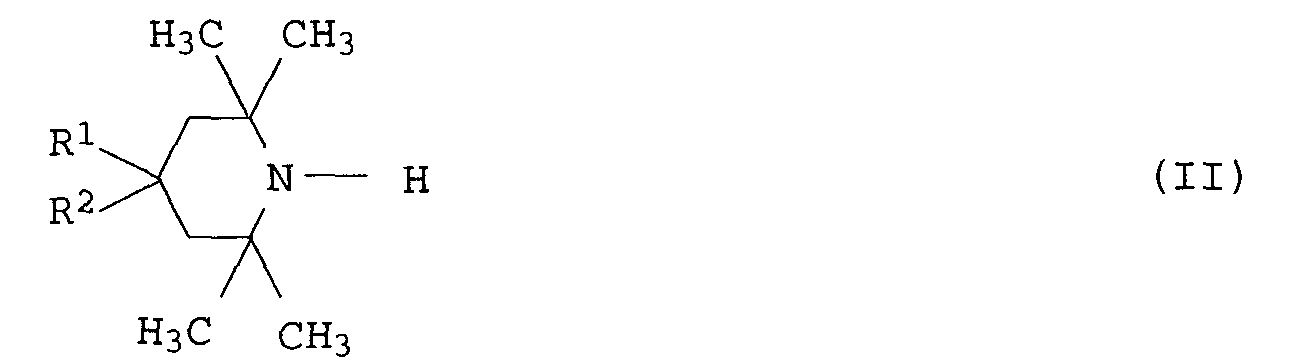
- the two pairs of residues R 1 / R 2 are preferably the same. However, if compounds I are to be prepared with different substituents at the 4-positions of the two piperidinyl rings, it is expedient to start from mixtures of the starting compounds II.
- the bridge members A with the meaning (a) are preferably installed in such a way that the respective oxygen atom or nitrogen atom is bonded directly to the piperidinyl ring.
- the urethane grouping -O-CO-NR 5 - O and N substitution are equally possible.
- Compounds I with a carbonyl function bonded directly to the 4-position of the piperidinyl ring can also be prepared by the process according to the invention, but the corresponding starting compounds II are more difficult to synthesize than in the case of O or N substitution.
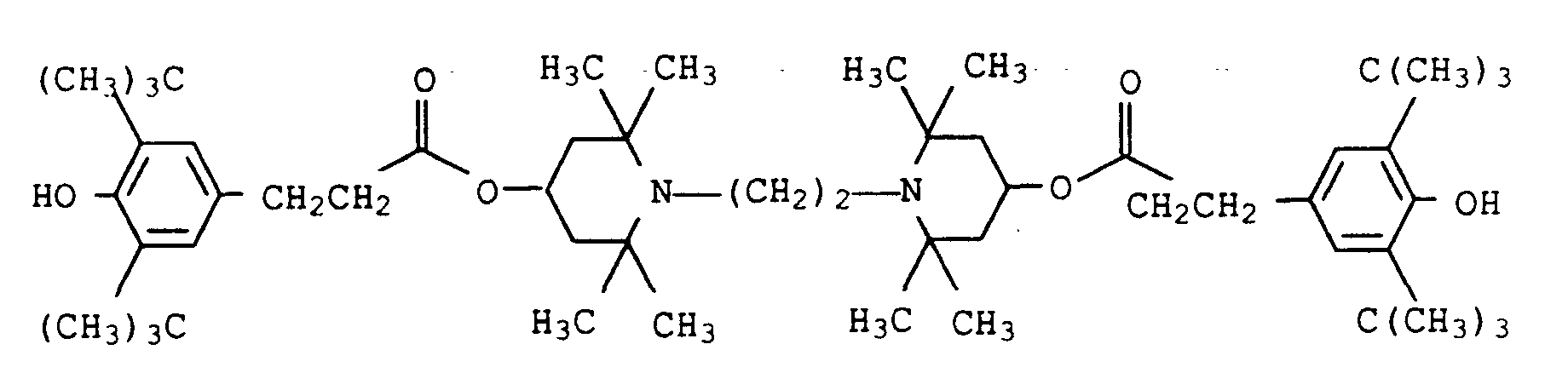
- the present invention also relates to a process for the preparation of N, N'-bridged bis-tetramethylpiperidinyl esters of the general formula Ib in which the variable m stands for the number 2 or 3 and R 10 is C 1 to C 20 alkyl or C 2 to C 20 alkenyl, which can be substituted by up to 3 hydroxyl groups, C 1 to C 20 Alkoxy, C 3 to C 12 cycloalkyl, which can be substituted by up to 3 C 1 to C 4 alkyl groups, phenyl, which can be substituted by up to 3 C 1 to C 6 alkyl groups or hydroxyl groups, or C 7 - to C 18 -phenylalkyl, which can be substituted by up to 3 C 1 - to C 4 -alkyl groups or hydroxyl groups, which is characterized in that N, N'-bridged bis- tetramethyl-hydroxypiperidinyl compounds of formula Ic reacted with carboxylic acid derivatives of the general formula R 10 -
- R 3 to R 6 and R 10 and in R 2 when important (b) and as substituents on cycloaliphatic rings, on aromatic rings and on heterocyclic rings, which are C 1 - to C 4 -, C 1 - to C 6 - and C 1 - to C 20 -alkyl radicals are suitable, for example methyl, ethyl, n-propyl, iso-propyl, n-butyl, iso-butyl, sec-butyl, tert-butyl, n-amyl, iso-amyl, sec.-amyl, tert.-amyl, neopentyl, n-hexyl, n-heptyl, n-octyl, 2-ethylhexyl, n-nonyl, iso-nonyl, n-decyl, n- Undecyl, n
- C 1 - to C 4 -alkyl radicals are preferred, in particular as substituents on cycloaliphatic, aromatic and heterocyclic rings.
- Technical or naturally occurring mixtures of various such residues can also occur as alkyl residues.
- C 2 - to C 20 -alkenyl radicals for R 3 , R 4 , R 6 and R 10 and in R 2 if (b) are, for example, vinyl, allyl, methallyl, 1-propenyl, 4-pentenyl, Oleyl, linolyl or linolenyl.
- C 2 to C 5 and C 16 to C 18 alkenyl radicals are preferred here.
- Suitable straight-chain or branched C 1 to C 20 alkoxy radicals for R 10 are, in particular, C 1 to C 4 alkoxy radicals.
- C 1 to C 4 alkoxy radicals for R 10 and R 11 methoxy and ethoxy are particularly preferred.
- Possible alkyl-substituted C 3 to C 12 cycloalkyl radicals for R 3 , R 4 and R 10 are preferably C 5 to C 8 cycloalkyl, especially C 5 to C 6 cycloalkyl such as cyclopentyl and cyclohexyl, and also cycloheptyl, Cyclooctyl, 2- or 3-methylcyclopentyl, 2,3-, 2,4-, 2,5- or 3,3-dimethylcyclopentyl, 2-, 3- or 4-methylcyclohexyl, 2-, 3- or 4-ethylcyclohexyl and 2,4-, 3,4-, 3,5- or 3,3-dimethylcyclohexyl, and also cyclopropyl, cyclobutyl, cyclododecyl, 3,4,5-trimethylcyclohexyl or 4-tert-butylcyclohexyl.
- Phenyl for R 3 substituted by alkyl and hydroxyl groups are, for example, o-, m- or p-tolyl, o-, m- or p-ethylphenyl, m- or p-tert-butylphenyl, 2,4,6-trimethylphenyl, 3,5-di-tert-butyl-4-hydroxyphenyl and o-, m- or p-hydroxyphenyl.
- Particularly suitable C 7 -C 18 phenylalkyl for R 3 , R 4 and R 10 are 1-phenylethyl, 2-phenylethyl, 1-phenylpropyl, 2-phenylpropyl, 3-phenylpropyl, 2-phenyl-prop-2-yl , 4-phenylbutyl, 2,2-dimethyl-2-phenylethyl, 5-phenylamyl, 10-phenyldecyl, 12-phenyldodecyl or especially benzyl.
- Examples of suitable substituted C 7 -C 18 -phenylalkyl are p-methylbenzyl, 2- (p-methylphenyl) ethyl, p-tert-butylbenzyl, 2- (p-tert-butylphenyl) ethyl and 2- (3 ' , 5'-di-tert-butyl-4'-hydroxyphenyl) ethyl.
- C 6 - to C 18 -cycloalkyl-alkyl for R 3 and R 4 are, for example, cyclohexyl-methyl, 4-methylcyclohexyl-methyl, 4-tert-butylcyclohexyl-methyl, 2-cyclohexyl-ethyl, 3,3-dimethylcyclohexyl-methyl and cyclopentyl-methyl.
- R 3 Possible five- or six-membered unsaturated or saturated heterocyclic rings for R 3 with up to three heteroatoms from the group nitrogen, oxygen and sulfur, which can additionally be benzanellated and substituted by the designated radicals:
- the radical pair R 1 / R 2 must not contain any primary or secondary amino groups, since otherwise the cyclic carbonate III could also react with these amino groups and would result in undesired by-products.
- alkoxycarbonyl-alk (en) yloxy groups for R 2 with meaning (b) are methoxycarbonyl-methoxy, 2- (methoxycarbonyl) -ethoxy, 2- (methoxycarbonyl) -ethenyloxy and 2- (methoxycarbonyl) -isopropenyloxy.
- the two radicals R 6 are preferably identical or together with the two oxygen atoms form a 1,3-dioxane or 1,3-dioxolane ring which can additionally carry lower alkyl groups and / or hydroxylalkyl groups as substituents.
- Examples of such cyclic acetal groups are 1,3-dioxane, 5-methyl-1,3-dioxane, 5, 5-dimethyl-1,3-dioxane, 4,5,5-trimethyl-1,3-dioxane , 5-hydroxymethyl-5-methyl-1,3-dioxane, 5,5-bishydroxymethyl-1,3-dioxane, 1,3-dioxolane, 4-methyl-1,3-dioxolane and 4-hydroxymethyl -1,3-dioxolane groupings.
- N, N'-bridged bis-tetramethylpiperidone compounds I according to meaning (d) can also in etherified form as enol ethers of the general formula are present, the two radicals R 4 being the same or different and having the meaning given above.
- carboxylic acid derivatives R 10 -CO-R 11 are the corresponding carboxylic acid halides, in particular carboxylic acid chlorides, the carboxylic acid esters, carboxylic acid anhydrides and carbonic acid diesters, in particular dialkyl carbonic acid esters.
- the process according to the invention becomes product I as a rule at temperatures from 60 to 200 ° C, preferably 100 to 180 ° C, carried out in particular 140 to 165 ° C. At the specified The temperature range is usually after 5 to 25 hours completely expired. Because in the implementation the gas carbon dioxide becomes free, one works expediently at normal pressure or at reduced pressure. In the inventive method for Product Ib is usually worked under the same conditions as indicated for the manufacture of product I.
- the solvent is used an excess of that used as a reactant cyclic carbonates III.
- the molar ratio is from tetramethylpiperidinyl compounds II to cyclic Carbonate III generally 1: 0.6 to 1:20, preferably 1: 1 to 1:10, especially 1: 2 to 1: 6, being for the actual Reaction 0.5 mol of cyclic carbonate III per mol of starting compound II are needed.
- carboxylic acid derivative R 10 -CO-R 11 as a solvent in the conversion of the alcohols Ic to the esters Ib, especially when working with carboxylic acid esters or carbonic acid diesters.
- the molar ratio of alcohol Ic to the designated carboxylic acid derivative is generally 1: 2.1 to 1:50, preferably 1: 3 to 1:40.
- the invention is further illustrated by the examples below explained.
- the manufacturing conditions have not been optimized.
Landscapes
- Chemical & Material Sciences (AREA)
- Organic Chemistry (AREA)
- Engineering & Computer Science (AREA)
- Materials Engineering (AREA)
- Life Sciences & Earth Sciences (AREA)
- Wood Science & Technology (AREA)
- Hydrogenated Pyridines (AREA)
- Slot Machines And Peripheral Devices (AREA)
Description

- R1
- Wasserstoff und R2 eine Gruppierung der Formel -A-R3, wobei
- A
- Sauerstoff oder ein Brückenglied der Formel -NR4-, -NR5-CO-, -O-CO-, -O-CO-NR5- oder O-CO-O- bedeutet,
- R3
- Wasserstoff, C1- bis C20-Alkyl, das durch bis zu 10 nicht benachbarte Sauerstoffatome oder Brückenglieder der Formel -NR4- und durch bis zu 3 Carbonylgruppen unterbrochen sein kann, C2- bis C20-Alkenyl, C3- bis C12-Cycloalkyl, das durch bis zu 3 C1- bis C4-Alkylgruppen substituiert sein kann, Phenyl, das durch bis zu 3 C1- bis C6-Alkylgruppen oder Hydroxylgruppen substituiert sein kann, C7- bis C18-Phenylalkyl, das durch bis zu 3 C1- bis C4-Alkylgruppen oder Hydroxylgruppen substituiert sein kann, C6- bis C18-Cycloalkyl-alkyl, das durch bis zu 3 C1- bis C4-Alkylgruppen substituiert sein kann, oder einen fünf- oder sechsgliedrigen ungesättigten oder gesättigten heterocyclischen Ring mit bis zu 3 Heteroatomen aus der Gruppe Stickstoff, Sauerstoff und Schwefel, welcher zusätzlich benzanelliert und durch bis zu 3 C1- bis C6-Alkylgruppen oder Hydroxylgruppen substituiert sein kann, bezeichnet, mit der Maßgabe, daß R3 nicht Wasserstoff bezeichnet, falls A das Brückenglied -NR4- bedeutet,
- R4
- C1- bis C20-Alkyl, C2- bis C20-Alkenyl, C3- bis C12-Cycloalkyl, das durch bis zu 3 C1- bis C4-Alkylgruppen substituiert sein kann, C7- bis C18-Phenylalkyl, das durch bis zu 3 C1- bis C4-Alkylgruppen substituiert sein kann, oder C6- bis C18-Cycloalkyl-alkyl, das durch bis zu 3 C1- bis C4-Alkylgruppen substituiert sein kann, bedeutet und
- R5
- Wasserstoff oder C1- bis C4-Alkyl bezeichnet;
- R1
- Wasserstoff und R2 C1- bis C6-Alkoxycarbonyl-C1- bis C20-alkyloxy oder C1- bis C6-Alkoxycarbonyl-C2- bis C20-alkenyloxy;
- R1 und R2
- Gruppierungen der Formel -O-R6, wobei die beiden Reste R6 jeweils gleich oder verschieden sind, für C1- bis C20-Alkyl oder C2- bis C20-Alkenyl, welches durch bis zu 3 Hydroxylgruppen substituiert sein kann, stehen und unter Ausbildung eines 1,3-Dioxan- oder eines 1,3-Dioxolan-Ringes verknüpft sein können;
- R1 / R2
- das Carbonyl-Sauerstoffatom eines Piperidon-Ringes, wobei diese Sauerstoffatome auch unter Ausbildung der entsprechenden Enol-Struktur am Piperidon-Ring durch Gruppierungen der Struktur R4 verethert sein können;



- Alkohole wie Methanol, Ethanol, iso-Propanol, Ethylenglykol, n-Propanol, n-Butanol, iso-Butanol, tert.-Butanol und insbesondere 2-Ethylhexanol, n-Octanol oder Diethylenglykol;
- Amide wie Formamid, Dimethylformamid, Dimethylacetamid und insbesondere N-Methylpyrrolidinon;
- Aromaten wie Chlorbenzol, Toluol, Xylol, Ethylbenzol oder höher alkylierte Benzole;
- Ether wie Diisopropylether, Di-n-propylether, Diphenylether oder Tetrahydrofuran;
- tertiäre Amine wie Triethylamin, Tributylamin oder Pyridin;
- Polyethylenglykole oder Polypropylenglykole bis zu einem Molekulargewicht von ca. 1000.
- Sulfonsäuren wie Methansulfonsäure, Trifluormethansulfonsäure, Benzolsulfonsäure oder p-Toluolsulfonsäure;
- Mineralsäuren (anorganische Säuren) wie Schwefelsäure, Salzsäure oder Phosphorsäure;
- Carbonsäuren wie Ameisen-, Essig-, Propion-, Butter-, Valerian-, Capron-, Capryl-, Caprin-, Stearin-, Öl-, Benzoe-, Methylbenzoe-, Phenylessig-, Zitronen-, Adipin-, Wein-, Nitrilotriessig- oder Ethylendiamintetraessigsäure;
- Zinnverbindungen wie Dibutylzinnoxid, Dibutylzinndiacetat oder Dibutylzinndilaurat;
- Titanate wie Tetramethoxytitanat, Tetra-iso-propoxytitanat oder Tetrabutoxytitanat;
- Phosphoniumverbindungen wie die Chloride, Bromide oder Iodide der Kationen Methyltriphenylphosphonium, Ethyltriphenylphosphonium, Butyltriphenylphosphonium, Methyltributylphosphonium, Methyltriphenoxyphosphonium oder Tetrabutylphosphonium;
- Ammoniumverbindungen wie die Chloride, Bromide, Iodide oder Hydroxide der Kationen Tetramethylammonium, Tetraethylammonium, Tetrabutylammonium, Methyltriphenylammonium, Methyltriethylammonium, Methyltributylammonium, Methyltrihexylammonium, Benzyltriethylammonium, Benzyltributylammonium, Benzyltriphenylammonium oder Benzyltrihexylammonium;
- Alkalimetallhalogenide wie Lithiumiodid, Natriumbromid, Natriumiodid, Kaliumbromid oder Kaliumiodid;
- Erdalkalimetallhalogenide wie Calciumchlorid, Magnesiumchlorid oder Magnesiumbromid;
- Zinkhalogenide wie Zinkchlorid, Zinkbromid oder Zinkiodid.


| Umsetzung von 2,2,6,6-Tetramethylpiperidin-4-ol mit Ethylencarbonat mit verschiedenen Katalysatoren | |
| Katalysator | Ausbeute [%] |
| Lithiumiodid | 89,4 |
| Natriumbromid | 83,2 |
| Natriumiodid | 85,3 |
| Kaliumbromid | 64,1 |
| Kaliumiodid | 60,2 |
| Magnesiumchlorid | 80,0 |
| Magnesiumbromid | 90,9 |
| Tetrabutylammoniumbromid | 55,3 |
| Tetrabutylammoniumiodid | 57,9 |
| Tetraethylammoniumiodid | 50,9 |
| Tetramethylammoniumiodid | 60,3 |
| Methyltriphenylphosphoniumiodid | 75,3 |
| Methyltriphenoxyphosphoniumiodid | 83,5 |
Claims (8)
- Verfahren zur Herstellung von N,N'-verbrückten Bis-tetramethylpiperidinyl-Verbindungen der allgemeinen Formel Iin der die Variable m für die Zahl 2 oder 3 steht und die beiden Restepaare R1/R2 gleich oder verschieden sind und folgende Bedeutungen haben können:
 ausgehend von Tetramethylpiperidinyl-Verbindungen der allgemeinen Formel II(a)
- R1
- Wasserstoff und R2 eine Gruppierung der Formel -A-R3, wobei
- A
- Sauerstoff oder ein Brückenglied der Formel -NR4-, -NR5-CO-, -O-CO-, -O-CO-NR5- oder -O-CO-O- bedeutet,
- R3
- Wasserstoff, C1- bis C20-Alkyl, das durch bis zu 10 nicht benachbarte Sauerstoffatome oder Brückenglieder der Formel -NR4- und durch bis zu 3 Carbonylgruppen unterbrochen sein kann, C2- bis C20-Alkenyl, C3- bis C12-Cycloalkyl, das durch bis zu 3 C1- bis C4-Alkylgruppen substituiert sein kann, Phenyl, das durch bis zu 3 C1- bis C6-Alkylgruppen oder Hydroxylgruppen substituiert sein kann, C7- bis C18-Phenylalkyl, das durch bis zu 3 C1- bis C4-Alkylgruppen oder Hydroxylgruppen substituiert sein kann, C6- bis C18-Cycloalkyl-alkyl, das durch bis zu 3 C1- bis C4-Alkylgruppen substituiert sein kann, oder einen fünf- oder sechsgliedrigen ungesättigten oder gesättigten heterocyclischen Ring mit bis zu 3 Heteroatomen aus der Gruppe Stickstoff, Sauerstoff und Schwefel, welcher zusätzlich benzanelliert und durch bis zu 3 C1- bis C6-Alkylgruppen oder Hydroxylgruppen substituiert sein kann, bezeichnet, mit der Maßgabe, daß R3 nicht Wasserstoff bezeichnet, falls A das Brückenglied -NR4- bedeutet,
- R4
- C1- bis C20-Alkyl, C2- bis C20-Alkenyl, C3- bis C12-Cycloalkyl, das durch bis zu 3 C1- bis C4-Alkylgruppen substituiert sein kann, C7 - bis C18-Phenylalkyl, das durch bis zu 3 C1- bis C4-Alkylgruppen substituiert sein kann, oder C6- bis C18-Cycloalkylalkyl, das durch bis zu 3 C1- bis C4-Alkylgruppen substituiert sein kann, bedeutet und
- R5
- Wasserstoff oder C1- bis C4-Alkyl bezeichnet;
(b)- R1
- Wasserstoff und R2 C1- bis C6-Alkoxycarbonyl-C1- bis C20-alkyloxy oder C1- bis C6-Alkoxycarbonyl-C2- bis C20-alkenyloxy;
(c)- R1 und R2
- Gruppierungen der Formel -O-R6, wobei die beiden Reste R6 jeweils gleich oder verschieden sind, für C1- bis C20-Alkyl oder C2- bis C20-Alkenyl, welches durch bis zu 3 Hydroxylgruppen substituiert sein kann, stehen und unter Ausbildung eines 1,3-Dioxan- oder eines 1,3-Dioxolan-Ringes verknüpft sein können;
(d)- R1 / R2
- das Carbonyl-Sauerstoffatom eines Piperidon-Ringes, wobei diese Sauerstoffatome auch unter Ausbildung der entsprechenden Enol-Struktur am Piperidon-Ring durch Gruppierungen der Struktur R4 verethert sein können;
dadurch gekennzeichnet, daß man die Verbindungen II mit einem cyclischen Carbonat der allgemeinen Formel III umsetzt.
- Verfahren zur Herstellung von N,N'-verbrückten Bis-tetramethylpiperidinyl-Verbindungen I nach Anspruch 1, dadurch gekennzeichnet, daß man als Lösungsmittel einen Überschuß des cyclischen Carbonates III einsetzt, wobei das molare Verhältnis von II zu III 1 : 0,6 bis 1 : 20 beträgt.
- Verfahren zur Herstellung von N,N'-verbrückten Bis-tetramethylpiperidinyl-Verbindungen I nach Anspruch 1 oder 2, dadurch gekennzeichnet, daß man die Umsetzung in Gegenwart von 0,01 bis 25 mol-%, bezogen auf die Menge an eingesetzten Tetramethylpiperidinyl-Verbindungen II, eines sauren Katalysators, eines schwermetallhaltigen Katalysators, eines organischen Katalysators mit quaternisiertem Heteroatom oder eines Halogenids als Katalysator durchführt.
- Verfahren zur Herstellung von N,N'-verbrückten Bis-tetramethylpiperidinyl-Verbindungen I nach den Ansprüchen 1 bis 3, dadurch gekennzeichnet, daß man als cyclisches Carbonat III Ethylencarbonat einsetzt.
- Verfahren zur Herstellung von N,N'-verbrückten Bis-tetramethylpiperidinyl-Verbindungen I nach den Ansprüchen 1 bis 4, ausgehend von Verbindungen II, bei denen gemäß Bedeutung (a) R1 Wasserstoff und R2 eine Gruppierung der Formel -OH, -NH-CO-R7 oder -O-CO-R7 bezeichnet, wobei R7 für C1- bis C4-Alkyl steht.
- Verfahren zur Herstellung von N,N'-verbrückten Bis-tetramethylpiperidinylestern der allgemeinen Formel Ibin der die Variable m für die Zahl 2 oder 3 steht und R10 C1- bis C20-Alkyl oder C2- bis C20-Alkenyl, welches durch bis zu 3 Hydroxylgruppen substituiert sein kann, C1- bis C20-Alkoxy, C3- bis C12-Cycloalkyl, das durch bis zu 3 C1- bis C4-Alkylgruppen substituiert sein kann, Phenyl, das durch bis zu 3 C1- bis C6-Alkylgruppen oder Hydroxylgruppen substituiert sein kann, oder C7- bis C18-Phenylalkyl, das durch bis zu 3 C1- bis C4-Alkylgruppen oder Hydroxylgruppen substituiert sein kann, bedeutet, dadurch gekennzeichnet, daß man nach dem Verfahren gemäß Anspruch 1 hergestellte N,N'-verbrückte Bistetramethyl-hydroxypiperidinyl-Verbindungen der Formel Ic
 mit Carbonsäurederivaten der allgemeinen Formel R10-CO-R11 umsetzt, in der R11 Chlor, Brom, C1- bis C4-Alkoxy oder eine Gruppe der Formel -O-CO-R10 bezeichnet.
- Verfahren zur Herstellung von N,N'-verbrückten Bis-tetramethylpiperidinylestern Ib nach Anspruch 6, dadurch gekennzeichnet, daß man als Lösungsmittel einen Überschuß des als Reaktionspartner verwendeten Carbonsäurederivates einsetzt, wobei das molare Verhältnis von Ic zu Carbonsäurederivat 1 : 2,1 bis 1 : 50 beträgt.
- Verfahren zur Herstellung von N,N'-verbrückten Bis-tetramethylpiperidinylestern Ib nach Anspruch 6 oder 7, dadurch gekennzeichnet, daß man die Umsetzung in Gegenwart von 0,01 bis 25 mol-%, bezogen auf die Menge an eingesetztem Alkohol Ic, eines sauren Katalysators, eines schwermetallhaltigen Katalysators, eines organischen Katalysators mit quaternisiertem Heteroatom oder eines Halogenids als Katalysator durchführt.
Applications Claiming Priority (3)
| Application Number | Priority Date | Filing Date | Title |
|---|---|---|---|
| DE4403085 | 1994-02-02 | ||
| DE4403085A DE4403085A1 (de) | 1994-02-02 | 1994-02-02 | Verfahren zur Herstellung von N,N'-verbrückten Bis-tetramethylpiperidinyl-Verbindungen |
| PCT/EP1995/000205 WO1995021157A1 (de) | 1994-02-02 | 1995-01-20 | Verfahren zur herstellung von n,n'-verbrückten bis-tetramethylpiperidinyl-verbindungen |
Publications (2)
| Publication Number | Publication Date |
|---|---|
| EP0741703A1 EP0741703A1 (de) | 1996-11-13 |
| EP0741703B1 true EP0741703B1 (de) | 2001-04-11 |
Family
ID=6509244
Family Applications (1)
| Application Number | Title | Priority Date | Filing Date |
|---|---|---|---|
| EP95906982A Expired - Lifetime EP0741703B1 (de) | 1994-02-02 | 1995-01-20 | Verfahren zur herstellung von n,n'-verbrückten bis-tetramethylpiperidinyl-verbindungen |
Country Status (15)
| Country | Link |
|---|---|
| US (2) | US5714611A (de) |
| EP (1) | EP0741703B1 (de) |
| KR (1) | KR970700654A (de) |
| CN (1) | CN1139921A (de) |
| AT (1) | ATE200483T1 (de) |
| AU (1) | AU684603B2 (de) |
| BR (1) | BR9506688A (de) |
| CA (1) | CA2179320A1 (de) |
| CZ (1) | CZ199796A3 (de) |
| DE (2) | DE4403085A1 (de) |
| ES (1) | ES2157319T3 (de) |
| HU (1) | HUT74711A (de) |
| PL (1) | PL315783A1 (de) |
| SK (1) | SK85996A3 (de) |
| WO (1) | WO1995021157A1 (de) |
Families Citing this family (5)
| Publication number | Priority date | Publication date | Assignee | Title |
|---|---|---|---|---|
| US6046304A (en) * | 1995-12-04 | 2000-04-04 | Ciba Specialty Chemicals Corporation | Block oligomers containing 2,2,6,6-tetramethyl-4-piperidyl groups as stabilizers for organic materials |
| DE69719004T2 (de) | 1996-12-24 | 2003-07-24 | Ciba Speciality Chemicals Holding Inc., Basel | Triazinverbindungen die 2,2,6,6-Tetramethyl-4-piperidingruppen enthalten als Stabilisatoren für organische Materialen |
| IT1292040B1 (it) * | 1997-05-30 | 1999-01-25 | Ciba Spec Chem Spa | Processo per la preparazione di prodotti politriazinici contenenti gruppi 2,2,6,6-tetrametil-4-piperidile |
| US8329603B2 (en) * | 2003-09-16 | 2012-12-11 | Uop Llc | Isoparaffin-olefin alkylation |
| WO2014125313A1 (en) | 2013-02-12 | 2014-08-21 | Rhodia Poliamida E Especialidades Ltda | Solvent systems and coating compositions therewith |
Family Cites Families (3)
| Publication number | Priority date | Publication date | Assignee | Title |
|---|---|---|---|---|
| JPS554133B2 (de) * | 1972-07-27 | 1980-01-29 | ||
| EP0007533B1 (de) * | 1978-07-21 | 1982-09-22 | Ciba-Geigy Ag | Piperidin-Derivate, Verfahren zu ihrer Herstellung und ihre Verwendung als Stabilisatoren für synthetische Polymere |
| JPS6275526A (ja) * | 1985-09-30 | 1987-04-07 | Konishiroku Photo Ind Co Ltd | カラ−写真感光材料 |
-
1994
- 1994-02-02 DE DE4403085A patent/DE4403085A1/de not_active Withdrawn
-
1995
- 1995-01-20 EP EP95906982A patent/EP0741703B1/de not_active Expired - Lifetime
- 1995-01-20 BR BR9506688A patent/BR9506688A/pt not_active Application Discontinuation
- 1995-01-20 CN CN95191427A patent/CN1139921A/zh active Pending
- 1995-01-20 AU AU15361/95A patent/AU684603B2/en not_active Ceased
- 1995-01-20 PL PL95315783A patent/PL315783A1/xx unknown
- 1995-01-20 CZ CZ961997A patent/CZ199796A3/cs unknown
- 1995-01-20 US US08/669,318 patent/US5714611A/en not_active Expired - Fee Related
- 1995-01-20 CA CA002179320A patent/CA2179320A1/en not_active Abandoned
- 1995-01-20 WO PCT/EP1995/000205 patent/WO1995021157A1/de not_active Ceased
- 1995-01-20 AT AT95906982T patent/ATE200483T1/de not_active IP Right Cessation
- 1995-01-20 HU HU9602130A patent/HUT74711A/hu unknown
- 1995-01-20 SK SK859-96A patent/SK85996A3/sk unknown
- 1995-01-20 DE DE59509183T patent/DE59509183D1/de not_active Expired - Lifetime
- 1995-01-20 ES ES95906982T patent/ES2157319T3/es not_active Expired - Lifetime
-
1996
- 1996-07-31 KR KR1019960704136A patent/KR970700654A/ko not_active Withdrawn
-
1997
- 1997-11-05 US US08/965,028 patent/US5914360A/en not_active Expired - Fee Related
Also Published As
| Publication number | Publication date |
|---|---|
| BR9506688A (pt) | 1997-11-18 |
| HU9602130D0 (en) | 1996-09-30 |
| KR970700654A (ko) | 1997-02-12 |
| ATE200483T1 (de) | 2001-04-15 |
| US5714611A (en) | 1998-02-03 |
| PL315783A1 (en) | 1996-12-09 |
| SK85996A3 (en) | 1997-03-05 |
| ES2157319T3 (es) | 2001-08-16 |
| US5914360A (en) | 1999-06-22 |
| WO1995021157A1 (de) | 1995-08-10 |
| AU684603B2 (en) | 1997-12-18 |
| CA2179320A1 (en) | 1995-08-10 |
| AU1536195A (en) | 1995-08-21 |
| DE4403085A1 (de) | 1995-08-03 |
| HUT74711A (en) | 1997-02-28 |
| EP0741703A1 (de) | 1996-11-13 |
| CN1139921A (zh) | 1997-01-08 |
| JPH09508398A (ja) | 1997-08-26 |
| CZ199796A3 (en) | 1996-10-16 |
| DE59509183D1 (de) | 2001-05-17 |
Similar Documents
| Publication | Publication Date | Title |
|---|---|---|
| DE2040983C3 (de) | Acrylsäurederivate des 2,2,6,6-Tetramethylpiperidins und Verfahren zu deren Herstellung | |
| DE2647452A1 (de) | Neue hydroxybenzylmalonsaeure-derivate | |
| DE2258752A1 (de) | Neue piperidin-derivate | |
| EP0316582A1 (de) | 4-Formylaminopiperidinderivate, deren Verwendung als Stabilisatoren und damit stabilisiertes organisches Material | |
| EP0020293B1 (de) | Stabilisatoren, Verfahren zu ihrer Herstellung und diese enthaltende Zusammensetzungen | |
| EP0013443B1 (de) | 2,2,6,6-Tetramethylpiperidin-Derivate, Verfahren zu ihrer Herstellung und mit ihrer Hilfe stabilisierte synthetische Polymere | |
| DE2233121A1 (de) | Verbessertes verfahren fuer die herstellung von piperidin-spiro-hydantoinderivaten | |
| EP1636199A2 (de) | Verfahren zur herstellung von phenylessig derivaten | |
| WO1995021157A1 (de) | Verfahren zur herstellung von n,n'-verbrückten bis-tetramethylpiperidinyl-verbindungen | |
| DE10163458A1 (de) | Verfahren zur Herstellung von Perfluoralkansulfonsäureestern und deren Salzen | |
| EP0149781B1 (de) | Furan-3-carbonsäurederivate | |
| DE2047846B2 (de) | 4-piperidonenolaether, verfahren zu deren herstellung und deren verwendung zum stabilisieren von synthetischen polymeren | |
| EP1024140B1 (de) | Verfahren zur N-Alkylierung von cyclischen Cyanamidinen | |
| EP0358016B1 (de) | 2,6-Polyalkylpiperidinsubstituierte Benzimidazol-2-carbonsäureanilide und deren Verwendung zum Stabilisieren von organischem Material | |
| US3097212A (en) | N-methyl-z- | |
| EP0391212B1 (de) | Verfahren zur Herstellung von bifunktionellen Z-Stilbenverbindungen, neue bifunktionelle Z-Stilbenverbindungen sowie die Verwendung der Z-Stilbenverbindungen zur Herstellung von Polymeren | |
| EP0007533A1 (de) | Piperidin-Derivate, Verfahren zu ihrer Herstellung und ihre Verwendung als Stabilisatoren für synthetische Polymere | |
| DE19954936A1 (de) | Verfahren zur Herstellung von Benzofuranonoximen | |
| DE69228670T2 (de) | Cyclohexylaminderivate | |
| EP0433806B1 (de) | Isocyanatoalkylsulfonate und ein Verfahren zu deren Herstellung | |
| AT334360B (de) | Verfahren zur herstellung von neuen heterocyklischen verbindungen | |
| EP0131801A1 (de) | Verfahren zur Herstellung substituierter Ethylenharnstoffe sowie neue N-Vinylethylenharnstoffe | |
| CH669195A5 (de) | Furan-3-carbonsaeurederivate und deren verwendung als lichtschutzmittel ausserhalb der textilindustrie. | |
| EP0376238B1 (de) | Polyalkylpiperidinsubstituierte Tetrahydropyridone und deren Verwendung | |
| DE19533219A1 (de) | Verfahren zur Herstellung von N-Alkenylcarbaminsäureestern |
Legal Events
| Date | Code | Title | Description |
|---|---|---|---|
| PUAI | Public reference made under article 153(3) epc to a published international application that has entered the european phase |
Free format text: ORIGINAL CODE: 0009012 |
|
| 17P | Request for examination filed |
Effective date: 19960603 |
|
| AK | Designated contracting states |
Kind code of ref document: A1 Designated state(s): AT BE CH DE ES FR GB IT LI NL SE |
|
| 17Q | First examination report despatched |
Effective date: 19970505 |
|
| GRAG | Despatch of communication of intention to grant |
Free format text: ORIGINAL CODE: EPIDOS AGRA |
|
| GRAG | Despatch of communication of intention to grant |
Free format text: ORIGINAL CODE: EPIDOS AGRA |
|
| GRAH | Despatch of communication of intention to grant a patent |
Free format text: ORIGINAL CODE: EPIDOS IGRA |
|
| GRAH | Despatch of communication of intention to grant a patent |
Free format text: ORIGINAL CODE: EPIDOS IGRA |
|
| GRAA | (expected) grant |
Free format text: ORIGINAL CODE: 0009210 |
|
| AK | Designated contracting states |
Kind code of ref document: B1 Designated state(s): AT BE CH DE ES FR GB IT LI NL SE |
|
| REF | Corresponds to: |
Ref document number: 200483 Country of ref document: AT Date of ref document: 20010415 Kind code of ref document: T |
|
| REG | Reference to a national code |
Ref country code: CH Ref legal event code: EP |
|
| REF | Corresponds to: |
Ref document number: 59509183 Country of ref document: DE Date of ref document: 20010517 |
|
| GBT | Gb: translation of ep patent filed (gb section 77(6)(a)/1977) |
Effective date: 20010504 |
|
| ITF | It: translation for a ep patent filed | ||
| REG | Reference to a national code |
Ref country code: ES Ref legal event code: FG2A Ref document number: 2157319 Country of ref document: ES Kind code of ref document: T3 |
|
| ET | Fr: translation filed | ||
| REG | Reference to a national code |
Ref country code: GB Ref legal event code: IF02 |
|
| PLBE | No opposition filed within time limit |
Free format text: ORIGINAL CODE: 0009261 |
|
| STAA | Information on the status of an ep patent application or granted ep patent |
Free format text: STATUS: NO OPPOSITION FILED WITHIN TIME LIMIT |
|
| 26N | No opposition filed | ||
| PGFP | Annual fee paid to national office [announced via postgrant information from national office to epo] |
Ref country code: SE Payment date: 20021213 Year of fee payment: 9 |
|
| PGFP | Annual fee paid to national office [announced via postgrant information from national office to epo] |
Ref country code: AT Payment date: 20021220 Year of fee payment: 9 |
|
| PGFP | Annual fee paid to national office [announced via postgrant information from national office to epo] |
Ref country code: NL Payment date: 20021223 Year of fee payment: 9 |
|
| PGFP | Annual fee paid to national office [announced via postgrant information from national office to epo] |
Ref country code: ES Payment date: 20030110 Year of fee payment: 9 |
|
| PGFP | Annual fee paid to national office [announced via postgrant information from national office to epo] |
Ref country code: BE Payment date: 20030117 Year of fee payment: 9 |
|
| PG25 | Lapsed in a contracting state [announced via postgrant information from national office to epo] |
Ref country code: AT Free format text: LAPSE BECAUSE OF NON-PAYMENT OF DUE FEES Effective date: 20040120 |
|
| PG25 | Lapsed in a contracting state [announced via postgrant information from national office to epo] |
Ref country code: SE Free format text: LAPSE BECAUSE OF NON-PAYMENT OF DUE FEES Effective date: 20040121 Ref country code: ES Free format text: LAPSE BECAUSE OF NON-PAYMENT OF DUE FEES Effective date: 20040121 |
|
| PG25 | Lapsed in a contracting state [announced via postgrant information from national office to epo] |
Ref country code: BE Free format text: LAPSE BECAUSE OF NON-PAYMENT OF DUE FEES Effective date: 20040131 |
|
| BERE | Be: lapsed |
Owner name: *BASF A.G. Effective date: 20040131 |
|
| PG25 | Lapsed in a contracting state [announced via postgrant information from national office to epo] |
Ref country code: NL Free format text: LAPSE BECAUSE OF NON-PAYMENT OF DUE FEES Effective date: 20040801 |
|
| EUG | Se: european patent has lapsed | ||
| NLV4 | Nl: lapsed or anulled due to non-payment of the annual fee |
Effective date: 20040801 |
|
| PGFP | Annual fee paid to national office [announced via postgrant information from national office to epo] |
Ref country code: FR Payment date: 20050110 Year of fee payment: 11 |
|
| PGFP | Annual fee paid to national office [announced via postgrant information from national office to epo] |
Ref country code: DE Payment date: 20050113 Year of fee payment: 11 |
|
| PGFP | Annual fee paid to national office [announced via postgrant information from national office to epo] |
Ref country code: CH Payment date: 20050117 Year of fee payment: 11 |
|
| PGFP | Annual fee paid to national office [announced via postgrant information from national office to epo] |
Ref country code: GB Payment date: 20050119 Year of fee payment: 11 |
|
| REG | Reference to a national code |
Ref country code: ES Ref legal event code: FD2A Effective date: 20040121 |
|
| PG25 | Lapsed in a contracting state [announced via postgrant information from national office to epo] |
Ref country code: GB Free format text: LAPSE BECAUSE OF NON-PAYMENT OF DUE FEES Effective date: 20060120 |
|
| PG25 | Lapsed in a contracting state [announced via postgrant information from national office to epo] |
Ref country code: LI Free format text: LAPSE BECAUSE OF NON-PAYMENT OF DUE FEES Effective date: 20060131 Ref country code: FR Free format text: LAPSE BECAUSE OF NON-PAYMENT OF DUE FEES Effective date: 20060131 Ref country code: CH Free format text: LAPSE BECAUSE OF NON-PAYMENT OF DUE FEES Effective date: 20060131 |
|
| PGFP | Annual fee paid to national office [announced via postgrant information from national office to epo] |
Ref country code: IT Payment date: 20060131 Year of fee payment: 12 |
|
| PG25 | Lapsed in a contracting state [announced via postgrant information from national office to epo] |
Ref country code: DE Free format text: LAPSE BECAUSE OF THE APPLICANT RENOUNCES Effective date: 20060304 |
|
| REG | Reference to a national code |
Ref country code: CH Ref legal event code: PL |
|
| GBPC | Gb: european patent ceased through non-payment of renewal fee |
Effective date: 20060120 |
|
| REG | Reference to a national code |
Ref country code: FR Ref legal event code: ST Effective date: 20060929 |
|
| PG25 | Lapsed in a contracting state [announced via postgrant information from national office to epo] |
Ref country code: IT Free format text: LAPSE BECAUSE OF NON-PAYMENT OF DUE FEES Effective date: 20070120 |