EP0742634A2 - Verbundwelle - Google Patents
Verbundwelle Download PDFInfo
- Publication number
- EP0742634A2 EP0742634A2 EP96303265A EP96303265A EP0742634A2 EP 0742634 A2 EP0742634 A2 EP 0742634A2 EP 96303265 A EP96303265 A EP 96303265A EP 96303265 A EP96303265 A EP 96303265A EP 0742634 A2 EP0742634 A2 EP 0742634A2
- Authority
- EP
- European Patent Office
- Prior art keywords
- shaft
- flexible disk
- stiff
- compound
- permanent magnet
- Prior art date
- Legal status (The legal status is an assumption and is not a legal conclusion. Google has not performed a legal analysis and makes no representation as to the accuracy of the status listed.)
- Withdrawn
Links
Images




Classifications
-
- H—ELECTRICITY
- H02—GENERATION; CONVERSION OR DISTRIBUTION OF ELECTRIC POWER
- H02K—DYNAMO-ELECTRIC MACHINES
- H02K1/00—Details of the magnetic circuit
- H02K1/06—Details of the magnetic circuit characterised by the shape, form or construction
- H02K1/22—Rotating parts of the magnetic circuit
- H02K1/27—Rotor cores with permanent magnets
- H02K1/2706—Inner rotors
- H02K1/272—Inner rotors the magnetisation axis of the magnets being perpendicular to the rotor axis
- H02K1/2726—Inner rotors the magnetisation axis of the magnets being perpendicular to the rotor axis the rotor consisting of a single magnet or two or more axially juxtaposed single magnets
-
- F—MECHANICAL ENGINEERING; LIGHTING; HEATING; WEAPONS; BLASTING
- F01—MACHINES OR ENGINES IN GENERAL; ENGINE PLANTS IN GENERAL; STEAM ENGINES
- F01D—NON-POSITIVE DISPLACEMENT MACHINES OR ENGINES, e.g. STEAM TURBINES
- F01D15/00—Adaptations of machines or engines for special use; Combinations of engines with devices driven thereby
- F01D15/10—Adaptations for driving, or combinations with, electric generators
-
- F—MECHANICAL ENGINEERING; LIGHTING; HEATING; WEAPONS; BLASTING
- F01—MACHINES OR ENGINES IN GENERAL; ENGINE PLANTS IN GENERAL; STEAM ENGINES
- F01D—NON-POSITIVE DISPLACEMENT MACHINES OR ENGINES, e.g. STEAM TURBINES
- F01D5/00—Blades; Blade-carrying members; Heating, heat-insulating, cooling or antivibration means on the blades or the members
- F01D5/02—Blade-carrying members, e.g. rotors
-
- H—ELECTRICITY
- H02—GENERATION; CONVERSION OR DISTRIBUTION OF ELECTRIC POWER
- H02K—DYNAMO-ELECTRIC MACHINES
- H02K7/00—Arrangements for handling mechanical energy structurally associated with dynamo-electric machines, e.g. structural association with mechanical driving motors or auxiliary dynamo-electric machines
- H02K7/08—Structural association with bearings
- H02K7/083—Structural association with bearings radially supporting the rotary shaft at both ends of the rotor
-
- H—ELECTRICITY
- H02—GENERATION; CONVERSION OR DISTRIBUTION OF ELECTRIC POWER
- H02K—DYNAMO-ELECTRIC MACHINES
- H02K7/00—Arrangements for handling mechanical energy structurally associated with dynamo-electric machines, e.g. structural association with mechanical driving motors or auxiliary dynamo-electric machines
- H02K7/14—Structural association with mechanical loads, e.g. with hand-held machine tools or fans
- H02K7/16—Structural association with mechanical loads, e.g. with hand-held machine tools or fans for operation above the critical speed of vibration of the rotating parts
Definitions
- This invention relates to the general field of shafts for rotating machinery and more particularly to an improved compound shaft that includes a flexible disk shaft and two relatively rigid or stiff shafts which together form the compound shaft.
- the shaft can be a single piece unitary structure of nearly constant diameter or it can be a compound structure having two or more relatively rigid or stiff shaft elements connected by one or more relatively flexible shaft elements.
- a single piece shaft machine would typically have its shaft supported by two journal bearings and a bi-directional thrust bearing.
- a two stiff shaft element compound shaft machine would typically have each of its stiff shaft elements supported by two journal bearings (for a total of four journal bearings) and would have either one or two bi-directional thrust bearings (two thrust bearings being required if the relatively flexible shaft element is unable to transmit axial loads).
- rigid body criticals will be defined as those rotor resonances where a single piece shaft or the stiff shafts of a compound shaft deflect within the compliant mounting of the journal bearings but do not bend This definition allows for bending of the flexible shaft element of a compound shaft due to rigid body critical rotor resonances.
- Flexural criticals are herein defined as those rotor resonances where a single piece shaft or the stiff shafts of a compound shaft bend.
- Imbalances in the rotor assembly cause the shaft to deflect from its straight line axis as it passes through these criticals. This deflection can induce rotor assembly rubbing, shaft stresses and bearing stresses that exceed design limits and cause hardware damage.
- a flexural critical must be negotiated since: 1) flexural criticals typically occur at higher rotor speeds than rigid body criticals; 2) high speed criticals store more resonant energy that must be damped by the turbomachine's bearings and suspensions than do low speed criticals; 3) rigid body criticals store most of their potential energy in the deflections of the springs in the bearings and suspensions where it is available for damping; and 4) flexural criticals store most of their potential energy in the deflections of the spring-like shafts where it is not available for damping by the bearings and suspensions.
- the bearings and suspensions used in turbomachinery typically have difficulty in damping a flexural critical
- these problems are further exacerbated when the turbomachinery utilizes conventional compliant foil hydrodynamic fluid film bearings (e.g., air bearings) since conventional bearings of this type typically have soft spring properties and poor damping properties.
- conventional compliant foil hydrodynamic fluid film bearings e.g., air bearings
- turbomachinery When high speed turbomachinery utilizes single piece shafts supported by two journal bearings, it is common for the highest frequency rigid body critical to occur at a relatively high percentage of operating speed (e.g., 30% to 50%) and for the first flexural critical to be near operating speed (e.g., 75 % to 125% of operating speed).
- the ratio of the frequency of the first flexural critical to the frequency of the last rigid body critical is typically low (e.g., slightly over 2:1). If the first flexural critical is in fact below operating speed and must be negotiated, it will be poorly damped and will require careful balancing of the turbomachine as an assembly.
- turbomachinery When high speed turbomachinery utilizes two piece compound shafts supported by four journal bearings and one or two bi-directional thrust bearings and utilizes a lightweight shaft with two universal joints to connect the two stiff shafts, machine length can be excessively long and machine complexity and costs can be high.
- the compound shaft generally comprises a first stiff shaft rotatably supported by a pair of journal bearings, a power head shaft or second stiff shaft rotatably supported by a single journal bearing and by a bi-directional thrust bearing, and a flexible disk shaft.
- the flexible disk shaft which includes the tie rod upon which the second stiff shaft, including the compressor wheel, bearing rotor, and turbine wheel, is removably mounted, is coupled with an interference fit to the first stiff shaft by a flexible disk and quill shaft which prevents translational or rotational movement between the first and second stiff shafts and yet permits flexure of the second stiff shaft with respect to the first stiff shaft.
- a generally cup-shaped flexible disk member and short quill shaft are at one end of the flexible disk shaft
- the cup-shaped flexible disk member interference fits over the corresponding end of the first stiff shaft which may be a sleeve enclosing a permanent magnet.
- a plurality of spaced holes or slots are included in the base or disk of the cup-shaped flexible disk to control the spring rate of the compound shaft or the flexible disk may have a tapered thickness.
- the flexible disk interference fits within the sleeve of the first shaft enclosing the permanent magnet.
- a compound shaft for a three journal bearing turbomachine which includes a first stiff shaft supported by two journal bearings, a second stiff shaft supported by one journal bearing and by one bi-directional thrust bearing and a flexible disk shaft that connects the first and second stiff shafts.
- the flexible disk shaft which operably connects the first and second stiff shafts, utilizes a metal flexure disk to function as a low hysterisis joint in parallel with a non-linear trunnion clock spring.
- the flexible disk shaft transfers overturning support from the first stiff shaft to the second stiff shaft and transfers thrust bearing support from the second stiff shaft to the first stiff shaft.
- the flexible disk shaft allows the compound shaft to tolerate extremely large misalignments of the three journal bearings from a strait line axis.
- the dynamic characteristics of the compound shaft are utilized to tune the frequencies of the turbomachine's rigid body and flexural criticals. All rigid body critical frequencies can be set below twenty percent of the machine's maximum operating speed. All flexural critical frequencies can be set more than thirty five percent above the machine's maximum operating speed.
- compliant foil hydrodynamic fluid film bearings both journal and thrust
- all negotiated rotor criticals can be extremely well damped (dimensionless damping coefficient Q of less than 2.5) and all criticals (both negotiated rigid body criticals and unnegotiated flexural criticals) need not be balanced.
- the first stiff shaft can be a hollow sleeve with a magnet for a permanent magnet motor/generator mounted therein.
- This permanent magnet shaft can have its sleeve's outer diameter serve as both the motor/generator rotor outer diameter and as the rotating surface for the two spaced compliant foil hydrodynamic fluid film journal bearings mounted at the ends of the permanent magnet shaft
- the permanent magnet shaft can have hollow ends for lightening and to induce cooling air flow.
- the hollow end of the first stiff shaft nearest the flexible disk shaft can have a stiffening sleeve inserted thereinto to increase the frequency of the first flexural critical
- An inertial mass ring can be attached to the compound shaft at the axial location of a node for a flexural critical (e.g., through the back plane of a turbine wheel) to increase the frequency of that critical.
- a soft spring rate e.g., in units of pound-inch per radian
- These coupling spring rates can be determined by attaching one of the stiff shafts to a ground measurement reference, than applying force and measuring the deflection of the other stiff shaft at the axial location of the journal bearing nearest the flexible disk member.
- the first stiff shaft knows that it is supported by two journal bearings but is only moderately aware of the radial movements of the second stiff shaft, while the second stiff shaft thinks that it is supported by two journal bearings but is very aware of the radial movement of the first stiff shaft.
- the compound shaft can tolerate 100 times the misalignment level tolerable by a solid single piece shaft supported by three journal bearing without exceeding the bearing load limits.
- rotating disks e.g., the turbine back plane
- a permanent magnet turbogenerator 10 is illustrated in Figure 1 as an example of a turbomachine utilizing the compound shaft of the present invention.
- the permanent magnet turbogenerator 10 generally comprises a permanent magnet generator 12, a power head 13, and a combustor 14.
- the permanent magnet generator 12 includes a permanent magnet rotor or sleeve 16, having a permanent magnet 17 disposed therein, rotatably supported within a permanent magnet stator 18 by a pair of spaced journal bearings 19, 20.
- the permanent magnet stator 18 comprises permanent magnet electrical windings 21 disposed between permanent magnet stator ends 22, 23.
- Radial permanent magnet stator cooling fins 25 are enclosed in a cylindrical sleeve 27 to form an annular air flow passage to cool the permanent magnet stator 18 and thereby preheat the air passing through on its way to the power head 13.
- the permanent magnet sleeve 16 and permanent magnet 17 collectively form the rotatable permanent magnet shaft 28 which is also referred to as the first stiff shaft.
- the permanent magnet 17 may be inserted into the permanent magnet sleeve 16 with a radial interference fit by any number of conventional techniques, including heating the permanent magnet sleeve 16 and supercooling the permanent magnet 17, hydraulic pressing, pressurized lubricating fluids, tapering the inside diameter of the permanent magnet sleeve 16 and/or the outer diameter of the permanent magnet 17, and other similar methods or combinations thereof.
- the power head 13 of the permanent magnet turbogenerator 10 includes compressor 30 and turbine 31.
- the compressor 30 having compressor wheel 32, which receives preheated air from the annular air flow passage in cylindrical sleeve 27 around the permanent magnet stator 18, is driven by the turbine 31 having turbine wheel 33 which receives heated exhaust gases from the combustor 14 supplied by air from recuperator 15.
- the compressor wheel 32 and turbine wheel 33 are disposed on bearing rotor 36 having bearing rotor disk 37.
- the bearing rotor 36 is rotatably supported by a single journal bearing 38 within the power head housing 39 while the bearing rotor disk 37 is rotatably supported by a bi-directional thrust bearing with one element of the thrust bearing on either side of the bearing rotor disk 37.
- a transition structure 29 is welded to the cylindrical sleeve 27 and is bolted to the power head housing 39 by a plurality of spaced bolts 42.
- the journal bearings 19, 20, and 38 would preferably be of the compliant foil hydrodynamic fluid film type of bearing, an example of which is described in detail in United States Patent No. 5,427,455 filed April 18, 1994 by Robert W. Bosley, entitled “Compliant Foil Hydrodynamic Fluid Film Radial Bearing” and is herein incorporated by reference.
- the thrust bearing would also preferably be of the compliant foil hydrodynamic fluid film type of bearing. An example of this type of bearing can be found in United States Patent Application No. 08/363,540 filed December 23, 1994 by Robert W. Bosley, entitled “Compliant Foil Hydrodynamic Fluid Film Thrust Bearing” and is also herein incorporated by reference.
- the permanent magnet shaft 28 is shown enlarged in Figure 2.
- the power head end 24 of the permanent magnet sleeve 16 may have a slightly smaller outer diameter than the outer diameter of the remainder of the permanent magnet sleeve 16.
- the permanent magnet sleeve 16, which may include an internal stiffening sleeve 34 at the power head end thereof, can be constructed of a material such as non-magnetic Inconel 718 steel, while the permanent magnet 17 may be constructed of a permanent magnet material such as samarium cobalt, neodymium-iron-boron or similar materials.
- cylindrical brass plugs (not shown) may be included at either end of the permanent magnet 17.
- the flexible disk shaft 40 is shown in the enlarged views of Figures 3-5.
- the flexible disk shaft 40 includes flexible disk member 47, a short tapered quill shaft 50 and a flange 45 at one end of tie rod 43.
- the opposite end of the tie rod 43 is threaded to receive nut 41.
- the quill shaft 50 is tapered from the flange 45 to the flexible disk member 47.
- the flexible disk member 47 is generally cup-shaped having the flexible disk 46 and cylindrical sides 48.
- the flexible disk 46 includes a plurality of spaced holes 49 extending therethrough. The size, number, and location of the holes 49 are selected to control the spring rate properties of the flexible disk 46 and thus insure soft trunnion spring rate characteristics and stiff radial translational spring rate characteristics normal to the compound shaft axis of rotation.
- the flexible disk 46 should generally not be radially stretched during the interference fit assembly onto the first stiff shaft since this would change the spring rate of the flexible disk 46 and the frequencies of the rotor criticals.
- the permanent magnet shaft 28 of Figure 2 and the flexible disk shaft 40 of Figures 3-5 are shown assembled in Figure 6.
- the cylindrical sides 48 of the cup-shaped flexible disk member 47 of the flexible disk shaft 40 fit over the power head end 24 of the permanent magnet shaft 28 with an interference fit.
- an interference fit is meant an interference of between 0.0002 and 0.005 inches.
- the power head shaft 35 is held in compression on the tie rod 43 by the nut 41.
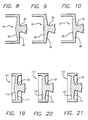
- Figures 8-10 illustrate three alternate flexible disk members for the flexible disk shafts of Figures 3-5.
- the thickness of the disk is increased from the cylindrical sides of the flexible disk member to the centerline of the disk.
- the disk 91 includes a flat outer surface 92 facing the quill shaft 50 and a tapered inner surface 93.
- the flexible disk 94 has a tapered outer surface 95 and a flat inner surface 96 while the flexible disk 97 of Figure 10 has both the outer surface 98 and inner surface 99 tapered.
- the flexible disk shaft 51 includes flexible disk member 58 which interference fits inside the permanent magnet sleeve 53, including permanent magnet 54, as specifically shown in Figure 11.
- the flexible disk member 58 includes flexible disk 64 and rim 59 with the disk 64 having a plurality of spiral slots 61 shown as four (4) in number.
- the tapered quill shaft 62 between the disk 64 and the flange 63 is elongated from that of the previously described version.
- the opposite end 57 of the tie rod 55, which supports the power head shaft 35, is threaded to receive the nut 41.
- the flexible disk member 73 includes rim 74 and flexible disk 77 which has five (5) spiral slots 75.
- Each of the spiral slots 75 is generally of a constant width except for an enlarged end 76 at the rim 74 to relieve stress in that area
- the quill shaft 82 between the flexible disk 77 and the flange 81 is still further elongated in this version of the flexible disk shaft 72.
- Tie rod 70 extends from the flange 81.
- the flexible disk 58 member of Figures 11-13 is interference fit only a short distance into the permanent magnet sleeve 53
- the flexible disk member 73 of Figures 14-16 is designed to interference fit at a greater depth into the permanent magnet sleeve 53 and to almost contact the permanent magnet 54.
- the axial position of the flexible disk member 73 will change the frequency of the compound shaft criticals and may require different balancing techniques depending upon how close the flexible disk member 73 is to the magnet 54.
- the inside diameter of the permanent magnet sleeve 53 can be slightly tapered to help the insertion of the flexible disk member 73 deep into the permanent magnet sleeve 53.
- Either of the flexible disk members 58 or 73 may have a generally drum-shaped configuration as shown in Figures 17 and 18.
- This version of the flexible disk member, identified as 84 includes drum head 86 and sides 85 with the drum head 86 having a plurality (shown as four) spiral slots 87 each having a flared opening 88 at the sides 85 and extending a considerable distance along the sides 85.
- the outer diameter of the sides 85 may be slightly flared at the open end, as shown in Figure 18, to facilitate insertion into the permanent magnet sleeve 53.
- the drum-shape can, however, be open at either end, that is, the open end can either face towards the permanent magnet 54 or away from the permanent magnet 54.
- the countersunk hole 90 at the center of the drum head 86 facilitates the transition of stresses into the web formed in the drum head 86 between the spiral slots 87.
- either of the flexible disk members 58 or 73 may have a flexible disk in which the thickness of the flexible disk is increased from the rim to the centerline of the disk as illustrated in Figures 19-21.
- the flexible disk 110 includes a flat surface 111 towards the quill shaft 50 and a tapered surface 112 away from the quill shaft 50.
- the flexible disk 113 has a tapered surface 114 towards the quill shaft 50 and a flat surface away from the quill shaft 50 while in the flexible disk 116 of Figure 21, both surfaces 117 and 118 are tapered.
- Figure 22 illustrates the turbine rotor 33 having an inertial ring 60 of increased mass at a radially outward position on the back plane of the rotor 33.
- This inertial ring 60 may be cast in place on the rotor 33 to provide increased mass in this area. Since the back plane of the rotor 33 is generally at or near a node of the first flexural critical, this increased mass at a radially extended position will provide gyroscopic stiffness at the node and increase the frequency of the first flexural critical.
- Thin brass disks are first bonded to each end of an unmagnetized samarium cobalt permanent magnet having a cylindrical shape and having a preferred magnetic axis normal to the cylinder's axis.
- the permanent magnet assembly with brass end pieces is then ground to obtain a precise outer diameter. It is then installed by thermal assembly techniques or other conventional means into the hollow permanent magnet sleeve which has an internal diameter that is slightly smaller than the permanent magnet assembly outer diameter.
- the resulting radial interference fit assures that the permanent magnet will not crack due to the tensile stresses that are induced when the permanent magnet assembly and permanent magnet sleeve experience rotationally induced gravitational fields when used in the turbomachine.
- the permanent magnet sleeve is longer than the permanent magnet assembly such that the permanent magnet sleeve has hollow ends when the permanent magnet assembly is installed therein.
- the internal stiffening sleeve is pressed with a radial interference fit into one of the hollow ends to stiffen the permanent magnet sleeve against bending induced by the first flexural critical mode of the compound shaft rotor assembly.
- the permanent magnet shaft assembly then has its outer surface contoured by grinding. It is then balanced as a component after which the permanent magnet is magnetized.
- the resulting permanent magnet shaft is a specific example of the first stiff shaft of the present invention.
- the flexible disk shaft is then pressed with an interference fit over the end of the first stiff shaft that has the internal stiffening sleeve.
- a compliant foil hydrodynamic fluid film journal bearing is installed into the turbomachine's power head housing.
- Half of the bi-directional compliant foil hydrodynamic fluid film thrust bearing is attached to the face of the power head housing.
- the bearing rotor (with a rotating thrust disk) is installed into the journal bearing and abutted against the thrust bearing half mounted in or attached to the power head.
- the second half of the thrust bearing in installed in the power head assembly to enclose the thrust disk of the bearing rotor.
- the compressor wheel is then attached to one end of the bearing rotor by arbor pressing the interference fit pilot diameters of the compressor wheel and bearing rotor.
- the turbine wheel is then attached to the other end of the bearing rotor by arbor pressing the interference fit pilot diameters of the turbine wheel and bearing rotor. This completes the assembly of the second stiff shaft and the power head less the compressor shroud and turbine shroud.
- the permanent magnet motor/generator stator is installed with a radial interference fit into the stator cooling fin structure by thermal assembly techniques.
- the fin structure is installed with a radial interference fit into the motor/generator housing cylindrical sleeve by thermal assembly techniques.
- the bearing cartridge retainers (2) are installed with a radial interference fit into the fin structure by either thermal assembly techniques or by arbor/hydraulic press techniques.
- the compliant foil hydrodynamic fluid film journal bearings (2) are installed into the cartridge retainers by slip fit techniques and secured by a washer and a tapered snap ring.
- the assembled motor/generator housing with built in compressor shroud is then bolted to the power head assembly.
- the assembled first stiff shaft and flexible disk shaft is then inserted through the motor/generator housing and into the second stiff shaft (compressor, bearing rotor, turbine) and power head and secured in place with a nut to place the compressor, bearing rotor, and turbine in compression.
- the turbine shroud is then installed, followed by the combustor and recuperator (heat exchanger) which completes the turbomachine (turbogenerator) assembly.
- the turbogenerator typically does not require assembly balancing. It may not even need to be checked to determine the state of rotor balance before being put into operation.
- all the rigid body criticals are negotiated when the machine has accelerated above 20,000 rpm.
- the dimensionless damping constant Q (defined as resonant energy stored by a critical divided by resonant energy dissipated by damping per rotor rotation) for the last negotiated critical is typically only 2.3.
- the other negotiated criticals are typically damped even better.
- No flexural criticals need to be negotiated.
- the operating speed is 96,000 rpm.
- the first flexural critical speed is over 130,000 rpm.
- the graph of Figure 23 is a plot of force in the y-axis vs deflection in the x-axis with line B representing a linear spring rate.
- Curve A includes section A" in which linear small deflection plate trunnion spring rate mechanisms dominate and section A' where the spring rate is dominated by non-linear large deflection plate trunnion and drum head tension mechanisms.
- Curves C, D, and E each illustrate buckling dominated spring rate mechanisms.
- Curve C represents a case with low radial compressive stress applied to the outer edge of the flexible disk with a resulting reduction in trunnion spring rate at low deflections.
- Curve D represents a case with medium compressive stress resulting in a barely positive spring rate.
- Curve E represents a case with high radial compressive stress resulting in a negative trunnion spring rate at low deflections.
- the alphabetical sequence of the curves represent decreasing positive spring rate.
- Increasing radial interference fit of the flexible disk rim in the permanent magnet sleeve increases compressive stresses directly and controls the bearing tolerance to misalignment and the rotor critical frequencies indirectly.
- a rotor critical dominated by the trunnion spring properties of a flexible disk shaft having negative spring rate will have a frequency of zero (the critical will disappear). While all of these curves are applicable to flexible disk shafts shown in Figures 11 and 14, only curves A & B apply to the flexible disk shaft shown in detail in Figures 3-5.
- Figures 24a and 24b are each a piot of shaft runout in the vertical direction vs shaft speed in the horizontal direction.
- Figure 24a represents a typical runout for a single piece unitary turbomachine shaft supported by two (2) journal bearings.
- Rigid body critical 100 and flexural critical 101 are both within the selected operating speed range for this typical turbomachine and will require considerable balancing and damping in order for the shaft to successfully negotiate them, particularly the flexural critical 101.
- Figures 25-28 are computer representations generally illustrating the criticals 104, 105, 106 and 107 of Figure 24b.
- the first rigid body critical 104 of Figure 25 has a low frequency of about 9000 rpm and a medium imbalance and runout defect leveL
- the second rigid body critical 105 as shown in Figure 26 would occur at about 14,000 rpm.
- the third rigid body critical 106 of Figure 27 would occur at about 21,000 rpm.
- Figure 28 illustrates that the first flexural critical which would occur at over 130,000 rpm.
- Each of these figures illustrate the static compound shaft, position S, and the compound shaft displaced at the speed of the critical, position T. While the first and second shafts are described as rigid or stiff, this is a relative term and is only true below the first flexural critical. At the high speeds of the first flexural critical, bending of these two shafts does occur as is graphically shown in Figure 28 .
- the flexure of the connecting structure between the first and second stiff shafts, namely the flexible disk shaft prevents either stiff shaft from delivering a moment to the other stiff shaft
- the first stiff shaft does not sense or know that there is in fact a second stiff shaft
- the second stiff shaft thinks that it is integrally connected to the power head end journal bearing of the first stiff shaft.
- the power head shaft journal bearing and the power head end journal bearing of the permanent magnet or first stiff shaft in essence support the power head shaft and prevent overturning motion and rubbing of the rotor.
- the compound shaft of the present invention provides for tuning or shifting of the rotor's rigid body and flexural critical frequencies. This provides flexibility in selecting the operating speed range of the turbomachine shaft. In most cases, a wide operating range is desirable over which there should be a no rigid body or flexural criticals that need to be negotiated during normal operation. This spread is achieved by lowering the rigid body critical frequencies and increasing the first flexural critical frequency. There are a number of factors which can affect frequencies of the rigid body criticals and the frequency of the first flexural critical. The length of the quill shaft between the flexible disk member and the flange on the flexible disk shaft, for example, can significantly affect the frequency of the first flexural critical; the shorter the quill shaft, the higher the frequency.
- the internal stiffening sleeve in the first stiff shaft rotor sleeve can increase the frequency of the first flexural critical by over 8,000 rpm.
- the number, type, size, and location of the holes or slots in the flexible disk or the variations in thickness in the flexible disk control the spring rate in the compound shaft, bearing tolerance to misalignment, and the frequencies of the rigid body criticals.
Landscapes
- Engineering & Computer Science (AREA)
- Power Engineering (AREA)
- Mechanical Engineering (AREA)
- General Engineering & Computer Science (AREA)
- Support Of The Bearing (AREA)
- Structures Of Non-Positive Displacement Pumps (AREA)
- Turbine Rotor Nozzle Sealing (AREA)
- Shafts, Cranks, Connecting Bars, And Related Bearings (AREA)
Applications Claiming Priority (2)
| Application Number | Priority Date | Filing Date | Title |
|---|---|---|---|
| US08/440,541 US5697848A (en) | 1995-05-12 | 1995-05-12 | Compound shaft with flexible disk coupling |
| US440541 | 1995-05-12 |
Publications (2)
| Publication Number | Publication Date |
|---|---|
| EP0742634A2 true EP0742634A2 (de) | 1996-11-13 |
| EP0742634A3 EP0742634A3 (de) | 1998-10-28 |
Family
ID=23749174
Family Applications (1)
| Application Number | Title | Priority Date | Filing Date |
|---|---|---|---|
| EP96303265A Withdrawn EP0742634A3 (de) | 1995-05-12 | 1996-05-10 | Verbundwelle |
Country Status (4)
| Country | Link |
|---|---|
| US (1) | US5697848A (de) |
| EP (1) | EP0742634A3 (de) |
| JP (1) | JPH08334117A (de) |
| IL (1) | IL118216A (de) |
Cited By (11)
| Publication number | Priority date | Publication date | Assignee | Title |
|---|---|---|---|---|
| EP0903466A3 (de) * | 1997-09-19 | 2000-07-19 | Capstone Turbine Corporation | Verbundwelle mit Doppelmembrane |
| US6314717B1 (en) | 1996-12-03 | 2001-11-13 | Elliott Energy Systems, Inc. | Electricity generating system having an annular combustor |
| US6605928B2 (en) | 1996-12-03 | 2003-08-12 | Elliott Energy Systems, Inc. | Electrical system for turbine/alternator on common shaft |
| EP2415967A1 (de) * | 2010-08-03 | 2012-02-08 | Siemens Aktiengesellschaft | Gasturbinenmotor mit Spannungsbolzen |
| US11603801B2 (en) * | 2021-05-24 | 2023-03-14 | General Electric Company | Midshaft rating for turbomachine engines |
| US11724813B2 (en) | 2021-05-24 | 2023-08-15 | General Electric Company | Midshaft rating for turbomachine engines |
| US11808214B2 (en) | 2021-05-24 | 2023-11-07 | General Electric Company | Midshaft rating for turbomachine engines |
| WO2024054490A1 (en) * | 2022-09-07 | 2024-03-14 | Sapphire Technologies, Inc. | Modular design of turboexpander components |
| US12071978B2 (en) | 2021-05-24 | 2024-08-27 | General Electric Company | Midshaft rating for turbomachine engines |
| US12203377B2 (en) | 2021-05-24 | 2025-01-21 | General Electric Company | Midshaft rating for turbomachine engines |
| US12392307B2 (en) | 2023-03-24 | 2025-08-19 | General Electric Company | High-speed shaft rating for turbine engines |
Families Citing this family (25)
| Publication number | Priority date | Publication date | Assignee | Title |
|---|---|---|---|---|
| US6123518A (en) * | 1998-03-13 | 2000-09-26 | Mi-Jack Products, Inc. | Integral shaft coupling for a flexible driveplate in a pump drivetrain |
| US20020079760A1 (en) * | 2000-10-31 | 2002-06-27 | Capstone Turbine Corporation | Double diaphragm coumpound shaft |
| EP1404974B1 (de) * | 2001-07-06 | 2008-11-05 | Borgwarner, Inc. | Verdichter mit elektromotorischem antrieb |
| GB0213166D0 (en) * | 2002-06-10 | 2002-07-17 | Leuven K U Res & Dev | Monolithic cutting tool |
| US7112036B2 (en) * | 2003-10-28 | 2006-09-26 | Capstone Turbine Corporation | Rotor and bearing system for a turbomachine |
| EP1850454B1 (de) | 2006-04-24 | 2011-06-22 | Inventio AG | Zugantrieb für einen Aufzug |
| BRPI1007723A2 (pt) | 2009-05-12 | 2018-03-06 | Icr Turbine Engine Corp | sistema de armazenamento e conversão de turbina a gás |
| US8162762B2 (en) * | 2009-07-01 | 2012-04-24 | Hamilton Sundstrand Corporation | Generator flexible drive coupling |
| US8376690B2 (en) * | 2009-12-08 | 2013-02-19 | Honeywell International Inc. | Three bearing flexible shaft for high speed turbomachinery |
| US8866334B2 (en) | 2010-03-02 | 2014-10-21 | Icr Turbine Engine Corporation | Dispatchable power from a renewable energy facility |
| US8984895B2 (en) | 2010-07-09 | 2015-03-24 | Icr Turbine Engine Corporation | Metallic ceramic spool for a gas turbine engine |
| US8669670B2 (en) | 2010-09-03 | 2014-03-11 | Icr Turbine Engine Corporation | Gas turbine engine configurations |
| US8757960B2 (en) | 2010-12-21 | 2014-06-24 | Hamilton Sundstrand Corporation | Shaft support for air cycle machine |
| US9051873B2 (en) | 2011-05-20 | 2015-06-09 | Icr Turbine Engine Corporation | Ceramic-to-metal turbine shaft attachment |
| BRPI1103647A2 (pt) * | 2011-07-07 | 2013-07-02 | Whirlpool Sa | disposiÇço entre componentes de compressor linear |
| BRPI1103447A2 (pt) * | 2011-07-19 | 2013-07-09 | Whirlpool Sa | feixe de molas para compressor e compressor provido de feixe de molas |
| BRPI1104172A2 (pt) * | 2011-08-31 | 2015-10-13 | Whirlpool Sa | compressor linear baseado em mecanismo oscilatório ressonante |
| US10094288B2 (en) | 2012-07-24 | 2018-10-09 | Icr Turbine Engine Corporation | Ceramic-to-metal turbine volute attachment for a gas turbine engine |
| AU2015417605B2 (en) * | 2015-12-18 | 2022-06-02 | Sandvik Intellectual Property Ab | Torque reaction pulley for an inertia cone crusher |
| JP2019019751A (ja) | 2017-07-18 | 2019-02-07 | パナソニックIpマネジメント株式会社 | ガスタービンロータ及びガスタービン発電機 |
| US11519271B2 (en) * | 2020-06-05 | 2022-12-06 | Rolls-Royce North American Technologies Inc. | Turbine engine rotor with flexibly coupled tie bolt |
| CN112283321B (zh) * | 2020-10-23 | 2022-02-11 | 东方电气集团东方汽轮机有限公司 | 一种套筒轴挠性杆刚性齿轮转子 |
| CN112332597B (zh) * | 2020-10-26 | 2022-11-18 | 北京动力机械研究所 | 一种高功率密度发电系统电机轴结构与工艺 |
| EP4117146A1 (de) * | 2021-07-07 | 2023-01-11 | Celeroton AG | Rotor für eine elektrische hochgeschwindigkeitsmaschine |
| CN114483303B (zh) * | 2021-12-30 | 2023-04-07 | 中车永济电机有限公司 | 一种应用于微型燃气轮机的高速永磁电机 |
Family Cites Families (35)
| Publication number | Priority date | Publication date | Assignee | Title |
|---|---|---|---|---|
| US1283787A (en) * | 1916-06-17 | 1918-11-05 | Gustavus A Schanze | Flexible shaft and universal coupling therefor. |
| US1460212A (en) * | 1921-04-01 | 1923-06-26 | Olive Paul | Universal joint |
| GB315338A (en) * | 1928-04-12 | 1929-07-12 | Leonard Miller | Improvements in the transmission of power through flexible shafts |
| DE737850C (de) * | 1938-11-27 | 1943-07-27 | Hans Still | Aus Brennkraftkolbenmaschine und elektrischem Generator bestehendes Stromerzeugungsagregat |
| US2300689A (en) * | 1941-03-24 | 1942-11-03 | American Brake Shoe & Foundry | Automatic priming pump and the like |
| GB614348A (en) * | 1946-07-11 | 1948-12-14 | Gen Electric Co Ltd | Improvements in or relating to electric motors |
| US2483616A (en) * | 1947-05-22 | 1949-10-04 | Svenska Flygmotor Aktiebolaget | Rotor for multistage turbines or similar machines |
| US2625883A (en) * | 1951-01-25 | 1953-01-20 | Julia M Howser | Centrifugal pump drive and seal means |
| DE1005790B (de) * | 1952-05-03 | 1957-04-04 | Max Planck Gesellschaft | Gleitlager mit Schmierung durch Luft oder Dampf, die unter Atmosphaerendruck Stehen |
| US2848882A (en) * | 1955-11-25 | 1958-08-26 | Gen Motors Corp | Drive noise insulating means |
| US3299722A (en) * | 1964-10-08 | 1967-01-24 | Jr Albert G Bodine | Mechanical sonic vibration generator with frequency step-up characteristic |
| US3448591A (en) * | 1967-12-13 | 1969-06-10 | Rudolf A Spyra | Spiral disk drive coupling |
| US3500754A (en) * | 1968-01-25 | 1970-03-17 | Loewe Pumpenfabrik Gmbh | Centrifugal pump units |
| US3635050A (en) * | 1969-11-25 | 1972-01-18 | Woodward Governor Co | Drive transmission with universal couplings |
| US3791169A (en) * | 1971-03-12 | 1974-02-12 | Koppers Co Inc | Torsionally resilient shaft coupling |
| US3788099A (en) * | 1971-06-30 | 1974-01-29 | D Miller | Flexible coupling |
| US3779451A (en) * | 1971-11-22 | 1973-12-18 | Int Equipment Co | Flexible shaft stabilizer |
| SE414137B (sv) * | 1972-01-12 | 1980-07-14 | Stihl Maschf Andreas | Kopplingsanordning for tillsatsapparater, serskilt tillsatsapparater for motorkedjesag |
| US3855817A (en) * | 1972-04-19 | 1974-12-24 | Gates Rubber Co | Flexible shaft |
| US3902333A (en) * | 1972-10-25 | 1975-09-02 | Anvar | Elastic couplings |
| US4176519A (en) * | 1973-05-22 | 1979-12-04 | United Turbine Ab & Co., Kommanditbolag | Gas turbine having a ceramic rotor |
| GB1429759A (en) * | 1973-12-18 | 1976-03-24 | Hofmann Maschf Geb | Measuring assembly for determining forces ind/or moments acting on a wheel |
| US3973867A (en) * | 1975-04-09 | 1976-08-10 | Chien Fu Lee | Radial flow type pump |
| DE2527498A1 (de) * | 1975-06-20 | 1976-12-30 | Daimler Benz Ag | Radialturbinenrad fuer eine gasturbine |
| DE2529458C2 (de) * | 1975-07-02 | 1982-11-18 | Sihi Gmbh & Co Kg, 2210 Itzehoe | Kreiselpumpenaggregat |
| US4044628A (en) * | 1976-03-24 | 1977-08-30 | U.S. Manufacturing Corporation | Torsional damper |
| US4121532A (en) * | 1977-01-06 | 1978-10-24 | Coryell Iii William Harlan | Speedboat safety driveline coupling |
| DE2823261C2 (de) * | 1978-05-27 | 1985-05-23 | Robert Bosch Gmbh, 7000 Stuttgart | Elektrische Maschine |
| DE3021318C2 (de) * | 1980-06-06 | 1982-04-22 | Klein, Schanzlin & Becker Ag, 6710 Frankenthal | Wellenverbindung |
| JPS57171122A (en) * | 1981-04-14 | 1982-10-21 | Toshiba Corp | Structure for mounting rotary disc on rotary shaft |
| US4854184A (en) * | 1983-11-07 | 1989-08-08 | Jessup Thurman W | Support system for shaft |
| JPH037367Y2 (de) * | 1985-05-31 | 1991-02-25 | ||
| US4795012A (en) * | 1987-05-26 | 1989-01-03 | Borg-Warner Automotive, Inc. | Spiral spring disc torsional coupling |
| US4934138A (en) * | 1988-12-06 | 1990-06-19 | Allied-Signal Inc. | High temperature turbine engine structure |
| US5577963A (en) * | 1994-05-02 | 1996-11-26 | Eaton Corporation | Torsion isolator spring with pivotal ends |
-
1995
- 1995-05-12 US US08/440,541 patent/US5697848A/en not_active Expired - Lifetime
-
1996
- 1996-05-10 EP EP96303265A patent/EP0742634A3/de not_active Withdrawn
- 1996-05-10 JP JP8116513A patent/JPH08334117A/ja not_active Withdrawn
- 1996-05-10 IL IL11821696A patent/IL118216A/xx not_active IP Right Cessation
Cited By (27)
| Publication number | Priority date | Publication date | Assignee | Title |
|---|---|---|---|---|
| US6314717B1 (en) | 1996-12-03 | 2001-11-13 | Elliott Energy Systems, Inc. | Electricity generating system having an annular combustor |
| US6605928B2 (en) | 1996-12-03 | 2003-08-12 | Elliott Energy Systems, Inc. | Electrical system for turbine/alternator on common shaft |
| US6891282B2 (en) | 1996-12-03 | 2005-05-10 | Elliott Energy Systems, Inc. | Method and apparatus for monitoring turbine parameters of turbine/alternator on common shaft |
| US6909199B2 (en) | 1996-12-03 | 2005-06-21 | Elliott Energy Systems, Inc. | Method and apparatus for compensating output voltage fluctuations of turbine/alternator on common shaft |
| US6911742B2 (en) | 1996-12-03 | 2005-06-28 | Elliott Energy Systems, Inc. | Method and apparatus for turbine/alternator on common shaft during start-up |
| US6956301B2 (en) | 1996-12-03 | 2005-10-18 | Elliott Energy Systems, Inc. | Method and apparatus for controlling output voltages and frequencies of turbine/alternator on common shaft |
| US6989610B2 (en) | 1996-12-03 | 2006-01-24 | Elliott Energy Systems, Inc. | Electrical system for turbine/alternator on common shaft |
| US6998728B2 (en) | 1996-12-03 | 2006-02-14 | Elliott Energy Systems, Inc. | Method and apparatus for controlling output current of turbine/alternator on common shaft |
| EP0903466A3 (de) * | 1997-09-19 | 2000-07-19 | Capstone Turbine Corporation | Verbundwelle mit Doppelmembrane |
| EP2415967A1 (de) * | 2010-08-03 | 2012-02-08 | Siemens Aktiengesellschaft | Gasturbinenmotor mit Spannungsbolzen |
| WO2012016981A1 (en) | 2010-08-03 | 2012-02-09 | Siemens Aktiengesellschaft | Gas turbine engine comprising a tension stud |
| US9279327B2 (en) | 2010-08-03 | 2016-03-08 | Siemens Aktiengesellschaft | Gas turbine engine comprising a tension stud |
| US11603801B2 (en) * | 2021-05-24 | 2023-03-14 | General Electric Company | Midshaft rating for turbomachine engines |
| US12546360B2 (en) | 2021-05-24 | 2026-02-10 | General Electric Company | Midshaft rating for turbomachine engines |
| US11795882B2 (en) | 2021-05-24 | 2023-10-24 | General Electric Company | Midshaft rating for turbomachine engines |
| US11808214B2 (en) | 2021-05-24 | 2023-11-07 | General Electric Company | Midshaft rating for turbomachine engines |
| US11724813B2 (en) | 2021-05-24 | 2023-08-15 | General Electric Company | Midshaft rating for turbomachine engines |
| US12065254B2 (en) | 2021-05-24 | 2024-08-20 | General Electric Company | Midshaft rating for turbomachine engines |
| US12071978B2 (en) | 2021-05-24 | 2024-08-27 | General Electric Company | Midshaft rating for turbomachine engines |
| US12140081B2 (en) | 2021-05-24 | 2024-11-12 | General Electric Company | Midshaft rating for turbomachine engines |
| US12203377B2 (en) | 2021-05-24 | 2025-01-21 | General Electric Company | Midshaft rating for turbomachine engines |
| US12215633B2 (en) | 2021-05-24 | 2025-02-04 | General Electric Company | Midshaft rating for turbomachine engines |
| WO2024054490A1 (en) * | 2022-09-07 | 2024-03-14 | Sapphire Technologies, Inc. | Modular design of turboexpander components |
| US12416277B1 (en) | 2023-03-24 | 2025-09-16 | General Electric Company | High-speed shaft rating for turbine engines |
| US12421918B1 (en) | 2023-03-24 | 2025-09-23 | General Electric Company | High-speed shaft rating for turbine engines |
| US12486819B1 (en) | 2023-03-24 | 2025-12-02 | General Electric Company | High-speed shaft rating for turbine engines |
| US12392307B2 (en) | 2023-03-24 | 2025-08-19 | General Electric Company | High-speed shaft rating for turbine engines |
Also Published As
| Publication number | Publication date |
|---|---|
| US5697848A (en) | 1997-12-16 |
| IL118216A (en) | 2000-08-31 |
| JPH08334117A (ja) | 1996-12-17 |
| EP0742634A3 (de) | 1998-10-28 |
| IL118216A0 (en) | 1996-09-12 |
Similar Documents
| Publication | Publication Date | Title |
|---|---|---|
| US5697848A (en) | Compound shaft with flexible disk coupling | |
| US6037687A (en) | Double diaphragm compound shaft | |
| US3395949A (en) | Gas-bearing assembly | |
| JP5060288B2 (ja) | 多厚フィルム層軸受カートリッジ及びハウジング | |
| EP2365227B1 (de) | Verdreh- und Verschiebesicherung einer zweireihigen Kugellageranordnung im Gehäuse einer Turbomaschine mit flüssigkeitsgefülltem Dämpfungsspalt | |
| EP1275191B1 (de) | Motor-generator mit axialspalt für hochgeschwindigkeitsbetrieb | |
| CA2496911C (en) | Compliant foil-fluid bearing support arrangement | |
| WO1997002437A1 (en) | Hybrid foil/magnetic bearing | |
| US20020079765A1 (en) | Compliant foil fluid film bearing with eddy current damper | |
| US5759011A (en) | Journal bearing assembly | |
| JP2856027B2 (ja) | スピンドルモータ | |
| EP0944777B1 (de) | Verbesserte schraubenfeder für freilauf-federkupplung | |
| RU1806302C (ru) | Осевой опорный узел с компенсацией перекоса | |
| JP4427768B2 (ja) | 円筒型磁気カップリング装置 | |
| Lee | Mechatronics in rotating machinery | |
| US7465097B2 (en) | Fluid dynamic bearing system | |
| KR20050117730A (ko) | 스핀들 모터 | |
| US4895475A (en) | Assembly of cylinder and shaft with low stress coupling and method of making same | |
| JP3240637B2 (ja) | 軸受装置 | |
| US5988890A (en) | Rotor shaft | |
| JPH09309350A (ja) | 車両用動力伝達装置 | |
| Heshmat et al. | Experimental investigation of 150 mm diameter large hybrid foil/magnetic bearing | |
| US10727724B2 (en) | Electric motor generator system with a plurality of magnet portions abutting an inwardly facing surface of a shaft | |
| SU1767248A1 (ru) | Упруга муфта | |
| US6525440B1 (en) | Thermal compensation spindle for ceramic ball bearings |
Legal Events
| Date | Code | Title | Description |
|---|---|---|---|
| PUAI | Public reference made under article 153(3) epc to a published international application that has entered the european phase |
Free format text: ORIGINAL CODE: 0009012 |
|
| AK | Designated contracting states |
Kind code of ref document: A2 Designated state(s): DE FR GB |
|
| PUAL | Search report despatched |
Free format text: ORIGINAL CODE: 0009013 |
|
| AK | Designated contracting states |
Kind code of ref document: A3 Designated state(s): DE FR GB |
|
| 17P | Request for examination filed |
Effective date: 19990422 |
|
| STAA | Information on the status of an ep patent application or granted ep patent |
Free format text: STATUS: THE APPLICATION HAS BEEN WITHDRAWN |
|
| 18W | Application withdrawn |
Withdrawal date: 20020822 |