EP0743067A2 - Verwendung von Harnstoff und Thioharnstoffverbindungen zur Entfernung oder Entgiftung von Superantigens aus Körperflüssigkeiten - Google Patents
Verwendung von Harnstoff und Thioharnstoffverbindungen zur Entfernung oder Entgiftung von Superantigens aus Körperflüssigkeiten Download PDFInfo
- Publication number
- EP0743067A2 EP0743067A2 EP96303441A EP96303441A EP0743067A2 EP 0743067 A2 EP0743067 A2 EP 0743067A2 EP 96303441 A EP96303441 A EP 96303441A EP 96303441 A EP96303441 A EP 96303441A EP 0743067 A2 EP0743067 A2 EP 0743067A2
- Authority
- EP
- European Patent Office
- Prior art keywords
- group
- use according
- super
- forming
- bond
- Prior art date
- Legal status (The legal status is an assumption and is not a legal conclusion. Google has not performed a legal analysis and makes no representation as to the accuracy of the status listed.)
- Granted
Links
- MVPPADPHJFYWMZ-UHFFFAOYSA-N Clc1ccccc1 Chemical compound Clc1ccccc1 MVPPADPHJFYWMZ-UHFFFAOYSA-N 0.000 description 1
Images
Classifications
-
- A—HUMAN NECESSITIES
- A61—MEDICAL OR VETERINARY SCIENCE; HYGIENE
- A61K—PREPARATIONS FOR MEDICAL, DENTAL OR TOILETRY PURPOSES
- A61K31/00—Medicinal preparations containing organic active ingredients
- A61K31/16—Amides, e.g. hydroxamic acids
- A61K31/17—Amides, e.g. hydroxamic acids having the group >N—C(O)—N< or >N—C(S)—N<, e.g. urea, thiourea, carmustine
-
- A—HUMAN NECESSITIES
- A61—MEDICAL OR VETERINARY SCIENCE; HYGIENE
- A61K—PREPARATIONS FOR MEDICAL, DENTAL OR TOILETRY PURPOSES
- A61K31/00—Medicinal preparations containing organic active ingredients
- A61K31/095—Sulfur, selenium, or tellurium compounds, e.g. thiols
-
- A—HUMAN NECESSITIES
- A61—MEDICAL OR VETERINARY SCIENCE; HYGIENE
- A61K—PREPARATIONS FOR MEDICAL, DENTAL OR TOILETRY PURPOSES
- A61K31/00—Medicinal preparations containing organic active ingredients
- A61K31/70—Carbohydrates; Sugars; Derivatives thereof
- A61K31/715—Polysaccharides, i.e. having more than five saccharide radicals attached to each other by glycosidic linkages; Derivatives thereof, e.g. ethers, esters
- A61K31/716—Glucans
- A61K31/717—Celluloses
-
- A—HUMAN NECESSITIES
- A61—MEDICAL OR VETERINARY SCIENCE; HYGIENE
- A61K—PREPARATIONS FOR MEDICAL, DENTAL OR TOILETRY PURPOSES
- A61K31/00—Medicinal preparations containing organic active ingredients
- A61K31/70—Carbohydrates; Sugars; Derivatives thereof
- A61K31/715—Polysaccharides, i.e. having more than five saccharide radicals attached to each other by glycosidic linkages; Derivatives thereof, e.g. ethers, esters
- A61K31/716—Glucans
- A61K31/722—Chitin, chitosan
-
- A—HUMAN NECESSITIES
- A61—MEDICAL OR VETERINARY SCIENCE; HYGIENE
- A61K—PREPARATIONS FOR MEDICAL, DENTAL OR TOILETRY PURPOSES
- A61K31/00—Medicinal preparations containing organic active ingredients
- A61K31/74—Synthetic polymeric materials
-
- A—HUMAN NECESSITIES
- A61—MEDICAL OR VETERINARY SCIENCE; HYGIENE
- A61L—METHODS OR APPARATUS FOR STERILISING MATERIALS OR OBJECTS IN GENERAL; DISINFECTION, STERILISATION OR DEODORISATION OF AIR; CHEMICAL ASPECTS OF BANDAGES, DRESSINGS, ABSORBENT PADS OR SURGICAL ARTICLES; MATERIALS FOR BANDAGES, DRESSINGS, ABSORBENT PADS OR SURGICAL ARTICLES
- A61L15/00—Chemical aspects of, or use of materials for, bandages, dressings or absorbent pads
- A61L15/16—Bandages, dressings or absorbent pads for physiological fluids such as urine or blood, e.g. sanitary towels, tampons
- A61L15/42—Use of materials characterised by their function or physical properties
-
- B—PERFORMING OPERATIONS; TRANSPORTING
- B01—PHYSICAL OR CHEMICAL PROCESSES OR APPARATUS IN GENERAL
- B01J—CHEMICAL OR PHYSICAL PROCESSES, e.g. CATALYSIS OR COLLOID CHEMISTRY; THEIR RELEVANT APPARATUS
- B01J20/00—Solid sorbent compositions or filter aid compositions; Sorbents for chromatography; Processes for preparing, regenerating or reactivating thereof
- B01J20/22—Solid sorbent compositions or filter aid compositions; Sorbents for chromatography; Processes for preparing, regenerating or reactivating thereof comprising organic material
- B01J20/24—Naturally occurring macromolecular compounds, e.g. humic acids or their derivatives
-
- B—PERFORMING OPERATIONS; TRANSPORTING
- B01—PHYSICAL OR CHEMICAL PROCESSES OR APPARATUS IN GENERAL
- B01J—CHEMICAL OR PHYSICAL PROCESSES, e.g. CATALYSIS OR COLLOID CHEMISTRY; THEIR RELEVANT APPARATUS
- B01J20/00—Solid sorbent compositions or filter aid compositions; Sorbents for chromatography; Processes for preparing, regenerating or reactivating thereof
- B01J20/22—Solid sorbent compositions or filter aid compositions; Sorbents for chromatography; Processes for preparing, regenerating or reactivating thereof comprising organic material
- B01J20/26—Synthetic macromolecular compounds
- B01J20/261—Synthetic macromolecular compounds obtained by reactions only involving carbon to carbon unsaturated bonds
-
- B—PERFORMING OPERATIONS; TRANSPORTING
- B01—PHYSICAL OR CHEMICAL PROCESSES OR APPARATUS IN GENERAL
- B01J—CHEMICAL OR PHYSICAL PROCESSES, e.g. CATALYSIS OR COLLOID CHEMISTRY; THEIR RELEVANT APPARATUS
- B01J20/00—Solid sorbent compositions or filter aid compositions; Sorbents for chromatography; Processes for preparing, regenerating or reactivating thereof
- B01J20/22—Solid sorbent compositions or filter aid compositions; Sorbents for chromatography; Processes for preparing, regenerating or reactivating thereof comprising organic material
- B01J20/26—Synthetic macromolecular compounds
- B01J20/262—Synthetic macromolecular compounds obtained otherwise than by reactions only involving carbon to carbon unsaturated bonds, e.g. obtained by polycondensation
-
- B—PERFORMING OPERATIONS; TRANSPORTING
- B01—PHYSICAL OR CHEMICAL PROCESSES OR APPARATUS IN GENERAL
- B01J—CHEMICAL OR PHYSICAL PROCESSES, e.g. CATALYSIS OR COLLOID CHEMISTRY; THEIR RELEVANT APPARATUS
- B01J20/00—Solid sorbent compositions or filter aid compositions; Sorbents for chromatography; Processes for preparing, regenerating or reactivating thereof
- B01J20/28—Solid sorbent compositions or filter aid compositions; Sorbents for chromatography; Processes for preparing, regenerating or reactivating thereof characterised by their form or physical properties
- B01J20/28002—Solid sorbent compositions or filter aid compositions; Sorbents for chromatography; Processes for preparing, regenerating or reactivating thereof characterised by their form or physical properties characterised by their physical properties
- B01J20/28004—Sorbent size or size distribution, e.g. particle size
-
- B—PERFORMING OPERATIONS; TRANSPORTING
- B01—PHYSICAL OR CHEMICAL PROCESSES OR APPARATUS IN GENERAL
- B01J—CHEMICAL OR PHYSICAL PROCESSES, e.g. CATALYSIS OR COLLOID CHEMISTRY; THEIR RELEVANT APPARATUS
- B01J20/00—Solid sorbent compositions or filter aid compositions; Sorbents for chromatography; Processes for preparing, regenerating or reactivating thereof
- B01J20/28—Solid sorbent compositions or filter aid compositions; Sorbents for chromatography; Processes for preparing, regenerating or reactivating thereof characterised by their form or physical properties
- B01J20/28014—Solid sorbent compositions or filter aid compositions; Sorbents for chromatography; Processes for preparing, regenerating or reactivating thereof characterised by their form or physical properties characterised by their form
- B01J20/28023—Fibres or filaments
-
- B—PERFORMING OPERATIONS; TRANSPORTING
- B01—PHYSICAL OR CHEMICAL PROCESSES OR APPARATUS IN GENERAL
- B01J—CHEMICAL OR PHYSICAL PROCESSES, e.g. CATALYSIS OR COLLOID CHEMISTRY; THEIR RELEVANT APPARATUS
- B01J20/00—Solid sorbent compositions or filter aid compositions; Sorbents for chromatography; Processes for preparing, regenerating or reactivating thereof
- B01J20/30—Processes for preparing, regenerating, or reactivating
- B01J20/3092—Packing of a container, e.g. packing a cartridge or column
-
- B—PERFORMING OPERATIONS; TRANSPORTING
- B01—PHYSICAL OR CHEMICAL PROCESSES OR APPARATUS IN GENERAL
- B01J—CHEMICAL OR PHYSICAL PROCESSES, e.g. CATALYSIS OR COLLOID CHEMISTRY; THEIR RELEVANT APPARATUS
- B01J20/00—Solid sorbent compositions or filter aid compositions; Sorbents for chromatography; Processes for preparing, regenerating or reactivating thereof
- B01J20/30—Processes for preparing, regenerating, or reactivating
- B01J20/32—Impregnating or coating ; Solid sorbent compositions obtained from processes involving impregnating or coating
- B01J20/3202—Impregnating or coating ; Solid sorbent compositions obtained from processes involving impregnating or coating characterised by the carrier, support or substrate used for impregnation or coating
- B01J20/3206—Organic carriers, supports or substrates
- B01J20/3208—Polymeric carriers, supports or substrates
- B01J20/321—Polymeric carriers, supports or substrates consisting of a polymer obtained by reactions involving only carbon to carbon unsaturated bonds
-
- B—PERFORMING OPERATIONS; TRANSPORTING
- B01—PHYSICAL OR CHEMICAL PROCESSES OR APPARATUS IN GENERAL
- B01J—CHEMICAL OR PHYSICAL PROCESSES, e.g. CATALYSIS OR COLLOID CHEMISTRY; THEIR RELEVANT APPARATUS
- B01J20/00—Solid sorbent compositions or filter aid compositions; Sorbents for chromatography; Processes for preparing, regenerating or reactivating thereof
- B01J20/30—Processes for preparing, regenerating, or reactivating
- B01J20/32—Impregnating or coating ; Solid sorbent compositions obtained from processes involving impregnating or coating
- B01J20/3202—Impregnating or coating ; Solid sorbent compositions obtained from processes involving impregnating or coating characterised by the carrier, support or substrate used for impregnation or coating
- B01J20/3206—Organic carriers, supports or substrates
- B01J20/3208—Polymeric carriers, supports or substrates
- B01J20/3212—Polymeric carriers, supports or substrates consisting of a polymer obtained by reactions otherwise than involving only carbon to carbon unsaturated bonds
-
- B—PERFORMING OPERATIONS; TRANSPORTING
- B01—PHYSICAL OR CHEMICAL PROCESSES OR APPARATUS IN GENERAL
- B01J—CHEMICAL OR PHYSICAL PROCESSES, e.g. CATALYSIS OR COLLOID CHEMISTRY; THEIR RELEVANT APPARATUS
- B01J20/00—Solid sorbent compositions or filter aid compositions; Sorbents for chromatography; Processes for preparing, regenerating or reactivating thereof
- B01J20/30—Processes for preparing, regenerating, or reactivating
- B01J20/32—Impregnating or coating ; Solid sorbent compositions obtained from processes involving impregnating or coating
- B01J20/3231—Impregnating or coating ; Solid sorbent compositions obtained from processes involving impregnating or coating characterised by the coating or impregnating layer
- B01J20/3242—Layers with a functional group, e.g. an affinity material, a ligand, a reactant or a complexing group
- B01J20/3244—Non-macromolecular compounds
- B01J20/3246—Non-macromolecular compounds having a well defined chemical structure
- B01J20/3248—Non-macromolecular compounds having a well defined chemical structure the functional group or the linking, spacer or anchoring group as a whole comprising at least one type of heteroatom selected from a nitrogen, oxygen or sulfur, these atoms not being part of the carrier as such
- B01J20/3251—Non-macromolecular compounds having a well defined chemical structure the functional group or the linking, spacer or anchoring group as a whole comprising at least one type of heteroatom selected from a nitrogen, oxygen or sulfur, these atoms not being part of the carrier as such comprising at least two different types of heteroatoms selected from nitrogen, oxygen or sulphur
-
- B—PERFORMING OPERATIONS; TRANSPORTING
- B01—PHYSICAL OR CHEMICAL PROCESSES OR APPARATUS IN GENERAL
- B01J—CHEMICAL OR PHYSICAL PROCESSES, e.g. CATALYSIS OR COLLOID CHEMISTRY; THEIR RELEVANT APPARATUS
- B01J20/00—Solid sorbent compositions or filter aid compositions; Sorbents for chromatography; Processes for preparing, regenerating or reactivating thereof
- B01J20/30—Processes for preparing, regenerating, or reactivating
- B01J20/32—Impregnating or coating ; Solid sorbent compositions obtained from processes involving impregnating or coating
- B01J20/3231—Impregnating or coating ; Solid sorbent compositions obtained from processes involving impregnating or coating characterised by the coating or impregnating layer
- B01J20/3242—Layers with a functional group, e.g. an affinity material, a ligand, a reactant or a complexing group
- B01J20/3244—Non-macromolecular compounds
- B01J20/3246—Non-macromolecular compounds having a well defined chemical structure
- B01J20/3248—Non-macromolecular compounds having a well defined chemical structure the functional group or the linking, spacer or anchoring group as a whole comprising at least one type of heteroatom selected from a nitrogen, oxygen or sulfur, these atoms not being part of the carrier as such
- B01J20/3253—Non-macromolecular compounds having a well defined chemical structure the functional group or the linking, spacer or anchoring group as a whole comprising at least one type of heteroatom selected from a nitrogen, oxygen or sulfur, these atoms not being part of the carrier as such comprising a cyclic structure not containing any of the heteroatoms nitrogen, oxygen or sulfur, e.g. aromatic structures
-
- C—CHEMISTRY; METALLURGY
- C08—ORGANIC MACROMOLECULAR COMPOUNDS; THEIR PREPARATION OR CHEMICAL WORKING-UP; COMPOSITIONS BASED THEREON
- C08G—MACROMOLECULAR COMPOUNDS OBTAINED OTHERWISE THAN BY REACTIONS ONLY INVOLVING UNSATURATED CARBON-TO-CARBON BONDS
- C08G18/00—Polymeric products of isocyanates or isothiocyanates
- C08G18/06—Polymeric products of isocyanates or isothiocyanates with compounds having active hydrogen
- C08G18/28—Polymeric products of isocyanates or isothiocyanates with compounds having active hydrogen characterised by the compounds used containing active hydrogen
- C08G18/30—Low-molecular-weight compounds
- C08G18/32—Polyhydroxy compounds; Polyamines; Hydroxyamines
- C08G18/3271—Hydroxyamines
- C08G18/3275—Hydroxyamines containing two hydroxy groups
-
- B—PERFORMING OPERATIONS; TRANSPORTING
- B01—PHYSICAL OR CHEMICAL PROCESSES OR APPARATUS IN GENERAL
- B01J—CHEMICAL OR PHYSICAL PROCESSES, e.g. CATALYSIS OR COLLOID CHEMISTRY; THEIR RELEVANT APPARATUS
- B01J2220/00—Aspects relating to sorbent materials
- B01J2220/40—Aspects relating to the composition of sorbent or filter aid materials
- B01J2220/48—Sorbents characterised by the starting material used for their preparation
- B01J2220/4812—Sorbents characterised by the starting material used for their preparation the starting material being of organic character
- B01J2220/4825—Polysaccharides or cellulose materials, e.g. starch, chitin, sawdust, wood, straw, cotton
-
- B—PERFORMING OPERATIONS; TRANSPORTING
- B01—PHYSICAL OR CHEMICAL PROCESSES OR APPARATUS IN GENERAL
- B01J—CHEMICAL OR PHYSICAL PROCESSES, e.g. CATALYSIS OR COLLOID CHEMISTRY; THEIR RELEVANT APPARATUS
- B01J2220/00—Aspects relating to sorbent materials
- B01J2220/50—Aspects relating to the use of sorbent or filter aid materials
- B01J2220/58—Use in a single column
Definitions
- the present invention relates to a material for detoxification or elimination of super antigens such as staphylococcal enterotoxin and streptococcal exotoxin.
- This material binds with super antigens existing in a protein solution at a high concentration such as in the human blood etc., it is preferably used as an (antidotal) medicine for reducing or eliminating toxic activity of super antigens, as a purification column for eliminating the super antigen or as a wound dressing material.
- Super antigens are a group of proteins which can directly bind with major histocompatibility antigen class II proteins (hereinbelow called "MHC class II" in some cases) on an antigen presenting cell without the necessity for passage, during processing, through the antigen presenting cell to be different from that for conventional antigens and furthermore, stimulate a T-cell by forming a complex with this MHC class II and T cell.
- MHC class II major histocompatibility antigen class II proteins
- binding subtances are proteins and peptides and they are easily deactivated by sterilization.
- affinity between ion exchange resins and super antigens is easily reduced by the influence of pH of the solution; specificity is decreased in the neutral region. Therefore, they are not suitable as a material with sufficient affinity for super antigens in solutions having a high protein concentration as blood, foods etc., where the pH should be kept neutral.
- the present invention seeks to address the problem of solving the disadvantages of conventional technologies by providing a material with excellent selective affinity for super antigens even in a high protein concentration solution at a pH in the neutral region, with residual activity after sterilization and which is inexpensive.
- the material of the present invention has a high affinity for super antigens and it can bind with super antigens existing in body fluids such as blood and urine, foods, drinks and medicines. It is possible by such binding that the toxin-like activities of the super antigens can be eliminated (detoxification) by changing such properties of the super antigens as their conformations or by shielding the binding sites with MHC class II or/and T-cells.
- the material of the present invention when used as a medicine, it is possible to effectively treat the effects of food poisoning, sepsis and autoimmune diseases or to prevent them from occurring.
- this material is water-insoluble, it becomes possible by using this to eliminate super antigens from body fluids such as blood and urine, foods, drinks and medicines to to treat the effects of food poisoning, sepsis and autoimmune diseases and to prevent them from occurring.
- body fluids such as blood and urine, foods, drinks and medicines to to treat the effects of food poisoning, sepsis and autoimmune diseases and to prevent them from occurring.
- it is suitable as a body fluid purifying column for eliminating super antigens or as a super antigen-adsorbing wound dressing material.
- the present invention provides a material which enables diagnosis and therapy of these diseases and prevents them from occurring.
- a material containing a urea bond or a thiourea bond has an affinity with staphylococcal enterotoxin and Streptococcal exotoxin. That is, a first aspect of the present invention provides a material for use in treatment of a human or animal body for eliminating or detoxifying super antigens wherein said material comprises a urea bond or a thiourea bond. A second aspect of the invention provides the use of such a material in the preparation of an agent employed in the treatment of a human or animal body for elimination or detoxification of super antigens, while a third aspect provides the use of such a material for in vitro elimination or detoxification of super antigens.
- the material preferably comprises a group capable of forming a hydrogen bond and an aromatic substituent.
- the material may be employed, for example, as a medicament, for example, on a wound dressing, or as a sorbing agent either during circulation of blood or plasma out of and thereafter back into a human or animal body, or during in vitro sorption procedures, which may be carried out on a body fluid such as blood, plasma or serum.
- a fourth aspect of the present invention provides a urea or thiourea compound, useful as the material employed in performance of the first to third aspects of the invention, which compound has the following formula: which compound contains (1) a group capable of forming a hydrogen bond and (2) an aromatic substituent, and
- a unit having a group capable of forming a hydrogen bond and a unit having an aromatic substituent alternate with one another.
- an amino group or a hydroxyl group, particularly, a secondary or tertiary amino, group is preferable. More preferably, in such a compound,
- a fifth aspect of the present invention provides a body fluid purifying column comprising the above mentioned material.
- a sixth aspect of the present invention provides a wound dressing material comprising the above mentioned material.
- substituent of the urea bond or the thiourea bond and aliphatic compounds such as a hexyl group, octyl group and dodecyl group and alicyclic compounds such as cyclohexane and cyclopentane may be used, but aromatic compounds such as those containing a phenyl group, naphthyl group and anthranyl group are more preferably used.
- derivatives such as those containing an aminohexyl group, monomethylaminohexyl group, dimethylaminohexyl group, aminooctyl group, aminododecyl group and tolyl group, chlorophenyl group, nitrophenyl group, diphenylmethyl group and aminodiphenylmethyl group are also preferably used.
- compounds containing, as substituents, a group capable of forming hydrogen bonds such as an amino group, hydroxyl group, carboxyl group and mercapto group are preferably used.
- such compounds as those having a hydroxyl group, for example, hydroxypropane, 1,3 diamino-2-hydroxypropane, hydroxybutanone, hydroxybutyric acid and hydroxypyrimidine and glucides such as monosaccharides, oligosaccharides and polysaccharides such as glucose, glucosamine, galactosamine, maltose, cellobiose, sucrose, agarose, cellulose, chitin, chitosan and derivatives thereof, and those compounds having amino group, for example, diethylenetriamine, triethylenetetramine, tetraethylepentamine, dipropylenetriamine, polyethyleneimine, N-methyl-2,2'-diaminodiethylamine are preferably used.
- a hydroxyl group for example, hydroxypropane, 1,3 diamino-2-hydroxypropane, hydroxybutanone, hydroxybutyric acid and hydroxypyrimidine and glucides such as
- the material of the present invention has most preferably both a group derived from an aromatic compound and a group capable of forming a hydrogen bond derived from a compound such as an amino group - or a hydroxyl group-containing compound (including glucides or their derivatives) as substituents on a urea bond or a thiourea bond.
- any of monomers, oligomers or polymers can be employed as a material used in accordance with the present invention.
- compounds such as polymers derived wholly or in part from compounds having the above described substituents are also in the range of materials of the present invention.
- polymers which partly or wholly comprise units having the above described substituents those having a repeating unit of synthetic polymers such as nylon, polymethyl methacrylate, polysulfone, polystyrene, polyethylene, polyvinyl alcohol and polytetrafluoroethylene and natural polymers such as cellulose, collagen, chitin, chitosan and their derivatives, are preferably used.
- polyurea or polythiourea wherein a plurality of urea bonds or thiourea bonds exist in the molecular structure is preferable as a material for use in the present invention.
- any one of the above described substituents can be used as the substituent of the urea bond or the thiourea bond, it is most preferable to incorporate both an aromatic compound and a compound having a group capable of forming a hydrogen bond such as amino group or hydroxyl group-containing compound (including glucides and their derivatives).
- the material of the present invention can be synthesized by generally known methods. For example, when a urea bond or a thiourea bond is introduced into an aliphatic compound and an aromatic compound, a method wherein an isocyanate derivative or an isothiocyanate derivative is reacted with an amino compound can be used.
- isocyanates or the isothiocyanates for example, aliphatic isocyanates or isothiocyanates such as ethyl isocyanate, stearyl isocyanate, n-butyl isocyanate, iso-butyl isocyanate, n-propyl isocyanate, methyl isothiocyanate, ethyl isothiocyanate, n-butyl isothiocyanate, benzyl isothiocyanate, hexamethylenediisocyanate, cyclohexyl isocyanate, cyclohexylisothiocyanate and cyclohexyldiisocyanate can be used, but aromatic isocyanates or isothiocyanates such as phenyl isocyanate, chlorophenyl isocyanate, fluorophenyl isocyanate, bromophenyl isocyanate, nitrophenyl isocyanate, toly
- amino group of the amino compounds used in the present invention any of primary amino group, secondary amino group or tertiary amino group can be used and as amino compound, for example, any one of sec-octyl-amine, 6-amino-n-caproic acid, 3-amino-1-propene, ⁇ -amino-isobutyric acid, aminopyridine, aminobenzenesulfonic acid, diethylenetriamine, triethylenetetramine, tetraethylenepentamine, dipropylenetriamine, N-methyldiaminodiethylamine, polyethyleneimine etc., can be used; however taking the reactivity of the amono group into consideration, it is preferable to have a primary amino group at at least one reaction site.
- amino compounds with a hydroxyl group can be more preferably used.
- aliphatic amines such as 2-ethanolamine, 3-propanolamine, 6-hexanolamine, 1,3-diamino-2-hydroxypropane and glucamine and derivatives of N-methyl-1,3-diaminopropanol or aromatic amines such as 4-aminophenol, diaminophenol, aminohydroxypyrimidine, diaminohydroxypyrimidine and diamonohydroxypyrazole or amino acids such as serine and tyrosine can be used.
- an amino compound with a hydroxyl group is synthesized from a compound only with a hydroxyl group or a compound only with an amino group by reacting it with epichlorohydrin and an amino compound or 1,3-dibromo-2-hydroxypropane etc.
- the mixing ratio of the amino compound to an isocyanate derivative or an isothiocyanate derivative can be arbitrarily selected and it is preferable that the amount of amino group is an equimolecular quantity or excess to the amount of isocyanate group to suppress the reaction of the hydroxyl group with isocyanate or isothiocyanate group.
- urea bonds or thiourea bonds are introduced into a glucide
- the same method as described above can be used. Namely, when a glucide with an amino group such as chitosan or glucosamine is used, the above described isocyanate derivative or isothiocyanate derivative can be reacted.
- a glucide that has no amino group such as cellulose
- an amino group is introduced by reacting it with ammonia or diaminoethane and urea bonds or thiourea bonds can be introduced into a glucide utilizing this amino group.
- the material of the present invention is an oligomer or a polymer
- a method wherein an oligomer or a polymer with an isocyanate group, a carboxyl group or an active ester group of a carboxylic acid such as succinimide group is reacted with the amino group of a urea derivative or a thiourea derivative is preferably used.
- the amino group used in the reaction because of the low reactivity of the terminal amino group of the urea bond or the thiourea bond, it is preferable to use an amino group existing on another position.
- a method wherein an oligomer and a polymer each with an amino group or an oligomer and a polymer wherein an amino group is introduced by using ammonia, diamonoethane, 1,3-diaminopropane or 1,3-diamino-2-hydroxypropane are reacted with an isocyanate derivative or an isothiocyanate derivative, is preferable.
- Functional groups such as amino groups, isocyanate groups, carboxyl groups or an active ester group of a carboxylic acid such as a succinimide group can be introduced if necessary, into an oligomer and a polymer.
- the material of the present invention is polyurea or polythiourea
- a method wherein a polyisocyanate derivative or a polyisothiocyanate derivative is reacted with a polyamino compound can be used.
- a polyamino compound e.g., 0.1-5 mole polyamine is preferably used to 1 mole polyisocyanate or polyisothiocyanate.
- polyisocyanate or polyisothiocyanate hexamethylenediisocyanate, cyclohexyldiisocyanate, tolylene diisocyanate, 4,4'-diphenylmethanediisocyanate, 3,3',5,5'tetraethyl-4,4'-diisocyanate-diphenylmethane, xylylene diisocyanate, methylene-bis(4-phenyl isothiocyanate) etc., are preferably used.
- polyamino compound diaminoethane, diaminopropane, 1,3-diamino-2-hydroxypropane, N-methyl-1,3-diamino-2-propanol, diamino-phenol, N,N'-diaminopiperazine, diethylenetriamine, triethylenetetramine, tetraethylenpentamine, polyethyleneimine, dipropylenetriamine, N-methyldiaminoethylamine etc., are preferably used.
- reaction solvent is not always necessary, but the reaction is ordinarily performed in the presence of a solvent.
- aliphatic hydrocarbons such as methanol, ethanol, isopropyl alcohol, n-butanol, hexane, acetone, N,N-dimethylformamide and dimethyl sulfoxide, aromatic hydrocarbons such as benzene, toluene and xylene, halogenated hydrocarbons such as dichloromethane, chloroform and chlorobenzene, ethers such as diethyl ether, tetrahydrofuran and dioxane are cited.
- the product can be purified by column chromatography and recrystallization after the reaction liquid is treated by such an ordinary aftertreatment as filtration and concentration.
- washing it by using a glass filter is also a preferable method.
- Water-insoluble materials of the present invention are preferably used, for example, for a super antigen elimination column, a wound dressing material or a quantitative measuring material.
- a super antigen elimination column shapes such as beads, fibers, hollow fibers, yarns, nets, braids, woven or knitted fabrics of coarse structure (randomly packed, spirally wound or packed with fragments thereof) are preferable and when they are used for a quantitative measuring material, shapes such as beads, plates, yarns, nets, braids, woven or knitted fabrics of coarse structure (randomly packed, spirally wound or packed with fragments thereof) are preferable and in the case of wound dressing materials, shapes such as fabrics and films are preferable.
- porous chitosan beads As materials having urea bonds, porous chitosan beads, "CHITOPEARL BCW-3001” and “CHITOPEARL BCW-3501" (Fuji Spinning Co., Ltd) are commercially available. However, these chitosan beads have been used as carriers for enzyme immobilization and are not yet known to have an affinity for super antigens. On the other hand, polyether urethane urea has urea bond and has been used as a material for medical use; however, it does not have affinity for super antigens.
- adsorption of four kinds of super antigen namely, staphylococcal enterotoxin A (SEA), staphylococcal enterotoxin B (SEB), staphylococcal enterotoxin C (SEC) and toxic shock syndrome toxin-1 (TSST-1) from a rabbit plasma were performed.
- the initial concentrations of these super antigens were 1 ng/ml and 1 ml of the above described chitosan beads after being autoclaved under high pressure at 120°C for 20 minutes was added into 10 ml plasma and the mixture was shaken at 37°C for 60 minutes.
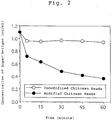
- Example 2 A super antigen adsorption test using a modified chitosan bead-circulation method
- Example 3 Super antigen adsorption tests using seven kinds of chitosan bead wherein urea bonds or thiourea bond were introduced
- Phenyl isocyanate, p-tolyl isocyanate, 1-naphthyl isocyanate, phenyl isothiocyanate and p-chlorophenyl isothiocyanate were respectively reacted with chitosan beads by the same method as in Example 1.
- 4,4'-diphenylmethanediisocyanate and hexamethylenediisocyanate were reacted with chitosan beads by the same method as in Example 1 and then, terminal isocyanate groups were hydrolyzed by reacting them with distilled water for 12 hours at room temperature. Thereafter, the beads were washed thoroughly with distilled water.
- Modified chitosan beads each with a respective structural formula (3)-(9) were obtained by the above described method.
- Formulae (8) and (9) correspond to "CHITOPEARL BCW-3501" and "CHITOPEARL BCW-3501", respectively.
- adsorption of super antigen (TSST-1) from rabbit plasma was performed in the same way as in Example 1.
- the initial concentration of TSST-1 was 1 ng/ml and 1 ml of the above described chitosan beads was added into 10 ml plasma, and the mixture was shaken at 37°C for 60 minutes and the concentrations of TSST-1 in the rabbit plasma samples after reaction were measured by means of an enzyme immune assay.
- the concentrations of TSST-1 after 60 minutes are shown in Table 2.
- the structural formula (1) was for unmodified chitosan beads. As these results showed, super antigen adsorbability was provided to the chitosan beads by introducing urea bonds or thiourea bonds.
- Aminated cellulose beads (“Amino-Cellulofine” manufactured by Chisso Co., Ltd., Tokyo Japan) with a structural formula (10), having a sedimentary volume of 12 ml and a particle diameter of about 0.2 mm were stirred in 20 ml N,N-dimethylformamide for five minutes. Then the beads and the solution were separated by means of a glass filter.
- adsorption of a super antigen (TSST-1) from rabbit plasma was performed in the same way as in Example 1.
- the initial concentration of TSST-1 was 1 ng/ml and 1 ml of the above described cellulose beads was added into 10 ml plasma and the mixture was shaked at 37°C for 60 minutes.
- the concentration of TSST-1 after the reaction was measured by an enzyme immune assay and the concentration of TSST-1 after 60 minutes are shown in Table 3.
- Example 5 Comparative Example 1 Comparative tests on adsorption functions of TSST-1 between beads with amide bonds and urethane bonds and beads with urea bonds.
- Chitosan beads with amide bonds were prepared by reacting chitosan beads ("CHITOPEARL AL-1" with a structural formula (1)) with p-chlorobenzoyl chloride. This was a product wherein urea bonds of chitosan beads with the structural formula (2) prepared in Example 1 were replaced with amide bonds.
- cellulose beads with urea bonds of structural formula (13) were prepared by reacting the aminated cellulose beads ("Aminocellulofine") used in Example 4 with p-chlorophenyl isocyanate.
- cellulose beads wherein urethane bonds were introduced were prepared by reacting cellulose beads (“Cellulofine GCL2000”) with p-chlorophenyl isocyanate in the presence of triethylamine for 12 hours.
- TSST-1 super antigen
- modified chitosan beads (the structural formula (2)) prepared in Example 1, adsorbability to TSST-1 as a super antigen was investigated and adsorbabilities to bovine serum albumin (BSA) and human immunoglobulin G (IgG) as non-super antigens were investigated.
- BSA bovine serum albumin
- IgG human immunoglobulin G
- DAHP 1,3-diamino-2-hydroxypropane
- DMSO dimethyl sulfoxide
- MDI 4,4'-diphenylmethanediisocyanate
- Adsorption tests of super antigens using polyurea derivatives prepared in Example 7 were performed by the same method as that in Example 1.
- a polyurethane derivative was prepared in the same way as Example 7 except that 1,3-propanediol was used instead of DAHP, triethylamine was included in the reaction mixture and the reaction was performed for 12 hours.
- the initial concentrations of SEA, SEB, SEC and TSST-1 were 1 ng/ml and each 1 ml of DAHP polyurea, DAP polyurea, polyurethane was added in 10 ml plasma and the mixture was shaken at 37°C for 60 minutes. All of DAHP polyurea, DAP polyurea and polyurethane were used after high pressure steam sterilization at 121°C for 20 minutes. The concentrations of four kinds of super antigen in rabbit plasma after 60 minutes reaction were measured by enzyme immuno assay and the results are shown in Table 6.
- Islands-in-a-sea type composite fiber described in U.S. Patent No. 4,661,260 (thickness: 2.6 denier; number of the islands:16) comprising of 50 wt parts of sea component (mixture of 46 wt parts of polystyrene and 4 wt parts of polypropylene) and 50 wt parts of islands component (polypropylene) were reacted in a mixed solution of 50g of N-methylol- ⁇ -chloracetamide, 400g of nitrobenzene, 400g of 98% sulfuric acid and 0.85g of paraformaldehyde at 20°C for one hour. Then the fiber was washed with nitrobenzene, and thrown into water to stop the reaction. After that, the fiber was washed again with warm water. Thus, chloroacetoamidemethylated crosslinked polystyrene fiber (hereinafter abbreviated as AMPSt fiber) was obtained.
- AMPSt fiber chloroacetoamidemethylated crosslinked polys
- Isocyanates or isothiocyanates used for reaction with polystyrene fiber Reaction product Isocyanates or isothiocyanates used for reaction (a) 0.23 g phenyl isocyanate (b) 0.30 g para-chlorophenyl isocyanate (c) 0.30 g meta-chlorophenyl isocyanate (d) 0.30 g ortho-chlorophenyl isocyanate (e) 0.27 g para-fluorophenyl isocyanate (f) 0.32 g para-methoxyphenyl isocyanate (g) 0.26 g para-tolyl isocyanate (h) 0.32 g para-nitrophenyl isocyanate (i) 0.33 g 1-naphthyl isocyanate (j) 0.48 g 4,4'-diphenylmethanediisocyanate (k) 0.70 g 3,3',5,5'-tetraethyl-4,4'
- the reaction was performed at 25°C for one hour. Thereafter, the reaction product was washed on a glass filter with 200 ml DMSO and 500 ml distilled water.
- the compounds obtained from the reaction with each isocyanate or isothiocyanate were referred to respectively as (a)-(r).
- AMPSt fiber wherein a p-nitrophenyl group was introduced by reacting p-nitrophenyl isocyanate was added into 100 ml aqueous sodium hydrosulfite solution (0.1 g/ml) and it was converted into a p-aminophenyl group by reduction at 60°C for 4 hours; it was referred to as the compound (s).
- Adsorption tests of super antigens using modified polystyrene fibers prepared in Example 9 were performed by the same method as that in Example 1.
- the initial concentrations of SEA, SEB, SEC and TSST-1 were 1 ng/ml and each 1 g of the modified AMPSt fiber was added in 10 ml plasma and the mixture was shaken at 37°C for 60 minutes.
- the modified AMPSt fibers were used after high pressure steam sterilization at 120°C for 20 minutes.
- the concentrations of four kinds of super antigen in rabbit plasma after 60 minutes reaction were measured by enzyme immuno assay and the results are shown in Table 8.
- an AMPSt fiber (t) wherein amide bonds were introduced instead of urea bonds by reacting benzoyl chloride instead of isocyanate under the same condition was used.
- an AMPSt fiber (u) wherein phenyl isocyanate was reacted after DAP was reacted instead of DAHP was also evaluated.
- AMPSt fiber (which corresponded to 2 mmol chloro content) were added into this solution while it was stirred. The reaction was performed at 25°C for 12 hours. Thereafter, AMPSt fiber was washed on a glass filter with 500 ml DMSO and then, successively with 50 ml N,N-dimethylformamide. After washing, the AMPSt fiber was added into 50 ml DMF in which 0.30 g p-chlorophenyl isocyanate had been dissolved. Thereafter, AMPSt fiber was washed on a glass filter with 200 ml DMSO and then, successively with 200 ml distilled water and AMPSt fiber (v) was obtained.
- Example 12 Adsorption of super antigens using polystyrene fibers with an amino group-containing urea derivatives on their side chains
- AMPSt fiber (v) obtained by Example 11 adsorption of super antigens were performed in the same way as in Example 1.
- AMPSt fiber (t) used in Example 10 was used.
- the initial concentrations of SEA, SEB, SEC and TSST-1 were 1 ng/ml and 1 g of the above described AMPSt (v) fiber were incorporated into 10 ml plasma and the mixture was shaken at 37°C for 60 minutes.
- Each AMPSt (v) fiber was used after being sterilized under high pressure steam at 121°C for 20 minutes.
- the concentrations of four kinds of super antigen in the rabbit plasmas after reaction for 60 minutes were measured by an enzyme immune assay and the results are shown in Table 9.
- material containing urea bonds or thiourea bonds with excellent selective binding characteristics with super antigens even in a high protein concentration solution in the neutral region and remaining activity even after sterilization and being inexpensive is provided by embodiments of the present invention.
- the activities of super antigens existing in body fluids such as blood and urine, foods, drinks and medicines can be removed (detoxified), it is possible to treat food poisoning, sepsis and autoimmune diseases and to prevent them from occurring.
- water-insoluble materials to eliminate efficiently super antigens from body fluids such as blood and urine, foods, drinks and medicines, by a super antigen eliminating column and a wound dressing material, it is possible to treat food poisoning, sepsis and autoimmune diseases and to prevent them from occurring.
- the material of the present invention can be used as a measuring material, it is possible to diagnose food poisoning, sepsis and autoimmune diseases.
Landscapes
- Chemical & Material Sciences (AREA)
- Health & Medical Sciences (AREA)
- Analytical Chemistry (AREA)
- Organic Chemistry (AREA)
- Chemical Kinetics & Catalysis (AREA)
- Life Sciences & Earth Sciences (AREA)
- Medicinal Chemistry (AREA)
- Epidemiology (AREA)
- Animal Behavior & Ethology (AREA)
- General Health & Medical Sciences (AREA)
- Public Health (AREA)
- Veterinary Medicine (AREA)
- Pharmacology & Pharmacy (AREA)
- Molecular Biology (AREA)
- Hematology (AREA)
- Materials Engineering (AREA)
- Engineering & Computer Science (AREA)
- Polymers & Plastics (AREA)
- External Artificial Organs (AREA)
- Polyurethanes Or Polyureas (AREA)
- Solid-Sorbent Or Filter-Aiding Compositions (AREA)
- Treating Waste Gases (AREA)
- Pharmaceuticals Containing Other Organic And Inorganic Compounds (AREA)
Applications Claiming Priority (6)
| Application Number | Priority Date | Filing Date | Title |
|---|---|---|---|
| JP117175/95 | 1995-05-16 | ||
| JP07117175 | 1995-05-16 | ||
| JP11717595 | 1995-05-16 | ||
| JP34420495 | 1995-12-28 | ||
| JP34420495 | 1995-12-28 | ||
| JP344204/95 | 1995-12-28 |
Publications (3)
| Publication Number | Publication Date |
|---|---|
| EP0743067A2 true EP0743067A2 (de) | 1996-11-20 |
| EP0743067A3 EP0743067A3 (de) | 1998-07-08 |
| EP0743067B1 EP0743067B1 (de) | 2002-11-27 |
Family
ID=26455347
Family Applications (1)
| Application Number | Title | Priority Date | Filing Date |
|---|---|---|---|
| EP96303441A Expired - Lifetime EP0743067B1 (de) | 1995-05-16 | 1996-05-15 | Verwendung von Harnstoff- und Thioharnstoffverbindungen zur Entfernung oder Entgiftung von Superantigenen aus Körperflüssigkeiten |
Country Status (8)
| Country | Link |
|---|---|
| US (2) | US5928633A (de) |
| EP (1) | EP0743067B1 (de) |
| KR (1) | KR100404825B1 (de) |
| CN (2) | CN1157817A (de) |
| AU (1) | AU699336B2 (de) |
| CA (1) | CA2176671C (de) |
| DE (1) | DE69624975T2 (de) |
| ES (1) | ES2187618T3 (de) |
Cited By (4)
| Publication number | Priority date | Publication date | Assignee | Title |
|---|---|---|---|---|
| EP0993834A4 (de) * | 1997-04-21 | 2000-04-19 | Kaneka Corp | Adsorbentien für toxisches schocksyndrom toxin-1, verfahren zur beseitigung des toxins durch adsorbtion, adsorberpackungen mit dem adsorbentien, nutzung der adsorbentien |
| EP1191034A1 (de) * | 2000-09-26 | 2002-03-27 | Kaneka Corporation | Adsorbentien, Vorrichtung und Verfahren zur adsorbtiven Entfernung von Enterotoxinen |
| WO2004039765A1 (en) * | 2002-10-31 | 2004-05-13 | Amersham Biosciences Ab | Use of urea variants as affinity ligands |
| EP1057529A4 (de) * | 1998-12-22 | 2004-08-25 | Toray Industries | Materialien zur entfernung von bakteriellen bestandteilen |
Families Citing this family (5)
| Publication number | Priority date | Publication date | Assignee | Title |
|---|---|---|---|---|
| US6528483B2 (en) | 1995-06-07 | 2003-03-04 | André Beaulieu | Method of producing concentrated non-buffered solutions of fibronectin |
| US7112320B1 (en) | 1995-06-07 | 2006-09-26 | Andre Beaulieu | Solid wound healing formulations containing fibronectin |
| US7064962B2 (en) * | 2002-09-06 | 2006-06-20 | Stratos International, Inc. | Transponder assembly for use with parallel optics modules in fiber optic communications systems |
| CN111560083B (zh) * | 2019-10-29 | 2021-02-19 | 皖西学院 | 壳聚糖萘基硫脲荧光探针、制备方法及其在检测铁离子中的应用 |
| CN114561013B (zh) * | 2022-04-28 | 2022-07-19 | 富海(东营)新材料科技有限公司 | 一种临界相变萃取法提纯聚砜类树脂材料的工艺 |
Family Cites Families (20)
| Publication number | Priority date | Publication date | Assignee | Title |
|---|---|---|---|---|
| NL254871A (de) * | 1959-08-14 | |||
| DE1644815C3 (de) * | 1968-01-29 | 1975-11-20 | Bayer Ag, 5090 Leverkusen | Mischung auf Basis von Umsetzungsprodukten von Zerewitinoff-aktiven Verbindungen mit N- Alkoxymethylispcyanaten |
| JPS461437Y1 (de) | 1968-11-29 | 1971-01-19 | ||
| JPS5943041B2 (ja) * | 1979-02-16 | 1984-10-19 | 大日精化工業株式会社 | 尿素基を有する糖誘導体およびその製造方法 |
| US4474806A (en) * | 1982-05-10 | 1984-10-02 | Merck & Co., Inc. | Sulfonyl or carbonyl inositol derivatives useful as anti-inflammatory/analgesic agents |
| JPH0738880B2 (ja) * | 1983-06-24 | 1995-05-01 | 東レ株式会社 | エンドトキシン血症治療剤 |
| DE3438527A1 (de) * | 1984-10-20 | 1986-04-24 | Bayer Ag, 5090 Leverkusen | Verfahren zur herstellung von harnstoffgruppen enthaltenden polyisocyanaten |
| JPS62288602A (ja) * | 1986-06-06 | 1987-12-15 | Agency Of Ind Science & Technol | キトサン変性物粒子の製造方法 |
| US5144013A (en) * | 1986-09-24 | 1992-09-01 | Ube Industries, Ltd. | Body fluid purifying material and method for purifying body fluid by use thereof |
| JPS63186660A (ja) * | 1986-09-24 | 1988-08-02 | 宇部興産株式会社 | 体液浄化剤 |
| JPS6397633A (ja) * | 1986-10-13 | 1988-04-28 | Fuji Boseki Kk | 新規なキトサン粒状物 |
| EP0355047B1 (de) * | 1988-07-22 | 1993-06-30 | Imre Corporation | Gereinigte Protein A-Zusammensetzungen und Verfahren zu ihrer Herstellung |
| JP2773412B2 (ja) * | 1990-09-04 | 1998-07-09 | 宇部興産株式会社 | パイロジェン吸着剤 |
| US5482947A (en) * | 1990-11-19 | 1996-01-09 | Talley; John J. | Retroviral protease inhibitors |
| US5314550A (en) * | 1992-03-27 | 1994-05-24 | Aerojet-General Corporation | Recovery of aluminum and hydrocarbon values from composite energetic compositions |
| JPH06288602A (ja) | 1993-03-31 | 1994-10-18 | Fujitsu General Ltd | 空気調和機 |
| US5534529A (en) * | 1993-06-30 | 1996-07-09 | Sankyo Company, Limited | Substituted aromatic amides and ureas derivatives having anti-hypercholesteremic activity, their preparation and their therapeutic uses |
| JPH0748431A (ja) * | 1993-08-04 | 1995-02-21 | Asahi Chem Ind Co Ltd | 医療用ポリウレタンウレア重合体 |
| JP3058009B2 (ja) * | 1994-06-14 | 2000-07-04 | 日本製紙株式会社 | キトサン誘導体、それらからなる近赤外線吸収剤用組成物および近赤外線吸収剤 |
| US5612377A (en) * | 1994-08-04 | 1997-03-18 | Minnesota Mining And Manufacturing Company | Method of inhibiting leukotriene biosynthesis |
-
1996
- 1996-05-13 AU AU52266/96A patent/AU699336B2/en not_active Ceased
- 1996-05-13 US US08/645,452 patent/US5928633A/en not_active Expired - Lifetime
- 1996-05-15 CA CA002176671A patent/CA2176671C/en not_active Expired - Fee Related
- 1996-05-15 ES ES96303441T patent/ES2187618T3/es not_active Expired - Lifetime
- 1996-05-15 EP EP96303441A patent/EP0743067B1/de not_active Expired - Lifetime
- 1996-05-15 KR KR1019960016108A patent/KR100404825B1/ko not_active Expired - Fee Related
- 1996-05-15 DE DE69624975T patent/DE69624975T2/de not_active Expired - Lifetime
- 1996-05-16 CN CN96110706A patent/CN1157817A/zh active Pending
- 1996-05-16 CN CNA031579639A patent/CN1507922A/zh active Pending
-
1999
- 1999-03-01 US US09/259,679 patent/US6190688B1/en not_active Expired - Lifetime
Cited By (7)
| Publication number | Priority date | Publication date | Assignee | Title |
|---|---|---|---|---|
| EP0993834A4 (de) * | 1997-04-21 | 2000-04-19 | Kaneka Corp | Adsorbentien für toxisches schocksyndrom toxin-1, verfahren zur beseitigung des toxins durch adsorbtion, adsorberpackungen mit dem adsorbentien, nutzung der adsorbentien |
| US6315907B1 (en) | 1997-04-21 | 2001-11-13 | Kaneka Corporation | Method for removing toxic shock syndrome toxin-1 in body fluids by adsorption |
| EP1057529A4 (de) * | 1998-12-22 | 2004-08-25 | Toray Industries | Materialien zur entfernung von bakteriellen bestandteilen |
| EP1191034A1 (de) * | 2000-09-26 | 2002-03-27 | Kaneka Corporation | Adsorbentien, Vorrichtung und Verfahren zur adsorbtiven Entfernung von Enterotoxinen |
| US6969616B2 (en) * | 2000-09-26 | 2005-11-29 | Kaneka Corporation | Enterotoxin adsorbent, method of adsorptive removal, and adsorption apparatus |
| WO2004039765A1 (en) * | 2002-10-31 | 2004-05-13 | Amersham Biosciences Ab | Use of urea variants as affinity ligands |
| US7645903B2 (en) | 2002-10-31 | 2010-01-12 | Ge Healthcare Bio-Sciences Ab | Use of urea variants as affinity ligands |
Also Published As
| Publication number | Publication date |
|---|---|
| AU699336B2 (en) | 1998-12-03 |
| CN1507922A (zh) | 2004-06-30 |
| US5928633A (en) | 1999-07-27 |
| CN1157817A (zh) | 1997-08-27 |
| CA2176671C (en) | 2007-05-08 |
| ES2187618T3 (es) | 2003-06-16 |
| DE69624975D1 (de) | 2003-01-09 |
| KR960040358A (ko) | 1996-12-17 |
| AU5226696A (en) | 1996-11-28 |
| DE69624975T2 (de) | 2003-07-17 |
| EP0743067A3 (de) | 1998-07-08 |
| KR100404825B1 (ko) | 2004-04-09 |
| US6190688B1 (en) | 2001-02-20 |
| CA2176671A1 (en) | 1996-11-17 |
| EP0743067B1 (de) | 2002-11-27 |
Similar Documents
| Publication | Publication Date | Title |
|---|---|---|
| US6461517B1 (en) | Bacterial-derived component removal material | |
| EP0743067B1 (de) | Verwendung von Harnstoff- und Thioharnstoffverbindungen zur Entfernung oder Entgiftung von Superantigenen aus Körperflüssigkeiten | |
| EP0993834B1 (de) | Adsorbentien für toxisches schocksyndrom toxin-1, verfahren zur beseitigung des toxins durch adsorbtion | |
| AU783457B2 (en) | Adsorbents for high mobility group proteins and column for purifying body fluid | |
| CN103028376B (zh) | 一种用于清除血液毒素的血液净化吸附剂及其制备方法 | |
| JPS6311167A (ja) | 血漿中の免疫グロブリン除去用吸着剤 | |
| AU664873B2 (en) | A support material and biocompatible anion exchange materials | |
| EP1507563B1 (de) | Endotoxin-bindende liganden und ihre verwendung | |
| US5648070A (en) | Biocompatible anion exchange materials | |
| JP4591974B2 (ja) | サイトカイン除去用あるいは不活化用の材料 | |
| CN101190409B (zh) | 一种血液净化蛋白a免疫吸附材料及其合成方法 | |
| JP3806970B2 (ja) | スーパー抗原除去用あるいは解毒用の材料 | |
| JP4606524B2 (ja) | ポリリジン、及びポリリジンの製造方法、及びポリリジン組成物、及びエンドトキシンを除去する医薬品の生産方法 | |
| JPS63186660A (ja) | 体液浄化剤 | |
| JP3733658B2 (ja) | β2ミクログロブリン除去、検出または測定用材料及びそれを用いた体液浄化カラム | |
| JP2006272075A (ja) | 吸着材料 | |
| HK1002956A (en) | A material for elimination or detoxification of super antigens | |
| JP4848573B2 (ja) | 遊離リポタイコ酸を液体から除去あるいは解毒する方法 | |
| JP3733657B2 (ja) | ポリペプチド系抗生物質の除去用あるいは解毒用材料 | |
| JP3890625B2 (ja) | スーパー抗原吸着材料 | |
| JPH10147541A (ja) | スーパー抗原除去用あるいは解毒用の材料 | |
| JP4591975B2 (ja) | 補体成分除去用あるいは不活化用の材料 | |
| JPH10147533A (ja) | パイロジェン除去用あるいは解毒用の材料 | |
| JP4110812B2 (ja) | 呼吸器の機能を改善する材料 | |
| JP2773412B2 (ja) | パイロジェン吸着剤 |
Legal Events
| Date | Code | Title | Description |
|---|---|---|---|
| PUAI | Public reference made under article 153(3) epc to a published international application that has entered the european phase |
Free format text: ORIGINAL CODE: 0009012 |
|
| AK | Designated contracting states |
Kind code of ref document: A2 Designated state(s): BE CH DE ES FR GB IT LI NL SE Kind code of ref document: A2 Designated state(s): AT BE CH DE DK ES FI FR GB GR IE IT LI NL PT SE |
|
| RIN1 | Information on inventor provided before grant (corrected) |
Inventor name: ISHIKAWA, KAZUO Inventor name: MIWA, KEISHI TORAY TAKATSUKI-RYO 515 Inventor name: FUKUYAMA, MAYUMI |
|
| PUAL | Search report despatched |
Free format text: ORIGINAL CODE: 0009013 |
|
| AK | Designated contracting states |
Kind code of ref document: A3 Designated state(s): AT BE CH DE DK ES FI FR GB GR IE IT LI NL PT SE |
|
| 17P | Request for examination filed |
Effective date: 19980827 |
|
| 17Q | First examination report despatched |
Effective date: 20000804 |
|
| GRAG | Despatch of communication of intention to grant |
Free format text: ORIGINAL CODE: EPIDOS AGRA |
|
| GRAG | Despatch of communication of intention to grant |
Free format text: ORIGINAL CODE: EPIDOS AGRA |
|
| GRAH | Despatch of communication of intention to grant a patent |
Free format text: ORIGINAL CODE: EPIDOS IGRA |
|
| GRAH | Despatch of communication of intention to grant a patent |
Free format text: ORIGINAL CODE: EPIDOS IGRA |
|
| GRAA | (expected) grant |
Free format text: ORIGINAL CODE: 0009210 |
|
| RBV | Designated contracting states (corrected) |
Designated state(s): BE CH DE ES FR GB IT LI NL SE |
|
| AK | Designated contracting states |
Kind code of ref document: B1 Designated state(s): BE CH DE ES FR GB IT LI NL SE |
|
| REG | Reference to a national code |
Ref country code: GB Ref legal event code: FG4D |
|
| REG | Reference to a national code |
Ref country code: CH Ref legal event code: EP |
|
| REG | Reference to a national code |
Ref country code: IE Ref legal event code: FG4D |
|
| REF | Corresponds to: |
Ref document number: 69624975 Country of ref document: DE Date of ref document: 20030109 |
|
| REG | Reference to a national code |
Ref country code: ES Ref legal event code: FG2A Ref document number: 2187618 Country of ref document: ES Kind code of ref document: T3 |
|
| ET | Fr: translation filed | ||
| PLBE | No opposition filed within time limit |
Free format text: ORIGINAL CODE: 0009261 |
|
| STAA | Information on the status of an ep patent application or granted ep patent |
Free format text: STATUS: NO OPPOSITION FILED WITHIN TIME LIMIT |
|
| 26N | No opposition filed |
Effective date: 20030828 |
|
| REG | Reference to a national code |
Ref country code: IE Ref legal event code: MM4A |
|
| PGFP | Annual fee paid to national office [announced via postgrant information from national office to epo] |
Ref country code: CH Payment date: 20050517 Year of fee payment: 10 |
|
| PG25 | Lapsed in a contracting state [announced via postgrant information from national office to epo] |
Ref country code: LI Free format text: LAPSE BECAUSE OF NON-PAYMENT OF DUE FEES Effective date: 20060531 Ref country code: CH Free format text: LAPSE BECAUSE OF NON-PAYMENT OF DUE FEES Effective date: 20060531 |
|
| REG | Reference to a national code |
Ref country code: CH Ref legal event code: PL |
|
| PGFP | Annual fee paid to national office [announced via postgrant information from national office to epo] |
Ref country code: NL Payment date: 20080501 Year of fee payment: 13 |
|
| PGFP | Annual fee paid to national office [announced via postgrant information from national office to epo] |
Ref country code: SE Payment date: 20090512 Year of fee payment: 14 |
|
| PGFP | Annual fee paid to national office [announced via postgrant information from national office to epo] |
Ref country code: BE Payment date: 20090428 Year of fee payment: 14 |
|
| NLV4 | Nl: lapsed or anulled due to non-payment of the annual fee |
Effective date: 20091201 |
|
| PG25 | Lapsed in a contracting state [announced via postgrant information from national office to epo] |
Ref country code: NL Free format text: LAPSE BECAUSE OF NON-PAYMENT OF DUE FEES Effective date: 20091201 |
|
| BERE | Be: lapsed |
Owner name: *TORAY INDUSTRIES INC. Effective date: 20100531 |
|
| EUG | Se: european patent has lapsed | ||
| PG25 | Lapsed in a contracting state [announced via postgrant information from national office to epo] |
Ref country code: BE Free format text: LAPSE BECAUSE OF NON-PAYMENT OF DUE FEES Effective date: 20100531 Ref country code: SE Free format text: LAPSE BECAUSE OF NON-PAYMENT OF DUE FEES Effective date: 20100516 |
|
| PGFP | Annual fee paid to national office [announced via postgrant information from national office to epo] |
Ref country code: ES Payment date: 20120518 Year of fee payment: 17 |
|
| PGFP | Annual fee paid to national office [announced via postgrant information from national office to epo] |
Ref country code: DE Payment date: 20130515 Year of fee payment: 18 |
|
| PGFP | Annual fee paid to national office [announced via postgrant information from national office to epo] |
Ref country code: GB Payment date: 20140514 Year of fee payment: 19 |
|
| REG | Reference to a national code |
Ref country code: DE Ref legal event code: R119 Ref document number: 69624975 Country of ref document: DE |
|
| REG | Reference to a national code |
Ref country code: DE Ref legal event code: R119 Ref document number: 69624975 Country of ref document: DE Effective date: 20141202 |
|
| PG25 | Lapsed in a contracting state [announced via postgrant information from national office to epo] |
Ref country code: DE Free format text: LAPSE BECAUSE OF NON-PAYMENT OF DUE FEES Effective date: 20141202 |
|
| REG | Reference to a national code |
Ref country code: FR Ref legal event code: PLFP Year of fee payment: 20 |
|
| REG | Reference to a national code |
Ref country code: ES Ref legal event code: FD2A Effective date: 20150626 |
|
| PG25 | Lapsed in a contracting state [announced via postgrant information from national office to epo] |
Ref country code: ES Free format text: LAPSE BECAUSE OF NON-PAYMENT OF DUE FEES Effective date: 20140516 |
|
| PGFP | Annual fee paid to national office [announced via postgrant information from national office to epo] |
Ref country code: IT Payment date: 20150515 Year of fee payment: 20 Ref country code: FR Payment date: 20150508 Year of fee payment: 20 |
|
| GBPC | Gb: european patent ceased through non-payment of renewal fee |
Effective date: 20150515 |
|
| PG25 | Lapsed in a contracting state [announced via postgrant information from national office to epo] |
Ref country code: GB Free format text: LAPSE BECAUSE OF NON-PAYMENT OF DUE FEES Effective date: 20150515 |