EP0743327A2 - Polymères d'éthylène ayant une faculté de mis en oeuvre améliorée - Google Patents
Polymères d'éthylène ayant une faculté de mis en oeuvre améliorée Download PDFInfo
- Publication number
- EP0743327A2 EP0743327A2 EP96303474A EP96303474A EP0743327A2 EP 0743327 A2 EP0743327 A2 EP 0743327A2 EP 96303474 A EP96303474 A EP 96303474A EP 96303474 A EP96303474 A EP 96303474A EP 0743327 A2 EP0743327 A2 EP 0743327A2
- Authority
- EP
- European Patent Office
- Prior art keywords
- ethylene polymer
- index
- polymer
- ethylene
- linear
- Prior art date
- Legal status (The legal status is an assumption and is not a legal conclusion. Google has not performed a legal analysis and makes no representation as to the accuracy of the status listed.)
- Granted
Links
Images
Classifications
-
- C—CHEMISTRY; METALLURGY
- C08—ORGANIC MACROMOLECULAR COMPOUNDS; THEIR PREPARATION OR CHEMICAL WORKING-UP; COMPOSITIONS BASED THEREON
- C08J—WORKING-UP; GENERAL PROCESSES OF COMPOUNDING; AFTER-TREATMENT NOT COVERED BY SUBCLASSES C08B, C08C, C08F, C08G or C08H
- C08J5/00—Manufacture of articles or shaped materials containing macromolecular substances
- C08J5/18—Manufacture of films or sheets
-
- C—CHEMISTRY; METALLURGY
- C08—ORGANIC MACROMOLECULAR COMPOUNDS; THEIR PREPARATION OR CHEMICAL WORKING-UP; COMPOSITIONS BASED THEREON
- C08F—MACROMOLECULAR COMPOUNDS OBTAINED BY REACTIONS ONLY INVOLVING CARBON-TO-CARBON UNSATURATED BONDS
- C08F10/00—Homopolymers and copolymers of unsaturated aliphatic hydrocarbons having only one carbon-to-carbon double bond
- C08F10/02—Ethene
-
- C—CHEMISTRY; METALLURGY
- C08—ORGANIC MACROMOLECULAR COMPOUNDS; THEIR PREPARATION OR CHEMICAL WORKING-UP; COMPOSITIONS BASED THEREON
- C08F—MACROMOLECULAR COMPOUNDS OBTAINED BY REACTIONS ONLY INVOLVING CARBON-TO-CARBON UNSATURATED BONDS
- C08F110/00—Homopolymers of unsaturated aliphatic hydrocarbons having only one carbon-to-carbon double bond
- C08F110/02—Ethene
-
- H—ELECTRICITY
- H01—ELECTRIC ELEMENTS
- H01B—CABLES; CONDUCTORS; INSULATORS; SELECTION OF MATERIALS FOR THEIR CONDUCTIVE, INSULATING OR DIELECTRIC PROPERTIES
- H01B3/00—Insulators or insulating bodies characterised by the insulating materials; Selection of materials for their insulating or dielectric properties
- H01B3/18—Insulators or insulating bodies characterised by the insulating materials; Selection of materials for their insulating or dielectric properties mainly consisting of organic substances
- H01B3/30—Insulators or insulating bodies characterised by the insulating materials; Selection of materials for their insulating or dielectric properties mainly consisting of organic substances plastics; resins; waxes
- H01B3/44—Insulators or insulating bodies characterised by the insulating materials; Selection of materials for their insulating or dielectric properties mainly consisting of organic substances plastics; resins; waxes vinyl resins; acrylic resins
- H01B3/441—Insulators or insulating bodies characterised by the insulating materials; Selection of materials for their insulating or dielectric properties mainly consisting of organic substances plastics; resins; waxes vinyl resins; acrylic resins from alkenes
-
- C—CHEMISTRY; METALLURGY
- C08—ORGANIC MACROMOLECULAR COMPOUNDS; THEIR PREPARATION OR CHEMICAL WORKING-UP; COMPOSITIONS BASED THEREON
- C08J—WORKING-UP; GENERAL PROCESSES OF COMPOUNDING; AFTER-TREATMENT NOT COVERED BY SUBCLASSES C08B, C08C, C08F, C08G or C08H
- C08J2323/00—Characterised by the use of homopolymers or copolymers of unsaturated aliphatic hydrocarbons having only one carbon-to-carbon double bond; Derivatives of such polymers
- C08J2323/02—Characterised by the use of homopolymers or copolymers of unsaturated aliphatic hydrocarbons having only one carbon-to-carbon double bond; Derivatives of such polymers not modified by chemical after treatment
- C08J2323/04—Homopolymers or copolymers of ethene
-
- Y—GENERAL TAGGING OF NEW TECHNOLOGICAL DEVELOPMENTS; GENERAL TAGGING OF CROSS-SECTIONAL TECHNOLOGIES SPANNING OVER SEVERAL SECTIONS OF THE IPC; TECHNICAL SUBJECTS COVERED BY FORMER USPC CROSS-REFERENCE ART COLLECTIONS [XRACs] AND DIGESTS
- Y10—TECHNICAL SUBJECTS COVERED BY FORMER USPC
- Y10S—TECHNICAL SUBJECTS COVERED BY FORMER USPC CROSS-REFERENCE ART COLLECTIONS [XRACs] AND DIGESTS
- Y10S526/00—Synthetic resins or natural rubbers -- part of the class 520 series
- Y10S526/901—Monomer polymerized in vapor state in presence of transition metal containing catalyst
Definitions
- This invention relates to ethylene polymers having enhanced processability, particularly extrudability, and a narrow comonomer distribution that may be advantageously made in a low pressure process. Melt extrusion properties of these ethylene polymers are superior to those of conventional linear low density polyethylene, and equivalent or superior to those of high pressure low density polyethylene at similar melt index.
- Linear polyethylene may be readily made in low pressure processes, for instance in gas phase, fluidized bed reactors. Its mechanical properties, such as stiffness, tensile strength and elongation, are good. However, its processability is deficient. Linear polyethylene has a tendency to melt fracture and experience web instability problems such as high neck-in and draw resonance when made into films that are rolled.
- High pressure low density polyethylene which is highly branched, is preferred to linear low density polyethylene for applications that require processing ease.
- High pressure low density polyethylene may, for example, be readily extruded into films without suffering from melt fracture, overheating, or web instability problems.
- conventional processes for making such resins require tubular reactors or autoclaves that operate at extremely high pressure (on the order of 30,000 to 45,000 psi) and high temperature (about 200 to 350° C), and are necessarily difficult and expensive to run.
- the mechanical properties of high pressure low density polyethylene are inferior to those of linear low density polyethylene.
- PCT Application No. WO 94/07930 assigned to Exxon Chemical Patents Inc. describes polymers having less than 5 long, linear branches per 1000 main chain carbon atoms with at least some of the branches having a molecular weight greater than the critical molecular weight for entanglement of the polymer.
- WO 94/07930 states that these polymers have superior processability as melts and superior mechanical properties as solids.
- PCT Application No. WO94/19381 assigned to Idemitsu Kosan Co., Ltd., relates to an ethylene copolymer derived from ethylene and a 3-20 carbon olefin said to have good processability and controllability with respect to various properties such as density, melting point and crystallinity.
- the copolymer is characterized by 1) the main chain of the polymer does not contain quaternary carbon, 2) the melt-flow activation energy (Ea) is 8-20 kcal/mol, and 3) when the Huggins constant k of the copolymer is compared to that of a linear polyethylene having the same limiting viscosity as the copolymer, the viscosity measurement being made in decalin at 135° C, the relationship is as follows: 1.12 ⁇ k1/k2 ⁇ 5 (in which k1 is the Huggins constant of the copolymer and k2 is that of the linear polyethylene).
- the invention provides an ethylene polymer having a Polydispersity Index of at least about 3.0; a melt index, MI, and Relaxation Spectrum Index, RSI, such that (RSI)(MI ⁇ ) is greater than about 26 when ⁇ is about 0.7; and a Crystallizable Chain Length Distribution Index, L w /L n , less than about 3.
- the ethylene polymer is efficiently extruded showing lower head pressure and amperage than are conventional linear low density polyethylene or newer commercially available metallocene-made polyethylene.
- the ethylene polymer which may be an ethylene homopolymer or interpolymer of ethylene, may be readily fabricated into a variety of useful articles such as general purpose filmes, clarity films, shrink films, extrusion coatings, wire and cable insulation and jacketing and cross-linked, power cable insulation, molded articles from injection, blow, or rotational molding, and semiconductive insulation and jacketing using methods well known in the art.
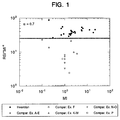
- Figure 1 is a plot of (RSI)(MI ⁇ ) versus melt index (MI) for ethylene polymers of the invention and various other polyethylenes.
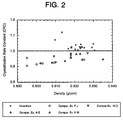
- Figure 2 is a plot of the Crystallization Rate Constant (CRC) versus density for ethylene polymers of the invention and various other polyethylenes.
- Ethylene polymers of the invention include ethylene homopolymers, and interpolymers of ethylene and linear or branched higher alpha-olefins containing 3 to about 20 carbon atoms, with densities ranging from about 0.86 to about 0.95.
- Suitable higher alpha-olefins include, for example, propylene, 1-butene, 1-pentene, 1-hexene, 4-methyl-1-pentone, 1-octene and 3, 5, 5-trimethyl 1-hexene.
- Dienes, particularly non-conjugated dienes may also be polymerized with the ethylene. Suitable non-conjugated dienes are linear, branched, or cyclic hydrocarbon dienes having from about 5 to about 20 carbon atoms.
- Especially preferred dienes include 1,5-hexadiene, 5-vinyl-2-norbornene, 1,7-octadiene and the like.
- Ethylene polymers also includes, for example, ethylene/propylene rubbers (EPR's), ethylene/propylene/diene terpolymers (EPDM's) and the like.
- Aromatic compounds having vinyl unsaturation, such as styrene and substituted styrenes, may be included as comonomers as well.
- Particularly preferred ethylene polymers comprise ethylene and 1 to about 40 percent by weight of one or more comonomers described above.
- the ethylene polymers have Polydispersity Indices uncorrected for long chain branching of at least about 3.0, preferably at least about 4.0, indicating that these ethylene polymers have molecular weight distributions that are advantageously quite broad.
- the Polydispersity Index (PDI) of a polymer is defined as the ratio of the weight average molecular weight of the polymer to the number average molecular weight of the polymer (M w /M n ).
- PDI uncorrected for long chain branching, is determined using size exclusion chromatography (SEC) with a WATERS 150C GPC instrument operating at 140°C with 1,2,4-trichlorobenzene at a flow rate of 1 ml/min.
- the pore size range of the column set provides for a MW separation covering the 200 to 10,000,000 Daltons range.
- National Institute of Standards Technology polyethylene standard NBS 1475 or 1496 is used as the calibration standard to obtain the uncorrected (linear polymer assumed) molecular weight distribution.
- the present ethylene polymers have unique rheological properties that impart superior melt strength, shear-thinning behavior and excellent drawdown enabling them to process extremely easily. Such enhanced processability encompasses ease in both extrusion and fabrication processes, such as in blown film, blow molding, extrusion coating and wire and cable extrusion operations.
- the ethylene polymers have melt indexes, MI, and Relaxation Spectrum Indexes, RSI, such that, for a given ethylene polymer: (RSI)(MI ⁇ ) > about 26 when ⁇ is about 0.7.
- MI is the melt index of the polymer reported as grams per 10 minutes, determined in accordance with ASTM D-1238, condition E, at 190°C
- RSI is the Relaxation Spectrum Index of the polymer in dimensionless units.
- the RSI of the ethylene polymer is determined by first subjecting the polymer to a shear deformation and measuring its response to the deformation using a rheometer.
- the relaxation modulus G(t) or the dynamic moduli G'( ⁇ ) and G''( ⁇ ) may be determined as functions of time t or frequency ⁇ , respectively (See J. M. Dealy and K. F. Wissbrun, Melt Rheology and Its Role in Plastics Processing , Van Nostrand Reinhold, 1990, pp. 269-297).
- the mathematical connection between the dynamic and storage moduli is a Fourier transform integral relation, but one set of data may also be calculated from the other using the well known relaxation spectrum (See S. H. Wasserman, J. Rheology , Vol. 39, pp. 601-625 (1995)).
- a discrete relaxation spectrum consisting of a series of relaxations or "modes,” each with a characteristic intensity or "weight” and relaxation time may be defined.
- a relaxation spectrum may be defined for the polymer using software such as IRIS® rheological software, which is commercially available from IRIS Development.
- RSI is sensitive to such parameters as a polymer's molecular weight distribution, molecular weight, and long chain branching, it is a reliable indicator of the processablity of a polymer. The higher the value of RSI, the better the processability of the polymer.
- the ethylene polymers have a Crystallizable Chain Length Distribution Index, L w /L n , of less than about 3, preferably less than about 2, indicating that they have narrow comonomer distributions and therefore substantial compositional homogeneity.
- the Crystallizable Chain Length Distribution Index is determined using Temperature Rising Elution Fractionation (TREF), as described in Wild et al., J. Polymer Sci., Poly. Phys. Ed. , Vol. 20, p. 441 (1982).
- a dilute solution of the ethylene polymer in a solvent such as 1,2,4-trichlorobenzene, at 1-4 mg/ml, is loaded at high temperature onto a packed column. The column is then allowed to slowly cool down at 0.1°C/min.
- the column is then heated in a controlled manner at 0.7°C/min to above 140°C with a constant solvent flow at 2ml/min through the column.
- the polymer fractions as they are eluted have decreasing branching (or increasing crystallinity) with the increasing temperature.
- An infrared concentration detector is used to monitor effluent concentrations. From the TREF temperature data, the branch frequency may be obtained for a given comonomer. Consequently, the main chain lengths between branches, expressed as L w and L n , may be calculated as follows.
- the narrow comonomer distributions of the ethylene polymers may be characterized using Differential Scanning Calorimetry (DSC).
- DSC Differential Scanning Calorimetry
- the melting temperature of a polymer is measured by a Differential Scanning Calorimeter, such as the DSC 2920 commercially available from Thermal Analysis Instruments, Inc.
- a polymer sample of about 5 mg sealed into an aluminum pen is first heated to 160° C at a rate of 10° C/min and then cooled to - 20° C also at a rate of 10° C/min. This is followed by a second heating to 160° C at a rate of 10° C/min.
- the peak melting temperature during the second melting endotherm is recorded as the melting point of the polymer.
- the DSC-related properties that the present ethylene polymers preferably have are 1) a DSC Homogeneity Index, DSC-HI, of at least about 7, preferably at least about 9, and 2) a Crystallization Rate Constant, CRC, equal to or greater than 1.
- ethylene polymers contain at least about 0.3 long chain branches per 1000 main chain carbon atoms. This further contributes to their excellent processability.
- the ethylene polymers contain at least about 0.5 long chain branches per 1000 main chain carbon atoms. More preferably, the ethylene polymers contain at least about 0.7 long chain branches per 1000 main chain carbon atoms.
- Long-chain branching or LCB is measured by coupled size exclusion chromatography (SEC) with solution viscometry using the Waters 150C GPC instrument (Waters Corporation) with an on-line differential viscometer made by Viscotek Corporation using the same experimental conditions as described elsewhere for standard size exclusion chromatography.
- the LCB values are derived from the viscosity ratio of the branched polymer to linear polymer of same molecular weight. (See Mirabella, F. M., Jr.; and Wild, L., Polymer Characterization, Amer. Chem. Soc. Symp. Ser. ,227, 1990, p. 23.)
- An epsilon value of 0.75 is used in relating the viscosity ratio to the ratio of mean-square radius of gyration of the branched polymer to linear polymer also at same molecular weight.
- the ethylene polymers may be made by any conventional suspension, solution, slurry or gas phase polymerization process, using reaction conditions well known in the art. One reactor or several reactors in series may be employed. Gas phase polymerization is preferred using one or more fluidized bed reactors.
- catalysts compositions that may be used to make the ethylene polymers of the invention are any of those known for the polymerization of ethylene, such as those comprising one or more conventional Ziegler-Natta catalysts, as well as newer metallocene catalysts, both of which are well documented in the literature.
- the use of a mixed catalyst system within or among catalyst families may also be used to make the ethylene polymers of the invention.
- a preferred process for preparing the ethylene polymers comprises contacting under gas phase polymerization conditions ethylene and optionally a higher alpha-olefin with a catalyst composition comprising: a) racemic and meso stereoisomers of a bridged metallocene catalyst containing two cycloalkadienyl ligands joined by a bridging linkage and complexed to a metal atom, each cycloalkadienyl ligand having facial chirality, and b) a cocatalyst selected from the group consisting of methylaluminoxane and modified methylaluminoxane.
- the metal atom is titanium, zirconium, or hafnium. More preferably, the metal atom is zirconium.
- Each of the cycloalkadienyl ligands of the bridged metallocene catalyst has facial chirality.
- Chirality is used to describe asymmetric molecules or ligands whose mirror images are non-superimposable (i.e., having "handedness").
- non-cyclic molecules there is a chiral center.
- the chiral center is the carbon atom:
- a plane of chirality may exist, giving rise to facial chirality.
- the indenyl ligand is used as an example.
- An indenyl ligand may be viewed as a cyclopentadienyl ligand containing two substituents that are connected to form a 6-carbon ring.
- An unsubstituted indenyl i.e., a cyclopentadienyl ligand containing only the two substituents that form the 6-member ring
- has no chirality If a chiral substituent is attached to the indenyl ligand, the ligand is described in terms of the chirality of the substituent's chiral center.
- the substituted indenyl ligand (the cyclopentadienyl ligand containing the two substituents connected to form the 6-member ring plus one or more additional achiral substituents) is then said to have facial chirality:
- the 2-methylindenyl ligand above has no chirality (facial or otherwise) but 1-methylindenyl ligand has facial prochirality.
- facial chirality implies a plane of chirality exists which incorporates the indenyl ligand.
- a metal (M) can coordinate to one of the two chiral faces of the 1-methylindenyl ligand, forming a basis for discrimination between the two prochiral faces.
- the metal can coordinate to the R face of each ligand ( R , R' ) or the S face of each ligand ( S , S' ) or it can coordinate to one of each face ( R , S' and S , R' ), wherein R , R' , S , and S' refer to the absolute configurations of the ligands.
- the R , R' and S , S' stereoisomers are collectively called the racemic stereoisomers, while the R , S' and S , R' stereoisomers are called the meso stereoisomers.
- both the racemic and meso stereoisomers be present in the catalyst composition in greater than trivial amounts.
- both the racemic and meso stereoisomers are present during polymerization in an amount greater than about 6, more preferably 10, percent by weight of the total amount of bridged metallocene catalyst containing cycloalkadienyl ligands having facial chirality.
- Such amount is independent of the ratio of racemic stereoisomer to meso stereoisomer present in the bridged metallocene catalyst containing cycloalkadienyl ligands with facial chirality before it is combined with the methylaluminoxane or modified methylaluminoxane cocatalyst to form the activated catalyst composition.
- the following compounds are illustrative but non-limiting examples of useful bridged metallocene catalysts containing two cycloalkadienyl ligands with facial chirality: dimethylsilylenebis(indenyl)zirconium dichloride, ethylenebis(lindenyl)zirconium dichloride, dimethylsilylenebis(4,5,6,7-tetrahydroindenyl)zirconium dichloride, ethylenebis(4,5,6,7-tetrahydroindenyl)zirconium dichloride, dimethylsilylenebis(2-methylindenyl)zirconium dichloride dimethylsilylenebis(2-methyl-4,5,6,7-tetrahydroindenyl)zirconium dichloride, methylphenylsilylenebis(2-methylindenyl)zirconium dichloride, dimethylsilylenebis(2,4,7-trimethylindenyl)zirconium dichloride, ethylenebis(2-methylindeny
- the bridged metallocene catalyst may be made by one of several methods.
- the method of manufacture is not critical. For example, see A. Razavi and J. Ferrara, J . Organomet . Chem ., 435 , 299 (1992) and K. P. Reddy and J. L. Petersen, Organometallics , 8 , 2107 (1989).
- One method comprises first reacting two equivalents of an optionally substituted cyclopentadiene with a metallic deprotonating agent such as an alkyllithium or potassium hydride in an organic solvent such as tetrahydrofuran, followed by reaction of this solution with a solution of one equivalent of a doubly-halogenated compound such as dichlorodimethylsilane.
- the resulting ligand is then isolated by conventional methods known to those skilled in the art (such as distillation or liquid chromatography), reacted with two equivalents of a metallic deprotonating agent as above, and then reacted with one equivalent of a tetrachloride of titanium, zirconium, or hafnium, optionally coordinated with donor ligand molecules such as tetrahydrofuran, in organic solvent.
- a metallic deprotonating agent as above
- donor ligand molecules such as tetrahydrofuran
- the bridged metallocene catalyst may be produced by first reacting one equivalent of an optionally substituted cyclopentadiene with one equivalent of metallic deprotonating agent in an organic solvent as above, followed by reaction with one equivalent of a molecule containing an unsaturated five-carbon ring to which is attached an exocyclic group susceptible to nucleophilic attack, such as a dialkylfulvene.
- the reactive solution is next quenched with water and the ligand is isolated by conventional methods.
- One equivalent of the ligand is next reacted with two equivalents of metallic deprotonating agent as above and the resulting solution is in turn reacted with one equivalent of a tetrachloride of titanium, zirconium, or hafnium optionally coordinated with donor ligand molecules such as tetrahydrofuran, in organic solvent.
- the resulting bridged metallocene catalyst is isolated by methods known to those skilled in the art.
- the cocatalyst is methylaluminoxane (MAO) or modified methylaluminoxane (MMAO).
- Aluminoxanes are well known in the art and comprise oligomeric linear alkyl aluminoxanes represented by the formula: and oligomeric cyclic alkyl aluminoxanes of the formula: wherein s is 1-40, preferably 10-20; p is 3-40, preferably 3-20; and R*** is an alkyl group containing 1 to 12 carbon atoms, preferably methyl or an aryl radical such as a substituted or unsubstituted phenyl or naphthyl radical.
- R*** in the two formulas immediately above is methyl.
- R*** is a mix of methyl and C 2 to C 12 alkyl groups, wherein methyl comprises about 20 to about 80 percent by weight of the R*** groups.
- Aluminoxanes may be prepared in a variety of ways. Generally, a mixture of linear and cyclic aluminoxanes is obtained in the preparation of aluminoxanes from, for example, trimethylaluminum and water.
- an aluminum alkyl may be treated with water in the form of a moist solvent.
- an aluminum alkyl, such as trimethylaluminum may be contacted with a hydrated salt, such as hydrated ferrous sulfate.
- the latter method comprises treating a dilute solution of trimethylaluminum in, for example, toluene with a suspension of ferrous sulfate heptahydrate.
- methylaluminoxanes by the reaction of a tetraalkyldialuminoxane containing C 2 or higher alkyl groups with an amount of trimethylaluminum that is less than a stoichiometric excess.
- the synthesis of methylaluminoxanes may also be achieved by the reaction of a trialkyl aluminum compound or a tetraalkyldialuminoxane containing C 2 or higher alkyl groups with water to form a polyalkyl aluminoxane, which is then reacted with trimethylaluminum.
- methylaluminoxanes which contain both methyl groups and higher alkyl groups, may be synthesized by the reaction of a polyalkyl aluminoxane containing C 2 or higher alkyl groups with trimethylaluminum and then with water as disclosed in, for example, U.S. Patent No. 5,041,584.
- the amount of bridged metallocene catalyst and cocatalyst usefully employed in the catalyst composition may vary over a wide range.
- the catalyst composition is present at a concentration sufficient to provide at least about 0.000001, preferably at least about 0.00001, percent by weight of transition metal based on the total weight of ethylene and other monomers.
- the mole ratio of aluminum atoms contained in the methylaluminoxane or modified methylaluminoxane to metal atoms contained in the bridged metallocene catalyst is generally in the range of about 2:1 to about 100,000:1, preferably in the range of about 10:1 to about 10,000:1, and most preferably in the range of about 30:1 to about 2,000:1.
- the catalyst composition may be supported or unsupported.
- the bridged metallocene catalyst and the cocatalyst may be impregnated in or deposited on the surface of an inert substrate such as silicon dioxide, aluminum oxide, magnesium dichloride, polystyrene, polyethylene, polypropylene, or polycarbonate, such that the catalyst composition is between 1 and 90 percent by weight of the total weight of the catalyst composition and the support.
- Polymerization is preferably conducted in the gas phase in a stirred or fluidized bed reactor, using equipment and procedures well known in the art.
- superatmospheric pressures in the range of 1 to 1000 psi, preferably 50 to 400 psi, and most preferably 100 to 300 psi, and temperatures in the range of 30 to 130°C, preferably 65 to 110°C are used.
- Ethylene and other monomers, if used, are contacted with an effective amount of catalyst composition at a temperature and a pressure sufficient to initiate polymerization.
- Suitable gas phase polymerization reaction systems comprise a reactor to which monomer(s) and catalyst composition may be added, and that contain a bed of forming polyethylene particles.
- the invention is not limited to any specific type of gas phase reaction system.
- a conventional fluidized bed process is conducted by passing a gaseous stream containing one or more monomers continuously through a fluidized bed reactor under reaction conditions and in the presence of catalyst composition at a velocity sufficient to maintain the bed of solid particles in a suspended condition.
- the gaseous stream containing unreacted gaseous monomer is withdrawn from the reactor continuously, compressed, cooled and recycled into the reactor.
- Product is withdrawn from the reactor and make-up monomer is added to the recycle stream.
- hydrogen When hydrogen is used as a chain transfer agent in the process, it is used in amounts varying between about 0.001 to about 10 moles of hydrogen per mole of total monomer feed. Also, as desired for temperature control of the system, any gas inert to the catalyst composition and reactants can also be present in the gas stream.
- Organometallic compounds may be employed as scavenging agents for poisons to increase the catalyst activity.
- these compounds are metal alkyls, preferably aluminum alkyls, most preferably trisobutyl-aluminum tri-n-hexyl aluminum. Use of such scavenging agents is well known in the art.
- the ethylene polymers may be blended with other polymers and resins as desired using techniques known in the art.
- various additives and agents such as thermo- and photo-oxidation stabilizers including hindered phenolic antioxidants, hindered amine light stabilizers and aryl phosphites or phosphonites, crosslinkers including dicumyl peroxide, colorants including carbon blacks and and titanium dioxide, lubricants including metallic stearates, processing aids including fluoroelastomers, slip agents including oleamide or erucamide, film antiblock or release agents including controlled particle size talc or silica, blowing agents, flame retardants and other conventional materials may be mixed with the ethylene polymer of the invention as desired.
- thermo- and photo-oxidation stabilizers including hindered phenolic antioxidants, hindered amine light stabilizers and aryl phosphites or phosphonites
- crosslinkers including dicumyl peroxide
- colorants including carbon blacks and and titanium dioxide
- the ethylene polymers of the invention are useful for fabrication into a variety of finished articles such as films including clarity films and shrink films, extrusion coatings, wire and cable insulation and jacketing, crosslinked power cable insulation, molded articles made by injection molding, blow molding, or rotational molding, extrusions of pipe, tubing, profiles and sheeting, and insulating and semiconductive jacketing and/or shields. Methods of making such articles are well known in the art.
- Examples 1-35 A series of ethylene polymers according to the invention (Examples 1-35) were compared with samples of known polyethylene for a variety of properties, including Polydispersity Index (PDI), Crystallizable Chain Length Distribution Index (L w /L n ), melt index (MI), Relaxation Spectrum Index (RSI), and (RSI)(MI ⁇ ) when ⁇ is about 0.7.
- PDI Polydispersity Index
- L w /L n melt index
- MI melt index
- RSI Relaxation Spectrum Index
- RSI Relaxation Spectrum Index
- RSI RSI(MI ⁇ ) when ⁇ is about 0.7.
- the long chain branching (LCB), DSC Homogeneity Index (DSC-HI), and Crystallization Rate Constant (CRC) were compared.
- the ethylene polymers in Examples 1-35 were made using a 14 inch nominal diameter, gas phase, fluidized bed reactor having a bed height of 10 feet.
- the catalyst composition employed to make each of these Examples comprised the racemic and meso isomers of dimethylsilylenebis(2-methylindenyl)zironium dichloride and methylaluminoxane cocatalyst supported on silica.
- Comparative Examples A-E were certain AFFINITY Polyolefin Plastomers commercially available from The Dow Chemical Company, as specified in Table 1.
- Comparative Examples F-J were certain EXACT Linear Ethylene Polymers commercially available from Exxon Chemical as specified in Table 1.
- Comparative Examples K-M were polyethylene made by high-pressure, free radical polymerization. These low density polyethylenes were produced in a high-pressure, tubular reactor using multiple organic initiators, pressures up to 3000 atmosphere and temperatures up to 320°C. The process used to produce these high-pressure, low density polyethylenes was similar to that described in Zabisky et al., Polymer , 33, No. 11, 2243, 1992.
- Comparative Examples N and O were commercial, linear low-density polyethylenes made by the UNIPOL® process (Union Carbide Corp.) using a gas phase, fluidized bed reactor. These polyethylenes were Ziegler-Natta catalyzed ethylene copolymers of either butene-1 or hexene-1 as described in US Patent No. 4,302,565.
- Comparative Examples P-R were low-density polyethylenes made by a gas phase, fluidized bed reaction in a staged reactor configuration using Ziegler-Natta catalyts.
- Molecular Weights, Molecular Weight Distribution, and Long Chain Branching were determined by size exclusion chromatography as follows.
- a WATERS 150C GPC chromatograph equipped with mixed-pore size columns for molecular weight measurements and a VISCOTEK 150R viscometer for on-line viscosity measurements were employed.
- SEC size exclusion chromatograhy
- a 25 cm long preliminary column from Polymer Labs having a 50 ⁇ nominal pore size, followed by three 25 cm long Shodex A-80 M/S (Showa) columns to affect a molecular weight separation for linear ethylene polymer from about 200 to 10,000,000 Daltons were used. Both columns contain porous poly(styrene-divinyl benzene) packing.
- 1,2,4,-trichlorobenzene was used as the solvent to prepare the polymer solutions and the chromatographic eluent. All measurements were made at a temperature of 140 ⁇ 0.2°C.
- the analog signals from the mass and viscosity detectors were collected into a computer system. The collected data were then processed using standard software commercially available from several sources (Waters Corporation and Viscotek Corporation) for uncorrected molecular weight distribution.
- the calibration uses the broad MWD calibrant method. (See W. W. Yau, J. J. Kirkland and D. D. Bly, Modern Size-Exclusion Liquid Chromatography , Wiley, 1979, p. 289-313. For the latter, two MW related statistics such as number and weight average MW values must be known for the polymer calibrant. Based on the MW calibration, elution volume is converted to molecular weight for the assumed linear ethylene polymer.
- Figure 2 is a plot of the CRC versus density data in Table 1.
- the ethylene polymers of the invention were each dry blended with 1000 ppm IRGANOX B-900 (Ciba-Geigy Corporation) and compounded in a 1-1/2 inch Killion Extruder with a standard LLDPE mixing screw (30/1 length to diameter) at a rate of 40 lb/hr ( ⁇ 90 rpm) with a set die temperature of 410°F.
- the pelleted ethylene polymers and the Comparative Example polyethylenes were extruded into blown films using typical operating conditions.
- the blown film extrusion equipment consisted of a 1 1/2 inch diameter Sterling extruder equipped with 24:1 L/D, general purpose LLDPE screw (constant pitch, decreasing depth, Maddox mixing-head screw) and a spiral pin die.
- Table 2 show the head pressure and amperage that was required to extrude each of the resins tested, as well as the head pressure and amperage normalized with respect to the die rate, so that direct comparisons may be made.
- the normalized data in Table 2 shows that the head pressures and amps required in extruding the ethylene polymers of the invention were much less than those needed to extrude the Comparative Examples when compared at similar melt index. Further, the ethylene polymers of the invention showed excellent drawdown and extrusion ease compared to high pressure, low density polyethylene.
Landscapes
- Chemical & Material Sciences (AREA)
- Organic Chemistry (AREA)
- Health & Medical Sciences (AREA)
- Chemical Kinetics & Catalysis (AREA)
- Medicinal Chemistry (AREA)
- Polymers & Plastics (AREA)
- Engineering & Computer Science (AREA)
- Manufacturing & Machinery (AREA)
- Spectroscopy & Molecular Physics (AREA)
- Materials Engineering (AREA)
- Physics & Mathematics (AREA)
- Addition Polymer Or Copolymer, Post-Treatments, Or Chemical Modifications (AREA)
- Transition And Organic Metals Composition Catalysts For Addition Polymerization (AREA)
- Organic Insulating Materials (AREA)
- Compositions Of Macromolecular Compounds (AREA)
- Coating Of Shaped Articles Made Of Macromolecular Substances (AREA)
- Manufacture Of Macromolecular Shaped Articles (AREA)
- Extrusion Moulding Of Plastics Or The Like (AREA)
Applications Claiming Priority (2)
| Application Number | Priority Date | Filing Date | Title |
|---|---|---|---|
| US44245395A | 1995-05-16 | 1995-05-16 | |
| US442453 | 1995-05-16 |
Publications (3)
| Publication Number | Publication Date |
|---|---|
| EP0743327A2 true EP0743327A2 (fr) | 1996-11-20 |
| EP0743327A3 EP0743327A3 (fr) | 1998-04-08 |
| EP0743327B1 EP0743327B1 (fr) | 2001-04-11 |
Family
ID=23756840
Family Applications (1)
| Application Number | Title | Priority Date | Filing Date |
|---|---|---|---|
| EP96303474A Expired - Lifetime EP0743327B1 (fr) | 1995-05-16 | 1996-05-16 | Polymères d'éthylène ayant une faculté de mis en oeuvre améliorée |
Country Status (26)
| Country | Link |
|---|---|
| US (1) | US5798427A (fr) |
| EP (1) | EP0743327B1 (fr) |
| JP (1) | JP3073929B2 (fr) |
| KR (1) | KR100267629B1 (fr) |
| CN (1) | CN1141306A (fr) |
| AR (1) | AR001953A1 (fr) |
| AT (1) | ATE200497T1 (fr) |
| AU (1) | AU713324B2 (fr) |
| BR (1) | BR9602284A (fr) |
| CA (1) | CA2176767C (fr) |
| CZ (1) | CZ291412B6 (fr) |
| DE (1) | DE69612424T2 (fr) |
| ES (1) | ES2158246T3 (fr) |
| GR (1) | GR3035742T3 (fr) |
| HU (1) | HUP9601322A3 (fr) |
| ID (1) | ID16439A (fr) |
| MX (1) | MX9601812A (fr) |
| MY (1) | MY115806A (fr) |
| PL (1) | PL187966B1 (fr) |
| PT (1) | PT743327E (fr) |
| RU (1) | RU2162858C2 (fr) |
| SK (1) | SK63796A3 (fr) |
| TR (1) | TR199600395A1 (fr) |
| TW (1) | TW426690B (fr) |
| UA (1) | UA47394C2 (fr) |
| ZA (1) | ZA963917B (fr) |
Cited By (13)
| Publication number | Priority date | Publication date | Assignee | Title |
|---|---|---|---|---|
| WO1999035174A1 (fr) * | 1998-01-07 | 1999-07-15 | Bp Chemicals Limited | Homopolymeres et copolymeres d'ethylene |
| WO1999060032A1 (fr) * | 1998-05-15 | 1999-11-25 | Univation Technologies Llc | Catalyseurs melanges et leur utilisation pour un processus de polymerisation |
| US6060567A (en) * | 1991-10-15 | 2000-05-09 | The Dow Chemical Company | Interpolymers formed by continuous processes |
| WO2000040621A1 (fr) * | 1997-12-29 | 2000-07-13 | Union Carbide Chemicals & Plastics Technology Corporation | Polymeres d'ethylene dont le traitement est ameliore |
| EP1038889A3 (fr) * | 1999-03-22 | 2001-01-31 | Union Carbide Chemicals & Plastics Technology Corporation | Terpolymère ayant de meilleures aptitudes à la réticulation |
| WO2002004556A3 (fr) * | 2000-07-12 | 2002-06-20 | Univation Tech Llc | Melanges d'inter-polymeres d'ethylene |
| WO2004025670A1 (fr) * | 2002-09-10 | 2004-03-25 | Union Carbide Chemicals & Plastics Technology Corporation | Composition pour gaines de cables en polypropylene ayant des proprietes physiques et de resistance a la fusion ameliorees |
| EP1428841A1 (fr) * | 2002-12-12 | 2004-06-16 | ATOFINA Research | Articles rotomoulés ayant une stabilité dimensionnelle |
| WO2005068519A3 (fr) * | 2004-01-09 | 2005-12-01 | Chevron Phillips Chemical Co | Compositions de catalyseurs et polyolefines destinees a des applications de revetement par extrusion |
| US8088704B2 (en) | 2007-11-15 | 2012-01-03 | Univation Technologies, Llc | Polymerization catalysts and methods of using the same to produce polyolefin products |
| US8435914B2 (en) | 2009-05-14 | 2013-05-07 | Univation Technologies, Llc | Mixed metal catalyst systems having a tailored hydrogen response |
| WO2013137953A1 (fr) * | 2012-03-15 | 2013-09-19 | Exxonmobil Chemical Patents Inc. | Adaptation par l'oxygène de polyéthylène |
| US8835577B2 (en) | 2007-11-15 | 2014-09-16 | Univation Technologies, Llc | Catalyst systems having a tailored hydrogen response |
Families Citing this family (69)
| Publication number | Priority date | Publication date | Assignee | Title |
|---|---|---|---|---|
| US6025448A (en) | 1989-08-31 | 2000-02-15 | The Dow Chemical Company | Gas phase polymerization of olefins |
| US6538080B1 (en) | 1990-07-03 | 2003-03-25 | Bp Chemicals Limited | Gas phase polymerization of olefins |
| IT1270253B (it) * | 1994-06-20 | 1997-04-29 | Spherilene Srl | Copolimeri dell'etilene e procedimento per la preparazione di polimeri dell'etilene |
| SE504455C2 (sv) * | 1995-07-10 | 1997-02-17 | Borealis Polymers Oy | Kabelmantlingskomposition, dess användning samt sätt för dess framställning |
| US6165387A (en) * | 1997-02-04 | 2000-12-26 | Borealis A/S | Composition for electric cables |
| SE9703798D0 (sv) | 1997-10-20 | 1997-10-20 | Borealis As | Electric cable and a method an composition for the production thereof |
| SE513362C2 (sv) | 1997-11-18 | 2000-09-04 | Borealis As | Förfarande för minskning av reaktornedsmutsning |
| DZ2740A1 (fr) * | 1998-03-12 | 2003-09-08 | Bp Chem Int Ltd | Catalyseurs de polymésation. |
| SE9802087D0 (sv) | 1998-06-12 | 1998-06-12 | Borealis Polymers Oy | An insulating composition for communication cables |
| TW460485B (en) | 1998-06-19 | 2001-10-21 | Japan Polyolefins Co Ltd | Ethylene.Α-olefin copolymer, and combinations, films and use thereof |
| SE9802386D0 (sv) | 1998-07-03 | 1998-07-03 | Borealis As | Composition for elektric cables |
| AU1272100A (en) * | 1998-11-25 | 2000-06-13 | Targor Gmbh | Metallocene monohalogenides |
| SE9804407D0 (sv) | 1998-12-18 | 1998-12-18 | Borealis Polymers Oy | A multimodal polymer composition |
| US6818585B2 (en) * | 1998-12-30 | 2004-11-16 | Univation Technologies, Llc | Catalyst compounds, catalyst systems thereof and their use in a polymerization process |
| US6339134B1 (en) | 1999-05-06 | 2002-01-15 | Univation Technologies, Llc | Polymerization process for producing easier processing polymers |
| US6271325B1 (en) | 1999-05-17 | 2001-08-07 | Univation Technologies, Llc | Method of polymerization |
| BR0014637B1 (pt) * | 1999-09-29 | 2011-02-22 | processo para a moldagem por sopro, extrusão ou produção de filme soprado extrusado de um polietileno. | |
| US6300439B1 (en) | 1999-11-08 | 2001-10-09 | Univation Technologies, Llc | Group 15 containing transition metal catalyst compounds, catalyst systems and their use in a polymerization process |
| US6271323B1 (en) | 1999-10-28 | 2001-08-07 | Univation Technologies, Llc | Mixed catalyst compounds, catalyst systems and their use in a polymerization process |
| US6624107B2 (en) | 1999-10-22 | 2003-09-23 | Univation Technologies, Llc | Transition metal catalyst compounds having deuterium substituted ligand and catalyst systems thereof |
| US6380328B1 (en) | 1999-12-10 | 2002-04-30 | Univation Technologies, Llc | Catalyst systems and their use in a polymerization process |
| US6274684B1 (en) * | 1999-10-22 | 2001-08-14 | Univation Technologies, Llc | Catalyst composition, method of polymerization, and polymer therefrom |
| US6417304B1 (en) | 1999-11-18 | 2002-07-09 | Univation Technologies, Llc | Method of polymerization and polymer produced therefrom |
| US6265505B1 (en) | 1999-11-18 | 2001-07-24 | Univation Technologies, Llc | Catalyst system and its use in a polymerization process |
| US6281306B1 (en) * | 1999-12-16 | 2001-08-28 | Univation Technologies, Llc | Method of polymerization |
| US20080281063A9 (en) * | 1999-12-30 | 2008-11-13 | Sukhadia Ashish M | Ethylene polymers and copolymers with high optical opacity and methods of making the same |
| EP1138702A1 (fr) * | 2000-03-30 | 2001-10-04 | Fina Research S.A. | Polyéthylène préparé à l'aide d'un catalyseur métallocène pour fabriquer des containers plastiques brillants |
| US6455638B2 (en) | 2000-05-11 | 2002-09-24 | Dupont Dow Elastomers L.L.C. | Ethylene/α-olefin polymer blends comprising components with differing ethylene contents |
| US7208559B2 (en) | 2002-12-27 | 2007-04-24 | Mitsui Chemicals, Inc. | Ethylened polymer and molded object obtained therefrom |
| JP4903357B2 (ja) * | 2003-03-28 | 2012-03-28 | 住友化学株式会社 | エチレン重合体 |
| US7119153B2 (en) | 2004-01-21 | 2006-10-10 | Jensen Michael D | Dual metallocene catalyst for producing film resins with good machine direction (MD) elmendorf tear strength |
| US20050182210A1 (en) | 2004-02-17 | 2005-08-18 | Natarajan Muruganandam | De-foaming spray dried catalyst slurries |
| US7094857B2 (en) * | 2004-03-10 | 2006-08-22 | Chevron Phillips Chemical Company, L.P. | Ethylene polymers and copolymers with high optical opacity |
| PT1574772E (pt) * | 2004-03-12 | 2008-07-23 | Borealis Tech Oy | Tubo de pressão de polímero de etileno reticulado e processo para a sua preparação |
| DE102004020524A1 (de) * | 2004-04-26 | 2005-11-10 | Basell Polyolefine Gmbh | Polyethylen und Katalysatorzusammensetzung zu dessen Herstellung |
| US7790826B2 (en) * | 2004-05-06 | 2010-09-07 | DowGlobal Technologies Inc. | Polymer molding compositions |
| ES2353718T3 (es) | 2005-01-31 | 2011-03-04 | Mitsui Chemicals, Inc. | Resinas etilénicas y artículos formados obtenidos a partir de las mismas. |
| JP5307552B2 (ja) * | 2005-12-29 | 2013-10-02 | ダウ グローバル テクノロジーズ エルエルシー | 低分子量エチレンインターポリマー、その製造法および使用 |
| ES2534469T3 (es) | 2006-05-17 | 2015-04-23 | Dow Global Technologies Llc | Procedimiento de polimerización de polietileno en disolución a alta temperatura |
| KR101096836B1 (ko) | 2006-07-31 | 2011-12-22 | 가부시키가이샤 프라임 폴리머 | 에틸렌계 수지 또는 에틸렌계 수지 조성물로 이루어지는 필름 또는 적층체 |
| WO2008140280A2 (fr) | 2007-05-16 | 2008-11-20 | Lg Chem, Ltd. | Copolymère d'alpha-oléfines d'éthylène, ramifié, à chaîne longue |
| TW200932762A (en) | 2007-10-22 | 2009-08-01 | Univation Tech Llc | Polyethylene compositions having improved properties |
| TW200932770A (en) * | 2007-10-22 | 2009-08-01 | Univation Tech Llc | Metallocene catalysts and their use in polymerization processes |
| EP2112175A1 (fr) | 2008-04-16 | 2009-10-28 | ExxonMobil Chemical Patents Inc. | Activateur de métallocènes comprenant au moins un ligand hétérocyclique substitué par halogène, coordonné à un alumoxane |
| US8110262B2 (en) * | 2008-11-10 | 2012-02-07 | Chevron Phillips Chemical Company Lp | Polymer compositions containing a polymer processing aid and a hindered amine light stabilizer |
| US8114946B2 (en) * | 2008-12-18 | 2012-02-14 | Chevron Phillips Chemical Company Lp | Process for producing broader molecular weight distribution polymers with a reverse comonomer distribution and low levels of long chain branches |
| DE112010002188T5 (de) | 2009-05-29 | 2012-08-30 | Sumitomo Chemical Company, Ltd. | Ethylen-α-Olefin-Copolymer und Formgegenstand |
| WO2011078923A1 (fr) | 2009-12-23 | 2011-06-30 | Univation Technologies, Llc | Procédés pour produire des systèmes de catalyseur |
| WO2011090914A1 (fr) | 2010-01-19 | 2011-07-28 | Dow Global Technologies LLC (Formerly known as Dow Global Technologies Inc.) | Procédé pour améliorer la stabilité de bulle d'une composition de polyéthylène adaptée pour un procédé d'extrusion de film soufflé |
| WO2011101438A1 (fr) | 2010-02-22 | 2011-08-25 | Ineos Europe Limited | Procédé amélioré de fabrication d'une polyoléfine |
| BR112012023374B1 (pt) | 2010-03-17 | 2020-06-09 | Borealis Ag | cabo de alimentação, processo para a produção, composição polimérica e uso da mesma |
| US10811164B2 (en) | 2010-03-17 | 2020-10-20 | Borealis Ag | Polymer composition for W and C application with advantageous electrical properties |
| US9309340B2 (en) | 2011-03-30 | 2016-04-12 | Japan Polyethylene Corporation | Ethylene-based polymer, polyethylene-based resin composition and use thereof, catalyst component for olefin polymerization, olefin polymerization catalyst containing the component, and method for producing ethylene-based polymer by using the catalyst |
| KR101309389B1 (ko) | 2011-06-28 | 2013-09-17 | 삼성토탈 주식회사 | 열수축 필름용 폴리에틸렌 수지 조성물 및 열수축 필름 |
| EP2799486B1 (fr) | 2011-12-28 | 2017-08-23 | Mitsui Chemicals, Inc. | Composition de polymère à base d'éthylène et corps moulé obtenu à partir de celle-ci |
| JP6096535B2 (ja) * | 2013-02-28 | 2017-03-15 | クレイトン・ポリマーズ・ユー・エス・エル・エル・シー | 透明かつ強靭なゴム組成物およびその製造方法 |
| US9382361B2 (en) | 2014-03-21 | 2016-07-05 | Exxonmobil Chemical Patents Inc. | Process to produce ethylene propylene copolymers |
| CN108026219B (zh) | 2015-09-17 | 2021-09-14 | 埃克森美孚化学专利公司 | 聚乙烯聚合物和由其制造的制品 |
| KR102427756B1 (ko) * | 2018-12-10 | 2022-08-01 | 주식회사 엘지화학 | 폴리에틸렌 및 이의 염소화 폴리에틸렌 |
| KR102252430B1 (ko) | 2018-12-10 | 2021-05-14 | 주식회사 엘지화학 | 폴리에틸렌 및 이의 염소화 폴리에틸렌 |
| KR102427755B1 (ko) | 2018-12-10 | 2022-08-01 | 주식회사 엘지화학 | 폴리에틸렌 및 이의 염소화 폴리에틸렌 |
| JP7276967B2 (ja) | 2018-12-21 | 2023-05-18 | エルジー・ケム・リミテッド | ポリオレフィン |
| US11987655B2 (en) | 2018-12-21 | 2024-05-21 | Lg Chem, Ltd. | Polyolefin |
| KR102394383B1 (ko) | 2018-12-21 | 2022-05-04 | 주식회사 엘지화학 | 폴리올레핀 |
| CA3187544A1 (fr) | 2020-08-05 | 2022-02-10 | Mohamed Esseghir | Compositions thermoplastiques comprenant un polyethylene bimodal et articles fabriques a partir de ces derniers |
| WO2022210844A1 (fr) | 2021-03-31 | 2022-10-06 | 三井化学株式会社 | COPOLYMER D'ÉTHYLÈNE-α-OLÈFINE, COMPOSITION DE RÉSINE THERMOPLASTIQUE ET FILM |
| JP7660662B2 (ja) | 2021-03-31 | 2025-04-11 | 三井化学株式会社 | エチレン系樹脂組成物および成形体 |
| WO2022210843A1 (fr) | 2021-03-31 | 2022-10-06 | 三井化学株式会社 | COPOLYMÈRE D'ÉTHYLÈNE-α-OLÉFINE, COMPOSITION DE RÉSINE THERMOPLASTIQUE, FILM ET STRATIFIÉ |
| WO2025229047A1 (fr) | 2024-05-02 | 2025-11-06 | Basell Poliolefine Italia S.R.L. | Plastomère de polyoléfine |
Family Cites Families (21)
| Publication number | Priority date | Publication date | Assignee | Title |
|---|---|---|---|---|
| US4794096A (en) * | 1987-04-03 | 1988-12-27 | Fina Technology, Inc. | Hafnium metallocene catalyst for the polymerization of olefins |
| US5120867A (en) * | 1988-03-21 | 1992-06-09 | Welborn Jr Howard C | Silicon-bridged transition metal compounds |
| DE3836059A1 (de) * | 1988-10-22 | 1990-05-03 | Hoechst Ag | Verfahren zur herstellung eines ethylen-propylen-copolymers |
| DE3916555A1 (de) * | 1989-05-20 | 1990-11-22 | Hoechst Ag | Verfahren zur herstellung von ethylenpolymeren |
| MY107639A (en) * | 1990-04-18 | 1996-05-30 | Mitsui Chemicals Incorporated | Process for the preparation of an ethylene copolymer and an olefin polymer, and catalyst for olefin polymeri -zation |
| DE4015254A1 (de) * | 1990-05-12 | 1991-11-14 | Hoechst Ag | Verfahren zur herstellung eines polyolefins |
| US5272236A (en) * | 1991-10-15 | 1993-12-21 | The Dow Chemical Company | Elastic substantially linear olefin polymers |
| EP0702030B1 (fr) * | 1991-05-27 | 2001-03-21 | TARGOR GmbH | Procédé de préparation de polyoléfines à large répartition de poids moléculaire |
| TW300901B (fr) * | 1991-08-26 | 1997-03-21 | Hoechst Ag | |
| US5395471A (en) * | 1991-10-15 | 1995-03-07 | The Dow Chemical Company | High drawdown extrusion process with greater resistance to draw resonance |
| EP0537686B1 (fr) * | 1991-10-15 | 2005-01-12 | Basell Polyolefine GmbH | Procédé de préparation d'un polymère oléfinique à l'aide de métallocènes ayant des ligands indényl substituées d'une manière spécifique |
| US5278272A (en) * | 1991-10-15 | 1994-01-11 | The Dow Chemical Company | Elastic substantialy linear olefin polymers |
| US5459217A (en) * | 1993-04-09 | 1995-10-17 | Mitsui Petrochemical Industries, Ltd. | Ethylene/alpha-olefin copolymer |
| FI945873L (fi) * | 1992-06-18 | 1994-12-14 | Spherilene Srl | Menetelmä etyleenisen polymeerin valmistamiseksi |
| ES2128371T3 (es) * | 1992-08-15 | 1999-05-16 | Targor Gmbh | Procedimiento para la obtencion de poliolefinas. |
| RU95110681A (ru) * | 1992-09-29 | 1997-01-10 | Эксон Кемикэл Пейтентс Инк. (US) | Разветвленные длинноцепочечные полимеры и способ получения разветвленных длинноцепочечных полимеров |
| US5420220A (en) * | 1993-03-25 | 1995-05-30 | Mobil Oil Corporation | LLDPE films |
| DE69430910T2 (de) * | 1993-02-22 | 2002-12-12 | Idemitsu Kosan Co. Ltd., Tokio/Tokyo | Ethylencopolymer, dieses enthaltende thermoplastische harzzusammensetzung und verfahren zu seiner herstellung |
| KR100314971B1 (ko) * | 1993-05-25 | 2002-07-03 | 엑손모빌 케미칼 패턴츠 인코포레이티드 | 올레핀중합을위한지지된메탈로센촉매시스템,그의제조방법및용도 |
| DE69412576T3 (de) * | 1993-12-21 | 2002-05-29 | Univation Technologies,Llc | Herstellung von Polyolefinen mit lankettiger Verzweigung nach einem Gasphaseverfahren |
| IT1270253B (it) * | 1994-06-20 | 1997-04-29 | Spherilene Srl | Copolimeri dell'etilene e procedimento per la preparazione di polimeri dell'etilene |
-
1996
- 1996-05-07 UA UA96051806A patent/UA47394C2/uk unknown
- 1996-05-13 KR KR1019960015713A patent/KR100267629B1/ko not_active Expired - Fee Related
- 1996-05-14 TR TR96/00395A patent/TR199600395A1/xx unknown
- 1996-05-15 JP JP08143480A patent/JP3073929B2/ja not_active Expired - Lifetime
- 1996-05-15 ID IDP961293A patent/ID16439A/id unknown
- 1996-05-15 RU RU96109205/04A patent/RU2162858C2/ru active
- 1996-05-15 MX MX9601812A patent/MX9601812A/es unknown
- 1996-05-15 PL PL31426096A patent/PL187966B1/pl not_active IP Right Cessation
- 1996-05-16 DE DE69612424T patent/DE69612424T2/de not_active Expired - Lifetime
- 1996-05-16 SK SK637-96A patent/SK63796A3/sk unknown
- 1996-05-16 MY MYPI96001861A patent/MY115806A/en unknown
- 1996-05-16 AR AR33652996A patent/AR001953A1/es active IP Right Grant
- 1996-05-16 PT PT96303474T patent/PT743327E/pt unknown
- 1996-05-16 HU HU9601322A patent/HUP9601322A3/hu unknown
- 1996-05-16 EP EP96303474A patent/EP0743327B1/fr not_active Expired - Lifetime
- 1996-05-16 BR BR9602284A patent/BR9602284A/pt not_active IP Right Cessation
- 1996-05-16 CA CA002176767A patent/CA2176767C/fr not_active Expired - Fee Related
- 1996-05-16 CZ CZ19961424A patent/CZ291412B6/cs not_active IP Right Cessation
- 1996-05-16 CN CN96110711A patent/CN1141306A/zh active Pending
- 1996-05-16 TW TW085105800A patent/TW426690B/zh not_active IP Right Cessation
- 1996-05-16 ES ES96303474T patent/ES2158246T3/es not_active Expired - Lifetime
- 1996-05-16 AU AU52295/96A patent/AU713324B2/en not_active Ceased
- 1996-05-16 AT AT96303474T patent/ATE200497T1/de not_active IP Right Cessation
- 1996-05-16 ZA ZA963917A patent/ZA963917B/xx unknown
- 1996-10-10 US US08/728,848 patent/US5798427A/en not_active Expired - Lifetime
-
2001
- 2001-04-12 GR GR20010400238T patent/GR3035742T3/el unknown
Cited By (28)
| Publication number | Priority date | Publication date | Assignee | Title |
|---|---|---|---|---|
| US6060567A (en) * | 1991-10-15 | 2000-05-09 | The Dow Chemical Company | Interpolymers formed by continuous processes |
| WO2000040621A1 (fr) * | 1997-12-29 | 2000-07-13 | Union Carbide Chemicals & Plastics Technology Corporation | Polymeres d'ethylene dont le traitement est ameliore |
| US6518385B1 (en) | 1998-01-07 | 2003-02-11 | Bp Chemicals Limited | Homopolymers and copolymers of ethylene |
| WO1999035174A1 (fr) * | 1998-01-07 | 1999-07-15 | Bp Chemicals Limited | Homopolymeres et copolymeres d'ethylene |
| EP1443062A3 (fr) * | 1998-01-07 | 2004-10-20 | BP Chemicals Limited | Homopolymères et copolymères d'éthylène |
| WO1999060032A1 (fr) * | 1998-05-15 | 1999-11-25 | Univation Technologies Llc | Catalyseurs melanges et leur utilisation pour un processus de polymerisation |
| US6207606B1 (en) | 1998-05-15 | 2001-03-27 | Univation Technologies, Llc | Mixed catalysts and their use in a polymerization process |
| AU743509B2 (en) * | 1998-05-15 | 2002-01-24 | Univation Technologies Llc | Mixed catalysts and their use in a polymerization process |
| US6492472B2 (en) | 1998-05-15 | 2002-12-10 | Univation Technologies, Llc | Mixed catalysts for use in a polymerization process |
| EP1038889A3 (fr) * | 1999-03-22 | 2001-01-31 | Union Carbide Chemicals & Plastics Technology Corporation | Terpolymère ayant de meilleures aptitudes à la réticulation |
| WO2002004556A3 (fr) * | 2000-07-12 | 2002-06-20 | Univation Tech Llc | Melanges d'inter-polymeres d'ethylene |
| WO2004025670A1 (fr) * | 2002-09-10 | 2004-03-25 | Union Carbide Chemicals & Plastics Technology Corporation | Composition pour gaines de cables en polypropylene ayant des proprietes physiques et de resistance a la fusion ameliorees |
| EP1428841A1 (fr) * | 2002-12-12 | 2004-06-16 | ATOFINA Research | Articles rotomoulés ayant une stabilité dimensionnelle |
| US7041617B2 (en) | 2004-01-09 | 2006-05-09 | Chevron Phillips Chemical Company, L.P. | Catalyst compositions and polyolefins for extrusion coating applications |
| US8426538B2 (en) | 2004-01-09 | 2013-04-23 | Chevron Phillips Chemical Company Lp | Catalyst compositions and polyolefins for extrusion coating applications |
| US7456243B2 (en) | 2004-01-09 | 2008-11-25 | Chevron Phillips Chemical Company, Lp | Catalyst compositions and polyolefins for extrusion coating applications |
| US7842763B2 (en) | 2004-01-09 | 2010-11-30 | Chevron Phillips Chemical Company Lp | Catalyst compositions and polyolefins for extrusion coating applications |
| US8030241B2 (en) | 2004-01-09 | 2011-10-04 | Chevron Phillips Chemical Company, Lp | Catalyst compositions and polyolefins for extrusion coating applications |
| WO2005068519A3 (fr) * | 2004-01-09 | 2005-12-01 | Chevron Phillips Chemical Co | Compositions de catalyseurs et polyolefines destinees a des applications de revetement par extrusion |
| EP2380919A3 (fr) * | 2004-01-09 | 2012-02-15 | Chevron Phillips Chemical Company LP | Composition catalytique et polyoléfines pour revêtements par extrusions |
| US8088704B2 (en) | 2007-11-15 | 2012-01-03 | Univation Technologies, Llc | Polymerization catalysts and methods of using the same to produce polyolefin products |
| US8455601B2 (en) | 2007-11-15 | 2013-06-04 | Univation Technologies, Llc | Polyolefin film |
| US8586497B2 (en) | 2007-11-15 | 2013-11-19 | Univation Technologies, Llc | Polymerization catalysts, methods of making, methods of using, and polyolefin products made therefrom |
| US8835577B2 (en) | 2007-11-15 | 2014-09-16 | Univation Technologies, Llc | Catalyst systems having a tailored hydrogen response |
| EP3309182A2 (fr) | 2007-11-15 | 2018-04-18 | Univation Technologies, LLC | Catalyseurs de polymérisation, leurs procédés de fabrication, leurs procédés d'utilisation et produits polyoléfiniques fabriqués à partir de ceux-ci |
| US8435914B2 (en) | 2009-05-14 | 2013-05-07 | Univation Technologies, Llc | Mixed metal catalyst systems having a tailored hydrogen response |
| WO2013137953A1 (fr) * | 2012-03-15 | 2013-09-19 | Exxonmobil Chemical Patents Inc. | Adaptation par l'oxygène de polyéthylène |
| US9284415B2 (en) | 2012-03-15 | 2016-03-15 | Exxonmobil Chemical Patents Inc. | Oxygen tailoring of polyethylene |
Also Published As
Similar Documents
| Publication | Publication Date | Title |
|---|---|---|
| US5798427A (en) | Ethylene polymers having enhanced processability | |
| EP0743324B1 (fr) | Production de polyéthylène utilisant des métallocènes stéréoisomériques | |
| US6159617A (en) | Ethylene polymers having superior clarity enhanced toughness, low extractables, and processing ease | |
| MXPA96001812A (en) | Ethylene polymers having enhanced processability | |
| AU621627B2 (en) | Process for production of high molecular weight epdm elastomers using a metallocene-alumoxane catalyst system | |
| JP2005538218A (ja) | 延伸フィルム | |
| EP4249530A1 (fr) | Polymère à base d'oléfine, film préparé à partir de celui-ci et procédés de préparation associés | |
| EP0784062A2 (fr) | Procédé de préparation de polymères à chaînes ramifiées longues | |
| JP3822633B2 (ja) | ポリオレフィンの製造方法 | |
| US5998558A (en) | Ethylene polymers having enhanced processing ease | |
| JP3766467B2 (ja) | 優れた透明度、高い靭性、低い抽出分及び加工容易性を有するエチレンポリマー | |
| AU679355B2 (en) | Linear low density polyethylene | |
| MXPA97002029A (en) | Ethylene polymers that have superior clarity, improved tenacity, low content of removable materials and ease of processing | |
| MXPA96001811A (en) | Polyethylene production using metalocene stereoisomery |
Legal Events
| Date | Code | Title | Description |
|---|---|---|---|
| PUAI | Public reference made under article 153(3) epc to a published international application that has entered the european phase |
Free format text: ORIGINAL CODE: 0009012 |
|
| 17P | Request for examination filed |
Effective date: 19960523 |
|
| AK | Designated contracting states |
Kind code of ref document: A2 Designated state(s): AT BE DE ES FR GB GR IT NL PT SE |
|
| PUAL | Search report despatched |
Free format text: ORIGINAL CODE: 0009013 |
|
| AK | Designated contracting states |
Kind code of ref document: A3 Designated state(s): AT BE DE ES FR GB GR IT NL PT SE |
|
| 17Q | First examination report despatched |
Effective date: 19991022 |
|
| GRAG | Despatch of communication of intention to grant |
Free format text: ORIGINAL CODE: EPIDOS AGRA |
|
| GRAG | Despatch of communication of intention to grant |
Free format text: ORIGINAL CODE: EPIDOS AGRA |
|
| GRAH | Despatch of communication of intention to grant a patent |
Free format text: ORIGINAL CODE: EPIDOS IGRA |
|
| GRAH | Despatch of communication of intention to grant a patent |
Free format text: ORIGINAL CODE: EPIDOS IGRA |
|
| GRAA | (expected) grant |
Free format text: ORIGINAL CODE: 0009210 |
|
| AK | Designated contracting states |
Kind code of ref document: B1 Designated state(s): AT BE DE ES FR GB GR IT NL PT SE |
|
| REF | Corresponds to: |
Ref document number: 200497 Country of ref document: AT Date of ref document: 20010415 Kind code of ref document: T |
|
| REF | Corresponds to: |
Ref document number: 69612424 Country of ref document: DE Date of ref document: 20010517 |
|
| ET | Fr: translation filed | ||
| ITF | It: translation for a ep patent filed | ||
| REG | Reference to a national code |
Ref country code: ES Ref legal event code: FG2A Ref document number: 2158246 Country of ref document: ES Kind code of ref document: T3 |
|
| REG | Reference to a national code |
Ref country code: PT Ref legal event code: SC4A Free format text: AVAILABILITY OF NATIONAL TRANSLATION Effective date: 20010703 |
|
| REG | Reference to a national code |
Ref country code: GB Ref legal event code: IF02 |
|
| PLBE | No opposition filed within time limit |
Free format text: ORIGINAL CODE: 0009261 |
|
| STAA | Information on the status of an ep patent application or granted ep patent |
Free format text: STATUS: NO OPPOSITION FILED WITHIN TIME LIMIT |
|
| 26N | No opposition filed | ||
| PGFP | Annual fee paid to national office [announced via postgrant information from national office to epo] |
Ref country code: NL Payment date: 20090504 Year of fee payment: 14 Ref country code: ES Payment date: 20090605 Year of fee payment: 14 |
|
| PGFP | Annual fee paid to national office [announced via postgrant information from national office to epo] |
Ref country code: SE Payment date: 20090512 Year of fee payment: 14 Ref country code: IT Payment date: 20090519 Year of fee payment: 14 Ref country code: FR Payment date: 20090515 Year of fee payment: 14 Ref country code: AT Payment date: 20090514 Year of fee payment: 14 |
|
| PGFP | Annual fee paid to national office [announced via postgrant information from national office to epo] |
Ref country code: BE Payment date: 20090525 Year of fee payment: 14 |
|
| PGFP | Annual fee paid to national office [announced via postgrant information from national office to epo] |
Ref country code: GB Payment date: 20100329 Year of fee payment: 15 |
|
| PGFP | Annual fee paid to national office [announced via postgrant information from national office to epo] |
Ref country code: PT Payment date: 20100427 Year of fee payment: 15 |
|
| BERE | Be: lapsed |
Owner name: *UNION CARBIDE CHEMICALS & PLASTICS TECHNOLOGY COR Effective date: 20100531 |
|
| REG | Reference to a national code |
Ref country code: NL Ref legal event code: V1 Effective date: 20101201 |
|
| PGFP | Annual fee paid to national office [announced via postgrant information from national office to epo] |
Ref country code: GR Payment date: 20100415 Year of fee payment: 15 |
|
| PG25 | Lapsed in a contracting state [announced via postgrant information from national office to epo] |
Ref country code: AT Free format text: LAPSE BECAUSE OF NON-PAYMENT OF DUE FEES Effective date: 20100516 |
|
| EUG | Se: european patent has lapsed | ||
| REG | Reference to a national code |
Ref country code: FR Ref legal event code: ST Effective date: 20110131 |
|
| PG25 | Lapsed in a contracting state [announced via postgrant information from national office to epo] |
Ref country code: IT Free format text: LAPSE BECAUSE OF NON-PAYMENT OF DUE FEES Effective date: 20100516 Ref country code: BE Free format text: LAPSE BECAUSE OF NON-PAYMENT OF DUE FEES Effective date: 20100531 Ref country code: SE Free format text: LAPSE BECAUSE OF NON-PAYMENT OF DUE FEES Effective date: 20100517 Ref country code: NL Free format text: LAPSE BECAUSE OF NON-PAYMENT OF DUE FEES Effective date: 20101201 |
|
| PG25 | Lapsed in a contracting state [announced via postgrant information from national office to epo] |
Ref country code: FR Free format text: LAPSE BECAUSE OF NON-PAYMENT OF DUE FEES Effective date: 20100531 |
|
| REG | Reference to a national code |
Ref country code: ES Ref legal event code: FD2A Effective date: 20110715 |
|
| PG25 | Lapsed in a contracting state [announced via postgrant information from national office to epo] |
Ref country code: ES Free format text: LAPSE BECAUSE OF NON-PAYMENT OF DUE FEES Effective date: 20110705 |
|
| PG25 | Lapsed in a contracting state [announced via postgrant information from national office to epo] |
Ref country code: ES Free format text: LAPSE BECAUSE OF NON-PAYMENT OF DUE FEES Effective date: 20100517 |
|
| REG | Reference to a national code |
Ref country code: PT Ref legal event code: MM4A Free format text: LAPSE DUE TO NON-PAYMENT OF FEES Effective date: 20111116 |
|
| GBPC | Gb: european patent ceased through non-payment of renewal fee |
Effective date: 20110516 |
|
| PG25 | Lapsed in a contracting state [announced via postgrant information from national office to epo] |
Ref country code: PT Free format text: LAPSE BECAUSE OF NON-PAYMENT OF DUE FEES Effective date: 20111116 |
|
| REG | Reference to a national code |
Ref country code: GR Ref legal event code: ML Ref document number: 20010400238 Country of ref document: GR Effective date: 20111202 |
|
| PG25 | Lapsed in a contracting state [announced via postgrant information from national office to epo] |
Ref country code: GR Free format text: LAPSE BECAUSE OF NON-PAYMENT OF DUE FEES Effective date: 20111202 |
|
| PG25 | Lapsed in a contracting state [announced via postgrant information from national office to epo] |
Ref country code: GB Free format text: LAPSE BECAUSE OF NON-PAYMENT OF DUE FEES Effective date: 20110516 |
|
| REG | Reference to a national code |
Ref country code: DE Ref legal event code: R082 Ref document number: 69612424 Country of ref document: DE Representative=s name: MEISSNER, BOLTE & PARTNER GBR, DE |
|
| REG | Reference to a national code |
Ref country code: DE Ref legal event code: R082 Ref document number: 69612424 Country of ref document: DE Representative=s name: MEISSNER, BOLTE & PARTNER GBR, DE |
|
| PGFP | Annual fee paid to national office [announced via postgrant information from national office to epo] |
Ref country code: DE Payment date: 20150512 Year of fee payment: 20 |
|
| REG | Reference to a national code |
Ref country code: DE Ref legal event code: R071 Ref document number: 69612424 Country of ref document: DE |