EP0743945B1 - Heterocyclische verbindungen und ihre herstellung und verwendung - Google Patents
Heterocyclische verbindungen und ihre herstellung und verwendung Download PDFInfo
- Publication number
- EP0743945B1 EP0743945B1 EP95909651A EP95909651A EP0743945B1 EP 0743945 B1 EP0743945 B1 EP 0743945B1 EP 95909651 A EP95909651 A EP 95909651A EP 95909651 A EP95909651 A EP 95909651A EP 0743945 B1 EP0743945 B1 EP 0743945B1
- Authority
- EP
- European Patent Office
- Prior art keywords
- quinoxalin
- trifluoromethylimidazo
- compound
- formula
- methyl
- Prior art date
- Legal status (The legal status is an assumption and is not a legal conclusion. Google has not performed a legal analysis and makes no representation as to the accuracy of the status listed.)
- Expired - Lifetime
Links
- 0 *C1*=CNC1* Chemical compound *C1*=CNC1* 0.000 description 1
Classifications
-
- C—CHEMISTRY; METALLURGY
- C07—ORGANIC CHEMISTRY
- C07D—HETEROCYCLIC COMPOUNDS
- C07D487/00—Heterocyclic compounds containing nitrogen atoms as the only ring hetero atoms in the condensed system, not provided for by groups C07D451/00 - C07D477/00
- C07D487/02—Heterocyclic compounds containing nitrogen atoms as the only ring hetero atoms in the condensed system, not provided for by groups C07D451/00 - C07D477/00 in which the condensed system contains two hetero rings
- C07D487/04—Ortho-condensed systems
-
- A—HUMAN NECESSITIES
- A61—MEDICAL OR VETERINARY SCIENCE; HYGIENE
- A61P—SPECIFIC THERAPEUTIC ACTIVITY OF CHEMICAL COMPOUNDS OR MEDICINAL PREPARATIONS
- A61P1/00—Drugs for disorders of the alimentary tract or the digestive system
- A61P1/08—Drugs for disorders of the alimentary tract or the digestive system for nausea, cinetosis or vertigo; Antiemetics
-
- A—HUMAN NECESSITIES
- A61—MEDICAL OR VETERINARY SCIENCE; HYGIENE
- A61P—SPECIFIC THERAPEUTIC ACTIVITY OF CHEMICAL COMPOUNDS OR MEDICINAL PREPARATIONS
- A61P25/00—Drugs for disorders of the nervous system
-
- A—HUMAN NECESSITIES
- A61—MEDICAL OR VETERINARY SCIENCE; HYGIENE
- A61P—SPECIFIC THERAPEUTIC ACTIVITY OF CHEMICAL COMPOUNDS OR MEDICINAL PREPARATIONS
- A61P25/00—Drugs for disorders of the nervous system
- A61P25/08—Antiepileptics; Anticonvulsants
-
- A—HUMAN NECESSITIES
- A61—MEDICAL OR VETERINARY SCIENCE; HYGIENE
- A61P—SPECIFIC THERAPEUTIC ACTIVITY OF CHEMICAL COMPOUNDS OR MEDICINAL PREPARATIONS
- A61P25/00—Drugs for disorders of the nervous system
- A61P25/18—Antipsychotics, i.e. neuroleptics; Drugs for mania or schizophrenia
-
- A—HUMAN NECESSITIES
- A61—MEDICAL OR VETERINARY SCIENCE; HYGIENE
- A61P—SPECIFIC THERAPEUTIC ACTIVITY OF CHEMICAL COMPOUNDS OR MEDICINAL PREPARATIONS
- A61P25/00—Drugs for disorders of the nervous system
- A61P25/28—Drugs for disorders of the nervous system for treating neurodegenerative disorders of the central nervous system, e.g. nootropic agents, cognition enhancers, drugs for treating Alzheimer's disease or other forms of dementia
-
- A—HUMAN NECESSITIES
- A61—MEDICAL OR VETERINARY SCIENCE; HYGIENE
- A61P—SPECIFIC THERAPEUTIC ACTIVITY OF CHEMICAL COMPOUNDS OR MEDICINAL PREPARATIONS
- A61P29/00—Non-central analgesic, antipyretic or antiinflammatory agents, e.g. antirheumatic agents; Non-steroidal antiinflammatory drugs [NSAID]
-
- A—HUMAN NECESSITIES
- A61—MEDICAL OR VETERINARY SCIENCE; HYGIENE
- A61P—SPECIFIC THERAPEUTIC ACTIVITY OF CHEMICAL COMPOUNDS OR MEDICINAL PREPARATIONS
- A61P3/00—Drugs for disorders of the metabolism
- A61P3/08—Drugs for disorders of the metabolism for glucose homeostasis
-
- C—CHEMISTRY; METALLURGY
- C07—ORGANIC CHEMISTRY
- C07D—HETEROCYCLIC COMPOUNDS
- C07D405/00—Heterocyclic compounds containing both one or more hetero rings having oxygen atoms as the only ring hetero atoms, and one or more rings having nitrogen as the only ring hetero atom
- C07D405/02—Heterocyclic compounds containing both one or more hetero rings having oxygen atoms as the only ring hetero atoms, and one or more rings having nitrogen as the only ring hetero atom containing two hetero rings
- C07D405/12—Heterocyclic compounds containing both one or more hetero rings having oxygen atoms as the only ring hetero atoms, and one or more rings having nitrogen as the only ring hetero atom containing two hetero rings linked by a chain containing hetero atoms as chain links
Definitions
- the present invention relates to therapeutically active heterocyclic compounds, a method of preparing the same, pharmaceutical compositions comprising the compounds, and a method of treating therewith.
- the invention relates to novel imidazo[1,2-a]quinoxalinone derivatives which are useful in the treatment of any indication caused by hyperactivity of excitatory amino acids, especially neuronal degeneration as are observed in amyotrophic lateral sclerosis, Huntington's chorea, Parkinson's disease, epilepsy and senile dementia or mental and motor dysfunctions seen after conditions of brain ischemia, oxygen deficiency, hypoglycemia and head and spinal cord trauma.
- Other possible indications are psychosis, muscle rigidity, emesis, acute and chronic inflammatory disease and analgesia.
- L-glutamic acid, L-aspartic acid and a number of other closely related amino acids have in common the ability to activate neurons in the central nervous system (CNS).
- CNS central nervous system
- Biochemical, electrophysiological and pharmacological studies have substantiated this and demonstrated that acidic amino acids are transmitters for the vast majority of excitatory neurons in the mammalian CNS.
- Excitatory amino acids exert their actions via specific receptors located postsynaptically or presynaptically. Such receptors are at present conveniently subdivided into three groups bases on electrophysiological and neurochemical evidence: 1 the NMDA (N-methyl-D-aspartate) receptors, 2 the AMPA receptors, and 3 the kainate receptors. L-glutamic acid and L-aspartic acid probably activate all the above types of excitatory amino acid receptors and possibly other types as well.
- N-methyl-D-aspartate (NMDA) receptors exhibit high selectivity for the excitant NMDA.
- Ibotenic acid, L-homocysteic acid, D-glutamic acid and trans-2,3-piperidine dicarboxylic acid (trans-2,3-PDA) exert a strong to moderate agonist activity on these receptors.
- the most potent and selective antagonists are the D-isomers of the 2-amino-5-phosphonocarboxylic acids, e.g.
- D-APV 2-amino-5-phosphono-valeric acid
- CPP 3-[( ⁇ )-2-carboxy-piperazin-4-yl)-propyl-1-phosphonic acid
- D-isomers of long chain 2-amino dicarboxylic acids e.g. D-2-amino-adipic acid
- long chain diaminodicarboxylic acids e.g. diaminopimelic acid
- AMPA receptors are activated selectively by AMPA (2-amino-3-hydroxy-5-methyl-4-isoxazolepropionic acid), other potent agonists being quisqualic acid and L-glutamic acid.
- Glutamic acid diethyl ester (GDEE) is a selective but very weak antagonist of this site.
- AMPA receptors are relatively insensitive to Mg 2+ .
- Glutamate release has long been thought to play a major role in neuronal death resulting from cerebral ischemia (Benveniste, H. et al., J. Neuro-chem. 43 , 1369-1374, 1984). It is well known that NMDA receptor evoked Ca 2+ influx is an important mechanism in ischemic neuronal cell loss. The non-NMDA receptor coupled ionophor is not permeable to calcium. However, the excitation by the Scaffer collaterals in the CA1 region is excerted by non-NMDA receptors, and this fact is of importance for the events in the postischemic period. Recent studies have shown that selective AMPA antagonists have neuroprotectant effects in global ischemia in the gerbil even when given several hours after reperfusion (Sheardown et al., Science 247 , 571-574, 1990).
- AMPA antagonists are therefore useful in the treatment of cerebral ischemia.
- Kainate receptors Excitatory responses to kainic acid are relatively insensitive to antagonism by NMDA-antagonists and by GDEE, and it has been proposed that kainic acid activates a third subclass of acidic amino acid receptor. Certain lactonized derivatives of kainic acid are selective antagonists (O. Goldberg et al., Neurosci. Lett. 23 , 187-191, 1981) and the dipeptide 3-glutamyl-glycine also shows some selectivity for kainate receptors. Ca 2+ but not Mg 2+ is a strong inhibitor of kainic acid binding.
- EP-A O 400 583 generically describes inter alia a class of imidazoquinoxalin-4(5H)-ones optionally having lower alkyl, which may be substituted with different groups comprising nitrogen as the substituent at the imidazo ring. These compounds are claimed to possess inodilatory, vasodilatory or venodilatory effects.
- US patent No. 4291033 and GB-A-2043637 generically describe a very broad class of pyrrolo- or imidazo-fused benzoxazine-, quinoxaline- or quinoline derivatives possibly with a keto group at position 4. Said compounds are alleged to have anti-allergic activity and no suggestion of activity in the central nervous system is given.
- Said class of compounds consists of compounds having the formula 1 wherein
- halogen refers to Cl, Br, F and I, preferably Cl, Br and F.
- C 1-6 -alkyl refers to a straight or branched, saturated hydrocarbon chain having 1-6 carbon atoms such as methyl, ethyl, 2-propyl, isopropyl, 2-butyl, tert.butyl, 3-pentyl, neopentyl or n-hexyl.
- C 1-6 -alkoxy refers to a monovalent substituent comprising an C 1-6 -alkyl group linked through an ether oxygen having its free valence bond from the ether oxygen, e.g. methoxy, ethoxy, propoxy, butoxy, pentoxy.
- 5- or 6-membered nitrogen-containing heterocyclic ring refers to a monocyclic unsaturated or saturated ring containing one or more nitrogen atoms and having 5 or 6 members, e.g. pyrrolidinyl, pyrrolinyl, imidazolidinyl, pyrazolidinyl, pyrazolinyl, piperidyl, piperazinyl, pyrrolyl, 2H-pyrrolyl, imidazolyl, pyrazolyl, triazolyl, pyridyl, pyrazinyl, pyrimidinyl, pyridazinyl, morpholino, thiomorpholino, isothiazolyl, isoxazolyl, oxazolyl, oxadiazolyl, thiadiazolyl, thiazolyl.
- one of R 1 , R 2 and R 3 is hydrogen, and the others of R 1 , R 2 and R 3 are hydrogen, C 1-6 -alkyl, preferably methyl, ethyl, isopropyl or tert.butyl, halogen, preferably Cl, Br or F, NO 2 , CN, CF 3 , SO 2 CH 3 , SO 2 CF 3 , imidazolyl, triazolyl, morpholino, benzimidazolyl, imidazolyl substituted with phenyl, or imidazolyl substituted with C 1-6 -alkyl, preferably methyl or ethyl.
- R 4 is CH 2 -R 6 wherein R 6 is hydrogen, halogen, preferably Cl, Br or F, dihydroxyphosphoryl, imidazolyl, imidazolyl substituted with C 1-6 -alkyl, preferably methyl or ethyl, imidazolyl substituted once or twice with halogen, preferably chlorine, piperazinyl substituted with C 1-6 -alkyl, preferably methyl or ethyl.
- R 6 is hydrogen, halogen, preferably Cl, Br or F, dihydroxyphosphoryl, imidazolyl, imidazolyl substituted with C 1-6 -alkyl, preferably methyl or ethyl, imidazolyl substituted once or twice with halogen, preferably chlorine, piperazinyl substituted with C 1-6 -alkyl, preferably methyl or ethyl.
- Preferred compounds of the invention are:
- the invention also relates to a method of preparing the above mentioned compounds.
- the present compounds of formula I are prepared as illustrated in the following schemes: wherein R 1 , R 2 and R 3 have the meanings defined above for formula I, R 12 is H or CH 3 , R 13 is C 1-6 -alkyl and Q 1 is halogen.
- Reduction of the nitro group to an amino group is readily achieved by catalytic hydrogenation to form a compound of formula V.
- Cyclization to a compound of formula VI was proceeded by reacting a compound of formula V with 1 to 4 equivalent excess of a doubly activated carbonic acid derivative in an inert aprotic solvent at a temperature of from about 150°C to about 200°C for about 30 min. to 6 h.
- the doubly activated carbonic acid derivative is selected from 1-1'-carbonyldiimidazole, diphenyl carbonate phosgene or an equivalent, preferably carbonyldiimidazole.
- the aprotic solvent is selected from N-methylpyrrolidinone, tetralin, decalin, 1,2-dichlorobenzene, 1,3-dimethyl-2-imidazolidinone, preferably 1,2-dichlorobenzene.
- the temperature of the reaction is preferably 170-180°C with a reaction duration of about 1-4 h.
- R 1 , R 2 , R 3 have the meanings defined above in formula I and R 13 is C 1- 6 alkyl and R 14 is POR"'R"", NR 7 R 8 or a 5- or 6-membered nitrogen containing heterocyclic ring optionally substituted with one or two of phenyl, C 1-6 -alkyl or halogen and R"', R"", R 7 , R 8 have the meanings defined above for formula I and Q 2 , Q 3 are halogen.
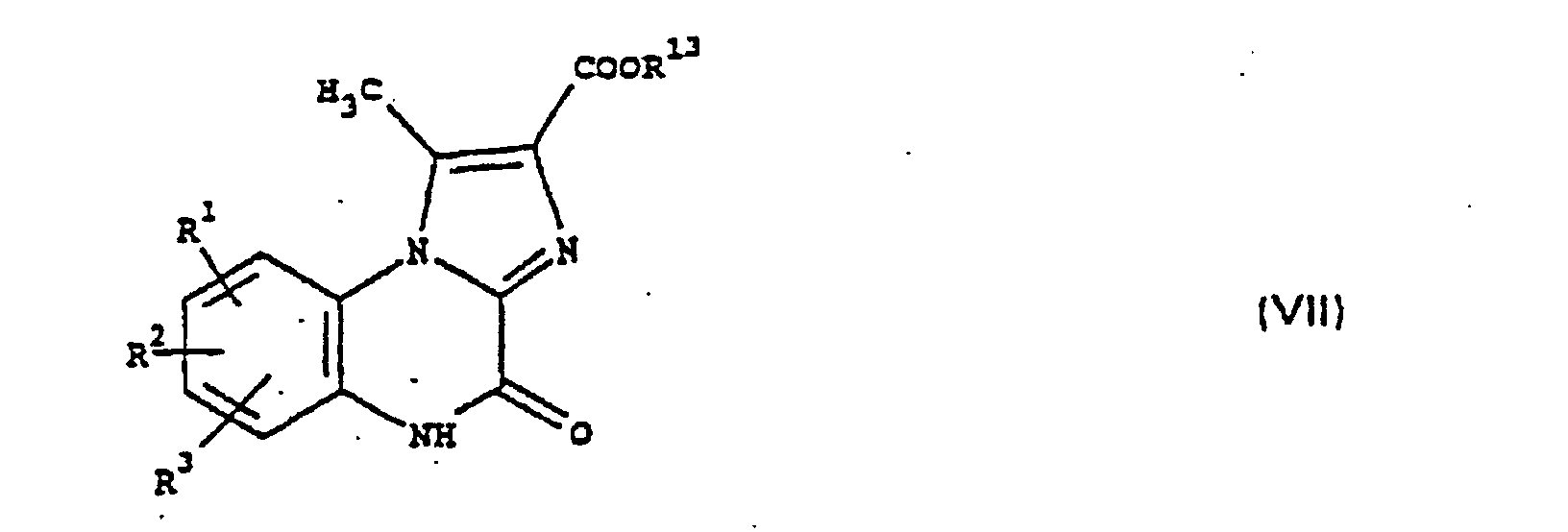
- Halogenation of a compound of formula VII to a compound of formula VIII may be effected by halogenating reagents such as phosgene, diphosgene, phosphorous pentachloride or thionyl chloride, preferably phosgene in dimethyl formamide at a temperature about 25-50°C.
- halogenating reagents such as phosgene, diphosgene, phosphorous pentachloride or thionyl chloride, preferably phosgene in dimethyl formamide at a temperature about 25-50°C.
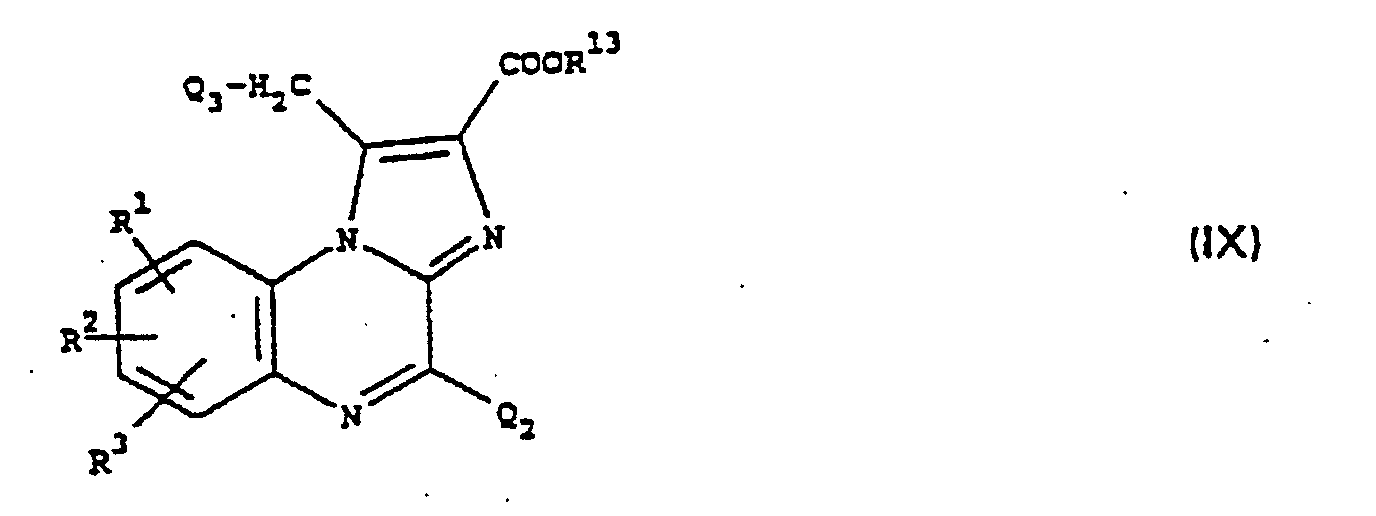
- the second halogenation in the allylic position to a compound of formula IX is carried out with a N-halo amide such as for example N-bromosuccinimide and an initiator in a nonpolar anhydrous reagent such as boiling carbon tetrachloride or chloroform.
- the initiator is preferably 2,2'-azobis(2-methylproprionitrile).
- Dehalogenation to the quinoxalinone (formula X) is preferably carried out in glacial acetic acid at elevated temperature.
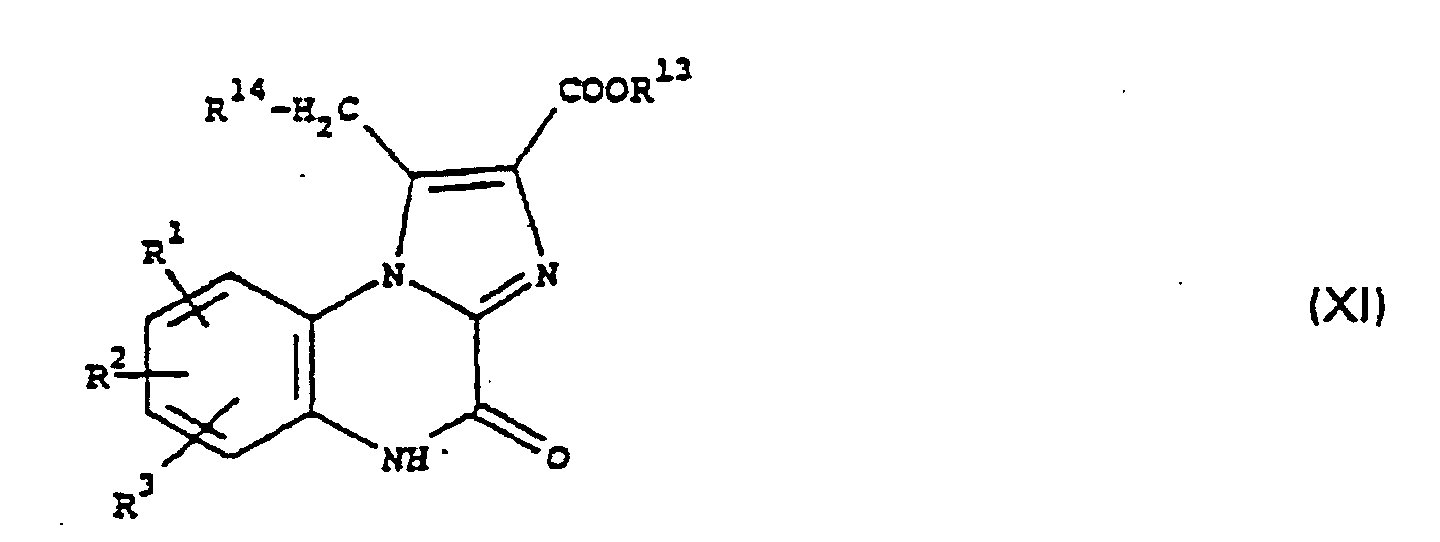
- Formation of a compound of formula XI wherein R 14 is POR'''R''' is achieved by heating a compound of formula X in trialkyl phosphite.
- the hydrolysis is performed in two steps using at first bromotrimethyl silane followed by a reaction with hydrobromic acid.
- Treatment of a compound of formula X with an appropriate amine to form a compound of formula XI wherein R 14 is an amine may conveniently be effected in an organic solvent such as acetonitrile or acetone in some examples in the presence of a base for example potassium carbonate.
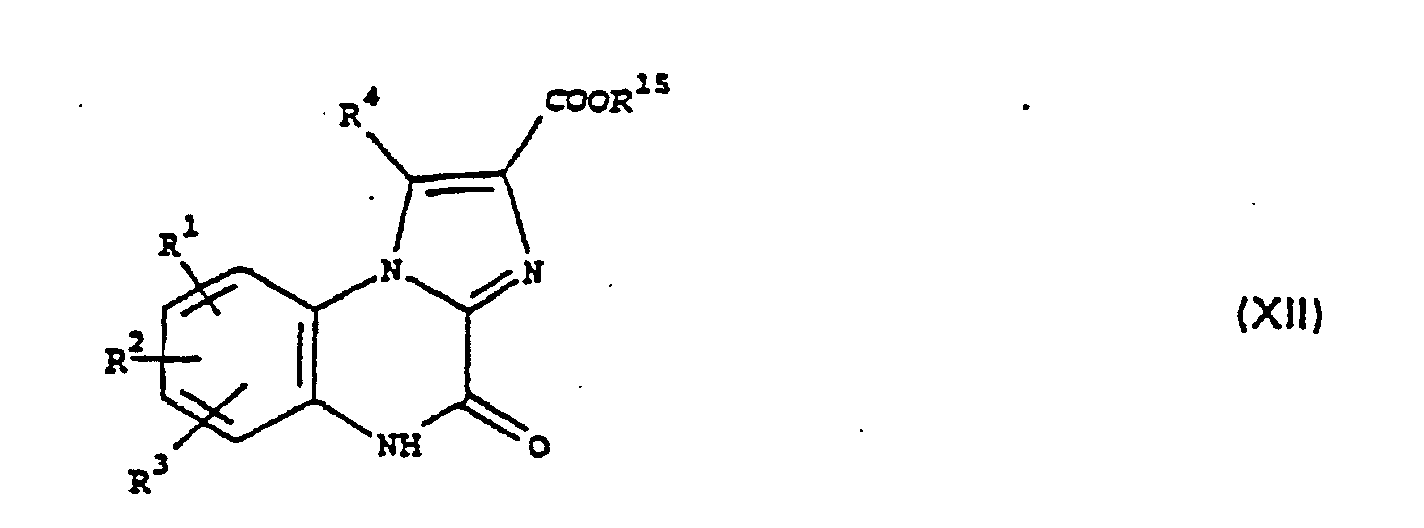
- R 1 , R 2 , R 3 and R 4 have the meanings defined above for formula I and R 15 is H or C 1-6 -alkyl.
- the hydrazides (formula XVI) are readily available by treating a compound of formula XV with hydrazine hydrate in a polar solvent as for example methanol.
- a polar solvent as for example methanol.
- the aidoximes can be dehydrated to the nitriles (formula XXI) by a dehydrating agent.
- the cyclization to the tetrazoles (formula XXII) is preferably performed using sodiumazide and ammonium chloride in dimethylformamide.
- the starting materials for which the preparation is not described herein are either known compounds or compounds which may be prepared in analogy with the preparation of known compounds or in analogy with known methods.
- the affinity of a substance for one or more of the different types of excitatory amino acid receptors may be studied in simple binding experiments.
- the method involves incubation of a particular selected radiolabelled ligand and the particular specific substance to be investigated with brain homogenate which contains the receptor. Measurement of receptor occupancy is made by determination of the radioactivity bound to the homogenate and subtraction of nonspecific binding.
- AMPA receptor binding may be studied by using 3 H-AMPA as radioligand.
- the influence of glutamic acid analogues on secondary effects of glutamate receptor interactions may be studied in vitro by using the phenomenon of spreading depression in chicken retina. Such experiments will provide information as to the efficacies (agonist/antagonist) of the test substances. This is in contrast to binding studies, which only provide information on the affinities of the compounds for the receptor.
- the pharmacological properties of the compounds of the present invention can be illustrated by determining their capability for displacing radioactively labelled 2-amino-3-hydroxy-5-methyl-4-isoxazolepropionic acid (AMPA) from the AMPA type receptors.
- AMPA 2-amino-3-hydroxy-5-methyl-4-isoxazolepropionic acid
- the antagonistic properties of the compounds is demonstrated by their capability to antagonize quisqualic acid stimulated spreading depression in chicken retina.
- the displacement activity of the compounds may be shown by determining the IC 50 value which represents the concentration ( ⁇ M) which causes a displacement of 50% of the specific binding of 3 H-AMPA.
- the antagonism is measured by determining the IC 50 value which represents the concentration which produces a 50% maximal inhibition of quisqualic acid stimulated spreading depression in chicken retina.
- rat cerebral cortical membrane homogenate 500 ⁇ l of thawed rat cerebral cortical membrane homogenate in Tris-HCI (30 mM), CaCl 2 (2.5 mM) and KSCN (100 mM) pH 7.1 were incubated at 0°C for 30 min. with 25 ⁇ l 3 H-AMPA (5 nM final concentration) and the test compound and buffer. Nonspecific binding was determined by incubation with L-glutamic acid (600 ⁇ M final concentration). The binding reaction was terminated by adding 5 ml of ice-cold buffer followed by filtration through Whatman GF/C glass fibre filters and 2x5 ml wash with ice-cold buffer. Bound radioactivity was measured by scintillation counting. IC 50 was determined by Hill analysis of at least four concentrations of test compound.
- P.S.S. physiological saline solution of the following composition (mM) NaCI (100), KCI (6.0), CaCl 2 (1.0), MgSO 4 (1.0), NaHCO 3 (30), NaH 2 PO 4 (1.0), glucose (20).
- the solution was saturated with 100% O 2 and maintained at a temperature of 26°C.
- Test results obtained by testing a compound of the present invention are shown in the following table 1.
- TEST 1 TEST 2 Compound of example IC 50 ⁇ M IC 50 ⁇ M example 2 0.45 1.1
- compositions comprising the compounds of the invention may be administered to humans or animals by oral, rectal or parenteral route.
- an effective amount of the active compound or a pharmaceutically acceptable salt thereof may be determined in accordance with the usual factors, such as the nature and severity of the condition and the weight of the mammal requiring treatment.
- excipients are such pharmaceutically acceptable organic or inorganic carrier substances suitable for parenteral or enteral application which do not deleteriously react with the active compounds.
- Such carriers are water, salt solutions, alcohols, polyethylene glycols, polyhydroxyethoxylated castor oil, gelatine, lactose, amylose, magnesium stearate, talc, silicic acid, fatty acid monoglycerides and diglycerides, pentaerythritol fatty acid esters, hydroxymethylcellulose, and polyvinylpyrrolidone.
- the pharmaceutical preparations can be sterilized and mixed, if desired, with auxiliary agents, such as lubricants, preservatives, stabilizers, wetting agents, emulsifiers, salt for influencing osmotic pressure, buffers and/or colouring substances and the like, which do not deleteriously react with the active compounds.
- auxiliary agents such as lubricants, preservatives, stabilizers, wetting agents, emulsifiers, salt for influencing osmotic pressure, buffers and/or colouring substances and the like, which do not deleteriously react with the active compounds.
- Injectable solutions or suspensions preferably aqueous solutions with the active compound dissolved in polyhydroxylated castor oil, are particularly suitable for parenteral administration.
- Ampoules are convenient unit dosage forms.
- Tablets, dragees, or capsules containing talc and/or a carrier or binder or the like are particularly suitable for oral administration.
- the carrier preferably is lactose and/or corn starch and/or potato starch.
- a syrup, elixir, or the like can be used in the cases where a sweetened vehicle can be employed or is desired.
- the compounds of this invention are dispensed in unit dosage form comprising 10-200 mg of active ingredient in or together with a pharmaceutically acceptable carrier per unit dosage.
- the dosage of the compounds according to this invention is 1-500 mg/day, e.g. about 100 mg per dose, when administered to patients, e.g. humans, as a drug.
- a typical tablet which may be prepared by conventional tabletting techniques contains: Core: Active compound (as free compound or salt thereof) 100 mg Colloidal silicon dioxide (Aerosil®) 1.5 mg Cellulose, microcryst. (Avicel®) 70 mg Modified cellulose gum (Ac-Di-Sol®) 7.5 mg Magnesium stearate 1 mg Coating: HPMC approx. 9 mg Mywacett® 9-40T approx. 0.9 mg
- alkali metal or earth alkali metal salts may be employed in such salt form.
- alkali metal or earth alkali metal salts are ordinarily formed by reacting the compound with an equivalent amount or excess of the selected alkali metal or earth alkali metal as the hydroxide, frequently and suitably by admixture in the presence of a neutral solvent, from which the salt may be precipitated or recovered in other conventional manner, e.g. by evaporation.
- Administration of a compound of the invention is often preferably in the form of a pharmaceutically acceptable water-soluble alkali metal or earth alkali metal salt thereof, and orally, rectally, or parenterally in the form of a pharmaceutical composition wherein it is present together with a pharmaceutically acceptable liquid or solid carrier or diluent.
- compositions and unit dosages thereof may be placed into the form of pharmaceutical compositions and unit dosages thereof, and in such form may be employed as solids, such as tablets or filled capsules, or liquids, such as solutions, suspensions, emulsions, elixirs, or capsules filled with the same, all for oral use, in the form of suppositories for rectal administration; or in the form of sterile injectable solutions for parenteral (including subcutaneous) use.
- Such pharmaceutical composition and unit dosage forms thereof may comprise conventional ingredients in conventional proportions, with or without additional active compounds or principles, and such unit dosage forms may contain any suitable effective AMPA antagonistic amount of the active ingredient commensurate with the intended daily dosage range to be employed. Tablets containing 10 mg to 200 mg of active ingredient or, more specified 50 mg, per tablet, are accordingly suitable representative unit dosage forms.
- the compounds of the invention may be administered to a subject, e.g. a living animal body, in need of such treatment, elimination, alleviation, or amelioration of an indication which is sensitive to a change in the AMPA receptor condition, e.g.
- sclerosis Parkinsonism, Alzheimer's disease, Huntington's disease, epilepsy, deficiencies seen after ischemia, anoxia, hypoglycemia, head and spinal cord trauma, psychosis, muscle rigidity, emesis and analgesia, often preferably in the form of an alkali metal or earth alkali metal salt thereof, concurrently, simultaneously, or together with a pharmaceutically acceptable carrier or diluent, especially and preferably in the form of a pharmaceutical composition thereof, whether by oral, rectal, or parenteral (including subcutaneous) route, in an effective amount.
- a pharmaceutically acceptable carrier or diluent especially and preferably in the form of a pharmaceutical composition thereof, whether by oral, rectal, or parenteral (including subcutaneous) route, in an effective amount.
- Suitable dosage ranges are 10-200 milligrams daily, preferably 50-100 milligrams daily, and especially 70-100 milligrams daily, depending as usual upon the exact mode of administration, form in which administered, the indication towards which the administration is directed, the subject involved and the body weight of the subject involved, and the preference and experience of the physician or veterinarian in charge.
- Such method of treating may be described as the treatment of an indication caused by or related to hyperactivity of the excitatory neurotransmitters, and particularly the AMPA receptors in a subject in need thereof, which comprises the step of administering to the said subject a neurologically effective amount of an AMPA antagonistic compound of the invention, or a pharmaceutically acceptable salt thereof.
- the present invention relates to the use of a compound of the invention for preparing a medicament for treating an indication caused by or related to hyperactivity of the excitatory neurotransmitters, and particularly the AMPA receptors in a subject in need thereof.
- Step b 1-(2-Amino-4-trifluoromethylphenyl)-4-ethoxycarbonyl-5-methyl-1 H-imidazole
- Step a 4-Chloro-2-ethoxycarbonyl-1-methyl-7-trifluoromethylimidazo-[1,2-a]quinoxaline
- Step b 1-Bromomethyl-4-chloro-2-ethoxycarbonyl-7-trifluoromethylimidazo[1,2-a]quinoxaline
- Triethylamine (12 ml, 86 mmol) was added and the reaction mixture was stirred for 5 min. and then allowed to warm up to room temperature. Water (300 ml) was added and the aqueous layer was reextracted with additional dichloromethane (4 x 100 ml). The organic layers were combined, washed with saturated sodium chloride solution (250 ml) and dried with anhydrous magnesium sulphate. The filtered solution was concentrated in vacuo to give crude 4-chloro-2-formyl- 1-(1-imidazolylmethyl)-7-trifluoromethylimidazo[1,2-a]quinoxaline which was hydrolysed to the title compound in 10 min at 40°C with glacial acetic acid (30 min.).
- Example 3 The title compound was preparef from 1-bromomethyl-2-ethoxycarbonyl-7-trifluoromethylimidazo[1,2-a]quinoxalin-4(5H)-one (Example 3) following the procedure outlined in Example 9. M.p. >250°C.
- Step b 4-Ethoxycarbonyl-5-methyl-1-(2-nitro-5-(1-imidazolyl)phenyl)-1H-imidazole
Landscapes
- Health & Medical Sciences (AREA)
- Organic Chemistry (AREA)
- Chemical & Material Sciences (AREA)
- Bioinformatics & Cheminformatics (AREA)
- Engineering & Computer Science (AREA)
- Animal Behavior & Ethology (AREA)
- Pharmacology & Pharmacy (AREA)
- Veterinary Medicine (AREA)
- Public Health (AREA)
- Chemical Kinetics & Catalysis (AREA)
- General Chemical & Material Sciences (AREA)
- Medicinal Chemistry (AREA)
- Nuclear Medicine, Radiotherapy & Molecular Imaging (AREA)
- General Health & Medical Sciences (AREA)
- Life Sciences & Earth Sciences (AREA)
- Neurology (AREA)
- Neurosurgery (AREA)
- Biomedical Technology (AREA)
- Diabetes (AREA)
- Hospice & Palliative Care (AREA)
- Pain & Pain Management (AREA)
- Psychiatry (AREA)
- Emergency Medicine (AREA)
- Hematology (AREA)
- Endocrinology (AREA)
- Obesity (AREA)
- Rheumatology (AREA)
- Otolaryngology (AREA)
- Pharmaceuticals Containing Other Organic And Inorganic Compounds (AREA)
- Agricultural Chemicals And Associated Chemicals (AREA)
- Nitrogen Condensed Heterocyclic Rings (AREA)
- Nitrogen And Oxygen Or Sulfur-Condensed Heterocyclic Ring Systems (AREA)
- Preparation Of Compounds By Using Micro-Organisms (AREA)
- Plural Heterocyclic Compounds (AREA)
Claims (14)
- Imidazo[1,2-a]chinoxalin-Verbindungen der allgemeinen Formel Iworin
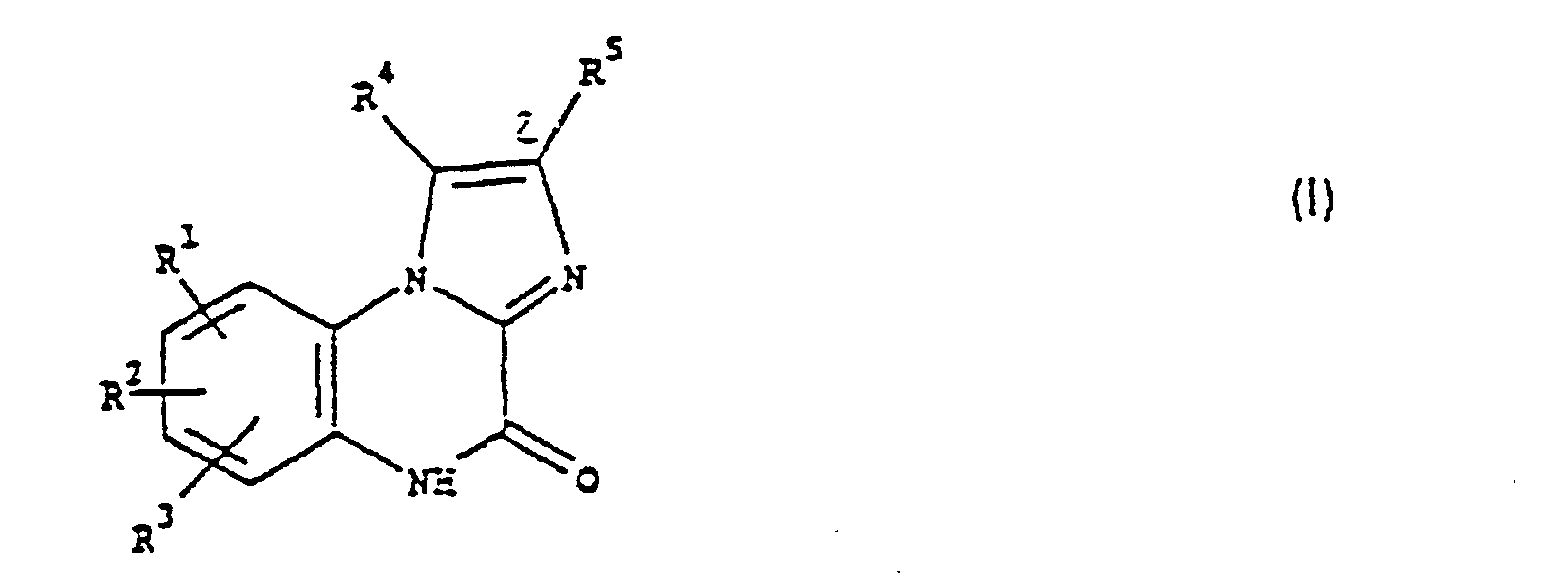 R1, R2 und R3 gleich sind oder unabhängig voneinander für Wasserstoff, C1-6-Alkyl, C1-6-Alkoxy, Halogen, NO2, NH2, CF3, CN, SO2CH3, SO2CF3, SO2NR'R'' oder einen gegebenenfalls mit Phenyl oder C1-6-Alkyl substituierten 5- oder 6- gliedrigen stickstoffhaltigen heterocyclischen Ring stehen undR' und R'' unabhängig voneinander Wasserstoff oder C1-6-Alkyl bedeuten;R4 für CH2-R6 steht undR6 Wasserstoff, Halogen, POR'''R'''', NR7R8 oder einen gegebenenfalls ein- oder zweifach mit Phenyl, C1-6-Alkyl oder Halogen substituierten 5- oder 6-gliedrigen stickstoffhaltigen heterocyclischen Ring bedeutet und R''' und R'''' unabhängig voneinander Hydroxy oder C1-6-Alkoxy bedeuten;R7 und R8 sind oder unabhängig voneinander für Wasserstoff,oder gegebenenfalls mit Hydroxy oder Phenyl substituiertes C1-6-Alkyl stehen und n 1, 2 oder 3 bedeutet;
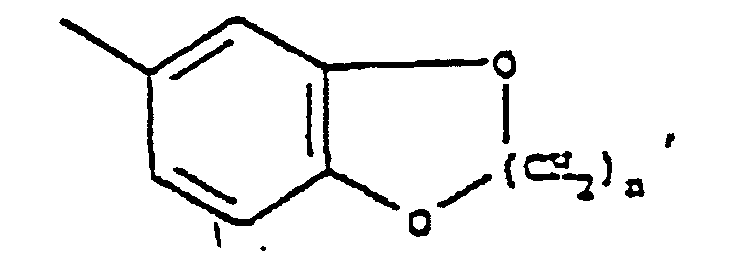 R5 füroder steht und
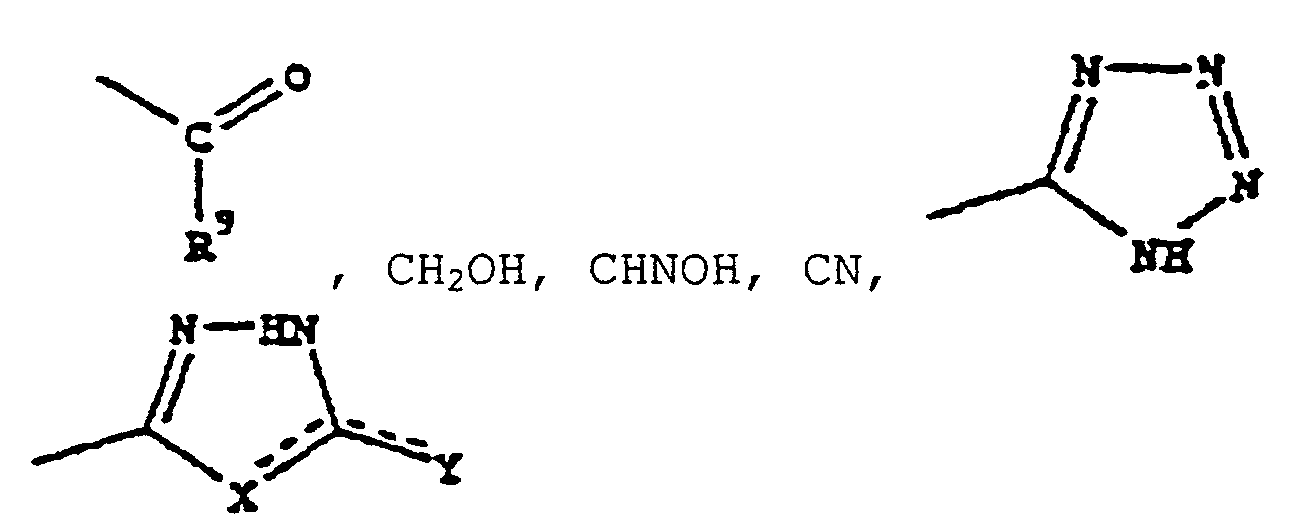 R9 Hydroxy, C1-6-Alkoxy, Wasserstoff oder NR10R11 bedeutet,R10 und R11 gleich sind oder unabhängig voneinander Wasserstoff, NH2 oder OH bedeuten,X O oder S bedeutet undY O, S oder NH2 bedeutet;und pharmazeutisch unbedenkliche Salze davon.
 - Verbindung nach Anspruch 1, bei der R1, R2 und R3 unabhängig voneinander für Wasserstoff, Cl, Br, F, CF3, SO2CH3 oder gegebenenfalls ein- oder zweifach mit Phenyl oder Methyl substituiertes Imidazolyl stehen.
- Verbindung nach Anspruch 1 oder 2, bei der R4 für Methyl, Brommethyl, gegebenenfalls ein- oder zweifach mit Methyl oder Cl substituiertes Imidazolylmethyl, gegebenenfalls mit Methyl substituiertes Piperazinylmethyl, 3,4-Methylendioxyanilinomethyl, Benzylaminomethyl, Phosphonomethyl oder Diethoxyphosphoryl steht.
- Verbindung nach Anspruch 1, 2 oder 3, bei der R5 für COOH, COOEt, CH2OH, CONH2, CHO, CH=NOH, CONHNH2 oder Oxadiazolthionyl steht.
- Verbindung nach einem der Ansprüche 1 bis 4, bei der es sich um2-Ethoxycarbonyl-1-methyl-7-trifluormethylimidazo-[1,2-a]chinoxalin-4(5H)-on;2-Carboxy-1-methyl-7-trifluormethylimidazo[1,2-a]-chinoxalin-4(5H)-on;1-Brommethyl-2-ethoxycarbonyl-7-trifluormethylimidazo[1,2-a]chinoxalin-4(5H)-on;1-Brommethyl-2-carboxy-7-trifluormethylimidazo[1,2-a]chinoxalin-4(5H)-on;2-Ethoxycarbonyl-1-(1-imidazolylmethyl)-7-trifluormethylimidazo[1,2-a]chinoxalin-4(5H)-on;2-Carboxy-1-(1-imidazolylmethyl)-7-trifluormethylimidazo[1,2-a]chinoxalin-4(5H)-on;2-Ethoxycarbonyl-1-(2-methyl-1-imidazolyl)methyl7-trifluormethylimidazo[1,2-a]chinoxalin-4(5H)-on;2-Carboxy-1-(2-methyl-1-imidazolyl)methyl-7-trifluormethylimidazo[1,2-a]chinoxalin-4(5H)-on;1-(4,5-Dichlor-1-imidazolyl)methyl-2-ethoxycarbonyl-7-trifluormethylimidazo[1,2-a]chinoxalin-4(5H)-on;2-Carboxy-1-(4,5-dichlor-1-imidazolyl)methyl-7-trifluormethylimidazo[1,2-a]chinoxalin-4(5H)-on;2-Ethoxycarbonyl-1-(4-methyl-1-piperazinyl)methyl-7-trifluormethylimidazo[1,2-a]chinoxalin-4(5H)-on;2-Carboxy-1-(4-methyl-1-piperazinyl)methyl-7-trifluormethylimidazo[1,2-a]chinoxalin-4(5H)-on;2-Ethoxycarbonyl-1-(3,4-methylendioxyanilino)-methyl-7-trifluormethylimidazo[1,2-a]chinoxalin-4(5H)-on;2-Carboxy-1-(3,4-methylendioxyanilino)methyl-7-trifluormethylimidazo[1,2-a]chinoxalin-4(5H)-on;2-Ethoxycarbonyl-7-fluor-1-methylimidazo[1,2-a]-chinoxalin-4(5H)-on;2-Carboxy-7-fluor-1-methylimidazo[1,2-a]-chinoxalin-4(5H)-on;2-Ethoxycarbonyl-1-methyl-7-methylsulfonylimidazo-[1,2-a]chinoxalin-4(5H)-on;2-Carboxy-1-methyl-7-methylsulfonylimidazo[1,2-a]-chinoxalin-4(5H)-on;2-Carbamoyl-1-methyl-7-trifluormethylimidazo[1,2-a]chinoxalin-4 (5H)-on;2-Carbazoyl-1-(1-imidazolylmethyl)-7-trifluormethylimidazo[1,2-a]chinoxalin-4(5H)-on;1-(1-Imidazolylmethyl)-2-(2(3H)thioxo-1,3,4-oxadiazol-5-yl)-7-trifluormethylimidazo[1,2-a]-chinoxalin-4(5H)-on;2-Hydroxymethyl-1-(1-imidazolylmethyl)-7-trifluormethylimidazo[1,2-a]chinoxalin-4(5H)-on;2-Formyl-1-(1-imidazolylmethyl)-7-trifluormethylimidazo[1,2-a]chinoxalin-4(5H)-on;2-Hydroxyiminomethyl-1-(1-imidazolylmethyl)-7-trifluormethylimidazo[1,2-a]chinoxalin-4(5H)-on;1-Benzylaminomethyl-2-ethoxycarbonyl-7-trifluormethylimidazo[1,2-a]chinoxalin-4(5H)-on;1-Benzylaminomethyl-2-carboxy-7-trifluormethylimidazo[1,2-a]chinoxalin-4(5H)-on;2-Ethoxycarbonyl-8-(1-imidazolyl)-1-methylimidazo-[1,2-a]chinoxalin-4(5H)-on;2-Carboxy-8-(1-imidazolyl)-1-methylimidazo[1,2-a]-chinoxalin-4(5H)-on;2-Ethoxycarbonyl-1-diethoxyphosphoryl-7-trifluormethylimidazo[1,2-a]chinoxalin-4(5H)-on;2-Ethoxycarbonyl-1-phosphonomethyl-7-trifluormethylimidazo[1,2-a]chinoxalin-4(5H)-on;2-Carboxy-1-phosphonomethyl-7-trifluormethyl-imidazo[1,2-a]chinoxalin-4(5H)-on handelt.
- Pharmazeutische Zusammensetzung, die als Wirkstoff eine Verbindung nach einem der Ansprüche 1 bis 5 oder ein pharmazeutisch unbedenkliches Salz davon und einen pharmazeutisch unbedenklichen Träger oder ein pharmazeutisch unbedenkliches Verdünnungsmittel enthält.
- Zur Verwendung bei der Behandlung einer mit Hyperaktivität der exzitatorischen Neuro-transmitter verbundenen Indikation geeignete pharmazeutische Zusammensetzung, die eine wirksame Menge einer Verbindung nach einem der Ansprüche 1 bis 5 oder eines pharmazeutisch unbedenklichen Salzes davon und einen pharmazeutisch unbedenklichen Träger oder ein pharmazeutisch unbedenkliches Verdünnungsmittel enthält.
- Pharmazeutische Zusammensetzung nach Anspruch 6 oder 7, die pro Dosierungseinheit 10 bis 200 mg der Verbindung nach einem der Ansprüche 1 bis 5 enthält.
- Verwendung einer Verbindung nach einem der Ansprüche 1 bis 5 zur Herstellung eines Arzneimittels zur Behandlung einer mit Hyperaktivität der exzitatorischen Neuro-transmitter verbundenen Indikation.
- Verwendung einer Verbindung nach einem der Ansprüche 1 bis 5 zur Behandlung einer mit Hyperaktivität der exzitatorischen Neuro-transmitter verbundenen Indikation bei einem Empfänger, der einer derartigen Behandlung bedarf, bei der man dem Empfänger eine neurologisch wirksame AMPA-antagonistische Menge einer Verbindung nach einem der Ansprüche 1 bis 5 verabreicht.
- Verwendung nach Anspruch 10, bei der es sich bei der Indikation um neuronale Degeneration handelt.
- Verwendung nach Anspruch 10 oder 11, bei der die Indikation mit cerebraler Ischämie verbunden ist.
- Verwendung nach Anspruch 10 oder 11, bei der die Indikation mit Analgesie verbunden ist.
- Verfahren zur Herstellung der Verbindungen nach Anspruch 1, bei dem man:worin R1, R2, R3, R4 und R15 die oben angegebenen Bedeutungen haben, zu einer Verbindung der Formel XVIIIa) eine Verbindung der Formel IIworin Q1 für Halogen steht und R1, R2 und R3 die oben bei Formel I angegebenen Bedeutungen haben, mit einer Verbindung der Formel III
 worin R12 für H oder CH3 und R13 für C1-6-Alkyl steht, zu einer Verbindung der Formel IV
 worin R1, R2, R3, R12 und R13 die oben angegebenen Bedeutungen haben, umsetzt, die Verbindung zu einer Verbindung der Formel V
 worin R1, R2, R3, R12 und R13 die oben angegebenen Bedeutungen haben, hydriert oder reduziert und die Verbindung zu einer Verbindung der Formel VI
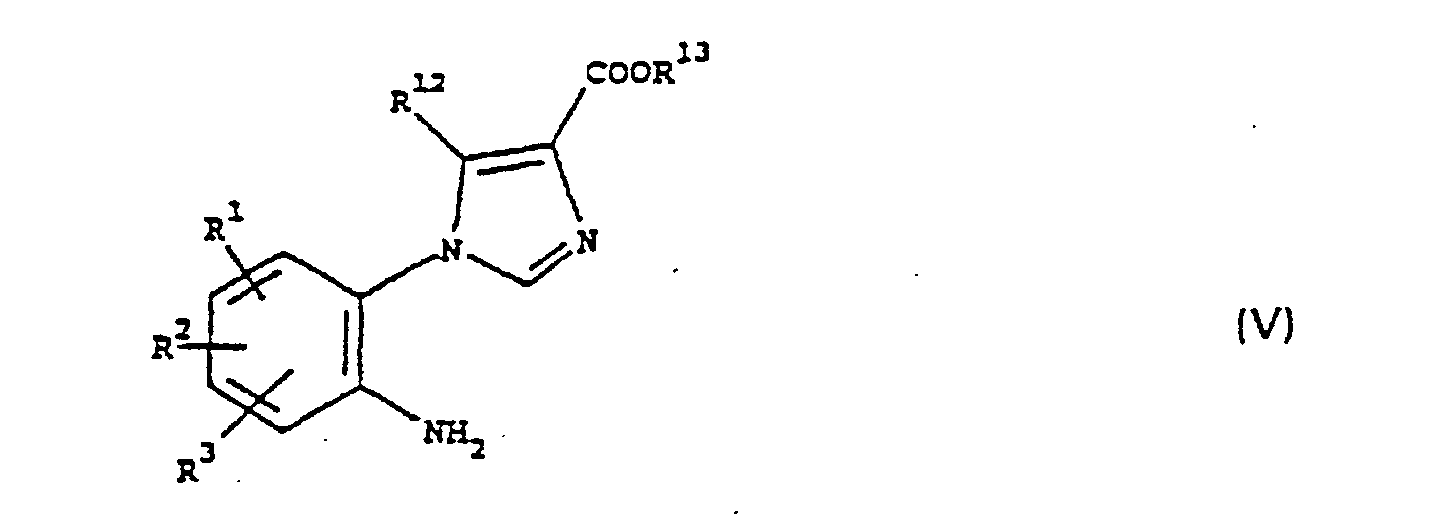 worin R1, R2, R3, R12 und R13 die oben angegebenen Bedeutungen haben, cyclisiert, oder
 b) eine Verbindung der Formel VIIworin R1, R2, R3 und R13 die oben angegebenen Bedeutungen haben, zu einer Verbindung der Formel VIII
 worin R1, R2, R3 und R13 die oben angegebenen Bedeutungen haben und Q2 für Halogen steht, halogeniert, die Verbindung der Formel VIII in der Allylposition halogeniert, wobei man eine Verbindung der Formel IX
 worin R1, R2, R3 und R13 die oben angegebenen Bedeutungen haben und Q2 und Q3 für Halogen stehen, erhält, die Verbindung zu einer Verbindung der Formel X
 worin R1, R2, R3 und R13 und Q3 die oben angegebenen Bedeutungen haben, enthalogeniert und die Verbindung mit einem Amin der Formel XXIII
 worin R1, R2, R3, R13 und R14 die oben angegebenen Bedeutungen haben, erhält, oder
 c) eine Verbindung der Formel XIIworin R1, R2, R3, R4 und R15 die oben angegebenen Bedeutungen haben, zu einer Carbonsäure der Formel XIII
 worin R1, R2, R3 und R4 die oben angegebenen Bedeutungen haben, hydrolysiert, oder
 d) eine Verbindung der Formel XIIworin R1, R2, R3, R4 und R15 die oben angegebenen Bedeutungen haben, in ein Amid der Formel XIV
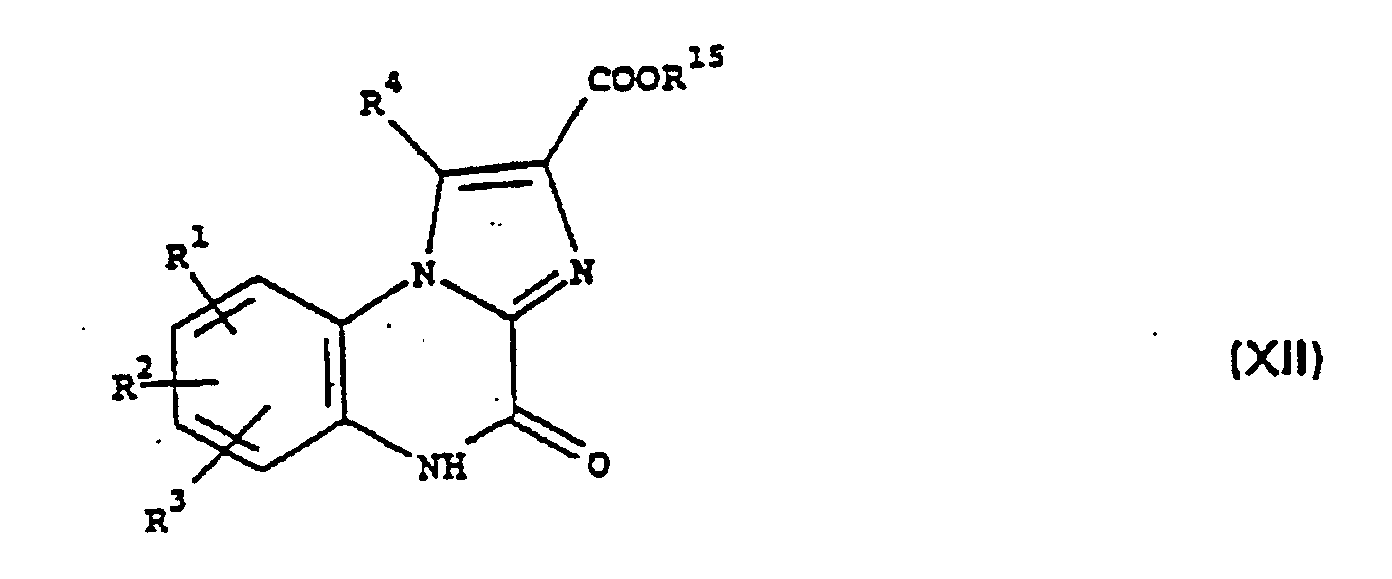 worin R1, R2, R3 und R4 die oben angegebenen Bedeutungen haben, umwandelt, oder
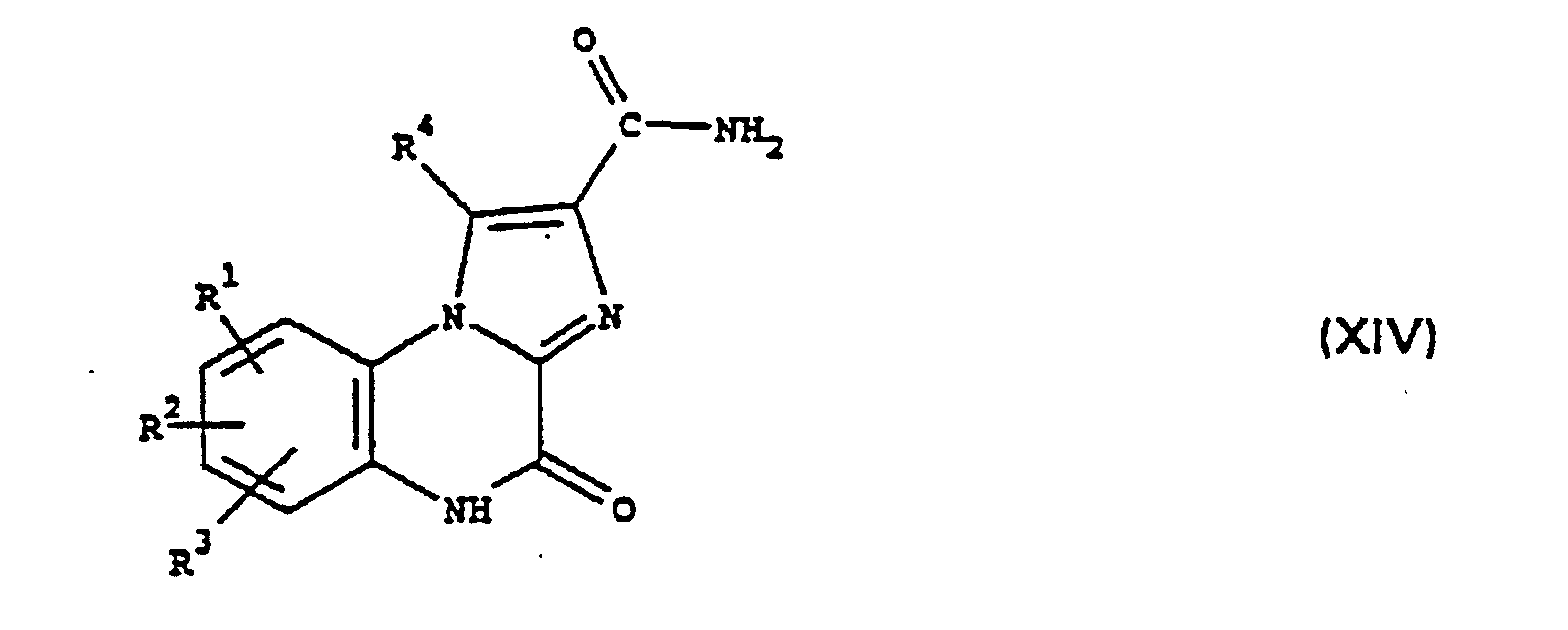 e) eine Verbindung der Formel XVworin R1, R2, R3, R4 und R13 die oben angegebenen Bedeutungen haben, in ein Hydrazid der Formel XVI
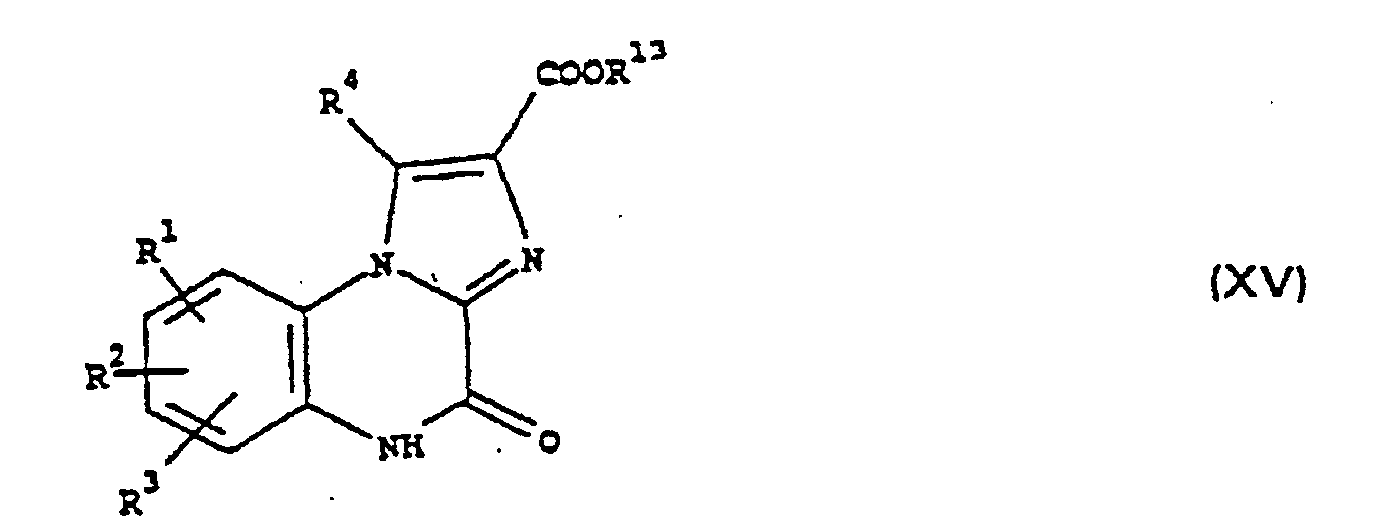 worin R1, R2, R3 und R4 die oben angegebenen Bedeutungen haben, umwandelt und dann zu einer Verbindung der Formel XVII
 worin R1, R2, R3, R4, X und Y die oben bei Formel I angegebenen Bedeutungen haben, cyclisiert, oder
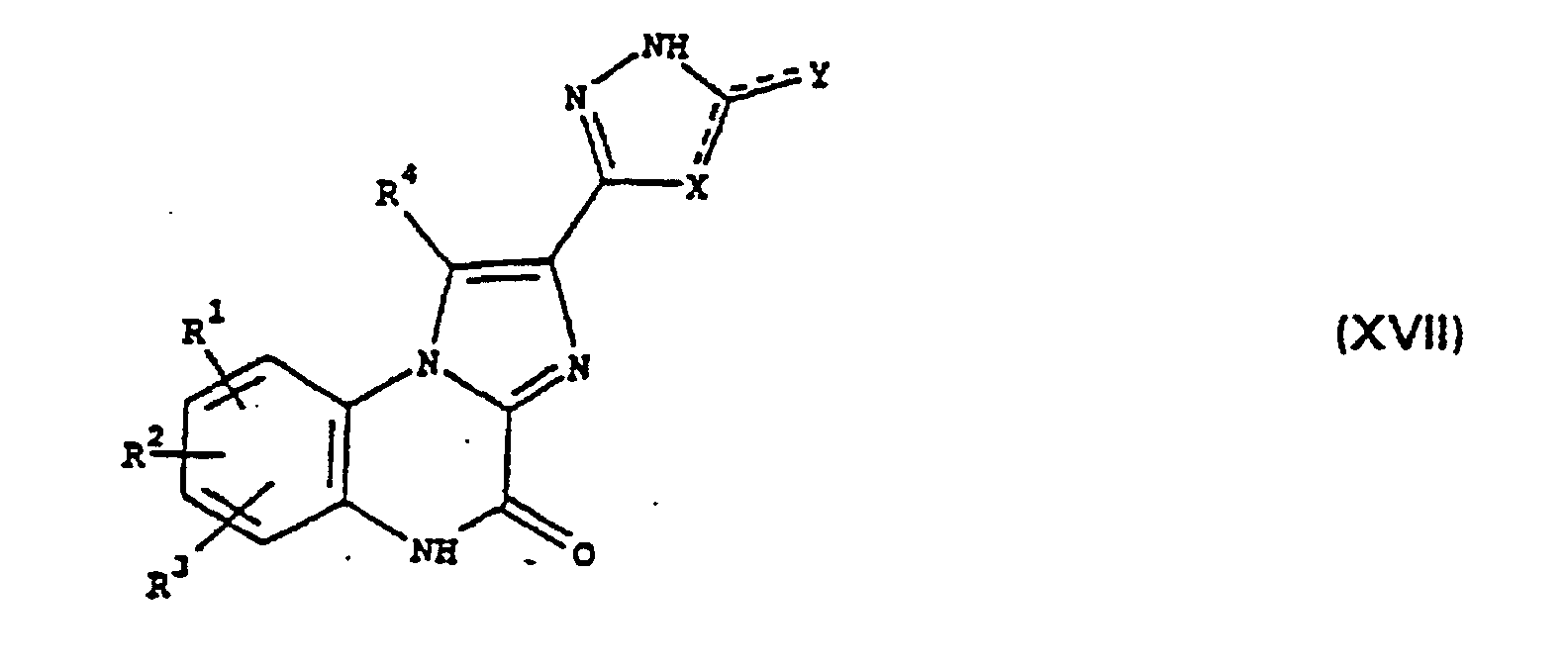 f) eine Verbindung der Formel XII
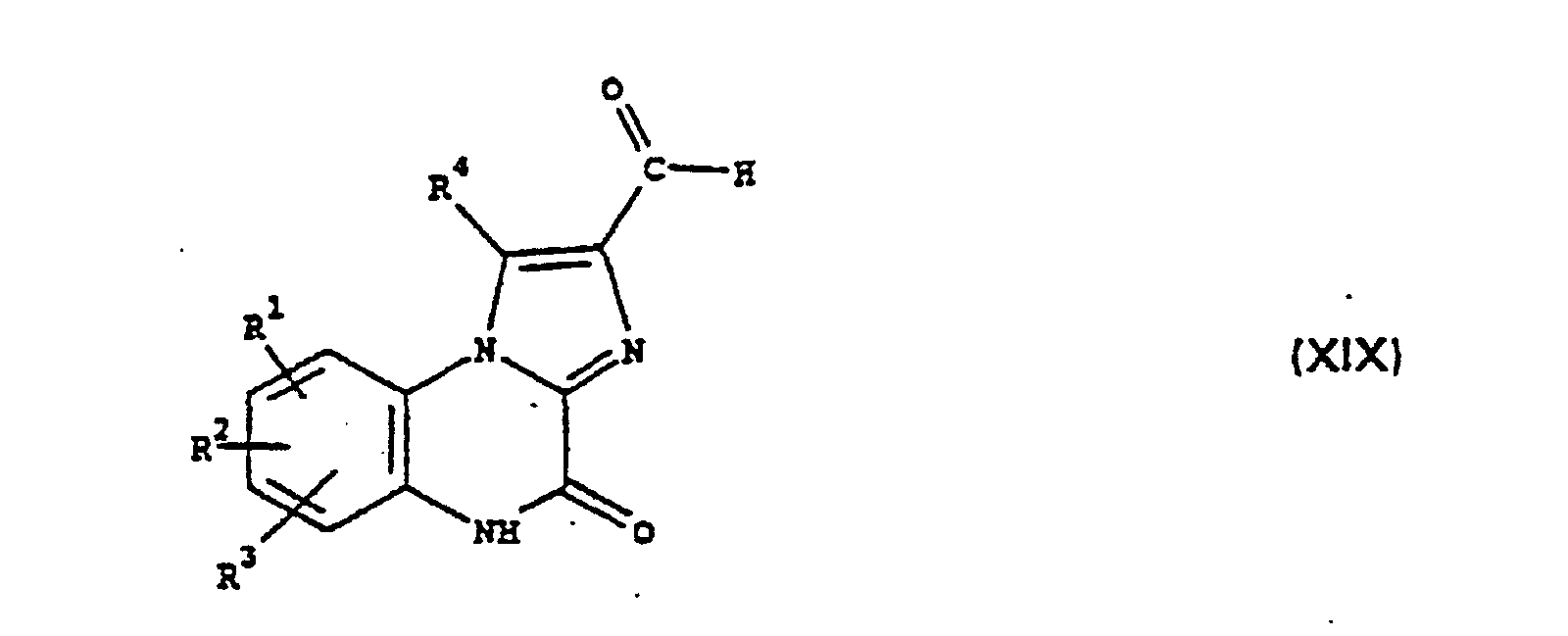
 worin R1, R2, R3 und R4 die oben angegebenen Bedeutungen haben, reduziert, dann zu einem Aldehyd der Formel XIX
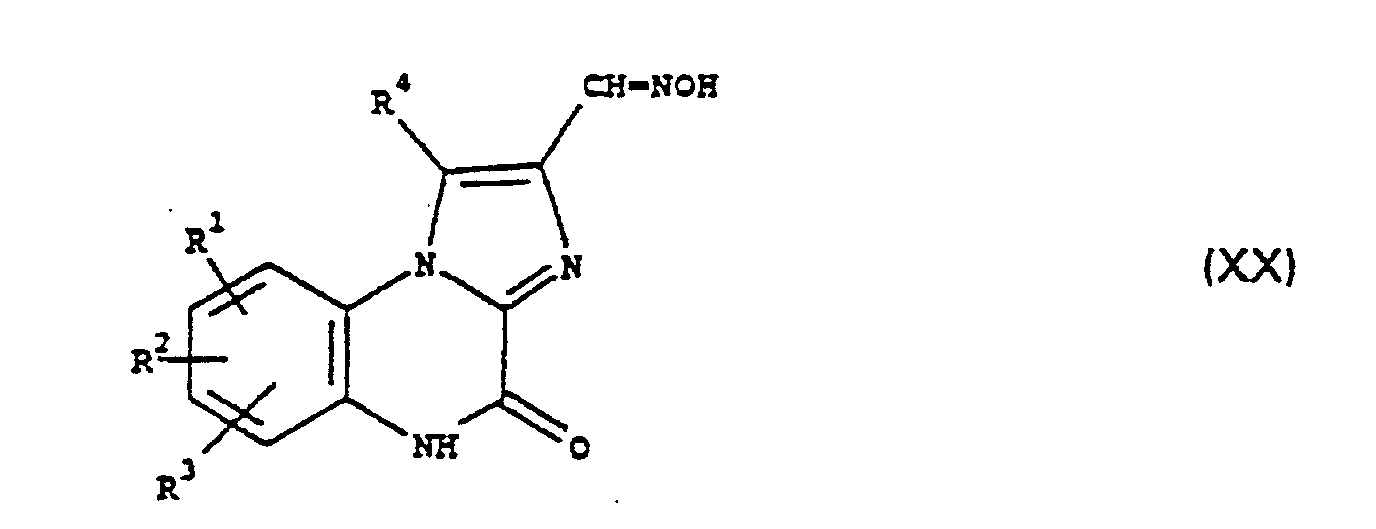
 worin R1, R2, R3 und R4 die oben angegebenen Bedeutungen haben, oxidiert, die Verbindung mit Hydroxylamin zu einem Oxim der Formel XX
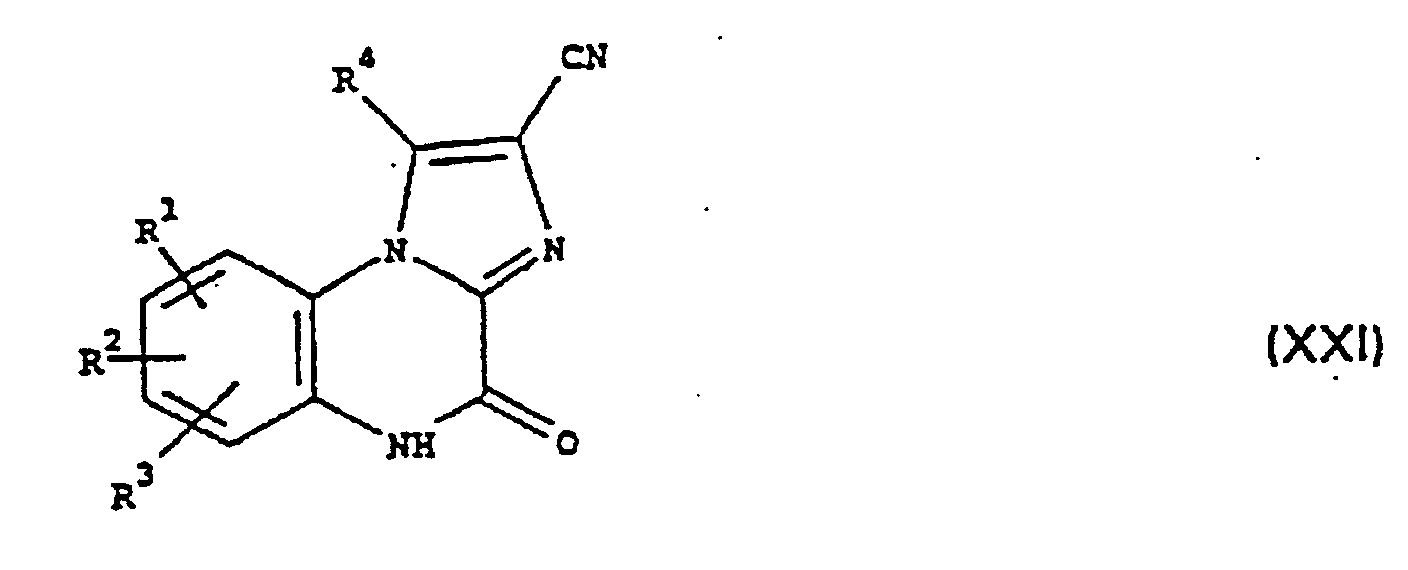
 worin R1, R2, R3 und R4 die oben angegebenen Bedeutungen haben, umsetzt, die Verbindung in ein Nitril der Formel XXI
 worin R1, R2, R3 und R4 die oben angegebenen Bedeutungen haben, umwandelt und die Verbindung zu einem Tetrazol der Formel XXII
 worin R1, R2, R3 und R4 die oben angegebenen Bedeutungen haben, cyclisiert.
Applications Claiming Priority (7)
| Application Number | Priority Date | Filing Date | Title |
|---|---|---|---|
| DK183/94 | 1994-02-11 | ||
| DK18394 | 1994-02-11 | ||
| DK18394 | 1994-02-11 | ||
| DK135194 | 1994-11-25 | ||
| DK1351/94 | 1994-11-25 | ||
| DK135194 | 1994-11-25 | ||
| PCT/DK1995/000044 WO1995021842A1 (en) | 1994-02-11 | 1995-01-30 | Heterocyclic compounds and their preparation and use |
Publications (2)
| Publication Number | Publication Date |
|---|---|
| EP0743945A1 EP0743945A1 (de) | 1996-11-27 |
| EP0743945B1 true EP0743945B1 (de) | 2002-03-06 |
Family
ID=26063483
Family Applications (1)
| Application Number | Title | Priority Date | Filing Date |
|---|---|---|---|
| EP95909651A Expired - Lifetime EP0743945B1 (de) | 1994-02-11 | 1995-01-30 | Heterocyclische verbindungen und ihre herstellung und verwendung |
Country Status (15)
| Country | Link |
|---|---|
| US (1) | US5741785A (de) |
| EP (1) | EP0743945B1 (de) |
| JP (1) | JPH09508632A (de) |
| KR (1) | KR970701192A (de) |
| CN (1) | CN1045964C (de) |
| AT (1) | ATE214069T1 (de) |
| AU (1) | AU692524B2 (de) |
| CA (1) | CA2182957A1 (de) |
| DE (1) | DE69525738D1 (de) |
| FI (1) | FI963130L (de) |
| HU (1) | HUT76323A (de) |
| IL (1) | IL112588A (de) |
| NO (1) | NO306781B1 (de) |
| NZ (1) | NZ281183A (de) |
| WO (1) | WO1995021842A1 (de) |
Families Citing this family (8)
| Publication number | Priority date | Publication date | Assignee | Title |
|---|---|---|---|---|
| PL319406A1 (en) * | 1994-09-30 | 1997-08-04 | Basf Ag | Novel heterocyclically substituted imidazoqunoxalinones, their production and application |
| FR2743363A1 (fr) * | 1996-01-10 | 1997-07-11 | Rhone Poulenc Rorer Sa | 5h,10h-imidazo(1,2-a)indeno(1,2-e)pyrazine-a-ones substituees en position 2, leur preparation et les medicaments les contenant |
| DE19611476A1 (de) * | 1996-03-22 | 1997-09-25 | Basf Ag | Neue heterocyclische substituierte Imidazolo-chinoxalinone, ihre Herstellung und Verwendung |
| IL125950A0 (en) * | 1997-09-05 | 1999-04-11 | Pfizer Prod Inc | Methods of administering ampa receptor antagonists to treat dyskinesias associated with dopamine agonist therapy |
| US8299080B2 (en) | 2006-12-13 | 2012-10-30 | Aska Pharmaceutical Co., Ltd. | Substituted imidazo[1,5-A] quinoxalines as a PDE9 inhibitor |
| CA2672860C (en) * | 2006-12-28 | 2013-01-29 | Abbott Laboratories | Inhibitors of poly(adp-ribose)polymerase |
| EP4403184A4 (de) | 2021-09-15 | 2025-09-24 | Univ Of The Ryukyus | Pharmazeutische zusammensetzung zur verwendung bei der behandlung von kognitivem verfall, übergewicht oder adipositas |
| JPWO2023042888A1 (de) | 2021-09-15 | 2023-03-23 |
Family Cites Families (10)
| Publication number | Priority date | Publication date | Assignee | Title |
|---|---|---|---|---|
| FR2448541A1 (fr) * | 1979-02-09 | 1980-09-05 | Roussel Uclaf | Nouveaux derives de l'oxoimidazoquinoxaline et leurs sels, leur procede de preparation, leur application comme medicaments et les compositions pharmaceutiques les renfermant |
| GB2043064B (en) * | 1979-02-09 | 1983-04-13 | Roussel Lab Ltd | Oximidazoquinoxaline derivatives |
| GB2043637B (en) * | 1979-02-09 | 1983-03-16 | Roussel Lab Ltd | Heterotricyclic derivatives |
| US5055465A (en) * | 1989-05-31 | 1991-10-08 | Berlex Laboratories, Inc. | Imidazoquinoxalinones, their aza analogs and process for their preparation |
| US5153196A (en) * | 1991-06-05 | 1992-10-06 | Eli Lilly And Company | Excitatory amino acid receptor antagonists and methods for the use thereof |
| US5182386A (en) * | 1991-08-27 | 1993-01-26 | Neurogen Corporation | Certain imidazoquinoxalinones; a new class of gaba brain receptor ligands |
| WO1993020077A1 (fr) * | 1992-04-03 | 1993-10-14 | Yamanouchi Pharmaceutical Co., Ltd. | Derive de quinoxalinone fondue et composition pharmaceutique le contenant |
| DE4329970A1 (de) * | 1993-03-31 | 1994-10-06 | Basf Ag | Neue Imidazolo-chinoxalinone, ihre Hestellung und Verwendung |
| DE4310523A1 (de) * | 1993-03-31 | 1994-10-06 | Basf Ag | Imidazolo-chinoxalinone zur Behandlung zentralnervöser Erkrankungen |
| CN1041928C (zh) * | 1993-03-31 | 1999-02-03 | Basf公司 | 新的咪唑并喹喔啉酮及其制备方法和用途 |
-
1995
- 1995-01-30 EP EP95909651A patent/EP0743945B1/de not_active Expired - Lifetime
- 1995-01-30 CA CA002182957A patent/CA2182957A1/en not_active Abandoned
- 1995-01-30 KR KR1019960704332A patent/KR970701192A/ko not_active Ceased
- 1995-01-30 DE DE69525738T patent/DE69525738D1/de not_active Expired - Fee Related
- 1995-01-30 WO PCT/DK1995/000044 patent/WO1995021842A1/en not_active Ceased
- 1995-01-30 JP JP7520915A patent/JPH09508632A/ja not_active Ceased
- 1995-01-30 CN CN95192360A patent/CN1045964C/zh not_active Expired - Fee Related
- 1995-01-30 NZ NZ281183A patent/NZ281183A/en unknown
- 1995-01-30 FI FI963130A patent/FI963130L/fi unknown
- 1995-01-30 HU HU9602203A patent/HUT76323A/hu unknown
- 1995-01-30 AU AU18055/95A patent/AU692524B2/en not_active Ceased
- 1995-01-30 AT AT95909651T patent/ATE214069T1/de not_active IP Right Cessation
- 1995-02-08 US US08/385,250 patent/US5741785A/en not_active Expired - Fee Related
- 1995-02-09 IL IL11258895A patent/IL112588A/xx not_active IP Right Cessation
-
1996
- 1996-08-09 NO NO963337A patent/NO306781B1/no not_active IP Right Cessation
Also Published As
| Publication number | Publication date |
|---|---|
| IL112588A0 (en) | 1995-05-26 |
| CN1145071A (zh) | 1997-03-12 |
| NZ281183A (en) | 1998-05-27 |
| NO963337D0 (no) | 1996-08-09 |
| US5741785A (en) | 1998-04-21 |
| HU9602203D0 (en) | 1996-10-28 |
| NO963337L (no) | 1996-10-11 |
| NO306781B1 (no) | 1999-12-20 |
| FI963130A7 (fi) | 1996-10-09 |
| JPH09508632A (ja) | 1997-09-02 |
| AU1805595A (en) | 1995-08-29 |
| FI963130L (fi) | 1996-10-09 |
| FI963130A0 (fi) | 1996-08-09 |
| DE69525738D1 (de) | 2002-04-11 |
| ATE214069T1 (de) | 2002-03-15 |
| KR970701192A (ko) | 1997-03-17 |
| IL112588A (en) | 1999-07-14 |
| CN1045964C (zh) | 1999-10-27 |
| AU692524B2 (en) | 1998-06-11 |
| HUT76323A (en) | 1997-08-28 |
| CA2182957A1 (en) | 1995-08-17 |
| WO1995021842A1 (en) | 1995-08-17 |
| EP0743945A1 (de) | 1996-11-27 |
Similar Documents
| Publication | Publication Date | Title |
|---|---|---|
| US5504085A (en) | Triazolo quinoxalines and their preparation and use | |
| AU652560B2 (en) | Quinoxaline compounds and their preparation and use | |
| US5559106A (en) | Heterocyclic compounds, their use and preparation | |
| EP0698024B1 (de) | [1,2,4-TRIAZOLO[4,3-a]CHINOXALINVERBINDUNGEN DEREN HERSTELLUNG UND VERWENDUNG | |
| EP0743945B1 (de) | Heterocyclische verbindungen und ihre herstellung und verwendung | |
| EP0511152A2 (de) | Quinoxalin-Verbindungen, ihre Herstellung und Verwendung | |
| US6001832A (en) | [1,2,4]triazolo[4,3-a]quinoxalinone derivatives, their preparation and use | |
| EP0781282B1 (de) | [1,2,4]-TRIAZOLO[4,3-a]CHINOXALINON-DERIVATE, IHRE HERSTELLUNG UND VERWENDUNG |
Legal Events
| Date | Code | Title | Description |
|---|---|---|---|
| PUAI | Public reference made under article 153(3) epc to a published international application that has entered the european phase |
Free format text: ORIGINAL CODE: 0009012 |
|
| 17P | Request for examination filed |
Effective date: 19960911 |
|
| AK | Designated contracting states |
Kind code of ref document: A1 Designated state(s): AT BE CH DE DK ES FR GB GR IE IT LI LU MC NL PT SE |
|
| AX | Request for extension of the european patent |
Free format text: LT PAYMENT 960911;SI PAYMENT 960911 |
|
| 17Q | First examination report despatched |
Effective date: 19971030 |
|
| GRAG | Despatch of communication of intention to grant |
Free format text: ORIGINAL CODE: EPIDOS AGRA |
|
| GRAG | Despatch of communication of intention to grant |
Free format text: ORIGINAL CODE: EPIDOS AGRA |
|
| GRAG | Despatch of communication of intention to grant |
Free format text: ORIGINAL CODE: EPIDOS AGRA |
|
| GRAH | Despatch of communication of intention to grant a patent |
Free format text: ORIGINAL CODE: EPIDOS IGRA |
|
| GRAH | Despatch of communication of intention to grant a patent |
Free format text: ORIGINAL CODE: EPIDOS IGRA |
|
| REG | Reference to a national code |
Ref country code: GB Ref legal event code: IF02 |
|
| GRAA | (expected) grant |
Free format text: ORIGINAL CODE: 0009210 |
|
| AK | Designated contracting states |
Kind code of ref document: B1 Designated state(s): AT BE CH DE DK ES FR GB GR IE IT LI LU MC NL PT SE |
|
| AX | Request for extension of the european patent |
Free format text: LT PAYMENT 19960911;SI PAYMENT 19960911 |
|
| LTIE | Lt: invalidation of european patent or patent extension | ||
| REF | Corresponds to: |
Ref document number: 214069 Country of ref document: AT Date of ref document: 20020315 Kind code of ref document: T |
|
| REG | Reference to a national code |
Ref country code: CH Ref legal event code: EP |
|
| PUAC | Information related to the publication of a b1 document modified or deleted |
Free format text: ORIGINAL CODE: 0009299EPPU |
|
| REF | Corresponds to: |
Ref document number: 69525738 Country of ref document: DE Date of ref document: 20020411 |
|
| STAA | Information on the status of an ep patent application or granted ep patent |
Free format text: STATUS: THE APPLICATION HAS BEEN WITHDRAWN |
|
| DB1 | Publication of patent cancelled | ||
| REG | Reference to a national code |
Ref country code: CH Ref legal event code: PK |
|
| 18W | Application withdrawn |
Withdrawal date: 20020331 |
|
| NLXE | Nl: other communications concerning ep-patents (part 3 heading xe) |
Free format text: PAT. BUL. 05/2002: PATENTNUMBER 0743945 SHOULD BE DELETED (SEE EUROPEAN PATENT BULLETIN 22.05.02/21). |
|
| EN | Fr: translation not filed | ||
| REG | Reference to a national code |
Ref country code: IE Ref legal event code: MM4A |
|
| REG | Reference to a national code |
Ref country code: DE Ref legal event code: R107 Ref document number: 69525738 Country of ref document: DE |