EP0743985B1 - Verfahren zur Herstellung von cyclischen Ketonen - Google Patents
Verfahren zur Herstellung von cyclischen Ketonen Download PDFInfo
- Publication number
- EP0743985B1 EP0743985B1 EP95901568A EP95901568A EP0743985B1 EP 0743985 B1 EP0743985 B1 EP 0743985B1 EP 95901568 A EP95901568 A EP 95901568A EP 95901568 A EP95901568 A EP 95901568A EP 0743985 B1 EP0743985 B1 EP 0743985B1
- Authority
- EP
- European Patent Office
- Prior art keywords
- process according
- oxo
- formula
- rhodococcus
- acid
- Prior art date
- Legal status (The legal status is an assumption and is not a legal conclusion. Google has not performed a legal analysis and makes no representation as to the accuracy of the status listed.)
- Expired - Lifetime
Links
- HFCMQKFXCMZZMZ-AKGZTFGVSA-N O=C1[C@@H](C2)C2CC1 Chemical compound O=C1[C@@H](C2)C2CC1 HFCMQKFXCMZZMZ-AKGZTFGVSA-N 0.000 description 1
Classifications
-
- C—CHEMISTRY; METALLURGY
- C12—BIOCHEMISTRY; BEER; SPIRITS; WINE; VINEGAR; MICROBIOLOGY; ENZYMOLOGY; MUTATION OR GENETIC ENGINEERING
- C12P—FERMENTATION OR ENZYME-USING PROCESSES TO SYNTHESISE A DESIRED CHEMICAL COMPOUND OR COMPOSITION OR TO SEPARATE OPTICAL ISOMERS FROM A RACEMIC MIXTURE
- C12P7/00—Preparation of oxygen-containing organic compounds
- C12P7/40—Preparation of oxygen-containing organic compounds containing a carboxyl group including Peroxycarboxylic acids
-
- Y—GENERAL TAGGING OF NEW TECHNOLOGICAL DEVELOPMENTS; GENERAL TAGGING OF CROSS-SECTIONAL TECHNOLOGIES SPANNING OVER SEVERAL SECTIONS OF THE IPC; TECHNICAL SUBJECTS COVERED BY FORMER USPC CROSS-REFERENCE ART COLLECTIONS [XRACs] AND DIGESTS
- Y10—TECHNICAL SUBJECTS COVERED BY FORMER USPC
- Y10S—TECHNICAL SUBJECTS COVERED BY FORMER USPC CROSS-REFERENCE ART COLLECTIONS [XRACs] AND DIGESTS
- Y10S435/00—Chemistry: molecular biology and microbiology
- Y10S435/8215—Microorganisms
- Y10S435/822—Microorganisms using bacteria or actinomycetales
- Y10S435/83—Arthrobacter
-
- Y—GENERAL TAGGING OF NEW TECHNOLOGICAL DEVELOPMENTS; GENERAL TAGGING OF CROSS-SECTIONAL TECHNOLOGIES SPANNING OVER SEVERAL SECTIONS OF THE IPC; TECHNICAL SUBJECTS COVERED BY FORMER USPC CROSS-REFERENCE ART COLLECTIONS [XRACs] AND DIGESTS
- Y10—TECHNICAL SUBJECTS COVERED BY FORMER USPC
- Y10S—TECHNICAL SUBJECTS COVERED BY FORMER USPC CROSS-REFERENCE ART COLLECTIONS [XRACs] AND DIGESTS
- Y10S435/00—Chemistry: molecular biology and microbiology
- Y10S435/8215—Microorganisms
- Y10S435/911—Microorganisms using fungi
Definitions
- the present invention relates to the field of bioorganic synthesis. It relates, more particularly, to a process for the preparation of cyclic ketones of formula possibly having a double bond in one of the positions indicated by the dotted lines and in which m represents a swelling number from 0 to 3 and n an integer from 0 to 10, the symbol or symbols R represent hydrogen or radicals identical or different alkyls, saturated or unsaturated, linear or branched, having from 1 to 6 carbon atoms, each of the substituent groups being able to be in any free position of the cycle, the process being characterized in that a substrate containing one or more cyclic carboxylic derivatives of formula in which the dotted lines and the symbols R and m have the meaning indicated in formula (I), p ⁇ n + 2 and is defined as an even whole number when n is even and odd when n is odd, to a culture of a microorganism capable of carrying out the ⁇ oxidation of the fatty acid chain of said derivatives, to provide at least one of the desired
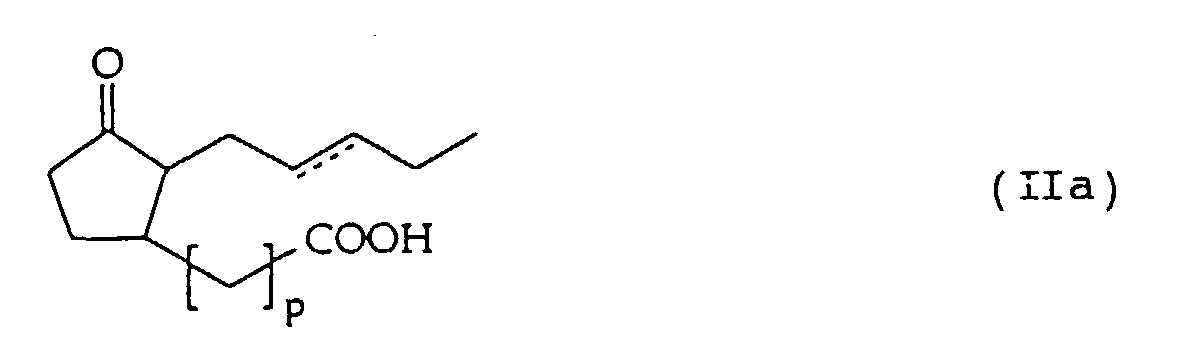
- a substrate of formula is used in which the dotted lines indicate the location of a single or double bond and p ⁇ n + 2 and is odd.
- compounds of formula n being an odd integer, among which are derivatives of cyclopentanone which are useful compounds for the synthesis of odorous substances.
- 3-oxo-2- (2-pentenyl) -1-cyclopentaneacetic acid, or jasmonic acid is a precursor of methyl jasmonate, a compound well appreciated in perfumery and a natural component of the essential oil of jasmine.
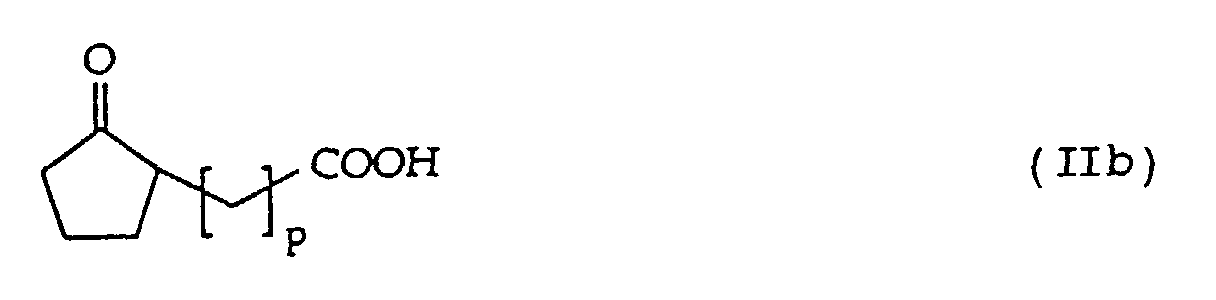
- 3-oxo-2-pentyl-1-cyclopentaneacetic acid is a precursor of Hédione® (3-oxo-2-pentyl-1-cyclopentaneacetate methyl; origin; Firmenich SA, Geneva, Switzerland), a perfume ingredient highly prized for its floral, jasmine scent and its effect exhilarating olfactory.
- these acids and their esters methylated are also useful in the flavor industry, for the preparation of edible products, and there is therefore a real need to have a bioorganic process, allowing them to be obtained by microbiological.
- GB-A-1286266 and DD-A-216734 disclose the production of jasmonic acid and its analogs biosynthetically.
- the method according to the present invention provides precisely new contribution to the problem posed by the bioorganic synthesis of these compounds. Thanks to this process, the compounds of formulas (I) and (Ia) can be prepared with excellent yields, using a wide variety of microorganisms, the ability of which has not been known to date metabolize the substrates of formula (II), and more particularly the substrates of formula (IIa) which make it possible to obtain jasmonic acids and dihydrojasmonique. There was therefore nothing to suggest that a process such as claimed now would open a new and general path for the preparation of cydopentenone and cydopentanone derivatives, which is particularly useful for the synthesis of ingredients of great interest in perfumery and the food industry.
- a compound of formula is used as substrate in which pa the direction indicated in formula (II), to obtain 2-oxo-1-cyclopentaneacetic acid and its higher counterparts.
- the product of oxidation may consist of one or more of these metabolites of the sequence reaction, depending on the reaction time and the kinetic characteristics of successive ⁇ oxidations. If necessary, once the reaction mixture extracted from the medium, the various components of this mixture can be separated by the usual methods, such as chromatography or distillation. Alternatively, and depending on the nature of the product that one wishes to obtain, one let the microorganism act until all metabolites intermediaries have been transformed at the same time and we essentially collect the last product of the reaction sequence.
- microorganisms which can be used according to the invention for carrying out the ⁇ oxidation of substrates (II)
- those of the genus Saccharomyces or Rhodococcus have proved to be of particularly advantageous use, in particular for the preparation of jasmonic and dihydrojasmonic acids.
- microorganisms are available from repositories of international renown. In the particular case of Saccharomyces , they can be bought from specialized companies, which often provide local culture species, especially from the beer, wine or baking industries. All these species are perfectly suitable for the process according to the invention.
- the culture of these microorganisms is obtained according to conventional methods. Their prior growth is carried out in common type nutrient media and under the usual conditions, either in the stationary phase or with stirring.
- the cells are then isolated from the growth medium, by example by centrifugation, and suspended in an aqueous medium containing the aforementioned substrates, generally devoid of any other source nutritious, at temperatures preferably between 20 and 35 ° C, for varying but relatively short periods of time, understood typically between 24 and 72 hours, under aerobic conditions. PH during the reaction will preferably be kept between 5 and 10.
- a first stage of preparation through a period of aeration of the culture, which consists in suspending it in l water, under aerobic conditions and with stirring, at a temperature between 15 and 30 ° C, for a sufficient time to guarantee that any nutritive source, of endogenous or exogenous origin, has been completely consumed before the addition of the substrates of formula (II).
- a preparation step is particularly suitable when the culture of the microorganism, as a result of the conditions in which its growth has taken place, has a residual nutritive source, in particular of carbohydrates, as is typically the case for Saccharomyces for example.
- the substrate is then added to the culture of the microorganism thus prepared, the addition preferably taking place in the absence of any other source nutritious, under the conditions mentioned above.
- the cells are then separated from the reaction medium by centrifugation or ultrafiltration and the aqueous solution thus obtained acidified and repeatedly extracted using an appropriate solvent, for example diethyl ether.
- the combined organic phases are then treated with routinely and, if desired, their components (I) separated by chromatography.
- esters can then be easily esterified chemically or enzymatically to form the corresponding esters.
- the substrates of formula (II) can be used under form of racemic mixtures of stereoisomers of cis and trans configuration, in the form of racemates of cis or trans configuration, or also in the form one of the four pure diastereomers. It has been observed that some microorganisms, when in contact with racemic substrates, containing mixtures of cis and trans isomers, favored the formation of some chiral end products. The details of these transformations are shown in the examples below.
- the reaction could be followed by taking aliquots (1 ml) of the mixture to regular intervals. These samples were centrifuged in tubes Eppendorf-type plastics for 2 minutes to precipitate cells. An aliquot (0.45 ml) of the clear supernatant solution was then acidified with 5M HCl (0.05-0.1 ml) and extracted with diethyl ether (2 times, identical volumes). The organic extracts were combined, dried under nitrogen and treated with diazomethane to form the methyl esters of acids contained in the reaction product. This mixture of esters then was analyzed by gas chromatography.
- reaction mixture was centrifuged (20 min, at 10,000 rpm) to precipitate the cells and the settled supernatant.
- To to wash the cells we suspended them again in 50 ml of water and we stirred for 30 min.
- the resulting solution was extracted with ether diethyl (3 times, identical volumes) to separate the neutral fraction.
- Example 1 The procedure was general I described in Example 1, using a variety of different organisms, listed in the table below. In this table, the compounds are indicated by the number which was assigned to them in Example 1. These results relate to the product obtained after 24 h of reaction, that is to say of activity of the corresponding microorganism.
- the yield of compound 1 represents the molar% relative to compound 4, based on the amount of the corresponding starting acid (100 mg).
- Compound (% CG) Microorganism Weight extract acids (mg) 1 2 3 4 Give back.
- the microorganism to be used in the reaction has been previously cultivated for three days in a medium containing starch. At the end of the three days, all the starch had been consumed.
- the cells were harvested by centrifugation and a portion of the biomass resulting (2 g), as well as 8 ml of demineralized water, were placed in a Erlenmeyer flask (50 ml) containing the substrate to be used, in the case present (Z) -3-oxo-2- (2-pentenyl) -1-cyclopentaneoctanoic acid (20 mg, 2 g / l; see preparation below).
- the balloon was sealed with a cap cotton wool and placed in an orbital shaker for 24 h, at 30 ° and 140 rpm.
- the cells were then precipitated by centrifugation (10,000 rpm) for 15 min at rt. After removing the supernatant liquid with a pipette, the cells were suspended again in demineralized water (10 ml) and then centrifuged. The resulting supernatant was combined with that obtained first and the combined volume adjusted to 25 ml with deionized water. This solution was then brought to pH 2 with H 2 SO 4 (10%) and extracted with diethyl ether (1x50 ml and 1x25 ml). The combined organic phases were dried over anhydrous MgSO 4 . The solvent was removed under a stream of nitrogen and the product weighed.
- the reaction product was also analyzed on a Megadex® dimethylpentyl- ⁇ -cydodextrin type chiral column (10 mx 2.5 mm x 0.25 ⁇ m film thickness) using a temperature program of 50 ° (1 ' ) - 130 ° (15 '), heating 15 ° / min, and up to 220 ° (5'), heating 2 ° / min.
- the retention times of each of the chiral species corresponding to each of the compounds A, B, C and D above are indicated in the following table.
- Example 3 We proceeded according to general method II described in Example 3, in using the microorganisms listed in the table below.
- the compounds A, B, C and D are those cited in Example 3.
- the results indicated relate to the product obtained after 24 h of reaction.
- Molar yields are indicated in% relative to the starting acid added, i.e. (Z) -3-oxo-2- (2-pentenyl) -1-cyclopentaneoctanoic acid (trans / cis 13: 1.20 mg, ⁇ 65 ⁇ mole).
- the acid fraction (38.6 mg) of the reaction product was esterified to provide a mixture of esters containing 25% by weight of the methyl ester of the starting acid, as well as the following two compounds:
Landscapes
- Organic Chemistry (AREA)
- Chemical & Material Sciences (AREA)
- Engineering & Computer Science (AREA)
- Zoology (AREA)
- Life Sciences & Earth Sciences (AREA)
- Wood Science & Technology (AREA)
- Chemical Kinetics & Catalysis (AREA)
- Microbiology (AREA)
- General Chemical & Material Sciences (AREA)
- Biotechnology (AREA)
- Health & Medical Sciences (AREA)
- Biochemistry (AREA)
- Bioinformatics & Cheminformatics (AREA)
- General Engineering & Computer Science (AREA)
- General Health & Medical Sciences (AREA)
- Genetics & Genomics (AREA)
- Organic Low-Molecular-Weight Compounds And Preparation Thereof (AREA)
Claims (9)
- Verfahren zur Herstellung von cyclischen Ketonen mit der Formeldie eine Doppelbindung in der durch die gestrichelte Linie angedeuteten Position aufweisen kann, und in der m für eine ganze Zahl von 0 bis 3 und n für eine ganze Zahl von 0 bis 10 steht, wobei das Symbol bzw. die Symbole R für Wasserstoff oder Alkylreste steht/stehen, die gleich oder voneinander verschieden, gesättigt oder ungesättigt, geradlinig oder verzweigt sind, 1 bis 6 Kohlenstoffatome aufweisen, und jede der Substituentengruppen sich in einer beliebigen freien Position des Rings befinden kann, wobei das Verfahren dadurch gekennzeichnet ist, daß ein Substrat, das ein oder mehrere cyclische Carboxylderivate mit der Formel
 enthält, in der die gestrichelte Linie und die Symbole R und m die für Formel (I) angegebene Bedeutung haben, p ≥ n+2 und als ganze gerade Zahl definiert ist, wenn n geradzahlig ist, und als ungerade, wenn n ungeradzahlig ist, einer Kultur eines Mikroorganismus zugegeben wird, der in der Lage ist, die Oxidation in der β-Position der Fettsäurekette der Derivate zu bewirken, um mindestens eines der gewünschten Ketone zu liefern, das anschließend aus dem Reaktionsmedium extrahiert wird.
- Verfahren nach Anspruch 1, dadurch gekennzeichnet, daß ein Substrat zugegeben wird, das ein oder mehrere Derivate mit der Formelenthält, in der die gestrichelte Linie die Stelle einer Einfach- oder Doppelbindung angibt, und p ≥ n+2 und ungeradzahlig ist.
- Verfahren nach Anspruch 1, dadurch gekennzeichnet, daß ein Substrat zugegeben wird, das ein oder mehrere Derivate mit der Formelenthält, in der p die für Formel (II) angegebene Bedeutung hat.
- Verfahren nach einem der Ansprüche 1 bis 3, dadurch gekennzeichnet, daß der Mikroorganismus von der Gattung Saccharomyces oder Rhodococcus ist.
- Verfahren nach einem der Ansprüche 1 bis 3, dadurch gekennzeichnet, daß der Mikroorganismus aus der Gruppe ausgewählt ist, die besteht aus Rhodococcus rhodochorus, Rhodococcus erytropolis, Rhodococcus sp., Nocardia calcarea, Arthrobacter petroleophagus, Arthrobacter artrocyanus, Arthrobacter ureafaciens, Aspergillus niger, Saccharomyces cerivisae, Mycobacterium phlei, Streptomyces viridosporus, Streptomyces rosechromogenus, Streptomyces bacilliaris, Cylindrocarpon candidum, Escherichia coli, Hansenula polymorpha, Pseudomonas Sp., Serratia marcesens und Aspergillus oryzae.
- Verfahren nach Anspruch 5, dadurch gekennzeichnet, daß (Z)-3-Oxo-2-(2-pentenyl)-1-cyclopentanoctansäure einer Kultur eines Mikroorganismus zugegeben wird, der aus der aus Rhodococcus rhodochorus, Rhodococcus erytropolis, Rhodococcus sp., Nocardia calcarea und Arthrobacter petroleophagus bestehenden Gruppe ausgewählt ist, um im wesentlichen (Z)-3-Oxo-2-(2-pentenyl)-1-cyclopentanessigsäure zu erhalten.
- Verfahren nach Anspruch 5, dadurch gekennzeichnet, daß 3-Oxo-2-pentyl-1-cyclopentanoctansäure einer Kultur eines Mikroorganismus zugegeben wird, der aus der aus Serratia marcesens und Aspergillus niger bestehenden Gruppe ausgewählt ist, um im wesentlichen 3-Oxo-2-pentyl-1-cyclopentanessigsäure zu erhalten.
- Verfahren nach einem der vorhergehenden Ansprüche, dadurch gekennzeichnet, daß es die anschließende Veresterung des erhaltenen Produktes zur Bildung des entsprechenden Esters aufweist.
- Verfahren nach einem der Ansprüche 1 bis 7, dadurch gekennzeichnet, daß die Zugabe des Substrats zur Kultur des Mikroorganismus in einem Medium stattfindet, das frei von jeglicher weiteren Nahrungsquelle ist.
Applications Claiming Priority (2)
| Application Number | Priority Date | Filing Date | Title |
|---|---|---|---|
| BR9408528A BR9408528A (pt) | 1994-12-12 | 1994-12-12 | Processo para a preparação de cetonas cíclicas |
| PCT/IB1994/000409 WO1996018742A1 (fr) | 1994-12-12 | 1994-12-12 | Procede pour la preparation de cetones cycliques |
Publications (2)
| Publication Number | Publication Date |
|---|---|
| EP0743985A1 EP0743985A1 (de) | 1996-11-27 |
| EP0743985B1 true EP0743985B1 (de) | 2000-10-11 |
Family
ID=25664654
Family Applications (1)
| Application Number | Title | Priority Date | Filing Date |
|---|---|---|---|
| EP95901568A Expired - Lifetime EP0743985B1 (de) | 1994-12-12 | 1994-12-12 | Verfahren zur Herstellung von cyclischen Ketonen |
Country Status (4)
| Country | Link |
|---|---|
| US (1) | US5667995A (de) |
| EP (1) | EP0743985B1 (de) |
| BR (1) | BR9408528A (de) |
| WO (1) | WO1996018742A1 (de) |
Families Citing this family (3)
| Publication number | Priority date | Publication date | Assignee | Title |
|---|---|---|---|---|
| US6926919B1 (en) * | 2003-02-26 | 2005-08-09 | Advanced Cardiovascular Systems, Inc. | Method for fabricating a coating for a medical device |
| DE102004044250A1 (de) * | 2004-09-14 | 2006-03-16 | Symrise Gmbh & Co. Kg | 2-Alkyliden- und 2-(Alkyl-1-en)-cyclopentanone als Riechstoffe |
| US8551535B1 (en) | 2012-08-06 | 2013-10-08 | Sarah McCann | Homeopathic remedies and methods for enhancing weight loss |
Family Cites Families (7)
| Publication number | Priority date | Publication date | Assignee | Title |
|---|---|---|---|---|
| DE216734C (de) * | ||||
| DE1252686B (de) * | 1964-12-17 | 1967-10-26 | Shell Internationale Research Maatschappij N.V., Den Haag | Verfahren zur mikrobiologischen Oxydation organischer Verbindungen |
| GB1286266A (en) * | 1968-10-22 | 1972-08-23 | Ici Ltd | Preparation of jasmonic acid |
| EP0110142B1 (de) * | 1982-12-06 | 1986-12-30 | Firmenich Sa | Verfahren zur Herstellung von alkylierten Cyclopentenonen und Acetyleen-Ester und deren Verwendung als Ausgangsstoffe in dem genannten Verfahren |
| DD216734A1 (de) * | 1983-05-31 | 1984-12-19 | Adw Ddr | Verfahren zur herstellung von jasmonsaeureanaloga |
| US4960597A (en) * | 1988-08-05 | 1990-10-02 | International Flavors & Fragrances Inc. | Flavoring with mixtures of lactones |
| IT1232906B (it) * | 1989-08-04 | 1992-03-05 | San Giorgio Flavors S P A | Procedimento per la produzione microbiologica di gamma e delta latto ni |
-
1994
- 1994-12-12 EP EP95901568A patent/EP0743985B1/de not_active Expired - Lifetime
- 1994-12-12 WO PCT/IB1994/000409 patent/WO1996018742A1/fr not_active Ceased
- 1994-12-12 BR BR9408528A patent/BR9408528A/pt not_active Application Discontinuation
- 1994-12-12 US US08/682,762 patent/US5667995A/en not_active Expired - Lifetime
Also Published As
| Publication number | Publication date |
|---|---|
| EP0743985A1 (de) | 1996-11-27 |
| WO1996018742A1 (fr) | 1996-06-20 |
| US5667995A (en) | 1997-09-16 |
| BR9408528A (pt) | 1997-08-05 |
Similar Documents
| Publication | Publication Date | Title |
|---|---|---|
| EP0810986B1 (de) | Verfahren zur herstellung von nootkaton | |
| EP0715615B1 (de) | Verfahren zur herstellung von (+)-(1r)-cis-3-oxo-2-pentyl-1-cyclopentanessigsäure | |
| FR2537130A1 (fr) | Derives d'acides b-hydroxybutyriques, leur procede de preparation et leur application a la preparation de l-carnitine | |
| BE898396A (fr) | Procédé de préparation de L-carnitine et produits intermédiaires utilisés à cet effet. | |
| Warmerdam et al. | Synthesis of (R)‐and (S)‐2‐hydroxy‐3‐enoic acid esters | |
| EP0743985B1 (de) | Verfahren zur Herstellung von cyclischen Ketonen | |
| EP0121828B1 (de) | Aliphatische Alkohole, ihre Herstellung und ihre Anwendung als Parfumierungsbestandteile | |
| EP0378825B1 (de) | Alicyclische Ester und ihre Anwendung als Riechstoffkomponenten | |
| EP0412880B1 (de) | Verfahren zur mikrobiologischen Herstellung von Gamma- und Delta-Laktonen | |
| FR2877339A1 (fr) | Gamma-undecenolactone, procede de preparation et utilisations | |
| EP0563346B1 (de) | Verfahren zur Herstellung von Karbonsäuren mit Hilfe von Mikroorganismen | |
| FR2776302A1 (fr) | Nouveau procede de preparation de la fexofenadine | |
| FR2582648A1 (fr) | Intermediaires carbacycline optiquement actifs et procedes de leur preparation | |
| EP1806978B1 (de) | Stereoselektive herstellung von gamma-lactonen | |
| JP3917653B2 (ja) | 方法 | |
| JP3999264B2 (ja) | 環式ケトンの製造法 | |
| WO1997046695A1 (fr) | Procede pour la preparation de cetones cycliques | |
| EP3280704B1 (de) | Verfahren zur synthese eines vorläufers eines einzigen milch-lacton-isomers | |
| EP0122202B1 (de) | Tetra-alkyl-2,2,5,5-cyclohexanon-4-ol-1 und ihre sulfonierte Derivate, Verfahren und Zwischenprodukte zur ihrer Herstellung und ihre Verwendung zur Herstellung von cis-Cyclopropanlaktonen | |
| CH677791A5 (en) | Prepn. of omega-hydroxy-(or carboxy)-2-methyl-allyl terpene(s) - by bacteria of fungus fermentation in presence of cpds. contg. terminal isoprenyl gp. | |
| EP0177742A2 (de) | Stickstoff-Verbindungen, ihre Herstellung und Verwendung als Ausgangsprodukte zur Herstellung von Decalinketonen | |
| EP0643958A2 (de) | Verwendung in Parfumerie vom optisch aktiven Isomeren des (E)-3,3-Dimethyl-5-(2,2,3-trimethyl-3-cyclopenten-1-yl)-4-penten-2-ol | |
| CA1228869A (fr) | Tetra-alkyl-2,2,5,5 cyclohexanone-1,4 et leur procede de preparation | |
| EP0694615A2 (de) | Verfahren zur Herstellung von Gamma-Nonalaktonen in natürlicher Form | |
| FR2700537A1 (fr) | 1-Hydroxy-2-alcoxycarbonyl-tétralines optiquement pures, procédé pour leur préparation et leur utilisation comme intermédiaires clés de synthèse. |
Legal Events
| Date | Code | Title | Description |
|---|---|---|---|
| PUAI | Public reference made under article 153(3) epc to a published international application that has entered the european phase |
Free format text: ORIGINAL CODE: 0009012 |
|
| AK | Designated contracting states |
Kind code of ref document: A1 Designated state(s): CH DE DK FR GB LI NL |
|
| RIN1 | Information on inventor provided before grant (corrected) |
Inventor name: WHITEHEAD, IAN, MICHAEL |
|
| 17P | Request for examination filed |
Effective date: 19961220 |
|
| GRAG | Despatch of communication of intention to grant |
Free format text: ORIGINAL CODE: EPIDOS AGRA |
|
| 17Q | First examination report despatched |
Effective date: 19991217 |
|
| GRAG | Despatch of communication of intention to grant |
Free format text: ORIGINAL CODE: EPIDOS AGRA |
|
| GRAH | Despatch of communication of intention to grant a patent |
Free format text: ORIGINAL CODE: EPIDOS IGRA |
|
| GRAH | Despatch of communication of intention to grant a patent |
Free format text: ORIGINAL CODE: EPIDOS IGRA |
|
| GRAA | (expected) grant |
Free format text: ORIGINAL CODE: 0009210 |
|
| AK | Designated contracting states |
Kind code of ref document: B1 Designated state(s): CH DE DK FR GB LI NL |
|
| REG | Reference to a national code |
Ref country code: CH Ref legal event code: EP |
|
| REF | Corresponds to: |
Ref document number: 69426126 Country of ref document: DE Date of ref document: 20001116 |
|
| PG25 | Lapsed in a contracting state [announced via postgrant information from national office to epo] |
Ref country code: DK Free format text: LAPSE BECAUSE OF FAILURE TO SUBMIT A TRANSLATION OF THE DESCRIPTION OR TO PAY THE FEE WITHIN THE PRESCRIBED TIME-LIMIT Effective date: 20010111 |
|
| GBT | Gb: translation of ep patent filed (gb section 77(6)(a)/1977) |
Effective date: 20010102 |
|
| PLBE | No opposition filed within time limit |
Free format text: ORIGINAL CODE: 0009261 |
|
| STAA | Information on the status of an ep patent application or granted ep patent |
Free format text: STATUS: NO OPPOSITION FILED WITHIN TIME LIMIT |
|
| 26N | No opposition filed | ||
| REG | Reference to a national code |
Ref country code: GB Ref legal event code: IF02 |
|
| PGFP | Annual fee paid to national office [announced via postgrant information from national office to epo] |
Ref country code: NL Payment date: 20071127 Year of fee payment: 14 |
|
| PGFP | Annual fee paid to national office [announced via postgrant information from national office to epo] |
Ref country code: CH Payment date: 20081203 Year of fee payment: 15 |
|
| PGFP | Annual fee paid to national office [announced via postgrant information from national office to epo] |
Ref country code: FR Payment date: 20081110 Year of fee payment: 15 |
|
| PGFP | Annual fee paid to national office [announced via postgrant information from national office to epo] |
Ref country code: DE Payment date: 20081128 Year of fee payment: 15 |
|
| PGFP | Annual fee paid to national office [announced via postgrant information from national office to epo] |
Ref country code: GB Payment date: 20081120 Year of fee payment: 15 |
|
| NLV4 | Nl: lapsed or anulled due to non-payment of the annual fee |
Effective date: 20090701 |
|
| PG25 | Lapsed in a contracting state [announced via postgrant information from national office to epo] |
Ref country code: NL Free format text: LAPSE BECAUSE OF NON-PAYMENT OF DUE FEES Effective date: 20090701 |
|
| REG | Reference to a national code |
Ref country code: CH Ref legal event code: PL |
|
| GBPC | Gb: european patent ceased through non-payment of renewal fee |
Effective date: 20091212 |
|
| REG | Reference to a national code |
Ref country code: FR Ref legal event code: ST Effective date: 20100831 |
|
| PG25 | Lapsed in a contracting state [announced via postgrant information from national office to epo] |
Ref country code: LI Free format text: LAPSE BECAUSE OF NON-PAYMENT OF DUE FEES Effective date: 20091231 Ref country code: FR Free format text: LAPSE BECAUSE OF NON-PAYMENT OF DUE FEES Effective date: 20091231 Ref country code: CH Free format text: LAPSE BECAUSE OF NON-PAYMENT OF DUE FEES Effective date: 20091231 |
|
| PG25 | Lapsed in a contracting state [announced via postgrant information from national office to epo] |
Ref country code: DE Free format text: LAPSE BECAUSE OF NON-PAYMENT OF DUE FEES Effective date: 20100701 |
|
| PG25 | Lapsed in a contracting state [announced via postgrant information from national office to epo] |
Ref country code: GB Free format text: LAPSE BECAUSE OF NON-PAYMENT OF DUE FEES Effective date: 20091212 |