EP0744263A2 - Moulage par transfert de résine (R.T.M.) - Google Patents
Moulage par transfert de résine (R.T.M.) Download PDFInfo
- Publication number
- EP0744263A2 EP0744263A2 EP96303734A EP96303734A EP0744263A2 EP 0744263 A2 EP0744263 A2 EP 0744263A2 EP 96303734 A EP96303734 A EP 96303734A EP 96303734 A EP96303734 A EP 96303734A EP 0744263 A2 EP0744263 A2 EP 0744263A2
- Authority
- EP
- European Patent Office
- Prior art keywords
- mould
- temperature
- peak
- cycle
- resin
- Prior art date
- Legal status (The legal status is an assumption and is not a legal conclusion. Google has not performed a legal analysis and makes no representation as to the accuracy of the status listed.)
- Granted
Links
- 238000009745 resin transfer moulding Methods 0.000 title claims abstract description 9
- 238000006243 chemical reaction Methods 0.000 claims abstract description 13
- 229920005989 resin Polymers 0.000 claims description 26
- 239000011347 resin Substances 0.000 claims description 26
- 238000000034 method Methods 0.000 claims description 12
- 238000012544 monitoring process Methods 0.000 claims description 4
- 238000000465 moulding Methods 0.000 description 7
- 239000003054 catalyst Substances 0.000 description 3
- 238000002347 injection Methods 0.000 description 3
- 239000007924 injection Substances 0.000 description 3
- 239000007788 liquid Substances 0.000 description 3
- 230000002787 reinforcement Effects 0.000 description 3
- NOBYOEQUFMGXBP-UHFFFAOYSA-N (4-tert-butylcyclohexyl) (4-tert-butylcyclohexyl)oxycarbonyloxy carbonate Chemical compound C1CC(C(C)(C)C)CCC1OC(=O)OOC(=O)OC1CCC(C(C)(C)C)CC1 NOBYOEQUFMGXBP-UHFFFAOYSA-N 0.000 description 1
- 238000009530 blood pressure measurement Methods 0.000 description 1
- 238000012937 correction Methods 0.000 description 1
- 230000000254 damaging effect Effects 0.000 description 1
- 230000001419 dependent effect Effects 0.000 description 1
- 238000001514 detection method Methods 0.000 description 1
- 238000010586 diagram Methods 0.000 description 1
- 239000003365 glass fiber Substances 0.000 description 1
- 238000010438 heat treatment Methods 0.000 description 1
- 230000000977 initiatory effect Effects 0.000 description 1
- 238000005259 measurement Methods 0.000 description 1
- 239000000203 mixture Substances 0.000 description 1
- 229920001225 polyester resin Polymers 0.000 description 1
- 239000004645 polyester resin Substances 0.000 description 1
- 238000000275 quality assurance Methods 0.000 description 1
- 238000009736 wetting Methods 0.000 description 1
Images


Classifications
-
- B—PERFORMING OPERATIONS; TRANSPORTING
- B29—WORKING OF PLASTICS; WORKING OF SUBSTANCES IN A PLASTIC STATE IN GENERAL
- B29C—SHAPING OR JOINING OF PLASTICS; SHAPING OF MATERIAL IN A PLASTIC STATE, NOT OTHERWISE PROVIDED FOR; AFTER-TREATMENT OF THE SHAPED PRODUCTS, e.g. REPAIRING
- B29C70/00—Shaping composites, i.e. plastics material comprising reinforcements, fillers or preformed parts, e.g. inserts
- B29C70/04—Shaping composites, i.e. plastics material comprising reinforcements, fillers or preformed parts, e.g. inserts comprising reinforcements only, e.g. self-reinforcing plastics
- B29C70/28—Shaping operations therefor
- B29C70/40—Shaping or impregnating by compression not applied
- B29C70/42—Shaping or impregnating by compression not applied for producing articles of definite length, i.e. discrete articles
- B29C70/46—Shaping or impregnating by compression not applied for producing articles of definite length, i.e. discrete articles using matched moulds, e.g. for deforming sheet moulding compounds [SMC] or prepregs
- B29C70/48—Shaping or impregnating by compression not applied for producing articles of definite length, i.e. discrete articles using matched moulds, e.g. for deforming sheet moulding compounds [SMC] or prepregs and impregnating the reinforcements in the closed mould, e.g. resin transfer moulding [RTM], e.g. by vacuum
-
- B—PERFORMING OPERATIONS; TRANSPORTING
- B29—WORKING OF PLASTICS; WORKING OF SUBSTANCES IN A PLASTIC STATE IN GENERAL
- B29C—SHAPING OR JOINING OF PLASTICS; SHAPING OF MATERIAL IN A PLASTIC STATE, NOT OTHERWISE PROVIDED FOR; AFTER-TREATMENT OF THE SHAPED PRODUCTS, e.g. REPAIRING
- B29C35/00—Heating, cooling or curing, e.g. crosslinking or vulcanising; Apparatus therefor
- B29C35/02—Heating or curing, e.g. crosslinking or vulcanizing during moulding, e.g. in a mould
- B29C35/0288—Controlling heating or curing of polymers during moulding, e.g. by measuring temperatures or properties of the polymer and regulating the process
-
- B—PERFORMING OPERATIONS; TRANSPORTING
- B29—WORKING OF PLASTICS; WORKING OF SUBSTANCES IN A PLASTIC STATE IN GENERAL
- B29C—SHAPING OR JOINING OF PLASTICS; SHAPING OF MATERIAL IN A PLASTIC STATE, NOT OTHERWISE PROVIDED FOR; AFTER-TREATMENT OF THE SHAPED PRODUCTS, e.g. REPAIRING
- B29C70/00—Shaping composites, i.e. plastics material comprising reinforcements, fillers or preformed parts, e.g. inserts
- B29C70/04—Shaping composites, i.e. plastics material comprising reinforcements, fillers or preformed parts, e.g. inserts comprising reinforcements only, e.g. self-reinforcing plastics
- B29C70/28—Shaping operations therefor
- B29C70/54—Component parts, details or accessories; Auxiliary operations, e.g. feeding or storage of prepregs or SMC after impregnation or during ageing
-
- B—PERFORMING OPERATIONS; TRANSPORTING
- B29—WORKING OF PLASTICS; WORKING OF SUBSTANCES IN A PLASTIC STATE IN GENERAL
- B29C—SHAPING OR JOINING OF PLASTICS; SHAPING OF MATERIAL IN A PLASTIC STATE, NOT OTHERWISE PROVIDED FOR; AFTER-TREATMENT OF THE SHAPED PRODUCTS, e.g. REPAIRING
- B29C37/00—Component parts, details, accessories or auxiliary operations, not covered by group B29C33/00 or B29C35/00
- B29C2037/90—Measuring, controlling or regulating
- B29C2037/903—Measuring, controlling or regulating by means of a computer
Definitions
- This invention relates to resin transfer moulding, and in particular to moulding apparatus and to a method of operating the apparatus.
- Resin transfer moulding involves the placing of preformed reinforcement (typically glass fibre mat) in a mould, closing the mould and then introducing liquid, catalysed resin which flows through the mould, wetting out the reinforcement, and then sets. When the resin has set, the mould can be opened, the moulded component can be removed and a new cycle can be started.
- preformed reinforcement typically glass fibre mat
- one typical polyester resin system consists of a base resin sold under the designation CV 6345 by Cray Valley Total Chemie and 2% of the catalyst Perkadox 16 sold by AKZO. At room temperature, this system would cure in about 4 hours, at 60°C it would cure in about 6 minutes. In using this system, it would be the intention to raise the mould temperature to 60°C to cure the resin, ie by about 40°C from a typical ambient temperature of 20°C.
- the same base resin is used with 1% of TBPEH (sold by AKZO) as catalyst. At room temperature this system would remain liquid for about 10 hours before curing, whereas at 70°C it would cure in about 16 minutes.
- the ambient temperature may vary between about 0°C and 30°C from day to day, and during each day, changes in ambient conditions can significantly affect the curing time of the resin and it is therefore necessary to ensure that corrections are made to the moulding conditions to compensate for changes in ambient conditions which would otherwise make the process inconsistent from one cycle to the next.
- apparatus for resin transfer moulding wherein a mould is provided with a plurality of sensors capable of detecting the occurrence and the magnitude of the peak of the exothermic reaction within the resin, the sensors are connected to a processor unit and the processor unit is connected to means for opening the mould, the processor being programmed to calculate, for each mould cycle, a delay period which depends on the magnitude of the peak, and to initiate mould opening at the end of the delay period.
- the cure or setting time of the resin in resin transfer moulding is considerably influenced by many factors, for example by mould and resin temperatures (which themselves are strongly influenced by ambient conditions), by cavity volumes and by resin chemistry. It is however a characteristic of the resin setting process that an exothermic reaction takes place, and the occurrence of this reaction can be noted by monitoring either the pressure or the temperature of the resin in the mould. A sharp increase in either pressure or temperature corresponds to the exothermic reaction taking place.
- the sensors may therefore be temperature or pressure sensors. Most commonly however, it will be temperature which is measured and the sensors will be temperature sensors.
- the processor unit will include means for detecting peak temperature readings from the temperature sensors.
- the processor will include a processor stage for calculating a delay period between the occurrence of peak exotherm and the initiation of mould opening. If the peak exotherm is at a high temperature, as will occur at high ambient temperatures and high mould temperatures, the delay period will be relatively short. If it is at a low temperature, as will occur at low ambient temperatures and low mould temperatures, the delay period will be relatively long.
- Temperature sensors for use in this apparatus are preferably thermocouples located in the mould cavity walls. However other temperature measuring sensors, such as thermistors, may alternatively be used.
- Pressure sensors may be any suitable transducer or other type of sensor which is capable of being mounted in close proximity to the cavity. Temperature increases in the resin will result in thermal expansion of the resin and this can be detected by pressure sensors. Pressure sensors can thus provide signals indicating the occurrence of temperature changes in the cavity.
- the invention also provides a method of operating a resin transfer moulding apparatus, the method comprising the steps of sensing parameters within the mould cavity during each mould cycle, monitoring the parameters sensed to determine the moment of occurrence and the magnitude of the peak of an exothermic reaction taking place in the mould, and opening the mould at a time after the peak of the exothermic reaction, which time is calculated for each cycle in dependence on the magnitude of the peak occurring in that cycle.
- the time between exotherm peak and mould opening will vary from cycle to cycle and will for example depend strongly on ambient conditions in the factory where the mould is sited, and on the mould temperature itself. At the beginning of the day, the mould will be relatively cold and the cycle time will be relatively long. During the day, as the ambient temperature and the mould temperature become higher, the cycle time will become shorter. For example, on hot days the product will cure more rapidly and the mould will be capable of being opened after a relatively short time whereas on cold days the product will cure slowly and it may be a relatively long time before sufficient cure has taken place to allow opening of the tool.
- the mould opening time will be correctly determined whatever the ambient and in-mould conditions so that on the one hand the cycle time is kept as short as possible (thus maximising productivity) and on the other hand the product is not left in the mould too long (which has a damaging effect on product quality).
- a personal computer (PC) 10, local to a programmable logic controller (PLC) 12 is connected to a mould 14 with upper and lower mould halves 14a and 14b and a mould cavity 16.
- PC personal computer
- PLC programmable logic controller
- Liquid resin is introduced to the cavity 16 through an inlet 18.
- a number of thermocouples 20 are provided in the cavity walls, at positions which will be determined in accordance with the shape of the cavity and the shape of the reinforcement preform which will be placed in the cavity before moulding.
- a program running on the PC not only provides the PLC with signals to indicate peak exotherm and demould at the appropriate times, but also logs thermal data from the thermocouples 20 to a log file on a remote computer, along with times at which the data was logged and/or when specific events occurred. This file can be interrogated later to provide better understanding of the moulding process and for quality assurance procedures.
- the software waits until the operator presses the 'cycle start' on a control panel 22.
- the system then autocycles continuously, or until an error code is received from the PLC control panel.
- the PC 10 Upon receiving the instruction from the PLC, the PC 10 informs the PLC 12 that it is ready to start logging data. When it is ready, the PLC sets a signal to inform the PC to start monitoring data. The PC writes the thermal data to the log file, whilst also graphically displaying selected thermocouple data on the display 24. Resin is injected into the cavity through the inlet 18 under the instruction of the PLC.
- the PLC sends a signal to the PC indicating that the injection phase is complete.
- the PC commences its routines for detection of the exotherm.
- FIG 2 shows temperature profiles taken from two different thermocouples during the course of one moulding cycle. Initially, during resin injection, there is a fall in temperature as the incoming resin cools the heated mould. Once resin injection ends (point 30 in Figure 2), the heating system in the mould begins to raise the resin temperature, and at a certain point, the catalyst/resin mixture begins to cure rapidly in an exothermic reaction. The heat evolved is readily detected by the thermocouples, and corresponding signals are sent to the PC. The PC detects the exotherm peak temperature at all the thermocouples before sending a 'peak exotherm' signal to the PLC.
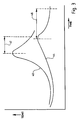
- FIG. 3 shows temperature profiles taken from the same thermocouple in two different moulding cycles which took place under significantly different ambient conditions.
- the cycle represented by the profile 40 had an early, high temperature exotherm peak, and a relatively short hardening off time 42.
- the cycle represented by the profile 44 had a later, low temperature exotherm peak, and a relatively long hardening off time 46.
- the PC When the peak exotherm has been detected and the resin temperature starts to fall, the PC indicates this to the PLC and the PLC sounds an alarm to indicate to the operators that the tool will be opened shortly.
- the software continues to monitor the cavity temperature, whilst maintaining the tool closed for a determined time period. This period provides time to enable the component to 'harden off' prior to being handled during its demoulding.
- This hardening off time is a variable which will be separately determined for each cycle. The relationship between magnitude of the exotherm peak and hardening off time (the time between exotherm peak and demoulding) can be determined empirically.
- the PC After this hardening off time, the PC indicates to the PLC that the tool is ready to be opened. The PC then stops temperature recording and instructs the mould opening gear to open the mould. Although temperature logging ceases, the PC continues to monitor signals from the PLC.
- the mould itself is provided with lifting means, indicated schematically in Figure 1 by ropes and eyes, and this lifting means can be caused to operate automatically on receipt of an appropriate signal from the PC 10.
- the PLC indicates completion to the PC.
- the PC increments the moulding record number, and the next cycle begins.
- the system described is able to produce significantly shorter cycle times because of the accuracy with which the occurrence of exotherm is known compared to the previously known technique of estimating the progress of resin setting from the occurrence of gelling at the mould vent locations. Furthermore, because demoulding will always occur at the same time after exotherm, problems with demoulding the components are avoided. If the component is allowed to cool too far in the mould, the component can shrink and bind onto the male half of the mould, making demoulding difficult.
Landscapes
- Chemical & Material Sciences (AREA)
- Engineering & Computer Science (AREA)
- Composite Materials (AREA)
- Mechanical Engineering (AREA)
- Physics & Mathematics (AREA)
- Health & Medical Sciences (AREA)
- Oral & Maxillofacial Surgery (AREA)
- Thermal Sciences (AREA)
- Injection Moulding Of Plastics Or The Like (AREA)
- Moulds For Moulding Plastics Or The Like (AREA)
- Casting Or Compression Moulding Of Plastics Or The Like (AREA)
Applications Claiming Priority (2)
| Application Number | Priority Date | Filing Date | Title |
|---|---|---|---|
| GB9510496 | 1995-05-24 | ||
| GBGB9510496.4A GB9510496D0 (en) | 1995-05-24 | 1995-05-24 | Resin transfer moulding |
Publications (3)
| Publication Number | Publication Date |
|---|---|
| EP0744263A2 true EP0744263A2 (fr) | 1996-11-27 |
| EP0744263A3 EP0744263A3 (fr) | 1997-02-26 |
| EP0744263B1 EP0744263B1 (fr) | 2000-07-12 |
Family
ID=10774955
Family Applications (1)
| Application Number | Title | Priority Date | Filing Date |
|---|---|---|---|
| EP96303734A Expired - Lifetime EP0744263B1 (fr) | 1995-05-24 | 1996-05-24 | Moulage par transfert de résine (R.T.M.) |
Country Status (4)
| Country | Link |
|---|---|
| EP (1) | EP0744263B1 (fr) |
| DE (1) | DE69609247T2 (fr) |
| ES (1) | ES2147900T3 (fr) |
| GB (1) | GB9510496D0 (fr) |
Cited By (10)
| Publication number | Priority date | Publication date | Assignee | Title |
|---|---|---|---|---|
| WO2000053400A1 (fr) * | 1999-03-12 | 2000-09-14 | Vec Technology, Inc. | Procede et appareil destines au moulage d'objets en composites |
| US6257867B1 (en) | 1996-09-18 | 2001-07-10 | Vec Technology, Inc. | Apparatus for molding composite articles |
| US6623672B2 (en) | 2000-10-03 | 2003-09-23 | Vec Technology Inc. | Method and apparatus for molding composite articles |
| GB2403927A (en) * | 2001-05-31 | 2005-01-19 | Jhm Technologies Inc | Controlling flow of resin into a mould cavity using sensors |
| US7367795B2 (en) | 2002-11-08 | 2008-05-06 | Advanced Plastics Technologies Luxembourg S.A. | Injection mold having a wear resistant portion and a high heat transfer portion |
| DE102007002309A1 (de) * | 2007-01-16 | 2008-07-17 | Bayerische Motoren Werke Aktiengesellschaft | Vorrichtung und Verfahren zur Herstellung eines Kunststoffbauteils |
| US7553435B2 (en) | 2004-01-23 | 2009-06-30 | Vec Industries, L.L.C. | Method and apparatus for molding composite articles |
| US7785518B2 (en) | 2007-01-19 | 2010-08-31 | Vec Industries, L.L.C. | Method and apparatus for molding composite articles |
| DE102018205998A1 (de) | 2018-04-19 | 2019-10-24 | Ford Global Technologies, Llc | Werkzeug zur Ausführung eines Spritzgieß-, Warmumformungs- oder Druckgussverfahrens und Verfahren zur Herstellung eines derartigen Werkzeugs |
| CN113059825A (zh) * | 2021-04-01 | 2021-07-02 | 南京航空航天大学 | 一种非同步压实复合材料构件的方法 |
Families Citing this family (5)
| Publication number | Priority date | Publication date | Assignee | Title |
|---|---|---|---|---|
| US6352426B1 (en) | 1998-03-19 | 2002-03-05 | Advanced Plastics Technologies, Ltd. | Mold for injection molding multilayer preforms |
| AU2001288916B2 (en) | 2000-09-05 | 2007-05-10 | Advanced Plastics Technologies Luxembourg S.A. | Multilayer containers and preforms having barrier properties utilizing recycled material |
| ES2321421T3 (es) | 2004-04-16 | 2009-06-05 | Advanced Plastics Technologies Luxembourg S.A. | Reforma y procedimientos de fabricacion de la preforma y una botella. |
| BRPI0511664A (pt) | 2004-06-10 | 2008-01-02 | Advanced Plastics Technologies | métodos e sistemas para o controle de temperaturas de moldes |
| US7717697B2 (en) | 2005-08-30 | 2010-05-18 | Sharon Hutchinson | Methods and systems for controlling mold temperatures |
Family Cites Families (4)
| Publication number | Priority date | Publication date | Assignee | Title |
|---|---|---|---|---|
| US4344142A (en) * | 1974-05-23 | 1982-08-10 | Federal-Mogul Corporation | Direct digital control of rubber molding presses |
| GB8922584D0 (en) * | 1989-10-06 | 1989-11-22 | Ford Motor Co | Resin transfer moulding equipment |
| US5219498A (en) * | 1991-11-12 | 1993-06-15 | Keller L Brian | Process for controlling curing and thermoforming of resins and composites |
| US5345397A (en) * | 1991-11-25 | 1994-09-06 | The Boeing Company | Optimal composite curing system and method |
-
1995
- 1995-05-24 GB GBGB9510496.4A patent/GB9510496D0/en active Pending
-
1996
- 1996-05-24 ES ES96303734T patent/ES2147900T3/es not_active Expired - Lifetime
- 1996-05-24 EP EP96303734A patent/EP0744263B1/fr not_active Expired - Lifetime
- 1996-05-24 DE DE69609247T patent/DE69609247T2/de not_active Expired - Fee Related
Cited By (14)
| Publication number | Priority date | Publication date | Assignee | Title |
|---|---|---|---|---|
| US6257867B1 (en) | 1996-09-18 | 2001-07-10 | Vec Technology, Inc. | Apparatus for molding composite articles |
| US6287493B1 (en) | 1996-09-18 | 2001-09-11 | Vec Technology, Inc. | Process for molding composite articles |
| WO2000053400A1 (fr) * | 1999-03-12 | 2000-09-14 | Vec Technology, Inc. | Procede et appareil destines au moulage d'objets en composites |
| US6623672B2 (en) | 2000-10-03 | 2003-09-23 | Vec Technology Inc. | Method and apparatus for molding composite articles |
| GB2403927A (en) * | 2001-05-31 | 2005-01-19 | Jhm Technologies Inc | Controlling flow of resin into a mould cavity using sensors |
| GB2403927B (en) * | 2001-05-31 | 2005-11-16 | Jhm Technologies Inc | Apparatus for molding articles |
| US7367795B2 (en) | 2002-11-08 | 2008-05-06 | Advanced Plastics Technologies Luxembourg S.A. | Injection mold having a wear resistant portion and a high heat transfer portion |
| US7553435B2 (en) | 2004-01-23 | 2009-06-30 | Vec Industries, L.L.C. | Method and apparatus for molding composite articles |
| DE102007002309A1 (de) * | 2007-01-16 | 2008-07-17 | Bayerische Motoren Werke Aktiengesellschaft | Vorrichtung und Verfahren zur Herstellung eines Kunststoffbauteils |
| DE102007002309B4 (de) * | 2007-01-16 | 2012-06-21 | Bayerische Motoren Werke Aktiengesellschaft | Vorrichtung und Verfahren zur Herstellung eines Kunststoffbauteils |
| US7785518B2 (en) | 2007-01-19 | 2010-08-31 | Vec Industries, L.L.C. | Method and apparatus for molding composite articles |
| US8845947B2 (en) | 2007-01-19 | 2014-09-30 | Vec Industries, L.L.C. | Method and apparatus for molding composite articles |
| DE102018205998A1 (de) | 2018-04-19 | 2019-10-24 | Ford Global Technologies, Llc | Werkzeug zur Ausführung eines Spritzgieß-, Warmumformungs- oder Druckgussverfahrens und Verfahren zur Herstellung eines derartigen Werkzeugs |
| CN113059825A (zh) * | 2021-04-01 | 2021-07-02 | 南京航空航天大学 | 一种非同步压实复合材料构件的方法 |
Also Published As
| Publication number | Publication date |
|---|---|
| EP0744263B1 (fr) | 2000-07-12 |
| EP0744263A3 (fr) | 1997-02-26 |
| ES2147900T3 (es) | 2000-10-01 |
| DE69609247D1 (de) | 2000-08-17 |
| GB9510496D0 (en) | 1995-07-19 |
| DE69609247T2 (de) | 2000-11-23 |
Similar Documents
| Publication | Publication Date | Title |
|---|---|---|
| EP0744263B1 (fr) | Moulage par transfert de résine (R.T.M.) | |
| US4566806A (en) | Method and device for controlling the curing rate of concrete | |
| US5518388A (en) | Automated apparatus and method for resin transfer molding | |
| Agrawal et al. | Injection‐molding process control—A review | |
| JP3431138B2 (ja) | 射出成形機の制御方法と装置 | |
| US5345397A (en) | Optimal composite curing system and method | |
| US3819915A (en) | Method and apparatus for controlling the cure of a rubber article | |
| JPH0753405B2 (ja) | 射出成形機における樹脂流動物性変動制御方法および装置 | |
| CN100503207C (zh) | 用于注模机的监控装置 | |
| US4542466A (en) | Method for controlling the state of vulcanization of wheel tires and apparatus therefor | |
| CN101590678A (zh) | 智能模制环境和控制施加合模力的方法 | |
| JPH0223822B2 (fr) | ||
| US4819177A (en) | Method for curing rubber articles | |
| CN119017669B (zh) | 注塑工艺控制方法、系统及存储介质 | |
| US4810438A (en) | Method of controlling a resin curing process | |
| JPS6068912A (ja) | 空気タイヤを加硫する方法及び装置 | |
| JP2530684B2 (ja) | 多ゾ―ン温度制御系のシュミレ―ションシステム | |
| JP2567968B2 (ja) | 成形機の製品自動検査方法 | |
| JP4127339B2 (ja) | 射出成形方法、及び、射出成形装置 | |
| JP4166746B2 (ja) | 射出成形機の樹脂特性測定方法及び射出制御方法 | |
| WO1989007043A1 (fr) | Procede et dispositif de moulage par injection-compression | |
| SU1766693A1 (ru) | Способ вакуум-автоклавного формовани изделий из композиционных материалов | |
| JPH079457A (ja) | 加硫制御方法及び加硫システム | |
| JPS6038117A (ja) | 熱硬化性樹脂材料の成形進行状態の検知方法及びこの検知方法を用いた成形制御方法並びに成形装置 | |
| JPH06297460A (ja) | タイヤ加硫制御方法 |
Legal Events
| Date | Code | Title | Description |
|---|---|---|---|
| PUAI | Public reference made under article 153(3) epc to a published international application that has entered the european phase |
Free format text: ORIGINAL CODE: 0009012 |
|
| AK | Designated contracting states |
Kind code of ref document: A2 Designated state(s): DE ES FR GB |
|
| PUAL | Search report despatched |
Free format text: ORIGINAL CODE: 0009013 |
|
| AK | Designated contracting states |
Kind code of ref document: A3 Designated state(s): DE ES FR GB |
|
| 17P | Request for examination filed |
Effective date: 19970707 |
|
| 17Q | First examination report despatched |
Effective date: 19980526 |
|
| GRAG | Despatch of communication of intention to grant |
Free format text: ORIGINAL CODE: EPIDOS AGRA |
|
| GRAG | Despatch of communication of intention to grant |
Free format text: ORIGINAL CODE: EPIDOS AGRA |
|
| GRAH | Despatch of communication of intention to grant a patent |
Free format text: ORIGINAL CODE: EPIDOS IGRA |
|
| GRAH | Despatch of communication of intention to grant a patent |
Free format text: ORIGINAL CODE: EPIDOS IGRA |
|
| GRAA | (expected) grant |
Free format text: ORIGINAL CODE: 0009210 |
|
| AK | Designated contracting states |
Kind code of ref document: B1 Designated state(s): DE ES FR GB |
|
| REF | Corresponds to: |
Ref document number: 69609247 Country of ref document: DE Date of ref document: 20000817 |
|
| REG | Reference to a national code |
Ref country code: ES Ref legal event code: FG2A Ref document number: 2147900 Country of ref document: ES Kind code of ref document: T3 |
|
| ET | Fr: translation filed | ||
| PLBE | No opposition filed within time limit |
Free format text: ORIGINAL CODE: 0009261 |
|
| STAA | Information on the status of an ep patent application or granted ep patent |
Free format text: STATUS: NO OPPOSITION FILED WITHIN TIME LIMIT |
|
| 26N | No opposition filed | ||
| REG | Reference to a national code |
Ref country code: GB Ref legal event code: IF02 |
|
| REG | Reference to a national code |
Ref country code: FR Ref legal event code: TP |
|
| PGFP | Annual fee paid to national office [announced via postgrant information from national office to epo] |
Ref country code: GB Payment date: 20050406 Year of fee payment: 10 |
|
| PGFP | Annual fee paid to national office [announced via postgrant information from national office to epo] |
Ref country code: FR Payment date: 20050517 Year of fee payment: 10 |
|
| PGFP | Annual fee paid to national office [announced via postgrant information from national office to epo] |
Ref country code: ES Payment date: 20050520 Year of fee payment: 10 |
|
| PGFP | Annual fee paid to national office [announced via postgrant information from national office to epo] |
Ref country code: DE Payment date: 20050531 Year of fee payment: 10 |
|
| REG | Reference to a national code |
Ref country code: FR Ref legal event code: CD Ref country code: FR Ref legal event code: CA |
|
| PG25 | Lapsed in a contracting state [announced via postgrant information from national office to epo] |
Ref country code: GB Free format text: LAPSE BECAUSE OF NON-PAYMENT OF DUE FEES Effective date: 20060524 |
|
| PG25 | Lapsed in a contracting state [announced via postgrant information from national office to epo] |
Ref country code: ES Free format text: LAPSE BECAUSE OF NON-PAYMENT OF DUE FEES Effective date: 20060525 |
|
| PG25 | Lapsed in a contracting state [announced via postgrant information from national office to epo] |
Ref country code: DE Free format text: LAPSE BECAUSE OF NON-PAYMENT OF DUE FEES Effective date: 20061201 |
|
| GBPC | Gb: european patent ceased through non-payment of renewal fee |
Effective date: 20060524 |
|
| REG | Reference to a national code |
Ref country code: FR Ref legal event code: ST Effective date: 20070131 |
|
| REG | Reference to a national code |
Ref country code: ES Ref legal event code: FD2A Effective date: 20060525 |
|
| PG25 | Lapsed in a contracting state [announced via postgrant information from national office to epo] |
Ref country code: FR Free format text: LAPSE BECAUSE OF NON-PAYMENT OF DUE FEES Effective date: 20060531 |