EP0744785B1 - Antenne de vitre de véhicule - Google Patents
Antenne de vitre de véhicule Download PDFInfo
- Publication number
- EP0744785B1 EP0744785B1 EP96201191A EP96201191A EP0744785B1 EP 0744785 B1 EP0744785 B1 EP 0744785B1 EP 96201191 A EP96201191 A EP 96201191A EP 96201191 A EP96201191 A EP 96201191A EP 0744785 B1 EP0744785 B1 EP 0744785B1
- Authority
- EP
- European Patent Office
- Prior art keywords
- antenna
- window
- principal element
- vehicle
- impedance matching
- Prior art date
- Legal status (The legal status is an assumption and is not a legal conclusion. Google has not performed a legal analysis and makes no representation as to the accuracy of the status listed.)
- Expired - Lifetime
Links
- 230000005540 biological transmission Effects 0.000 claims description 12
- 230000002093 peripheral effect Effects 0.000 claims description 12
- 239000005357 flat glass Substances 0.000 claims description 8
- 239000000126 substance Substances 0.000 claims description 5
- 239000004020 conductor Substances 0.000 claims description 3
- 239000010410 layer Substances 0.000 description 21
- 230000008878 coupling Effects 0.000 description 10
- 238000010168 coupling process Methods 0.000 description 10
- 238000005859 coupling reaction Methods 0.000 description 10
- 239000011521 glass Substances 0.000 description 8
- 239000000853 adhesive Substances 0.000 description 7
- 230000001070 adhesive effect Effects 0.000 description 7
- 239000002184 metal Substances 0.000 description 5
- 230000008901 benefit Effects 0.000 description 4
- 229910052751 metal Inorganic materials 0.000 description 4
- 229910044991 metal oxide Inorganic materials 0.000 description 4
- BQCADISMDOOEFD-UHFFFAOYSA-N Silver Chemical compound [Ag] BQCADISMDOOEFD-UHFFFAOYSA-N 0.000 description 3
- 230000000994 depressogenic effect Effects 0.000 description 3
- 230000006872 improvement Effects 0.000 description 3
- 150000004706 metal oxides Chemical class 0.000 description 3
- 230000005855 radiation Effects 0.000 description 3
- 229910052709 silver Inorganic materials 0.000 description 3
- 239000004332 silver Substances 0.000 description 3
- RTAQQCXQSZGOHL-UHFFFAOYSA-N Titanium Chemical compound [Ti] RTAQQCXQSZGOHL-UHFFFAOYSA-N 0.000 description 2
- 230000003667 anti-reflective effect Effects 0.000 description 2
- 230000001010 compromised effect Effects 0.000 description 2
- 230000000694 effects Effects 0.000 description 2
- 238000004519 manufacturing process Methods 0.000 description 2
- 239000002245 particle Substances 0.000 description 2
- 239000011241 protective layer Substances 0.000 description 2
- 230000009467 reduction Effects 0.000 description 2
- 239000010936 titanium Substances 0.000 description 2
- 229910052719 titanium Inorganic materials 0.000 description 2
- RYGMFSIKBFXOCR-UHFFFAOYSA-N Copper Chemical compound [Cu] RYGMFSIKBFXOCR-UHFFFAOYSA-N 0.000 description 1
- 229910000831 Steel Inorganic materials 0.000 description 1
- ATJFFYVFTNAWJD-UHFFFAOYSA-N Tin Chemical compound [Sn] ATJFFYVFTNAWJD-UHFFFAOYSA-N 0.000 description 1
- GWEVSGVZZGPLCZ-UHFFFAOYSA-N Titan oxide Chemical compound O=[Ti]=O GWEVSGVZZGPLCZ-UHFFFAOYSA-N 0.000 description 1
- HCHKCACWOHOZIP-UHFFFAOYSA-N Zinc Chemical compound [Zn] HCHKCACWOHOZIP-UHFFFAOYSA-N 0.000 description 1
- 229910052782 aluminium Inorganic materials 0.000 description 1
- XAGFODPZIPBFFR-UHFFFAOYSA-N aluminium Chemical compound [Al] XAGFODPZIPBFFR-UHFFFAOYSA-N 0.000 description 1
- 230000000903 blocking effect Effects 0.000 description 1
- 125000004063 butyryl group Chemical group O=C([*])C([H])([H])C([H])([H])C([H])([H])[H] 0.000 description 1
- 238000004891 communication Methods 0.000 description 1
- 239000002131 composite material Substances 0.000 description 1
- 238000010276 construction Methods 0.000 description 1
- 229910052802 copper Inorganic materials 0.000 description 1
- 239000010949 copper Substances 0.000 description 1
- 230000001808 coupling effect Effects 0.000 description 1
- 230000003247 decreasing effect Effects 0.000 description 1
- 230000004313 glare Effects 0.000 description 1
- 239000000463 material Substances 0.000 description 1
- 238000000465 moulding Methods 0.000 description 1
- 239000000615 nonconductor Substances 0.000 description 1
- 230000004044 response Effects 0.000 description 1
- 238000007789 sealing Methods 0.000 description 1
- 229910001220 stainless steel Inorganic materials 0.000 description 1
- 239000010935 stainless steel Substances 0.000 description 1
- 239000010421 standard material Substances 0.000 description 1
- 239000010959 steel Substances 0.000 description 1
- 239000012815 thermoplastic material Substances 0.000 description 1
- OGIDPMRJRNCKJF-UHFFFAOYSA-N titanium oxide Inorganic materials [Ti]=O OGIDPMRJRNCKJF-UHFFFAOYSA-N 0.000 description 1
- 229920002554 vinyl polymer Polymers 0.000 description 1
- 229910052725 zinc Inorganic materials 0.000 description 1
- 239000011701 zinc Substances 0.000 description 1
Images

Classifications
-
- B—PERFORMING OPERATIONS; TRANSPORTING
- B32—LAYERED PRODUCTS
- B32B—LAYERED PRODUCTS, i.e. PRODUCTS BUILT-UP OF STRATA OF FLAT OR NON-FLAT, e.g. CELLULAR OR HONEYCOMB, FORM
- B32B17/00—Layered products essentially comprising sheet glass, or glass, slag, or like fibres
- B32B17/06—Layered products essentially comprising sheet glass, or glass, slag, or like fibres comprising glass as the main or only constituent of a layer, next to another layer of a specific material
- B32B17/10—Layered products essentially comprising sheet glass, or glass, slag, or like fibres comprising glass as the main or only constituent of a layer, next to another layer of a specific material of synthetic resin
- B32B17/10005—Layered products essentially comprising sheet glass, or glass, slag, or like fibres comprising glass as the main or only constituent of a layer, next to another layer of a specific material of synthetic resin laminated safety glass or glazing
- B32B17/10165—Functional features of the laminated safety glass or glazing
- B32B17/10293—Edge features, e.g. inserts or holes
-
- B—PERFORMING OPERATIONS; TRANSPORTING
- B32—LAYERED PRODUCTS
- B32B—LAYERED PRODUCTS, i.e. PRODUCTS BUILT-UP OF STRATA OF FLAT OR NON-FLAT, e.g. CELLULAR OR HONEYCOMB, FORM
- B32B17/00—Layered products essentially comprising sheet glass, or glass, slag, or like fibres
- B32B17/06—Layered products essentially comprising sheet glass, or glass, slag, or like fibres comprising glass as the main or only constituent of a layer, next to another layer of a specific material
- B32B17/10—Layered products essentially comprising sheet glass, or glass, slag, or like fibres comprising glass as the main or only constituent of a layer, next to another layer of a specific material of synthetic resin
- B32B17/10005—Layered products essentially comprising sheet glass, or glass, slag, or like fibres comprising glass as the main or only constituent of a layer, next to another layer of a specific material of synthetic resin laminated safety glass or glazing
- B32B17/10009—Layered products essentially comprising sheet glass, or glass, slag, or like fibres comprising glass as the main or only constituent of a layer, next to another layer of a specific material of synthetic resin laminated safety glass or glazing characterized by the number, the constitution or treatment of glass sheets
- B32B17/10036—Layered products essentially comprising sheet glass, or glass, slag, or like fibres comprising glass as the main or only constituent of a layer, next to another layer of a specific material of synthetic resin laminated safety glass or glazing characterized by the number, the constitution or treatment of glass sheets comprising two outer glass sheets
-
- B—PERFORMING OPERATIONS; TRANSPORTING
- B32—LAYERED PRODUCTS
- B32B—LAYERED PRODUCTS, i.e. PRODUCTS BUILT-UP OF STRATA OF FLAT OR NON-FLAT, e.g. CELLULAR OR HONEYCOMB, FORM
- B32B17/00—Layered products essentially comprising sheet glass, or glass, slag, or like fibres
- B32B17/06—Layered products essentially comprising sheet glass, or glass, slag, or like fibres comprising glass as the main or only constituent of a layer, next to another layer of a specific material
- B32B17/10—Layered products essentially comprising sheet glass, or glass, slag, or like fibres comprising glass as the main or only constituent of a layer, next to another layer of a specific material of synthetic resin
- B32B17/10005—Layered products essentially comprising sheet glass, or glass, slag, or like fibres comprising glass as the main or only constituent of a layer, next to another layer of a specific material of synthetic resin laminated safety glass or glazing
- B32B17/10165—Functional features of the laminated safety glass or glazing
- B32B17/10174—Coatings of a metallic or dielectric material on a constituent layer of glass or polymer
-
- H—ELECTRICITY
- H01—ELECTRIC ELEMENTS
- H01Q—ANTENNAS, i.e. RADIO AERIALS
- H01Q1/00—Details of, or arrangements associated with, antennas
- H01Q1/12—Supports; Mounting means
- H01Q1/1271—Supports; Mounting means for mounting on windscreens
-
- H—ELECTRICITY
- H01—ELECTRIC ELEMENTS
- H01Q—ANTENNAS, i.e. RADIO AERIALS
- H01Q13/00—Waveguide horns or mouths; Slot antennas; Leaky-waveguide antennas; Equivalent structures causing radiation along the transmission path of a guided wave
- H01Q13/10—Resonant slot antennas
- H01Q13/16—Folded slot antennas
Definitions
- the antenna comprises a transparent, electrically conducting film disposed between the sheets of glass in a composite glass windshield.
- the antenna as described in the patent provides satisfactory performance in the commercial AM and FM broadcasting bands and can be adapted for television and/or telephone bands.
- the antenna described above performs well, but its presence in the windshield of a vehicle affects the vehicle's appearance and therefore its commercial acceptance.
- the antenna film is generally transparent to visible light, it can appear to an observer to be different in color from the rest of the windshield, due to light diffraction effects.
- the horizontal principal element is placed in an upper, dark tinted region of a vehicle window to reduce its visibility; but the vertical impedance matching element projects downward into the lighter tinted or untinted region of the window; and some may consider the color difference in this portion of the windshield to be visually objectionable.
- the present invention provides an antenna which is electrically conducting and situated in a vehicle window glass.
- the antenna comprises a horizontally elongate principal element as in the "T" shaped antenna of the prior art described above, which is substantially parallel to and spaced from the upper edge portion of the window aperture and has an effective horizontal length of an odd multiple of one quarter wavelength of a predetermined radio wave to be received.
- the antenna further comprises an impedance matching element which is modified from that of the prior art to form an enlarged main portion and a narrow vertical portion connecting the main portion to the principal element.
- the main portion has a peripheral edge with a horizontal upper portion spaced below the principal element by an amount sufficient that no significant slot transmission line is formed therewith and a remainder spaced from the remaining edge portion of the window aperture so as to form a slot transmission line therewith.
- the slot transmission line has an effective length which is a multiple of one half the wavelength to which the principal element is tuned and is parasitically coupled to the principal element.
- the parasitically coupled slot transmission line formed between the impedance matching element and the edge of the window aperture permits adjustment of the antenna impedance by choice of the slot width.
- the antenna is preferably an electrically conducting film which is transparent to visible light.
- the impedance matching element may preferably be made continuous within its peripheral edge to provide a uniform, and therefore less objectionable, appearance over most of the main viewing area of the window. If the window is to be provided with an upper dark tinted region, the principal element and upper peripheral edge of the impedance matching element may preferably be hidden within this region for a further improvement in appearance.
- An additional advantage of the antenna is superior commercial AM radio performance.
- the wavelength to which the principal element of the antenna is tuned is generally in a commercial FM band [typically 3 meters]; at the longer wavelengths of a commercial AM band [typically 150-600 meters], the antenna is essentially a capacitive antenna. Due to the large size of the antenna, the capacitive performance at commercial AM wavelengths is superior to most other vehicle antennas. This allows greater design choices to the antenna designer for a particular vehicle, since some of the superior performance at commercial AM wavelengths can be traded off, if necessary, for improved performance at commercial FM or other wavelengths.
- the antenna may preferably be provided with at least one infrared blocking substance or layer that provides a uniform appearance across substantially the entire window outside the upper dark tinted region.
- Many infrared reflecting films used in vehicle windows contain an electrically conductive substance which, if the infrared reflective film and a separate conductive film antenna of the prior art were combined in the same window, would reduce antenna performance to unacceptable levels.
- the antenna of this invention permits the addition of infrared reflecting material to the antenna itself so as to provide an infrared reflecting substance to the window in a visually acceptable manner without reducing antenna performance.
- a vehicle window antenna in accordance with the present invention is characterised by the features specified in claim 1.
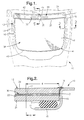
- Figures 1 and 2 show a portion of a vehicle body 10 made of an electrically conducting metal such as steel or aluminum and having a window aperture defined by body window edge 11.
- a window glass 12 overlaps body window edge 11 around its periphery to provide, in this embodiment, a windshield for vehicle body 10.
- the outer edge 13 of windshield 12 overlaps a depressed annular flange region 15 of body 10 defined between body window edge 11 and a retaining wall 16 which connects depressed flange 15 to the remainder of body 10 and retains windshield 12 flush with the remainder of body 10 in a predetermined position relative to body window edge 11.
- annular sealing member 17 is placed between window glass 12 and depressed annular flange region 15 of body 10; and an annular molding 18 bridges the outer gap between vehicle body 10 and window glass 12; these elements are of standard material and construction and are omitted from Figure 1 to avoid unnecessary clutter.
- windshield 12 is a standard laminated vehicle windshield formed of outer layer 20, preferably of glass, and inner layer 21, preferably of glass, with an interposed layer 22, preferably of a standard polyvinyl butyryl or similar thermoplastic material.
- Windshield 12 may be provided with a horizontal dark tinted region 24 across the top thereof, defined by its lower border 25 in Figure 1; and this dark tinted region, although commonly used in windshields for light and glare reduction, may be advantageously utilized in this invention to render the principal element of the antenna less visible.
- An antenna 30 is provided in windshield 12 as a film applied to the inner surface of the outer layer 20 of windshield 12 so as to be contained between layers 20.and 21 of windshield 12, as shown in exaggerated width in Figure 2.
- the film of antenna 30 is essentially transparent to visible light, highly reflective of infrared radiation, and electrically conducting, preferably with a sheet resistance of 4 ohms per square or less.
- An example of a suitable film is described in U.S. Patent No. 4,898,789 to Finley, issued Feb.
- Antenna 30 is a planar antenna of substantially constant thickness and substance across its planar shape; and its reception or radiating characteristics are greatly affected by its planar shape.
- the antenna may be described as comprising two basic elements. The first of these is a principal element substantially similar to the principal element of the referenced U.S. Patent No. 5,083,135: a horizontally elongate principal element 32 substantially parallel to and spaced from the horizontal upper portion of body window edge 11. Principal element 32 is essentially rectangular, although its horizontal edges may follow any slight curvature of the upper portion of body window edge 11 and its corners may be rounded for a more pleasing appearance.
- Principal element 32 is a tuned element having an effective horizontal length of an odd integer multiple of one quarter (1/4) of the wavelength to which it is tuned, whereby it exhibits a zero reactive impedance at the tuned wavelength.
- principal element 32 is tuned to a wavelength in the center of the commercial FM broadcasting band, such as three meters and thus has an effective horizontal length of about 0.75 meters.
- the physical length of element 32 at resonance is somewhat shorter than a measured one quarter of the actual midband signal wavelength. It is believed that this is due to coupling with the vehicle body; and the length by which it is shorter will vary with the specific vehicle application.
- principal element 32 has been found to work well with an actual horizontal length of 60 cm and a vertical width of 50 mm. It is ideally spaced below the horizontal upper portion of body window edge 11 by a distance which provides maximum FM gain; but this distance may be compromised to gain other advantages, as described below, for a particular vehicle design.
- the second element of antenna 30 is a an impedance matching element 38 having a main portion 40 which covers substantially all or most of windshield 12 below dark tinted region 24 and thus most or all of the main viewing area of windshield 12.
- Main portion 40 of impedance matching element 38 has a peripheral edge 41 with a horizontal upper portion 42 spaced at least 25 mm below the lower edge of principal element 32 so as to minimize transmission coupling effects therebetween and is connected thereto for electrical current flow by a narrow vertical portion 35.
- Upper portion 42 of peripheral edge 41 is preferably within dark tinted region 24 of windshield 12 along its entire length from close to one side to close to the other side of windshield 12, so that dark tinted region 24 overlaps the main portion 40 of impedance matching element 38.
- peripheral edge 41 of impedance matching element 38 is spaced a distance "A", as seen in Figure 2, from body window edge 11 so as to provide, in combination therewith, a planar slot transmission line which is parasitically coupled to principal element 32.
- gap width "A" is preferably within the range 10 -25 mm.
- the length of the slot is substantially an integer multiple of one half of the wavelength to which principal element 30 is tuned, so that each end of the slot transmission line, at the junctions of upper portion 42 and remainder 43 of peripheral edge 41, appears as an electrical open circuit. In this embodiment, with a large windshield, this length is one full wavelength, which for the middle of the commercial FM frequency band, is approximately 3 meters.
- Impedance matching element 38 is used to adjust the real component of the antenna's impedance to match the characteristic impedance, typically 125 ohms, of the coaxial cable used to feed the antenna; and this is accomplished by the proper choice, within the range 10 -25 mm, for the width "A" of the gap between the remainder 43 of peripheral edge 41 of impedance matching element 38 and the adjacent portion of body window edge 11.
- a dark, opaque, painted band may be provided around the sides and bottom of window glass 12 to substantially or completely cover the area outward from the remainder 43 of peripheral edge 41 of impedance matching element 38 to the outer edge 13 of window 12.
- This band can be broken into dots of decreasing size toward its inner boundary for a fadeout effect as is known in the industry. If such a band is provided, together with the dark tinted region at the top of the windshield, substantially the entire viewing area of windshield 12 can be uniformly provided with the infrared reflecting film of antenna 30.
- Impedance matching element 38 in addition to providing infrared radiation reflection over substantially all the lighter tinted portion of the windshield and impedance matching for greater gain at commercial FM wavelengths, provides an additional benefit at commercial AM wavelengths [150-600 meters].
- antenna 12 is not a resonant antenna but is substantially a capacitive antenna; and the large area of impedance matching element 38 provides a substantial boost in gain for antenna 12, as compared with similar planar and other antennas of the prior art.
- the boost in AM gain is so great that some of it can be sacrificed, if desired, in fine tuning antenna performance for further improvements in FM gain, directional response, or other characteristics, while still yielding good AM performance.
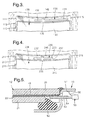
- a connection arrangement is provided for an external coaxial cable.
- the film of antenna 30 is extended in a narrow strip 45, about 25 mm wide, upward from the center of principal element 32 almost to (1 mm from) the upper edge of windshield 12.
- a portion of inner glass layer 21 is removed to expose about 12 mm (by 25 mm wide) of the end of strip 45.
- a length of conductive tape 50 soldered to the inner wire 54 of a coaxial cable 55 is affixed by adhesive 52 to the exposed section of strip 45.
- the adhesive may be electrically insulating or electrically conducting.
- the outer conductor 56 of coaxial cable 55 is affixed to body 10, for example by a rivet 57, at a convenient point close to body window edge 11.
- the electrically insulating adhesive provides an AC coupling between coaxial cable 55 and antenna 30.
- the adhesive is less expensive; and the coupling is easier to achieve; but the superior antenna AM gain is reduced due to the small coupling area (12 x 25 mm), and removal of more glass to obtain a larger area is not considered desirable.
- a DC coupling achieves good gain with a small contact area between the copper tape and strip 45 but requires the establishment of electrical contact through the top protective layer of the film, which is an electrical insulator.
- the suspended silver particles of the conductive adhesive will provide such electrical contact if the top layer is removed to expose a conductive layer. It has also been found that, under certain conditions, they will provide electrical contact even if the top layer is not removed. It is believed that the particles can be pressed through a thin insulating layer to establish electrical contact during manufacture.
- FIG 7 An alternate coupling arrangement is shown in Figure 7, which looks through an upper middle portion of windshield 12.
- a thin connecting strip 60 made from an electrically conducting metal such as stainless steel, is inserted between glass layers 20 and 21, against the inner surface of glass layer 20, during manufacture of windshield 12.
- a portion of connecting strip 60, contact pad 61 is affixed to principal element 32 in a manner similar to that shown and described with reference to Figures 5 and 6, either by nonconducting adhesive for AC coupling or by conducting adhesive for DC coupling.
- the 18 mm square size and shape of contact pad 61 provides a contact area similar to that of the arrangement shown in Figures 5 and 6.
- Contact pad 61 is joined by a narrow connecting portion 62 to a wider terminal portion 63 which projects outward from the upper edge of windshield 12.
- the inner conductor 54 of coaxial cable 55 is soldered to terminal portion 63 as shown; while the outer connector, not shown in this Figure, of coaxial cable 55 may be connected to body 10 as in the arrangement of Figures 5 and 6.
- a variation 130 of the antenna of Figures 1 and 2 is shown in Figure 3.
- principal element 132 differs from the corresponding element 32 in Figure 1; the other elements shown in Figure 3 are identical to the similarly numbered elements in the embodiment of Figures 1 and 2.
- principal element 132 the only difference is that it is longer and asymmetrical with respect to the center of windshield 12, with a side 133 which projects almost to the side edge of the windshield (although not as close to the edge as impedance matching element 138.
- This embodiment may be coupled to a coaxial cable by any of the arrangements shown in or described with respect to Figures 5 -7.
- This variation of the antenna can provide up to one dB improved FM gain if its asymmetrical appearance is commercially acceptable.
- FIG. 4 Another variation of the antenna of Figures 1 and 2 is shown in Figure 4.
- only principal element 232 of Figure 4 differs from the corresponding element 32 of Figures 1 and 2; and all other elements are identical.
- the end 233 of one side of element 232 is connected to impedance matching element 238 by a connecting link 237.
- This embodiment may be coupled to a coaxial cable by any of the arrangements shown in or described with respect to Figures 5 -7.
- This variation of the antenna can provide a slight improvement in AM gain if its asymmetrical appearance is commercially acceptable.
Landscapes
- Details Of Aerials (AREA)
Claims (5)
- Antenne (30) de fenêtre de véhicule destinée à recevoir des ondes radio de longueur d'onde prédéterminée, le véhicule ayant une structure électriquement conductrice (50) formant une ouverture de fenêtre avec un verre de fenêtre (12) disposé dedans, l'ouverture ayant un bord (11) avec une partie formant bord supérieur horizontal et une partie formant bord restant, l'antenne située dans le verre de fenêtre étant réalisée en un matériau électriquement conducteur, et comportant un élément principal (32), horizontalement allongé, sensiblement parallèle à la partie formant bord supérieur de l'ouverture de fenêtre, et ce en lui étant espacé, et ayant une longueur horizontale effective égale à un multiple impair d'un quart de la longueur d'onde et un élément d'adaptation d'impédance (38) s'étendant vers le bas à partir de l'élément principal, caractérisé en ce que l'élément d'adaptation d'impédance comporte :une partie principale (40) ayant un bord périphérique (41) avec une partie supérieure horizontale (42) espacée au-dessous de l'élément principal à raison d'une quantité suffisante pour qu'aucune ligne de transmission à fente significative ne soit formée entre eux, et le bord périphérique (41) comporte une partie restante (43) espacée vis-à-vis de la partie formant bord restant de l'ouverture de fenêtre de manière à former une ligne de transmission à fente entre eux, la longueur effective de la ligne de transmission à fente étant un multiple d'une moitié de la longueur d'onde, etune partie verticale étroite (35) reliant la partie principale à l'élément principal, la ligne de transmission à fente étant ainsi couplée d'une manière parasite à l'élément principal.
- Antenne de véhicule selon la revendication 1, qui comporte un film électriquement conducteur qui est continu dans le bord périphérique et est transparent pour la lumière visible.
- Antenne de véhicule selon la revendication 1, dans laquelle le verre de fenêtre comporte, au niveau de son extrémité supérieure, une région 24 teintée en sombre qui chevauche la partie principale de l'élément d'adaptation d'impédance.
- Antenne de véhicule selon la revendication 1, dans laquelle l'élément comporte en outre une substance réfléchissant les infrarouges.
- Antenne de véhicule selon la revendication 1, dans laquelle la longueur d'onde prédéterminée se situe approximativement au milieu d'une bande de diffusion commerciale incluant la longueur d'onde de 3 mètres.
Applications Claiming Priority (2)
| Application Number | Priority Date | Filing Date | Title |
|---|---|---|---|
| US08/445,884 US5528314A (en) | 1995-05-22 | 1995-05-22 | Transparent vehicle window antenna |
| US445884 | 1995-05-22 |
Publications (2)
| Publication Number | Publication Date |
|---|---|
| EP0744785A1 EP0744785A1 (fr) | 1996-11-27 |
| EP0744785B1 true EP0744785B1 (fr) | 2001-10-17 |
Family
ID=23770580
Family Applications (1)
| Application Number | Title | Priority Date | Filing Date |
|---|---|---|---|
| EP96201191A Expired - Lifetime EP0744785B1 (fr) | 1995-05-22 | 1996-04-29 | Antenne de vitre de véhicule |
Country Status (3)
| Country | Link |
|---|---|
| US (1) | US5528314A (fr) |
| EP (1) | EP0744785B1 (fr) |
| DE (1) | DE69615913T2 (fr) |
Families Citing this family (39)
| Publication number | Priority date | Publication date | Assignee | Title |
|---|---|---|---|---|
| DE4420903C1 (de) * | 1994-06-15 | 1996-01-25 | Sekurit Saint Gobain Deutsch | Antennenscheibe und Verfahren zu ihrer Herstellung |
| US5739794A (en) * | 1995-05-22 | 1998-04-14 | General Motors Corporation | Vehicle window antenna with parasitic slot transmission line |
| US6580369B1 (en) | 1995-10-11 | 2003-06-17 | Motorola, Inc. | Electronic tag assembly and method therefor |
| US5999134A (en) * | 1996-12-19 | 1999-12-07 | Ppg Industries Ohio, Inc. | Glass antenna system with an impedance matching network |
| CA2197828C (fr) * | 1997-02-18 | 2004-05-04 | Normand Dery | Dispositif d'antenne en film mince pour systemes de teledemarrage de vehicule |
| US5872542A (en) * | 1998-02-13 | 1999-02-16 | Federal Data Corporation | Optically transparent microstrip patch and slot antennas |
| US6384790B2 (en) | 1998-06-15 | 2002-05-07 | Ppg Industries Ohio, Inc. | Antenna on-glass |
| US5999136A (en) * | 1998-08-07 | 1999-12-07 | Ppg Industries Ohio, Inc. | Use of electrically conductive ceramic paints in antenna systems |
| AU2846600A (en) * | 1999-01-11 | 2000-08-01 | Motorola, Inc. | Transparent electrostatic electrodes with radio frequency identification, and method of using transparent electrostatic electrodes |
| US6031500A (en) * | 1999-04-01 | 2000-02-29 | General Motors Corporation | Broadband FM vehicle rear window antenna not requiring a boost amplifier |
| US6266023B1 (en) | 1999-06-24 | 2001-07-24 | Delphi Technologies, Inc. | Automotive radio frequency antenna system |
| US6211831B1 (en) | 1999-06-24 | 2001-04-03 | Delphi Technologies, Inc. | Capacitive grounding system for VHF and UHF antennas |
| US6147654A (en) * | 1999-07-27 | 2000-11-14 | General Motors Corporation | AM defogger grounding system for vehicle window antennas |
| US6191746B1 (en) | 1999-07-29 | 2001-02-20 | General Motors Corporation | FM diversity feed system for the solar-ray antenna |
| US6118410A (en) * | 1999-07-29 | 2000-09-12 | General Motors Corporation | Automobile roof antenna shelf |
| DE10002777C1 (de) * | 2000-01-22 | 2001-08-09 | Saint Gobain Sekurit D Gmbh | Kontaktierung einer Scheibe mit elektrischen Funktionen |
| MXPA02007453A (es) | 2000-02-11 | 2002-12-13 | Ppg Ind Ohio Inc | Antena de vehiculo. |
| US6331838B1 (en) | 2000-07-19 | 2001-12-18 | Delphi Technologies, Inc. | Flexible vehicle antenna |
| US6317090B1 (en) | 2000-08-03 | 2001-11-13 | General Motors Corporation | AM/FM solar-ray antenna with mirror wiring grounding strap |
| KR100428139B1 (ko) | 2001-08-28 | 2004-04-30 | 현대자동차주식회사 | 차량용 글라스 안테나 |
| US6814795B2 (en) | 2001-11-27 | 2004-11-09 | Ferro Corporation | Hot melt conductor paste composition |
| DE10259828B4 (de) * | 2002-12-19 | 2015-06-18 | Webasto Ag | Element für ein Fahrzeugdach sowie Herstellungsverfahren dafür |
| GB0622786D0 (en) * | 2006-11-15 | 2006-12-27 | Pilkington Automotive D Gmbh | Antennae |
| EP2121307A1 (fr) | 2006-11-15 | 2009-11-25 | PILKINGTON Automotive Deutschland GmbH | Vitrage |
| JP5399256B2 (ja) | 2006-11-15 | 2014-01-29 | ピルキントン オートモーティヴ ドイチェラント ゲーエムベーハー | アンテナコネクタ |
| US8466842B2 (en) | 2010-10-22 | 2013-06-18 | Pittsburgh Glass Works, Llc | Window antenna |
| US8576130B2 (en) | 2010-10-22 | 2013-11-05 | Pittsburgh Glass Works, Llc | Wideband antenna |
| WO2012079040A1 (fr) | 2010-12-09 | 2012-06-14 | Agc Automotive Americas R&D, Inc. | Ensemble fenêtre doté d'une couche transparente avec une rainure pour un élément d'antenne transparent |
| CN105209274B (zh) * | 2013-03-15 | 2018-01-02 | Agc汽车美洲研发公司 | 具有在透明区域中形成的性能提升狭缝的窗户组件 |
| US9337525B2 (en) | 2014-02-03 | 2016-05-10 | Pittsburgh Glass Works, Llc | Hidden window antenna |
| US9551180B2 (en) | 2014-06-04 | 2017-01-24 | Milgard Manufacturing Incorporated | System for controlling noise in a window assembly |
| JP2016111572A (ja) * | 2014-12-08 | 2016-06-20 | 株式会社フジクラ | 化粧板 |
| CN107851890B (zh) * | 2015-07-24 | 2020-12-22 | Agc株式会社 | 玻璃天线和具有玻璃天线的车辆用窗玻璃 |
| JP2017212553A (ja) * | 2016-05-24 | 2017-11-30 | 旭硝子株式会社 | 車両用窓ガラス |
| US10847887B2 (en) | 2017-10-05 | 2020-11-24 | Eastman Kodak Company | Method for fabricating a transparent antenna |
| US10524356B2 (en) | 2017-10-05 | 2019-12-31 | Eastman Kodak Company | Transparent antenna |
| US10854940B2 (en) | 2018-02-06 | 2020-12-01 | GM Global Technology Operations LLC | Window assembly having a coplanar waveguide to coplanar waveguide coupler for radio frequency devices |
| WO2020007746A1 (fr) * | 2018-07-02 | 2020-01-09 | Agc Glass Europe | Vitrage à antenne de véhicule |
| CN116470281A (zh) * | 2023-04-07 | 2023-07-21 | 上海移远通信技术股份有限公司 | 用于与天线连接的馈电转接装置 |
Family Cites Families (9)
| Publication number | Priority date | Publication date | Assignee | Title |
|---|---|---|---|---|
| GB2193846B (en) * | 1986-07-04 | 1990-04-18 | Central Glass Co Ltd | Vehicle window glass antenna using transparent conductive film |
| GB2200498B (en) * | 1986-12-19 | 1990-07-18 | Central Glass Co Ltd | Vehicle window glass antenna using transparent conductive film |
| JPS63196106U (fr) * | 1987-01-20 | 1988-12-16 | ||
| KR890001219A (ko) * | 1987-06-27 | 1989-03-18 | 노브오 사수가 | 자동차용 수신장치 |
| DE3808401A1 (de) * | 1988-03-12 | 1989-09-21 | Blaupunkt Werke Gmbh | Sichtscheibe fuer fahrzeuge |
| JPH066582Y2 (ja) * | 1988-03-31 | 1994-02-16 | 日本板硝子株式会社 | 自動車用窓ガラスアンテナ |
| US4866453A (en) * | 1988-08-15 | 1989-09-12 | General Motors Corporation | Vehicle slot antenna with parasitic slot |
| US5083135A (en) * | 1990-11-13 | 1992-01-21 | General Motors Corporation | Transparent film antenna for a vehicle window |
| US5355144A (en) * | 1992-03-16 | 1994-10-11 | The Ohio State University | Transparent window antenna |
-
1995
- 1995-05-22 US US08/445,884 patent/US5528314A/en not_active Expired - Lifetime
-
1996
- 1996-04-29 DE DE69615913T patent/DE69615913T2/de not_active Expired - Lifetime
- 1996-04-29 EP EP96201191A patent/EP0744785B1/fr not_active Expired - Lifetime
Also Published As
| Publication number | Publication date |
|---|---|
| DE69615913D1 (de) | 2001-11-22 |
| US5528314A (en) | 1996-06-18 |
| DE69615913T2 (de) | 2002-04-25 |
| EP0744785A1 (fr) | 1996-11-27 |
Similar Documents
| Publication | Publication Date | Title |
|---|---|---|
| US5528314A (en) | Transparent vehicle window antenna | |
| US5083135A (en) | Transparent film antenna for a vehicle window | |
| US6317090B1 (en) | AM/FM solar-ray antenna with mirror wiring grounding strap | |
| US5739794A (en) | Vehicle window antenna with parasitic slot transmission line | |
| EP0961342B1 (fr) | Antenne transparente de vitre pour véhicule avec connecteur à couplage capacitif | |
| KR960015569B1 (ko) | 슬롯 안테나 | |
| US5898407A (en) | Motor vehicle with antenna window with improved radiation and reception characteristics | |
| US6266023B1 (en) | Automotive radio frequency antenna system | |
| CA2163812C (fr) | Antenne en materiau de verre, a installer dans glace de vehicule automobile | |
| US5589839A (en) | Radio antenna arrangement located next to vehicle window panels | |
| US4768037A (en) | Vehicle window glass antenna using transparent conductive film | |
| EP2630691B1 (fr) | Antenne à large bande | |
| US8077100B2 (en) | Antenna connector | |
| KR101571948B1 (ko) | 안테나 구조물용 평각 도체 연결 요소 | |
| US5264858A (en) | Glass antenna for a telephone of an automobile | |
| CA2164366C (fr) | Connecteur electrique | |
| WO2012054330A1 (fr) | Antenne de fenêtre | |
| US9837699B2 (en) | Multi-element window antenna | |
| US6191746B1 (en) | FM diversity feed system for the solar-ray antenna | |
| US6417811B1 (en) | In-glass antenna element matching | |
| US5079560A (en) | Vehicle window antenna | |
| JPH05226919A (ja) | 窓組込み型車輌用アンテナ | |
| EP0794589B1 (fr) | Vitre de véhicule avec dispositif de liaison d'antenne | |
| JP7512727B2 (ja) | 窓ガラス取り付け構造 | |
| JP2022032205A (ja) | 窓ガラス取り付け構造 |
Legal Events
| Date | Code | Title | Description |
|---|---|---|---|
| PUAI | Public reference made under article 153(3) epc to a published international application that has entered the european phase |
Free format text: ORIGINAL CODE: 0009012 |
|
| AK | Designated contracting states |
Kind code of ref document: A1 Designated state(s): DE FR GB |
|
| 17P | Request for examination filed |
Effective date: 19970527 |
|
| GRAG | Despatch of communication of intention to grant |
Free format text: ORIGINAL CODE: EPIDOS AGRA |
|
| 17Q | First examination report despatched |
Effective date: 20010215 |
|
| GRAG | Despatch of communication of intention to grant |
Free format text: ORIGINAL CODE: EPIDOS AGRA |
|
| GRAH | Despatch of communication of intention to grant a patent |
Free format text: ORIGINAL CODE: EPIDOS IGRA |
|
| GRAH | Despatch of communication of intention to grant a patent |
Free format text: ORIGINAL CODE: EPIDOS IGRA |
|
| GRAA | (expected) grant |
Free format text: ORIGINAL CODE: 0009210 |
|
| AK | Designated contracting states |
Kind code of ref document: B1 Designated state(s): DE FR GB |
|
| REF | Corresponds to: |
Ref document number: 69615913 Country of ref document: DE Date of ref document: 20011122 |
|
| REG | Reference to a national code |
Ref country code: GB Ref legal event code: IF02 |
|
| ET | Fr: translation filed | ||
| PLBE | No opposition filed within time limit |
Free format text: ORIGINAL CODE: 0009261 |
|
| STAA | Information on the status of an ep patent application or granted ep patent |
Free format text: STATUS: NO OPPOSITION FILED WITHIN TIME LIMIT |
|
| 26N | No opposition filed | ||
| PGFP | Annual fee paid to national office [announced via postgrant information from national office to epo] |
Ref country code: DE Payment date: 20110427 Year of fee payment: 16 Ref country code: FR Payment date: 20110426 Year of fee payment: 16 |
|
| PGFP | Annual fee paid to national office [announced via postgrant information from national office to epo] |
Ref country code: GB Payment date: 20110427 Year of fee payment: 16 |
|
| GBPC | Gb: european patent ceased through non-payment of renewal fee |
Effective date: 20120429 |
|
| REG | Reference to a national code |
Ref country code: FR Ref legal event code: ST Effective date: 20121228 |
|
| PG25 | Lapsed in a contracting state [announced via postgrant information from national office to epo] |
Ref country code: GB Free format text: LAPSE BECAUSE OF NON-PAYMENT OF DUE FEES Effective date: 20120429 |
|
| REG | Reference to a national code |
Ref country code: DE Ref legal event code: R119 Ref document number: 69615913 Country of ref document: DE Effective date: 20121101 |
|
| PG25 | Lapsed in a contracting state [announced via postgrant information from national office to epo] |
Ref country code: FR Free format text: LAPSE BECAUSE OF NON-PAYMENT OF DUE FEES Effective date: 20120430 |
|
| PG25 | Lapsed in a contracting state [announced via postgrant information from national office to epo] |
Ref country code: DE Free format text: LAPSE BECAUSE OF NON-PAYMENT OF DUE FEES Effective date: 20121101 |