EP0745938A1 - Hauptspeichervorrichtung mit Betiebssystemmittelbereich - Google Patents
Hauptspeichervorrichtung mit Betiebssystemmittelbereich Download PDFInfo
- Publication number
- EP0745938A1 EP0745938A1 EP96108651A EP96108651A EP0745938A1 EP 0745938 A1 EP0745938 A1 EP 0745938A1 EP 96108651 A EP96108651 A EP 96108651A EP 96108651 A EP96108651 A EP 96108651A EP 0745938 A1 EP0745938 A1 EP 0745938A1
- Authority
- EP
- European Patent Office
- Prior art keywords
- memory
- storage unit
- main storage
- resource region
- bodies
- Prior art date
- Legal status (The legal status is an assumption and is not a legal conclusion. Google has not performed a legal analysis and makes no representation as to the accuracy of the status listed.)
- Withdrawn
Links
Images



Classifications
-
- G—PHYSICS
- G06—COMPUTING OR CALCULATING; COUNTING
- G06F—ELECTRIC DIGITAL DATA PROCESSING
- G06F12/00—Accessing, addressing or allocating within memory systems or architectures
- G06F12/02—Addressing or allocation; Relocation
- G06F12/0223—User address space allocation, e.g. contiguous or non contiguous base addressing
- G06F12/023—Free address space management
Definitions
- the present invention relates to a main storage unit having an operating system (OS) function for a microprocessor, and particularly, to a memory management system of the main storage unit.
- OS operating system
- a random access memory (RAM) as a main storage unit is indispensible to store programs and data. Particularly, in a single chip microprocessor, and as a result, the capacity of the main storage unit is limited.
- a prior art main storage unit for a microprocessor is divided into an OS resource region and a user region which users freely use.
- the number of bits of pointers is as large as possible so that the OS resource region can be located in any area of the main storage unit.
- the OS resource region can be located in the whole of the main storage unit, and therefore, all of the memory blocks of the OS resource region can be increased. In other words, there is no limit on the OS resource region within the main storage unit.
- the management system for the main storage unit when the number of resources is increased in the OS resource region, the total number of bits of pointers is also increased in proportion to the number of resources, thus substantially reducing the capacity of the main storage unit.
- a main storage unit including an OS resource region and a user region, a plurality of memory pools each having a first memory pool header, a second memory pool header, a plurality of memory block management regions and a plurality of memory bodies
- the first and second memory pool headers and the memory block management regions are located in the OS resource region
- the memory bodies are located in the user region. That is, the memory bodies are moved from the OS resource region to the user region.
- the memory bodies are designated by full addresses of the main storage unit, so that the memory bodies can be located in any areas of the main storage unit.
- Fig. 1 which illustrates a prior art main storage unit for a 24-bit microprocessor
- a 16 Mbyte main storage unit 1 is connectd to a central process unit (CPU) 2.
- CPU central process unit
- the number of bits of pointers (header) is 3 byte (24 bits)
- an OS resource region can be located in any area of the main sotage unit 1.
- the number of bits of pointers (headers) is 2 bytes (16 bits), to save 1 byte per one pointer.
- the main storage unit 1 is divided into an OS resource region 11 and a user region 12 which users can freely use.
- the OS resource region 11 is a range of 64 kbytes from an address having fixed base address designated by users.
- the OS resource region 11 is divided into a system management region 111, resource management regions such as task management regions 112, event/flag management regions 113, semaphore management regions 114 and mailbox management regions 115, and memory pools 116 each including a queue of memory blocks.
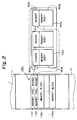
- the details of one memory pool 116x of Fig. 1 are explained next with reference to Fig. 2.
- the memory pool 116x includes a 2-byte memory pool header (pointer) 1161 for indicating a first memory block 1163 1 of the queue and a 2-byte memory pool header (pointer) 1162 for indicating a last memory block 1163 n of the queue.
- the queue is comprised of a simple linked list (sequence) of the memory blocks 1163 1 to 1163 n .
- Each of the memory blocks 1163 1 to 1163 n is formed by a 2-byte header (pointer) 1163a for indicating the next memory block and a memory body 1163b which actually can store data.
- the OS management resource region 11 receives a system call from an application task managed by one of the task management regions 112.
- the OS management resource region 11 searches an empty memory block with reference to the contents of the memory pool headers 1161 and 1162. As a result, if there is an empty memory block, the control proceeds to steps 303 and 304. Otherwise, the control proceeds to step 305.
- the OS resource region 11 delivers a 2-byte address of the memory body of the empty memory block to the application task. Then, at step 304, the queue is rearranged by removing the memory block delievered to the application task.
- the OS resource region 11 delivers an error signal for indicating that there is no empty memory block to the application task.
- the memory bodies 1163b are located in the OS resource region 11, the number of resources in the OS resource region 11 is limited, which deteriorates the function of the operating system.
- each of the memory pools 116 is located in both the OS resource region 11 and the user region 12. That is, memory pool management regions 1160 of the memory pools 116 are located in the OS resource region 11, and the memory bodies 1163b of the memory pools 116 are located in the user region 12.
- memory block management regions 1163 1 ' to 1163 n ' are provided instead of the memory blocks 1161 1 to 1163 n of Fig. 2.
- Each of the memory block management regions 1163 1 ' to 1163 n ' is formed by the 2-byte header 1163a for indicating the next memory block management region and a 3-byte pointer 1163c for storing a full address of one of the memory bodies 1163b.
- the memory bodies 1163b can be located in any areas of the main storage unit 1.
- step 601 is provided instead of step 303 of Fig. 3. That is, at step 601, the OS resource region 11 delivers a 3-byte address of the memory body of the empty memory block to the application task in accordance with the content of the pointer 1163c of the empty memory block.
- the capacity of each of the memory bodies 1163b is 4 kbytes and the number of the memory blocks is 20
- the 104 bytes are allocated to the OS resource region 11, and the 80 kbytes are allocated to the user region 12. Therefore, it is easily possible to accommodate the 104 bytes of the memory pool 116x in the 64 kbyte OS resource region 11. Thus, it is possible to prepare a large capacity of memory pools.
- the number of resources in the OS resource region 11 is not limited, which improves the function of the operating system.
- the main storage unit 1 of Fig. 4 is used for a 16-bit single chip microprocessor, and the capacity of the main storage unit 1 is 64 kbytes.
- the number of bits of pointers (headers) is 1 byte (8 bits), which saves 2 bytes per one pointer.
- the 82 bytes are allocated to the OS resource region 11, and the 400 bytes are allocated to the user region 12. Therefore, it is easily possible to accommodate the 82 bytes of the memory pool 116x in the 256 kbyte OS resource region 11. Thus, it is possible to prepare a large capacity of memory pools.
- the number of resources in the OS resource region 11 is not limited, which improves the function of the operating system.
- the memory bodies of the memory blocks are moved from the OS resource region to the user region and the memory bodies are designated by full addresses of the main storage unit, the memory bodies can be located in any areas of the main storage unit, thus increasing the capacity of the memory pools. Also, since the OS resource regions are not limited, users can use a large number of OS resources.
Landscapes
- Engineering & Computer Science (AREA)
- Theoretical Computer Science (AREA)
- Physics & Mathematics (AREA)
- General Engineering & Computer Science (AREA)
- General Physics & Mathematics (AREA)
- Memory System Of A Hierarchy Structure (AREA)
Applications Claiming Priority (2)
| Application Number | Priority Date | Filing Date | Title |
|---|---|---|---|
| JP13396995A JPH08328944A (ja) | 1995-05-31 | 1995-05-31 | メモリ管理方式 |
| JP133969/95 | 1995-05-31 |
Publications (1)
| Publication Number | Publication Date |
|---|---|
| EP0745938A1 true EP0745938A1 (de) | 1996-12-04 |
Family
ID=15117320
Family Applications (1)
| Application Number | Title | Priority Date | Filing Date |
|---|---|---|---|
| EP96108651A Withdrawn EP0745938A1 (de) | 1995-05-31 | 1996-05-30 | Hauptspeichervorrichtung mit Betiebssystemmittelbereich |
Country Status (2)
| Country | Link |
|---|---|
| EP (1) | EP0745938A1 (de) |
| JP (1) | JPH08328944A (de) |
Cited By (1)
| Publication number | Priority date | Publication date | Assignee | Title |
|---|---|---|---|---|
| KR20140046702A (ko) * | 2012-10-10 | 2014-04-21 | 삼성전자주식회사 | 운영 체제 프로그램을 저장하는 메인 메모리 시스템 및 이를 포함하는 컴퓨터 시스템 |
Families Citing this family (1)
| Publication number | Priority date | Publication date | Assignee | Title |
|---|---|---|---|---|
| JP2011028537A (ja) * | 2009-07-27 | 2011-02-10 | Buffalo Inc | 外部記憶装置へのアクセスを高速化する方法および外部記憶システム |
Family Cites Families (5)
| Publication number | Priority date | Publication date | Assignee | Title |
|---|---|---|---|---|
| JPS6027963A (ja) * | 1983-07-26 | 1985-02-13 | Fujitsu Ltd | メモリ使用状況測定処理方式 |
| JP2708424B2 (ja) * | 1987-07-15 | 1998-02-04 | 株式会社日立製作所 | データ記憶方式 |
| JP2535568B2 (ja) * | 1987-11-18 | 1996-09-18 | 富士通株式会社 | アプリケ―ションプログラムでの動的バッファ管理方式 |
| JP2787835B2 (ja) * | 1990-03-15 | 1998-08-20 | キヤノン株式会社 | 印刷処理方法及び装置 |
| JP2636484B2 (ja) * | 1990-09-19 | 1997-07-30 | 富士通株式会社 | バッファ管理方式 |
-
1995
- 1995-05-31 JP JP13396995A patent/JPH08328944A/ja active Pending
-
1996
- 1996-05-30 EP EP96108651A patent/EP0745938A1/de not_active Withdrawn
Non-Patent Citations (4)
| Title |
|---|
| "Architektonische Merkmale von Einchip-Computern", ELEKTRONIK, vol. 31, no. 7, April 1982 (1982-04-01), MUNCHEN DE, pages 86 - 92, XP002014102 * |
| "LINKED LIST SEARCH TABLE ARRAY FOR FREE STORAGE BLOCKS", IBM TECHNICAL DISCLOSURE BULLETIN, vol. 33, no. 8, 1 January 1991 (1991-01-01), pages 474 - 479, XP000109329 * |
| ANONYMOUS: "Storage Algorithm for Chains of Control Block Pools. November 1980.", IBM TECHNICAL DISCLOSURE BULLETIN, vol. 23, no. 6, November 1980 (1980-11-01), NEW YORK, US, pages 2411 - 2412, XP002014101 * |
| RALSTON, ANTHONY REILLY,EDWIN D.: "Encyclopedia of Computer Science", 1993, VAN NOSTRAND REINHOLD, UNITED STATES * |
Cited By (1)
| Publication number | Priority date | Publication date | Assignee | Title |
|---|---|---|---|---|
| KR20140046702A (ko) * | 2012-10-10 | 2014-04-21 | 삼성전자주식회사 | 운영 체제 프로그램을 저장하는 메인 메모리 시스템 및 이를 포함하는 컴퓨터 시스템 |
Also Published As
| Publication number | Publication date |
|---|---|
| JPH08328944A (ja) | 1996-12-13 |
Similar Documents
| Publication | Publication Date | Title |
|---|---|---|
| JP2983167B2 (ja) | ネットワーク・インタフェース装置およびネットワーク・インタフェースにおけるパケット処理方法 | |
| US5873089A (en) | Data handling system with circular queue formed in paged memory | |
| US5339411A (en) | Method for managing allocation of memory space | |
| US5893148A (en) | System and method for allocating cache memory storage space | |
| US6148321A (en) | Processor event recognition | |
| US6366994B1 (en) | Cache aware memory allocation | |
| US5426424A (en) | Selective call receiver with database capability | |
| US5027330A (en) | FIFO memory arrangement including a memory location fill indication | |
| JP4156033B2 (ja) | 連続するメモリのバッファを獲得し、ページテーブルを構築する方法 | |
| EP1619584A1 (de) | Speicherzuordnung | |
| US5964859A (en) | Allocatable post and prefetch buffers for bus bridges | |
| US5161215A (en) | Method for controlling data transfer buffer | |
| US4704717A (en) | Receive message processor for a solicited message packet transfer system | |
| JPH06187298A (ja) | データ転送処理方法及びデータ転送処理装置 | |
| US5287471A (en) | Data transfer controller using direct memory access method | |
| US6779100B1 (en) | Method and device for address translation for compressed instructions | |
| WO1999001817A1 (en) | Defragmentation of stored data without pointer indirection | |
| US6912712B1 (en) | Real time control system for multitasking digital signal processor using ready queue | |
| US5535359A (en) | Computer system with cache memory having address mask register | |
| US5524214A (en) | System for modification of dynamic buffer allocation by comparing modification request with current allocation and updating allocation based upon comparison discrepancy | |
| EP0745938A1 (de) | Hauptspeichervorrichtung mit Betiebssystemmittelbereich | |
| GB2371641A (en) | Direct Memory Access (DMA) controller for circular buffers | |
| EP0220683A2 (de) | Speicherbereichstruktur in einem Informationsprozessor | |
| EP0261947A1 (de) | Computeranordnung | |
| EP0787326B1 (de) | System und verfahren zur verarbeitung von speicherdaten und kommunikationssystemen mit diesem system |
Legal Events
| Date | Code | Title | Description |
|---|---|---|---|
| PUAI | Public reference made under article 153(3) epc to a published international application that has entered the european phase |
Free format text: ORIGINAL CODE: 0009012 |
|
| AK | Designated contracting states |
Kind code of ref document: A1 Designated state(s): DE FR GB |
|
| 17P | Request for examination filed |
Effective date: 19961108 |
|
| 17Q | First examination report despatched |
Effective date: 19991130 |
|
| STAA | Information on the status of an ep patent application or granted ep patent |
Free format text: STATUS: THE APPLICATION HAS BEEN WITHDRAWN |
|
| 18W | Application withdrawn |
Withdrawal date: 20000121 |