EP0748101A2 - System and apparatus for generating within the premises a dial tone for enhanced phone services - Google Patents
System and apparatus for generating within the premises a dial tone for enhanced phone services Download PDFInfo
- Publication number
- EP0748101A2 EP0748101A2 EP96303798A EP96303798A EP0748101A2 EP 0748101 A2 EP0748101 A2 EP 0748101A2 EP 96303798 A EP96303798 A EP 96303798A EP 96303798 A EP96303798 A EP 96303798A EP 0748101 A2 EP0748101 A2 EP 0748101A2
- Authority
- EP
- European Patent Office
- Prior art keywords
- phone
- dial tone
- premises
- communication channel
- tone controller
- Prior art date
- Legal status (The legal status is an assumption and is not a legal conclusion. Google has not performed a legal analysis and makes no representation as to the accuracy of the status listed.)
- Withdrawn
Links
Images

Classifications
-
- H—ELECTRICITY
- H04—ELECTRIC COMMUNICATION TECHNIQUE
- H04M—TELEPHONIC COMMUNICATION
- H04M3/00—Automatic or semi-automatic exchanges
- H04M3/42—Systems providing special services or facilities to subscribers
-
- H—ELECTRICITY
- H04—ELECTRIC COMMUNICATION TECHNIQUE
- H04M—TELEPHONIC COMMUNICATION
- H04M3/00—Automatic or semi-automatic exchanges
- H04M3/42—Systems providing special services or facilities to subscribers
- H04M3/44—Additional connecting arrangements for providing access to frequently-wanted subscribers, e.g. abbreviated dialling
-
- H—ELECTRICITY
- H04—ELECTRIC COMMUNICATION TECHNIQUE
- H04Q—SELECTING
- H04Q1/00—Details of selecting apparatus or arrangements
- H04Q1/18—Electrical details
- H04Q1/30—Signalling arrangements; Manipulation of signalling currents
- H04Q1/44—Signalling arrangements; Manipulation of signalling currents using alternate current
- H04Q1/444—Signalling arrangements; Manipulation of signalling currents using alternate current with voice-band signalling frequencies
- H04Q1/45—Signalling arrangements; Manipulation of signalling currents using alternate current with voice-band signalling frequencies using multi-frequency signalling
- H04Q1/453—Signalling arrangements; Manipulation of signalling currents using alternate current with voice-band signalling frequencies using multi-frequency signalling in which m-out-of-n signalling frequencies are transmitted
-
- H—ELECTRICITY
- H04—ELECTRIC COMMUNICATION TECHNIQUE
- H04Q—SELECTING
- H04Q3/00—Selecting arrangements
- H04Q3/42—Circuit arrangements for indirect selecting controlled by common circuits, e.g. register controller, marker
-
- H—ELECTRICITY
- H04—ELECTRIC COMMUNICATION TECHNIQUE
- H04M—TELEPHONIC COMMUNICATION
- H04M15/00—Arrangements for metering, time-control or time indication ; Metering, charging or billing arrangements for voice wireline or wireless communications, e.g. VoIP
Definitions
- This application relates to a system and apparatus in which a premises controller generates a dial tone to a premises phone for enhanced phone services such as retrieval of phone numbers contained within a database of the dial tone controller without interfering with baseband services.
- the local telephone loop is formed by and connected directly to a premises phone and the central office of a local exchange carrier (LEC).
- LEC local exchange carrier
- the premises phone is connected to the local exchange carrier by a local loop of two wires called a wire pair.
- One of the wires is called T (for tip) and the other is called R (for ring).
- T for tip
- R for ring
- the switch hook closes, completing the circuit to the local exchange carrier, creating an "off-hook" condition.
- the off-hook signal tells the local exchange carrier that a call is desired, and the local exchange carrier returns a dial tone to the premises phone to let the premises caller know that the exchange is ready to accept a telephone number, or "address".
- the premises caller enters telephone numbers corresponding to the desired destination address.
- the local exchange carrier then switches the call into the phone network to complete the call.
- the premises phone has been connected to the local exchange carrier and a dial tone has been generated from the local exchange carrier to the premises phone.
- the premises phone is in an off-hook condition, and any dialed numbers are sent directly to the local exchange carrier.
- local premises equipment could be connected within the premises phone line and connected to the premises phone for generating a dial tone to the premises phone without interfering with the baseband service of the local exchange carrier. This would allow phone dialing and other phone functions without interrupting any baseband service of the local exchange carrier.
- a premises customer could issue simple voice commands through the phone, such as "call Bob," as well as instruct the premises equipment to look up various numbers in a stored database.
- the premises equipment could connect to a cable TV POTS service or other service by routing generated signals from the premises phone to the cable TV POTS service.
- the present invention now provides a system and apparatus for generating by a dial tone controller a dial tone within the premises for enhanced phone services.
- a premises phone is connected to a phone network via a first communication channel.
- a dial tone controller is connected between the premises phone and the phone network along the first communication channel.
- the dial tone controller includes circuitry for generating a dial tone to the premises phone along a second communication channel extending between the premises phone and the dial tone controller.
- the dial tone controller also includes a processor and associated circuitry for receiving and processing signals received from the premises phone.
- the dial tone controller generates a dual-tone multifrequency signal (DTMF tones) for establishing communication within the network based on the generated signals received from the premises phone.
- a switch is operatively connected between the premises phone and the dial tone controller for switching the premises phone from communication with the network along the first communication channel and communication with the dial tone controller along the second communication channel so that the premises phone receives a dial tone from and sends signals to the dial tone controller.
- the first communication channel comprises a twisted wire pair and a carrier signal extending along the twisted wire pair having a first frequency range.
- a second communication channel comprises a subcarrier signal extending along the twisted wire pair having a second frequency range.
- the first communication channel comprises a first twisted wire pair and the second communication channel comprises a second twisted wire pair. This second twisted wire pair is sometimes found in some premises, but not always used. Thus, it may be available for use as a second communication channel.
- the switch is responsive to raising of the premises phone handset from the hook for switching the premises phone to the second communication channel.
- the dial tone controller can include a database of stored telephone numbers, which can include billing rate data for determining a least cost routing rate for a phone call.
- the dial tone controller makes the appropriate database look-up based on the dialed number to determine what possible rates are available. The dial tone controller then dials the more advantageous call (the least cost route), and once the call is completed, the premises switch completes the connection between the premises phone, first communication channel and phone network.
- the dial tone controller includes voice recognition circuitry for receiving and recognizing voice commands transmitted from the premises phone to the dial tone controller along the second communication channel.
- the dial tone controller then generates a telephone number, such as "Bob's" number, obtained from the database corresponding to the recognized voice command, such as "call Bob".
- the dial tone controller also includes circuitry for routing a signal generated from the premises phone to a location separate from the network, such as connecting to a cable TV POTS service.
- the dial tone controller includes a housing and phone jacks mounted on the housing for connecting the dial tone controller within an existing phone line connected to the premises phone.
- the switch can be mounted within the housing.
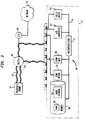
- FIG. 10 there is illustrated generally at 10 a system of the present invention for generating within a premises, indicated by the dotted line 12 , a dial tone for enhanced phone services of a premises phone 14 connected to a phone network 16 by a local exchange carrier 18 and first communication channel 20 .
- the present system is advantageous because it does not interrupt baseband services.
- a dial tone controller is connected between the premises phone 14 and the phone network 16 along the first communication channel 20 .
- the dial tone controller 22 includes circuitry and system 24 for generating a dial tone to the premises phone along a second communication channel, indicated by the dotted line 26 , extending between the premises phone 14 and the dial tone controller 22 .
- the dial tone controller 22 receives and processes signals received from the premises phone 14 and generates a dual-tone multifrequency signal ("DTMF" tones) for establishing communication within the phone network 16 based on generated signals received from the premises phone 14 .
- DTMF dual-tone multifrequency signal
- a switch 30 is operatively connected between the premises phone 14 and the dial tone controller 22 for switching the premises phone 14 from communication with the phone network 16 along the first communication channel 20 and communication with the dial tone controller 22 along the second communication channel 26 for 1) receiving a dial tone from, and 2) sending signals to, the dial tone controller 22 .
- the first communication channel 20 comprises a twisted wire pair 32 ( Figure 2) and a carrier signal extending along the twisted wire pair of a first frequency range such as the conventional baseband signal from 300 Hertz (Hz) to 3 kilohertz (KHz).
- the second communication channel 26 can comprise a subcarrier signal extending along the twisted wire pair and having a second frequency range of 300 to 400 kilohertz.
- the first communication channel 20 can comprise a first twisted wire pair 32 and the second communication channel 26 can comprise a second twisted wire pair, indicated by the twisted dotted lines at 34 .
- a second twisted wire pair 34 is a part of the conventional wiring, but remains unused.
- At least two premises phones can also be used in the system of the present invention and are illustrated in the home premises environment and connected to the local exchange carrier 18 via the first communication channel 20 .
- a base station 40 is connected to the first communication channel 20 and works with a hand-held cordless telephone 42 .
- One switch 30 can be used for the entire premises, as shown in Figure 1, and by connection 44 to the station 40 , or a switch 30 ' can be used for the other premises phone 14 so that each premises phone can be individually controlled relative to the dial tone controller 22 .
- the dial tone controller 22 has a main processing system, indicated generally at 50 , which includes a microprocessor 52 connected to a digital bus 54 .
- the dial tone controller 22 also includes a memory 56 for storing digital information such as a database of telephone numbers, messages and corresponding names. Part of the memory 56 can be RAM 58 for fast short-term retrieval as well as a hard storage device 60 . Both memories 58 , 60 are connected to the digital bus 54 . Data such as phone numbers and least-cost routing rates can be stored in the memory. Data is read from memory 56 when instructed by the microprocessor 52 .
- An analog-to-digital converter 62 may be included for converting incoming analog signals to digital data for storage in memory 56 and further processing by the microprocessor 52 .
- the dial tone controller 22 also includes voice recognition circuitry 64 for determining voice commands.
- This voice recognition circuitry 64 connects to the microprocessor 52 and the communication channels. For example, a premises customer may speak a command into the premises phone such as "call Bob". The voice recognition circuitry 64 analyzes this command and determines, based on the data stored in the database, that the command "call Bob" corresponds to a particular phone number belonging to "Bob". The dial tone controller 22 then calls the number belonging to Bob by means of a dual-tone multifrequency generator 66 and transmits the signal to the phone network 16 . Once communication is established to Bob's telephone number, the switch 30 then couples the premises phone 14 to the first communication channel 20 so that communication is established between Bob and the premises customer using the premises phone.
- the dial tone controller 22 also can include dual-tone multifrequency detection circuitry 70 connected to the communication channels and bus 54 extending to the network in the premises phone.
- This circuitry 70 can detect tones used as control signals generated from either a premises phone or network phone to instruct the microprocessor 52 in various functions so as to control processing, memory functions and telephone number retrieval from the database.
- the switch 30 can be responsive to raising of the premises phone handset 14a from off its hook 14b ( Figure 1) for switching the premises phone to the second communication channel 26 .
- the dial tone controller 22 can also include a standard interface 72 conventionally known to those skilled in the art for connecting the dial tone controller 22 to a cable TV company 74 or a cable TV POTS service 76 so as to route generated signals from the premises phone 14 through a television and cable TV POTS service 76 .
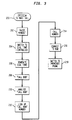
- the flow chart of Figure 4 illustrates the various steps of just one aspect of the system for generating within a premises a dial tone for enhanced phone services.
- the blocks of the flow chart are numbered with numerals starting in the 200 series.
- the premises customer initially decides to make a telephone call.
- the premises customer picks the handset 14a from off the premises phone hook 14b (block 202) and the switch 30 automatically couples the premises phone into communication with the dial tone controller (block 204).
- the dial tone controller 22 and switch 30 determine when the "off-hook" condition occurs.
- the dial tone controller 22 generates a dial tone to the premises phone 14 (block 206).
- the premises customer then speaks "call Bob” after receiving the dial tone (block 208).
- the voice recognition circuitry 64 of the dial tone controller 22 analyzes the command "call Bob" (block 210) and the microprocessor 52 looks up the corresponding telephone number for the command "call Bob" within the database (block 212).
- the dial tone controller 22 calls the number (block 214) and connects to Bob (block 216).
- the switch 30 then couples the premises phone 14 to the phone network 16 via the first communication channel 20 (block 218) once a call completion is made.
Landscapes
- Engineering & Computer Science (AREA)
- Computer Networks & Wireless Communication (AREA)
- Signal Processing (AREA)
- Telephonic Communication Services (AREA)
- Sub-Exchange Stations And Push- Button Telephones (AREA)
Applications Claiming Priority (2)
| Application Number | Priority Date | Filing Date | Title |
|---|---|---|---|
| US08/488,667 US5781625A (en) | 1995-06-08 | 1995-06-08 | System and apparatus for generating within the premises a dial tone for enhanced phone services |
| US488667 | 1995-06-08 |
Publications (1)
| Publication Number | Publication Date |
|---|---|
| EP0748101A2 true EP0748101A2 (en) | 1996-12-11 |
Family
ID=23940634
Family Applications (1)
| Application Number | Title | Priority Date | Filing Date |
|---|---|---|---|
| EP96303798A Withdrawn EP0748101A2 (en) | 1995-06-08 | 1996-05-29 | System and apparatus for generating within the premises a dial tone for enhanced phone services |
Country Status (3)
| Country | Link |
|---|---|
| US (1) | US5781625A (ja) |
| EP (1) | EP0748101A2 (ja) |
| JP (1) | JPH098953A (ja) |
Families Citing this family (11)
| Publication number | Priority date | Publication date | Assignee | Title |
|---|---|---|---|---|
| JPH09172430A (ja) * | 1995-12-21 | 1997-06-30 | Sharp Corp | 最適無線通信路の自動選択装置 |
| US7630895B2 (en) * | 2000-01-21 | 2009-12-08 | At&T Intellectual Property I, L.P. | Speaker verification method |
| US6198945B1 (en) * | 1998-01-22 | 2001-03-06 | Lucent Technologies, Inc. | Method for providing a dial tone for use in wireless environments |
| US9294629B2 (en) * | 1998-04-16 | 2016-03-22 | At&T Intellectual Property I, L.P. | Home gateway system with telephony functions and method |
| US7027566B2 (en) * | 1998-04-16 | 2006-04-11 | Sbc Knowledg Ventures, L.P | Home gateway system with telephony functions and method |
| KR100557110B1 (ko) * | 1998-08-01 | 2006-06-16 | 삼성전자주식회사 | 무선가입자망 단말장치의 다이얼링 방법 |
| US6327346B1 (en) * | 1998-09-01 | 2001-12-04 | At&T Corp. | Method and apparatus for setting user communication parameters based on voice identification of users |
| US6839410B2 (en) | 1998-09-01 | 2005-01-04 | At&T Corp. | Method and apparatus for setting user communication parameters based on voice identification of users |
| US6853714B2 (en) * | 2000-02-25 | 2005-02-08 | Keith A. Liljestrand | Apparatus and method for providing enhanced telecommunications services |
| EP1661124A4 (en) * | 2003-09-05 | 2008-08-13 | Stephen D Grody | PROCESSES AND DEVICES FOR PROVIDING SERVICES THROUGH THE USE OF LANGUAGE IDENTIFICATION |
| US8675849B2 (en) * | 2005-02-09 | 2014-03-18 | Cisco Technology, Inc. | Ubiquitous transfer of a phone number to another phone |
Family Cites Families (5)
| Publication number | Priority date | Publication date | Assignee | Title |
|---|---|---|---|---|
| US4322581A (en) * | 1980-02-11 | 1982-03-30 | Stromberg-Carlson Corporation | Multifunction telephone with message information and control information circuits for connecting stations and common equipment in a telephone network |
| CA1158738A (en) * | 1980-04-30 | 1983-12-13 | Manitoba Telephone System (The) | Video and data distribution module with subscriber terminal |
| US4748656A (en) * | 1986-03-21 | 1988-05-31 | American Telephone And Telegraph Company | Personal computer--as an interface between a telephone station set and a business communication system |
| US4928302A (en) * | 1987-11-06 | 1990-05-22 | Ricoh Company, Ltd. | Voice actuated dialing apparatus |
| US5359598A (en) * | 1990-06-22 | 1994-10-25 | Unisys Corporation | Voice server for digital communication network |
-
1995
- 1995-06-08 US US08/488,667 patent/US5781625A/en not_active Expired - Fee Related
-
1996
- 1996-05-29 EP EP96303798A patent/EP0748101A2/en not_active Withdrawn
- 1996-06-07 JP JP8145319A patent/JPH098953A/ja active Pending
Also Published As
| Publication number | Publication date |
|---|---|
| JPH098953A (ja) | 1997-01-10 |
| US5781625A (en) | 1998-07-14 |
Similar Documents
| Publication | Publication Date | Title |
|---|---|---|
| US5526403A (en) | Wireline interface for cellular telephone | |
| US6011794A (en) | Internet based telephone apparatus and method | |
| US5499287A (en) | FAX-telephone interface circuit | |
| US4139739A (en) | Telecommunications call back system | |
| EP0684722B1 (en) | Diverter interface between two telecommunication lines and a subscriber station set | |
| US4645879A (en) | Call-routing device | |
| US5781625A (en) | System and apparatus for generating within the premises a dial tone for enhanced phone services | |
| US6377576B1 (en) | Telephone call setup procedure | |
| KR940009476B1 (ko) | 표준 전화기를 갖는 셀룰러 전화 | |
| CA2234499A1 (en) | Remote answering of doorbell | |
| JPS5986357A (ja) | 自動交換電話装置 | |
| US5878118A (en) | Computerized telephone apparatus | |
| JPS58108849A (ja) | 被呼者情報自動記憶装置 | |
| JPH05276555A (ja) | 電話制御装置および電話交換装置 | |
| US5410539A (en) | Communication apparatus and method | |
| GB2340340A (en) | Call back procedure giving the effect of reverse-charge call | |
| JP3232640B2 (ja) | 電話交換機 | |
| KR100779797B1 (ko) | 교환기의 디아이디 국선에 대한 발신자 정보 표시 방법 | |
| KR970004825B1 (ko) | 국제통신 콜링(calling) 제어장치 및 그 제조방법 | |
| KR100469742B1 (ko) | 사설 교환시스템에서 디아디 기능을 이용한 디자 전용 국선설정 방법 | |
| KR100402677B1 (ko) | 발신자 정보 표시 서비스를 제공하기 위한 아날로그가입자용 접속장치 | |
| JP2968635B2 (ja) | Isdn電話通信方法及び装置 | |
| KR19980013936A (ko) | 전자식 간이 교환장치의 호 서비스방법 | |
| KR100255323B1 (ko) | 사설교환기에 접속된 음성우편장치의 팩스 자동전환방법 | |
| KR100247178B1 (ko) | 교환기에서 착신호와 발신호의 충돌을 방지하는 장치 및 방법 |
Legal Events
| Date | Code | Title | Description |
|---|---|---|---|
| PUAI | Public reference made under article 153(3) epc to a published international application that has entered the european phase |
Free format text: ORIGINAL CODE: 0009012 |
|
| AK | Designated contracting states |
Kind code of ref document: A2 Designated state(s): DE GB |
|
| STAA | Information on the status of an ep patent application or granted ep patent |
Free format text: STATUS: THE APPLICATION HAS BEEN WITHDRAWN |
|
| 18W | Application withdrawn |
Withdrawal date: 19970821 |