EP0749067A2 - Optimierer - Google Patents
Optimierer Download PDFInfo
- Publication number
- EP0749067A2 EP0749067A2 EP96304374A EP96304374A EP0749067A2 EP 0749067 A2 EP0749067 A2 EP 0749067A2 EP 96304374 A EP96304374 A EP 96304374A EP 96304374 A EP96304374 A EP 96304374A EP 0749067 A2 EP0749067 A2 EP 0749067A2
- Authority
- EP
- European Patent Office
- Prior art keywords
- constant
- expression
- variable
- hold variable
- operand
- Prior art date
- Legal status (The legal status is an assumption and is not a legal conclusion. Google has not performed a legal analysis and makes no representation as to the accuracy of the status listed.)
- Granted
Links
Images







Classifications
-
- G—PHYSICS
- G06—COMPUTING OR CALCULATING; COUNTING
- G06F—ELECTRIC DIGITAL DATA PROCESSING
- G06F8/00—Arrangements for software engineering
- G06F8/40—Transformation of program code
-
- G—PHYSICS
- G06—COMPUTING OR CALCULATING; COUNTING
- G06F—ELECTRIC DIGITAL DATA PROCESSING
- G06F8/00—Arrangements for software engineering
- G06F8/40—Transformation of program code
- G06F8/41—Compilation
- G06F8/44—Encoding
- G06F8/443—Optimisation
Definitions
- the machine language program in the following description includes the assembler program.
- a source program written in a high level language is compiled by a compiler to a machine language program.
- Such a compiler is provided with an optimizer.
- a program written in a programming language is rewritten by the optimizer so as to be efficiently executed in a micro processor of a target machine.
- the optimizer rewrites a program in various manners in order to minimize the total running time of a finally produced machine language program and the total size of the program (the total running time of a finally prepared machine language program, or a memory size of such a machine language program is generally called "cost").
- Processes conducted by an optimizer include the constant propagation process and the constant folding process which are used for rewriting a program so as to reduce the total running time and the memory size of a machine language program. When these processes are alternately repeated, the optimizer can largely reduce the number of expressions in the program. This will be described with reference to diagrams of FIGs. 13A to 13F.
- FIG. 13B shows the result of this rewriting.
- the variables x and y remain unchanged because they are variables which are not a constant hold variable, such as variables holding a return value of a function.
- the optimizer judges the substitution expression to be a redundant substitution expression and deletes the substitution expression so that the code size of the expression is reduced.
- the optimizer searches an operation expression wherein the constant hold variable "b" is an operand.
- Three arrows elongate from the variable "b”, and respectively terminate at other variables "b". The arrows indicate operation expressions wherein the variable "b" is used as an operand.
- the optimizer searches operation expressions at the positions s9, s10, and s11, and rewrites the constant hold variable "b" which is used in the operation expressions as an operand, to its hold value "30000.”
- the optimizer conducts a resource allocation process, so that variables remaining in the program are allocated to registers or a memory.
- the optimizer allocates variables having live ranges which overlap with each other, to different registers, because of the following reason.
- a live range is a range in a program extending from the substitution of a variable to the final use of the variable.
- variables having live ranges which overlap with each other are allocated to the same register, a number of processes of saving and restoring values held by the register are required in a machine language program.
- the optimizer allocates some of the variables to a memory.
- the optimizer of the invention may further comprise:
- the optimizer of the invention may further comprise:
- the optimizer of the invention may further comprise:
- the management means manages a constant hold variable which are variables into which a constant is to be substituted, as a related expression set of the constant hold variable, by associating an expression wherein a constant is substituted into the constant hold variable with an expression wherein the constant hold variable is an operand.
- a constant hold variable is an operand
- an expression wherein any other operand is a constant
- an expression of unary operation wherein the constant hold variable is an operand are rewritten by the first rewrite means to an expression, therein the constant held by the constant hold variable being an operand.
- an immediate data indicative of the constant held by the constant hold variable is set as an operand of a machine language operation.
- the constant hold variable is an operand
- machine language instructions is generated wherein one operand is a register or a memory and another operand is an immediate value.
- the first estimation means estimates the execute cycle and/or the code size of the machine language instruction in the unit of a related expression set on the basis of the byte length of the constant.
- the comparison means compares an estimation result of the first estimation means with an estimation result of the second estimation means, for each related expression set.
- the second rewrite means rewrites any constant hold variable used as an operand to a constant held in the constant hold variable.
- an expression wherein any operand is made a constant by rewriting conducted by the first and second rewrite means is rewritten by the fourth rewrite means to an expression wherein an operation result is substituted.
- the operation result is a constant (immediate data) which is equivalent to a constant expression, such as "300" in the case of "100 + 200" and "70” in the case of "30 + 10*4.”
- the control means After rewriting of the fourth rewrite means is conducted, the control means causes the new constant hold variable into which the operation result is to be substituted in the expression generated by the rewriting, the expression wherein a constant is substituted into the constant hold variable, and any expression wherein the constant hold variable is used as an operand, to be managed as a related expression set of the constant hold variable by the management means.
- the first rewrite means is activated on the related expression set which is newly managed by the management means. When the first rewrite means is activated, the first and second estimation means are then activated, and the second rewrite means is activated. Therefore, also the new constant hold variable related expression set is subjected to estimation of the execute cycle and/or the code size, and to rewriting of expressions in the related expression set on the basis of the estimation result.
- the resource allocation means allocates variables in the program to registers or a memory, on the basis of an overlap state of live ranges of the variables and a use frequency of each variable.
- variables which are allocated to the memory by the resource allocation means a variable which is a constant hold variable is judged.
- the fifth rewrite means rewrites any constant hold variable which is an operand in a related expression set of the judged constant hold variable, to the constant held in the constant hold variable.
- the third rewrite means deletes an expression wherein a constant is substituted into the constant hold variable.
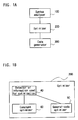
- FIG. 1A is a diagram of the configuration of the compiler.
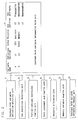
- FIG. 2 is a diagram of the internal configuration of a constant optimizer 60 in the embodiment of the invention.
- FIG. 3 is a flowchart showing the process of a partial constant expression rewrite unit 9.
- FIG. 4B is a diagram of the configuration of a memory variable rewrite unit 12.
- FIG. 5 is a diagram showing an example of contents held in a cost hold unit 15.
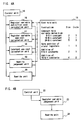
- FIG. 6A is a flowchart showing the process of the cost judgement and rewrite unit 10, in the internal configuration of the constant optimizer 60.
- FIG. 6B is a flowchart showing the process of the memory variable rewrite unit 12, in the internal configuration of the constant optimizer 60.
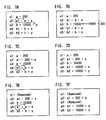
- FIG. 7A through FIG. 7F are diagrams showing an example of a source program and an intermediate language program, and the manner of rewriting the example.
- FIG. 7A shows an example of a source program.
- FIG. 7C shows an example of an intermediate language program which has passed through the cost judgement and rewrite unit.
- FIG. 7E shows an example of an intermediate language program which has passed through a constant hold variable definition removal unit.
- FIG. 7F shows an example of an intermediate language program which has passed through the constant hold variable definition removal unit.
- FIG. 8A through FIG. 8E are diagrams showing the transition manner of contents of constant variable information.
- FIG. 8A shows an example of constant variable information which has been subjected to the process of a use expression detection unit 8.
- FIG. 8B shows an example of constant variable information which has been subjected to the process of the partial constant expression rewrite unit 9.
- FIG. 8C shows an example of constant variable information which has been subjected to the process of the cost judgement and rewrite unit 10.
- FIG. 8D shows an example of constant variable information which has been subjected to the process of the memory variable rewrite unit 12.
- FIG. 11B shows an example of an intermediate language program which has passed through the partial constant expression rewrite unit.
- FIG. 11D shows an example of an intermediate language program which has been subjected to constant propagation and constant folding.
- FIG. 11F shows an example of an intermediate language program which has been subjected to constant propagation and constant folding.
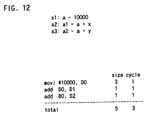
- FIG. 12 shows an example of a machine language program which has passed through the optimizer of the invention.
- FIG. 13B shows an example of an intermediate language program which has been subjected to constant propagation and constant folding in the prior art.
- FIG. 13C shows an example of an intermediate language program which has been subjected to constant propagation and constant folding in the prior art.
- FIG. 13E shows an example of an intermediate language program which has been subjected to constant propagation and constant folding in the prior art.
- FIG. 13F shows an example of an intermediate language program which has been subjected to constant propagation and constant folding in the prior art.
- the optimizer is disposed in a compiler for a high level language such as C language, and activated after the compiler conducts a lexical analysis, a syntax analysis, and a semantic analysis on a source program.
- the program to be processed is an intermediate language program which is to be output as the analysis result after the compiler conducts a lexical analysis, a syntax analysis, and a semantic analysis.
- FIG. 1A is a diagram of the configuration of the compiler in the embodiment of the invention.
- the compiler comprises a syntax analyzer 100, an optimizer 200, and a code generator 300.
- the optimizer 200 optimizes the intermediate language program so that the program size of a finally prepared machine language program is reduced and the running time is shortened.
- the code generator 300 converts the optimized intermediate language program into machine language instructions of the target machine, and outputs the instructions in the form of a machine language program.
- FIG. 1B is a diagram of the configuration of the optimizer 200 shown in FIG. 1A.
- the optimizer 200 comprises an optimization information detector 40, a general-code optimizer 50, and a constant optimizer 60.
- the general-code optimizer 50 conducts optimization operations except constant optimization, such as dead-code elimination, inline expansion, and code motion of a loop invariant expression.
- constant optimization such as dead-code elimination, inline expansion, and code motion of a loop invariant expression.
- the other optimization operations such as dead-code elimination, inline expansion, and code movement of a loop invariant expression are not within the scope of the invention and therefore their description is omitted.
- FIG. 2 is a diagram of the configuration of the constant optimizer 60.
- the constant optimizer 60 comprises a constant hold variable information hold unit 6, a constant hold variable definition detection unit 7, a use expression detection unit 8, a partial constant expression rewrite unit 9, a cost judgement and rewrite unit 10, a resource allocation unit 11, a memory variable rewrite unit 12, and a constant hold variable definition removal unit 13.
- constant hold variable information hold unit 6 a data base of constant hold variable information held by a plurality of constant hold variables defined in the program is constructed.
- An example of constant hold variable information is shown in the frame in the figure indicating the constant hold variable information hold unit 6.
- Each constant hold variable information is configured by: the name of a constant hold variable; the position at which the constant hold variable is defined and which is indicated by means of position information in the program; a value held by the constant hold variable; a resource column indicating a resource to which the constant hold variable is allocated; the position at which the constant hold variable is used and which is indicated by means of position information in the program; and use attributes of use positions indicative of whether a hold value to be propagated to the respective use positions or not.
- the position information described above is information which is provided for each of operation expressions, such as the example shown in FIGs. 13A to 13F, and corresponds to s1, s2, s3, s4, ... in the figures.
- the constant hold variable definition detection unit 7 detects from the program a substitution expression in which a constant or a constant expression is substituted into a variable, and checks the name of a constant hold variable which is defined in the detected substitution expression, the definition position of the constant hold variable, and the value held by the constant hold variable. The constant hold variable definition detection unit 7 then bundles these sets of information into one set of constant hold variable information, and registers the information in the data base of the constant hold variable information hold unit 6.
- a constant hold variable has been described above.
- a variable which is not a constant hold variable is a variable holding a value which is not uniquely determined by a substitution expression. For example, this value corresponds to a variable which stores a return value of a function, a variable which varies in value during execution of a program, etc. such as those described in the prior art example.
- the partial constant expression rewrite unit 9 it is forecasted whether, when a constant hold variable used as an operand in the program is replaced with its hold value, an operation expression containing the operand becomes a constant or a constant expression or not. In view of the result of the data flow analysis, it is verified whether, even when the replacement is conducted, the dependence relationships between variables can be ensured or not. If, as a result of the series of the processes, it is forecasted that the replacement to the hold value causes the operation expression to become a constant or a constant expression and it is verified that the dependence relationships between variables can be held, the replacement is then executed. After the execution of the replacement, "propagation" is substituted into the use attribute of constant hold variable information held in the constant hold variable information hold unit 6, thereby causing a trace of the replacement to remain.
- a constant hold variable which has been forecasted that the cost of the allocation to a register is lower, and verified that, even when the variable is rewritten to its hold value, the dependence relationships between variables can be ensured, and which has not been allocated to a register by the resource allocation unit 11 is rewritten to a constant which is the hold value. "Propagation" is substituted into the use attribute of the constant hold variable information held in the constant hold variable information hold unit 6, thereby causing a trace of the rewriting to remain.
- Step a2 cooperates with step a9 so that the succeeding processes (steps a3 to a8) are repeated for all the operation expressions wherein the constant hold variable which is currently processed in step al is contained as an operand.
- step a3 it is checked whether, when the currently processed constant hold variable is replaced with its hold value, an operation expression containing the constant hold variable becomes a constant expression or not.
- the constant hold variable is checked to see whether it is an operand of a unary operator or not, and whether it is an operand of a binary operator and the other operand is a constant or a constant hold variable or not.
- step a5 it is checked whether, as a result of the replacement in step a4, a new constant expression appears in the program or not.
- the new constant expression in the program is folded into a constant.
- step a6 it is judged whether the expression (substitution expression) which is rewritten in steps a4 and a5 becomes the substitution expression defining the constant hold variable or not.
- step a7 with respect to the substitution expression defining the constant hold variable which is judged in step a6 to be coincident, the name, the definition position, and the hold value of the constant hold variable are bundled to be registered in the data base of the constant hold variable information hold unit 6.
- step a8 with respect to the constant hold variable which is registered in step a7 in the data base of the constant hold variable information hold unit 6, all operation expressions wherein the constant hold variable is positioned at an operand are detected from the program. The positions of the detected operation expressions are registered in the constant hold variable information hold unit 6, and the use attribute of the constant hold variable information is set to "nonpropagation".
- FIG. 4A is a diagram of the internal configuration of the cost judgement and rewrite unit 10.
- the control unit 14 performs the process according to the flowchart of FIG. 6A.
- Step b1 cooperates with step b7 so that the constant hold variables which are registered in the constant hold variable information hold unit 6 are processed one by one as the process object and the processes of steps b2 to b6 are repeated.
- step b2 with respect to the currently processed constant hold variable, data of the definition position of the constant hold variable are taken out from the constant hold variable information hold unit 6.
- the cost which should be consumed in a substitution expression located at the constant hold variable definition position, for taking out the substitution expression and defining the constant hold variable as a register variable (hereinafter, the cost is referred to as "register variable definition cost") is estimated.
- step b3 among the use positions of the currently processed constant hold variable, all use positions where the use attribute does not propagate are taken out from the constant hold variable information hold unit 6.
- the cost which should be consumed in an operation expression which contains a constant hold variable as an operand at the taken out use position, for taking out the operation expression and using the constant hold variable as a register variable (hereinafter, the cost is referred to as "register variable use cost") is estimated.
- step b5 from the costs calculated in steps b2 to b4, the sum of the register variable definition cost and the register variable use cost is calculated, and the sum is compared with the constant use cost.
- step b6 If the constant use cost is lower than or equal to the sum in step b5, the operation of step b6 is performed. In this case, the cost of replacing the constant hold variable with a constant is lower as a whole, and hence the use positions of the currently processed constant hold variable are taken out from the constant hold variable information hold unit 6. Furthermore, an operation expression which contains the constant hold variable as an operand at each of the constant hold variable use positions is taken out. The use of the constant hold variable which is an operand of the operation expression is replaced with that of a constant which is the hold value. The use attribute of the use position is set to "propagation".
- the cost hold unit 15 shown in FIG. 4A holds all patterns which indicate typical examples of a machine language code for performing definition and use and costs which are to be consumed in the patterns, with associating the patterns and the costs with each other.
- FIG. 5 shows a series of contents held in the cost hold unit 15. In FIG. 5, "instruction,” “size,” and “cycle” are laterally arranged in the frame indicating the cost hold unit 15.
- the cost hold unit 15 holds also costs which are consumed by these instructions, so that costs can be calculated for all the expressions contained in the program.
- Content of the cost hold unit 15 is decided by an instruction set of the processor which is a target of the compiler. An example of a part of the instruction set is illustrated at a lower portion of FIG. 5.
- the content of the cost hold unit 15 illustrated at an upper portion of FIG. 5 is decided on the basis of the instruction set. Referring to FIG. 5, expression “#imm8" represents a constant which can be represented by 8 bits. Expressions “Dn” and “reg” represent registers. Expression “@mem” represents a memory.
- the register variable definition cost calculation unit 16 performs the inference in step b2. Specifically, the cost hold unit 15 is retrieved by a substitution expression which defines a constant hold variable, a cost matching the substitution expression is taken out, and the cost is used as an inference result.
- the constant use cost calculation unit 18 is activated in step b4 and conducts retrieval on the cost hold unit 15 with respect to an operation expression which contains a constant hold variable as an operand at a constant hold variable use position where the use attribute is "nonpropagation", by using as the retrieval item an operation expression wherein a constant hold variable is replaced with a constant held by the variable. Costs matching the retrieval item are taken out, the taken out costs are accumulated, and the accumulation is used as an inference result.
- the rewrite judgement unit 19 is activated in step b5, and receives the register variable definition cost from the register variable definition cost calculation unit 16 and the register variable use cost from the register variable use cost calculation unit 17.
- the rewrite judgement unit 19 further receives the constant use cost from the constant use cost calculation unit 18 and calculates the sum of the register variable definition cost and the register variable use cost. Then, the sum is compared with the constant use cost. If the constant use cost is lower than or equal to the sum, the cost of rewriting the constant hold variable with the hold value is lower as a whole. Therefore, the rewrite unit 20 is called so that the constant hold variable is rewritten to the constant. If the constant use cost is higher, the cost of changing the constant hold variable to a register variable is lower as a whole, and hence the rewriting is not conducted.
- the rewrite unit 20 takes out the use positions of the currently processed constant hold variable from the constant hold variable information hold unit 6, and also operation expressions which contain the constant hold variable as an operand at the constant hold variable use positions.
- the use of the constant hold variable in the program is replaced with the use of the hold value, and the use attribute of each use position is set to "propagation".
- FIG. 4B is a diagram of the internal configuration of the memory variable rewrite unit 12.
- the memory variable rewrite unit 12 comprises a control unit 22, a register variable judgement unit 23, and a rewrite unit 24.
- control unit 22 calls the register variable judgement unit 23.
- FIG. 6B is a flowchart showing the procedure of the control unit 22 shown in FIG. 4B.
- Step c1 cooperates with step c7 so that the succeeding processes (steps c2 to c6) are repeated for all the constant hold variables registered in the constant hold variable information hold unit 6.
- step c2 with respect to the currently processed constant hold variable, a resource to which the variable is allocated is taken out from the constant hold variable information hold unit 6, and it is judged whether the variable is allocated to the memory or not.
- Step c3 cooperates with step c6 so that, with respect to the constant hold variable which is judged in step c2 to be allocated to the memory, the use of the constant hold variable is taken out from the constant hold variable information hold unit. Thereafter, the succeeding processes (steps c4 and c5) are repeated for all the uses of the constant hold variable.
- step c4 with respect to the use of the currently processed constant hold variable, the use attribute of the variable is taken out from the constant hold variable information hold unit 6, and it is judged whether the use attribute is "nonpropagation" or not.
- step c5 with respect to the use of the constant hold variable which is judged in step c2 to be allocated to the memory and in which the use attribute is judged in step c4 to be "nonpropagation", the use position is taken out from the constant hold variable information hold unit 6.
- the constant hold variable which is used as an operand at the use position is replaced with a constant value which is its hold value and the use attribute is set to "propagation".
- the register variable judgement unit 23 takes out the use attribute of the currently processed constant hold variable from the constant hold variable information hold unit 6. On the basis of the resource column of the constant hold variable information hold unit 6, it is judged whether the variable is allocated to a register or the memory. If it is judged that the variable is allocated to the memory, it is further judged whether the use attribute of the variable is "nonpropagation" or not. If the use attribute is "nonpropagation", the rewrite unit 24 is activated.
- the rewrite judgement unit 19 calculates the sum of the cost calculated in the register variable definition cost calculation unit 16 and that calculated in the register variable use cost calculation unit 17. The sum is compared with the cost calculated in the constant use cost calculation unit 18 (step b5).
- the process is terminated.
- the constant hold variable "b" is allocated to a register
- the program becomes as shown in FIG. 7C.
- the constant hold variable definition detection unit 7 removes the definition expression of the constant hold variable from the program, on the basis of the contents of the section of the constant hold variable definition position registered in the constant hold variable information hold unit 6.
- the attribute section of the constant hold variable information is further checked to see whether the use attribute is "nonpropagation" or not (step c4).
- the use attributes at the use positions s4 and s5 are "nonpropagation". Therefore, the rewrite unit 24 is activated so that the use of the constant hold variable is rewritten to the use of its hold value (step c5).
- the program is rewritten as shown in FIG. 7D.
- the information in the constant hold variable information hold unit is as shown in FIG. 8E and constant hold variables which can be subjected to removal of a definition expression are a and b.
- the definition expression (the position sl in the program) of the constant hold variable "a” and the definition expression (the position s3 in the program) of the constant hold variable "b” are removed, with the result that the program is finally rewritten as shown in FIG. 7F.
- the definition position of the constant hold variable "a” is taken out from the constant hold variable information hold unit 6, and the definition expression from the program.
- the unit 16 checks the matching of the position and the expression with the patterns stored in the cost hold unit 15, and takes out the definition cost of the constant hold variable "a". In this case, since 10000 is a constant which is not larger than 16 bits, size 3 and cycle 1 are taken out as the cost (step b2).
- the unit 17 checks the matching of the position and the expression with the patterns stored in the cost hold unit 15, and takes out the use cost of the constant hold variable "a". In this case, both (s2 and s3) match an addition of register variables, and size 1 and cycle 1 are taken out as the cost (step b3).
- the use position of the constant hold variable "a” is taken out from the constant hold variable information hold unit 6, and, among use expressions at the use positions, an expression where the use attribute is "nonpropagation" is taken out.
- the unit 18 checks the matching of a constant expression wherein the constant hold variable in the use expression is replaced with its hold value, with the patterns stored in the cost hold unit 15, and takes out the use cost in the case where the constant hold variable "a" is replaced with the hold value. In this example, both match an addition of a register variable and a 16-bit constant, and size 4 and cycle 2 are taken out as the cost (step b4).
- the rewrite judgement unit 19 the sum of the cost calculated in the register variable definition cost calculation unit 16 and the cost calculated in the register variable use cost calculation unit 17 is calculated. The sum is compared with the cost calculated in the constant use cost calculation unit 18 (step b5).
- the intermediate language program of FIG. 11A is changed so as to have the form of FIG. 11B.
- the variable "b” of the substitution expression at the position s4 becomes a new constant hold variable.
- the optimizer detects operation expressions at the positions s9 and s10, and rewrites the constant hold variable "b" which is used in the operation expressions as an operand, to its hold value "30000.”
- the optimizer further repeats "propagation" and folding on the variables.
- "propagation” and folding are repeated in this way, the substitution expressions at the positions s4, s9, and s10 are deleted as the program so that the program becomes very simple.
- the optimizer conducts constant propagation and constant folding. Thereafter, the optimizer allocates variables remaining in the program to registers or a memory. In the resource allocation, the optimizer allocates variables having live ranges which overlap with each other, to different registers.
- FIG. 12 shows machine language codes which are generated from the intermediate language program at the positions s1 to s3 in FIG. 11F.
- "movi #10000, D0,” “add D0, D1,” and “add D0, D2” correspond to the substitution expressions of the intermediate language program after optimization.
- memory sizes and execute cycles are written on the right side of the machine language codes.
- both the size and the running time (the number of cycles) of an instruction are used in parallel as costs.
- the setting may be conducted so that priorities are assigned to costs. Specifically, when a higher priority is to be assigned to the code size, the code size is first used as a cost, and, in the case where codes of the same size are used, the cycle numbers are compared with each other. When a higher priority is to be assigned to the running speed, the cycle number is first used as a cost, and, in the case where codes of the same cycle number are used, comparison of the code sizes is conducted. Alternatively, either of the code size and the cycle number may be singly used. It is a matter of course that a value which is obtained by performing an operation on such information may be used as a cost.
- a program can be simplified by rewriting of the first rewrite means. Since the rewriting of other expressions is conducted only when the estimation result of the first estimation means is not higher than the estimation result of the second estimation means, the cost increase due to constant propagation can be prevented from occurring. When cost propagation is conducted without causing the cost increase in this way, redundant portions are eliminated from the program. Therefore, the machine language program which is generated on the basis of the program is very high efficient.
- the optimizer of the invention can attain the following effects.
- the optimizer of the invention can attain the following effects.
- Resource allocation is conducted on variables of the program in which expressions are deleted by the first, second, and fourth rewrite means.
- constant hold variables allocated to the memory as a result of the resource allocation, a constant hold variable is caused not to be allocated to the memory, and rewritten to a constant.
- the constant hold variable is an operand and those wherein a constant is substituted, therefore, it is not required to conduct a memory access. Consequently, the running time can be shortened by a time corresponding to the memory access.
- the optimizer of the invention can attain the following effects.
- the invention provides an optimizer for a program compiler, the optimizer being operable to judge, for a constant hold variable, whether to re-write an expression containing the constant hold variable as an operand, as an expression containing a constant as an operand, on the basis of cost in terms of execution speed of the compiled program and/or code length of the compiled program.
Landscapes
- Engineering & Computer Science (AREA)
- General Engineering & Computer Science (AREA)
- Theoretical Computer Science (AREA)
- Software Systems (AREA)
- Physics & Mathematics (AREA)
- General Physics & Mathematics (AREA)
- Devices For Executing Special Programs (AREA)
Applications Claiming Priority (3)
| Application Number | Priority Date | Filing Date | Title |
|---|---|---|---|
| JP15026195A JP3650649B2 (ja) | 1995-06-16 | 1995-06-16 | 最適化装置 |
| JP15026195 | 1995-06-16 | ||
| JP150261/95 | 1995-06-16 |
Publications (3)
| Publication Number | Publication Date |
|---|---|
| EP0749067A2 true EP0749067A2 (de) | 1996-12-18 |
| EP0749067A3 EP0749067A3 (de) | 1997-05-14 |
| EP0749067B1 EP0749067B1 (de) | 2002-03-27 |
Family
ID=15493080
Family Applications (1)
| Application Number | Title | Priority Date | Filing Date |
|---|---|---|---|
| EP96304374A Expired - Lifetime EP0749067B1 (de) | 1995-06-16 | 1996-06-12 | Optimierer |
Country Status (7)
| Country | Link |
|---|---|
| US (1) | US5842021A (de) |
| EP (1) | EP0749067B1 (de) |
| JP (1) | JP3650649B2 (de) |
| KR (1) | KR100215502B1 (de) |
| CN (1) | CN1122216C (de) |
| DE (1) | DE69620057T2 (de) |
| TW (1) | TW434512B (de) |
Cited By (1)
| Publication number | Priority date | Publication date | Assignee | Title |
|---|---|---|---|---|
| EP1870842A1 (de) | 2006-06-20 | 2007-12-26 | Alcatel Lucent | Verfahren zur Erstellung von Multimediainhalten für mobile Endgeräte, Computerprogrammprodukt zur Durchführung eines solchen Verfahrens |
Families Citing this family (23)
| Publication number | Priority date | Publication date | Assignee | Title |
|---|---|---|---|---|
| US6223337B1 (en) * | 1997-12-12 | 2001-04-24 | Hewlett-Packard Company | Random test generation for compiler optimization |
| KR100492131B1 (ko) * | 1998-04-08 | 2005-08-01 | 한국항공우주산업 주식회사 | 웹 프로그램의 변수 전달 방법 |
| US6189141B1 (en) * | 1998-05-04 | 2001-02-13 | Hewlett-Packard Company | Control path evaluating trace designator with dynamically adjustable thresholds for activation of tracing for high (hot) activity and low (cold) activity of flow control |
| JP4041248B2 (ja) * | 1999-07-09 | 2008-01-30 | 松下電器産業株式会社 | コンパイラ装置、コンパイルプログラムが記録されたコンピュータ読み取り可能な記録媒体及びコンパイル方法 |
| JP2002073333A (ja) * | 2000-08-25 | 2002-03-12 | Hitachi Ltd | 手続き呼び出し先のデータ依存の解析表示方法 |
| US20040003383A1 (en) * | 2002-06-28 | 2004-01-01 | Microsoft Corporation | Stripping of unnecessary information from source code |
| US20040095348A1 (en) * | 2002-11-19 | 2004-05-20 | Bleiweiss Avi I. | Shading language interface and method |
| KR20050118177A (ko) * | 2003-03-10 | 2005-12-15 | 카테나 가부시키가이샤 | Lyee지향 소프트웨어에 관한 정적(靜的)분석방법 |
| US7784039B2 (en) * | 2004-09-22 | 2010-08-24 | Panasonic Corporation | Compiler, compilation method, and compilation program |
| JP4377369B2 (ja) * | 2005-11-09 | 2009-12-02 | 株式会社日立製作所 | リソース割当調停装置およびリソース割当調停方法 |
| US20070233745A1 (en) * | 2006-03-29 | 2007-10-04 | Ori Pomerantz | Data Flow Optimization in Meta-Directories |
| US7870544B2 (en) * | 2006-04-05 | 2011-01-11 | International Business Machines Corporation | Insuring maximum code motion of accesses to DMA buffers |
| US20080250032A1 (en) * | 2007-04-04 | 2008-10-09 | International Business Machines Corporation | Method and system for efficiently saving and retrieving values of a large number of resource variables using a small repository |
| US8087012B2 (en) * | 2007-08-21 | 2011-12-27 | International Business Machines Corporation | Eliminating maximum/minimum operations in loop bounds |
| JP5165969B2 (ja) * | 2007-08-29 | 2013-03-21 | インターナショナル・ビジネス・マシーンズ・コーポレーション | プログラムのコンパイルのために変数にレジスタを割り付ける技術 |
| US7505963B1 (en) * | 2008-01-07 | 2009-03-17 | International Business Machines Corporation | Method and system for efficiently saving and retrieving values of a large number of resource variables using a small repository |
| US20100199269A1 (en) * | 2008-02-05 | 2010-08-05 | Panasonic Corporation | Program optimization device and program optimization method |
| US9176845B2 (en) * | 2010-03-19 | 2015-11-03 | Red Hat, Inc. | Use of compiler-introduced identifiers to improve debug information pertaining to user variables |
| CN102184090B (zh) * | 2011-05-27 | 2013-12-04 | 清华大学 | 一种动态可重构处理器及其固定数的调用方法 |
| JP6481515B2 (ja) * | 2015-05-29 | 2019-03-13 | 富士通株式会社 | 情報処理装置、コンパイル方法、及びコンパイラプログラム |
| US11334469B2 (en) | 2018-04-13 | 2022-05-17 | Microsoft Technology Licensing, Llc | Compound conditional reordering for faster short-circuiting |
| CN109145013A (zh) * | 2018-08-10 | 2019-01-04 | 上海达梦数据库有限公司 | 一种表达式转换方法、装置、设备及存储介质 |
| JP6950772B2 (ja) * | 2020-03-13 | 2021-10-13 | 株式会社安川電機 | 生産システム、制御方法、及びプログラム |
Family Cites Families (5)
| Publication number | Priority date | Publication date | Assignee | Title |
|---|---|---|---|---|
| US4802091A (en) * | 1986-10-31 | 1989-01-31 | International Business Machines Corporation | Method for improving the efficiency of arithmetic code generation in an optimizing compiler using the technique of reassociation |
| JPH01108638A (ja) * | 1987-10-21 | 1989-04-25 | Hitachi Ltd | 並列化コンパイル方式 |
| JPH0417031A (ja) * | 1990-05-10 | 1992-01-21 | Nec Corp | 定数値伝播最適化方式 |
| JP3280449B2 (ja) * | 1993-03-01 | 2002-05-13 | 富士通株式会社 | コンパイル装置 |
| US5659754A (en) * | 1995-03-31 | 1997-08-19 | Sun Microsystems, Inc. | Method and apparatus for an improved optimizing compiler |
-
1995
- 1995-06-16 JP JP15026195A patent/JP3650649B2/ja not_active Expired - Fee Related
-
1996
- 1996-06-04 TW TW085106680A patent/TW434512B/zh not_active IP Right Cessation
- 1996-06-04 US US08/657,489 patent/US5842021A/en not_active Expired - Lifetime
- 1996-06-12 EP EP96304374A patent/EP0749067B1/de not_active Expired - Lifetime
- 1996-06-12 DE DE69620057T patent/DE69620057T2/de not_active Expired - Fee Related
- 1996-06-15 KR KR1019960021648A patent/KR100215502B1/ko not_active Expired - Fee Related
- 1996-06-17 CN CN96108810A patent/CN1122216C/zh not_active Expired - Fee Related
Cited By (1)
| Publication number | Priority date | Publication date | Assignee | Title |
|---|---|---|---|---|
| EP1870842A1 (de) | 2006-06-20 | 2007-12-26 | Alcatel Lucent | Verfahren zur Erstellung von Multimediainhalten für mobile Endgeräte, Computerprogrammprodukt zur Durchführung eines solchen Verfahrens |
Also Published As
| Publication number | Publication date |
|---|---|
| US5842021A (en) | 1998-11-24 |
| KR100215502B1 (ko) | 1999-08-16 |
| KR970002621A (ko) | 1997-01-28 |
| CN1122216C (zh) | 2003-09-24 |
| EP0749067A3 (de) | 1997-05-14 |
| EP0749067B1 (de) | 2002-03-27 |
| JP3650649B2 (ja) | 2005-05-25 |
| CN1143774A (zh) | 1997-02-26 |
| DE69620057T2 (de) | 2002-09-05 |
| JPH096627A (ja) | 1997-01-10 |
| DE69620057D1 (de) | 2002-05-02 |
| TW434512B (en) | 2001-05-16 |
Similar Documents
| Publication | Publication Date | Title |
|---|---|---|
| EP0749067B1 (de) | Optimierer | |
| US6427234B1 (en) | System and method for performing selective dynamic compilation using run-time information | |
| US5428793A (en) | Method and apparatus for compiling computer programs with interproceduural register allocation | |
| Chambers et al. | Customization: Optimizing compiler technology for SELF, a dynamically-typed object-oriented programming language | |
| Chambers et al. | An efficient implementation of SELF a dynamically-typed object-oriented language based on prototypes | |
| US6381738B1 (en) | Method for optimizing creation and destruction of objects in computer programs | |
| US6131189A (en) | System and method to efficiently represent aliases and indirect memory operations in static single assignment form during compilation | |
| US6463582B1 (en) | Dynamic optimizing object code translator for architecture emulation and dynamic optimizing object code translation method | |
| US6530079B1 (en) | Method for optimizing locks in computer programs | |
| JP3311462B2 (ja) | コンパイル処理装置 | |
| EP0740251B1 (de) | Optimierungsgerät zum Entfernen von Gefahren durch Arrangierung der Befehlsreihenfolge | |
| US7036118B1 (en) | System for executing computer programs on a limited-memory computing machine | |
| US5946491A (en) | Register allocation method and apparatus for gernerating spill code as a function of register pressure compared to dual thresholds | |
| Kennedy et al. | Typed fusion with applications to parallel and sequential code generation | |
| US6925639B2 (en) | Method and system for register allocation | |
| JPH03500463A (ja) | デジタルデータ処理システム用総称コード共用化装置及び方法 | |
| Chambers et al. | Whole-program optimization of object-oriented languages | |
| EP0936543A2 (de) | Programmumwandlungsverfahren und -system | |
| US5581762A (en) | Compiling apparatus having a function to analyze overlaps of memory addresses of two or more data expressions and a compiling method | |
| JP2002259134A (ja) | ポストリンク・コードの最適化方法及び装置 | |
| US20040194071A1 (en) | Compiling device, computer-readable recording medium on which a compiling program is recorded and a compiling method | |
| Verbrugge et al. | Generalized constant propagation a study in c | |
| JP4044756B2 (ja) | プログラム変換装置、プログラム変換方法、及び当該プログラム変換装置を実現するプログラム | |
| US5535392A (en) | Using hint generation to cause portions of object files to remain the same | |
| Burger | Efficient compilation and profile-driven dynamic recompilation in scheme |
Legal Events
| Date | Code | Title | Description |
|---|---|---|---|
| PUAI | Public reference made under article 153(3) epc to a published international application that has entered the european phase |
Free format text: ORIGINAL CODE: 0009012 |
|
| 17P | Request for examination filed |
Effective date: 19960703 |
|
| AK | Designated contracting states |
Kind code of ref document: A2 Designated state(s): DE FR GB NL |
|
| RIN1 | Information on inventor provided before grant (corrected) |
Inventor name: TANAKA, AKIRA Inventor name: SAYAMA, JUNKO Inventor name: ODANI, KENSUKE |
|
| PUAL | Search report despatched |
Free format text: ORIGINAL CODE: 0009013 |
|
| AK | Designated contracting states |
Kind code of ref document: A3 Designated state(s): DE FR GB NL |
|
| 17Q | First examination report despatched |
Effective date: 20000328 |
|
| GRAG | Despatch of communication of intention to grant |
Free format text: ORIGINAL CODE: EPIDOS AGRA |
|
| GRAG | Despatch of communication of intention to grant |
Free format text: ORIGINAL CODE: EPIDOS AGRA |
|
| GRAH | Despatch of communication of intention to grant a patent |
Free format text: ORIGINAL CODE: EPIDOS IGRA |
|
| GRAH | Despatch of communication of intention to grant a patent |
Free format text: ORIGINAL CODE: EPIDOS IGRA |
|
| REG | Reference to a national code |
Ref country code: GB Ref legal event code: IF02 |
|
| GRAA | (expected) grant |
Free format text: ORIGINAL CODE: 0009210 |
|
| AK | Designated contracting states |
Kind code of ref document: B1 Designated state(s): DE FR GB NL |
|
| REF | Corresponds to: |
Ref document number: 69620057 Country of ref document: DE Date of ref document: 20020502 |
|
| ET | Fr: translation filed | ||
| PLBE | No opposition filed within time limit |
Free format text: ORIGINAL CODE: 0009261 |
|
| STAA | Information on the status of an ep patent application or granted ep patent |
Free format text: STATUS: NO OPPOSITION FILED WITHIN TIME LIMIT |
|
| 26N | No opposition filed |
Effective date: 20021230 |
|
| PGFP | Annual fee paid to national office [announced via postgrant information from national office to epo] |
Ref country code: FR Payment date: 20050608 Year of fee payment: 10 |
|
| PGFP | Annual fee paid to national office [announced via postgrant information from national office to epo] |
Ref country code: DE Payment date: 20050609 Year of fee payment: 10 |
|
| PG25 | Lapsed in a contracting state [announced via postgrant information from national office to epo] |
Ref country code: DE Free format text: LAPSE BECAUSE OF NON-PAYMENT OF DUE FEES Effective date: 20070103 |
|
| REG | Reference to a national code |
Ref country code: FR Ref legal event code: ST Effective date: 20070228 |
|
| PG25 | Lapsed in a contracting state [announced via postgrant information from national office to epo] |
Ref country code: FR Free format text: LAPSE BECAUSE OF NON-PAYMENT OF DUE FEES Effective date: 20060630 |
|
| PGFP | Annual fee paid to national office [announced via postgrant information from national office to epo] |
Ref country code: NL Payment date: 20090615 Year of fee payment: 14 |
|
| PGFP | Annual fee paid to national office [announced via postgrant information from national office to epo] |
Ref country code: GB Payment date: 20090610 Year of fee payment: 14 |
|
| REG | Reference to a national code |
Ref country code: NL Ref legal event code: V1 Effective date: 20110101 |
|
| GBPC | Gb: european patent ceased through non-payment of renewal fee |
Effective date: 20100612 |
|
| PG25 | Lapsed in a contracting state [announced via postgrant information from national office to epo] |
Ref country code: NL Free format text: LAPSE BECAUSE OF NON-PAYMENT OF DUE FEES Effective date: 20110101 |
|
| PG25 | Lapsed in a contracting state [announced via postgrant information from national office to epo] |
Ref country code: GB Free format text: LAPSE BECAUSE OF NON-PAYMENT OF DUE FEES Effective date: 20100612 |