EP0749201A1 - Phasen-synchronisiertes Motor-Steuerungssystem - Google Patents
Phasen-synchronisiertes Motor-Steuerungssystem Download PDFInfo
- Publication number
- EP0749201A1 EP0749201A1 EP96109496A EP96109496A EP0749201A1 EP 0749201 A1 EP0749201 A1 EP 0749201A1 EP 96109496 A EP96109496 A EP 96109496A EP 96109496 A EP96109496 A EP 96109496A EP 0749201 A1 EP0749201 A1 EP 0749201A1
- Authority
- EP
- European Patent Office
- Prior art keywords
- motor
- signal
- phase
- timing signal
- period
- Prior art date
- Legal status (The legal status is an assumption and is not a legal conclusion. Google has not performed a legal analysis and makes no representation as to the accuracy of the status listed.)
- Granted
Links
- 238000000034 method Methods 0.000 claims abstract description 10
- 230000008859 change Effects 0.000 description 11
- 238000010586 diagram Methods 0.000 description 6
- 230000006870 function Effects 0.000 description 5
- 238000009987 spinning Methods 0.000 description 4
- 239000003086 colorant Substances 0.000 description 3
- 230000010354 integration Effects 0.000 description 3
- 230000004044 response Effects 0.000 description 3
- 230000001360 synchronised effect Effects 0.000 description 3
- 240000007320 Pinus strobus Species 0.000 description 2
- 230000008901 benefit Effects 0.000 description 2
- 230000008569 process Effects 0.000 description 2
- 238000012545 processing Methods 0.000 description 2
- 230000002123 temporal effect Effects 0.000 description 2
- 230000002411 adverse Effects 0.000 description 1
- 230000003247 decreasing effect Effects 0.000 description 1
- 238000013461 design Methods 0.000 description 1
- VPWFPZBFBFHIIL-UHFFFAOYSA-L disodium 4-[(4-methyl-2-sulfophenyl)diazenyl]-3-oxidonaphthalene-2-carboxylate Chemical compound [Na+].[Na+].[O-]S(=O)(=O)C1=CC(C)=CC=C1N=NC1=C(O)C(C([O-])=O)=CC2=CC=CC=C12 VPWFPZBFBFHIIL-UHFFFAOYSA-L 0.000 description 1
- 238000001914 filtration Methods 0.000 description 1
- 230000007274 generation of a signal involved in cell-cell signaling Effects 0.000 description 1
- 239000004973 liquid crystal related substance Substances 0.000 description 1
- 238000005259 measurement Methods 0.000 description 1
- 238000012986 modification Methods 0.000 description 1
- 230000004048 modification Effects 0.000 description 1
- 230000003287 optical effect Effects 0.000 description 1
- KXXXUIKPSVVSAW-UHFFFAOYSA-K pyranine Chemical compound [Na+].[Na+].[Na+].C1=C2C(O)=CC(S([O-])(=O)=O)=C(C=C3)C2=C2C3=C(S([O-])(=O)=O)C=C(S([O-])(=O)=O)C2=C1 KXXXUIKPSVVSAW-UHFFFAOYSA-K 0.000 description 1
- 238000004904 shortening Methods 0.000 description 1
- 230000011664 signaling Effects 0.000 description 1
Images


Classifications
-
- H—ELECTRICITY
- H04—ELECTRIC COMMUNICATION TECHNIQUE
- H04N—PICTORIAL COMMUNICATION, e.g. TELEVISION
- H04N9/00—Details of colour television systems
- H04N9/12—Picture reproducers
- H04N9/31—Projection devices for colour picture display, e.g. using electronic spatial light modulators [ESLM]
- H04N9/3102—Projection devices for colour picture display, e.g. using electronic spatial light modulators [ESLM] using two-dimensional electronic spatial light modulators
- H04N9/3111—Projection devices for colour picture display, e.g. using electronic spatial light modulators [ESLM] using two-dimensional electronic spatial light modulators for displaying the colours sequentially, e.g. by using sequentially activated light sources
- H04N9/3114—Projection devices for colour picture display, e.g. using electronic spatial light modulators [ESLM] using two-dimensional electronic spatial light modulators for displaying the colours sequentially, e.g. by using sequentially activated light sources by using a sequential colour filter producing one colour at a time
-
- H—ELECTRICITY
- H02—GENERATION; CONVERSION OR DISTRIBUTION OF ELECTRIC POWER
- H02P—CONTROL OR REGULATION OF ELECTRIC MOTORS, ELECTRIC GENERATORS OR DYNAMO-ELECTRIC CONVERTERS; CONTROLLING TRANSFORMERS, REACTORS OR CHOKE COILS
- H02P23/00—Arrangements or methods for the control of AC motors characterised by a control method other than vector control
- H02P23/18—Controlling the angular speed together with angular position or phase
- H02P23/186—Controlling the angular speed together with angular position or phase of one shaft by controlling the prime mover
-
- H—ELECTRICITY
- H02—GENERATION; CONVERSION OR DISTRIBUTION OF ELECTRIC POWER
- H02P—CONTROL OR REGULATION OF ELECTRIC MOTORS, ELECTRIC GENERATORS OR DYNAMO-ELECTRIC CONVERTERS; CONTROLLING TRANSFORMERS, REACTORS OR CHOKE COILS
- H02P23/00—Arrangements or methods for the control of AC motors characterised by a control method other than vector control
- H02P23/22—Controlling the speed digitally using a reference oscillator, a speed proportional pulse rate feedback and a digital comparator
-
- G—PHYSICS
- G09—EDUCATION; CRYPTOGRAPHY; DISPLAY; ADVERTISING; SEALS
- G09G—ARRANGEMENTS OR CIRCUITS FOR CONTROL OF INDICATING DEVICES USING STATIC MEANS TO PRESENT VARIABLE INFORMATION
- G09G2310/00—Command of the display device
- G09G2310/02—Addressing, scanning or driving the display screen or processing steps related thereto
- G09G2310/0235—Field-sequential colour display
Definitions
- This invention relates to the field of motor control systems, more particularly to phase-locked color wheel systems.
- Display systems are commonly used to convey information to system observers.
- Display systems typically include some type of spatial light modulator, such as a Cathode Ray Tube (CRT) or Liquid Crystal Display (LCD) to form a modulated light image.
- CRT Cathode Ray Tube
- LCD Liquid Crystal Display
- One new type of display system which has the capability to replace the conventional Cathode Ray Tube (CRT) based display system in many applications, is based on Texas Instruments' Digital Micromirror Device (DMD).
- the DMD is an integrated circuit that includes a large number of very small mirrors on the surface of the circuit.
- a typical DMD may have over one million mirrors, each approximately 17 mm across, in a sealed package having a transparent cover over the mirrors.
- Addressing circuitry in the DMD is used to electrostatically rotate each mirror +/- 10° about a hinge axis. The rotated position of the mirror determines the direction incident light will be deflected from the surface of the mirror.
- a projection lamp In a typical DMD-based display system, a projection lamp generates a beam of light which is focused onto the surface of the DMD.
- the incident beam of light generally strikes the surface of the DMD along a path which is 20° from normal to the surface of the DMD.
- Mirrors which are rotated to a first "ON" position reflect the incident light along a path which is normal to the surface of the DMD.
- Mirrors which are rotated in the opposite "OFF" direction reflect light along a path which is 40° from normal to the surface of the DMD and 60° away from the incident light beam.
- a projection lens is used to capture the light which has been reflected by the DMD along a path normal to the surface of the DMD.
- the projection lens focuses this light onto a viewing screen.
- Each mirror has a one-to-one relationship with a portion of the viewing screen such that for each mirror that is rotated to the "ON" position, there is a corresponding bright spot on the viewing screen.
- the bright spots collectively form an image which may be interpreted by a viewer.
- Realistic images require many intensity levels to represent realistically life-like shading and contouring.
- modern versions of the DMD are only designed to operate in either the "ON" position, in which all of the light incident on the mirror is reflected onto the viewing screen, or in the "OFF" position, in which none of the incident light is reflected onto the viewing screen. Therefore, time based integration methods are used to create images which have multiple intensity levels.
- Typical video signals are transmitted as a series of video frames, or images, each frame representing the complete image at a given point in time.
- Time based integration is implemented by breaking each image frame into a series of subframes. Individually, each subframe is a single-intensity version of the desired image and does not represent the entire image accurately. But, because the human eye integrates a series of instantaneous images, a series of subframes may be created which will appear, to the human eye, to be a single image with multiple intensity levels.
- Multiple beams of colored light are used to generate a full-color image.
- the output of three separate image display systems one with a red light source, one with a green light source, and one with a blue light source, may be combined to create a full-color image.
- a single image display system sequentially may use three light sources to generate a full-color image.
- the integration properties of the human eye are relied upon to blend the three monochromatic images of a color-serial display system into a single full-color image.
- a motor control system which provides a low-cost method of phase-locking a motor to an input timing signal.
- a timer circuit measures the period of a timing signal and the relative phase between the timing signal and a motor rotor.
- a frequency command generator circuit outputs a motor speed command based on the period of the timing signal and the relative phase of the timing signal compared to the motor rotor.
- the motor speed command controls the output of a motor driver circuit such that the motor driver circuit drives the motor rotor speed synchronously with the input timing signal.
- the motor speed command also causes the motor driver to gradually alter the rotor speed thereby adjusting the relative phase between the input timing signal and the motor rotor.
- the frequency command generator introduces a small frequency-lock error in order to change the phase relationship between the rotor and the timing signal.
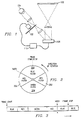
- An efficient method of generating three single-color images is to use a single display system with a color wheel 102 added in the light path.
- light from a light source 104 passes through the color wheel 102 and is focused on a spatial light modulator 106.
- the spatial light modulator 106 modulates the light to form an image bearing light beam which is projected onto a viewing surface 108.
- a controller 110 writes image data to the spatial light modulator 106 and synchronizes the operation of the spatial light modulator 106 with the rotation of the color wheel 102.
- the color wheel 102 shown in Figure 2, is typically a transparent disk on which three different colored light filters are attached.
- the three light filters preferably abut on the wheel in order to maximize the amount of time the light passing through the color wheel is monochromatic. As the color wheel turns in the light path, the light passing through the wheel will be changed from one color to the next. If the speed of the color wheel equals the rate at which the image frames are provided, each of the filters rotates through the light path during each frame, and each image frame is comprised of several monochromatic images. As described in U.S.
- each of the monochromatic image frames is comprised of multiple bit-planes, allowing the image perceived by the human eye to include a full range of colors and intensities.
- the color wheel 102 shown in Figure 2 includes red 202, green 204, and blue 206 filters, each covering one-third of the color wheel surface.
- the red filter is comprised of two segments while the green and blue filters are a single segment.
- the rotation of the color wheel is synchronized with the video frames so that each frame of video data is displayed during a period that begins and ends when the light beam is passing through the middle of the blue filter.
- Many other color filter combinations are possible.
- a color wheel 102 may be fabricated with six segments, or any other number of segments.
- a four-segment color wheel could have two blue segments or two green segments instead of the two red segments shown in Figure 2.
- FIG. 3 A simplified timeline showing the periods in which the three colors are displayed is shown in Figure 3.
- the bit sequences shown in Figure 3 are for instructional purposes only and do not represent the optimum bit sequences.
- the display period for some of the longer image bits is typically broken up into multiple non-contiguous display periods. Additionally, in horizontal split-reset DMD systems, separate portions of the spatial light modulator will display the image bits in a unique order.
- a frequency-locked loop circuit may be used to synchronize the operation of the spatial light modulator and the motor used to turn the color wheel.
- motor speed is synchronized to the vertical synchronization signal, VSYNC, component of the input video signal, which indicates the beginning of each image frame.
- An image frame buffer stores one image frame until the color wheel reaches a point where a given filter enters the light path signalling that a new display frame is to begin.
- a position sensor outputs a signal, INDEX, indicating the beginning of a new display frame. After the INDEX signal is received, the display system reads the image data from the frame memory and writes it to the spatial light modulator.
- a frequency-locked control circuit has the advantage of being simple to design, but requires an additional frame memory, which drives up the cost of the display, in order to buffer the output of the image processing circuitry prior to input to the spatial light modulator. Furthermore, because control systems always have some uncorrected errors, a frequency locked loop will have some frequency error implying that the buffer/frame memory will be over/under filled. This error may cause the display system to skip a frame of data and lead to visible temporal artifacts in the projected image.
- the additional frame memory may be eliminated by phase-locking the color wheel to the incoming video signal.
- the color wheel is phase-locked to the input video signal, there is a pre-determined relationship between the VSYNC and INDEX signals.
- a phase-locked display system allows the image processing circuitry to write one frame of image data into a frame memory while the prior frame of image data is read out of a second frame memory by the spatial light modulator.
- a phase-locked color wheel driver circuit presents several problems.
- the motor driving the color wheel In order to phase-lock to the new VSYNC signal rapidly, the motor driving the color wheel must have enough output torque to change the velocity of the color wheel abruptly. Because the cost of the color wheel motor rises with output torque, the output torque of the color wheel motor must be carefully balanced to minimize the cost of the motor while still providing acceptable performance.
- a similar problem is encountered when designing a display system that is capable of displaying video sequences from sources which have different frame rates.
- European television is typically broadcast at 50 frames per second
- North American television systems broadcast video signals at a 60 frame per second rate.
- Video images that are generated by computer systems are often displayed at 72 frames per second. Because of the abrupt changes in color wheel velocity necessary to change quickly between different frame rates, the cost of the color wheel motor tends to increase on systems that are capable of displaying images at more than one frame rate.
- a frequency-locked loop is a phase-locked loop with an arbitrary phase relationship between the input signal and the output signal.
- This realization allows the use of a simple and cost-effective frequency-locked motor controller to drive the color wheel motor, with the addition of a controller to introduce a frequency error signal which will drive the color wheel from an arbitrary position to the desired position without requiring a rapid change in the velocity of the color wheel.
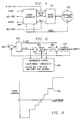
- FIG. 4 A first embodiment of a phase-locked motor controller, as discussed above for use in a single-modulator sequential-color display system, is shown in Figure 4.
- a three-phase DC motor 402 such as a Nidec model 32S8754010, is used to turn a four to six-inch color wheel.
- a three-phase brushless DC motor controller/driver 404 such as the Allegro A8902CLBA, is used to drive the motor 402 at a constant frequency.
- the motor driver 404 receives a 14-bit period word that represents the desired period of one revolution of the motor.
- the period word is loaded into a 14-bit internal counter which is decremented every 16 input clock cycles.
- the controller generates a reference waveform which stays active until the counter reaches zero.
- the length of the reference waveform represents the time required for one revolution of the motor 402 at the desired speed.
- the driver 404 also generates a signal, TACH, which represents the actual period of time required for one revolution of the motor 402.
- TACH a signal
- the controller generates the TACH signal by sensing the back-EMF zero crossings of the motor 402, and dividing by 24 (3 phases times 8 poles).
- an external position indicator may be used.
- the state of the TACH signal changes with each revolution of the motor.
- the driver 404 compares the period of the TACH signal to the period of the reference signal. Depending on which signal ends first, a charge pump internal to the driver 404 integrates either up or down to control the current provided to the motor 402, thereby enabling the driver 404 to alter the speed of the motor 402.
- Microcontroller 406 converts the circuit from a simple frequency-locked loop controller to an inexpensive phase-locked control circuit by modifying the 14-bit period word which is written into the driver 404.
- Microcontroller 406 monitors a color wheel position signal, INDEX, which strobes active when the color wheel rotates to a particular point. For example, INDEX may strobe active when the border between the red and blue filters crosses the light path.
- INDEX may strobe active when the border between the red and blue filters crosses the light path.
- the controller 406 alters the phase of the color wheel by temporarily increasing or decreasing the period word written to the driver 404. Slight changes in the period word cause the driver 404 to increase or decrease the speed of the motor 402 by a very small amount. If the actual color wheel position lags the desired color wheel position, as determined by the phase measurement between the VSYNC and INDEX signals, the speed of the motor is slightly increased until the color wheel advances to the proper phase relationship with VSYNC.
- the phase loop adjustment range of the color wheel period is limited to +/- 51.2 mS.
- the narrow range of wheel velocities (+/- 0.18 rps) reduces the torque load on the motor 402 while allowing a worst-case phase error of 180° to be corrected within 5 seconds.
- the controller 406 may increase the motor speed to a maximum of 3611 rpm, or decrease the motor speed to a minimum of 3589 rpm while still maintaining the velocity profile. These minimum and maximum speeds require the controller 406 to change the period word by +/- 32.
- FIG. 5 is a block diagram of the operation of the microcontroller 406.
- Blocks 502 and 504 measure the periods of the VSYNC and INDEX signals.
- Block 506 measures the relative timing of VSYNC and INDEX to determine the amount of lead or lag between VSYNC and INDEX.
- the VSYNC period is scaled and filtered by blocks 508 and 510 to determine the desired motor speed.
- the output from block 510, which represents the desired motor speed is input to block 512 and used to determine the desired phase offset between VSYNC and INDEX. This phase offset is subtracted from the measured phase difference to generate the phase error.
- Block 518 processes the phase error to get the phase error command.
- Block 514 receives information from blocks 502, 504, and 512, as well as the VSYNC and INDEX signals, and determines the state of several status bits.
- the status bits, output by block 516 include bits to indicate the state of the VSYNC and INDEX signals, a bit to indicate that the color wheel is spinning at an acceptable speed, and several bits which indicate the current frequency-lock and phase-lock status of the system.
- the VSYNC period is both scaled and filtered to determine the desired motor speed.
- a scale factor of 1 is used when the VSYNC signal has a frequency between 49 and 62.9 Hz.
- the unitary scale factor results in a motor speed equal to the video frame rate. If the frame rate increases to more than 62.9 Hz, the motor control circuit switches into a spoke-synchronous mode, which will be discussed below, and a scale factor of 1.2 is used. If the frame rate then drops below 62.6 Hz, the motor control circuit switches out of spoke-synchronous mode and the scale factor returns to 1.
- Block 528 generates a sequence start command to the display electronics using INDEX for color display modes, or TACH for black and white display modes.
- Spoke synchronous mode is used to limit the velocity range over which the motor must operate, thereby increasing the efficiency of the display system.
- the color wheel In spoke-synchronous mode, the color wheel is only turned 300° every VSYNC, or frame period, which results in the relationship between VSYNC and the color wheel changing 60° each frame period. Because the color wheel does not rotate an entire revolution each frame period, the proportion of time a given color filter is in the light path will not be equal for each color, and the color balance of the displayed image will be adversely affected. However, over a period of several frames, each of the three colors will be affected equally and a viewer will not notice that the color balance of each frame is incorrect.
- a VSYNC filter acts to smooth the measured period of the VSYNC signal.
- the filter incorporates both a first order response and a second order response to allow the smoothed VSYNC period to quickly respond to large changes in the input VSYNC period, which occur on a change in input source frame rates, while minimizing the response of the motor to spurious jumps in the VSYNC period, which may occur when a change in the input source causes a change in the VSYNC phase.
- a conventional second order filter designed to rapidly respond to changes in the input signal has a much larger overshoot.
- a block diagram of the filter is shown in Figure 6.
- the smoothed VSYNC period signal output by the filter is subtracted from the input VSYNC period to determine the VSYNC error.
- Error signal generation block 602 creates two error signals based on the VSYNC error.
- the first error signal for use in the first order loop, is the VSYNC error divided by 16, plus one.
- the first error signal is limited to the range of +/- 8 LSB.
- the second error signal, for use in the second order loop is the VSYNC error limited to the range of +/- 1 LSB.
- the second error signal is integrated by accumulator 604 each VSYNC period.
- the accumulator controller 606 limits the range of the accumulator 604 between +127 and -128 LSBs.
- the accumulator controller also clears the accumulator 604 whenever the signs of the accumulator 604 and the second error signal disagree.
- the integrated second error signal from the accumulator 604 is divided by four and added to the first error signal and the previous value of the smoothed VSYNC period to create a new smoothed VSYNC period value.
- a flowchart detailing the operation of the VSYNC filter is shown in Figure 7.
- the temporal relationship between the INDEX and VSYNC signals is used to determine the phase offset of the color wheel and to generate a phase error signal.
- One embodiment using the color wheel of Figure 2 receives VSYNC as the motor rotates the mid-point of the blue filter, and generates an INDEX signal at the red-blue boundary of the color wheel through the light path. This embodiment results in a desired phase offset, VSYNC to INDEX, of 300°.
- the relationship between INDEX, VSYNC, and the color wheel position is arbitrary.
- the phase error signal represents the difference between the actual VSYNC to INDEX phase delay, and the desired phase offset.
- the microcontroller 406 calculates the actual phase delay by subtracting the VSYNC time-of-arrival from the INDEX time-of-arrival. The microcontroller 406 then subtracts the desired phase offset from the value of the actual phase delay, leaving the phase error value.
- the desired phase offset varies for each frame of video data. Recall that in spoke-synchronous mode, the color wheel only rotates 300° during each frame of video data. Therefore, the desired phase offset must change each frame. In spoke-synchronous mode, the phase offset word continually follows the sequence, 300°, 240°, 180°, 120°, 60°, 0°.
- phase command function 802 is shown as a series of steps, each tending to drive the phase error toward zero. When the phase error IS very small, the phase command is zero. As the phase error increases, the phase commands increase to quickly reduce the phase error to zero. In Figure 8, the phase command function is linear and the step size doubles each step. Many other functions could be used to generate the phase commands including simply scaling the phase error, or scaling the phase error and limiting the magnitude of the phase command.
- the controller may step to a new phase offset to minimize the initial phase error and expedite the phase-lock process.
- a short frame display length must be chosen to avoid running over into the following color wheel frame period when the color wheel is spinning too quickly. Choosing a frame display period that is short enough to avoid problems when the color wheel is spinning too quickly reduces the efficiency of the display system when the color wheel is spinning at the proper speed because the spatial light modulator will not operate during the last portion of the color wheel frame period. Additionally, if a constant frame display length is too short, the spatial light modulator may begin to display a color plane while the color wheel is still filtering the light using the previous color filter.
- the microcontroller 406 To maximize the efficiency of the display system while avoiding color artifacts, the microcontroller 406 generates a sequence code, based on the color wheel period, which is used by the display system to control the length of the frame display period. As shown in Figure 5, block 522 uses the measured index period to generate a sequence code which is output by block 524. In a first embodiment, 43 6-bit codes are used to communicate the length of the frame display period as determined by the actual color wheel speed.
- the sequence codes are used to alter the bit display periods when there is a significant error in the color wheel frequency. For example, if the display system is changed from a 60 Hz frame rate signal to a 72 Hz frame rate signal, the system will enter spoke-synchronous mode and the color wheel will be rotating too fast for the new signal. Because the color wheel is rotating too fast, the image data bit periods for each color must be shortened in order to finish the video frame before the color wheel rotates 300°. The display period of a frame may be shortened by either shortening the bit periods, only displaying some of the bits, or both. In a first embodiment, 43 6-bit sequence codes are used to coordinate the color wheel with the rest of the display system.
- the present invention has been discussed in terms of a color wheel motor controller, the novel features of this invention may be used in other fields, such as a motor controller for a video read/write head.
- a motor controller for a video read/write head.
- the present invention has been discussed with reference to a first embodiment having a integrated circuit motor controller and a microcontroller, the motor controller could be implemented using many other combinations of circuits including discrete logic gates or analog circuitry.
Landscapes
- Engineering & Computer Science (AREA)
- Power Engineering (AREA)
- Multimedia (AREA)
- Signal Processing (AREA)
- Video Image Reproduction Devices For Color Tv Systems (AREA)
- Projection Apparatus (AREA)
- Control Of Electric Motors In General (AREA)
Applications Claiming Priority (2)
| Application Number | Priority Date | Filing Date | Title |
|---|---|---|---|
| US17295P | 1995-06-13 | 1995-06-13 | |
| US172 | 1995-06-13 |
Publications (2)
| Publication Number | Publication Date |
|---|---|
| EP0749201A1 true EP0749201A1 (de) | 1996-12-18 |
| EP0749201B1 EP0749201B1 (de) | 1999-04-07 |
Family
ID=21690253
Family Applications (1)
| Application Number | Title | Priority Date | Filing Date |
|---|---|---|---|
| EP96109496A Expired - Lifetime EP0749201B1 (de) | 1995-06-13 | 1996-06-13 | Phasen-synchronisiertes Motor-Steuerungssystem |
Country Status (5)
| Country | Link |
|---|---|
| US (1) | US5880573A (de) |
| EP (1) | EP0749201B1 (de) |
| JP (1) | JPH09140177A (de) |
| DE (1) | DE69601979T2 (de) |
| TW (1) | TW410496B (de) |
Cited By (4)
| Publication number | Priority date | Publication date | Assignee | Title |
|---|---|---|---|---|
| WO2002085036A1 (en) * | 2001-04-12 | 2002-10-24 | Koninklijke Philips Electronics N.V. | Scrolling color projector and a method for alignment of the optical and the electrical scan thereof |
| WO2002087257A1 (en) * | 2001-04-12 | 2002-10-31 | Koninklijke Philips Electronics N.V. | Scrolling color projector and a scanner phase control therefor |
| WO2003084246A1 (en) * | 2002-04-02 | 2003-10-09 | Koninklijke Philips Electronics N.V. | Variable rate row addressing method |
| EP1054380A4 (de) * | 1998-12-01 | 2005-01-19 | Seiko Epson Corp | Farbanzeigevorrichtung und -verfahren |
Families Citing this family (9)
| Publication number | Priority date | Publication date | Assignee | Title |
|---|---|---|---|---|
| US6084235A (en) * | 1998-05-27 | 2000-07-04 | Texas Instruments Incorporated | Self aligning color wheel index signal |
| US6134044A (en) * | 1999-02-08 | 2000-10-17 | Diamond Visionics Company | Projection screen to replace a CRT display for simulation |
| US6621529B2 (en) | 1999-12-28 | 2003-09-16 | Texas Instruments Incorporated | Common color wheel speed system |
| US6828961B2 (en) | 1999-12-30 | 2004-12-07 | Texas Instruments Incorporated | Color wheel synchronization in multi-frame-rate display systems |
| US7139040B2 (en) * | 2003-12-29 | 2006-11-21 | Texas Instruments Incorporated | Method to correct non-periodic index event time-of-arrival data in a synchronization system |
| KR100629534B1 (ko) * | 2004-02-12 | 2006-09-27 | 엘지전자 주식회사 | 온도변화에 따른 색오차 보정방법 및 장치 |
| TWI276907B (en) * | 2005-05-13 | 2007-03-21 | Coretronic Corp | Color wheel calibrating method, color wheel module and projection apparatus |
| JP2015022295A (ja) * | 2013-07-24 | 2015-02-02 | カシオ計算機株式会社 | 速度制御装置、投影装置、速度制御方法及びプログラム |
| WO2019193805A1 (ja) * | 2018-04-02 | 2019-10-10 | ローム株式会社 | スイッチ駆動装置 |
Citations (10)
| Publication number | Priority date | Publication date | Assignee | Title |
|---|---|---|---|---|
| EP0020211A1 (de) * | 1979-05-23 | 1980-12-10 | Enertec Societe Anonyme | Vorrichtung zur Geschwindigkeitsregelung |
| GB2132387A (en) * | 1982-12-27 | 1984-07-04 | Welch Allyn Inc | Colour video system syncronisation |
| GB2143059A (en) * | 1983-06-16 | 1985-01-30 | Canon Kk | Motor speed control |
| US4599545A (en) * | 1984-05-15 | 1986-07-08 | Sanyo Electric Co., Ltd. | Servomotor controller |
| EP0280931A1 (de) * | 1987-02-10 | 1988-09-07 | Sanyo Electric Co., Ltd. | Digitales Servosystem mit Mikrocomputer zur Regelung der Phase und der Geschwindigkeit eines rotierenden Körpers |
| US4998163A (en) * | 1990-04-02 | 1991-03-05 | Welch Allyn, Inc. | Stepping motor control having a dynamically variable loop filter circuit |
| US5046162A (en) * | 1988-08-31 | 1991-09-03 | Brother Kogyo Kabushiki Kaisha | Image input device having color filters and filter position detector |
| US5086261A (en) * | 1989-10-31 | 1992-02-04 | Konica Corporation | Motor speed control device for use in an image forming apparatus |
| US5365283A (en) * | 1993-07-19 | 1994-11-15 | Texas Instruments Incorporated | Color phase control for projection display using spatial light modulator |
| EP0712253A2 (de) * | 1994-11-14 | 1996-05-15 | Texas Instruments Incorporated | Bildanzeigesysteme |
Family Cites Families (6)
| Publication number | Priority date | Publication date | Assignee | Title |
|---|---|---|---|---|
| US3567850A (en) * | 1968-02-08 | 1971-03-02 | Telefunken Patent | Arrangement for phase-correct regulation of the speed of a rotating shaft |
| NL7711634A (nl) * | 1977-10-24 | 1979-04-26 | Philips Nv | Tachometerstelsel. |
| US4193020A (en) * | 1978-05-22 | 1980-03-11 | Sperry Rand Corporation | Phase lock control system with trajectory correction |
| JPS5532139A (en) * | 1978-08-30 | 1980-03-06 | Sony Corp | Automatic correction circuit for residual error |
| JPS60134310A (ja) * | 1983-12-22 | 1985-07-17 | Hitachi Ltd | モータ制御装置 |
| KR0130537B1 (ko) * | 1994-05-31 | 1998-04-09 | 이대원 | 토크리플을 최소화시킨 브러쉬없는 직류전동기 제어시스템 |
-
1996
- 1996-06-12 JP JP8151398A patent/JPH09140177A/ja active Pending
- 1996-06-12 US US08/662,192 patent/US5880573A/en not_active Expired - Lifetime
- 1996-06-13 DE DE69601979T patent/DE69601979T2/de not_active Expired - Lifetime
- 1996-06-13 EP EP96109496A patent/EP0749201B1/de not_active Expired - Lifetime
- 1996-08-09 TW TW085109653A patent/TW410496B/zh not_active IP Right Cessation
Patent Citations (10)
| Publication number | Priority date | Publication date | Assignee | Title |
|---|---|---|---|---|
| EP0020211A1 (de) * | 1979-05-23 | 1980-12-10 | Enertec Societe Anonyme | Vorrichtung zur Geschwindigkeitsregelung |
| GB2132387A (en) * | 1982-12-27 | 1984-07-04 | Welch Allyn Inc | Colour video system syncronisation |
| GB2143059A (en) * | 1983-06-16 | 1985-01-30 | Canon Kk | Motor speed control |
| US4599545A (en) * | 1984-05-15 | 1986-07-08 | Sanyo Electric Co., Ltd. | Servomotor controller |
| EP0280931A1 (de) * | 1987-02-10 | 1988-09-07 | Sanyo Electric Co., Ltd. | Digitales Servosystem mit Mikrocomputer zur Regelung der Phase und der Geschwindigkeit eines rotierenden Körpers |
| US5046162A (en) * | 1988-08-31 | 1991-09-03 | Brother Kogyo Kabushiki Kaisha | Image input device having color filters and filter position detector |
| US5086261A (en) * | 1989-10-31 | 1992-02-04 | Konica Corporation | Motor speed control device for use in an image forming apparatus |
| US4998163A (en) * | 1990-04-02 | 1991-03-05 | Welch Allyn, Inc. | Stepping motor control having a dynamically variable loop filter circuit |
| US5365283A (en) * | 1993-07-19 | 1994-11-15 | Texas Instruments Incorporated | Color phase control for projection display using spatial light modulator |
| EP0712253A2 (de) * | 1994-11-14 | 1996-05-15 | Texas Instruments Incorporated | Bildanzeigesysteme |
Cited By (13)
| Publication number | Priority date | Publication date | Assignee | Title |
|---|---|---|---|---|
| US7821476B2 (en) | 1998-12-01 | 2010-10-26 | Seiko Epson Corporation | Color display device and color display method |
| EP1054380A4 (de) * | 1998-12-01 | 2005-01-19 | Seiko Epson Corp | Farbanzeigevorrichtung und -verfahren |
| EP1758088A3 (de) * | 1998-12-01 | 2008-02-27 | Seiko Epson Corporation | Farbanzeigevorrichtung und -verfahren |
| US7508357B2 (en) | 1998-12-01 | 2009-03-24 | Seiko Epson Corporation | Color display device and color display method |
| US7508358B2 (en) | 1998-12-01 | 2009-03-24 | Seiko Epson Corporation | Color display device and color display method |
| US7663572B2 (en) | 1998-12-01 | 2010-02-16 | Seiko Epson Corporation | Color display device and color display method |
| US7969385B2 (en) | 1998-12-01 | 2011-06-28 | Seiko Epson Corporation | Color display device and color display method |
| US8199071B2 (en) | 1998-12-01 | 2012-06-12 | Seiko Epson Corporation | Color display device and color display method |
| US8378926B2 (en) | 1998-12-01 | 2013-02-19 | Seiko Epson Corporation | Color display device and color display method |
| WO2002087257A1 (en) * | 2001-04-12 | 2002-10-31 | Koninklijke Philips Electronics N.V. | Scrolling color projector and a scanner phase control therefor |
| US6690432B2 (en) * | 2001-04-12 | 2004-02-10 | Koninklijke Philips Electronics N.V. | Alignment of the optical and the electrical scan in a scrolling color projector |
| WO2002085036A1 (en) * | 2001-04-12 | 2002-10-24 | Koninklijke Philips Electronics N.V. | Scrolling color projector and a method for alignment of the optical and the electrical scan thereof |
| WO2003084246A1 (en) * | 2002-04-02 | 2003-10-09 | Koninklijke Philips Electronics N.V. | Variable rate row addressing method |
Also Published As
| Publication number | Publication date |
|---|---|
| EP0749201B1 (de) | 1999-04-07 |
| US5880573A (en) | 1999-03-09 |
| DE69601979D1 (de) | 1999-05-12 |
| DE69601979T2 (de) | 1999-10-28 |
| TW410496B (en) | 2000-11-01 |
| JPH09140177A (ja) | 1997-05-27 |
Similar Documents
| Publication | Publication Date | Title |
|---|---|---|
| EP0749201B1 (de) | Phasen-synchronisiertes Motor-Steuerungssystem | |
| US7233427B2 (en) | Display system with clock dropping | |
| US5625424A (en) | Digital motor controller for color wheel | |
| EP0748128B1 (de) | Bilderzeugungssysteme | |
| US6018408A (en) | Laser projection display apparatus | |
| US7954960B2 (en) | Video image display apparatus and timing control method | |
| KR100392997B1 (ko) | 컬러휠의위상에러제어 | |
| US8061846B2 (en) | Light source control method for video image display apparatus and video image display apparatus | |
| US6084235A (en) | Self aligning color wheel index signal | |
| US7339631B2 (en) | Apparatus and method for correcting color error | |
| EP0749248B1 (de) | Anzeigesysteme | |
| US20010055081A1 (en) | Image display device | |
| JP2001337390A (ja) | カラーホイールとそれを用いた色順次カラー表示装置 | |
| JP2001188196A (ja) | 投射型表示装置 | |
| CN116609993B (zh) | 一种基于fpga的色轮/荧光轮同步驱动方法和系统 | |
| JP4049755B2 (ja) | カラーホイールモータ回転位相制御システム | |
| US20090141194A1 (en) | Apparatus and method, both for controlling spatial light modulator | |
| KR20040091830A (ko) | 컬러 휠의 속도 및 색위상 제어방법 | |
| KR20050098042A (ko) | 투사형 영상표시기기 및 그 제어방법 | |
| KR20040093212A (ko) | 디엘피 티브이 및 그 화질개선방법 |
Legal Events
| Date | Code | Title | Description |
|---|---|---|---|
| PUAI | Public reference made under article 153(3) epc to a published international application that has entered the european phase |
Free format text: ORIGINAL CODE: 0009012 |
|
| AK | Designated contracting states |
Kind code of ref document: A1 Designated state(s): DE FR GB IT NL |
|
| 17P | Request for examination filed |
Effective date: 19970502 |
|
| GRAG | Despatch of communication of intention to grant |
Free format text: ORIGINAL CODE: EPIDOS AGRA |
|
| 17Q | First examination report despatched |
Effective date: 19980603 |
|
| GRAG | Despatch of communication of intention to grant |
Free format text: ORIGINAL CODE: EPIDOS AGRA |
|
| GRAH | Despatch of communication of intention to grant a patent |
Free format text: ORIGINAL CODE: EPIDOS IGRA |
|
| GRAH | Despatch of communication of intention to grant a patent |
Free format text: ORIGINAL CODE: EPIDOS IGRA |
|
| GRAA | (expected) grant |
Free format text: ORIGINAL CODE: 0009210 |
|
| ITF | It: translation for a ep patent filed | ||
| AK | Designated contracting states |
Kind code of ref document: B1 Designated state(s): DE FR GB IT NL |
|
| REF | Corresponds to: |
Ref document number: 69601979 Country of ref document: DE Date of ref document: 19990512 |
|
| ET | Fr: translation filed | ||
| PLBE | No opposition filed within time limit |
Free format text: ORIGINAL CODE: 0009261 |
|
| STAA | Information on the status of an ep patent application or granted ep patent |
Free format text: STATUS: NO OPPOSITION FILED WITHIN TIME LIMIT |
|
| 26N | No opposition filed | ||
| REG | Reference to a national code |
Ref country code: GB Ref legal event code: IF02 |
|
| PGFP | Annual fee paid to national office [announced via postgrant information from national office to epo] |
Ref country code: IT Payment date: 20070627 Year of fee payment: 12 |
|
| PG25 | Lapsed in a contracting state [announced via postgrant information from national office to epo] |
Ref country code: IT Free format text: LAPSE BECAUSE OF NON-PAYMENT OF DUE FEES Effective date: 20080613 |
|
| PGFP | Annual fee paid to national office [announced via postgrant information from national office to epo] |
Ref country code: FR Payment date: 20110603 Year of fee payment: 16 |
|
| PGFP | Annual fee paid to national office [announced via postgrant information from national office to epo] |
Ref country code: GB Payment date: 20110523 Year of fee payment: 16 Ref country code: NL Payment date: 20110615 Year of fee payment: 16 |
|
| PGFP | Annual fee paid to national office [announced via postgrant information from national office to epo] |
Ref country code: DE Payment date: 20110630 Year of fee payment: 16 |
|
| REG | Reference to a national code |
Ref country code: NL Ref legal event code: V1 Effective date: 20130101 |
|
| GBPC | Gb: european patent ceased through non-payment of renewal fee |
Effective date: 20120613 |
|
| REG | Reference to a national code |
Ref country code: FR Ref legal event code: ST Effective date: 20130228 |
|
| PG25 | Lapsed in a contracting state [announced via postgrant information from national office to epo] |
Ref country code: GB Free format text: LAPSE BECAUSE OF NON-PAYMENT OF DUE FEES Effective date: 20120613 Ref country code: DE Free format text: LAPSE BECAUSE OF NON-PAYMENT OF DUE FEES Effective date: 20130101 Ref country code: FR Free format text: LAPSE BECAUSE OF NON-PAYMENT OF DUE FEES Effective date: 20120702 Ref country code: NL Free format text: LAPSE BECAUSE OF NON-PAYMENT OF DUE FEES Effective date: 20130101 |
|
| REG | Reference to a national code |
Ref country code: DE Ref legal event code: R119 Ref document number: 69601979 Country of ref document: DE Effective date: 20130101 |