EP0750906A1 - Delta-(s-methylsothioureido)-l-norvaline et remede des troubles cerebro-vasculaires presentant une activite inhibitrice de la synthase du monoxyde d'azote - Google Patents
Delta-(s-methylsothioureido)-l-norvaline et remede des troubles cerebro-vasculaires presentant une activite inhibitrice de la synthase du monoxyde d'azote Download PDFInfo
- Publication number
- EP0750906A1 EP0750906A1 EP95909966A EP95909966A EP0750906A1 EP 0750906 A1 EP0750906 A1 EP 0750906A1 EP 95909966 A EP95909966 A EP 95909966A EP 95909966 A EP95909966 A EP 95909966A EP 0750906 A1 EP0750906 A1 EP 0750906A1
- Authority
- EP
- European Patent Office
- Prior art keywords
- cnos
- methylisothioureido
- norvaline
- compound
- therapeutic
- Prior art date
- Legal status (The legal status is an assumption and is not a legal conclusion. Google has not performed a legal analysis and makes no representation as to the accuracy of the status listed.)
- Withdrawn
Links
Images


Classifications
-
- A—HUMAN NECESSITIES
- A61—MEDICAL OR VETERINARY SCIENCE; HYGIENE
- A61K—PREPARATIONS FOR MEDICAL, DENTAL OR TOILETRY PURPOSES
- A61K31/00—Medicinal preparations containing organic active ingredients
- A61K31/185—Acids; Anhydrides, halides or salts thereof, e.g. sulfur acids, imidic, hydrazonic or hydroximic acids
- A61K31/19—Carboxylic acids, e.g. valproic acid
- A61K31/195—Carboxylic acids, e.g. valproic acid having an amino group
- A61K31/197—Carboxylic acids, e.g. valproic acid having an amino group the amino and the carboxyl groups being attached to the same acyclic carbon chain, e.g. gamma-aminobutyric acid [GABA], beta-alanine, epsilon-aminocaproic acid or pantothenic acid
- A61K31/198—Alpha-amino acids, e.g. alanine or edetic acid [EDTA]
-
- A—HUMAN NECESSITIES
- A61—MEDICAL OR VETERINARY SCIENCE; HYGIENE
- A61K—PREPARATIONS FOR MEDICAL, DENTAL OR TOILETRY PURPOSES
- A61K31/00—Medicinal preparations containing organic active ingredients
- A61K31/185—Acids; Anhydrides, halides or salts thereof, e.g. sulfur acids, imidic, hydrazonic or hydroximic acids
- A61K31/19—Carboxylic acids, e.g. valproic acid
- A61K31/195—Carboxylic acids, e.g. valproic acid having an amino group
-
- C—CHEMISTRY; METALLURGY
- C07—ORGANIC CHEMISTRY
- C07C—ACYCLIC OR CARBOCYCLIC COMPOUNDS
- C07C335/00—Thioureas, i.e. compounds containing any of the groups, the nitrogen atoms not being part of nitro or nitroso groups
- C07C335/30—Isothioureas
- C07C335/32—Isothioureas having sulfur atoms of isothiourea groups bound to acyclic carbon atoms
Definitions
- This invention relates to amino acid derivatives, more particularly to ⁇ -(S-methylisothioureido)-L-norvaline which has a nitric oxide synthase (NOS) inhibiting action and which inhibits the formation of nitric oxide (NO) so as to prove effective against the pathology of cerebrovascular diseases in the manifestation of which excess NO or NO metabolites are speculated to play an important role.
- NOS nitric oxide synthase
- the invention also relates to preventives and therapeutics of such cerebrovascular diseases that comprise the ⁇ -(S-methylisothioureido)-L-norvaline or pharmaceutically acceptable salts thereof as an effective ingredient.
- NO which is at least one of the endothelium-derived relaxing factors (EDRF) (Nature, 327, 524 - 526, 1987; Nature, 333, 664 - 666, 1988), not only has a vasodilation effect and a platelet aggregation and adhesion inhibiting effect but also plays an important role in the maintenance of biological functions as an intra-/inter-cellular signaling molecule.
- EDRF endothelium-derived relaxing factors
- NO is produced not only from endothelial cells but also from other cells such as neurons, glial cells and macrophages and at least three distinct clones encoding independent NOS enzymes have been isolated (Nature, 351, 714 - 718, 1991; Proc. Natl. Acad. Sci. USA, 89, 11141 - 11145, 1992; Proc. Natl. Acad. Sci. USA, 89, 6348 - 6352, 1992; FEBS Lett., 307, 287 - 293, 1992; J. Clin. Inv., 90, 2092 - 2096, 1992; Science, 256, 225 - 228, 1992; J. Biol.
- N G -nitro-L-arginine (L-NNA) has been found to be capable of ameliorating ischemic cerebral infarction and edema (Eur. J. Pharmacol. 204, 339 - 340, 1991; Neurosci. Lett., 147, 159 - 162, 1992). This finding opened a road to the application of a substance having a NOS inhibiting activity to a therapeutic of cerebrovascular diseases.
- Brain edema is developed several hours after the occurrence of cerebral ischemia and its progress continues for about one week from the onset in clinical settings. Thereafter, the brain edema decreases gradually and, depending or the focal range of infarction, the edema persists as an infarcted area from one to three months. Since the brain is covered with the rigid skull, cerebral edema causes an increase in the brain volume.
- cerebral edema exceeds a certain limit, there occurs an abrupt increase in the tissue pressure and the intracranical pressure, often inducing fatal hernia and eventually aggravating the encephalopathy to determine the scope of the subsequent infarcted area (J. Neurosurg. 77, 169 - 184, 1992).
- the treatment of cerebral edema which is critical to the patient's life and the prognosis of his disease is clinically a very important objective.
- L-NNA had a capability for ameliorating cerebral edema and infarction that were developed after focal cerebral ischemia (Neurosci. Lett., 147, 159 - 162, 1992), as well as the neuronal cell death that was developed after global cerebral ischemia (Eur. J. Pharmacol. Env. Tox., 248, 325 - 328, 1993).
- NOS inhibitors are not only ineffective against ischemic brain damage but also they sometimes aggravate the situation (J. Cereb. Blood Flow Metab., 14, 175 - 192, 1994).
- N-cNOS neuronal constitutive NOS
- E-cNOS endothelial constitutive NOS
- iNOS inducible NOS
- NO is at least one of EDRF
- E-cNOS if E-cNOS is inhibited to less than a certain level, the cerebral blood flow will decrease whereas the blood pressure will increase, thereby aggravating the dynamics of cerebral micro-circulation, possibly leading to an expansion of the ischemic lesion. Therefore, if a therapeutic for ischemic cerebral diseases is to be developed, a NOS inhibitor is desirable that does not inhibit E-cNOS as effectively as N-cNOS (Eur. J. Pharmacol., 204, 339 - 340, 1991; Proc. Natl. Acad. Sci. USA, 88, 6368 - 6371, 1991).
- the present inventors conducted intensive studies in order to solve the aforementioned problems. As a result, we found that ⁇ -(S-methylisothioureido)-L-norvaline represented by the formula (I): or salts thereof had a greater N-cNOS inhibiting action than the aforementioned L-NNA and other existing NOS inhibitors and, hence, were effective as therapeutics for cerebrovascular diseases.
- the present invention has been accomplished on the basis of these findings.
- the present invention provides a novel therapeutic for cerebrovascular diseases that involves an entirely different mechanism of action from the existing drugs in that it has a capability for selective inhibition of N-cNOS).
- the compound of the invention can be produced in accordance with the process described in J. Med. Chem. 37, 885 - 887, 1994, supra; alternatively, the following process may be adopted.
- a compound of the general formula (II): (where R 1 is a lower alkoxycarbonyl group in which the alkyl portion may optionally have a substituent or an optionally substituted lower acyl group; R 2 is an optionally substituted straight-chained or branched alkyl group having 1 - 6 carbon atoms) is hydrolyzed or deprotected by direct treatment with a deprotecting agent so as to produce ⁇ -(S-methylisothioureido)-L-norvaline of the formula (I) or a salt thereof.
- examples of the lower alkoxycarbonyl group in which the alkyl portion may optionally have a substituent include a benzyloxycarbonyl group, a 9-fluorenylmethyloxycarbonyl group and a t-butoxycarbonyl group; example of the optionally substituted lower acyl group includes an acetyl group.
- a particularly preferred example of R 1 is a t-butoxycarbonyl group.
- Examples of the straight-chained or branched alkyl group having 1 - 6 carbon atoms include methyl, ethyl, benzyl and t-butyl group, preferably the t-butyl group.
- the deprotecting reaction is carried out under appropriate conditions depending on the type of the protecting groups used. For example, if R 1 is a benzyloxycarbonyl group and R 2 is a benzyl group, catalytic reduction may be performed at room temperature in a solvent such as ethyl acetate, methanol or ethanol in the presence of palladium-carbon.
- a solvent such as ethyl acetate, methanol or ethanol in the presence of palladium-carbon.
- the reaction is preferably carried out using a deprotecting agent such as trifluoroacetic acid, hydrochloric acid, sulfuric acid or methanesulfonic acid in a solvent that will cause no adverse effects on the reaction such as methylene chloride, ethyl acetate, methanol, ethanol, dioxane or water, or without using any solvent at a temperature ranging from 0°C to room temperature.
- a deprotecting agent such as trifluoroacetic acid, hydrochloric acid, sulfuric acid or methanesulfonic acid in a solvent that will cause no adverse effects on the reaction such as methylene chloride, ethyl acetate, methanol, ethanol, dioxane or water, or without using any solvent at a temperature ranging from 0°C to room temperature.
- a deprotecting agent such as trifluoroacetic acid, hydrochloric acid, sulfuric acid or methanesulfonic acid in a solvent that will cause no adverse effects
- Pharmaceutically acceptable salts of the compound (I) include organic acid salts such as acetates, maleates, tartrates, methanesulfonates, benzenesulfonates, formates, p-toluenesulfonates and trifluoroacetates, and inorganic acid salts such as hydrochlorides, sulfates, hydrobromides and phosphates, preferably the dihydrochlorides.
- any pharmaceutically acceptable salts can be used without particular limitations and examples include salts with inorganic acids such as hydrochloric acid, sulfuric acid, nitric acid, hydrobromic acid and phosphoric acid, salts with organic acids such as acetic acid, oxalic acid, tartaric acid, maleic acid, methanesulfonic acid, benzenesulfonic acid, formic acid, p-toluenesulfonic acid and trifluoroacetic acid, mixed salts with alkali metals such as sodium and potassium, and mixed salts with alkaline earth metals such as calcium and magnesium, preferably the dihydrochlorides.
- inorganic acids such as hydrochloric acid, sulfuric acid, nitric acid, hydrobromic acid and phosphoric acid
- salts with organic acids such as acetic acid, oxalic acid, tartaric acid, maleic acid, methanesulfonic acid, benzenesulfonic acid, formic acid, p-to
- the compound of the invention may be formulated with suitable additives (e.g. excipients, adjuvants, lubricants, antiseptics, disintegrators, buffering agents, binders, stabilizers, wetting agents, emulsifiers, coloring agents, flavoring agents and fragrances) into suitable dosage forms such as tablets, granules, subtilized granules, powders, capsules, syrups, elixirs, suspensions, emulsions and injections, which can be administered either perorally or parenterally, preferably by intramuscular or intravenous injection.
- suitable additives e.g. excipients, adjuvants, lubricants, antiseptics, disintegrators, buffering agents, binders, stabilizers, wetting agents, emulsifiers, coloring agents, flavoring agents and fragrances
- suitable dosage forms such as tablets, granules, subtilized granules, powders, capsules, syrups, elixirs
- the compound of the invention or salts thereof may be administered in doses that vary with the physical constitution of the patient, his or her age, physical condition, the severity of the disease, the time of lapse after the onset of the disease and other factors; preferably, the daily dose ranges from 0.6 to 60 mg/body.
- the compound of the invention or salts thereof are to be formulated as a preparation for internal application, lactose, sucrose, sorbitol, mannitol, starches such as potato starch or corn starch, starch derivatives and common additives such as cellulose derivatives or gelatin are suitably used as vehicles, with lubricants such as magnesium stearate, carbowaxes and polyethylene glycol being optionally added concurrently; the resulting mixture may be formulated in the usual manner into granules, tablets, capsules or other forms suitable for internal application.
- an effective amount of the principal ingredient may be dissolved in distilled water for injection, with antioxidants, stabilizers, dissolution aids, buffering agents, preservatives, etc. added as required and, after a complete solution is formed, it is filtered, filled into ampules, sealed and sterilized by a suitable medium such as high-pressure vapor or dry heat so as to prepare an injection.
- a suitable medium such as high-pressure vapor or dry heat
- an aqueous solution having the principal ingredient dissolved in distilled water for injection may be freeze-dried in the usual manner.
- excipients that can be readily freeze-dried such as sugars (e.g. lactose, maltose and sucrose), sugar alcohols (e.g. mannitol and inositol) and glycine may be added to the aqueous solution, which is thereafter freeze-dried in the usual manner.
- Example 1 The compound of Example 1 was evaluated for its inhibitory action against N-cNOS and E-cNOS in comparison with previously reported NOS inhibitors.
- a crude enzyme sample of N-cNOS was a soluble cytosolic fraction of the rat cerebral cortex whereas a crude enzyme sample of E-cNOS was a homogenate of cow pulmonary arterial endothelium (CPAE) strain.
- CPAE cow pulmonary arterial endothelium
- NOS inhibitors were used as control compounds: L-NNA; N G -nitro-L-arginine methyl ester (L-NAME); N G -amino-L-arginine (L-AA); N G -iminoethyl-ornithine (L-NIO); N G -monomethyl-L-arginine (L-NMMA); N G -allyl-L-arginine (L-ALA); 7-nitroindazole (7-NI); aminoguanidine (AG).
- L-NNA N G -nitro-L-arginine methyl ester
- L-AA N G -amino-L-arginine
- L-NIO N G -iminoethyl-ornithine
- L-NMMA N G -monomethyl-L-arginine
- L-ALA N G -allyl-L-arginine
- 7-NI aminoguanidine
- the crude enzyme sample of N-cNOS was prepared by the following procedure. Normal untreated male Sprague-Dawley (SD) rats weighing 300 - 400 g were decapitated; the whole brain was immediately extracted from each animal and the cerebral cortex was separated on ice. Then, 5 volumes of 50 mM Tris-HCl containing 1 mM DTT (pH 7.4) was added and the mixture was homogenized for 3 min, followed by centrifugation at 1,000 ⁇ g for 10 min. The supernate was further centrifuged at 100,000 ⁇ g for 60 min and a soluble cytosolic fraction of the finally obtained supernate was used as the crude enzyme sample of N-cNOS.
- the crude enzyme sample of E-cNOS was prepared by the following procedure. CPAE was cultured in a MEM medium containing 20% of FBS. Several days later, the cells were detached from the flask using a solution of 0.25% trypsin containing 1 mM EDTA in 0.1 M phosphate-buffered saline (PBS; pH 7.4) and centrifuged at 1,000 rpm for 5 min. The supernate was discarded and upon addition of a suitable amount of PBS, centrifugation was performed at 1,000 rpm for 5 min to wash the cells. The same procedure was repeated using 50 mM Tris-HCl containing 1 mM DTT (pH 7.4) to wash the cells. To the precipitating cells, there was added 50 mM Tris-HCl containing 1 mM DTT (pH 7.4) and the mixture was homogenized for 3 min to yield the crude enzyme sample of E-cNOS.
- PBS phosphate-buffered saline
- the method of measuring the NOS activity was basically the same as already reported by the present inventors and consisted of determining quantitatively the conversion of a substrate L-[ 3 H] arginine to a reaction product L-[ 3 H] citrulline [Brain Edema IX (Ito et al. eds.) 60, pp. 285 - 288, 1994, Acta Neurochir., Springer-Verlag].
- the reaction solution consisted of 100 nM L-[ 3 H] arginine, N-cNOS or E-cNOS as crude enzyme sample (6 - 20 ⁇ g/ml protein), 1.25 mM CaCl 2 , 1 mM EDTA, 10 ⁇ /ml calmodulin, 1 mM NADPH, 100 ⁇ M tetrahydrobiopterin, 10 ⁇ M FAD, 10 ⁇ M FMN and 50 mM Tris-HCl (pH 7.4), to which the compound of the invention or one of the control compounds was added.
- the reaction was started by adding L-[ 3 H] arginine to the reaction solution and the mixture was incubated at 37°C for 10 min. Incubation was terminated by addition of 2 ml of 50 mM Tris-HCl (pH 5.5) containing 1 mM EDTA. The reaction solution was quenched by placing the mixture on ice. The reaction solution was passed through a cation-exchange resin column (Dowex AG50WX-8, Na + form, 3.2 ml) and the reaction product L-[ 3 H] citrulline was separated from the unreacted residual substrate L-[ 3 H] arginine.
- the eluant was combined with another eluant resulting from the passage of distilled water (3 ml) through the column and put into a mini vial for recovery of L-[ 3 H] citrulline. Thereafter, 5 ml of a scintillation fluid was added and the contained radioactivity was measured with a liquid scintillation counter to determine the amount of L-[ 3 H] citrulline.
- the protein concentration of each crude enzyme sample was determined with a micro-assay kit of Biorad Co.
- Table 1 lists the values of IC 50 of all test compounds as their concentrations necessary to inhibit 50% of each NOS isoform activity, as well as the ratio of IC 50 against E-cNOS to IC 50 against N-cNOS. All data in Table 1 are expressed by mean ⁇ standard error, with the number of cases within parentheses.
- the third branch of the trigeminal nerve was identified in the bottommost part of the temporal bone as running inside the lateral muscle and a small hole with a diameter of about 3 mm was opened by means of a dental drill in a position between the foramen oval from which the identified third branch extended and the orbital fissure.
- a thin layer of the bone was removed by means of a micro-hook and a micro-needle holder.
- the dura mater and arachnoidea were slightly cut by means of a needle (27G) and a micro-hook and the trunk of the MCA was occluded with a mini-clip for 48 h in the position where the lenticulostriate artery (LSA) branched; alternatively, the same position was occluded for 2 h and then allowed for 2-h reperfusion with the clip removed.
- the temperatures of the right temporal muscle and the rectum were monitored such that they would be kept constant at about 37°C.
- the rats Forty-eight hours after MCA occlusion, the rats were decapitated and the left cerebral hemisphere was extracted from each animal within 60 sec; the wet weight of the brain tissue was measured with a chemical balance within 90 sec. Thereafter, the hemisphere was dried in an oven at 105°C for 3 days and its dry weight was measured.
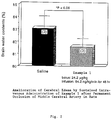
- the water content in the brain was determined by the following formula: (wet weight - dry weight)/(wet weight) ⁇ 100 (%) ; the results are shown in Figs. 1 and 2.
- Fig. 2 shows that the sustained intravenous administration of the compound of the invention was also effective in significantly alleviating the cerebral edema due to 48-h MCA occlusion.
- ⁇ -(S-methylisothioureido)-L-norvaline is far superior to the existing NOS inhibitors in terms of (1) the N-cNOS inhibiting action and (2) the selectivity for N-cNOS in preference to E-cNOS; hence, the compound is useful as a therapeutic for cerebrovascular diseases.
- IC 50 Values of Test Compounds against Two NOS Isoforms Test compound IC 50 values (nM) Ratio of IC 50 values N-cNOS (Brain cytosol) E-cNOS (CPAE) E-cNOS/N-cNOS Example 1 5.6 ⁇ 0.3 (5) 238.1 ⁇ 82.3 (3) 42.5 L-NNA 16.9 ⁇ 3.6 (4) 89.8 ⁇ 28.7 (3) 5.3 L-NAME 79.4 ⁇ 11.6 (3) 985.4 ⁇ 389.8 (3) 12.4 L-AA 152.5 ⁇ 55.7 (3) 523.5 ⁇ 61.4 (3) 3.4 L-NIO 277.0 ⁇ 58.7 (3) 2,225.5 ⁇ 112.6 (3) 8.0 L-NMMA 337.8 ⁇ 24.7 (3) 950.7 ⁇ 232.1 (3) 2.8 L-ALA 992.0 ⁇ 162.4 (3) 15,053.4 ⁇ 8,529.6 (3) 15.2 7-NI 4,823.6 ⁇ 985.2 (3) 2,132.7 ⁇ 793.8 (3) 0.4 AG 20,262.9 ⁇ 4,172.6 (3) > 100,000 (3) >4.9
Landscapes
- Health & Medical Sciences (AREA)
- Chemical & Material Sciences (AREA)
- Organic Chemistry (AREA)
- Animal Behavior & Ethology (AREA)
- Epidemiology (AREA)
- Life Sciences & Earth Sciences (AREA)
- Pharmacology & Pharmacy (AREA)
- General Health & Medical Sciences (AREA)
- Public Health (AREA)
- Veterinary Medicine (AREA)
- Medicinal Chemistry (AREA)
- Pharmaceuticals Containing Other Organic And Inorganic Compounds (AREA)
- Acyclic And Carbocyclic Compounds In Medicinal Compositions (AREA)
Applications Claiming Priority (5)
| Application Number | Priority Date | Filing Date | Title |
|---|---|---|---|
| JP66386/94 | 1994-02-25 | ||
| JP6638694 | 1994-02-25 | ||
| JP222396/94 | 1994-08-12 | ||
| JP22239694 | 1994-08-12 | ||
| PCT/JP1995/000265 WO1995022968A1 (fr) | 1994-02-25 | 1995-02-23 | δ-(S-METHYLSOTHIOUREIDO)-L-NORVALINE ET REMEDE DES TROUBLES CEREBRO-VASCULAIRES PRESENTANT UNE ACTIVITE INHIBITRICE DE LA SYNTHASE DU MONOXYDE D'AZOTE |
Publications (2)
| Publication Number | Publication Date |
|---|---|
| EP0750906A1 true EP0750906A1 (fr) | 1997-01-02 |
| EP0750906A4 EP0750906A4 (fr) | 1999-02-10 |
Family
ID=26407592
Family Applications (1)
| Application Number | Title | Priority Date | Filing Date |
|---|---|---|---|
| EP95909966A Withdrawn EP0750906A4 (fr) | 1994-02-25 | 1995-02-23 | Delta-(s-methylsothioureido)-l-norvaline et remede des troubles cerebro-vasculaires presentant une activite inhibitrice de la synthase du monoxyde d'azote |
Country Status (5)
| Country | Link |
|---|---|
| US (1) | US5869526C1 (fr) |
| EP (1) | EP0750906A4 (fr) |
| AU (1) | AU1823695A (fr) |
| TW (1) | TW411272B (fr) |
| WO (1) | WO1995022968A1 (fr) |
Families Citing this family (2)
| Publication number | Priority date | Publication date | Assignee | Title |
|---|---|---|---|---|
| AU7246398A (en) * | 1997-04-30 | 1998-11-24 | Northwestern University | Inhibition of nitric oxide synthase by amino acids and dipeptides |
| RU2453001C1 (ru) * | 2010-10-18 | 2012-06-10 | Государственное образовательное учреждение высшего профессионального образования "Курский государственный медицинский университет Федерального агентства по здравоохранению и социальному развитию" | Способ коррекции гипергомоцистеин индуцированного дефицита оксида азота l-норвалином в эксперименте |
Family Cites Families (2)
| Publication number | Priority date | Publication date | Assignee | Title |
|---|---|---|---|---|
| JPH09504278A (ja) * | 1944-06-01 | 1997-04-28 | ザ、ウェルカム、ファンデーション、リミテッド | Noシンターゼインヒビターとしての置換尿素およびイソチオ尿素誘導体 |
| US5364881A (en) * | 1993-11-15 | 1994-11-15 | The Medical College Of Wisconsin Research Foundation, Inc. | S-alkyl-isothioureido-amino acids and use thereof |
-
1995
- 1995-02-23 AU AU18236/95A patent/AU1823695A/en not_active Abandoned
- 1995-02-23 WO PCT/JP1995/000265 patent/WO1995022968A1/fr not_active Ceased
- 1995-02-23 EP EP95909966A patent/EP0750906A4/fr not_active Withdrawn
- 1995-02-25 TW TW084101769A patent/TW411272B/zh not_active IP Right Cessation
-
1996
- 1996-08-21 US US08696866 patent/US5869526C1/en not_active Expired - Fee Related
Also Published As
| Publication number | Publication date |
|---|---|
| TW411272B (en) | 2000-11-11 |
| WO1995022968A1 (fr) | 1995-08-31 |
| EP0750906A4 (fr) | 1999-02-10 |
| AU1823695A (en) | 1995-09-11 |
| US5869526C1 (en) | 2001-02-06 |
| US5869526A (en) | 1999-02-09 |
Similar Documents
| Publication | Publication Date | Title |
|---|---|---|
| US6218417B1 (en) | Ace-inhibitor nitric salts | |
| EP1040094B9 (fr) | Composes des cyclopentane et cyclopentene convenant comme inhibiteurs de neuraminidase | |
| CN106822168B (zh) | 含硒有机化合物的组合物和其使用方法 | |
| EP0595878A1 (fr) | Acylmercaptoalcanoyldipeptides, leurs procedes de preparation et leur utilisation therapeutique | |
| US20030083266A1 (en) | Treatment of ischemic brain injuries with brain targeted antioxidant compounds | |
| SK280249B6 (sk) | Deriváty aminokyselín, spôsob ich výroby, ich použ | |
| DE60221508T2 (de) | Aminosäurederivate als hiv-protease-inhibitoren | |
| US6593362B2 (en) | Non-peptidic cyclophilin binding compounds and their use | |
| NO973539L (no) | Prolinderivater anvendelige som inhibitorer for human leukocyttelastase | |
| JP2019523260A (ja) | キラルペプチド | |
| EP1272458A1 (fr) | Mimetiques de l'arginine utilises comme inhibiteurs du facteur xa | |
| AU2019403856B2 (en) | Mitochondria-targeting peptides | |
| US5190926A (en) | 3'-azido-2',3'-dideoxypyrimidines and related compounds as antiviral agents | |
| US5869526A (en) | δ-(S-methylisothioureido)-L-norvaline therapeutic for cerebrovascular diseases having nitric oxide synthase inhibiting factor | |
| US6274557B1 (en) | Inhibition of nitric oxide synthase by amino acids and dipeptides | |
| TW202100517A (zh) | 心肌肌鈣蛋白活化劑之多晶型物 | |
| WO2025194856A1 (fr) | Composé thiényl-5-fluoro-1h-pyrazolopyridine substitué et son utilisation | |
| JP3276762B2 (ja) | イソキノリン誘導体を含有する医薬組成物 | |
| JP5849336B2 (ja) | アデニル酸シクラーゼの活性調節剤 | |
| US6124351A (en) | Amino acid derivatives having a nitric oxide synthase inhibiting action | |
| JP2756941B2 (ja) | 2−クロロ−3−アリールアミノ−1,4−ナフトキノン誘導体の血小板凝集抑制剤としての用途 | |
| JPH08104670A (ja) | δ−(S−メチルイソチオウレイド)−L−ノルバリンおよび 一酸化窒素合成酵素阻害作用を有する脳血管障害治療剤 | |
| EP0274230B1 (fr) | Emploi de dérivés de 2-oxo-imidazolidine pour la prophylaxie et le traitement de la décompensation cardiaque | |
| EP4205766A1 (fr) | Agent prophylactique et/ou thérapeutique pour la fibrose pulmonaire idiopathique | |
| JPH08109165A (ja) | 一酸化窒素合成酵素阻害作用を有するアミノ酸誘導体 |
Legal Events
| Date | Code | Title | Description |
|---|---|---|---|
| PUAI | Public reference made under article 153(3) epc to a published international application that has entered the european phase |
Free format text: ORIGINAL CODE: 0009012 |
|
| 17P | Request for examination filed |
Effective date: 19960925 |
|
| AK | Designated contracting states |
Kind code of ref document: A1 Designated state(s): AT BE CH DE DK ES FR GB GR IE IT LI LU MC NL PT SE |
|
| AX | Request for extension of the european patent |
Free format text: LT PAYMENT 960925;SI PAYMENT 960925 |
|
| A4 | Supplementary search report drawn up and despatched | ||
| AK | Designated contracting states |
Kind code of ref document: A4 Designated state(s): AT BE CH DE DK ES FR GB GR IE IT LI LU MC NL PT SE |
|
| 17Q | First examination report despatched |
Effective date: 19991209 |
|
| GRAG | Despatch of communication of intention to grant |
Free format text: ORIGINAL CODE: EPIDOS AGRA |
|
| GRAG | Despatch of communication of intention to grant |
Free format text: ORIGINAL CODE: EPIDOS AGRA |
|
| GRAH | Despatch of communication of intention to grant a patent |
Free format text: ORIGINAL CODE: EPIDOS IGRA |
|
| STAA | Information on the status of an ep patent application or granted ep patent |
Free format text: STATUS: THE APPLICATION IS DEEMED TO BE WITHDRAWN |
|
| 18D | Application deemed to be withdrawn |
Effective date: 20020702 |