EP0751966B1 - Verfahren zur copolymerisierung von ethylen und alpha-olefinen - Google Patents
Verfahren zur copolymerisierung von ethylen und alpha-olefinen Download PDFInfo
- Publication number
- EP0751966B1 EP0751966B1 EP95913178A EP95913178A EP0751966B1 EP 0751966 B1 EP0751966 B1 EP 0751966B1 EP 95913178 A EP95913178 A EP 95913178A EP 95913178 A EP95913178 A EP 95913178A EP 0751966 B1 EP0751966 B1 EP 0751966B1
- Authority
- EP
- European Patent Office
- Prior art keywords
- compound
- procatalyst
- ethene
- metal selected
- organohalogenous
- Prior art date
- Legal status (The legal status is an assumption and is not a legal conclusion. Google has not performed a legal analysis and makes no representation as to the accuracy of the status listed.)
- Expired - Lifetime
Links
- VGGSQFUCUMXWEO-UHFFFAOYSA-N Ethene Chemical compound C=C VGGSQFUCUMXWEO-UHFFFAOYSA-N 0.000 title claims description 39
- 238000000034 method Methods 0.000 title claims description 36
- 239000004711 α-olefin Substances 0.000 title claims description 36
- 230000008569 process Effects 0.000 title claims description 34
- 229910052751 metal Inorganic materials 0.000 claims description 43
- 239000002184 metal Substances 0.000 claims description 43
- 150000002366 halogen compounds Chemical class 0.000 claims description 34
- 229910052782 aluminium Inorganic materials 0.000 claims description 33
- 231100000252 nontoxic Toxicity 0.000 claims description 27
- 230000003000 nontoxic effect Effects 0.000 claims description 27
- 150000001875 compounds Chemical class 0.000 claims description 26
- 229910052725 zinc Inorganic materials 0.000 claims description 26
- 239000000203 mixture Substances 0.000 claims description 25
- 150000002894 organic compounds Chemical class 0.000 claims description 25
- 238000007334 copolymerization reaction Methods 0.000 claims description 22
- 239000010936 titanium Substances 0.000 claims description 16
- VOITXYVAKOUIBA-UHFFFAOYSA-N triethylaluminium Chemical compound CC[Al](CC)CC VOITXYVAKOUIBA-UHFFFAOYSA-N 0.000 claims description 16
- 230000002140 halogenating effect Effects 0.000 claims description 13
- UAIZDWNSWGTKFZ-UHFFFAOYSA-L ethylaluminum(2+);dichloride Chemical compound CC[Al](Cl)Cl UAIZDWNSWGTKFZ-UHFFFAOYSA-L 0.000 claims description 12
- YNLAOSYQHBDIKW-UHFFFAOYSA-M diethylaluminium chloride Chemical compound CC[Al](Cl)CC YNLAOSYQHBDIKW-UHFFFAOYSA-M 0.000 claims description 11
- TWRXJAOTZQYOKJ-UHFFFAOYSA-L Magnesium chloride Chemical compound [Mg+2].[Cl-].[Cl-] TWRXJAOTZQYOKJ-UHFFFAOYSA-L 0.000 claims description 10
- MGDOJPNDRJNJBK-UHFFFAOYSA-N ethylaluminum Chemical compound [Al].C[CH2] MGDOJPNDRJNJBK-UHFFFAOYSA-N 0.000 claims description 10
- 229910052719 titanium Inorganic materials 0.000 claims description 10
- JGHYBJVUQGTEEB-UHFFFAOYSA-M dimethylalumanylium;chloride Chemical compound C[Al](C)Cl JGHYBJVUQGTEEB-UHFFFAOYSA-M 0.000 claims description 9
- 239000011541 reaction mixture Substances 0.000 claims description 9
- XJDNKRIXUMDJCW-UHFFFAOYSA-J titanium tetrachloride Chemical compound Cl[Ti](Cl)(Cl)Cl XJDNKRIXUMDJCW-UHFFFAOYSA-J 0.000 claims description 8
- 125000005234 alkyl aluminium group Chemical group 0.000 claims description 7
- 238000010438 heat treatment Methods 0.000 claims description 7
- 229910052723 transition metal Inorganic materials 0.000 claims description 7
- 150000003623 transition metal compounds Chemical class 0.000 claims description 7
- 229910052720 vanadium Inorganic materials 0.000 claims description 6
- 229910052715 tantalum Inorganic materials 0.000 claims description 5
- 229910052804 chromium Inorganic materials 0.000 claims description 4
- 150000002681 magnesium compounds Chemical class 0.000 claims description 4
- YSTQWZZQKCCBAY-UHFFFAOYSA-L methylaluminum(2+);dichloride Chemical compound C[Al](Cl)Cl YSTQWZZQKCCBAY-UHFFFAOYSA-L 0.000 claims description 4
- 229910052750 molybdenum Inorganic materials 0.000 claims description 4
- 150000003609 titanium compounds Chemical class 0.000 claims description 4
- 150000003624 transition metals Chemical class 0.000 claims description 4
- 229910052726 zirconium Inorganic materials 0.000 claims description 4
- 150000001336 alkenes Chemical class 0.000 claims description 3
- 229910001629 magnesium chloride Inorganic materials 0.000 claims description 3
- 125000004400 (C1-C12) alkyl group Chemical group 0.000 claims description 2
- 125000004178 (C1-C4) alkyl group Chemical group 0.000 claims description 2
- 125000000217 alkyl group Chemical group 0.000 claims description 2
- 150000002430 hydrocarbons Chemical group 0.000 claims description 2
- 229910052809 inorganic oxide Inorganic materials 0.000 claims description 2
- CWEHKOAQFGHCFQ-UHFFFAOYSA-N methylalumane Chemical compound [AlH2]C CWEHKOAQFGHCFQ-UHFFFAOYSA-N 0.000 claims description 2
- JRZJOMJEPLMPRA-UHFFFAOYSA-N olefin Natural products CCCCCCCC=C JRZJOMJEPLMPRA-UHFFFAOYSA-N 0.000 claims description 2
- 229920000642 polymer Polymers 0.000 description 34
- 238000006116 polymerization reaction Methods 0.000 description 27
- 239000003054 catalyst Substances 0.000 description 25
- LIKMAJRDDDTEIG-UHFFFAOYSA-N 1-hexene Chemical compound CCCCC=C LIKMAJRDDDTEIG-UHFFFAOYSA-N 0.000 description 24
- 239000007795 chemical reaction product Substances 0.000 description 21
- 229920000092 linear low density polyethylene Polymers 0.000 description 19
- 239000004707 linear low-density polyethylene Substances 0.000 description 19
- 239000000047 product Substances 0.000 description 19
- 229920001577 copolymer Polymers 0.000 description 18
- 229920000573 polyethylene Polymers 0.000 description 16
- 238000011065 in-situ storage Methods 0.000 description 13
- -1 alkylaluminium chloride compound Chemical class 0.000 description 11
- 238000006243 chemical reaction Methods 0.000 description 11
- 230000000052 comparative effect Effects 0.000 description 9
- VYPSYNLAJGMNEJ-UHFFFAOYSA-N Silicium dioxide Chemical compound O=[Si]=O VYPSYNLAJGMNEJ-UHFFFAOYSA-N 0.000 description 8
- 230000003197 catalytic effect Effects 0.000 description 8
- 230000000694 effects Effects 0.000 description 7
- NNPPMTNAJDCUHE-UHFFFAOYSA-N isobutane Chemical group CC(C)C NNPPMTNAJDCUHE-UHFFFAOYSA-N 0.000 description 7
- RTAQQCXQSZGOHL-UHFFFAOYSA-N Titanium Chemical compound [Ti] RTAQQCXQSZGOHL-UHFFFAOYSA-N 0.000 description 6
- 229910052739 hydrogen Inorganic materials 0.000 description 6
- 239000001257 hydrogen Substances 0.000 description 6
- 125000002496 methyl group Chemical group [H]C([H])([H])* 0.000 description 6
- 239000013078 crystal Substances 0.000 description 5
- 238000002425 crystallisation Methods 0.000 description 5
- 230000008025 crystallization Effects 0.000 description 5
- KWKAKUADMBZCLK-UHFFFAOYSA-N 1-octene Chemical compound CCCCCCC=C KWKAKUADMBZCLK-UHFFFAOYSA-N 0.000 description 4
- 239000003153 chemical reaction reagent Substances 0.000 description 4
- 239000003795 chemical substances by application Substances 0.000 description 4
- 239000011651 chromium Substances 0.000 description 4
- 150000002431 hydrogen Chemical class 0.000 description 4
- 229920002521 macromolecule Polymers 0.000 description 4
- 238000002360 preparation method Methods 0.000 description 4
- 239000000377 silicon dioxide Substances 0.000 description 4
- 239000002002 slurry Substances 0.000 description 4
- VZGDMQKNWNREIO-UHFFFAOYSA-N tetrachloromethane Chemical compound ClC(Cl)(Cl)Cl VZGDMQKNWNREIO-UHFFFAOYSA-N 0.000 description 4
- 230000032683 aging Effects 0.000 description 3
- 238000013019 agitation Methods 0.000 description 3
- 125000003545 alkoxy group Chemical group 0.000 description 3
- 239000004411 aluminium Substances 0.000 description 3
- 229920001903 high density polyethylene Polymers 0.000 description 3
- 239000004700 high-density polyethylene Substances 0.000 description 3
- 239000001282 iso-butane Substances 0.000 description 3
- 235000011147 magnesium chloride Nutrition 0.000 description 3
- 239000000155 melt Substances 0.000 description 3
- VLKZOEOYAKHREP-UHFFFAOYSA-N n-Hexane Chemical compound CCCCCC VLKZOEOYAKHREP-UHFFFAOYSA-N 0.000 description 3
- 239000002685 polymerization catalyst Substances 0.000 description 3
- 239000000376 reactant Substances 0.000 description 3
- 230000035945 sensitivity Effects 0.000 description 3
- 239000000126 substance Substances 0.000 description 3
- VXNZUUAINFGPBY-UHFFFAOYSA-N 1-Butene Chemical compound CCC=C VXNZUUAINFGPBY-UHFFFAOYSA-N 0.000 description 2
- UFHFLCQGNIYNRP-UHFFFAOYSA-N Hydrogen Chemical compound [H][H] UFHFLCQGNIYNRP-UHFFFAOYSA-N 0.000 description 2
- FYYHWMGAXLPEAU-UHFFFAOYSA-N Magnesium Chemical compound [Mg] FYYHWMGAXLPEAU-UHFFFAOYSA-N 0.000 description 2
- 229910003074 TiCl4 Inorganic materials 0.000 description 2
- 230000003213 activating effect Effects 0.000 description 2
- XAGFODPZIPBFFR-UHFFFAOYSA-N aluminium Chemical compound [Al] XAGFODPZIPBFFR-UHFFFAOYSA-N 0.000 description 2
- 238000005660 chlorination reaction Methods 0.000 description 2
- HGCIXCUEYOPUTN-UHFFFAOYSA-N cyclohexene Chemical compound C1CCC=CC1 HGCIXCUEYOPUTN-UHFFFAOYSA-N 0.000 description 2
- LPIQUOYDBNQMRZ-UHFFFAOYSA-N cyclopentene Chemical compound C1CC=CC1 LPIQUOYDBNQMRZ-UHFFFAOYSA-N 0.000 description 2
- 230000001627 detrimental effect Effects 0.000 description 2
- 238000010828 elution Methods 0.000 description 2
- 230000002708 enhancing effect Effects 0.000 description 2
- 239000013067 intermediate product Substances 0.000 description 2
- 229910052749 magnesium Inorganic materials 0.000 description 2
- 239000011777 magnesium Substances 0.000 description 2
- 150000002736 metal compounds Chemical class 0.000 description 2
- 239000000178 monomer Substances 0.000 description 2
- TVMXDCGIABBOFY-UHFFFAOYSA-N n-Octanol Natural products CCCCCCCC TVMXDCGIABBOFY-UHFFFAOYSA-N 0.000 description 2
- YWAKXRMUMFPDSH-UHFFFAOYSA-N pentene Chemical compound CCCC=C YWAKXRMUMFPDSH-UHFFFAOYSA-N 0.000 description 2
- 239000007787 solid Substances 0.000 description 2
- YONPGGFAJWQGJC-UHFFFAOYSA-K titanium(iii) chloride Chemical compound Cl[Ti](Cl)Cl YONPGGFAJWQGJC-UHFFFAOYSA-K 0.000 description 2
- JLTRXTDYQLMHGR-UHFFFAOYSA-N trimethylaluminium Chemical compound C[Al](C)C JLTRXTDYQLMHGR-UHFFFAOYSA-N 0.000 description 2
- LEONUFNNVUYDNQ-UHFFFAOYSA-N vanadium atom Chemical compound [V] LEONUFNNVUYDNQ-UHFFFAOYSA-N 0.000 description 2
- YHQXBTXEYZIYOV-UHFFFAOYSA-N 3-methylbut-1-ene Chemical compound CC(C)C=C YHQXBTXEYZIYOV-UHFFFAOYSA-N 0.000 description 1
- LDTAOIUHUHHCMU-UHFFFAOYSA-N 3-methylpent-1-ene Chemical compound CCC(C)C=C LDTAOIUHUHHCMU-UHFFFAOYSA-N 0.000 description 1
- VXEGSRKPIUDPQT-UHFFFAOYSA-N 4-[4-(4-methoxyphenyl)piperazin-1-yl]aniline Chemical compound C1=CC(OC)=CC=C1N1CCN(C=2C=CC(N)=CC=2)CC1 VXEGSRKPIUDPQT-UHFFFAOYSA-N 0.000 description 1
- SUWJESCICIOQHO-UHFFFAOYSA-N 4-methylhex-1-ene Chemical compound CCC(C)CC=C SUWJESCICIOQHO-UHFFFAOYSA-N 0.000 description 1
- WNEYWVBECXCQRT-UHFFFAOYSA-N 5-methylhept-1-ene Chemical compound CCC(C)CCC=C WNEYWVBECXCQRT-UHFFFAOYSA-N 0.000 description 1
- VEXZGXHMUGYJMC-UHFFFAOYSA-M Chloride anion Chemical compound [Cl-] VEXZGXHMUGYJMC-UHFFFAOYSA-M 0.000 description 1
- VYZAMTAEIAYCRO-UHFFFAOYSA-N Chromium Chemical compound [Cr] VYZAMTAEIAYCRO-UHFFFAOYSA-N 0.000 description 1
- 229920000089 Cyclic olefin copolymer Polymers 0.000 description 1
- LFQSCWFLJHTTHZ-UHFFFAOYSA-N Ethanol Chemical compound CCO LFQSCWFLJHTTHZ-UHFFFAOYSA-N 0.000 description 1
- 229910015221 MoCl5 Inorganic materials 0.000 description 1
- ZOKXTWBITQBERF-UHFFFAOYSA-N Molybdenum Chemical compound [Mo] ZOKXTWBITQBERF-UHFFFAOYSA-N 0.000 description 1
- 101100023124 Schizosaccharomyces pombe (strain 972 / ATCC 24843) mfr2 gene Proteins 0.000 description 1
- 229910003910 SiCl4 Inorganic materials 0.000 description 1
- 229910010062 TiCl3 Inorganic materials 0.000 description 1
- ZMANZCXQSJIPKH-UHFFFAOYSA-N Triethylamine Chemical compound CCN(CC)CC ZMANZCXQSJIPKH-UHFFFAOYSA-N 0.000 description 1
- 229910021551 Vanadium(III) chloride Inorganic materials 0.000 description 1
- 229910021552 Vanadium(IV) chloride Inorganic materials 0.000 description 1
- 239000011954 Ziegler–Natta catalyst Substances 0.000 description 1
- QCWXUUIWCKQGHC-UHFFFAOYSA-N Zirconium Chemical compound [Zr] QCWXUUIWCKQGHC-UHFFFAOYSA-N 0.000 description 1
- 229910007928 ZrCl2 Inorganic materials 0.000 description 1
- 229910007932 ZrCl4 Inorganic materials 0.000 description 1
- 239000002671 adjuvant Substances 0.000 description 1
- 238000005054 agglomeration Methods 0.000 description 1
- 230000002776 aggregation Effects 0.000 description 1
- 150000001298 alcohols Chemical class 0.000 description 1
- 125000001931 aliphatic group Chemical group 0.000 description 1
- 125000005907 alkyl ester group Chemical group 0.000 description 1
- 125000004429 atom Chemical group 0.000 description 1
- 230000009286 beneficial effect Effects 0.000 description 1
- AZWXAPCAJCYGIA-UHFFFAOYSA-N bis(2-methylpropyl)alumane Chemical compound CC(C)C[AlH]CC(C)C AZWXAPCAJCYGIA-UHFFFAOYSA-N 0.000 description 1
- DEFMLLQRTVNBOF-UHFFFAOYSA-K butan-1-olate;trichlorotitanium(1+) Chemical compound [Cl-].[Cl-].[Cl-].CCCCO[Ti+3] DEFMLLQRTVNBOF-UHFFFAOYSA-K 0.000 description 1
- 125000000484 butyl group Chemical group [H]C([*])([H])C([H])([H])C([H])([H])C([H])([H])[H] 0.000 description 1
- 125000004432 carbon atom Chemical group C* 0.000 description 1
- 239000000969 carrier Substances 0.000 description 1
- 239000012986 chain transfer agent Substances 0.000 description 1
- 150000004292 cyclic ethers Chemical class 0.000 description 1
- 150000001925 cycloalkenes Chemical class 0.000 description 1
- CFBGXYDUODCMNS-UHFFFAOYSA-N cyclobutene Chemical compound C1CC=C1 CFBGXYDUODCMNS-UHFFFAOYSA-N 0.000 description 1
- MKNXBRLZBFVUPV-UHFFFAOYSA-L cyclopenta-1,3-diene;dichlorotitanium Chemical compound Cl[Ti]Cl.C=1C=C[CH-]C=1.C=1C=C[CH-]C=1 MKNXBRLZBFVUPV-UHFFFAOYSA-L 0.000 description 1
- 150000004796 dialkyl magnesium compounds Chemical class 0.000 description 1
- SIPUZPBQZHNSDW-UHFFFAOYSA-N diisobutylaluminium hydride Substances CC(C)C[Al]CC(C)C SIPUZPBQZHNSDW-UHFFFAOYSA-N 0.000 description 1
- 125000001495 ethyl group Chemical group [H]C([H])([H])C([H])([H])* 0.000 description 1
- 230000005281 excited state Effects 0.000 description 1
- 230000002349 favourable effect Effects 0.000 description 1
- 239000012467 final product Substances 0.000 description 1
- 239000007789 gas Substances 0.000 description 1
- 239000007792 gaseous phase Substances 0.000 description 1
- 229910052736 halogen Inorganic materials 0.000 description 1
- 150000002367 halogens Chemical class 0.000 description 1
- XSDROIXQOHPJQY-UHFFFAOYSA-N hex-5-en-3-ylbenzene Chemical compound C=CCC(CC)C1=CC=CC=C1 XSDROIXQOHPJQY-UHFFFAOYSA-N 0.000 description 1
- 229920001519 homopolymer Polymers 0.000 description 1
- 125000002887 hydroxy group Chemical group [H]O* 0.000 description 1
- 239000012535 impurity Substances 0.000 description 1
- 230000001788 irregular Effects 0.000 description 1
- 230000005923 long-lasting effect Effects 0.000 description 1
- 238000002844 melting Methods 0.000 description 1
- 230000008018 melting Effects 0.000 description 1
- GICWIDZXWJGTCI-UHFFFAOYSA-I molybdenum pentachloride Chemical compound Cl[Mo](Cl)(Cl)(Cl)Cl GICWIDZXWJGTCI-UHFFFAOYSA-I 0.000 description 1
- JFNLZVQOOSMTJK-KNVOCYPGSA-N norbornene Chemical compound C1[C@@H]2CC[C@H]1C=C2 JFNLZVQOOSMTJK-KNVOCYPGSA-N 0.000 description 1
- 230000003287 optical effect Effects 0.000 description 1
- 150000002902 organometallic compounds Chemical class 0.000 description 1
- 238000012856 packing Methods 0.000 description 1
- RGSFGYAAUTVSQA-UHFFFAOYSA-N pentamethylene Natural products C1CCCC1 RGSFGYAAUTVSQA-UHFFFAOYSA-N 0.000 description 1
- 230000035699 permeability Effects 0.000 description 1
- 239000002574 poison Substances 0.000 description 1
- 231100000614 poison Toxicity 0.000 description 1
- 230000000379 polymerizing effect Effects 0.000 description 1
- 230000001737 promoting effect Effects 0.000 description 1
- QQONPFPTGQHPMA-UHFFFAOYSA-N propylene Natural products CC=C QQONPFPTGQHPMA-UHFFFAOYSA-N 0.000 description 1
- 125000004805 propylene group Chemical group [H]C([H])([H])C([H])([*:1])C([H])([H])[*:2] 0.000 description 1
- 229920005989 resin Polymers 0.000 description 1
- 239000011347 resin Substances 0.000 description 1
- 235000012239 silicon dioxide Nutrition 0.000 description 1
- FDNAPBUWERUEDA-UHFFFAOYSA-N silicon tetrachloride Chemical compound Cl[Si](Cl)(Cl)Cl FDNAPBUWERUEDA-UHFFFAOYSA-N 0.000 description 1
- 239000005049 silicon tetrachloride Substances 0.000 description 1
- GUVRBAGPIYLISA-UHFFFAOYSA-N tantalum atom Chemical compound [Ta] GUVRBAGPIYLISA-UHFFFAOYSA-N 0.000 description 1
- ZLMGMVJGEULFPP-UHFFFAOYSA-J titanium(4+) trichloride phenoxide Chemical compound Cl[Ti](Cl)(Cl)OC1=CC=CC=C1 ZLMGMVJGEULFPP-UHFFFAOYSA-J 0.000 description 1
- JTJFQBNJBPPZRI-UHFFFAOYSA-J vanadium tetrachloride Chemical compound Cl[V](Cl)(Cl)Cl JTJFQBNJBPPZRI-UHFFFAOYSA-J 0.000 description 1
- HQYCOEXWFMFWLR-UHFFFAOYSA-K vanadium(iii) chloride Chemical compound [Cl-].[Cl-].[Cl-].[V+3] HQYCOEXWFMFWLR-UHFFFAOYSA-K 0.000 description 1
- DUNKXUFBGCUVQW-UHFFFAOYSA-J zirconium tetrachloride Chemical compound Cl[Zr](Cl)(Cl)Cl DUNKXUFBGCUVQW-UHFFFAOYSA-J 0.000 description 1
Images






Classifications
-
- C—CHEMISTRY; METALLURGY
- C08—ORGANIC MACROMOLECULAR COMPOUNDS; THEIR PREPARATION OR CHEMICAL WORKING-UP; COMPOSITIONS BASED THEREON
- C08F—MACROMOLECULAR COMPOUNDS OBTAINED BY REACTIONS ONLY INVOLVING CARBON-TO-CARBON UNSATURATED BONDS
- C08F210/00—Copolymers of unsaturated aliphatic hydrocarbons having only one carbon-to-carbon double bond
- C08F210/16—Copolymers of ethene with alpha-alkenes, e.g. EP rubbers
Definitions
- the invention relates to a process for copolymerizing ethene and ⁇ -olefins comprising reacting at least the following components with each other:
- the Ziegler-Natta catalyst system comprising a "procatalyst” and a “cocatalyst", is generally used for olefin polymerization.
- a procatalyst is a component based on a transition metal compound selected from Ti, Zr, V, Ta, Mo and Co.
- a cocatalyst is a component based on an organometallic compound of a metal selected from Al and Zn.
- Conventional catalytic systems usually also comprise carriers, electron donor compounds and other adjuvants enhancing and modifying catalytic properties.
- Branched low-density polyethenes have low density (due to high atom crystallization packing density reduced by branches), low opacity (given that large reflective crystal agglomerations are hampered) and a low melting point, yield limit, surface hardness and Young index (all these properties depending on the crystallization degree).
- gas and vapor permeability of the polyethene will be higher.
- polyethene density has been chosen as a measure of short branching appearing in polymers.
- LDPE polymer Alongside short branches, a number of long branches appear in LDPE polymer per polymer molecule. These side chains may be of the same length as the original main chain, resulting in a broad chain length distribution in the same manner as the main chain. Long side chains affect the viscosity of LDPE polymers. Unbranched polymers have higher melt viscosities than long-chained polymers with the same average molecular weight. This is in fact to be expected, because long-chained molecules are more solid, and are not as easily twisted around other molecules as linear polymers.
- Lately linear low-density polyethene qualities have been developed, being practically totally without long-chained branches, but containing short side chains produced by copolymerization of ethene and a minor amount of ⁇ -olefins ( ⁇ -olefin, e.g. 1-hexene, 1-octene and similar).
- ⁇ -olefin e.g. 1-hexene, 1-octene and similar.
- This type of branching hampers polymer crystallization in the same way as in former LDPE qualities, yielding a low-density product in the way they did.
- linear implies absence of long chains, not short chains.
- a second problem consists in the low comonomer sensitivity provided by the catalyst, i.e. a poor tendency to incorporate the catalyst in the molecule chain.
- US patent specification 4,833,111 describes an ⁇ -olefin on a carrier, and specifically an LLDPE polymerization catalyst composition, prepared by contacting the carrier with dialkyl magnesium, by contacting the first reaction product with alcohol, by reacting the second reaction product thus obtained with a soluble transition metal compound, by contacting the third reaction product obtained with a halogenated alkyl aluminium compound, and by eventually associating the fourth reaction product with trimethyl aluminium.
- the catalyst composition is very sensitive to higher (C 3 -C 10 )- ⁇ -olefins acting as a comonomer.
- the specification does not mention the distribution of higher ⁇ -olefins vis-à-vis macromolecules.
- US patent specification 4,954,470 discloses an ⁇ -olefin and more specifically an LLDPE polymerization catalyst composition on a carrier, prepared by contacting the carrier with dialkylmagnesium, by contacting the first reaction product obtained with chlorinated alcohol, by contacting the second reaction product obtained with a soluble transition metal compound, and by associating the third reaction product obtained with a catalyst-activating agent, such as trialkylaluminium.
- the catalyst composition described yields an LLDPE, among other substances, having a narrow molecular weight distribution when determined as a melt-flow ratio, which is the melt index ratio of a high and a low load.
- EP patent specification 435 557 sets forth an ⁇ -olefin, and specifically an LLDPE polymerization catalyst composition, prepared by contacting a magnesium compound with a titanium compound, by contacting the first reaction product obtained with a carrier, and by contacting the second reaction product obtained with dimethylaluminium chloride.
- the explicit purpose of this specification is to replace trialkylaluminium with an alkylaluminium chloride compound, for the catalyst to produce an LLDPE polymer that has a substantially more regular side branch distribution over the polymer molecules than do similar resins, produced with the same catalyst except for the use of trialkylaluminium.
- US patent specification 5,139,986 describes a catalyst composition for the preparation of polyethene, in particular LLDPE, prepared by contacting a magnesium compound with a transition metal compound, by activating the first reaction product obtained partly with dimethylaluminium chloride, trimethylaluminium or a mixture of these, and by eventually activating the second reaction product obtained with an organoaluminous compound.
- This catalyst composition specifically yields an LLDPE product with enhanced mechanical strength, enhanced bulk density, narrower molecular weight distribution and less soluble fraction.
- EP patent specification 518 604 sets out a catalyst composition for HDPE and LLDPE preparation, prepared by impregnating an inorganic carrier containing hydroxyl with a dialkylmagnesium compound, by treating the impregnated product with a halogenous reagent, by treating the halogenated product with titanium tetrachloride and by associating the titanium product with triethylaluminium or diisobutylaluminium hydride, yielding polyethene with a molecular weight distribution of average width.
- VLDPE Very low-density ethene copolymer
- the invention aims at a process and a catalyst having optimal comonomer sensitivity, i.e. tendency to incorporate comonomer in the growing polyethene chain.
- the invention also aims at a process and a catalyst yielding an ethene copolymer having a molecular weight distribution, i.e. molar mass distribution as beneficial as possible to the mechanical properties of the product.
- a final objective of the invention is to provide an adequate hydrogen sensitivity, i.e. aptitude of the catalyst to react with hydrogen and to break the growing ethene copolymer chains in an appropriate manner.
- organohalogenous compound of the metal selected from Al and Zn by reacting the organic compound of a metal selected from Al and Zn and the catalytically non-toxic halogen compound not earlier than 1 hour and preferably 30 minutes before starting the copolymerization.
- organohalogenous compounds of a metal selected from Al and Zn are also known, which are formed with a similar reaction between an organic compound of a metal and a catalytically non-toxic halogen compound.
- the catalytic behaviour of a fresh reaction mixture being different from that of an ageing reaction mixture, the reason must be that the final product is so slowly generated that an intermediate product of the generating reaction acts as a catalyst.
- this catalytic difference is particularly noticeable in that, when determined with a TREF analyser, the ethene copolymer obtained has a more regular, i.e. better comonomer distribution over the macromolecules than in copolymerization using the final, i.e. an aged organohalogenous compound.
- the procatalyst component in the process and the catalyst composition of the invention contains a halogen compound of a transition metal selected from titanium Ti, zirkonium Zr, vanadium V, tantalum Ta, chromium Cr, molybdene Mo and cobolt Co.
- a transition metal selected from titanium Ti, zirkonium Zr, vanadium V, tantalum Ta, chromium Cr, molybdene Mo and cobolt Co.
- the most preferred transition metal halogen compounds are halogenides and alkoxy halogenides of titanium and vanadium.
- Alkoxy halogenides can be formed by reacting titanium tetraalkoxide with a compound that chlorinates it, such as an aluminous alkylchloride compound or similar.
- a compound that chlorinates it such as an aluminous alkylchloride compound or similar.
- the most preferred are titanium halogenides and alkoxy halogenides, such as titanium trichloride and titanium tetrachloride mentioned above, and also metoxytitanium trichloride, butoxytitanium trichloride, phenoxytitanium trichloride, etc.
- Transition metal halogen compounds to be especially recommended are chlorous tetravalent titanium compounds of formula (1) (RO) n TiCl 4-n in which n is 0, 1, 2 or 3, and R is a hydrocarbon group, preferably alkyl, and most preferably C 1 -C 4 -alkyl.
- the procatalyst used in the process and catalyst composition of the invention may contain magnesium compounds promoting catalytic activity (cf. prior art description above), among which magnesium dihalogenides, especially magnesium dichloride are particularly advantageous.
- the procatalyst may also contain an "internal donor" to promote polymerization.
- internal donors are for instance alkyl esters of aliphatic and aromatic carboxylic acids, aliphatic ethers, including cyclic ethers, aliphatic ketones and aliphatic alcohols. Internal donors are well known in the profession, and the choice of such donors is not crucial for this invention.
- the procatalyst component comprises magnesium dichloride and titanium tetrachloride, most preferably with titanium tetrachloride and magnesium chloride deposited on a solid carrier agent, preferably on an inorganic oxide carrier and most preferably on silica, i.e. silicon dioxide.
- the cocatalyst of the process and the catalyst composition of the invention comprises an organohalogenous compound of a metal selected from Al and Zn, prepared by reacting an organic compound of said metal and a catalytically non-toxic halogen compound either during the very copolymerization or not earlier than three hours before polymerization.
- the organohalogenous compound of said metal must be fresh in order to yield an ⁇ -olefinmer distribution as regular as possible for the ethene and ⁇ -olefin copolymer.
- the second reactant that is an organic compound of a metal selected from Al and Zn
- Aluminium is preferred. Preferred organic compounds of aluminium are tri-C 1 -C 10 -alkylaluminiums, preferably tri-C 1 -C 5 -alkylaluminiums and most preferred is triethylaluminium TEA.
- the organic compound of a metal selected from Al and Zn is reacted with a catalytically non-toxic halogen compound either in situ during copolymerization, or not earlier than 3 hours before polymerization.
- the catalytically non-toxic halogen compound may consist of any halogenating compound or a blend which does not poison the procatalyst and thus is appropriate in the sense of the invention.
- halogenating reagents we may cite halogens Cl 2 , Br 2 and I 2 , carbon tetrachloride CCl 4 , silicon tetrachloride SiCl 4 and chlorous metal compounds.
- the catalytically non-toxic halogen compound is an alkylaluminium halogenide, preferably ethylaluminium dichloride, a mixture of ethylaluminium dichloride and diethylaluminium chloride, ethylaluminium sesquichloride, methylaluminium dichloride, a mixture of methylaluminium dichloride and dimethylaluminium chloride, or methylaluminium sesquichloride.
- the most preferred alkylaluminium halogenide is ethylaluminium sesquichloride.
- Cocatalyst reactants are preferably introduced in an amount such that the ratio of cocatalyst to procatalyst calculated as a molar ratio M/Ti is approx. 5 to 200, preferably approx. 10 to 50.
- the catalytically non-toxic halogen compound and the organic compound of a metal selected from Al and Zn is preferably introduced in a molar ratio in the range of approx. 0.1 to 2 and most preferably approx. 1.
- a study of the process of the present invention shows that the components to be introduced in the polymerization composition or contacted with it are a procatalyst, ethene, an ⁇ -olefin copolymerizing with ethene, an organic compound of a metal selected from Al and Zn, and a catalytically non-toxic halogen compound.
- the mixture may naturally also contain intermediate agents and other agents acting on polymerization.
- These components may be introduced in any order, provided that the organic compound of the metal selected from Al and Zn and the catalytically non-toxic halogen compound are contacted either during copolymerization, or not earlier than 3 hours before it.
- the reaction may be conducted by contacting the procatalyst and the organic compound of said metal and by subsequently introducing the catalytically non-toxic halogen compound into the reaction mixture formed by these, or optionally by contacting the organic compound of said metal and the catalytically non-toxic halogen compound, and by eventually contacting their reaction mixture with the procatalyst and the monomers. All the same, the process of the invention comprises two chief embodiments.
- the organohalogenous compound of a metal selected from Al and Zn is first prepared from an organic compound of the metal concerned and a non-toxic halogen compound, and subsequently they are reacted within 3 hours with the procatalyst, ethene and a copolymerizing ⁇ -olefin.
- This process yields a fresh cocatalyst, which subsequently reacts with the procatalyst and the monomers, forming an ethene copolymer having a particularly advantageous ⁇ -olefinmer distribution.
- the organohalogenous compound of the metal concerned is prepared by heating an organic compound of a metal selected from Al and Zn and a catalytically non-toxic halogen compound jointly, the reaction mixture obtained, preferably warm and fresh from the oven, being subsequently reacted with a procatalyst, ethene and ⁇ -olefin.
- the fresh cocatalyst is prepared in situ during copolymerization.
- the procatalyst and the organic compound of a metal selected from Al and Zn are first contacted, and the mixture or product obtained is subsequently reacted with a catalytically non-toxic halogen compound, and within 3 hours it is further copolymerized with ethene and ⁇ -olefin.
- the process of the invention may use any ⁇ -olefin copolymerizing with ethene.
- preferred ⁇ -olefins are such ⁇ -olefins that together with ethene, especially in small amounts, form linear low-density polyethene "LLDPE".
- LLDPE linear low-density polyethene
- ⁇ -olefins examples include propylene, 1-butene, 1-pentene, 1-hexene, 1-octene, etc., cyclo-olefins such as cyclobutene, cyclopentene, cyclohexene and norbornene, branched ⁇ -olefins such as 3-methyl-1-pentene(Y-M-I-P), 4-methyl-1-hexene, 5-methyl-1-heptene, 3-methyl-1-butene, 4-phenyl-1-hexene, etc. Particularly good results are achieved when C 4 -C 10 -1-alkene, e.g. 1-hexene, is used as an ⁇ -olefin copolymerizing with ethene.
- the process of the invention may implement any process for ethene copolymerization using the Ziegler-Natta system. Slurry and gaseous phase processes are most preferred. As stated above, hydrogen usually acts as a chain transfer reagent. The processes may adopt any suitable temperatures, e.g. in the range of approx. 30 to 115 °C. The period of contacting the organic compound of a metal selected from Al and Zn with a halogenating, catalytically non-toxic halogen compound may vary greatly, provided that the contacting time before polymerization does not exceed the 3 hours mentioned above.
- the copolymerization runs were conducted by using a procatalyst supported on silica, prepared in the manner set out in FI lay-out print 89500, enclosed as a reference.
- the active transition metal compound consisted of a reaction product of titanium tetraalkoxide and an aluminium alkyl chloride chlorinating this.
- the reactor was a 2 1 slurry reactor of Büchi type.
- the reference polymerization runs, i.e. example 1 (comparison) and example 2 (comparison) were conducted by using triethylaluminium TEA and diethylaluminium chloride DEAC respectively as cocatalysts. All the polymerization runs were conducted in the same way. Polymerization conditions: procatalyst cf. above, 60 mg comonomer 1-hexene, 150 ml medium isobutane chain transfer agent hydrogen, 8 bar/330 ml temperature 85 °C total pressure 19 bar
- the molar ratio of the halogenating, catalytically non-toxic halogen compound to the organic compound of said metal, i.e. to the triethyl aluminium used was 1:1.
- the halogenating, catalytically non-toxic halogen compound used was ethylaluminium sesquichloride EASC and ethylaluminium dichloride EADC respectively.
- the overall molar ratio Al/Ti of the entire catalytic system was 50.
- the tests were conducted in a system provided with double feed flasks.
- the procatalytically non-toxic halogen compound was fed from the first cylinder to the reactor before heating.
- the procatalyst and the triethylaluminium were precontacted in the second flask during heating of the reactor for about 1 hour.
- the catalyst and the triethyl aluminium were introduced in the reactor at a temperature of 85 °C.
- Example 4 A-alkyl TEA DEAC EASC TEA TEA Halogen compound - - - EASC EADC Activity kgPE/g cat. 3.4 2.3 0 2.0 2.2 Density 939 922 928 927 Comonomer 5.8% by 8.6% by 5.5% by 6.5% by content weight weight weight weight CH 3 /1000C 10.3 15.2 9.8 11.5 MFR2 9.5 0.65 0.45 0.73 MFR21 22.9 13.7 24.0 FRR 21/2 35.2 30.4 32.9 TREF, 33.5% 31.4% 17.2% 27.8% HD surface DSC, sp. 125.7 °C 124.4 °C 124.3 °C 124.3 °C DSC, crystal 52.8% 44.9% 44.7% 44.4%
- Table 1 clearly shows how the fresh reaction products of triethylaluminium and ethylaluminium sesquichloride, and ethylaluminium dichloride, respectively, have affected the polymer properties as compared to procatalysts, in which triethylaluminium, diethylaluminium chloride or ethylaluminium sesquichloride alone have been used. It is worth noting that the diethylaluminium chloride used in comparative example 2 actually is the final, i.e. old reaction product of triethylaluminium and ethylaluminium sesquichloride and ethylaluminium dichloride respectively.
- MFR 2 values are also closer to the comparative test carried out with DEAC.
- a surprising finding is the comonomer content of polymers prepared according to the invention as a function of density.
- the values are not explained merely by the conversion of TEA into DEAC.
- the tests clearly show that the comonomer distribution is more regular with TEA chlorinated in situ than with DEAC.
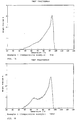
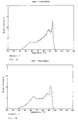
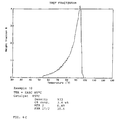
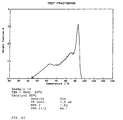
- a heat-fractioning TREF analysis with polymer obtained from fresh TEA + EASC product shows a relatively narrow peak in the LLDPE area, the peak being located at about 90 °C of the elution temperature (cf. figure 1).
- the TREF curve also indicates that the polymer product contains no rubber-like fraction very rich in comonomer. This fraction appears in the comparative tests at an elution temperature of approx. 50 °C.
- DMAC dimethylaluminium chloride
- Examples 1 to 5 indicate that the comonomer, i.e. 1-hexene distribution over the various polymer molecules is more regular when a reaction product of triethylaluminium and ethylaluminium sesquchloride, prepared in situ or fresh, is being used, than with diethylaluminium chloride.
- a double flask was used for feeding.
- the TEA and EASC solution was first introduced in the reactor at a temperature of 20 °C and the procatalyst was subsequently introduced in the reactor, heated to a temperature of 85 °C.
- the first polymerization run i.e. embodiment example 6, was undertaken as soon as possible after TEA and EASC had been admixed. The polymerization was thus started 30 minutes after admixing and heating had been started.
- Comparative example 7 was conducted by starting polymerization after a 24-hour agitation, and comparative example 8 was conducted by starting polymerization one week after the agitation. During the one week, the TEA and EASC solution, that is to say the solution of the reaction product formed by these, was kept in a nitrogen-protected vessel. The results are given in table 2.
- Example Example 6 Example 7 (comparison)
- Example 8 (comparison) Polymerization after agitation 30 min. 24 hours 1 week Activity kgPE/g cat.
- melt flow values MFR 2 remain roughly the same.
- the melt index ratio shows that the molecular weight distribution has become broader.
- the heat-fractioning TREF analysis indicates appreciable differences in the comonomer distribution.
- a fresh solution yielded the highest and the narrowest peak in the area of a linear low-density polyethene fraction.
- the proportion of detrimental, very low-density polyethene fraction will grow, the growth also appearing as a lower average density of the polymer product.
- This copolymer portion is apparently sticky and causes problems in the process. What is more, this fraction affects the mechanical properties of the end products.
- Embodiment example 6 and comparative examples 7 and 8 clearly indicate that ageing of the TEA-EASC reaction product has a distinct effect on the comonomer distribution of the polymer.
- the results lead to the conclusion that a fresh TEA-EASC solution has a different chemical composition than an aged reaction mixture, this chemical difference resulting in a more regular ethene copolymer comonomer distribution.
- the feed equipment consisted of a double feed flask system, comprising one cylinder on top of another. First, the first cylinder was emptied into the reactor, and subsequently the second cylinder was emptied into the reactor through the first cylinder.
- the following feed systems were adopted in the embodiment examples:
- EASC in the first cylinder feed at a temperature of 20 °C.
- Procatalyst + TEA in the second cylinder feed at a temperature of 85 °C.
- TEA + EASC in the first cylinder feed at a temperature of 20 °C.
- Procatalyst in the second cylinder feed at a temperature of 85 °C.
- TEA + EASC in the first cylinder feed at a temperature of 85 °C.
- Procatalyst in the second cylinder feed at a temperature of 85 °C.
- the cylinders were not heatable, and heating of the reactor lasted about 30 min.The cylinders had to be filled and connected to the reactor before heating.
- the precontacting time between procatalyst and TEA stayed about 30 minutes at room temperature
- the TEA-EASC mixture was in the reactor for about 30 minutes, heated at a temperature of 20 °C to a final temperature of 85 °C .
- the TEA-EASC reaction mixture was kept at room temperature for 30 minutes, and was introduced into the reactor at a temperature of 85 °C.
- Example 10 Feed cylinder A EASC fed at a temp. of 20 °C TEA+EASC fed at a temp. of 20 °C TEA+EASC fed at a temp. of 85 °C Feed cylinder B procatalyst+TEA fed at 85 °C procatalyst fed at 85 °C procatalyst fed at 85 °C Activity kgPE/g cat.
- procatalyst prepared as defined in US patent specification 4,395,359, enclosed as a reference.
- silica was used as a carrier, and TiCl 4 as an active transition metal compound.
- the tests were conducted with the combination TEA + EASC, and with mere TEA in reference test 11.
- Copolymerization conditions procatalyst see above, 100 mg comonomer 1-hexene, 300 ml medium isobutane, 700 ml chain transfer hydrogen, 9.2 bar/330 ml temperature 85 °C total pressure 19 bar
- TEA in the first cylinder feed at a temperature of 20 °C.
- Procatalyst in the second cylinder feed at a temperature of 85 °C.
- TEA + EASC in the first cylinder feed at a temperature of 20 °C.
- Procatalyst in the second cylinder feed at a temperature of 85 °C.
- TEA + EASC in the first cylinder feed at a temperature of 85 °C.
- Procatalyst in the second cylinder feed at a temperature of 85 °C.
- Example 12 (comp.)
- Example 13 Example 14
- Feed cylinder B procatalyst fed at 85°C procatalyst fed at 85°C procatalyst fed at 85°C Activity kgPE/g cat.
Landscapes
- Chemical & Material Sciences (AREA)
- Health & Medical Sciences (AREA)
- Chemical Kinetics & Catalysis (AREA)
- Medicinal Chemistry (AREA)
- Polymers & Plastics (AREA)
- Organic Chemistry (AREA)
- Transition And Organic Metals Composition Catalysts For Addition Polymerization (AREA)
- Addition Polymer Or Copolymer, Post-Treatments, Or Chemical Modifications (AREA)
Claims (15)
- Verfahren zur Copolymerisation von Ethylen und α-Olefinen, wobei mindestens die folgenden Komponenten miteinander umgesetzt werden:dadurch gekennzeichnet, daß die Organohalogenverbindung eines Metalls, ausgewählt aus Al und Zn, hergestellt wird durch Umsetzung einer organischen Verbindung eines Metalls, ausgewählt aus Al und Zn, und einer halogenierenden, katalytisch nicht-toxischen Halogenverbindung, während der Copolymerisation oder nicht früher als 3 Stunden vor der Copolymerisation.a) ein Prokatalysator, enthaltend eine Halogenverbindung eines Übergangsmetalls, ausgewählt aus Ti, Zr, V, Ta, Cr, Mo und Co,b) ein Cokatalysator, enthaltend eine Organohalogenverbindung eines Metalls, ausgewählt aus Al und Zn,c) Ethylen undd) ein oder mehrere α-Olefine, die mit Ethylen copolymerisieren,
- Verfahren nach Anspruch 1, dadurch gekennzeichnet, daß die Organohalogenverbindung eines Metalls, ausgewählt aus Al und Zn, hergestellt wird durch Umsetzung der organischen Verbindung eines Metalls, ausgewählt aus Al und Zn, und einer halogenierenden, katalytisch nicht-toxischen Halogenverbindung, nicht früher als 1 Stunde und vorzugsweise 30 Minuten vor Beginn der Copolymerisation.
- Verfahren nach Anspruch 1 oder 2, dadurch gekennzeichnet, daß die Übergangsmetallverbindung eine Chlortitanverbindung der Formel (1)
- Verfahren nach einem der vorhergehenden Ansprüche, dadurch gekennzeichnet, daß der Prokatalysator eine Magnesiumverbindung und eine Halogentitanverbindung enthält, vorzugsweise Magnesiumchlorid und Titantetrachlorid.
- Verfahren nach Anspruch 4, dadurch gekennzeichnet, daß der Prokatalysator Titantetrachlorid, Magnesiumchlorid, einen anorganischen Oxidträger und ggf. einen Elektronendonor enthält.
- Verfahren nach einem der vorhergehenden Ansprüche, dadurch gekennzeichnet, daß die organische Verbindung eines Metalls, ausgewählt aus Al und Zn, eine Verbindung der Formel (2)
- Verfahren nach einem der vorhergehenden Ansprüche, dadurch gekennzeichnet, daß die halogenierende, katalytisch nicht-toxische Halogenverbindung (1) ein Alkylaluminiumhalogenid, vorzugsweise Ethylaluminiumdichlorid, ein Gemisch aus Ethylaluminiumdichlorid und Diethylaluminiumchlorid, Ethylaluminiumsesquichlorid, Methylaluminiumdichlorid, ein Gemisch aus Methylaluminiumdichlorid und Dimethylaluminiumchlorid, oder Methylaluminiumsesquichlorid ist.
- Verfahren nach Anspruch 7, dadurch gekennzeichnet, daß das Alkylaluminiumhalogenid Ethylaluminiumsesquichlorid ist.
- Verfahren nach einem der vorhergehenden Ansprüche, dadurch gekennzeichnet, daß das Verhältnis von Cokatalysator zu Prokatalysator, bezogen auf das Molekulargewicht, 5 bis 200, vorzugsweise 10 bis 50 beträgt.
- Verfahren nach einem der vorhergehenden Ansprüche, dadurch gekennzeichnet, daß das Molverhältnis von halogenierender katalytisch nicht-toxischer Halogenverbindung zu organischer Verbindung eines Metalls, ausgewählt aus Al und Zn, 0,1 bis 2, vorzugsweise etwa 1 beträgt.
- Verfahren nach einem der vorhergehenden Ansprüche, dadurch gekennzeichnet, daß man zunächst die Organohalogenverbindung eines Metalls, ausgewählt aus Al und Zn, herstellt, und diese dann innerhalb von 3 Stunden mit dem Prokatalysator, Ethylen und einem copolymerisierenden Olefin umsetzt.
- Verfahren nach Anspruch 11, dadurch gekennzeichnet, daß die Organohalogenverbindung eines Metalls, ausgewählt aus Al und Zn, innerhalb 1 Stunde, und vorzugsweise innerhalb 30 Minuten, mit dem Prokatalysator, Ethylen und einem oder mehreren α-Olefinen umgesetzt wird.
- Verfahren nach Anspruch 11 oder 12, dadurch gekennzeichnet, daß die Organohalogenverbindung des Metalls hergestellt wird durch Erhitzen einer organischen Verbindung eines Metalls, ausgewählt aus Al und Zn, zusammen mit der halogenierenden, katalytisch nicht-toxischen Halogenverbindung, und anschließende Umsetzung des erhitzten Reaktionsgemisches mit dem Prokatalysator, Ethylen und einem oder mehreren α-Olefinen.
- Verfahren nach einem der Ansprüche 1 bis 13, dadurch gekennzeichnet, daß man die Copolymerisation durchführt, indem zunächst der Prokatalysator mit einer organischen Verbindung eines Metalls, ausgewählt aus A und Zn, umgesetzt wird, anschließend das erhaltene Gemisch mit einer halogenierenden katalytisch nicht-toxischen Halogenverbindung zur Reaktion gebracht wird, und ggf. mit dem erhaltenen Reaktionsgemisch die Copolymerisation von Ethylen mit einem oder mehreren α-Olefinen durchgeführt wird.
- Verfahren nach einem der vorhergehenden Ansprüche, dadurch gekennzeichnet, daß als mit Ethylen copolymerisierendes α-Olefin C4-C10-1-Alken verwendet wird.
Applications Claiming Priority (3)
| Application Number | Priority Date | Filing Date | Title |
|---|---|---|---|
| FI941369 | 1994-03-24 | ||
| FI941369A FI98916C (fi) | 1994-03-24 | 1994-03-24 | Menetelmä eteenin ja -olefiinin kopolymeroimiseksi |
| PCT/FI1995/000152 WO1995025758A1 (en) | 1994-03-24 | 1995-03-23 | PROCESS FOR COPOLYMERIZING ETHENE AND α-OLEFINS |
Publications (2)
| Publication Number | Publication Date |
|---|---|
| EP0751966A1 EP0751966A1 (de) | 1997-01-08 |
| EP0751966B1 true EP0751966B1 (de) | 2001-05-23 |
Family
ID=8540376
Family Applications (1)
| Application Number | Title | Priority Date | Filing Date |
|---|---|---|---|
| EP95913178A Expired - Lifetime EP0751966B1 (de) | 1994-03-24 | 1995-03-23 | Verfahren zur copolymerisierung von ethylen und alpha-olefinen |
Country Status (9)
| Country | Link |
|---|---|
| US (1) | US6043326A (de) |
| EP (1) | EP0751966B1 (de) |
| JP (1) | JPH10500436A (de) |
| CN (1) | CN1080270C (de) |
| AU (1) | AU684927B2 (de) |
| CA (1) | CA2186344A1 (de) |
| DE (1) | DE69521038T2 (de) |
| FI (1) | FI98916C (de) |
| WO (1) | WO1995025758A1 (de) |
Families Citing this family (16)
| Publication number | Priority date | Publication date | Assignee | Title |
|---|---|---|---|---|
| ATE223445T1 (de) † | 1997-07-21 | 2002-09-15 | Dow Chemical Co | Ethyleninterpolymerzusammensetzungen mit breiter molekulargewichtsverteilung und einheitlicher zusammensetzung, verfahren zu dessen herstellung und daraus hergestellte artikel |
| EP1232193B1 (de) | 1999-09-10 | 2007-02-07 | Basell Poliolefine Italia S.r.l. | Katalysator für die polymerisation von olefinen |
| US6433133B1 (en) * | 1999-11-16 | 2002-08-13 | Eastman Chemical Company | Process for reducing the weight average molecular weight and melt index ratio of polyethylenes and polyethylene products |
| EP2246368A1 (de) | 2009-04-30 | 2010-11-03 | Borealis AG | Verbesserte Ethylenpolymerisationskatalysatorzusammensetzung |
| EP2246369B1 (de) | 2009-04-30 | 2012-09-05 | Borealis AG | Geradkettiges Polyethylen niedriger Dichte mit gleichmäßiger oder umgekehrter Comonomerzusammensetzungsverteilung |
| EP2399943A1 (de) | 2010-06-28 | 2011-12-28 | Borealis AG | Verfahren zur Herstellung von Polyethylen |
| KR101331556B1 (ko) | 2012-03-30 | 2013-11-20 | 대림산업 주식회사 | 멀티모달 폴리올레핀 수지 및 이로부터 제조되는 성형체 |
| CN103910930A (zh) * | 2012-12-31 | 2014-07-09 | 中国科学院化学研究所 | 含有碳纳米管的聚丙烯釜内合金及其制备方法与应用 |
| US9879105B2 (en) * | 2013-11-15 | 2018-01-30 | Dow Global Technologies Llc | Polyolefin composition and method of producing the same |
| CN105037600A (zh) * | 2015-06-24 | 2015-11-11 | 合肥蓝科新材料有限公司 | 一种高透明高导电性多壁碳纳米管增强聚丙烯树脂及其制备方法 |
| CN105037599A (zh) * | 2015-06-25 | 2015-11-11 | 合肥蓝科新材料有限公司 | 一种耐紫外多壁碳纳米管增强聚丙烯树脂及其制备方法 |
| CN105037597A (zh) * | 2015-06-25 | 2015-11-11 | 合肥蓝科新材料有限公司 | 一种高韧性多壁碳纳米管增强聚丙烯树脂及其制备方法 |
| CN105017461A (zh) * | 2015-06-25 | 2015-11-04 | 合肥蓝科新材料有限公司 | 一种纳米硼纤维和多壁碳纳米管协同增强聚丙烯树脂及其制备方法 |
| US10344105B2 (en) | 2017-08-04 | 2019-07-09 | Formosa Plastics Corporation, Usa | Process for making polyethylene copolymers with a reversed comonomer distribution |
| US20190352439A1 (en) | 2018-05-17 | 2019-11-21 | Formosa Plastics Corporation, Usa | Ethylene/Alpha-Olefin Copolymers for Better Optical and Mechanical Properties and Processability of Film Made Therefrom |
| CN110964141B (zh) * | 2019-12-06 | 2022-04-01 | 中玺新材料(安徽)有限公司 | 一种负载铬锆钼三金属催化剂及其制备方法和应用 |
Family Cites Families (23)
| Publication number | Priority date | Publication date | Assignee | Title |
|---|---|---|---|---|
| NL206073A (de) * | 1955-04-07 | 1900-01-01 | Hercules Powder Co Ltd | |
| US3118865A (en) * | 1960-02-03 | 1964-01-21 | Du Pont | Olefin polymerization catalyst |
| BE597164A (de) * | 1959-11-18 | |||
| US3172881A (en) * | 1961-11-20 | 1965-03-09 | Titanium haude-organometal-organq- metal iodide catalyst for produc- tion of cis i,x-polybutadiene | |
| GB1367087A (en) * | 1970-12-08 | 1974-09-18 | Shell Int Research | Olefin polymerisation |
| JPS5222080A (en) * | 1975-08-12 | 1977-02-19 | Nippon Oil Co Ltd | Preparation of polyolefin |
| IT1042711B (it) * | 1975-09-19 | 1980-01-30 | Montedison Spa | Compnenti di catalizzatori per la polimerizzazione di olefine |
| US4258161A (en) * | 1978-02-14 | 1981-03-24 | Mitsubishi Chemical Industries Ltd. | Process for polymerizing propylene |
| JPS55164206A (en) * | 1979-06-11 | 1980-12-20 | Mitsui Petrochem Ind Ltd | Preparation of wax |
| JPS5611908A (en) * | 1979-07-11 | 1981-02-05 | Mitsui Petrochem Ind Ltd | Preparation of olefin polymer |
| US4354009A (en) * | 1981-07-30 | 1982-10-12 | Union Carbide Corporation | Catalyst composition for copolymerizing ethylene |
| US4349648A (en) * | 1981-07-31 | 1982-09-14 | Union Carbide Corporation | Catalyst composition for copolymerizing ethylene |
| JPS58127710A (ja) * | 1982-01-26 | 1983-07-29 | Idemitsu Petrochem Co Ltd | ポリエチレンの製造法 |
| US4442276A (en) * | 1982-02-12 | 1984-04-10 | Mitsui Petrochemical Industries, Ltd. | Process for polymerizing or copolymerizing olefins |
| JPS6067508A (ja) * | 1983-09-22 | 1985-04-17 | Toa Nenryo Kogyo Kk | オレフインの重合方法 |
| US4549001A (en) * | 1984-09-27 | 1985-10-22 | Phillips Petroleum Company | Olefin polymerization |
| US4647633A (en) * | 1984-10-05 | 1987-03-03 | Atlantic Richfield Company | Polymerization process |
| NL8500521A (nl) * | 1985-02-23 | 1986-09-16 | Stamicarbon | Werkwijze voor het bereiden van een vaste katalytische titaankomponent en werkwijze voor het polymeriseren van alkenen-1 onder toepassing van een dergelijke titaankomponent. |
| JPH07116253B2 (ja) * | 1986-01-21 | 1995-12-13 | 東ソー株式会社 | ポリオレフインの製造方法 |
| US4736002A (en) * | 1986-06-30 | 1988-04-05 | El Paso Products Company | Novel propylene polymerization process |
| BR8906953A (pt) * | 1988-05-06 | 1990-12-11 | Dow Chemical Co | Polietileno linear de baixa densidade de ultra baixa densidade |
| CA2032543A1 (en) * | 1989-12-26 | 1991-06-27 | Robert Olds Hagerty | Dimethylaluminum chloride-activated olefin polymerisation catalyst composition |
| US5139986A (en) * | 1991-08-06 | 1992-08-18 | Mobil Oil Corporation | Catalyst composition for production of linear low-density ethylene-hexene copolymers and films thereof |
-
1994
- 1994-03-24 FI FI941369A patent/FI98916C/fi active IP Right Grant
-
1995
- 1995-03-23 DE DE69521038T patent/DE69521038T2/de not_active Expired - Lifetime
- 1995-03-23 US US08/716,298 patent/US6043326A/en not_active Expired - Fee Related
- 1995-03-23 EP EP95913178A patent/EP0751966B1/de not_active Expired - Lifetime
- 1995-03-23 JP JP7524407A patent/JPH10500436A/ja active Pending
- 1995-03-23 WO PCT/FI1995/000152 patent/WO1995025758A1/en not_active Ceased
- 1995-03-23 CA CA002186344A patent/CA2186344A1/en not_active Abandoned
- 1995-03-23 AU AU20741/95A patent/AU684927B2/en not_active Ceased
- 1995-03-23 CN CN95193217A patent/CN1080270C/zh not_active Expired - Fee Related
Non-Patent Citations (3)
| Title |
|---|
| Nomenclature of Inorganic Chemistry, Second Edition, Butterworths, London, pages 10-12 * |
| Römpp Chemie Lexikon, 7. Auflage, Teil 4, page 2556 b * |
| Römpp Chemie Lexikon, 9. Auflage,Band 4, Georg Thieme Verlag, Stuttgart-NewYork, 1991, pages 3280-3287 * |
Also Published As
| Publication number | Publication date |
|---|---|
| EP0751966A1 (de) | 1997-01-08 |
| CA2186344A1 (en) | 1995-09-28 |
| AU2074195A (en) | 1995-10-09 |
| DE69521038T2 (de) | 2002-03-21 |
| FI941369L (fi) | 1995-09-25 |
| AU684927B2 (en) | 1998-01-08 |
| FI98916B (fi) | 1997-05-30 |
| FI98916C (fi) | 1997-09-10 |
| DE69521038D1 (de) | 2001-06-28 |
| CN1148858A (zh) | 1997-04-30 |
| WO1995025758A1 (en) | 1995-09-28 |
| JPH10500436A (ja) | 1998-01-13 |
| US6043326A (en) | 2000-03-28 |
| FI941369A0 (fi) | 1994-03-24 |
| CN1080270C (zh) | 2002-03-06 |
Similar Documents
| Publication | Publication Date | Title |
|---|---|---|
| EP0751966B1 (de) | Verfahren zur copolymerisierung von ethylen und alpha-olefinen | |
| US4530913A (en) | Polymerization catalyst and method | |
| EP0869978B1 (de) | Prokatalysator, prokatalysatorvorstufe und verfahren zur herstellung eines multimodalen ethylenpolmers | |
| EP0231102A2 (de) | Katalysatorzusammensetzung für Olefinpolymerisation | |
| EP0447722B1 (de) | Katalysatorzusammensetzung auf Zirkoniumbasis für Olefinpolymerisation | |
| JP2774807B2 (ja) | 分子量分布の狭いアルファオレフィンポリマー重合用触媒組成物 | |
| AU661043B2 (en) | Catalysts for the polymerization of olefins | |
| US4656151A (en) | Intermetallic compound | |
| EP0137097B1 (de) | Verfahren zur Äthylenpolymerisation | |
| US4578440A (en) | Polymerization catalyst and method | |
| RU2142472C1 (ru) | Каталитическая система для полимеризации этилена, способ ее получения и способ полимеризации этилена | |
| EP0669943A1 (de) | Katalisator zur polymerisation von ethylen | |
| EP1863856B1 (de) | Verfahren zur herstellung von kristallinen ethylen(co)polymeren | |
| US11021551B2 (en) | Tri-n-octyl aluminum co-catalyst for higher density homopolymers for the solution process | |
| JP2022543558A (ja) | 高分子量を有するポリエチレンを生成するための重合触媒 | |
| CN101146833B (zh) | 用于烯烃聚合的催化剂组分 | |
| EP2077284B1 (de) | Verwendung eines verbesserten Festkörper-Vanadium-haltigen Ziegler-Natta-Katalysatorensystems zur Herstellung von Ethylenpolymerzusammensetzungen in einem mehrstufigen Verfahren | |
| US4851378A (en) | Olefin polymerization of copolymerization catalyst components | |
| CA1154421A (en) | Ultra high efficiency catalyst for polymerizing olefins | |
| JP2008534722A (ja) | オレフィン類の重合用触媒成分 |
Legal Events
| Date | Code | Title | Description |
|---|---|---|---|
| PUAI | Public reference made under article 153(3) epc to a published international application that has entered the european phase |
Free format text: ORIGINAL CODE: 0009012 |
|
| AK | Designated contracting states |
Kind code of ref document: A1 Designated state(s): BE DE DK ES FR GB IT NL PT SE |
|
| 17P | Request for examination filed |
Effective date: 19961014 |
|
| 17Q | First examination report despatched |
Effective date: 19970218 |
|
| RTI1 | Title (correction) |
Free format text: PROCESS FOR COPOLYMERIZING ETHENE AND ALPHA-OLEFINS |
|
| GRAG | Despatch of communication of intention to grant |
Free format text: ORIGINAL CODE: EPIDOS AGRA |
|
| RTI1 | Title (correction) |
Free format text: PROCESS FOR COPOLYMERIZING ETHENE AND ALPHA-OLEFINS |
|
| GRAG | Despatch of communication of intention to grant |
Free format text: ORIGINAL CODE: EPIDOS AGRA |
|
| GRAH | Despatch of communication of intention to grant a patent |
Free format text: ORIGINAL CODE: EPIDOS IGRA |
|
| RAP1 | Party data changed (applicant data changed or rights of an application transferred) |
Owner name: BOREALIS TECHNOLOGY OY |
|
| GRAH | Despatch of communication of intention to grant a patent |
Free format text: ORIGINAL CODE: EPIDOS IGRA |
|
| GRAA | (expected) grant |
Free format text: ORIGINAL CODE: 0009210 |
|
| AK | Designated contracting states |
Kind code of ref document: B1 Designated state(s): BE DE DK ES FR GB IT NL PT SE |
|
| PG25 | Lapsed in a contracting state [announced via postgrant information from national office to epo] |
Ref country code: NL Free format text: LAPSE BECAUSE OF FAILURE TO SUBMIT A TRANSLATION OF THE DESCRIPTION OR TO PAY THE FEE WITHIN THE PRESCRIBED TIME-LIMIT Effective date: 20010523 Ref country code: BE Free format text: LAPSE BECAUSE OF FAILURE TO SUBMIT A TRANSLATION OF THE DESCRIPTION OR TO PAY THE FEE WITHIN THE PRESCRIBED TIME-LIMIT Effective date: 20010523 |
|
| ITF | It: translation for a ep patent filed | ||
| REF | Corresponds to: |
Ref document number: 69521038 Country of ref document: DE Date of ref document: 20010628 |
|
| PG25 | Lapsed in a contracting state [announced via postgrant information from national office to epo] |
Ref country code: SE Free format text: LAPSE BECAUSE OF FAILURE TO SUBMIT A TRANSLATION OF THE DESCRIPTION OR TO PAY THE FEE WITHIN THE PRESCRIBED TIME-LIMIT Effective date: 20010823 Ref country code: PT Free format text: LAPSE BECAUSE OF FAILURE TO SUBMIT A TRANSLATION OF THE DESCRIPTION OR TO PAY THE FEE WITHIN THE PRESCRIBED TIME-LIMIT Effective date: 20010823 Ref country code: DK Free format text: LAPSE BECAUSE OF FAILURE TO SUBMIT A TRANSLATION OF THE DESCRIPTION OR TO PAY THE FEE WITHIN THE PRESCRIBED TIME-LIMIT Effective date: 20010823 |
|
| ET | Fr: translation filed | ||
| NLV1 | Nl: lapsed or annulled due to failure to fulfill the requirements of art. 29p and 29m of the patents act | ||
| PG25 | Lapsed in a contracting state [announced via postgrant information from national office to epo] |
Ref country code: ES Free format text: LAPSE BECAUSE OF FAILURE TO SUBMIT A TRANSLATION OF THE DESCRIPTION OR TO PAY THE FEE WITHIN THE PRESCRIBED TIME-LIMIT Effective date: 20011130 |
|
| REG | Reference to a national code |
Ref country code: GB Ref legal event code: IF02 |
|
| PLBE | No opposition filed within time limit |
Free format text: ORIGINAL CODE: 0009261 |
|
| STAA | Information on the status of an ep patent application or granted ep patent |
Free format text: STATUS: NO OPPOSITION FILED WITHIN TIME LIMIT |
|
| 26N | No opposition filed | ||
| PGFP | Annual fee paid to national office [announced via postgrant information from national office to epo] |
Ref country code: IT Payment date: 20120329 Year of fee payment: 18 |
|
| PG25 | Lapsed in a contracting state [announced via postgrant information from national office to epo] |
Ref country code: IT Free format text: LAPSE BECAUSE OF NON-PAYMENT OF DUE FEES Effective date: 20130323 |
|
| PGFP | Annual fee paid to national office [announced via postgrant information from national office to epo] |
Ref country code: DE Payment date: 20140328 Year of fee payment: 20 |
|
| PGFP | Annual fee paid to national office [announced via postgrant information from national office to epo] |
Ref country code: FR Payment date: 20140319 Year of fee payment: 20 |
|
| PGFP | Annual fee paid to national office [announced via postgrant information from national office to epo] |
Ref country code: GB Payment date: 20140319 Year of fee payment: 20 |
|
| REG | Reference to a national code |
Ref country code: DE Ref legal event code: R071 Ref document number: 69521038 Country of ref document: DE |
|
| REG | Reference to a national code |
Ref country code: DE Ref legal event code: R071 Ref document number: 69521038 Country of ref document: DE |
|
| REG | Reference to a national code |
Ref country code: GB Ref legal event code: PE20 Expiry date: 20150322 |
|
| PG25 | Lapsed in a contracting state [announced via postgrant information from national office to epo] |
Ref country code: GB Free format text: LAPSE BECAUSE OF EXPIRATION OF PROTECTION Effective date: 20150322 |