EP0752768A2 - Nachrichtenübertragungssystem und Netzwerkelement bei einem Nachrichtenübertragungssystem - Google Patents
Nachrichtenübertragungssystem und Netzwerkelement bei einem Nachrichtenübertragungssystem Download PDFInfo
- Publication number
- EP0752768A2 EP0752768A2 EP96850118A EP96850118A EP0752768A2 EP 0752768 A2 EP0752768 A2 EP 0752768A2 EP 96850118 A EP96850118 A EP 96850118A EP 96850118 A EP96850118 A EP 96850118A EP 0752768 A2 EP0752768 A2 EP 0752768A2
- Authority
- EP
- European Patent Office
- Prior art keywords
- network
- information
- telecommunication system
- devices
- channel creating
- Prior art date
- Legal status (The legal status is an assumption and is not a legal conclusion. Google has not performed a legal analysis and makes no representation as to the accuracy of the status listed.)
- Ceased
Links
Images


Classifications
-
- H—ELECTRICITY
- H04—ELECTRIC COMMUNICATION TECHNIQUE
- H04L—TRANSMISSION OF DIGITAL INFORMATION, e.g. TELEGRAPHIC COMMUNICATION
- H04L12/00—Data switching networks
- H04L12/28—Data switching networks characterised by path configuration, e.g. LAN [Local Area Networks] or WAN [Wide Area Networks]
- H04L12/46—Interconnection of networks
- H04L12/4637—Interconnected ring systems
-
- H—ELECTRICITY
- H04—ELECTRIC COMMUNICATION TECHNIQUE
- H04Q—SELECTING
- H04Q11/00—Selecting arrangements for multiplex systems
- H04Q11/04—Selecting arrangements for multiplex systems for time-division multiplexing
- H04Q11/0407—Selecting arrangements for multiplex systems for time-division multiplexing using a stored program control
-
- H—ELECTRICITY
- H04—ELECTRIC COMMUNICATION TECHNIQUE
- H04Q—SELECTING
- H04Q3/00—Selecting arrangements
- H04Q3/0016—Arrangements providing connection between exchanges
- H04Q3/002—Details
-
- H—ELECTRICITY
- H04—ELECTRIC COMMUNICATION TECHNIQUE
- H04Q—SELECTING
- H04Q2213/00—Indexing scheme relating to selecting arrangements in general and for multiplex systems
- H04Q2213/13141—Hunting for free outlet, circuit or channel
-
- H—ELECTRICITY
- H04—ELECTRIC COMMUNICATION TECHNIQUE
- H04Q—SELECTING
- H04Q2213/00—Indexing scheme relating to selecting arrangements in general and for multiplex systems
- H04Q2213/13166—Fault prevention
-
- H—ELECTRICITY
- H04—ELECTRIC COMMUNICATION TECHNIQUE
- H04Q—SELECTING
- H04Q2213/00—Indexing scheme relating to selecting arrangements in general and for multiplex systems
- H04Q2213/13167—Redundant apparatus
-
- H—ELECTRICITY
- H04—ELECTRIC COMMUNICATION TECHNIQUE
- H04Q—SELECTING
- H04Q2213/00—Indexing scheme relating to selecting arrangements in general and for multiplex systems
- H04Q2213/13242—Broadcast, diffusion, multicast, point-to-multipoint (1 : N)
-
- H—ELECTRICITY
- H04—ELECTRIC COMMUNICATION TECHNIQUE
- H04Q—SELECTING
- H04Q2213/00—Indexing scheme relating to selecting arrangements in general and for multiplex systems
- H04Q2213/13332—Broadband, CATV, dynamic bandwidth allocation
-
- H—ELECTRICITY
- H04—ELECTRIC COMMUNICATION TECHNIQUE
- H04Q—SELECTING
- H04Q2213/00—Indexing scheme relating to selecting arrangements in general and for multiplex systems
- H04Q2213/13349—Network management
Definitions
- the present invention relates to a telecommunication system where information is transmitted between subscribers in the telecommunication system.
- the transmitted information can relate to speech, video, data etc.
- the subscriber equipments which are utilized in the telecommunication system consequently can be of different kinds, or involve a number of different functions.
- Figure 1 is shown a conventional telecommunication system with a connection established between a subscriber A and a subscriber B.
- the connection of the subscribers has in this case been made over the stations S1, S2, S3.
- This picture can be regarded to show the early telephone station systems where connection occurred directly via different switches in the telecommunication system.
- the picture also can be regarded as showing a connection procedure in a completely manual system.
- Figure 3 is shown a further development of the telecommunication system where a ring network is arranged between units labelled ADM, where ADM has been introduced to relieve other logical functions in the system.
- connection between two subscribers, or between a subscriber and a service in the network is made over one or more stations in the system.
- the different stations in the network are of different kinds, and different control systems exist, and the different resources are charged at each connection. Examples of equipments at the stations and in the network which are utilized are MUX and DEMUX etc.
- the present invention relates to a telecommunication system which includes network, channel creating devices and control devices.
- Information in the telecommunication network is transmitted in channels.
- Channel creating devices are arranged between the subscribers and the network.
- the channel creating devices transmit digital or analog information to the telecommunication network after conversion of the information to for the network suitable information.
- the information is added to or extracted from the telecommunication network in time slots.
- the time slots are allowed to be of different sizes, depending on the current need of information. Allocation of suitable time slots is made by control devices in the system.
- the control system also indicates which time slots and the size of times slots that have been allocated the different channel allocation devices and the subscribers.
- the networks in the telecommunication system is preferably arranged ring-shaped, and depending on the necessary capacity arranged parallelly and/or within each other. Information transmission between the networks is made via channel creating devices.
- the control devices are preferably arranged to control each ring network individually.
- a control device can also be in common for a number of ring networks.
- Channel creating devices which are arranged to transmit information to/from the telecommunication network from/to subscribers are arranged to transform the information to/from the telecommunication network from/to the subscriber equipments.
- the information in the network is transmitted digitally. Further, one and the same subscriber is allowed to communicate with one or more other subscribers at the same time. It consequently is allowed, in one and the same subscription, to establish a number of simultaneous communication connections. The subscriber at this decides which information that shall be transmitted to any of the other subscribers, and also decides to what extent information received from other subscribers shall be transmitted to other subscribers in the communication/communications.
- the control devices are further arranged to communicate with each other and agree regarding channel allocations in the network/networks.
- the control devices at this identify the need of channels for each subsciber, and allocate the subscribers channel sizes corresponding to the the current need of information.
- the control devices are further arranged to identify individual subscribers and their information transmission need, and with which of the other subscribers, one or more, in the telecommunication system that information exchange shall be made.
- the control devices further decide which channel creating divices that shall be utilized in the individual communications.
- the control devices further receive control information from the subscribers.
- the invention further relates to a network element at telecommunication system.
- the telecommunication system includes channel allocation devices and control devices. Information to/from subscribers are transmitted to the channel allocation devices.
- the control devices allocate necessary room for information and place.
- the channel allocation devices add/extract said information, and the information transmission in the telecommunication system is made in logical channels.
- the present invention has the advantage that the information is early transformed to a digital form which can be utilized in all parts of the network. In this way the need for telecommunication stations, transmission equipment etc is excluded. Switching and routing in this case is only made in one type of channel allocation devices which are in common for the whole system. The transmission consequently is made in logical channels in and between the networks in the telecommunication system. From maintenance point of view, this is an advantage, since the maintenance staff only need to learn one or a few types of equipments. Further there are obvious economical advantages in the fact that the channel allocation devices can be arranged close to the subscribers.
- the ring network structure further allows that the vulnerability in the network can be most significantly reduced.
- the control devices can in case of a break in any part of the network reroute the traffic other paths, or possibly only close that part or parts which are out of function. In the traditional network which is used at present, generally a lot of subscribers are affected.
- Figure 1 shows the fundamental construction of a conventional telecommunication network.
- Figure 2 shows a further development of the conventional telecommunication system where different network databases have been involved in the network for provision of different services.
- Figure 3 shows a further development of the system according to Figure 2.
- x represents "Resource allocation, channel allocation device, switch”, and ADM "Resource allocation device MUX/DEMUX”.
- Figure 4 shows the fundamental construction according to the invention.
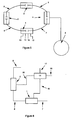
- Figure 5 shows ring network with channel allocation devices.
- Figure 6 shows the central control device and the network element.
- a number of ring networks R1, R2, R3 and R4 are arranged.
- the ring networks R1 and R2 are arranged parallelly to each other, as are the ring networks R3 and R4 in relation to each other.
- the ring networks R3 and R4 are further arranged within the ring network R1.
- K a number of channel creating devices
- the channel creating devices are utilized for information transmission between the networks, respective between the networks and the subscribers, A.
- LX two control devices
- the number of control devices can be fewer or more, depending on the capacity and functionality of the telcommunication system.
- One of the subscribers in the ring network R1 intends to establish a communication.
- the subscriber activates his/her subscriber equipment and the channel creating device registers this.
- Information is transmitted between the channel creating device and the control device regarding the identity of the subscriber.
- the control device registers this at the same time as the subscriber identifies his/her wishes regarding communication with another subscriber, for instance one or more of the subscribers in ring network R2.
- the subscriber In connection with request for connection with the wanted subscriber/subscribers in the other ring network, the subscriber also indicates which service or services, respective subscriber equipments that shall be utilized.
- the control system registers this, and notes which information need that exists. We can for instance suppose that subscribers want to get an ordinary telephone connection with one of the subscribers, and a video transmission with the other subscriber.
- the necessary amount of information for the video transmission is essentially larger than for a conventional speech connection.
- the control device registers this and allocates two channels to the subscriber, where the channels are adapted to the need of information.
- the channel for the video transmission is consequently considerably larger than the one for speech transmission.
- the control device further decides which channels that shall be utilized for what, and informs the channel creating device about this.
- the control device further decides which route in the network the connection shall be established. At this the control device informs said channel allocation devices in the ring network R1, R2 and R3. Further the control device informs the control device for ring network 2 about the connection in question.
- the control device for ring network 2 at this receives information about which subscribers that are affected, and which type of information that shall be transmitted to respective subscriber.
- the control device for the other network further receives information about which channels the control device in the first network has reserved for the information transmission in its network/networks.
- the control device in the other network registers this and appoints which channels that shall be utilized in ring network 2.
- Information is transmitted to the channel creating devices about which channels that have been reserved, and the size of these.
- the channel creating devices further receive information about which subscriber/subscribers that are affected by the communication.
- the channel creating devices register this and transmits call signal to the subscribers in question. When the subscribers have answered, the control device is informed, which also informs the control device in the first network, whereafter the communication transmission can start.
- the channel creation device receives the information in analog form and transforms this to digital information before it is introduced into the time slot in question at the information transmission in the ring network. After that also in this case a transmission of the information between networks in question via channel allocation devices in question is made.
- a transformation is made from digital to analog information.
- Information can after that be transmitted from the subscriber in the first ring network, R1, to respective subscribers in the second ring network, R2.
- Respective subscribers can, while the communication is going on, add or remove other communications which are needed or can be spared.
- the control devices register which type of communication that has been applied, and transmit this information to charging equipments.
- the charging equipments after that see to it, for instance periodically, that costs for the established connections are charged respective subscribers.
- the control devices are further arranged to check whether a certain type of communication is allowed for involved subscribers in the system. This includes for instance a check that respective communicating subscribers have access to equipments for the connection in question, and whether certain type of equipments are not allowed. Examples of not allowed communications can for instance be calls to certain services which the subscriber have declined, or restrictions regarding international calls etc.
- the invention further relates to a network element in a telecommunication network, i.e. that the invention includes arrangements which can be combined with other arrangements to obtain telecommunication networks.
- a network element has the form of a ring which is connected by a number of transmission parts which are connected by nodes.
- a central control unit controls all operations in all nodes in the ring, and receives especially traffic routing data and checks the traffic level in the ring.
- Network elements can be connected to external transmission routes and other network elements via the nodes.
- the invention can be utilized at the construction of telecommunication networks and the control functions where the network is controlled by control devices which are centrally placed or placed in different points in the network.
- the invention also can act as a centre in a telecommunication network and supply traffic allocation functions for this network.
- the invention consequently supplies redundancy in the network element, since breaks in a connection can be attended to by the transmission being arranged another route in the system than the original.
- the redundancy is less than what should be obtained at a doubling of transmission routes, and is related to the number of nodes which are supplied in the ring.
- Figure 5 the network element according to the present invention is shown
- Figure 6 shows the way in which the central control device is introduced in the network element.
- the ring network is a series of transmission parts 6, 7, 8 and 9, connected with nodes, connection devices 2, 3, 4 and 5.
- Each node is equipped with a bus to which a series in-/out-devices are connected, shown i Figure 5 for node 1 as 10, 11, 12 and 13. These devices control the traffic in and out from the network element.
- These devices can supply links for varying transmission media such as optical fibre, coaxial cable or radio. Transmission media can supply communication links with other network elements such as are shown as 5, information transmitters or information receivers.
- Each node has the following functions:
- the information is preferably transmitted time multiplexed and in digital form.
- the control device 14 receives Information about the traffic level in each of the nodes, and the accessibility of the transmission parts from the control device 14, see Figure 6, via the connections 15 and 16.
- the nodes are controlled via signals from the control device 14 to the nodes over the connections 15 and 16.
- the control device establishes which channels that should be utilized for the transmission of data round the ring and also the direction of the transmission.
- the control device is progammed to control the connection elements in the node making the traffic pattern in the ring optimized and the traffic flow into and out from the ring controlled.
- control device 14 initiates a signal to node 1 and 4 to close the part 7 and reroute the traffic via the paths 6, 8 and 9.
- control device 14 is shown together with the connections 15 and 16 which connects it to node 1 and 2. Similar connections are supplied by the control device 14 to the nodes 3 and 4.
- the control device decides channel by time slot allocation in the ring and controls connection function preferably via the nodes 1, 2, 3 and 4.
Landscapes
- Engineering & Computer Science (AREA)
- Computer Networks & Wireless Communication (AREA)
- Signal Processing (AREA)
- Small-Scale Networks (AREA)
- Time-Division Multiplex Systems (AREA)
- Input Circuits Of Receivers And Coupling Of Receivers And Audio Equipment (AREA)
- Mobile Radio Communication Systems (AREA)
Applications Claiming Priority (2)
| Application Number | Priority Date | Filing Date | Title |
|---|---|---|---|
| SE9502467 | 1995-07-06 | ||
| SE9502467A SE517837C2 (sv) | 1995-07-06 | 1995-07-06 | Telesystem och nätverkselement vid telesystem |
Publications (2)
| Publication Number | Publication Date |
|---|---|
| EP0752768A2 true EP0752768A2 (de) | 1997-01-08 |
| EP0752768A3 EP0752768A3 (de) | 1999-12-22 |
Family
ID=20398883
Family Applications (1)
| Application Number | Title | Priority Date | Filing Date |
|---|---|---|---|
| EP96850118A Ceased EP0752768A3 (de) | 1995-07-06 | 1996-06-25 | Nachrichtenübertragungssystem und Netzwerkelement bei einem Nachrichtenübertragungssystem |
Country Status (3)
| Country | Link |
|---|---|
| EP (1) | EP0752768A3 (de) |
| NO (1) | NO317275B1 (de) |
| SE (1) | SE517837C2 (de) |
Cited By (2)
| Publication number | Priority date | Publication date | Assignee | Title |
|---|---|---|---|---|
| WO2001078311A3 (en) * | 2000-04-06 | 2002-03-21 | Adc Telecomm Israel Ltd | Autoconfiguration for an access network |
| CN1323497C (zh) * | 2002-07-30 | 2007-06-27 | 中兴通讯股份有限公司 | 光传输网络中面向连接的手工业务配置方法 |
Family Cites Families (1)
| Publication number | Priority date | Publication date | Assignee | Title |
|---|---|---|---|---|
| US4999832A (en) * | 1989-11-27 | 1991-03-12 | At&T Bell Laboratories | Broadband multirate switching architecture |
-
1995
- 1995-07-06 SE SE9502467A patent/SE517837C2/sv not_active IP Right Cessation
-
1996
- 1996-06-25 EP EP96850118A patent/EP0752768A3/de not_active Ceased
- 1996-07-02 NO NO19962796A patent/NO317275B1/no not_active IP Right Cessation
Cited By (2)
| Publication number | Priority date | Publication date | Assignee | Title |
|---|---|---|---|---|
| WO2001078311A3 (en) * | 2000-04-06 | 2002-03-21 | Adc Telecomm Israel Ltd | Autoconfiguration for an access network |
| CN1323497C (zh) * | 2002-07-30 | 2007-06-27 | 中兴通讯股份有限公司 | 光传输网络中面向连接的手工业务配置方法 |
Also Published As
| Publication number | Publication date |
|---|---|
| SE517837C2 (sv) | 2002-07-23 |
| SE9502467L (sv) | 1997-01-07 |
| EP0752768A3 (de) | 1999-12-22 |
| SE9502467D0 (sv) | 1995-07-06 |
| NO962796L (no) | 1997-01-07 |
| NO962796D0 (no) | 1996-07-02 |
| NO317275B1 (no) | 2004-10-04 |
Similar Documents
| Publication | Publication Date | Title |
|---|---|---|
| EP0724818B1 (de) | Verteiltes telekommunikationsvermittlungssystem | |
| US5841767A (en) | Mobile communication system using efficient service area expansion scheme | |
| US5748624A (en) | Method of time-slot allocation in a TDMA communication system | |
| EP0304955B1 (de) | Funkkonzentratorsystem mit Fähigkeit zur Vervollständigung von Notrufen bei Rufstauung | |
| KR100394284B1 (ko) | 인터스위치핸드오버들을제공하는방법및장치 | |
| KR950003108B1 (ko) | 분배 제어 스위칭 시스템 | |
| EP0113662A2 (de) | Zellulares mobiles Funkfernsprechsystem | |
| CA2220790C (en) | Automatic learning of network routing using random routes | |
| JPH07508379A (ja) | マイクロセルラー無線ネットワーク | |
| JPH09289675A (ja) | 無線通信システム | |
| US6229800B1 (en) | Establishing a wireless link between a central terminal and a subscriber terminal of a wireless telecommunications system | |
| FI98482C (fi) | Kytkentäkeskus autoradiopuhelinkäyttöön | |
| JPH04222140A (ja) | Isdnサービスにおけるメンテナンス通信制御方式 | |
| CA2247605C (en) | Multiple connection method and device for subscriber access network | |
| EP0784890B1 (de) | Einrichtung zur kapazitätsregelung eines telekommunikationsnetzwerkes | |
| JPH10210051A (ja) | 方向性方法及びローカル移動アクセスネットワーク | |
| US6119008A (en) | Flexible multiple subscriber radio access system | |
| CA2250327A1 (en) | System and method for providing services to subscriber stations connected to an access network | |
| NO317275B1 (no) | Telekommunikasjonssystem og nettelement for systemet | |
| US8320413B2 (en) | Communication method using one access | |
| EP0752776B1 (de) | Netzwerkarchitektur | |
| JPH0716265B2 (ja) | 回線割当方式加入者線による交換システム | |
| JP3028068B2 (ja) | 衛星通信システムの回線制御方式 | |
| JP2828417B2 (ja) | 電話交換機におけるアナログ回線関連情報信号とisdn回線関連情報信号との統一スイッチング方式 | |
| JPH06125324A (ja) | 時分割多重化通信システム |
Legal Events
| Date | Code | Title | Description |
|---|---|---|---|
| PUAI | Public reference made under article 153(3) epc to a published international application that has entered the european phase |
Free format text: ORIGINAL CODE: 0009012 |
|
| AK | Designated contracting states |
Kind code of ref document: A2 Designated state(s): CH DE DK ES FR GB IT LI NL |
|
| PUAL | Search report despatched |
Free format text: ORIGINAL CODE: 0009013 |
|
| RIC1 | Information provided on ipc code assigned before grant |
Free format text: 6H 04J 3/08 A, 6H 04L 12/00 B, 6H 04L 12/46 B, 6H 04Q 3/00 B, 6H 04Q 11/04 B |
|
| AK | Designated contracting states |
Kind code of ref document: A3 Designated state(s): CH DE DK ES FR GB IT LI NL |
|
| 17P | Request for examination filed |
Effective date: 20000623 |
|
| 17Q | First examination report despatched |
Effective date: 20011204 |
|
| RAP1 | Party data changed (applicant data changed or rights of an application transferred) |
Owner name: TELIASONERA AB |
|
| STAA | Information on the status of an ep patent application or granted ep patent |
Free format text: STATUS: THE APPLICATION HAS BEEN REFUSED |
|
| 18R | Application refused |
Effective date: 20110220 |