EP0752992B1 - DERIVES D'IMIDAZO[1,2-a]INDENO[1,2-e]PYRAZIN-4-ONE ET COMPOSITIONS PHARMACEUTIQUES LES CONTENANT - Google Patents
DERIVES D'IMIDAZO[1,2-a]INDENO[1,2-e]PYRAZIN-4-ONE ET COMPOSITIONS PHARMACEUTIQUES LES CONTENANT Download PDFInfo
- Publication number
- EP0752992B1 EP0752992B1 EP95914404A EP95914404A EP0752992B1 EP 0752992 B1 EP0752992 B1 EP 0752992B1 EP 95914404 A EP95914404 A EP 95914404A EP 95914404 A EP95914404 A EP 95914404A EP 0752992 B1 EP0752992 B1 EP 0752992B1
- Authority
- EP
- European Patent Office
- Prior art keywords
- alk
- radical
- coor
- imidazo
- indeno
- Prior art date
- Legal status (The legal status is an assumption and is not a legal conclusion. Google has not performed a legal analysis and makes no representation as to the accuracy of the status listed.)
- Expired - Lifetime
Links
- 239000008194 pharmaceutical composition Substances 0.000 title claims description 7
- RAEFWQHVCBYJKM-UHFFFAOYSA-N 2,5,8-triazatetracyclo[7.7.0.02,6.010,15]hexadeca-1(16),3,5,8,10,12,14-heptaen-7-one Chemical class C12=CC=CC=C2C=C2C1=NC(=O)C1=NC=CN12 RAEFWQHVCBYJKM-UHFFFAOYSA-N 0.000 title description 2
- 150000001875 compounds Chemical class 0.000 claims abstract description 172
- 239000000203 mixture Substances 0.000 claims abstract description 165
- 150000003839 salts Chemical class 0.000 claims abstract description 58
- 238000002360 preparation method Methods 0.000 claims abstract description 46
- -1 nitro, cyano, phenyl Chemical group 0.000 claims description 449
- 150000003254 radicals Chemical class 0.000 claims description 414
- 125000004435 hydrogen atom Chemical group [H]* 0.000 claims description 159
- 125000000217 alkyl group Chemical group 0.000 claims description 141
- 230000002829 reductive effect Effects 0.000 claims description 127
- RAXXELZNTBOGNW-UHFFFAOYSA-N imidazole Natural products C1=CNC=N1 RAXXELZNTBOGNW-UHFFFAOYSA-N 0.000 claims description 122
- 125000005843 halogen group Chemical group 0.000 claims description 119
- 238000000034 method Methods 0.000 claims description 116
- 125000004093 cyano group Chemical group *C#N 0.000 claims description 108
- 125000003545 alkoxy group Chemical group 0.000 claims description 97
- 125000001997 phenyl group Chemical group [H]C1=C([H])C([H])=C(*)C([H])=C1[H] 0.000 claims description 95
- 125000001424 substituent group Chemical group 0.000 claims description 91
- 230000008569 process Effects 0.000 claims description 48
- 229910052786 argon Inorganic materials 0.000 claims description 36
- 125000003884 phenylalkyl group Chemical group 0.000 claims description 36
- 125000003917 carbamoyl group Chemical group [H]N([H])C(*)=O 0.000 claims description 23
- 239000001257 hydrogen Substances 0.000 claims description 21
- 229910052739 hydrogen Inorganic materials 0.000 claims description 21
- MDFFNEOEWAXZRQ-UHFFFAOYSA-N aminyl Chemical compound [NH2] MDFFNEOEWAXZRQ-UHFFFAOYSA-N 0.000 claims description 20
- CTSLXHKWHWQRSH-UHFFFAOYSA-N oxalyl chloride Chemical compound ClC(=O)C(Cl)=O CTSLXHKWHWQRSH-UHFFFAOYSA-N 0.000 claims description 20
- IJOOHPMOJXWVHK-UHFFFAOYSA-N chlorotrimethylsilane Chemical compound C[Si](C)(C)Cl IJOOHPMOJXWVHK-UHFFFAOYSA-N 0.000 claims description 18
- XBDQKXXYIPTUBI-UHFFFAOYSA-N dimethylselenoniopropionate Natural products CCC(O)=O XBDQKXXYIPTUBI-UHFFFAOYSA-N 0.000 claims description 18
- WRHZVMBBRYBTKZ-UHFFFAOYSA-N pyrrole-2-carboxylic acid Chemical compound OC(=O)C1=CC=CN1 WRHZVMBBRYBTKZ-UHFFFAOYSA-N 0.000 claims description 17
- KUXUMEQGEVLABX-UHFFFAOYSA-N 10-amino-10-methyl-5h,10h-imidazo[1,2-a]indeno[1,2-e]pyrazin-4-one Chemical compound N1=C(O)C2=NC=CN2C2=C1C1=CC=CC=C1C2(N)C KUXUMEQGEVLABX-UHFFFAOYSA-N 0.000 claims description 16
- ILYZLFNNAJZSHB-UHFFFAOYSA-N 10-amino-10-methyl-8-(3-methylureido)-5h,10h-imidazo[1,2-a]indeno[1,2-e]pyrazin-4-one Chemical compound N1C(=O)C2=NC=CN2C2=C1C1=CC=C(NC(=O)NC)C=C1C2(N)C ILYZLFNNAJZSHB-UHFFFAOYSA-N 0.000 claims description 15
- UFHFLCQGNIYNRP-UHFFFAOYSA-N Hydrogen Chemical compound [H][H] UFHFLCQGNIYNRP-UHFFFAOYSA-N 0.000 claims description 14
- 125000002883 imidazolyl group Chemical group 0.000 claims description 14
- ZIAYSTMIZWQEEP-UHFFFAOYSA-N [8-(3-methylureido)-4,5-dihydro-4-oxo-10h-imidazo[1,2-a]-indeno[1,2-e]pyrazin-10-yl]acetic acid Chemical compound N1=C(O)C2=NC=CN2C2=C1C1=CC=C(NC(=O)NC)C=C1C2CC(O)=O ZIAYSTMIZWQEEP-UHFFFAOYSA-N 0.000 claims description 13
- HUAQACNOSIBYLJ-UHFFFAOYSA-N 10-(carboxymethyl-ene)-5h,10h-imidazo[1,2-a]indeno[1,2-e]pyrazin-4-one Chemical compound N1C(=O)C2=NC=CN2C2=C1C1=CC=CC=C1C2=CC(=O)O HUAQACNOSIBYLJ-UHFFFAOYSA-N 0.000 claims description 12
- HBAQYPYDRFILMT-UHFFFAOYSA-N 8-[3-(1-cyclopropylpyrazol-4-yl)-1H-pyrazolo[4,3-d]pyrimidin-5-yl]-3-methyl-3,8-diazabicyclo[3.2.1]octan-2-one Chemical class C1(CC1)N1N=CC(=C1)C1=NNC2=C1N=C(N=C2)N1C2C(N(CC1CC2)C)=O HBAQYPYDRFILMT-UHFFFAOYSA-N 0.000 claims description 12
- 125000002496 methyl group Chemical group [H]C([H])([H])* 0.000 claims description 12
- GTCAFBXBBIBNEV-UHFFFAOYSA-N 4-[(7-oxo-2,5,8-triazatetracyclo[7.7.0.02,6.010,15]hexadeca-1(9),3,5,10,12,14-hexaen-16-yl)methyl]benzoic acid Chemical compound C1=CC(C(=O)O)=CC=C1CC1C(N2C=CN=C2C(=O)N2)=C2C2=CC=CC=C21 GTCAFBXBBIBNEV-UHFFFAOYSA-N 0.000 claims description 11
- 150000002148 esters Chemical class 0.000 claims description 11
- MGBIKTRDPXXYGN-UHFFFAOYSA-N 10-(3-carboxybenzylidene)-5h,10h-imidazo[1,2-a]indeno[1,2-e]pyrazin-4-one Chemical compound OC(=O)C1=CC=CC(C=C2C=3N4C=CN=C4C(=O)NC=3C3=CC=CC=C32)=C1 MGBIKTRDPXXYGN-UHFFFAOYSA-N 0.000 claims description 10
- XBDQKXXYIPTUBI-UHFFFAOYSA-M Propionate Chemical compound CCC([O-])=O XBDQKXXYIPTUBI-UHFFFAOYSA-M 0.000 claims description 10
- CIUQDSCDWFSTQR-UHFFFAOYSA-N [C]1=CC=CC=C1 Chemical compound [C]1=CC=CC=C1 CIUQDSCDWFSTQR-UHFFFAOYSA-N 0.000 claims description 10
- 125000000623 heterocyclic group Chemical group 0.000 claims description 10
- JJNRLCAMQGZBSG-UHFFFAOYSA-N 10-(1-pyrrolyl)-5h,10h-imidazo[1,2-a]indeno[1,2-e]pyrazin-4-one Chemical compound C1=2N3C=CN=C3C(=O)NC=2C2=CC=CC=C2C1N1C=CC=C1 JJNRLCAMQGZBSG-UHFFFAOYSA-N 0.000 claims description 9
- ONHCZSMAZVTABR-UHFFFAOYSA-N 10-(2-carboxy-benzyl)-5h,10h-imidazo[1,2-a]indeno-[1,2-e]pyrazin-4-one Chemical compound OC(=O)C1=CC=CC=C1CC1C(N2C=CN=C2C(=O)N2)=C2C2=CC=CC=C21 ONHCZSMAZVTABR-UHFFFAOYSA-N 0.000 claims description 9
- MFEWNEYJXIUWIC-UHFFFAOYSA-N 10-(4-aminobenzyl)-5h,10h-imidazo-[1,2-a]indeno[1,2-e]pyrazin-4-one Chemical compound C1=CC(N)=CC=C1CC1C(N2C=CN=C2C(=O)N2)=C2C2=CC=CC=C21 MFEWNEYJXIUWIC-UHFFFAOYSA-N 0.000 claims description 9
- VENAPPQWSAPAMV-UHFFFAOYSA-N 10-(4-imidazolylmethyl)-5h,10h-imidazo[1,2-a]indeno[1,2-e]-pyrazin-4-one Chemical compound C1=2N3C=CN=C3C(=O)NC=2C2=CC=CC=C2C1CC1=CN=CN1 VENAPPQWSAPAMV-UHFFFAOYSA-N 0.000 claims description 9
- CKDJMTCBCCWWHI-UHFFFAOYSA-N 10-(carboxymethyl)-5h,10h-imidazo[1,2-a]indeno[1,2-e]-pyrazin-4-one Chemical compound N1C(=O)C2=NC=CN2C2=C1C1=CC=CC=C1C2CC(=O)O CKDJMTCBCCWWHI-UHFFFAOYSA-N 0.000 claims description 9
- SOBSPIWLDROJOD-UHFFFAOYSA-N 10-[(1-methylimidazol-5-yl)methyl]-5h,10h-imidazo[1,2-a]indeno[1,2-e]pyrazin-4-one Chemical compound CN1C=NC=C1CC1C(N2C=CN=C2C(=O)N2)=C2C2=CC=CC=C21 SOBSPIWLDROJOD-UHFFFAOYSA-N 0.000 claims description 9
- FQLZLAZIDUPHBM-UHFFFAOYSA-N 10-acetamido-10-methyl-5h,10h-imidazo[1,2-a]indeno[1,2-e]pyrazin-4-one Chemical compound N1C(=O)C2=NC=CN2C2=C1C1=CC=CC=C1C2(C)NC(=O)C FQLZLAZIDUPHBM-UHFFFAOYSA-N 0.000 claims description 9
- JTTBJBPUJYXKIL-UHFFFAOYSA-N 10-hydroxymethyl-10-methyl-5h,10h-imidazo[1,2-a]indeno[1,2-e]pyrazin-4-one Chemical compound N1C(=O)C2=NC=CN2C2=C1C1=CC=CC=C1C2(CO)C JTTBJBPUJYXKIL-UHFFFAOYSA-N 0.000 claims description 9
- PRBMCOVDXNPGSY-UHFFFAOYSA-N 10-nicotinoylamino-5h,10h-imidazo[1,2-a]indeno[1,2-e]pyrazin-4-one Chemical compound C12=CC=CC=C2C=2NC(=O)C3=NC=CN3C=2C1NC(=O)C1=CC=CN=C1 PRBMCOVDXNPGSY-UHFFFAOYSA-N 0.000 claims description 9
- MHZOQCMXCILQIR-UHFFFAOYSA-N 10-phenylacetamido-5h,10h-imidazo[1,2-a]indeno[1,2-e]-pyrazin-4-one Chemical compound C12=CC=CC=C2C=2NC(=O)C3=NC=CN3C=2C1NC(=O)CC1=CC=CC=C1 MHZOQCMXCILQIR-UHFFFAOYSA-N 0.000 claims description 9
- CWTPCPACTSZYKJ-UHFFFAOYSA-N 16-amino-16-benzyl-2,5,8-triazatetracyclo[7.7.0.02,6.010,15]hexadeca-1(9),3,5,10,12,14-hexaen-7-one Chemical compound C12=CC=CC=C2C=2NC(=O)C3=NC=CN3C=2C1(N)CC1=CC=CC=C1 CWTPCPACTSZYKJ-UHFFFAOYSA-N 0.000 claims description 9
- IRIDCDXKSYSMTE-UHFFFAOYSA-N 3-(16-methyl-7-oxo-2,5,8-triazatetracyclo[7.7.0.02,6.010,15]hexadeca-1(9),3,5,10,12,14-hexaen-16-yl)propanenitrile Chemical compound N1C(=O)C2=NC=CN2C2=C1C1=CC=CC=C1C2(CCC#N)C IRIDCDXKSYSMTE-UHFFFAOYSA-N 0.000 claims description 9
- XIJDACOJXCBURM-UHFFFAOYSA-N N-[3-[(7-oxo-2,5,8-triazatetracyclo[7.7.0.02,6.010,15]hexadeca-1(9),3,5,10,12,14-hexaen-16-yl)methyl]phenyl]acetamide Chemical compound CC(=O)NC1=CC=CC(CC2C=3N4C=CN=C4C(=O)NC=3C3=CC=CC=C32)=C1 XIJDACOJXCBURM-UHFFFAOYSA-N 0.000 claims description 9
- FDUVYYIIYYFDEW-UHFFFAOYSA-N chembl318653 Chemical compound N1=C(O)C2=NC=CN2C2=C1C1=CC=CC=C1C2(N)CCC FDUVYYIIYYFDEW-UHFFFAOYSA-N 0.000 claims description 9
- 150000004820 halides Chemical class 0.000 claims description 9
- 125000000956 methoxy group Chemical group [H]C([H])([H])O* 0.000 claims description 9
- 235000019260 propionic acid Nutrition 0.000 claims description 9
- 125000004076 pyridyl group Chemical group 0.000 claims description 9
- IUVKMZGDUIUOCP-BTNSXGMBSA-N quinbolone Chemical compound O([C@H]1CC[C@H]2[C@H]3[C@@H]([C@]4(C=CC(=O)C=C4CC3)C)CC[C@@]21C)C1=CCCC1 IUVKMZGDUIUOCP-BTNSXGMBSA-N 0.000 claims description 9
- MASMLHIEPWUURZ-UHFFFAOYSA-N 10-(3-aminobenzyl)-5h,10h-imidazo[1,2-a]indeno[1,2-e]pyrazin-4-one Chemical compound NC1=CC=CC(CC2C=3N4C=CN=C4C(=O)NC=3C3=CC=CC=C32)=C1 MASMLHIEPWUURZ-UHFFFAOYSA-N 0.000 claims description 8
- ZHIUPRXQPUTPEV-UHFFFAOYSA-N 10-(3-carboxybenzyl)-5h,10h-imidazo[1,2-a]indeno[1,2-e]pyrazin-4-one Chemical compound OC(=O)C1=CC=CC(CC2C=3N4C=CN=C4C(=O)NC=3C3=CC=CC=C32)=C1 ZHIUPRXQPUTPEV-UHFFFAOYSA-N 0.000 claims description 8
- RPIAHSDUBBTSOG-UHFFFAOYSA-N 10-(4-acetylamino-benzyl)-5h,10h-imidazo[1,2-a]indeno[1,2-e]pyrazin-4-one Chemical compound C1=CC(NC(=O)C)=CC=C1CC1C(N2C=CN=C2C(=O)N2)=C2C2=CC=CC=C21 RPIAHSDUBBTSOG-UHFFFAOYSA-N 0.000 claims description 8
- IXFSKZNKZQTIFE-UHFFFAOYSA-N 10-[(1-methylimidazol-2-yl)methylene]-5h,10h-imidazo-[1,2-a]indeno[1,2-e]pyrazin-4-one Chemical compound CN1C=CN=C1C=C1C(N2C=CN=C2C(=O)N2)=C2C2=CC=CC=C21 IXFSKZNKZQTIFE-UHFFFAOYSA-N 0.000 claims description 8
- NSUJERILUIVMTH-UHFFFAOYSA-N 10-[(1-methylimidazol-5-yl)methylene]-5h,10h-imidazo[1,2-a]indeno[1,2-e]-pyrazin-4-one Chemical compound CN1C=NC=C1C=C1C(N2C=CN=C2C(=O)N2)=C2C2=CC=CC=C21 NSUJERILUIVMTH-UHFFFAOYSA-N 0.000 claims description 8
- GRGZSUZNBONUAL-UHFFFAOYSA-N 10-formamido-5h,10h-imidazo[1,2-a]indeno[1,2-e]pyrazin-4-one Chemical compound N1C(=O)C2=NC=CN2C2=C1C1=CC=CC=C1C2NC=O GRGZSUZNBONUAL-UHFFFAOYSA-N 0.000 claims description 8
- PPGJAFSTVJIDMK-UHFFFAOYSA-N 10-methyl-10-[(l-methylimidazol-2-yl)methyl]-5h,10h-imidazo[1,2-a]indeno[1,2-e]pyrazin-4-one Chemical compound CN1C=CN=C1CC1(C)C(N2C=CN=C2C(=O)N2)=C2C2=CC=CC=C21 PPGJAFSTVJIDMK-UHFFFAOYSA-N 0.000 claims description 8
- DJABQLWLKXPXCR-UHFFFAOYSA-N 16-amino-16-(3-phenylpropyl)-2,5,8-triazatetracyclo[7.7.0.02,6.010,15]hexadeca-1(9),3,5,10,12,14-hexaen-7-one Chemical compound C12=CC=CC=C2C=2NC(=O)C3=NC=CN3C=2C1(N)CCCC1=CC=CC=C1 DJABQLWLKXPXCR-UHFFFAOYSA-N 0.000 claims description 8
- PREOXXASVYNXSK-UHFFFAOYSA-N 2-[13-[(3-fluorophenyl)carbamoylamino]-7-oxo-2,5,8-triazatetracyclo[7.7.0.02,6.010,15]hexadeca-1(9),3,5,10(15),11,13-hexaen-16-yl]acetic acid Chemical compound C=1C=C2C=3NC(=O)C4=NC=CN4C=3C(CC(=O)O)C2=CC=1NC(=O)NC1=CC=CC(F)=C1 PREOXXASVYNXSK-UHFFFAOYSA-N 0.000 claims description 8
- KXDHJXZQYSOELW-UHFFFAOYSA-M Carbamate Chemical compound NC([O-])=O KXDHJXZQYSOELW-UHFFFAOYSA-M 0.000 claims description 8
- IKIPYUCCDSVGIV-UHFFFAOYSA-N N=C1C=2C=CC=CC2C=2NC(C=3N(C21)C=CN3)=O Chemical compound N=C1C=2C=CC=CC2C=2NC(C=3N(C21)C=CN3)=O IKIPYUCCDSVGIV-UHFFFAOYSA-N 0.000 claims description 8
- 125000004432 carbon atom Chemical group C* 0.000 claims description 8
- 125000003178 carboxy group Chemical group [H]OC(*)=O 0.000 claims description 8
- LBGGNWTVYCYZJO-UHFFFAOYSA-N chembl100155 Chemical compound N1=C(O)C2=NC=CN2C2=C1C1=CC=CC=C1C2(C)NC LBGGNWTVYCYZJO-UHFFFAOYSA-N 0.000 claims description 8
- VHZMVYYMISOJBA-UHFFFAOYSA-N chembl319946 Chemical compound N1=C(O)C2=NC=CN2C2=C1C1=CC=CC=C1C2(N)CCCC VHZMVYYMISOJBA-UHFFFAOYSA-N 0.000 claims description 8
- 229910052736 halogen Inorganic materials 0.000 claims description 8
- SXDBAJYFVCDYBY-UHFFFAOYSA-N 10-(1-carboxy-1-hydroxymethyl)-8-(3-methylureido)-5h,10h-imidazo[1,2-a]indeno[1,2-e]pyrazin-4-one Chemical compound N1C(=O)C2=NC=CN2C2=C1C1=CC=C(NC(=O)NC)C=C1C2C(O)C(O)=O SXDBAJYFVCDYBY-UHFFFAOYSA-N 0.000 claims description 7
- RHRDXCMZHNDWQH-UHFFFAOYSA-N 10-(3-dimethylaminopropyl)-10-methyl-5h,10h-imidazo[1,2-a]indeno[1,2-e]pyrazin-4-one Chemical compound N1C(=O)C2=NC=CN2C2=C1C1=CC=CC=C1C2(C)CCCN(C)C RHRDXCMZHNDWQH-UHFFFAOYSA-N 0.000 claims description 7
- YGHPXQNOPOEUGI-UHFFFAOYSA-N 10-(4-hydroxybutyl)-10-methyl-5h,10h-imidazo[1,2-a]indeno-[1,2-e]pyrazin-4-one Chemical compound N1C(=O)C2=NC=CN2C2=C1C1=CC=CC=C1C2(CCCCO)C YGHPXQNOPOEUGI-UHFFFAOYSA-N 0.000 claims description 7
- CUKBETDZEQPPFB-UHFFFAOYSA-N 10-(4-phenylbutyramido)-5h,10h-imidazo-[1,2-a]indeno[1,2-e]pyrazin-4-one Chemical compound C12=CC=CC=C2C=2NC(=O)C3=NC=CN3C=2C1NC(=O)CCCC1=CC=CC=C1 CUKBETDZEQPPFB-UHFFFAOYSA-N 0.000 claims description 7
- IBCMERMAMCRGIH-UHFFFAOYSA-N 10-(tert-butoxycarbonyl-methyl)-5h,10h-imidazo[l,2-a]indeno[1,2-e]pyrazin-4-one Chemical compound N1C(=O)C2=NC=CN2C2=C1C1=CC=CC=C1C2CC(=O)OC(C)(C)C IBCMERMAMCRGIH-UHFFFAOYSA-N 0.000 claims description 7
- AEQFHGIMGPOFMG-UHFFFAOYSA-N 10-[4-(imidazol-1-yl)butyl]-10-methyl-5h,10h-imidazo[1,2-a]indeno-[1,2-e]pyrazin-4-one Chemical compound C12=CC=CC=C2C=2NC(=O)C3=NC=CN3C=2C1(C)CCCCN1C=CN=C1 AEQFHGIMGPOFMG-UHFFFAOYSA-N 0.000 claims description 7
- PFSVFMFSNGMIRG-UHFFFAOYSA-N 10-methyl-10-(1-pyrrolyl)-5h,10h-imidazo[1,2-a]indeno[1,2-e]pyrazin-4-one Chemical compound C12=CC=CC=C2C=2NC(=O)C3=NC=CN3C=2C1(C)N1C=CC=C1 PFSVFMFSNGMIRG-UHFFFAOYSA-N 0.000 claims description 7
- NGEIMANTFSXTHK-UHFFFAOYSA-N 16-amino-16-ethyl-2,5,8-triazatetracyclo[7.7.0.02,6.010,15]hexadeca-1(9),3,5,10,12,14-hexaen-7-one Chemical compound N1C(=O)C2=NC=CN2C2=C1C1=CC=CC=C1C2(N)CC NGEIMANTFSXTHK-UHFFFAOYSA-N 0.000 claims description 7
- PMBQCSOZDSYBNS-UHFFFAOYSA-N 16-methoxyimino-2,5,8-triazatetracyclo[7.7.0.02,6.010,15]hexadeca-1(9),3,5,10,12,14-hexaen-7-one Chemical compound CON=C1C=2C=CC=CC2C=2NC(C=3N(C21)C=CN3)=O PMBQCSOZDSYBNS-UHFFFAOYSA-N 0.000 claims description 7
- AWIBDNKXFPXZQO-UHFFFAOYSA-N 3-(diethylamino)-N-(7-oxo-2,5,8-triazatetracyclo[7.7.0.02,6.010,15]hexadeca-1(9),3,5,10,12,14-hexaen-16-yl)propanamide Chemical compound N1C(=O)C2=NC=CN2C2=C1C1=CC=CC=C1C2NC(=O)CCN(CC)CC AWIBDNKXFPXZQO-UHFFFAOYSA-N 0.000 claims description 7
- 150000001412 amines Chemical class 0.000 claims description 7
- 125000002924 primary amino group Chemical group [H]N([H])* 0.000 claims description 7
- 125000003373 pyrazinyl group Chemical group 0.000 claims description 7
- 125000000999 tert-butyl group Chemical group [H]C([H])([H])C(*)(C([H])([H])[H])C([H])([H])[H] 0.000 claims description 7
- RGVGCCRANNELIH-VGOFRKELSA-N (2R)-3,3,3-trifluoro-2-methoxy-N-[(16R)-7-oxo-2,5,8-triazatetracyclo[7.7.0.02,6.010,15]hexadeca-1(9),3,5,10,12,14-hexaen-16-yl]-2-phenylpropanamide Chemical compound C1([C@](C(=O)N[C@H]2C=3N4C=CN=C4C(=O)NC=3C3=CC=CC=C32)(OC)C(F)(F)F)=CC=CC=C1 RGVGCCRANNELIH-VGOFRKELSA-N 0.000 claims description 6
- RGVGCCRANNELIH-HTAPYJJXSA-N (2R)-3,3,3-trifluoro-2-methoxy-N-[(16S)-7-oxo-2,5,8-triazatetracyclo[7.7.0.02,6.010,15]hexadeca-1(9),3,5,10,12,14-hexaen-16-yl]-2-phenylpropanamide Chemical compound C1([C@](C(=O)N[C@@H]2C=3N4C=CN=C4C(=O)NC=3C3=CC=CC=C32)(OC)C(F)(F)F)=CC=CC=C1 RGVGCCRANNELIH-HTAPYJJXSA-N 0.000 claims description 6
- JCYQZUCGFLMCGQ-UHFFFAOYSA-N 1-(16-amino-16-methyl-7-oxo-2,5,8-triazatetracyclo[7.7.0.02,6.010,15]hexadeca-1(9),3,5,10(15),11,13-hexaen-13-yl)-3-propylurea Chemical compound N1C(=O)C2=NC=CN2C2=C1C1=CC=C(NC(=O)NCCC)C=C1C2(N)C JCYQZUCGFLMCGQ-UHFFFAOYSA-N 0.000 claims description 6
- ZQYSWNWLKUFYGQ-UHFFFAOYSA-N 10-(3-aminobenzylidene)-5h-imidazo-[1,2-a]indeno[1,2-e]pyrazin-4-one Chemical compound NC1=CC=CC(C=C2C=3N4C=CN=C4C(=O)NC=3C3=CC=CC=C32)=C1 ZQYSWNWLKUFYGQ-UHFFFAOYSA-N 0.000 claims description 6
- MVRYELIAVDYIQF-UHFFFAOYSA-N 16-[(1-methylimidazol-2-yl)methyl]-2,5,8-triazatetracyclo[7.7.0.02,6.010,15]hexadeca-1(9),3,5,10,12,14-hexaen-7-one Chemical compound CN1C=CN=C1CC1C(N2C=CN=C2C(=O)N2)=C2C2=CC=CC=C21 MVRYELIAVDYIQF-UHFFFAOYSA-N 0.000 claims description 6
- ZWARPVUWEMVTAD-UHFFFAOYSA-N 2-[13-(methylcarbamoylamino)-7-oxo-2,5,8-triazatetracyclo[7.7.0.02,6.010,15]hexadeca-1(9),3,5,10(15),11,13-hexaen-16-ylidene]acetic acid Chemical compound N1C(=O)C2=NC=CN2C2=C1C1=CC=C(NC(=O)NC)C=C1C2=CC(O)=O ZWARPVUWEMVTAD-UHFFFAOYSA-N 0.000 claims description 6
- PQOGJHKGIUAOQM-UHFFFAOYSA-N methyl 3-[(7-oxo-2,5,8-triazatetracyclo[7.7.0.02,6.010,15]hexadeca-1(9),3,5,10,12,14-hexaen-16-ylidene)methyl]benzoate Chemical compound COC(=O)C1=CC=CC(C=C2C=3N4C=CN=C4C(=O)NC=3C3=CC=CC=C32)=C1 PQOGJHKGIUAOQM-UHFFFAOYSA-N 0.000 claims description 6
- 125000000714 pyrimidinyl group Chemical group 0.000 claims description 6
- 125000000168 pyrrolyl group Chemical group 0.000 claims description 6
- DYHSDKLCOJIUFX-UHFFFAOYSA-N tert-butoxycarbonyl anhydride Chemical compound CC(C)(C)OC(=O)OC(=O)OC(C)(C)C DYHSDKLCOJIUFX-UHFFFAOYSA-N 0.000 claims description 6
- NLMYWWZACNJUOK-UHFFFAOYSA-N 16-(3-imidazol-1-ylpropyl)-16-methyl-2,5,8-triazatetracyclo[7.7.0.02,6.010,15]hexadeca-1(9),3,5,10,12,14-hexaen-7-one Chemical compound C12=CC=CC=C2C=2NC(=O)C3=NC=CN3C=2C1(C)CCCN1C=CN=C1 NLMYWWZACNJUOK-UHFFFAOYSA-N 0.000 claims description 5
- NPQYEKYPIFWCAV-UHFFFAOYSA-N 5-(10-methyl-4,5-dihydro-4-oxo-10h-imidazo[1,2-a]indeno[1,2-e]pyrazin-10-yl)valeric acid Chemical compound N1C(=O)C2=NC=CN2C2=C1C1=CC=CC=C1C2(CCCCC(O)=O)C NPQYEKYPIFWCAV-UHFFFAOYSA-N 0.000 claims description 5
- DOYOPBSXEIZLRE-UHFFFAOYSA-N pyrrole-3-carboxylic acid Natural products OC(=O)C=1C=CNC=1 DOYOPBSXEIZLRE-UHFFFAOYSA-N 0.000 claims description 5
- 239000005051 trimethylchlorosilane Substances 0.000 claims description 5
- BGJSXRVXTHVRSN-UHFFFAOYSA-N 1,3,5-trioxane Chemical compound C1OCOCO1 BGJSXRVXTHVRSN-UHFFFAOYSA-N 0.000 claims description 4
- HTVJYZIAEJEBGY-UHFFFAOYSA-N 5-(7-oxo-2,5,8-triazatetracyclo[7.7.0.02,6.010,15]hexadeca-1(9),3,5,10,12,14-hexaen-16-ylidene)pentanoic acid Chemical compound N1C(=O)C2=NC=CN2C2=C1C1=CC=CC=C1C2=CCCCC(=O)O HTVJYZIAEJEBGY-UHFFFAOYSA-N 0.000 claims description 4
- 229910006069 SO3H Inorganic materials 0.000 claims description 4
- 150000008064 anhydrides Chemical class 0.000 claims description 4
- BLNWTAHYTCHDJH-UHFFFAOYSA-O hydroxy(oxo)azanium Chemical group O[NH+]=O BLNWTAHYTCHDJH-UHFFFAOYSA-O 0.000 claims description 4
- 125000000020 sulfo group Chemical group O=S(=O)([*])O[H] 0.000 claims description 4
- VHUUQVKOLVNVRT-UHFFFAOYSA-N Ammonium hydroxide Chemical compound [NH4+].[OH-] VHUUQVKOLVNVRT-UHFFFAOYSA-N 0.000 claims description 3
- STSCVKRWJPWALQ-UHFFFAOYSA-N TRIFLUOROACETIC ACID ETHYL ESTER Chemical compound CCOC(=O)C(F)(F)F STSCVKRWJPWALQ-UHFFFAOYSA-N 0.000 claims description 3
- 125000004453 alkoxycarbonyl group Chemical group 0.000 claims description 3
- 239000000908 ammonium hydroxide Substances 0.000 claims description 3
- 125000002757 morpholinyl group Chemical group 0.000 claims description 3
- 125000003831 tetrazolyl group Chemical group 0.000 claims description 3
- 125000002769 thiazolinyl group Chemical group 0.000 claims description 3
- 125000000335 thiazolyl group Chemical group 0.000 claims description 3
- 125000001425 triazolyl group Chemical group 0.000 claims description 3
- IIVWHGMLFGNMOW-UHFFFAOYSA-N 2-methylpropane Chemical group C[C](C)C IIVWHGMLFGNMOW-UHFFFAOYSA-N 0.000 claims description 2
- NINIDFKCEFEMDL-UHFFFAOYSA-N Sulfur Chemical group [S] NINIDFKCEFEMDL-UHFFFAOYSA-N 0.000 claims description 2
- QVGXLLKOCUKJST-UHFFFAOYSA-N atomic oxygen Chemical compound [O] QVGXLLKOCUKJST-UHFFFAOYSA-N 0.000 claims description 2
- 150000007522 mineralic acids Chemical class 0.000 claims description 2
- 229910052760 oxygen Inorganic materials 0.000 claims description 2
- 239000001301 oxygen Substances 0.000 claims description 2
- 125000000026 trimethylsilyl group Chemical group [H]C([H])([H])[Si]([*])(C([H])([H])[H])C([H])([H])[H] 0.000 claims description 2
- 125000001462 1-pyrrolyl group Chemical group [*]N1C([H])=C([H])C([H])=C1[H] 0.000 claims 8
- NQPDZGIKBAWPEJ-UHFFFAOYSA-N valeric acid Chemical compound CCCCC(O)=O NQPDZGIKBAWPEJ-UHFFFAOYSA-N 0.000 claims 4
- IUVVLAXDBMAYQF-UHFFFAOYSA-N 3-(16-methyl-7-oxo-2,5,8-triazatetracyclo[7.7.0.02,6.010,15]hexadeca-1(9),3,5,10,12,14-hexaen-16-yl)propanoic acid Chemical compound N1C(=O)C2=NC=CN2C2=C1C1=CC=CC=C1C2(CCC(O)=O)C IUVVLAXDBMAYQF-UHFFFAOYSA-N 0.000 claims 2
- IFPDKSTVNCHRFY-UHFFFAOYSA-N 4-(10-methyl-4,5-dihydro-4-oxo-10h-imidazo[1,2-a]indeno-[1,2-e]pyrazin-10-yl)butyric acid Chemical compound N1C(=O)C2=NC=CN2C2=C1C1=CC=CC=C1C2(CCCC(O)=O)C IFPDKSTVNCHRFY-UHFFFAOYSA-N 0.000 claims 2
- YOFHXPCAXZHDRR-UHFFFAOYSA-N 4-(10-methyl-4,5-dihydro-4-oxo-10h-imidazo[1,2-a]indeno[1,2-e]pyrazin-10-yl)-butyronitrile Chemical compound N1C(=O)C2=NC=CN2C2=C1C1=CC=CC=C1C2(CCCC#N)C YOFHXPCAXZHDRR-UHFFFAOYSA-N 0.000 claims 2
- 125000002887 hydroxy group Chemical group [H]O* 0.000 claims 2
- 125000005968 oxazolinyl group Chemical group 0.000 claims 2
- 125000004442 acylamino group Chemical group 0.000 claims 1
- ORTFAQDWJHRMNX-UHFFFAOYSA-M oxidooxomethyl Chemical compound [O-][C]=O ORTFAQDWJHRMNX-UHFFFAOYSA-M 0.000 claims 1
- 229940005605 valeric acid Drugs 0.000 claims 1
- DHMQDGOQFOQNFH-UHFFFAOYSA-N Glycine Chemical compound NCC(O)=O DHMQDGOQFOQNFH-UHFFFAOYSA-N 0.000 abstract description 10
- 102000004868 N-Methyl-D-Aspartate Receptors Human genes 0.000 abstract description 7
- 108090001041 N-Methyl-D-Aspartate Receptors Proteins 0.000 abstract description 7
- 239000004471 Glycine Substances 0.000 abstract description 5
- UUDAMDVQRQNNHZ-UHFFFAOYSA-N (S)-AMPA Chemical compound CC=1ONC(=O)C=1CC(N)C(O)=O UUDAMDVQRQNNHZ-UHFFFAOYSA-N 0.000 abstract description 4
- 102000003678 AMPA Receptors Human genes 0.000 abstract description 3
- 108090000078 AMPA Receptors Proteins 0.000 abstract description 3
- 229940044551 receptor antagonist Drugs 0.000 abstract description 3
- 239000002464 receptor antagonist Substances 0.000 abstract description 3
- HOKKHZGPKSLGJE-GSVOUGTGSA-N N-Methyl-D-aspartic acid Chemical compound CN[C@@H](C(O)=O)CC(O)=O HOKKHZGPKSLGJE-GSVOUGTGSA-N 0.000 abstract description 2
- 239000003446 ligand Substances 0.000 abstract description 2
- 230000000144 pharmacologic effect Effects 0.000 abstract description 2
- UMFJAHHVKNCGLG-UHFFFAOYSA-N n-Nitrosodimethylamine Chemical compound CN(C)N=O UMFJAHHVKNCGLG-UHFFFAOYSA-N 0.000 abstract 1
- 230000036963 noncompetitive effect Effects 0.000 abstract 1
- 102000005962 receptors Human genes 0.000 abstract 1
- 108020003175 receptors Proteins 0.000 abstract 1
- ZMXDDKWLCZADIW-UHFFFAOYSA-N N,N-Dimethylformamide Chemical compound CN(C)C=O ZMXDDKWLCZADIW-UHFFFAOYSA-N 0.000 description 379
- OKKJLVBELUTLKV-UHFFFAOYSA-N Methanol Chemical compound OC OKKJLVBELUTLKV-UHFFFAOYSA-N 0.000 description 288
- XLYOFNOQVPJJNP-UHFFFAOYSA-N water Chemical compound O XLYOFNOQVPJJNP-UHFFFAOYSA-N 0.000 description 213
- QTBSBXVTEAMEQO-UHFFFAOYSA-N Acetic acid Chemical compound CC(O)=O QTBSBXVTEAMEQO-UHFFFAOYSA-N 0.000 description 193
- CSCPPACGZOOCGX-UHFFFAOYSA-N Acetone Chemical compound CC(C)=O CSCPPACGZOOCGX-UHFFFAOYSA-N 0.000 description 166
- IAZDPXIOMUYVGZ-UHFFFAOYSA-N Dimethylsulphoxide Chemical compound CS(C)=O IAZDPXIOMUYVGZ-UHFFFAOYSA-N 0.000 description 160
- VEXZGXHMUGYJMC-UHFFFAOYSA-N Hydrochloric acid Chemical compound Cl VEXZGXHMUGYJMC-UHFFFAOYSA-N 0.000 description 143
- 239000007787 solid Substances 0.000 description 135
- LFQSCWFLJHTTHZ-UHFFFAOYSA-N Ethanol Chemical compound CCO LFQSCWFLJHTTHZ-UHFFFAOYSA-N 0.000 description 132
- 238000002844 melting Methods 0.000 description 109
- 230000008018 melting Effects 0.000 description 109
- 239000000243 solution Substances 0.000 description 104
- 239000012153 distilled water Substances 0.000 description 98
- 229910001868 water Inorganic materials 0.000 description 92
- 238000001914 filtration Methods 0.000 description 89
- XEKOWRVHYACXOJ-UHFFFAOYSA-N Ethyl acetate Chemical compound CCOC(C)=O XEKOWRVHYACXOJ-UHFFFAOYSA-N 0.000 description 84
- 239000000047 product Substances 0.000 description 81
- 238000004458 analytical method Methods 0.000 description 75
- 239000000725 suspension Substances 0.000 description 74
- YMWUJEATGCHHMB-UHFFFAOYSA-N Dichloromethane Chemical compound ClCCl YMWUJEATGCHHMB-UHFFFAOYSA-N 0.000 description 73
- VYPSYNLAJGMNEJ-UHFFFAOYSA-N Silicium dioxide Chemical compound O=[Si]=O VYPSYNLAJGMNEJ-UHFFFAOYSA-N 0.000 description 69
- 229960001760 dimethyl sulfoxide Drugs 0.000 description 64
- 238000009835 boiling Methods 0.000 description 61
- RTZKZFJDLAIYFH-UHFFFAOYSA-N Diethyl ether Chemical compound CCOCC RTZKZFJDLAIYFH-UHFFFAOYSA-N 0.000 description 59
- 238000006243 chemical reaction Methods 0.000 description 59
- ZMANZCXQSJIPKH-UHFFFAOYSA-N Triethylamine Chemical compound CCN(CC)CC ZMANZCXQSJIPKH-UHFFFAOYSA-N 0.000 description 57
- 239000002198 insoluble material Substances 0.000 description 57
- 239000002253 acid Substances 0.000 description 54
- 230000009471 action Effects 0.000 description 52
- 235000019441 ethanol Nutrition 0.000 description 52
- 239000012429 reaction media Substances 0.000 description 51
- 238000003756 stirring Methods 0.000 description 51
- 239000012442 inert solvent Substances 0.000 description 49
- HEMHJVSKTPXQMS-UHFFFAOYSA-M Sodium hydroxide Chemical compound [OH-].[Na+] HEMHJVSKTPXQMS-UHFFFAOYSA-M 0.000 description 48
- 229910000104 sodium hydride Inorganic materials 0.000 description 44
- KEAYESYHFKHZAL-UHFFFAOYSA-N Sodium Chemical compound [Na] KEAYESYHFKHZAL-UHFFFAOYSA-N 0.000 description 42
- 239000012312 sodium hydride Substances 0.000 description 42
- KDLHZDBZIXYQEI-UHFFFAOYSA-N Palladium Chemical compound [Pd] KDLHZDBZIXYQEI-UHFFFAOYSA-N 0.000 description 41
- 239000011541 reaction mixture Substances 0.000 description 41
- 239000000706 filtrate Substances 0.000 description 40
- 239000002244 precipitate Substances 0.000 description 39
- WFDIJRYMOXRFFG-UHFFFAOYSA-N acetic acid anhydride Natural products CC(=O)OC(C)=O WFDIJRYMOXRFFG-UHFFFAOYSA-N 0.000 description 31
- 239000002904 solvent Substances 0.000 description 31
- 239000011734 sodium Substances 0.000 description 30
- 239000000460 chlorine Substances 0.000 description 27
- 230000006978 adaptation Effects 0.000 description 26
- 239000000377 silicon dioxide Substances 0.000 description 26
- JUJWROOIHBZHMG-UHFFFAOYSA-N Pyridine Chemical compound C1=CC=NC=C1 JUJWROOIHBZHMG-UHFFFAOYSA-N 0.000 description 24
- WYURNTSHIVDZCO-UHFFFAOYSA-N Tetrahydrofuran Chemical compound C1CCOC1 WYURNTSHIVDZCO-UHFFFAOYSA-N 0.000 description 24
- HEDRZPFGACZZDS-UHFFFAOYSA-N Chloroform Chemical compound ClC(Cl)Cl HEDRZPFGACZZDS-UHFFFAOYSA-N 0.000 description 23
- 238000001816 cooling Methods 0.000 description 23
- 238000000655 nuclear magnetic resonance spectrum Methods 0.000 description 23
- 238000003786 synthesis reaction Methods 0.000 description 23
- AQQPIVYLMVOXNA-UHFFFAOYSA-N 5h,10h-imidazo-[1,2-a]indeno[1,2-e]pyrazin-4-one Chemical compound C1=CC=C2C(NC(C3=NC=CN33)=O)=C3CC2=C1 AQQPIVYLMVOXNA-UHFFFAOYSA-N 0.000 description 22
- 238000004587 chromatography analysis Methods 0.000 description 22
- 239000002585 base Substances 0.000 description 20
- QGZKDVFQNNGYKY-UHFFFAOYSA-N Ammonia Chemical compound N QGZKDVFQNNGYKY-UHFFFAOYSA-N 0.000 description 19
- BWHMMNNQKKPAPP-UHFFFAOYSA-L potassium carbonate Substances [K+].[K+].[O-]C([O-])=O BWHMMNNQKKPAPP-UHFFFAOYSA-L 0.000 description 18
- DGAQECJNVWCQMB-PUAWFVPOSA-M Ilexoside XXIX Chemical compound C[C@@H]1CC[C@@]2(CC[C@@]3(C(=CC[C@H]4[C@]3(CC[C@@H]5[C@@]4(CC[C@@H](C5(C)C)OS(=O)(=O)[O-])C)C)[C@@H]2[C@]1(C)O)C)C(=O)O[C@H]6[C@@H]([C@H]([C@@H]([C@H](O6)CO)O)O)O.[Na+] DGAQECJNVWCQMB-PUAWFVPOSA-M 0.000 description 17
- CDBYLPFSWZWCQE-UHFFFAOYSA-L Sodium Carbonate Chemical compound [Na+].[Na+].[O-]C([O-])=O CDBYLPFSWZWCQE-UHFFFAOYSA-L 0.000 description 17
- 238000010992 reflux Methods 0.000 description 17
- 230000007062 hydrolysis Effects 0.000 description 16
- 238000006460 hydrolysis reaction Methods 0.000 description 16
- 239000002609 medium Substances 0.000 description 16
- XEEYBQQBJWHFJM-UHFFFAOYSA-N Iron Chemical compound [Fe] XEEYBQQBJWHFJM-UHFFFAOYSA-N 0.000 description 15
- 238000001704 evaporation Methods 0.000 description 15
- 230000008020 evaporation Effects 0.000 description 15
- 239000000843 powder Substances 0.000 description 15
- CFKQWPIGRFCIKY-UHFFFAOYSA-N 10-methyl-5h,10h-imidazo[1,2-a]indeno[1,2-e]pyrazin-4-one Chemical compound N1C(=O)C2=NC=CN2C2=C1C1=CC=CC=C1C2C CFKQWPIGRFCIKY-UHFFFAOYSA-N 0.000 description 14
- 239000000741 silica gel Substances 0.000 description 14
- 229910002027 silica gel Inorganic materials 0.000 description 14
- 229910052708 sodium Inorganic materials 0.000 description 14
- 239000007864 aqueous solution Substances 0.000 description 13
- 230000009467 reduction Effects 0.000 description 13
- 238000011282 treatment Methods 0.000 description 13
- 238000005406 washing Methods 0.000 description 13
- RYHBNJHYFVUHQT-UHFFFAOYSA-N 1,4-Dioxane Chemical compound C1COCCO1 RYHBNJHYFVUHQT-UHFFFAOYSA-N 0.000 description 12
- WRQCJWHBRIJPKB-UHFFFAOYSA-N 10-acetamido-5h,10h-imidazo-[1,2-a]indeno[1,2-e]pyrazin-4-one Chemical compound N1C(=O)C2=NC=CN2C2=C1C1=CC=CC=C1C2NC(=O)C WRQCJWHBRIJPKB-UHFFFAOYSA-N 0.000 description 12
- WEVYAHXRMPXWCK-UHFFFAOYSA-N Acetonitrile Chemical compound CC#N WEVYAHXRMPXWCK-UHFFFAOYSA-N 0.000 description 12
- XKRFYHLGVUSROY-UHFFFAOYSA-N Argon Chemical compound [Ar] XKRFYHLGVUSROY-UHFFFAOYSA-N 0.000 description 12
- KFZMGEQAYNKOFK-UHFFFAOYSA-N Isopropanol Chemical compound CC(C)O KFZMGEQAYNKOFK-UHFFFAOYSA-N 0.000 description 12
- 238000004061 bleaching Methods 0.000 description 12
- UMJSCPRVCHMLSP-UHFFFAOYSA-N pyridine Natural products COC1=CC=CN=C1 UMJSCPRVCHMLSP-UHFFFAOYSA-N 0.000 description 12
- YLQBMQCUIZJEEH-UHFFFAOYSA-N tetrahydrofuran Natural products C=1C=COC=1 YLQBMQCUIZJEEH-UHFFFAOYSA-N 0.000 description 12
- 239000003054 catalyst Substances 0.000 description 11
- 239000013078 crystal Substances 0.000 description 11
- IJGRMHOSHXDMSA-UHFFFAOYSA-N Atomic nitrogen Chemical compound N#N IJGRMHOSHXDMSA-UHFFFAOYSA-N 0.000 description 10
- ZAFNJMIOTHYJRJ-UHFFFAOYSA-N Diisopropyl ether Chemical compound CC(C)OC(C)C ZAFNJMIOTHYJRJ-UHFFFAOYSA-N 0.000 description 10
- KWYUFKZDYYNOTN-UHFFFAOYSA-M Potassium hydroxide Chemical compound [OH-].[K+] KWYUFKZDYYNOTN-UHFFFAOYSA-M 0.000 description 10
- KAESVJOAVNADME-UHFFFAOYSA-N Pyrrole Chemical compound C=1C=CNC=1 KAESVJOAVNADME-UHFFFAOYSA-N 0.000 description 10
- UIIMBOGNXHQVGW-UHFFFAOYSA-M Sodium bicarbonate Chemical compound [Na+].OC([O-])=O UIIMBOGNXHQVGW-UHFFFAOYSA-M 0.000 description 10
- QAOWNCQODCNURD-UHFFFAOYSA-N Sulfuric acid Chemical compound OS(O)(=O)=O QAOWNCQODCNURD-UHFFFAOYSA-N 0.000 description 10
- 238000013019 agitation Methods 0.000 description 10
- OJHAHQJRQIOCFK-UHFFFAOYSA-N azane;chloroform;methanol Chemical compound N.OC.ClC(Cl)Cl OJHAHQJRQIOCFK-UHFFFAOYSA-N 0.000 description 10
- WGLUMOCWFMKWIL-UHFFFAOYSA-N dichloromethane;methanol Chemical compound OC.ClCCl WGLUMOCWFMKWIL-UHFFFAOYSA-N 0.000 description 10
- 239000006196 drop Substances 0.000 description 10
- 125000001495 ethyl group Chemical group [H]C([H])([H])C([H])([H])* 0.000 description 10
- 150000004678 hydrides Chemical class 0.000 description 10
- 238000005984 hydrogenation reaction Methods 0.000 description 10
- 229940072033 potash Drugs 0.000 description 10
- 235000015320 potassium carbonate Nutrition 0.000 description 10
- 229910021529 ammonia Inorganic materials 0.000 description 9
- 230000007935 neutral effect Effects 0.000 description 9
- 229910052757 nitrogen Inorganic materials 0.000 description 9
- 239000012299 nitrogen atmosphere Substances 0.000 description 9
- 238000003860 storage Methods 0.000 description 9
- CRXCJPMWUCLBAF-UHFFFAOYSA-N 10-(2-carboxybenzylidene)-5h,10h-imidazo[1,2-a]indeno-[1,2-e]pyrazin-4-one Chemical compound OC(=O)C1=CC=CC=C1C=C1C(N2C=CN=C2C(=O)N2)=C2C2=CC=CC=C21 CRXCJPMWUCLBAF-UHFFFAOYSA-N 0.000 description 8
- FERIUCNNQQJTOY-UHFFFAOYSA-N Butyric acid Chemical compound CCCC(O)=O FERIUCNNQQJTOY-UHFFFAOYSA-N 0.000 description 8
- DTQVDTLACAAQTR-UHFFFAOYSA-N Trifluoroacetic acid Chemical compound OC(=O)C(F)(F)F DTQVDTLACAAQTR-UHFFFAOYSA-N 0.000 description 8
- KVNRLNFWIYMESJ-UHFFFAOYSA-N butyronitrile Chemical compound CCCC#N KVNRLNFWIYMESJ-UHFFFAOYSA-N 0.000 description 8
- 238000000354 decomposition reaction Methods 0.000 description 8
- 229910052500 inorganic mineral Inorganic materials 0.000 description 8
- 235000010755 mineral Nutrition 0.000 description 8
- 239000011707 mineral Substances 0.000 description 8
- 125000005270 trialkylamine group Chemical group 0.000 description 8
- CSNNHWWHGAXBCP-UHFFFAOYSA-L Magnesium sulfate Chemical compound [Mg+2].[O-][S+2]([O-])([O-])[O-] CSNNHWWHGAXBCP-UHFFFAOYSA-L 0.000 description 7
- 150000001298 alcohols Chemical class 0.000 description 7
- 229910000102 alkali metal hydride Inorganic materials 0.000 description 7
- 150000008046 alkali metal hydrides Chemical class 0.000 description 7
- 239000012736 aqueous medium Substances 0.000 description 7
- 239000008346 aqueous phase Substances 0.000 description 7
- 239000012298 atmosphere Substances 0.000 description 7
- 230000015572 biosynthetic process Effects 0.000 description 7
- 239000006071 cream Substances 0.000 description 7
- 238000001035 drying Methods 0.000 description 7
- 239000012071 phase Substances 0.000 description 7
- FGIUAXJPYTZDNR-UHFFFAOYSA-N potassium nitrate Chemical compound [K+].[O-][N+]([O-])=O FGIUAXJPYTZDNR-UHFFFAOYSA-N 0.000 description 7
- ZLMJMSJWJFRBEC-UHFFFAOYSA-N Potassium Chemical compound [K] ZLMJMSJWJFRBEC-UHFFFAOYSA-N 0.000 description 6
- YXFVVABEGXRONW-UHFFFAOYSA-N Toluene Chemical compound CC1=CC=CC=C1 YXFVVABEGXRONW-UHFFFAOYSA-N 0.000 description 6
- 150000007513 acids Chemical class 0.000 description 6
- 125000003118 aryl group Chemical group 0.000 description 6
- 239000003480 eluent Substances 0.000 description 6
- 239000011521 glass Substances 0.000 description 6
- 239000005457 ice water Substances 0.000 description 6
- UHOVQNZJYSORNB-UHFFFAOYSA-N monobenzene Natural products C1=CC=CC=C1 UHOVQNZJYSORNB-UHFFFAOYSA-N 0.000 description 6
- 239000003921 oil Substances 0.000 description 6
- 235000019198 oils Nutrition 0.000 description 6
- 239000011591 potassium Substances 0.000 description 6
- 229910052700 potassium Inorganic materials 0.000 description 6
- 238000000425 proton nuclear magnetic resonance spectrum Methods 0.000 description 6
- FVAUCKIRQBBSSJ-UHFFFAOYSA-M sodium iodide Chemical compound [Na+].[I-] FVAUCKIRQBBSSJ-UHFFFAOYSA-M 0.000 description 6
- FYSNRJHAOHDILO-UHFFFAOYSA-N thionyl chloride Chemical class ClS(Cl)=O FYSNRJHAOHDILO-UHFFFAOYSA-N 0.000 description 6
- KSUJYMZVYKOJOU-UHFFFAOYSA-N 8-nitro-10-(carboxymethylene)-5h,10h-imidazo-[1,2-a]indeno[1,2-e]pyrazin-4-one Chemical compound N1C(=O)C2=NC=CN2C2=C1C1=CC=C([N+]([O-])=O)C=C1C2=CC(=O)O KSUJYMZVYKOJOU-UHFFFAOYSA-N 0.000 description 5
- USFZMSVCRYTOJT-UHFFFAOYSA-N Ammonium acetate Chemical compound N.CC(O)=O USFZMSVCRYTOJT-UHFFFAOYSA-N 0.000 description 5
- VMHLLURERBWHNL-UHFFFAOYSA-M Sodium acetate Chemical compound [Na+].CC([O-])=O VMHLLURERBWHNL-UHFFFAOYSA-M 0.000 description 5
- 239000012300 argon atmosphere Substances 0.000 description 5
- 125000004429 atom Chemical group 0.000 description 5
- DNSISZSEWVHGLH-UHFFFAOYSA-N butanamide Chemical compound CCCC(N)=O DNSISZSEWVHGLH-UHFFFAOYSA-N 0.000 description 5
- 150000001735 carboxylic acids Chemical class 0.000 description 5
- 238000009833 condensation Methods 0.000 description 5
- 230000005494 condensation Effects 0.000 description 5
- 239000012043 crude product Substances 0.000 description 5
- 238000000605 extraction Methods 0.000 description 5
- 125000004356 hydroxy functional group Chemical group O* 0.000 description 5
- 150000007530 organic bases Chemical class 0.000 description 5
- 229910052763 palladium Inorganic materials 0.000 description 5
- 125000006239 protecting group Chemical group 0.000 description 5
- 235000017557 sodium bicarbonate Nutrition 0.000 description 5
- 229910000030 sodium bicarbonate Inorganic materials 0.000 description 5
- 238000001228 spectrum Methods 0.000 description 5
- 238000004809 thin layer chromatography Methods 0.000 description 5
- LGRRIEHAGOJLFA-UHFFFAOYSA-N (1,3-dimethylpyrazol-4-yl)methanol Chemical compound CC1=NN(C)C=C1CO LGRRIEHAGOJLFA-UHFFFAOYSA-N 0.000 description 4
- DNQQOSSJASAJQW-UHFFFAOYSA-N 10-(1-carboxy-1-hydroxymethyl)-5h,10h-imidazo[1,2-a]indeno[1,2-e]pyrazin-4-one Chemical compound N1C(=O)C2=NC=CN2C2=C1C1=CC=CC=C1C2C(O)C(O)=O DNQQOSSJASAJQW-UHFFFAOYSA-N 0.000 description 4
- MYSGOFSGBLNZAM-UHFFFAOYSA-N 7-chloro-5h,10h-imidazo[1,2-a]indeno[1,2-e]-pyrazin-4-one Chemical compound N1C(=O)C2=NC=CN2C2=C1C1=CC(Cl)=CC=C1C2 MYSGOFSGBLNZAM-UHFFFAOYSA-N 0.000 description 4
- 239000005695 Ammonium acetate Substances 0.000 description 4
- OKTJSMMVPCPJKN-UHFFFAOYSA-N Carbon Chemical compound [C] OKTJSMMVPCPJKN-UHFFFAOYSA-N 0.000 description 4
- QOSSAOTZNIDXMA-UHFFFAOYSA-N Dicylcohexylcarbodiimide Chemical compound C1CCCCC1N=C=NC1CCCCC1 QOSSAOTZNIDXMA-UHFFFAOYSA-N 0.000 description 4
- XTHFKEDIFFGKHM-UHFFFAOYSA-N Dimethoxyethane Chemical compound COCCOC XTHFKEDIFFGKHM-UHFFFAOYSA-N 0.000 description 4
- 241001465754 Metazoa Species 0.000 description 4
- 229910052783 alkali metal Inorganic materials 0.000 description 4
- 229910052784 alkaline earth metal Inorganic materials 0.000 description 4
- 235000019257 ammonium acetate Nutrition 0.000 description 4
- 229940043376 ammonium acetate Drugs 0.000 description 4
- 210000004556 brain Anatomy 0.000 description 4
- 150000002367 halogens Chemical class 0.000 description 4
- 208000014674 injury Diseases 0.000 description 4
- 239000012280 lithium aluminium hydride Substances 0.000 description 4
- BDAGIHXWWSANSR-UHFFFAOYSA-N methanoic acid Natural products OC=O BDAGIHXWWSANSR-UHFFFAOYSA-N 0.000 description 4
- HAMGRBXTJNITHG-UHFFFAOYSA-N methyl isocyanate Chemical compound CN=C=O HAMGRBXTJNITHG-UHFFFAOYSA-N 0.000 description 4
- XBXCNNQPRYLIDE-UHFFFAOYSA-M n-tert-butylcarbamate Chemical compound CC(C)(C)NC([O-])=O XBXCNNQPRYLIDE-UHFFFAOYSA-M 0.000 description 4
- 239000012074 organic phase Substances 0.000 description 4
- NXJCBFBQEVOTOW-UHFFFAOYSA-L palladium(2+);dihydroxide Chemical compound O[Pd]O NXJCBFBQEVOTOW-UHFFFAOYSA-L 0.000 description 4
- 229910000027 potassium carbonate Inorganic materials 0.000 description 4
- BDERNNFJNOPAEC-UHFFFAOYSA-N propan-1-ol Chemical compound CCCO BDERNNFJNOPAEC-UHFFFAOYSA-N 0.000 description 4
- 238000007127 saponification reaction Methods 0.000 description 4
- 159000000000 sodium salts Chemical class 0.000 description 4
- 239000000126 substance Substances 0.000 description 4
- FWPIDFUJEMBDLS-UHFFFAOYSA-L tin(II) chloride dihydrate Chemical compound O.O.Cl[Sn]Cl FWPIDFUJEMBDLS-UHFFFAOYSA-L 0.000 description 4
- 238000000844 transformation Methods 0.000 description 4
- 230000008733 trauma Effects 0.000 description 4
- ZLKFGFIBRVAIDL-UHFFFAOYSA-N (1,5-dimethylpyrazol-4-yl)methanol Chemical compound CC1=C(CO)C=NN1C ZLKFGFIBRVAIDL-UHFFFAOYSA-N 0.000 description 3
- DNIAPMSPPWPWGF-GSVOUGTGSA-N (R)-(-)-Propylene glycol Chemical compound C[C@@H](O)CO DNIAPMSPPWPWGF-GSVOUGTGSA-N 0.000 description 3
- IGJREDVLGVEPFI-UHFFFAOYSA-N 1,3-dimethylpyrazole-4-carbaldehyde Chemical compound CC1=NN(C)C=C1C=O IGJREDVLGVEPFI-UHFFFAOYSA-N 0.000 description 3
- YOFJBRZKRZUDGB-UHFFFAOYSA-N 1,3-oxazole-5-carbaldehyde Chemical compound O=CC1=CN=CO1 YOFJBRZKRZUDGB-UHFFFAOYSA-N 0.000 description 3
- PFSOBDNTRQFWQS-UHFFFAOYSA-N 10-(3-nitrobenzylidene)-5h-imidazo-[1,2-a]indeno[1,2-e]pyrazin-4-one Chemical compound [O-][N+](=O)C1=CC=CC(C=C2C=3N4C=CN=C4C(=O)NC=3C3=CC=CC=C32)=C1 PFSOBDNTRQFWQS-UHFFFAOYSA-N 0.000 description 3
- AWOOGFCNRZWMJL-UHFFFAOYSA-N 10-(4-acetylaminobenzylidene)-5h,10h-imidazo[1,2-a]indeno[1,2-e]pyrazin-4-one Chemical compound C1=CC(NC(=O)C)=CC=C1C=C1C(N2C=CN=C2C(=O)N2)=C2C2=CC=CC=C21 AWOOGFCNRZWMJL-UHFFFAOYSA-N 0.000 description 3
- MSEYLHFJSCQMCM-UHFFFAOYSA-N 10-(4-imidazolylmethylene)-5h,10h-imidazo[1,2-a]indeno[1,2-e]pyrazin-4-one Chemical compound C1=2N3C=CN=C3C(=O)NC=2C2=CC=CC=C2C1=CC1=CN=CN1 MSEYLHFJSCQMCM-UHFFFAOYSA-N 0.000 description 3
- RFEXYISKNSLOCY-UHFFFAOYSA-N 10-acetamido-10-butyl-5h,10h-imidazo[1,2-a]indeno[1,2-e]pyrazin-4-one Chemical compound N1C(=O)C2=NC=CN2C2=C1C1=CC=CC=C1C2(NC(C)=O)CCCC RFEXYISKNSLOCY-UHFFFAOYSA-N 0.000 description 3
- ZDGVIGWGGHHJNK-UHFFFAOYSA-N 10-acetamido-10-isopropyl-5h,10h-imidazo[1,2-a]indeno[1,2-e]pyrazin-4-one Chemical compound N1C(=O)C2=NC=CN2C2=C1C1=CC=CC=C1C2(NC(C)=O)C(C)C ZDGVIGWGGHHJNK-UHFFFAOYSA-N 0.000 description 3
- WHZQHRIGSAEVTR-UHFFFAOYSA-N 10-amino-5h,10h-imidazo[1,2-a]indeno-[1,2-e]pyrazin-4-one Chemical compound N1C(=O)C2=NC=CN2C2=C1C1=CC=CC=C1C2N WHZQHRIGSAEVTR-UHFFFAOYSA-N 0.000 description 3
- SOXAQSNKOQZEFX-UHFFFAOYSA-N 8-(3-methylureido)-5h,10h-imidazo[1,2-a]indeno[1,2-e]pyrazin-4-one Chemical compound N1C(=O)C2=NC=CN2C2=C1C1=CC=C(NC(=O)NC)C=C1C2 SOXAQSNKOQZEFX-UHFFFAOYSA-N 0.000 description 3
- UKDVGDBYLNUUJU-UHFFFAOYSA-N 8-amino-10-(carboxymethylene)-5h,10h-imidazo[1,2-a]indeno[1,2-e]pyrazin-4-one dihydrochloride Chemical compound Cl.Cl.N1C(=O)C2=NC=CN2C2=C1C1=CC=C(N)C=C1C2=CC(O)=O UKDVGDBYLNUUJU-UHFFFAOYSA-N 0.000 description 3
- QTBSBXVTEAMEQO-UHFFFAOYSA-M Acetate Chemical compound CC([O-])=O QTBSBXVTEAMEQO-UHFFFAOYSA-M 0.000 description 3
- SDUHUWYBSGCNFG-UHFFFAOYSA-N Cl.NC1=CC=2C(C3=C(NC(C=4N3C=CN4)=O)C2C=C1)=CC(=O)O Chemical compound Cl.NC1=CC=2C(C3=C(NC(C=4N3C=CN4)=O)C2C=C1)=CC(=O)O SDUHUWYBSGCNFG-UHFFFAOYSA-N 0.000 description 3
- XFXPMWWXUTWYJX-UHFFFAOYSA-N Cyanide Chemical compound N#[C-] XFXPMWWXUTWYJX-UHFFFAOYSA-N 0.000 description 3
- PEDCQBHIVMGVHV-UHFFFAOYSA-N Glycerine Chemical compound OCC(O)CO PEDCQBHIVMGVHV-UHFFFAOYSA-N 0.000 description 3
- NNDSFUXKTISPST-UHFFFAOYSA-N N-(13-amino-16-methyl-7-oxo-2,5,8-triazatetracyclo[7.7.0.02,6.010,15]hexadeca-1(9),3,5,10(15),11,13-hexaen-16-yl)acetamide Chemical compound N1C(=O)C2=NC=CN2C2=C1C1=CC=C(N)C=C1C2(C)NC(=O)C NNDSFUXKTISPST-UHFFFAOYSA-N 0.000 description 3
- ILNLDNAEOHNTSF-UHFFFAOYSA-N N-(16-ethyl-7-oxo-2,5,8-triazatetracyclo[7.7.0.02,6.010,15]hexadeca-1(9),3,5,10,12,14-hexaen-16-yl)acetamide Chemical compound N1C(=O)C2=NC=CN2C2=C1C1=CC=CC=C1C2(NC(C)=O)CC ILNLDNAEOHNTSF-UHFFFAOYSA-N 0.000 description 3
- MNPXTCCXZHJPOF-UHFFFAOYSA-N N-(7-oxo-16-propyl-2,5,8-triazatetracyclo[7.7.0.02,6.010,15]hexadeca-1(9),3,5,10,12,14-hexaen-16-yl)acetamide Chemical compound N1C(=O)C2=NC=CN2C2=C1C1=CC=CC=C1C2(NC(C)=O)CCC MNPXTCCXZHJPOF-UHFFFAOYSA-N 0.000 description 3
- JDJMAUVIFMLJQK-MHWRWJLKSA-N N1C(=O)C2=NC=CN2C2=C1C1=CC=CC=C1\C2=N/O Chemical compound N1C(=O)C2=NC=CN2C2=C1C1=CC=CC=C1\C2=N/O JDJMAUVIFMLJQK-MHWRWJLKSA-N 0.000 description 3
- DNIAPMSPPWPWGF-UHFFFAOYSA-N Propylene glycol Chemical compound CC(O)CO DNIAPMSPPWPWGF-UHFFFAOYSA-N 0.000 description 3
- HCHKCACWOHOZIP-UHFFFAOYSA-N Zinc Chemical compound [Zn] HCHKCACWOHOZIP-UHFFFAOYSA-N 0.000 description 3
- 150000008044 alkali metal hydroxides Chemical class 0.000 description 3
- 229940040526 anhydrous sodium acetate Drugs 0.000 description 3
- 150000001555 benzenes Chemical class 0.000 description 3
- 244000309464 bull Species 0.000 description 3
- 229910052799 carbon Inorganic materials 0.000 description 3
- 239000001913 cellulose Substances 0.000 description 3
- 229920002678 cellulose Polymers 0.000 description 3
- 229920001577 copolymer Chemical class 0.000 description 3
- 238000002425 crystallisation Methods 0.000 description 3
- 230000008025 crystallization Effects 0.000 description 3
- 238000010908 decantation Methods 0.000 description 3
- 238000004090 dissolution Methods 0.000 description 3
- 239000003814 drug Substances 0.000 description 3
- 230000032050 esterification Effects 0.000 description 3
- 238000005886 esterification reaction Methods 0.000 description 3
- 239000000284 extract Substances 0.000 description 3
- 150000002431 hydrogen Chemical class 0.000 description 3
- NXPHCVPFHOVZBC-UHFFFAOYSA-N hydroxylamine;sulfuric acid Chemical compound ON.OS(O)(=O)=O NXPHCVPFHOVZBC-UHFFFAOYSA-N 0.000 description 3
- INQOMBQAUSQDDS-UHFFFAOYSA-N iodomethane Chemical compound IC INQOMBQAUSQDDS-UHFFFAOYSA-N 0.000 description 3
- 208000028867 ischemia Diseases 0.000 description 3
- OWFXIOWLTKNBAP-UHFFFAOYSA-N isoamyl nitrite Chemical compound CC(C)CCON=O OWFXIOWLTKNBAP-UHFFFAOYSA-N 0.000 description 3
- 238000001819 mass spectrum Methods 0.000 description 3
- FEIOASZZURHTHB-UHFFFAOYSA-N methyl 4-formylbenzoate Chemical compound COC(=O)C1=CC=C(C=O)C=C1 FEIOASZZURHTHB-UHFFFAOYSA-N 0.000 description 3
- XONPDZSGENTBNJ-UHFFFAOYSA-N molecular hydrogen;sodium Chemical compound [Na].[H][H] XONPDZSGENTBNJ-UHFFFAOYSA-N 0.000 description 3
- 125000001477 organic nitrogen group Chemical group 0.000 description 3
- 238000006053 organic reaction Methods 0.000 description 3
- MOOYVEVEDVVKGD-UHFFFAOYSA-N oxaldehydic acid;hydrate Chemical compound O.OC(=O)C=O MOOYVEVEDVVKGD-UHFFFAOYSA-N 0.000 description 3
- 230000003647 oxidation Effects 0.000 description 3
- 238000007254 oxidation reaction Methods 0.000 description 3
- 239000004323 potassium nitrate Substances 0.000 description 3
- 235000010333 potassium nitrate Nutrition 0.000 description 3
- 229920006395 saturated elastomer Polymers 0.000 description 3
- 239000012258 stirred mixture Substances 0.000 description 3
- 239000010414 supernatant solution Substances 0.000 description 3
- 238000001665 trituration Methods 0.000 description 3
- JIAARYAFYJHUJI-UHFFFAOYSA-L zinc dichloride Chemical compound [Cl-].[Cl-].[Zn+2] JIAARYAFYJHUJI-UHFFFAOYSA-L 0.000 description 3
- CDQDMLWGTVLQEE-UHFFFAOYSA-N (1-methylimidazol-2-yl)methanol Chemical compound CN1C=CN=C1CO CDQDMLWGTVLQEE-UHFFFAOYSA-N 0.000 description 2
- RJNZRYZLCYHIMF-UHFFFAOYSA-N (10 rs)-10-acetamido-10-(3-phenylpropyl)-5h,10h-imidazo[1,2-a]-indeno[1,2-e]pyrazin-4-one Chemical compound C12=CC=CC=C2C=2NC(=O)C3=NC=CN3C=2C1(NC(=O)C)CCCC1=CC=CC=C1 RJNZRYZLCYHIMF-UHFFFAOYSA-N 0.000 description 2
- PNDJTJOTLFQVDU-UHFFFAOYSA-N (10 rs)-10-acetamido-10-(4-phenylbutyl)-5h,10h-imidazo-[1,2-a]indeno[1,2-e]pyrazin-4-one Chemical compound C12=CC=CC=C2C=2NC(=O)C3=NC=CN3C=2C1(NC(=O)C)CCCCC1=CC=CC=C1 PNDJTJOTLFQVDU-UHFFFAOYSA-N 0.000 description 2
- SBTVLCPCSXMWIQ-UHFFFAOYSA-N (3,5-dimethylphenyl) carbamate Chemical compound CC1=CC(C)=CC(OC(N)=O)=C1 SBTVLCPCSXMWIQ-UHFFFAOYSA-N 0.000 description 2
- ZXRLWHGLEJGMNO-UHFFFAOYSA-N 1,3-thiazole-5-carbaldehyde Chemical compound O=CC1=CN=CS1 ZXRLWHGLEJGMNO-UHFFFAOYSA-N 0.000 description 2
- SGNRGSSHBKKIJR-UHFFFAOYSA-N 1,5-dimethylpyrazole-4-carbaldehyde Chemical compound CC1=C(C=O)C=NN1C SGNRGSSHBKKIJR-UHFFFAOYSA-N 0.000 description 2
- LMDZBCPBFSXMTL-UHFFFAOYSA-N 1-ethyl-3-(3-dimethylaminopropyl)carbodiimide Chemical compound CCN=C=NCCCN(C)C LMDZBCPBFSXMTL-UHFFFAOYSA-N 0.000 description 2
- UEBFLTZXUXZPJO-UHFFFAOYSA-N 1-methylimidazole-2-carbaldehyde Chemical compound CN1C=CN=C1C=O UEBFLTZXUXZPJO-UHFFFAOYSA-N 0.000 description 2
- UIKPUVLIJJJXNA-UHFFFAOYSA-N 1-methylimidazole-2-carboxamide Chemical compound CN1C=CN=C1C(N)=O UIKPUVLIJJJXNA-UHFFFAOYSA-N 0.000 description 2
- JNMIKGMKPRAUPK-UHFFFAOYSA-N 10-(1-tert-butoxycarbonyl-1-hydroxymethyl)-5h,10h-imidazo[1,2-a]indeno[1,2-e]pyrazin-4-one Chemical compound N1C(=O)C2=NC=CN2C2=C1C1=CC=CC=C1C2C(O)C(=O)OC(C)(C)C JNMIKGMKPRAUPK-UHFFFAOYSA-N 0.000 description 2
- FEWBAPZKNSFIGS-UHFFFAOYSA-N 10-(tert-butoxycarbonyl-methylene)-5h,10h-imidazo[l,2-a]indeno[1,2-e]pyrazin-4-one Chemical compound N1C(=O)C2=NC=CN2C2=C1C1=CC=CC=C1C2=CC(=O)OC(C)(C)C FEWBAPZKNSFIGS-UHFFFAOYSA-N 0.000 description 2
- ZFNQJVDWEQJQRR-UHFFFAOYSA-N 10-acetamido-10-benzyl-5h,10h-imidazo[1,2-a]indeno[1,2-e]pyrazin-4-one Chemical compound C12=CC=CC=C2C=2NC(=O)C3=NC=CN3C=2C1(NC(=O)C)CC1=CC=CC=C1 ZFNQJVDWEQJQRR-UHFFFAOYSA-N 0.000 description 2
- QSOIOEURQQSDES-UHFFFAOYSA-N 10-acetamido-7-chloro-5h,10h-imidazo[1,2-a]indeno[1,2-e]pyrazin-4-one Chemical compound N1C(=O)C2=NC=CN2C2=C1C1=CC(Cl)=CC=C1C2NC(=O)C QSOIOEURQQSDES-UHFFFAOYSA-N 0.000 description 2
- GFZMNQBOEKXQOH-UHFFFAOYSA-N 10-dimethylaminomethylene-5h,10h-imidazo-[1,2-a]indeno[1,2-e]pyrazin-4-one Chemical compound N1C(=O)C2=NC=CN2C2=C1C1=CC=CC=C1C2=CN(C)C GFZMNQBOEKXQOH-UHFFFAOYSA-N 0.000 description 2
- FMGFKMNKVTWWPO-UHFFFAOYSA-N 10-hydroxymethylene-5h,10h-imidazo[1,2-a]indeno-[1,2-e]pyrazin-4-one Chemical compound N1C(=O)C2=NC=CN2C2=C1C1=CC=CC=C1C2=CO FMGFKMNKVTWWPO-UHFFFAOYSA-N 0.000 description 2
- ZQEXIXXJFSQPNA-UHFFFAOYSA-N 1h-imidazole-5-carbaldehyde Chemical compound O=CC1=CNC=N1 ZQEXIXXJFSQPNA-UHFFFAOYSA-N 0.000 description 2
- GQHTUMJGOHRCHB-UHFFFAOYSA-N 2,3,4,6,7,8,9,10-octahydropyrimido[1,2-a]azepine Chemical compound C1CCCCN2CCCN=C21 GQHTUMJGOHRCHB-UHFFFAOYSA-N 0.000 description 2
- PQTZMQSUFCKQSJ-UHFFFAOYSA-N 2,5,8-triazatetracyclo[7.7.0.02,6.010,15]hexadeca-1(9),3,5,7,10,12,14-heptaene Chemical compound C1=CN=C2N1C1=C(N=C2)C=2C=CC=CC=2C1 PQTZMQSUFCKQSJ-UHFFFAOYSA-N 0.000 description 2
- JDIPKQBKSBWIKU-UHFFFAOYSA-N 2-(chloromethyl)-1-methylimidazole;hydrochloride Chemical compound Cl.CN1C=CN=C1CCl JDIPKQBKSBWIKU-UHFFFAOYSA-N 0.000 description 2
- FALRKNHUBBKYCC-UHFFFAOYSA-N 2-(chloromethyl)pyridine-3-carbonitrile Chemical compound ClCC1=NC=CC=C1C#N FALRKNHUBBKYCC-UHFFFAOYSA-N 0.000 description 2
- HZAXFHJVJLSVMW-UHFFFAOYSA-N 2-Aminoethan-1-ol Chemical compound NCCO HZAXFHJVJLSVMW-UHFFFAOYSA-N 0.000 description 2
- AXZQGZAKEHWUSJ-UHFFFAOYSA-N 2-bromo-6-chloro-2,3-dihydroinden-1-one Chemical compound ClC1=CC=C2CC(Br)C(=O)C2=C1 AXZQGZAKEHWUSJ-UHFFFAOYSA-N 0.000 description 2
- MNNZINNZIQVULG-UHFFFAOYSA-N 2-chloroethylbenzene Chemical compound ClCCC1=CC=CC=C1 MNNZINNZIQVULG-UHFFFAOYSA-N 0.000 description 2
- JMTMSDXUXJISAY-UHFFFAOYSA-N 2H-benzotriazol-4-ol Chemical compound OC1=CC=CC2=C1N=NN2 JMTMSDXUXJISAY-UHFFFAOYSA-N 0.000 description 2
- 125000004180 3-fluorophenyl group Chemical group [H]C1=C([H])C(*)=C([H])C(F)=C1[H] 0.000 description 2
- BNYKZFOZWZMEJD-UHFFFAOYSA-N 3-methylimidazole-4-carbaldehyde Chemical compound CN1C=NC=C1C=O BNYKZFOZWZMEJD-UHFFFAOYSA-N 0.000 description 2
- OSWFIVFLDKOXQC-UHFFFAOYSA-N 4-(3-methoxyphenyl)aniline Chemical compound COC1=CC=CC(C=2C=CC(N)=CC=2)=C1 OSWFIVFLDKOXQC-UHFFFAOYSA-N 0.000 description 2
- RSEFFXGUXYVGOD-UHFFFAOYSA-N 4-[(7-oxo-2,5,8-triazatetracyclo[7.7.0.02,6.010,15]hexadeca-1(9),3,5,10,12,14-hexaen-16-ylidene)methyl]benzoic acid Chemical compound C1=CC(C(=O)O)=CC=C1C=C1C(N2C=CN=C2C(=O)N2)=C2C2=CC=CC=C21 RSEFFXGUXYVGOD-UHFFFAOYSA-N 0.000 description 2
- ZNBNBTIDJSKEAM-UHFFFAOYSA-N 4-[7-hydroxy-2-[5-[5-[6-hydroxy-6-(hydroxymethyl)-3,5-dimethyloxan-2-yl]-3-methyloxolan-2-yl]-5-methyloxolan-2-yl]-2,8-dimethyl-1,10-dioxaspiro[4.5]decan-9-yl]-2-methyl-3-propanoyloxypentanoic acid Chemical compound C1C(O)C(C)C(C(C)C(OC(=O)CC)C(C)C(O)=O)OC11OC(C)(C2OC(C)(CC2)C2C(CC(O2)C2C(CC(C)C(O)(CO)O2)C)C)CC1 ZNBNBTIDJSKEAM-UHFFFAOYSA-N 0.000 description 2
- XRMACLJEBLOSGG-UHFFFAOYSA-N 5-(diethoxymethyl)-1,3-oxazole Chemical compound CCOC(OCC)C1=CN=CO1 XRMACLJEBLOSGG-UHFFFAOYSA-N 0.000 description 2
- WEHIJEBHPNGKQU-UHFFFAOYSA-N 5-methyl-2,8-diaza-5-azoniatetracyclo[7.7.0.02,6.010,15]hexadeca-1(9),3,5,10,12,14-hexaen-7-one bromide Chemical compound [Br-].C1C2=CC=CC=C2C2=C1N1C=C[N+](C)=C1C(=O)N2 WEHIJEBHPNGKQU-UHFFFAOYSA-N 0.000 description 2
- JBIKDNXJMSUXTA-UHFFFAOYSA-N 8-[3-(3-fluorophenyl)ureido]-10-(carboxymethylene)-5h,10h-imidazo[1,2-a]indeno-[1,2-e]pyrazin-4-one hydrochloride Chemical compound Cl.C=1C=C2C=3NC(=O)C4=NC=CN4C=3C(=CC(=O)O)C2=CC=1NC(=O)NC1=CC=CC(F)=C1 JBIKDNXJMSUXTA-UHFFFAOYSA-N 0.000 description 2
- 208000030507 AIDS Diseases 0.000 description 2
- 208000024827 Alzheimer disease Diseases 0.000 description 2
- NLXLAEXVIDQMFP-UHFFFAOYSA-N Ammonia chloride Chemical compound [NH4+].[Cl-] NLXLAEXVIDQMFP-UHFFFAOYSA-N 0.000 description 2
- 206010002660 Anoxia Diseases 0.000 description 2
- 241000976983 Anoxia Species 0.000 description 2
- 208000019901 Anxiety disease Diseases 0.000 description 2
- BVKZGUZCCUSVTD-UHFFFAOYSA-M Bicarbonate Chemical compound OC([O-])=O BVKZGUZCCUSVTD-UHFFFAOYSA-M 0.000 description 2
- 208000014644 Brain disease Diseases 0.000 description 2
- WKBOTKDWSSQWDR-UHFFFAOYSA-N Bromine atom Chemical compound [Br] WKBOTKDWSSQWDR-UHFFFAOYSA-N 0.000 description 2
- AGHMZYLNVLWWCP-UHFFFAOYSA-N C=C(CCl)Cl.Cl Chemical compound C=C(CCl)Cl.Cl AGHMZYLNVLWWCP-UHFFFAOYSA-N 0.000 description 2
- BVKZGUZCCUSVTD-UHFFFAOYSA-L Carbonate Chemical compound [O-]C([O-])=O BVKZGUZCCUSVTD-UHFFFAOYSA-L 0.000 description 2
- DNIDMODNALPXMH-UHFFFAOYSA-N ClC=1C=CC=2C(C3=C(NC(C=4N3C=CN4)=O)C2C1)=NO Chemical compound ClC=1C=CC=2C(C3=C(NC(C=4N3C=CN4)=O)C2C1)=NO DNIDMODNALPXMH-UHFFFAOYSA-N 0.000 description 2
- ROSDSFDQCJNGOL-UHFFFAOYSA-N Dimethylamine Chemical compound CNC ROSDSFDQCJNGOL-UHFFFAOYSA-N 0.000 description 2
- 208000032274 Encephalopathy Diseases 0.000 description 2
- WSFSSNUMVMOOMR-UHFFFAOYSA-N Formaldehyde Chemical compound O=C WSFSSNUMVMOOMR-UHFFFAOYSA-N 0.000 description 2
- 201000004311 Gilles de la Tourette syndrome Diseases 0.000 description 2
- 208000023105 Huntington disease Diseases 0.000 description 2
- 206010021143 Hypoxia Diseases 0.000 description 2
- MFESCIUQSIBMSM-UHFFFAOYSA-N I-BCP Chemical compound ClCCCBr MFESCIUQSIBMSM-UHFFFAOYSA-N 0.000 description 2
- 201000005505 Measles Diseases 0.000 description 2
- BAVYZALUXZFZLV-UHFFFAOYSA-N Methylamine Chemical compound NC BAVYZALUXZFZLV-UHFFFAOYSA-N 0.000 description 2
- TXKQQSLOGYYJIZ-UHFFFAOYSA-N N-(16-methyl-13-nitro-7-oxo-2,5,8-triazatetracyclo[7.7.0.02,6.010,15]hexadeca-1(9),3,5,10(15),11,13-hexaen-16-yl)acetamide Chemical compound N1C(=O)C2=NC=CN2C2=C1C1=CC=C([N+]([O-])=O)C=C1C2(C)NC(=O)C TXKQQSLOGYYJIZ-UHFFFAOYSA-N 0.000 description 2
- IMNFDUFMRHMDMM-UHFFFAOYSA-N N-Heptane Chemical compound CCCCCCC IMNFDUFMRHMDMM-UHFFFAOYSA-N 0.000 description 2
- XGQUKBJNBFQSEX-UHFFFAOYSA-N N-[16-(4-ethoxyphenyl)-7-oxo-2,5,8-triazatetracyclo[7.7.0.02,6.010,15]hexadeca-1(9),3,5,10,12,14-hexaen-16-yl]acetamide Chemical compound C1=CC(OCC)=CC=C1C1(NC(C)=O)C(N2C=CN=C2C(=O)N2)=C2C2=CC=CC=C21 XGQUKBJNBFQSEX-UHFFFAOYSA-N 0.000 description 2
- 208000012902 Nervous system disease Diseases 0.000 description 2
- 208000025966 Neurological disease Diseases 0.000 description 2
- 208000018737 Parkinson disease Diseases 0.000 description 2
- 206010037742 Rabies Diseases 0.000 description 2
- FAPWRFPIFSIZLT-UHFFFAOYSA-M Sodium chloride Chemical compound [Na+].[Cl-] FAPWRFPIFSIZLT-UHFFFAOYSA-M 0.000 description 2
- 206010043376 Tetanus Diseases 0.000 description 2
- 208000000323 Tourette Syndrome Diseases 0.000 description 2
- 208000016620 Tourette disease Diseases 0.000 description 2
- 239000007983 Tris buffer Substances 0.000 description 2
- KXKVLQRXCPHEJC-UHFFFAOYSA-N acetic acid trimethyl ester Natural products COC(C)=O KXKVLQRXCPHEJC-UHFFFAOYSA-N 0.000 description 2
- 230000021736 acetylation Effects 0.000 description 2
- 238000006640 acetylation reaction Methods 0.000 description 2
- 125000001931 aliphatic group Chemical group 0.000 description 2
- 239000003513 alkali Substances 0.000 description 2
- 229910000288 alkali metal carbonate Inorganic materials 0.000 description 2
- 150000008041 alkali metal carbonates Chemical class 0.000 description 2
- 150000001340 alkali metals Chemical class 0.000 description 2
- 150000001342 alkaline earth metals Chemical class 0.000 description 2
- 230000029936 alkylation Effects 0.000 description 2
- 238000005804 alkylation reaction Methods 0.000 description 2
- 150000001408 amides Chemical class 0.000 description 2
- 150000003863 ammonium salts Chemical class 0.000 description 2
- 206010002026 amyotrophic lateral sclerosis Diseases 0.000 description 2
- 230000007953 anoxia Effects 0.000 description 2
- 230000008485 antagonism Effects 0.000 description 2
- 239000005557 antagonist Substances 0.000 description 2
- 230000003474 anti-emetic effect Effects 0.000 description 2
- 230000002460 anti-migrenic effect Effects 0.000 description 2
- 239000002111 antiemetic agent Substances 0.000 description 2
- 230000036506 anxiety Effects 0.000 description 2
- WPYMKLBDIGXBTP-UHFFFAOYSA-N benzoic acid Chemical compound OC(=O)C1=CC=CC=C1 WPYMKLBDIGXBTP-UHFFFAOYSA-N 0.000 description 2
- KCXMKQUNVWSEMD-UHFFFAOYSA-N benzyl chloride Chemical compound ClCC1=CC=CC=C1 KCXMKQUNVWSEMD-UHFFFAOYSA-N 0.000 description 2
- 229940073608 benzyl chloride Drugs 0.000 description 2
- WGQKYBSKWIADBV-UHFFFAOYSA-N benzylamine Chemical compound NCC1=CC=CC=C1 WGQKYBSKWIADBV-UHFFFAOYSA-N 0.000 description 2
- 125000001951 carbamoylamino group Chemical group C(N)(=O)N* 0.000 description 2
- 150000001718 carbodiimides Chemical class 0.000 description 2
- 125000002915 carbonyl group Chemical group [*:2]C([*:1])=O 0.000 description 2
- 230000003197 catalytic effect Effects 0.000 description 2
- 210000003710 cerebral cortex Anatomy 0.000 description 2
- 239000003638 chemical reducing agent Substances 0.000 description 2
- 239000003795 chemical substances by application Substances 0.000 description 2
- 239000012230 colorless oil Substances 0.000 description 2
- 230000002920 convulsive effect Effects 0.000 description 2
- 230000007850 degeneration Effects 0.000 description 2
- 238000011161 development Methods 0.000 description 2
- 239000003085 diluting agent Substances 0.000 description 2
- 201000010099 disease Diseases 0.000 description 2
- 208000037265 diseases, disorders, signs and symptoms Diseases 0.000 description 2
- 229940079593 drug Drugs 0.000 description 2
- 210000003027 ear inner Anatomy 0.000 description 2
- 230000000694 effects Effects 0.000 description 2
- 238000010828 elution Methods 0.000 description 2
- 239000000839 emulsion Substances 0.000 description 2
- 230000002397 epileptogenic effect Effects 0.000 description 2
- UMYZHWLYICNGRQ-UHFFFAOYSA-N ethanol;heptane Chemical compound CCO.CCCCCCC UMYZHWLYICNGRQ-UHFFFAOYSA-N 0.000 description 2
- UEOAHNKIDQAFPD-UHFFFAOYSA-N ethyl 1,3-dimethylpyrazole-4-carboxylate Chemical compound CCOC(=O)C1=CN(C)N=C1C UEOAHNKIDQAFPD-UHFFFAOYSA-N 0.000 description 2
- UHYNYIGCGVDBTC-UHFFFAOYSA-N ethyl 1h-imidazole-2-carboxylate Chemical compound CCOC(=O)C1=NC=CN1 UHYNYIGCGVDBTC-UHFFFAOYSA-N 0.000 description 2
- WUPBOSISFPJABC-UHFFFAOYSA-N ethyl 5-oxopentanoate Chemical compound CCOC(=O)CCCC=O WUPBOSISFPJABC-UHFFFAOYSA-N 0.000 description 2
- UREBWPXBXRYXRJ-UHFFFAOYSA-N ethyl acetate;methanol Chemical compound OC.CCOC(C)=O UREBWPXBXRYXRJ-UHFFFAOYSA-N 0.000 description 2
- 238000003818 flash chromatography Methods 0.000 description 2
- 229910052731 fluorine Inorganic materials 0.000 description 2
- 235000019253 formic acid Nutrition 0.000 description 2
- HHLFWLYXYJOTON-UHFFFAOYSA-N glyoxylic acid Chemical compound OC(=O)C=O HHLFWLYXYJOTON-UHFFFAOYSA-N 0.000 description 2
- 230000002140 halogenating effect Effects 0.000 description 2
- 238000010438 heat treatment Methods 0.000 description 2
- 208000007386 hepatic encephalopathy Diseases 0.000 description 2
- ORTFAQDWJHRMNX-UHFFFAOYSA-N hydroxidooxidocarbon(.) Chemical compound O[C]=O ORTFAQDWJHRMNX-UHFFFAOYSA-N 0.000 description 2
- NPZTUJOABDZTLV-UHFFFAOYSA-N hydroxybenzotriazole Substances O=C1C=CC=C2NNN=C12 NPZTUJOABDZTLV-UHFFFAOYSA-N 0.000 description 2
- 229910000378 hydroxylammonium sulfate Inorganic materials 0.000 description 2
- 239000003701 inert diluent Substances 0.000 description 2
- 230000002401 inhibitory effect Effects 0.000 description 2
- 239000012948 isocyanate Substances 0.000 description 2
- 150000002513 isocyanates Chemical class 0.000 description 2
- HQKMJHAJHXVSDF-UHFFFAOYSA-L magnesium stearate Chemical compound [Mg+2].CCCCCCCCCCCCCCCCCC([O-])=O.CCCCCCCCCCCCCCCCCC([O-])=O HQKMJHAJHXVSDF-UHFFFAOYSA-L 0.000 description 2
- 239000012528 membrane Substances 0.000 description 2
- 229910052751 metal Inorganic materials 0.000 description 2
- 239000002184 metal Substances 0.000 description 2
- 229910052987 metal hydride Inorganic materials 0.000 description 2
- 150000004681 metal hydrides Chemical class 0.000 description 2
- 229910000000 metal hydroxide Inorganic materials 0.000 description 2
- 150000004692 metal hydroxides Chemical class 0.000 description 2
- UVSBCUAQEZINCQ-UHFFFAOYSA-N methyl 3-formylbenzoate Chemical compound COC(=O)C1=CC=CC(C=O)=C1 UVSBCUAQEZINCQ-UHFFFAOYSA-N 0.000 description 2
- LQLIUWCGHMPMFU-UHFFFAOYSA-N methyl 4-[(7-oxo-2,5,8-triazatetracyclo[7.7.0.02,6.010,15]hexadeca-1(9),3,5,10,12,14-hexaen-16-yl)methyl]benzoate Chemical compound C1=CC(C(=O)OC)=CC=C1CC1C(N2C=CN=C2C(=O)N2)=C2C2=CC=CC=C21 LQLIUWCGHMPMFU-UHFFFAOYSA-N 0.000 description 2
- IMYPBJWQNPBRFR-UHFFFAOYSA-N methyl 4-[(7-oxo-2,5,8-triazatetracyclo[7.7.0.02,6.010,15]hexadeca-1(9),3,5,10,12,14-hexaen-16-ylidene)methyl]benzoate Chemical compound C1=CC(C(=O)OC)=CC=C1C=C1C(N2C=CN=C2C(=O)N2)=C2C2=CC=CC=C21 IMYPBJWQNPBRFR-UHFFFAOYSA-N 0.000 description 2
- 239000003706 n methyl dextro aspartic acid receptor stimulating agent Substances 0.000 description 2
- 208000015122 neurodegenerative disease Diseases 0.000 description 2
- 239000002581 neurotoxin Substances 0.000 description 2
- 231100000618 neurotoxin Toxicity 0.000 description 2
- 238000006396 nitration reaction Methods 0.000 description 2
- 125000000449 nitro group Chemical group [O-][N+](*)=O 0.000 description 2
- QJGQUHMNIGDVPM-UHFFFAOYSA-N nitrogen group Chemical group [N] QJGQUHMNIGDVPM-UHFFFAOYSA-N 0.000 description 2
- 230000009871 nonspecific binding Effects 0.000 description 2
- 150000007524 organic acids Chemical class 0.000 description 2
- 239000003960 organic solvent Substances 0.000 description 2
- 125000002734 organomagnesium group Chemical group 0.000 description 2
- 229910052698 phosphorus Inorganic materials 0.000 description 2
- 239000011574 phosphorus Substances 0.000 description 2
- 231100000572 poisoning Toxicity 0.000 description 2
- 230000000607 poisoning effect Effects 0.000 description 2
- 229920001223 polyethylene glycol Polymers 0.000 description 2
- NTTOTNSKUYCDAV-UHFFFAOYSA-N potassium hydride Chemical compound [KH] NTTOTNSKUYCDAV-UHFFFAOYSA-N 0.000 description 2
- 229910000105 potassium hydride Inorganic materials 0.000 description 2
- 230000003405 preventing effect Effects 0.000 description 2
- 108090000765 processed proteins & peptides Proteins 0.000 description 2
- 102000004169 proteins and genes Human genes 0.000 description 2
- 108090000623 proteins and genes Proteins 0.000 description 2
- 238000000746 purification Methods 0.000 description 2
- 230000001603 reducing effect Effects 0.000 description 2
- 210000001525 retina Anatomy 0.000 description 2
- 238000007363 ring formation reaction Methods 0.000 description 2
- 239000012047 saturated solution Substances 0.000 description 2
- 201000000980 schizophrenia Diseases 0.000 description 2
- 229910000029 sodium carbonate Inorganic materials 0.000 description 2
- 235000009518 sodium iodide Nutrition 0.000 description 2
- 230000009870 specific binding Effects 0.000 description 2
- 229940014800 succinic anhydride Drugs 0.000 description 2
- 229910052717 sulfur Inorganic materials 0.000 description 2
- JRMUNVKIHCOMHV-UHFFFAOYSA-M tetrabutylammonium bromide Chemical compound [Br-].CCCC[N+](CCCC)(CCCC)CCCC JRMUNVKIHCOMHV-UHFFFAOYSA-M 0.000 description 2
- VZCYOOQTPOCHFL-UHFFFAOYSA-N trans-butenedioic acid Natural products OC(=O)C=CC(O)=O VZCYOOQTPOCHFL-UHFFFAOYSA-N 0.000 description 2
- GETQZCLCWQTVFV-UHFFFAOYSA-N trimethylamine Chemical compound CN(C)C GETQZCLCWQTVFV-UHFFFAOYSA-N 0.000 description 2
- CSRZQMIRAZTJOY-UHFFFAOYSA-N trimethylsilyl iodide Chemical compound C[Si](C)(C)I CSRZQMIRAZTJOY-UHFFFAOYSA-N 0.000 description 2
- 238000000825 ultraviolet detection Methods 0.000 description 2
- 235000015112 vegetable and seed oil Nutrition 0.000 description 2
- 239000008158 vegetable oil Substances 0.000 description 2
- 230000003612 virological effect Effects 0.000 description 2
- AAAKGEUOKNGMCM-UHFFFAOYSA-N (10 rs)-10-amino-10-(3-phenylpropyl)-5h,10h-imidazo[1,2-a]indeno[1,2-e]pyrazin-4-one hydrochloride Chemical compound Cl.C12=CC=CC=C2C=2NC(=O)C3=NC=CN3C=2C1(N)CCCC1=CC=CC=C1 AAAKGEUOKNGMCM-UHFFFAOYSA-N 0.000 description 1
- PAORVUMOXXAMPL-VIFPVBQESA-N (2r)-3,3,3-trifluoro-2-methoxy-2-phenylpropanoyl chloride Chemical compound CO[C@@](C(Cl)=O)(C(F)(F)F)C1=CC=CC=C1 PAORVUMOXXAMPL-VIFPVBQESA-N 0.000 description 1
- WSLDOOZREJYCGB-UHFFFAOYSA-N 1,2-Dichloroethane Chemical compound ClCCCl WSLDOOZREJYCGB-UHFFFAOYSA-N 0.000 description 1
- ZHTDTJPDPPKLTG-UHFFFAOYSA-N 1-bromo-3-chlorobutane Chemical compound CC(Cl)CCBr ZHTDTJPDPPKLTG-UHFFFAOYSA-N 0.000 description 1
- RIKWVZGZRYDACA-UHFFFAOYSA-N 1-fluoro-3-isocyanatobenzene Chemical compound FC1=CC=CC(N=C=O)=C1 RIKWVZGZRYDACA-UHFFFAOYSA-N 0.000 description 1
- SBTQVUUYWJZUKD-UHFFFAOYSA-N 10-(3-bromo-benzylidene)-5h,10h-imidazo[1,2-a]indeno[1,2-e]pyrazin-4-one Chemical compound BrC1=CC=CC(C=C2C=3N4C=CN=C4C(=O)NC=3C3=CC=CC=C32)=C1 SBTQVUUYWJZUKD-UHFFFAOYSA-N 0.000 description 1
- VGGXBJPIDFGSRD-UHFFFAOYSA-N 10-(3-methoxycarbonyl-benzylidene)-5h-imidazo[1,2-a]indeno[1,2-e]pyrazin-4-one acetate Chemical compound CC(O)=O.COC(=O)C1=CC=CC(C=C2C=3N4C=CN=C4C(=O)NC=3C3=CC=CC=C32)=C1 VGGXBJPIDFGSRD-UHFFFAOYSA-N 0.000 description 1
- XVIRRAISWSJSMT-UHFFFAOYSA-N 10-(5-thiazolylmethylene)-5h,10h-imidazo[1,2-a]indeno[1,2-e]pyrazin-4-one Chemical compound C1=2N3C=CN=C3C(=O)NC=2C2=CC=CC=C2C1=CC1=CN=CS1 XVIRRAISWSJSMT-UHFFFAOYSA-N 0.000 description 1
- STAYURDZWHFLIL-UHFFFAOYSA-N 10-amino-10-butyl-5h,10h-imidazo[1,2-a]indeno[1,2-e]-pyrazin-4-one hydrochloride Chemical compound Cl.N1C(=O)C2=NC=CN2C2=C1C1=CC=CC=C1C2(N)CCCC STAYURDZWHFLIL-UHFFFAOYSA-N 0.000 description 1
- WRCDTJAIVOGJQQ-UHFFFAOYSA-N 10-amino-10-isopropyl-5h,10h-imidazo[1,2-a]indeno-[1,2-e]pyrazin-4-one hydrochloride Chemical compound Cl.N1C(=O)C2=NC=CN2C2=C1C1=CC=CC=C1C2(N)C(C)C WRCDTJAIVOGJQQ-UHFFFAOYSA-N 0.000 description 1
- KBBHIFFPJSVYJA-UHFFFAOYSA-N 10-amino-5h,10h-imidazo[1,2-a]indeno-[1,2-e]pyrazin-4-one hydrochloride Chemical compound Cl.N1C(=O)C2=NC=CN2C2=C1C1=CC=CC=C1C2N KBBHIFFPJSVYJA-UHFFFAOYSA-N 0.000 description 1
- RMDLIILRUKEYCV-UHFFFAOYSA-N 12-chloro-2,5,8-triazatetracyclo[7.7.0.02,6.010,15]hexadeca-1(9),3,5,10(15),11,13-hexaen-7-one hydrochloride Chemical compound Cl.N1C(=O)C2=NC=CN2C2=C1C1=CC(Cl)=CC=C1C2 RMDLIILRUKEYCV-UHFFFAOYSA-N 0.000 description 1
- VAGMPKFIBWFYEL-UHFFFAOYSA-N 16-(1,3-oxazol-5-ylmethylidene)-2,5,8-triazatetracyclo[7.7.0.02,6.010,15]hexadeca-1(9),3,5,10,12,14-hexaen-7-one Chemical compound C1=2N3C=CN=C3C(=O)NC=2C2=CC=CC=C2C1=CC1=CN=CO1 VAGMPKFIBWFYEL-UHFFFAOYSA-N 0.000 description 1
- MIUIPPVRRURVHX-UHFFFAOYSA-N 16-(benzylamino)-16-methyl-2,5,8-triazatetracyclo[7.7.0.02,6.010,15]hexadeca-1(9),3,5,10,12,14-hexaen-7-one Chemical compound C12=CC=CC=C2C=2NC(=O)C3=NC=CN3C=2C1(C)NCC1=CC=CC=C1 MIUIPPVRRURVHX-UHFFFAOYSA-N 0.000 description 1
- LBEZSDUTFLLIEB-UHFFFAOYSA-N 16-[(3-fluorophenyl)methylidene]-2,5,8-triazatetracyclo[7.7.0.02,6.010,15]hexadeca-1(9),3,5,10,12,14-hexaen-7-one Chemical compound FC1=CC=CC(C=C2C=3N4C=CN=C4C(=O)NC=3C3=CC=CC=C32)=C1 LBEZSDUTFLLIEB-UHFFFAOYSA-N 0.000 description 1
- PRRSQQVIOGZNQZ-UHFFFAOYSA-N 16-hydroxy-3-methylidene-2,5,8-triazatetracyclo[7.7.0.02,6.010,15]hexadeca-1(9),5,10,12,14-pentaen-7-one Chemical compound C12=CC=CC=C2C(O)C2=C1NC(=O)C1=NCC(=C)N21 PRRSQQVIOGZNQZ-UHFFFAOYSA-N 0.000 description 1
- MWUZCPRSIQKZRH-UHFFFAOYSA-N 16-methyl-16-(methylamino)-2,5,8-triazatetracyclo[7.7.0.02,6.010,15]hexadeca-1(9),3,5,10,12,14-hexaen-7-one dihydrochloride Chemical compound Cl.Cl.CC1(C=2C=CC=CC2C=2NC(C=3N(C21)C=CN3)=O)NC MWUZCPRSIQKZRH-UHFFFAOYSA-N 0.000 description 1
- QJXQFMNMJDMGFS-UHFFFAOYSA-N 16-methylidene-2,5,8-triazatetracyclo[7.7.0.02,6.010,15]hexadeca-1(9),3,5,10,12,14-hexaen-7-one Chemical compound N1C(=O)C2=NC=CN2C2=C1C1=CC=CC=C1C2=C QJXQFMNMJDMGFS-UHFFFAOYSA-N 0.000 description 1
- GFISDBXSWQMOND-UHFFFAOYSA-N 2,5-dimethoxyoxolane Chemical compound COC1CCC(OC)O1 GFISDBXSWQMOND-UHFFFAOYSA-N 0.000 description 1
- DNNKRXPEQXJDPR-UHFFFAOYSA-N 2-(12-chloro-7-oxo-2,5,8-triazatetracyclo[7.7.0.02,6.010,15]hexadeca-1(9),3,5,10(15),11,13-hexaen-16-ylidene)acetic acid Chemical compound C(=O)(O)C=C1C=2C=CC(=CC2C=2NC(C=3N(C21)C=CN3)=O)Cl DNNKRXPEQXJDPR-UHFFFAOYSA-N 0.000 description 1
- VYEGAEUUQMJXTM-UHFFFAOYSA-N 2-(chloromethyl)-1-methylimidazole Chemical compound CN1C=CN=C1CCl VYEGAEUUQMJXTM-UHFFFAOYSA-N 0.000 description 1
- HUHXLHLWASNVDB-UHFFFAOYSA-N 2-(oxan-2-yloxy)oxane Chemical compound O1CCCCC1OC1OCCCC1 HUHXLHLWASNVDB-UHFFFAOYSA-N 0.000 description 1
- JKMHFZQWWAIEOD-UHFFFAOYSA-N 2-[4-(2-hydroxyethyl)piperazin-1-yl]ethanesulfonic acid Chemical compound OCC[NH+]1CCN(CCS([O-])(=O)=O)CC1 JKMHFZQWWAIEOD-UHFFFAOYSA-N 0.000 description 1
- UXVCSPSWUNMPMT-UHFFFAOYSA-N 2-bromo-2,3-dihydroinden-1-one Chemical compound C1=CC=C2C(=O)C(Br)CC2=C1 UXVCSPSWUNMPMT-UHFFFAOYSA-N 0.000 description 1
- REXUYBKPWIPONM-UHFFFAOYSA-N 2-bromoacetonitrile Chemical compound BrCC#N REXUYBKPWIPONM-UHFFFAOYSA-N 0.000 description 1
- VMZCDNSFRSVYKQ-UHFFFAOYSA-N 2-phenylacetyl chloride Chemical compound ClC(=O)CC1=CC=CC=C1 VMZCDNSFRSVYKQ-UHFFFAOYSA-N 0.000 description 1
- NWSJJNCNEBVNRP-UHFFFAOYSA-N 3-(diethylamino)propanoyl chloride;hydrochloride Chemical compound Cl.CCN(CC)CCC(Cl)=O NWSJJNCNEBVNRP-UHFFFAOYSA-N 0.000 description 1
- IECQULMJVNSKDB-RCWTXCDDSA-N 3-[(2s)-1-methylpyrrolidin-2-yl]pyridine;sulfuric acid Chemical compound OS(O)(=O)=O.CN1CCC[C@H]1C1=CC=CN=C1.CN1CCC[C@H]1C1=CC=CN=C1 IECQULMJVNSKDB-RCWTXCDDSA-N 0.000 description 1
- SUISZCALMBHJQX-UHFFFAOYSA-N 3-bromobenzaldehyde Chemical compound BrC1=CC=CC(C=O)=C1 SUISZCALMBHJQX-UHFFFAOYSA-N 0.000 description 1
- CQZIEDXCLQOOEH-UHFFFAOYSA-N 3-bromopropanenitrile Chemical compound BrCCC#N CQZIEDXCLQOOEH-UHFFFAOYSA-N 0.000 description 1
- XMZQWZJMTBCUFT-UHFFFAOYSA-N 3-bromopropylbenzene Chemical compound BrCCCC1=CC=CC=C1 XMZQWZJMTBCUFT-UHFFFAOYSA-N 0.000 description 1
- PIKNVEVCWAAOMJ-UHFFFAOYSA-N 3-fluorobenzaldehyde Chemical compound FC1=CC=CC(C=O)=C1 PIKNVEVCWAAOMJ-UHFFFAOYSA-N 0.000 description 1
- ZETIVVHRRQLWFW-UHFFFAOYSA-N 3-nitrobenzaldehyde Chemical compound [O-][N+](=O)C1=CC=CC(C=O)=C1 ZETIVVHRRQLWFW-UHFFFAOYSA-N 0.000 description 1
- 150000000499 3-oxazolines Chemical class 0.000 description 1
- HIJQFTSZBHDYKW-UHFFFAOYSA-N 4,4-dimethyloxane-2,6-dione Chemical compound CC1(C)CC(=O)OC(=O)C1 HIJQFTSZBHDYKW-UHFFFAOYSA-N 0.000 description 1
- SKLUWKYNZNXSLX-UHFFFAOYSA-N 4-Acetamidobenzaldehyde Chemical compound CC(=O)NC1=CC=C(C=O)C=C1 SKLUWKYNZNXSLX-UHFFFAOYSA-N 0.000 description 1
- XIBPCLQLEGQADN-UHFFFAOYSA-N 4-acetyloxy-4-oxobutanoic acid Chemical compound CC(=O)OC(=O)CCC(O)=O XIBPCLQLEGQADN-UHFFFAOYSA-N 0.000 description 1
- CQPGDDAKTTWVDD-UHFFFAOYSA-N 4-bromobutanenitrile Chemical compound BrCCCC#N CQPGDDAKTTWVDD-UHFFFAOYSA-N 0.000 description 1
- FLLZCZIHURYEQP-UHFFFAOYSA-N 4-chlorobutylbenzene Chemical compound ClCCCCC1=CC=CC=C1 FLLZCZIHURYEQP-UHFFFAOYSA-N 0.000 description 1
- VQDQISMDUHBUFF-UHFFFAOYSA-N 4-phenylbutanoyl chloride Chemical compound ClC(=O)CCCC1=CC=CC=C1 VQDQISMDUHBUFF-UHFFFAOYSA-N 0.000 description 1
- NTWFLKSHVVEYTP-UHFFFAOYSA-N 7-ethoxycarbonyloxy-2,5,8-triazatetracyclo[7.7.0.02,6.010,15]hexadeca-1(9),3,5,7,10,12,14-heptaene-16,16-dicarboxylic acid Chemical compound C12=CC=CC=C2C(C(O)=O)(C(O)=O)C2=C1N=C(OC(=O)OCC)C1=NC=CN12 NTWFLKSHVVEYTP-UHFFFAOYSA-N 0.000 description 1
- ZCYVEMRRCGMTRW-UHFFFAOYSA-N 7553-56-2 Chemical compound [I] ZCYVEMRRCGMTRW-UHFFFAOYSA-N 0.000 description 1
- GVRKDUYPXASEFL-UHFFFAOYSA-N 8-amino-5h,10h-imidazo[1,2-a]indeno[1,2-e]pyrazine-4-one Chemical compound N1C(=O)C2=NC=CN2C2=C1C1=CC=C(N)C=C1C2 GVRKDUYPXASEFL-UHFFFAOYSA-N 0.000 description 1
- ZIBCTBIISWJKRC-UHFFFAOYSA-N 8-amino-5h,10h-imidazo[1,2-a]indeno[1,2-e]pyrazine-4-one hydrochloride Chemical compound Cl.N1C(=O)C2=NC=CN2C2=C1C1=CC=C(N)C=C1C2 ZIBCTBIISWJKRC-UHFFFAOYSA-N 0.000 description 1
- FTWWNFYQSPXDJL-UHFFFAOYSA-N 8-nitro-5h,10h-imidazo[1,2-a]indeno[1,2-e]pyrazin-4-one Chemical compound N1C(=O)C2=NC=CN2C2=C1C1=CC=C([N+](=O)[O-])C=C1C2 FTWWNFYQSPXDJL-UHFFFAOYSA-N 0.000 description 1
- WDAQGVJSNJRSFQ-UHFFFAOYSA-N 9h-indeno[1,2-b]pyrazine Chemical compound C1=CN=C2CC3=CC=CC=C3C2=N1 WDAQGVJSNJRSFQ-UHFFFAOYSA-N 0.000 description 1
- 229940098747 AMPA receptor antagonist Drugs 0.000 description 1
- 239000000775 AMPA receptor antagonist Substances 0.000 description 1
- GUBGYTABKSRVRQ-XLOQQCSPSA-N Alpha-Lactose Chemical compound O[C@@H]1[C@@H](O)[C@@H](O)[C@@H](CO)O[C@H]1O[C@@H]1[C@@H](CO)O[C@H](O)[C@H](O)[C@H]1O GUBGYTABKSRVRQ-XLOQQCSPSA-N 0.000 description 1
- 206010001939 Aminoaciduria Diseases 0.000 description 1
- 239000004475 Arginine Substances 0.000 description 1
- 206010003694 Atrophy Diseases 0.000 description 1
- 201000006474 Brain Ischemia Diseases 0.000 description 1
- CPELXLSAUQHCOX-UHFFFAOYSA-M Bromide Chemical compound [Br-] CPELXLSAUQHCOX-UHFFFAOYSA-M 0.000 description 1
- FOZYFYIZWVIMQX-UHFFFAOYSA-N C1=CN=C2N1C=1C(=NC2=O)C=2C=CC=CC2C1.Cl Chemical compound C1=CN=C2N1C=1C(=NC2=O)C=2C=CC=CC2C1.Cl FOZYFYIZWVIMQX-UHFFFAOYSA-N 0.000 description 1
- OYPRJOBELJOOCE-UHFFFAOYSA-N Calcium Chemical compound [Ca] OYPRJOBELJOOCE-UHFFFAOYSA-N 0.000 description 1
- 239000004215 Carbon black (E152) Substances 0.000 description 1
- 206010008120 Cerebral ischaemia Diseases 0.000 description 1
- VEXZGXHMUGYJMC-UHFFFAOYSA-M Chloride anion Chemical compound [Cl-] VEXZGXHMUGYJMC-UHFFFAOYSA-M 0.000 description 1
- ZAMOUSCENKQFHK-UHFFFAOYSA-N Chlorine atom Chemical compound [Cl] ZAMOUSCENKQFHK-UHFFFAOYSA-N 0.000 description 1
- ASNFTDCKZKHJSW-UHFFFAOYSA-N DL-Quisqualic acid Natural products OC(=O)C(N)CN1OC(=O)NC1=O ASNFTDCKZKHJSW-UHFFFAOYSA-N 0.000 description 1
- 206010012335 Dependence Diseases 0.000 description 1
- LCGLNKUTAGEVQW-UHFFFAOYSA-N Dimethyl ether Chemical compound COC LCGLNKUTAGEVQW-UHFFFAOYSA-N 0.000 description 1
- QXNVGIXVLWOKEQ-UHFFFAOYSA-N Disodium Chemical class [Na][Na] QXNVGIXVLWOKEQ-UHFFFAOYSA-N 0.000 description 1
- 206010013647 Drowning Diseases 0.000 description 1
- LVGKNOAMLMIIKO-UHFFFAOYSA-N Elaidinsaeure-aethylester Natural products CCCCCCCCC=CCCCCCCCC(=O)OCC LVGKNOAMLMIIKO-UHFFFAOYSA-N 0.000 description 1
- IAYPIBMASNFSPL-UHFFFAOYSA-N Ethylene oxide Chemical compound C1CO1 IAYPIBMASNFSPL-UHFFFAOYSA-N 0.000 description 1
- PXGOKWXKJXAPGV-UHFFFAOYSA-N Fluorine Chemical compound FF PXGOKWXKJXAPGV-UHFFFAOYSA-N 0.000 description 1
- VZCYOOQTPOCHFL-OWOJBTEDSA-N Fumaric acid Chemical compound OC(=O)\C=C\C(O)=O VZCYOOQTPOCHFL-OWOJBTEDSA-N 0.000 description 1
- 230000005526 G1 to G0 transition Effects 0.000 description 1
- 239000007995 HEPES buffer Substances 0.000 description 1
- 208000010496 Heart Arrest Diseases 0.000 description 1
- 241000282414 Homo sapiens Species 0.000 description 1
- CPELXLSAUQHCOX-UHFFFAOYSA-N Hydrogen bromide Chemical compound Br CPELXLSAUQHCOX-UHFFFAOYSA-N 0.000 description 1
- 208000033892 Hyperhomocysteinemia Diseases 0.000 description 1
- 208000013016 Hypoglycemia Diseases 0.000 description 1
- 208000001953 Hypotension Diseases 0.000 description 1
- 208000021342 Isolated sulfite oxidase deficiency Diseases 0.000 description 1
- ODKSFYDXXFIFQN-BYPYZUCNSA-P L-argininium(2+) Chemical compound NC(=[NH2+])NCCC[C@H]([NH3+])C(O)=O ODKSFYDXXFIFQN-BYPYZUCNSA-P 0.000 description 1
- 229930195714 L-glutamate Natural products 0.000 description 1
- WHUUTDBJXJRKMK-VKHMYHEASA-N L-glutamic acid Chemical compound OC(=O)[C@@H](N)CCC(O)=O WHUUTDBJXJRKMK-VKHMYHEASA-N 0.000 description 1
- ROHFNLRQFUQHCH-YFKPBYRVSA-N L-leucine Chemical compound CC(C)C[C@H](N)C(O)=O ROHFNLRQFUQHCH-YFKPBYRVSA-N 0.000 description 1
- KDXKERNSBIXSRK-YFKPBYRVSA-N L-lysine Chemical compound NCCCC[C@H](N)C(O)=O KDXKERNSBIXSRK-YFKPBYRVSA-N 0.000 description 1
- GUBGYTABKSRVRQ-QKKXKWKRSA-N Lactose Natural products OC[C@H]1O[C@@H](O[C@H]2[C@H](O)[C@@H](O)C(O)O[C@@H]2CO)[C@H](O)[C@@H](O)[C@H]1O GUBGYTABKSRVRQ-QKKXKWKRSA-N 0.000 description 1
- ROHFNLRQFUQHCH-UHFFFAOYSA-N Leucine Natural products CC(C)CC(N)C(O)=O ROHFNLRQFUQHCH-UHFFFAOYSA-N 0.000 description 1
- WHXSMMKQMYFTQS-UHFFFAOYSA-N Lithium Chemical compound [Li] WHXSMMKQMYFTQS-UHFFFAOYSA-N 0.000 description 1
- KDXKERNSBIXSRK-UHFFFAOYSA-N Lysine Natural products NCCCCC(N)C(O)=O KDXKERNSBIXSRK-UHFFFAOYSA-N 0.000 description 1
- 239000004472 Lysine Substances 0.000 description 1
- FYYHWMGAXLPEAU-UHFFFAOYSA-N Magnesium Chemical compound [Mg] FYYHWMGAXLPEAU-UHFFFAOYSA-N 0.000 description 1
- AFVFQIVMOAPDHO-UHFFFAOYSA-N Methanesulfonic acid Chemical compound CS(O)(=O)=O AFVFQIVMOAPDHO-UHFFFAOYSA-N 0.000 description 1
- 201000002169 Mitochondrial myopathy Diseases 0.000 description 1
- 208000001089 Multiple system atrophy Diseases 0.000 description 1
- 241000699670 Mus sp. Species 0.000 description 1
- MBBZMMPHUWSWHV-BDVNFPICSA-N N-methylglucamine Chemical compound CNC[C@H](O)[C@@H](O)[C@H](O)[C@H](O)CO MBBZMMPHUWSWHV-BDVNFPICSA-N 0.000 description 1
- 229910002651 NO3 Inorganic materials 0.000 description 1
- NHNBFGGVMKEFGY-UHFFFAOYSA-N Nitrate Chemical compound [O-][N+]([O-])=O NHNBFGGVMKEFGY-UHFFFAOYSA-N 0.000 description 1
- JDJMAUVIFMLJQK-UHFFFAOYSA-N ON=C1C=2C=CC=CC2C=2NC(C=3N(C21)C=CN3)=O Chemical compound ON=C1C=2C=CC=CC2C=2NC(C=3N(C21)C=CN3)=O JDJMAUVIFMLJQK-UHFFFAOYSA-N 0.000 description 1
- 208000026251 Opioid-Related disease Diseases 0.000 description 1
- MUBZPKHOEPUJKR-UHFFFAOYSA-N Oxalic acid Chemical compound OC(=O)C(O)=O MUBZPKHOEPUJKR-UHFFFAOYSA-N 0.000 description 1
- 229910019142 PO4 Inorganic materials 0.000 description 1
- 239000005662 Paraffin oil Substances 0.000 description 1
- LGRFSURHDFAFJT-UHFFFAOYSA-N Phthalic anhydride Natural products C1=CC=C2C(=O)OC(=O)C2=C1 LGRFSURHDFAFJT-UHFFFAOYSA-N 0.000 description 1
- 239000002202 Polyethylene glycol Substances 0.000 description 1
- ASNFTDCKZKHJSW-REOHCLBHSA-N Quisqualic acid Chemical compound OC(=O)[C@@H](N)CN1OC(=O)NC1=O ASNFTDCKZKHJSW-REOHCLBHSA-N 0.000 description 1
- 208000006289 Rett Syndrome Diseases 0.000 description 1
- 229920002472 Starch Polymers 0.000 description 1
- 208000006011 Stroke Diseases 0.000 description 1
- CZMRCDWAGMRECN-UGDNZRGBSA-N Sucrose Chemical compound O[C@H]1[C@H](O)[C@@H](CO)O[C@@]1(CO)O[C@@H]1[C@H](O)[C@@H](O)[C@H](O)[C@@H](CO)O1 CZMRCDWAGMRECN-UGDNZRGBSA-N 0.000 description 1
- 229930006000 Sucrose Natural products 0.000 description 1
- QAOWNCQODCNURD-UHFFFAOYSA-L Sulfate Chemical compound [O-]S([O-])(=O)=O QAOWNCQODCNURD-UHFFFAOYSA-L 0.000 description 1
- 108700036932 Sulfite oxidase deficiency Proteins 0.000 description 1
- ATJFFYVFTNAWJD-UHFFFAOYSA-N Tin Chemical compound [Sn] ATJFFYVFTNAWJD-UHFFFAOYSA-N 0.000 description 1
- 239000004480 active ingredient Substances 0.000 description 1
- 239000002671 adjuvant Substances 0.000 description 1
- 239000000443 aerosol Substances 0.000 description 1
- 238000007605 air drying Methods 0.000 description 1
- 125000003158 alcohol group Chemical group 0.000 description 1
- 125000002947 alkylene group Chemical group 0.000 description 1
- VREFGVBLTWBCJP-UHFFFAOYSA-N alprazolam Chemical compound C12=CC(Cl)=CC=C2N2C(C)=NN=C2CN=C1C1=CC=CC=C1 VREFGVBLTWBCJP-UHFFFAOYSA-N 0.000 description 1
- 125000003277 amino group Chemical group 0.000 description 1
- 235000019270 ammonium chloride Nutrition 0.000 description 1
- 229940035676 analgesics Drugs 0.000 description 1
- 239000000730 antalgic agent Substances 0.000 description 1
- 229940121363 anti-inflammatory agent Drugs 0.000 description 1
- 239000002260 anti-inflammatory agent Substances 0.000 description 1
- 230000003110 anti-inflammatory effect Effects 0.000 description 1
- 238000010936 aqueous wash Methods 0.000 description 1
- ODKSFYDXXFIFQN-UHFFFAOYSA-N arginine Natural products OC(=O)C(N)CCCNC(N)=N ODKSFYDXXFIFQN-UHFFFAOYSA-N 0.000 description 1
- 229960003121 arginine Drugs 0.000 description 1
- 230000037444 atrophy Effects 0.000 description 1
- HYTACLVSJIFYBY-UHFFFAOYSA-N azane;dichloromethane;methanol Chemical compound N.OC.ClCCl HYTACLVSJIFYBY-UHFFFAOYSA-N 0.000 description 1
- CBHOOMGKXCMKIR-UHFFFAOYSA-N azane;methanol Chemical compound N.OC CBHOOMGKXCMKIR-UHFFFAOYSA-N 0.000 description 1
- UPABQMWFWCMOFV-UHFFFAOYSA-N benethamine Chemical compound C=1C=CC=CC=1CNCCC1=CC=CC=C1 UPABQMWFWCMOFV-UHFFFAOYSA-N 0.000 description 1
- 125000001797 benzyl group Chemical group [H]C1=C([H])C([H])=C(C([H])=C1[H])C([H])([H])* 0.000 description 1
- SIPUZPBQZHNSDW-UHFFFAOYSA-N bis(2-methylpropyl)aluminum Chemical compound CC(C)C[Al]CC(C)C SIPUZPBQZHNSDW-UHFFFAOYSA-N 0.000 description 1
- GDTBXPJZTBHREO-UHFFFAOYSA-N bromine Substances BrBr GDTBXPJZTBHREO-UHFFFAOYSA-N 0.000 description 1
- 229910052794 bromium Inorganic materials 0.000 description 1
- 239000000872 buffer Substances 0.000 description 1
- JHIWVOJDXOSYLW-UHFFFAOYSA-N butyl 2,2-difluorocyclopropane-1-carboxylate Chemical compound CCCCOC(=O)C1CC1(F)F JHIWVOJDXOSYLW-UHFFFAOYSA-N 0.000 description 1
- NRYDRJHYTRBBEA-UHFFFAOYSA-N butyl 2-oxoacetate Chemical group CCCCOC(=O)C=O NRYDRJHYTRBBEA-UHFFFAOYSA-N 0.000 description 1
- KMGBZBJJOKUPIA-UHFFFAOYSA-N butyl iodide Chemical compound CCCCI KMGBZBJJOKUPIA-UHFFFAOYSA-N 0.000 description 1
- 239000011575 calcium Substances 0.000 description 1
- 229910052791 calcium Inorganic materials 0.000 description 1
- 239000002775 capsule Substances 0.000 description 1
- 150000004649 carbonic acid derivatives Chemical class 0.000 description 1
- 125000006297 carbonyl amino group Chemical group [H]N([*:2])C([*:1])=O 0.000 description 1
- 125000002057 carboxymethyl group Chemical group [H]OC(=O)C([H])([H])[*] 0.000 description 1
- 230000000747 cardiac effect Effects 0.000 description 1
- 238000005119 centrifugation Methods 0.000 description 1
- 206010008118 cerebral infarction Diseases 0.000 description 1
- KXZJHVJKXJLBKO-UHFFFAOYSA-N chembl1408157 Chemical compound N=1C2=CC=CC=C2C(C(=O)O)=CC=1C1=CC=C(O)C=C1 KXZJHVJKXJLBKO-UHFFFAOYSA-N 0.000 description 1
- 229910052801 chlorine Inorganic materials 0.000 description 1
- OEYIOHPDSNJKLS-UHFFFAOYSA-N choline Chemical compound C[N+](C)(C)CCO OEYIOHPDSNJKLS-UHFFFAOYSA-N 0.000 description 1
- 229960001231 choline Drugs 0.000 description 1
- 230000001684 chronic effect Effects 0.000 description 1
- 239000003245 coal Substances 0.000 description 1
- 239000011248 coating agent Substances 0.000 description 1
- 238000000576 coating method Methods 0.000 description 1
- 229940110456 cocoa butter Drugs 0.000 description 1
- 235000019868 cocoa butter Nutrition 0.000 description 1
- 238000004040 coloring Methods 0.000 description 1
- 239000012141 concentrate Substances 0.000 description 1
- 230000001143 conditioned effect Effects 0.000 description 1
- 150000001913 cyanates Chemical class 0.000 description 1
- 230000020335 dealkylation Effects 0.000 description 1
- 238000006900 dealkylation reaction Methods 0.000 description 1
- 230000018044 dehydration Effects 0.000 description 1
- 238000006297 dehydration reaction Methods 0.000 description 1
- MHDVGSVTJDSBDK-UHFFFAOYSA-N dibenzyl ether Chemical compound C=1C=CC=CC=1COCC1=CC=CC=C1 MHDVGSVTJDSBDK-UHFFFAOYSA-N 0.000 description 1
- ZFTFAPZRGNKQPU-UHFFFAOYSA-N dicarbonic acid Chemical compound OC(=O)OC(O)=O ZFTFAPZRGNKQPU-UHFFFAOYSA-N 0.000 description 1
- WBKFWQBXFREOFH-UHFFFAOYSA-N dichloromethane;ethyl acetate Chemical compound ClCCl.CCOC(C)=O WBKFWQBXFREOFH-UHFFFAOYSA-N 0.000 description 1
- 150000004683 dihydrates Chemical class 0.000 description 1
- 239000008298 dragée Substances 0.000 description 1
- 230000001804 emulsifying effect Effects 0.000 description 1
- 239000012374 esterification agent Substances 0.000 description 1
- BUPSXJWSGYSVFL-UHFFFAOYSA-N ethyl 1,5-dimethylpyrazole-4-carboxylate Chemical compound CCOC(=O)C=1C=NN(C)C=1C BUPSXJWSGYSVFL-UHFFFAOYSA-N 0.000 description 1
- PUSKHXMZPOMNTQ-UHFFFAOYSA-N ethyl 2,1,3-benzoselenadiazole-5-carboxylate Chemical compound CCOC(=O)C1=CC=C2N=[Se]=NC2=C1 PUSKHXMZPOMNTQ-UHFFFAOYSA-N 0.000 description 1
- AFRWBGJRWRHQOV-UHFFFAOYSA-N ethyl 5-bromopentanoate Chemical compound CCOC(=O)CCCCBr AFRWBGJRWRHQOV-UHFFFAOYSA-N 0.000 description 1
- LVGKNOAMLMIIKO-QXMHVHEDSA-N ethyl oleate Chemical compound CCCCCCCC\C=C/CCCCCCCC(=O)OCC LVGKNOAMLMIIKO-QXMHVHEDSA-N 0.000 description 1
- 229940093471 ethyl oleate Drugs 0.000 description 1
- 239000003889 eye drop Substances 0.000 description 1
- 229940012356 eye drops Drugs 0.000 description 1
- 239000011737 fluorine Substances 0.000 description 1
- 230000004927 fusion Effects 0.000 description 1
- 239000000499 gel Substances 0.000 description 1
- 238000005227 gel permeation chromatography Methods 0.000 description 1
- 239000007903 gelatin capsule Substances 0.000 description 1
- VANNPISTIUFMLH-UHFFFAOYSA-N glutaric anhydride Chemical compound O=C1CCCC(=O)O1 VANNPISTIUFMLH-UHFFFAOYSA-N 0.000 description 1
- 235000011187 glycerol Nutrition 0.000 description 1
- 239000008187 granular material Substances 0.000 description 1
- 230000026030 halogenation Effects 0.000 description 1
- 238000005658 halogenation reaction Methods 0.000 description 1
- 229930195733 hydrocarbon Natural products 0.000 description 1
- MSYBLBLAMDYKKZ-UHFFFAOYSA-N hydron;pyridine-3-carbonyl chloride;chloride Chemical compound Cl.ClC(=O)C1=CC=CN=C1 MSYBLBLAMDYKKZ-UHFFFAOYSA-N 0.000 description 1
- XLYOFNOQVPJJNP-UHFFFAOYSA-M hydroxide Chemical compound [OH-] XLYOFNOQVPJJNP-UHFFFAOYSA-M 0.000 description 1
- 208000023399 hyperprolinemia Diseases 0.000 description 1
- 230000002218 hypoglycaemic effect Effects 0.000 description 1
- 150000002460 imidazoles Chemical class 0.000 description 1
- 208000023692 inborn mitochondrial myopathy Diseases 0.000 description 1
- 230000005764 inhibitory process Effects 0.000 description 1
- 230000035987 intoxication Effects 0.000 description 1
- 231100000566 intoxication Toxicity 0.000 description 1
- 229910052740 iodine Inorganic materials 0.000 description 1
- 239000011630 iodine Substances 0.000 description 1
- HVTICUPFWKNHNG-UHFFFAOYSA-N iodoethane Chemical compound CCI HVTICUPFWKNHNG-UHFFFAOYSA-N 0.000 description 1
- 229910052742 iron Inorganic materials 0.000 description 1
- JEIPFZHSYJVQDO-UHFFFAOYSA-N iron(III) oxide Inorganic materials O=[Fe]O[Fe]=O JEIPFZHSYJVQDO-UHFFFAOYSA-N 0.000 description 1
- SUMDYPCJJOFFON-UHFFFAOYSA-N isethionic acid Chemical compound OCCS(O)(=O)=O SUMDYPCJJOFFON-UHFFFAOYSA-N 0.000 description 1
- 125000001449 isopropyl group Chemical group [H]C([H])([H])C([H])(*)C([H])([H])[H] 0.000 description 1
- FMKOJHQHASLBPH-UHFFFAOYSA-N isopropyl iodide Chemical compound CC(C)I FMKOJHQHASLBPH-UHFFFAOYSA-N 0.000 description 1
- 150000002576 ketones Chemical class 0.000 description 1
- 239000008101 lactose Substances 0.000 description 1
- 230000003902 lesion Effects 0.000 description 1
- 229960003136 leucine Drugs 0.000 description 1
- 239000007788 liquid Substances 0.000 description 1
- 229910052744 lithium Inorganic materials 0.000 description 1
- 239000006210 lotion Substances 0.000 description 1
- 208000012866 low blood pressure Diseases 0.000 description 1
- 231100000053 low toxicity Toxicity 0.000 description 1
- 239000000314 lubricant Substances 0.000 description 1
- 229960003646 lysine Drugs 0.000 description 1
- 239000011777 magnesium Substances 0.000 description 1
- 229910052749 magnesium Inorganic materials 0.000 description 1
- 235000019359 magnesium stearate Nutrition 0.000 description 1
- 229960003390 magnesium sulfate Drugs 0.000 description 1
- 229910052943 magnesium sulfate Inorganic materials 0.000 description 1
- 229940073640 magnesium sulfate anhydrous Drugs 0.000 description 1
- 235000019341 magnesium sulphate Nutrition 0.000 description 1
- 229940091250 magnesium supplement Drugs 0.000 description 1
- VZCYOOQTPOCHFL-UPHRSURJSA-N maleic acid Chemical compound OC(=O)\C=C/C(O)=O VZCYOOQTPOCHFL-UPHRSURJSA-N 0.000 description 1
- 150000002739 metals Chemical class 0.000 description 1
- UKVIEHSSVKSQBA-UHFFFAOYSA-N methane;palladium Chemical compound C.[Pd] UKVIEHSSVKSQBA-UHFFFAOYSA-N 0.000 description 1
- YUDUYCUJCQMCCJ-UHFFFAOYSA-N methyl 2,5-dimethoxyoxolane-2-carboxylate Chemical compound COC1CCC(OC)(C(=O)OC)O1 YUDUYCUJCQMCCJ-UHFFFAOYSA-N 0.000 description 1
- SRXOJMOGPYFZKC-UHFFFAOYSA-N methyl 4-chloro-4-oxobutanoate Chemical compound COC(=O)CCC(Cl)=O SRXOJMOGPYFZKC-UHFFFAOYSA-N 0.000 description 1
- GTCAXTIRRLKXRU-UHFFFAOYSA-N methyl carbamate Chemical class COC(N)=O GTCAXTIRRLKXRU-UHFFFAOYSA-N 0.000 description 1
- 230000002438 mitochondrial effect Effects 0.000 description 1
- 230000000051 modifying effect Effects 0.000 description 1
- 239000002324 mouth wash Substances 0.000 description 1
- HXRAMSFGUAOAJR-UHFFFAOYSA-N n,n,n',n'-tetramethyl-1-[(2-methylpropan-2-yl)oxy]methanediamine Chemical compound CN(C)C(N(C)C)OC(C)(C)C HXRAMSFGUAOAJR-UHFFFAOYSA-N 0.000 description 1
- 125000004123 n-propyl group Chemical group [H]C([H])([H])C([H])([H])C([H])([H])* 0.000 description 1
- PVWOIHVRPOBWPI-UHFFFAOYSA-N n-propyl iodide Chemical compound CCCI PVWOIHVRPOBWPI-UHFFFAOYSA-N 0.000 description 1
- 229940100662 nasal drops Drugs 0.000 description 1
- 210000002569 neuron Anatomy 0.000 description 1
- 238000006386 neutralization reaction Methods 0.000 description 1
- 239000012457 nonaqueous media Substances 0.000 description 1
- 235000008390 olive oil Nutrition 0.000 description 1
- 239000004006 olive oil Substances 0.000 description 1
- 208000031237 olivopontocerebellar atrophy Diseases 0.000 description 1
- 201000005040 opiate dependence Diseases 0.000 description 1
- 235000005985 organic acids Nutrition 0.000 description 1
- 150000002895 organic esters Chemical class 0.000 description 1
- 125000001979 organolithium group Chemical group 0.000 description 1
- 150000002902 organometallic compounds Chemical class 0.000 description 1
- 125000002524 organometallic group Chemical group 0.000 description 1
- 150000002916 oxazoles Chemical class 0.000 description 1
- 125000002971 oxazolyl group Chemical group 0.000 description 1
- 230000020477 pH reduction Effects 0.000 description 1
- 229940124641 pain reliever Drugs 0.000 description 1
- 238000007911 parenteral administration Methods 0.000 description 1
- 230000009984 peri-natal effect Effects 0.000 description 1
- 239000003208 petroleum Substances 0.000 description 1
- 239000000546 pharmaceutical excipient Substances 0.000 description 1
- 239000000825 pharmaceutical preparation Substances 0.000 description 1
- 229940127557 pharmaceutical product Drugs 0.000 description 1
- 239000003186 pharmaceutical solution Substances 0.000 description 1
- NBIIXXVUZAFLBC-UHFFFAOYSA-K phosphate Chemical compound [O-]P([O-])([O-])=O NBIIXXVUZAFLBC-UHFFFAOYSA-K 0.000 description 1
- 239000010452 phosphate Substances 0.000 description 1
- RLOWWWKZYUNIDI-UHFFFAOYSA-N phosphinic chloride Chemical compound ClP=O RLOWWWKZYUNIDI-UHFFFAOYSA-N 0.000 description 1
- 150000003017 phosphorus Chemical class 0.000 description 1
- 239000006187 pill Substances 0.000 description 1
- BASFCYQUMIYNBI-UHFFFAOYSA-N platinum Chemical compound [Pt] BASFCYQUMIYNBI-UHFFFAOYSA-N 0.000 description 1
- NNFCIKHAZHQZJG-UHFFFAOYSA-N potassium cyanide Chemical compound [K+].N#[C-] NNFCIKHAZHQZJG-UHFFFAOYSA-N 0.000 description 1
- ZNNZYHKDIALBAK-UHFFFAOYSA-M potassium thiocyanate Chemical compound [K+].[S-]C#N ZNNZYHKDIALBAK-UHFFFAOYSA-M 0.000 description 1
- 239000012256 powdered iron Substances 0.000 description 1
- 238000001556 precipitation Methods 0.000 description 1
- 239000002243 precursor Substances 0.000 description 1
- 230000002265 prevention Effects 0.000 description 1
- 150000003141 primary amines Chemical class 0.000 description 1
- FVSKHRXBFJPNKK-UHFFFAOYSA-N propionitrile Chemical compound CCC#N FVSKHRXBFJPNKK-UHFFFAOYSA-N 0.000 description 1
- 230000001681 protective effect Effects 0.000 description 1
- 230000002685 pulmonary effect Effects 0.000 description 1
- 229910052703 rhodium Inorganic materials 0.000 description 1
- YGSDEFSMJLZEOE-UHFFFAOYSA-M salicylate Chemical compound OC1=CC=CC=C1C([O-])=O YGSDEFSMJLZEOE-UHFFFAOYSA-M 0.000 description 1
- 229960001860 salicylate Drugs 0.000 description 1
- 238000007086 side reaction Methods 0.000 description 1
- 239000001632 sodium acetate Substances 0.000 description 1
- 235000017281 sodium acetate Nutrition 0.000 description 1
- ODZPKZBBUMBTMG-UHFFFAOYSA-N sodium amide Chemical compound [NH2-].[Na+] ODZPKZBBUMBTMG-UHFFFAOYSA-N 0.000 description 1
- 239000012279 sodium borohydride Substances 0.000 description 1
- 229910000033 sodium borohydride Inorganic materials 0.000 description 1
- 239000011780 sodium chloride Substances 0.000 description 1
- 239000008247 solid mixture Substances 0.000 description 1
- 239000003381 stabilizer Substances 0.000 description 1
- 230000000087 stabilizing effect Effects 0.000 description 1
- 239000008107 starch Substances 0.000 description 1
- 235000019698 starch Nutrition 0.000 description 1
- 239000008223 sterile water Substances 0.000 description 1
- 230000001954 sterilising effect Effects 0.000 description 1
- 238000004659 sterilization and disinfection Methods 0.000 description 1
- 239000003206 sterilizing agent Substances 0.000 description 1
- KDYFGRWQOYBRFD-UHFFFAOYSA-L succinate(2-) Chemical compound [O-]C(=O)CCC([O-])=O KDYFGRWQOYBRFD-UHFFFAOYSA-L 0.000 description 1
- 239000005720 sucrose Substances 0.000 description 1
- 125000000446 sulfanediyl group Chemical group *S* 0.000 description 1
- 239000011593 sulfur Substances 0.000 description 1
- 125000004434 sulfur atom Chemical group 0.000 description 1
- 239000006228 supernatant Substances 0.000 description 1
- 239000000829 suppository Substances 0.000 description 1
- 238000001356 surgical procedure Methods 0.000 description 1
- 208000011580 syndromic disease Diseases 0.000 description 1
- 239000006188 syrup Substances 0.000 description 1
- 235000020357 syrup Nutrition 0.000 description 1
- 239000003826 tablet Substances 0.000 description 1
- 239000000454 talc Substances 0.000 description 1
- 229910052623 talc Inorganic materials 0.000 description 1
- 125000004213 tert-butoxy group Chemical group [H]C([H])([H])C(O*)(C([H])([H])[H])C([H])([H])[H] 0.000 description 1
- WDPZTIFGRQKSEN-UHFFFAOYSA-N tert-butyl 2-oxoacetate Chemical compound CC(C)(C)OC(=O)C=O WDPZTIFGRQKSEN-UHFFFAOYSA-N 0.000 description 1
- 150000003512 tertiary amines Chemical class 0.000 description 1
- 238000002560 therapeutic procedure Methods 0.000 description 1
- 230000008719 thickening Effects 0.000 description 1
- ZWZVWGITAAIFPS-UHFFFAOYSA-N thiophosgene Chemical compound ClC(Cl)=S ZWZVWGITAAIFPS-UHFFFAOYSA-N 0.000 description 1
- 238000011200 topical administration Methods 0.000 description 1
- 230000000699 topical effect Effects 0.000 description 1
- WILBTFWIBAOWLN-UHFFFAOYSA-N triethyl(triethylsilyloxy)silane Chemical compound CC[Si](CC)(CC)O[Si](CC)(CC)CC WILBTFWIBAOWLN-UHFFFAOYSA-N 0.000 description 1
- 238000002604 ultrasonography Methods 0.000 description 1
- 239000002966 varnish Substances 0.000 description 1
- 239000003981 vehicle Substances 0.000 description 1
- 238000009736 wetting Methods 0.000 description 1
- 239000000080 wetting agent Substances 0.000 description 1
- 229910052725 zinc Inorganic materials 0.000 description 1
- 239000011701 zinc Substances 0.000 description 1
- 239000011592 zinc chloride Substances 0.000 description 1
- 235000005074 zinc chloride Nutrition 0.000 description 1
Classifications
-
- C—CHEMISTRY; METALLURGY
- C07—ORGANIC CHEMISTRY
- C07D—HETEROCYCLIC COMPOUNDS
- C07D487/00—Heterocyclic compounds containing nitrogen atoms as the only ring hetero atoms in the condensed system, not provided for by groups C07D451/00 - C07D477/00
- C07D487/02—Heterocyclic compounds containing nitrogen atoms as the only ring hetero atoms in the condensed system, not provided for by groups C07D451/00 - C07D477/00 in which the condensed system contains two hetero rings
- C07D487/04—Ortho-condensed systems
-
- A—HUMAN NECESSITIES
- A61—MEDICAL OR VETERINARY SCIENCE; HYGIENE
- A61P—SPECIFIC THERAPEUTIC ACTIVITY OF CHEMICAL COMPOUNDS OR MEDICINAL PREPARATIONS
- A61P25/00—Drugs for disorders of the nervous system
-
- A—HUMAN NECESSITIES
- A61—MEDICAL OR VETERINARY SCIENCE; HYGIENE
- A61P—SPECIFIC THERAPEUTIC ACTIVITY OF CHEMICAL COMPOUNDS OR MEDICINAL PREPARATIONS
- A61P25/00—Drugs for disorders of the nervous system
- A61P25/04—Centrally acting analgesics, e.g. opioids
-
- A—HUMAN NECESSITIES
- A61—MEDICAL OR VETERINARY SCIENCE; HYGIENE
- A61P—SPECIFIC THERAPEUTIC ACTIVITY OF CHEMICAL COMPOUNDS OR MEDICINAL PREPARATIONS
- A61P25/00—Drugs for disorders of the nervous system
- A61P25/08—Antiepileptics; Anticonvulsants
-
- A—HUMAN NECESSITIES
- A61—MEDICAL OR VETERINARY SCIENCE; HYGIENE
- A61P—SPECIFIC THERAPEUTIC ACTIVITY OF CHEMICAL COMPOUNDS OR MEDICINAL PREPARATIONS
- A61P25/00—Drugs for disorders of the nervous system
- A61P25/18—Antipsychotics, i.e. neuroleptics; Drugs for mania or schizophrenia
-
- A—HUMAN NECESSITIES
- A61—MEDICAL OR VETERINARY SCIENCE; HYGIENE
- A61P—SPECIFIC THERAPEUTIC ACTIVITY OF CHEMICAL COMPOUNDS OR MEDICINAL PREPARATIONS
- A61P25/00—Drugs for disorders of the nervous system
- A61P25/20—Hypnotics; Sedatives
-
- A—HUMAN NECESSITIES
- A61—MEDICAL OR VETERINARY SCIENCE; HYGIENE
- A61P—SPECIFIC THERAPEUTIC ACTIVITY OF CHEMICAL COMPOUNDS OR MEDICINAL PREPARATIONS
- A61P25/00—Drugs for disorders of the nervous system
- A61P25/24—Antidepressants
-
- A—HUMAN NECESSITIES
- A61—MEDICAL OR VETERINARY SCIENCE; HYGIENE
- A61P—SPECIFIC THERAPEUTIC ACTIVITY OF CHEMICAL COMPOUNDS OR MEDICINAL PREPARATIONS
- A61P25/00—Drugs for disorders of the nervous system
- A61P25/26—Psychostimulants, e.g. nicotine, cocaine
-
- A—HUMAN NECESSITIES
- A61—MEDICAL OR VETERINARY SCIENCE; HYGIENE
- A61P—SPECIFIC THERAPEUTIC ACTIVITY OF CHEMICAL COMPOUNDS OR MEDICINAL PREPARATIONS
- A61P25/00—Drugs for disorders of the nervous system
- A61P25/28—Drugs for disorders of the nervous system for treating neurodegenerative disorders of the central nervous system, e.g. nootropic agents, cognition enhancers, drugs for treating Alzheimer's disease or other forms of dementia
-
- A—HUMAN NECESSITIES
- A61—MEDICAL OR VETERINARY SCIENCE; HYGIENE
- A61P—SPECIFIC THERAPEUTIC ACTIVITY OF CHEMICAL COMPOUNDS OR MEDICINAL PREPARATIONS
- A61P29/00—Non-central analgesic, antipyretic or antiinflammatory agents, e.g. antirheumatic agents; Non-steroidal antiinflammatory drugs [NSAID]
-
- A—HUMAN NECESSITIES
- A61—MEDICAL OR VETERINARY SCIENCE; HYGIENE
- A61P—SPECIFIC THERAPEUTIC ACTIVITY OF CHEMICAL COMPOUNDS OR MEDICINAL PREPARATIONS
- A61P31/00—Antiinfectives, i.e. antibiotics, antiseptics, chemotherapeutics
- A61P31/12—Antivirals
-
- A—HUMAN NECESSITIES
- A61—MEDICAL OR VETERINARY SCIENCE; HYGIENE
- A61P—SPECIFIC THERAPEUTIC ACTIVITY OF CHEMICAL COMPOUNDS OR MEDICINAL PREPARATIONS
- A61P39/00—General protective or antinoxious agents
- A61P39/02—Antidotes
-
- A—HUMAN NECESSITIES
- A61—MEDICAL OR VETERINARY SCIENCE; HYGIENE
- A61P—SPECIFIC THERAPEUTIC ACTIVITY OF CHEMICAL COMPOUNDS OR MEDICINAL PREPARATIONS
- A61P9/00—Drugs for disorders of the cardiovascular system
-
- A—HUMAN NECESSITIES
- A61—MEDICAL OR VETERINARY SCIENCE; HYGIENE
- A61P—SPECIFIC THERAPEUTIC ACTIVITY OF CHEMICAL COMPOUNDS OR MEDICINAL PREPARATIONS
- A61P9/00—Drugs for disorders of the cardiovascular system
- A61P9/10—Drugs for disorders of the cardiovascular system for treating ischaemic or atherosclerotic diseases, e.g. antianginal drugs, coronary vasodilators, drugs for myocardial infarction, retinopathy, cerebrovascula insufficiency, renal arteriosclerosis
Definitions
- the present invention relates to pharmaceutical compositions containing as active ingredient at least one compound of formula: or their pharmaceutically acceptable salts, the new compounds of formula (I), their salts and their preparation.
- Imidazo [1,2-a] pyrazine-4-one derivatives are described in application WO95 / 02601 published on January 26, 1995.
- the polyfluoroalkoxy radicals are radicals trifluoromethoxy.
- radicals R 1 are in position -7 or -8.
- the present invention also relates to the salts of these compounds new, their isomers, their enantiomers and diastereoisomers and their tautomeric forms indicated above.
- R 1 and R 2 have the same meanings as in formula (I).
- This alkylation is preferably carried out by means of a halide alkyl, in the presence of a base such as an alkali metal amide (sodium amide), in ammonia, at a temperature close to -33 ° C.
- a base such as an alkali metal amide (sodium amide), in ammonia
- the derivatives of formula (II) can be obtained by the action of an alkyl nitrite on a derivative of formula: in which R 1 and R 2 have the same meanings as in formula (I).
- This reaction is generally carried out in an inert solvent such as dimethyl sulfoxide, in the presence of an alkali metal hydride such as sodium hydride, at a temperature close to 20 ° C.
- an alkali metal hydride such as sodium hydride
- the derivatives of formula (III) can be obtained by dealkylation and desalification of a derivative of formula: in which R 1 and R 2 have the same meanings as in formula (I), Ra represents an alkyl radical and Hal represents a halogen atom.
- This reaction is preferably carried out in the presence of imidazole, at a temperature between 100 and 200 ° C.
- the derivatives of formula (IV) can be obtained by the action of a derivative of formula: in which Ra has the same meanings as in formula (IV), on a haloindanone of formula: in which R 1 and R 2 have the same meanings as in formula (I) and Hal represents a halogen atom.
- This reaction is generally carried out in an inert solvent such as dimethylformamide, at a temperature between 50 and 150 ° C (from preferably at 115 ° C).
- an inert solvent such as dimethylformamide
- the 2-haloindanones of formula (VI) can be obtained by application or adaptation of the method described by M. OLIVIER et al., Bull. Soc. Chim. France, 3092 (1973).
- the derivatives of formula (III) can also be prepared by cyclization of a derivative of formula: in which R 1 and R 2 have the same meanings as in formula (I).
- This cyclization is generally carried out by means of an acid such as the acid hydrochloric acid or acetic acid, in aqueous solution, at a temperature between 20 ° C and the boiling temperature of the reaction medium.
- an acid such as the acid hydrochloric acid or acetic acid
- the derivatives of formula (VII) can be obtained by the action of ammonia on a derivative of formula: in which R 1 and R 2 have the same meanings as in formula (I).
- This reaction is generally carried out in an inert solvent such as alcohol, at a temperature between 20 ° C and the boiling temperature of the reaction medium.
- an inert solvent such as alcohol
- the derivatives of formula (VIII) can be obtained by condensation of ethyl imidazole-2-carboxylate on a derivative of formula (VI) in which R 1 and R 2 have the same meanings as in formula (I) and Hal represents a halogen atom and preferably a bromine atom.
- This reaction is carried out either in an inert solvent such as an alcohol lower aliphatic (methanol, ethanol for example), a hydrocarbon aromatic such as toluene, dimethylformamide is in the absence of solvent optionally in the presence of sodium hydride, at a temperature between 20 ° C and the boiling temperature of the reaction medium or the fusion of the reaction medium, either within acetone, in the presence of a alkali metal carbonate, at a temperature between 20 ° C and the boiling point of the reaction medium.
- an inert solvent such as an alcohol lower aliphatic (methanol, ethanol for example)
- a hydrocarbon aromatic such as toluene, dimethylformamide
- Ethyl imidazole-2-carboxylate can be obtained according to the method described in U.S. Patent 3,600,399.
- This reaction is generally carried out either in an inert solvent such as dimethylformamide, 1,2-dimethoxyethane, an alcohol (methanol, ethanol for example) or a mixture of these solvents, in the presence of a base such than soda, potash, a strong organic base such as 1,8-diazabicyclo [5,4,0] undec-7-ene, at a temperature between 20 and 100 ° C, either within dimethyl sulfoxide, in the presence of an alkaline hydride such as sodium hydride, at a temperature close to 20 ° C., presence of tetrabutylammonium bromide and a base such as alkali metal hydroxide (soda, potash for example), within dimethyl sulfoxide, at a temperature between 20 and 100 ° C, or at within acetic acid or acetic anhydride, in the presence of acetate ammonium, at a temperature between 20 ° C and the temperature of boiling of the reaction medium.
- a base
- the derivatives of formula OHC-R 10 are marketed or can be obtained by application or adaptation of the methods described in the examples. They can also be obtained (a) by oxidation of the corresponding alcohols HOH 2 CR 10 (using K 2 Cr 2 O 7 , in sulfuric medium; CrO 3 within pyridine or MnO 2 within a chlorinated solvent (dichloromethane for example), at a temperature in the region of 20 ° C or using dimethyl sulfoxide and CICO-COCI by adaptation or application of the method described by D. SWERN et al., J. Org.
- OHC-R 10 derivatives for which R 10 represents an -alk-Het "radical can also be obtained by application or adaptation of the method described by GT YOUND et al., J. Chem. Soc. Perkin Trans I, 1767 (1985 ).
- the organolithian or organomagnesium of the heterocycle or of the corresponding substituted benzene is reacted with formalin, ethylene oxide or a derivative Hal-alk-CH 2 OP where P is a protective group.
- P is a protective group.
- Hal is a halogen atom and alk is an alkyl radical then release of the alcohol function by application or adaptation of the methods described by W. GREENE et al., Protecting Groups in Organic Synthesis, second edition, 1991, John Wiley and sons.
- the corresponding alcohols HOH 2 CR 10 for which R 10 represents a radical -alk-Het "or -alk-Ar in which Ar is substituted can also be obtained by reduction of the carboxylic acids or of the corresponding esters, by means of lithium hydride- aluminum, in an inert solvent such as tetrahydrofuran or diethyl ether, at the boiling temperature of the reaction medium.
- the corresponding alcohols HOH 2 CR 10 for which R 10 represents an -alk-Het "radical can also be obtained by application or adaptation of the method described by J.Th. MEYER et al., Helv. Chem. Acta, 65, 1868 (1982) from the Hal-alk (0-5C) -Het "derivatives which are themselves obtained by the action of a halogenating agent (halogenated phosphorus or thionyl chloride derivative) on a HOH 2 C derivative alk (0-5C) -Het "corresponding, optionally in an inert solvent such as dichloromethane, at a temperature between 20 and 40 ° C.
- a halogenating agent halogenated phosphorus or thionyl chloride derivative
- the organometallic derivative of the corresponding heterocycle or of the corresponding substituted benzene is prepared and it is reacted either on CO 2 or on a Hal-alk-COOalk derivative in which Hal represents an atom. halogen and alk an alkyl radical followed by hydrolysis of the ester.
- Hal-alk-COOalk derivatives are marketed or prepared by the action of Hal-alk-Hal in which Hal represents a halogen atom and alk a radical alkyl on an alkaline cyanide such as sodium or potassium cyanide within a lower aliphatic water-alcohol mixture, at a temperature between 0 ° C and the boiling point of the reaction medium, followed the action of an acid such as hydrochloric acid, in the presence of an alcohol aliphatic C1-C6 in straight or branched chain, at a temperature included between 0 ° C and the boiling temperature of the reaction medium.
- Hal-alk-Hal in which Hal represents a halogen atom and alk a radical alkyl on an alkaline cyanide such as sodium or potassium cyanide within a lower aliphatic water-alcohol mixture, at a temperature between 0 ° C and the boiling point of the reaction medium, followed the action of an acid such as hydrochloric acid, in the presence of an alcohol
- Hal-alk-Hal derivatives are commercially available or can be obtained from corresponding dialcohols by application or adaptation of the methods described by C. LAROCK, "Comprehensive Organic Transformations", Ed. HCV, page 353 (1989).
- the corresponding esters alkOOC-R 10 are sold or can be obtained from acids by the action of an organic acid such as hydrochloric acid or sulfuric acid, within alcohol also serving as an esterification agent. , at the boiling point of the reaction medium.
- R 1 and R 2 have the same meanings as in formula (I)
- Rb represents a hydrogen atom
- Rc represents a radical -NHR 7
- R 7 has the same meanings as in formula (I) on the ethyl trifluoroacetate.
- This reaction is generally carried out in an inert solvent such as dimethylformamide, at a temperature close to 60 ° C.
- This reaction is generally carried out at a temperature between 50 and 100 ° C.
- Zinc is preferably used as the reducing agent.
- This reaction is preferably carried out in an inert solvent such as dimethylformamide, tetrahydrofuran, dimethylsulfoxide, in the presence a base such as a tertiary amine (triethylamine for example) or aromatic (pyridine for example) or a mineral base such as alkali metal hydroxide (e.g. soda or potash), at a temperature between 20 ° C and the boiling temperature of the medium reactive.
- a base such as a tertiary amine (triethylamine for example) or aromatic (pyridine for example) or a mineral base such as alkali metal hydroxide (e.g. soda or potash)
- R 16 can be prepared by dehydration of a derivative of formula (IX) in which R 1 and R 2 have the same meanings as in formula (I), Rb represents a hydrogen atom and Rc represents a radical -C (OH) (R 16 ) COOR 7 in which R 7 and R 16 have the same meanings as in formula (I).
- This reaction is carried out in an inert solvent such as dimethylformamide, at a temperature close to 100 ° C or within acetic anhydride, in the presence of a catalytic amount of chloride zinc, at the boiling point of the reaction medium.
- an inert solvent such as dimethylformamide
- the derivatives of formula (IX) for which Rb represents a hydrogen atom and Rc represents a radical -C (OH) (R 16 ) COOR 7 in which R 7 and R 16 have the same meanings as in formula (I) can be obtained by condensation of a derivative of formula (III) for which R 1 and R 2 have the same meanings as in formula (I), on a derivative R 16 -CO-COOR 7 for which R 7 and R 16 have the same meanings as in formula (I).
- This condensation generally takes place in an inert solvent such as as dimethylformamide, in the presence of an alkali metal hydride such as sodium hydride, at a temperature close to 20 ° C.
- an alkali metal hydride such as sodium hydride
- the acid When the acid is used, it is carried out in the presence of a condensation used in peptide chemistry such as a carbodiimide (by example N, N'-dicyclohexylcarbodiimide) or N, N'-diimidazole carbonyl, in an inert solvent such as an ether (tetrahydrofuran, dioxane by example), an amide (dimethylformamide) or a chlorinated solvent (chloride methylene, 1,2-dichloroethane, chloroform for example) at a temperature between 0 ° C and the reflux temperature of the reaction mixture.
- a condensation used in peptide chemistry such as a carbodiimide (by example N, N'-dicyclohexylcarbodiimide) or N, N'-diimidazole carbonyl
- an inert solvent such as an ether (tetrahydrofuran, dioxane by example), an amide (dimethylform
- an ester When we use an ester, we then operate either in an organic medium, optionally in the presence of an acid acceptor such as a base organic nitrogen (trialkylamine, pyridine, diaza-1,8 bicyclo [5.4.0] undecene-7 or diaza-1,5 bicyclo [4.3.0] nonene-5 for example), in a solvent as mentioned above, or a mixture of these solvents, at a temperature between 0 ° C and the reflux temperature of the mixture reaction, either in a two-phase hydroorganic medium in the presence of a alkaline or alkaline earth base (soda, potash) or a carbonate or bicarbonate of an alkali or alkaline earth metal at a temperature between 0 and 40 ° C.
- an acid acceptor such as a base organic nitrogen (trialkylamine, pyridine, diaza-1,8 bicyclo [5.4.0] undecene-7 or diaza-1,5 bicyclo [4.3.0] nonene-5 for example)
- oxalyl chloride generally takes place in a solvent halogenated such as chloroform, at a temperature between 0 and 20 ° C; the action of ammonium hydroxide takes place after addition of dimethylformamide in the reaction medium, at a temperature in the region of 20 ° C.
- R represents a radical C (R 4 ) R 5 in which R 5 represents a radical -alk-COOR 7 , -NH-COalk or -NR 12 R 13 in which R 12 and R 13 represent hydrogen atoms
- R 4 represents a radical C (R 4 ) R 5 in which R 5 represents a radical -alk-COOR 7 , -NH-COalk or -NR 12 R 13 in which R 12 and R 13 represent hydrogen atoms
- R 4 has the same meanings as in formula (I)
- R 1 and R 2 have the same meanings as in formula (I)
- Rb represents a hydrogen atom
- Rc represents a radical -alk-COOR 7
- optionally followed by hydrolysis of the acylamine derivative optionally followed by hydrolysis of the acylamine derivative.
- This reaction is generally carried out in an inert solvent such as dimethyl sulfoxide, in the presence of an alkali metal hydride such as sodium hydride, at a temperature close to 20 ° C.
- Hydrolysis is generally carried out using a mineral acid such as acid hydrochloric, in aqueous medium, at the boiling point of the medium reactive.
- Halides Hal-R 4 are marketed or can be obtained from the corresponding alcohols by application or adaptation of the methods described by RC LAROCK, "Comprehensive Organic Transformations", Ed. VCH, page 353 (1989).
- R represents a radical C (R 4 ) R 5 in which R 5 represents a radical -NR 12 R 13 , R 13 represents a hydrogen atom or an alkyl radical and R 12 represents a alkyl radical, -alk-COOR 7 , -alk-NR 7 R 15 , -alk-Het, -alk-Het "or phenylalkyl in which the phenyl ring is optionally substituted
- R represents a radical C (R 4 ) R 5
- R 5 represents a radical -NR 12 R 13
- R 12 represents a hydrogen atom
- R 13 represents a hydrogen atom or an alkyl radical on a halide Hal-R 12 in which R 12 has the same meanings as before.
- This reaction is generally carried out in an inert solvent such as dimethylformamide, in the presence of an alkali metal carbonate such as sodium or potassium carbonate or a trialkylamine such as triethylamine or pyridine, at a temperature between 0 ° C and the boiling point of the reaction medium.
- an alkali metal carbonate such as sodium or potassium carbonate
- a trialkylamine such as triethylamine or pyridine
- R 12 represents a radical -alk-COOR 7
- R 12 represents a radical -alk-COOR 7
- a derivative Hal-alk-Hal in which Hal represents a halogen atom and alk represents an alkyl radical on an alkaline cyanide (sodium cyanide or potassium), in a water-alcohol mixture, at a temperature between 0 ° C. and the boiling point of the reaction medium, followed by the action of a strong acid such as HCl, optionally in the presence of a lower aliphatic alcohol, at a temperature between 0 ° C. and the boiling point of the reaction medium.
- a strong acid such as HCl
- the compounds of formula (I) for which R represents a radical C (R 4 ) R 5 in which R 5 represents a radical -NR 12 R 13 , R 12 has the same meanings as in formula (I) and R 13 represents an alkyl radical can be prepared by the action of a corresponding compound of formula (I) for which R represents a radical C (R 4 ) R 5 , R 5 represents a radical -NR 12 R 13 , R 12 has the same meanings as in formula (I) and R 13 represents a hydrogen atom on a derivative of formula Hal-alk in which Hal represents a halogen atom and alk represents an alkyl radical.
- This reaction is carried out in an inert solvent such as dimethylformamide, in the presence of an acid acceptor such as a base organic nitrogen (pyridine or trialkylamine such as triethylamine), to a temperature between 0 ° C and the boiling temperature of the medium reactive.
- an acid acceptor such as a base organic nitrogen (pyridine or trialkylamine such as triethylamine
- Hal-alk halides are commercially available or can be obtained from from the corresponding alcohols by application or adaptation of the methods described by R.C. LAROCK, "Comprehensive Organic Transformations ", Ed. VCH, pages 345 and 353 (1989).
- R represents a radical C (R 4 ) R 5 in which R 5 represents a radical -COOR 7 , -alk-CN, -alk-Het ", -alk-COOR 7 , -alk -CO-NR 7 R 15 , -alk-NR 7 R 15 or phenylalkyl in which the phenyl nucleus is substituted by one or more substituents chosen from halogen atoms and alkyl, alkoxy, nitro, amino, hydroxy, cyano, -alk-NH 2 , -COOR 7 and -alk-COOR 7 can be prepared by the action of a derivative of formula (IX) in which R 1 and R 2 have the same meanings as in formula (I), Rc represents an alkyl, -alk-Het, -alk-Het "or phenylalkyl radical in which the phenyl nucleus is optionally substituted with one or more substituents
- This reaction is generally carried out in an inert solvent such as dioxane or dimethylformamide, in the presence of a metal hydride alkaline such as sodium or potassium hydride, at a temperature close to 20 ° C.
- a metal hydride alkaline such as sodium or potassium hydride
- the hydrolysis is preferably carried out using a base such as an alkali metal hydroxide (e.g. soda or potash), within a water-alcohol mixture (ethanol for example), at a temperature about 20 to 30 ° C.
- Hal-Re derivatives are marketed or those for which Re represents an -alk-Het "or phenylalkyl radical in which the phenyl is substituted can be prepared from the corresponding alcohols by adaptation of the methods described by RC LAROCK," Comprehensive Organic Transformations ", Ed.
- Hal-alk-CO-Hal derivatives are commercially available or can be obtained by halogenation of the corresponding acids using a halogenating agent such as thionyl chloride, in an inert solvent such as 1,2- dichloroethane, at a temperature close to 60 ° C.
- a halogenating agent such as thionyl chloride
- an inert solvent such as 1,2- dichloroethane
- Rc represents an alkyl radical (2-6C), -alk-Het, -alk-Het "or phenylalkyl of which the phenyl ring is optionally substituted with one or more substituents chosen from halogen atoms and alkyl, alkoxy, nitro, amino, hydroxy, cyano, -alk-NH 2 , -COOR 7 and -alk-COOR 7 and Rb radicals represents a hydrogen atom can be obtained by hydrogenation of the derivatives of formula: in which R 1 and R 2 have the same meanings as in formula (I) and Rf represents an alkyl radical (1-5C), -alk (1-5C) -Het, Het, -alk (1-5C) - Het ", Het", phenylalkyl the phenyl nucleus of which is optionally substituted by one or more substituents chosen from
- This reaction is generally carried out either in an inert solvent such as dimethylformamide, 1,2-dimethoxyethane, an alcohol (methanol, ethanol for example) or a mixture of these solvents, in the presence of a base such that soda, potash, a strong organic base such as 1,8-diazabicyclo [5,4,0] undec-7-ene, at a temperature between 20 and 100 ° C or within dimethyl sulfoxide, in the presence of an alkaline hydride such that sodium hydride, at a temperature in the region of 20 ° C, is present tetrabutylammonium bromide and a base such as hydroxide alkali metal (soda, potash for example), within dimethylsulfoxide, to a temperature between 20 ° C and the boiling temperature of the medium reactive.
- an inert solvent such as dimethylformamide, 1,2-dimethoxyethane, an alcohol (methanol, ethanol for example) or a mixture of these solvents
- the OHC-Rf derivatives are commercially available or can be obtained by the methods described above for the preparation of the OHC-R 10 derivatives.
- the derivatives of formula (X) for which Rf represents a hydroxy radical can be obtained by hydrolysis of derivatives of formula (X) correspondent for which Rf represents a dialkylamino radical.
- HC (Rg) (Rh) Ri derivatives can be obtained by application or adaptation of the method described by H. BREDERECK, Liebigs Ann. Chem., 762, 62 (1972).
- R 15 represents a C (R 4 ) R 5 radical in which R 5 represents either an -alk-Het radical "in which Het” represents a 1-imidazolyl radical or an -alk-NR radical 7 R 15
- Rc represents an alkyl radical, -alk-Het, - alk-Het "or phenylalkyl in which the phenyl nucleus is optionally substituted by one or more substituents chosen from halogen atoms and alkyl, alkoxy, nitro, amino, hydroxy, cyano, -alk-NH 2 , -COOR 7 and -alk-COOR 7 in which alk, Het, Het "and R 7 have the same meanings as in formula (I) and Rb represents a hydrogen atom followed by the action of
- the compounds of formula (I) for which R represents a radical C (R 4 ) R 5 in which R 5 represents a radical -alk-COOR 7 in which R 7 represents a hydrogen atom can also be prepared by hydrolysis of a compound of corresponding formula (I) for which R represents a radical C (R 4 ) R 5 in which R 5 represents a radical -alk-CN.
- This hydrolysis is generally carried out using a mineral acid (HCI, HBr for example), in an aqueous medium, at a temperature between 30 ° C. and the boiling point of the reaction medium.
- HCI mineral acid
- HBr HBr for example
- the compounds of formula (I) for which R represents a radical C (R 4 ) R 5 in which R 5 represents a radical -alk (2-6C) OH can be prepared by the action of oxalyl chloride on a compound of formula (I) correspondent for which R represents a radical C (R 4 ) R 5 in which R 5 represents a radical -alk-COOR 7 and R 7 represents a hydrogen atom followed by a reduction.
- This reaction is carried out in an inert solvent such as dioxane.
- the reduction is preferably carried out using sodium borohydride, within an inert solvent such as dimethylformamide, at a temperature between 10 and 20 ° C.
- Rb represents a hydrogen atom
- Rc represents an alkyl, -alk-Het, -alk-Het "or phenylalkyl radical in which the phenyl nucleus is optionally substituted by one or more substituents chosen from halogen atoms and alkyl, alkoxy, nitro, amino, hydroxy, cyano, -alk-NH 2 , -COOR 7 and -alk-COOR 7 radicals for which alk, Het, Het "and R 7 have the same meanings as in formula (I) then action of trioxane.
- This reaction is generally carried out in an inert solvent such as dimethylformamide, in the presence of sodium hydride then reaction with trioxane at a temperature between 0 and 25 ° C.
- R represents a radical C (R 4 ) R 5 in which R 5 represents a radical -NH-CHO or else R represents a radical CH-R 6 and R 6 represents a radical -NH- CHO
- Rb represents a hydrogen atom or an alkyl radical, -alk-Het , -alk-Het "or phenylalkyl, the phenyl nucleus of which is optionally substituted by one or more substituents chosen from halogen atoms and alkyl, alkoxy, nitro, amino, hydroxy, cyano, -alk-NH 2 , -COOR radicals 7 and -alk-COOR 7 and Rc represents an amino radical on CH 3 COOCHO.
- This reaction is preferably carried out in an inert solvent such as formic acid, in the presence of sodium acetate, at a temperature close to 20 ° C.
- an inert solvent such as formic acid
- This reaction is generally carried out in an inert solvent such as dimethylformamide, dimethyl sulfoxide, in the presence of an acid acceptor such as a trialkylamine (triethylamine for example) or a metal hydride alkaline (sodium hydride for example), at a temperature close to 20 ° C.
- an acid acceptor such as a trialkylamine (triethylamine for example) or a metal hydride alkaline (sodium hydride for example), at a temperature close to 20 ° C.
- Hal-Rj derivatives are sold or those for which Rj represents a radical -CO-Het, -CO-Het ", -CO-alk-Het, -CO-alk-Het", -CO-cycloalkyle, -CO-alk -COOR 7 , -CO-alk-NR 7 R 15 , -CO-alk-Ar in which Ar is optionally substituted by one or more substituents chosen from halogen atoms and alkyl, alkoxy, nitro, amino, hydroxy radicals, cyano, -alk-NH 2 , -COOR 7 and -alk-COOR 7 can be obtained from the corresponding carboxylic acids by the action of a phosphorus halide (PCl 5 or POCl 3 for example), preferably within 1 phosphorus halide, optionally in the presence of an inert solvent such as dichloromethane, at a temperature between 20 ° C and the boiling temperature of the reaction medium.
- Rb represents a hydrogen atom or an alkyl radical, -alk-Het, -alk -Het "or phenylalkyl in which the phenyl nucleus is optionally substituted by one or more substituents chosen from halogen atoms and alkyl, alkoxy, nitro, amino, hydroxy, cyano, -alk-NH 2 , -COOR 7 and - radicals alk-COOR 7 in which R 7 , Het, Het "and alk have the same meanings as in formula (I) and Rc represents an amino radical on di-tert-butyl dicarbonate
- R represents either a C (R 4 ) R 5 or CH-R 6 radical in which R 5 and R 6 represent either a -NH-CO-Ar radical in which Ar is substituted by a radical -COOR 7 and R 7 represents a hydrogen atom or a radical -NH-CO-alk-COOR 7 in which alk represents an alkyl radical containing 1 to 3 carbon atoms in a straight chain or -CH 2 -C (CH 3 ) 2 -CH 2 -, -CH 2 -CH 2 -C (CH 3 ) 2 -, -CH 2 -C (CH 3 ) 2 - and R 7 represents a hydrogen atom
- Rb represents a hydrogen atom or an alkyl radical, -alk-Het, -alk-Het "or phenylalkyl in which the
- This reaction is generally carried out in an inert solvent such as acetic acid, at a temperature close to 20 ° C.
- the compounds of formula (I) for which R represents a radical C (R 4 ) R 5 in which R 5 represents a radical -NH-CO-Het, -NH-CO-Het ", -NH-CO-alk-COOR 7 , -NH-CO-alk-NR 7 R 15 , -NH-CO-Ar in which Ar is optionally substituted, -NH-CO-alk-Ar in which Ar is optionally substituted, -NH-CO-alk-Het, - NH-CO-alk-Het ", -NH-CO-alk or -NH-CO-cycloalkyle can also be prepared by the action of a corresponding compound of formula (I) for which R represents a radical C (R 4 ) R 5 in which R 5 represents a radical -NR 12 R 13 , R 12 and R 13 are hydrogen atoms on a HOOC-Rk derivative in which Rk represents a radical -Het, -Het ", -alk-
- This reaction is generally carried out in an inert solvent such as dimethylformamide, in the presence of hydroxybenzotriazole, 1- (3-dimethylaminopropyl) -3 ethylcarbodiimide and an organic base such than a trialkylamine (triethylamine for example), at a temperature comprised between 0 and 5 ° C.
- an inert solvent such as dimethylformamide
- HOOC-Rk acids are sold or those for which Rk represents Het can be obtained by the methods described above for the preparation of HOOC-Het "acids from heterocycles correspondents.
- R represents a radical C (R 4 ) R 5 in which R 5 represents a pyrrolyl-1 radical optionally substituted by a radical -COOR 7 or else R represents a radical CH-R 6 , R 6 represents a pyrrolyl-1 radical optionally substituted by a radical -COOR 7
- Rb represents a hydrogen atom or an alkyl, -alk-Het, -alk-Het "or phenylalkyl radical in which the phenyl nucleus is optionally substituted by one or more substituents chosen from halogen atoms and alkyl, alkoxy, nitro radicals, amino, hydroxy, cyano, -alk-NH 2 , -COOR 7 and -alk-COOR 7 and Rc represents an amino radical, on a derivative of formula: in which alk
- This reaction is generally carried out in an inert solvent such as acetic acid, at the boiling point of the reaction medium, optionally in the presence of an acid acceptor such as acetate sodium.
- the hydrolysis is generally carried out by means of a hydroxide of alkali metal (soda or potash for example), within an aliphatic alcohol lower than propanol, at the boiling point of the medium reactive.
- R represents a CH-R 6 radical and R 6 represents a -COOalk radical
- R 1 and R 2 have the same meanings as in formula (I) and alk represents alkyl radicals.
- This reaction is preferably carried out in an inert solvent such as tetrahydrofuran, at a temperature in the region of 20 ° C.
- an inert solvent such as tetrahydrofuran
- hydrochloric acid is preferably used in aqueous solution 1N.
- the derivatives of formula (XII) can be obtained by the action of a derivative of formula (III) on a Hal-COOalk halide in which alk represents a alkyl radical.
- This reaction is generally carried out in an inert solvent such as dioxane, in the presence of an alkali metal hydride such as hydride sodium, at a temperature between 20 ° C and the boiling temperature of the reaction medium.
- an alkali metal hydride such as hydride sodium
- the compounds of formula (I) for which R represents a radical CH-R 6 and R 6 represents a radical -alk-COOR 7 can be prepared by reduction of a compound of formula (X) in which R 1 and R 2 have the same meanings as in formula (I) and Rf represents a radical -alk (1-5C) -COOR 7 or -COOR 7 in which alk has the same meanings as in formula (I) and R 7 represents an alkyl radical , optionally followed by saponification of the ester thus obtained.
- This reduction is carried out by means of hydrogen at a pressure of 1 to 20 bar, in the presence of a hydrogenation catalyst such as palladium on carbon, palladium hydroxide or palladium (N. RICO et al., New Journal of Chemistry, 10, 1, 25 (1986)), in an inert solvent such as dimethylformamide, acetic acid, ethyl acetate, an alcohol (methanol or ethanol for example) or a mixture of these solvents, at a temperature between 20 and 60 ° C or by adaptation of the method of LM STRAWN et al., J. Med.
- a hydrogenation catalyst such as palladium on carbon, palladium hydroxide or palladium
- an inert solvent such as dimethylformamide, acetic acid, ethyl acetate, an alcohol (methanol or ethanol for example) or a mixture of these solvents
- the derivatives of formula (X) for which R 1 and R 2 have the same meanings as in formula (I) and Rf represents a radical -COOR 7 in which R 7 has the same meanings as in formula (I) can be obtained by the action of a derivative of formula (III) on an alkyl glyoxylate optionally followed by saponification.
- This reaction is carried out in an inert solvent such as dimethyl sulfoxide, in the presence of an alkali metal hydride (hydride of sodium or potassium for example), at a temperature close to 20 ° C.
- the saponification is carried out by any known method and, preferably, at by means of an acid such as hydrochloric acid, within dimethylsulfoxide, at a temperature of 20 to 30 ° C or by means of trifluoroacetic acid at a temperature around 20 to 30 ° C.
- the derivatives of formula (X) for which R 1 and R 2 have the same meanings as in formula (I) and Rf represents a radical -alk-COOR 7 can be obtained in a manner analogous to the process described above for the compounds of formula (X) for which Rf represents an alkyl radical or else by reduction of the derivatives of formula (X) for which Rf represents a carboxy radical, by means of iron and hydrochloric acid, optionally in the presence of a lower aliphatic alcohol, to a temperature between 20 ° C and the boiling temperature of the reaction medium.
- R 5 and R 6 represent a radical -alk-CO-NR 7 R 15
- R 15 can also be prepared by action of '' a compound of corresponding formula (I) for which R represents a radical C (R 4 ) R 5 or CH-R 6 and R 5 and R 6 represent a radical -alk-COOR 7 on an amine HNR 7 R 15 in which R 7 and R 15 have the same meanings as in formula (I).
- an ester When we use an ester, we then operate either in an organic medium, optionally in the presence of an acid acceptor such as a base organic nitrogen (trialkylamine, pyridine, diaza-1,8 bicyclo [5.4.0] undecene-7 or diaza-1,5 bicyclo [4.3.0] nonene-5 for example), in a solvent as mentioned above, or a mixture of these solvents, at a temperature between 0 ° C and the reflux temperature of the mixture reaction, either in a two-phase hydroorganic medium in the presence of a alkaline or alkaline earth base (soda, potash) or a carbonate or bicarbonate of an alkali or alkaline earth metal at a temperature between 0 and 40 ° C.
- an acid acceptor such as a base organic nitrogen (trialkylamine, pyridine, diaza-1,8 bicyclo [5.4.0] undecene-7 or diaza-1,5 bicyclo [4.3.0] nonene-5 for example)
- R 6 represents a radical -alk (1C) -CO-NR 7 R 15 and R 7 and R 15 represent hydrogen atoms
- Rf represents a radical -CONH 2 .
- This reaction is generally carried out either by means of hydrogen, in an inert solvent such as dimethylformamide, in the presence of a hydrogenation catalyst such as palladium on carbon or palladium, at a temperature in the region of 20 to 30 ° C, or by adaptation of the method of LM STRAWN et al., J. Med. Chem., 32, 2104 (1989) which consists in reacting the compound with hydroxylamine sulphate and H 2 NOSO 3 H in water, at a pH between 6 and 7, at a temperature of 10 ° C.
- the derivatives of formula (X) in which R 1 and R 2 have the same meanings as in formula (I) and Rf represents a radical -CONH 2 can be obtained by the action of ammonia on a derivative of formula (X) corresponding for which Rf represents a -COOalk radical under the conditions described by DT MOWRY et al., Organic Synth., IV, 486 or J. KLEINBERG et al., Organic Synth., III, 516.
- R 6 represents a radical -alk-Het ", phenylalkyl in which the phenyl nucleus is substituted
- R 10 represents a radical -Het ", -alk (1-5C) -Het"
- This reduction is carried out by means of hydrogen at a pressure of 1 to 20 bar, in the presence of a hydrogenation catalyst such as palladium on carbon, palladium hydroxide or palladium (N. RICO et al., New Journal of Chemistry, 10, 1, 25 (1986)), in an inert solvent such as dimethylformamide, acetic acid, ethyl acetate, an alcohol (methanol or ethanol for example) or a mixture of these solvents, at a temperature between 20 and 60 ° C or by adaptation of the method of LM STRAWN et al., J. Med. Chem., 32, 2104 (1989) which consists in reacting the compound with hydroxylamine sulphate and H 2 NOSO 3 H in water, at a pH between 6 and 7, at a temperature of 10 ° C.
- a hydrogenation catalyst such as palladium on carbon, palladium hydroxide or palladium
- an inert solvent such as dimethylformamide, acetic acid, ethyl
- R represents a radical CH-R 6 and R 6 represent a radical -R 14 -COOR 7
- R 1 and R 2 have the same meanings as in formula (I) on a derivative of formula OHC-alk (0-5C) -COOR 7 in which alk represents an alkyl radical and R 7 has the same meanings as in formula (I).
- This reaction is preferably carried out in an inert solvent such as dimethyl sulfoxide, in the presence of an alkali metal hydride such as sodium hydride, at a temperature close to 20 ° C.
- an alkali metal hydride such as sodium hydride
- the compounds of formula (I) for which R represents a radical CH-R 6 and R 6 represents a radical -CO-COOR 7 can be prepared by oxidation of a compound of formula (I) corresponding for which R represents a radical CH -R 6 , R 6 represents a radical -R 14 -COOR 7 in which R 7 represents a hydrogen atom and R 14 represents a radical -CHOH-optionally followed by an esterification.
- the compounds of formula (I) for which R represents a CH-R 6 radical and R 6 represents a radical -NH-CO-Ar in which the Ar is substituted, -NH-CO-Het, -NH-CO-Het ", -NH-CO-alk-Het, -NH-CO-alk-Het ", -NH CO-alk (2-6C) -NH 2 , - NH-CO-alk-N (alk) 2 , -NH-CO -alk-NH-alk, -NH-CO-alk (2-6C) -COOR 7 or -NH-CO-alk-Ar in which Ar is optionally substituted can also be prepared by the action of a derivative of formula (IX) for which R 1 and R 2 have the same meanings as in formula (I), Rb represents a hydrogen atom and Rc represents an amino radical on a HOOC-Rn derivative in which Rn represents a phenyl radical substituted by one or more substituents chosen
- This reaction is generally carried out in an inert solvent such as dimethylformamide, in the presence of hydroxybenzotriazole, 1- (3-dimethylaminopropyl) -3 ethylcarbodiimide and an organic base such than a trialkylamine (triethylamine for example), at a temperature comprised between 0 and 5 ° C.
- an inert solvent such as dimethylformamide
- the compounds of formula (I) for which R 1 represents a hydrogen atom and R 2 represents a nitro radical in position -8 can also be prepared by nitration of the corresponding compounds of formula (I) for which R 1 and R 2 are hydrogen atoms.
- This nitration is preferably carried out by means of KNO 3 , in concentrated sulfuric medium, at a temperature between 0 and 25 ° C.
- the compounds of formula (I) for which R 1 represents a hydrogen atom and R 2 represents an amino radical can also be prepared by reducing a corresponding compound of formula (I) for which R 1 represents a hydrogen atom and R 2 represents a nitro radical.
- This reduction is carried out by any process for reducing a nitro group to an amino group.
- it is reduced either by means of hydrogen, at a pressure of 1 to 5 bar, in the presence of a hydrogenation catalyst such as palladium on carbon, in an inert solvent such as dimethylformamide, acetic acid, ethyl acetate, an alcohol or a mixture of these solvents; either by means of SnCl 2 , in concentrated hydrochloric acid medium, at a temperature between 20 and 60 ° C.
- the compounds of formula (I) for which R 1 represents a hydrogen atom and R 2 represents a radical -NH-CO-NR 8 R 9 or -NH-CS-NR 8 R 9 and R 9 represents a atom of hydrogen can also be prepared by the action of a corresponding compound of formula (I) for which R 1 represents a hydrogen atom and R 2 represents an amino radical on a derivative
- This reaction is generally carried out in an inert solvent such as dimethylformamide, tetrahydrofuran or dioxane, at a temperature between 20 ° C and the boiling point of the reaction medium followed hydrolysis of the silylated derivative to obtain the compound for which R8 represents a hydrogen atom, by means of an aqueous solution, at a temperature between 20 and 50 ° C.
- an inert solvent such as dimethylformamide, tetrahydrofuran or dioxane
- the compounds of formula (I) for which R 6 represents a phenylalkyl radical in which the phenyl is substituted by an amino radical can also be prepared by hydrolysis of a corresponding compound of formula (I) for which R 6 represents a phenylalkyl radical in which the phenyl is substituted by an acetylamino radical.
- This reaction is generally carried out using a metal hydroxide alkaline (soda, potassium for example) in an aqueous medium, at a temperature between 20 ° C and the boiling temperature of the reaction medium.
- a metal hydroxide alkaline sodium, potassium for example
- the compounds of formula (I) for which R 6 represents a phenylalkyl radical in which the phenyl is substituted by an acetylamino radical can also be prepared by acetylation of a corresponding compound of formula (I) for which R 6 represents a phenylalkyl radical in which the phenyl is substituted with an amino radical;
- This acetylation is preferably carried out using acetic anhydride, within acetic acid, at a temperature close to 80 ° C.
- This reaction is generally carried out using a metal hydroxide alkaline (soda, potassium for example) in an aqueous medium, at a temperature between 20 ° C and the boiling temperature of the reaction medium.
- a metal hydroxide alkaline sodium, potassium for example
- esters methoxymethylester, tetrahydropyranylester, benzylester for example
- oxazoles 2-alkyl-1,3-oxazolines.
- Other protecting groups which can be used are described by W. GREENE et al., Protecting Groups in Organic Synthesis, second edition, 1991, Jonh Wiley & Sons.
- the compounds of formula (I) comprising a basic residue can be optionally transformed into addition salts with a mineral acid or organic by the action of such an acid within an organic solvent such as a alcohol, a ketone, an ether or a chlorinated solvent.
- organic solvent such as a alcohol, a ketone, an ether or a chlorinated solvent.
- salts may be cited addition salts with mineral or organic acids (such as acetate, propionate, succinate, benzoate, fumarate, maleate, oxalate, methanesulfonate, isethionate, theophyllinacetate, salicylate, methylene-bis- ⁇ -oxynaphtoate, hydrochloride, sulfate, nitrate and phosphate), the salts with alkali metals (sodium, potassium, lithium) or with metals alkaline earth (calcium, magnesium), ammonium salt, base salts nitrogenous (ethanolamine, trimethylamine, methylamine, benzylamine, N-benzyl- ⁇ -phenethylamine, choline, arginine, leucine, lysine, N-methyl glucamine).
- mineral or organic acids such as acetate, propionate, succinate, benzoate, fumarate, maleate, oxalate, methanesulfonate, is
- the compounds of formula (I) are antagonists not of the N-methyl-D-aspartate receptor (NMDA) and, more in particular, they are ligands for the glycine modulator sites of the NMDA receptor.
- NMDA N-methyl-D-aspartate receptor
- the affinity of the compounds of formula (I) for the glycine site linked to the NMDA receptor was determined by studying the antagonism of the specific binding of [ 3 H] -DCKA on membranes of rat cerebral cortex according to the method described by T. CANTON et al., J. Pharm. Pharmacol., 44, 812 (1992).
- the [ 3 H] -DCKA (20 nM) is incubated in the presence of 0.1 mg of proteins at 4 ° C. for 30 minutes in 50 mM HEPES buffer, pH 7.5.
- the non-specific binding is determined in the presence of 1mM glycine.
- the bound radioactivity is separated by filtration on Whatman GF / B filters.
- the inhibitory activity of these products is less than or equal to 100 ⁇ M.
- the substituent R 1 is in position -7 or -8.
- 5H, 10H-imidazo [1,2-a] indeno [1,2-e] pyrazine-4-one can be prepared from as follows: a solution of 4.8 g of 3-methyl-4-oxo-5H bromide, 10H-imidazo [1,2-a] indeno [1,2-e] pyrazinium in 30 g of imidazole is heated for 24 hours at 160 ° C, cooled to 100 ° C then poured onto a stirred mixture of 75 g of ice and 75 g of distilled water. The insoluble matter is filtered, washed 2 times with a total of 20 ml of distilled water and then dried under pressure reduced (10 mm Hg; 1.3 kPa) at 50 ° C.
- the product thus obtained (4 g) is dissolved in 80 ml of dimethylformamide and the solution containing 20 g of silica is concentrated to dryness under reduced pressure (15 mm Hg, 2 kPa) at 100 ° C.
- the mixture is introduced into a column 4.2 cm in diameter containing 240 g of silica then eluted with a dichloromethane-methanol mixture (97-3 by volume) by collecting 60 ml fractions.
- Fractions 10 to 70 are combined, added with 1.5 g of bleaching black, filtered and concentrated to dry under reduced pressure (15 mm Hg; 2 kPa) at 55 ° C.
- 3-methyl-4-oxo-5H, 10H-imidazo [1,2-a] indeno [1,2-e] pyrazinium bromide can be prepared as follows: a solution of 5 g of 1-methyl- 1H-imidazole-2-carboxamide and 12 g of 85% 2-bromoindanone in 100 ml of anhydrous dimethylformamide is stirred for 28 hours at 115 ° C and then cooled to a temperature in the region of 20 ° C. The insoluble material is separated by filtration, washed twice with a total of 20 ml of ice-cold dimethylformamide and dried under reduced pressure (10 mm Hg; 1.3 kPa).
- 10-amino-5H, 10H-imidazo [1,2-a] indeno [1,2-e] pyrazine-4-one can be prepared as follows: a solution of 12.9 g of 10-acetamido- 5H, 10H-imidazo [1,2-a] indeno [1,2-e] pyrazine-4-one in 650 ml of a 2N aqueous solution of hydrochloric acid is heated to boiling for 2 hours, cooled and then concentrated to dryness under reduced pressure (15 mm Hg; 2 kPa) at 80 ° C.
- 10-acetamido-5H, 10H-imidazo [1,2-a] indeno [1,2-e] pyrazine-4-one can be prepared as follows: a suspension of 5.25 g of 10- (E -hydroxyimino) -5H, 10H-imidazo [1,2-a] indeno [1,2-e] pyrazine-4-one and 2.9 g of zinc powder in 100 ml of acetic acid is heated for 2 hours at a temperature between 80 ° C and 90 ° C. After adding 100 ml of acetic acid, the mixture is filtered and the filtrate is concentrated to dryness under reduced pressure (10 mm Hg; 2 kPa) at 65 ° C.
- the product obtained (3.8 g) is suspended in 100 ml of distilled water, filtered, washed with 10 ml of distilled water and with 10 ml of acetone and then dried under reduced pressure (15 mm Hg; 2 kPa ) at 20 ° C.
- the product obtained (2 g) is dissolved in 60 ml of boiling dimethylformamide and the solution, supplemented with 0.1 g of bleaching black, is filtered hot.
- the filter is washed with 10 ml of boiling dimethylformamide then the combined filtrate and washing are kept for 4 hours at a temperature in the region of 20 ° C.
- 10- (E-hydroxyimino) -5H, 10H-imidazo [1,2-a] indeno [1,2-e] pyrazine-4-one can be prepared as follows: 0.4 g of hydride 80% sodium is added to a suspension of 1.1 g of 5H, 10H-imidazo [1.2 a] indeno [1.2 e] pyrazine-4-one in 10 ml of anhydrous dimethyl sulfoxide. After 10 minutes of stirring at a temperature in the region of 20 ° C., a solution of 0.7 g of isoamyl nitrite in 2 ml of anhydrous dimethylsulfoxide is added dropwise over 5 minutes then the mixture is stirred for 1 hour at the same temperature.
- the solid is suspended in 20 ml of distilled water, filtered, washed with 20 ml of acetone and dried under reduced pressure (15 mm Hg; 2 kPa) at 20 ° C.
- the product obtained (0.9 g) is dissolved in 75 ml of dimethysulfoxide at 20 ° C and the solution, supplemented with 0.1 g of bleaching black, is filtered.
- the filter is washed twice with a total of 20 ml of dimethyl sulfoxide, then the filtrate and the washing are combined, added with 75 ml of distilled water and centrifuged.
- a suspension of 8 g of 10- (2-carboxybenzylidene) -5H, 10H-imidazo [1,2-a] -indeno [1,2-e] pyrazine-4-one in 350 ml of dimethylformamide and 50 ml of methanol is hydrogenated in the presence of 1 g of palladium-on-carbon 10% for 20 hours at 10 bar at a temperature close to 20 ° C.
- the reaction mixture is filtered on clarcel and the filtrate is evaporated under pressure scaled down.
- the beige residue obtained is triturated in 200 ml of boiling methanol, filtered and dried at 100 ° C under vacuum (1 mm Hg; 0.13 kPa); 2.2 g of 10- (2-carboxybenzyl) -5H, 10H-imidazo [1,2-a] indeno [1,2-e] pyrazine-4-one as an off-white solid melting above 260 ° C (Analysis% calculated C: 70.58, H: 4.23, N: 11.76, O: 13.43,% found C: 70.6, H: 4.3, N : 12.1).
- 10- (2-carboxybenzylidene) -5H, 10H-imidazo [1,2-a] indeno [1,2-e] pyrazine-4-one can be prepared as follows: under nitrogen blanket in solution cooled to 19 ° C of 8 g of 5H, 10H-imidazo [1,2-a] indeno [1,2-e] pyrazine-4-one in 120 ml of dimethyl sulfoxide is added with stirring and in portions 2.56 g 80% sodium hydride. Stirring is continued for 35 minutes and a solution of 6.47 g of 2-methoxycarbonylbenzaldehyde in 20 ml of dimethyl sulfoxide is added dropwise. Stirring is continued for 5 hours.
- the mixture of acid and of starting ester was prepared in the following way: one operates as in Example 3 but starting from 6.47 g of 4-methoxycarbonylbenzaldehyde and by modifying the treatment of the reaction: with the mixture 7 ml of acetic acid are added dropwise, between 21 and 26 ° C., then 140 ml of water and 200 ml of methanol.
- 10- (4-acetylaminobenzylidene) -5H, 10H-imidazo [1,2-a] indeno [1,2-e] pyrazine-4-one can be prepared as follows: the procedure is as in Example 3 for the preparation of 10- (2-carboxybenzylidene) -5H, 10H-imidazo [1,2-a] indeno [1,2-e] pyrazine-4-one but from 4 g of 5H, 10H-imidazo [1,2-a] indeno [1,2-e] pyrazine-4-one, 70 ml of dimethyl sulfoxide, 3.2 g of 4-acetylaminobenzaldehyde and 1.6 g of sodium hydride at 60%.
- a mixture of 0.1 g 10- (4-acetylaminobenzyl) -5H, 10H-imidazo [1,2-a] indeno [1,2-e] pyrazine-4-one is heated at 98 ° C. for 16 hours. 5 ml of 1N sodium hydroxide and 5 ml of water. After cooling to a temperature in the region of 20 ° C., the reaction mixture is acidified with 1 ml of acetic acid, filtered, the precipitate formed is washed with 1 ml of methanol and air dried.
- 1-methyl-2-formylimidazole can be prepared according to the process described by P. FOURNARI et al., Bull. Soc. Chim. Fr., (6), 2438 (1968).
- Example 3 The procedure is as in Example 3 but from 3.5 g of 10 - [(1-methylimidazol-2-yl) methylene-5H, 10H-imidazo [1,2-a] indeno [1,2-e] pyrazine-4-one, 200 ml of dimethylformamide, 50 ml of methanol and 0.35 g 10% palladium on carbon. After evaporation of the solvents the crude product is dissolved in 30 ml of methanol and added to 100 ml of ethyl ether and 8 ml of 3.2N hydrochloric acid in ethyl ether. The precipitate formed is filtered, triturated in 30 ml of ethanol and filtered.
- the solid obtained is dissolved at hot in a mixture of 75 ml of ethanol and 75 ml of methanol, the solution 0.5 g of activated carbon is added, filtered and concentrated to a third; the solid obtained is filtered and dried at 20 ° C under vacuum (1 mmHg; 0.13 kPa).
- the insoluble material is washed with water (3x50 ml), with acetone (3x30 ml), air-dried and dissolved at 80 ° C in 50 ml of dimethylformamide.
- the solution is filtered, added with 50 ml of methanol and left at a temperature in the region of 5 ° C overnight.
- the crystals formed are filtered, the solid obtained (1.4 g) is dissolved in dimethylformamide and fixed on 4 g of silica by evaporation of the solvent on a rotary evaporator.
- the evaporation residue is washed with a mixture of dichloromethane and methanol (95/5 by volume), then with 300 ml of dimethylformamide.
- Tertiary butyl glyoxalate can be prepared according to the process described by L.A. CARPINO, J. Org. Chem., 29, 2820 (1964).
- the crystals formed are filtered, washed with 20 ml of water and dried at 80 ° C under vacuum (2 mmHg; 0.26 kPa) to give 3.4 g of 10- (tert-butoxycarbonylmethylene) -5H, 10H-imidazo [1,2-a] indeno [1,2-e] pyrazine -4-one under form of red solid melting above 260 ° C (Analysis% calculated C: 68.05, H: 5.11, N: 12.53, O: 14.31,% found C: 68.0, H: 5.6, N: 12.5, O: 14.3).
- Example 3 The procedure is as in Example 3 but starting with 1.78 g of 10- (tert-butoxycarbonylmethylene) -5H, 10H-imidazo [1,2-a] indeno [1,2-e] pyrazine-4-one , 280 ml of dimethylformamide, 20 ml of methanol and 0.18 g of palladium-on-carbon 10%. After evaporation of the solvents, the beige solid obtained is purified by chromatography on a silica column (180 g partially deactivated with 2% water), eluting with a dichloromethane-methanol mixture (95/5 in volumes).
- a white solid is obtained which is triturated in 10 ml of methyltertiobutylether, filter and dry at 80 ° C under vacuum (2 mmHg; 0.26 kPa) to give 0.35 g of 10- (tert-butoxycarbonylmethyl) -5H, 10H-imidazo [1,2-a] indeno [1,2-e] pyrazine-4-one (Analysis% calculated C: 67.64, H: 5.68, N: 12.45, O: 14.23,% found C: 67.2, H: 6.0, N: 12.4, O: 14.5).
- Agitation is carried out for 107 hours at a temperature in the region of 20 ° C. under cover. of argon a mixture of 1 g of 10- (tert-butoxycarbonylmethyl) -5H, 10H-imidazo [1,2-a] indeno [1,2-e] pyrazine-4-one, 5 ml dimethyl sulfoxide and 25 ml of 3N hydrochloric acid in ethyl ether. After concentration under reduced pressure the residue is crystallized from 30 ml of acetone.
- the solid obtained is treated with 50 ml of water and 7 ml of a saturated solution sodium hydrogencarbonate; on this mixture we perform three extractions with dichloromethane (3x50 ml), filters the aqueous phase and acidifies the aqueous solution with 8 ml of 1N hydrochloric acid.
- the precipitate formed is filtered, washed with water and dried at 80 ° C under vacuum (1 mmHg; 0.13 kPa) to give 0.35 g of 10- (carboxymethyl) -5H, 10H-imidazo [1,2-a] indeno [1,2-e] pyrazine-4-one in the form of a greenish solid melting above 260 ° C (Analysis% calculated C: 64.05, H: 3.94, N: 14.94, O: 17.06,% found C: 63.7, H: 3.2, N : 14.9).
- reaction mixture is treated with 25 ml of water and the precipitate formed is filtered, washed with 25 ml of water, then 2x25 ml of acetone and dried at 80 ° C under vacuum (1 mmHg; 0.13 kPa) to give 0.52 g of 10- (carboxymethylene) -5H, 10H-imidazo [1,2-a] indeno [1,2-e] pyrazine-4-one in the form of an orange-yellow solid which is converted into salt of formula C 15 H 8 N 3 O 3 Na (Analysis% calculated C: 59.81, H: 2.68, N: 13.95, O: 15.93, Na: 7.63,% found C : 59.5, H: 2.1, N: 13.6).
- 10- (1-carboxy-1-hydroxymethyl) -5H, 10H-imidazo [1,2-a] indeno [1,2-e] pyra zine-4-one can be prepared as follows: in Example 3 but from 6.7 g of 5H, 10H-imi-dazo [1,2-a] indeno [1,2-e] pyrazine-4-one, 140 ml of dimethylformamide, 4.15 g of glyoxylic acid and 4.95 g of sodium hydride at 80%. After treating the reaction mixture with 11 ml of acetic acid, the suspension is heated at 80 ° C for two hours.
- the suspension is then filtered and the solid obtained is washed with acetone (3 ⁇ 75 ml), with methanol (75 ml), again with acetone (2 ⁇ 75 ml) and then dissolved in 500 ml of water.
- the aqueous phase is extracted with ethyl acetate (2x100 ml) and the aqueous solution is filtered and acidified with 45 ml of 1N hydrochloric acid.
- the precipitate which forms is filtered, washed with 50 ml of water, then with acetone (3 ⁇ 75 ml) and dried at 70 ° C. under vacuum (1 mmHg; 0.13 kPa).
- Hydrogenation is carried out under 1.7 bar at a temperature in the region of 23 ° C for 22 hours in the presence of 2 g of 10% palladium on carbon a solution of 19.95 g of 10- (carboxymethylene) -5H, 10H-imidazo [1 , 2-a] indeno [1,2-e] pyrazine-4-one in 720 ml of 1N sodium hydroxide and 200 ml of water.
- the reaction mixture is filtered and the filtrate is acidified with 95 ml of 1N hydrochloric acid.
- the precipitate formed is filtered, washed with water (200 ml), then with acetone (5x200 ml) and dried at 80 ° C under vacuum (1 mmHg; 0.13 kPa).
- Ethyl 5-oxo-pentanoate can be prepared according to the process described by O.P. VIG et al., J. Indian Chem. Soc., 49, 163 (1972).
- Example 15 The procedure is as in Example 15 for the preparation of 10- (1-carboxy-1-hydroxymethyl) -5H, 10H-imidazo [1,2-a] indeno [1,2-e] pyrazine-4-one but at from 2 g of 8- (3-methylureido) -5H, 10H-imidazo [1,2-a] indeno [1,2-e] pyrazine-4-one, 32 ml dimethyl sulfoxide, 0.93 g glyoxylic acid monohydrate and 1.11 g of sodium hydride. After treatment of the mixture reaction with acetic acid (2.4 ml), the suspension is filtered and the filtrate is supplemented with 100 ml of acetone.
- acetic acid 2.4 ml
- the greyish precipitate formed is filtered, crushed in ethanol (2x50 ml), filtered and dried at 60 ° C under vacuum (1 mmHg; 0.13 kPa).
- the solid obtained (2.29 g) is treated with 24 ml of water and 12 ml 1N hydrochloric acid.
- a brown precipitate is formed which is filtered, washed with water (2x5 ml), then with acetone (2x5 ml) and dried at 60 ° C under vacuum (1 mmHg; 0.13 kPa).
- 8- (3-methylureido) -5H, 10H-imidazo [1,2-a] indeno [1,2-e] pyrazine-4-one can be prepared as follows: 1.5 g of hydrochloride 8-amino-5H, 10H-imidazo [1,2-a] indeno [1,2-e] pyrazine-4-one in suspension in 50 ml of dimethylformamide, 2.3 ml of triethylamine are added, then after dissolution, 0.65 ml of methylisocyanate dissolved in 10 ml of dimethylformamide. The reaction is continued for 15 hours at a temperature close to 20 ° C.
- 8-amino-5H, 10H-imidazo [1,2-a] indeno [1,2-e] pyrazine-4-one can be prepared as follows: a mixture of 9.7 g of 5H, 10H- 8-nitro-imidazo [1,2-a] indeno [1,2-e] pyrazine-4-one, 370 ml of 0.1 N aqueous sodium hydroxide and 0.3 g of 10% palladium-on-carbon is hydrogenated at a temperature in the region of 20 ° C under a pressure of 1.2 bar for 23 hours. The suspension is acidified with 80 ml of 1N hydrochloric acid, then it is filtered. The solid obtained is taken up in 600 ml of boiling water.
- the product obtained (1.04 g) is suspended for 10 minutes in 20 ml of boiling isopropanol and, after cooling and storage for 1 hour at 5 ° C., separated by filtration, washed with 1 ml of ice-cold isopropanol and dried under reduced pressure (1 mm Hg; 0.13 kPa) at 60 ° C.
- the product obtained (0.43 g) is suspended in 5 ml of methanol, separated by filtration, washed with 2 ml of methanol and dried under reduced pressure (1 mm Hg; 0.13 kPa) at 100 ° C.
- the insoluble material which has appeared is separated by filtration, washed with 10 ml of dimethylformamide and then the combined filtrate and washing are concentrated to dryness under reduced pressure (2 mm Hg; 0.26 kPa) at 60 ° C.
- the product obtained (3 g) is suspended in 30 ml of methanol, separated by filtration, washed with 5 ml of methanol and air dried.
- Out of 0.4 g of product obtained in total, 0.3 g is suspended for 10 minutes in 3 ml of boiling methanol and, after cooling to 20 ° C., separated by filtration, washed with 0.5 ml of methanol and dried under reduced pressure (1 mm Hg; 0.13 kPa) at 100 ° C.
- the filtrate and the washing are combined, added with 80 ml of distilled water and the insoluble material which has appeared is separated by filtration, washed twice with 2 ml in total of distilled water and then air-dried.
- the product obtained (0.27 g) is suspended for 5 minutes in 3 ml of boiling methanol and, after cooling and storage for 1 hour at 5 ° C., the solid which appears is separated by filtration, washed twice with 1 ml in total methanol and dried under reduced pressure (5 mm Hg; 0.65 kPa) at 60 ° C.
- 0.1 g of sodium is dissolved in 3 ml of liquid ammonia at -33 ° C and then 0.3 g of 10-hydroxyimino-5H, 10H-imidazo [1,2-a] indeno [1 , 2-e] pyrazine-4-one. After 30 minutes of stirring, 0.3 g of methyl iodide is added dropwise and the stirring is continued for 4 hours at the same temperature and then for 16 hours, allowing the temperature to gradually rise to 20 ° C. The solid obtained is suspended in a solution of 0.25 g of ammonium chloride in 20 ml of distilled water and, after 15 minutes of stirring, it is filtered and washed with distilled water.
- the solid obtained is suspended in 50 ml of boiling ethanol, filtered at 20 ° C., washed twice with 10 ml in total of ethyl ether and dried under reduced pressure (1 mm Hg; 0.13 kPa) at 100 ° C.
- the mixture is poured onto a mixture of 200 g of ice and 560 ml of distilled water, then the pH is adjusted to 4 by addition of 4 ml of acetic acid.
- the mixture is centrifuged so as to remove the tarry part and to recover the supernatant suspension which is concentrated to dryness under reduced pressure (1 mm Hg; 0.13 kPa) at 60 ° C.
- the product obtained (10 g) is suspended in 200 ml of distilled water, separated by filtration, washed twice with 80 ml in total of distilled water and dried under reduced pressure (1 mm Hg; 0.13 kPa) at 100 ° C.
- the product obtained (1.6 g) is suspended for 10 minutes in 20 ml of boiling ethanol then, after storage for 1 hour at 5 ° C, separated by filtration, washed twice with 4 ml of total ethanol glazed and dried under reduced pressure (15 mm Hg; 2 kPa) at 20 ° C.
- the product obtained (1.4 g) is suspended for 10 minutes in 20 ml of boiling ethanol then, after storage for 1 hour at 5 ° C, separated by filtration, washed twice with 4 ml of total ethanol glazed and dried under reduced pressure (1 mm Hg; 0.13 kPa) at 40 ° C.
- Example 3 The procedure is as in Example 3 but starting with 1.1 g of 10- (4-imidazolylmethylene) -5H, 10H-imidazo [1,2-a] indeno [1,2-e] pyrazine-4-one , 250 ml of dimethylformamide, 5 ml of acetic acid and 0.1 g of 10% palladium on charcoal. After evaporation of the solvents, the crude product is purified by chromatography on a silica column (100 g partially deactivated with 3% water) in eluting with a mixture of chloroform, methanol and ammonia to 28% (24/6/1 by volume).
- the reaction mixture is poured into 20 ml of water and 2 ml of acetic acid and the brown solution obtained is concentrated on a rotary evaporator, supplemented with 20 ml of water and evaporated again. Evaporation residue is triturated three times in ethyl acetate (3x25 ml), filtered each time, then treated with 25 ml of hot isopropanol and filtered immediately. The filtrate isopropanolic is evaporated to give a solid red meringue which is purified by chromatography on a silica column (50 g), eluting with a mixture of dichloromethane and methanol (95/5 by volume).
- 10-methyl-5H, 10H-imidazo [1,2-a] indeno [1,2-e] pyrazine-4-one can be obtained as follows: a mixture of 1 g of 10-hydroxymethylene-5H, 10H-imidazo [1,2-a] indeno [1,2-e] pyrazine-4-one, 80 ml of dimethylformamide and 20 ml of methanol is hydrogenated at a temperature close to 20 ° C and under normal pressure for 4 hours in the presence 10% palladium on carbon.
- the product obtained (1.1 g) is dissolved in 120 ml of dimethylsulfoxide and, after the addition of 120 ml of water, the solid which appears is separated by filtration, washed 2 times with 1.0 ml in total of distilled water and 2 times with a total of 10 ml of acetone and then dried under reduced pressure (1 mm Hg; 0.13 kPa) at 100 ° C.
- 10-dimethylaminomethylene-5H, 10H-imidazo [1,2-a] indeno [1,2-e] pyrazine-4-one can be prepared as follows: 6.3 g of t-butoxybis (dimethylamino) methane are added dropwise at a temperature in the region of 25 ° C over 5 minutes to a suspension of 5.5 g of 5H, 10H-imidazo [1,2-a] indeno [1,2-e] pyrazine-4-one in 100 ml of dimethylformamide. After 30 minutes of stirring at the same temperature, the mixture is poured into 500 ml of distilled water and extracted 5 times with 1.5 liters in total of chloroform.
- the organic extracts are combined, washed with 250 ml of distilled water, dried over anhydrous magnesium sulfate and concentrated to dryness under reduced pressure (15 mm Hg; 2 kPa) at 60 ° C.
- the product obtained (4.5 g) is suspended in 25 ml of methanol, filtered, washed twice with 20 ml in total of methanol and dried under reduced pressure (15 mm Hg; 2 kPa) at 20 ° C.
- the product obtained (4.5 g) is dissolved in 45 ml of boiling dimethylformamide and the solution, after cooling, is stored for 4 hours at a temperature in the region of 5 ° C.
- 8-amino-10-acetamido-10-methyl-5H, 10H-imidazo [1,2-a] indeno [1,2-e] pyrazine-4-one can be obtained according to the following procedure: 12 g of 8-nitro-10-acetamido-10-methyl-5H, 10H-imidazo [1,2-a] indeno [1,2-e] pyrazine-4-one are hydrogenated at atmospheric pressure in 200 ml of dimethylformamide in the presence of 1.5 g of 10% palladium on carbon at a temperature close to 20 ° C.
- 8-nitro-10-acetamido-10-methyl-5H, 10H-imidazo [1,2-a] indeno [1,2-e] pyrazine-4-one can be prepared according to the following method: to 150 ml concentrated sulfuric acid cooled to 5 ° C, gradually added 13.6 g of 10-acetamido-10-methyl-5H, 10H-imidazo [1,2-a] indeno [1,2-e] pyrazine-4-one, then after 30 minutes of stirring at 10 ° C, 4.67 g of nitrate potassium in one go. The reaction is continued for 90 minutes at same temperature. The reaction medium is poured into 1 liter of ice water and the precipitate formed filtered, washed with water and dried. 12 g of product are thus obtained expected as a yellow solid with a melting point above 260 ° C.
- 8-nitro-10- (carboxymethylene) -5H, 10H-imidazo [1,2-a] indeno [1,2-e] pyra zine-4-one can be prepared according to the following method: to 450 ml of acid concentrated sulfuric cooled to 5 ° C, gradually adding 35.9 g of 10- (carboxymethylene) -5H, 10H-imidazo [1,2-a] indeno [1,2-e] pyrazine-4-one, then after 30 minutes of stirring at 10 ° C, 13 g of potassium nitrate in only once. The reaction is continued for 90 minutes at the same temperature. The reaction medium is poured into 1 liter of ice water and the precipitate formed filtered, washed with water and dried. 35.5 g g of expected product are thus obtained under form of yellow solid with a melting point above 260 ° C.
- 10-acetamido-7-chloro-5H, 10H-imidazo [1,2-a] indeno [1,2-e] pyrazine-4-one can be prepared as follows: 8.5 g of 10-hydroxyimino-7-chloro-5H-imidazo [1,2-a] indeno [1,2-e] pyrazine-4-one in 150 ml of acid acetic, 4.43 g of zinc powder is gradually added. The middle the reaction is then brought to 90 ° C. for 1 hour. After returning to a temperature close to 20 ° C, 3 ml of acetic anhydride are then added to the reaction medium and the reaction continued 72 hours at the same temperature.
- Example 44 The procedure is as in Example 44 but starting with 3 g of (10RS) -10-acetamido-5H, 10H-imidazo [1,2-a] indeno [1,2-e] pyrazine-4-one, 70 ml of dimethyl sulfoxide, 1.2 g of sodium hydride suspension in 80% oil, and 2.6 ml of 1-bromo-3-phenylpropane.
- the reaction medium is poured in a mixture of 250 g of ice, 435 ml of distilled water and 6 ml of acid acetic.
- the suspension obtained is added with 200 ml of ethyl acetate, the whole is stirred, then, after decantation, the ethyl acetate is removed.
- Example 44 The procedure is as in Example 44 but starting with 3 g of (10RS) -10-acetamido-5H, 10H-imidazo [1,2-a] indeno [1,2-e] pyrazine-4-one, 70 ml of dimethyl sulfoxide, 1.2 g of sodium hydride suspension in 80% oil, and 2.7 g of 1-chloro-4-phenylbutane.
- the reaction medium is poured into a mixture of 250 g of ice, 435 ml of distilled water and 6 ml of acetic acid. 200 ml of ethyl acetate are added to the suspension obtained, the whole is stirred, then, after decantation, the ethyl acetate is removed. The operation is repeated once.
- 5- (10-methyl-4,5-dihydro-4-oxo-10H-imidazo [1,2-a] indeno [1,2-e] pyrazine-10-yl) valerate ethyl can be prepared as follows: under current of argon 0.33 g of 80% sodium hydride is added in portions to a solution stirred 0.48 g of 10-methyl-5H, 10H-imidazo [1,2-a] indeno [1,2-e] pyrazine-4-one in 25 ml of dimethylformamide. We continue the agitation for 20 minutes, 0.3 ml of trimethylsilyl chloride is added and let stir for 15 minutes.
- 10-methyl-5H, 10H-imidazo [1,2-a] indeno [1,2-e] pyrazine-4-one can be prepared as follows: A mixture of 1 g of 10-hydroxymethyl-lene-5H, 10H-imidazo [1,2-a] indeno [1,2-e] pyrazine-4-one, 80 ml of dimethylformamide and 20 ml of methanol is hydrogenated at a temperature close to 20 ° C and under normal pressure for 4 hours in the presence of carbon palliated at 10%.
- the product obtained (0.7 g) is then purified by treatment with 0.07 N hydrochloric acid (27 ml), washing of the aqueous phase with dichloromethane (2x20 ml), alkalization of the phase aqueous using a concentrated solution of sodium hydrogen carbonate and extraction of the alkaline phase with dichloromethane (3 ⁇ 25 ml), then with chloroform (50 ml).
- the organic phases are combined, dried over sulfate magnesium, filtered and evaporated in a rotary evaporator. Evaporation residue is triturated in 30 ml of isopropyl ether, filtered and the solid obtained is dried at 60 ° C under vacuum (1 mmHg; 0.13 kPa).
- Example 50 The procedure is as in Example 50 to prepare 5- (10-methyl-4,5-dihydro-4-oxo-10H-imidazo [1,2-a] indeno [1,2-e] pyrazine-10- yl) valerate ethyl, but from 1.42 g of 10-methyl-5H, 10H-imidazo [1,2-a] indeno [1,2-e] pyrazine-4-one, 75 ml of dimethylformamide, 1 g of hydride sodium, 0.84 ml of trimethylsilyl chloride and 0.76 ml of 4-bromobutyronitrile.
- the product is first purified by crystallization in acetonitrile, then by heating the crystals at reflux in a mixture ethyl acetate-methanol (9-1 by volume). After 2 hours of rest at a temperature close to 20 ° C. the suspension is filtered and the solid is washed with ethyl acetate and dried at 60 ° C under vacuum (1 mmHg; 0.13 kPa).
- a mixture is heated to a temperature in the region of 80 ° C. for 44 hours.
- the reaction mixture is cooled to a temperature close to 20 ° C and filtered.
- the solid is washed with distilled water and added with 0.1 N sodium hydroxide (55 ml). This mixture is stirred for 15 minutes and the aqueous phase is washed with dichloromethane (2x35 ml), supplemented with 0.2 g of animal black and filtered.
- the filtrate is acidified to pH 4 with acid acetic acid and, after a night of stirring at a temperature close to 20 ° C., the suspension is filtered.
- the solid obtained is washed with distilled water, then with ether isopropyl and dried at 60 ° C under vacuum (1 mmHg; 0.13 kPa).
- a part (0.32 g) of the pale pink solid obtained is treated with 10 ml of 0.1 N sodium hydroxide to using ultrasound, then the solution is filtered and lyophilized.
- Example 50 The procedure is as in Example 50 to prepare 5- (10-methyl-4,5-dihydro-4-oxo-10H-imidazo [1,2-a] indeno [1,2-e] pyrazine-10- yl) valerate ethyl but from 0.48 g of 10-methyl-5H, 10H-imidazo [1,2-a] indeno [1,2-e] pyrazine-4-one, 25 ml of dimethylformamide, 0.33 g of sodium hydride, 0.28 ml of trimethylsilyl chloride and 0.1 g of trioxane.
- reaction mixture is concentrated on a rotary evaporator and the evaporation residue is stirred for 2 hours with 30 ml of distilled water.
- the solid is filtered and purified by chromatography on a silica column (25 g), eluting under a pressure of 0.5 bar with a mixture of dichloromethane and methanol (9-1 by volume).
- Example 53 The procedure is as in Example 53 but starting with 0.84 g of (10-methyl-4,5-dihydro-4-oxo-10H-imidazo [1,2, -a] indeno [1,2-e ] pyrazine-10-yl) acetonitrile, 7.6 ml of concentrated hydrochloric acid and 1.5 ml of distilled water.
- the reaction mixture is cooled to a temperature in the region of 20 ° C., basified with 7 ml of concentrated sodium hydroxide and filtered.
- the filtrate is added with distilled water (qs 50 ml) and acidified to pH 4 with acetic acid.
- (10-methyl-4,5-dihydro-4-oxo-10H-imidazo [1,2, -a] indeno [1,2-e] pyrazine-10-yl) acetonitrile can be prepared as follows: we proceed as in Example 51 to prepare 5- (10-methyl-4,5-dihydro-4-oxo-10H-imidazo [1,2-a] indeno [1,2-e] pyrazine-10-yl) valerate ethyl but from 4.74 g of 10-methyl-5H, 10H-imidazo [1,2-a] indeno [1,2-e] pyrazine-4-one, 250 ml of dimethylformamide, 3.3 g of sodium hydride, 2.78 ml of trimethylsilyl chloride and 1.55 ml of bromoacetonitrile.
- the product obtained (5.3 g) is purified by chromatography on a silica column (525 g) in eluting under pressure with a mixture of dichloromethane and methanol (19-1 by volume).
- Example 50 The procedure is as in Example 50 to prepare 5- (10-methyl-4,5-dihydro-4-oxo-10H-imidazo [1,2-a] indeno [1,2-e] pyrazine-10- yl) valerate ethyl, but from 3.56 g of 10-methyl-5H, 10H-imidazo [1,2-a] indeno [1,2-e] pyrazine-4-one, 200 ml of dimethylformamide, 2.5 g of hydride sodium, 2.1 ml of trimethylsilyl chloride and 1.4 ml of 3-bromopropionitrile.
- Part (2.77 g) of the product obtained is purified by chromatography on a silica column (140 g), eluting under pressure 0.5 bar with a mixture of dichloromethane and methanol (9-1 in volumes).
- 0.7 g of 3- (10-methyl-4,5-dihydro-4-oxo-10H-imidazo [1,2-a] indeno [1,2-e] pyrazine-10-yl) propionitrile is obtained as a solid melting around 240 ° C (Analysis% calculated C: 70.33, H: 4.86, N: 19.30, O: 5.51,% found C: 70.3, H: 5.3, N: 19.7).
- the evaporation residue is purified by chromatography on a silica column (100 g), eluting under a pressure of 0.5 bar first with a mixture of dichloromethane-methanol (95-5 by volume), then with a mixture of 28% dichloromethane-methanol-ammonia (90-10-0.5 by volume).
- the mixture reaction is treated with 6 ml of acetic acid and 200 ml of water.
- the solution obtained is washed with ethyl acetate (2x200 ml) and the phase aqueous solution is concentrated on a rotary evaporator.
- the evaporation residue is crushed in 20 ml of isopropanol, filtered and the filtrate is concentrated on a rotary evaporator.
- We obtain a pasty residue which is purified by chromatography on a silica column (80 g) eluting with a mixture of dichloromethane-methanol (85-15 in volumes).
- 2-chloromethyl-1-methylimidazole hydrochloride can be prepared in the following manner following: to 2 g of 2-hydroxymethyl-1-methylimidazole is added 10 ml of thionyl chloride and heating to a temperature in the region of 80 ° C. during 2 hours. The reaction mixture is concentrated on a rotary evaporator and the pasty residue is triturated in 50 ml of ethyl ether. The solid obtained is quickly filtered and dried under vacuum (15 mmHg; 2 kPa) in the presence of potash. 2.3 g of 2-chloromethyl-1-methylimidazole hydrochloride are obtained as a light yellow solid used as it is in subsequent syntheses.
- 2-hydroxymethyl-1-methylimidazole can be prepared according to the process described by P. FOURNARI et al., Bull. Soc. Chim. Fr., (6), 2438 (1968).
- hydrochloride as an orange-yellow solid melting above 260 ° C (Analysis% calculated C: 55.68, H: 3.89, Cl: 18.26, N: 18.04, O: 4.12, % found C: 55.7, H: 3.6, N: 18.0).
- 1-methyl-5-imidazolecarboxaldehyde can be prepared according to the process described by R. KIRCHLECHNER et al., Synthesis, 247, (1994).
- a mixture of 3.2 g is hydrogenated at a temperature in the region of 20 ° C. 10 - [(1-methylimidazol-5-yl) methylene] -5H, 10H-imidazo [1,2-a] indeno [1,2-e] pyrazine-4-one, 60 ml of 1N hydrochloric acid and 30 ml of water under a pressure of 1.7 bar of hydrogen for 6 hours in the presence of coal palliated at 10%.
- the precipitate white formed is filtered, washed with distilled water and dried at 35 ° C under vacuum (1 mmHg; 0.13 kPa).
- Example 62 The procedure is as in Example 62 but starting with 0.3 g of 8- [3- (3-fluorophenyl) ureido] -10- (carboxymethylene) -5H, 10H-imidazo [1,2-a] indéno [ 1,2-e] pyrazine-4-one hydrochloride, 15 ml of water and 1 ml of sodium hydroxide. After removal of the catalyst, the filtrate is acidified with 2 ml of hydrochloric acid N and the precipitate formed is filtered, washed with distilled water and dried under vacuum (1 mmHg; 0.13 kPa).
- 8- [3- (3-fluorophenyl) ureido] -10- (carboxymethylene) -5H, 10H-imidazo [1,2-a] indeno [1,2-e] pyrazine-4-one hydrochloride can be prepared as follows : to a stirred suspension of 0.6 g of 8-amino-10- (carboxymethylene) -5H, 10H-imidazo [1,2-a] indeno [1,2-e] pyrazine-4-one hydrochloride and 0.66 g of potassium carbonate in 10 ml of dimethylformamide 0.55 ml of 3-fluorophenylisocyanate is added and maintains agitation for 48 hours.
- the reaction mixture is added 25 ml of ethyl ether and the precipitate formed is filtered, triturated in 10 ml of distilled and filtered water.
- the red brown solid obtained is suspended fine in 10 ml of distilled water, supplemented with 1 ml of 1N hydrochloric acid, filtered, washed with distilled water and dried under vacuum (1 mmHg; 0.13 kPa).
- 8-amino-10- (carboxymethylene) -5H, 10H-imidazo [1,2-a] indeno [1,2-e] pyrazine-4-one hydrochloride can be prepared as follows: a stirred mixture of 15.3 ml of concentrated hydrochloric acid and 2.08 g of stannous chloride dihydrate 1 g of 8-nitro-10- (carboxymethylene) -5H, 10H-imidazo [1,2-a] indeno [1,2-e] pyrazine-4-one is added and we heat to a temperature close to 45 ° C for 4 hours. The reaction mixture is cooled to around 20 ° C and filtered.
- 8-nitro-10- (carboxymethylene) -5H, 10H-imidazo [1,2-a] indeno [1,2-e] pyrazine-4-one can be prepared as follows: temperature close to 2 ° C a solution of 23.2 g of 10- (carboxymethylene) -5H, 10H-imidazo [1,2-a] indeno [1,2-e] pyrazine-4-one in 280 ml of concentrated sulfuric acid and added in portions 15 minutes 8.38 g of potassium nitrate while maintaining the temperature below 5 ° C. The temperature of the reaction medium is allowed to rise to around 20 ° C and continues stirring for 4 hours. The mixture reaction is poured onto 1 liter of water and ice.
- a mixture is heated to a temperature in the region of 35 ° C. for 2 hours.
- the mixture is acidified with 1N hydrochloric acid and the precipitate formed is filtered, washed with distilled water and dried at 60 ° C under vacuum (1 mmHg; 0.13 kPa).
- [8- (3-methylureido) -4,5-dihydro-4-oxo-10H-imidazo [1,2-a] indeno [1,2-e] pyrazine-10-yl] acetate methyl can be prepared in the way following: to a stirred suspension of 7.72 g of (8-amino4,5-dihydro-4-oxo-10H-imidazo [1,2-a] indeno [1,2-e] pyrazine-10-yl] acetate methyl and 2.76 g of potassium carbonate in 90 ml of dimethylformamide is added drip a solution of 1.95 ml of methyl isocyanate in 6 ml dimethylformamide and stirring is continued for 6 hours at a temperature close to 20 ° C.
- the reaction mixture is filtered and the filtrate is concentrated in rotary evaporator.
- the evaporation residue is stirred for 48 hours in the presence of 200 ml of ethyl acetate and filtered.
- the brown residue obtained is purified by chromatography on a silica column (200 g), eluting with a 28% chloroform-methanol-ammonia mixture (24-6-1 by volume).
- 8-amino-4,5-dihydro-4-oxo-10H-imidazo [1,2-a] indeno [1,2-e] pyrazine-10-yl] acetate methyl can be prepared as follows: under argon atmosphere in a stirred suspension of 14 g of 8-nitro-10- (carboxymethylene) -5H, 10H-imidazo [1,2-a] indeno [1,2-e] pyrazine-4-one in 230 ml of methanol, 185 ml of concentrated hydrochloric acid are added, then 7.75 g of iron powder and stirring is continued for 2 hours at a temperature close to 20 ° C.
- the A [8- (3-methylureido) -4,5-dihydro-4-oxo-10H-imidazo [1,2-a] indeno [1,2-e] pyrazine-10-yl] acetate enantiomer methyl can be prepared by pressure chromatography of the racemic mixture on a column of stationary phase consisting of silica coated with tris (3,5-dimethylphenylcarbamate) cellulose eluting with a mixture heptane-ethanol (30-70 by volume) containing 0.1% acid trifluoroacetic.
- the reaction mixture is filtered, the solid is washed with acetone (3 ⁇ 75 ml), with methanol (75 ml), again with acetone (2 ⁇ 75 ml) and dried under vacuum (1 mmHg; 0.13 kpa).
- the light beige solid obtained (10.1 g) is dissolved in 500 ml of distilled water and the aqueous solution is washed with ethyl acetate (2x100 ml), then treated with 0.5 g of animal black and filtered .
- the filtrate is acidified with 45 ml of 1N hydrochloric acid and the precipitate formed is filtered, washed with distilled water (50 ml), with acetone (3 ⁇ 75 ml) and dried at 70 ° C under vacuum (1 mmHg; 0.13 kPa).
- the product obtained is suspended in 100 ml of distilled water, the insoluble material which appears is separated by filtration, washed successively 4 times with a total of 40 ml of distilled water, 3 times with 30 ml of total of methanol, 3 times with 30 ml in total of acetone then dried under pressure reduced (1 mm Hg; 0.13 kPa) at 100 ° C.
- the product obtained (2.6 g) is chromatographed on neutral silica gel, eluting with a dichloromethane-methanol mixture (90-10 by volume). Fractions containing the expected product are concentrated to dryness and the product obtained (1.6 g) is dissolved in 100 ml of dimethylformamide at 100 ° C. The solution is then added 30 ml of distilled water and cooled to a temperature close to 20 ° C. The insoluble material which appears is separated by filtration, washed 3 times with 15 ml total distilled water and air dried. The product obtained (0.86 g) is stirred in suspension in 20 ml of boiling methanol and, after cooling, separated by filtration, washed with 5 ml of methanol and air dried.
- the product obtained (0.56 g) is dissolved in a boiling mixture of 30 ml acetic acid and 40 ml of dimethylformamide and, after cooling at a temperature in the region of 5 ° C., the insoluble material which has appeared is separated by filtration, washed twice with 10 ml total acetic acid and twice with 10 ml total isopropyl ether then dried under reduced pressure (1 mm Hg; 0.13 kPa) to 60 ° C.
- the fractions containing the expected product are concentrated to dryness and the product obtained (1.9 g) is dissolved in a boiling mixture of 40 ml of acid acetic acid and 50 ml of dimethylformamide and, after cooling and storage for 15 hours at a temperature close to 5 ° C, the insoluble appeared is separated by filtration, washed twice with 10 ml of total acid acetic and 2 times with 10 ml in total of isopropyl ether and then dried under reduced pressure (1 mm Hg; 0.13 kPa) at 80 ° C.
- the insoluble material that has appeared is eliminated by centrifugation and the supernatant solution is kept for 15 hours at a temperature close to 20 ° C.
- the insoluble material which appears is separated by filtration, washed twice with 10 ml of distilled water in total and with 5 ml of acetone and then dried under reduced pressure (1 mm Hg; 0.13 kPa) at 80 ° C.
- 10-acetamido-10-ethyl-5H, 10H-imidazo [1,2-a] indeno [1,2-e] pyrazine-4-one can be prepared as follows: To a suspension of 1.4 g of 10-acetamido-5H, 10H-imidazo [1,2-a] indeno [1,2-e] pyrazine-4-one in 35 ml anhydrous dimethyl sulfoxide maintained at 20 ° C. under a nitrogen atmosphere, 0.36 g of 80% sodium hydride is added and the mixture is stirred for 20 minutes.
- the product obtained (5.6 g) is suspended in 10 ml of distilled water and, after storage for 30 minutes at a temperature close to 5 ° C, the insoluble is separated by filtration, washed twice with 10 ml of distilled water in total and then dried under reduced pressure (1 mm Hg; 0.13 kPa) at 80 ° C.
- 10-acetamido-10-propyl-5H, 10H-imidazo [1,2-a] indeno [1,2-e] pyrazine-4-one can be prepared as follows: To a suspension of 2.4 g of 10-acetamido-5H, 10H-imidazo [1,2-a] indeno [1,2-e] pyrazine-4-one in 85 ml anhydrous dimethyl sulfoxide maintained at 20 ° C. under a nitrogen atmosphere, 0.6 g of 80% sodium hydride is added and the mixture is stirred for 30 minutes.
- the product obtained (8.1 g) is suspended in 30 ml of distilled water and, after stirring for 30 minutes at a temperature close to 20 ° C, the insoluble matter is separated by filtration, washed twice with a total of 30 ml of water distilled and then dried under reduced pressure (2 mm Hg; 0.26 kPa) at 80 ° C.
- We 1.5 g of 10-acetamido-10-propyl-5H, 10H-imidazo [1,2-a] indeno [1,2-e] pyrazine-4-one are thus obtained.
- the product obtained (1.3 g) is stirred in suspension in 15 ml of ethanol for 30 minutes and the insoluble material which has appeared is separated by filtration, washed with 5 ml of ethanol and then dried under reduced pressure (1 mm Hg; 0.13 kPa) at 50 ° C.
- the product obtained (0.55 g) is stirred in suspension in 10 ml of boiling distilled water for 5 minutes and for 30 minutes at a temperature close to 20 ° C.
- the insoluble material is separated by filtration, washed with 5 ml of distilled water and with 5 ml of ethanol then air-dried.
- the product obtained (0.34 g) is chromatographed on neutral silica gel, eluting with a chloroform-methanol-ammonia mixture at 28% (65-30-5 by volume). Fractions containing the expected product are concentrated to dryness and the product obtained (0.27 g) is stirred in suspension in 5 ml of isopropyl ether.
- the insoluble material which appears is separated by filtration, washed with 10 ml of acetone and dried under reduced pressure (1 mm Hg; 0.13 kPa) at 60 ° C.
- the product obtained (0.6 g) is stirred in suspension in 20 ml of isopropyl ether boiling for 15 minutes and, after cooling to a temperature close to 20 ° C, the insoluble material is separated by filtration, washed 2 times with a total of 20 ml of isopropyl ether and dried under reduced pressure (1 mm Hg; 0.13 kPa) at 60 ° C.
- 10-acetamido-10-isopropyl-5H, 10H-imidazo [1,2-a] indeno [1,2-e] pyrazine-4-one can be prepared as follows: To a 2.4 g suspension of 10-acetamido-5H, 10H-imidazo [1,2-a] indeno [1,2-e] pyrazine-4-one in 85 ml of anhydrous dimethyl sulfoxide maintained at 20 ° C under atmosphere of nitrogen, 0.6 g of 80% sodium hydride is added and the mixture is stirred for 30 minutes.
- the product obtained (7.9 g) is suspended in 30 ml distilled water and, after stirring for 30 minutes at a similar temperature at 20 ° C, the insoluble material is separated by filtration, washed twice with 30 ml at total distilled water and twice with 20 ml total isopropanol then dried under reduced pressure (2 mm Hg; 0.26 kPa) at 100 ° C.
- 0.9 g of 10-acetamido-10-isopropyl-5H, 10H-imidazo [1,2-a] indeno [1,2-e] pyrazine-4-one is thus obtained.
- 10-acetamido-10-butyl-5H, 10H-imidazo [1,2-a] indeno [1,2-e] pyrazine-4-one can be prepared as follows: To a suspension of 2.4 g of 10-acetamido-5H, 10H-imidazo [1,2-a] indeno [1,2-e] pyrazine-4-one in 85 ml anhydrous dimethyl sulfoxide maintained at 20 ° C. under a nitrogen atmosphere, 0.6 g of 80% sodium hydride is added and the mixture is stirred for 30 minutes.
- the product obtained (7.9 g) is suspended in 30 ml of distilled water and, after stirring for 30 minutes at a temperature in the region of 20 ° C, the insoluble material is separated by filtration, washed twice with a total of 20 ml of water distilled and then dried under reduced pressure (2 mm Hg; 0.26 kPa) at 100 ° C.
- We 1.3 g of 10-acetamido-10-butyl-5H, 10H-imidazo [1,2-a] indeno [1,2-e] pyrazine-4-one are thus obtained.
- N-benzyl-N- [10- (10-methyl-4-oxo-4,5-dihydro-10H-imidazo [1,2-a] indeno [1,2-e] pyrazinyl)] carbamate tert-butyl can be prepared following: To a suspension of 1.8 g of N- [10- (10-methyl-4-oxo-4,5-dihydro-10H-imidazo [1,2-a] indeno [1,2-e] pyrazinyl )] carbamate tert-butyl in 35 ml of anhydrous dimethylformamide maintained at 20 ° C under atmosphere of nitrogen, 0.6 g of 80% sodium hydride is added and the mixture is stirred for 30 minutes.
- hydrochloric 1,3N then concentrates the solution to dryness under reduced pressure (15 mm Hg; 2 kPa) at 40 ° C.
- the product obtained (1.9 g) is suspended in 20 ml of methanol and the insoluble material is separated by filtration, washed twice with 20 total ml of methanol then dried under reduced pressure (1 mm Hg; 0.13 kPa) at 60 ° C.
- N-methyl-N- [10- (10-methyl-4-oxo-4,5-dihydro-10H-imidazo [1,2-a] indeno [1,2-e] pyrazinyl)] carbamate tert-butyl can be prepared following: To a suspension of 6.3 g of N- [10- (10-methyl-4-oxo-4,5-dihydro-10H-imidazo [1,2-a] indeno [1,2-e] pyrazinyl )] carbamate tert-butyl in 125 ml of anhydrous dimethylformamide maintained at 20 ° C under atmosphere of nitrogen, 2.2 g of 80% sodium hydride are added and the mixture is stirred for 30 minutes.
- 7-chloro-5H, 10H-imidazo [1,2-a] indeno [1,2-e] pyrazine-4-one can be prepared as follows: 1 g of 1- [2- (6-chloro -1-oxo-indanyl)] imidazole-2-carboxamide is dissolved in 50 ml of boiling methanol and the solution containing 0.1 g of bleaching black is filtered. The filter is washed with 25 ml of boiling methanol, then the filtrate and the washing are combined, added with 15 ml of 12N aqueous hydrochloric acid solution and stored for 3 hours at 5 ° C.
- 1- [2- (6-chloro-1-oxo-indanyl)] imidazole-2-carboxamide can be prepared as follows: 1.2 g of 1- [2- (6-chloro-1-oxo-indanyl)] imidazole-2-carboxylate of ethyl are dissolved in 45 ml of a 2.5 N solution of methanol ammonia and the solution is kept for 20 hours at a temperature close to 20 ° C and then concentrated to dryness under reduced pressure (15 mm Hg; 2 kPa) at 35 ° C.
- Ethyl 1- [2- (5-fluoro-1-oxo-indanyl)] imidazole-2-carboxylate can be prepared as follows: a solution of 2.5 g of imidazole-2-carboxylate ethyl in 70 ml of anhydrous dimethylformamide is added drop by drop in 20 minutes at a temperature between 20 ° C and 25 ° C to a suspension of 0.7 g of 80% sodium hydride in 10 ml of anhydrous dimethylformamide maintained under a nitrogen atmosphere. After 15 minutes of stirring, a solution of 5.4 g of 2-bromo-6-chloro-1-indanone in 20 ml of anhydrous dimethylformamide is added dropwise 10 minutes at the same temperature.
- 2-bromo-6-chloro-1-indanone can be prepared as described in German patent 2,640,358.
- the purity of the two enantiomers is checked by chromatography under the same conditions (column: 25 cm / 4.6 mm; Chiralcel OD type phase; eluent: EtOH / heptane: 80/20; flow rate: 1 ml / min; UV detection at 254 nm): it is greater than 98% for the first enantiomer and greater than 90% for the second.
- Example 9 The procedure is as in Example 9 but starting with 1.6 g of 5H, 10H-imidazo [1,2-a] indeno [1,2-e] pyrazine-4-one, 29 ml dimethyl sulfoxide, 1.2 g of 1,3-dimbthyl-1 H-pyrazole-4-carboxaldehyde and 0.43 g of hydride 80% sodium. After hydrolysis of the reaction mixture and filtration, the solid green obtained (2.2 g) is crystallized from 50 ml of dimethylformamide. The crystals are filtered, washed with acetone and dried at 60 ° C under vacuum (1 mmHg; 0.13 kPa).
- 1,3-dimethyl-1H-pyrazole-4-carboxaldehyde can be prepared from as follows: to a solution cooled to a temperature close to -65 ° C of 1.8 ml of oxalyl chloride in 44 ml of dichloromethane on add 3 ml of dimethyl sulfoxide dropwise with stirring, then solution of 2.3 g 1,3-dimethyl-1H-pyrazole-4-methanol in 18 ml of dichloromethane, maintaining the cooling bath at -70 ° C during the addition and for 15 minutes after the end of the addition. Then we add in 10 minutes 12.7 ml of triethylamine and the temperature of the reaction medium in the vicinity of 20 ° C.
- 1,3-dimethyl-1 H-pyrazole-4-methanol can be prepared in the following way: following: under argon sweep, to a suspension cooled to a temperature close to -15 ° C of 3.4 g of lithium aluminum hydride in 65 ml of ethyl ether is added with stirring over 20 minutes solution of 9.7 g of ethyl 1,3-dimethyl-1H-pyrazole-4-carboxylate in 130 ml of ethyl ether. The reaction medium is then left to return to a temperature around 25 ° C and stirring is continued for 2 hours and 30 minutes. The reaction mixture is treated with 60 ml of ethyl acetate, then filtered.
- Ethyl 1,3-dimethyl-1H-pyrazole-4-carboxylate can be prepared according to the process described by G. MENOZZI et al., J. Het. Chem., 24.1669 (1987).
- a mixture of 3.7 g of 5-oxazolecarboxaldehyde is heated at reflux for 48 hours, 2.8 g 5H, 10H-imidazo [1,2-a] indeno [1,2-e] pyrazine-4-one and 0.62 g of ammonium acetate in 40 ml of acetic anhydride.
- the mixture reaction is poured into 70 ml of distilled water and the precipitate is filtered and air dried.
- the crude product obtained (2 g) is purified by chromatography on silica column (200 g), eluting with a mixture of chloroform-methanol-ammonia at 28% (24-6-1 by volume).
- 5-oxazolecarboxaldehyde can be prepared as follows: stirred at a temperature close to 20 ° C for 18 hours a mixture of 4.3 g of 5-diethoxymethyloxazole, 50 ml of tetrahydrofuran and 1.7 ml 0.1N hydrochloric acid. The reaction mixture is concentrated to rotavapor, the evaporation residue is added with ethyl ether and evaporated again. 3.7 g of 5-oxazolecarboxaldehyde are obtained in the form of an oil light red which is used immediately in subsequent syntheses.
- 5-diethoxymethyloxazole can be prepared according to the process described by A. S. KENDE et al., J. Am. Chem. Soc., 112, 4070 (1990).
- 5-thiazolecarboxaldehyde can be prepared according to the process described in German patent 1,182,234.
- 1,5-dimethyl-1H-pyrazole-4-carboxaldehyde can be prepared as in Example 91 for the preparation of 1,3-dimethyl-1H-pyrazole-4-carboxaldehyde but from 0.7 ml of oxalyl chloride, 1.2 ml of dimethyl sulfoxide, 0.9 g of 1,5-dimethyl-1H-pyrazole-4-methanol, 5 ml of triethylamine and 28 ml of dichloromethane.
- 1,5-dimethyl-1H-pyrazole-4-methanol can be prepared as in Example 91 for the preparation of 1,3-dimethyl-1H-pyrazole-4-methanol but from 1.7 g of lithium aluminum hydride, 4.8 g 1,5-dimethyl-1H-pyrazole-4-carboxylate ethyl and 100 ml of ethyl ether.
- Ethyl 1,5-dimethyl-1H-pyrazole-4-carboxylate can be prepared according to the process described by G. MENOZZI et al., J. Het. Chem., 24, 1669 (1987).
- the medicaments according to the invention consist of a compound of formula (I) or a salt of such a compound, in the pure state or in the form of a composition in which it is associated with any other pharmaceutical product compatible, possibly inert or physiologically active.
- Medication according to the invention can be used orally, parenterally, rectally or topical.
- the sterile compositions for parenteral administration can be of preferably aqueous or non-aqueous solutions, suspensions or emulsions.
- solvent or vehicle water, propylene glycol, polyethylene glycol, vegetable oils, in particular olive oil, injectable organic esters, for example ethyl oleate or other suitable organic solvents.
- These compositions can also contain adjuvants, in particular wetting agents, isotonizing, emulsifying, dispersing and stabilizing. Sterilization can be do this in several ways, for example by aseptic filtration, by incorporating sterilizing agents into the composition, by irradiation or by heater. They can also be prepared in the form of compositions sterile solids which can be dissolved at the time of use in sterile water or any other sterile injectable medium.
- compositions for rectal administration are suppositories or rectal capsules which contain, in addition to the active product, excipients such than cocoa butter, semi-synthetic glycerides or polyethylene glycols.
- compositions for topical administration may, for example, be creams, lotions, eye drops, mouthwashes, nose drops or aerosols.
- the compounds according to the invention are particularly useful for the treatment and / or prevention of conditions which require administration of an AMPA receptor antagonist or an antagonist of the NMDA receptor.
- These compounds are particularly useful for treating or prevent all ischemia and in particular cerebral ischemia, the effects due to anoxia, the development of neurodegenerative diseases, chorea HUNTINGTON, ALZHEIMER's disease, amyotrophic lateral sclerosis, olivo-pontocerebellar atrophy and PARKINSON's disease, vis-à-vis epileptogenic and / or convulsive manifestations, for the treatment of brain and spinal trauma, trauma related to degeneration of the inner ear or retina, anxiety, depression, schizophrenia, TOURETTE syndrome, encephalopathy hepatic, as analgesics, anti-inflammatories, anti-anorexics, antimigraine, antiemetic and to treat poisoning by neurotoxins or other NMDA receptor agonist substances, as well as neurological disorders associated with viral diseases such as AIDS, rab
- the doses depend on the desired effect, the duration of the treatment and the route of administration used; they are generally between 10 mg and 100 mg daily orally for an adult with unit doses ranging from 5 mg to 50 mg of active substance.
- the doctor will determine the appropriate dosage dependent on age, weight and all other factors specific to the subject treat.
Landscapes
- Health & Medical Sciences (AREA)
- Chemical & Material Sciences (AREA)
- Organic Chemistry (AREA)
- Life Sciences & Earth Sciences (AREA)
- Public Health (AREA)
- Bioinformatics & Cheminformatics (AREA)
- Animal Behavior & Ethology (AREA)
- General Health & Medical Sciences (AREA)
- Engineering & Computer Science (AREA)
- Chemical Kinetics & Catalysis (AREA)
- General Chemical & Material Sciences (AREA)
- Medicinal Chemistry (AREA)
- Nuclear Medicine, Radiotherapy & Molecular Imaging (AREA)
- Pharmacology & Pharmacy (AREA)
- Veterinary Medicine (AREA)
- Neurosurgery (AREA)
- Biomedical Technology (AREA)
- Neurology (AREA)
- Psychiatry (AREA)
- Pain & Pain Management (AREA)
- Heart & Thoracic Surgery (AREA)
- Cardiology (AREA)
- Vascular Medicine (AREA)
- Urology & Nephrology (AREA)
- Anesthesiology (AREA)
- Toxicology (AREA)
- Virology (AREA)
- Communicable Diseases (AREA)
- Oncology (AREA)
- Rheumatology (AREA)
- Hospice & Palliative Care (AREA)
- Pharmaceuticals Containing Other Organic And Inorganic Compounds (AREA)
- Nitrogen Condensed Heterocyclic Rings (AREA)
Description

Des dérivés d'imidazo[1,2-a]pyrazine-4-one sont décrits dans la demande WO95/02601 publiée le 26 Janvier 1995.
- R représente un radical C=R3, C(R4)R5 ou CH-R6,
- R1 et R2, identiques ou différents, représentent des atomes d'hydrogène ou d'halogène ou des radicaux alkyle, alcoxy, amino, -N=CH-N(alk)alk', nitro, cyano, phényle, imidazolyle, SO3H, hydroxy, polyfluoroalcoxy, -COOR7, -NH-CO-NR8R9, -N(alk)-CO-NR8R9, -N(alk-Ar)-CO-NR8R9, -NH-CS-NR8R9, -N(alk)-CS-NR8R9, -NH-CO-R18, -NH-CS-R19,
- NH-C(=NR20)-NR7R9, -N(alk)-C(=NR20)-NR7R9, -NH-SO2-NR7R9, -N(alk)-SO2-NR7R9, -CO-NR7R9, -NH-SO2-CF3, -NH-SO2-alk, -NR9R11, -S(O)m-alk-Ar, -SO2-NR7R9, 2-oxo-1-imidazolidinyle dont la position -3 est éventuellement substituée par un radical alkyle ou 2-oxo-1-perhydropyrimidinyle dont la position -3 est éventuellement substituée par un radical alkyle,
- R3 représente un radical NO-alk, CHR10, NR7, C(COOR7)R16 ou C(CONR7R15)R16,
- R4 représente un radical alkyle, -alk-Het, -alk-Het" ou phénylalkyle dont le noyau phényle est éventuellement substitué par un ou plusieurs substituants choisis parmi les atomes d'halogène et les radicaux alkyle, alcoxy, nitro, amino, hydroxy, cyano, -alk-NH2, -COOR7 et -alk-COOR7,
- R5 représente un radical -NR12R13, -NH-CHO, -NH-COOR17, -NH-SO2R19, -COOR7, -alk-COOR7, -alk-CONR7R15, -alk-NR7R15, -alk-OH, -alk-CN, -alk-Het", phénylalkyle dont le noyau phényle est substitué par un ou plusieurs substituants choisis parmi les atomes d'halogène et les radicaux alkyle, alcoxy, nitro, amino, hydroxy, cyano, -alk-NH2, -COOR7 et -alk-COOR7, -NH-CO-Ar dont Ar est éventuellement substitué par un ou plusieurs substituants choisis parmi les atomes d'halogène et les radicaux alkyle, alcoxy, nitro, amino, hydroxy, cyano, -alk-NH2, -COOR7 et -alk-COOR7, -NH-CO-Het, -NH-CO-Het", -NH-CO-alk-Het, -NH-CO-alk-Het", -NH-CO-alk-COOR7, -NH-CO-alk-NR7R15, -NH-CO-alk-Ar dont Ar est éventuellement substitué par un ou plusieurs substituants choisis parmi les atomes d'halogène et les radicaux alkyle, alcoxy, nitro, amino, hydroxy, cyano, -alk-NH2, -COOR7 et -alk-COOR7, -NH-CO-C(Ar)(CF3)OCH3, pyrrolyl-1 éventuellement substitué par un radical -COOR7, -NH-COalk ou -NH-COcycloalkyle,
- R6 représente un radical -NH-CHO, -COOalk, -alk-COOR7, -alk-CO-NR7R15, phénylalkyle dont le noyau phényle est substitué par un ou plusieurs substituants choisis parmi les atomes d'halogène et les radicaux alkyle, alcoxy, nitro, amino, acétylamino, hydroxy, cyano, -alk-NH2, -COOR7 et -alk-COOR7, -R14-COOR7, -CO-COOR7, -NH-COOR17, -NH-CO-Ar dont Ar est substitué par un ou plusieurs substituants choisis parmi les atomes d'halogène et les radicaux alkyle, alcoxy, nitro, amino, hydroxy, cyano, -alk-NH2, -COOR7 et -alk-COOR7, -NH-CO-Het, -NH-CO-alk-Het, -NH-CO-Het", -NH-CO-alk-Het", -NH-CO-alk(2-6C)-COOR7, -NH-CO-alk(2-6C)-NH2, -NH-CO-alk-N(alk)2, -NH-CO-alk-NHalk, -NH-CO-alk-Ar dont Ar est éventuellement substitué par un ou plusieurs substituants choisis parmi les atomes d'halogène et les radicaux alkyle, alcoxy, nitro, amino, hydroxy, cyano, -alk-NH2, -COOR7 et -alk-COOR7, -NH-CO-C(Ar)(CF3)OCH3, -alk-Het", pyrrolyl-1 éventuellement substitué par un radical -COOR7,
- R7 représente un atome d'hydrogène ou un radical alkyle,
- R8 représente un atome d'hydrogène ou un radical alkyle, -alk-COOR7, -alk-Het", -alk-Het, -alk-NR9R7, phénylalkyle dont le noyau phényle est éventuellement substitué par un ou plusieurs substituants choisis parmi les atomes d'halogène et les radicaux alkyle, alcoxy, nitro, amino, hydroxy, -alk-NH2, COOR7, cyano et -alk-COOR7, phényle éventuellement substitué par un ou plusieurs substituants choisis parmi les atomes d'halogène et les radicaux alkyle, alcoxy, nitro, amino, hydroxy, -alk-NH2, -COOR7, cyano et -alk-COOR7, -Het ou -Het",
- R9 représente un atome d'hydrogène ou un radical alkyle,
- R10 représente un radical -alk-COOR7, -Het", -alk-Het", phényle substitué par un ou plusieurs substituants choisis parmi les atomes d'halogène et les radicaux alkyle, alcoxy, nitro, amino, hydroxy, -alk-NH2, -COOR7, cyano et -alk-COOR7 ou phénylalkyle dont le noyau phényle est substitué par un ou plusieurs substituants choisis parmi les atomes d'halogène et les radicaux alkyle, alcoxy, nitro, amino, hydroxy, -alk-NH2, -COOR7, cyano et -alk-COOR7,
- R11 représente un radical alkyle, -Het, -Het" ou alcoxycarbonyle,
- R12 représente un atome d'hydrogène ou un radical alkyle, -alk-COOR7, -alk-NR7R15, -alk-Het, -alk-Het" ou phénylalkyle dont le noyau phényle est éventuellement substitué par un ou plusieurs substituants choisis parmi les atomes d'halogène et les radicaux alkyle, alcoxy, nitro, amino, hydroxy, -alk-NH2, carboxy, alcoxycarbonyle, cyano et -alk-COOR7,
- R13 représente un atome d'hydrogène ou un radical alkyle,
- R14 représente une chaíne -CHOH- ou -CHOH-alk(1-5C)-,
- R15 représente un atome d'hydrogène ou un radical alkyle,
- R16 représente un atome d'hydrogène ou un radical alkyle,
- R17 représente un un radical alkyle ou phénylalkyle,
- R18 représente un atome d'hydrogène ou un radical alkyle (1-9C en chaíne droite ou ramifiée), alcoxy, -alk-COOR7, -alk-Het", -alk-Het, -alk-NR9R7, phénylalkyle dont le noyau phényle est éventuellement substitué par un ou plusieurs substituants choisis parmi les atomes d'halogène et les radicaux alkyle, alcoxy, nitro, amino, hydroxy, -alk-NH2, -COOR7, cyano et -alk-COOR7, phényle éventuellement substitué par un ou plusieurs substituants choisis parmi les atomes d'halogène et les radicaux alkyle, alcoxy, nitro, amino, hydroxy, -alk-NH2, COOR7, cyano et -alk-COOR7, Het ou -Het",
- R19 représente un radical alkyle ou phényle,
- R20 représente un atome d'hydrogène ou un radical alkyle,
- alk représente un radical alkyle ou alkylène,
- alk' représente un radical alkyle,
- Ar représente un radical phényle,
- m est égal à 0, 1 ou 2,
- Het représente un hétérocycle choisi parmi les cycles pyrrolyle, pyridyle, pyrimidinyle, morpholinyle et pyrazinyle,
- Het" représente un hétérocycle choisi parmi les cycles cycles pyrrolyle
substitué par un ou plusieurs radicaux alkyle, pyridyle substitué par un ou
plusieurs radicaux alkyle, pyrimidinyle substitué par un ou plusieurs radicaux
alkyle, imidazolyle éventuellement substitué par un ou plusieurs radicaux
alkyle, thiazolyle éventuellement substitué par un ou plusieurs radicaux
alkyle, thiazolinyle éventuellement substitué par un ou plusieurs radicaux
alkyle, pyrazinyle substitué par un ou plusieurs radicaux
alkyle, tétrazolyle éventuellement substitué par un ou plusieurs radicaux
alkyle, triazolyle éventuellement substitué par un ou plusieurs radicaux
alkyle, oxazolyle éventuellement substitué par un ou plusieurs radicaux
alkyle, les substituants de ces cycles sont de préférence des radicaux
méthyle,
étant entendu que lorsque R1 et R2 représentent des atomes d'hydrogène, R représente un radical CHR6, R6 représente un radical -alk-Het" dans lequel alk représente un radical alkyle (1C), Het" ne peut pas être un radical 2-imidazolyle.


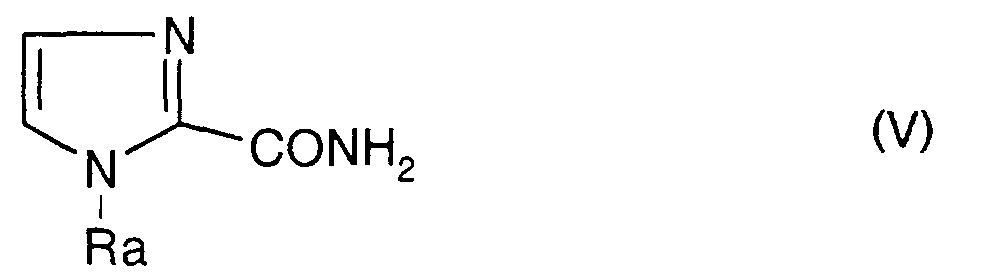


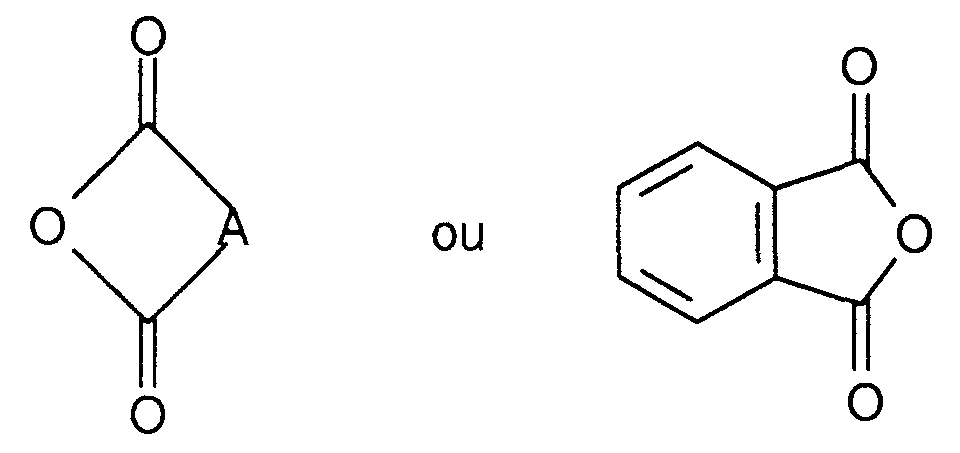


- 5H,10H-imidazo[1,2-a]indéno[1,2-e]pyrazine-4-one-10-carboxylate d'éthyle,
- 10-imino-5H,10H-imidazo[1,2-a]indéno[1,2-e]pyrazine-4-one,
- 10-(2-carboxybenzyl)-5H,10H-imidazo[1,2-a]indéno[1,2-e]pyrazine-4-one,
- 10-(4-carboxybenzyl)-5H,10H-imidazo[1,2-a]indéno[1,2-e]pyrazine-4-one,
- 10-(3-carboxybenzylidène)-5H,10H-imidazo[1,2-a]indéno[1,2-e]pyrazine-4-one,
- 10-(3-carboxybenzyl)-5H,10H-imidazo[1,2-a]indéno[1,2-e]pyrazine-4-one,
- 10-(4-acétylaminobenzyl)-5H,10H-imidazo[1,2-a]indéno[1,2-e]pyrazine-4-one,
- 10-(4-aminobenzyl)-5H,10H-imidazo[1,2-a]indéno[1,2-e]pyrazine-4-one,
- 10-[(1-méthylimidazol-2-yl)méthylène]-5H,10H-imidazo[1,2-a]indéno[1,2-e] pyrazine-4-one,
- 10-[(1-méthylimidazol-2-yl)méthyl]-5H,10H-imidazo[1,2-a]indéno[1,2-e] pyrazine-4-one,
- 10-(tert-butoxycarbonylméthyl)-5H,10H-imidazo[1,2-a]indéno[1,2-e]pyrazine-4-one,
- 10-(carboxyméthyl)-5H,10H-imidazo[1,2-a]indéno[1,2-e]pyrazine-4-one,
- 10-(carboxyméthylène)-5H,10H-imidazo[1,2-a]indéno[1,2-e]pyrazine-4-one,
- acide 5-(4-hydroxy-imidazo[1,2-a]indéno[1,2-e]pyrazine-10-ylidène)pentanoïque,
- 10-(1 -carboxy-1-hydroxyméthyl)-8-(3-méthyluréido)-5H,10H-imidazo[1,2-a]indéno[1,2-e]pyrazine-4-one,
- 10-nicotinoylamino-5H,10H-imidazo[1,2-a]indéno[1,2-e]pyrazine-4-one,
- 3-[10-(4,5-dihydro-4-oxo-10H-imidazo[1,2-a]indéno[1,2-e]pyrazinyl) aminocarbonyl]propionate de méthyle,
- 10-(3-diéthylaminopropionamido)-5H,10H-imidazo[1,2-a]indéno[1,2-e] pyrazine-4-one,
- 10-formamido-5H,10H-imidazo[1,2-a]indéno[1,2-e]pyrazine-4-one,
- (10R)- 10[(R)-α-méthoxy-α-trifluorométhylphénylacétamido]-5H,10H-imidazo[1,2-a]indéno[1,2-e]pyrazine-4-one,
- (10S)-10[(R)-α-méthoxy-α-trifluorométhylphénylacétamido]-5H,10H-imidazo[1,2-a]indéno[1,2-e]pyrazine-4-one,
- 10-(4-phénylbutyramido)-5H,10H-imidazo[1,2-a]indéno[1,2-e]pyrazine-4-one,
- 10-phénylacétamido-5H,10H-imidazo[1,2-a]indéno[1,2-e]pyrazine-4-one,
- N-[10-(4,5-dihydro-4-oxo-10H-imidazo[1,2-a]indéno[1,2-e]pyrazinyl)] carbamate de tert-butyle,
- 10-(1-pyrrolyl)-5H,10H-imidazo[1,2-a]indéno[1,2-e]pyrazine-4-one,
- 1-[10-(4,5-dihydro-4-oxo-10H-imidazo[1,2-a]indéno[1,2-e]pyrazinyl)]pyrrole-2-carboxylate de méthyle,
- 10-méthoxyimino-5H,10H-imidazo[1,2-a]indéno[1,2-e]pyrazine-4-one,
- 10-acétamido-10-méthyl-5H,10H-imidazo[1,2-a]indéno[1,2-e]pyrazine-4-one,
- 10-amino-10-méthyl-5H,10H-imidazo[1,2-a]indéno[1,2-e]pyrazine-4-one,
- 10-(4-imidazolylméthyl)-5H,10H-imidazo[1,2-a]indéno[1,2-e]pyrazine-4-one,
- 10-[3-(imidazole-1 -yl)propyl]-10-méthyl-5H,10H-imidazo[1,2-a]indéno[1,2-e] pyrazine-4-one,
- 10-[4-(imidazole-1-yl)butyl]-10-méthyl-5H,10H-imidazo[1,2-a]indéno[1,2-e] pyrazine-4-one,
- 10-amino-10-méthyl-8-(3-méthyluréido)-5H,10H-imidazo[1,2-a]indéno[1,2-e] pyrazine-4-one,
- 10-(carboxyméthylène)-8-(3-méthyluréido)-5H,10H-imidazo[1,2-a]indéno[1,2-e]pyrazine-4-one,
- 10-amino-10-méthyl-8-(3-n-propyluréido)-5H,10H-imidazo[1,2-a]indéno[1,2-e]pyrazine-4-one,
- 10-amino-10-benzyl-7-chloro-5H,10H-imidazo[1,2-a]indéno[1,2-e]pyrazine-4-one,
- 10-(3-aminobenzyl)-5H,10H-imidazo[1,2-a]indéno[1,2-e]pyrazine-4-one,
- 10-(3-aminobenzylidène)-5H-imidazo[1,2-a]indéno[1,2-e]pyrazine-4-one,
- 10-(3-acétylaminobenzyl)-5H,10H-imidazo[1,2-a]indéno[1,2-e]pyrazine-4-one,
- 10-(3-méthoxycarbonylbenzylidène)-5H-imidazo[1,2-a]indéno[1,2-e]pyrazine-4-one,
- 10-amino-10-(3-phénylpropyl)-5H,10H-imidazo[1,2-a]indéno[1,2-e]pyrazine-4-one,
- acide 5-(10-méthyl-4,5-dihydro-4-oxo-10H-imidazo[1,2-a]indéno[1,2-e]pyrazine-10-yl)valérique,
- 10-(3-diméthylaminopropyl)-10-méthyl-5H,10H-imidazo[1,2-a]indéno[1,2-e] pyrazine-4-one,
- 4-(10-méthyl-4,5-dihydro-4-oxo-10H-imidazo[1,2,-a]indéno[1,2-e]pyrazine-10-yl)butyronitrile,
- acide 4-(10-méthyl-4,5-dihydro-4-oxo-10H-imidazo[1,2,-a]indéno[1,2-e]pyrazine-10-yl)butyrique,
- 10-hydroxyméthyl-10-méthyl-5H,10H-imidazo[1,2-a]indéno[1,2-e]pyrazine-4-one,
- 4-(10-méthyl-4,5-dihydro-4-oxo-10H-imidazo[1,2,-a]indéno[1,2-e]pyrazine-10-yl)butyramide,
- 3-(10-méthyl-4,5-dihydro-4-oxo-10H-imidazo[1,2-a]indéno[1,2-e]pyrazine-10-yl)propionitrile,
- acide 3-(10-méthyl-4,5-dihydro-4-oxo-10H-imidazo[1,2,-a]indéno[1,2-e]pyrazine-10-yl)propionique,
- 10-(4-hydroxybutyl)-10-méthyl-5H,10H-imidazo[1,2-a]indéno[1,2-e]pyrazine-4-one,
- 10-méthyl-10-[(1-méthylimidazol-2-yl)méthyl]-5H,10H-imidazo[1,2-a]indéno[1,2-e]pyrazine-4-one,
- 10-[(1-méthylimidazol-5-yl)méthylène]-5H,10H-imidazo[1,2-a]indéno[1,2-e]pyrazine-4-one,
- 10-[(1-méthylimidazol-5-yl)méthyl]-5H,10H-imidazo[1,2-a]indéno[1,2-e]pyrazine-4-one,
- 8-[3-(3-fluorophényl)uréido]-10-(carboxyméthyl)-5H,10H-imidazo[1,2-a]indéno[1,2-e]pyrazine-4-one,
- acide [8-(3-méthyluréido)-4,5-dihydro-4-oxo-10H-imidazo[1,2-a]indéno[1,2-e]pyrazine-10-yl]acétique,
- acide (+) [8-(3-méthyluréido)-4,5-dihydro-4-oxo-10H-imidazo[1,2-a]indéno[1,2-e]pyrazine-10-yl]acétique,
- acide (-) [8-(3-méthyluréido)-4,5-dihydro-4-oxo-10H-imidazo[1,2-a]indéno[1,2-e]pyrazine-10-yl]acétique,
- 10-méthyl-10-(1-pyrrolyl)-5H,10H-imidazo[1,2-a]indéno[1,2-e]pyrazine-4-one,
- acide 1-[10-(4-oxo-4,5-dihydro-10H-imidazo[1,2-a]indéno[1,2-e]pyrazinyl)]pyrrole-2-carboxylique,
- acide 3-[10-(4-oxo-4,5-dihydro-10H-imidazo[1,2-a]indéno[1,2-e] pyrazinyl)aminocarbonyl]propionique,
- 10-amino-10-éthyl-5H,10H-imidazo[1,2-a]indéno[1,2-e]pyrazine-4-one,
- 10-amino-10-benzyl-5H,10H-imidazo[1,2-a]indéno[1,2-e]pyrazine-4-one,
- 10-amino-10-propyl-5H,10H-imidazo[1,2-a]indéno[1,2-e]pyrazine-4-one,
- 10-amino-10-isopropyl-5H,10H-imidazo[1,2-a]indéno[1,2-e]pyrazine-4-one,
- 10-amino-10-butyl-5H,10H-imidazo[1,2-a]indéno[1,2-e]pyrazine-4-one,
- 10-méthyl-10-méthylamino-5H,10H-imidazo[1,2-a]indéno[1,2-e]pyrazine-4-one,
- 10-amino-10-méthyl-8-(3-méthyluréido)-5H,10H-imidazo[1,2-a]indéno[1,2-e]pyrazine-4-one et ses énantiomères,
- 10-(1,3-diméthyl-1 H-pyrazole-4-méthylène)-5H,10H-imidazo[1,2-a]indéno[1,2-e]pyrazine-4-one,
et leurs sels.
- 5H,10H-imidazo[1,2-a]indéno[1,2-e]pyrazine-4-one-10-carboxylate d'éthyle,
- 10-imino-5H,10H-imidazo[1,2-a]indéno[1,2-e]pyrazine-4-one,
- 10-(2-carboxybenzyl)-5H,10H-imidazo[1,2-a]indéno[1,2-e]pyrazine-4-one,
- 10-(4-carboxybenzyl)-5H,10H-imidazo[1,2-a]indéno[1,2-e]pyrazine-4-one,
- 10-(3-carboxybenzylidène)-5H,10H-imidazo[1,2-a]indéno[1,2-e]pyrazine-4-one,
- 10-(3-carboxybenzyl)-5H,10H-imidazo[1,2-a]indéno[1,2-e]pyrazine-4-one,
- 10-(4-aminobenzyl)-5H,10H-imidazo[1,2-a]indéno[1,2-e]pyrazine-4-one,
- 10-[(1-méthylimidazol-2-yl)méthylène]-5H,10H-imidazo[1,2-a]indéno[1,2-e] pyrazine-4-one,
- 10-(carboxyméthyl)-5H,10H-imidazo[1,2-a]indéno[1,2-e]pyrazine-4-one,
- 10-(carboxyméthylène)-5H,10H-imidazo[1,2-a]indéno[1,2-e]pyrazine-4-one,
- acide 5-(4-hydroxy-imidazo[1,2-a]indéno[1,2-e]pyrazine-10-ylidène) pentanoïque,
- 10-(1-carboxy-1-hydroxyméthyl)-8-(3-méthyluréido)-5H,10H-imidazo[1,2-a]indéno[1,2-e]pyrazine-4-one,
- 10-nicotinoylamino-5H,10H-imidazo[1,2-a]indéno[1,2-e]pyrazine-4-one,
- 3-[10-(4,5-dihydro-4-oxo-10H-imidazo[1,2-a]indéno[1,2-e]pyrazinyl) aminocarbonyl]propionate de méthyle,
- 10-(3-diéthylaminopropionamido)-5H,10H-imidazo[1,2-a]indéno[1,2-e] pyrazine-4-one,
- 10-formamido-5H,10H-imidazo[1,2-a]indéno[1,2-e]pyrazine-4-one,
- (10R)-10[(R)-α-méthoxy-α-trifluorométhylphénylacétamido]-5H,10H-imidazo[1,2-a]indéno[1,2-e]pyrazine-4-one,
- (10S)-10[(R)-a-méthoxy-a-trifluorométhylphénylacétamido]-5H,10H-imidazo[1,2-a]indéno[1,2-e]pyrazine-4-one,
- 10-phénylacétamido-5H,10H-imidazo[1,2-a]indéno[1,2-e]pyrazine-4-one,
- N-[10-(4,5-dihydro-4-oxo-10H-imidazo[1,2-a]indéno[1,2-e]pyrazinyl)] carbamate de tert-butyle,
- 10-(1 -pyrrolyl)-5H,10H-imidazo[1,2-a]indéno[1,2-e]pyrazine-4-one,
- 1-[10-(4,5-dihydro-4-oxo-10H-imidazo[1,2-a]indéno[1,2-e]pyrazinyl)]pyrrole-2-carboxylate de méthyle,
- 10-méthoxyimino-5H,10H-imidazo[1,2-a]indéno[1,2-e]pyrazine-4-one,
- 10-acétamido-10-méthyl-5H,10H-imidazo[1,2-a]indéno[1,2-e]pyrazine-4-one,
- 10-amino-10-méthyl-5H,10H-imidazo[1,2-a]indéno[1,2-e]pyrazine-4-one,
- 10-(4-imidazolylméthyl)-5H,10H-imidazo[1,2-a]indéno[1,2-e]pyrazine-4-one,
- 10-amino-10-méthyl-8-(3-méthyluréido)-5H,10H-imidazo[1,2-a]indéno[1,2-e] pyrazine-4-one,
- 10-(carboxyméthylène)-8-(3-méthyluréido)-5H,10H-imidazo[1,2-a]indéno[1,2-e]pyrazine-4-one,
- 10-amino-10-méthyl-8-(3-n-propyluréido)-5H,10H-imidazo[1,2-a]indéno[1,2-e]pyrazine-4-one,
- 10-(3-aminobenzyl)-5H,10H-imidazo[1,2-a]indéno[1,2-e]pyrazine-4-one,
- 10-(3-aminobenzylidène)-5H-imidazo[1,2-a]indéno[1,2-e]pyrazine-4-one,
- 10-(3-acétylaminobenzyl)-5H,10H-imidazo[1,2-a]indéno[1,2-e]pyrazine-4-one,
- 10-(3-méthoxycarbonylbenzylidène)-5H-imidazo[1,2-a]indéno[1,2-e]pyrazine-4-one,
- 10-amino-10-(3-phénylpropyl)-5H,10H-imidazo[1,2-a]indéno[1,2-e]pyrazine-4-one,
- acide 5-(10-méthyl-4,5-dihydro-4-oxo-10H-imidazo[1,2-a]indéno[1,2-e]pyrazine-10-yl)valérique,
- 4-(10-méthyl-4,5-dihydro-4-oxo-10H-imidazo[1,2,-a]indéno[1,2-e]pyrazine-10-yl)butyronitrile,
- acide 4-(10-méthyl-4,5-dihydro-4-oxo-10H-imidazo[1,2,-a]indéno[1,2-e]pyrazine-10-yl)butyrique,
- 10-hydroxyméthyl-10-méthyl-5H, 10H-imidazo[1,2-a]indéno[1,2-e]pyrazine-4-one,
- 3-(10-méthyl-4,5-dihydro-4-oxo-10H-imidazo[1,2-a]indéno[1,2-e]pyrazine-10-yl)propionitrile,
- acide 3-(10-méthyl-4,5-dihydro-4-oxo-10H-imidazo[1,2,-a]indéno[1,2-e]pyrazine-10-yl)propionique,
- 10-méthyl-10-[(1-méthylimidazol-2-yl)méthyl]-5H,10H-imidazo[1,2-a]indéno[1,2-e]pyrazine-4-one,
- 10-[(1 -méthylimidazol-5-yl)méthylène]-5H,10H-imidazo[1,2-a]indéno[1,2-e]pyrazine-4-one,
- 10-[(1-méthylimidazol-5-yl)méthyl]-5H,10H-imidazo[1,2-a]indéno[1,2-e]pyrazine-4-one,
- 8-[3-(3-fluorophényl)uréido]-10-(carboxyméthyl)-5H,10H-imidazo[1,2-a]indéno[1,2-e]pyrazine-4-one,
- acide [8-(3-méthyluréido)-4,5-dihydro-4-oxo-10H-imidazo[1,2-a]indéno[1,2-e]pyrazine-10-yl]acétique,
- acide (+) [8-(3-méthyluréido)-4,5-dihydro-4-oxo-10H-imidazo[1,2-a]indéno[1,2-e]pyrazine-10-yl]acétique,
- acide (-) [8-(3-méthyluréido)-4,5-dihydro-4-oxo-10H-imidazo[1,2-a]indéno[1,2-e]pyrazine-10-yl]acétique,
- 10-méthyl-10-(1-pyrrolyl)-5H,10H-imidazo[1,2-a]indéno[1,2-e]pyrazine-4-one,
- acide 1-[10-(4-oxo-4,5-dihydro-10H-imidazo[1,2-a]indéno[1,2-e]pyrazinyl)]pyrrole-2-carboxylique,
- acide 3-[10-(4-oxo-4,5-dihydro-10H-imidazo[1,2-a]indéno[1,2-e] pyrazinyl)aminocarbonyl]propionique,
- 10-amino-10-éthyl-5H,10H-imidazo[1,2-a]indéno[1,2-e]pyrazine-4-one,
- 10-amino-10-benzyl-5H,10H-imidazo[1,2-a]indéno[1,2-e]pyrazine-4-one,
- 10-amino-10-propyl-5H,10H-imidazo[1,2-a]indéno[1,2-e]pyrazine-4-one,
- 10-amino-10-isopropyl-5H,10H-imidazo[1,2-a]indéno[1,2-e]pyrazine-4-one,
- 10-amino-10-butyl-5H,10H-imidazo[1,2-a]indéno[1,2-e]pyrazine-4-one,
- 10-méthyl-10-méthylamino-5H,10H-imidazo[1,2-a]indéno[1,2-e]pyrazine-4-one,
- 10-amino-10-méthyl-8-(3-méthyluréido)-5H,10H-imidazo[1,2-a]indéno[1,2-e]pyrazine-4-one et ses énantiomères,
- 10-(1,3-diméthyl-1 H-pyrazole-4-méthylène)-5H,10H-imidazo[1,2-a]indéno[1,2-e]pyrazine-4-one
- 5H,10H-imidazo[1,2-a]indéno[1,2-e]pyrazine-4-one-10-carboxylate d'éthyle,
- 10-imino-5H,10H-imidazo[1,2-a]indéno[1,2-e]pyrazine-4-one,
- 10-(2-carboxybenzyl)-5H,10H-imidazo[1,2-a]indéno[1,2-e]pyrazine-4-one,
- 10-(4-carboxybenzyl)-5H,10H-imidazo[1,2-a]indéno[1,2-e]pyrazine-4-one,
- 10-(3-carboxybenzylidène)-5H,10H-imidazo[1,2-a]indéno[1,2-e]pyrazine-4-one,
- 10-(3-carboxybenzyl)-5H,10H-imidazo[1,2-a]indéno[1,2-e]pyrazine-4-one,
- 10-(4-acétylaminobenzyl)-5H,10H-imidazo[1,2-a]indéno[1,2-e]pyrazine-4-one,
- 10-(4-aminobenzyl)-5H,10H-imidazo[1,2-a]indéno[1,2-e]pyrazine-4-one,
- 10-[(1-méthylimidazol-2-yl)méthyl]-5H,10H-imidazo[1,2-a]indéno[1,2-e] pyrazine-4-one,
- 10-(tert-butoxycarbonylméthyl)-5H,10H-imidazo[1,2-a]indéno[1,2-e]pyrazine-4-one,
- 10-(carboxyméthyl)-5H,10H-imidazo[1,2-a]indéno[1,2-e]pyrazine-4-one,
- 10-(carboxyméthylène)-5H,10H-imidazo[1,2-a]indéno[1,2-e]pyrazine-4-one,
- 10-nicotinoylamino-5H,10H-imidazo[1,2-a]indéno[1,2-e]pyrazine-4-one,
- 10-formamido-5H,10H-imidazo[1,2-a]indéno[1,2-e]pyrazine-4-one,
- (10R)-10[(R)-a-méthoxy-a-trifluorométhylphénylacétamido]-5H,10H-imidazo[1,2-a]indéno[1,2-e]pyrazine-4-one,
- (10S)-10[(R)-α-méthoxy-α-trifluorométhylphénylacétamido]-5H,10H-imidazo[1,2-a]indéno[1,2-e]pyrazine-4-one,
- 10-(4-phénylbutyramido)-5H,10H-imidazo[1,2-a]indéno[1,2-e]pyrazine-4-one,
- 10-phénylacétamido-5H,10H-imidazo[1,2-a]indéno[1,2-e]pyrazine-4-one,
- N-[10-(4,5-dihydro-4-oxo-10H-imidazo[1,2-a]indéno[1,2-e]pyrazinyl)] carbamate de tert-butyle,
- 10-(1 -pyrrolyl)-5H,10H-imidazo[1,2-a]indéno[1,2-e]pyrazine-4-one,
- 10-amino-10-méthyl-5H,10H-imidazo[1,2-a]indéno[1,2-e]pyrazine-4-one,
- 10-(4-imidazolylméthyl)-5H,10H-imidazo[1,2-a]indéno[1,2-e]pyrazine-4-one,
- 10-[4-(imidazole-1-yl)butyl]-10-méthyl-5H,10H-imidazo[1,2-a]indéno[1,2-e] pyrazine-4-one,
- 10-amino-10-benzyl-7-chloro-5H,10H-imidazo[1,2-a]indéno[1,2-e]pyrazine-4-one,
- 10-(3-acétylaminobenzyl)-5H,10H-imidazo[1,2-a]indéno[1,2-e]pyrazine-4-one,
- 10-amino-10-(3-phénylpropyl)-5H,10H-imidazo[1,2-a]indéno[1,2-e]pyrazine-4-one,
- acide 5-(10-méthyl-4,5-dihydro-4-oxo-10H-imidazo[1,2-a]indéno[1,2-e]pyrazine-10-yl)valérique,
- 10-(3-diméthylaminopropyl)-10-méthyl-5H,10H-imidazo[1,2-a]indéno[1,2-e] pyrazine-4-one,
- 4-(10-méthyl-4,5-dihydro-4-oxo-10H-imidazo[1,2,-a]indéno[1,2-e]pyrazine-10-yl)butyronitrile,
- 10-hydroxyméthyl-10-méthyl-5H,10H-imidazo[1,2-a]indéno[1,2-e]pyrazine-4-one,
- 4-(10-méthyl-4,5-dihydro-4-oxo-10H-imidazo[1,2,-a]indéno[1,2-e]pyrazine-10-yl)butyramide,
- 3-(10-méthyl-4,5-dihydro-4-oxo-10H-imidazo[1,2-a]indéno[1,2-e]pyrazine-10-yl)propionitrile,
- acide 3-(10-méthyl-4,5-dihydro-4-oxo-10H-imidazo[1,2,-a]indéno[1,2-e]pyrazine-10-yl)propionique,
- 10-(4-hydroxybutyl)-10-méthyl-5H,10H-imidazo[1,2-a]indéno[1,2-e]pyrazine-4-one,
- 10-méthyl-10-[(1-méthylimidazol-2-yl)méthyl]-5H,10H-imidazo[1,2-a]indéno[1,2-e]pyrazine-4-one,
- 10-[(1-méthylimidazol-5-yl)méthyl]-5H,10H-imidazo[1,2-a]indéno[1,2-e]pyrazine-4-one,
- 8-[3-(3-fluorophényl)uréido]-10-(carboxyméthyl)-5H,10H-imidazo[1,2-a]indéno[1,2-e]pyrazine-4-one,
- acide [8-(3-méthyluréido)-4,5-dihydro-4-oxo-10H-imidazo[1,2-a]indéno[1,2-e]pyrazine-10-yl]acétique,
- acide 1-[10-(4-oxo-4,5-dihydro-10H-imidazo[1,2-a]indéno[1,2-e]pyrazinyl)]pyrrole-2-carboxylique,
- acide 3-[10-(4-oxo-4,5-dihydro-10H-imidazo[1,2-a]indéno[1,2-e] pyrazinyl)aminocarbonyl]propionique,
- 10-amino-10-benzyl-5H,10H-imidazo[1,2-a]indéno[1,2-e]pyrazine-4-one,
- 10-amino-10-propyl-5H,10H-imidazo[1,2-a]indéno[1,2-e]pyrazine-4-one,
- 10-amino-10-isopropyl-5H,10H-imidazo[1,2-a]indéno[1,2-e]pyrazine-4-one,
- 10-amino-10-butyl-5H,10H-imidazo[1,2-a]indéno[1,2-e]pyrazine-4-one,
- 10-méthyl-10-méthylamino-5H,10H-imidazo[1,2-a]indéno[1,2-e]pyrazine-4-one,
On forme le dichlorhydrate en ajoutant à une suspension de 1,5 g de base brute dans 50 ml de méthanol 3 ml d'une solution d'acide chlorhydrique 3N dans l'éther éthylique. Le précipité jaune formé est filtré et séché à 60°C sous vide (1 mm Hg; 0,13 kPa). On obtient 1,75 g de dichlorhydrate de 10-[(1-méthylimidazol-2-yl)méthylène]-5H,10H-imidazo[1,2-a]indéno[1,2-e] pyrazine-4-one fondant au-dessus de 260°C (Analyse % calculé C : 55,68, H : 3,89, Cl : 18,26, N : 18,04, O : 4,12, % trouvé C : 55,8, H : 3,9, N : 17,9).
- Composé de formule (I) 50 mg
- Cellulose 18 mg
- Lactose 55 mg
- Silice colloïdale 1 mg
- Carboxyméthylamidon sodique 10 mg
- Talc 10 mg
- Stéarate de magnésium 1 mg
- Composé de formule (I) 50 mg
- Lactose. 104 mg
- Cellulose 40 mg
- Polyvidone 10 mg
- Carboxyméthylamidon sodique 22 mg
- Talc 10 mg
- Stéarate de magnésium 2 mg
- Silice colloïdale 2 mg
- Mélange d'hydroxyméthylcellulose, glycérine, oxyde de titane (72-3,5-24,5) q.s.p. 1 comprimé pelliculé terminé à 245 mg
- Composé de formule (I) 10 mg
- Acide benzoïque 80 mg
- Alcool benzylique 0,06 ml
- Benzoate de sodium 80 mg
- Ethanol à 95 % 0,4 ml
- Hydroxyde de sodium 24 mg
- Propylène glycol 1,6 ml
- Eau q.s.p 4 ml
Claims (44)
- Compositions pharmaceutiques contenant en tant que principe actif au moins un composé de formule :dans laquelle
 étant entendu que lorsque R1 et R2 représentent des atomes d'hydrogène, R représente un radical CHR6, R6 représente un radical -alk-Het" dans lequel alk représente un radical alkyle (1C), Het" ne peut pas être un radical 2-imidazolyle,R représente un radical C=R3, C(R4)R5 ou CH-R6,R1 et R2, identiques ou différents, représentent des atomes d'hydrogène ou d'halogène ou des radicaux alkyle, alcoxy, amino, -N=CH-N(alk)alk', nitro, cyano, phényle, imidazolyle, SO3H, hydroxy, polyfluoroalcoxy, -COOR7, -NH-CO-NR8R9, -N(alk)-CO-NR8R9, -N(alk-Ar)-CO-NR8R9, -NH-CS-NR8R9, -N(alk)-CS-NR8R9, -NH-CO-R18, -NH-CS-R19, -NH-C(=NR20)-NR7R9, -N(alk)-C(=NR2O)-NR7R9, -NH-SO2-NR7R9, -N(alk)-SO2-NR7R9, -CO-NR7R9, -NH-SO2-CF3, -NH-SO2-alk, -NR9R11, -S(O)m-alk-Ar, -SO2-NR7R9, 2-oxo-1-imidazolidinyle dont la position -3 est éventuellement substituée par un radical alkyle ou 2-oxo-1-perhydropyrimidinyle dont la position -3 est éventuellement substituée par un radical alkyle,R3 représente un radical NO-alk, CHR10, NR7, C(COOR7)R16 ou C(CONR7R15)R16,R4 représente un radical alkyle, -alk-Het, -alk-Het" ou phénylalkyle dont le noyau phényle est éventuellement substitué par un ou plusieurs substituants choisis parmi les atomes d'halogène et les radicaux alkyle, alcoxy, nitro, amino, hydroxy, cyano, -alk-NH2, -COOR7 et -alk-COOR7,R5 représente un radical -NR12R13, -NH-CHO, -NH-COOR17, -NH-SO2R19, -COOR7, -alk-COOR7, -alk-CONR7R15, -alk-NR7R15, -alk-OH, -alk-CN, -alk-Het", phénylalkyle dont le noyau phényle est substitué par un ou plusieurs substituants choisis parmi les atomes d'halogène et les radicaux alkyle, alcoxy, nitro, amino, hydroxy, cyano, -alk-NH2, -COOR7 et -alk-COOR7, -NH-CO-Ar dont Ar est éventuellement substitué par un ou plusieurs substituants choisis parmi les atomes d'halogène et les radicaux alkyle, alcoxy, nitro, amino, hydroxy, cyano, -alk-NH2, -COOR7 et -alk-COOR7, -NH-CO-Het, -NH-CO-Het", -NH-CO-alk-Het, -NH-CO-alk-Het", -NH-CO-alk-COOR7, -NH-CO-alk-NR7R15, -NH-CO-alk-Ar dont Ar est éventuellement substitué par un ou plusieurs substituants choisis parmi les atomes d'halogène et les radicaux alkyle, alcoxy, nitro, amino, hydroxy, cyano, -alk-NH2, -COOR7 et -alk-COOR7, -NH-CO-C(Ar)(CF3)OCH3, pyrrolyl-1 éventuellement substitué par un radical -COOR7, -NH-COalk ou -NH-COcycloalkyle,R6 représente un radical -NH-CHO, -COOalk, -alk-COOR7, -alk-CO-NR7R15, phénylalkyle dont le noyau phényle est substitué par un ou plusieurs substituants choisis parmi les atomes d'halogène et les radicaux alkyle, alcoxy, nitro, amino, acétylamino, hydroxy, cyano, -alk-NH2, -COOR7 et -alk-COOR7, -R14-COOR7, -CO-COOR7, -NH-COOR17, -NH-CO-Ar dont Ar est substitué par un ou plusieurs substituants choisis parmi les atomes d'halogène et les radicaux alkyle, alcoxy, nitro, amino, hydroxy, cyano, -alk-NH2, -COOR7 et -alk-COOR7, -NH-CO-Het, -NH-CO-alk-Het, -NH-CO-Het", -NH-CO-alk-Het", -NH-CO-alk(2-6C)-COOR7, -NH-CO-alk(2-6C)-NH2, -NH-CO-alk-N(alk)2, -NH-CO-alk-NHalk, -NH-CO-alk-Ar dont Ar est éventuellement substitué par un ou plusieurs substituants choisis parmi les atomes d'halogène et les radicaux alkyle, alcoxy, nitro, amino, hydroxy, cyano, -alk-NH2, -COOR7 et -alk-COOR7, -NH-CO-C(Ar)(CF3)OCH3, -alk-Het", pyrrolyl-1 éventuellement substitué par un radical -COOR7,R7 représente un atome d'hydrogène ou un radical alkyle,R8 représente un atome d'hydrogène ou un radical alkyle, -alk-COOR7, -alk-Het", -alk-Het, -alk-NR9R7, phénylalkyle dont le noyau phényle est éventuellement substitué par un ou plusieurs substituants choisis parmi les atomes d'halogène et les radicaux alkyle, alcoxy, nitro, amino, hydroxy, -alk-NH2, COOR7, cyano et -alk-COOR7, phényle éventuellement substitué par un ou plusieurs substituants choisis parmi les atomes d'halogène et les radicaux alkyle, alcoxy, nitro, amino, hydroxy, -alk-NH2, -COOR7, cyano et -alk-COOR7, -Het ou -Het",R9 représente un atome d'hydrogène ou un radical alkyle,R10 représente un radical -alk-COOR7, -Het", -alk-Het", phényle substitué par un ou plusieurs substituants choisis parmi les atomes d'halogène et les radicaux alkyle, alcoxy, nitro, amino, hydroxy, -alk-NH2, -COOR7, cyano et -alk-COOR7 ou phénylalkyle dont le noyau phényle est substitué par un ou plusieurs substituants choisis parmi les atomes d'halogène et les radicaux alkyle, alcoxy, nitro, amino, hydroxy, -alk-NH2, -COOR7, cyano et -alk-COOR7,R11 représente un radical alkyle, -Het, -Het" ou alcoxycarbonyle,R12 représente un atome d'hydrogène ou un radical alkyle, -alk-COOR7, -alk-NP7R15, -alk-Het, -alk-Het" ou phénylalkyle dont le noyau phényle est éventuellement substitué par un ou plusieurs substituants choisis parmi les atomes d'halogène et les radicaux alkyle, alcoxy, nitro, amino, hydroxy, -alk-NH2, carboxy, alcoxycarbonyle, cyano et -alk-COOR7,R13 représente un atome d'hydrogène ou un radical alkyle,R14 représente une chaíne -CHOH- ou -CHOH-alk(1-5C)-,R15 représente un atome d'hydrogène ou un radical alkyle,R16 représente un atome d'hydrogène ou un radical alkyle,R17 représente un un radical alkyle ou phénylalkyle,R18 représente un atome d'hydrogène ou un radical alkyle (1-9C en chaíne droite ou ramifiée), alcoxy, -alk-COOR7, -alk-Het", -alk-Het, -alk-NR9R7, phénylalkyle dont le noyau phényle est éventuellement substitué par un ou plusieurs substituants choisis parmi les atomes d'halogène et les radicaux alkyle, alcoxy, nitro, amino, hydroxy, -alk-NH2, -COOR7, cyano et -alk-COOR7, phényle éventuellement substitué par un ou plusieurs substituants choisis parmi les atomes d'halogène et les radicaux alkyle, alcoxy, nitro, amino, hydroxy, -alk-NH2, COOR7, cyano et -alk-COOR7, Het ou -Het",R19 représente un radical alkyle ou phényle,R20 représente un atome d'hydrogène ou un radical alkyle,alk représente un radical alkyle ou alkylène,alk' représente un radical alkyle,Ar représente un radical phényle,m est égal à 0, 1 ou 2,Het représente un hétérocycle choisi parmi les cycles pyrrolyle, pyridyle, pyrimidinyle, morpholinyle et pyrazinyle,Het" représente un hétérocycle choisi parmi les cycles pyrrolyle substitué par un ou plusieurs radicaux alkyle, pyridyle substitué par un ou plusieurs radicaux alkyle, pyrimidinyle substitué par un ou plusieurs radicaux alkyle, imidazolyle éventuellement substitué par un ou plusieurs radicaux alkyle, thiazolyle éventuellement substitué par un ou plusieurs radicaux alkyle, thiazolinyle éventuellement substitué par un ou plusieurs radicaux alkyle, pyrazinyle substitué par un ou plusieurs radicaux alkyle, tétrazolyle éventuellement substitué par un ou plusieurs radicaux alkyle, triazolyle éventuellement substitué par un ou plusieurs radicaux alkyle, oxazolinyle éventuellement substitué par un ou plusieurs radicaux alkyle,
étant entendu que les radicaux et portions alkyle, alcoxy et alkylène contiennent 1 à 6 atomes de carbone en chaíne droite ou ramifiée, les radicaux cycloalkyle contiennent 3 à 6 atomes de carbone,
ainsi que les isomères des composés pour lesquels R3 représente un radical NO-alk, C(COOR7)R16, C(CONR7R15)R16 ou CHR10, les formes tautomères des composés pour lesquels R représente un radical CH-R6, R6 représente un radical -CO-COOR7, les énantiomères et diastéréoisomères des composés pour lesquels R représente un radical C(R4)R5 ou CH-R6,
ainsi que leurs sels. - Compositions pharmaceutiques contenant un composé de formule (I) selon la revendication 1 pour lesquels R représente un radical C=R3 dans lequel R3 représente un radical NO-alk, CHP10 ou NR7 dans lequel R7 représente un atome d'hydrogène, R10 représente un radical -alk-COOR7, -Het", phényle substitué par un ou plusieurs substituants choisis parmi les atomes d'halogène et les radicaux nitro, amino ou -COOR7, R1 représente un atome d'hydrogène ou d'halogène ou un radical NH-CO-NR8R9 dans lequel R8 représente un atome d'hydrogène et R9 représente un radical alkyle et R2 représente un atome d'hydrogène.
- Compositions pharmaceutiques contenant un composé de formule (I) selon la revendication 1 pour lequel R représente un radical C(R4)R5, R4 représente un radical alkyle ou phénylalkyle, R5 représente un radical -NR12R13 dans lequel R12 représente un atome d'hydrogène ou un radical alkyle et R13 représente un atome d'hydrogène, -alk-COOR7, -alk-NR7R15 dans lequel R7 et R15 représentent des atomes d'hydrogène, -alk-OH, -alk-CN, -alk- Het" dans lequel Het" est un cycle imidazolyle éventuellement substitué par un radical alkyle, pyrrolyl-1 ou -NH-COalk, R1 représente un atome d'hydrogène ou d'halogène ou un radical NH-CO-NR8R9 dans lequel R8 représente un atome d'hydrogène et R9 représente un radical alkyle et R2 représente un atome d'hydrogène.
- Compositions pharmaceutiques contenant un composé de formule (I) selon la revendication 1 pour lequel R représente un radical CH-R6 dans lequel R6 représente -NH-CHO, -COOalk, -alk-COOR7 dans lequel R7 représente un atome d'hydrogène, phénylalkyle dont le noyau phényle est substitué par un substituant choisi parmi les radicaux amino, acétylamino et -COOR7, -R14-COOR7 dans lequel R14 représente -CHOH, -NH-COOR17 dans lequel R17 représente un radical alkyle, -NH-CO-Het dans lequel Het représente un cycle pyridyle, -NH-CO-alk(2-6C)-COOR7, -NH-CO-alk-Ar, -alk-Het" dans lequel Het" est un cycle imidazolyle éventuellement substitué par un radical alkyle, pyrrolyl-1 éventuellement substitué par un radical -COOR7, R1 représente un atome d'hydrogène ou un radical NH-CO-NR8R9 dans lequel R8 représente un atome d'hydrogène et R9 représente un radical alkyle ou phényle substitué par halogène et R2 représente un atome d'hydrogène.
- Compositions pharmaceutiques selon la revendication 1 contenant au moins un des composés suivants :5H,10H-imidazo[1,2-a]indéno[1,2-e]pyrazine-4-one-10-carboxylate d'éthyle,10-imino-5H,10H-imidazo[1,2-a]indéno[1,2-e]pyrazine-4-one,10-(2-carboxybenzyl)-5H,10H-imidazo[1,2-a]indéno[1,2-e]pyrazine-4-one,10-(4-carboxybenzyl)-5H,10H-imidazo[1,2-a]indéno[1,2-e]pyrazine-4-one,10-(3-carboxybenzylidène)-5H,10H-imidazo[1,2-a]indéno[1,2-e]pyrazine-4-one,10-(3-carboxybenzyl)-5H,10H-imidazo[1,2-a]indéno[1,2-e]pyrazine-4-one,10-(4-acétylaminobenzyl)-5H,10H-imidazo[1,2-a]indéno[1,2-e]pyrazine-4-one,10-(4-aminobenzyl)-5H,10H-imidazo[1,2-a]indéno[1,2-e]pyrazine-4-one,10-[(1-méthylimidazol-2-yl)méthylène]-5H,10H-imidazo[1,2-a]indéno[1,2-e] pyrazine-4-one,10-[(1 -méthylimidazol-2-yl)méthyl]-5H,10H-imidazo[1,2-a]indéno[1,2-e] pyrazine-4-one,10-(tert-butoxycarbonylméthyl)-5H,10H-imidazo[1,2-a]indéno[1,2-e]pyrazine-4-one,10-(carboxyméthyl)-5H,10H-imidazo[1,2-a]indéno[1,2-e]pyrazine-4-one,10-(carboxyméthylène)-5H,10H-imidazo[1,2-a]indéno[1,2-e]pyrazine-4-one,acide 5-(4-hydroxy-imidazo[1,2-a]indéno[1,2-e]pyrazine-10-ylidène)pentanoïque,10-(1-carboxy-1-hydroxyméthyl)-8-(3-méthyluréido)-5H,10H-imidazo[1 ,2-a]indéno[1,2-e]pyrazine-4-one,10-nicotinoylamino-5H,10H-imidazo[1,2-a]indéno[1,2-e]pyrazine-4-one,3-[10-(4,5-dihydro-4-oxo-10H-imidazo[1,2-a]indéno[1,2-e]pyrazinyl) aminocarbonyl]propionate de méthyle,10-(3-diéthylaminopropionamido)-5H,10H-imidazo[1,2-a]indéno[1,2-e] pyrazine-4-one,10-formamido-5H,10H-imidazo[1,2-a]indéno[1,2-e]pyrazine-4-one,(10R)-10[(R)-α-méthoxy-α-trifluorométhylphénylacétamido]-5H,10H-imidazo[1,2-a]indéno[1,2-e]pyrazine-4-one,(10S)-10[(R)-α-méthoxy-α-trifluorométhylphénylacétamido]-5H,10H-imidazo[1,2-a]indéno[1,2-e]pyrazine-4-one,10-(4-phénylbutyramido)-5H,10H-imidazo[1,2-a]indéno[1,2-e]pyrazine-4-one,10-phénylacétamido-5H,10H-imidazo[1,2-a]indéno[1,2-e]pyrazine-4-one,N-[10-(4,5-dihydro-4-oxo-10H-imidazo[1,2-a]indéno[1,2-e]pyrazinyl)] carbamate de tert-butyle,10-(1 -pyrrolyl)-5H,10H-imidazo[1,2-a]indéno[1,2-e]pyrazine-4-one,1-[10-(4,5-dihydro-4-oxo-10H-imidazo[1,2-a]indéno[1,2-e]pyrazinyl)]pyrrole-2-carboxylate de méthyle,10-méthoxyimino-5H,10H-imidazo[1,2-a]indéno[1,2-e]pyrazine-4-one,10-acétamido-10-méthyl-5H,10H-imidazo[1,2-a]indéno[1,2-e]pyrazine-4-one,10-amino-10-méthyl-5H,10H-imidazo[1,2-a]indéno[1,2-e]pyrazine-4-one,10-(4-imidazolylméthyl)-5H,10H-imidazo[1,2-a]indéno[1,2-e]pyrazine-4-one,10-[3-(imidazole-1 -yl)propyl]-10-méthyl-5H,10H-imidazo[1,2-a]indéno[1,2-e] pyrazine-4-one,10-[4-(imidazole-1-yl)butyl]-10-méthyl-5H,10H-imidazo[1,2-a]indéno[1,2-e] pyrazine-4-one,10-amino-10-méthyl-8-(3-méthyluréido)-5H,10H-imidazo[1,2-a]indéno[1,2-e] pyrazine-4-one,10-(carboxyméthylène)-8-(3-méthyluréido)-5H,10H-imidazo[1,2-a]indéno[1,2-e]pyrazine-4-one,10-amino-10-méthyl-8-(3-n-propyluréido)-5H,10H-imidazo[1,2-a]indéno[1,2-e]pyrazine-4-one,10-amino-10-benzyl-7-chloro-5H,10H-imidazo[1,2-a]indéno[1,2-e]pyrazine-4-one,10-(3-aminobenzyl)-5H,10H-imidazo[1,2-a]indéno[1,2-e]pyrazine-4-one,10-(3-aminobenzylidène)-5H-imidazo[1,2-a]indéno[1,2-e]pyrazine-4-one,10-(3-acétylaminobenzyl)-5H,10H-imidazo[1,2-a]indéno[1,2-e]pyrazine-4-one,10-(3-méthoxycarbonylbenzylidène)-5H-imidazo[1,2-a]indéno[1,2-e]pyrazine-4-one,10-amino-10-(3-phénylpropyl)-5H,10H-imidazo[1,2-a]indéno[1,2-e]pyrazine-4-one,acide 5-(10-méthyl-4,5-dihydro-4-oxo-10H-imidazo[1,2-a]indéno[1,2-e]pyrazine-10-yl)valérique,10-(3-diméthylaminopropyl)-10-méthyl-5H,10H-imidazo[1,2-a]indéno[1,2-e] pyrazine-4-one,4-(10-méthyl-4,5-dihydro-4-oxo-10H-imidazo[1,2,-a]indéno[1,2-e]pyrazine-10-yl)butyronitrile,acide 4-(10-méthyl-4,5-dihydro-4-oxo-10H-imidazo[1,2,-a]indéno[1,2-e]pyrazine-10-yl)butyrique,10-hydroxyméthyl-10-méthyl-5H,10H-imidazo[1,2-a]indéno[1,2-e]pyrazine-4-one,4-(10-méthyl-4,5-dihydro-4-oxo-10H-imidazo[1,2,-a]indéno[1,2-e]pyrazine-10-yl)butyramide,3-(10-méthyl-4,5-dihydro-4-oxo-10H-imidazo[1,2-a]indéno[1,2-e]pyrazine-10-yl)propionitrile,acide 3-(10-méthyl-4,5-dihydro-4-oxo-10H-imidazo[1,2,-a]indéno[1,2-e]pyrazine-10-yl)propionique,10-(4-hydroxybutyl)-10-méthyl-5H,10H-imidazo[1,2-a]indéno[1,2-e]pyrazine-4-one,10-méthyl-10-[(1 -méthylimidazol-2-yl)méthyl]-5H,10H-imidazo[1,2-a]indéno[1,2-e]pyrazine-4-one,10-[(1 -méthylimidazol-5-yl)méthylène]-5H,10H-imidazo[1,2-a]indéno[1,2-e]pyrazine-4-one,10-[(1-méthylimidazol-5-yl)méthyl]-5H,10H-imidazo[1,2-a]indéno[1,2-e]pyrazine-4-one,8-[3-(3-fluorophényl)uréido]-10-(carboxyméthyl)-5H,10H-imidazo[1,2-a]indéno[1,2-e]pyrazine-4-one,acide [8-(3-méthyluréido)-4,5-dihydro-4-oxo-10H-imidazo[1,2-a]indéno[1,2-e]pyrazine-10-yl]acétique,acide (+) [8-(3-méthyluréido)-4,5-dihydro-4-oxo-10H-imidazo[1,2-a]indéno[1,2-e]pyrazine-10-yl]acétique,acide (-) [8-(3-méthyluréido)-4,5-dihydro-4-oxo-10H-imidazo[1,2-a]indéno[1,2-e]pyrazine-10-yl]acétique,10-méthyl-10-(1-pyrrolyl)-5H,10H-imidazo[1,2-a]indéno[1,2-e]pyrazine-4-one,acide 1-[10-(4-oxo-4,5-dihydro-10H-imidazo[1,2-a]indéno[1,2-e]pyrazinyl)]pyrrole-2-carboxylique,acide 3-[10-(4-oxo-4,5-dihydro-10H-imidazo[1,2-a]indéno[1,2-e] pyrazinyl)aminocarbonyl]propionique,10-amino-10-éthyl-5H,10H-imidazo[1,2-a]indéno[1,2-e]pyrazine-4-one,10-amino-10-benzyl-5H,10H-imidazo[1,2-a]indéno[1,2-e]pyrazine-4-one,10-amino-10-propyl-5H,10H-imidazo[1,2-a]indéno[1,2-e]pyrazine-4-one,10-amino-10-isopropyl-5H,10H-imidazo[1,2-a]indéno[1,2-e]pyrazine-4-one,10-amino-10-butyl-5H,10H-imidazo[1,2-a]indéno[1,2-e]pyrazine-4-one,10-méthyl-10-méthylamino-5H,10H-imidazo[1,2-a]indéno[1,2-e]pyrazine-4-one,10-amino-10-méthyl-8-(3-méthyluréido)-5H,10H-imidazo[1,2-a]indéno[1,2-e]pyrazine-4-one et ses énantiomères,10-(1,3-diméthyl-1 H-pyrazole-4-méthylène)-5H,10H-imidazo[1,2-a]indéno[1,2-e]pyrazine-4-one et leurs sels.
- Composés de formule :dans laquelle
 à l'exception des composés pour lesquels (a) R1 et R2 représentent des atomes d'hydrogène et (i) R représente un radical CHR6, R6 représente un radical -alk-Het" dans lequel alk représente un radical alkyle (1C) et Het" représente un radical 2-imidazolyle ou (ii) R représente un radical C=R3 dans lequel R3 représente un radical CHR10 et R10 représente un radical 2-imidazolyle, (b) R1 et R2 identiques ou différents représentent des atomes d'hydrogène ou d'halogène ou un radical alkyle, alcoxy, amino, -NH-CO-P18 dans lequel R18 reprèsente un radical alkyle (1-3C), -NH-CO-NR8R9 dans lequel R8 représente un radical phényle et R9 est un atome d'hydrogène, -N=CH-N(alk)alk' dans lequel alk et alk' représentent des radicaux alkyle, nitro, cyano, phényle, imidazolyle ou SO3H et R représente soit un radical CHR6 dans lequel R6 représente un radical (i) -NHCHO, (ii) -alk-COOR7 dans lequel R7 représente un atome d'hydrogène ou un radical alkyle ou (iii) -alk-CONR7R15 dans lequel alk représente un radical alkyle, R7 et R15 représentent des atomes d'hydrogène ou bien R est un radical C=R3 dans lequel R3 représente soit un radical CHR10 et R10 représente un radical -alk-COO R7 dans lequel R7 est un radical alkyle soit un radical C(COOR7)R16 dans lequel R7 est un radical alkyle et R16 est un atome d'hydrogène,R représente un radical C=R3, C(R4)R5 ou CH-R6,R1 et R2, identiques ou différents, représentent des atomes d'hydrogène ou d'halogène ou des radicaux alkyle, alcoxy, amino, -N=CH-N(alk)alk', nitro, cyano, phényle, imidazolyle, SO3H, hydroxy, polyfluoroalcoxy, -COOR7,NH-CO-NR8R9, -N(alk)-CO-NR8R9, -N(alk-Ar)-CO-NR8R9, -NH-CS-NR8R9, -N(alk)-CS-NR8R9, -NH-CO-R18, -NH-CS-R19, -NH-C(=NR20)-NR7R9, -N(alk)-C(=NR20)-NR7R9, -NH-SO2-NR7R9, -N(alk)-SO2-NR7R9, -CO-NR7R9, -NH-SO2-CF3, -NH-SO2-alk, -NR9R11, -S(O)m-alk-Ar, -SO2-NR7R9, 2-oxo-1-imidazolidinyle dont la position -3 est éventuellement substituée par un radical alkyle ou 2-oxo-1-perhydropyrimidinyle dont la position -3 est éventuellement substituée par un radical alkyle,R3 représente un radical NO-alk, CHR10, NR7, C(COOR7)R16 ou C(CONR7R15)R16,R4 représente un radical alkyle, -alk-Het, -alk-Het" ou phénylalkyle dont le noyau phényle est éventuellement substitué par un ou plusieurs substituants choisis parmi les atomes d'halogène et les radicaux alkyle, alcoxy, nitro, amino, hydroxy, cyano, -alk-NH2, -COOR7 et -alk-COOR7,R5 représente un radical -NR12R13, -NH-CHO, -NH-COOR17, -NH-SO2R19, -COOR7, -alk-COOR7, -alk-CONR7R15, -alk-NR7R15, -alk-OH, -alk-CN, -alk-Het", phénylalkyle dont le noyau phényle est substitué par un ou plusieurs substituants choisis parmi les atomes d'halogène et les radicaux alkyle, alcoxy, nitro, amino, hydroxy, cyano, -alk-NH2, -COOR7 et -alk-COOR7, -NH-CO-Ar dont Ar est éventuellement substitué par un ou plusieurs substituants choisis parmi les atomes d'halogène et les radicaux alkyle, alcoxy, nitro, amino, hydroxy, cyano, -alk-NH2, -COOR7 et -alk-COOR7, -NH-CO-Het, -NH-CO-Het", -NH-CO-alk-Het, -NH-CO-alk-Het", -NH-CO-alk-COOR7, -NH-CO-alk-NR7R15, -NH-CO-alk-Ar dont Ar est éventuellement substitué par un ou plusieurs substituants choisis parmi les atomes d'halogène et les radicaux alkyle, alcoxy, nitro, amino, hydroxy, cyano, -alk-NH2, -COOR7 et -alk-COOR7, -NH-CO-C(Ar)(CF3)OCH3, pyrrolyl-1 éventuellement substitué par un radical -COOR7, -NH-COalk ou -NH-COcycloalkyle,R6 représente un radical -NH-CHO, -COOalk, -alk-COOR7, -alk-CO-NR7R15, phénylalkyle dont le noyau phényle est substitué par un ou plusieurs substituants choisis parmi les atomes d'halogène et les radicaux alkyle, alcoxy, nitro, amino, acétylamino, hydroxy, cyano, -alk-NH2, -COOR7 et -alk-COOR7, -R14-COOR7, -CO-COOR7, -NH-COOR17, -NH-CO-Ar dont Ar est substitué par un ou plusieurs substituants choisis parmi les atomes d'halogène et les radicaux alkyle, alcoxy, nitro, amino, hydroxy, cyano, - alk-NH2, -COOR7 et -alk-COOR7, -NH-CO-Het, -NH-CO-alk-Het, -NH-CO-Het", -NH-CO-alk-Het", -NH-CO-alk(2-6C)-COOR7, -NH-CO-alk(2-6C)-NH2, -NH-CO-alk-N(alk)2, -NH-CO-alk-NHalk, -NH-CO-alk-Ar dont Ar est éventuellement substitué par un ou plusieurs substituants choisis parmi les atomes d'halogène et les radicaux alkyle, alcoxy, nitro, amino, hydroxy, cyano, -alk-NH2, -COOR7 et -alk-COOR7, -NH-CO-C(Ar)(CF3)OCH3, -alk-Het", pyrrolyl-1 éventuellement substitué par un radical -COOR7,R7 représente un atome d'hydrogène ou un radical alkyle,R8 représente un atome d'hydrogène ou un radical alkyle, -alk-COOR7, -alk-Het", -alk-Het, -alk-NR9R7, phénylalkyle dont le noyau phényle est éventuellement substitué par un ou plusieurs substituants choisis parmi les atomes d'halogène et les radicaux alkyle, alcoxy, nitro, amino, hydroxy, -alk-NH2, COOR7, cyano et -alk-COOR7, phényle éventuellement substitué par un ou plusieurs substituants choisis parmi les atomes d'halogène et les radicaux alkyle, alcoxy, nitro, amino, hydroxy, -alk-NH2, -COOR7, cyano et -alk-COOR7, -Het ou -Het",R9 représente un atome d'hydrogène ou un radical alkyle,R10 représente un radical -alk-COOR7, -Het", -alk-Het", phényle substitué par un ou plusieurs substituants choisis parmi les atomes d'halogène et les radicaux alkyle, alcoxy, nitro, amino, hydroxy, -alk-NH2, -COOR7, cyano et -alk-COOR7 ou phénylalkyle dont le noyau phényle est substitué par un ou plusieurs substituants choisis parmi les atomes d'halogène et les radicaux alkyle, alcoxy, nitro, amino, hydroxy, -alk-NH2, -COOR7, cyano et -alk-COOR7,R11 représente un radical alkyle, -Het, -Het" ou alcoxycarbonyle,R12 représente un atome d'hydrogène ou un radical alkyle, -alk-COOR7, -alk-NR7R15, -alk-Het, -alk-Het" ou phénylalkyle dont le noyau phényle est éventuellement substitué par un ou plusieurs substituants choisis parmi les atomes d'halogène et les radicaux alkyle, alcoxy, nitro, amino, hydroxy, -alk-NH2, carboxy, alcoxycarbonyle, cyano et -alk-COOR7,R13 représente un atome d'hydrogène ou un radical alkyle,R14 représente une chaíne -CHOH- ou -CHOH-alk(1-5C)-,R15 représente un atome d'hydrogène ou un radical alkyle,R16 représente un atome d'hydrogène ou un radical alkyle,R17 représente un un radical alkyle ou phénylalkyle,R18 représente un atome d'hydrogène ou un radical alkyle (1-9C en chaíne droite ou ramifiée), alcoxy, -alk-COOR7, -alk-Het", -alk-Het, -alk-NR9R7, phénylalkyle dont le noyau phényle est éventuellement substitué par un ou plusieurs substituants choisis parmi les atomes d'halogène et les radicaux alkyle, alcoxy, nitro, amino, hydroxy, -alk-NH2, -COOR7, cyano et -alk-COOR7, phényle éventuellement substitué par un ou plusieurs substituants choisis parmi les atomes d'halogène et les radicaux alkyle, alcoxy, nitro, amino, hydroxy, -alk-NH2, COOR7, cyano et -alk-COOR7, Het ou -Het",R19 représente un radical alkyle ou phényle,R20 représente un atome d'hydrogène ou un radical alkyle,alk représente un radical alkyle ou alkylène,alk' représente un radical alkyle,Ar représente un radical phényle,m est égal à 0, 1 ou 2,Het représente un hétérocycle choisi parmi les cycles pyrrolyle, pyridyle, pyrimidinyle, morpholinyle et pyrazinyle,Het" représente un hétérocycle choisi parmi les cycles pyrrolyle substitué par un ou plusieurs radicaux alkyle, pyridyle substitué par un ou plusieurs radicaux alkyle, pyrimidinyle substitué par un ou plusieurs radicaux alkyle, imidazolyle éventuellement substitué par un ou plusieurs radicaux alkyle, thiazolyle éventuellement substitué par un ou plusieurs radicaux alkyle, thiazolinyle éventuellement substitué par un ou plusieurs radicaux alkyle, pyrazinyle substitué par un ou plusieurs radicaux alkyle, tétrazolyle éventuellement substitué par un ou plusieurs radicaux alkyle, triazolyle éventuellement substitué par un ou plusieurs radicaux alkyle, oxazolinyle éventuellement substitué par un ou plusieurs radicaux alkyle,
étant entendu que les radicaux et portions alkyle, alcoxy et alkylène contiennent 1 à 6 atomes de carbone en chaíne droite ou ramifiée, les radicaux cycloalkyle contiennent 3 à 6 atomes de carbone,
ainsi que les isomères des composés pour lesquels R3 représente un radical NO-alk, C(COOR7)R16, C(CONR7R15)R16 ou CHR10, les formes tautomères des composés pour lesquels R représente un radical CH-R6, R6 représente un radical -CO-COOR7, les énantiomères et diastéréoisomères des composés pour lesquels R représente un radical C(R4)R5 ou CH-R6,
ainsi que leurs sels. - Composés de formule (I) selon la revendication 6 pour lesquels R représente un radical C=R3 dans lequel R3 représente un radical NO-alk, CHR10 ou NR7 dans lequel R7 représente un atome d'hydrogène, R10 représente un radical -alk-COOR7, -Het", phényle substitué par un ou plusieurs substituants choisis parmi les atomes d'halogène et les radicaux nitro, amino ou -COOR7, R1 représente un atome d'hydrogène ou d'halogène ou un radical NH-CO-NR8R9 dans lequel R8 représente un atome d'hydrogène et R9 représente un radical alkyle et R2 représente un atome d'hydrogène.
- Composés de formule (I) selon la revendication 6 pour lesquels R représente un radical C(R4)R5, R4 représente un radical alkyle ou phénylalkyle, R5 représente un radical -NR12R13 dans lequel R12 représente un atome d'hydrogène ou un radical alkyle et R13 représente un atome d'hydrogène, -alk-COOR7, -alk-NR7R15 dans lequel R7 et R15 représentent des atomes d'hydrogène, -alk-OH, -alk-CN, -alk- Het" dans lequel Het" est un cycle imidazolyle éventuellement substitué par un radical alkyle, pyrrolyl-1 ou -NH-COalk, R1 représente un atome d'hydrogène ou d'halogène ou un radical NH-CO-NR8R9 dans lequel R8 représente un atome d'hydrogène et R9 représente un radical alkyle et R2 représente un atome d'hydrogène.
- Composés de formule (I) selon la revendication 6 pour lesquels R représente un radical CH-R6 dans lequel R6 représente -NH-CHO, -COOalk, -alk-COOR7 dans lequel R7 représente un atome d'hydrogène, phénylalkyle dont le noyau phényle est substitué par un substituant choisi parmi les radicaux amino, acétylamino et -COOR7, -R14-COOR7 dans lequel R14 représente -CHOH, -NH-COOR17 dans lequel R17 représente un radical alkyle, -NH-CO-Het dans lequel Het représente un cycle pyridyle-NH-CO-alk(2-6C)-COOR7, -NH-CO-alk-Ar, -alk-Het" dans lequel Het" est un cycle imidazolyle éventuellement substitué par un radical alkyle, pyrrolyl-1 éventuellement substitué par un radical -COOR7, R1 représente un atome d'hydrogène ou un radical NH-CO-NR8R9 dans lequel R8 représente un atome d'hydrogène et R9 représente un radical alkyle ou phényle substitué par halogène et R2 représente un atome d'hydrogène.
- Composés de formule (I) selon la revendication 6 suivants :5H,10H-imidazo[1,2-a]indéno[1,2-e]pyrazine-4-one-10-carboxylate d'éthyle,10-imino-5H,10H-imidazo[1,2-a]indéno[1,2-e]pyrazine-4-one,10-(2-carboxybenzyl)-5H,10H-imidazo[1,2-a]indéno[1,2-e]pyrazine-4-one,10-(4-carboxybenzyl)-5H,10H-imidazo[1,2-a]indéno[1,2-e]pyrazine-4-one,10-(3-carboxybenzylidène)-5H,10H-imidazo[1,2-a]indéno[1,2-e]pyrazine-4-one,10-(3-carboxybenzyl)-5H,10H-imidazo[1,2-a]indéno[1,2-e]pyrazine-4-one,10-(4-acétylaminobenzyl)-5H,10H-imidazo[1,2-a]indéno[1,2-e]pyrazine-4-one,10-(4-aminobenzyl)-5H,10H-imidazo[1,2-a]indéno[1,2-e]pyrazine-4-one,10-[(1-méthylimidazol-2-yl)méthylène]-5H,10H-imidazo[1,2-a]indéno[1,2-e] pyrazine-4-one,10-[(1-méthylimidazol-2-yl)méthyl]-5H,10H-imidazo[1,2-a]indéno[1,2-e] pyrazine-4-one,10-(carboxyméthylène)-5H,10H-imidazo[1,2-a]indéno[1,2-e]pyrazine-4-one,acide 5-(4-hydroxy-imidazo[1,2-a]indéno[1,2-e]pyrazine-10-ylidène)pentanoïque,10-(1-carboxy-1-hydroxyméthyl)-8-(3-méthyluréido)-5H,10H-imidazo[1,2-a]indéno[1,2-e]pyrazine-4-one,10-nicotinoylamino-5H,10H-imidazo[1,2-a]indéno[1,2-e]pyrazine-4-one,3-[10-(4,5-dihydro-4-oxo-10H-imidazo[1,2-a]indéno[1,2-e]pyrazinyl) aminocarbonyl]propionate de méthyle,10-(3-diéthylaminopropionamido)-5H,10H-imidazo[1,2-a]indéno[1,2-e] pyrazine-4-one,(10R)-10[(R)-α-méthoxy-α-trifluorométhylphénylacétamido]-5H,10H-imidazo[1,2-a]indéno[1,2-e]pyrazine-4-one,(10S)-10[(R)-α-méthoxy-α-trifluorométhylphénylacétamido]-5H,10H-imidazo[1,2-a]indéno[1,2-e]pyrazine-4-one,10-(4-phénylbutyramido)-5H,10H-imidazo[1,2-a]indéno[1,2-e]pyrazine-4-one,10-phénylacétamido-5H,10H-imidazo[1,2-a]indéno[1,2-e]pyrazine-4-one,N-[10-(4,5-dihydro-4-oxo-10H-imidazo[1,2-a]indéno[1,2-e]pyrazinyl)] carbamate de tert-butyle,10-(1-pyrrolyl)-5H,10H-imidazo[1,2-a]indéno[1,2-e]pyrazine-4-one,1-[10-(4,5-dihydro-4-oxo-10H-imidazo[1,2-a]indéno[1,2-e]pyrazinyl)]pyrrole-2-carboxylate de méthyle,10-méthoxyimino-5H,10H-imidazo[1,2-a]indéno[1,2-e]pyrazine-4-one,10-acétamido-10-méthyl-5H,10H-imidazo[1,2-a]indéno[1,2-e]pyrazine-4-one,10-amino-10-méthyl-5H,10H-imidazo[1,2-a]indéno[1,2-e]pyrazine-4-one,10-(4-imidazolylméthyl)-5H,10H-imidazo[1,2-a]indéno[1,2-e]pyrazine-4-one,10-[3-(imidazole-1-yl)propyl]-10-méthyl-5H,10H-imidazo[1,2-a]indéno[1,2-e] pyrazine-4-one,10-[4-(imidazole-1-yl)butyl]-10-méthyl-5H,10H-imidazo[1,2-a]indéno[1,2-e] pyrazine-4-one,10-amino-10-méthyl-8-(3-méthyluréido)-5H,10H-imidazo[1,2-a]indéno[1,2-e] pyrazine-4-one,10-(carboxyméthylène)-8-(3-méthyluréido)-5H,10H-imidazo[1,2-a]indéno[1,2-e]pyrazine-4-one,10-amino-10-méthyl-8-(3-n-propyluréido)-5H,10H-imidazo[1,2-a]indéno[1,2-e]pyrazine-4-one,10-amino-10-benzyl-7-chloro-5H,10H-imidazo[1,2-a]indéno[1,2-e]pyrazine-4-one,10-(3-aminobenzyl)-5H,10H-imidazo[1,2-a]indéno[1,2-e]pyrazine-4-one,10-(3-aminobenzylidène)-5H-imidazo[1,2-a]indéno[1,2-e]pyrazine-4-one,10-(3-acétylaminobenzyl)-5H,10H-imidazo[1,2-a]indéno[1,2-e]pyrazine-4-one,10-(3-méthoxycarbonylbenzylidène)-5H-imidazo[1,2-a]indéno[1,2-e]pyrazine-4-one,10-amino-10-(3-phénylpropyl)-5H,10H-imidazo[1,2-a]indéno[1,2-e]pyrazine-4-one,acide 5-(10-méthyl-4,5-dihydro-4-oxo-10H-imidazo[1,2-a]indéno[1,2-e]pyrazine-10-yl)valérique,10-(3-diméthylaminopropyl)-10-méthyl-5H,10H-imidazo[1,2-a]indéno[1,2-e] pyrazine-4-one,4-(10-méthyl-4,5-dihydro-4-oxo-10H-imidazo[1,2,-a]indéno[1,2-e)pyrazine-10-yl)butyronitrile,acide 4-(10-méthyl-4,5-dihydro-4-oxo-10H-imidazo[1,2,-a]indéno[1,2-e]pyrazine-10-yl)butyrique,10-hydroxyméthyl-10-méthyl-5H,10H-imidazo[1,2-a]indéno[1,2-e]pyrazine-4-one,4-(10-méthyl-4,5-dihydro-4-oxo-10H-imidazo[1,2,-a]indéno[1,2-e]pyrazine-10-yl)butyramide,3-(10-méthyl-4,5-dihydro-4-oxo-10H-imidazo[1,2-a]indéno[1,2-e]pyrazine-10-yl)propionitrile,acide 3-(10-méthyl-4,5-dihydro-4-oxo-10H-imidazo[1,2,-a]indéno[1,2-e]pyrazine-10-yl)propionique,10-(4-hydroxybutyl)-10-méthyl-5H,10H-imidazo[1,2-a]indéno[1,2-e]pyrazine-4-one,10-méthyl-10-[(1-méthylimidazol-2-yl)méthyl]-5H,10H-imidazo[1,2-a]indéno[1,2-e]pyrazine-4-one,10-[(1-méthylimidazol-5-yl)méthylène]-5H,10H-imidazo[1,2-a]indéno[1,2-e]pyrazine-4-one,10-[(1-méthylimidazol-5-yl)méthyl]-5H,10H-imidazo[1,2-a]indéno[1,2-e]pyrazine-4-one,8-[3-(3-fluorophényl)uréido]-10-(carboxyméthyl)-5H,10H-imidazo[1,2-a]indéno[1,2-e]pyrazine-4-one,acide [8-(3-méthyluréido)-4,5-dihydro-4-oxo-10H-imidazo[1,2-a]indéno[1,2-e]pyrazine-10-yl]acétique,acide (+) [8-(3-méthyluréido)-4,5-dihydro-4-oxo-10H-imidazo[1,2-a]indéno[1,2-e]pyrazine-10-yl]acétique,acide (-) [8-(3-méthyluréido)-4,5-dihydro-4-oxo-10H-imidazo[1,2-a]indéno[1,2-e]pyrazine-10-yl]acétique,10-méthyl-10-(1-pyrrolyl)-5H,10H-imidazo[1,2-a]indéno[1,2-e]pyrazine-4-one,acide 1-[10-(4-oxo-4,5-dihydro-10H-imidazo[1,2-a]indéno[1,2-e]pyrazinyl)]pyrrole-2-carboxylique,acide 3-[10-(4-oxo-4,5-dihydro-10H-imidazo[1,2-a]indéno[1,2-e] pyrazinyl)aminocarbonyl]propionique,10-amino-10-éthyl-5H,10H-imidazo[1,2-a]indéno[1,2-e]pyrazine-4-one,10-amino-10-benzyl-5H,10H-imidazo[1,2-a]indéno[1,2-e]pyrazine-4-one,10-amino-10-propyl-5H,10H-imidazo[1,2-a]indéno[1,2-e]pyrazine-4-one,10-amino-10-isopropyl-5H,10H-imidazo[1,2-a]indéno[1,2-e]pyrazine-4-one,10-amino-10-butyl-5H,10H-imidazo[1,2-a]indéno[1,2-e]pyrazine-4-one,10-méthyl-10-méthylamino-5H,10H-imidazo[1,2-a]indéno[1,2-e]pyrazine-4-one,10-amino-10-méthyl-8-(3-méthyluréido)-5H,10H-imidazo[1,2-a]indéno[1,2-e]pyrazine-4-one et ses énantiomères,10-(1,3-diméthyl-1H-pyrazole-4-méthylène)-5H,10H-imidazo[1,2-a]indéno[1,2-e]pyrazine-4-one et leurs sels.
- Procédé de préparation des composés de formule (I) selon la revendication 6 pour lesquels R représente un radical C=R3 et R3 représente un radical NO-alk caractérisé en ce que l'on alkyle un dérivé de formule :dans laquelle R1 et R2 ont les mêmes significations que dans la revendication 6, isole le produit et le transforme éventuellement en sel.
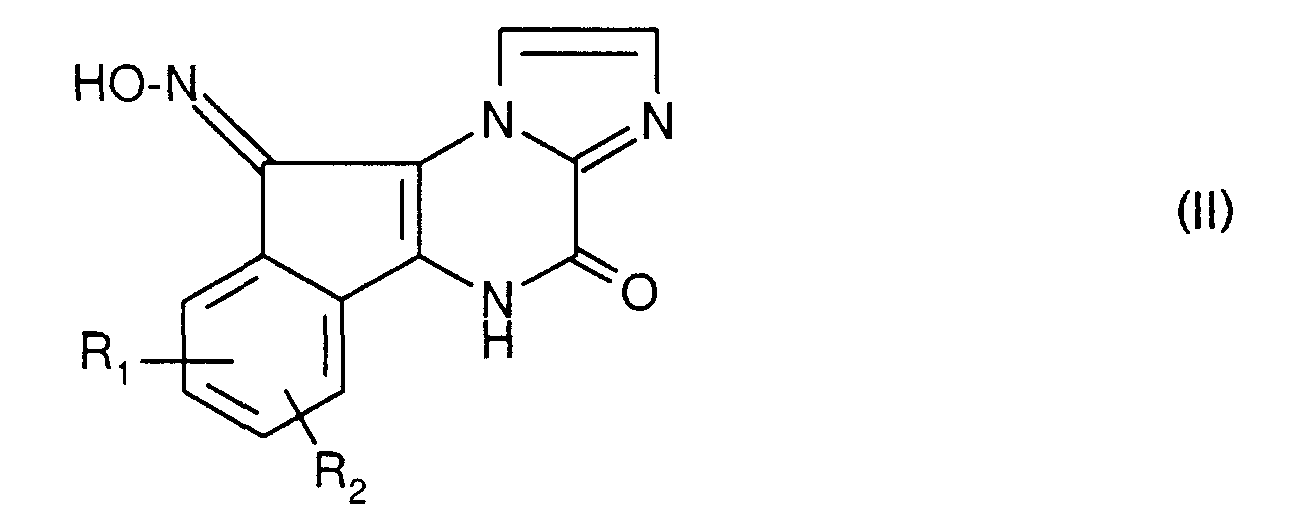
- Procédé de préparation des composés de formule (I) selon la revendication 6 pour lesquels R représente un radical C=R3 et R3 représente un radical CHR10 caractérisé en ce que l'on fait réagir un dérivé de formule :dans laquelle R1 et R2 ont les mêmes significations que dans la revendication 6 sur un dérivé de formule OHC-P10 dans laquelle R10 a les mêmes significations que dans la revendication 6, isole le produit et le transforme éventuellement en sel.
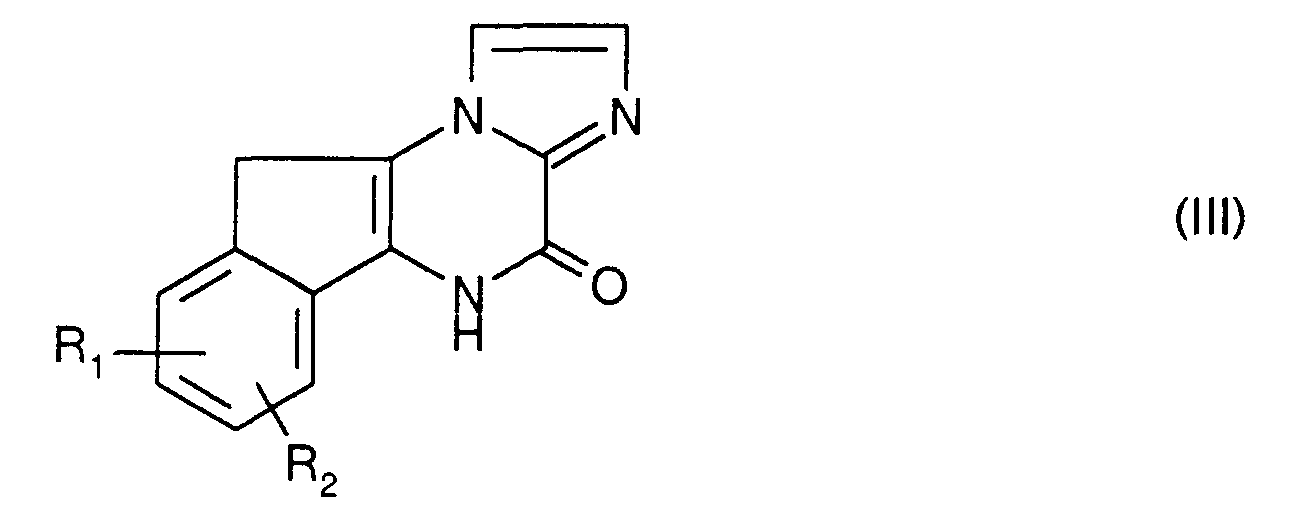
- Procédé de préparation des composés de formule (I) selon la revendication 6 pour lesquels R représente un radical C=R3 et R3 représente un radical NR7 caractérisé en ce que l'on fait réagir un dérivé de formule :dans laquelle R1 et R2 ont les mêmes significations que dans la revendication 6, Rb représente un atome d'hydrogène, Rc représente un radical -NHR7 et R7 a les mêmes significations que dans la revendication 6 sur le trifluoroacétate d'éthyle, isole le produit et le transforme éventuellement en sel.
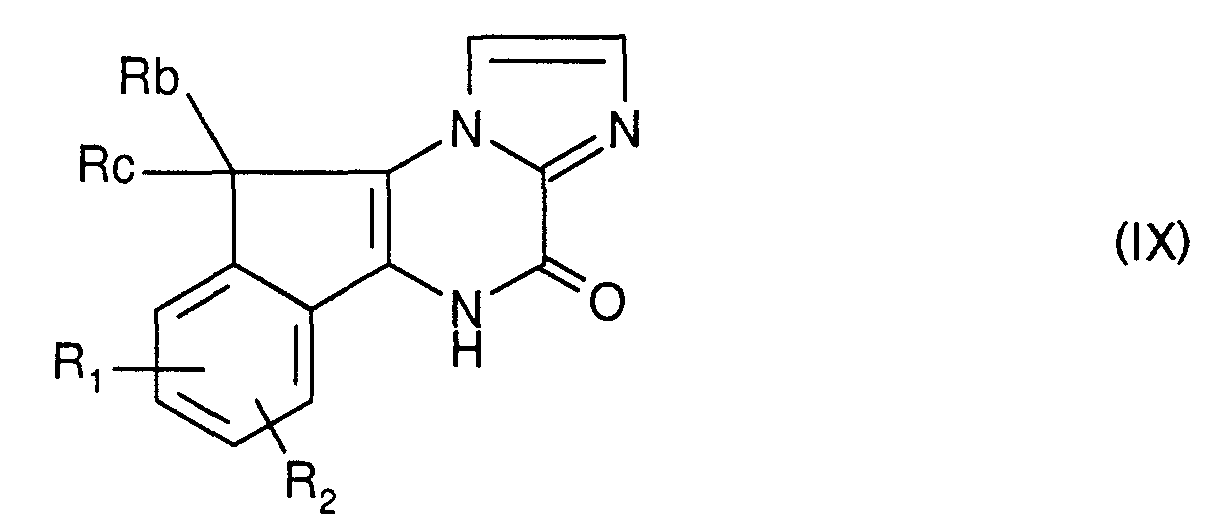
- Procédé de préparation des composés de formule (I) selon la revendication 6 pour lesquels R représente un radical C=R3 et R3 représente un radical C(COOR7)R16 caractérisé en ce que l'on déshydrate un dérivé de formule :dans laquelle R1 et R2 ont les mêmes significations que dans la revendication 6, Rb représente un atome d'hydrogène et Rc représente un radical -C(OH)(R16)COOR7 dans lequel R7 et R16 ont les mêmes significations que dans la revendication 6, isole le produit et le transforme éventuellement en sel.

- Procédé de préparation des composés de formule (I) selon la revendication 6 pour lesquels R représente un radical C=R3 et R3 représente un radical C(CONR7R15)R16 caractérisé en ce que l'on fait réagir un composé de formule (I) correspondant pour lequel R représente un radical C=R3 et R3 représente un radical C(COOR7)R16 sur une amine HNR7R15 dans laquelle R7 et R15 ont les mêmes significations que dans la revendication 6, isole le produit et le transforme éventuellement en sel.
- Procédé de préparation des composés de formule (I) selon la revendication 6 pour lesquels R représente un radical C=R3 et R3 représente un radical C(CONR7R15)R16 dans lequel R7 et R15 représentent des atomes d'hydrogène caractérisé en ce que l'on fait réagir un composé de formule (I) correspondant pour lequel R représente un radical C=R3 et R3 représente un radical C(COOR7)R16 dans lequel R7 représente un atome d'hydrogène sur le chlorure d'oxalyle puis sur l'hydroxyde d'ammonium, isole le produit et le transforme éventuellement en sel.
- Procédé de préparation des composés de formule (I) selon la revendication 6 pour lesquels R représente un radical C(R4)R5 dans lequel R5 représente un radical -alk-COOR7, -NH-COalk ou -NR12R13 dans lequel R12 et R13 représentent des atomes d'hydrogène caractérisé en ce que l'on fait réagir un halogènure Hal-R4 dans lequel Hal représente un atome d'halogène et R4 a les mêmes significations que dans la revendication 6 sur un dérivé de formule :dans laquelle R1 et R2 ont les mêmes significations que dans la revendication 6, Rb représente un atome d'hydrogène et Rc représente un radical -alk-COOR7, -NH-COalk dans lesquels alk représente un radical alkyle et R7 a les mêmes significations que dans la revendication 6, puis éventuellement hydrolyse le dérivé acylaminé, isole le produit et le transforme éventuellement en sel.

- Procédé de préparation des composés de formule (I) selon la revendication 6 pour lesquels R représente un radical C(R4)R5 dans lequel R5 représente un radical -NR12R13, R13 représente un atome d'hydrogène ou un radical alkyle et R12 représente un radical alkyle, -alk-COOR7, -alk-NR7R15, -alk-Het, -alk-Het" ou phénylalkyle dont le noyau phényle est éventuellement substitué caractérisé en ce que l'on fait réagir un composé de formule (I) correspondant pour lequel R représente un radical C(R4)R5, R5 représente un radical -NR12R13, R12 représente un atome d'hydrogène et R13 représente un atome d'hydrogène ou un radical alkyle sur un halogènure Hal-R12 dans lequel R12 a les mêmes significations que précédemment, isole le produit et le transforme éventuellement en sel.
- Procédé de préparation des composés de formule (I) selon la revendication 6 pour lesquels R représente un radical C(R4)R5 dans lequel R5 représente un radical -NR12R13, R12 a les mêmes significations que dans la revendication 6 et R13 représente un radical alkyle caractérisé en ce que l'on fait réagir un composé de formule (I) correspondant pour lequel R représente un radical C(R4)R5, R5 représente un radical -NR12R13, R12 a les mêmes significations que dans la revendication 6 et R13 représente un atome d'hydrogène sur un dérivé de formule Hal-alk dans laquelle Hal représente un atome d'halogène et alk représente un radical alkyle, isole le produit et le transforme éventuellement en sel.
- Procédé de préparation des composés de formule (I) selon la revendication 6 pour lesquels R représente un radical C(R4)R5 dans lequel R5 représente un radical -COOR7, -alk-CN, -alk-Het", -alk-COOR7, -alk-CO-NR7R15, -alk-NR7R15 ou phénylalkyle dont le noyau phényle est substitué par un ou plusieurs substituants choisis parmi les atomes d'halogène et les radicaux alkyle, alcoxy, nitro, amino, hydroxy, cyano, -alk-NH2, -COOR7 et -alk-COOR7 caractérisé en ce que l'on fait réagir un dérivé de formule :dans laquelle R1 et R2 ont les mêmes significations que dans la revendication 6, Rc représente un radical alkyle, -alk-Het, -alk-Het" ou phénylalkyle dont le noyau phényle est éventuellement substitué par un ou plusieurs substituants choisis parmi les atomes d'halogène et les radicaux alkyle, alcoxy, nitro, amino, hydroxy, cyano, -alk-NH2, -COOR7 et -alk-COOR7 dans lesquels alk, Het, Het" et R7 ont les mêmes significations que dans la revendication 6 et Rb représente un atome d'hydrogène sur un halogénure HalRe dans lequel Re représente un radical -COOR7 dans lequel R7 représente un radical alkyle, -alk-CN, -alk-Het", -alk-COOR7, -alk-CO-NR7R15, -alk-NR7R15 ou phénylalkyle dont le noyau phényle est substitué par un ou plusieurs substituants choisis parmi les atomes d'halogène et les radicaux alkyle, alcoxy, nitro, amino, hydroxy, cyano, -alk-NH2, -COOR7 et -alk-COOR7 dans lesquels alk, Het", R15 et R7 ont les mêmes significations que dans la revendication 6, puis éventuellement hydrolyse le composé pour lequel R5 représente un radical -COOR7 ou -alk-COOR7 dans lesquels R7 représente un radical alkyle pour obtenir le composé correspondant pour lequel R7 est un atome d'hydrogène, isole le produit et le transforme éventuellement en sel.

- Procédé de préparation des composés de formule (I) selon la revendication 6 pour lesquels R représente un radical C(R4)R5 dans lequel R5 représente soit un radical -alk-Het" dans lequel Het" représente un radical 1-imidazolyle soit un radical -alk-NR7R15 caractérisé en ce que l'on fait réagir le triméthylchlorosilane sur un dérivé de formule :dans laquelle R1 et R2 ont les mêmes significations que dans la revendication 6, Rc représente un radical alkyle, -alk-Het, -alk-Het" ou phénylalkyle dont le noyau phényle est éventuellement substitué par un ou plusieurs substituants choisis parmi les atomes d'halogène et les radicaux alkyle, alcoxy, nitro, amino, hydroxy, cyano, -alk-NH2, -COOR7 et -alk-COOR7 dans lesquels alk, Het, Het" et R7 ont les mêmes significations que dans la revendication 6 et Rb représente un atome d'hydrogène puis un dérivé Hal-alk-Hal dans lequel Hal représente un atome d'halogène et alk représente un radical alkyle puis l'imidazole ou une amine HNR7R15 dans laquelle R7 et R15 ont les mêmes significations que dans la revendication 6, isole le produit et le transforme éventuellement en sel.

- Procédé de préparation des composés de formule (I) selon la revendication 6 pour lesquels R représente un radical C(R4)R5 dans lequel R5 représente un radical -alk-COOR7 dans lequel R7 représente un atome d'hydrogène caractérisé en ce que l'on hydrolyse un composé de formule (I) correspondant pour lequel R représente un radical C(R4)R5 dans lequel R5 représente un radical -alk-CN, isole le produit et le transforme éventuellement en sel.
- Procédé de préparation des composés de formule (I) selon la revendication 6 pour lesquels R représente un radical C(R4)R5 dans lequel R5 représente un radical -alk(2-6C)OH caractérisé en ce que l'on fait réagir le chlorure d'oxalyle sur un composé de formule (I) correspondant pour lequel R représente un radical C(R4)R5 dans lequel R5 représente un radical -alk-COOR7 et R7 représente un atome d'hydrogène puis réduit le produit obtenu, isole le produit et le transforme éventuellement en sel.
- Procédé de préparation des composés de formule (I) selon la revendication 6 pour lesquels R représente un radical C(R4)R5 dans lequel R5 représente un radical -alk(1C)OH caractérisé en ce que l'on fait réagir du chlorure de triméthylsilane sur un dérivé de formule :pour lequel R1 et R2 ont les mêmes significations que dans la revendication 6, Rb représente un atome d'hydrogène et Rc représente un radical alkyle, -alk-Het, -alk-Het" ou phénylalkyle dont le noyau phényle est éventuellement substitué par un ou plusieurs substituants choisis parmi les atomes d'halogène et les radicaux alkyle, alcoxy, nitro, amino, hydroxy, cyano, -alk-NH2, -COOR7 et -alk-COOR7 pour lesquels alk, Het, Het" et R7 ont les mêmes significations que dans la revendication 6 puis du trioxane, isole le produit et le transforme éventuellement en sel.

- Procédé de préparation des composés de formule (I) selon la revendication 6 pour lesquels R représente un radical C(R4)R5 dans lequel R5 représente un radical -NH-CHO ou bien R représente un radical CH-R6 et R6 représente un radical -NH-CHO caractérisé en ce que l'on fait réagir un dérivé de formule :dans laquelle R1 et R2 ont les mêmes significations que dans la revendication 6, Rb représente un atome d'hydrogène ou un radical alkyle, -alk-Het, -alk-Het" ou phénylalkyle dont le noyau phényle est éventuellement substitué par un ou plusieurs substituants choisis parmi les atomes d'halogène et les radicaux alkyle, alcoxy, nitro, amino, hydroxy, cyano, -alk-NH2, -COOR7 et -alk-COOR7 et Rc représente un radical amino sur CH3COOCHO, isole le produit et le transforme éventuellement en sel.
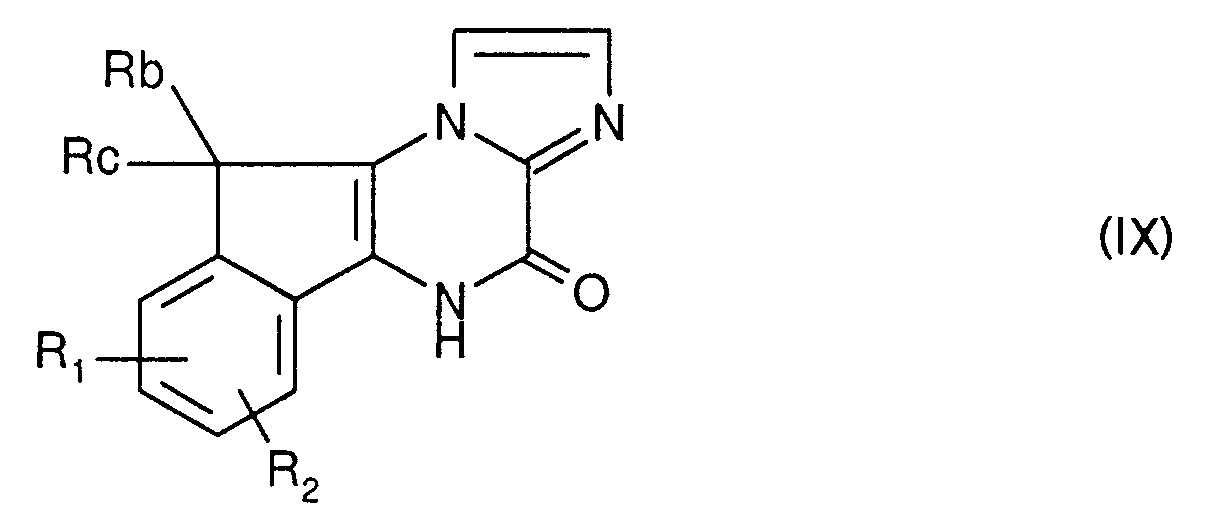
- Procédé de préparation des composés de formule (I) selon la revendication 6 pour lesquels R représente un radical C(R4)R5 dans lequel R5 représente un radical -NH-COOR17, -NH-CO-Het, -NH-CO-Het", -NH-CO-alk-COOR7, -NH-CO-alk-NR7R15, -NH-CO-Ar dont Ar est éventuellement substitué, -NH-CO-alk-Ar dont Ar est éventuellement substitué, -NH-CO-C(Ar)(CF3)OCH3, -NH-CO-alk-Het, -NH-CO-alk-Het", -NH-CO-alk, -NH-CO-cycloalkyle ou -NH-SO2R19 ou bien R représente un radical CH-R6 et R6 représente un radical -NH-COOR17, -NH-CO-Ar dont le Ar est substitué, -NH-CO-Het, -NH-CO-Het", -NH-CO-alk-Het, -NH-CO-alk-Het", -NH-CO-alk(2-6C)-NH2, -NH-CO-alk-N(alk)2, -NH-CO-alk-NH-alk, -NH-CO-alk(2-6C)-COOR7, -NH-CO-alk-Ar dont Ar est éventuellement substitué ou -NH-CO-C(Ar)(CF3)OCH3 caractérisé en ce que l'on fait réagir un dérivé de formule :pour lequel R1 et R2 ont les mêmes significations que dans la revendication 6, Rb représente un atome d'hydrogène ou un radical alkyle, -alk-Het, -alk-Het" ou phénylalkyle dont le noyau phényle est éventuellement substitué par un ou plusieurs substituants choisis parmi les atomes d'halogène et les radicaux alkyle, alcoxy, nitro, amino, hydroxy, cyano, -alk-NH2, -COOR7 et -alk-COOR7 dans lesquels R7, Het, Het" et alk ont les mêmes significations que dans la revendication 6 et Rc représente un radical amino sur un dérivé Hal-Rj dans lequel Hal représente un atome d'halogène et Rj représente un radical -COOR17, -CO-Het, -CO-Het", -CO-alk-COOR7, -CO-alk-NR7R15, -CO-Ar éventuellement substitué par un ou plusieurs substituants choisis parmi les atomes d'halogène et les radicaux alkyle, alcoxy, nitro, amino, hydroxy, cyano, -alk-NH2, -COOR7 et -alk-COOR7, -CO-alk-Ar dont Ar est éventuellement substitué par un ou plusieurs substituants choisis parmi les atomes d'halogène et les radicaux alkyle, alcoxy, nitro, amino, hydroxy, cyano, -alk-NH2, -COOR7 et -alk-COOR7, -CO-C(Ar)(CF3)OCH3, -CO-alk-Het, -CO-alk-Het", -CO-alk, -COcycloalkyle, -SO2R19, -CO-alk(2-6C)-NH2, -CO-alk-N(alk)2, -CO-alk-NH-alk, -CO-alk(2-6C)-COOR7 dans lesquels R7, R15, R17, R19, Het, Het", Ar et alk ont les mêmes significations que dans la revendication 6, isole le produit et le transforme éventuellement en sel.
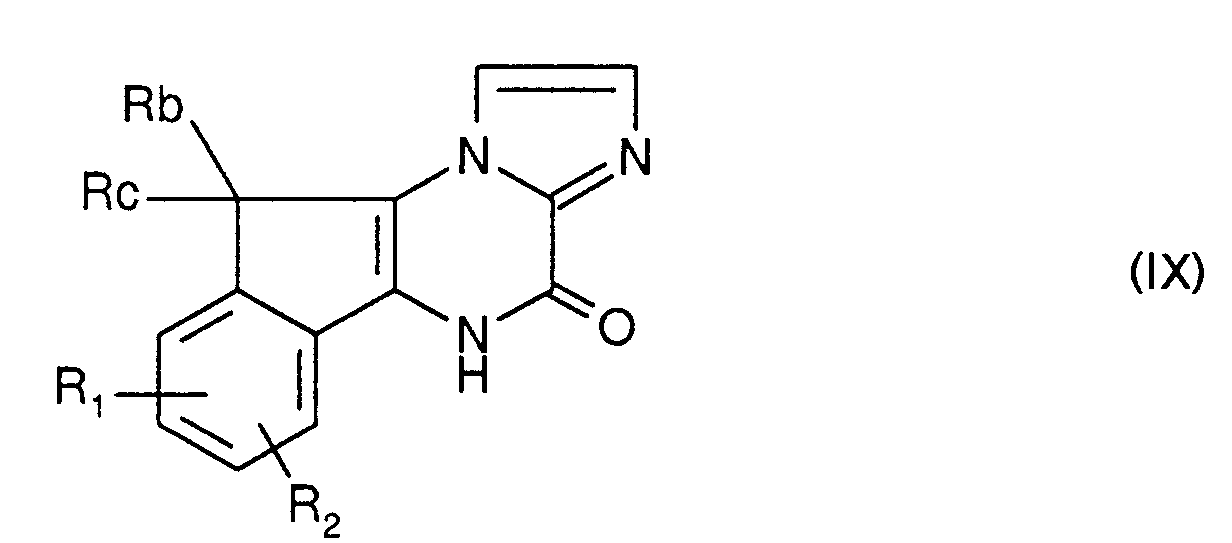
- Procédé de préparation des composés de formule (I) selon la revendication 6 pour lesquels R représente un radical C(R4)R5 ou CH-R6 dans lesquels R5 et R6 représentent un radical -NH-COOR17 et R17 représente un radical tertbutyle caractérisé en ce que l'on fait réagir un dérivé de formule :pour lequel R1 et R2 ont les mêmes significations que dans la revendication 6, Rb représente un atome d'hydrogène ou un radical alkyle, -alk-Het, -alk-Het" ou phénylalkyle dont le noyau phényle est éventuellement substitué par un ou plusieurs substituants choisis parmi les atomes d'halogène et les radicaux alkyle, alcoxy, nitro, amino, hydroxy, cyano, -alk-NH2, -COOR7 et -alk-COOR7 dans lesquels R7, Het, Het" et alk ont les mêmes significations que dans la revendication 6 et Rc représente un radical amino sur le dicarbonate de di-tertbutyle, isole le produit et le transforme éventuellement en sel.

- Procédé de préparation des composés de formule (I) selon la revendication 6 pour lesquels R représente soit un radical C(R4)R5 ou CH-R6 dans lesquels R5 et R6 représentent soit un radical -NH-CO-Ar dans lequel Ar est substitué par un radical -COOR7 et R7 représente un atome d'hydrogène soit un radical -NH-CO-alk-COOR7 dans lequel alk représente un radical alkyle contenant 1 à 3 atomes de carbone en chaíne droite ou -CH2-C(CH3)2-CH2-, -CH2-CH2-C(CH3)2-, -CH2-C(CH3)2- et R7 représente un atome d'hydrogène caractérisé en ce que l'on fait réagir un dérivé de formule :pour lequel R1 et R2 ont les mêmes significations que dans la revendication 6, Rb représente un atome d'hydrogène ou un radical alkyle, -alk-Het, -alk-Het" ou phénylalkyle dont le noyau phényle est éventuellement substitué par un ou plusieurs substituants choisis parmi les atomes d'halogène et les radicaux alkyle, alcoxy, nitro, amino, hydroxy, cyano, -alk-NH2, -COOR7 et -alk-COOR7 dans lesquels R7, Het, Het" et alk ont les mêmes significations que dans la revendication 6 et Rc représente un radical amino sur un anhydride de formules :
 dans lesquelles A représente un radical alkyle (1-3C en chaíne droite), -CH2-C(CH3)2-CH2-, -CH2-CH2-C(CH3)2- ou -CH2-C(CH3)2-, isole le produit et le transforme éventuellement en sel.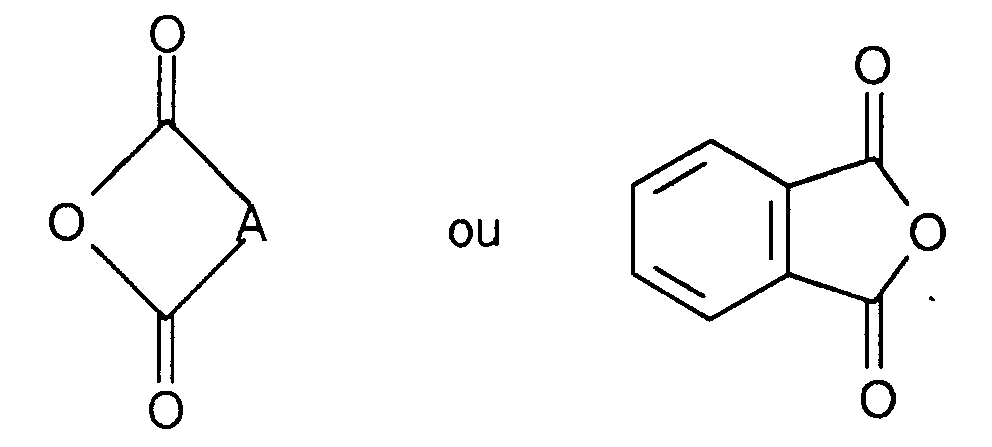
- Procédé de préparation des composés de formule (I) selon la revendication 6 pour lesquels R représente un radical C(R4)R5 dans lequel R5 représente un radical -NH-CO-Het, -NH-CO-Het", -NH-CO-alk-COOR7, -NH-CO-alk-NR7R15, -NH-CO-Ar dont Ar est éventuellement substitué, -NH-CO-alk-Ar dont Ar est éventuellement substitué, -NH-CO-alk-Het, -NH-CO-alk-Het", -NH-CO-alk ou -NH-CO-cycloalkyle caractérisé en ce que l'on fait réagir un composé de formule (I) correspondant pour lequel R représente un radical C(R4)R5 dans lequel R5 représente un radical -NR12R13, R12 et R13 sont des atomes d'hydrogène sur un dérivé HOOC-Rk dans lequel Rk représente un radical -Het, -Het", -alk-COOR7, -alk-NR7R15, phényle éventuellement substitué par un ou plusieurs substituants choisis parmi les atomes d'halogène et les radicaux alkyle, alcoxy, nitro, amino, hydroxy, cyano, -alk-NH2, -COOR7 et -alk-COOR7, phénylalkyle dont le phényle est éventuellement substitué par un ou plusieurs substituants choisis parmi les atomes d'halogène et les radicaux alkyle, alcoxy, nitro, amino, hydroxy, cyano, -alk-NH2, -COOR7 et -alk-COOR7, -alk-Het, -alk-Het", -alkyle ou -cycloalkyle dans lesquels R7, R15, Het, Het", Ar et alk ont les mêmes significations que dans la revendication 6, isole le produit et le transforme éventuellement en sel.
- Procédé de préparation des composés de formule (I) selon la revendication 6 pour lesquels R représente un radical C(R4)R5 dans lequel R5 représente un radical pyrrolyl-1 éventuellement substitué par un radical -COOR7 ou bien R représente un radical CH-R6, R6 représente un radical pyrrolyl-1 éventuellement substitué par un radical -COOR7 caractérisé en ce que l'on fait réagir un dérivé de formule :pour lequel R1 et R2 ont les mêmes significations que dans la revendication 6, Rb représente un atome d'hydrogène ou un radical alkyle, -alk-Het, -alk-Het" ou phénylalkyle dont le noyau phényle est éventuellement substitué par un ou plusieurs substituants choisis parmi les atomes d'halogène et les radicaux alkyle, alcoxy, nitro, amino, hydroxy, cyano, -alk-NH2, -COOR7 et -alk-COOR7 et Rc représente un radical amino, sur un dérivé de formule :
 dans laquelle alk représente un radical alkyle, RI représente un atome d'hydrogène ou un radical -COOR7 et R7 a les mêmes significations que dans la revendication 6 puis éventuellement hydrolyse l'ester pour obtenir les composés pour lesquels R7 représente un atome d'hydrogène, isole le produit et le transforme éventuellement en sel.
- Procédé de préparation des composés de formule (I) selon la revendication 6 pour lesquels R représente un radical CH-R6 et R6 représente un radical -COOalk caractérisé en ce que l'on fait réagir un acide minéral sur un dérivé de formule :dans laquelle R1 et R2 ont les mêmes significations que dans la revendication 6 et alk représente des radicaux alkyle, isole le produit et le transforme éventuellement en sel.

- Procédé de préparation des composés de formule (I) selon la revendication 6 pour lesquels R représente un radical CH-R6 et R6 représente un radical -alk-COOR7 caractérisé en ce que l'on réduit un composé de formule :dans laquelle R1 et R2 ont les mêmes significations que dans la revendication 6 et Rf représente un radical -alk(1-5C)-COOR7 ou -COOR7 dans lesquels alk a les mêmes significations que dans la revendication 6, R7 représente un radical alkyle, puis éventuellement saponifie l'ester ainsi obtenu, isole le produit et le transforme éventuellement en sel.

- Procédé de préparation des composés de formule (I) selon la revendication 6 pour lesquels R représente un radical C(R4)R5 ou CH-R6, R5 et R6 représentent un radical -alk-CO-NR7R15 caractérisé en ce que l'on fait réagir un composé de formule (I) correspondant pour lequel R représente un radical C(R4)R5 ou CH-R6 et R5 et R6 représentent un radical -alk-COOR7 sur une amine HNR7R15 dans laquelle R7 et R15 ont les mêmes significations que dans la revendication 6, isole le produit et le transforme éventuellement en sel.
- Procédé de préparation des composés de formule (I) selon la revendication 6 pour lesquels R représente un radical CH-R6, R6 représente un radical -alk(1C)-CO-NR7R15 et R7 et R15 représentent des atomes d'hydrogène caractérisé en ce que l'on hydrogène un dérivé de formule :dans laquelle R1 et R2 ont les mêmes significations que dans la revendication 6 et Rf représente un radical -CONH2, isole le produit et le transforme éventuellement en sel.
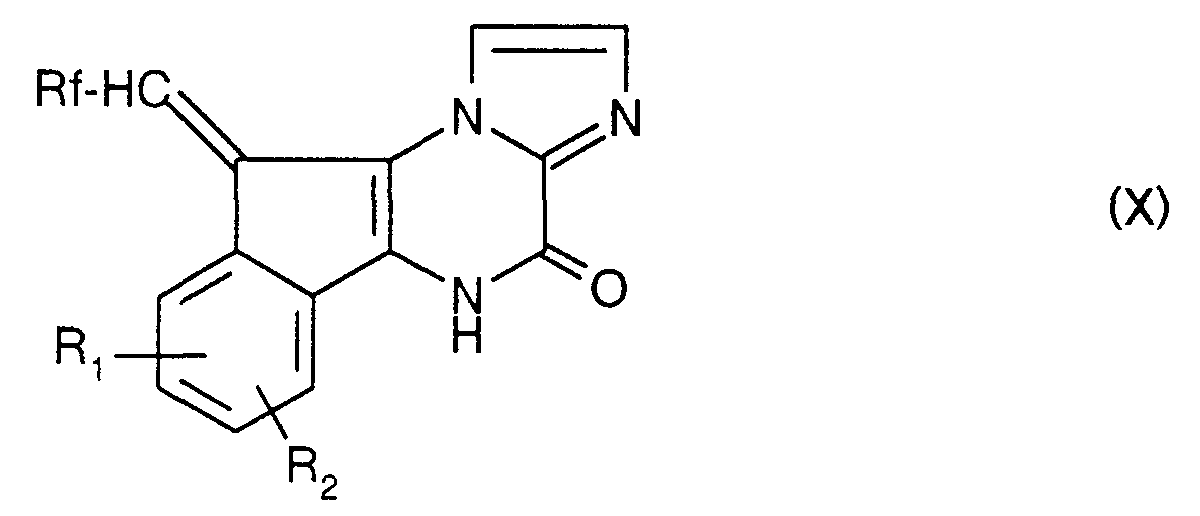
- Procédé de préparation des composés de formule (I) selon la revendication 6 pour lesquels R représente un radical CH-R6, R6 représente un radical -alk-Het", phénylalkyle dont le noyau phényle est substitué caractérisé en ce que l'on hydrogène un composé de formule (I) correspondant pour lequel R représente un radical C=R3, R3 représente un radical CH-R10 et R10 représente un radical -Het", -alk(1-5C)-Het", phényle substitué par un ou plusieurs substituants choisis parmi les atomes d'halogène et les radicaux alkyle, alcoxy, nitro, amino, hydroxy, cyano, -alk-NH2, -COOR7 et -alk-COOR7 ou phénylalkyle(1-5C) dont le noyau phényle est substitué par un ou plusieurs substituants choisis parmi les atomes d'halogène et les radicaux alkyle, alcoxy, nitro, amino, hydroxy, cyano, -alk-NH2, -COOR7 et -alk-COOR7 dans lesquels alk et R7 ont les mêmes significations que dans la revendication 6, isole le produit et le transforme éventuellement en sel.
- Procédé de préparation des composés de formule (I) selon la revendication 6 pour lesquels R représente un radical CH-R6 et R6 représentent un radical -R14-COOR7 caractérisé en ce que l'on fait réagir un dérivé de formule :dans laquelle R1 et R2 ont les mêmes significations que dans la revendication 6 sur un dérivé de formule OHC-alk(0-5C)-COOR7 dans laquelle alk représente un radical alkyle et R7 a les mêmes significations que dans la revendication 6, isole le produit et le transforme éventuellement en sel.

- Procédé de préparation des composés de formule (I) selon la revendication 6 pour lesquels R représente un radical CH-R6 et R6 représente un radical -CO-COOR7 caractérisé en ce que l'on oxyde un composé de formule (I) correspondant pour lequel R représente un radical CH-R6, R6 représente un radical -R14-COOR7 dans lequel R7 représente un atome d'hydrogène et R14 représente un radical -CHOH- et éventuellement estérifie le produit obtenu, isole le produit et le transforme éventuellement en sel.
- Procédé de préparation des composés de formule (I) selon la revendication 6 pour lesquels R représente un radical CH-R6 et R6 représente un radical -NH-CO-Ar dont le Ar est substitué, -NH-CO-Het, -NH-CO-Het", -NH-CO-alk-Het, -NH-CO-alk-Het", -NH-CO-alk(2-6C)-NH2, -NH-CO-alk-N(alk)2, -NH-CO-alk-NH-alk, -NH-CO-alk(2-6C)-COOR7 ou -NH-CO-alk-Ar dont Ar est éventuellement substitué caractérisé en ce que l'on fait réagir un dérivé de formule :pour lequel R1 et R2 ont les mêmes significations que dans la revendication 6, Rb représente un atome d'hydrogène et Rc représente un radical amino sur un dérivé HOOC-Rn dans lequel Rn représente un radical phényle substitué par un ou plusieurs substituants choisis parmi les atomes d'halogène et les radicaux alkyle, alcoxy, nitro, amino, hydroxy, -alk-NH2, -COOR7 et -alk-COOR7, -Het, -Het", -alk-Het, -alk-Het", -alk(2-6C)-COOR7, -alk(2-6C)-NH2, -alk-N(alk)2, -alk-NH-alk ou phénylalkyle dont le phényle est éventuellement substitué par un ou plusieurs substituants choisis parmi les atomes d'halogène et les radicaux alkyle, alcoxy, nitro, amino, hydroxy, -alk-NH2, -COOR7 et -alk-COOR7 dans lesquels alk, Het, Het", R7, R15 et Ar ont les mêmes significations que dans la revendication 6, isole le produit et le transforme éventuellement en sel.
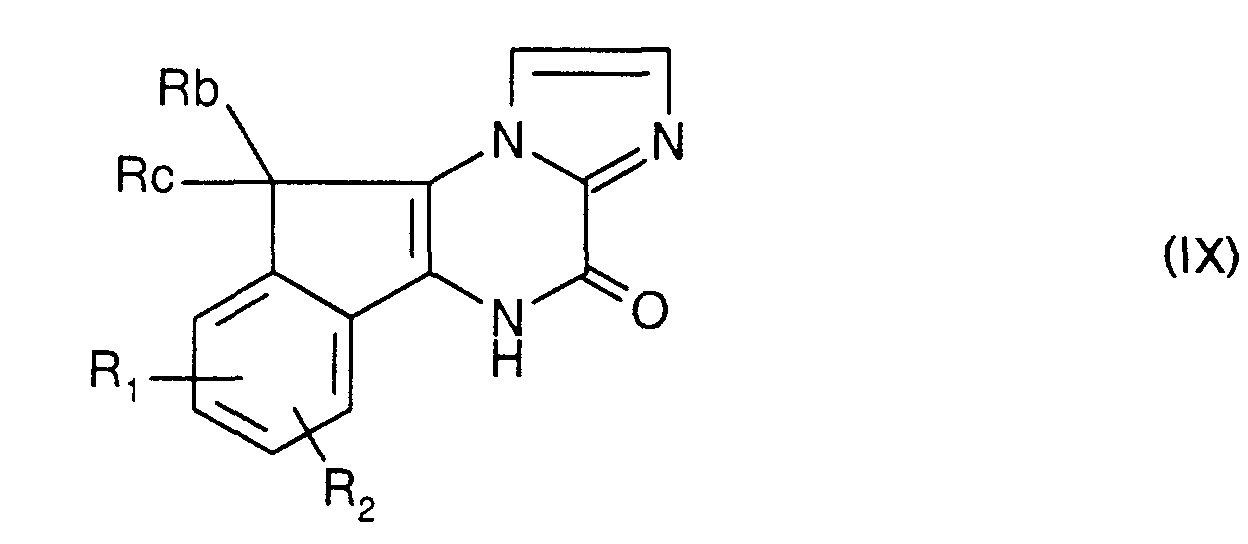
- Procédé de préparation des composés de formule (I) selon la revendication 6 pour lesquels R1 représente un atome d'hydrogène et R2 représente un radical nitro en position -8 caractérisé en ce que l'on nitre un composé de formule (I) correspondant pour lequel R1 et R2 sont des atomes d'hydrogène, isole le produit et le transforme éventuellement en sel.
- Procédé de préparation des composés de formule (I) selon la revendication 6 pour lesquels R1 représente un atome d'hydrogène et R2 représente un radical amino caractérisé en ce que l'on réduit un composé de formule (I) correspondant pour lequel R1 représente un atome d'hydrogène et R2 représente un radical nitro, isole le produit et le transforme éventuellement en sel.
- Procédé de préparation des composés de formule (I) selon la revendication 6 pour lesquels R1 représente un atome d'hydrogène et R2 représente un radical -NH-CO-NR8R9 ou -NH-CS-NR8R9 et R9 représente un atome d'hydrogène caractérisé en ce que l'on fait réagir un composé de formule (I) correspondant pour lequel R1 représente un atome d'hydrogène et R2 représente un radical amino sur un dérivé Ro=C=N=Rp dans lequel Ro représente un atome d'oxygène ou de soufre et Rp représente un radical triméthylsilyle, alkyle, -alk-COOR7, -alk-Het, -alk-Het", -alkNR9R7, phénylalkyle dont le phényle est éventuellement substitué par un ou plusieurs substituants choisis parmi les atomes d'halogène et les radicaux alkyle, alcoxy, nitro, amino, hydroxy, cyano, -alk-NH2, -COOR7 et -alk-COOR7, phényle éventuellement substitué par un ou plusieurs substituants choisis parmi les atomes d'halogène et les radicaux alkyle, alcoxy, nitro, amino, hydroxy, cyano, -alk-NH2, -COOR7 et -alk-COOR7, Het ou Het" dans lesquels alk, Het, Het", R7 et R9 ont les mêmes significations que dans la revendication 6, isole le produit et le transforme éventuellement en sel.
- Procédé de préparation des composés de formule (I) selon la revendication 6 pour lesquels R6 représente un radical phénylalkyle dont le phényle est substitué par un radical amino caractérisé en ce que l'on hydrolyse un composé de formule (I) correspondant pour lequel R6 représente un radical phénylalkyle dont le phényle est substitué par un radical acétylamino, isole le produit et le transforme éventuellement en sel.
- Procédé de préparation des composés de formule (I) selon la revendication 6 pour lesquels R6 représente un radical phénylalkyle dont le phényle est substitué par un radical acétylamino caractérisé en ce que l'on acétyle un composé de formule (I) correspondant pour lequel R6 représente un radical phénylalkyle dont le phényle est substitué par un radical amino, isole le produit et le transforme éventuellement en sel.
- Procédé de préparation des composés de formule (I) selon la revendication 6 comportant un radical carboxy caractérisé en ce que l'on hydrolyse un composé de formule (I) correspondant comportant un radical alcoxycarbonyle, isole le produit et le transforme éventuellement en sel.
Applications Claiming Priority (3)
| Application Number | Priority Date | Filing Date | Title |
|---|---|---|---|
| FR9403582A FR2717813B1 (fr) | 1994-03-28 | 1994-03-28 | Dérivés d'imidazo[1,2-a]indeno[1,2-e]pyrazine-4-one, leur préparation et les médicaments les contenant . |
| FR9403582 | 1994-03-28 | ||
| PCT/FR1995/000358 WO1995026350A1 (fr) | 1994-03-28 | 1995-03-23 | Derives d'imidazo(1,2-a)indeno(1,2-e)pyrazin-4-one et compositions pharmaceutiques les contenant |
Publications (2)
| Publication Number | Publication Date |
|---|---|
| EP0752992A1 EP0752992A1 (fr) | 1997-01-15 |
| EP0752992B1 true EP0752992B1 (fr) | 2001-05-30 |
Family
ID=9461467
Family Applications (1)
| Application Number | Title | Priority Date | Filing Date |
|---|---|---|---|
| EP95914404A Expired - Lifetime EP0752992B1 (fr) | 1994-03-28 | 1995-03-23 | DERIVES D'IMIDAZO[1,2-a]INDENO[1,2-e]PYRAZIN-4-ONE ET COMPOSITIONS PHARMACEUTIQUES LES CONTENANT |
Country Status (14)
| Country | Link |
|---|---|
| US (1) | US5807859A (fr) |
| EP (1) | EP0752992B1 (fr) |
| JP (1) | JPH09510727A (fr) |
| AT (1) | ATE201686T1 (fr) |
| AU (1) | AU2141395A (fr) |
| DE (1) | DE69521125T2 (fr) |
| DK (1) | DK0752992T3 (fr) |
| ES (1) | ES2158099T3 (fr) |
| FR (1) | FR2717813B1 (fr) |
| GR (1) | GR3035956T3 (fr) |
| IL (1) | IL113148A0 (fr) |
| PT (1) | PT752992E (fr) |
| WO (1) | WO1995026350A1 (fr) |
| ZA (1) | ZA952529B (fr) |
Families Citing this family (13)
| Publication number | Priority date | Publication date | Assignee | Title |
|---|---|---|---|---|
| FR2743364A1 (fr) * | 1996-01-10 | 1997-07-11 | Rhone Poulenc Rorer Sa | Derives de 5h,10h-imidazo(1,2-a)indeno(1,2-e)pyrazine-4-one, leur preparation et les medicaments les contenant |
| US7732162B2 (en) | 2003-05-05 | 2010-06-08 | Probiodrug Ag | Inhibitors of glutaminyl cyclase for treating neurodegenerative diseases |
| WO2008053301A2 (fr) * | 2006-10-30 | 2008-05-08 | Hybrigenics Sa | Tetracyclic inhibitors of cysteine proteases, the pharmaceutical compositions thereof and their therapeutic applications |
| US8278345B2 (en) | 2006-11-09 | 2012-10-02 | Probiodrug Ag | Inhibitors of glutaminyl cyclase |
| JP5523107B2 (ja) | 2006-11-30 | 2014-06-18 | プロビオドルグ エージー | グルタミニルシクラーゼの新規阻害剤 |
| EP2481408A3 (fr) | 2007-03-01 | 2013-01-09 | Probiodrug AG | Nouvelle utilisation d'inhibiteurs glutaminyle cyclase |
| WO2008128985A1 (fr) | 2007-04-18 | 2008-10-30 | Probiodrug Ag | Dérivés de thio-urée utilisés comme inhibiteurs de la glutaminyl cyclase |
| MX2012002993A (es) | 2009-09-11 | 2012-04-19 | Probiodrug Ag | Derivados heterociclicos como inhibidores de ciclasa glutaminilo. |
| JP6026284B2 (ja) | 2010-03-03 | 2016-11-16 | プロビオドルグ エージー | グルタミニルシクラーゼの阻害剤 |
| US8269019B2 (en) | 2010-03-10 | 2012-09-18 | Probiodrug Ag | Inhibitors |
| WO2011131748A2 (fr) | 2010-04-21 | 2011-10-27 | Probiodrug Ag | Nouveaux inhibiteurs |
| ES2570167T3 (es) | 2011-03-16 | 2016-05-17 | Probiodrug Ag | Derivados de benzimidazol como inhibidores de glutaminil ciclasa |
| PL3461819T3 (pl) | 2017-09-29 | 2020-11-30 | Probiodrug Ag | Inhibitory cyklazy glutaminylowej |
Family Cites Families (12)
| Publication number | Priority date | Publication date | Assignee | Title |
|---|---|---|---|---|
| US4507300A (en) * | 1980-05-09 | 1985-03-26 | Usv Pharmaceutical Corporation | Pyridotriazolopyrazine-diones for treating allergy |
| US4668678A (en) * | 1980-05-09 | 1987-05-26 | Usv Pharmaceutical Corporation | Triazoloquinoxalin-1,4-diones |
| US4400382A (en) * | 1980-05-09 | 1983-08-23 | Usv Pharmaceutical Corporation | Thiazoloquinoxalin-1,4-diones for treating allergy |
| US4354027A (en) * | 1980-05-19 | 1982-10-12 | Usv Pharmaceutical Corporation | Triazoloquinoxalin-4-ones |
| US5196421A (en) * | 1991-06-05 | 1993-03-23 | Eli Lilly And Company | Excitatory amino acid receptor antagonists in methods for the use thereof |
| US5153196A (en) * | 1991-06-05 | 1992-10-06 | Eli Lilly And Company | Excitatory amino acid receptor antagonists and methods for the use thereof |
| DK162491D0 (da) * | 1991-09-20 | 1991-09-20 | Novo Nordisk As | Heterocycliske forbindelser, deres fremstilling og farmaceutiske praeparater indeholdende forbindelserne |
| WO1994000124A1 (fr) * | 1992-06-22 | 1994-01-06 | Eckard Weber | Antagonistes des recepteurs de glycine et leur utilisation |
| FR2696466B1 (fr) * | 1992-10-02 | 1994-11-25 | Rhone Poulenc Rorer Sa | Dérivés de 5H,10H-imidazo[1,2-a]indeno[1,2-e]pyrazine-4-one, leur préparation et les médicaments les contenant. |
| DK12293D0 (da) * | 1993-02-02 | 1993-02-02 | Novo Nordisk As | Heterocykliske forbindelser og deres fremstilling og anvendelse |
| FR2707643B1 (fr) * | 1993-07-16 | 1995-08-11 | Rhone Poulenc Rorer Sa | Dérivés d'imidazo[1,2-a]pyrazine-4-one, leur préparation et les médicaments les contenant. |
| FR2707645B1 (fr) * | 1993-07-16 | 1995-08-11 | Rhone Poulenc Rorer Sa | Dérivés d'imidazo[1,2-a]pirazine-4-one, leur préparation et les médicaments les contenant. |
-
1994
- 1994-03-28 FR FR9403582A patent/FR2717813B1/fr not_active Expired - Fee Related
-
1995
- 1995-03-23 AT AT95914404T patent/ATE201686T1/de not_active IP Right Cessation
- 1995-03-23 DE DE69521125T patent/DE69521125T2/de not_active Expired - Fee Related
- 1995-03-23 AU AU21413/95A patent/AU2141395A/en not_active Abandoned
- 1995-03-23 PT PT95914404T patent/PT752992E/pt unknown
- 1995-03-23 JP JP7524995A patent/JPH09510727A/ja not_active Ceased
- 1995-03-23 WO PCT/FR1995/000358 patent/WO1995026350A1/fr not_active Ceased
- 1995-03-23 DK DK95914404T patent/DK0752992T3/da active
- 1995-03-23 EP EP95914404A patent/EP0752992B1/fr not_active Expired - Lifetime
- 1995-03-23 ES ES95914404T patent/ES2158099T3/es not_active Expired - Lifetime
- 1995-03-23 US US08/716,311 patent/US5807859A/en not_active Expired - Fee Related
- 1995-03-27 IL IL11314895A patent/IL113148A0/xx unknown
- 1995-03-28 ZA ZA952529A patent/ZA952529B/xx unknown
-
2001
- 2001-05-31 GR GR20000402828T patent/GR3035956T3/el not_active IP Right Cessation
Also Published As
| Publication number | Publication date |
|---|---|
| FR2717813B1 (fr) | 1996-05-10 |
| DK0752992T3 (da) | 2001-07-30 |
| ZA952529B (en) | 1996-01-22 |
| US5807859A (en) | 1998-09-15 |
| ES2158099T3 (es) | 2001-09-01 |
| DE69521125D1 (de) | 2001-07-05 |
| EP0752992A1 (fr) | 1997-01-15 |
| JPH09510727A (ja) | 1997-10-28 |
| AU2141395A (en) | 1995-10-17 |
| IL113148A0 (en) | 1995-06-29 |
| DE69521125T2 (de) | 2001-11-15 |
| GR3035956T3 (en) | 2001-08-31 |
| WO1995026350A1 (fr) | 1995-10-05 |
| PT752992E (pt) | 2001-10-31 |
| FR2717813A1 (fr) | 1995-09-29 |
| ATE201686T1 (de) | 2001-06-15 |
Similar Documents
| Publication | Publication Date | Title |
|---|---|---|
| EP0708774B1 (fr) | DERIVES D'IMIDAZO[1,2-a]PYRAZIN-4-ONE ANTAGONISTES DES RECEPTEURS AMPA ET NMDA | |
| EP0752988B1 (fr) | DERIVES DE 5H-INDENO[1,2-b]PYRAZINE-2,3-DIONE ANTAGONISTES DES RECEPTEURS AMPA ET NMDA | |
| EP0708778B1 (fr) | Derives d'imidazo [1,2-a]pyrazine-4-one/utiles comme antagonistes des recepteurs ampa et nmda | |
| EP0789699B1 (fr) | SPIRO[HETEROCYCLE-IMIDAZO[1,2-a]INDENO[1,2-e]PYRAZINE]-4'-ONES, LEUR PREPARATION ET LES MEDICAMENTS LES CONTENANT | |
| EP0752992A1 (fr) | Derives d'imidazo(1,2-a)indeno(1,2-e)pyrazin-4-one et compositions pharmaceutiques les contenant | |
| EP0752991B1 (fr) | IMIDAZO[1,2-a]INDENO[1,2-e]PYRAZIN-4-ONES ANTAGONISTES DES RECEPTEURS AMPA ET NMDA | |
| EP0662971B1 (fr) | DERIVES DE 5H,10H-IMIDAZO[1,2-a]INDENO[1,2-e]PYRAZINE-4-ONE, LEUR PREPARATION ET LES MEDICAMENTS LES CONTENANT | |
| WO1997025329A1 (fr) | DERIVES DE 5H,10H-IMIDAZO[1,2-a]INDOLO[3,2-e]PYRAZINE-4-ONE, LEUR PREPARATION ET LES MEDICAMENTS LES CONTENANT | |
| EP0880522B1 (fr) | DERIVES DE 5H,10H-IMIDAZO[1,2-a]INDENO[1,2-e]PYRAZINE-4-ONE ANTAGONISTES DES RECEPTEURS AMPA ET NMDA, LEUR PREPARATION, LEURS INTERMEDIAIRES ET LES MEDICAMENTS LES CONTENANT | |
| EP0752994A1 (fr) | DERIVES D'IMIDAZO[1,2-a]PYRAZIN-4-ONE, LEUR PREPARATION ET LES MEDICAMENTS LES CONTENANT | |
| EP0772615B1 (fr) | DERIVES D'ACIDE IMIDAZO[1,2-a]INDENO[1,2-e]PYRAZINE-2-CARBOXYLIQUE, LEUR PREPARATION ET LES MEDICAMENTS LES CONTENANT | |
| EP1000067B1 (fr) | Thiazolobenzoheterocycles, leur preparation et les medicaments les contenant | |
| EP0820455B1 (fr) | DERIVES DE 5H, 10H-IMIDAZO [1,2-a] INDENO [1,2-e] PYRAZIN-4-ONE, LEUR PREPARATION ET LES MEDICAMENTS LES CONTENANT | |
| FR2738821A1 (fr) | Indeno[1,2-e]pyrazin-4-ones, leur preparation et les medicaments les contenant | |
| EP0752993A1 (fr) | DERIVES DE 1,2,4-TRIAZOLO [4.3-a] PYRAZINE-4-ONE, LEUR PREPARATION ET LES MEDICAMENTS LES CONTENANT | |
| WO1997025326A1 (fr) | 5H,10H-IMIDAZO[1,2-a]INDENO[1,2-e]PYRAZINE-4-ONES SUBSTITUEES EN POSITION 2, LEUR PREPARATION ET LES MEDICAMENTS LES CONTENANT |
Legal Events
| Date | Code | Title | Description |
|---|---|---|---|
| PUAI | Public reference made under article 153(3) epc to a published international application that has entered the european phase |
Free format text: ORIGINAL CODE: 0009012 |
|
| 17P | Request for examination filed |
Effective date: 19960916 |
|
| AK | Designated contracting states |
Kind code of ref document: A1 Designated state(s): AT BE CH DE DK ES FR GB GR IE IT LI LU NL PT SE |
|
| 17Q | First examination report despatched |
Effective date: 19971002 |
|
| RTI1 | Title (correction) |
Free format text: IMIDAZO(1,2-A)INDENO(1,2-E)PYRAZIN-4-ONE DERIVATIVES AND PHARMACEUTICAL COMPOSITIONS CONTAINING THE SAME |
|
| GRAG | Despatch of communication of intention to grant |
Free format text: ORIGINAL CODE: EPIDOS AGRA |
|
| RTI1 | Title (correction) |
Free format text: IMIDAZO(1,2-A)INDENO(1,2-E)PYRAZIN-4-ONE DERIVATIVES AND PHARMACEUTICAL COMPOSITIONS CONTAINING THE SAME |
|
| GRAG | Despatch of communication of intention to grant |
Free format text: ORIGINAL CODE: EPIDOS AGRA |
|
| GRAH | Despatch of communication of intention to grant a patent |
Free format text: ORIGINAL CODE: EPIDOS IGRA |
|
| GRAH | Despatch of communication of intention to grant a patent |
Free format text: ORIGINAL CODE: EPIDOS IGRA |
|
| GRAA | (expected) grant |
Free format text: ORIGINAL CODE: 0009210 |
|
| ITF | It: translation for a ep patent filed | ||
| AK | Designated contracting states |
Kind code of ref document: B1 Designated state(s): AT BE CH DE DK ES FR GB GR IE IT LI LU NL PT SE |
|
| REF | Corresponds to: |
Ref document number: 201686 Country of ref document: AT Date of ref document: 20010615 Kind code of ref document: T |
|
| REG | Reference to a national code |
Ref country code: CH Ref legal event code: EP |
|
| REG | Reference to a national code |
Ref country code: CH Ref legal event code: NV Representative=s name: KIRKER & CIE SA * KIRKER & CIE SA |
|
| REF | Corresponds to: |
Ref document number: 69521125 Country of ref document: DE Date of ref document: 20010705 |
|
| REG | Reference to a national code |
Ref country code: IE Ref legal event code: FG4D Free format text: FRENCH |
|
| REG | Reference to a national code |
Ref country code: DK Ref legal event code: T3 |
|
| REG | Reference to a national code |
Ref country code: ES Ref legal event code: FG2A Ref document number: 2158099 Country of ref document: ES Kind code of ref document: T3 |
|
| GBT | Gb: translation of ep patent filed (gb section 77(6)(a)/1977) |
Effective date: 20010810 |
|
| REG | Reference to a national code |
Ref country code: PT Ref legal event code: SC4A Free format text: AVAILABILITY OF NATIONAL TRANSLATION Effective date: 20010808 |
|
| REG | Reference to a national code |
Ref country code: GB Ref legal event code: IF02 |
|
| PGFP | Annual fee paid to national office [announced via postgrant information from national office to epo] |
Ref country code: LU Payment date: 20020304 Year of fee payment: 8 |
|
| PLBE | No opposition filed within time limit |
Free format text: ORIGINAL CODE: 0009261 |
|
| STAA | Information on the status of an ep patent application or granted ep patent |
Free format text: STATUS: NO OPPOSITION FILED WITHIN TIME LIMIT |
|
| 26N | No opposition filed | ||
| PG25 | Lapsed in a contracting state [announced via postgrant information from national office to epo] |
Ref country code: LU Free format text: LAPSE BECAUSE OF NON-PAYMENT OF DUE FEES Effective date: 20030323 |
|
| PGFP | Annual fee paid to national office [announced via postgrant information from national office to epo] |
Ref country code: DK Payment date: 20080314 Year of fee payment: 14 Ref country code: CH Payment date: 20080313 Year of fee payment: 14 |
|
| PGFP | Annual fee paid to national office [announced via postgrant information from national office to epo] |
Ref country code: PT Payment date: 20080305 Year of fee payment: 14 Ref country code: NL Payment date: 20080303 Year of fee payment: 14 Ref country code: IT Payment date: 20080326 Year of fee payment: 14 Ref country code: IE Payment date: 20080313 Year of fee payment: 14 Ref country code: SE Payment date: 20080306 Year of fee payment: 14 Ref country code: GB Payment date: 20080326 Year of fee payment: 14 |
|
| PGFP | Annual fee paid to national office [announced via postgrant information from national office to epo] |
Ref country code: AT Payment date: 20080313 Year of fee payment: 14 |
|
| PGFP | Annual fee paid to national office [announced via postgrant information from national office to epo] |
Ref country code: FR Payment date: 20080311 Year of fee payment: 14 Ref country code: ES Payment date: 20080418 Year of fee payment: 14 Ref country code: DE Payment date: 20080407 Year of fee payment: 14 |
|
| PGFP | Annual fee paid to national office [announced via postgrant information from national office to epo] |
Ref country code: GR Payment date: 20080215 Year of fee payment: 14 Ref country code: BE Payment date: 20080916 Year of fee payment: 14 |
|
| BERE | Be: lapsed |
Owner name: S.A. *AVENTIS PHARMA Effective date: 20090331 |
|
| REG | Reference to a national code |
Ref country code: PT Ref legal event code: MM4A Free format text: LAPSE DUE TO NON-PAYMENT OF FEES Effective date: 20090923 |
|
| PG25 | Lapsed in a contracting state [announced via postgrant information from national office to epo] |
Ref country code: PT Free format text: LAPSE BECAUSE OF NON-PAYMENT OF DUE FEES Effective date: 20090923 Ref country code: AT Free format text: LAPSE BECAUSE OF NON-PAYMENT OF DUE FEES Effective date: 20090323 |
|
| REG | Reference to a national code |
Ref country code: CH Ref legal event code: PL |
|
| REG | Reference to a national code |
Ref country code: DK Ref legal event code: EBP |
|
| EUG | Se: european patent has lapsed | ||
| GBPC | Gb: european patent ceased through non-payment of renewal fee |
Effective date: 20090323 |
|
| NLV4 | Nl: lapsed or anulled due to non-payment of the annual fee |
Effective date: 20091001 |
|
| REG | Reference to a national code |
Ref country code: FR Ref legal event code: ST Effective date: 20091130 |
|
| REG | Reference to a national code |
Ref country code: IE Ref legal event code: MM4A |
|
| PG25 | Lapsed in a contracting state [announced via postgrant information from national office to epo] |
Ref country code: LI Free format text: LAPSE BECAUSE OF NON-PAYMENT OF DUE FEES Effective date: 20090331 Ref country code: IE Free format text: LAPSE BECAUSE OF NON-PAYMENT OF DUE FEES Effective date: 20090323 Ref country code: DE Free format text: LAPSE BECAUSE OF NON-PAYMENT OF DUE FEES Effective date: 20091001 Ref country code: CH Free format text: LAPSE BECAUSE OF NON-PAYMENT OF DUE FEES Effective date: 20090331 |
|
| PG25 | Lapsed in a contracting state [announced via postgrant information from national office to epo] |
Ref country code: BE Free format text: LAPSE BECAUSE OF NON-PAYMENT OF DUE FEES Effective date: 20090331 Ref country code: NL Free format text: LAPSE BECAUSE OF NON-PAYMENT OF DUE FEES Effective date: 20091001 |
|
| PG25 | Lapsed in a contracting state [announced via postgrant information from national office to epo] |
Ref country code: GB Free format text: LAPSE BECAUSE OF NON-PAYMENT OF DUE FEES Effective date: 20090323 Ref country code: FR Free format text: LAPSE BECAUSE OF NON-PAYMENT OF DUE FEES Effective date: 20091123 Ref country code: DK Free format text: LAPSE BECAUSE OF NON-PAYMENT OF DUE FEES Effective date: 20090331 |
|
| REG | Reference to a national code |
Ref country code: ES Ref legal event code: FD2A Effective date: 20090324 |
|
| PG25 | Lapsed in a contracting state [announced via postgrant information from national office to epo] |
Ref country code: GR Free format text: LAPSE BECAUSE OF NON-PAYMENT OF DUE FEES Effective date: 20091002 |
|
| PG25 | Lapsed in a contracting state [announced via postgrant information from national office to epo] |
Ref country code: ES Free format text: LAPSE BECAUSE OF NON-PAYMENT OF DUE FEES Effective date: 20090324 |
|
| PG25 | Lapsed in a contracting state [announced via postgrant information from national office to epo] |
Ref country code: IT Free format text: LAPSE BECAUSE OF NON-PAYMENT OF DUE FEES Effective date: 20090323 |
|
| PG25 | Lapsed in a contracting state [announced via postgrant information from national office to epo] |
Ref country code: SE Free format text: LAPSE BECAUSE OF NON-PAYMENT OF DUE FEES Effective date: 20090324 |