EP0755559B1 - Matrice memoire mettant en oeuvre des cellules memoire a etats multiples - Google Patents
Matrice memoire mettant en oeuvre des cellules memoire a etats multiples Download PDFInfo
- Publication number
- EP0755559B1 EP0755559B1 EP96904650A EP96904650A EP0755559B1 EP 0755559 B1 EP0755559 B1 EP 0755559B1 EP 96904650 A EP96904650 A EP 96904650A EP 96904650 A EP96904650 A EP 96904650A EP 0755559 B1 EP0755559 B1 EP 0755559B1
- Authority
- EP
- European Patent Office
- Prior art keywords
- cell
- cells
- voltage
- array
- memory
- Prior art date
- Legal status (The legal status is an assumption and is not a legal conclusion. Google has not performed a legal analysis and makes no representation as to the accuracy of the status listed.)
- Expired - Lifetime
Links
- 230000015654 memory Effects 0.000 title claims abstract description 84
- 238000007667 floating Methods 0.000 claims abstract description 49
- 230000006870 function Effects 0.000 claims abstract description 13
- 239000004065 semiconductor Substances 0.000 claims description 11
- 230000002708 enhancing effect Effects 0.000 abstract 1
- 210000004027 cell Anatomy 0.000 description 253
- 108091006146 Channels Proteins 0.000 description 50
- 230000007246 mechanism Effects 0.000 description 8
- 239000000758 substrate Substances 0.000 description 8
- 230000005689 Fowler Nordheim tunneling Effects 0.000 description 7
- 229910021420 polycrystalline silicon Inorganic materials 0.000 description 7
- 229920005591 polysilicon Polymers 0.000 description 7
- 238000010586 diagram Methods 0.000 description 3
- 108090000699 N-Type Calcium Channels Proteins 0.000 description 2
- 102000004129 N-Type Calcium Channels Human genes 0.000 description 2
- 230000008901 benefit Effects 0.000 description 2
- 230000008878 coupling Effects 0.000 description 2
- 238000010168 coupling process Methods 0.000 description 2
- 238000005859 coupling reaction Methods 0.000 description 2
- 238000013500 data storage Methods 0.000 description 2
- 238000009792 diffusion process Methods 0.000 description 2
- 239000002784 hot electron Substances 0.000 description 2
- PWPJGUXAGUPAHP-UHFFFAOYSA-N lufenuron Chemical compound C1=C(Cl)C(OC(F)(F)C(C(F)(F)F)F)=CC(Cl)=C1NC(=O)NC(=O)C1=C(F)C=CC=C1F PWPJGUXAGUPAHP-UHFFFAOYSA-N 0.000 description 2
- 238000000034 method Methods 0.000 description 2
- 238000000926 separation method Methods 0.000 description 2
- 101100537098 Mus musculus Alyref gene Proteins 0.000 description 1
- 101100269674 Mus musculus Alyref2 gene Proteins 0.000 description 1
- 108010075750 P-Type Calcium Channels Proteins 0.000 description 1
- 101150095908 apex1 gene Proteins 0.000 description 1
- 230000008859 change Effects 0.000 description 1
- 230000005684 electric field Effects 0.000 description 1
- 238000005516 engineering process Methods 0.000 description 1
- 238000005259 measurement Methods 0.000 description 1
- 230000004044 response Effects 0.000 description 1
- 210000000352 storage cell Anatomy 0.000 description 1
Images




Classifications
-
- G—PHYSICS
- G11—INFORMATION STORAGE
- G11C—STATIC STORES
- G11C11/00—Digital stores characterised by the use of particular electric or magnetic storage elements; Storage elements therefor
- G11C11/56—Digital stores characterised by the use of particular electric or magnetic storage elements; Storage elements therefor using storage elements with more than two stable states represented by steps, e.g. of voltage, current, phase, frequency
- G11C11/5621—Digital stores characterised by the use of particular electric or magnetic storage elements; Storage elements therefor using storage elements with more than two stable states represented by steps, e.g. of voltage, current, phase, frequency using charge storage in a floating gate
- G11C11/5628—Programming or writing circuits; Data input circuits
-
- G—PHYSICS
- G11—INFORMATION STORAGE
- G11C—STATIC STORES
- G11C11/00—Digital stores characterised by the use of particular electric or magnetic storage elements; Storage elements therefor
- G11C11/56—Digital stores characterised by the use of particular electric or magnetic storage elements; Storage elements therefor using storage elements with more than two stable states represented by steps, e.g. of voltage, current, phase, frequency
- G11C11/5621—Digital stores characterised by the use of particular electric or magnetic storage elements; Storage elements therefor using storage elements with more than two stable states represented by steps, e.g. of voltage, current, phase, frequency using charge storage in a floating gate
-
- G—PHYSICS
- G11—INFORMATION STORAGE
- G11C—STATIC STORES
- G11C11/00—Digital stores characterised by the use of particular electric or magnetic storage elements; Storage elements therefor
- G11C11/56—Digital stores characterised by the use of particular electric or magnetic storage elements; Storage elements therefor using storage elements with more than two stable states represented by steps, e.g. of voltage, current, phase, frequency
- G11C11/5621—Digital stores characterised by the use of particular electric or magnetic storage elements; Storage elements therefor using storage elements with more than two stable states represented by steps, e.g. of voltage, current, phase, frequency using charge storage in a floating gate
- G11C11/5628—Programming or writing circuits; Data input circuits
- G11C11/5635—Erasing circuits
-
- G—PHYSICS
- G11—INFORMATION STORAGE
- G11C—STATIC STORES
- G11C11/00—Digital stores characterised by the use of particular electric or magnetic storage elements; Storage elements therefor
- G11C11/56—Digital stores characterised by the use of particular electric or magnetic storage elements; Storage elements therefor using storage elements with more than two stable states represented by steps, e.g. of voltage, current, phase, frequency
- G11C11/5621—Digital stores characterised by the use of particular electric or magnetic storage elements; Storage elements therefor using storage elements with more than two stable states represented by steps, e.g. of voltage, current, phase, frequency using charge storage in a floating gate
- G11C11/5642—Sensing or reading circuits; Data output circuits
-
- G—PHYSICS
- G11—INFORMATION STORAGE
- G11C—STATIC STORES
- G11C16/00—Erasable programmable read-only memories
- G11C16/02—Erasable programmable read-only memories electrically programmable
- G11C16/06—Auxiliary circuits, e.g. for writing into memory
- G11C16/24—Bit-line control circuits
-
- G—PHYSICS
- G11—INFORMATION STORAGE
- G11C—STATIC STORES
- G11C7/00—Arrangements for writing information into, or reading information out from, a digital store
- G11C7/18—Bit line organisation; Bit line lay-out
Definitions
- the present invention relates generally to non-volatile semiconductor memories and, in particular, to semiconductor memories which include multistate EPROM or EEPROM cells.
- Non-volatile semiconductor memories including EPROMs (Electrical Programmable Read Only Memories) and EEPROMs (Electrically Erasable Programmable Read Only Memories) and Flash memories are becoming more popular. These memories utilize memory cells having a floating gate which is electrically isolated from the remainder of the cell and which stores an electrical charge indicative of the state of the cell.
- Figure 1A shows one exemplary embodiment of a conventional flash memory cell 10.
- the cell 10 is formed in an P- type substrate 12, with an N+ type diffusion being formed in the substrate 12 to form the cell drain region 14.
- Cell 10 could also be formed in a P- type well, with term semiconductor body referring both to a substrate and a well.
- a graded N+/N- diffusion 16 is further formed in the substrate to from the source region. That portion of the substrate 12 intermediate the source and drain region is referred to as the channel region 12a and is the location where the N type channel is formed when the cell is rendered conductive.
- the drain region 14 for the subject N channel cells 10, as distinguished from the source region 16 is that region which is at the most positive voltage during read operations.
- the floating gate 18 is separated from the channel region 12a by a thin gate oxide layer which is typically 100 ⁇ thick.
- the floating gate 18 and the control gate 20 are separated from each other by a relatively thick interpoly dielectric 24.
- the threshold voltage (V TH ) of the cell 10 is defined herein as being that voltage applied to the control gate 20, relative to the source region 16, which causes a current to flow from the drain to the source (I DS ) of I microampere when the drain to source voltage is +1 volt.
- the threshold voltage V TH of the cell can be adjusted by changing the charge on the floating gate 18 during the programming of the cell.
- the magnitude of the threshold voltage V TH determines the state of the cell, that is, whether the cell is programmed to a "1" or a "0' state.
- Figure 1A shows the configuration of the cell 10 during a programming sequence.
- the cell 10 is in a completely erased state with no charge being present on the floating gate.
- a relatively large positive voltage V PP typically +10 to + 12 volts, is applied to the control gate and the source region 14 is grounded (V SS ).
- the drain region is connected to an intermediate voltage VDD of typically +6 to +9 volts. These conditions cause electrons to exit the source region and travel towards the drain region 14.
- the electrons will be injected from the channel region 12a and onto the floating gate 20 by virtue of the positive voltage on the control gate 20 by a mechanism commonly referred to as CHE (channel hot electron).
- CHE channel hot electron
- Figure 1B depicts the conditions for reading the flash memory cell 10.
- the source region is grounded (V SS ) and a positive voltage V CC is applied to the control gate 20.
- Voltage V CC which is the primary memory supply voltage, is typically +5 volts.
- positive voltage V R is applied to the drain region.
- Voltage V R which is derived from an active load divider (not depicted) connected to voltage V CC , is typically +1 volts.
- the threshold voltage V TH will be relatively low.
- the magnitude of the voltage V CC applied to the control gate 20 will be sufficient to invert the channel region 12a so that an N type channel will be formed between the drain and source regions.
- the flow of drain/source current I DS will result in an increase in voltage dropped across the active load which will be detected by a sense amplifier (not depicted) connected between the drain region 14 and voltage V CC .
- the sensed change in voltage indicates that the cell being read is in a given logic state ("1").
- the presence of negative charge on the floating gate 18 will effectively increase the threshold voltage V TH of the device. In that event, the applied source-control gate voltage V CC will not be sufficient to invert the channel region 12a.
- the cell 10 will remain non-conductive and the voltage at the drain (V R ) will remain unchanged.
- the sense amplifier connected to the drain of the cell, will interpret cell 10 to be in a state ("0") opposite to that when the cell remains in an erased, low threshold voltage state (“0").
- the cell 10 is erased under the conditions shown in Figure 1C.
- the drain region 14 is left floating (F) and the source region 16 is connected to positive voltage V CC .
- a negative voltage V EE is applied to the control gate 20.
- the resultant electric field causes electrons to be removed from the floating gate 20 to the source region 16 by way of Fowler-Nordheim tunneling.
- FIG. 2 shows a typical exemplary prior art split channel flash memory cell 26 of the type disclosed in the above-noted U.S.P.No. 5,043,940.
- the split channel cell sometimes referred to as a split gate cell or a one and one-half transistor cell, is formed in a P- type substrate 12 and includes an N+ type drain region 14 and an N+ type source region 16 separated by a channel region split between regions segments 12a and 12b.
- a polysilicon floating gate 18 is disposed over channel region segment 12a, but not segment 12b. The floating gate 18 is separated from the channel segment 12a by a thin (typically 100 ⁇ ) gate oxide 22.
- Split channel cell 26 further includes a polysilicon control gate 20 having one segment 20a overlying the floating gate 18 and separated from the floating gate 18 by an interpoly dielectric 24.
- the control gate 20 includes another segment 20b separated from channel segment 12b by the gate oxide 22.
- the cell 26 can be viewed as having two threshold voltage - one associated with channel segment 12a and one associates with channel segment 12b.
- the threshold voltage associated with segment 12b remains fixed and may be, by way of example, +1.5 volts.
- the threshold voltage associated with channel segment 12a will vary with the charge present on the floating gate 18 and may vary from +5 volts to +1 volt.
- channel segment 12a will become inverted (N type) and the threshold voltage associated with segment (V Ta ) will become negative.
- channel segment 12b will not become inverted since the floating gate 18 does not overlie that portion of the channel.
- the threshold voltage associated with channel segment 12b V Tb
- channel segments 12a and 12b are connected in series, the cell 26 will remain non-conductive when the control gate 20 is grounded (when the cell is deselected), notwithstanding the fact that the cell was overerased.
- the Figure 2 cell 26 can, as disclosed in the above-noted U.S.P.No. 5,043,940, be implemented in a memory array having more than two states per cell. This is accomplished by programming/erasing the cell 26 so that there are four distinct threshold voltages V Ta associated with the channel segment 12a thereby providing four distinct states. It is desirable to maximize the voltage separation between the four states so as to provide greater operation reliability due to increased sense margin. This can be accomplished by erasing/programming the cells to have both negative and positive threshold voltages V Ta .
- a negative threshold voltage V Ta means that the net charge on the floating gate 18 is positive, a condition similar to the above-described overerase condition previously described in connection with Figure 1.
- the threshold voltage V Ta of the cell 26 may be, by way of example, +4.5 volts (State "0"), +2.0 volts (State “1"), -0.5 volts (State “2”) and -3.0 volts (State "3").
- State "0" +4.5 volts
- State "1" +2.0 volts
- State "2" -0.5 volts
- State "3" -3.0 volts
- the voltage V CC is sufficient to invert channel segment 12b which has a fixed threshold voltage of typically +1 volt.
- the voltage V CC is also sufficient to invert channel segment 12a so that the cell 26 is rendered conductive.
- the magnitude of the resultant drain/source current I DS is a function of the variable threshold voltage V Ta . Using a sense amplifier arrangement to differentiate between the four possible values of I DS , it is possible to determine the programmed state of the cell 26.
- the cells 26 are typically arranged in an array having a plurality of rows and columns. All of the cells in a particular column typically have their sources and drains connected to respective - bit lines and all of the cells in a particular row are connected to a common word line. As is well known, a particular cell in the array is selected for reading by applying the appropriate voltages shown in Figure 2 to the appropriate bit and word lines. Other cells in the same row are deselected during the read sequence by grounding the bit line connected to the drains 14 of the cells, as opposed to applying voltage VR to the selected cell. Other cells in the same column as the selected cell are deselected by grounding the word line connected to the control gate 20.
- a grounded control gate 20 for the Figure 2 split channel cell 26 will insure that current does not flow notwithstanding the fact that the cell may be programmed to have a negative threshold voltage V Ta . This is because the threshold voltage V Tb associated with channel segment 12b will be at a fixed positive voltage of typically +1 volts. Thus, the deselected ones of cells 26 will not be turned on, thereby permitting the selected cell 26 to be properly read.
- the previously described multistate cell 26 thus provides increased data storage density since each cell is capable of storing more than one bit of data.
- the split channel (one and one-half transistor) configuration of the cell 26 as shown in Figure 2 requires more area to implement than does simpler cell configurations such as single transistor cell 10 shown in Figure 1.
- the overall threshold voltage V TH of the split channel cell 26 is a function of the both the fixed threshold voltage associated with channel segment 12b and the variable threshold voltage associated with channel segment 12a.
- the fixed threshold voltage component tends to diminish the influence of the variable component such that the voltage margin between states is smaller than it would otherwise be in the case of a single transistor cell 10 as shown in Figures 1A - 1C.
- the single transistor cell 10 does not have a split channel to overcome the above-described problem which arises when the cell 10 has been programmed to a state where the threshold voltage V TH is negative, that is, when the cell has been programmed into the depletion mode.
- the present invention is directed to a memory system having single transistor cells which are capable of multistate memory operation, that is storing a multiplicity (three or more) of states so as to enhance memory density. It is further possible to program the cells over a wide range of threshold voltages V TH , including negative voltages, so as to increase the reliability of memory read operations.
- V TH threshold voltages
- the advantage of increased voltage margin between states is provided since the single transistor cell does not have the fixed threshold voltage component associated with split channel cells. Further, smaller geometry single transistor cells provide enhanced memory density in comparison to split channel cells.
- non-volatile memory system comprising:
- a negative threshold voltage for an N channel type cell is indicative that the cell is operating in the depletion mode of operation where a net positive charge is present on the floating gate.
- the associated control circuit includes read circuitry for applying voltages to selected cells so that the programmed state of the cell can be determined. This includes the application of a positive voltage, relative to the voltage applied to the source region of the cell, to the word line associated with the row in which the selected cell is located and for applying a negative voltage to the remaining word lines of the array.
- the positive voltage will cause the selected cell to conduct current indicative of the programmed state of the cell and the negative voltage will force the deselected cells in rows other than the row in which the selected cell is located to remain non-conductive so as not to interfere with the reading of the selected cell.
- Figure 3A shows a cross-section of a conventional single transistor cell 11 somewhat similar to cell 10 of Figures 1A - 1C.
- cell 10 or 11 can be used in connection with the subject invention, the subject invention will be described assuming that cell 11 is used, even though cell 10 could also be used.
- Cell 11 unlike cell 10, is implemented such that the cell is programmed utilizing the Fowler-Nordheim tunneling mechanism rather than the channel hot electron (CHE) mechanism.
- the coupling coefficient between the control gate and floating gate of cell 11 sometimes referred to as KP 2 P 1 (coupling between Poly 2 and Poly 1), is typically about 0.6 to 0.75 so that Fowler-Nordheim tunneling can occur during programming.
- KP 2 P 1 for cell 10 which used CHE for programming is somewhat less, typically 0.6.
- cells 11 are symmetrical, utilizing graded junction drain and source regions 14 and 16, respectively. The source and drain regions are separated by a P- type channel region 12a of the semiconductor body 12 which may be either a substrate or a well formed in the substrate.
- the polysilicon floating gate 18 is disposed over the channel region 12a and separated form the channel region by a thin (100 ⁇ ) gate oxide 22.
- floating gate 20 extends from the drain region 14 to the source region 16 so that the conductivity of the full length of channel region 12a is controlled by the floating gate 18.
- Buried thick oxide segments 23 are disposed adjacent the drain and source regions 14 and 16, with segments 23 typically being 1000 ⁇ to 3000 ⁇ thick.
- Cell 11 includes a polysilicon control gate 20 which is separated from the polysilicon floating gate 18 by an interpoly dielectric 24, typically referred to as ONO.
- ONO interpoly dielectric
- Figure 3B which shows two adjacent cells 11, the control gates 20 are connected together to form a common word line.
- each cell has its own separate drain and source regions 14 and 16.
- a field oxide 25, typically 6,000 ⁇ to 10,000 ⁇ thick is disposed intermediate the two adjacent cells 11 and functions to isolate the two cells from each other.
- Table 1 below shows the voltages which are used to program, erase and read cell 11. OPERATION DRAIN SOURCE CONTROL GATE PROGRAM V SS F V PP ERASE F V CC V EE READ VR V SS V CC
- cell 11 is programmed by grounding (V SS ) the drain region 14 and floating (F) the source region 16.
- V SS grounding
- F floating
- Cell 11 is erased, as indicated by Table 1, by floating (F) the drain region 14 and connecting a positive voltage V CC to the source region 16.
- VCC is typically +3 to +5 volts.
- a large negative voltage V EE is applied to the control gate 20. This combination of voltages causes the electrons to be removed from the floating gate 18. It is possible to remove a sufficient number of electrons so that there is a net positive charge on the floating gate 20 similar to that which can occur in connection with cell 10.
- Cell 11 is read by grounding (V SS ) the source region 16 and applying a positive voltage V R to the drain region 14.
- V SS grounding
- V R positive voltage
- V CC positive voltage
- V CC typically +3 to + 5 volts
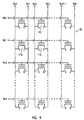
- Figure 4 shows a memory array 28 comprised of flash memory cells arranged in rows and columns.
- the individual cells are preferably similar to the small geometry cells 11 previously described in connection with Figures 3A and 3B.
- All of the cells 11 in a particular row have their respective control gates 20 connected to a common word line.
- cells 11A, 11B and the other cells in the same row have their control gates connected to word line WL1.
- all of the cells in a particular column have their drain regions 14 and source regions 16 connected to respective common bit lines.
- cells 11A, 11C and the other cells in the same column have their drain regions connected to common bit line BL3 and their source regions connected to common bit line BL2.
- Figure 5 shows a memory system which includes an array 28 of flash memory cells 11.
- the system is provided with a Column Decoder 30 which is connected to the bit line BLN of array 28 and a Row Decoder connected to the word lines WLN of the array.
- the system further includes a Control Circuit 34 which performs most of the functions relating to memory operations as will be described.
- the cells 11 are programmed to provide multistate capability.
- each cell 11 can have one of four potential states thereby enabling each cell to store two bits of data.
- Table 2 shows the four States “0", “1", “2” and “3” and the corresponding threshold voltage VTH of the cell.
- State "3” is in depletion mode, as indicated by the negative threshold voltage.
- STATE THRESHOLD VOLTAGE (volts) 0 +4.0 to +3.0 1 +2.5 to +1.5 2 +1.0 to 0 3 -0.5 to -1.5
- Table 3 below shows the various conditions necessary to carry out memory operations, including programming, erasing and reading.
- the voltages set forth in the table are applied by the Figure 5 Column Decoder 30 and the Row Decoder 32 under the direction of the Control Circuit 34.
- PROGRAM ERASE READ (ALT 1) READ (ALT 2) SELECTED WORD LINE V PP V EE V SE V SE DESELECTED WORD LINE V PP /2 V EE V N V N SELECTED BIT LINE - SOURCE F F V SS V SS SELECTED BIT LINE - DRAIN V SS V CC V R (S/A) V R (S/A) DESELECTED BIT LINE - SOURCE F F V R V SS DESELECTED BIT LINE - DRAIN V PP /2 V CC V R V SS
- the threshold voltage V TH corresponds to State "3" as set forth in Table 2.
- Erase algorithms for carrying out the erase function are well known in the art and need not be described in detail here.
- the erase operation includes two basic steps. First, all of the cells 11 are programmed to the maximum threshold state, State "0", where the threshold voltage ranges from +4.0 to +3 volts, as indicated by Table 2.
- the entire array 28 is erased, or a block of cells are erased. depending upon the particular implementation of the memory. This is accomplished by applying the erase voltages set forth in Table 3. The voltages are applied in unit pulses and the threshold voltages V TH of the cells 11 are tested to determine whether the target erased threshold voltage has been reached. In this case, the target erased threshold voltage corresponds to State "3" shown in Table 2. Ideally, the erased threshold voltage should be close to -1.5 volts or slightly higher (e.g., -1.4 volts).
- V PP voltage V PP is applied to the selected word line WL1.
- Voltage V PP is typically +18 to + 20 volts.
- the selected bit line connected to the source region of the target cell 11A, line BL2, is left floating (F) and the selected bit line connected to the drain region of the target cell, line BL3, is grounded (V SS ).
- the magnitude and/or duration of the programming pulse V PP is controlled so as to program the target cell to the desired state.
- the deselected word lines during a programming sequence lines WL0, WL2 and WLN, are connected to voltage about equal to V PP /2 which has a magnitude ranging from about -8 volts to about-11 volts.
- the deselected bit lines associated with the sources of the deselected cell, lines BL0 and BLN-1 are left floating (F) and the deselected bit lines associated with the drains of the deselected cell, lines BL1 and BLN, are connected to a voltage about equal to V PP /2.
- target cell 11A will be programmed by way of Fowler-Nordheim tunneling so as to add a negative charge to the floating gate of the cell.
- the conditions will further prevent the deselected cells from becoming programmed. Details regarding one exemplary programming sequence will be subsequently described in connection with Figure 6.
- Table 3 also shows the voltages to be applied to the array 28 during a cell 11 reading sequence.
- Two alternative reading conditions are set forth in the table.
- the first alternative set of conditions calls for a voltage V SE to be applied to the selected word line.
- voltage V SE is applied to word line WL1 having a magnitude of approximately +3 volts.
- the bit line associated with the source of cell 11A, line BL2 is connected to ground (V SS ) and the bit line associated with the drain, line BL3 is connected to a positive voltage V R which is typically generated by an voltage divider connected to the bit line which further functions as a load.
- Voltage V R is typically about +1 volt.
- the deselected word lines WL0, WL2 and WLN are connected to a negative voltage V N of typically -3 volts.
- voltage V R is connected to the deselected bit lines including lines BL0, BL1.
- the negative voltage V N functions to ensure that the deselected cells located in those rows other than the row in which the target cell is located will remain non-conductive even when the deselected cells have been programmed to the depletion mode.
- cell 11C will remain non-conductive because the control gate to source voltage will range from -3 to -6 volts, more than enough voltage to cause a cell having a worst case threshold voltage of -1.5 volts (State "3") to remain non-conductive.
- Those deselected cells located in the same row as the selected cell, such as cell 11B will remain disconnected from the sense amplifiers, while the selected cells in the selected columns are being read.
- Table 3 also shows a second alternative set of conditions for carrying out the read sequence. These conditions are similar to those of the first alternative set except the deselected bit lines associated with the source and drain are both grounded (V SS ), as opposed to being connected to voltage V R .
- Figure 6 is a diagram of part of the Column Decoder 30 and Control Circuit 34 ( Figure 5) for carrying out part of the programming and reading functions.
- the target cell 11N is connected to the voltages shown in Table 3 (either alternative).
- a decoder transistor 38 connected to the bit line BLN associated with the drain of the cell 11N being read is turned on by the Control Circuit 34.
- an active load is connected by the transistor 38 thereby causing voltage V R to be applied to the bit line BLN.
- Decoder transistor 38 functions to connect the selected bit line BLN to a bank of four sense amplifiers SA0 - SA3.
- Each of the sense amplifiers has an associated reference Ref0 - Ref3 which corresponds to the drain/source current I DS for the four possible programmed states of cell 1IN.
- Ref0 is implemented to provide a reference to one input to sense amplifier SA0 which is slightly less than the predetermined current for State 0.
- sense amplifier SA0 provides an active output only if cell 11N conducts a current I DS equal to or exceeds the current produced when the cell is in State "0".
- sense amplifiers SA1 - SA3 and associated respective references Ref1 - Ref3 are used for providing an active output only if the measured cell I DS current equals or exceeds that which would be produced if the cell had been programmed to States 1 - 3.
- sense amplifier SA0 is used in the programming sequence.
- Decoder Logic 40 will produce data outputs D0 and D1 of "0,0". If the cell 11N has been programmed to State 1, the cell current will exceed Refl but will be less than Ref2 and Ref3. Thus, only the output of sense amplifier SA1 will be active. In that event, Decoder Logic 40 will produce data outputs DO and D1 of "0,1".
- the Figure 6 circuitry is also used in for programming the cells to the desired state. All of the cells are originally in an erased state having a threshold voltage V TH which is somewhat higher than the minimum voltage -1.5 volts, such as -1.4 volts. Initially, it is preferable to read the target cell to determine the actual threshold voltage of the cell. This is done in the manner previously described by applying the appropriate voltages to selected and deselected word lines and bit lines as set forth in Table 3. The voltages set forth in Table 3 are applied to the selected or target cell 11N and to the selected cells based upon the address of the target cell supplied to the Control Circuit 34.
- the desired programmed state represented by two bits of data, is provided to a Comparator 42 ( Figure 6). All four sense amplifier SA0 - SA3 outputs are provided to the input of Comparator 42. Based upon the Data In applied to the Comparator 42, only the Sense Amplifier associated with the State which corresponds to Data In will be monitored and used for controlling Program Control 36.
- Comparator 42 will monitor only the output of Sense Amplifier SA2 during the programming sequence.
- the cell current is first read by applying the voltages set forth in Table 3 for reading.
- the selected cell is then slightly programmed by application of a voltage pulse of magnitude V PP (Table 3) for a short duration so as to slightly increase the negative charge present on the floating gate thereby increasing the threshold voltage.
- V PP magnitude V PP
- the magnitude or duration of the programming pulse, or combination of both, applied to the word line WLN of the target cell should be controlled so that the resulting increase in threshold voltage is sufficiently small so that the target threshold voltage is not overshot.
- the target cell is read.
- the threshold voltage should be increased sufficiently so that the output of sense amplifier SA0 is active. However, the remaining sense amplifiers, including SA2, will remain inactive, therefore, the programming sequence is not completed.
- Another programming pulse is applied and the cell is read a second time. This sequence will continue until the cell has been programmed to the proper level, that is, until the Comparator 42 determines that the output of SA2 has become active. At this point, Comparator 42 will cause Program Control 36 to refrain from applying additional programming pulses.
- the exemplary memory system disclosed herein utilizes four states per cell. It would be possible to use a greater number of states per cell. In addition, certain specific threshold voltages have been assigned to a particular cell state as set forth in Table 2. It would be possible to assign different threshold voltages to different states, including increasing the number of states so that some states have enhancement threshold voltages and some states have depletion threshold voltages.
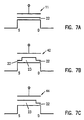
- Figures 3A/3B shows a cell 11 having a uniformly thin (typically 100 ⁇ ) gate oxide 22 which is represented schematically in Figure 7A.
- the conditions for programming, erasing and reading are depicted in Table 1.
- Table 1 For example, the cell structure described in a publication entitled "A 1.28 ⁇ m 2 Contactless Memory Cell Technology For a 3 Volt Only 64 Mb EEPROM", H. Kume et al. IEDM, 1992, pp 991-93 can also be adopted for use in this memory allowing multiple cell states.
- Figure 7B shows another type of conventional flash memory cell 42 which can be used in connection with the subject invention.
- This cell is described in U.S.P.No. 5,103,273 to Gill et al.
- Cell 42 has a thin (typically 100 ⁇ ) gate oxide region 22 adjacent the drain region and adjacent the source region. Intermediate the thin gate oxide regions 22 is a thicker oxide 23 (typically 200 ⁇ ).
- Cell 42 is programmed primarily on the drain side of the cell and is erased only on the source side.
- Figure 7C shows a still further conventional alternative flash memory cell 44 which has a thin (typically 100 ⁇ ) gate oxide region 22 located near the source region and a thicker oxide 23 (typically 200 ⁇ ) above the remainder of the channel region.
- This cell is described in U.S.P.No. 5,051,795 to Gill et al. Cell 44 is programmed and erased on the drain side of the cell only.
- memory array 28 is shown as a "Two Rail" configuration where the source and drain for each cell in a column have separate bit lines. This array configuration is typically used where cell of the type depicted in Figure 3A are used where the programming mechanism is Fowler-Nordheim tunneling.
- a "Single Rail" configuration is used where there is a single bit line connected to the drain regions of the cells located in a particular column. The source regions of all of the cells of the array are then connected to a common source line, as is well known.
Landscapes
- Engineering & Computer Science (AREA)
- Computer Hardware Design (AREA)
- Read Only Memory (AREA)
- Non-Volatile Memory (AREA)
Abstract
Claims (3)
- Système de mémoire non volatile comportant :une matrice de cellules de mémoire comprenant un corps en semiconducteur de conductivité de type P;un groupe de cellules de mémoire (11) disposé dans le corps en semiconducteur et agencé dans la matrice en de multiples rangées et colonnes, chacune desdites cellules comprenant :caractérisé en ce que les cellules de mémoire sont des cellules de mémoire à un seul transistor avec des grilles flottantes à largeur de canal complète, permettant ainsi un agencement compact, et le moyen de lecture applique une tension négative, par rapport à la tension de la région de source de la cellule sélectionnée, à la ligne de mots non sélectionnée de la matrice.(a) une région de drain d'une conductivité de type N;(b) une région de source de conductivité N espacée de la région de drain, de façon à former une région de canal (12a) dans le corps en semiconducteur entre les régions de source et de drain ;(c) une grille flottante (18) disposée au-dessus de la région de canal ou isolée de la région de canal ;(d) une grille de commande (20) disposée au-dessus de la grille flottante et isolée de la grille flottante ;
dans lequel les grilles de commande de toutes les cellules dans une rangée de matrice respective sont connectées à une ligne de mots respectifs commune (WL1) ; et un moyen de commande destiné à programmer, lire et effacer les cellules de la matrice, ledit moyen de commande comprenant :un moyen de programmation destiné à appliquer des tensions à l'une, sélectionnée, des cellules de la matrice pour programmer la cellule sélectionnée dans l'un quelconque d'au moins trois états de mémoire programmés distincts, au moins l'un desdits états de mémoire programmés aboutissant à ce que la cellule sélectionnée présente une tension de seuil positive, par rapport à la tension de source de la cellule sélectionnée, et au moins l'un des états de mémoire programmé aboutissant à ce que la cellule sélectionnée présente une tension de seuil négative, par rapport au potentiel de source de la cellule sélectionnée ; etun moyen de lecture destiné à appliquer des tensions à une cellule sélectionnée de la matrice afin que l'état programmé de la cellule sélectionnée puisse être déterminé, comprenant l'application d'une tension positive, par rapport à la tension de la région de source de la cellule sélectionnée, à la ligne de mots associée à la rangée dans laquelle la cellule sélectionnée est située, - Système de mémoire selon la revendication 1, dans lequel le moyen de programmation fonctionne de façon à programmer les cellules sélectionnées et à effacer par effet tunnel de Fowler-Nordheim.
- Système de mémoire selon la revendication 1, dans lequel il y a quatre états de mémoire programmables distincts.
Applications Claiming Priority (3)
| Application Number | Priority Date | Filing Date | Title |
|---|---|---|---|
| US08/387,171 US5550772A (en) | 1995-02-13 | 1995-02-13 | Memory array utilizing multi-state memory cells |
| US387171 | 1995-02-13 | ||
| PCT/US1996/002209 WO1996025742A1 (fr) | 1995-02-13 | 1996-02-13 | Matrice memoire mettant en oeuvre des cellules memoire a etats multiples |
Publications (2)
| Publication Number | Publication Date |
|---|---|
| EP0755559A1 EP0755559A1 (fr) | 1997-01-29 |
| EP0755559B1 true EP0755559B1 (fr) | 2001-08-29 |
Family
ID=23528782
Family Applications (1)
| Application Number | Title | Priority Date | Filing Date |
|---|---|---|---|
| EP96904650A Expired - Lifetime EP0755559B1 (fr) | 1995-02-13 | 1996-02-13 | Matrice memoire mettant en oeuvre des cellules memoire a etats multiples |
Country Status (4)
| Country | Link |
|---|---|
| US (1) | US5550772A (fr) |
| EP (1) | EP0755559B1 (fr) |
| DE (1) | DE69614787T2 (fr) |
| WO (1) | WO1996025742A1 (fr) |
Families Citing this family (28)
| Publication number | Priority date | Publication date | Assignee | Title |
|---|---|---|---|---|
| US5218569A (en) | 1991-02-08 | 1993-06-08 | Banks Gerald J | Electrically alterable non-volatile memory with n-bits per memory cell |
| US6002614A (en) * | 1991-02-08 | 1999-12-14 | Btg International Inc. | Memory apparatus including programmable non-volatile multi-bit memory cell, and apparatus and method for demarcating memory states of the cell |
| JP3584338B2 (ja) * | 1994-03-03 | 2004-11-04 | ローム・ユーエスエー・インク | 電気的に消去及びプログラム可能なデバイスの消去方法 |
| US5808937A (en) * | 1994-12-16 | 1998-09-15 | National Semiconductor Corporation | Self-convergent method for programming FLASH and EEPROM memory cells that moves the threshold voltage from an erased threshold voltage range to one of a plurality of programmed threshold voltage ranges |
| US6353554B1 (en) | 1995-02-27 | 2002-03-05 | Btg International Inc. | Memory apparatus including programmable non-volatile multi-bit memory cell, and apparatus and method for demarcating memory states of the cell |
| US6072719A (en) * | 1996-04-19 | 2000-06-06 | Kabushiki Kaisha Toshiba | Semiconductor memory device |
| JPH10302486A (ja) * | 1996-08-30 | 1998-11-13 | Sanyo Electric Co Ltd | 半導体記憶装置 |
| JP3204119B2 (ja) * | 1996-09-30 | 2001-09-04 | 日本電気株式会社 | 不揮発性半導体メモリおよびそのデータ書込方法 |
| US5862074A (en) * | 1996-10-04 | 1999-01-19 | Samsung Electronics Co., Ltd. | Integrated circuit memory devices having reconfigurable nonvolatile multi-bit memory cells therein and methods of operating same |
| US5835406A (en) * | 1996-10-24 | 1998-11-10 | Micron Quantum Devices, Inc. | Apparatus and method for selecting data bits read from a multistate memory |
| JP3090066B2 (ja) * | 1996-10-29 | 2000-09-18 | 日本電気株式会社 | 多値不揮発性半導体メモリ |
| US5959892A (en) * | 1997-08-26 | 1999-09-28 | Macronix International Co., Ltd. | Apparatus and method for programming virtual ground EPROM array cell without disturbing adjacent cells |
| US5973957A (en) * | 1997-09-16 | 1999-10-26 | Intel Corporation | Sense amplifier comprising a preamplifier and a differential input latch for flash memories |
| US5910914A (en) * | 1997-11-07 | 1999-06-08 | Silicon Storage Technology, Inc. | Sensing circuit for a floating gate memory device having multiple levels of storage in a cell |
| KR100266745B1 (ko) * | 1997-12-29 | 2000-09-15 | 윤종용 | 멀티-비트 데이터를 저장하기 위한 반도체 메모리 장치 |
| US6040993A (en) * | 1998-02-23 | 2000-03-21 | Macronix International Co., Ltd. | Method for programming an analog/multi-level flash EEPROM |
| KR100299872B1 (ko) * | 1998-06-29 | 2001-10-27 | 박종섭 | 다비트데이터기록제어회로 |
| TW446876B (en) * | 1998-08-27 | 2001-07-21 | Sanyo Electric Co | Non-volatile semiconductor memory |
| US6128221A (en) * | 1998-09-10 | 2000-10-03 | Taiwan Semiconductor Manufacturing Co., Ltd. | Circuit and programming method for the operation of flash memories to prevent programming disturbances |
| FR2786910B1 (fr) * | 1998-12-04 | 2002-11-29 | St Microelectronics Sa | Memoire a grille flottante multiniveau |
| US6215697B1 (en) * | 1999-01-14 | 2001-04-10 | Macronix International Co., Ltd. | Multi-level memory cell device and method for self-converged programming |
| US7057935B2 (en) * | 2001-08-30 | 2006-06-06 | Micron Technology, Inc. | Erase verify for non-volatile memory |
| US6483734B1 (en) | 2001-11-26 | 2002-11-19 | Hewlett Packard Company | Memory device having memory cells capable of four states |
| US7177199B2 (en) * | 2003-10-20 | 2007-02-13 | Sandisk Corporation | Behavior based programming of non-volatile memory |
| US7450433B2 (en) * | 2004-12-29 | 2008-11-11 | Sandisk Corporation | Word line compensation in non-volatile memory erase operations |
| TWI302751B (en) * | 2006-06-14 | 2008-11-01 | Macronix Int Co Ltd | Nonvolatile memory cell, mixed nonvolatile memory array and method for operation thereof |
| US8525561B2 (en) | 2011-10-18 | 2013-09-03 | International Business Machines Corporation | Phase lock loop having high frequency CMOS programmable divider with large divide ratio |
| US8791728B2 (en) | 2011-10-18 | 2014-07-29 | International Business Machines Corporation | High frequency CMOS programmable divider with large divide ratio |
Family Cites Families (14)
| Publication number | Priority date | Publication date | Assignee | Title |
|---|---|---|---|---|
| US4181980A (en) * | 1978-05-15 | 1980-01-01 | Electronic Arrays, Inc. | Acquisition and storage of analog signals |
| DE2828855C2 (de) * | 1978-06-30 | 1982-11-18 | Siemens AG, 1000 Berlin und 8000 München | Wortweise elektrisch umprogrammierbarer, nichtflüchtiger Speicher sowie Verfahren zum Löschen bzw. Einschreiben eines bzw. in einen solchen Speicher(s) |
| IT1224062B (it) * | 1979-09-28 | 1990-09-26 | Ates Componenti Elettron | Metodo di programmazione per una memoria a semiconduttore non volatile elettricamente alterabile |
| US4698787A (en) * | 1984-11-21 | 1987-10-06 | Exel Microelectronics, Inc. | Single transistor electrically programmable memory device and method |
| JPH07120720B2 (ja) * | 1987-12-17 | 1995-12-20 | 三菱電機株式会社 | 不揮発性半導体記憶装置 |
| US5043940A (en) * | 1988-06-08 | 1991-08-27 | Eliyahou Harari | Flash EEPROM memory systems having multistate storage cells |
| FR2650109B1 (fr) * | 1989-07-20 | 1993-04-02 | Gemplus Card Int | Circuit integre mos a tension de seuil ajustable |
| US5204835A (en) * | 1990-06-13 | 1993-04-20 | Waferscale Integration Inc. | Eprom virtual ground array |
| US5187683A (en) * | 1990-08-31 | 1993-02-16 | Texas Instruments Incorporated | Method for programming EEPROM memory arrays |
| US5218569A (en) * | 1991-02-08 | 1993-06-08 | Banks Gerald J | Electrically alterable non-volatile memory with n-bits per memory cell |
| US5346842A (en) * | 1992-02-04 | 1994-09-13 | National Semiconductor Corporation | Method of making alternate metal/source virtual ground flash EPROM cell array |
| US5418743A (en) * | 1992-12-07 | 1995-05-23 | Nippon Steel Corporation | Method of writing into non-volatile semiconductor memory |
| US5477499A (en) * | 1993-10-13 | 1995-12-19 | Advanced Micro Devices, Inc. | Memory architecture for a three volt flash EEPROM |
| US5416738A (en) * | 1994-05-27 | 1995-05-16 | Alliance Semiconductor Corporation | Single transistor flash EPROM cell and method of operation |
-
1995
- 1995-02-13 US US08/387,171 patent/US5550772A/en not_active Expired - Lifetime
-
1996
- 1996-02-13 WO PCT/US1996/002209 patent/WO1996025742A1/fr not_active Ceased
- 1996-02-13 EP EP96904650A patent/EP0755559B1/fr not_active Expired - Lifetime
- 1996-02-13 DE DE69614787T patent/DE69614787T2/de not_active Expired - Fee Related
Also Published As
| Publication number | Publication date |
|---|---|
| WO1996025742A1 (fr) | 1996-08-22 |
| DE69614787T2 (de) | 2002-05-23 |
| EP0755559A1 (fr) | 1997-01-29 |
| DE69614787D1 (de) | 2001-10-04 |
| US5550772A (en) | 1996-08-27 |
Similar Documents
| Publication | Publication Date | Title |
|---|---|---|
| EP0755559B1 (fr) | Matrice memoire mettant en oeuvre des cellules memoire a etats multiples | |
| US5646886A (en) | Flash memory having segmented array for improved operation | |
| US7692969B2 (en) | Nonvolatile semiconductor memory device including plural memory cells and a dummy cell coupled to an end of a memory cell | |
| US6804151B2 (en) | Nonvolatile semiconductor memory device of virtual-ground memory array with reliable data reading | |
| US5666307A (en) | PMOS flash memory cell capable of multi-level threshold voltage storage | |
| US5457652A (en) | Low voltage EEPROM | |
| KR100297602B1 (ko) | 비휘발성메모리장치의프로그램방법 | |
| US6975537B2 (en) | Source side self boosting technique for non-volatile memory | |
| US6449188B1 (en) | Low column leakage nor flash array-double cell implementation | |
| US6031765A (en) | Reversed split-gate cell array | |
| US5357463A (en) | Method for reverse programming of a flash EEPROM | |
| US5973962A (en) | Method of programming non-volatile memory devices having a NAND type cell array | |
| US5790456A (en) | Multiple bits-per-cell flash EEPROM memory cells with wide program and erase Vt window | |
| US5576992A (en) | Extended-life method for soft-programming floating-gate memory cells | |
| KR19990029125A (ko) | 메모리 셀 및 이를 구비한 불휘발성 반도체 기억 장치 | |
| US6363014B1 (en) | Low column leakage NOR flash array-single cell implementation | |
| US6222771B1 (en) | Unified program method and circuitry in flash EEPROM | |
| KR20040015161A (ko) | 높은 칼럼 누설이 존재하는 nor 플래쉬 메모리 셀들을위한 정확한 검증 장치 및 방법 | |
| US5633823A (en) | Method of narrowing flash memory device threshold voltage distribution | |
| US5408430A (en) | Method for operating nonvolatile memory semiconductor devices memories | |
| US7031194B2 (en) | Nonvolatile semiconductor memory and method for controlling the same | |
| KR0161413B1 (ko) | 비휘발성 메모리 장치 | |
| US7301820B2 (en) | Non-volatile memory dynamic operations | |
| EP3828892B1 (fr) | Memoire flash compatible logique avec un schema de programmation a commande par largeur d'impulsion | |
| JP2815077B2 (ja) | 半導体不揮発性記憶装置の使用方法 |
Legal Events
| Date | Code | Title | Description |
|---|---|---|---|
| PUAI | Public reference made under article 153(3) epc to a published international application that has entered the european phase |
Free format text: ORIGINAL CODE: 0009012 |
|
| AK | Designated contracting states |
Kind code of ref document: A1 Designated state(s): DE FR GB |
|
| 17P | Request for examination filed |
Effective date: 19970208 |
|
| 17Q | First examination report despatched |
Effective date: 19990818 |
|
| GRAG | Despatch of communication of intention to grant |
Free format text: ORIGINAL CODE: EPIDOS AGRA |
|
| GRAG | Despatch of communication of intention to grant |
Free format text: ORIGINAL CODE: EPIDOS AGRA |
|
| GRAH | Despatch of communication of intention to grant a patent |
Free format text: ORIGINAL CODE: EPIDOS IGRA |
|
| GRAH | Despatch of communication of intention to grant a patent |
Free format text: ORIGINAL CODE: EPIDOS IGRA |
|
| GRAA | (expected) grant |
Free format text: ORIGINAL CODE: 0009210 |
|
| AK | Designated contracting states |
Kind code of ref document: B1 Designated state(s): DE FR GB |
|
| PG25 | Lapsed in a contracting state [announced via postgrant information from national office to epo] |
Ref country code: FR Free format text: LAPSE BECAUSE OF FAILURE TO SUBMIT A TRANSLATION OF THE DESCRIPTION OR TO PAY THE FEE WITHIN THE PRESCRIBED TIME-LIMIT Effective date: 20010829 |
|
| REF | Corresponds to: |
Ref document number: 69614787 Country of ref document: DE Date of ref document: 20011004 |
|
| REG | Reference to a national code |
Ref country code: GB Ref legal event code: IF02 |
|
| EN | Fr: translation not filed | ||
| PG25 | Lapsed in a contracting state [announced via postgrant information from national office to epo] |
Ref country code: GB Free format text: LAPSE BECAUSE OF NON-PAYMENT OF DUE FEES Effective date: 20020213 |
|
| PLBE | No opposition filed within time limit |
Free format text: ORIGINAL CODE: 0009261 |
|
| STAA | Information on the status of an ep patent application or granted ep patent |
Free format text: STATUS: NO OPPOSITION FILED WITHIN TIME LIMIT |
|
| 26N | No opposition filed | ||
| PG25 | Lapsed in a contracting state [announced via postgrant information from national office to epo] |
Ref country code: DE Free format text: LAPSE BECAUSE OF NON-PAYMENT OF DUE FEES Effective date: 20020903 |
|
| GBPC | Gb: european patent ceased through non-payment of renewal fee |
Effective date: 20020213 |