EP0755948A2 - Verfahren zur Herstellung von stabilisierten Olefinpolymeren - Google Patents
Verfahren zur Herstellung von stabilisierten Olefinpolymeren Download PDFInfo
- Publication number
- EP0755948A2 EP0755948A2 EP96810404A EP96810404A EP0755948A2 EP 0755948 A2 EP0755948 A2 EP 0755948A2 EP 96810404 A EP96810404 A EP 96810404A EP 96810404 A EP96810404 A EP 96810404A EP 0755948 A2 EP0755948 A2 EP 0755948A2
- Authority
- EP
- European Patent Office
- Prior art keywords
- alkyl
- carbon atoms
- phenyl
- formula
- hydrogen
- Prior art date
- Legal status (The legal status is an assumption and is not a legal conclusion. Google has not performed a legal analysis and makes no representation as to the accuracy of the status listed.)
- Granted
Links
- 0 CCC(C1)[C@]1C=*N* Chemical compound CCC(C1)[C@]1C=*N* 0.000 description 7
- NRTAYKKQDWDJOS-UHFFFAOYSA-N Cc(cc1N)cc(O)c1OC Chemical compound Cc(cc1N)cc(O)c1OC NRTAYKKQDWDJOS-UHFFFAOYSA-N 0.000 description 1
Classifications
-
- C—CHEMISTRY; METALLURGY
- C08—ORGANIC MACROMOLECULAR COMPOUNDS; THEIR PREPARATION OR CHEMICAL WORKING-UP; COMPOSITIONS BASED THEREON
- C08F—MACROMOLECULAR COMPOUNDS OBTAINED BY REACTIONS ONLY INVOLVING CARBON-TO-CARBON UNSATURATED BONDS
- C08F10/00—Homopolymers and copolymers of unsaturated aliphatic hydrocarbons having only one carbon-to-carbon double bond
-
- C—CHEMISTRY; METALLURGY
- C08—ORGANIC MACROMOLECULAR COMPOUNDS; THEIR PREPARATION OR CHEMICAL WORKING-UP; COMPOSITIONS BASED THEREON
- C08K—Use of inorganic or non-macromolecular organic substances as compounding ingredients
- C08K5/00—Use of organic ingredients
- C08K5/49—Phosphorus-containing compounds
- C08K5/51—Phosphorus bound to oxygen
- C08K5/52—Phosphorus bound to oxygen only
- C08K5/527—Cyclic esters
-
- C—CHEMISTRY; METALLURGY
- C08—ORGANIC MACROMOLECULAR COMPOUNDS; THEIR PREPARATION OR CHEMICAL WORKING-UP; COMPOSITIONS BASED THEREON
- C08F—MACROMOLECULAR COMPOUNDS OBTAINED BY REACTIONS ONLY INVOLVING CARBON-TO-CARBON UNSATURATED BONDS
- C08F4/00—Polymerisation catalysts
- C08F4/42—Metals; Metal hydrides; Metallo-organic compounds; Use thereof as catalyst precursors
- C08F4/44—Metals; Metal hydrides; Metallo-organic compounds; Use thereof as catalyst precursors selected from light metals, zinc, cadmium, mercury, copper, silver, gold, boron, gallium, indium, thallium, rare earths or actinides
- C08F4/60—Metals; Metal hydrides; Metallo-organic compounds; Use thereof as catalyst precursors selected from light metals, zinc, cadmium, mercury, copper, silver, gold, boron, gallium, indium, thallium, rare earths or actinides together with refractory metals, iron group metals, platinum group metals, manganese, rhenium technetium or compounds thereof
- C08F4/619—Component covered by group C08F4/60 containing a transition metal-carbon bond
- C08F4/61912—Component covered by group C08F4/60 containing a transition metal-carbon bond in combination with an organoaluminium compound
-
- C—CHEMISTRY; METALLURGY
- C08—ORGANIC MACROMOLECULAR COMPOUNDS; THEIR PREPARATION OR CHEMICAL WORKING-UP; COMPOSITIONS BASED THEREON
- C08F—MACROMOLECULAR COMPOUNDS OBTAINED BY REACTIONS ONLY INVOLVING CARBON-TO-CARBON UNSATURATED BONDS
- C08F4/00—Polymerisation catalysts
- C08F4/42—Metals; Metal hydrides; Metallo-organic compounds; Use thereof as catalyst precursors
- C08F4/44—Metals; Metal hydrides; Metallo-organic compounds; Use thereof as catalyst precursors selected from light metals, zinc, cadmium, mercury, copper, silver, gold, boron, gallium, indium, thallium, rare earths or actinides
- C08F4/60—Metals; Metal hydrides; Metallo-organic compounds; Use thereof as catalyst precursors selected from light metals, zinc, cadmium, mercury, copper, silver, gold, boron, gallium, indium, thallium, rare earths or actinides together with refractory metals, iron group metals, platinum group metals, manganese, rhenium technetium or compounds thereof
- C08F4/619—Component covered by group C08F4/60 containing a transition metal-carbon bond
- C08F4/61916—Component covered by group C08F4/60 containing a transition metal-carbon bond supported on a carrier, e.g. silica, MgCl2, polymer
-
- C—CHEMISTRY; METALLURGY
- C08—ORGANIC MACROMOLECULAR COMPOUNDS; THEIR PREPARATION OR CHEMICAL WORKING-UP; COMPOSITIONS BASED THEREON
- C08F—MACROMOLECULAR COMPOUNDS OBTAINED BY REACTIONS ONLY INVOLVING CARBON-TO-CARBON UNSATURATED BONDS
- C08F4/00—Polymerisation catalysts
- C08F4/42—Metals; Metal hydrides; Metallo-organic compounds; Use thereof as catalyst precursors
- C08F4/44—Metals; Metal hydrides; Metallo-organic compounds; Use thereof as catalyst precursors selected from light metals, zinc, cadmium, mercury, copper, silver, gold, boron, gallium, indium, thallium, rare earths or actinides
- C08F4/60—Metals; Metal hydrides; Metallo-organic compounds; Use thereof as catalyst precursors selected from light metals, zinc, cadmium, mercury, copper, silver, gold, boron, gallium, indium, thallium, rare earths or actinides together with refractory metals, iron group metals, platinum group metals, manganese, rhenium technetium or compounds thereof
- C08F4/619—Component covered by group C08F4/60 containing a transition metal-carbon bond
- C08F4/6192—Component covered by group C08F4/60 containing a transition metal-carbon bond containing at least one cyclopentadienyl ring, condensed or not, e.g. an indenyl or a fluorenyl ring
- C08F4/61922—Component covered by group C08F4/60 containing a transition metal-carbon bond containing at least one cyclopentadienyl ring, condensed or not, e.g. an indenyl or a fluorenyl ring containing at least two cyclopentadienyl rings, fused or not
-
- C—CHEMISTRY; METALLURGY
- C08—ORGANIC MACROMOLECULAR COMPOUNDS; THEIR PREPARATION OR CHEMICAL WORKING-UP; COMPOSITIONS BASED THEREON
- C08F—MACROMOLECULAR COMPOUNDS OBTAINED BY REACTIONS ONLY INVOLVING CARBON-TO-CARBON UNSATURATED BONDS
- C08F4/00—Polymerisation catalysts
- C08F4/42—Metals; Metal hydrides; Metallo-organic compounds; Use thereof as catalyst precursors
- C08F4/44—Metals; Metal hydrides; Metallo-organic compounds; Use thereof as catalyst precursors selected from light metals, zinc, cadmium, mercury, copper, silver, gold, boron, gallium, indium, thallium, rare earths or actinides
- C08F4/60—Metals; Metal hydrides; Metallo-organic compounds; Use thereof as catalyst precursors selected from light metals, zinc, cadmium, mercury, copper, silver, gold, boron, gallium, indium, thallium, rare earths or actinides together with refractory metals, iron group metals, platinum group metals, manganese, rhenium technetium or compounds thereof
- C08F4/62—Refractory metals or compounds thereof
- C08F4/64—Titanium, zirconium, hafnium or compounds thereof
- C08F4/659—Component covered by group C08F4/64 containing a transition metal-carbon bond
- C08F4/6592—Component covered by group C08F4/64 containing a transition metal-carbon bond containing at least one cyclopentadienyl ring, condensed or not, e.g. an indenyl or a fluorenyl ring
- C08F4/65922—Component covered by group C08F4/64 containing a transition metal-carbon bond containing at least one cyclopentadienyl ring, condensed or not, e.g. an indenyl or a fluorenyl ring containing at least two cyclopentadienyl rings, fused or not
Definitions
- the present invention relates to a process for the preparation of stabilized olefin polymers, a stabilizer and optionally further additives being added during the polymerization.
- the invention also relates to the olefin polymers thus produced.
- organometallic complex catalysts e.g. Ziegler-Natta catalysts
- organometallic complex catalysts usually leads to a finely powdered polymer which is granulated in an extruder before it is shaped.
- substances such as e.g. Stabilizers, corrosion-preventing compounds, color improvers, antistatic agents or other processing aids added.
- the polymer is subjected to thermal and frictional loads, which can lead to damage.
- Granulation is also not always possible, e.g. for high molecular weight polymers. Therefore, there is a desire to add additives that are important for processing or long-term stability during the polymerization. This also includes additives which reduce the corrosive effect of the polymer on metal surfaces, generally attributed to catalyst residues or degradation products of the catalyst system.
- catalyst systems based on a transition metallocene complex allow the production of polymers with a particularly narrow molecular weight distribution or of (co) polymers which have a special structure. These systems can either be present as homogeneous catalyst systems or as supported catalysts. Further details of the possible catalyst systems can be found, for example, in EP-A-0 563 917, EP-A-0 578 838, US-4,659,685, US-5,240,894 and WO 92/00333. To achieve the technically required stability to heat and light in particular, these polymers are also usually granulated with the addition of various additives.
- the invention therefore relates to a process for the preparation of olefin polymers by polymerization on a transition metallocene complex, characterized in that the polymerization with the addition of at least one phosphorus (III) compound, a sterically hindered amine, a sterically hindered phenol or an acid scavenger, alone or in Combination with one another, is carried out, in the case of a phosphorus (III) compound and / or a sterically hindered amine, the addition only takes place when at least 0.1% of the total conversion has already taken place.
- the olefins polymerizable by this process are ethylene and ⁇ -olefins, e.g. Propylene, 1-butene, 4-methylpentene-1, 5-methylhexene-1, i-hexene, i-octene, cycloolefins (cyclopentadiene (monomer or dimer) or norbornene) or styrene, and mixtures of olefins such as e.g. Ethylene propylene or propylene in a mixture with smaller amounts of higher ⁇ -olefins. C2 or C3 olefins, their copolymers and styrene are preferred.
- ethylene and ⁇ -olefins e.g. Propylene, 1-butene, 4-methylpentene-1, 5-methylhexene-1, i-hexene, i-octene, cycloolefins (cyclopentad
- high molecular weight PE is a PE with a high molecular weight i.e. MW greater than 250000 or melt index less than 1g / 10min at 5kg and 190 ° C to understand.
- the transition metallocene catalysts are, for example, compounds of the formula ⁇ [(R 1 ) (R 2 M) a ] an + an / q [LQ m ] q- ⁇ (A), in which a 1 or 2 and n and q independently of one another are each an integer from 1 to 4, M represents the cation of a monovalent to tetravalent metal from Group IVb to VIIIb, VIII or Ib of the Periodic Table of the Elements, m is an integer corresponding to the valence of L + q and Q is a halogen atom, L is a divalent to seven-valent metal or non-metal, R 1 is a ⁇ -arene and R2 is a ⁇ -arene or the anion of a ⁇ -arene.
- Suitable ⁇ -arenes R1 and R 2 are, in particular, aromatic groups with 6 to 24 carbon atoms or heteroaromatic groups with 3 to 30 carbon atoms, these groups optionally having identical or different monovalent radicals such as halogen atoms, preferably chlorine or bromine atoms, or C 1 -C 8 alkyl, C 1 -C 8 alkoxy, cyano, C 1 -C 8 alkylthio, C 2 -C 6 monocarboxylic acid alkyl ester, phenyl, C 2 -C 5 alkanoyl or benzoyl groups can be mono- or polysubstituted.
- halogen atoms preferably chlorine or bromine atoms
- ⁇ -arene groups can represent mononuclear, condensed multinuclear or uncondensed multinuclear systems, in the latter systems the nuclei can be linked directly or via bridge members such as -S- or -O-.
- R2 as an anion of a ⁇ -arene can be an anion of a ⁇ -arene of the type mentioned above, for example the indenyl anion and in particular the cyclopentadienyl anion, these anions also optionally being replaced by identical or different monovalent radicals such as C 1 -C 8 -alkyl-, C2 -C6-monocarboxylic acid alkyl ester, cyano, C2-C5-alkanoyl or benzoyl groups can be mono- or polysubstituted.
- alkyl, alkoxy, alkylthio, monocarboxylic acid alkyl esters and alkanoyl substituents can be straight-chain or branched.
- Typical alkyl, alkoxy, alkylthio, monocarboxylic acid alkyl ester or alkanoyl substituents are methyl, ethyl, n-propyl, isopropyl, n-butyl, sec-butyl, tert-butyl, n-pentyl, n-hexyl and n Octyl, methoxy, ethoxy, n-propoxy, isopropoxy, n-butoxy, n-hexyloxy and n-octyloxy, methylthio, ethylthio, n-propylthio, isopropylthio, n-butylthio, n-pentylthio and n-hexylthio, methyl
- Alkyl, alkoxy, alkylthio and monocarboxylic acid alkyl ester groups with 1 to 4 and in particular 1 or 2 carbon atoms in the alkyl parts and alkanoyl groups with 2 or 3 carbon atoms are preferred.
- Preferred substituted ⁇ -arenes or anions of substituted ⁇ -arenes are those which have one or two of the above-mentioned substituents, in particular chlorine or bromine atoms, methyl, ethyl, methoxy, ethoxy, cyano, methyl or ethyl carboxylate groups and acetyl groups.
- ⁇ -arenes may be present as R 1 and R 2 .
- Systems containing S, N and / or O atoms are suitable as heteroaromatic p-arenes.
- Heteroaromatic ⁇ -arenes containing S and / or O atoms are preferred.
- Suitable ⁇ -arenes are benzene, toluene, xylene, ethylbenzene, methoxybenzene, ethoxybenzene, dimethoxybenzene, p-chlorotoluene, chlorobenzene, bromobenzene, dichlorobenzene, acetylbenzene, trimethylbenzene, trimethoxybenzene, naphthronine, 1,2-naphthalene, 1,2-naphthalene , 4-tetrahydronaphthalene, methylnaphthalenes, methoxynaphthalenes, aethoxynaphthalenes, chloronaphthalenes, bromnaphthalenes, biphenyl, indene, biphenylene, fluorene, phenanthrene, anthracene, 9,10-dihydroanthracene, triphenylene, pyrene, naphththenophen
- R 2 is preferably the anion of a ⁇ -arene
- M is the same metal atom.
- anions of substituted ⁇ -arenes are the anions of methyl, ethyl, n-propyl and n-butylcyclopentadiene, the anions of dimethylcyclopentadiene, cyclopentadienecarboxylic acid methyl and ethyl esters and acetylcyclopentadiene, propionylcyclopentadiene, cyancyclopentadiene and benzoyl cycladentienes.
- Preferred anions are the anion of the unsubstituted indene and in particular the unsubstituted cyclopentadiene.
- a is 1, and R 2 is benzene, toluene, xylene, methoxybenzene, chlorobenzene, p-chlorotoluene, naphthalene, methylnaphthalene, chloronaphthalene, methoxynaphthalene, biphenyl, indene, pyrene or diphenylene sulfide, and R2 represents the anion of cyclopentadiene , Acetylcyclopentadiens or Indens or for benzene, toluene, xylene, trimethylbenzene, naphthalene or methylnaphthalene.
- M is, for example, Ti 2+ , Ti 3+ , Ti 4+ , Zr + , ZR 2+ , ZR 3+ , Zr 4+ , Hf + , Hf 2+ , Hf 3+ , Hf 4+ , Nb + , Nb 2 + , Nb 3+ , Cr + , Mo + , Mo 2+ , W + , W 2+ , Mn + , Mn 2+ , Re + , Fe 2+ , Co 2+ , Co 3+ , Ni 2+ or Cu 2+ .
- M is preferably a titanium, zirconium or hafnium cation, in particular titanium or zirconium cation, and particularly preferably Ti 4+ or ZR 4+ .
- suitable metals or non-metals L are Sb, Fe, Sn, Bi, Al, Ga, In, Ti, Zr, Sc, V, Cr, Mn and Cu; Lanthanides such as Ce, Pr and Nd or actinides such as Th, Pa, U or Np.
- Suitable non-metals are in particular B, P and As. L is preferably P, As, B or Sb, with P being particularly preferred.
- Complex anions [LQm] q- are, for example, BF 4 - , PF 6 - , AsF 6 - , SbF 6 - , FeCl 4 - , SnCl 6 - , Sbcl 6 - , and Bicl 6 - .
- the particularly preferred complex anions are SbF 6 - , BF 4 - , AsF 6 - and PF 6 - .
- the compounds of the formula (A) can be prepared by methods known per se, for example by reacting a compound of the formula ⁇ [(R 1 ) (R 2 M) a ] an + an / q [X] q- ⁇ (B) with a salt of an anion [Lq m ] q- , where a, m, n, q, R 1 , R 2 , M and L have the meanings given under the formula (A) and [X] q- is one of [LQ m ] q- represents a different anion.
- Both the compounds of the formula (B) and the compounds of the formula ⁇ [(R ' 1 ) (R 2 M) a ] ⁇ (C), in which a and M have the meanings indicated above and R' 1 is a ⁇ -arene or the anion of a ⁇ -arene and R 2 represent an anion of a ⁇ -arene, can be reacted by reacting the same or different ⁇ -arenes in the presence of a Lewis acid with a salt of a metal from group IVb to VIIIb, VIII or Ib of the Establish the periodic table.
- the compounds of the formulas (A), (B) and (C) are also suitable for carrying out a ligand exchange by reacting these compounds in the presence of a Lewis acid with a ⁇ different from R 1 and / or R 2 or R ' 1 -Aren implements.
- n is preferably 2 and particularly preferably 1.
- Compounds of formula (A) in which L is a metal can be obtained by reacting the same or different ⁇ -arenes in the presence of a Lewis acid with a suitable salt of a metal from Group IVb to VIIIb, VIII or Ib of the Periodic Table of the Elements, for example a titanium, zirconium, chrome, manganese and in particular an iron salt.
- a suitable salt of a metal from Group IVb to VIIIb, VIII or Ib of the Periodic Table of the Elements for example a titanium, zirconium, chrome, manganese and in particular an iron salt.
- compounds of the formula (A) can also be prepared in a conventional manner Convert anion exchange into complexes of formula (A) with a different anion [LQ m ] q- .
- uncharged ⁇ complexes of the formula (C), for example ferrocene or bis- ( ⁇ 5 -indenyl) iron (II), are used as starting materials, and these are converted into a complex of the formula (B) by ligand exchange, which is then reacted with a salt of an anion [LQ m ] q- .
- the complex of formula (B) obtained as an intermediate is usually not isolated.
- Suitable salts of anions [LQ m ] q- are, for example, alkali, alkaline earth or ammonium salts. It is preferred to use alkali salts, and particularly preferably sodium and potassium salts.
- Suitable Lewis acids for the reactions described above are, for example, AlCl 3 , AlBr 3 , BF 3 , SnCl 4 and TiCl 4 , with AlCl 3 being preferred. It may be advantageous to carry out the ligand exchange reactions with the addition of a reducing agent, for example aluminum or magnesium, to the reaction mixture, or to subsequently add a reducing agent, for example Na2SO3 or ascorbic acid, to the reaction mixture. Aluminum is preferred as the reducing agent.
- the ligand exchange reactions are conveniently carried out in an inert organic solvent. Suitable solvents are, for example, aliphatic or cycloaliphatic hydrocarbons such as octane, nonane, decane and cyclohexane. If desired, an excess of ⁇ -arene can also be used as the solvent.
- reaction of the compounds of formula (B) with a salt of an anion [LQ m ] -q and the anion exchange conversion of compounds of formula (A) are expediently carried out in an aqueous or aqueous-alcoholic medium, for example in mixtures of water and methanol or Ethanol.
- the salts of the anions [LQm] -q are used in at least stoichiometric amounts, but preferably in excess.
- a metallocene catalyst consisting of two main components (A-1 and A-2) can be used in the process according to the invention.
- Component A-1 is a metallocene compound.
- any metallocene can be used regardless of its structure and composition.
- the metallocenes can be both bridged and unbridged, have the same or different ligands.
- These are compounds of the metals of groups IVb, Vb or Vlb of the periodic table, for example compounds of titanium, zirconium, hafnium, vanadium, niobium, tantalum, chromium, molybdenum, tungsten, preferably zirconium, hafnium and titanium, in particular zirconium.
- EP-A-0 336 127 EP-A-0 336 128, EP-A-0 387 690, EP-A-0 387 691, EP-A-0 302 424 , EP-A-0 129 368, EP-A-0 320 762, EP-A-0 284 707, EP-A-0 316 155, EP-A-0 351 392, US 5,017,714, J. Organomet. Chem., 342 (1988) 21.
- Metalloid means, for example, the elements silicon, germanium, tin and lead.
- metalloc corresponds to the following structure: where M is Ti or Zr and the further substituents are as indicated above.
- the indenyl or tetrahydroindenyl ligands in formula (I) are preferably in 2-, 2,4-, 4,7-, 2,6-, 2,4,6-, 2,5,6-, 2,4, 5,6- and 2,4,5,6,7-position, in particular in the 2,4,6-position, substituted.
- the substitution is preferably carried out by a C 1 -C 4 alkyl group such as methyl, ethyl or isopropyl.
- the 2-position is preferably substituted by methyl.
- the metallocenes of the formula (I) are particularly suitable for the production of high molecular weight polyolefins with high stereoregularity.
- metallocenes which can be used according to the invention: Biscyclopentadienylzirconiumdichloride Biscyclopentadienylzirkoniumdimethyl, Biscyclopentadienylzirkoniumdiphenyl, Biscyclopentadienylzirkoniumdibenzyl, Biscyclopentadienylzirkoniumbistrimethylsilyl, bis (methylcyclopentadienyl) zirconium dichloride, bis (1, 2-dimethylcyclopentadienyl) zirconium dichloride, bis (1,3-dimethylcyclopentadienyl) zirconium dichloride, bis (1,2,4-trimethylcyclopentadienyl) zirconium dichloride, bis ( 1,2,3-trimethylcyclopentadienyl) zirconium dichloride, bis (pentamethylcyclopentadienyl) zirconium dichloride
- Chiral metallocenes are preferably used as a racemate in the preparation of the catalyst.
- the pure R or S shape can also be used. With these pure stereoisomeric forms, optically active polymer can be produced.
- the meso form of the metallocenes should be separated, since the polymerization-active center (the metal atom) in these compounds is no longer chiral due to mirror symmetry at the central metal and therefore cannot produce a highly tactical polymer. Will not be the meso shape separated, atactic polymer is formed in addition to isotactic or syndiotactic polymers. For certain applications - soft moldings for example - or for the production of polyethylene types, this can be quite desirable.
- the stereoisomers are separated by methods known from the literature.
- aluminoxanes A compound of the formula (III) is preferably used as the aluminoxane for the linear type and / or the formula (IV) used for the cyclic type, where in the formulas (III) and (IV) the radicals R may be the same or different and denote a C 1 -C 6 alkyl group, a C 6 -C 18 aryl group, benzyl or hydrogen, and p is an integer from 2 to 50, preferably 10 to 35.
- R is preferably the same and is methyl, isobutyl, n-butyl, phenyl or benzyl, particularly preferably methyl.
- radicals R are different, they are preferably methyl and hydrogen, methyl and isobutyl or methyl and n-butyl, with hydrogen or isobutyl or n-butyl preferably containing 0.01-40% (number of the radicals R).
- the aluminoxane can be prepared in various ways by known methods.
- One of the methods is, for example, that an aluminum hydrocarbon compound and / or a hydridoaliminium hydrocarbon compound with water (gaseous, solid, liquid or bound - for example as water of crystallization) in an inert solvent (such as toluene).
- an inert solvent such as toluene
- two different aluminum trialkyls AIR 3 + AlR ' 3
- AIR 3 + AlR ' 3 two different aluminum trialkyls
- Ion exchange compounds are compounds which contain a cation which irreversibly reacts with a ligand of component A-1 and a non-coordinating anion which is sterically demanding, labile and chemically inert.
- a cation which irreversibly reacts with a ligand of component A-1 and a non-coordinating anion which is sterically demanding, labile and chemically inert.
- an ion pair is formed from the cation of A-2 and a ligand of A-1.
- Examples of cations of component A-2 are: Bronsted acids, such as ammonium ions, or reducible Lewis acids, such as Ag + or ferrocene ions.
- the aluminoxane which can be used as component A-2 can also be formed in the preparation of a supported catalyst from trimethylaluminium.
- the metallocenes can also be used as heterogeneous catalysts.
- the catalyst is applied to an inorganic or organic support by processes known to those skilled in the literature.
- the inorganic carrier materials are preferably silica gels; Further details can be found, for example, in US Pat. No. 5,240,894.
- organic carrier materials are microporous polymeric carriers which are commercially available (for example the ®Accurel types from AKZO such as ®Accurel-PE, ®Accurel-PP, ®Accurel-PA-6 or ®Accurel-PA-12 with a volume of approx. 75% by volume).
- the Pore size of the ®Accurel materials is 0.5-5 ⁇ m (PP), 1.0-5 ⁇ m (HDPE), 0.5-3 ⁇ m (PA-6 and PA-12).
- the microporous, polymeric carrier is previously dried, e.g. by treatment with aluminum alkyl solutions, then washed and rendered inert under protective gas.
- aluminoxane in a suitable solvent, e.g. Pentane, hexane, heptane, toluene or dichloromethane, with at least one metallocene by intensive mixing, e.g. by stirring, reacting.
- the reaction temperature is preferably -20 to + 120 ° C, especially 15-40 ° C.
- the molar ratio of aluminum to transition metal M of the metallocene is preferably between 10: 1 and 10,000: 1, in particular between 100: 1 and 2000: 1.
- the reaction time is generally between 5 and 120 minutes, preferably 10-30 minutes.
- the aluminum concentration is preferably greater than 0.01 mol / liter, in particular greater than 0.5 mol / liter.
- the reaction is carried out under inert conditions.
- aluminoxane instead of the aluminoxane, a mixture of an aluminoxane with another aluminum alkyl compound such as e.g. Trimethyl, triethyl or triisobutyl aluminum can be used for the described reaction with the metallocene.
- another aluminum alkyl compound such as e.g. Trimethyl, triethyl or triisobutyl aluminum
- the solution thus prepared is reacted in a suitable manner with the microporous, polymeric carrier.
- the carrier is added at least in an amount whose total pore volume can absorb the solution from the pre-reaction.
- This reaction is preferably carried out at temperatures between -20 and + 20 ° C, in particular 15-40 ° C, by intensive mixing e.g. by stirring or treatment with ultrasound. Good homogenization should take place.
- the exchange of the inert gas of the pore volume can e.g. can be accelerated by brief evacuation.
- the supported catalyst can also be prepared in a one-pot reaction, ie all 3 starting components are mixed simultaneously in a suitable one Solvent / suspending agent reacted with each other.
- the amount of polymeric carrier should preferably be such that it can hold the entire volume of liquid.
- the catalyst may be in an inert suspending agent such as e.g. Heptane, n-decane, hexane or diesel oil suspended or also dry, possibly after removing the remaining solvent by a drying step e.g. in a vacuum, metered into the polymerization system.
- an inert suspending agent such as e.g. Heptane, n-decane, hexane or diesel oil suspended or also dry, possibly after removing the remaining solvent by a drying step e.g. in a vacuum, metered into the polymerization system.
- the catalyst can advantageously be prepolymerized in the gas phase, in the liquid monomer or in suspension, it being possible to dispense with the addition of a further organoaluminum compound.
- the polymerization with these catalysts can be carried out in the liquid or gaseous phase by known methods.
- the liquid phase can e.g. be an aliphatic hydrocarbon or the liquid monomer itself.
- the metallocene catalysts can also be used in a mixture with other types of catalysts, such as, for example, Ziegler or Phillips catalysts.
- the catalyst is destroyed, e.g. by adding water (steam), moist nitrogen, carbon dioxide or alcohol.
- the phosphorus (III) compound, the sterically hindered amine, the sterically hindered phenol or the acid scavenger, alone or in combination with one another is added to the polymerization medium at the beginning, during or towards the end before the termination of the polymerization.
- the compounds mentioned and, if appropriate, the further additives are preferably added at the beginning.
- the compounds mentioned and, if appropriate, the further additives are likewise added continuously; either separately or together with the monomers.
- Particularly suitable phosphites of the formula (V) are those in which R ' 1 , R' 2 and R ' 3 independently of one another are alkyl with 1 to 18 carbon atoms, phenyl, with 1 to 3 alkyl radicals with a total of 1 to 18 carbon atoms, substituted phenyl or 2, 2,6,6-tetramethylpiperid-4-yl, in particular are independently substituted phenyl with 1 to 3 alkyl radicals with a total of 1 to 12 carbon atoms.
- Particularly suitable phosphites of the formula (VI) are those in which A ', preferably when n' is 2, alkylene having 2 to 12 carbon atoms, -CH 2 CH 2 -O-CH 2 CH 2 -, -CH 2 CH 2 -O -CH 2 CH 2 O-CH 2 CH 2 - or -CH 2 CH 2 -NR ' 4 -CH 2 CH 2 -, or A' when n 'is 3, N is (CH 2 CH 2 -) 3 where R ' 4 is alkyl of 1 to 4 carbon atoms.
- Particularly suitable phosphites of formula (VII) are those wherein p is 1, D 'is methyl, R' 9 is methyl and R '10 is from 1 to 3 alkyl radicals having in total 1 to 18 carbon atoms substituted phenyl.
- Particularly suitable phosphites of the formula (IX) are those in which Q, if y is 1, is a radical of the formula -OR '16 , -NR' 17 R '18 or fluorine, or Q, if y is 2, a radical of Formula is -O-CH 2 CH 2 -NR ' 4 -CH 2 CH 2 -O-, or W, when y is 3, is a radical of formula N (CH 2 CH 2 O-) 3 , where R' is 16 Is alkyl of 1 to 18 carbon atoms, R '17 and R' 18 are independently alkyl of 1 to 18 carbon atoms, cyclohexyl or benzyl, or R '17 and R' 18 together form a piperidyl, morpholinyl or hexamethyleneimino radical, and R ' 4 has the meaning given, Z is a direct bond, -CH 2 - or -CH (CH 3 ) -, and the two substituents R '
- R '15 is hydrogen and Z is -CH 2 - or -CH (CH 3 ) -, or Q, when y is 2, a radical of the formula -O-CH 2 CH 2- NCH 3 -CH 2 CH 2 - O- is.
- Preferred phosphites are, for example, trilauryl phosphite, trioctadecyl phosphite, distearylpentaerythritol diphosphite or tristearyl sorbitol triphosphite.
- Aromatic phosphites are also preferred. Aromatic phosphites are those which have an aromatic hydrocarbon radical, such as a phenyl radical. Examples include triphenyl phosphite, diphenylalkyl phosphites, phenyl dialkyl phosphites and in particular tris (nonylphenyl) phosphite, tris (2,4-di-tert.butylphenyl) phosphite, bis (2,4-di-tert.butylphenyl) pentaerythritol diphosphite and 2,2'-ethylidene bis (4,6-di-tert-butylphenyl) fluorophosphite.
- aromatic hydrocarbon radical such as a phenyl radical. Examples include triphenyl phosphite, diphenylalkyl phosphites, phenyl dialkyl phosphites and in particular tris (n
- phosphites which contain the PO-Ar group as a structural element, where Ar is an aromatic radical, preferably an alkyl-substituted phenyl radical.
- Suitable alkyl substituents are C 1 -C 18 alkyl radicals or also C 5 -C 7 cycloalkyl radicals; preferred are C 1 -C 4 alkyl radicals and especially tert-butyl (in the formulas as reproduced).
- Tris (2,4-di-tert-butylphenyl) phosphite Tris (2,4-di-tert.butylphenyl) phosphite or is very particularly preferably used
- Phosphonites in the sense of this invention can be represented, for example, by the formula X are shown, wherein R * one to five C 1 -C 8 alkyl radicals; X 'a rest or and X represents a direct bond, - (O) S (O) -, -C (O) -, -S-, -O- or arylene.
- Arylene means, for example, naphthylene, m-phenylene or p-phenylene.
- R * means one to three tert-butyl or methyl groups.
- X ' represents a 4,4'-biphenyldiyl radical.
- Tetrakis (2,4-di-tert-butylphenyl) -4,4'-biphenylene diphosphonite (Irgafos PEPQ) is very particularly preferred.
- the amount of phosphorus (III) compound added depends on the desired degree of stabilization. In general, 0.01 to 0.5% by weight, in particular 0.05 to 0.5% by weight, based on the polymer, is added.
- the sterically hindered phenols which can be used according to the invention are likewise known stabilizers against the thermal-oxidative aging of plastics, in particular polyolefins.
- the sterically hindered phenols contain at least one group of the formula Xl wherein R 'is hydrogen, methyl or tert-butyl; and R "means optionally substituted alkyl or optionally substituted alkylthioalkyl.
- Examples of preferred sterically hindered phenols are: 2,6-di-tert-butyl-4-methylphenol, 2-tert-butyl-4,6-dimethylphenol, 2,6-di-tert-butyl-4-ethylphenol, 2,6-di-tert-butyl- 4-n-butylphenol, 2,6-di-tert-butyl-4-i-butylphenol, 2,6-di-cyclopentyl-4-methylphenol, 2- ( ⁇ -methylcyclohexyl) -4,6-dimethylphenol, 2, 6-di-octadecyl-4-methylphenol, 2,4,6-tri-cyclohexylphenol, 2,6-di-tert-butyl-4-methoxymethylphenol, 2,6-di-nonyl-4-methylphenol, 2,6- Di-tert-butyl-4-methoxyphenol, 2,5-di-tert-butyl-hydroquinone, 2,5-
- Particularly preferred sterically hindered phenols are compounds which have at least one group of the formula contain wherein R 'is methyl or tert-butyl; and R "means optionally substituted alkyl or optionally substituted alkylthioalkyl.
- sterically hindered phenols are the esters of ⁇ - (3,5-di-tert-butyl-4-hydroxyphenyl) propionic acid and ⁇ - (5-tert-butyl-4-hydroxy-3-methylphenyl) propionic acid with mono- or polyhydric alcohols, such as with methanol, octanol, octadecanol, 1,6-hexanediol, neopentyl glycol, thiodiethylene glycol, diethylene glycol, triethylene glycol, pentaerythritol, tris (hydroxyethyl) isocyanurate, N, N'-bis (hydroxyethyl) oxalic acid diamide, and the amides thereof Acids such as N, N'-bis (3,5-di-tert-butyl-4-hydroxyphenylpropionyl) hexamethylene diamine, N, N'-bis (3,5-di-tert-
- a mixture of different sterically hindered phenols can also be used in the context of the present invention.
- the amount of the sterically hindered phenol added depends on the desired degree of stabilization. In general, 0.01 to 0.5% by weight, in particular 0.05 to 0.5% by weight, based on the polymer, is added.
- the sterically hindered amines preferably piperidine compounds, which can be used according to the invention are primarily known as light stabilizers. These compounds contain a group of formula XIII one or more times. They can be compounds of relatively low molecular weight ( ⁇ 700) or of higher molecular weight. In the latter case, it can also be oligomeric or polymeric products. Tetramethylpiperidine compounds with a molecular weight greater than 700 are preferred which do not contain any ester groups.
- n is a number from 1 to 4, preferably 1 or 2
- R 1 is hydrogen, oxyl, C 1 -C 12 alkyl, C 3 -C 8 alkenyl, C 3 -C 8 alkynyl, C 7 -C 12 Aralkyl, C 1 -C 8 alkanoyl, C 3 -C 5 alkenoyl, glycidyl or a group -CH 2 CH (OH) -Z, where Z is hydrogen, methyl or phenyl, where R 1 is preferably C 1 -C 4 alkyl, allyl, benzyl, acetyl or acryloyl and R 2 , when n is 1, hydrogen, optionally interrupted by one or more oxygen atoms C 1 -C 18 alkyl, cyanoethyl, benzyl, glycidyl, a monovalent radical aliphatic, cycloaliphatic, araliphatic, unsaturated
- any substituents are C 1 -C 12 -alkyl, they are, for example, methyl, ethyl, n-propyl, n-butyl, sec-butyl, tert-butyl, n-hexyl, n-octyl, 2-ethyl-hexyl , n-nonyl, n-decyl, n-undecyl or n-dodecyl.
- R 2 can represent, for example, the groups mentioned above and, for example, n-tridecyl, n-tetradecyl, n-hexadecyl or n-octadecyl.
- R 1 is C 3 -C 8 alkenyl, it can be, for example, 1-propenyl, allyl, methallyl, 2-butenyl, 2-pentenyl, 2-hexenyl, 2-octenyl, 4-tert-butyl-2 -butenyl act.
- R 1 as C 3 -C 8 alkynyl is preferably propargyl.
- R 1 is in particular phenethyl and especially benzyl.
- R 1 is as C 1 -C 8 alkanoyl, for example formyl, propionyl, butyryl, octanoyl, but preferably acetyl and as C3-C5-alkenoyl, in particular acryloyl.
- R 2 is a monovalent radical of a carboxylic acid, it is, for example, acetic, caproic, stearic, acrylic, methacrylic, benzoic or ⁇ - (3,5-di-tert-butyl-4-hydroxyphenyl) -propionic acid residue.
- R 2 is a divalent radical of a dicarboxylic acid, it represents, for example, malonic, succinic, glutaric, adipic, suberic, sebacic, maleic, phthalic, dibutylmalonic, dibenzylmalonic, butyl (3.5 -di-tert-butyl-4-hydroxybenzyl) -malonic acid or bicycloheptenedicarboxylic acid residue.
- R 2 represents a trivalent carboxylic acid residue, it means, for example, a trimellitic acid or a nitrilotriacetic acid residue.
- R 2 represents a tetravalent residue of a tetracarboxylic acid, it means, for example, the tetravalent residue of butane-1,2,3,4-tetracarboxylic acid or of pyromellitic acid.
- R 2 is a divalent radical of a dicarbamic acid, it represents, for example, a hexamethylene dicarbamic acid or a 2,4-tolylene dicarbamic acid radical.
- n is the number 1 or 2
- R 1 has the meaning given under a
- R 3 is hydrogen, C 1 -C 12 alkyl, C 2 -C 5 hydroxyalkyl, C 5 -C 7 cycloalkyl, C 7 - C 8 aralkyl, C 2 -C 18 alkanoyl, Is C 3 -C 5 alkenoyl or benzoyl and R 4 when n is 1 is hydrogen, C 1 -C 18 alkyl, C 3 -C 8 alkenyl, C 5 -C 7 cydoalkyl, with a hydroxy, cyano -, Alkoxycarbonyl- or carbamide group substituted C 1 -C 4 alkyl, glycidyl, a group of the formula -CH 2 -CH (OH) -Z or the formula -CONH-Z, wherein Z is hydrogen, methyl or phenyl; when n is 2, C 2 -C
- any substituents are C 5 -C 7 cycloalkyl, they are in particular cyclohexyl.
- R 3 is in particular phenylethyl or especially benzyl.
- R 3 is in particular 2-hydroxyethyl or 2-hydroxypropyl.
- R 3 is as C 2 -C 18 alkanoyl, for example propionyl, butyryl, octanoyl, dodecanoyl, hexadecanoyl, octadecanoyl, but preferably acetyl and as C 3 -C 5 alkenoyl in particular acryloyl.
- R 4 is C 2 -C 8 alkenyl, then it is, for example, allyl, methallyl, 2-butenyl, 2-pentenyl, 2-hexenyl or 2-octenyl.
- R 4 as a C 1 -C 4 -alkyl substituted by a hydroxyl, cyano, alkoxycarbonyl or carbamide group may, for example, 2-hydroxyethyl, 2-hydroxypropyl, 2-cyanoethyl, methoxycarbonylmethyl, 2-ethoxycarbonylethyl, 2-aminocarbonylpropyl or 2- ( Be dimethylaminocarbonyl) ethyl.
- Any C 2 -C 12 alkylene substituents are, for example, ethylene, propylene, 2,2-dimethylpropylene, tetramethylene, hexamethylene, octamethylene, decamethylene or dodecamethylene.
- Any C 6 -C 15 arylene substituents are, for example, o-, m- or p-phenylene, 1,4-naphthylene or 4,4'-diphenylene.
- D is in particular cyclohexylene.
- n is the number 1 or 2
- R 1 has the meaning given under a) and R 5 , when n is 1, C 2 -C 8 alkylene or C 2 -C 8 hydroxyalkylene or C 4 -C 22 acyloxyalkylene , and when n is 2, the group is (-CH 2 ) 2 C (CH 2 -) 2 .
- R 5 is C 2 -C 8 -alkylene or -hydroxyalkylene, it is, for example, ethylene, 1-methyl-ethylene, propylene, 2-ethyl-propylene or 2-ethyl-2-hydroxymethylpropylene.
- R 5 means, for example, 2-ethyl-2-acetoxymethylpropylene.
- R 1 has the meaning given under a)
- R 6 is hydrogen, C 1 -C 12 alkyl, allyl, benzyl, glycidyl or C 2 -C 6 alkoxyalkyl and R 7 if n is 1, hydrogen, C 1 -C 12 alkyl, C 3 -C 5 alkenyl, C 7 -C 9 aralkyl, C 5 -C 7 cycloalkyl, C 2 -C 4 hydroxyalkyl, C 2 -C 6 -alkoxyalkyl, C 6 -C 10 -aryl, glycidyl or a group of the formula - (CH 2 ) p -COO-Q or of the formula - (CH 2 ) p -O-CO-Q, where p is 1 or 2 and QC 1 -C 4 alkyl or phenyl,
- any substituents are C 1 -C 12 -alkyl, they are, for example, methyl, ethyl, n-propyl, n-butyl, sec-butyl, tert-butyl, n-hexyl, n-octyl, 2-ethyl-hexyl , n-nonyl, n-decyl, n-undecyl or n-dodecyl.
- C 1 -C 18 alkyl can represent, for example, the groups mentioned above and, for example, n-tridecyl, n-tetradecyl, n-hexadecyl or n-octadecyl.
- any substituents are C 2 -C 6 -alkoxyalkyl, they are, for example, methoxymethyl, ethoxymethyl, propoxymethyl, tert-butoxymethyl, ethoxyethyl, ethoxypropyl, n-butoxyethyl, tert-butoxyethyl, isopropoxyethyl or propoxypropyl.
- R 7 is C 3 -C 5 alkenyl, it means, for example, 1-propenyl, allyl, methallyl, 2-butenyl or 2-pentenyl.
- R 7 , T 1 and T 2 are especially phenethyl or especially benzyl. If T 1 and T 2 form a cycloalkane ring together with the C atom, this can be, for example, a cyclopentane, cyclohexane, cyclooctane or cyclododecane ring.
- R 7 is C 2 -C 4 -hydroxyalkyl, it is, for example, 2-hydroxyethyl, 2-hydroxypropyl, 2-hydroxybutyl or 4-hydroxybutyl.
- R 7 , T 1 and T 2 are in particular phenyl, ⁇ - or ⁇ -naphthyl, which are optionally substituted by halogen or C 1 -C 4 alkyl.
- R 7 is C 2 -C 12 alkylene, it is, for example, ethylene, propylene, 2,2-dimethylpropylene, tetramethylene, hexamethylene, octamethylene, decamethylene or dodecamethylene.
- R 7 is in particular 2-butenylene, 2-pentenylene or 3-hexenylene.
- R 7 is C 6 -C 12 arylene, it is, for example, o-, m- or p-phenylene, 1,4-naphthylene or 4,4'-diphenylene.
- Z ' is C 2 -C 12 -alkanoyl, it is, for example, propionyl, butyryl, octanoyl, dodecanoyl, but preferably acetyl.
- any substituents are C 1 -C 12 -alkyl, they are, for example, methyl, ethyl, n-propyl, n-butyl, sec-butyl, tert-butyl, n-hexyl, n-octyl, 2-ethylhexyl, n -Nonyl, n-decyl, n-undecyl or n-dodecyl.
- substituents are C 1 -C 4 -hydroxyalkyl, they are, for example, 2-hydroxyethyl, 2-hydroxypropyl, 3-hydroxypropyl, 2-hydroxybutyl or 4-hydroxybutyl.
- AC 2 -C 6 alkylene is, it represents, for example, ethylene, propylene, 2,2-dimethylpropylene, tetramethylene or hexamethylene.
- R 11 and R 12 together represent C 4 -C 5 alkylene or oxaalkylene, this means, for example, tetramethylene, pentamethylene or 3-oxapentamethylene.
- oligomers or polymeric compounds the recurring structural unit of which contains one or more 2,2,6,6-tetraalkylpiperidine residues of the formula (XIII), in particular Polyesters, polyethers, polyamides, polyamines, polyurethanes, polyureas, polyaminotriazines, poly (meth) acrylates, polysiloxanes, poly (meth) acrylamides and their copolymers which contain such radicals.
- classes e) and f) are particularly suitable, in particular those tetraalkylpiperidine compounds which contain s-triazine groups.
- Compounds 74, 76, 84, 87, 92, 95 and 96 are also particularly suitable.
- a mixture of different sterically hindered amines can also be used in the context of the present invention.
- the amount of addition of the sterically hindered amine depends on the desired degree of stabilization. In general, 0.01 to 0.5% by weight, in particular 0.05 to 0.5% by weight, based on the polymer, is added.
- the acid scavenger which can be used according to the invention is preferably a compound from the series of hydrotalcites, zeolites, metal carbonates or metal oxides which does not release water under the reaction conditions.
- the compounds that can be used from the series of hydrotalcites, zeolites, metal soaps, metal carbonates or metal oxides are both the naturally occurring minerals and also synthetically produced compounds.
- a n- is preferably OH - , Cl - , Br - , l - , ClO 4 - , HCO 3 - , CH 3 COO - , C 6 H 5 COO - , CO 3 2- , SO 4 2- , [OC ( O) C (O) O] 2- , (CHOHCOO) 2 2- , (CHOH) 4 CH 2 OHCOO - . C 2 H 4 (COO) 2 2- , (CH 2 COO) 2 2- , CH 3 CHOHCOO - , SiO 3 2- , SiO 4 4- , Fe (CN) 6 3- , Fe (CN) 6 4- or HPO 4 2- .
- hydrotalcites which can suitably be used in the process as described above are compounds of the general formula M 2+ x • Al 2 (OH) 2x + 6nz • (A n- ) 2 • mH 2 O (XVIIIa) where in the present formula XVlla M 2+ represents at least one metal from the series of Mg and Zn and Mg 2+ is preferred,
- a n - an anion for example from the series of CO 3 2- , [OC (O) C (O ) O] 2- , OH - and S 2- , where n is the valence of the anion, m is a positive number, preferably from 0.5 to 15, and x and z are positive numbers, where x is preferably 2 to 6 and z is less than 2.
- hydrotalcites are e.g. DHT-4A and DHT-4C from Kyowa, Japan.
- Hydrotalcites of the formulas are very particularly preferred Al 2 O 3 • 6MgO • CO 2 • 12H 2 O, Mg 4.5 • Al 2 • (OH) 13 • CO 3 • 3.5H 2 O, 4MgO • Al 2 O 3 • CO 2 • 9H 2 O, 4MgO • Al 2 O 3 • CO 2 • 6H 2 O, ZnO • 3MgO • Al 2 O 3 • CO 2 • 8-9H 2 O or ZnO • 3MgO • Al 2 O 3 • CO 2 • 5-6H 2 O.
- the preferred known zeolites which can be used in the above process have an average effective pore diameter of 3-5 ⁇ , those of the NaA type which have an average effective pore diameter of 4 ⁇ , which is why they are also referred to as zeolites 4A.
- zeolites examples include the compounds: Na 12 [(AlO 2 ) 12 (SiO 2 ) 12 ] • 12H 2 O Ca 4.5 Na 3 [(AlO 2 ) 12 (SiO 2 ) 12 ] • 30H 2 O K 9 Na 3 [(AlO 2 ) 12 (SiO 2 ) 12 ] • 27H 2 O
- Preferred and commercially available zeolites are molecular sieves.
- metal soaps can also be used.
- Metal soaps of divalent metals with fatty acids which have 8-28 carbon atoms are preferred.
- Metal soaps of calcium are particularly preferred, calcium stearate and calcium pelargonate being very particularly preferred.
- metal carbonates or metal oxides can also be used.
- Oxides of divalent metals are preferred.
- Oxides of the metals of the second main or subgroup are particularly preferred, zinc and magnesium oxide being very particularly preferred.
- the compounds which can be used according to the invention are dried at 50-800 ° C., preferably 80-400 ° C., to remove the water which is not bound or only weakly bound, provided that they have not already dried sufficiently and have been stored with the exclusion of moisture. Drying can take place in a vacuum or under inert gas.
- the surfaces of the substances can be treated with surface-active reagents such as carboxylic acids or linear alcohols with 8 or more carbon atoms, e.g. Stearic acid.
- the compounds from the series of hydrotalcites, zeolites, metal soaps, metal carbonates, metal oxides or similar synthetically produced compounds which do not release water under the reaction conditions are generally added in an amount of 0.005 to 0.2% by weight, based on the polymer, preferably in an amount of 0.01 to 0.1% by weight.
- a particularly preferred embodiment of the invention is to carry out the above process with the addition of a phosphorus (III) compound and a sterically hindered phenol. Furthermore, a method is preferred in which a phosphorus (III) compound, a sterically hindered phenol and a sterically hindered amine are added. The use of a combination of phosphorus (III) compound, sterically hindered phenol, sterically hindered amine and acid scavenger is very particularly preferred. It applies to the combinations mentioned that the preferred combinations consist of the respectively preferred individual compounds.
- the compounds are usually added after at least 0.1%, preferably at least 1% and particularly preferably at least 10%, of the conversion, based on the overall yield of polymer, has been reached.
- the present invention also relates to the use of at least one of the phosphorus (III) compounds defined above, sterically hindered phenols, sterically hindered amines and / or acid scavengers in a process for the polymerization of Olefins on a transition metallocene catalyst to stabilize the polymers thus obtainable.
- the preferences of the method apply analogously.
- the present invention further relates to the polyolefins obtainable by the process defined in more detail above.
- the preferences of the method apply analogously.
- the polyolefins produced according to the invention are particularly suitable for the production of semi-finished products (plates, tubes and profiles of any cross-section) and for the following production processes: rotary molding, centrifugal casting, injection molding, thermoplastic foam molding, injection molding, pressing, sintering, calendering, extruding, hollow blow molding, extrusion stretch blow molding, casting of hollow bodies , Spinning, foaming, powder coating, coating and cable sheathing.
- a 3-liter steel autoclave is evacuated at 110 ° C for half an hour, then rinsed with ethylene at the same temperature.
- the autoclave is cooled to 20 ° C. 5 ml of a solution of 10 mg of zirconocene dichloride in 100 ml of toluene are mixed for 10 minutes with 2.5 ml of a 30% solution of methylaluminoxane in toluene and diluted in 1000 ml of heptane and added to the autoclave.
- the autoclave is closed and 100 ml of hydrogen and ethylene are added up to a total pressure of 10 bar.
- the temperature is raised to 60-65 ° C.
- the autoclave is depressurized, flooded with argon and 100 mg of P-1 (or AO-1 or H-1) added in solid form.
- the autoclave is closed and 100 ml of hydrogen and ethylene are added up to a total pressure of 10 bar.
- the autoclave is depressurized and the catalyst is deactivated by adding 10 ml of isopropanol.
- the heptane is distilled off in vacuo on a rotary evaporator and the polymer is dried overnight in vacuo at 60.degree. 10% of the total conversion is achieved during the prepolymerization; adding the additives does not reduce sales.
- the polymers containing additives show good processing, long-term and light stability.
- a 3-1 steel autoclave is evacuated at 110 ° C for half an hour, then rinsed with ethylene at the same temperature.
- the autoclave is cooled to 20 ° C.
- 5 ml of a solution of 10 mg of zirconocene dichloride in 100 ml of toluene are mixed for 10 minutes with 2.5 ml of a 30% strength solution of methylaluminoxane in toluene and diluted together with 100 mg of AO-1 in 1000 ml of heptane are added to the autoclave.
- the autoclave is closed and 100 ml of hydrogen and ethylene are added up to a total pressure of 10 bar.
- the temperature is raised to 60-65 ° C.
- the autoclave is depressurized and the catalyst is deactivated by adding 10 ml of isopropanol.
- the heptane is distilled off in vacuo on a rotary evaporator and the polymer is dried overnight in vacuo at 60.degree.
- the addition of the additive does not reduce the conversion, in comparison to a polymerization without an additive.
- Aerosil® 812 (Degussa; DE) are dried at 800 ° C. under argon. 10 g of it are suspended in 200 ml of toluene, which contains 100 mg of water. After 10 minutes with stirring, 3 ml of trimethyl aluminum are added and the mixture is stirred for one hour. The solvent is filtered off and the residue is washed three times with 50 ml of heptane. The residue is suspended in 100 ml of heptane. A solution of 10 mg of zirconocene dichloride in 100 ml of toluene is added to the suspension, stirred for one hour, filtered and washed three times with 50 ml of heptane.
- a 3-liter steel autoclave is evacuated at 110 ° C for half an hour, then rinsed with ethylene at the same temperature.
- the autoclave is cooled to 20 ° C.
- 21 mg of the catalyst prepared by the above process are diluted in 1500 ml of heptane and added to the autoclave.
- the autoclave is closed and 100 ml of hydrogen and ethylene are added up to a total pressure of 10 bar.
- the temperature is raised to 60-65 ° C.
- the ethylene supply is interrupted, the autoclave is depressurized, flooded with argon and 100 mg of P-1 (or AO-1 or H-1) are added in solid form.
- the autoclave is closed and 100 ml of hydrogen and ethylene are added up to a total pressure of 10 bar. After 2 hours of polymerization, the autoclave is depressurized and the catalyst is deactivated by adding 10 ml of isopropanol. The heptane is distilled off in vacuo on a rotary evaporator and the polymer is dried overnight in vacuo at 60.degree. 30% of the total conversion is achieved during the prepolymerization; adding the additives does not reduce sales. The polymers containing the additives show good processing, long-term and light stability.
- the solvent is drawn off in vacuo, while the flask is heated to 70 ° C. and flooded with a gentle stream of argon.
- the catalyst is then dried at 70 ° C. in a vacuum of 0.1 mbar for about 12 hours (removal of the toluene from the pores).
- the catalyst is then suspended in 100 ml of hexane, cooled to 0 ° C. outside the drybox, and flowed through with stirring at a low ethylene flow of approx. 20 ml / min.
- the flask is placed in the drybox, the solvent is filtered off, the catalyst is briefly washed with hexane and dried in vacuo. 16 g of catalyst are obtained.
Landscapes
- Chemical & Material Sciences (AREA)
- Health & Medical Sciences (AREA)
- Chemical Kinetics & Catalysis (AREA)
- Medicinal Chemistry (AREA)
- Polymers & Plastics (AREA)
- Organic Chemistry (AREA)
- Transition And Organic Metals Composition Catalysts For Addition Polymerization (AREA)
- Addition Polymer Or Copolymer, Post-Treatments, Or Chemical Modifications (AREA)
- Electrical Control Of Ignition Timing (AREA)
- Valve Device For Special Equipments (AREA)
Abstract
Description
- Die vorliegende Erfindung betrifft ein Verfahren zur Herstellung von stabilisierten Olefinpolymeren, wobei während der Polymerisation ein Stabilisator und gegebenenfalls weitere Zusätze zugegeben werden. Die Erfindung betrifft auch die so hergestellten Olefinpolymere.
- Die Polymerisation von Olefinen mittels metallorganischen Komplexkatalysatoren (z.B. Ziegler-Natta- Katalysatoren) führt üblicherweise zu einem feinpulverigen Polymerisat, das vor der formgebenden Verarbeitung in einem Extruder granuliert wird. Bei dieser Granulierung werden dem Polymeren Substanzen wie z.B. Stabilisatoren, korrosionsverhindernde Verbindungen, Farbverbesserer, Antistatika oder sonstige Verarbeitungshilfsmittel zugesetzt. Bei dieser Granulierung wird das Polymer thermisch und frikativ belastet, was zu Schädigungen führen kann. Auch ist eine Granulierung nicht immer möglich, wie z.B. bei hochmolekularen Polymeren. Daher besteht der Wunsch, Zusätze, die für die Verarbeitung bzw. die Langzeitstabilität wichtig sind, bereits bei der Polymerisation zuzugeben. Hierzu gehören auch Zusätze, die die korrosive Wirkung des Polymerisats gegenüber Metalloberflächen, im allgemeinen auf Katalysatorreste oder Abbauprodukte des Katalysatorsystems zurückgeführt, vermindern.
- Es ist bekannt (EP-A-192 987 oder US-5,244,948), dass bei einer Polymerisation an Trägerkatalysatoren sterisch gehinderte Aminstabilisatoren vom Typ der Polyalkylpiperidine eingesetzt werden können.
- Es wurde weiterhin für Polymerisationen an Trägerkatalysatoren vorgeschlagen (EP-A-0 254 348), organische Phosphite oder Phosphonite während der Polymerisation als Antioxidantien zuzusetzen.
- Neuerdings erlauben Katalysatorsysteme basierend auf einem Übergangsmetallocenkomplex die Herstellung von Polymeren mit einer besonders engen Molekulargewichtsverteilung oder von (Co)Polymeren, welche einen besonderen Aufbau aufweisen. Diese Systeme können entweder als homogene Katalysatorsysteme vorliegen oder als Trägerkatalysatoren. Nähere Ausführungen zu den möglichen Katalysatorsystemen finden sich beispielsweise in EP-A-0 563 917, EP-A-0 578 838, US-4,659,685, US-5,240,894 und WO 92/00333. Zur Erzielung der technisch erforderlichen Stabilität gegenüber vor allem Wärme und Licht werden auch diese Polymere üblicherweise unter Zusatz diverser Additive granuliert.
- Überraschend wurde nunmehr gefunden, dass der Zusatz von Phosphor(lll)-verbindungen, sterisch gehinderten Aminen, sterisch gehinderten Phenolen oder Säurefängern, allein oder in Kombination untereinander, die Polymerisation von Olefinen mit Hilfe von Metallocenkomplexen von Übergangsmetallen nicht beeinträchtigt. Die so erhaltenen Polymere weisen eine ausgezeichneten Stabilität auf.
- Die Erfindung betrifft daher ein Verfahren zur Herstellung von Olefinpolymeren durch Polymerisation an einem Übergangsmetallocenkomplex, dadurch gekennzeichnet, dass man die Polymerisation unter Zusatz mindestens einer Phosphor(lll)-verbindung, eines sterisch gehinderten Amins, eines sterisch gehinderten Phenols oder eines Säurefängers, allein oder in Kombination untereinander, durchführt, wobei im Falle einer Phosphor(III)-verbindung und/oder eines sterisch gehinderten Amins die Zugabe erst erfolgt, wenn mindestens 0,1 % des Gesamtumsatzes bereits erfolgt sind.
- Die mit diesem Verfahren polymerisierbaren Olefine sind Ethylen und α-Olefine, wie z.B. Propylen, 1-Buten, 4-Methylpenten-1, 5-Methylhexen-1, i-Hexen, i-Octen, Cycloolefine (Cyclopentadien (monomer oder dimer) oder Norbornen) oder Styrol, sowie Gemische von Olefinen wie z.B. Ethylen-Propylen oder Propylen im Gemisch mit kleineren Mengen höherer α-Olefine. Bevorzugt sind hierbei C2- oder C3-Olefine, deren Copolymere und Styrol. Von besonderem Interesse ist das Verfahren für die Polymerisation und Copolymerisation von Ethylen und Propylen, insbesondere für hochmolekulares PE oder PP. Unter hochmolekularem PE ist ein PE mit einem hohen Molekulargewicht d.h. MW grösser 250000 beziehungsweise Schmelzindex kleiner 1g/10min bei 5kg und 190°C zu verstehen.
- Bei den Übergangsmetallocenkatalysatoren handelt es sich beispielsweise um Verbindungen der Formel { [(R1)(R2M)a]an+ an/q[LQm]q- } (A), worin a 1 oder 2 sowie n und q unabhängig voneinander je eine ganze Zahl von 1 bis 4 sind, M das Kation eines einwertigen bis vierwertigen Metalls aus Gruppe IVb bis Vllb, VIII oder Ib des Periodensystems der Elemente darstellt, m eine der Wertigkeit von L + q entsprechende ganze Zahl ist und Q ein Halogenatom, L ein zweiwertiges bis siebenwertiges Metall oder Nichtmetall, R1 ein π-Aren und R2 ein π-Aren oder das Anion eines π-Arens bedeuten. Als π-Arene R1 und R2 kommen insbesondere aromatische Gruppen mit 6 bis 24 Kohlenstoffatomen oder heteroaromatische Gruppen mit 3 bis 30 Kohlenstoffatomen in Betracht, wobei diese Gruppen gegebenenfalls durch gleiche oder verschiedene einwertige Reste wie Halogenatome, vorzugsweise Chlor- oder Bromatome, oder C1-C8-Alkyl-, C1-C8-Alkoxy-, Cyan-, C1-C8-Alkylthio-, C2-C6-Monocarbonsäurealkylester-, Phenyl-, C2-C5- Alkanoyl- oder Benzoylgruppen einfach oder mehrfach substituiert sein können. Diese π-Arengruppen können einkernige, kondensierte mehrkernige oder unkondensierte mehrkernige Systeme darstellen, wobei in den zuletzt genannten Systemen die Kerne direkt oder über Brückenglieder wie -S- oder -O- verknüpft sein können. R2 als Anion eines π-Arens kann ein Anion eines π-Arens der obengenannten Art sein, zum Beispiel das Indenylanion und insbesondere das Cyclopentadienylanion, wobei auch diese Anionen gegebenenfalls durch gleiche oder verschiedene einwertige Reste wie C1-C8-Alkyl-, C2-C6-Monocarbonsäure-alkylester-, Cyan-, C2-C5-Alkanoyl- oder Benzoylgruppen einfach oder mehrfach substituiert sein können.
- Die Alkyl-, Alkoxy-, Alkylthio-, Monocarbonsäurealkylester und Alkanoylsubstituenten können dabei geradkettig oder verzweigt sein. Als typische Alkyl-, Alkoxy-, Alkylthio-, Monocarbonsäurealkylester- bzw. Alkanoylsubstituenten seien Methyl, Ethyl, n-Propyl, Isopropyl, n-Butyl, sek.-Butyl, tert.-Butyl, n-Pentyl, n-Hexyl und n-Octyl, Methoxy, Ethoxy, n-Propoxy, Isopropoxy, n-Butoxy, n-Hexyloxy und n-Octyloxy, Methylthio, Aethylthio, n-Propylthio, Isopropylthio, n-Butylthio, n-Pentylthio und n-Hexylthio, Carbonsäuremethyl-, -ethyl-, -n-propyl-, -isopropyl-, -n-butyl- und -n-pentylester bzw. Acetyl, Propionyl, Butyryl und Valeroyl genannt. Dabei sind Alkyl-, Alkoxy-, Alkylthio und Monocarbonsäurealkylestergruppen mit 1 bis 4 und insbesondere 1 oder 2 Kohlenstoffatomen in den Alkylteilen sowie Alkanoylgruppen mit 2 oder 3 Kohlenstoffatomen bevorzugt. Als substituierte π-Arene oder Anionen von substituierten π-Arenen werden solche bevorzugt, die einen oder zwei der obengenannten Substituenten, insbesondere Chlor- oder Bromatome, Methyl-, Ethyl-, Methoxy-, Ethoxy-, Cyan-, Carbonsäuremethyl- oder -ethylestergruppen und Acetylgruppen, enthalten.
- Als R1 und R2 können gleiche oder verschiedene π-Arene vorliegen. Als heteroaromatische p-Arene eignen sich S-, N und/oder O-Atome enthaltende Systeme. Heteroaromatische π-Arene, die S- und/oder O-Atome enthalten, sind bevorzugt.
- Beispiele für geeignete π-Arene sind Benzol, Toluol, Xylole, Aethylbenzol, Methoxybenzol, Aethoxybenzol, Dimethoxybenzol, p-Chlortoluol, Chlorbenzol, Brombenzol, Dichlorbenzol, Acetylbenzol, Trimethylbenzol, Trimethoxybenzol, Naphthalin, 1,2-Dihydronaphthalin, 1,2,3,4-Tetrahydronaphthalin, Methylnaphthaline, Methoxynaphthaline, Aethoxynaphthaline, Chlornaphthaline, Bromnaphthaline, Biphenyl, Inden, Biphenylen, Fluoren, Phenanthren, Anthracen, 9,10-Dihydroanthracen, Triphenylen, Pyren, Naphthacen, Coronen, Thiophen, Chromen, Xanthen, Thioxanthen, Benzothiophen, Naphthothiophen, Thianthren, Diphenylenoxyd, Diphenylsulfid, Acridin und Carbazol.
- Wenn a 2 ist, stellt R2 vorzugsweise je das Anion eines π-Arens dar, und M ist jeweils das gleiche Metallatom.
Beispiele für Anionen substituierter π-Arene sind die Anionen des Methyl-, Ethyl-, n-Propyl-und n-Butylcyclopentadiens, die Anionen des Dimethylcyclopentadiens, der Cyclopentadiencarbonsäuremethyl-und ethylester sowie des Acetylcyclopentadiens, Propionylcyclopentadiens, Cyancyclopentadiens und Benzoylcyclopentadiens. Bevorzugte Anionen sind das Anion des unsubstituierten Indens und insbesondere des unsubstituierten Cyclopentadiens. - Bevorzugt hat a den Wert 1, und R2 steht für Benzol, Toluol, Xylol, Methoxybenzol, Chlorbenzol, p-Chlortoluol, Naphthalin, Methylnaphthalin, Chlornaphthalin, Methoxynaphthalin, Biphenyl, Inden, Pyren oder Diphenylensulfid, und R2 steht für das Anion des Cyclopentadiens, Acetylcyclopentadiens oder Indens oder für Benzol, Toluol, Xylol, Trimethylbenzol, Naphthalin oder Methylnaphthalin.
- Besonders bevorzugt sind solche Komplexe der Formel (A), worin a 1 ist, R1 für η6-Pyren oder η6-Naphthalin und R2 für das Anion des η5-Cydopentadiens stehen, n vorzugsweise 1 oder 2, insbesondere 1, and q vorzugsweise 1 sind. M ist beispielsweise Ti2+, Ti3+, Ti4+, Zr+, ZR2+, ZR3+, Zr4+, Hf+, Hf2+, Hf3+, Hf4+, Nb+, Nb2+, Nb3+, Cr+, Mo+, Mo2+, W+, W2+, Mn+, Mn2+, Re+, Fe2+, Co2+, Co3+, Ni2+ oder Cu2+. Vorzugsweise ist M ein Titan-, Zirkon- oder Hafniumkation, insbesondere Titan- oder Zirkonkation, und besonders bevorzugt Ti4+ oder ZR4+.
- Beispiele für geeignete Metalle oder Nichtmetalle L sind Sb, Fe, Sn, Bi, Al, Ga, In, Ti, Zr, Sc, V, Cr, Mn und Cu; Lanthanide wie Ce, Pr und Nd oder Actinide wie Th, Pa, U oder Np. Geeignete Nichtmetalle sind insbesondere B, P und As. L ist vorzugsweise P, As, B oder Sb, wobei P besonders bevorzugt wird.
- Komplexe Anionen [LQm]q- sind beispielsweise BF4 -, PF6 -, AsF6 -, SbF6 -, FeCl4 -, SnCl6 -, Sbcl6 -, und Bicl6 -. Die besonders bevorzugten komplexen Anionen sind SbF6 -, BF4 -, AsF6 - und PF6 -.
- Die Verbindungen der Formel (A) lassen sich nach an sich bekannten Methoden herstellen, zum Beispiel durch Umsetzung einer Verbindung der Formel {[(R1)(R2M)a]an+ an/q[X]q- } (B) mit einem Salz eines Anions [Lqm]q- , worin a, m, n, q, R1, R2, M und L die unter der Formel (A) angegebenen Bedeutungen haben und [X]q- ein von [LQm]q- verschiedenes Anion darstellt.
- Sowohl die Verbindungen der Formel (B) als auch die Verbindungen der Formel {[(R' 1)(R2M)a]} (C), worin a und M die oben angegebenen Bedeutungen haben und R'1 ein π-Aren oder das Anion eines π-Arens und R2 ein Anion eines π-Arens darstellen, lassen sich durch Umsetzung gleicher oder verschiedener π-Arene in Gegenwart einer Lewis-Säure mit einem Salz eines Metalls aus der Gruppe IVb bis Vllb, VIII oder lb des Periodensystems herstellen. Die Verbindungen der Formeln (A), (B) und (C) eignen sich auch zur Durchführung eines Ligandenaustauschs, indem man diese Verbindungen in Gegenwart einer Lewis-Säure mit einem von R1 und/oder R2 bzw. R' 1 verschiedenen π-Aren umsetzt. In diesen Fällen ist n vorzugsweise 2 und besonders bevorzugt 1.
- Verbindungen der Formel(A) worin L ein Metall ist, lassen sich durch Umsetzung gleicher oder verschiedener π-Arene in Gegenwart einer Lewis-Säure mit einem geeigneten Salz eines Metalls aus der Gruppe IVb bis Vllb, VIII oder Ib des Periodensystems der Elemente, z.B. einem Titan-, Zirkon-, Chrom-, Mangan und insbesondere einem Eisensalz, herstellen. Schliesslich kann man auch Verbindungen der Formel (A) in herkömmlicher Weise durch Anionenaus-tausch in Komplexe der Formel (A) mit einem verschiedenen Anion [LQm]q- umwandeln.
- Bei einer bevorzugten Ausführungsform werden ungeladene π-Komplexe der Formel (C), z.B. Ferrocen oder Bis-(η5-indenyl)-eisen(ll) als Ausgangsstoffe eingesetzt, und diese werden durch Ligandenaustausch in einen Komplex der Formel (B) umgewandelt, der anschliessend mit einem Salz eines Anions [LQm]q- zur Reaktion gebracht wird. Der dabei als Zwischenprodukt erhaltene Komplex der Formel (B) wird üblicherweise nicht isoliert.
- Als Salze von Anionen [LQm]q- eignen sich beispielsweise Alkali-, Erdalkali- oder Ammoniumsalze. Es wird bevorzugt, Alkalisalze und besonders bevorzugt Natrium- und Kaliumsalze zu verwenden.
- Als Lewis-Säuren für die oben beschriebenen Reaktionen eignen sich beispielsweise AlCl3, AlBr3, BF3, SnCl4 und TiCl4, wobei AlCl3 bevorzugt ist. Es kann vorteilhaft sein, die Ligandenaustauschreaktionen unter Zusatz eines Reduktionsmittels, z.B. Aluminium oder Magnesium, zum Reaktionsgemisch durchzuführen, oder nachträglich dem Reaktionsgemisch ein Reduktionsmittel, z.B. Na2SO3 oder Ascorbinsäure, zuzusetzen. Aluminium wird als Reduktionsmittel bevorzugt. Die Ligandenaustauschreaktionen werden zweckmässig in einem inerten organischen Lösungsmittel durchgeführt. Geeignete Lösungsmittel sind beispielsweise aliphatische oder cycloaliphatische Kohlenwasserstoffe wie Octan, Nonan, Decan und Cyclohexan. Gewünschtenfalls kann man auch einen Überschuss π-Aren als Lösungsmittel einsetzen.
- Die Umsetzung der Verbindungen der Formel (B) mit einem Salz eines Anions [LQm]-q und die Anionenaustauschumwandlung von Verbindungen der Formel (A) werden zweckmässig in einem wässrigen oder wässrig-alkoholischen Medium durchgeführt, z.B. in Gemischen aus Wasser und Methanol oder Ethanol. Die Salze der Anionen [LQm]-q werden in mindestens stöchiometrischen Mengen, aber vorzugsweise im Überschuss eingesetzt.
- Weiterhin lässt sich im erfindungsgemässen Verfahren ein aus zwei Hauptkomponenten (A-1 und A-2) bestehender Metallocen-Katalysator verwenden.
- Komponente A-1 ist dabei eine Metallocenverbindung. Einsetzbar ist grundsätzlich jedes Metallocen unabhängig von Struktur und Zusammensetzung. Die Metallocene können sowohl verbrückt als auch unverbrückt sein, gleiche oder verschiedene Liganden aufweisen. Es handelt sich um Verbindungen der Metalle der Gruppen IVb, Vb oder Vlb des Periodensystems, z.B. Verbindungen von Titan, Zirkonium, Hafnium, Vanadium, Niob, Tantal, Chrom, Molybdän, Wolfram, bevorzugt von Zirkonium, Hafnium und Titan, insbesondere Zirkonium.
- Solche Metallocene sind bekannt und beispielsweise in folgenden Dokumenten beschrieben: EP-A-0 336 127, EP-A-0 336 128, EP-A-0 387 690, EP-A-0 387 691, EP-A-0 302 424, EP-A-0 129 368, EP-A-0 320 762, EP-A-0 284 707, EP-A-0 316 155, EP-A-0 351 392, US 5,017,714, J. Organomet. Chem., 342 (1988) 21.
- Hervorzuheben sind Metallocene der allgemeinen Struktur

- Mm+ ein m-wertiges Kation eines Metalls der Gruppen IVb, Vb oder Vlb des Periodensystems, z.B. Titan, Zirkonium, Hafnium, Vanadium, Niob, Tantal, Chrom, Molybdän, Wolfram, bevorzugt Zirkonium, Hafnium und Titan, insbesondere Zirkonium ist;
- (C5H5-xRx) ein Cyclopentadienylring, welcher mit null bis fünf Substituenten R substituiert ist; x eine Zahl null, eins, zwei, drei, vier oder fünf;
- n eins oder zwei;
- R, unabhängig voneinander, einen C1-C20-Kohlenwasserstoffrest, einen durch ein oder mehrere Halogenatome substituierten C1-C20-Kohlenwasserstoffrest, einen metalloidsubstituierten C1-C20-Kohlenwasserstoffrest oder Halogen; oder zwei benachbarte Reste R einen C4-C20-Ring; oder, wenn n 1 ist, auch einen Rest By-JR'z-1-y, worin
- J ein Element der Gruppe VA des Periodensystems mit der Koordinationszahl 3 oder ein Element der Gruppe VIA des Periodensystems mit der Koordinationszahl 2, vorzugsweise N, P, O oder S;
- R', unabhängig voneinander, einen C1-C20-Kohlenwasserstoffrest oder einen durch ein oder mehrere Halogenatome substituierten C1-C20-Kohlenwasserstoffrest;
- z die Koordinationszahl des Elementes J;
- y null oder eins;
- B, wenn y eins ist, ein Brückenglied enthaltend ein Element der Gruppe IVA oder VA des Periodensystems, beispielsweise C1-C20-Alkylen, einen Di-C1-C20-alkyl-, C7-C20-Alkylaryl-oder Di-C6-C20-aryl-Silicium- oder -Germaniumrest oder einen Alkyl- oder Aryl-Phosphin-oder Aminrest;
- oder R, wenn n zwei ist, eine Gruppe ausgewählt aus -M2(R10)(R11)-,
- -M2(R10)(R11)-M2(R10)(R11)-, -C(R10)(R11)-C(R10)(R11)-, -O-M2(R10)(R11)-O-, -C(R10)(R11)-, -O-M2(R10)(R11)-, -C(R10)(R11)-M2(R10)(R11)-, -B(R10)-, -Al(R10)- -Ge-, -Sn-, -O-, -S-, -S(O)-, -S(O)2-, -N(R10)-, -C(O)-, -P(R10)- oder -P(O)(R10)- ist;
- wobei
- R10 und R11 gleich oder verschieden sind und ein Wasserstoffatom, ein Halogenatom, eine C1-C10-Alkylgruppe, C1-C10-Fluoralkylgruppe, eine C6-C10-Arylgruppe, eine C6-C10-Fluoraryl-gruppe, eine C1-C10-Alkoxygruppe, eine C2-C10-Alkenylgruppe, eine C7-C40-Arylalkylgruppe, eine C8-C40-Arylalkenylgruppe, eine C7-C40-Alkylarylgruppe bedeuten oder R10 und R11 jeweils mit den sie verbindenden Atomen einen Ring bilden und
- M2 Silizium, Germanium oder Zinn ist,
- Q, unabhängig voneinander, Wasserstoff, einen C1-C50-Kohlenwasserstoffrest, einen mit einer oder mehreren elektronenziehenden Gruppen, beispielsweise Halogen oder Alkoxy, substituierter C1-C50-Kohlenwasserstoffrest oder einen metalloidsubstituierten C1-C50-Kohlenwasserstoffrest, wobei das Metalloid ein Element der Gruppe IVA des Periodensystems ist, ausgenommen Kohlenwasserstoffreste der Formel (C5H5-xRx); oder zwei Reste Q Alkyliden, Olefin, Acetylen oder einen cyclometallierten Kohlenwasserstoffrest;
- L eine neutrale Lewisbase, beispielsweise Diethylether, Tetrahydrofuran, Dimethylanilin, Anilin, Trimethylphosphin oder n-Butylamin; und
- w eine Zahl von 0 bis 3 bedeutet.
- Unter Metalloid sind beispielsweise die Elemente Silicium, Germanium, Zinn und Blei zu verstehen.
- Ein bevorzugter Metallocentyp entspricht dabei der folgenden Struktur:

- Weitere Erläuterungen zu Metallocenen des vorstehenden Typs finden sich auch in WO 92/00333.
- Für die isospezifische Polymerisation von substituierten Olefinen, z.B. Propen, Buten, Styrol und deren Copolymerisation, auch mit anderen Olefinen, sind Metallocene von Interesse, speziell Zirkonocene, die Indenylderivate als Liganden tragen. Es handelt sich dabei bevorzugt um die Verbindungen der nachstehenden Formel I

- M1 ein Metall der Gruppe IVb, Vb oder Vlb des Periodensystems ist;
- R1 und R2 gleich oder verschieden sind und ein Wasserstoffatom, eine C1-C10-Alkylgruppe, C1-C10-Alkoxygruppe, eine C6-C10-Arylgruppe, eine C6-C10-Aryloxygruppe, eine C2-C10-Alkenylgruppe, eine C7-C40-Arylalkylgruppe, eine C7-C40-Alkylarylgruppe, eine C8-C40-Arylalkenylgruppe, eine OH-Gruppe oder ein Halogenatom bedeuten,
- die Reste R3 gleich oder verschieden sind und ein Wasserstoffatom, ein Halogenatom, eine C1-C10-Alkylgruppe, die halogeniert sein kann, eine C6-C10-Arylgruppe, einen -NR2, -SR, -OSiR3, -SiR3 oder PR2-Rest bedeuten, worin R ein Halogenatom, eine C1-C10-Alkylgruppe oder eine C6-C10-Arylgruppe ist.
- R4 bis R8 die für R3 genannten Bedeutungen besitzen oder benachbarte Reste R4 bis R8 mit den sie verbindenden Atomen einen aromatischen oder aliphatischen Ring bilden,
- R9 eine Gruppe ausgewählt aus -M2(R10)(R11)-, -M2(R10)(R11)-M2(R10)(R11)-,
- -C(R10)(R11)-C(R10)(R11)-, -O-M2(R10)(R11)-O-, -C(R10)(R11)-, -O-M2(R10)(R11)-, -C(R10)(R11)-M2(R10)(R11)-, -B(R10)-, -Al(R10)- -Ge-, -Sn-, -O-, -S-, -S(O)-, -S(O)2-, -N(R10)-, -C(O)-, -P(R10)- oder -P(O)(R10)- ist; wobei
- R10 und R11 gleich oder verschieden sind und ein Wasserstoffatom, ein Halogenatom, eine C1-C10-Alkylgruppe, C1-C10-Fluoralkylgruppe, eine C6-C10-Arylgruppe, eine C6-C10-Fluorarylgruppe, eine C1-C10-Alkoxygruppe, eine C2-C10-Alkenylgruppe, eine C7-C40-Arylalkylgruppe, eine C8-C40-Arylalkenylgruppe, eine C7-C40-Alkylarylgruppe bedeuten oder R10 und R11 jeweils mit den sie verbindenden Atomen einen Ring bilden und
- M2 Silizium, Germanium oder Zinn ist.
- Die den Verbindungen der Formel (I) entsprechenden 4,5,6,7-Tetrahydroindenylanaloga sind ebenfalls von Bedeutung.
- In Formel (I) gilt bevorzugt, dass
- M1 Zirkonium ist,
- R1 und R2 gleich sind und für Methyl oder Chlor, insbesondere Chlor, stehen,
- R3 bis R8 Wasserstoff oder C1-C4-Alkyl bedeuten,
- R9-Si(R10)(R11)-, -C(R10)(R11)- oder -C(R10)(R11)-C(R10)(R11)- bedeutet und
- R10 und R11 gleich oder verschieden sind und C1-C4-Alkyl oder C6-C10-Aryl bedeuten.
- Insbesondere sind R10 und R11 gleich oder verschieden und bedeuten Methyl oder Phenyl.
- Die Indenyl- bzw. Tetrahydroindenylliganden in Formel (I) sind bevorzugt in 2-, 2,4-, 4,7-, 2,6-, 2,4,6-, 2,5,6-, 2,4,5,6- und 2,4,5,6,7-Stellung, insbesondere in 2,4,6-Stellung, substituiert. Die Substitution erfolgt bevorzugt durch eine C1-C4-Alkylgruppe wie z.B. Methyl, Ethyl oder Isopropyl. Die 2-Stellung ist bevorzugt durch Methyl substituiert.
- Von besonderer Bedeutung sind weiterhin solche Verbindungen der Formel (I), bei denen die Substituenten in 4- und 5-Stellung der Indenylreste (R5 und R6) zusammen mit den sie verbindenden Atomen einen Benzolring bilden. Dieses kondensierte Ringsystem kann ebenfalls durch Reste in der Bedeutung von R3-R8 substituiert sein. Beispielhaft für solche Verbindungenl ist Dimethylsilandiylbis(2-methyl-4,5-benzoindenyl)-zirkondichlorid zu nennen.
- Die Metallocene der Formel (I) sind insbesondere zur Herstellung von hochmolekularen Polyolefinen mit hoher Stereoregularität geeignet.
- Von besonderer Bedeutung sind auch Verbindungen der Formel (I) mit (subst.) Phenyl, Naphthyl substituiert in 4-Stellung.
- Für die syndiospezifische Polymerisation von substituierten Olefinen, z.B. Propen, Buten, Styrol und deren Copolymerisation, auch mit anderen Olefinen, sind Metallocene der Formel (II) von Interesse:

- M1 ein Metall der Gruppe IVb, Vb oder Vlb des Periodensystems ist;
- R1 und R2 gleich oder verschieden sind und ein Wasserstoffatom, eine C1-C10-Alkylgruppe, C1-C10-Alkoxygruppe, eine C6-C10-Arylgruppe, eine C6-C10-Aryloxygruppe, eine C2-C10-Alkenylgruppe, eine C7-C40-Arylalkylgruppe, eine C7-C40-Alkylarylgruppe, eine C8-C40-Arylalkenylgruppe, eine OH-Gruppe oder ein Halogenatom bedeuten,
- die Reste R3 gleich oder verschieden sind und ein Wasserstoffatom, ein Halogenatom, eine C1-C10-Alkylgruppe, die halogeniert sein kann, eine C6-C10-Arylgruppe, einen -NR2, -SR, -OSiR3, -SiR3 oder PR2-Rest bedeuten, worin R ein Halogenatom, eine C1-C10-Alkylgruppe oder eine C6-C10-Arylgruppe ist.
- R4 bis R8 die für R3 genannten Bedeutungen besitzen oder benachbarte Reste R4 bis R8 mit den sie verbindenden Atomen einen aromatischen oder aliphatischen Ring bilden,
- R9 eine Gruppe ausgewählt aus -M2(R10)(R11)-, -M2(R10)(R11)-M2(R10)(R11)-,
- -C(R10)(R11)-C(R10)(R11)-, -O-M2(R10)(R11)-O-, -C(F10)(R11)-, -O-M2(R10)(R11)-, -C(R10)(R11)-M2(R10)(R11)-, -B(R10)-, -Al(R10)- -Ge-, -Sn-, -O-, -S-, -S(O)-, -S(O)2-, -N(R10)-, -C(O)-, -P(R10)- oder -P(O)(R10)- ist; wobei
- R10 und R11 gleich oder verschieden sind und ein Wasserstoffatom, ein Halogenatom, eine C1-C10-Alkylgruppe, C1-C10-Fluoralkylgruppe, eine C6-C10-Arylgruppe, eine C6-C10-Fluorarylgruppe, eine C1-C10-Alkoxygruppe, eine C2-C10-Alkenylgruppe, eine C7-C40-Arylalkylgruppe, eine C8-C40-Arylalkenylgruppe, eine C7-C40-Alkylarylgruppe bedeuten oder R10 und R11 jeweils mit den sie verbindenden Atomen einen Ring bilden und
- M2 Silizium, Germanium oder Zinn ist; und
- R12 bis R17 die für R3 genannten Bedeutungen besitzen.
- Beispielhaft für erfindungsgemäss verwendbare Metallocene seien die folgenden Verbindungen genannt:
Biscyclopentadienylzirkoniumdichlorid, Biscyclopentadienylzirkoniumdimethyl, Biscyclopentadienylzirkoniumdiphenyl, Biscyclopentadienylzirkoniumdibenzyl, Biscyclopentadienylzirkoniumbistrimethylsilyl, Bis(methylcyclopentadienyl)zirkoniumdichlorid, Bis(1 ,2-dimethylcyclopentadienyl)zirkoniumdichlorid, Bis(1,3-dimethylcyclopentadienyl)zirkoniumdichlorid, Bis(1,2,4-trimethylcyclopentadienyl)zirkoniumdichlorid, Bis(1,2,3-trimethylcyclopentadienyl)zirkoniumdichlorid, Bis(pentamethylcyclopentadienyl)zirkoniumdichlorid, Bisindenylzirkoniumdichlorid, Bis(tetrahydroindenyl)zirkoniumdichlorid, Dimethylsilyl-bis-1-tetrahydroindenylzirkoniumdichlorid, Dimethylsilyl-bis-1-(2-methyltetrahydroindenyl)-zirkoniumdichlorid, Dimethylsilyl-bis-1-(2,3,5-trimethyl-cyclopentadienyl)-zirkoniumdichlorid, Dimethylsilyl-bis-1-(2,4-dimethyl-cyclopentadienyl)-zirkoniumdichlorid, Dimethylsilyl-bis-1-indenylzirkoniumdichlorid, Dimethylsilyl-bis-1-indenylzirkoniumdimethyl, Dimethylgermyl-bis-1-indenylzirkoniumdichlorid, Dimethylsilyl-bis-1-(2-methyl-indenyl)-zirkoniumdichlorid, Dimethylsilyl-bis-1-(2-methyl-4-isopropylindenyl)-zirkoniumdichlorid, Phenylmethylsilyl-bis-1-(2-methyl-indenyl)-zirkoniumdichlorid, Dimethylsilyl-bis-1-(2-methyl-4-ethylindenyl)-zirkoniumdichlorid, Ethylen-bis-1-(4,7-dimethyl-indenyl)-zirkoniumdichlorid, Phenyl(methyl)silyl-bis-1-indenylzirkoniumdichlorid, Phenyl(vinyl)silyl-bis-1-indenylzirkoniumdichlorid, Diphenylsilyl-bis-1-indenylzirkoniumdichlorid, Dimethylsilylbis(1-(2-methyl-4-tertiärbutylindenyl))-zirkondichlorid, Methylphenylsilylbis(1-(2-methyl-4-isopropylindenyl))-zirkondichlorid, Dimethylsilylbis(1-(2-ethyl-4-methylindenyl))-zirkondichlorid, Dimethylsilylbis(1-(2,4-dimethylindenyl))-zirkondichlorid, Dimethylsilylbis(1-(2-methyl-4-ethylindenyl))-zirkondichlorid, Dimethylsilylbis(2-methyl-4,6-diisopropylindenyl)-zirkondichlorid, Dimethylsilylbis-(2,4,6-trimethylindenyl)-zirkondichlorid, Methylphenylsilylbis(2-methyl-4,6-diisopropylindenyl)-zirkondichlorid, 1 ,2-Ethandiylbis(2-methyl-4,6-diisopropylindenyl)-zirkondichlorid, Dimethylsilyl-(9-fluorenyl)-(cyclopentadienyl)-zirkondichlorid, Diphenylsilyl-(9-fluorenyl)-(cyclopentadienyl)-zirkondichlorid, Diphenylmethylen-(9-fluorenyl)-cyclopentadienyl-zirkondichlorid, Isopropyliden-(9-fluorenyl)-cyclopentadienyl-zirkondichlorid, Phenylmethylmethylen-(9-fluorenyl)-cyclopentadienyl-zirkondichlorid, Isopropyliden-(9-fluorenyl)-(1-(3-isopropyl)cyclopentadienyl)-zirkondichlorid, Isopropyliden-(9-fluorenyl)-(1-(3-methyl)cyclopentadienyl)-zirkondichlorid, Diphenylmethylen-(9-fluorenyl)(1-(3-methyl)cyclopentadienyl)-zirkondichlorid, Methylphenylmethylen-(9-fluorenyl)(1-(3-methyl)cyclopentadienyl)-zirkondichlorid, Dimethylsilyl-(9-fluorenyl)-(1-(3-methyl)-cyclopentadienyl)-zirkondichlorid, Diphenylsilyl-(9-fluorenyl)-(1-(3-methyl)cyclopentadienyl)-zirkondichlorid, Diphenylmethylen-(9-fluorenyl)(1-(3-tert.-butyl)cyclopentadienyl)-zirkondichlorid und Isopropyliden-(9-fluorenyl)(1-(3-tert.-butyl)cyclopentadienyl)-zirkondichlorid. - Chirale Metallocene werden bei der Herstellung des Katalysators bevorzugt als Racemat eingesetzt. Verwendet werden kann aber auch die reine R- oder S-Form. Mit diesen reinen stereoisomeren Formen ist optisch aktives Polymeres herstellbar. Abgetrennt werden sollte jedoch die meso-Form der Metallocene, da das polymerisationsaktive Zentrum (das Metallatom) in diesen Verbindungen wegen Spiegelsymmetrie am Zentralmetall nicht mehr chiral ist und daher kein hochtaktisches Polymeres erzeugen kann. Wird die meso-Form nicht abgetrennt, entsteht neben isotaktischen bzw. syndiotaktischen Polymeren auch ataktisches Polymer. Für bestimmte Anwendungen - weiche Formkörper beispielsweise - oder für die Herstellung von Polyethylentypen kann dies durchaus wünschenswert sein. Die Tren-nung der Stereoisomeren erfolgt nach literaturbekannten Verfahren.
- Als Komponente A-2 kommen beispielsweise die folgenden Verbindungen in Frage.
a) Aluminoxane
Als Aluminoxan wird bevorzugt eine Verbindung der Formel (III)

- Bevorzugt sind Reste R gleich und bedeuten Methyl, Isobutyl, n-Butyl, Phenyl oder Benzyl, besonders bevorzugt Methyl.
- Sind die Reste R unterschiedlich, so sind sie bevorzugt Methyl und Wasserstoff, Methyl und Isobutyl oder Methyl und n-Butyl, wobei Wasserstoff bzw. Isobutyl oder n-Butyl bevorzugt zu 0,01 - 40% (Zahl der Reste R) enthalten sind.
- Das Aluminoxan kann auf verschiedene Arten nach bekannten Verfahren hergestellt werden. Eine der Methoden ist beispielsweise, dass eine Aluminiumkohlenwasserstoffverbindung und/oder eine Hydridoaliminiumkohlenwasserstoffverbindung mit Wasser (gasförmig, fest, flüssig oder gebunden - beispielsweise als Kristallwasser) in einem inerten Lösungsmittel (wie z.B. Toluol) umgesetzt wird. Zur Herstellung eines Aluminoxans mit verschiedenen Alkylgruppen R werden entsprechend der gewünschten Zusammensetzung und Reaktivität zwei verschiedene Aluminiumtrialkyle (AIR3 + AlR'3) mit Wasser umgesetzt (vgl. S.Pasynkiewicz, Polyhedron 9 (1990) 429 und EP-A-302 424)
- Die genaue Struktur der Aluminoxane der Formel (III) und (IV) ist nicht bekannt.
- Unabhängig von der Art der Herstellung ist allen Aluminoxanlösungen ein wechselnder Gehalt an nicht umgesetzter Aluminiumausgangsverbindung, die in freier Form oder als Addukt vorliegt, gemeinsam.
- lonenaustauschverbindungen sind Verbindungen, welche ein Kation, was irreversibel mit einem Liganden der Komponente A-1 reagiert und ein nichtkoordinierendes Anion enthalten, welches sterisch anspruchsvoll, labil und chemisch inert ist. Durch das Zusammengeben der Komponenten A-1 und A-2 entsteht ein lonenpaar aus dem Kation von A-2 und einem Liganden von A-1. Beispiele für Kationen der Komponente A-2 sind: Bronsted Säuren, wie Ammoniumionen, oder reduzierbare Lewis Säuren, wie Ag+ oder Ferrocenionen.
- Das als Komponente A-2 verwendbare Aluminoxan kann auch bei der Herstellung eines Trägerkatalysators aus Trimethylaluminium entstehen.
- Neben homogenen Katalysatorsystemen können die Metallocene auch als heterogene Katalysatoren verwendet werden. Nach dem Fachmann aus der Literatur bekannten Verfahren wird dabei der Katalysator auf einen anorganischen oder organischen Träger gebracht. Bei den anorganischen Trägermaterialien handelt es sich bevorzugt um Kieselgele; nähere Ausführungen hierzu finden sich beispielsweise in US 5,240,894.
- Beispiele für organische Trägermaterialien sind mikroporöse polymere Träger, welche im Handel erhältlich sind (z.B. die ®Accurel-Typen der Fa. AKZO wie ®Accurel-PE, ®Accurel-PP, ®Accurel-PA-6 oder ®Accurel-PA-12 mit einem Holhraumanteil von ca. 75Vol.-%). Die Porengrösse der ®Accurel-Materialien beträgt 0,5-5µm (PP), 1,0-5µm (HDPE), 0,5-3µm (PA-6 und PA-12).
- Vorteilhafter Weise wird der mikroporöse, polymere Träger zuvor getrocknet, z.B. durch Behandeln mit Aluminiumalkyl-Lösungen, anschliessend gewaschen und unter Schutzgas inertisiert.
- Dies geschieht bevorzugt in der Weise, dass man zunächst das Aluminoxan in einem geeigneten Lösungsmittel, z.B. Pentan, Hexan, Heptan, Toluol oder Dichlormethan, mit mindestens einem Metallocen durch intensive Mischung, z.B. durch Verrühren, zur Reaktion bringt. Die Reaktionstemperatur beträgt bevorzugt -20 bis +120°C, insbesondere 15-40°C. Das molare Verhältnis Aluminium zu Übergangsmetall M des Metallocens liegt bevorzugt zwischen 10:1 und 10.000:1, insbesondere zwischen 100:1 und 2000:1. Die Reaktionszeit beträgt allgemein zwischen 5 und 120 Minuten, bevorzugt 10-30 Minuten. Man arbeitet vorzugsweise bei einer Aluminium-Konzentration von grösser 0,01 mol/Liter, insbesondere grösser 0,5 mol/Liter. Die Reaktion wird unter Inertbedingungen durchgeführt.
- Anstelle des Aluminoxans kann auch ein Gemisch eines Aluminoxans mit einer weiteren Aluminiumalkylverbindung wie z.B. Trimethyl-, Triethyl- oder Triisobutylaluminium für die beschriebene Reaktion mit dem Metallocen verwendet werden.
- Nach erfolgter Reaktion kann z.B. im Vakuum das Lösungsmittel teilweise entfernt oder nach Aufkonzentrieren durch ein anderes Lösungsmittel ersetzt werden. Die so hergestellte Lösung wird in geeigneter Weise mit dem mikroporösen, polymeren Träger umgesetzt. Dabei wird der Träger mindestens in einer Menge zugesetzt, deren Poren-Gesamtvolumen die Lösung aus der Vorreaktion aufnehmen kann. Diese Umsetzung erfolgt bevorzugt bei Temperaturen zwischen -20 und +20°C, insbesondere 15-40°C, durch intensive Mischung z.B. durch Verrühren oder Behandlung mit Ultraschall. Es sollte eine gute Homogenisierung erfolgen. Dabei kann der Austausch des Inertgases des Porenvolumens z.B. durch kurzzeitiges Evakuieren beschleunigt werden.
- Prinzipiell kann die Herstellung des geträgerten Katalysators auch in einer Eintopfreaktion erfolgen, d.h. alle 3 Ausgangskomponenten werden gleichzeitig in einem geeigneten Lösungs-/Suspensionsmittel miteinander umgesetzt. Dabei sollte die Menge des polymeren Trägers vorzugsweise so bemessen sein, dass er das gesamte Flüssigkeitsvolumen aufnehmen kann.
- Der Katalysator kann in einem inerten Suspensionsmittel wie z.B. Heptan, n-Decan, Hexan oder Dieselöl suspendiert oder auch trocken, evtl. nach dem Entfernen des restlichen Lösungsmittels durch einen Trocknungsschritt z.B. im Vakuum, in das Polymerisationssystem eindosiert werden.
- Der Katalysator kann vorteilhaft in der Gasphase, im flüssigen Monomer oder in Suspension vorpolymerisiert werden, wobei auf einen Zusatz einer weiteren aluminiumorganischen Verbindung verzichtet werden kann.
- Die Polymerisation mit diesen Katalysatoren kann nach bekannten Methoden in flüssiger oder gasförmiger Phase durchgeführt werden. Die flüssige Phase kann z.B. ein aliphatischer Kohlenwasserstoff sein oder das flüssige Monomer selbst. Die Metallocenkatalysatoren können auch in Mischung mit anderen Katalysatorentypen eingesetzt werden, wie beispielsweise Ziegler- oder Phillips-Katalysatoren. Am Ende der Polymerisation wird der Katalysator zerstört, z.B. durch Zugabe von Wasser(dampf), feuchtem Stickstoff, Kohlendioxid oder Alkohol.
- Erfindungsgemäss wird die Phosphor(lll)-verbindung, das sterisch gehinderte Amin, das sterisch gehinderte Phenol oder der Säurefänger, allein oder in Kombination untereinander, am Beginn, während oder gegen Ende vor dem Abbruch der Polymerisation dem Polymerisationsmedium zugesetzt. Bei Batchpolymerisationen werden die genannten Verbindungen und gegebenenfalls die weiteren Zusätze vorzugsweise am Beginn zugesetzt. Bei den häufig grosstechnisch durchgeführten kontinuierlichen Polymerisationen werden die genannten Verbindungen und gegebenenfalls die weiteren Zusätze ebenfalls kontinuierlich zugegeben; entweder separat oder gemeinsam mit den Monomeren.
- Die erfindungsgemäss zu verwendenden Phosphor(lll)-verbindungen sind für sich bekannt als Polymerstabilisatoren; man bezeichnet sie häufig auch als Phosphite und Phosphonite. Phosphite entsprechen beispielsweise den Formeln V-IX


- R'1, R'2 und R'3 unabhängig voneinander Alkyl mit 1 bis 18 Kohlenstoffatomen, mit Halogen, -COOR'4, -CN oder -CONR'4R'4 substituiertes Alkyl mit 1 bis 18 Kohlenstoffatomen, durch -S-, -O- oder -NR'4- unterbrochenes Alkyl mit 2 bis 18 Kohlenstoffatomen, Cycloalkyl mit 5 bis 8 Kohlenstoffatomen, Phenyl oder Naphthyl, mit Halogen, 1 bis 3 Alkylresten oder Alkoxyresten mit insgesamt 1 bis 18 Kohlenstoffatomen substituiertes Phenyl oder Naphthyl, 2,2,6,6-Tetramethylpiperid-4-yl, N-Allyl- oder N-Benzyl- oder N-Alkyl-2,2,6,6-tetramethylpiperid-4-yl mit 1 bis 4 Kohlenstoffatomen im Alkylteil oder N-Alkanoyl-2,2,6,6-tetramethylpiperid-4-yl mit 1 bis 4 Kohlenstoffatomen im Alkylteil, oder N-Alkylen-2,2,6,6-tetramethylpiperidyl oder N-Alkylen-4-alkoxy-2,2,6,6-tetramethylpiperidyl mit 1 bis 3 Kohlenstoffatomen im Alkylenteil und 1 bis 18 Kohlenstoffatomen im Alkoxyteil sind,
- R'4 beziehungsweise die Reste R'4 unabhängig voneinander Wasserstoff, Alkyl mit 1 bis 18 Kohlenstoffatomen, Cycloalkyl mit 5 bis 12 Kohlenstoffatomen oder Phenylalkyl mit 1 bis 4 Kohlenstoffatomen im Alkylteil,
- n' 2, 3 oder 4,
- A', wenn n' oder q 2 ist, Alkylen mit 2 bis 12 Kohlenstoffatomen, durch -S-, -O- oder -NR'4-unterbrochenes Alkylen mit 2 bis 12 Kohlenstoffatomen, worin R'4 die angegebene
- Bedeutung hat, oder ein Rest der Formel


- A', wenn n' oder q 3 ist, ein Rest der Formel CrH2r-1- oder N(CH2CH2-)3,
- r 5 oder 6 ist,
- A', wenn n' 4 ist, den Rest der Formel C(CH2-)4 bedeutet,
- R'5 und R'6 unabhängig voneinander Wasserstoff oder Alkyl mit 1 bis 8 Kohlenstoffatomen sind,
- A'' ein Rest der Formel -CH2-, -CHR'4-, -CR'1R'4-, -S- oder eine direkte Bindung, worin R'1 und R'4 die angegebenen Bedeutungen haben,
- p 1 oder 2,
- D', wenn p 1 ist, Methyl und wenn p 2 ist, -CH2OCH2- ist,
- R'9 Methyl ist, und R'10 die Bedeutung von R'1 hat,
- q 2 oder 3 ist,
- y 1, 2 oder 3,
- Q, wenn y 1 ist, Alkyl mit 1 bis 18 Kohlenstoffatomen, ein Rest der Formel -OR'16, -NR'17R'18 oder Fluor ist,
- Q, wenn y 2 ist, ein Rest der Formel -O-A'''-O- oder

- ist,
- Q, wenn y 3 ist, ein Rest der Formel R'4C(CH2O-)3, N(C2H4O-)3 oder N(C3H6O-)3 ist, worin
- R'4 die angegebene Bedeutung hat,
- R'16 die Bedeutung von R'1 hat,
- R'17 und R'18 unabhängig voneinander Alkyl mit 1 bis 18 Kohlenstoffatomen, Benzyl, Cyclohexyl, ein 2,2,6,6-Tetra- oder 1,2,2,6,6-Pentamethylpiperid-4-ylrest sind, oder R'17 und R'18 zusammen Butylen, Pentylen, Hexylen oder den Rest der Formel -CH2CH2-O-CH2CH2-bilden,
- A"' die Bedeutung von A', wenn n' 2 ist, hat,
- R'19 Wasserstoff oder Methyl ist,
- die Substituenten R'14 unabhängig voneinander Wasserstoff, Alkyl mit 1 bis 9 Kohlenstoffatomen oder Cyclohexyl sind,
- R'15 Wasserstoff oder Methyl und
- Z eine direkte Bindung, -CH2-, -C(R'14-)2 oder -S- ist, worin die Substituenten R'14 gleich oder verschieden sind und die angegebene Bedeutung haben.
- Besonders geeignete Phosphite der Formel (V) sind solche, worin R'1, R'2 und R'3 unabhängig voneinander Alkyl mit 1 bis 18 Kohlenstoffatomen, Phenyl, mit 1 bis 3 Alkylresten mit insgesamt 1 bis 18 Kohlenstoffatomen substituiertes Phenyl oder 2,2,6,6-Tetramethylpiperid-4-yl, insbesondere unabhängig voneinander mit 1 bis 3 Alkylresten mit insgesamt 1 bis 12 Kohlenstoffatomen substituiertes Phenyl sind.
- Besonders geeignete Phosphite der Formel (Vl) sind solche, worin A' vorzugsweise, wenn n' 2 ist, Alkylen mit 2 bis 12 Kohlenstoffatomen, -CH2CH2-O-CH2CH2-, -CH2CH2-O-CH2CH2O-CH2CH2- oder -CH2CH2-NR'4-CH2CH2- ist, oder A', wenn n' 3 ist, N(CH2CH2-)3 ist, wobei R'4 Alkyl mit 1 bis 4 Kohlenstoffatomen ist.
- Besonders geeignete Phosphite der Formel (VII) sind solche, worin p 1, D' Methyl, R'9 Methyl und R'10 mit 1 bis 3 Alkylresten mit insgesamt 1 bis 18 Kohlenstoffatomen substituiertes Phenyl ist.
- Besonders geeignete Phosphite der Formel (IX) sind solche, worin Q, wenn y 1 ist, ein Rest der Formel -OR'16, -NR'17R'18 oder Fluor ist, oder Q, wenn y 2 ist, ein Rest der Formel -O-CH2CH2-NR'4-CH2CH2-O- ist, oder W, wenn y 3 ist, ein Rest der Formel N(CH2CH2O-)3 ist, wobei R'16 Alkyl mit 1 bis 18 Kohlenstoffatomen ist, R'17 und R'18 unabhängig voneinander Alkyl mit 1 bis 18 Kohlenstoffatomen, Cyclohexyl oder Benzyl sind, oder R'17 und R'18 zusammen einen Piperidyl-, Morpholinyl- oder Hexamethyleniminorest bilden, und R'4 die angegebene Bedeutung hat, Z eine direkte Bindung, -CH2- oder -CH(CH3)- ist, und die beiden Substituenten R'14 unabhängig voneinander Alkyl mit 1 bis 4 Kohlenstoffatomen sind, und insbesondere, wenn y 1 ist, Q 2-Ethylhexyloxy oder Fluor, R'14 tert. Butyl, R'15 Wasserstoff und Z -CH2- oder -CH(CH3)- ist, oder Q, wenn y 2 ist, ein Rest der Formel -O-CH2CH2-NCH3-CH2CH2-O- ist.
- Bevorzugte Phosphite sind beispielsweise Trilaurylphosphit, Trioctadecylphosphit, Distearylpentaerythritdiphosphit oder Tristearyl-sorbit-triphosphit.
- Weiterhin sind aromatische Phosphite bevorzugt. Als aromatische Phosphite werden jene bezeichnet, die einen aromatischen Kohlenwasserstoffrest aufweisen, wie beispielsweise einen Phenylrest. Beispiele hierfür sind Triphenylphosphit, Diphenylalkylphosphite, Phenyldialkylphosphite und im einzelnen Tris-(nonylphenyl)-phosphit, Tris-(2,4-di-tert.butylphenyl)-phosphit, Bis-(2,4-di-tert.butylphenyl)-pentaerythritdiphosphit und 2,2'-Ethyliden-bis-(4,6-di-tert.butylphenyl)-fluorophosphit.
- Von besonderem Interesse sind Phosphite, welche als Strukturelement die Gruppierung P-O-Ar enthalten, wobei Ar für einen aromatischen Rest, vorzugsweise einen alkylsubstituierten Phenylrest, steht. Als Alkylsubstituenten kommen C1-C18-Alkylreste oder auch C5-C7-Cycloalkylreste in Frage; bevorzugt sind C1-C4-Alkylreste und insbesondere tert.-Butyl (in den Formeln als

- Besonders bevorzugt werden die folgenden Phosphite verwendet:
Tris-(2,4-di-tert.butylphenyl)-phosphit;


X' ein Rest


- Arylen bedeutet beispielsweise Naphthylen, m-Phenylen oder p-Phenylen.
- Insbesondere bedeutet R* ein bis drei tert.-Butyl- oder Methylgruppen. Insbesondere bedeutet X' einen 4,4'-Biphenyldiylrest.
- Ganz besonders bevorzugt ist Tetrakis-(2,4-di-tert-butylphenyl)-4,4'-biphenylendiphosphonit (Irgafos PEPQ).
- Anstelle einer einzelnen Phosphor(lll)-verbindung kann im Rahmen der vorliegenden Erfindung auch ein Gemisch verschiedener Phosphor(lll)-verbindungen verwendet werden.
- Die Menge des Zusatzes der Phosphor(lll)-verbindung richtet sich nach dem gewünschten Grad der Stabilisierung. Im allgemeinen setzt man 0,01 bis 0,5 Gew.-%, insbesondere 0,05 bis 0,5 Gew.-%, bezogen auf das Polymer, zu.
- Die erfindungsgemäss verwendbaren sterisch gehinderten Phenole sind ebenfalls bekannte Stabilisatoren gegen die thermisch-oxidative Alterung von Kunststoffen, insbesondere von Polyolefinen. Beispielsweise enthalten die sterisch gehinderten Phenole mindestens eine Gruppe der Formel Xl

R" gegebenenfalls substituiertes Alkyl oder gegebenenfalls substituiertes Alkylthioalkyl bedeutet. - Besonders geeignet ist als sterisch gehindertes Phenol eine Verbindung der Formel XII

- A
- Wasserstoff, C1-C24-Alkyl, C5-C12-Cycloalkyl, Phenyl-C1-C4-alkyl, Phenyl oder eine Gruppe -CH2-S-R25 oder
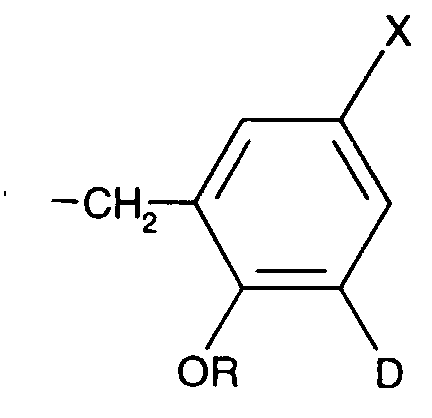
- D
- C1-C24-Alkyl, C5-C12-Cydoalkyl, Phenyl-C1-C4-alkyl, Phenyl oder eine Gruppe -CH2-S-R25 bedeutet,
- x
- Wasserstoff, C1-C18-Alkyl oder eine der Gruppen -CaH2a-Sq-R26, -CbH2b-CO-OR27, -CbH2b-CO-N(R29)(R30), -CH2N(R34(R35),


- R
- Wasserstoff oder eine Gruppe der Formel -CO-CH=CH2 ist,
- G*
- für Wasserstoff oder C1-C12-Alkyl steht,
- R25
- C1-C18-Alkyl, Phenyl oder eine Gruppe -(CH2)c-CO-OR28 oder -CH2CH2OR33 bedeutet,
- R26
- Wasserstoff, C1-C18-Alkyl, Phenyl, Benzyl oder eine Gruppe

- R27
- C1-C30-Alkyl oder eine der Gruppen -CHR31-CH2-S-R32,


- R28
- C1-C24-Alkyl bedeutet,
- R29
- Wasserstoff, C1-C18-Alkyl oder Cyclohexyl bedeutet,
- R30
- C1-C18-Alkyl, Cyclohexyl, Phenyl, durch C1-C18-Alkyl substituiertes Phenyl oder eine der Gruppen


- R31
- Wasserstoff, C1-C4-Alkyl oder Phenyl bedeutet,
- R32
- C1-C18-Alkyl bedeutet,
- R33
- Wasserstoff, C1-C24-Alkyl, Phenyl, C2-C18-Alkanoyl oder Benzoyl bedeutet,
- R34
- C1-C18-Alkyl, Cyclohexyl, Phenyl, durch C1-C18-Alkyl substituiertes Phenyl oder eine

- R35
- Wasserstoff, C1-C18-Alkyl, Cyclohexyl, oder eine Gruppe
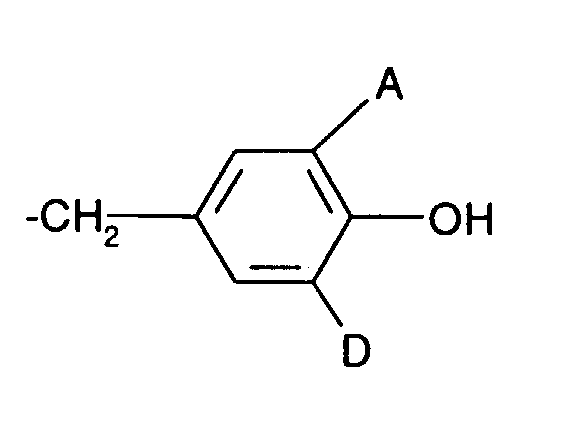
- R34 und R35
- zusammen C4-C8-Alkylen, das durch -O- oder -NH-unterbrochen sein kann, bedeuten,
- Bevorzugt ist eine Verbindung der Formel XII, worin
- A
- Wasserstoff, C1-C8-Alkyl, Cyclohexyl, Phenyl oder eine Gruppe -CH2-S-C1-C18-Alkyl oder

- D
- C1-C8-Alkyl, Cyclohexyl, Phenyl oder eine Gruppe -CH2-S-C1-C18-Alkyl bedeutet,
- X
- Wasserstoff, C1-C8-Alkyl oder eine der Gruppen -CaH2a-Sq-R26, -CbH2b-CO-OR27,


- R26
- C1-C12-Alkyl, Phenyl oder eine Gruppe -(CH2)c-CO-OR28 bedeutet,
- R27
- C1-C16Alkyl oder eine Gruppe


- R28
- C1-C18-Alkyl bedeutet,
- R34 und R35
- unabhängig voneinander Wasserstoff oder C1-C12-Alkyl sind oder
- R34 und R35
- zusammen C4-C8-Alkylen, das durch -O- oder -NH-unterbrochen sein kann, bedeuten,
- Beispiele für bevorzugte sterisch gehinderten Phenole sind:
2,6-Di-tert.butyl-4-methylphenol, 2-Tert.butyl-4,6-dimethylphenol, 2,6-Di-tert.butyl-4-ethylphenol, 2,6-Di-tert.butyl-4-n-butylphenol, 2,6-Di-tert.butyl-4-i-butylphenol, 2,6-Di-cyclopentyl-4-methylphenol, 2-(α-Methylcyclohexyl)-4,6-dimethylphenol, 2,6-Di-octadecyl-4-methylphenol, 2,4,6-Tri-cyclohexylphenol, 2,6-Di-tert.butyl-4-methoxymethylphenol, 2,6-Di-nonyl-4-methylphenol, 2,6-Di-tert.butyl-4-methoxyphenol, 2,5-Di-tert.butyl-hydrochinon, 2,5-Di-tert.amyl-hydrochinon, 2,6-Di-phenyl-4-octadecyloxyphenol, 2,2'-Thio-bis-(6-tert.butyl-4-methylphenol), 2,2'-Thio-bis-(4-octylphenol), 4,4'-Thio-bis-(6-tert.butyl-3-methylphenol), 4,4'-Thio-bis-(6-tert.butyl-2-methylphenol), 2,2'-Methylen-bis-(6-tert.butyl-4-methylphenol), 2,2'-Methylen-bis-(6-tert.butyl-4-ethylphenol), 2,2'-Methylen-bis-[4-methyl-6-(α-methylcyclohexyl)-phenol], 2,2'-Methylen-bis-(4-methyl-6-cyclohexylphenol), 2,2'-Methylen-bis-(6-nonyl-4-methylphenol), 2,2'-Methylen-bis-(4,6-di-tert.butylphenol), 2,2'-Ethyliden-bis-(4,6-di-tert.butylphenol), 2,2'-Ethyliden-bis-(6-tert.butyl-4-isobutylphenol), 2,2'-Methylen-bis-[6-(α-methylbenzyl)-4-nonylphenol], 2,2'-Methylen-bis-[6-(α,α-dimethylbenzyl)-4-nonylphenol], 4,4'-Methylen-bis-(2,6-di-tert.butylphenol), 4,4'-Methylen-bis-(6-tert.butyl-2-methylphenol), 1,1-Bis-(5-tert.butyl-4-hydroxy-2-methylphenyl)-butan, 2,6-Bis-(3-tert.butyl-5-methyl-2-hydroxybenzyl)-4-methylphenol, 1,1,3-Tris-(5-tert.butyl-4-hydroxy-2-methylphenyl)-butan, 1,1-Bis-(5-tert.butyl-4-hydroxy-2-methylphenyl)-3-n-dodecylmercaptobutan, Ethylenglycol-bis-[3,3-bis-(3'-tert.butyl-4'-hydroxyphenyl)-butyrat], Bis-(3-tert.butyl-4-hydroxy-5-methylphenyl)-dicyclopentadien, Bis-[2-(3'-tert.butyl-2'-hydroxy-5'-methylbenzyl)-6-tert.butyl-4-methyl-phenyl]-terephthalat, 1,3,5-Tris-(3,5-di-tert.butyl-4-hydroxybenzyl)-2,4,6-trimethylbenzol, Bis-(3,5-di-tert.butyl-4-hydroxybenzyl)sulfid, 3,5-Di-tert.butyl-4-hydroxybenzylmercaptoessigsäure-iso-octylester, Bis-(4-tert.butyl-3-hydrox-2,6-dimethylbenzyl)dithiolterephthalat, 1,3,5-Tris-(3,5-di-tert.butyl-4-hydroxybenzyl)-isocyanurat, 1,3,5-Tris-(4-tert.butyl-3-hydroxy-2,6-dimethylbenzyl)-isocyanurat, 3,5-Di-tert.butyl-4-hydroxybenzylphosphonsäure-dioctadecylester und das Ca-Salz des 3,5-Di-tert.butyl-4-hydroxybenzylphosphonsäure-monoethylester. - Besonders bevorzugt als sterisch gehinderte Phenole sind Verbindungen, die mindestens eine Gruppe der Formel

R" gegebenenfalls substituiertes Alkyl oder gegebenenfalls substituiertes Alkylthioalkyl bedeutet. - Beispiele für solche sterisch gehinderten Phenole sind die Ester von β-(3,5-Di-tert.butyl-4-hydroxyphenyl)-propionsäure und der β-(5-tert.Butyl-4-hydroxy-3-methylphenyl)-propionsäure mit ein- oder mehrwertigen Alkoholen, wie z.B. mit Methanol, Octanol, Octadecanol, 1,6-Hexandiol, Neopentylglycol, Thiodiethylenglycol, Diethylenglycol, Triethylenglycol, Pentaerythrit, Tris-(hydroxyethyl)-iso-cyanurat, N,N'-Bis-(hydroxyethyl)-oxalsäurediamid, sowie die Amide dieser Säuren, wie z.B. N,N'-Bis-(3,5-di-tert.butyl-4-hydroxyphenylpropionyl)-hexamethylendiamin, N,N'-Bis-(3,5-di-tert.butyl-4-hydroxyphenylpropionyl)-trimethylendiamin und N,N'-Bis-(3,5-di-tert.butyl-4-hydroxyphenylpropionyl)-hydrazin.
- Ganz besonders bevorzugt als sterisch gehindertes Phenol sind 1,3,5-Tris-(3,5-di-tert.butyl-4-hydroxybenzyl)-2,4,6-trimethylbenzol, 1,1,3-Tris-(5-tert.butyl-4-hydroxy-2-methylphenyl)-butan und Tocopherole (Vitamin E).
- Anstelle eines einzelnen sterisch gehinderten Phenols kann im Rahmen der vorliegenden Erfindung auch ein Gemisch verschiedener sterisch gehinderter Phenole verwendet werden.
- Die Menge des Zusatzes des sterisch gehinderten Phenols richtet sich nach dem gewünschten Grad der Stabilisierung. Im allgemeinen setzt man 0,01 bis 0,5 Gew.-%, insbesondere 0,05 bis 0,5 Gew.-%, bezogen auf das Polymer, zu.
- Die erfindungsgemäss verwendbaren sterisch gehinderten Amine, vorzugsweise Piperidinverbindungen, sind vor allem als Lichtschutzmittel bekannt. Diese Verbindungen enthalten eine Gruppe der Formel XIII

- Von Bedeutung als Stabilisatoren sind insbesondere die folgenden Klassen von Tetramethylpiperidinverbindungen.
- a) Verbindungen der Formel XIV

- Bedeuten etwaige Substituenten C1-C12-Alkyl, so stellen sie z.B. Methyl, Ethyl, n-Propyl, n-Butyl, sek.-Butyl, tert.-Butyl, n-Hexyl, n-Octyl, 2-Ethyl-hexyl, n-Nonyl, n-Decyl, n-Undecyl oder n-Dodecyl dar.
- In der Bedeutung von C1-C18-Alkyl kann R2 z.B. die oben angeführten Gruppen und dazu noch beispielsweise n-Tridecyl, n-Tetradecyl, n-Hexadecyl oder n-Octadecyl darstellen.
- Wenn R1 C3-C8-Alkenyl bedeutet, so kann es sich z.B. um 1-Propenyl, Allyl, Methallyl, 2-Butenyl, 2-Pentenyl, 2-Hexenyl, 2-Octenyl, 4-tert.-Butyl-2-butenyl handeln.
- R1 ist als C3-C8-Alkinyl bevorzugt Propargyl.
- Als C7-C12-Aralkyl ist R1 insbesondere Phenethyl und vor allem Benzyl.
- R1 ist als C1-C8-Alkanoyl beispielsweise Formyl, Propionyl, Butyryl, Octanoyl, aber bevorzugt Acetyl und als C3-C5-Alkenoyl insbesondere Acryloyl.
- Bedeutet R2 einen einwertigen Rest einer Carbonsäure, so stellt es beispielsweise einen Essigsäure-, Capronsäure-, Stearinsäure-, Acrylsäure-, Methacrylsäure-, Benzoe- oder β-(3,5-Di-tert.-butyl-4-hydroxyphenyl)-propionsäurerest dar.
- Bedeutet R2 einen zweiwertigen Rest einer Dicarbonsäure, so stellt es beispielsweise einen Malonsäure-, Bernsteinsäure-, Glutarsäure-, Adipinsäure-, Korksäure-, Sebacinsäure-, Maleinsäure-, Phthalsäure-, Dibutylmalonsäure-, Dibenzylmalonsäure-, Butyl-(3,5-di-tert.-butyl-4-hydroxybenzyl)-malonsäure- oder Bicycloheptendicarbonsäurerest dar.
- Stellt R2 einen dreiwertigen Rest einer Tricarbonsäure dar, so bedeutet es z.B. einen Trimellitsäure- oder einen Nitrilotriessigsäurerest.
- Stellt R2 einen vierwertigen Rest einer Tetracarbonsäure dar, so bedeutet es z.B. den vierwertigen Rest von Butan-1,2,3,4-tetracarbonsäure oder von Pyromellitsäure.
- Bedeutet R2 einen zweiwertigen Rest einer Dicarbaminsäure, so stellt es beispielsweise einen Hexamethylendicarbaminsäure- oder einen 2,4-Toluylen-dicarbaminsäurerest dar.
- Beispiele für Polyalkylpiperidin-Verbindungen dieser Klasse sind folgende Verbindungen:
- 1) 4-Hydroxy-2,2,6,6-tetramethylpiperidin
- 2) 1-Allyl-4-hydroxy-2,2,6,6-tetramethylpiperidin
- 3) 1 -Benzyl-4-hydroxy-2,2,6,6-tetramethylpiperidin
- 4) 1-(4-tert.-Butyl-2-butenyl)-4-hydroxy-2,2,6,6-tetramethylpiperidin
- 5) 4-Stearoyloxy-2,2,6,6-tetramethylpiperidin
- 6) 1-Ethyl-4-salicyloyloxy-2,2,6,6-tetramethylpiperidin
- 7) 4-Methacryloyloxy-1,2,2,6,6-pentamethylpiperidin
- 8) 1,2,2,6,6-Pentamethylpiperidin-4-yl-β-(3,5-di-tert.-butyl-4-hydroxyphenyl)-propionat 9) Di-(1-benzyl-2,2,6,6-tetramethylpiperidin-4-yl)-maleinat
- 10) Di-(2,2,6,6-tetramethylpiperidin-4-yl)-succinat
- 11) Di-(2,2,6,6-tetramethylpiperidin-4-yl)-glutarat
- 12) Di-(2,2,6,6-tetramethylpiperidin-4-yl)-adipat
- 13) Di-(2,2,6,6-tetramethylpiperidin-4-yl)-sebacat
- 14) Di-(1,2,2,6,6-pentamethylpiperidin-4-yl)-sebacat
- 15) Di-(1,2,3,6-tetramethyl-2,6-diethyl-piperidin-4-yl)-sebacat
- 16) Di-(1-allyl-2,2,6,6-tetramethylpiperidin-4-yl)-phthalat
- 17) 1-Propargyl-4-β-cyanoethyloxy-2,2,6,6-tetramethylpiperidin
- 18) 1-Acetyl-2,2,6,6-tetramethylpiperidin-4-yl-acetat
- 19) Trimellithsäure-tri-(2,2,6,6-tetramethylpiperidin-4-yl)-ester
- 20) 1-Acryloyl-4-benzyloxy-2,2,6,6-tetramethylpiperidin
- 21) Diethylmalonsäure-di(2,2,6,6-tetramethylpiperidin-4-yl)-ester
- 22) Dibutyl-malonsäure-di-(1,2,2,6,6-pentamethylpiperidin-4-yl)-ester
- 23) Butyl-(3,5-di-tert.-butyl-4-hydroxybenzyl)-malonsäure-di-(1,2,2,6,6-pentamethylpiperidin-4-yl)-ester
- 24) Dibenzyl-malonsäure-di-(1,2,2,6,6-pentamethylpiperidin-4-yl)-ester
- 25) Dibenzyl-malonsäure-di-(1,2,3,6-tetramethyl-2,6-diethyl-piperidin-4-yl)ester
- 26) Hexan-1',6'-bis-(4-carbamoyloxy-1-n-butyl-2,2,6,6-tetramethyl-piperidin)
- 27) Toluol-2',4'-bis-(4-carbamoyloxy-1-n-propyl-2,2,6,6-tetramethyl-piperidin)
- 28) Dimethyl-bis-(2,2,6,6-tetramethylpiperidin-4-oxy)-silan
- 29) Phenyl-tris-(2,2,6,6-tetramethylpiperidin-4-oxy)-silan
- 30) Tris-(1-propyl-2,2,6,6-tetramethylpiperidin-4-yl)-phosphit
- 31) Tris-(1-propyl-2,2,6'6-tetramethylpiperidin-4-yl)phosphat
- 32) Phenyl-[bis-(1,2,2,6,6-pentamethylpiperidin-4-yl)]-phosphonat
- 33) 4-Hydroxy-1,2,2,6,6-pentamethylpiperidin
- 34) 4-Hydroxy-N-hydroxyethyl-2,2,6,6-tetramethylpiperidin
- 35) 4-Hydroxy-N-(2-hydroxypropyl)-2,2,6,6-tetramethylpiperidin
- 36) 1-Glycidyl-4-hydroxy-2,2,6,6-tetramethylpiperidin
- b) Verbindungen der Formel (XV)

- Stellen etwaige Substituenten C1-C12- oder C1-C18-Alkyl dar, so haben sie die bereits unter a) angegebene Bedeutung.
- Bedeuten etwaige Substituenten C5-C7-Cycloalkyl, so stellen sie insbesondere Cyclohexyl dar.
- Als C7-C8-Aralkyl ist R3 insbesondere Phenylethyl oder vor allem Benzyl. Als C2-C5-Hydroxyalkyl ist R3 insbesondere 2-Hydroxyethyl oder 2-Hydroxypropyl.
- R3 ist als C2-C18-Alkanoyl beispielsweise Propionyl, Butyryl, Octanoyl, Dodecanoyl, Hexadecanoyl, Octadecanoyl, aber bevorzugt Acetyl und als C3-C5-Alkenoyl insbesondere Acryloyl.
- Bedeutet R4 C2-C8-Alkenyl, dann handelt es sich z.B. um Allyl, Methallyl, 2-Butenyl, 2-Pentenyl, 2-Hexenyl oder 2-Octenyl.
- R4 als mit einer Hydroxy-, Cyano-, Alkoxycarbonyl- oder Carbamidgruppe substituiertes C1-C4-Alkyl kann z.B. 2-Hydroxyethyl, 2-Hydroxypropyl, 2-Cyanethyl, Methoxycarbonylmethyl, 2-Ethoxycarbonylethyl, 2-Aminocarbonylpropyl oder 2-(Dimethylaminocarbonyl)-ethyl sein.
- Stellen etwaige Substituenten C2-C12-Alkylen dar, so handelt es sich z.B. um Ethylen, Propylen, 2,2-Dimethylpropylen, Tetramethylen, Hexamethylen, Octamethylen, Decamethylen oder Dodecamethylen.
- Bedeuten etwaige Substituenten C6-C15-Arylen, so stellen sie z.B. o-, m- oder p-Phenylen, 1,4-Naphthylen oder 4,4'-Diphenylen dar.
- Als C6-C12-Cycloalkylen ist D insbesondere Cyclohexylen.
- Beispiele für Polyalkylpiperidin-Verbindungen dieser Klasse sind folgende Verbindungen:
- 37) N,N'-Bis-(2,2,6,6-tetramethylpiperidin-4-yl)-hexamethylen-1,6-diamin
- 38) N,N'-Bis-(2,2,6,6-tetramethylpiperidin-4-yl)-hexamethylen-1,6-diacetamid
- 39) 1-Acetyl-4-(N-cyclohexylacetamido)-2,2,6,6-tetramethylpiperidin
- 40) 4-Benzoylamino-2,2,6,6-tetramethylpiperidin
- 41) N,N'-Bis-(2,2,6,6-tetramethylpiperidin-4-yl)-N,N'-dibutyl-adipamid
- 42) N,N'-Bis-(2,2,6,6-tetramethylpiperidin-4-yl)-N,N'-dicyclohexyl-2-hydroxypropylen-1,3-diamin
- 43) N,N'-Bis-(2,2,6,6-tetramethylpiperidin-4-yl)-p-xylylen-diamin
- 44) N,N'-Bis-(2,2,6,6-tetramethylpiperidin-4-yl)-succindiamid
- 45) N-(2,2,6,6-Tetramethylpiperidin-4-yl)-β-aminodipropionsäure-di-(2,2,6,6-tetramethylpiperidin-4-yl)-ester
- 46) Die Verbindung der Formel
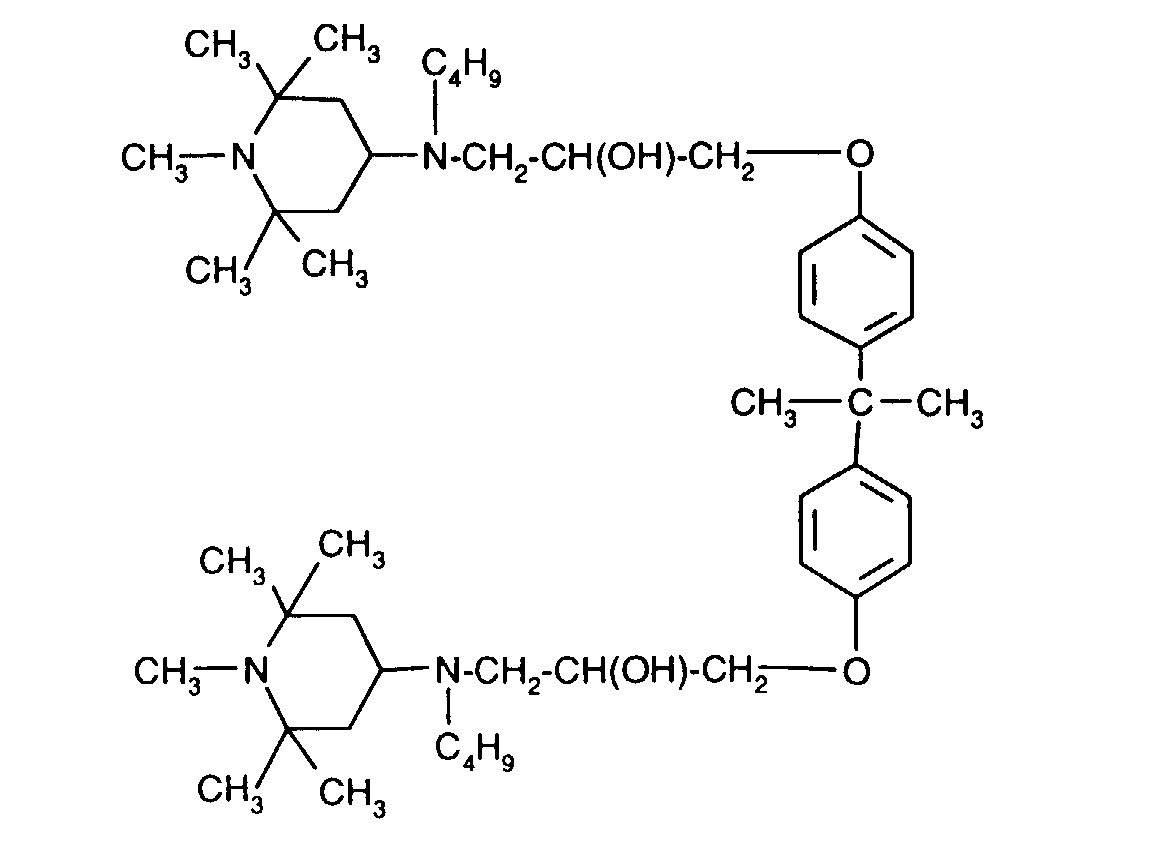
- 47) 4-(Bis-2-hydroxyethyl-amino)-1,2,2,6,6-pentamethylpiperidin
- 48) 4-(3-Methyl-4-hydroxy-5-tert.-butyl-benzoesäureamido)-2,2,6,6-tetramethylpiperidin
- 49) 4-Methacrylamido-1,2,2,6,6-pentamethylpiperidin
- c) Verbindungen der Formel (XVI)

- Bedeutet R5 C2-C8-Alkylen oder -Hydroxyalkylen, so stellt es beispielsweise Ethylen, 1-Methyl-ethylen, Propylen, 2-Ethyl-propylen oder 2-Ethyl-2-hydroxymethylpropylen dar.
- Als C4-C22-Acyloxyalkylen bedeutet R5 z.B. 2-Ethyl-2-acetoxymethylpropylen.
- Beispiele für Polyalkylpiperidin-Verbindungen dieser Klasse sind folgende Verbindungen:
- 50) 9-Aza-8,8,10,10-tetramethyl-1,5-dioxaspiro[5.5]undecan
- 51) 9-Aza-8,8,10,10-tetramethyl-3-ethyl-1,5-dioxaspiro[5.5]undecan
- 52) 8-Aza-2,7,7,8,9,9-hexamethyl-1,4-dioxaspiro[4.5]decan
- 53) 9-Aza-3-hydroxymethyl-3-ethyl-8,8,9,10,10-pentamethyl-1,5-dioxaspiro[5.5]undecan
- 54) 9-Aza-3-ethyl-3-acetoxymethyl-9-acetyl-8,8,10,10-tetramethyl-1,5-dioxaspiro[5.5]-undecan
- 55) 2,2,6,6-Tetramethylpiperidin-4-spiro-2'-(1',3'-dioxan)-5'-spiro-5''-(1'',3''-dioxan)-2''-spiro-4'''-(2''',2''',6''',6'''-tetramethylpiperidin).
- d) Verbindungen der Formeln XVla, XVlb und XVlc


- Bedeuten etwaige Substituenten C1-C12-Alkyl, so stellen sie z.B. Methyl, Ethyl, n-Propyl, n-Butyl, sek.-Butyl, tert.-Butyl, n-Hexyl, n-Octyl, 2-Ethyl-hexyl, n-Nonyl, n-Decyl, n-Undecyl oder n-Dodecyl dar.
- Etwaige Substituenten in der Bedeutung von C1-C18-Alkyl können z.B. die oben angeführten Gruppen und dazu noch beispielsweise n-Tridecyl, n-Tetradecyl, n-Hexadecyl oder n-Octadecyl darstellen.
- Bedeuten etwaige Substituenten C2-C6-Alkoxyalkyl, so stellen sie z.B. Methoxymethyl, Ethoxymethyl, Propoxymethyl, tert.-Butoxymethyl, Ethoxyethyl, Ethoxypropyl, n-Butoxyethyl, tert.-Butoxyethyl, Isopropoxyethyl oder Propoxypropyl dar.
- Stellt R7 C3-C5-Alkenyl dar, so bedeutet es z.B. 1-Propenyl, Allyl, Methallyl, 2-Butenyl oder 2-Pentenyl.
- Als C7-C9-Aralkyl sind R7, T1 und T2 insbesondere Phenethyl oder vor allem Benzyl. Bilden T1 und T2 zusammen mit dem C-Atom einen Cycloalkanring, so kann dies z.B. ein Cyclopentan-, Cyclohexan-, Cyclooctan- oder Cyclododecanring sein.
- Bedeutet R7 C2-C4-Hydroxyalkyl, so stellt es z.B. 2-Hydroxyethyl, 2-Hydroxypropyl, 2-Hydroxybutyl oder 4-Hydroxybutyl dar.
- Als C6-C10-Aryl bedeuten R7, T1 und T2 insbesondere Phenyl, α- oder β-Naphthyl, die gegebenenfalls mit Halogen oder C1-C4-Alkyl substituiert sind.
- Stellt R7 C2-C12-Alkylen dar, so handelt es sich z.B. um Ethylen, Propylen, 2,2-Dimethylpropylen, Tetramethylen, Hexamethylen, Octamethylen, Decamethylen oder Dodecamethylen.
- Als C4-C12-Alkenylen bedeutet R7 insbesondere 2-Butenylen, 2-Pentenylen oder 3-Hexenylen.
- Bedeutet R7 C6-C12-Arylen, so stellt es beispielsweise o-, m- oder p-Phenylen, 1,4-Naphthylen oder 4,4'-Diphenylen dar.
- Bedeutet Z' C2-C12-Alkanoyl, so stellt es beispielsweise Propionyl, Butyryl, Octanoyl, Dodecanoyl, aber bevorzugt Acetyl dar.
- D hat als C2-C10-Alkylen, C6-C15-Arylen oder C6-C12-Cydoalkylen die unter b) angegebene Bedeutung.
- Beispiele für Polyalkylpiperidin-Verbindungen dieser Klasse sind folgende Verbindungen:
- 56) 3-Benzyl-1,3,8-triaza-7,7,9,9-tetramethylspiro[4.5]decan-2,4-dion
- 57) 3-n-Octyl-1,3,8-triaza-7,7,9,9-tetramethylspiro[4.5]decan-2,4-dion
- 58) 3-Allyl-1,3,8-triaza-1,7,7,9,9-pentamethylspiro[4.5]decan-2,4-dion
- 59) 3-Glycidyl-1,3,8-triaza-7,7,8,9,9-pentamethylspiro[4.5]decan-2,4-dion
- 60) 1,3,7,7,8,9,9-Heptamethyl-1,3,8-triazaspiro[4.5]decan-2,4-dion
- 61) 2-lso-propyl-7,7,9,9-tetramethyl-1-oxa-3,8-diaza-4-oxo-spiro-[4.5]-decan
- 62) 2,2-Dibutyl-7,7,9,9-tetramethyl-1-oxa-3,8-diaza-4-oxo-spiro-[4.5]-decan
- 63) 2,2,4,4-Tetramethyl-7-oxa-3,20-diaza-21-oxo-dispiro-[5.1.11.2]-heneicosan
- 64) 2-Butyl-7,7,9,9-tetramethyl-1-oxa-4,8-diaza-3-oxo-spiro-[4,5]decan
- 65) 8-Acetyl-3-dodecyl-1,3,8-triaza-7,7,9,9-tetramethylspiro[4,5]-decan-2,4-dion oder die Verbindungen der folgenden Formeln:
- 66)

- 67)

- 68)

- 69)

- e) Verbindungen der Formel XVII


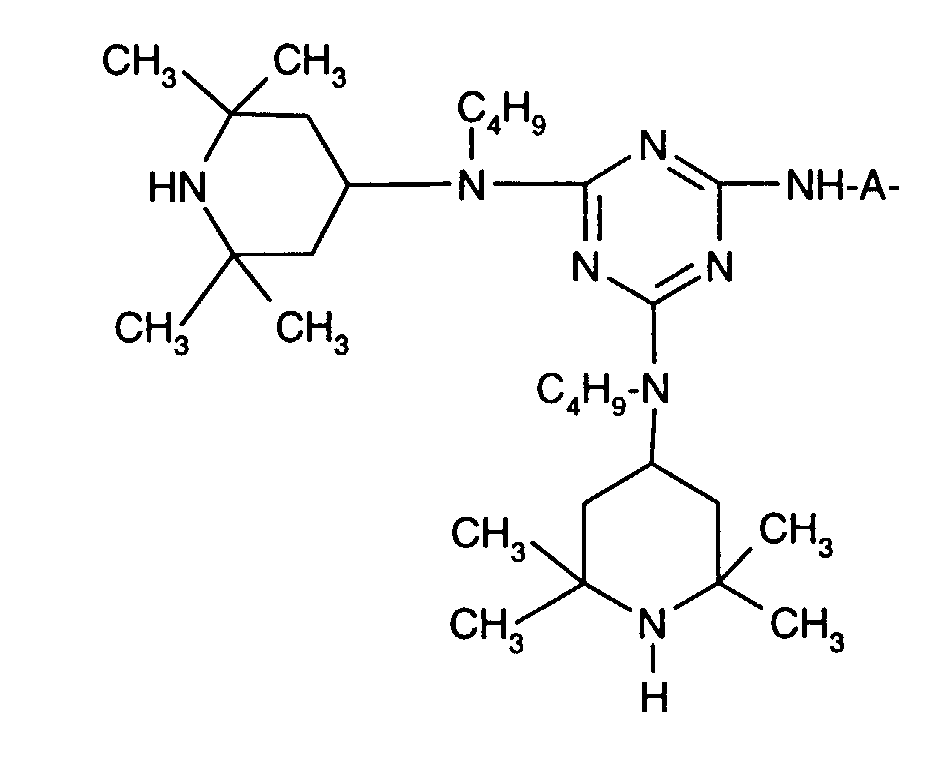
- Bedeuten etwaige Substituenten C1-C12-Alkyl, so stellen sie beispielsweise Methyl, Ethyl, n-Propyl, n-Butyl, sek.-Butyl, tert.-Butyl, n-Hexyl, n-Octyl, 2-Ethylhexyl, n-Nonyl, n-Decyl, n-Undecyl oder n-Dodecyl dar.
- Bedeuten etwaige Substituenten C1-C4-Hydroxyalkyl, so stellen sie z.B. 2-Hydroxyethyl, 2-Hydroxypropyl, 3-Hydroxypropyl, 2-Hydroxybutyl oder 4-Hydroxybutyl dar.
- Bedeutet A C2-C6-Alkylen, so stellt es beispielsweise Ethylen, Propylen, 2,2-Dimethylpropylen, Tetramethylen oder Hexamethylen dar.
- Stellen R11 und R12 zusammen C4-C5-Alkylen oder -oxaalkylen dar, so bedeutet dies z.B. Tetramethylen, Pentamethylen oder 3-Oxapentamethylen.
- Beispiele für Polyalkylpiperidin-Verbindungen dieser Klasse sind die Verbindungen der folgenden Formeln:
- 70)

- 71)

- 72)

- 73)

- 74)

- 75)

- mit

- 76)

- mit

- 77)

- mit

- 78)
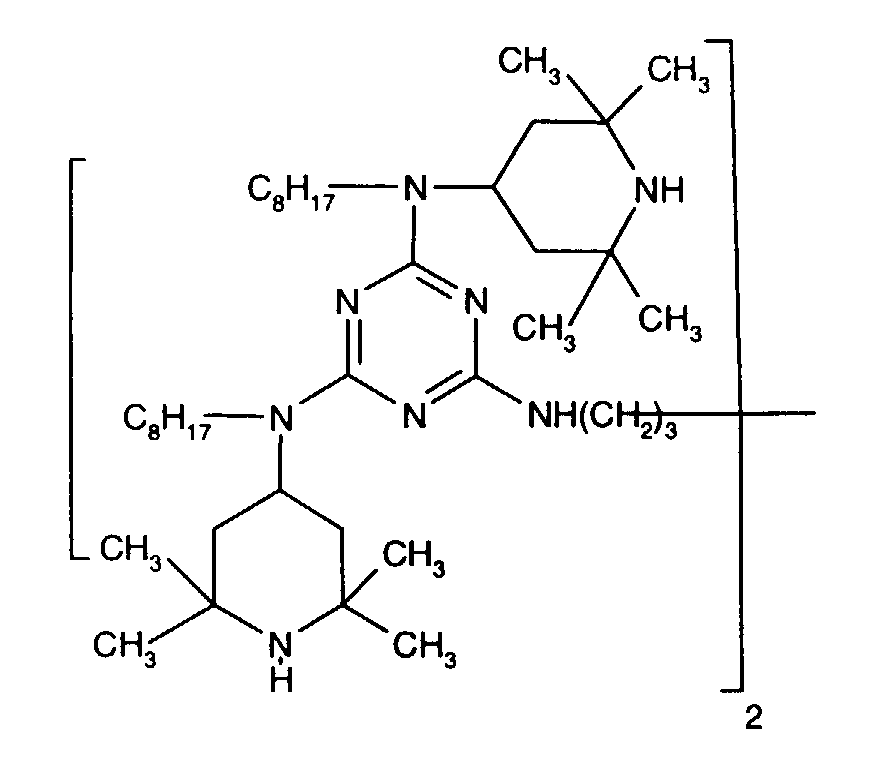
- 79)
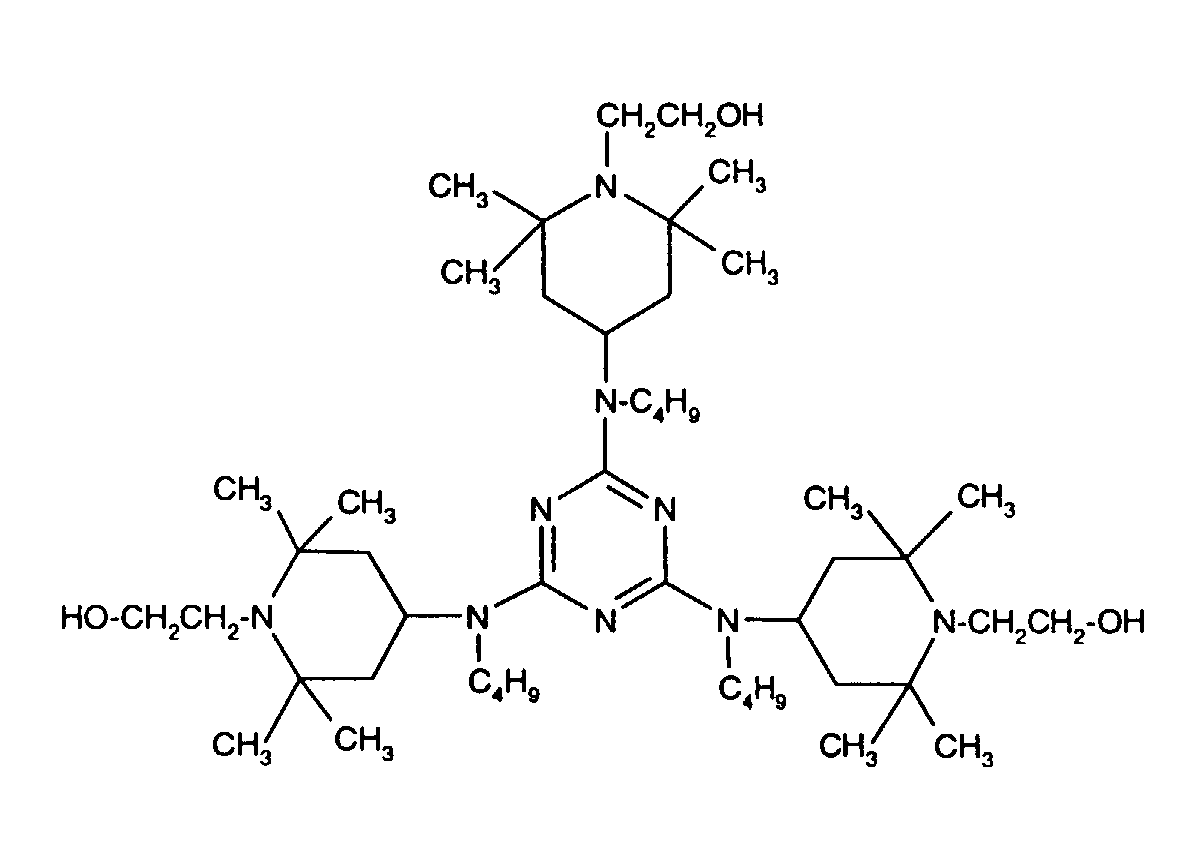
- 80)
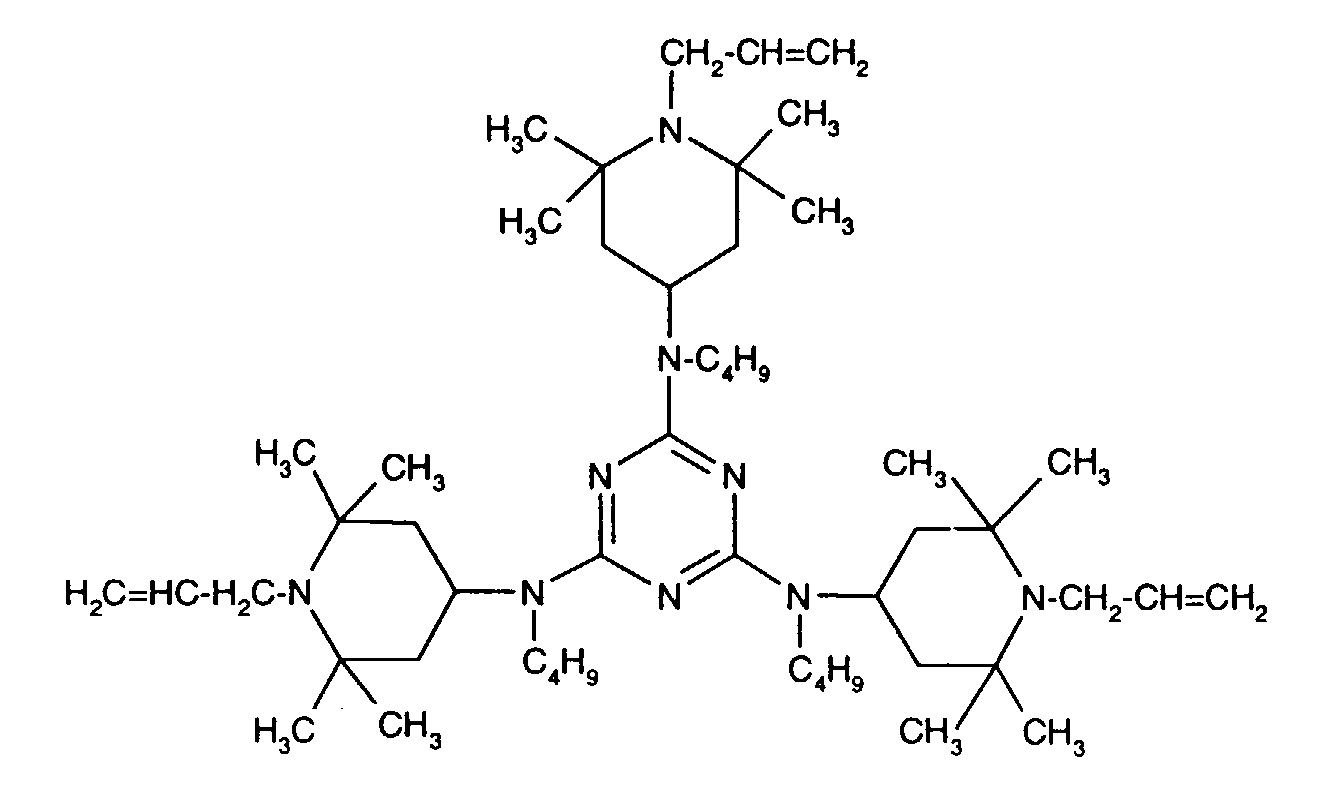
- f) Oligomere oder polymere Verbindungen, deren wiederkehrende Struktureinheit einen oder mehrere 2,2,6,6-Tetraalkylpiperidinreste der Formel (XIII) enthält, insbesondere Polyester, Polyäther, Polyamide, Polyamine, Polyurethane, Polyharnstoffe, Polyaminotriazine, Poly(meth)acrylate, Polysiloxane, Poly(meth)acrylamide und deren Copolymeren, die solche Reste enthalten.
- Beispiele für 2,2,6,6-Polyalkylpiperidin-Lichtschutzmittel dieser Klasse sind die Verbindungen der folgenden Formeln, wobei m eine Zahl von 2 bis etwa 200 bedeutet.
- 81)

- 82)

- 83)

- 84)

- 85)
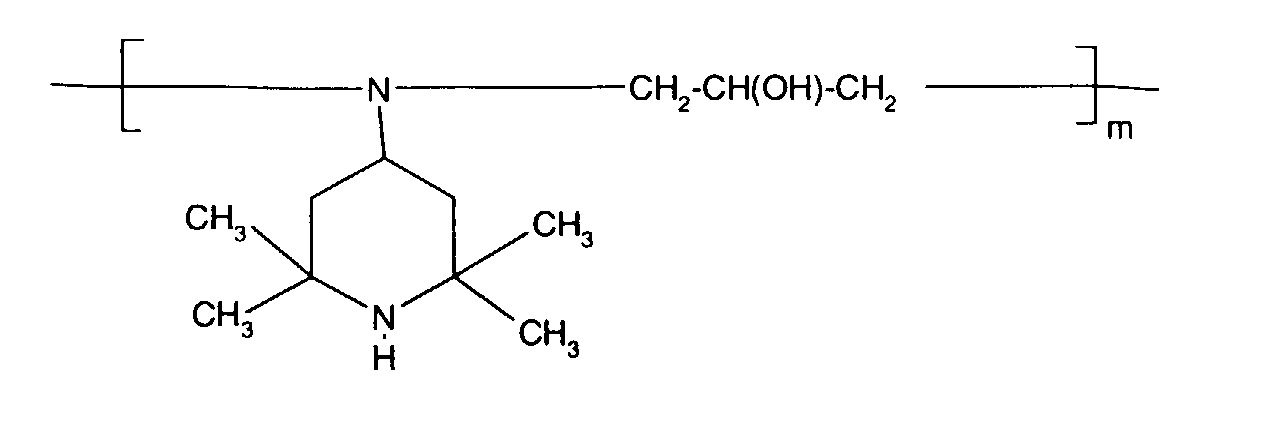
- 86)

- 87)

- 88]

- 89)

- 90)

- 91)

- 92)

- 93)

- 94)

- 95)

- 96)


- Von diesen Klassen sind die Klassen e) und f) besonders geeignet, insbesondere solche Tetraalkylpiperidinverbindugen, die s-Triazin-Gruppen enthalten. Weiterhin sind besonders geeignet die Verbindungen 74, 76, 84, 87, 92, 95 und 96.
- Anstelle eines einzelnen sterisch gehinderten Amins kann im Rahmen der vorliegenden Erfindung auch ein Gemisch verschiedener sterisch gehinderter Amine verwendet werden.
- Die Menge des Zusatzes des sterisch gehinderten Amins richtet sich nach dem gewünschten Grad der Stabilisierung. Im allgemeinen setzt man 0,01 bis 0,5 Gew.-%, insbesondere 0,05 bis 0,5 Gew.-%, bezogen auf das Polymer, zu.
- Der erfindungsgemas verwendbare Säurefänger ist bevorzugt eine unter den Reaktionsbedingungen kein Wasser freisetzende Verbindung aus der Reihe der Hydrotalcite, Zeolithe, Metallcarbonate oder Metalloxide.
- Die verwendbaren Verbindungen aus der Reihe der Hydrotalcite, Zeolithe, Metallseifen, Metallcarbonate oder Metalloxide sind sowohl die natürlich vorkommenden Mineralien wie auch synthetisch hergestellte Verbindungen.
- Verbindungen aus der Reihe der Hydrotalcite können durch die allgemeine Formel XVIII,
M2+ 1-x•M3+ x•(OH)2•(An-)x/n•mH2O (XVIII)
wobei - M2+
- = Mg2+, Ca2+, Sr2+, Ba2+, Zn2+, Cd2+, Pb2+, Sn2+ und/oder Ni2+ ist,
- M3+
- = Al3+, B3+ oder Bi3+ ist,
- An-
- ein Anion mit der Valenz n darstellt,
- n
- eine Zahl von 1-4 ist,
- x
- eine Zahl von 0-0,5 ist und
- m
- eine Zahl von 0-20 ist, dargestellt werden.
- An- ist bevorzugt OH-, Cl-, Br-, l-, ClO4 -, HCO3 -, CH3COO-, C6H5COO-, CO3 2-, SO4 2-, [OC(O)C(O)O]2-, (CHOHCOO)22-, (CHOH)4CH2OHCOO-. C2H4(COO)2 2-, (CH2COO)2 2-, CH3CHOHCOO-, SiO3 2-, SiO4 4-, Fe(CN)6 3-, Fe(CN)6 4- oder HPO4 2-.
- Andere Hydrotalcite, die zweckmässig in dem Verfahren, wie oben beschrieben, eingesetzt werden können, sind Verbindungen mit der allgemeinen Formel
M2+ x•Al2(OH)2x+6nz•(An-)2•mH2O (XVIIIa)
wobei in vorliegender Formel XVlla M2+ wenigstens ein Metall aus der Reihe von Mg und Zn darstellt und Mg2+ bevorzugt ist, An- ein Anion, beispielsweise aus der Reihe von CO3 2-, [OC(O)C(O)O]2-, OH- und S2- darstellt, wobei n die Valenz des Anions ist, m eine positive Zahl, vorzugsweise von 0,5 bis 15, darstellt und x und z positive Zahlen darstellen, wobei x vorzugsweise 2 bis 6 ist und z kleiner als 2 ist. - Bevorzugte und kommerziell erhältliche Hydrotalcite sind z.B. DHT-4A und DHT-4C der Firma Kyowa, Japan.
- Bevorzugt sind Verbindungen aus der Reihe der Hydrotalcite der allgemeinen Formel XVIII,
M2+ 1-x•M3+ x•(OH)2•(An-)x/n•mH2O (XVIII)
wobei M2+ die Bedeutung von Mg2+ oder einer festen Lösung von Mg und Zn hat, An- für CO3 2- steht, x eine Zahl von 0 bis 0,5 ist und m eine Zahl von 0 bis 20 ist. - Ganz besonders bevorzugt sind Hydrotalcite der Formeln
Al2O3•6MgO•CO2•12H2O,
Mg4,5•Al2•(OH)13•CO3•3,5H2O,
4MgO•Al2O3•CO2•9H2O,
4MgO•Al2O3•CO2•6H2O,
ZnO•3MgO•Al2O3•CO2•8-9H2O oder
ZnO•3MgO•Al2O3•CO2•5-6H2O.
- Erfindungsgemäss können weiterhin Zeolithe der allgemeinen Formel (XIX)
Mx/n[(AlO2)x(SiO2)y] • wH2O (XIX)
- wobei n die Ladung des Kations M,
- M ein Element der ersten oder zweiten Hauptgruppe,
- y:x eine Zahl zwischen 0,8 und 1,2 und
- w eine Zahl zwischen 0,5 und 30 ist,
- verwendet werden.
- Die bevorzugten an sich bekannten Zeolithe, welche im obigen Verfahren eingesetzt werden können, weisen einen durchschnittlichen wirksamen Porendurchmesser von 3-5Å auf, wobei jene vom Typ NaA, die einen durchschnittlichen wirksamen Porendurchmesser von 4Å besitzen, weshalb sie auch als Zeolithe 4A bezeichnet werden.
- Beispiele für geeignete Zeolithe sind die Verbindungen:
Na12[(AlO2)12(SiO2)12]• 12H2O
Ca4,5Na3[(AlO2)12(SiO2)12] • 30H2O
K9Na3[(AlO2)12(SiO2)12] • 27H2O
- Bevorzugte und kommerziell erhältliche Zeolithe sind Molekularsiebe.
- Erfindungsgemäss können weiterhin Metallseifen verwendet werden. Bevorzugt sind Metallseifen zweiwertiger Metalle mit Fettsäuren, welche 8-28 Kohlenstoffatome aufweisen. Besonders bevorzugt sind Metallseifen des Calciums, wobei Calciumstearat und Calciumpelargonat ganz besonders bevorzugt ist.
- Erfindungsgemäss können weiterhin Metallcarbonate oder Metalloxide verwendet werden. Bevorzugt sind Oxide zweiwertiger Metalle. Besonders bevorzugt sind Oxide der Metalle der zweiten Haupt- oder Nebengruppe, wobei Zink- und Magnesiumoxid ganz besonders bevorzugt ist.
- Die erfindungsgemäss einsetzbaren Verbindungen werden zur Entfernung des nicht oder nur schwach gebundenen Wassers bei 50-800°C, bevorzugt 80-400°C, getrocknet, sofern sie nicht schon ausreichend getrocknet sind und unter Feuchtigkeitsausschluss gelagert wurden. Die Trocknung kann im Vakuum oder unter Inertgas erfolgen. Die Oberflächen der Substanzen können mit oberflächenaktiven Reagenzien, wie Carbonsäuren oder linearen Alkoholen mit 8 oder mehr C-Atomen, z.B. Stearinsäure, behandelt werden.
- Anstelle eines einzelnen Säurefängers kann im Rahmen der vorliegenden Erfindung auch ein Gemisch verschiedener Säurefänger verwendet werden.
- Die unter den Reaktionsbedingungen kein Wasser freisetzenden Verbindungen aus der Reihe der Hydrotalcite, Zeolithe, Metallseifen, Metallcarbonate, Metalloxide oder ähnlicher synthetisch hergestellter Verbindungen werden im allgemeinen in einer Menge von 0,005 bis 0,2 Gew.-%, bezogen auf das Polymere, zugesetzt, vorzugsweise in einer Menge von 0,01 bis 0,1 Gew.-%.
- Eine besonders bevorzugte Ausführung der Erfindung ist es, obiges Verfahren unter Zugabe einer Phosphor(lll)-verbindung und eines sterisch gehinderten Phenols durchzuführen. Weiterhin ist ein Verfahren bevorzugt, in dem eine Phosphor(lll)-verbindung, ein sterisch gehindertes Phenol und ein sterisch gehindertes Amin zugesetzt wird. Ganz besonders bevorzugt ist die Verwendung einer Kombination aus Phosphor(lll)-verbindung, sterisch gehindertem Phenol, sterisch gehindertem Amin und Säurefänger. Für die genannten Kombinationen gilt, dass die bevorzugten Kombinationen aus den jeweils bevorzugten Einzelverbindungen bestehen.
- Die Zugabe der Verbindungen, einzeln oder auch in Form von Mischungen, erfolgt üblicherweise nachdem mindestens 0,1 %, bevorzugt mindestens 1 % und besonders bevorzugt mindestens 10 %, des Umsatzes bezogen auf die Gesamtausbeute an Polymer erreicht sind.
- Gegenstand der vorliegenden Erfindung ist auch die Verwendung mindestens einer der oben näher definierten Phosphor(lll)-verbindungen, sterisch gehinderten Phenole, sterisch gehinderten Amine und/oder Säurefänger in einem Verfahren zur Polymerisation von Olefinen an einem Übergangsmetallocenkatalysator zur Stabilisierung der so erhältlichen Polymeren. Die Bevorzugungen des Verfahrens gelten hierbei analog.
- Ein weiterer Gegenstand der vorliegenden Erfindung sind die nach dem oben näher definierten Verfahren erhältlichen Polyolefine. Die Bevorzugungen des Verfahrens gelten hierbei analog.
- Die erfindungsgemäss hergestellten Polyolefine eignen sich besonders zur Herstellung von Halbzeugen (Platten, Rohren und Profilen beliebigen Querschnittes) und für folgende Fertigungsverfahren: Rotationsformen, Schleudergiessen, Spritzgiessen, Thermoplastschaumguss, Spritzpressen, Pressen, Sintern, Kalandieren, Extrudieren, Hohlkörperblasformen, Extrusionsstreckblasen, Giessen von Hohlkörpern, Spinnen, Schäumen, Pulverbeschichten, Beschichten und Kabelummantelung.
- Die Definitionen der Reste R1-R35, R', M1, M2, A, L, Q, X und der Indices a, n, m, p, q, y, z, w können in der Beschreibung mehrfach vorkommen, sie beziehen sich jeweils auf die unmittelbar vorher angegebene Formel.
- Die folgenden Beispiele erläutern das Verfahren näher. Darin, sowie in der übrigen Beschreibung und in den Patentansprüchen, bedeuten Teile Gewichtsteile, %
- Gewichtsprozente,""einen tert.Butylrest und bei Zahlenintervallen sind die Grenzwerte eingeschlossen soweit nicht anders angegeben.

- Ein 3-l Stahlautoklav wird bei 110°C eine halbe Stunde evakuiert, dann bei gleicher Temperatur mit Ethylen gespült. Der Autoklav wird auf 20°C gekühlt. 5 ml einer Lösung von 10 mg Zirconocendichlorid in 100 ml Toluol werden während 10 Minuten mit 2,5 ml einer 30 %igen Lösung von Methylaluminoxan in Toluol gemischt und in 1000 ml Heptan verdünnt in den Autoklav gegeben. Der Autoklav wird verschlossen und es werden 100 ml Wasserstoff und Ethylen bis zu einem Gesamtdruck von 10 bar zugegeben. Die Temperatur wird auf 60-65°C erhöht. Nach 30 Minuten wird die Ethylenzufuhr unterbrochen, der Autoklav entspannt, mit Argon geflutet und es werden 100 mg P-1 (bzw. AO-1 bzw. H-1) in fester Form zugegeben. Der Autoklav wird verschlossen und es werden 100 ml Wasserstoff und Ethylen bis zu einem Gesamtdruck von 10 bar zugegeben. Nach 2 Stunden Polymerisationsdauer wird der Autoklav entspannt und der Katalysator durch Zugabe von 10 ml Isopropanol desaktiviert. Das Heptan wird im Vakuum am Rotationsverdampfer abdestilliert und das Polymer über Nacht im Vakuum bei 60°C getrocknet.
Während der Vorpolymerisation wird 10 % des Gesamtumsatzes erzielt; durch die Zugabe der Additive reduziert sich der Umsatz nicht. Die, die Additive enthaltenden, Polymere zeigen gute Verarbeitungs-, Langzeit- und Lichtstabilität. - Ein 3-1 Stahlautoklav wird bei 110°C eine halbe Stunde evakuiert, dann bei gleicher Temperatur mit Ethylen gespült. Der Autoklav wird auf 20°C gekühlt. 5 ml einer Lösung von 10 mg Zirconocendichlorid in 100 ml Toluol werden während 10 Minuten mit 2,5 ml einer 30 %igen Lösung von Methylaluminoxan in Toluol gemischt und zusammen mit 100 mg AO-1 in 1000 ml Heptan verdünnt in den Autoklav gegeben. Der Autoklav wird verschlossen und es werden 100 ml Wasserstoff und Ethylen bis zu einem Gesamtdruck von 10 bar zugegeben. Die Temperatur wird auf 60-65°C erhöht. Nach 2 Stunden Polymerisationsdauer wird der Autoklav entspannt und der Katalysator durch Zugabe von 10 ml Isopropanol desaktiviert. Das Heptan wird im Vakuum am Rotationsverdampfer abdestilliert und das Polymer über Nacht im Vakuum bei 60°C getrocknet.
Durch die Zugabe des Additivs reduziert sich der Umsatz, im Vergleich zu einer Polymerisation ohne Additiv, nicht. - Herstellung des Katalysators: 100 g Aerosil® 812 (Degussa; DE) werden bei 800°C unter Argon getrocknet. 10 g davon werden in 200 ml Toluol suspendiert, das 100 mg Wasser enthält. Nach 10 Minuten unter Rühren werden 3 ml Trimethylaluminium zugegeben und eine Stunde gerührt. Das Lösungsmittel wird abfiltriert und der Rückstand dreimal mit 50 ml Heptan gewaschen. Der Rückstand wird in 100 ml Heptan suspendiert. Eine Lösung von 10 mg Zirconocendichlorid in 100 ml Toluol wird zu der Suspension gegeben, eine Stunde gerührt, filtriert und dreimal mit 50 ml Heptan gewaschen.
- Polymerisation: Ein 3-l Stahlautoklav wird bei 110°C eine halbe Stunde evakuiert, dann bei gleicher Temperatur mit Ethylen gespült. Der Autoklav wird auf 20°C gekühlt. 21 mg des nach obigem Verfahren hergestellten Katalysators werden in 1500 ml Heptan verdünnt in den Autoklav gegeben. Der Autoklav wird verschlossen und es werden 100 ml Wasserstoff und Ethylen bis zu einem Gesamtdruck von 10 bar zugegeben. Die Temperatur wird auf 60-65°C erhöht. Nach 30 Minuten wird die Ethylenzufuhr unterbrochen, der Autoklav entspannt, mit Argon geflutet und es werden 100 mg P-1 (bzw. AO-1 bzw. H-1) in fester Form zugegeben. Der Autoklav wird verschlossen und es werden 100 ml Wasserstoff und Ethylen bis zu einem Gesamtdruck von 10 bar zugegeben. Nach 2 Stunden Polymerisationsdauer wird der Autoklav entspannt und der Katalysator durch Zugabe von 10 ml Isopropanol desaktiviert. Das Heptan wird im Vakuum am Rotationsverdampfer abdestilliert und das Polymer über Nacht im Vakuum bei 60°C getrocknet.
Während der Vorpolymerisation wird 30 % des Gesamtumsatzes erzielt; durch die Zugabe der Additive reduziert sich der Umsatz nicht. Die die Additive enthaltenden Polymere zeigen gute Verarbeitungs-, Langzeit- und Lichtstabilität. - Herstellung des Katalysators: Unter Luftausschluss (in einer Drybox unter Argon) werden in einem 250 ml Rundkolben mit Hahn 18.5 ml einer 30%igen Methylaluminoxan-Lösung in Toluol vorgelegt. Danach werden 14 ml Toluol und 100 mg racemisches Dimethylsilandiyl-bis(2-methyl-4,5-benzo-indenyl)-zirconium-dichlorid zugegeben. Bei der Zugabe des Zirconocenkomplexes entsteht eine orange Lösung. Nach 20 minütigem Rühren bei Raumtemperatur werden 4 g SiO2 (Grace 951, getrocknet bei 900°C) portionsweise zugegeben. Nach weiteren 30 Minuten wird das Lösungsmittel am Vakuum abgezogen, während der Kolben auf 70°C erwärmt und mit einem leichten Argonstrom durchflutet wird. Der Katalysator wird dann bei 70°C in einem Vakuum von 0.1 mbar ca. 12 Stunden getrocknet (Entfernen des Toluols aus den Poren). Danach wird der Katalysator in 100 ml Hexan suspendiert, ausserhalb der Drybox auf 0°C gekühlt , und unter Rühren mit einem geringen Ethylenfluss von ca. 20 ml/min durchströmt. Nach 30 Minuten wird der Kolben in die Drybox verbracht, das Lösungsmittel abfiltriert, der Katalysator mit Hexan kurz gewaschen und im Vakuum getrocknet. Es werden 16 g Katalysator erhalten.
- Polymerisation: Die zu testenden Stabilisatoren, 9 ml 10%ige Triethylaluminium-Lösung (in Hexan) und 200 mg Katalysator werden bei 20°C unter Argon in einem gut getrockneten 3-l Stahlautoklav (vgl. Beispiele 1-7) vorgelegt und der Autoklav verschlossen. 650 g Propylen werden in flüssiger Form zugegeben, gerührt und die Temperatur innerhalb von 3 Minuten auf 65°C erhöht. Nach 2 Stunden wird der Autoklav entspannt, 20 ml Isopropanol werden zugegeben und 15 Minuten bei 70°C gerührt. Danach wird der Autoklav entladen und das Polymer ca. 12 Stunden bei 70°C getrocknet.
Bestimmt werden der Yelloness Index (Yl) gemäss ASTM D 1925, der Melt Flow Wert (MF) (PP: 2.16 kg/230°C) nach ISO 1133-1981, der Schmelzpunkt (m.p.) mittels "Differential Scanning Calorimetry" (DSC) und der "Oxygen Induction Time"-Wert (OIT). Die OIT-Prüfung geschieht folgendermassen: ein Stück mit 5 mm Durchmesser wird aus einem 0.5 mm dicken gepressten Walzfell des zu testenden Polyolefins gestanzt. Die Probe wird in eine offene DSC Probenschale in der DSC-Zelle gelegt. Die Zelle wird mit Stickstoff gespült (50 ml/min) und auf 200°C erhitzt. Dann wird Sauerstoff eingeleitet (t=0) und die Zeit bis zum Beginn der Exothermie bestimmt. Je höher der Wert, desto besser ist die Stabilisierung deR getesten Probe.
Die getesten Stabilisatoren und Stabilisatormischungen, sowie die Testergebnisse sind der folgenden Tabelle 1 zu entnehmen.Tabelle 1 Beispiel Additiv Menge [mg] Ausbeute PP [g] Yl OIT/200°C [min] MF [g/10 min] m.p. [°C] -- -- 130 1.8 0.17 66.6 150 8 AO-1 100 111 2.4 2.48 62.1 149 P-1 200 9 AO-1 100 104 2.6 2.62 47.5 149 P-1 200 HT-1 100 - In den Beispielen verwendete Additive:
-
- P-1:
- Tris-(2,4-di-tert.butylphenyl)-phosphit (Irgafos® 168)
- P-2:
-

- AO-1:
- Tris-1,3,5-(3,5-di-tert.butyl-4-hydroxybenzyl) (lrganox® 1330)
- H-1:
-


- HT-1:
- DHT-4A Hydrotalcit der Firma Kyowa, Japan.
Claims (13)
- Verfahren zur Herstellung von Olefinpolymeren durch Polymerisation an einem Übergangsmetallocenkatalysator, dadurch gekennzeichnet, dass man die Polymerisation unter Zusatz mindestens einer Phosphor(lll)-verbindung, eines sterisch gehinderten Amins, eines sterisch gehinderten Phenols oder eines Säurefängers, allein oder in Kombination untereinander, durchführt, wobei im Falle einer Phosphor(lll)-verbindung und/oder eines sterisch gehinderten Amins die Zugabe erst erfolgt, wenn mindestens 0,1 % des Gesamtumsatzes bereits erfolgt sind.
- Verfahren nach Anspruch 1, dadurch gekennzeichnet, dass die Zugabe der Phosphor(lll)-verbindung, des sterisch gehinderten Amins, des sterisch gehinderten Phenols oder des Säurefängers, allein oder in Kombination untereinander, erst erfolgt, wenn mindestens 1 % des Gesamtumsatzes bereits erfolgt sind.
- Verfahren gemäss Anspruch 1, dadurch gekennzeichnet, dass man 0,005 bis 1 Gew.-%, insbesondere 0,01 bis 0,5 Gew.-%, bezogen auf das Polymere, der Phosphor(lll)-verbindung, des sterisch gehinderten Amins, des sterisch gehinderten Phenols oder des Säurefängers, allein oder in Kombination untereinander, verwendet.
- Verfahren nach Anspruch 1, dadurch gekennzeichnet, dass die Phosphor(lll)-verbindung eine Verbindung der Formeln V, VI, Vll, VIII oder IX


 R'1, R'2 und R'3 unabhängig voneinander Alkyl mit 1 bis 18 Kohlenstoffatomen, mit Halogen, -COOR'4, -CN oder -CONR'4R'4 substituiertes Alkyl mit 1 bis 18 Kohlenstoffatomen, durch -S-, -O- oder -NR'4- unterbrochenes Alkyl mit 2 bis 18 Kohlenstoffatomen, Cycloalkyl mit 5 bis 8 Kohlenstoffatomen, Phenyl oder Naphthyl, mit Halogen, 1 bis 3 Alkylresten oder Alkoxyresten mit insgesamt 1 bis 18 Kohlenstoffatomen substituiertes Phenyl oder Naphthyl, 2,2,6,6-Tetramethylpiperid-4-yl, N-Allyl- oder N-Benzyl- oder N-Alkyl-2,2,6,6-tetramethylpiperid-4-yl mit 1 bis 4 Kohlenstoffatomen im Alkylteil oder N-Alkanoyl-2,2,6,6-tetramethylpiperid-4-yl mit 1 bis 4 Kohlenstoffatomen im Alkylteil, oder N-Alkylen-2,2,6,6-tetramethylpiperidyl oder N-Alkylen-4-alkoxy-2,2,6,6- tetramethylpiperidyl mit 1 bis 3 Kohlenstoffatomen im Alkylenteil und 1 bis 18 Kohlenstoffatomen im Alkoxyteil sind,R'4 beziehungsweise die Reste R'4 unabhängig voneinander Wasserstoff, Alkyl mit 1 bis 18 Kohlenstoffatomen, Cycloalkyl mit 5 bis 12 Kohlenstoffatomen oder Phenylalkyl mit 1 bis 4 Kohlenstoffatomen im Alkylteil,n' 2, 3 oder 4,A', wenn n' oder q 2 ist, Alkylen mit 2 bis 12 Kohlenstoffatomen, durch -S-, -O- oder -NR'4-unterbrochenes Alkylen mit 2 bis 12 Kohlenstoffatomen, worin R'4 die angegebeneBedeutung hat, oder ein Rest der Formel
 A', wenn n' oder q 3 ist, ein Rest der Formel CrH2r-1- oder N(CH2CH2-)3,r 5 oder 6 ist,A', wenn n' 4 ist, den Rest der Formel C(CH2-)4 bedeutet,R'5 und R'6 unabhängig voneinander Wasserstoff oder Alkyl mit 1 bis 8 Kohlenstoffatomen sind,A'' ein Rest der Formel -CH2-, -CHR'4-, -CR'1R'4-, -S- oder eine direkte Bindung, worin R'1 und R'4 die angegebenen Bedeutungen haben,p 1 oder 2,D', wenn p 1 ist, Methyl und wenn p 2 ist, -CH2OCH2- ist,R'9 Methyl ist, und R'10 die Bedeutung von R'1 hat,q 2 oder 3 ist,y 1, 2 oder 3,Q, wenn y 1 ist, Alkyl mit 1 bis 18 Kohlenstoffatomen, ein Rest der Formel -OR'16, -NR'17R'18 oder Fluor ist.Q, wenn y 2 ist, ein Rest der Formel -O-A'''-O- oder
 ist,Q, wenn y 3 ist, ein Rest der Formel R'4C(CH2O-)3, N(C2H4O-)3 oder N(C3H6O-)3 ist, worinR'4 die angegebene Bedeutung hat,R'16 die Bedeutung von R'1 hat,R'17 und R'18 unabhängig voneinander Alkyl mit 1 bis 18 Kohlenstoffatomen, Benzyl, Cyclohexyl, ein 2,2,6,6-Tetra- oder 1,2,2,6,6-Pentamethylpiperid-4-ylrest sind, oder R'17 und R'18 zusammen Butylen, Pentylen, Hexylen oder den Rest der Formel -CH2CH2-O-CH2CH2-bilden,A"' die Bedeutung von A', wenn n' 2 ist, hat,R'19 Wasserstoff oder Methyl ist,die Substituenten R'14 unabhängig voneinander Wasserstoff, Alkyl mit 1 bis 9 Kohlenstoffatomen oder Cyclohexyl sind,R'15 Wasserstoff oder Methyl undZ eine direkte Bindung, -CH2-, -C(R'14-)2 oder -S- ist, worin die Substituenten R'14 gleich oder verschieden sind und die angegebene Bedeutung habenoder eine Verbindung der Formel X
 dargestellt werden, wobei R* ein bis fünf C1-C8-Alkylreste;X' ein Rest
- Verfahren nach Anspruch 1, dadurch gekennzeichnet, dass das sterisch gehinderte Amin eine Verbindung ist, die mindestens eine Gruppe der Formel XIII

- Verfahren gemäss Anspruch 1, dadurch gekennzeichnet, dass das sterisch gehinderte Amin eine Verbindung der Formel


ist. - Verfahren nach Anspruch 1, dadurch gekennzeichnet, dass das sterisch gehinderte Phenol eine Verbindung derFormel Xll
 A Wasserstoff, C1-C24-Alkyl, C5-C12-Cycloalkyl, Phenyl-C1-C4-alkyl, Phenyl oder eine Gruppe -CH2-S-R25 oder
 D C1-C24-Alkyl, C5-C12-Cycloalkyl, Phenyl-C1-C4-alkyl, Phenyl oder eine Gruppe -CH2-S-R25 bedeutet,X Wasserstoff, C1-C18-Alkyl oder eine der Gruppen -CaH2a-Sq-R26, -CbH2b-CO-OR27, -CbH2b-CO-N(R29)(R30), -CH2N(R34)(R35) ,
 R Wasserstoff oder eine Gruppe der Formel -CO-CH=CH2 ist,G* für Wasserstoff oder C1-C12-Alkyl steht,R25 C1-C18-Alkyl, Phenyl oder eine Gruppe -(CH2)c-CO-OR28 oder -CH2CH2OR33 bedeutet,R26 Wasserstoff, C1-C18-Alkyl, Phenyl, Benzyl oder eine Gruppe
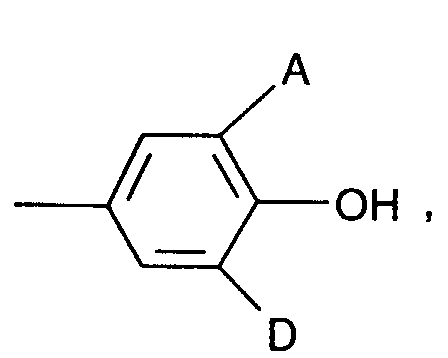 R27 oder -(CH2)c-CO-OR28 oder -CH2-CH2-OR33 bedeutet, C1-C30-Alkyl oder eine der Gruppen -CHR31-CH2-S-R32,
 R28 C1-C24-Alkyl bedeutet,R29 Wasserstoff, C1-C18-Alkyl oder Cyclohexyl bedeutet,R30 C1-C18-Alkyl, Cyclohexyl, Phenyl, durch C1-C18-Alkyl substituiertes Phenyl oder eine der Gruppen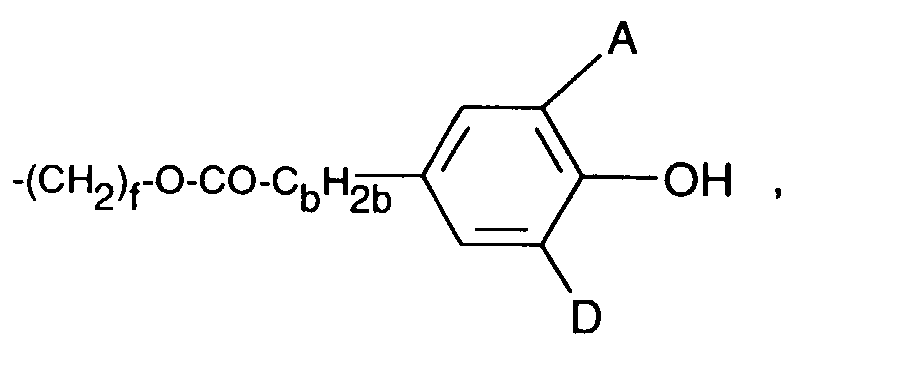


oderR29 und R30 zusammen C4-C8-Alkylen, das durch -O- oder -NH- unterbrochen sein kann, bedeuten,R31 Wasserstoff, C1-C4-Alkyl oder Phenyl bedeutet,R32 C1-C18-Alkyl bedeutet,R33 Wasserstoff, C1-C24-Alkyl, Phenyl, C2-C18-Alkanoyl oder Benzoyl bedeutet,R34 C1-C18-Alkyl, Cyclohexyl, Phenyl, durch C1-C18-Alkyl substituiertes Phenyl oder eine Gruppe R35 Wasserstoff, C1-C18-Alkyl, Cyclohexyl, oder eine Gruppeoder R34 und R35 zusammen C4-C8-Alkylen, das durch -O- oder -NH-unterbrochen sein kann, bedeuten,
a 0, 1, 2 oder 3 ist, b 0, 1, 2 oder 3 ist, c 1 oder 2 ist, d 1 bis 5 ist, f 2 bis 8 ist und q 1, 2, 3 oder 4 ist;
ist. - Verfahren gemäss Anspruch 1, dadurch gekennzeichnet, dass man als sterisch gehindertes Phenol β-(3,5-Di-tert.butyl-4-hydroxyphenyl)-propionsäure-octadecylester, Tocopherol oder 1,3,5-Tris-(3,5-di-tert.butyl-4-hydroxybenzyl)-2,4,6-trimethylbenzol verwendet.
- Verfahren nach Anspruch 1, dadurch gekennzeichnet, dass man als Säurefänger eine unter den Reaktionsbedingungen kein Wasser freisetzende Verbindung aus der Reihe der Hydrotalcite, Zeolithe, Metallseifen, Metallcarbonate oder Metalloxide verwendet.
- Verfahren gemäss Anspruch 1, dadurch gekennzeichnet, dass man als Säurefänger ein Hydrotalcit verwendet.
- Verwendung mindestens einer Phosphor(lll)-verbindung, eines sterisch gehinderten Amins, eines sterisch gehinderten Phenols oder eines Säurefängers, allein oder in Kombination untereinander, in einem Verfahren zur Polymerisation von Olefinen an einem Übergangsmetallocenkatalysator zur Stabilisierung der so erhältlichen Polymeren.
- Stabilisiertes Polyolefin, erhältlich nach dem Verfahren des Anspruches 1.
- Stabilisiertes Polyethylen oder Polypropylen gemäss Anspruch 12 mit hohem Molekulargewicht.
Applications Claiming Priority (3)
| Application Number | Priority Date | Filing Date | Title |
|---|---|---|---|
| CH1912/95 | 1995-06-29 | ||
| CH191295 | 1995-06-29 | ||
| CH191295 | 1995-06-29 |
Publications (3)
| Publication Number | Publication Date |
|---|---|
| EP0755948A2 true EP0755948A2 (de) | 1997-01-29 |
| EP0755948A3 EP0755948A3 (de) | 1998-01-07 |
| EP0755948B1 EP0755948B1 (de) | 2001-07-04 |
Family
ID=4221505
Family Applications (1)
| Application Number | Title | Priority Date | Filing Date |
|---|---|---|---|
| EP96810404A Expired - Lifetime EP0755948B1 (de) | 1995-06-29 | 1996-06-18 | Verfahren zur Herstellung von stabilisierten Olefinpolymeren |
Country Status (12)
| Country | Link |
|---|---|
| US (2) | US5703149A (de) |
| EP (1) | EP0755948B1 (de) |
| JP (1) | JPH0912621A (de) |
| KR (1) | KR100420981B1 (de) |
| AT (1) | ATE202789T1 (de) |
| BR (1) | BR9602944A (de) |
| CA (1) | CA2180073A1 (de) |
| DE (1) | DE59607205D1 (de) |
| ES (1) | ES2159009T3 (de) |
| NO (1) | NO311978B1 (de) |
| TW (1) | TW338046B (de) |
| ZA (1) | ZA965517B (de) |
Cited By (4)
| Publication number | Priority date | Publication date | Assignee | Title |
|---|---|---|---|---|
| WO1998009995A1 (en) * | 1996-09-04 | 1998-03-12 | The Dow Chemical Company | Incorporation of free radical inhibitors in polyolefins |
| FR2789082A1 (fr) * | 1999-02-01 | 2000-08-04 | Ciba Sc Holding Ag | Composition de polyolefine contenant un melange stabilisant et procede de stabilisation utilisant ledit melange |
| US6995219B2 (en) | 2001-05-10 | 2006-02-07 | Borealis Technology Oy | Olefin polymerization process |
| EP1881012A4 (de) * | 2005-05-12 | 2010-08-25 | Japan Polypropylene Corp | Katalysatoren für die olefinpolymerisation, verfahren zur herstellung der katalysatoren und konservierungsverfahren dafür |
Families Citing this family (22)
| Publication number | Priority date | Publication date | Assignee | Title |
|---|---|---|---|---|
| US6593485B1 (en) | 1994-10-06 | 2003-07-15 | Clariant Finance (Bvi) Limited | Stabilizer composition |
| CA2237231C (en) | 1998-05-08 | 2006-08-08 | Nova Chemicals Ltd. | Heterogeneous metallocene catalyst |
| NL1012219C2 (nl) * | 1998-06-19 | 2000-04-13 | Ciba Sc Holding Ag | Werkwijze voor de polymersitie van overzadigde polyalkylpiperidinen. |
| DE10028432A1 (de) * | 2000-06-13 | 2001-12-20 | Basell Polyolefine Gmbh | Auf calciniertes Hydrotalcit geträgerter Katalysatorfeststoff zur Olefinpolymerisation |
| US6518344B1 (en) * | 2000-08-18 | 2003-02-11 | Ferro Corporation | Flame retarded polyolefin composition |
| US6747077B2 (en) | 2000-10-17 | 2004-06-08 | Ciba Specialty Chemicals Corporation | Stabilized metallocene polypropylene |
| US6767937B2 (en) * | 2001-10-03 | 2004-07-27 | Eastman Kodak Company | Stabilizer system for polymer components of displays |
| AU2003255313A1 (en) * | 2002-08-07 | 2004-02-25 | Ciba Specialty Chemicals Holding Inc. | Beta-nucleating, light stabilizing agents for polypropylene |
| JP4866624B2 (ja) * | 2005-03-09 | 2012-02-01 | 日本ポリプロ株式会社 | オレフィン重合用固体触媒成分、オレフィン重合用触媒、およびこれを用いたポリオレフィンの製造方法 |
| JP4969070B2 (ja) * | 2005-03-11 | 2012-07-04 | 株式会社Adeka | 安定化されたポリマーの製造方法 |
| US20070105992A1 (en) * | 2005-11-07 | 2007-05-10 | Hayder Zahalka | Cycloalkyl phosphites as stabilizers for thermoplastic resins |
| JP5596327B2 (ja) * | 2009-01-28 | 2014-09-24 | 株式会社Adeka | 食品・医療・水道用パイプ用途のポリオレフィン系樹脂組成物 |
| JP5322681B2 (ja) * | 2009-02-09 | 2013-10-23 | 株式会社Adeka | 安定化されたポリマーの製造方法 |
| KR102055223B1 (ko) | 2010-11-16 | 2019-12-12 | 가부시키가이샤 아데카 | 폴리머의 장기 안정화 방법 및 부직포, 일래스터머 조성물의 제조 방법 |
| JPWO2012117823A1 (ja) | 2011-03-02 | 2014-07-07 | 株式会社Adeka | ラミネートフィルムおよび塗装部材用樹脂組成物の製造方法 |
| JP2013199551A (ja) | 2012-03-23 | 2013-10-03 | Adeka Corp | 家電材料用及び自動車内装材料用オレフィン樹脂組成物の製造方法 |
| PT2841471T (pt) * | 2012-04-27 | 2020-05-29 | Grace W R & Co | Composições de ativador, a sua preparação e a sua utilização em catalisadores |
| WO2015060257A1 (ja) | 2013-10-21 | 2015-04-30 | 株式会社Adeka | 安定化されたポリマーの製造方法 |
| CN110809600A (zh) | 2017-07-06 | 2020-02-18 | 巴斯夫欧洲公司 | 聚乙烯管 |
| ES3061860T3 (en) | 2018-12-21 | 2026-04-07 | Basf Se | A polypropylene composition |
| CN111423658A (zh) * | 2020-04-10 | 2020-07-17 | 天津大学 | 一种极性翻转工况下聚丙烯电缆材料及其制备方法、用途 |
| JP7553342B2 (ja) | 2020-12-11 | 2024-09-18 | 日置電機株式会社 | 増幅回路及び測定装置 |
Family Cites Families (17)
| Publication number | Priority date | Publication date | Assignee | Title |
|---|---|---|---|---|
| US4170589A (en) * | 1978-02-22 | 1979-10-09 | Union Carbide Corporation | Catalytic polymerization of ethylene with supported chromium [II] catalyst in the presence of a phenolic antioxidant |
| AU555386B2 (en) * | 1981-09-24 | 1986-09-25 | Mobil Oil Corp. | Organo-metallic-zeolite catalyst |
| IT1207491B (it) * | 1985-01-30 | 1989-05-25 | Himont Inc | Procedimento per preparare polimeri olefinici, termicamente stabili. |
| US4659685A (en) * | 1986-03-17 | 1987-04-21 | The Dow Chemical Company | Heterogeneous organometallic catalysts containing a supported titanium compound and at least one other supported organometallic compound |
| EP0551277B2 (de) * | 1990-06-22 | 2005-03-09 | ExxonMobil Chemical Patents Inc. | Aluminiumfreie monocyclopentadienyl-metallocenkatalysatoren für olefinpolymerisation |
| TW218884B (de) * | 1991-05-01 | 1994-01-11 | Mitsubishi Kakoki Kk | |
| EP0544308B1 (de) * | 1991-11-28 | 1998-02-18 | Showa Denko Kabushikikaisha | Neues Metallocen und Verfahren zur Herstellung von Polyolefinen unter Verwendung desselben |
| MX9207621A (es) * | 1992-01-21 | 1993-07-01 | Ciba Geigy Ag | Nuevos bisfenolfosfitos de cicloalquilideno |
| FI112233B (fi) * | 1992-04-01 | 2003-11-14 | Basell Polyolefine Gmbh | Katalyytti olefiinipolymerointia varten, menetelmä sen valmistamiseksi ja sen käyttö |
| EP0578838A1 (de) * | 1992-04-29 | 1994-01-19 | Hoechst Aktiengesellschaft | Katalysator für die Olefinpolymerisation, Verfahren zu seiner Herstellung und seine Verwendung |
| US5240894A (en) * | 1992-05-18 | 1993-08-31 | Exxon Chemical Patents Inc. | Method for making and using a supported metallocene catalyst system |
| GB2276387B (en) * | 1993-03-25 | 1996-10-02 | Sandoz Ltd | Stabilizing polyolefins with phosphorus compounds |
| BR9402553A (pt) * | 1993-06-28 | 1995-03-28 | Union Carbide Chem Plastic | Processo para controlar de forma reversível a atividade de uma reação de polimerização de olefina; processo para finalizar de forma reversível uma reação de polimerização de olefina; processo para finalizar e reiniciar uma reação de polimerização de olefina |
| IT1264946B1 (it) * | 1993-07-16 | 1996-10-17 | Ciba Geigy Spa | Derivati del 2,2,6,6-tetrametil-4-piperidinolo utili come stabilizzanti alla luce ed all'ossidazione per materiali organici. |
| EP0644206B1 (de) * | 1993-09-16 | 1997-12-29 | Showa Denko Kabushiki Kaisha | Katalysator zur Polymerisation von Olefin und Verfahren zur Herstellung von Polyolefin |
| WO1996004318A1 (en) * | 1994-08-05 | 1996-02-15 | Exxon Chemical Patents Inc. | Polymerization catalyst systems, their production and use |
| WO1996013531A1 (en) * | 1994-10-31 | 1996-05-09 | W.R. Grace & Co.-Conn. | Preparation of modified polyolefin catalysts and in situ preparation of supported metallocene and ziegler-natta/metallocene polyolefin catalysts |
-
1996
- 1996-06-13 TW TW085107082A patent/TW338046B/zh active
- 1996-06-18 AT AT96810404T patent/ATE202789T1/de not_active IP Right Cessation
- 1996-06-18 DE DE59607205T patent/DE59607205D1/de not_active Expired - Fee Related
- 1996-06-18 EP EP96810404A patent/EP0755948B1/de not_active Expired - Lifetime
- 1996-06-18 ES ES96810404T patent/ES2159009T3/es not_active Expired - Lifetime
- 1996-06-24 US US08/668,889 patent/US5703149A/en not_active Expired - Fee Related
- 1996-06-27 CA CA002180073A patent/CA2180073A1/en not_active Abandoned
- 1996-06-28 NO NO19962762A patent/NO311978B1/no not_active IP Right Cessation
- 1996-06-28 ZA ZA965517A patent/ZA965517B/xx unknown
- 1996-06-29 KR KR1019960026922A patent/KR100420981B1/ko not_active Expired - Fee Related
- 1996-07-01 BR BR9602944A patent/BR9602944A/pt not_active IP Right Cessation
- 1996-07-01 JP JP8190104A patent/JPH0912621A/ja not_active Withdrawn
-
1997
- 1997-09-10 US US08/929,149 patent/US5955522A/en not_active Expired - Fee Related
Cited By (7)
| Publication number | Priority date | Publication date | Assignee | Title |
|---|---|---|---|---|
| WO1998009995A1 (en) * | 1996-09-04 | 1998-03-12 | The Dow Chemical Company | Incorporation of free radical inhibitors in polyolefins |
| US6410629B1 (en) | 1996-09-04 | 2002-06-25 | The Dow Chemical Company | Incorporation of free radical inhibitors in polyolefins |
| FR2789082A1 (fr) * | 1999-02-01 | 2000-08-04 | Ciba Sc Holding Ag | Composition de polyolefine contenant un melange stabilisant et procede de stabilisation utilisant ledit melange |
| NL1014245C2 (nl) * | 1999-02-01 | 2001-08-07 | Ciba Sc Holding Ag | Gestabiliseerde metalloceen-polyalkenen. |
| BE1013263A3 (fr) * | 1999-02-01 | 2001-11-06 | Ciba Sc Holding Ag | Composition de polyolefine contenant un melange stabilisant et procede de stabilisation utilisant ledit melange. |
| US6995219B2 (en) | 2001-05-10 | 2006-02-07 | Borealis Technology Oy | Olefin polymerization process |
| EP1881012A4 (de) * | 2005-05-12 | 2010-08-25 | Japan Polypropylene Corp | Katalysatoren für die olefinpolymerisation, verfahren zur herstellung der katalysatoren und konservierungsverfahren dafür |
Also Published As
| Publication number | Publication date |
|---|---|
| DE59607205D1 (de) | 2001-08-09 |
| US5703149A (en) | 1997-12-30 |
| KR970001382A (ko) | 1997-01-24 |
| BR9602944A (pt) | 1998-04-28 |
| EP0755948B1 (de) | 2001-07-04 |
| KR100420981B1 (ko) | 2004-07-15 |
| NO962762L (no) | 1996-12-30 |
| ATE202789T1 (de) | 2001-07-15 |
| ZA965517B (en) | 1996-12-30 |
| NO962762D0 (no) | 1996-06-28 |
| TW338046B (en) | 1998-08-11 |
| CA2180073A1 (en) | 1996-12-30 |
| US5955522A (en) | 1999-09-21 |
| JPH0912621A (ja) | 1997-01-14 |
| EP0755948A3 (de) | 1998-01-07 |
| NO311978B1 (no) | 2002-02-25 |
| ES2159009T3 (es) | 2001-09-16 |
Similar Documents
| Publication | Publication Date | Title |
|---|---|---|
| EP0755948B1 (de) | Verfahren zur Herstellung von stabilisierten Olefinpolymeren | |
| EP0351360B1 (de) | Verfahren zur Herstellung von thermisch stabilen Olefinpolymeren | |
| DE69001565T2 (de) | Katalysator für Olefinpolymerisation. | |
| EP0803514B1 (de) | Verfahren zur Herstellung von Polyalk-1-enen in Gegenwart eines geträgerten Metallocenkatalysatorsystems und eines Antistatikums | |
| DE69033435T3 (de) | Katalysator zur Herstellung von hemi-isotaktischem Polypropylen | |
| EP0444474B1 (de) | Lösliche Katalysatorsysteme zur Polymerisation von C2- bis C10-Alk-1-enen | |
| EP0633897B1 (de) | Katalysatorsysteme zur polymerisation von c 2 - bis c 10 -alk-1-enen | |
| DE4120009A1 (de) | Loesliche katalysatorsysteme zur herstellung von polyalk-1-enen mit hohen molmassen | |
| EP0290391B1 (de) | Gegen Lichtschädigung stabilisierte Polyolefine | |
| DE3872997T2 (de) | Verfahren zur herstellung eines aktiven metallocen-alumoxan-katalysators "in situ" waehrend der polymerisation. | |
| WO1999041293A1 (de) | Spritzstreckgeblasene behälter aus olefinpolymerisaten | |
| DE10058290A1 (de) | Verfahren zur Stabilisierung von Polyolefinen | |
| EP0710677A2 (de) | Verfahren zur Herstellung von stabilisierten Olefinpolymeren | |
| EP0737213B1 (de) | Verfahren zur herstellung von polymerisaten des ethylens durch suspensionspolymerisation | |
| DE4139262A1 (de) | Getraegerte katalysatorsysteme zur polymerisation von c(pfeil abwaerts)2(pfeil abwaerts)- bis c(pfeil abwaerts)1(pfeil abwaerts)(pfeil abwaerts)0(pfeil abwaerts)-alkenen | |
| DE19709866A1 (de) | Geträgertes Katalysatorsystem zur Polymerisation von Alk-1-enen | |
| DE4203753A1 (de) | Katalysatorsysteme zur polymerisation von c(pfeil abwaerts)2(pfeil abwaerts)-bis c(pfeil abwaerts)1(pfeil abwaerts)(pfeil abwaerts)0(pfeil abwaerts)-alkenen | |
| DE3151972A1 (de) | Verfahren zur herstellung eines mischpolymeren auf der basis von propylen | |
| DE19927492A1 (de) | Verfahren zur Polymerisation ungesättigter Polyalkylpiperidine | |
| DE19621838A1 (de) | Verfahren zur Herstellung von Polymerisaten von C¶2¶- bis C¶1¶¶2¶-Alkenen unter Zusatz eines Reaktionsverzögerers | |
| DE68915456T2 (de) | Katalysator und verfahren zur polymerisierung von olefinen. | |
| EP0643729B1 (de) | Katalysatorsysteme zur polymerisation von c2- bis c10-alk-1-enen | |
| DE60318403T2 (de) | Verfahren zur polymerisation von olefinen | |
| DE4139263A1 (de) | Katalysatorsysteme zur polymerisation von c(pfeil abwaerts)2(pfeil abwaerts)- bis c(pfeil abwaerts)1(pfeil abwaerts)(pfeil abwaerts)0(pfeil abwaerts)-alkenen | |
| MXPA96002519A (en) | Process for the preparation of polymers of olefin stabilize |
Legal Events
| Date | Code | Title | Description |
|---|---|---|---|
| PUAI | Public reference made under article 153(3) epc to a published international application that has entered the european phase |
Free format text: ORIGINAL CODE: 0009012 |
|
| AK | Designated contracting states |
Kind code of ref document: A2 Designated state(s): AT BE DE ES FR GB IT NL SE |
|
| RAP3 | Party data changed (applicant data changed or rights of an application transferred) |
Owner name: CIBA SPECIALTY CHEMICALS HOLDING INC. |
|
| PUAL | Search report despatched |
Free format text: ORIGINAL CODE: 0009013 |
|
| AK | Designated contracting states |
Kind code of ref document: A3 Designated state(s): AT BE DE ES FR GB IT NL SE |
|
| 17P | Request for examination filed |
Effective date: 19980518 |
|
| D17P | Request for examination filed (deleted) | ||
| R17P | Request for examination filed (corrected) |
Effective date: 19980608 |
|
| 17Q | First examination report despatched |
Effective date: 19981026 |
|
| GRAG | Despatch of communication of intention to grant |
Free format text: ORIGINAL CODE: EPIDOS AGRA |
|
| GRAG | Despatch of communication of intention to grant |
Free format text: ORIGINAL CODE: EPIDOS AGRA |
|
| GRAH | Despatch of communication of intention to grant a patent |
Free format text: ORIGINAL CODE: EPIDOS IGRA |
|
| GRAH | Despatch of communication of intention to grant a patent |
Free format text: ORIGINAL CODE: EPIDOS IGRA |
|
| GRAA | (expected) grant |
Free format text: ORIGINAL CODE: 0009210 |
|
| AK | Designated contracting states |
Kind code of ref document: B1 Designated state(s): AT BE DE ES FR GB IT NL SE |
|
| REF | Corresponds to: |
Ref document number: 202789 Country of ref document: AT Date of ref document: 20010715 Kind code of ref document: T |
|
| REF | Corresponds to: |
Ref document number: 59607205 Country of ref document: DE Date of ref document: 20010809 |
|
| REG | Reference to a national code |
Ref country code: ES Ref legal event code: FG2A Ref document number: 2159009 Country of ref document: ES Kind code of ref document: T3 |
|
| ITF | It: translation for a ep patent filed | ||
| GBT | Gb: translation of ep patent filed (gb section 77(6)(a)/1977) |
Effective date: 20010911 |
|
| PG25 | Lapsed in a contracting state [announced via postgrant information from national office to epo] |
Ref country code: SE Free format text: LAPSE BECAUSE OF FAILURE TO SUBMIT A TRANSLATION OF THE DESCRIPTION OR TO PAY THE FEE WITHIN THE PRESCRIBED TIME-LIMIT Effective date: 20011004 |
|
| ET | Fr: translation filed | ||
| REG | Reference to a national code |
Ref country code: GB Ref legal event code: IF02 |
|
| PLBE | No opposition filed within time limit |
Free format text: ORIGINAL CODE: 0009261 |
|
| STAA | Information on the status of an ep patent application or granted ep patent |
Free format text: STATUS: NO OPPOSITION FILED WITHIN TIME LIMIT |
|
| 26N | No opposition filed | ||
| PGFP | Annual fee paid to national office [announced via postgrant information from national office to epo] |
Ref country code: FR Payment date: 20040525 Year of fee payment: 9 |
|
| PGFP | Annual fee paid to national office [announced via postgrant information from national office to epo] |
Ref country code: NL Payment date: 20040528 Year of fee payment: 9 |
|
| PGFP | Annual fee paid to national office [announced via postgrant information from national office to epo] |
Ref country code: GB Payment date: 20040604 Year of fee payment: 9 Ref country code: DE Payment date: 20040604 Year of fee payment: 9 |
|
| PGFP | Annual fee paid to national office [announced via postgrant information from national office to epo] |
Ref country code: ES Payment date: 20040608 Year of fee payment: 9 |
|
| PGFP | Annual fee paid to national office [announced via postgrant information from national office to epo] |
Ref country code: AT Payment date: 20040630 Year of fee payment: 9 |
|
| PGFP | Annual fee paid to national office [announced via postgrant information from national office to epo] |
Ref country code: BE Payment date: 20040802 Year of fee payment: 9 |
|
| PG25 | Lapsed in a contracting state [announced via postgrant information from national office to epo] |
Ref country code: IT Free format text: LAPSE BECAUSE OF NON-PAYMENT OF DUE FEES;WARNING: LAPSES OF ITALIAN PATENTS WITH EFFECTIVE DATE BEFORE 2007 MAY HAVE OCCURRED AT ANY TIME BEFORE 2007. THE CORRECT EFFECTIVE DATE MAY BE DIFFERENT FROM THE ONE RECORDED. Effective date: 20050618 Ref country code: GB Free format text: LAPSE BECAUSE OF NON-PAYMENT OF DUE FEES Effective date: 20050618 Ref country code: AT Free format text: LAPSE BECAUSE OF NON-PAYMENT OF DUE FEES Effective date: 20050618 |
|
| PG25 | Lapsed in a contracting state [announced via postgrant information from national office to epo] |
Ref country code: ES Free format text: LAPSE BECAUSE OF NON-PAYMENT OF DUE FEES Effective date: 20050620 |
|
| PG25 | Lapsed in a contracting state [announced via postgrant information from national office to epo] |
Ref country code: BE Free format text: LAPSE BECAUSE OF NON-PAYMENT OF DUE FEES Effective date: 20050630 |
|
| PG25 | Lapsed in a contracting state [announced via postgrant information from national office to epo] |
Ref country code: NL Free format text: LAPSE BECAUSE OF NON-PAYMENT OF DUE FEES Effective date: 20060101 |
|
| PG25 | Lapsed in a contracting state [announced via postgrant information from national office to epo] |
Ref country code: DE Free format text: LAPSE BECAUSE OF NON-PAYMENT OF DUE FEES Effective date: 20060103 |
|
| PG25 | Lapsed in a contracting state [announced via postgrant information from national office to epo] |
Ref country code: FR Free format text: LAPSE BECAUSE OF NON-PAYMENT OF DUE FEES Effective date: 20060228 |
|
| GBPC | Gb: european patent ceased through non-payment of renewal fee |
Effective date: 20050618 |
|
| NLV4 | Nl: lapsed or anulled due to non-payment of the annual fee |
Effective date: 20060101 |
|
| REG | Reference to a national code |
Ref country code: FR Ref legal event code: ST Effective date: 20060228 |
|
| REG | Reference to a national code |
Ref country code: ES Ref legal event code: FD2A Effective date: 20050620 |
|
| BERE | Be: lapsed |
Owner name: *CIBA SPECIALTY CHEMICALS HOLDING INC. Effective date: 20050630 |