EP0760435A2 - Circuit de filtrage et circuit de commande pour la commande d'un rotor - Google Patents
Circuit de filtrage et circuit de commande pour la commande d'un rotor Download PDFInfo
- Publication number
- EP0760435A2 EP0760435A2 EP96113263A EP96113263A EP0760435A2 EP 0760435 A2 EP0760435 A2 EP 0760435A2 EP 96113263 A EP96113263 A EP 96113263A EP 96113263 A EP96113263 A EP 96113263A EP 0760435 A2 EP0760435 A2 EP 0760435A2
- Authority
- EP
- European Patent Office
- Prior art keywords
- axes
- axis
- gain
- signal
- rotor
- Prior art date
- Legal status (The legal status is an assumption and is not a legal conclusion. Google has not performed a legal analysis and makes no representation as to the accuracy of the status listed.)
- Withdrawn
Links
Images







Classifications
-
- F—MECHANICAL ENGINEERING; LIGHTING; HEATING; WEAPONS; BLASTING
- F16—ENGINEERING ELEMENTS AND UNITS; GENERAL MEASURES FOR PRODUCING AND MAINTAINING EFFECTIVE FUNCTIONING OF MACHINES OR INSTALLATIONS; THERMAL INSULATION IN GENERAL
- F16C—SHAFTS; FLEXIBLE SHAFTS; ELEMENTS OR CRANKSHAFT MECHANISMS; ROTARY BODIES OTHER THAN GEARING ELEMENTS; BEARINGS
- F16C32/00—Bearings not otherwise provided for
- F16C32/04—Bearings not otherwise provided for using magnetic or electric supporting means
- F16C32/0406—Magnetic bearings
- F16C32/044—Active magnetic bearings
- F16C32/0444—Details of devices to control the actuation of the electromagnets
- F16C32/0451—Details of controllers, i.e. the units determining the power to be supplied, e.g. comparing elements, feedback arrangements with P.I.D. control
-
- F—MECHANICAL ENGINEERING; LIGHTING; HEATING; WEAPONS; BLASTING
- F16—ENGINEERING ELEMENTS AND UNITS; GENERAL MEASURES FOR PRODUCING AND MAINTAINING EFFECTIVE FUNCTIONING OF MACHINES OR INSTALLATIONS; THERMAL INSULATION IN GENERAL
- F16C—SHAFTS; FLEXIBLE SHAFTS; ELEMENTS OR CRANKSHAFT MECHANISMS; ROTARY BODIES OTHER THAN GEARING ELEMENTS; BEARINGS
- F16C32/00—Bearings not otherwise provided for
- F16C32/04—Bearings not otherwise provided for using magnetic or electric supporting means
- F16C32/0406—Magnetic bearings
- F16C32/044—Active magnetic bearings
- F16C32/0444—Details of devices to control the actuation of the electromagnets
- F16C32/0451—Details of controllers, i.e. the units determining the power to be supplied, e.g. comparing elements, feedback arrangements with P.I.D. control
- F16C32/0453—Details of controllers, i.e. the units determining the power to be supplied, e.g. comparing elements, feedback arrangements with P.I.D. control for controlling two axes, i.e. combined control of x-axis and y-axis
-
- H—ELECTRICITY
- H03—ELECTRONIC CIRCUITRY
- H03H—IMPEDANCE NETWORKS, e.g. RESONANT CIRCUITS; RESONATORS
- H03H11/00—Networks using active elements
- H03H11/02—Multiple-port networks
- H03H11/04—Frequency selective two-port networks
Definitions
- the present invention relates to a filter circuit and a control circuit for controlling a magnetic bearing used in a high-speed rotary machine, for example.
- the shaft of a rotor which is supported by a magnetic bearing is generally subject to a whirling phenomenon due to motion (translational motion) of the center of gravity of the rotor and tilting motion (attitude motion) around the center of gravity.
- motion translational motion
- tilting motion attitude motion
- state quantities including the position, speed, and angle of inclination of the rotor and to control a current to be supplied to the electromagnets of the magnetic bearing based on the detected state quantities.
- state quantities detected by sensors with respect to two radial axes perpendicular to the rotor shaft i.e., x- and y-axes
- a control circuit having a transfer function suitable for the purpose of the control to produce desired output signals.
- Another control process employs a state quantity estimator known as an observer.
- the control circuit has been designed and constructed on the basis of a transfer function with real-number coefficients.
- Another object of the present invention is to provide a filter circuit and a control circuit for controlling a rotor, which can adjust the gain and the phase angle irrespective to the frequency.
- the gradient (dB/dec) of a gain characteristic curve approximated by a broken line is superficially the same in any frequency range.
- a change (increase) in the frequency represented by the abscissa on a linear scale is much larger than on a logarithmic scale at a higher break frequency.
- a rotor is controlled on two orthogonal radial axes thereon. Therefore, it is frequently practiced to use a complex varable which comprises a real number representing a signal related to the x-axis and an imaginary number multiplied by j (imaginary unit) representing a signal related to the y-axis.
- a complex coefficient transfer function including complex coefficient is highly effective in handling those complex variables. In such a complex system, positive and negative frequencies should be distinguished from each other, and the characteristic root of the system does not necessarily become a conjugate root.
- a For a first-order low-pass filter a/(a+s) , for example, "a" may be considered to represent a break frequency and zero may be considered to represent a central angular frequency.
- the central angular frequency is not limited to zero, but is ⁇
- the original low-pass filter changes to a complex coefficient transfer function a/ ⁇ a+(s-j ⁇ ) ⁇ having a symmetrical point of ⁇ .
- the break frequency "a” represents a distance from ⁇ , but not from zero, or represents one half of the passband. Even if ⁇ is of a large value, it does not matter since change of s is measured from not zero but ⁇ .
- the filter circuit for controlling the rotor according to the present invention is capable of separating two vibrational modes whose absolute values of the mode frequencies are very close to each other and which have usually opposite signs in flexible modes of the rotor, and selecting only one of the modes to estimate a state quantity thereof and apply a given control law thereto. Consequently, the filter circuit can control the rotor in a manner to match operating conditions of the rotor with a relatively simple device and piece of software, and allows the rotor to operate stably while it is being supported by a magnetic bearing or the like.
- central angular frequencies which may be either positive or negative, to be passed and rejected are represented by ⁇ 1 , ⁇ 2 ( ⁇ 1 ⁇ ⁇ 2 ), and to pass a component including a bandwidth (2a) across the central angular frequency ⁇ 1 , and reject a component including a bandwidth (2b) across the central angular frequency ⁇ 2
- the complex transfer function is given as: k(s+b-j ⁇ 2 )/(s+a-j ⁇ 1 ) or k(s+b-j ⁇ 2 )/ ⁇ (s-j ⁇ 1 ) 2 +2za(s-j ⁇ 1 )+a 2 ⁇
- "k” represents an optional gain or coefficient
- "z" represents an optional dimensionless constant.
- the numerator and/or denominator of the transfer function F(s) includes a second-order system expressed by k(s 2 +2zas+a 2 ) where "k" represents an optional gain or coefficient and 2a represents a pass or rejection bandwidth across the central angular frequency, and wherein the opposite ends of the bandwidth near break points in gain characteristics of the frequency characteristics of the filter are made closer to those of an ideal filter by replacing "s" with (s-j ⁇ ) and a dimensionless number "z" is selected as an optional number.
- a plurality of the above filter circuits are combined to pass or reject a particular band in an entire frequency band including a negative frequency range. This is also useful for controlling the phase characteristic of the system.
- the frequencies ⁇ , ⁇ 1 , ⁇ 2 comprise variables, not constants, the variables being of instantaneous values.
- a filter circuit for controlling a rotor in a system for electromagnetically controlling two radial axes perpendicular to a rotational axis of the rotor, by receiving an input signal related to the two radial axes and extracting a positive or negative angular frequency component required to produce a two-axis control signal, wherein signal passages for the respective two radial axes have respective integrators, negative feedback loops for feeding back output signals from the integrators with a gain which is 1/2 of a pass bandwidth, and feedback loops for feeding back output signals from the integrators across between the two radial axes such that the output signal from one of the axes to the other axis is positive and the output signal from the other axis to the one of the axes is negative, the feedback loops having a central angular frequency to be passed which is inserted as a gain to selectively pass the central angular frequency therethrough.
- a filter circuit for controlling a rotor in a system for electromagnetically controlling two radial axes perpendicular to a rotational axis of the rotor, by receiving an input signal related to the two radial axes and rejecting or passing a positive or negative angular frequency component required to produce a two-axis control signal, wherein signal passages for the respective two radial axes have direct passages each having a gain 1, parallel first-order low-pass filters branched respectively from the direct passages for producing respective output signals which are multiplied by a gain that is produced by subtracting 1/2 of a rejection bandwidth or a bottom bandwidth (distance between the two external break points) for a pass filter from a break frequency of the low-pass filters, and returned subtractively to the direct passages, and feedback passages for feeding back the output signals respectively from the low-pass filters to the low-pass filters across between the two radial axes, the feedback passages having a central angular frequency to be
- the control circuit for controlling the rotor according to the present invention is capable of simultaneously adjusting the gain and the phase irrespective of the frequency, which have heretofore been impossible to adjust, and hence of controlling the rotor in a manner to match operating conditions of the rotor.
- FIG. 1 shows in block diagram form a filter circuit according to a first embodiment of the present invention.
- the filter circuit shown in FIG. 1 is incorporated in a magnetic bearing device having a rotor which is magnetically supported, electromagnets for magnetically controlling the rotor on two x- and y-axes perpendicular to the spinning axis of the rotor, displacement sensors for detecting displacements of the rotor along the respective x- and y-axes, and power amplifiers for transmitting drive signals to the electromagnets.
- the filter circuit is constructed on the basis of a transfer function F 1 (s) of a low-pass filter which has a first-order real-number coefficient, as given below.
- F 1 (s) ⁇ 1/(s+ ⁇ )
- the filter circuit shown in FIG. 1 is generated when the above equations are substantiated. Specifically, the filter circuit shown in FIG. 1 has integrators 1/s connected in respective signal paths for the x- and y-axes and negative feedback loops for feeding back output signals from the integrators, accompanied by ⁇ representing 1/2 of the pass bandwidth, thus providing a first-order low-pass filter.
- the output signals from the integrators are also fed back between the x- and y-axes such that the output signal from the x-axis to the y-axis is fed back as a positive signal and the output signal from the y-axis to the x-axis is fed back as a negative signal.
- An angular frequency ⁇ to be passed is inserted as a gain in the feedback loops, which can thus selectively pass the angular frequency component.
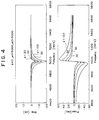
- the Bode diagrams indicate that a frequency band including a central angular frequency which may either be positive or negative is passed with sharp selectivity.
- the equation (7) is of a real-number system and should be provided individually for the two x- and y-axes.
- One specific block diagram of a filter circuit for the equation (7) for the two x- and y-axes is shown in FIG. 18.
- the filter circuit shown in FIG. 18 has a total of four integrators, two for each axis. With "z" being fixed, the gradient of attenuation is constant in a Bode diagram. If the abscissa is drawn on a linear scale, then the sharpness is reduced in a high-frequency range, and the bandwidth equivalently increases.
- FIG. 3A shows in block form a filter circuit according to a second embodiment of the present invention.
- the filter circuit comprises a notch filter for rejecting the passage of a specific frequency signal only.
- a real-number coefficient transfer function which serves as a basis for the notch filter is given as follows: F 2 (s) ⁇ k(s+b)/(s+a), a>b>0
- F 2 (s-j ⁇ ) A complex coefficient transfer function which is represented by F 2 (s-j ⁇ ) which is produced by replacing "s" in the equation (8) with (s-j ⁇ ).
- the filter circuit shown in FIG. 3A is a substantiated form of the real-number coefficient transfer function.
- the filter circuit includes two signal passages for the respective axes which have respective direct passages each having a gain "k”, first order low-pass filters (LPF) branched from and connected parallel to the direct passages, passages connected to output terminals of the low-pass filters for multiplying output signals from the low-pass filters by a gain (a-b) that is produced by subtracting "b" which is half the rejection bandwidth from a break frequency "a" of the low-pass filters, and supplying product signals back to the direct passages, and crossing passages for feeding the output signals from the low-pass filters back to the opposite low-pass filters across between the axes.
- Each of the low-pass filters comprises an integrator and a gain "a” fed back across the integrator, as shown in FIG.
- An angular frequency to be rejected is inserted as a gain in each of the crossing passages.
- the crossing passages are connected to the opposite low-pass filters such that the low-pass filter output signal from the x-axis to the y-axis is added and the low-pass filter output signal from the y-axis to the x-axis is subtracted.
- the filter circuit may be compensated to maintain stable operation by rejecting the passage of only one of positive and negative angular frequencies and giving appropriate phase to the remaining signal.
- FIG. 5 shows in block diagram form a filter circuit according to a third embodiment of the present invention.
- the filter circuit according to the third embodiment is a combination of the filter circuits according to the first and second embodiments, and is functionally equivalent to a series-connected circuit arrangement of the filter circuits according to the first and second embodiments.
- the filter circuit according to the third embodiment passes a positive or negative angular frequency component ⁇ 1 required to form a two-axis control signal and rejects another positive or negative angular frequency component ⁇ 2 .
- the filter circuit is divided into an element which multiplies an input signal by k and passes it, and an element having a first order lag or low-pass filter which contains a complex constant of the second term of the equation (11). Only a process of constructing the second term will be described below.
- Multiplying the denominator and numerator of the equation (10) by conjugate of the denominator to convert the denominator into a real number is not desirable because it would increase both the degrees of order and numbers of the constructiong elements of the system.
- the filter circuit has two direct passages each having a gain of 1 and two parallel circuits branched respectively from the direct passages.
- One of the parallel circuits is given a gain (b-a) produced by subtracting a break frequency "a" of a low-pass filter LPF from "b” which is half the rejection bandwidth, and inputting the gain (b-a) to the low-pass filter LPF.
- the other parallel circuit is given a gain ( ⁇ 1 - ⁇ 2 ), and is connected along a crossing path to the input terminal of the low-pass filter LPF.
- the parallel circuits are connected such that an output signal from a first axis to a second axis is added and an output signal from the second axis to the first axis is subtracted.
- a circuit including a low-pass filter LPF, which is the same as the low-pass filter shown in FIG. 3B, and a crossing feedback loop of ⁇ 1 is the same as described with reference to FIG. 1 except that ⁇ is replaced with "a" and ⁇ is replaced with ⁇ 1 .
- the signal paths for the respective axes have respective integrators and negative feedback loops for feeding back output signals from the integrators, accompanied by ⁇ representing 1/2 of the pass bandwidth.
- the output signals from the integrators are also fed back between the x- and y-axes such that the output signal from the x-axis to the y-axis is fed back as a positive signal and the output signal from the y-axis to the x-axis is fed back as a negative signal.
- An angular frequency ⁇ 1 to be passed is inserted as a gain in the crossing feedback loops.
- Output signals from a bandpass filter as a whole are added to the direct passages.
- FIG. 5 The filter circuit shown in FIG. 5 is effective particularly in the case where ⁇ 1 ⁇ ⁇ 2 , i.e., where only the mode of ⁇ 1 is to be selected and the mode of ⁇ 2 , which is immediately close thereto, is to be untouched.
- "a” is set small so far as the fliter circuit does not oscillate, thus inverting the phase sharply for a bandwidth between the two angular frequencies.
- "b” may be preferably set zero or small quantity for a sharp reverse.
- the gain characteristic has not become totally flat.
- a filter of second order itself has a steep characteristic curve, allows a bump configuration as well as a bandwidth to be selected freely, and also allows positive and negative passbands to be selected freely.
- any optional central angular frequency ⁇ which may be either positive or negative, again as a reference, "s" in the equation (16) is replaced with (s-j ⁇ ).
- the abscissa represents the angular frequency on a linear scale.
- the bandwidth can be given by 2a. Appropriate selection of "z" is effective to improve corners of the bandwidth. The smaller the bandwidth, the steeper the gain characteristic curve.
- FIG. 10 shows in block diagram form a control apparatus which incorporates a control circuit for controlling a rotor according to an embodiment of the present invention.
- the control apparatus extracts a necessary angular frequency component or band, irrespective of whether it may be positive or negative, from an input signal which is output by sensors, gives a necessary phase angle to the component or band, and feeds back the component or band with the given phase angle to stabilize the component or band or utilize the component or band for estimating other information required for control.
- the control circuit is incorporated in a magnetic bearing device having a rotor 1 which is magnetically supported, a pair of electromagnets 2a, 2b for magnetically controlling the rotor 1 on two x- and y-axes perpendicular to the axis of the rotor 1, displacement sensors 3a, 3b for detecting displacements of the rotor 1 along the respective x- and y-axes, and power amplifiers 4a - 4d (see FIG. 12) for transmitting drive signals to the electromagnets 4a ⁇ 4d.
- the control circuit has pass, rejection, or combination filters 5a, 5b, ⁇ for passing respective different frequencies or rejecting nearby unwanted frequency components.
- Complex gain circuits 6a, 6b, ⁇ are connected to the respective filters 5a, 5b, ⁇ .
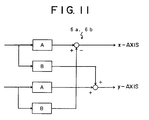
- signal passages for the two radial axes are branched into crossing passages, with a constant A given as a gain to one of the passages and a constant B given as a gain to the other of the passages which are crossing ones.
- the crossing passages are connected to junctions behind the gains A across between the signal passages.
- the crossing passages are connected to the junctions such that an output signal from the x-axis to the y-axis is added to the junction and an output signal from the y-axis to the x-axis is subtracted from the junction.
- the complex gain circuits 6a, 6b, ⁇ allow the phase of their output signals to be increased or decreaced, irrespective of the input frequency, by any optional phase angle tan -1 [B/A] by optionally selecting A, B. At this time, the gain is represented by (A 2 +B 2 ) 1/2 .
- FIGS. 12 and 13 A closed-loop system for stabilizing the above control circuit to control a magnetic bearing, for example, is shown in FIGS. 12 and 13.
- pass filters 5a, 5b select and pass respective frequencies + ⁇ , - ⁇ .
- FIG. 13 is a complex expression block diagram which expresses the dynamic characteristics of the controlled system shown in FIG. 12 as 1/(s 2 + ⁇ 2 ) .
- the complex gain circuits 6a, 6b may operate with a phase lead or lag. Since their gains are free of dynamic characteristics, the gains are not increased with a phase lead insofar as the ratio B/A is maintained and they are not too large. A plurality of passages for selecting frequencies (bands) may be provided, and gains and phases required for stabilization may be given to them.
- FIG. 14 shows a control apparatus which incorporates a control circuit for controlling a rotor according to still another embodiment of the present invention.
- the control apparatus shown in FIG. 14 is employed in the case where an object to be controlled has the same dynamic characteristics as shown in FIG. 13 and comprises electromagnets, for example, for producing control forces, the electromagnets having a time lag of first order with a large time constant T, and where a transfer function for the time lag is represented by 1/(1+Ts), and a +j ⁇ mode is given sufficient damping for some reasons, but only a -j ⁇ is given insufficient damping. In this case, only a -j ⁇ mode component may be selected, given a constant complex gain k , and fed back.
- (1-j ⁇ T) is newly added to the numerator in order to remove the influence of the time lag of first order.
- FIG. 15 shows in block diagram form a tracking filter according to the present invention.
- a tracking filter is used to extract a rotational synchronizing component to remove a vibrational component close to a rotational speed, or to increase the stiffness of a bearing only in the vicinity of a rotational speed.
- the tracking filter according to the present invention resides in that the frequency ⁇ fed back along the crossing passages is not a constant, but a variable, in the bandpass filter described with reference to FIG. 1. Specifically, signals from the displacement sensors 3a, 3b or voltage signals, corresponding to a rotational speed, generated by sensors for detecting the rotational speed, are applied as a variable to multiply output signals from the integrators. ⁇ which is fed back from the output signals from the integrators is one half of the pass bandwidth, and serves to operate as a low-pass filter as well as to prevent the selective passages from oscillating. If ⁇ is suppressed to a magnitude large enough to include an error of a generated voltage corresponding to the rotational speed, then noise and unwanted signals other than the rotational synchronizing signal are filtered out.
Landscapes
- Engineering & Computer Science (AREA)
- General Engineering & Computer Science (AREA)
- Physics & Mathematics (AREA)
- Electromagnetism (AREA)
- Mechanical Engineering (AREA)
- Magnetic Bearings And Hydrostatic Bearings (AREA)
Applications Claiming Priority (2)
| Application Number | Priority Date | Filing Date | Title |
|---|---|---|---|
| JP233276/95 | 1995-08-18 | ||
| JP23327695 | 1995-08-18 |
Publications (2)
| Publication Number | Publication Date |
|---|---|
| EP0760435A2 true EP0760435A2 (fr) | 1997-03-05 |
| EP0760435A3 EP0760435A3 (fr) | 1998-01-07 |
Family
ID=16952561
Family Applications (1)
| Application Number | Title | Priority Date | Filing Date |
|---|---|---|---|
| EP96113263A Withdrawn EP0760435A3 (fr) | 1995-08-18 | 1996-08-19 | Circuit de filtrage et circuit de commande pour la commande d'un rotor |
Country Status (2)
| Country | Link |
|---|---|
| US (1) | US5736801A (fr) |
| EP (1) | EP0760435A3 (fr) |
Cited By (4)
| Publication number | Priority date | Publication date | Assignee | Title |
|---|---|---|---|---|
| US6567758B1 (en) | 1998-12-16 | 2003-05-20 | Paul A. Wuori | Analysis method and analyzer |
| EP0883244A4 (fr) * | 1996-12-04 | 2005-01-12 | Ebara Corp | Circuit filtrant |
| EP1396649A3 (fr) * | 2002-09-03 | 2005-06-08 | BOC Edwards Japan Limited | Dispositif à palier magnétique avec fonction de limitation des vibrations, dispositif à palier magnétique avec fonction d'estimation des vibrations, et dispositif de pompage sur lequel sont montés les dispositifs à palier magnétiques |
| CN110501910A (zh) * | 2019-09-09 | 2019-11-26 | 朱嘉慧 | 多因式开环传函与系统特征辅助函数及闭环传函测算方法 |
Families Citing this family (6)
| Publication number | Priority date | Publication date | Assignee | Title |
|---|---|---|---|---|
| JP3701115B2 (ja) | 1998-02-12 | 2005-09-28 | 株式会社荏原製作所 | 磁気軸受制御装置 |
| JP4036567B2 (ja) * | 1999-01-27 | 2008-01-23 | 株式会社荏原製作所 | 制御形磁気軸受装置 |
| CN103036529B (zh) * | 2011-09-29 | 2017-07-07 | 株式会社大亨 | 信号处理装置、滤波器、控制电路、逆变器和转换器系统 |
| DK2575252T3 (en) * | 2011-09-29 | 2018-10-08 | Daihen Corp | Signal processor, filter, power converter for power converter circuit, connection inverter system and PWM inverter system |
| JP5938216B2 (ja) * | 2012-01-12 | 2016-06-22 | 株式会社ダイヘン | 電力変換回路の制御回路、この制御回路を用いた系統連系インバータシステムおよび単相pwmコンバータシステム |
| CN112947614B (zh) * | 2021-01-28 | 2022-02-25 | 哈尔滨工业大学 | 一种变速倾侧动量轮的主动振动控制方法 |
Family Cites Families (6)
| Publication number | Priority date | Publication date | Assignee | Title |
|---|---|---|---|---|
| JP2776871B2 (ja) * | 1989-03-01 | 1998-07-16 | 株式会社日立製作所 | フーリエ変換バンドパスフイルタ形制御装置 |
| DE58906215D1 (de) * | 1989-07-10 | 1993-12-23 | Siemens Ag | Verfahren und Einrichtung zur Elimination des Einflusses von periodischen Störgrössen mit bekannter, veränderlicher Frequenz. |
| JPH0510326A (ja) * | 1991-06-27 | 1993-01-19 | Matsushita Electric Ind Co Ltd | 磁気軸受の制御装置 |
| US5365787A (en) * | 1991-10-02 | 1994-11-22 | Monitoring Technology Corp. | Noninvasive method and apparatus for determining resonance information for rotating machinery components and for anticipating component failure from changes therein |
| DE69319004T2 (de) * | 1992-03-09 | 1998-12-24 | Hitachi, Ltd., Tokio/Tokyo | Verfahren und Gerät zur Steuerung eines Magnetlagers |
| JP3296074B2 (ja) * | 1994-03-18 | 2002-06-24 | 株式会社日立製作所 | 高速回転体およびそれに用いる磁気軸受の制御装置 |
-
1996
- 1996-08-15 US US08/698,452 patent/US5736801A/en not_active Expired - Fee Related
- 1996-08-19 EP EP96113263A patent/EP0760435A3/fr not_active Withdrawn
Cited By (4)
| Publication number | Priority date | Publication date | Assignee | Title |
|---|---|---|---|---|
| EP0883244A4 (fr) * | 1996-12-04 | 2005-01-12 | Ebara Corp | Circuit filtrant |
| US6567758B1 (en) | 1998-12-16 | 2003-05-20 | Paul A. Wuori | Analysis method and analyzer |
| EP1396649A3 (fr) * | 2002-09-03 | 2005-06-08 | BOC Edwards Japan Limited | Dispositif à palier magnétique avec fonction de limitation des vibrations, dispositif à palier magnétique avec fonction d'estimation des vibrations, et dispositif de pompage sur lequel sont montés les dispositifs à palier magnétiques |
| CN110501910A (zh) * | 2019-09-09 | 2019-11-26 | 朱嘉慧 | 多因式开环传函与系统特征辅助函数及闭环传函测算方法 |
Also Published As
| Publication number | Publication date |
|---|---|
| EP0760435A3 (fr) | 1998-01-07 |
| US5736801A (en) | 1998-04-07 |
Similar Documents
| Publication | Publication Date | Title |
|---|---|---|
| US5736801A (en) | Filter circuit and control circuit for controlling a rotor | |
| US5138883A (en) | Analog torque rebalance loop for a tuned rotor gyroscope | |
| US4121143A (en) | Device for compensating synchronous disturbances in the magnetic suspension of a rotor | |
| US5434467A (en) | Vibrator and detector circuit for vibrating gyro | |
| US10113874B2 (en) | Detection device, sensor, electronic apparatus and moving object | |
| KR20010049414A (ko) | 동기위치제어장치 및 방법 | |
| FR2552222A1 (fr) | Ensemble d'accelerometres pour plate-forme inertielle et plate-forme inertielle le comportant | |
| US5379223A (en) | Inertial measurement and navigation system using digital signal processing techniques | |
| JPS63501245A (ja) | コリオリ力を感知する加速度計配列を使用した慣性計測のための信号プロセッサ | |
| KR20090074788A (ko) | 진동 센서를 사용하여 회전율을 측정하는 장치 | |
| US5203220A (en) | Optical tracking and stabilizing system with a gimbal mounted mirror for establishing a line of sight | |
| JPH02213907A (ja) | 磁気軸受を自動平衡させるためのサーボ制御ループ装置 | |
| EP0883244A1 (fr) | Circuit filtrant | |
| US3992952A (en) | Control system for angular displacement sensor | |
| GB2319085A (en) | Rotation-measurement apparatus having a vibrating mechanical resonator | |
| US5442593A (en) | Apparatus and method of nulling discrete frequency noise signals | |
| US5073747A (en) | Feedback system control device and applications in amplifiers and servomechanisms | |
| US4079630A (en) | Ellipticity control system for angular displacement sensor | |
| JPH09120301A (ja) | 回転体制御用フィルタ回路 | |
| US4189947A (en) | Nutation damper for two-axis gyroscope | |
| US4986139A (en) | Gyroscope control systems | |
| JPH03172711A (ja) | 角速度センサ駆動・検出装置 | |
| RU2177170C2 (ru) | Двухканальный самонастраивающийся автопилот для вращающейся по крену ракеты | |
| JP3349550B2 (ja) | フィルタ回路 | |
| JPH03282032A (ja) | 能動振動制御方法及びその制御装置 |
Legal Events
| Date | Code | Title | Description |
|---|---|---|---|
| PUAI | Public reference made under article 153(3) epc to a published international application that has entered the european phase |
Free format text: ORIGINAL CODE: 0009012 |
|
| AK | Designated contracting states |
Kind code of ref document: A2 Designated state(s): CH DE FR GB LI |
|
| PUAL | Search report despatched |
Free format text: ORIGINAL CODE: 0009013 |
|
| AK | Designated contracting states |
Kind code of ref document: A3 Designated state(s): CH DE FR GB LI |
|
| 17P | Request for examination filed |
Effective date: 19980706 |
|
| 17Q | First examination report despatched |
Effective date: 20020206 |
|
| STAA | Information on the status of an ep patent application or granted ep patent |
Free format text: STATUS: THE APPLICATION IS DEEMED TO BE WITHDRAWN |
|
| 18D | Application deemed to be withdrawn |
Effective date: 20020618 |