EP0760562A2 - Kontrollsystem für Kommunikationsprozedur - Google Patents
Kontrollsystem für Kommunikationsprozedur Download PDFInfo
- Publication number
- EP0760562A2 EP0760562A2 EP96306320A EP96306320A EP0760562A2 EP 0760562 A2 EP0760562 A2 EP 0760562A2 EP 96306320 A EP96306320 A EP 96306320A EP 96306320 A EP96306320 A EP 96306320A EP 0760562 A2 EP0760562 A2 EP 0760562A2
- Authority
- EP
- European Patent Office
- Prior art keywords
- synchronization
- data
- procedure
- transmission
- video
- Prior art date
- Legal status (The legal status is an assumption and is not a legal conclusion. Google has not performed a legal analysis and makes no representation as to the accuracy of the status listed.)
- Granted
Links
Images







Classifications
-
- H—ELECTRICITY
- H04—ELECTRIC COMMUNICATION TECHNIQUE
- H04J—MULTIPLEX COMMUNICATION
- H04J3/00—Time-division multiplex systems
- H04J3/02—Details
- H04J3/06—Synchronising arrangements
- H04J3/0602—Systems characterised by the synchronising information used
- H04J3/0605—Special codes used as synchronising signal
-
- H—ELECTRICITY
- H04—ELECTRIC COMMUNICATION TECHNIQUE
- H04N—PICTORIAL COMMUNICATION, e.g. TELEVISION
- H04N7/00—Television systems
- H04N7/24—Systems for the transmission of television signals using pulse code modulation
- H04N7/52—Systems for transmission of a pulse code modulated video signal with one or more other pulse code modulated signals, e.g. an audio signal or a synchronizing signal
- H04N7/54—Systems for transmission of a pulse code modulated video signal with one or more other pulse code modulated signals, e.g. an audio signal or a synchronizing signal the signals being synchronous
- H04N7/56—Synchronising systems therefor
Definitions
- a method for multiplexing audio information, video information and data in a transmission line is defined by ITU-T Recommendation H.221.
- Information to be multiplexed according to the H.221 has various forms: audio, image, LSD (Low-Speed Data), HSD (High-Speed Data), MLP (Multilayer Protocol), HMLP (High-Speed Multilayer Protocol) and ECS (Encryption Control Signal).
- LSD and HSD may have free contents for applications, e.g., data for external device control, character data, highly fine color still image and facsimile.
- one 64-kbps channel B is constructed of octets to be transmitted at 8 kHz.
- a data unit is a frame of 80 octets, a sub-multiframe consisting of 2 frames, and a multiframe consisting of 8 sub-multiframes.
- a receiver establishes synchronization of every data unit by detecting a frame alignment (synchronizing) word (FAW) and a multiframe alignment (synchronizing) word (MFAW). Recognition of establishment or getting-out of synchronization is made with front two-step alignment guard and back two-step alignment guard operations.
- FAW frame alignment
- MFAW multiframe alignment
- bit arrangement of multiplexed different kinds of signals There is an example of bit arrangement of multiplexed different kinds of signals according to H.211.
- information consisting of audio 48 kbps, video 68.8 kbps and LSD 8 kbps is multiplexed to be transmitted over 2B channels.
- a communication party (receiving terminal) is informed by BAS (Bitrate Allocation Signal) codes of how the information was multiplexed.
- BAS Bit Allocation Signal
- a receiving terminal after establishment of frame alignment (synchronization) and multiframe alignment separates multiplexed information referring to the received BAS codes.
- the BAS code is transmitted one for each sub-multiframe.
- the separated information e,g., image data is handled as follows:
- ITU-T Recommendation H.261 defines an image coding method.
- the channel coding enables the detection and correction of transmission error at communicating terminals.
- Forward Error Correction (FEC) is conducted by using BCH (Bose Chaudhuri Hocquenghem) code of "511, 493".
- BCH Bose Chaudhuri Hocquenghem
- This channel coding is to add an error-correcting code of 18 bits to a file identifier (Fi) of 1 bit and coded image data of 492 bits.
- the receiving terminal first detects synchronizing bit pattern of a FEC frame and then decodes coded image data correcting error by using error correcting parity bit.
- a sending party and a receiving party negotiate with each other to determine how to multiplex and transmit the above-mentioned different kinds of information, i.e., transmission mode not to exceed the receiving capability of parties.
- This negotiation is defined as a communication procedure using BAS codes according to the ITU-T Recommendation H.242.
- the Recommendation provides that BAS code itself consists of double error-correcting code (16, 8). Namely, it uses such protection that the received BAS code is considered to be invalid if an error of not less than 3 bits occurred in a frame synchronization word in the same sub-multiframe, and three of the BAS codes received just before the frame synchronization was lost is also considered to be invalid.
- the double error-correcting code (16, 8) has 8 error correcting bits added to 8 bits of BAS code.
- the above-mentioned protection is ineffective if an uncorrectable transmission-line error occurred only in BAS data strings. In consequence of the transmission error in BAS code, incorrect separation of the received information occurs.
- a conventional communication procedure control system that includes a video synchronization monitoring portion for monitoring the video FEC synchronization in a video data decoding, a data synchronization monitoring portion for monitoring synchronization of synchronous data and a H.211 frame-synchronization monitoring portion for monitoring the synchronization of the H.211 frame.
- These monitoring portions detect loss of the FEC synchronization in a video data decoding portion and loss of the data synchronization in a data receiving portion when the received information was incorrectly separated.
- a transmission procedure executing portion recognizes that the receiving mode of the receiving terminal does not match with the transmitting mode of the sending terminal and then executes the mode-mismatch recovering procedure.
- This procedure repeats the negotiation of a communication mode at the beginning of the communication between them as shown in the latter stage of the mode-mismatch recovery procedure, whereat the communication will be once conducted only in an initial mode of audio ⁇ -law OF for call-setting-up.
- the transmission mode is then determined by the negotiation and the receiving party is informed of the multiplexing conditions and multiplexed information to establish again the initially intended communication mode.
- MLP 6.4 kbps is multiplied to the transmission state and a resultant transmission state is recognized with a result of incorrect separation of the three kinds of information. Namely, a part of video data is recognized as MLP (M1, M2, ...) and, therefore, the video (FEC) synchronization is lost and will not be restored.
- the data (LSD) can be correctly separated keeping the data synchronization because the transmission condition of both is the same.
- the conventional mode-mismatch recovering procedure is executed again starting with only speech communication, causing interruption of data transmission.
- the present invention relates to a communication procedure control system that can exactly execute error recovery procedure whenever out-of-synchronization condition occurs in any portion during multiplex transmission of data framed according to the ITU-T Recommendation No. H.221 and which can be applied to communications with audiovisual terminals.
- the present invention has, as its object the provision of a communication procedure control system which, in the event that any of different kinds of multiplexed data after separation is pulled out of synchronization (except for the H.221 frame alignment being maintained), can recover the normal synchronous transmission condition from the mismatched mode condition without interrupting transmission of information in the established synchronization.
- the present invention provides a communication procedure control system comprising data synchronization monitoring means for monitoring data synchronization of different kinds of data separated after having been received in the form of a frame H.221 over a multiplex transmission line, frame synchronization monitoring means for monitoring alignment of the frame H.221 and transmission procedure executing means for executing a synchronization recovery procedure and a mode-mismatch recovering procedure in the case that synchronization is lost and can not be restored after the elapse of a specified time;
- the communication procedure control system includes the synchronization control means for conducting overall control of synchronization of H.221 frames, video FEC synchronization and data synchronization and for making a request for executing a transmission procedure suitable for synchronizing condition of signal. Using this function, the system can execute mode-mismatch recovering procedure without interrupting transmission of information which synchronization being established.
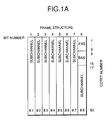
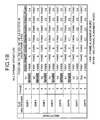
- Figures 1A and 1B are illustrative of a frame structure according to the recommendation H.221 of ITU-T.
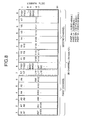
- Figure 2 shows an example of bit arrangement for multiplexing signals by using frames H.221.
- Figure 3 is illustrative of a method for communication line coding system according to the recommendation H.261 of ITU-T.
- Figure 4 shows an exemplified state in which an error is added to BAS code.
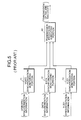
- Figure 5 is a block diagram of a control portion of a conventional transmission control system.
- Figure 6 shows an example of recognition of a BAS code with the error attached thereto.
- Figure 7 shows an example of a sequence of BAS codes to be transmitted and received when executing a mode initializing procedure and a mode mismatch recovering procedure according to a conventional transmission control system.
- Figure 8 is another example of bit arrangement for multiplexing signals by using frames H.221.
- Figure 9 is a block diagram of a control portion of a communication procedure control system embodying the present invention.
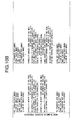
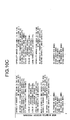
- Figure 10 (10A, 10B and 10C) shows an example of a sequence of BAS codes to be transmitted and received when executing a mode initializing procedure and a mode mismatch recovering procedure according to the present invention.
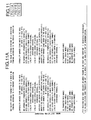
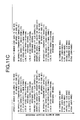
- Figure 11 shows an example of a sequence of BAS codes to be transmitted and received when executing a mode initializing procedure and a mode mismatch recovering procedure according to a communication procedure control system according to the present invention.
- a method for multiplexing audio information, video information and data in a transmission line is defined by ITU-T Recommendation H.221.
- Information to be multiplexed according to the H.221 has various forms: audio, image, LSD (Low-Speed Data), HSD (High-Speed Data), MLP (Multilayer Protocol), HMLP (High-Speed Multilayer Protocol) and ECS (Encryption Control Signal).
- LSD and HSD may have free contents for applications, e.g., data for external device control, character data, highly fine color still image and facsimile.
- Fig. 1A and Fig. 1B illustrate a frame structure according to the H.221.
- One 64-kbps channel B is constructed of octets to be transmitted at 8 kHz.
- a data unit is a frame of 80 octets (see Fig. 1A), sub-multiframe consisting of 2 or 8 unit frames, and a multiframe consisting of 8 sub-multiframes (see Fig. 1B).
- a receiver establishes synchronization of every data unit by detecting a frame alignment (synchronizing) word (FAW) and a multiframe alignment (synchronizing) word (MFAW). Recognition of establishment or getting-out of synchronization is made with front two-step alignment guard and back two-step alignment guard operations.
- FAW frame alignment
- MFAW multiframe alignment
- Fig. 2 shows an example of bit arrangement of multiplexed different kinds of signals according to H.211.
- Information consisting of audio 48 kbps, video 68.8 kbps and LSD 8 kbps is multiplexed to be transmitted over 2B channels.
- a communication party (receiving terminal) is informed by BAS codes (see Fig. 2) of how the information was multiplexed.
- BAS codes see Fig. 2 of how the information was multiplexed.
- a receiving terminal after establishment of frame alignment (synchronization) and multiframe alignment separates multiplexed information referring to the received BAS codes.
- the BAS code is transmitted one for each sub-multiframe.
- the separated information e.g., image data is handled as follows:
- Fig. 3 is a view for explaining a channel coding method according to the ITU-T Recommendation standard H.261.
- This recommended standard H.261 defines an image coding method.
- the channel coding enables the detection and correction of transmission error at communicating terminals.
- Forward Error Correction (FEC) is conducted by using BCH (Bose Chaudhuri Hocquenghem) code of "511, 493".
- BCH Bose Chaudhuri Hocquenghem
- This channel coding is to add an error-correcting code of 18 bits to a file identifier (Fi) of 1 bit and coded image data of 492 bits.
- the receiving terminal first detects synchronizing bit pattern S1 to S8 of a FEC frame and then decodes coded image data correcting error by using error correcting parity bit.
- a sending party and a receiving party negotiate with each other to determine how to multiplex and transmit the above-mentioned different kinds of information, i.e., transmission mode not to exceed the receiving capability of parties.
- This negotiation is defined as a communication procedure using BAS codes according to the ITU-T Recommendation standard H.242.
- the Recommendation standard (H.242) provides that BAS code itself consists of double error-correcting code (16, 8). Namely, it uses such protection that the received BAS code is considered to be invalid if an error of not less than 3 bits occurred in a frame synchronization word in the same sub-multiframe, and three of the BAS codes received just before the frame synchronization was lost is also considered to be invalid.
- the double error-correcting code (16, 8) has 8 error correcting bits added to 8 bits of BAS code.
- the above-mentioned protection is ineffective if an uncorrectable transmission-line error occurred only in BAS data strings as shown in Fig. 4. In consequence of the transmission error in BAS code, incorrect separation of the received information occurs.
- Fig. 5 is a block diagram of a conventional communication procedure control system that includes a video synchronization monitoring portion 11 for monitoring the video FEC synchronization in a video data decoding, a data synchronization monitoring portion 12 for monitoring synchronization of synchronous data and a H.211 frame-synchronization monitoring portion 13 for monitoring the synchronization of the H.211 frame.
- These monitoring portions detect loss of the FEC synchronization in a video data decoding portion and loss of the data synchronization in a data receiving portion when the received information was incorrectly separated.
- Figs. 6 and 7A show an example of erroneous recognition BAS code, where a sequence LSD8k of BAS codes in a sub-multiframe SMFn+7 transmitted from a sending terminal is incorrectly recognized as MLP6.4k in the received sequence of BAS codes.
- Figs. 7B and 7C shows an example of a sequence of BAS codes to be transmitted and received when a mode mismatch recovering procedure: the above-mentioned erroneous recognition occurred in a mode-initializing procedure (as shown in Fig. 7A) resulting in loosing video synchronization.
- a transmission procedure executing portion 15' recognizes that the receiving mode of the receiving terminal does not match with the transmitting mode of the sending terminal and then executes the mode-mismatch recovering procedure.
- This procedure repeats the negotiation of a communication mode at the beginning of the communication between them as shown in the latter stage of the mode-mismatch recovery procedure (shown in Figs. 7B and 7C), whereat the communication will be once conducted only in an initial mode of audio ⁇ -law OF for call-setting-up.
- the transmission mode is then determined by the negotiation and the receiving party is informed of the multiplexing conditions and multiplexed information to establish again the initially intended communication mode.
- a resultant transmission state of Fig. 8 is recognized with a result of incorrect separation of the three kinds of information. Namely, a part of video data is recognized as MLP (M1, M2, ...) and, therefore, the video (FEC) synchronization is lost and will not be restored.
- the data (LSD) can be correctly separated keeping the data synchronization because the transmission condition of Fig. 2 is the same as that of the transmission conditions of Fig. 8.
- the conventional mode-mismatch recovering procedure is executed again starting with only speech communication, causing interruption of data transmission.
- Fig. 9 is a block diagram of a control portion of a communication procedure control system embodying the present invention.
- a video-synchronization monitoring portion 11 monitors FEC synchronization of video data in a video-data decoding portion
- a data synchronization monitoring portion 12 monitors synchronization of synchronous data in a data receiving portion
- a H.221 synchronization monitoring portion 13 monitors frame synchronization of each H.221 frame.
- a synchronization control portion 14 is connected to the video-synchronization monitoring portion 11, the data synchronization monitoring portion 12 and the H.221 synchronization monitoring portion 13. It realizes overall control of the synchronized conditions of every kind of information and makes a request for executing mode-mismatch recovering procedure in the case that synchronization of any kind of information was lost and could not be restored after the elapse of a specified time.
- a transmission procedure executing portion 15 is connected to the synchronization control portion 14 and executes the synchronization restoring procedure and the mode-mismatch recovering procedure.
- Fig. 10 shows an example of a string of BAS codes to be transmitted when executing a mode-mismatch recovering procedure (shown in Figs. 10B and 10C) according to the present invention in the case that the FEC synchronization of video signals is lost and the synchronization of LSD data is kept as established.
- the shown example will be explained below in comparison with the string of BAS codes to be transmitted when executing the conventional mode-mismatch recovering procedure (shown in Figs. 7B and 7C).
- one terminal has a BAS code set of transmission capability ⁇ 2B Capability, G.722-48k, Capability Au16kb/s, CIF, 1/29.97, 1/29.97, Capability LSD9.6k, Capability LSD8k, Capability MLP6.4k ⁇ and the other terminal has a BAS code set of transmission capability ⁇ Capability 2B, G.722-48k, CIF, 2/29.97, 3/29.97, Capability LSD8k, Capability MLP6.4k ⁇ .
- a BAS command set specifying a transmission mode of the receiving terminal is determined as ⁇ 2B, G.722m3, H.261, LSD8kb/s ⁇ and a BAS command set specifying a transmission mode of a sending terminal becomes the same as that of the receiving terminal.
- a BAS code of MLP6.4kb/s is incorrectly recognized resulting in that the video FEC synchronization is lost and can not be restored but the H.221-frame alignment and the data synchronization are kept as established.
- the prior art system transmits a BAS command set ⁇ 1B, ⁇ -law OF, video OFF, LSD OFF ⁇ and then a capability-indicating BAS code set ⁇ Capability 1B, Capability ⁇ -law ⁇ .
- the receiving terminal which received the capability-indicating BAS code set during the communication with the sending terminal, transmits a BAS code set indicating own capability to the sending terminal and then carries-out again negotiation to determine a transmission mode like at the communication starting stage.
- the receiving terminal presents that it is capable of receiving only audio signal of ⁇ -law and incapable of receiving video and data LSD and MLD.
- the sending terminal stops transmission of video and data LSD and sends only audio signal of ⁇ -law OF to restore the initial call setting-up mode.
- the receiving terminal stops separation of video, data LSD and erroneously recognized data MLP. Like the mode initializing procedure at the beginning of data communication, the both terminals send and receive the capability-indicating BAS code set, determines the communication mode and sends and receives the BAS command set. The mismatched mode condition is corrected and accurate data transmission is achieved.
- the communication procedure control system Under the condition that the video FEC synchronization is lost and can not be restored but the H.221 frame alignment and the data synchronization are kept as established over the LSD transmission line, the communication procedure control system according to the present invention first transmits the BAS command set ⁇ 2B, ⁇ -law OF, Video OFF, LSD8k ⁇ and then the capability-indicating BAS code set ⁇ 2B Capability, ⁇ -Law Capability, LSD8k Capability ⁇ to initialize video, MLP data and asynchronous audio modes.
- the receiving terminal informed that it can receive audio signals of ⁇ -law and data of LSD8k but can not receive video signals and MLP data, and the sending terminal, therefore, stops the transmission of video signals and continues transmission of LSD8k data and selects the speech communication " ⁇ -Law OF".
- the receiving terminal stops separation of video signals and erroneously recognized MLP data.
- the both terminals send and receive the capability-indicating BAS code set, determines the communication mode and sends and receives the BAS command set.
- the mismatched mode condition is corrected and correct transmission of various kinds of information is resumed. Namely, according to the present invention, the recovery from mismatched mode can be achieved, keeping the LSD transmission line in its synchronized condition.
- Fig. 11 shows an example of mode-mismatch recovering means according to the present invention, which operates, by way of example, under the condition that synchronization of FED video signals is maintained but synchronization of LSD data is lost.
- a receiving terminal and a sending terminal are assumed to have the same transmission capability ⁇ 2B capability, G.722-48k, CIF, 1/29.97, 1/29.97, Variable LSD capability, Encrypting capability ⁇ .
- both terminals have the same BAS codes ⁇ 2B, G.722m3, H.261, Variable LSD ⁇ .
- a BAS code of encryption ON is incorrectly recognized resulting in that the LSD data synchronization is lost and can not be restored but the H.221-frame alignment and the FEC video synchronization are maintained as established.
- the receiving terminal in this instance first transmits the BAS command set ⁇ 2B, ⁇ -law OF, H.261, LSD OFF ⁇ and then the capability-indicating BAS code set ⁇ 2B Capability, ⁇ -Law Capability, CIF, 1/29.97, 1/29.97 ⁇ .
- the receiving terminal informed the sending terminal that it can receive audio signals of ⁇ -law and data of LSD8k but can not receive video signals and MLP data.
- the sending terminal therefore, stops transmission of LSD data and continues transmission of video signals and selects the speech communication " ⁇ -Law OF".
- the receiving terminal stops separation of video signals and incorrectly recognized encrypted data.
- the both terminals send and receive the capability-indicating BAS set, determine the communication mode and send and receive the BAS command set.
- the mismatched mode condition is corrected and accurate transmission of various kinds of information is restored. Namely, according to the present invention, the recovery from the mismatched mode can be achieved, keeping the video transmission line in its synchronized condition.
- the present invention offers the following advantages:
- the communication procedure control system is also applicable to transmission of various kinds of data such as video-data and synchronous data.
Landscapes
- Engineering & Computer Science (AREA)
- Signal Processing (AREA)
- Multimedia (AREA)
- Computer Networks & Wireless Communication (AREA)
- Time-Division Multiplex Systems (AREA)
- Synchronisation In Digital Transmission Systems (AREA)
- Communication Control (AREA)
- Two-Way Televisions, Distribution Of Moving Picture Or The Like (AREA)
Applications Claiming Priority (3)
| Application Number | Priority Date | Filing Date | Title |
|---|---|---|---|
| JP222108/95 | 1995-08-30 | ||
| JP22210895A JPH0969822A (ja) | 1995-08-30 | 1995-08-30 | 通信手順制御システム |
| JP22210895 | 1995-08-30 |
Publications (3)
| Publication Number | Publication Date |
|---|---|
| EP0760562A2 true EP0760562A2 (de) | 1997-03-05 |
| EP0760562A3 EP0760562A3 (de) | 1999-06-23 |
| EP0760562B1 EP0760562B1 (de) | 2004-10-27 |
Family
ID=16777275
Family Applications (1)
| Application Number | Title | Priority Date | Filing Date |
|---|---|---|---|
| EP19960306320 Expired - Lifetime EP0760562B1 (de) | 1995-08-30 | 1996-08-30 | Kontrollsystem für Kommunikationsprozedur |
Country Status (3)
| Country | Link |
|---|---|
| EP (1) | EP0760562B1 (de) |
| JP (1) | JPH0969822A (de) |
| DE (1) | DE69633702T2 (de) |
Cited By (3)
| Publication number | Priority date | Publication date | Assignee | Title |
|---|---|---|---|---|
| WO1999012299A1 (de) * | 1997-08-29 | 1999-03-11 | Siemens Aktiengesellschaft | Verfahren und kommunikationssystem zur synchronisation zweier vorrichtungen auf ein vorgebbares datenübertragungsverfahren |
| EP0973329A3 (de) * | 1998-07-06 | 2000-10-25 | General Instrument Corporation | HDTV-Rahmensynchronisierungssystem ,das ein sauberes digitales Signal liefert ohne variable Verzögerung |
| CN112565664A (zh) * | 2020-11-27 | 2021-03-26 | 北京融讯科创技术有限公司 | 视频会议码流反馈方法、装置、设备及计算机可读存储介质 |
Families Citing this family (1)
| Publication number | Priority date | Publication date | Assignee | Title |
|---|---|---|---|---|
| JP3374795B2 (ja) | 1999-07-29 | 2003-02-10 | 株式会社豊田自動織機 | 産業車両のフェンダーカバー一体ステップ |
Family Cites Families (3)
| Publication number | Priority date | Publication date | Assignee | Title |
|---|---|---|---|---|
| JP3226945B2 (ja) * | 1991-10-02 | 2001-11-12 | キヤノン株式会社 | マルチメディア通信装置 |
| US5537150A (en) * | 1992-05-01 | 1996-07-16 | Canon Kabushiki Kaisha | Image processing apparatus and image communicating apparatus |
| JPH0638188A (ja) * | 1992-07-20 | 1994-02-10 | Canon Inc | ブロック歪み除去装置 |
-
1995
- 1995-08-30 JP JP22210895A patent/JPH0969822A/ja active Pending
-
1996
- 1996-08-30 EP EP19960306320 patent/EP0760562B1/de not_active Expired - Lifetime
- 1996-08-30 DE DE1996633702 patent/DE69633702T2/de not_active Expired - Lifetime
Cited By (5)
| Publication number | Priority date | Publication date | Assignee | Title |
|---|---|---|---|---|
| WO1999012299A1 (de) * | 1997-08-29 | 1999-03-11 | Siemens Aktiengesellschaft | Verfahren und kommunikationssystem zur synchronisation zweier vorrichtungen auf ein vorgebbares datenübertragungsverfahren |
| US6687318B1 (en) | 1997-08-29 | 2004-02-03 | Siemens Aktiengesellschaft | Method and communication system for synchronizing two devices with a predeterminable data transmission method |
| EP0973329A3 (de) * | 1998-07-06 | 2000-10-25 | General Instrument Corporation | HDTV-Rahmensynchronisierungssystem ,das ein sauberes digitales Signal liefert ohne variable Verzögerung |
| CN112565664A (zh) * | 2020-11-27 | 2021-03-26 | 北京融讯科创技术有限公司 | 视频会议码流反馈方法、装置、设备及计算机可读存储介质 |
| CN112565664B (zh) * | 2020-11-27 | 2023-04-28 | 北京融讯科创技术有限公司 | 视频会议码流反馈方法、装置、设备及计算机可读存储介质 |
Also Published As
| Publication number | Publication date |
|---|---|
| EP0760562A3 (de) | 1999-06-23 |
| EP0760562B1 (de) | 2004-10-27 |
| DE69633702D1 (de) | 2004-12-02 |
| DE69633702T2 (de) | 2006-02-02 |
| JPH0969822A (ja) | 1997-03-11 |
Similar Documents
| Publication | Publication Date | Title |
|---|---|---|
| US5343462A (en) | Fault notifying system for asynchronous transfer mode communication system | |
| JPH03267846A (ja) | 非同期伝送用codec装置 | |
| EP0244629B1 (de) | Funkübertragungssystem mit vereinfachter Fehlerkorrekturschaltung und schneller Kanalumschaltung | |
| EP0653871A1 (de) | Seitenkanalkommunikation bei gleichzeitiger Sprach- und Datenübertragung | |
| KR100238133B1 (ko) | 영상전화기의 화상 복구 장치 및 방법 | |
| JPH11225128A (ja) | 同期通信網における端局、現用/予備切替機能のミスマッチ検出装置、及びその方法 | |
| JP3556323B2 (ja) | 中継装置 | |
| EP0760562B1 (de) | Kontrollsystem für Kommunikationsprozedur | |
| US20040267951A1 (en) | Data transmission system, data transmission apparatus, data reception apparatus, and data transmission method | |
| EP0196647B1 (de) | Digitales Übertragungssystem | |
| EP1389849B1 (de) | Verfahren und Vorrichtung zur Detektion falscher Synchronisation und zur Rückgewinnung der Synchronisation | |
| US20030112463A1 (en) | Path control method, a transmitter circuit, and a receiver circuit | |
| CA2152177C (en) | Method and system for synchronizing an encoder and a decoder when an error is detected upon transmission of encoded data on communication networks | |
| JP2001119392A (ja) | Isdn暗号アダプタおよびisdn暗号通信方法 | |
| US8713238B1 (en) | Recovery of a hot-pluggable serial communication link | |
| JP3295834B2 (ja) | 時分割多重データ受信装置 | |
| JP2776302B2 (ja) | 冗長構成を有する補助信号伝送システム | |
| JP2859002B2 (ja) | 同期信号処理装置 | |
| JP2003069614A (ja) | データ伝送装置 | |
| JP2964653B2 (ja) | 伝送装置 | |
| JPH01180143A (ja) | 補助信号伝送方式 | |
| JPH0575695A (ja) | Crc手順利用/非利用自動切替回路 | |
| JPH11284661A (ja) | データ監視装置および方法 | |
| JPH07177484A (ja) | 多地点間通信制御装置 | |
| JPH1042262A (ja) | 画像通信端末装置 |
Legal Events
| Date | Code | Title | Description |
|---|---|---|---|
| PUAI | Public reference made under article 153(3) epc to a published international application that has entered the european phase |
Free format text: ORIGINAL CODE: 0009012 |
|
| AK | Designated contracting states |
Kind code of ref document: A2 Designated state(s): DE FR GB |
|
| PUAL | Search report despatched |
Free format text: ORIGINAL CODE: 0009013 |
|
| RIC1 | Information provided on ipc code assigned before grant |
Free format text: 6H 04J 3/06 A, 6H 04N 7/56 B, 6H 04N 7/66 B |
|
| AK | Designated contracting states |
Kind code of ref document: A3 Designated state(s): DE FR GB |
|
| 17P | Request for examination filed |
Effective date: 19991220 |
|
| 17Q | First examination report despatched |
Effective date: 20011116 |
|
| GRAP | Despatch of communication of intention to grant a patent |
Free format text: ORIGINAL CODE: EPIDOSNIGR1 |
|
| GRAS | Grant fee paid |
Free format text: ORIGINAL CODE: EPIDOSNIGR3 |
|
| GRAA | (expected) grant |
Free format text: ORIGINAL CODE: 0009210 |
|
| AK | Designated contracting states |
Kind code of ref document: B1 Designated state(s): DE FR GB |
|
| REG | Reference to a national code |
Ref country code: GB Ref legal event code: FG4D |
|
| REF | Corresponds to: |
Ref document number: 69633702 Country of ref document: DE Date of ref document: 20041202 Kind code of ref document: P |
|
| ET | Fr: translation filed | ||
| PLBE | No opposition filed within time limit |
Free format text: ORIGINAL CODE: 0009261 |
|
| STAA | Information on the status of an ep patent application or granted ep patent |
Free format text: STATUS: NO OPPOSITION FILED WITHIN TIME LIMIT |
|
| 26N | No opposition filed |
Effective date: 20050728 |
|
| REG | Reference to a national code |
Ref country code: FR Ref legal event code: PLFP Year of fee payment: 20 |
|
| PGFP | Annual fee paid to national office [announced via postgrant information from national office to epo] |
Ref country code: DE Payment date: 20150825 Year of fee payment: 20 Ref country code: GB Payment date: 20150826 Year of fee payment: 20 |
|
| PGFP | Annual fee paid to national office [announced via postgrant information from national office to epo] |
Ref country code: FR Payment date: 20150811 Year of fee payment: 20 |
|
| REG | Reference to a national code |
Ref country code: DE Ref legal event code: R071 Ref document number: 69633702 Country of ref document: DE |
|
| REG | Reference to a national code |
Ref country code: GB Ref legal event code: PE20 Expiry date: 20160829 |
|
| PG25 | Lapsed in a contracting state [announced via postgrant information from national office to epo] |
Ref country code: GB Free format text: LAPSE BECAUSE OF EXPIRATION OF PROTECTION Effective date: 20160829 |