EP0761732B1 - Procede de degradation de polymere - Google Patents
Procede de degradation de polymere Download PDFInfo
- Publication number
- EP0761732B1 EP0761732B1 EP96903251A EP96903251A EP0761732B1 EP 0761732 B1 EP0761732 B1 EP 0761732B1 EP 96903251 A EP96903251 A EP 96903251A EP 96903251 A EP96903251 A EP 96903251A EP 0761732 B1 EP0761732 B1 EP 0761732B1
- Authority
- EP
- European Patent Office
- Prior art keywords
- days
- carrier
- degraded
- microorganism
- longer
- Prior art date
- Legal status (The legal status is an assumption and is not a legal conclusion. Google has not performed a legal analysis and makes no representation as to the accuracy of the status listed.)
- Expired - Lifetime
Links
Images
Classifications
-
- C—CHEMISTRY; METALLURGY
- C08—ORGANIC MACROMOLECULAR COMPOUNDS; THEIR PREPARATION OR CHEMICAL WORKING-UP; COMPOSITIONS BASED THEREON
- C08J—WORKING-UP; GENERAL PROCESSES OF COMPOUNDING; AFTER-TREATMENT NOT COVERED BY SUBCLASSES C08B, C08C, C08F, C08G or C08H
- C08J11/00—Recovery or working-up of waste materials
-
- C—CHEMISTRY; METALLURGY
- C12—BIOCHEMISTRY; BEER; SPIRITS; WINE; VINEGAR; MICROBIOLOGY; ENZYMOLOGY; MUTATION OR GENETIC ENGINEERING
- C12P—FERMENTATION OR ENZYME-USING PROCESSES TO SYNTHESISE A DESIRED CHEMICAL COMPOUND OR COMPOSITION OR TO SEPARATE OPTICAL ISOMERS FROM A RACEMIC MIXTURE
- C12P1/00—Preparation of compounds or compositions, not provided for in groups C12P3/00 - C12P39/00, by using microorganisms or enzymes
- C12P1/04—Preparation of compounds or compositions, not provided for in groups C12P3/00 - C12P39/00, by using microorganisms or enzymes by using bacteria
-
- C—CHEMISTRY; METALLURGY
- C08—ORGANIC MACROMOLECULAR COMPOUNDS; THEIR PREPARATION OR CHEMICAL WORKING-UP; COMPOSITIONS BASED THEREON
- C08J—WORKING-UP; GENERAL PROCESSES OF COMPOUNDING; AFTER-TREATMENT NOT COVERED BY SUBCLASSES C08B, C08C, C08F, C08G or C08H
- C08J11/00—Recovery or working-up of waste materials
- C08J11/04—Recovery or working-up of waste materials of polymers
- C08J11/06—Recovery or working-up of waste materials of polymers without chemical reactions
-
- C—CHEMISTRY; METALLURGY
- C12—BIOCHEMISTRY; BEER; SPIRITS; WINE; VINEGAR; MICROBIOLOGY; ENZYMOLOGY; MUTATION OR GENETIC ENGINEERING
- C12N—MICROORGANISMS OR ENZYMES; COMPOSITIONS THEREOF; PROPAGATING, PRESERVING, OR MAINTAINING MICROORGANISMS; MUTATION OR GENETIC ENGINEERING; CULTURE MEDIA
- C12N1/00—Microorganisms; Compositions thereof; Processes of propagating, maintaining or preserving microorganisms or compositions thereof; Processes of preparing or isolating a composition containing a microorganism; Culture media therefor
-
- C—CHEMISTRY; METALLURGY
- C12—BIOCHEMISTRY; BEER; SPIRITS; WINE; VINEGAR; MICROBIOLOGY; ENZYMOLOGY; MUTATION OR GENETIC ENGINEERING
- C12N—MICROORGANISMS OR ENZYMES; COMPOSITIONS THEREOF; PROPAGATING, PRESERVING, OR MAINTAINING MICROORGANISMS; MUTATION OR GENETIC ENGINEERING; CULTURE MEDIA
- C12N11/00—Carrier-bound or immobilised enzymes; Carrier-bound or immobilised microbial cells; Preparation thereof
- C12N11/02—Enzymes or microbial cells immobilised on or in an organic carrier
- C12N11/04—Enzymes or microbial cells immobilised on or in an organic carrier entrapped within the carrier, e.g. gel or hollow fibres
-
- C—CHEMISTRY; METALLURGY
- C12—BIOCHEMISTRY; BEER; SPIRITS; WINE; VINEGAR; MICROBIOLOGY; ENZYMOLOGY; MUTATION OR GENETIC ENGINEERING
- C12N—MICROORGANISMS OR ENZYMES; COMPOSITIONS THEREOF; PROPAGATING, PRESERVING, OR MAINTAINING MICROORGANISMS; MUTATION OR GENETIC ENGINEERING; CULTURE MEDIA
- C12N11/00—Carrier-bound or immobilised enzymes; Carrier-bound or immobilised microbial cells; Preparation thereof
- C12N11/14—Enzymes or microbial cells immobilised on or in an inorganic carrier
-
- C—CHEMISTRY; METALLURGY
- C12—BIOCHEMISTRY; BEER; SPIRITS; WINE; VINEGAR; MICROBIOLOGY; ENZYMOLOGY; MUTATION OR GENETIC ENGINEERING
- C12P—FERMENTATION OR ENZYME-USING PROCESSES TO SYNTHESISE A DESIRED CHEMICAL COMPOUND OR COMPOSITION OR TO SEPARATE OPTICAL ISOMERS FROM A RACEMIC MIXTURE
- C12P1/00—Preparation of compounds or compositions, not provided for in groups C12P3/00 - C12P39/00, by using microorganisms or enzymes
-
- C—CHEMISTRY; METALLURGY
- C12—BIOCHEMISTRY; BEER; SPIRITS; WINE; VINEGAR; MICROBIOLOGY; ENZYMOLOGY; MUTATION OR GENETIC ENGINEERING
- C12R—INDEXING SCHEME ASSOCIATED WITH SUBCLASSES C12C - C12Q, RELATING TO MICROORGANISMS
- C12R2001/00—Microorganisms ; Processes using microorganisms
Definitions
- This invention relates to a method for degrading a polymer, especially a polymer having biodegradability with a microorganism.
- High molecular compounds typified by plastics are abundantly produced and used around the world in a wide variety of fields for their convenient properties of lightness and strength.
- wastes of used high molecular compounds generally do not degrade in the natural environment. Even if they are buried, they therefore remain undegraded and accumulate year after year in the global environment.
- incineration of wastes of high molecular compounds causes problems such as occurrence of high heat and toxic gas. Accordingly, disposal of wastes of high molecular compounds has now turned to be a social problem.
- Biodegradable high-molecular substances which are now under research can be divided roughly into “synthetic high-molecular substances", “microbially-produced high-molecular substances” and “plant- or animal-derived, natural high-molecular substances”.
- Synthetic high-molecular substances permit molecular designing of high molecular substances having various functions from a large number of structural units and are expected to become substitutes for general plastics.
- polyvinyl alcohol is degradable by a bacterium belonging to the genus of Pseudomonas (Suzuki et al., Agric. Biol. Chem., 37, 747, 1973). Further, polyethylene glycol whose molecular weight is 6,000 is degradable by a symbiotic bacterium system of a Pseudomonas sp. and a Flavobacterium sp. (Kawai et al., J. Ferment. Technol., 55, 125, 1977).
- polymers which are formed from lactic acid, glycolic acid, or lactic acid and glycolic acid have the features that they are more mold-resistant than natural high-molecular substances derived from plants or animals and also that they are superior in transparency to microbially-produced high-molecular substances and other synthetic high-molecular substances.
- the polymers formed from lactic acid, glycolic acid, or lactic acid and glycolic acid are hydrolyzed into lactic acid or glycolic acid, they have high biosafety and are thus suited for use in the field of medical materials or foods.
- poly(L-lactic acid) degrades in about 2 weeks in physiological saline when its molecular weight is 1,000. Its material strength is however so low that it is not practically usable. When the molecular weight increases to 10,000 or higher, its material strength increases to such a level as permitting its use as plastics although it becomes hardly degradable.
- an object of the present invention is to provide a method for degrading a polymer having high strength at a time of use, which makes use of a solid phase with a microorganism, nutrients required for the growth of the microorganism and water retained on a carrier for promptly degrading the polymer with good reproducibility, and also an apparatus suitable for use in the practice of the method.
- the present invention provides a method for degrading a polymer by bringing the polymer into contact with a solid phase composed of a carrier, a specific microorganism and an aqueous solution, said aqueous solution containing nutrients required for the growth of the microorganism and water, wherein said carrier has a maximum water retention of at least 40 wt.% but at most 4,000 wt.%, said aqueous solution is retained in said carrier in an amount of at least 10% but at most 100% of said maximum water retention of said carrier, and said solid phase has a percentage of interstices of 25% or greater but smaller than 100%; and also an apparatus suitable for use in the practice of the method.
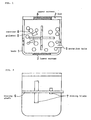
- FIGS. 1 and 2 illustrate a polymer degradation apparatus useful in the practice of the present invention, in which FIG. 1 shows a side cross-section and FIG. 2 is a front cross-section.
- the carrier which is used in the present invention to retain the microorganism and the nutrients, is required to be of such quality as not inhibiting growth of the microorganism, to permit the retention of the nutrients and water required for the growth of the microorganism and, when employed as a solid phase in the method of the present invention, to enable formation of interstices to such a degree as permitting a supply of oxygen required for the growth of the microorganism from the air.
- the maximum water retention of the carrier is at least 40 wt.% (gram-water/gram-dry carrier) but at most 4,000 wt.% (gram-water/gram-dry carrier), preferably at least 50 wt.% (gram-water/gram-dry carrier) but at most 3,000 wt.% (gram-water/gram-dry carrier).
- the carrier employed in the present invention is made of an organic high-molecular substance or an inorganic substance.
- organic high-molecular substance examples include non-human animal materials, such as leather and wool, and their processed products; plant materials, such as saw dust, loofahs, husks, millets, wheat bran, paper and cotton, and their processed products; foamed organic high-molecular substances such as porous foamed cellulose, foamed urethane and foamed polyvinyl alcohol; and fibrous organic high-molecular substances such as non-woven fabrics. Further, foamed organic substances which are biodegradable high-molecular substances by themselves can also be mentioned as examples.
- inorganic substance examples include molecular sieve, vermiculite, perlite, stainless steel fibers, aluminum wool, glass wool, and aluminum honeycomb cones.
- Substances other than those exemplified above are also usable as carriers in the present invention insofar as they can satisfy the requirement of the maximum water retention.
- the above-exemplified carriers are usable either singly or in combination in the present invention, with the proviso that, when the carrier is a mixture of plural substances, the maximum water retention as defined by assuming that the carriers in the solid phase are deemed to be a single piece of carrier be at least 40 wt.% but at most 4,000 wt.%.
- a carrier does not by itself have any particular size like that made of a foamed organic high-molecular substance, it is only necessary to form the material into pieces of an appropriate size and to use them as many as needed.
- voids spaces which exist in a carrier are called "voids" while spaces between pieces of the carrier are called “interstices”.
- the specific microorganism used in the present invention are bacteria selected from include Pseudomonas bacteria, Escherichia bacteria and Bacillus bacteria.
- Bacillus subtilis MT-10658 a Bacillus sp. isolated from a soil by the present inventors, can be mentioned. Under the Budapest Treaty on microorganisms, this strain has been deposited under the deposition number of FERM BP-5341 (date of deposition: December 19, 1995) with the National Institute of Bioscience and Human-Technology, Agency of Industrial Science and Technology, MITI, 1-3, Higashi 1-chome, Tsukuba-shi, Ibaraki-ken.
- microorganisms can be used singly. It is however not absolutely necessary to use them singly. Colonies of two or more microorganisms can be used preferably.
- nutrients means substances required for the growth of a microorganism which degrades a polymer. No particular limitation is imposed insofar as a carbon source, a nitrogen source, inorganic salts and trace elements are contained. Bouillon medium (meat extract: 3 g/l, peptone: 10 g/l, sodium chloride: 5 g/l) can be mentioned by way of example.
- a compost or the like is therefore also usable as a solid phase in the present invention.
- a carrier like that mentioned above is impregnated with an aqueous solution containing nutrients and a microorganism like a culture liquor.
- an aqueous solution containing nutrients and a microorganism like a culture liquor.
- the amount of the solution is preferably at least 10% but at most 100%, more preferably at least 20% but at most 95%, still more preferably at least 25% but at most 90%, all based on the maximum water retention of the carrier.
- solid phase which is employed to decompose a polymer in the present invention, means the entirety of a carrier, a microorganism, an aqueous solution containing nutrients required for the growth of the microorganism and water, and optional other components. If a solid phase is composed, for example, of pieces of a carrier impregnated with an aqueous solution containing a microorganism, nutrients and water, interstices should also be considered as a solid phase in the present invention, to say nothing of the carrier, the microorganism, the aqueous solution and voids.
- interstices mean a whole space which remains after substantial portions of a carrier and other components are removed from a solid phase.
- the term “interstices” as used herein means a whole space which can accommodate a microorganism, nutrients, water and air, said nutrients, water and air being all required for the growth of the microorganism, in a solid phase. Accordingly, internal voids of pieces of a carrier, into which materials can penetrate, are also deemed as interstices, to say nothing of spaces or gaps between the pieces of the carrier.
- the percentage of interstices of the solid phase is at least 25% but smaller than 100%, preferably at least 40%, more preferably 60% but smaller than 100%.
- the microorganism it is only necessary to make pieces of a carrier and additional pieces of the carrier, the former pieces containing nutrients and the latter pieces being impregnated with an aqueous solution containing a microorganism, allow the microorganism to grow and then to bring a polymer, which is to be degraded, into contact with a container in which the carrier are contained, or to add the polymer into the container.
- the temperature at which the polymer is degraded is generally a temperature at which the microorganism is allowed to grow, and is specifically from 0 to 80°C, with 20 to 60°C being preferred. Occasional mixing of the contents of the container may promote the degradation of the polymer. It is preferred to cause a gas to flow into the contents of the container.
- the polymer subjected to degradation by the method of the present invention does not inhibit growth of the microorganism, and is selected from homopolymers of lactic acid or glycolic acid, a copolymer of lactic acid and glycolic acid and polyesters obtained from aliphatic dicarboxylic acids, such as succinic acid, adipic acid and cyclohexanedicarboxylic acids, and glycols such as ethylene glycol, 1,4-butanediol, 1,4-cyclohexanedimethanol and benzenedimethanol.
- homopolymers of lactic acid or glycolic acid a copolymer of lactic acid and glycolic acid and polyesters obtained from aliphatic dicarboxylic acids, such as succinic acid, adipic acid and cyclohexanedicarboxylic acids, and glycols such as ethylene glycol, 1,4-butanediol, 1,4-cyclohexanedimethanol and benzenedimethanol.
- the method of the present invention can be suitably applied for the degradation of aliphatic polyesters, notably polymers formed from lactic acid, glycolic acid, or lactic acid and glycolic acid.
- aliphatic polyesters notably polymers formed from lactic acid, glycolic acid, or lactic acid and glycolic acid.
- the molecular weights of these aliphatic polyester polymers preferably range from 2,000 to 1,000,000.
- polylactic acid especially poly(L-lactic acid) is particularly preferred.
- the apparatus according to the present invention can be equipped with mixing means, aerating means, temperature control means and moisture control means as needed.
- FIG. 1 and FIG. 2 As shown in FIG. 1, it is preferred to arrange a lower screen 3 in a bottom wall of a main body 1 and to form corner portions, which are defined between the bottom wall and respective side walls of the main body 1, into gently rounded or curved configurations. A top portion of the main body 1 is covered by a lid 2. An upper screen 4 is arranged in the lid 2. The lower screen 2 and the upper screen 4 both facilitate flows of gas and moisture through the main body. Aeration holes 5 may be formed as aerating means through one or more of the side walls of the main body.
- the main body 1 is provided with mixing means, which comprises a mixing shaft 6 and mixing blades 7.
- Rotation of the mixing shaft 6 by an electric motor or the like causes the mixing blades 7 to rotate, whereby the contents inside the main body are agitated.
- the shapes, number and positions of the mixing blades 7 can be modified as desired. Further, provision of means for incubating or cooling the main body 1 as a whole makes it possible to control the internal temperature of the main body.
- each experiment 50 cm 3 of one of the carriers shown in Table 1 was placed in a 100-ml beaker. Further, each beaker was added with a culture medium of the composition, which is shown in Table 2, in an amount as much as 50 wt.% of the maximum water retention of the carrier, followed by steam sterilization at 120°C for 30 minutes. After the sterilization, the carrier was cooled down to 37°C and then inoculated with 1 ml of a culture liquor (about 10 8 cells/ml) of Bacillus subtilis MT-10658, said culture liquor having been obtained by culturing the strain overnight in the culture medium of the composition shown in Table 2.
- a culture liquor about 10 8 cells/ml
- a specimen film which had been obtained from 1 g of poly(L-lactic acid) of about 100,000 in molecular weight by compression molding and had a size of 1 x 2 cm, was sterilized with 70% alcohol and inserted in the carrier. The carrier with the film inserted therein was maintained at 37°C. The progress of degradation of the specimen film was observed along the passage of time. The results are shown in Table 1.
- Table 1 also shows the progresses of degradation of specimen films when clayey soil having a maximum water retention of 1,000 wt.% and a percentage of interstices of 20%, urethane pellets having a maximum water retention of 30 wt.% and a percentage of interstices of 60% and glass beads having a maximum water retention of 20 wt.% and a percentage of interstices of 35% were used as carriers, respectively, and when the microorganism was allowed to grow in the liquid culture medium shown in Table 2 without using any carrier and a specimen film was placed in the resulting culture liquor.
- the term "degraded" in the table indicates that the specimen film became no longer visible (i.e., disappeared) in the course of the visual observation of the progress of degradation of the specimen film.
- a similar evaluation standard was used in the subsequent examples.
- the specimen films were all degraded when the solid phases having a maximum water retention of at least 40 wt.% (gram-water/gram-dry carrier) but at most 4,000 wt.% (gram-water/gram-dry carrier) and a percentage of interstices of at least 25% but smaller than 100% were employed.
- the specimen films remained absolutely unchanged when the other carriers or solid phases were used. From this observation, the method of the present invention has been found to be effective for the degradation of the polymer.
- the single-strain microorganisms shown in Table 3-1 to Table 3-3 i.e., Escherichia coli HB101 (commercially available), Pseudomonas fluorescens ATCC 13525 and Bacillus subtilis MT-10658 and as mixed-strain microorganisms, the standard activated sludge (Chemicals Inspection & Testing Institute, Japan) and soil extract microorganisms (collected from a soil in Mobara-shi, Chiba-ken) were separately cultured overnight. Further, the individual carriers shown in Table 3-1 to Table 3-3 were placed in 100-ml beakers in an amount of 50 cm 3 per beaker, respectively.
- Each of the carriers was added with the culture medium shown in Table 2 in an amount of 50 wt.% of the maximum water retention of the corresponding carrier, followed by steam sterilization at 120°C for 30 minutes.
- the carrier was then allowed to cool down to 37°C, to which 1 ml of the above-described culture liquor (about 10 8 cells/ml) was inoculated.
- the carrier with the specimen film inserted therein was maintained at 37°C. The progress of degradation of the specimen film was observed along the passage of time. The results are shown in Table 3-1 to Table 3-3.
- Table 3-1 to Table 3-3 also show the progresses of degradation of specimen films when the individual carriers were not inoculated with any microorganism, when clayey soil was used as a carrier, when the microorganisms were allowed to grow in the liquid culture medium shown in Table 2 without using any carrier and specimen film were placed in the resulting culture liquors, respectively.
- the specimen films were degraded by various bacteria and mixed microorganisms, but no degradation took place when experiments were conducted without using any solid phase having, as a carrier, a maximum water retention of at least 40 wt.% (gram-water/gram-dry carrier) but at most 4,000 wt.% (gram-water/gram-dry carrier) and a percentage of interstices of at least 25% but smaller than 100% were employed.
- the single-strain microorganism, Bacillus subtills MT-10658, shown in Table 4-1 to 4-2 was cultured overnight in a culture medium of the composition shown in Table 2. Further, the individual carriers shown in Table 4-1 to Table 4-2 were placed in 100-ml beakers in an amount of 50 cm 3 per beaker, respectively. Each of the carriers was added with the culture medium shown in Table 2 in an amount of 50 wt.% of the maximum water retention of the corresponding carrier, followed by steam sterilization at 120°C for 30 minutes. The carrier was then allowed to cool down to 37°C, to which 1 ml of the above-described culture liquor (about 10 8 cells/ml) was inoculated.
- Specimen films (1 x 2 cm), one being made of a copolymer of poly(L-lactic acid) and polybutylene succinate and about 100,000 in molecular weight (comparative) and the other being made of a homopolymer of polybutylene succinate and having a molecular weight of 100,000, which had been sterilized with 70% alcohol, were then inserted in the carrier.
- the carrier with the specimen films inserted therein was maintained at 37°C. The progress of degradation the two kinds of specimen films was observed along the passage of time. The results are shown in Table 4-1 to Table 4-2.
- Table 4-1 to Table 4-2 also show the progresses of degradation of specimen films when the individual carriers were not inoculated with any microorganism, when clayey soil was used as a carrier, when the microorganisms were allowed to grow in the liquid culture medium shown in Table 2 without using any carrier and specimen films were placed in the resulting culture liquors, respectively.
- the specimen films of the copolymer of poly(L-lactic acid) and polybutylene succinate and of the homopolymer of polybutylene succinate were degraded, but no degradation took place when experiments were conducted without using any solid phase having, as a carrier, a maximum water retention of at least 40 wt.% (gram-water/gram-dry carrier) but at most 4,000 wt.% (gram-water/gram-dry carrier) and a percentage of interstices of at least 25% but smaller than 100% were employed.
- the maximum water retention of the whole carrier contained in its solid phase was 250 wt.%, and the percentage of interstices in the solid phase was 60%.
- the maximum water retention of the whole carrier contained in its solid phase was 220 wt.%, and the percentage of interstices in the solid phase was 60%.
- the maximum water retention of the whole carrier contained in its solid phase was 220 wt.%, and the percentage of interstices in the solid phase was 50%.
- the maximum water retention of the whole carrier contained in its solid phase was 220 wt.%, and the percentage of interstices in the solid phase was 20%.
- a culture medium of the composition shown in Table 2 was added in an amount of 50 wt.% of the maximum water retention of the foamed urethane, followed by steam sterilization at 120°C for 30 minutes.
- the foamed urethane was allowed to cool down to 37°C, to which 1 ml of a culture liquor (about 10 8 cells/ml) of Bacillus subtilis MT-10658, said culture liquor having been obtained by culturing the strain in the culture medium of the composition shown in Table 2, was inoculated.
- a specimen film of the poly(L-lactic acid) was then inserted in the thus-prepared foamed urethane.
- the carrier with the specimen film thus inserted was maintained at 37°C.
- the progress of degradation of the specimen film was observed along the passage of time. The results are shown in Table 6.
- the polymer was also found to degrade in the personally-prepared composts. Further, when the foamed urethane was used as a carrier, the specimen film degraded faster.
- the personally-prepared composts were experimented in view of composts available under the current situation, namely, composts which vary in quality (i.e., the carrier, initial nutrients, and the like) depending on the place or time of collection of each raw material. Substantial variations were observed in the gradation of the specimen films of poly(L-lactic acid).
- polymers having high strength at the time of use especially polymers made form lactic acid, glycolic acid, or lactic acid and glycolic acid can be degraded promptly and surely.
Landscapes
- Chemical & Material Sciences (AREA)
- Life Sciences & Earth Sciences (AREA)
- Organic Chemistry (AREA)
- Engineering & Computer Science (AREA)
- Wood Science & Technology (AREA)
- Health & Medical Sciences (AREA)
- Zoology (AREA)
- Bioinformatics & Cheminformatics (AREA)
- Genetics & Genomics (AREA)
- Biotechnology (AREA)
- General Health & Medical Sciences (AREA)
- Biochemistry (AREA)
- General Engineering & Computer Science (AREA)
- Microbiology (AREA)
- Chemical Kinetics & Catalysis (AREA)
- Biomedical Technology (AREA)
- Medicinal Chemistry (AREA)
- Mycology (AREA)
- General Chemical & Material Sciences (AREA)
- Tropical Medicine & Parasitology (AREA)
- Sustainable Development (AREA)
- Dispersion Chemistry (AREA)
- Polymers & Plastics (AREA)
- Inorganic Chemistry (AREA)
- Virology (AREA)
- Micro-Organisms Or Cultivation Processes Thereof (AREA)
- Biological Depolymerization Polymers (AREA)
- Processing Of Solid Wastes (AREA)
- Separation, Recovery Or Treatment Of Waste Materials Containing Plastics (AREA)
- Immobilizing And Processing Of Enzymes And Microorganisms (AREA)
- Biological Treatment Of Waste Water (AREA)
Claims (3)
- Procédé de dégradation d'un polymère capable d'être dégradé par un microorganisme en mettant le polymère en contact avec une phase solide composé d'un support, ledit microorganisme et une solution aqueuse, ladite solution comprenant des nutriments nécessaire pour la croissance du microorganisme et de l'eau, caractérisé en ce qui ledit support a une rétention d'eau maximal d'au moins 40 % en poids, mais d'au plus 4000 % en poids, ladite solution aqueuse est retenue dans ledit support en une quantité d'au moins 10 % , mais d'au plus 100 % de ladite rétention d'eau maximale dudit support et ladite phase solide a un pourcentage d'interstices de 25 % ou plus mais inférieur à 100 %, et dans lequel ledit microorganisme est au moins une bactérie choisi dans le groupe constitué de la bactérie Pseudomonas, la bactérie Escherichia et la bactérie Bacillus, et ledit polymère est choisi parmi(i) un homopolymère d'acide lactique,(ii) un homopolymère d'acide glycolique,(iii) un compolymère d'acide lactique et d'acide glycolique, ou(iv) un polyester formé à partir d'un acide dicarboxylique aliphatique et d'un glycol.
- Procédé selon la revendication 1, dans lequel ledit support est un tamis moléculaire, la vermiculite, la perlite ou des fibres en acier inoxydable.
- Procédé selon la revendication 1, dans lequel ledit microorganisme est Bacillus subtilis FERM BP-5341.
Applications Claiming Priority (4)
| Application Number | Priority Date | Filing Date | Title |
|---|---|---|---|
| JP4024095 | 1995-02-28 | ||
| JP4024095 | 1995-02-28 | ||
| JP40240/95 | 1995-02-28 | ||
| PCT/JP1996/000448 WO1996026974A1 (fr) | 1995-02-28 | 1996-02-27 | Procede de degradation de polymere |
Publications (3)
| Publication Number | Publication Date |
|---|---|
| EP0761732A1 EP0761732A1 (fr) | 1997-03-12 |
| EP0761732A4 EP0761732A4 (fr) | 1998-04-08 |
| EP0761732B1 true EP0761732B1 (fr) | 2004-07-07 |
Family
ID=12575199
Family Applications (1)
| Application Number | Title | Priority Date | Filing Date |
|---|---|---|---|
| EP96903251A Expired - Lifetime EP0761732B1 (fr) | 1995-02-28 | 1996-02-27 | Procede de degradation de polymere |
Country Status (6)
| Country | Link |
|---|---|
| US (1) | US6313194B1 (fr) |
| EP (1) | EP0761732B1 (fr) |
| KR (1) | KR100188446B1 (fr) |
| DE (1) | DE69632849T2 (fr) |
| FI (1) | FI964266L (fr) |
| WO (1) | WO1996026974A1 (fr) |
Families Citing this family (9)
| Publication number | Priority date | Publication date | Assignee | Title |
|---|---|---|---|---|
| US6740731B2 (en) * | 1988-08-08 | 2004-05-25 | Cargill Dow Polymers Llc | Degradation control of environmentally degradable disposable materials |
| DE19754063A1 (de) * | 1997-12-05 | 1999-06-10 | Bayer Ag | Abbau von biologisch abbaubaren Polymeren |
| WO2003099987A1 (fr) * | 2002-05-23 | 2003-12-04 | Unilever N.V. | Article et procede pour le nettoyage de tissus |
| JP2007106783A (ja) * | 2005-10-11 | 2007-04-26 | Fujitsu Ltd | 樹脂成型体およびこれを用いた電子機器、樹脂成型体の処理方法 |
| US8258364B2 (en) | 2008-06-16 | 2012-09-04 | Renaud Regis P | Method for steam biomass reactor |
| IT1403272B1 (it) * | 2010-12-20 | 2013-10-17 | Novamont Spa | Strutture oligomeriche complesse |
| KR20160015253A (ko) | 2013-05-10 | 2016-02-12 | 쥬세로 인코퍼레이티드 | 착즙 시스템 및 방법 |
| JP6489542B2 (ja) * | 2013-12-04 | 2019-03-27 | 国立大学法人帯広畜産大学 | ウレタンの分解方法およびウレタンの分解剤 |
| US10543652B2 (en) | 2016-03-03 | 2020-01-28 | Fresh Press LLC | Press |
Citations (1)
| Publication number | Priority date | Publication date | Assignee | Title |
|---|---|---|---|---|
| EP0611742A1 (fr) * | 1993-02-16 | 1994-08-24 | Sanyo Electric Co. Ltd | Dispositif d'élimination de déchets menagères |
Family Cites Families (7)
| Publication number | Priority date | Publication date | Assignee | Title |
|---|---|---|---|---|
| JPS5346910B2 (fr) * | 1974-05-20 | 1978-12-16 | ||
| JPS5618587A (en) * | 1979-07-20 | 1981-02-21 | Tottori Daigaku | Decomposition and assimilation of polyvinyl alcohol by symbiotic bacteria |
| US5378738A (en) * | 1991-10-31 | 1995-01-03 | Kabushiki Kaisha Kobe Seiko Sho | Biodegradable plastic |
| JP3194792B2 (ja) * | 1992-06-12 | 2001-08-06 | 天野エンザイム株式会社 | 酵素を用いた脂肪族ポリエステルの分解法 |
| JP3474892B2 (ja) * | 1993-05-27 | 2003-12-08 | 三洋電機株式会社 | 厨芥処理装置 |
| JP3178159B2 (ja) * | 1993-04-09 | 2001-06-18 | エヌオーケー株式会社 | 高分子量ポリエチレングリコールの分解方法 |
| JPH06319533A (ja) * | 1993-05-14 | 1994-11-22 | Sumitomo Metal Ind Ltd | 新規微生物及びそれを用いた廃棄物の分解処理方法 |
-
1996
- 1996-02-27 EP EP96903251A patent/EP0761732B1/fr not_active Expired - Lifetime
- 1996-02-27 DE DE69632849T patent/DE69632849T2/de not_active Expired - Lifetime
- 1996-02-27 KR KR1019960706031A patent/KR100188446B1/ko not_active Expired - Lifetime
- 1996-02-27 FI FI964266A patent/FI964266L/fi unknown
- 1996-02-27 WO PCT/JP1996/000448 patent/WO1996026974A1/fr not_active Ceased
- 1996-10-04 US US08/725,506 patent/US6313194B1/en not_active Expired - Lifetime
Patent Citations (1)
| Publication number | Priority date | Publication date | Assignee | Title |
|---|---|---|---|---|
| EP0611742A1 (fr) * | 1993-02-16 | 1994-08-24 | Sanyo Electric Co. Ltd | Dispositif d'élimination de déchets menagères |
Also Published As
| Publication number | Publication date |
|---|---|
| EP0761732A1 (fr) | 1997-03-12 |
| FI964266A7 (fi) | 1996-11-18 |
| FI964266A0 (fi) | 1996-10-23 |
| US6313194B1 (en) | 2001-11-06 |
| WO1996026974A1 (fr) | 1996-09-06 |
| DE69632849T2 (de) | 2005-06-30 |
| FI964266L (fi) | 1996-11-18 |
| KR970702926A (ko) | 1997-06-10 |
| KR100188446B1 (ko) | 1999-06-01 |
| EP0761732A4 (fr) | 1998-04-08 |
| DE69632849D1 (de) | 2004-08-12 |
Similar Documents
| Publication | Publication Date | Title |
|---|---|---|
| Meereboer et al. | Review of recent advances in the biodegradability of polyhydroxyalkanoate (PHA) bioplastics and their composites | |
| Sakai et al. | Isolation of a thermophilic poly-L-lactide degrading bacterium from compost and its enzymatic characterization | |
| US20120252100A1 (en) | Mixed Strain Culture For The Disposal Of Food Waste, And Food Waste Disposal Method Using Same | |
| Yottakot et al. | Isolation and Optimisation of Polylactic Acid (PLA)-packaging-degrading Actinomycete for PLA-packaging Degradation. | |
| EP0761732B1 (fr) | Procede de degradation de polymere | |
| Barak et al. | Biodegradability of Polyhydroxybutyrate (co‐hydroxyvalerate) and Starch‐Incorporated Polyethylene Plastic Films in Soils | |
| JP3641156B2 (ja) | 新規微生物および海生物の生物処理法 | |
| JP2004058010A (ja) | 生分解性樹脂製成形物を含む有機廃棄物の処理方法 | |
| Badahit | Screening of plastic degrading Pseudomonas spp. from soil | |
| JPH09131177A (ja) | 新規の微生物を含有する微生物製剤、その製造方法及び該微生物を利用した下水処理並びに脱臭方法 | |
| Lomthong et al. | Solid state fermentation for poly (L-lactide)-degrading enzyme production by Laceyella sacchari LP175 in aerated tray reactor and its hydrolysis of poly (lactide) polymer | |
| KR19990065800A (ko) | 폐수처리용 미생물 및 미생물제제 | |
| JP2007143542A (ja) | 新規微生物コンソーシア及び固形有機物の液化のためのその使用 | |
| KR102055544B1 (ko) | 신규한 지오바실러스속 균주 및 이의 용도 | |
| JP4252115B2 (ja) | ポリマーの分解方法及び装置 | |
| US5702605A (en) | Slime hydrolase producing bacterium and process for producing slime hydrolase | |
| KR100571999B1 (ko) | 음식물소멸용 미생물 및 그 미생물의 번식촉진용 영양물이 첨가된 발효 종균제 | |
| Belal | Biodegradation of aliphatic-aromatic coplyester under thermophilic conditions | |
| JP3897750B2 (ja) | 生ゴミの分解菌、微生物製剤、及び分解処理方法 | |
| JP3734118B2 (ja) | ポリ乳酸樹脂の分解方法 | |
| JPH07246381A (ja) | 有機質廃棄物の処理方法 | |
| JP4765273B2 (ja) | ポリエステル系樹脂の分解処理方法 | |
| JP3128577B1 (ja) | ポリ乳酸樹脂の分解方法 | |
| KR100205914B1 (ko) | 미생물에 의한 유기물의 분해방법 | |
| JPH11158318A (ja) | 低密度ポリエチレン分解能力を有する微生物を用いた低密度ポリエチレンの分解方法 |
Legal Events
| Date | Code | Title | Description |
|---|---|---|---|
| PUAI | Public reference made under article 153(3) epc to a published international application that has entered the european phase |
Free format text: ORIGINAL CODE: 0009012 |
|
| 17P | Request for examination filed |
Effective date: 19961025 |
|
| AK | Designated contracting states |
Kind code of ref document: A1 Designated state(s): DE FR GB IT NL |
|
| A4 | Supplementary search report drawn up and despatched |
Effective date: 19980219 |
|
| AK | Designated contracting states |
Kind code of ref document: A4 Designated state(s): DE FR GB IT NL |
|
| RAP1 | Party data changed (applicant data changed or rights of an application transferred) |
Owner name: MITSUI CHEMICALS, INC. |
|
| 17Q | First examination report despatched |
Effective date: 20020103 |
|
| GRAP | Despatch of communication of intention to grant a patent |
Free format text: ORIGINAL CODE: EPIDOSNIGR1 |
|
| GRAS | Grant fee paid |
Free format text: ORIGINAL CODE: EPIDOSNIGR3 |
|
| GRAA | (expected) grant |
Free format text: ORIGINAL CODE: 0009210 |
|
| AK | Designated contracting states |
Kind code of ref document: B1 Designated state(s): DE FR GB IT NL |
|
| PG25 | Lapsed in a contracting state [announced via postgrant information from national office to epo] |
Ref country code: NL Free format text: LAPSE BECAUSE OF FAILURE TO SUBMIT A TRANSLATION OF THE DESCRIPTION OR TO PAY THE FEE WITHIN THE PRESCRIBED TIME-LIMIT Effective date: 20040707 Ref country code: IT Free format text: LAPSE BECAUSE OF FAILURE TO SUBMIT A TRANSLATION OF THE DESCRIPTION OR TO PAY THE FEE WITHIN THE PRESCRIBED TIME-LIMIT;WARNING: LAPSES OF ITALIAN PATENTS WITH EFFECTIVE DATE BEFORE 2007 MAY HAVE OCCURRED AT ANY TIME BEFORE 2007. THE CORRECT EFFECTIVE DATE MAY BE DIFFERENT FROM THE ONE RECORDED. Effective date: 20040707 |
|
| REG | Reference to a national code |
Ref country code: GB Ref legal event code: FG4D |
|
| REF | Corresponds to: |
Ref document number: 69632849 Country of ref document: DE Date of ref document: 20040812 Kind code of ref document: P |
|
| RAP2 | Party data changed (patent owner data changed or rights of a patent transferred) |
Owner name: MITSUI CHEMICALS, INC. |
|
| NLV1 | Nl: lapsed or annulled due to failure to fulfill the requirements of art. 29p and 29m of the patents act | ||
| ET | Fr: translation filed | ||
| PLBE | No opposition filed within time limit |
Free format text: ORIGINAL CODE: 0009261 |
|
| STAA | Information on the status of an ep patent application or granted ep patent |
Free format text: STATUS: NO OPPOSITION FILED WITHIN TIME LIMIT |
|
| 26N | No opposition filed |
Effective date: 20050408 |
|
| REG | Reference to a national code |
Ref country code: DE Ref legal event code: R082 Ref document number: 69632849 Country of ref document: DE Representative=s name: MAI DOERR BESIER PATENTANWAELTE, DE |
|
| REG | Reference to a national code |
Ref country code: FR Ref legal event code: PLFP Year of fee payment: 20 |
|
| PGFP | Annual fee paid to national office [announced via postgrant information from national office to epo] |
Ref country code: DE Payment date: 20150219 Year of fee payment: 20 |
|
| PGFP | Annual fee paid to national office [announced via postgrant information from national office to epo] |
Ref country code: FR Payment date: 20150219 Year of fee payment: 20 Ref country code: GB Payment date: 20150218 Year of fee payment: 20 |
|
| REG | Reference to a national code |
Ref country code: DE Ref legal event code: R071 Ref document number: 69632849 Country of ref document: DE |
|
| REG | Reference to a national code |
Ref country code: GB Ref legal event code: PE20 Expiry date: 20160226 |
|
| PG25 | Lapsed in a contracting state [announced via postgrant information from national office to epo] |
Ref country code: GB Free format text: LAPSE BECAUSE OF EXPIRATION OF PROTECTION Effective date: 20160226 |